



Abstract
Categorizations of multiracial individuals provide insight into the psychological mechanisms driving social stratification, but few studies have explored the interplay of cognitive and motivational underpinnings of these categorizations. In the present study, we integrated research on racial essentialism (i.e., the belief that race demarcates unobservable and immutable properties) and negativity bias (i.e., the tendency to weigh negative entities more heavily than positive entities) to explain why people might exhibit biases in the categorization of multiracial individuals. As theorized, racial essentialism, both dispositional (Study 1) and experimentally induced (Study 2), led to the categorization of Black-White multiracial individuals as Black, but only among individuals evaluating Black people more negatively than White people. These findings demonstrate how fundamental cognitive and motivational biases interact to influence the categorization of multiracial individuals.
In the United States, Black-White multiracial individuals are often categorized as Black (Davis, 1991; Ho, Sidanius, Levin, & Banaji, 2011; Peery & Bodenhausen, 2008). Research on the underpinnings of this categorization bias, often called hypodescent, has focused primarily on social motivations. Such research has demonstrated that among White adults, beliefs about equality, threats to the hierarchical status quo, racial biases, and political ideology undergird hypodescent (Chen, Moons, Gaither, Hamilton, & Sherman, 2014; Ho, Sidanius, Cuddy, & Banaji, 2013; Krosch & Amodio, 2014; Krosch, Berntsen, Amodio, Jost, & Van Bavel, 2013; Kteily, Cotterill, Sidanius, Sheehy-Skeffington, & Bergh, 2014; Rodeheffer, Hill, & Lord, 2012). Less research has identified cognitive biases that contribute to hypodescent (but see Halberstadt, Sherman, & Sherman, 2011), and we are aware of no research that has identified the interplay of cognitive biases and social motivations. Thus, the social-psychological examination of hypodescent has primarily detected cognitive or motivational antecedents in isolation, offering little insight into whether such factors might work together to bias social categorization. Here, we focused on psychological essentialism and anti-Black bias, examining how these factors might jointly influence the categorization of Black-White multiracial individuals.
Psychological essentialism is the belief that members of a group share hidden, inborn, and inalterable “essences” that grant them their categorical identity and that those identities exist within sharp (i.e., discrete) boundaries (Gelman, 2003; Haslam, Rothschild, & Ernst, 2000; Prentice & Miller, 2007). The idea that category boundaries are discrete follows from the definitive nature of essences (i.e., one either has the essence or does not; Dennett, 1995) as well as the view of essences as inherited and immutable (see Gelman, 2003; Haslam et al., 2000, for a review of evidence that essences are construed in this manner). A belief in category discreteness is empirically linked to essentialism with regard to both individual differences (i.e., those who more highly endorse other aspects of essentialism also more highly endorse discreteness; Haslam et al., 2000) and category differences (i.e., essentialized categories such as basic-level animal groups are treated as having absolute category membership, whereas nonessentialized categories such as artifact groups are not treated as such; Rhodes & Gelman, 2009; Rhodes, Gelman, & Karuza, 2014). In the context of race, category discreteness implies that people who endorse racial essentialism understand that someone could have one Black parent and one White parent, but their rigid concepts of race result in a tendency to categorize this person as Black rather than as both Black and White (Chao, Hong, & Chiu, 2013). In other words, they tend to treat racial-category membership as all or none and to resist classifying individuals into multiple categories (Haslam et al., 2000). Yet racial essentialism alone cannot explain why Black-White multiracial individuals are categorized as Black: Why might the “Black essence” be weighted more heavily than the “White essence”?
We hypothesized that individuals who are biased against Blacks would disproportionately weight Black ancestry in the evaluations of Black-White multiracial individuals. Such a negativity bias, whereby people give greater weight to entities they view as negative, compared with equivalent entities they view as positive, has been found across a variety of domains (Rozin & Royzman, 2001). For example, monetary losses are weighted more heavily than equivalent monetary gains, and negative events have a greater impact on mood than positive events (Kahneman & Tversky, 1979; Taylor, 1991).
Integrating research on essentialism and negativity bias, we predicted that essentialist thinking would lead to the categorization of Black-White multiracial individuals as Black, but only among individuals who evaluated Black people more negatively than White people because they would more heavily weight Black ancestry or phenotype in their categorizations. Study 1 examined whether individuals who were high in racial essentialism were more likely to categorize Black-White multiracial individuals with known ancestry as Black than as White. Study 2 examined whether inducing people to think of race as biological increased the likelihood that racially ambiguous individuals were perceived and categorized as Black.
Study 1
Method
Participants
White U.S. adults (N = 149; 54% female, 46% male; mean age = 35.9 years, SD = 12.3) were recruited through Amazon’s Mechanical Turk. On the basis of our experience with correlational research on racial categorization involving statistical interaction analyses and our expectation that approximately 75% of the participant pool would be White, we recruited 200 participants. We focused on White adults, the highest-status group in the United States (Kahn, Ho, Sidanius, & Pratto, 2009), because they have been shown to exhibit higher levels of pro-White/anti-Black bias than non-Whites (Bar-Anan & Nosek, 2014) and because the interrelationships among intergroup biases, attitudes, and behaviors are strongest among members of high-status groups (Sidanius, Levin, & Pratto, 1996; Sidanius & Pratto, 1999). 1
Materials and procedure
Participants first completed a measure of racial essentialism (the Race Conceptions Scale, or RCS; Williams & Eberhardt, 2008), followed by a feeling thermometer and 20 personality items included as a distractor (e.g., “I enjoy looking at maps of different places”). Measures of hypodescent followed the distractor items. We chose the RCS because it was designed to measure a conception of race as biological, which is what we theorized would be most related to beliefs about the intergenerational transmission of racial traits. Although Williams and Eberhardt (2008) did not find theoretically coherent factors, our factor analysis with the current sample revealed that the RCS comprised two primary factors explaining 41% of the variance—one representing race as a biological concept and the other representing racial categories as historically stable (e.g., “in 200 years, society will use basically the same racial categories”). Because of our a priori interest in biological conceptions of race, we computed a scale composed of items from the first factor (e.g., “Racial groups are primarily determined by biology”). Responses were made on a scale from 1, strongly disagree, to 7, strongly agree (α = .75; M = 5.40, SD = 1.23). 2 Pro-White/anti-Black bias was assessed using the feeling thermometer (1, very cold, to 7, very warm). Means for how warmly participants felt toward Blacks were subtracted from means for how warmly they felt toward Whites. Positive scores indicated a relatively negative evaluation of Blacks (M = 0.58, SD = 1.31). 3
We had two measures of hypodescent—the first assessed whether participants had a lower threshold for considering a Black-White multiracial target as Black than as White. On this measure, the extent to which a target with one Black grandparent and three White grandparents was considered Black was compared with the extent to which a target with one White grandparent and three Black grandparents was considered White. We subtracted ratings for the latter from ratings for the former to index a threshold bias reflecting hypodescent. Responses for both targets were made on a scale from 1, completely Black, to 7, completely White (reverse-scored for the target with one Black and three White grandparents), with 4 (equally Black and White) as the scale midpoint (mean difference = 0.14, SD = 1.09). We additionally asked respondents the extent to which they saw a target with two Black grandparents and two White grandparents as Black or White. Reponses for this measure were made on a scale from 1, completely Black, to 7, completely White (reverse-scored), with a midpoint of 4 (equally Black and White; M = 4.13, SD = 0.51; Ho et al., 2011). For both hypodescent measures, scores above the midpoint (i.e., 0 and 4, respectively) indicated a tendency to categorize targets as Black. One dichotomous dependent variable regarding the aforementioned half-Black/half-White target (“If the child needed to check only one census box for ‘race,’ should he/she check ‘Black’ or ‘White’?”) was included for exploratory purposes and will not be discussed further. 4
Finally, participants answered three items regarding how seriously they took the study and how carefully and honestly they answered the questions, from 1, not at all, to 5, very (M = 4.86, SD = 0.30; α = .78). The primary analyses reported here were based on those who scored 5 on this composite measure, which indicated a high degree of attention (n = 117). 5
Results
To examine whether racial essentialism was related to hypodescent, particularly among individuals who exhibited relatively high levels of pro-White/anti-Black bias, we conducted a multiple regression analysis in which we regressed hypodescent on racial essentialism and intergroup bias (both mean-centered) and their interaction term. We did this first with our hypodescent-threshold-bias index, which revealed no main effects for racial essentialism or bias. Critically, however, we found a significant interaction between racial essentialism and bias (b = 0.16, SE b = 0.08, β = 0.25), t(114) = 2.05, p = .04 (see Fig. 1).
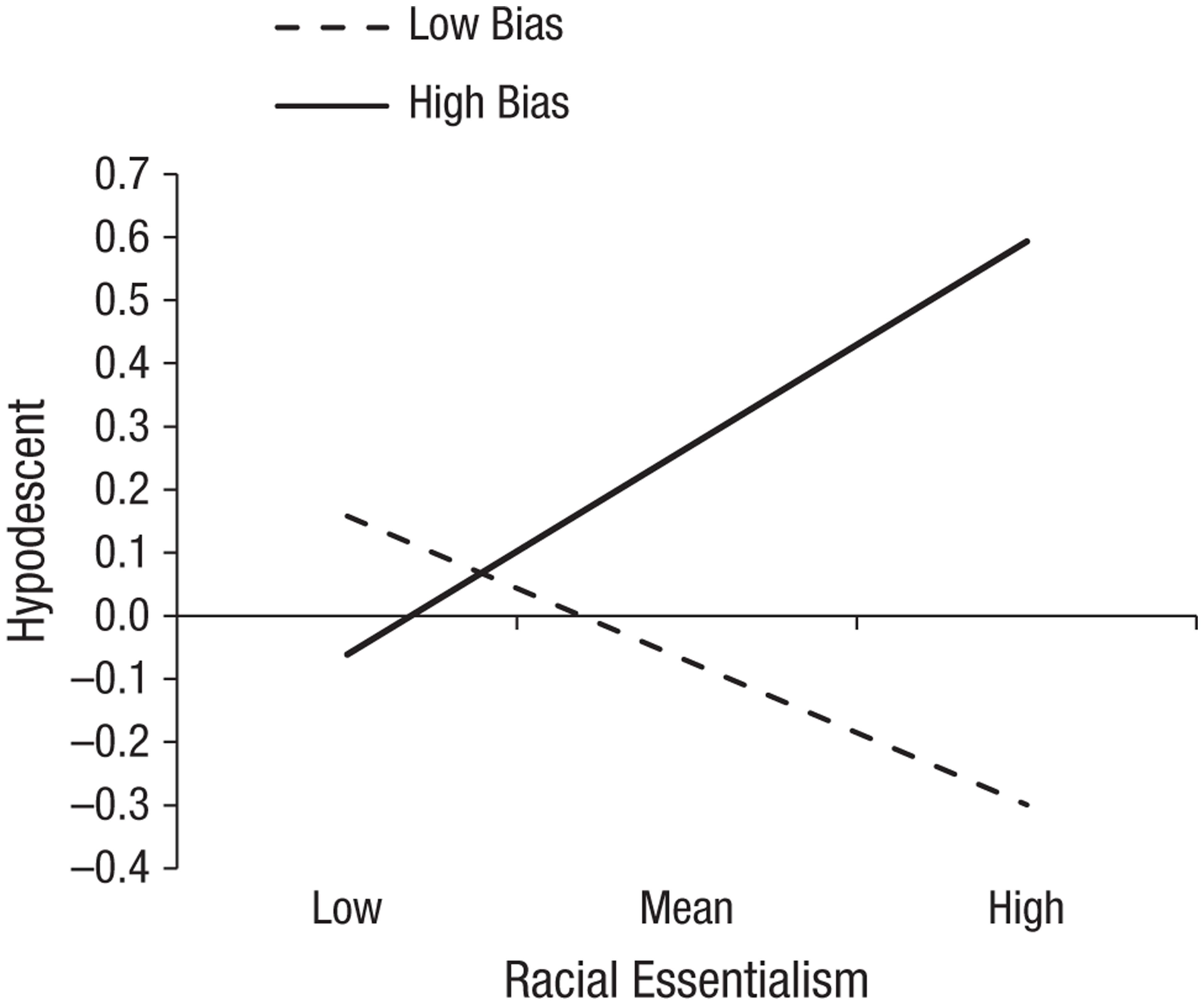
Results from Study 1: mean hypodescent rating as a function of racial essentialism and intergroup bias. Low and high refer to values 1 standard deviation below and above the mean, respectively. For the measure of hypodescent, scores above 0 indicate a lower threshold for categorizing multiracial individuals as Black than as White, whereas scores below 0 indicate the reverse.
Simple-slopes analyses revealed that at low levels of intergroup bias, there was no relationship between racial essentialism and hypodescent (b = −0.18, SE b = 0.12, β = −0.21), t(114) = −1.53, p = .13 (all simple-slopes analyses referencing low and high levels refer to 1 SD below and above the mean, respectively). 6 In contrast, at high levels of bias, there was a marginally significant positive relationship between racial essentialism and hypodescent (b = 0.26, SE b = 0.15, β = 0.30), t(114) = 1.76, p = .08. We also examined the simple slopes with essentialism as the moderator. This analysis revealed that bias was not related to hypodescent at low levels of essentialism (b = −0.08, SE b = 0.16, β = −0.10), t(114) = −0.50, p = .62, but it was related at high levels (b = 0.33, SE b = 0.09, β = 0.41), t(114) = 3.65, p < .001. Our hypodescent measure of categorizations of half-Black/half-White multiracial targets revealed a similar pattern. That is, the Racial Essentialism × Bias interaction was marginally significant (b = 0.07, SE b = 0.04, β = 0.24), t(114) = 1.90, p = .06; at low levels of bias, there was no relationship between essentialism and hypodescent (b = −0.06, SE b = 0.06, β = −0.14), t(114) = −1.01, p = .32, and at high levels, the relationship was positive and marginally significant (b = 0.14, SE b = 0.07, β = 0.33), t(114) = 1.95, p = .054. Examining the simple slopes of this interaction with essentialism as the moderator revealed that at low levels of essentialism, negativity bias was unrelated to hypodescent (b = −0.04, SE b = 0.08, β = −0.10), t(114) = −0.50, p = .62, whereas at high levels of essentialism, bias was positively related (b = 0.14, SE b = 0.04, β = 0.37), t(114) = 3.29, p = .001.
Study 1 demonstrates that racial essentialism relates to hypodescent, but only to the extent that Black people are evaluated more negatively than White people (see the Supplemental Material available online for analyses with non-Whites, who were not included in the primary analyses for theoretical reasons introduced in the Participants section).
Study 2
In Study 2, we experimentally manipulated whether participants thought of race as biological or socially constructed. We also developed a new task that assessed categorizations on the basis of phenotype alone. This study complemented Study 1, which focused on categorizations based on racial ancestry alone. Intergroup bias was assessed 1 to 3 weeks before the essentialism experiment and categorization task, to provide a stringent test of whether individuals predisposed to assess Black people more negatively were more influenced by information suggesting that race is biological. By measuring intergroup bias in a separate session, we avoided cuing social-desirability concerns when participants were completing the racial-categorization task, a common problem in cross-sectional survey research.
Method
Participants
The final sample consisted of 121 White U.S. adults recruited on Amazon’s Mechanical Turk (62% female, 38% male; mean age = 38.1 years, SD = 12.9).
Materials and procedure
The study was conducted in two sessions. Participants completed a brief survey in Part 1, providing demographic information and reporting on their bias toward Whites and Blacks using the same feeling thermometer as in Study 1 (feeling toward Whites minus feeling toward Blacks: M = 0.37, SD = 1.34). A four-item measure of ethnic identity was also included in Part 1 for exploratory purposes and will not be discussed further. 7 Of the 601 Whites who participated in Part 1, 364 provided e-mail addresses so they could be contacted for Part 2, and 178 completed the second part of the study 1 to 3 weeks later. 8 Because this was the first test of how this manipulation of exposure to essentialist beliefs might influence racial categorization and how it might interact with intergroup bias, we could not estimate the observed effect size. Furthermore, because of our two-part design, we were unsure of what the attrition rate might be. Therefore, we aimed to recruit 100 Whites initially to examine whether we would observe any effect of this experimental manipulation. Following initial data collection, and on the basis of the observed rate of attrition, we aimed to recruit enough participants for Part 1 to yield approximately 50 more Whites completing both parts.
To examine the effects of sample attrition, we compared responses on the feeling thermometer between participants who completed only Part 1 and participants who completed both Parts 1 and 2. A one-way analysis of variance revealed that participants who completed only Part 1 (M = 4.77, SD = 1.40) were significantly less warm toward Black people than participants who completed both parts (M = 5.11, SD = 1.32), F(1, 599) = 6.00, p = .02, η p 2 = .01. Critically, given that the final sample was relatively warmer toward Black people, Study 2 provided a conservative test of the effect of racial bias. Because we expected that the essentialism manipulation would affect only those who paid attention and believed the material they were presented with, we also included three questions at the end of Part 2 concerning how seriously participants took the study and how carefully and honestly they responded to the measures. Responses were made on a scale from 1, not at all, to 5, very (M = 4.78, SD = 0.39; α = .83). Participants also indicated whether they “didn’t believe some parts of the study” on a scale from 1, strongly disagree, to 5, strongly agree (M = 2.53, SD = 1.01; α = .75). On the basis of these quality checks, we excluded 56 participants from the final analysis: 55 who scored below 5 on the attention scale and 1 who scored 5 on the distrust scale. 9
The second part of the study began with random assignment to a racial-essentialism condition: In the genetic condition (n = 63), participants read a fictitious article titled “Scientists Pinpoint Genetic Underpinning of Race,” whereas in the nongenetic (control) condition (n = 58), participants read an article titled “Scientists Reveal That Race Has No Genetic Basis” (taken from Williams & Eberhardt, 2008). Participants then completed an eight-item measure assessing their beliefs in the biological basis of race as a manipulation check (e.g., “The kind of person someone is can be largely attributed to their genetic inheritance”; Bastian & Haslam, 2006). Participants responded on a scale from 1, strongly disagree, to 7, strongly agree (M = 4.10, SD = 1.24). This was followed by the categorization task. In this task, participants were asked to categorize 20 multiracial faces as Black, Black-White multiracial, or White. All participants were debriefed and told that the articles were fictitious. Faces were morphed photographs of monoracial Black and White males created with Photo Morpher (Version 3.17; Morpheus Software, Howell, MI). All faces were forward facing, had neutral expressions, and were presented in gray scale (see Fig. 2). The number of Black categorizations was the dependent variable (M = 6.30, SD = 3.66).

Sample morphed multiracial faces from the racial-categorization task in Study 2. Participants were asked to categorize faces as Black, Black-White multiracial, or White.
Results
First, we found that participants in the genetic condition were more likely than participants in the nongenetic condition to agree that race has a biological basis (genetic condition: M = 4.54, SD = 1.13; nongenetic condition: M = 3.63, SD = 1.18), t(119) = −4.38, p < .001, r = .37. As in Study 1, we examined the interactive effects of racial bias and essentialism by regressing Black categorizations on bias (zero-centered), racial-essentialism condition, and their interaction term. Once again, this revealed no main effect of either racial bias or essentialism, but the two interacted significantly to predict the number of Black categorizations (b = 1.06, SE b = 0.48, β = 0.20), t(117) = 2.19, p = .03 (see Fig. 3).
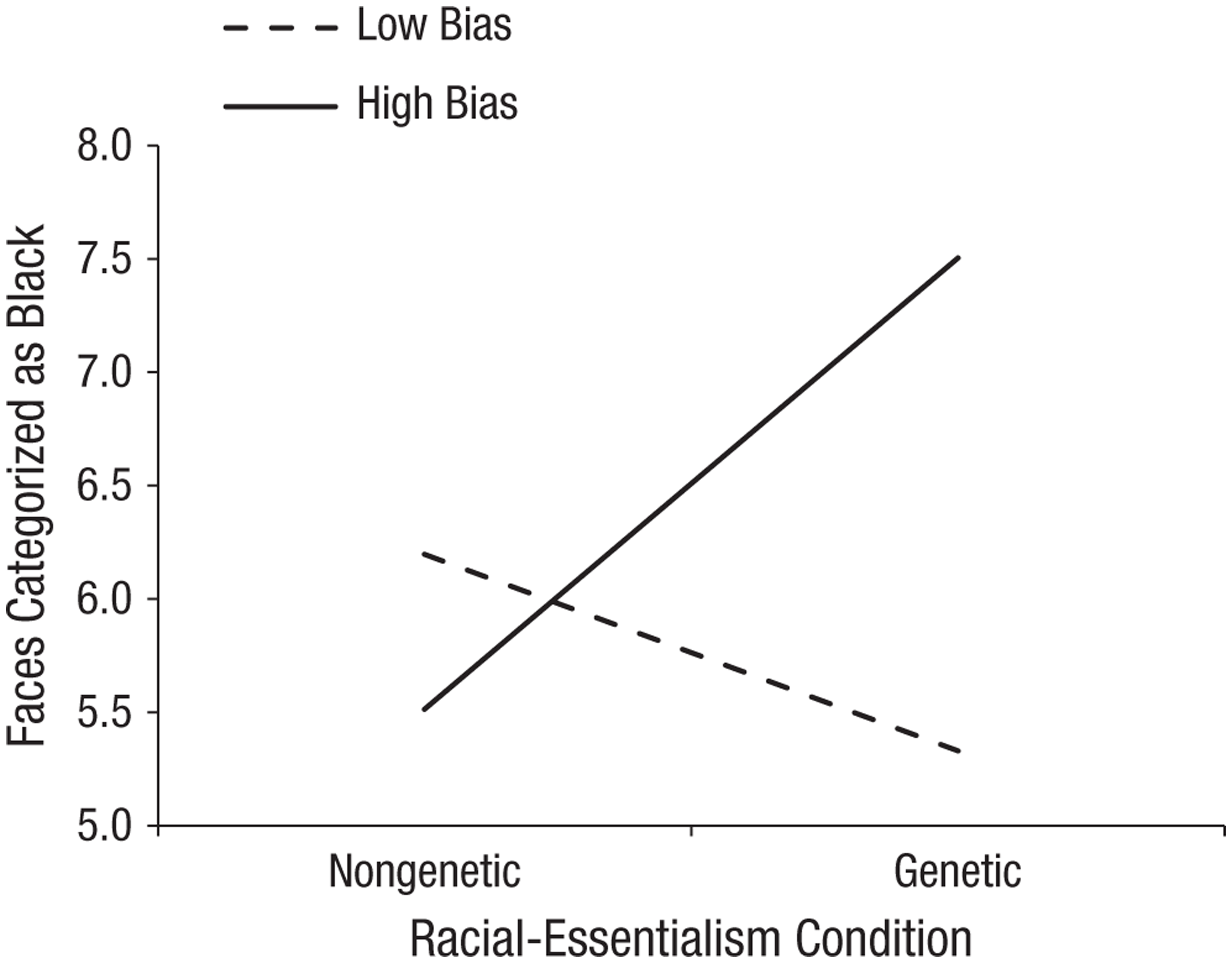
Results from Study 2: mean number of faces categorized as Black as a function of racial-essentialism condition and intergroup bias. Low and high bias refer to values 1 standard deviation below and above the mean, respectively.
Simple-slopes analyses revealed that among individuals low in intergroup bias, racial essentialism was unrelated to Black categorizations (b = −0.86, SE b = 0.92, β = −0.12), t(117) = −0.94, p = .35. 10 However, in line with expectations, and conceptually replicating Study 1, results showed that individuals high in intergroup bias in the genetic condition were significantly more likely to categorize multiracial target faces as Black, compared with individuals high in intergroup bias in the control condition (b = 1.99, SE b = 0.92, β = 0.28), t(117) = 2.16, p = .03. When condition was used as the moderator in this interaction analysis, bias was unrelated to categorizations of multiracial faces as Black for participants in the nongenetic condition (b = −0.25, SE b = 0.34, β = −0.09), t(117) = −0.75, p = .46. In contrast, bias was positively related to categorizations of multiracial faces as Black for participants in the genetic condition (b = 0.81, SE b = 0.35, β = 0.30), t(117) = 2.33, p = .02. Thus, we again found that the relationship between racial essentialism and the categorizations of multiracial targets as Black hinged on racial bias. In contrast, making salient a concept of race as genetic did not influence the categorization of ambiguous targets as White or as multiracial at any level of intergroup bias (see the Supplementary Material for analyses).
General Discussion
Racial essentialism entails the belief that racial categories are inherited, nonoverlapping, and immutable. Those who endorse racial essentialism tend to categorize individuals with Black and White parentage as Black relative to White (Chao et al., 2013). However, essentialism alone cannot explain this categorization bias. We reasoned that intergroup bias would interact with essentialism, such that people who endorsed more racial essentialism and felt negatively toward Black people would be more likely to categorize Black-White multiracial individuals as Black. In Study 1, a priori individual differences in racial essentialism interacted with intergroup bias to predict a decreased threshold for minority categorization—quarter-Black targets were categorized as Black to a greater extent than quarter-White targets were categorized as White. In Study 2, an experimental induction of racial essentialism led individuals who were previously known to exhibit intergroup biases to categorize racially ambiguous faces as Black.
Racial essentialism is related to stereotyping, perceptions of outgroup homogeneity, and decreased desire to help disadvantaged groups (Bastian & Haslam, 2006; Prentice & Miller, 2007; Williams & Eberhardt, 2008). Our data demonstrate that racial essentialism also plays a role in the categorization of multiracial individuals but, furthermore, that essentialism does not act alone. Negatively evaluated groups are disproportionally weighted by people with essentialist beliefs, which leads to categorization biases. Although previous work has typically focused on cognitive or motivational underpinnings of hypodescent in isolation, our data reveal that the interplay of these processes may be critical in racial categorization. Indeed, social motivations may similarly augment other cognitive biases that have been shown to undergird hypodescent (e.g., increased attention to minority-group phenotype; Halberstadt et al., 2011). Likewise, cognitive biases might facilitate the effects of motivational biases on hypodescent. For example, the pervasive cognitive bias toward believing that race is biological may enable those who are motivated to dislike Blacks to similarly impugn the character of Black-White multiracial individuals and consequently engage in hypodescent. 11 Our findings demonstrating effects with either essentialism or anti-Black bias as the moderating variable would support this view.
Since racial essentialism develops with age (Kinzler & Dautel, 2012), it is no surprise that adults but not children endorse hypodescent when categorizing multiracial individuals (Roberts & Gelman, in press). Additional work is needed to uncover when in development racial essentialism emerges and interacts with racial biases to produce hypodescent. Future research would also do well to examine this phenomenon among non-White participants (see the Supplemental Material) and with targets mixing other backgrounds (e.g., Latino-White). Additional research will no doubt reveal more about this important orientation to social others. For now, the current studies—grounded in prior theorizing on racial essentialism, negativity bias, and hypodescent—reveal how cognitive and motivational biases can interact to drive social stratification when people are confronted with individuals who blur traditional notions of social-group boundaries.
Footnotes
Declaration of Conflicting Interests
The authors declared that they had no conflicts of interest with respect to their authorship or the publication of this article.
Funding
S. A. Gelman was supported by National Institute of Child Health and Human Development Grant No. R01HD36043.

Notes
References
Supplementary Material
Please find the following supplemental material available below.
For Open Access articles published under a Creative Commons License, all supplemental material carries the same license as the article it is associated with.
For non-Open Access articles published, all supplemental material carries a non-exclusive license, and permission requests for re-use of supplemental material or any part of supplemental material shall be sent directly to the copyright owner as specified in the copyright notice associated with the article.
