




Abstract
Belief in conspiracy theories has often been associated with a biased perception of randomness, akin to a nothing-happens-by-accident heuristic. Indeed, a low prior for randomness (i.e., believing that randomness is a priori unlikely) could plausibly explain the tendency to believe that a planned deception lies behind many events, as well as the tendency to perceive meaningful information in scattered and irrelevant details; both of these tendencies are traits diagnostic of conspiracist ideation. In three studies, we investigated this hypothesis and failed to find the predicted association between low prior for randomness and conspiracist ideation, even when randomness was explicitly opposed to malevolent human intervention. Conspiracy believers’ and nonbelievers’ perceptions of randomness were not only indistinguishable from each other but also accurate compared with the normative view arising from the algorithmic information framework. Thus, the motto “nothing happens by accident,” taken at face value, does not explain belief in conspiracy theories.
Immediately after the Charlie Hebdo murders on January 7, 2015, in Paris, amateur theories purportedly explaining the events began to flourish online. Such fast and widespread hypotheses after major events are now familiar and are known as conspiracy theories, defined as unverified claims of conspiracy (i.e., a secret agreement between powerful individuals to enforce and hide a malevolent agenda) with sensationalistic implications (e.g., Douglas & Sutton, 2008).
Conspiracy theories typically involve interpreting errant data (Keeley, 1999), that is, unaccounted-for elements in the official narrative, as evidence of a conspiracy rather than mere anomalies. In the Charlie Hebdo case, the errant data were, for example, discrepancies in different pictures of the offenders’ car or the fact that one perpetrator left his ID card in the car. This highlighting of alleged incongruities is sometimes summarized by the expression “nothing happens by accident” and has been outlined as a critical mechanism of conspiracist ideation (Barkun, 2003; Campion-Vincent, 2005; Lewandowsky et al., 2015; Taguieff, 2013). In a similar vein, McCauley and Jacques (1979), as well as Leman and Cinnirella (2007), suggested that the common heuristic that big events have big causes may lead to conspiracy thinking, which indicates that major events that are targeted by conspiracy theories are not intuitively attributed to minor causes, such as chance.
Early social and psychological mechanisms for conspiracist ideation involved the role of nonclinical paranoia (Hofstadter, 1965), but more recently, a number of factors have been found to correlate with adherence to conspiracy theories. For instance, an association with anomia (distrust toward authorities, feelings of powerlessness, and feelings of dissatisfaction about one’s life) has been established across a number of studies (Abalakina-Paap, Stephan, Craig, & Gregory, 1999; Brotherton, French, & Pickering, 2013; Goertzel, 1994; Swami, Chamorro-Premuzic, & Furnham, 2010; Swami et al., 2011; Wagner-Egger & Bangerter, 2007). The emotional state of anxiety has also been linked to a higher belief in conspiracy theories (Grzesiak-Feldman, 2007; Wagner-Egger & Bangerter, 2007), as has the political attitude of right-wing authoritarianism (Abalakina-Paap et al., 1999; Grzesiak-Feldman & Irzycka, 2009; Wagner-Egger & Bangerter, 2007). People believing conspiracy theories were also prone to the conjunction fallacy (an error of probabilistic reasoning in which people overestimate the likelihood of co-occurring events; Brotherton & French, 2014). Although such findings suggest a polarized or irrational mind-set, Franks, Bangerter, and Bauer (2013) argued that conspiracist ideation could serve important social and cultural functions, such as making sense of ambiguous, threatening events and seeking to restore order in an uncertain world.
In this view, conspiracist ideation has been associated with a tendency to downplay or deny coincidences and a need to perceive structure (Barkun, 2003; Whitson & Galinsky, 2008). According to this approach, the conspiracist mind sees specific events as too complex or convenient to have arisen by chance alone—as illustrated by the expression “nothing happens by accident”—and this leads to a preference for sophisticated plots.
Whitson and Galinsky (2008) investigated a link between the rejection of randomness and conspiracist ideation. In their framework, lack of experienced control over events increases the (illusory) perception of patterns in noisy backgrounds. Belief in conspiracy theories would thus be akin to “the identification of a coherent and meaningful interrelationship among a set of random or unrelated stimuli” (Whitson & Galinsky, 2008, p. 115). They found that participants who lacked a sense of control tended to perceive a greater likelihood of conspiracy than did participants who had a sense of control. However, the scenario used in this study to measure conspiracy belief was an interpersonal conspiracy (involving colleagues and a boss), not a large-scale conspiracy as commonly understood. Moreover, Van Prooijen and Jostmann (2013) noted that the evidence for a direct relationship between uncertainty and conspiracy beliefs is mixed. Indeed, people sometimes preserve a sense of order by increasing the faith they have in governmental institutions (see also Kay, Whitson, Gaucher, & Galinsky, 2009).
Further evidence suggesting a link, albeit indirect, between conspiracist ideation and the rejection of randomness comes from the correlation found between endorsement of conspiracy theories and paranormal beliefs (Brotherton et al., 2013; Swami et al., 2011; Wagner-Egger & Bangerter, 2007). Such beliefs have repeatedly been found to be associated with the misperception of random noise as ordered patterns (Brugger, Landis, & Regard, 1990; Riekki, Lindeman, & Raij, 2014).
Thus, although there seems to be wide agreement about the importance of randomness perception for the belief in conspiracy theories, direct evidence to support this claim is lacking. In this study, we set out to explore the relationship between the ability to judge the randomness of binary strings and conspiracist ideation. We predicted that participants who tend to judge binary strings to be less random overall would be more prone to conspiracist ideation. This is a very straightforward and conservative test of the hypothesis that conspiracist ideation is linked to a low prior for randomness (i.e., a general tendency to dismiss randomness as a possible cause for an event). If this is the case, then subjective ratings of randomness for binary strings among believers in conspiracy theories should be lower than average, which would provide strong evidence that, for these people, nothing indeed happens by accident.
General Method
In all three experiments reported in this article, we tested whether increased belief in conspiracy theories correlates with a lower prior for randomness, following the experimental design used by Matthews (2013). Participants were presented with strings of 12 Os and Xs that represented binary outcomes and were asked to rate the randomness of each string. This rating was our measure of subjective randomness. The current theory of randomness perception (e.g., Griffiths & Tenenbaum, 2007; for additional details and references, see the Supplemental Material available online) is based on the idea that when people face a given stimulus s, they estimate the probability that s is random (R), as opposed to the hypothesis that it was created by an unknown deterministic process (D), in a way that is similar to applying Bayes’s rule:

On the right-hand side of this formula, p(s|D) refers to the probability that s occurs from an unknown nonrandom process. p(R) is the prior for randomness (i.e., the subjective probability assigned by the participant to the a priori hypothesis that the process leading to s is chance). Because p(R|s) decreases with p(R), the average subjective randomness score for a given participant is an indication of his prior for randomness.
In addition, to ascertain that participants did in fact behave in a way that is correctly modeled by this framework, we compared subjective randomness with the normative value arising from algorithmic information theory (as suggested elsewhere; Gauvrit, Soler-Toscano, & Zenil, 2014; Griffiths & Tenenbaum, 2007). In this formal approach, p(s|D)—the algorithmic probability of s—is the probability that a randomly chosen deterministic algorithm would produce s (Gauvrit, Soler-Toscano, Zenil, & Delahaye, 2014; Soler-Toscano, Zenil, Delahaye, & Gauvrit, 2014). Setting a prior for randomness (usually at .5, following the conventions of Bayesian methods), we could compute p(R|s) using Bayes’s formula. In what follows, we refer to the normative value of p(R|s) as true randomness. We computed the true randomness of binary strings using function prob_random included in the acss R package (Version 0.2-5; Gauvrit, Singmann, Soler-Toscano, & Zenil, 2015) for use in the R software environment (Version 3.2.2; R Development Core Team, 2015). This approach allowed determination of the extent to which participants’ judgments of the randomness of meaningless binary strings approached a robust algorithmic approximation of the actual content of those strings, in terms of complexity. In other words, it measures whether subjective (psychological) assessments of randomness matched a purely mathematical construct of randomness that is unlikely to be consciously accessible. Details concerning the rationale and methods, as well as examples and empirical supports for this approach, are available in the Supplemental Material.
Experiment 1
Participants
Participants were 107 first-year psychology students (86 women; mean age = 20.8 years, SD = 2.1, range = 18–31 years) at the University of Fribourg who were available for testing in a single session. They received course credits as a reward for participating.
Method
Participants first read the following instructions: In this questionnaire, you will have to judge sequences composed of the two symbols X and O. They may correspond to heads or tails, to even or odd digits, or to series of successes and failures. For instance, the series “tails, heads, heads, tails” could be represented by OXXO. The series “success, failure, success” could be represented by OXO, etc. Some of these sequences were created using a real fair coin, which means that they are random series. Other sequences, however, correspond to nonrandom processes: They may come from computer calculations or from sport performances (for example, series of success and losses of a basketball team). For each sequence, your task is to decide whether the sequence was produced by a truly random process or could be the outcome of nonrandom processes; you will do this by selecting the response that seems more appropriate to you, from “certainly random” to “certainly not random” or any intermediate response. Please answer as fast and accurately as possible.
Forty 12-character strings of Xs and Os were displayed in the questionnaire. The strings were semirandomly chosen in such a way that they would cover the whole range of possible complexity. Participants were instructed to rate the randomness of each string on a 6-point Likert scale with anchors of certainly random and certainly not random (all binary sequences and their true-randomness indices are available in the Supplemental Material). To increase the readability of the statistics, we recoded this rating so that 0 corresponded to certainly not random, 1 corresponded to certainly random, and .2, .4, .6, and .8 corresponded to intermediate responses.
In a second part of the study, ostensibly an unrelated project aimed at validating a French translation of a questionnaire on political opinions, participants filled out the 15-item Generic Conspiracist Beliefs Scale (Brotherton et al., 2013), which captures generic conspiracist ideation without alluding to specific conspiracies (e.g., “The government is involved in the murder of innocent citizens and/or well-known public figures, and keeps this a secret”). They also completed four items, taken from Wagner-Egger and Bangerter (2007), measuring adherence to classical conspiracy theories (the September 11 attacks, the assassination of John F. Kennedy, Princess Diana’s car crash, and the Apollo 11 moon landing). Next, participants read two scenarios describing situations of potential conspiracies, one interpersonal (Whitson & Galinsky, 2008) and the other political (assassination of a president; Leman & Cinnirella, 2007), and were asked to rate the perceived probability of conspiracy in these situations. These four conspiracy scales (general, classical, interpersonal, and political) were counterbalanced in four orders (Latin-square design; see the Supplemental Material for all conspiracy scales). Finally, participants were asked to provide some demographic information.
Results
No order effect was found for the measures of adherence to conspiracy theories. We thus aggregated the data across the four orders. The reliability of the scales used was satisfactory (subjective randomness: α = .89; general conspiracy theories: α = .85; classical conspiracy theories: α = .68). Compared with the means reported by Brotherton et al. (2013) for the Generic Conspiracist Beliefs Scale, our mean score of 2.95 (SD = 0.58) was slightly higher but similar (near the midpoint of the scale; i.e., from 2.22 to 2.61 in their Studies 2–4). As in Wagner-Egger and Bangerter (2007), the classical conspiracy theory about John F. Kennedy’s assassination was the only one to receive a score significantly higher than the midpoint of the scale, on average, t(106) = 7.25, p < .001. Correlation coefficients among the scales are given in Table 1. All measures of belief in conspiracy theories were significantly associated with each other. However, subjective randomness was not significantly correlated with any measures of belief in conspiracy theory.
Pearson Correlation Coefficients Between the Scales in Experiment 1

p < .05. **p < .01. ***p < .001 (one-tailed tests).
The mean subjective randomness of strings was linked to their true randomness, r(38) = .52, p < .001. Figure 1 displays a scatterplot showing mean subjective randomness of strings as a function of true randomness.
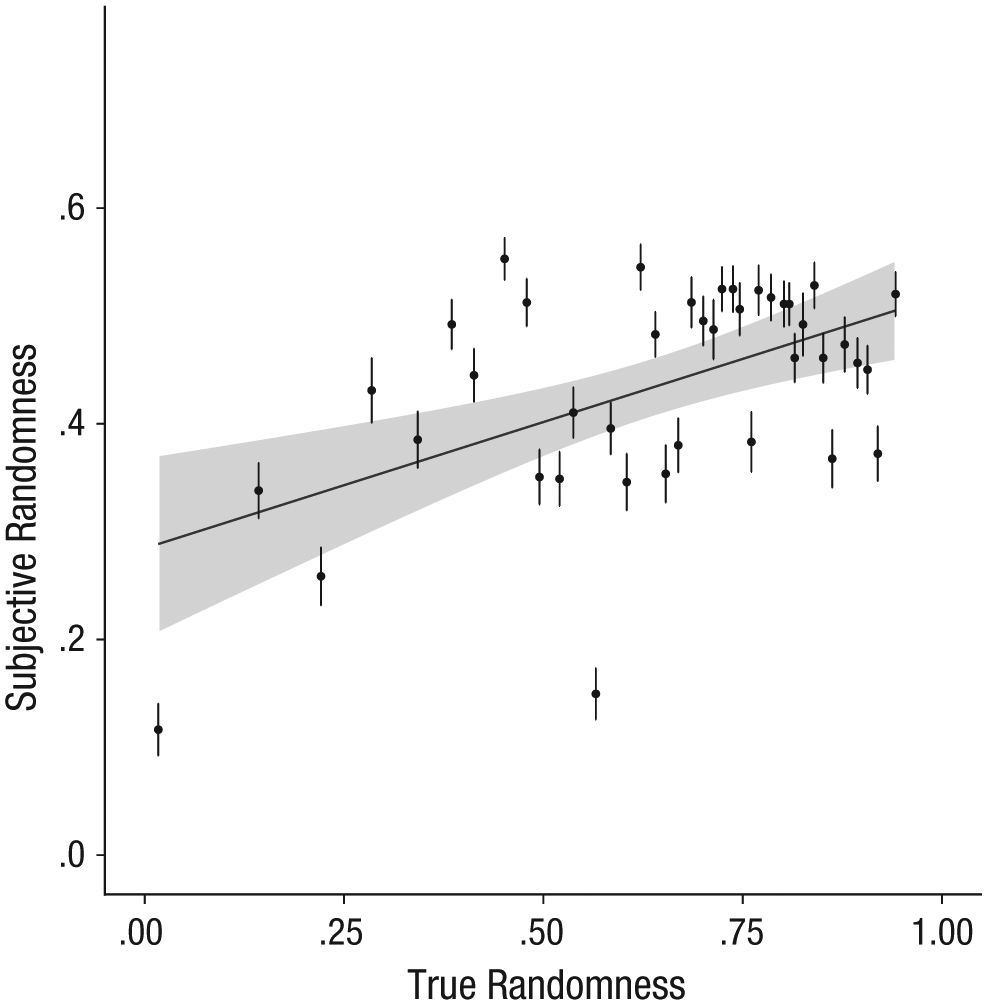
Results from Experiment 1. Scatterplot (with best-fitting regression line) of mean subjective randomness as a function of true randomness (with a prior set at .5). Error bars represent ±1 SEM. The shaded area represents the 95% confidence interval around the regression line.
Discussion
The subjective-randomness measure showed that there are indeed individual differences in global perception of randomness. However, the data did not support our initial hypothesis that conspiracist ideation is linked to a low prior for randomness, because no conspiracy theory subscale correlated with subjective randomness (Table 1).
The mean subjective randomness of a binary sequence was (moderately) correlated with its true randomness. This finding confirmed that our participants had a sound (albeit approximate) perception of randomness or complexity (i.e., an implicit sense of what true randomness looks like), and thus that they genuinely attempted to perform the task. All measures of belief in conspiracy theories were correlated with each other, thus replicating the now standard finding that conspiracy-theory beliefs involve a monological belief system (Goertzel, 1994; Lewandowsky, Oberauer, & Gignac, 2013; Swami et al., 2011; Wagner-Egger & Bangerter, 2007; Wood, Douglas, & Sutton, 2012).
Thus, although the data replicated two robust findings from the literature on randomness perception and conspiracist ideation, Experiment 1 failed to provide evidence of a link between the two domains. In this experiment, randomness was contrasted with an unspecified deterministic process. However, previous research has shown that judgments of randomness can be modulated by contextual factors (Matthews, 2013), potentially leading to differential assessments of chance, mechanistic, or intentional processes. Therefore, it may be that conspiracist ideation is linked to a low prior for randomness but only when people are resolving a choice between randomness and human agency, and especially a malevolent agency. Study 2 was designed to address this possibility.
Experiment 2
Participants
Participants were 123 first-year psychology students (102 women; mean age = 21.0 years, SD = 3.9, range = 18–43 years) at the University of Fribourg who were available for testing in a single session. They participated in the experiment for course credits. None took part in Experiment 1.
Method
The method for Experiment 2 was similar to that for Experiment 1, but with a key difference: There were two versions of the randomness-perception task, one for the inventing condition and one for the cheating condition. The first set of instructions for both versions was similar to the instructions in Experiment 1: In this questionnaire, you will have to judge series composed of the two symbols X and O. They may correspond to heads or tails, to even and odd numbers, or to series of successes and failures. For instance, the series “tails, heads, heads, tails” could be represented by OXXO. The series “success, failure, success” could be represented by OXO, etc.
After this, there was a second set of instructions. In the inventing condition, the second set read as follows: Some of these series were created using a real fair coin, which means that they are random series. On the other hand, some other series have been invented by humans. For each sequence, your task is to decide whether the sequence was produced by a truly random process or by human invention; you will do this by selecting the response that seems more appropriate to you, from “certainly random” to “certainly invented” or any intermediate response. Please answer as fast and accurately as possible.
In the cheating condition, the second set read as follows: In the context of a game, two players have to isolate themselves in a room, toss a coin a couple of times, and write down the obtained series. One of the players correctly follows the rule and tosses the coin, but the other intentionally cheats: He makes up the series without tossing the coin. For each sequence, your task is to decide whether the sequence was produced by the honest player (randomly produced by tossing a coin) or by the cheater (intentionally produced); you will do this by selecting the response that seems more appropriate to you, from “certainly random” to “certainly invented” or any intermediate response. Please answer as fast and accurately as possible.
Participants then had to rate the randomness of each of 40 strings of Xs and Os (the same strings as in Experiment 1) on a 6-point Likert scale with anchors of certainly random and certainly not random. The rationale for these two conditions was to allow investigation of the possible role of nefarious intent (i.e., cheating) compared with a more neutral intent (i.e., inventing) because conspiracy theories are usually defined as involving deliberate mischief rather than mere hoaxing. Participants were randomly assigned to one condition or the other. We deliberately did not specify how an actual cheater would behave in such a situation, leaving it to the participants to resolve its paradoxical nature: Indeed, a perfect cheater would create highly complex series, and a very clumsy (or maximally mischievous) cheater would come up with highly ordered series. This paradox is inherent in conspiracy theorizing: The plotting agents can be considered either inordinately efficient in hiding their tracks (leaving an event to be “too good to be true”) or transparently flawed (leaving “too many coincidences” behind them).
The second part of the study was similar to the second part of Experiment 1, except that the order of the four conspiracy-theory scales was kept constant because no order effects had been observed in Experiment 1. Hence, participants were asked to complete the Generic Conspiracist Beliefs Scale (Brotherton et al., 2013), the four classical conspiracy-theory items (Wagner-Egger & Bangerter, 2007), the interpersonal conspiracy scenario (Whitson & Galinsky, 2008), and the political conspiracy scenario (Leman & Cinnirella, 2007). Finally, participants were invited to provide some demographic information.
Results
The reliability of the scales used was satisfactory overall (subjective randomness: α = .83; general conspiracy theories: α = .82; classical conspiracy theories: α = .71). As in Experiment 1, our mean score of 3.01 (SD = 0.56) on the Generic Conspiracist Beliefs Scale was slightly higher than but similar to (i.e., near the midpoint of the scale) the means reported in Brotherton et al. (2013). As in Experiment 1, the classical conspiracy theory about John F. Kennedy’s assassination was the only one to receive a score significantly higher than the midpoint of the scale, on average, t(122) = 9.45, p < .001. Correlation coefficients among the scales are given in Table 2.
Pearson Correlation Coefficients Between the Scales in Experiment 2

Note: The correlation coefficients in the inventing condition are reported above the diagonal; the coefficients in the cheating condition are reported below the diagonal.
p < .05. **p < .001 (one-tailed tests).
There were no significant differences in subjective randomness between conditions, Welch two-sample t test, t(118.1) = 0.76, p = .45, or between Experiment 1 and Experiment 2 results, Welch two-sample t test, t(202.1) = 1.49, p = .14. The mean subjective randomness of strings was highly correlated in the two conditions, r(38) = .95, p < .001, and moderately correlated with true randomness—inventing condition: r(38) = .40, p < .05; cheating condition: r(38) = .51, p < .001. As in Experiment 1, subjective randomness was not significantly correlated with any of our four measures of belief in conspiracy theories. This was true in both conditions.
Discussion
Whereas Experiment 1 contrasted randomness with an unspecified deterministic process, Experiment 2 used a more specific, nonrandom anchor, especially relevant to conspiracy theories: a deliberate human intervention that, in the cheating condition, could be interpreted as an attempt to induce the appearance of randomness. We found no significant link between subjective randomness and any of the conspiracy-theory scales. Again, the data did not support our primary hypothesis, but they did confirm that participants were able to distinguish randomness from structure. In light of the cheater’s paradox highlighted earlier, the results suggest that both people who believe in conspiracy theories and those who do not use similar criteria to discern random from created sequences.
These negative findings could result from a lack of heterogeneity in our sample of psychology students and perhaps an excess of binary strings for them to evaluate, which could have induced tiredness and stereotypical responses. Study 3 was designed to improve on these possible issues and thus reinvestigated the cheating condition with increased statistical power, a more diverse population than in the previous experiments, and a shortened paradigm.
Experiment 3
Participants
Participants were recruited via social networks and e-mails and redirected to a URL for an online experiment; the URL remained available for 1 week after the initial announcement. After a week, 217 French-speaking participants (82 female; mean age = 34.6 years, SD = 9.9, range = 17–64 years) had freely taken part in the experiment.
Method
The method in Experiment 3 was similar to that in the two previous experiments. In this experiment, however, we contrasted randomness only with cheating (or intentional deceit). The experiment was run online to obtain a larger and more varied sample of participants. Finally, we included additional items related to political ideology and optimism to control for other possible variables related to conspiracist ideation. Moreover, in Experiment 2, the instructions mentioned two players, one of whom cheated. This may have triggered a .5 prior that would not have come into play otherwise. Thus, in Experiment 3, we provided no hint about the prior probability, to avoid this possible shortcoming.
In the first part of the study, participants completed the randomness-perception task. They were asked to read the following instructions: In the context of a game of chance, participants used a coin bearing an X symbol on one side and an O on the other. They had to throw the coin 12 times and write down the obtained sequence of Xs and Os. In what follows, you will see some of these sequences. Some of them have been correctly produced by the throwing of the coin. However, we know that others have been made up by cheating participants; instead of throwing the coin, they directly wrote down a sequence of Xs and Os. For each sequence, your task is to decide whether the sequence was produced by a truly random process or by a cheater; you will do this by clicking the response that seems most appropriate to you, from “certainly random” to “certainly cheating” or any intermediate response. Please answer as fast and as accurately as possible.
Fifteen 12-character strings of Xs and Os were then displayed on the screen, one after the other. The strings were chosen in such a way that they covered the whole range of possible complexity. Participants were asked to rate the randomness of each string on a 6-point Likert scale with anchors of certainly random to certainly cheating.
The second part of the study was similar to the second part of Experiment 1. Participants completed the scale from Brotherton et al. (2013) and entered some demographic information. Finally, they rated their own political general orientation on a 6-point Likert scale with anchors of far left (liberal) and far right (conservative), and they rated their pessimism and optimism on a 6-point Likert scale with anchors of extremely pessimistic and extremely optimistic.
Results
The reliability of the scales used was satisfactory (subjective randomness: α = .84; general conspiracy theories: α = .88; classical conspiracy theories: α = .79). Our mean score of 2.48 (SD = 0.72) on the Generic Conspiracist Beliefs Scale was again very similar to those reported in Brotherton et al. (2013) but lower than in our Experiments 1 and 2. This can be explained by the fact that participants in Experiments 1 and 2 were younger overall than those in Experiment 3, and younger age has been found to be associated with increased support for conspiracy theories (e.g., Goertzel, 1994). In this experiment, adherence to the four classical conspiracy theories was indeed negatively correlated with age, r (213) = −.24, p < .001. As in Experiments 1 and 2, the classical conspiracy theory about John F. Kennedy’s assassination was the only one to receive a score significantly higher than the midpoint of the scale, on average, t(216) = 2.05, p = .04. Correlation coefficients among the variables are given in Table 3.
Pearson Correlation Coefficients Between the Scales in Experiment 3

p < .01. **p < .001 (one-tailed tests).
Contrary to our initial hypothesis, the correlation between conspiracist ideation and subjective randomness was again found to be nonsignificant, r(217) = −.10, p = .13, 95% confidence interval, or CI = [−.23, .03]. (A power analysis indicated that our sample size was sufficient for the experiment to have 80% power to detect any correlation greater than |.17| at a p level of .05.) Likewise, we found no correlation between self-reported optimism and general conspiracist ideation. However, scores for optimism and randomness were positively correlated: More optimistic participants were more prone to perceive a string to be randomly produced; correspondingly, pessimistic participants were more prone to perceive a string to have been produced by a cheater. Finally, a weak but significant positive correlation between conspiracy ideation and political background was found: Participants with a liberal ideology were slightly less prone to conspiracist ideation than participants with a conservative ideology.
There was a strong correlation between subjective and true randomness, r(13) = .84, p < .001: Participants’ intuitions about the probability of randomness conformed to the normative view given by algorithmic probability (Fig. 2).

Results from Experiment 3. Scatterplot (with best-fitting regression line) of mean subjective randomness as a function of true randomness. Error bars represent ±1 SEM. The shaded area represents the 95% confidence interval around the regression line.
Discussion
In Experiment 3, we specifically contrasted randomness with cheating (i.e., malevolent deception) and used a large and diverse sample, which maximized the likelihood of confirming our initial hypothesis that people with conspiracy-theory beliefs have a lower prior for randomness. However, even in this particular condition and despite a high power, no significant correlation appeared.
Study 3 replicated previous findings of an association between political conservatism and conspiracist ideation (Abalakina-Paap et al., 1999; Grzesiak-Feldman & Irzycka, 2009; Wagner-Egger & Bangerter, 2007) and also found that a pessimistic bent was linked to a higher perceived probability of deceit and, thus, to a lower prior for randomness (further consolidating our paradigm by showing that it can detect predictable differences in subjective randomness). Finally, in line with Experiments 1 and 2, as well as with previous findings (Gauvrit, Soler-Toscano, & Zenil, 2014; Matthews, 2013; Yamada, Kawabe, & Miyazaki, 2013), Experiment 3 also confirmed that people share intuitions about randomness that approximate the algorithmic account of randomness, and these intuitions allowed them to distinguish randomness from structured patterns, again confirming that they genuinely attempted to perform the task.
General Discussion
Contrary to our initial prediction, which was based on a widely held interpretation of the psychology underlying belief in conspiracy theories, conspiracist ideation was not found to be associated with a low prior for randomness, even when randomness was opposed to deliberate and malevolent intentions. In fact, both participants who favored conspiracy theories and those who did not proved to have an accurate sense of randomness, attuned to the true randomness defined by algorithmic complexity theory. Although the concept of true randomness might seem counterintuitive and its mathematical foundations are not easy to grasp, this finding shows that human participants can tap into it while looking at meaningless binary strings. How exactly they do it is a question that we defer to further research, but we note that (a) this finding guarantees that participants genuinely attempted to detect order or randomness in the strings, and (b) the mechanisms involved seem unrelated to conspiracist ideation.
Our findings appear to contradict two lines of research. First, an increased tendency to exhibit probabilistic biases (e.g., the conjunction fallacy) has been reported in conspiracy-theory believers (Brotherton & French, 2014). However, our paradigm investigated the human approximate-complexity sense, not the ability to perform sound probabilistic reasoning. Probabilistic reasoning involves more than a perception of complexity: Poor reasoning built on a sound approximate randomness perception may lead to biases. In fact, conspiracy-theory believers have been found to simultaneously hold contradictory conspiracy theories (Wood et al., 2012). This tolerance to contradiction may well explain why they are prone to the conjunction fallacy, independently of their core perception of randomness.
Second, belief in conspiracy theories has been associated with a need to detect meaningful patterns to restore a sense of control (Whitson & Galinsky, 2008). However, this finding relied on interpersonal scenarios in which a conspiracy could be plausibly believed. In the current study, we used a more conservative approach to investigate randomness perception, aiming at a core randomness sense and focusing mostly on large-scale conspiracy theories.
It thus seems that the nothing-happens-by-accident heuristic, if it applies at all in the case of conspiracist ideation, would involve high levels of information processing and cognitive integration rather than a core, low-level, and quasisensory disposition. This does not preclude the need for further research on deep individual idiosyncrasies that could shed light on conspiracist ideation, but the present negative finding certainly puts the focus on higher-level approaches to understand, and possibly remediate, this increasingly widespread phenomenon. Climate-change skepticism is an analogous phenomenon: Research has shown that it is unrelated to scientific literacy but is strongly dependent on more general ideological and cultural factors (Kahan et al., 2012). Negative results, such as the one we obtained in the current study, can thus help narrow the psychological and social mechanisms involved in specific belief structures.
In conclusion, one cannot take the expression “nothing happens by accident” at face value as an explanation for conspiracist ideation. Nevertheless, the lack of a direct link between a general low prior for randomness and conspiracy-theory beliefs does not rule out the possibility that a low prior for randomness could in fact be a consequence, rather than a cause, of conspiracist ideation for general or specific conspiracy-theory beliefs. Consequently, people who believe or even develop conspiracy theories themselves may dismiss any intervention of chance for events that they perceive to be best explained by their imagined conspiracy.
Footnotes

References
Supplementary Material
Please find the following supplemental material available below.
For Open Access articles published under a Creative Commons License, all supplemental material carries the same license as the article it is associated with.
For non-Open Access articles published, all supplemental material carries a non-exclusive license, and permission requests for re-use of supplemental material or any part of supplemental material shall be sent directly to the copyright owner as specified in the copyright notice associated with the article.
