




Abstract
Uncertainty preferences are typically studied in neutral, nonsocial contexts. This approach, however, fails to capture the dynamic factors that influence choices under uncertainty in the real world. Our goal was twofold: to test whether uncertainty valuation is similar across social and nonsocial contexts, and to investigate the effects of acute stress on uncertainty preferences. Subjects completed matched gambling and trust games following either a control or a stress manipulation. Those who were not under stress exhibited no differences between the amount of money gambled and the amount of money entrusted to partners. In comparison, stressed subjects gambled more money but entrusted less money to partners. We further found that irrespective of stress, subjects were highly attuned to irrelevant feedback in the nonsocial, gambling context, believing that every loss led to a greater chance of winning (the gamblers’ fallacy). However, when deciding to trust a stranger, control subjects behaved rationally, treating each new interaction as independent. Stress compromised this adaptive behavior, increasing sensitivity to irrelevant social feedback.
Experimental economics has illustrated that uncertainty is ubiquitous in decision making, influences learning, and contributes crucially to the valuation of options in diverse situations. One situation in which uncertainty is endemic is deciding whether to trust another person. In fact, a significant feature of any economic transaction (Arrow, 1974) is the ability to trust and cooperate with nonrelated others. Learning whom to trust and deciding to trust require the evaluation of numerous factors, including various risk and ambiguity considerations (Gambetta, 1988). For instance, an individual typically must evaluate how trustworthy another person appears to be, while also weighing whether past decisions to trust others have led to reciprocal exchanges. In these unknown environments, choosing to trust is tantamount to making a decision under uncertainty. Although stress is known to affect choices involving uncertainty in nonsocial contexts (Starcke & Brand, 2012), little is known about how stress affects choices involving uncertainty in social contexts.
Current models of uncertainty preferences assume that people assess the desirability and likelihood of possible outcomes through some type of expectation-based calculus. In social contexts, uncertainty considerations become especially important when one must decide whether to trust another person—a dynamic captured in the trust game (Berg, Dickhaut, & McCabe, 1995). In this game, an individual can increase a monetary endowment by trusting another player, but runs the risk of losing all the money if that player decides not to reciprocate. Thus, the outcome of a decision to trust is highly uncertain (Ben-Ner & Putterman, 2001), and the game is akin to playing a gamble in which the probability of winning is unknown (Knight, 1921).
One critical question that has received little attention is how uncertainty considerations are differentially valued in social and nonsocial contexts. Extensive research within nonsocial contexts has illustrated that individuals can be averse to uncertainty, choosing a safe option that yields a small but reliable payout over an uncertain option that can yield a large but unreliable payout (Holt & Laury, 2002). Notably, individuals are more averse to uncertainty when potential outcomes have unknown probabilities (i.e., ambiguity) than when they have known probabilities, such as a 50% chance of winning (i.e., risk; Ellsberg, 1961). In the social domain, where an individual must engage with others, relatively few decisions involving uncertainty have outcomes with known probabilities, and thus decisions in this domain are typically characterized by ambiguous uncertainty rather than risky uncertainty. Because little is known about how ambiguity considerations are valued in social situations, our first goal in the study reported here was to compare the valuation of uncertainty considerations in nonsocial contexts and social contexts. To explore possible differences in ambiguity preferences, we used two tasks—the trust game and a matched lottery game; all components of the two tasks were held constant except the source of uncertainty (i.e., other players vs. unknown probability of winning gambles). By directly measuring decisions under ambiguity in social and nonsocial contexts, we were able to observe whether individuals differentially valued ambiguous uncertainty for choices made during social interactions compared with choices devoid of any social component.
A second question concerns how acute stress might differentially affect the valuation of uncertainty within social and nonsocial contexts. Stress has a profound—albeit inconsistent (Pabst, Schoofs, Pawlikowski, Brand, & Wolf, 2013)—effect on risky decision making in nonsocial contexts. In some cases, individuals become less risk averse under stress (Lighthall, Mather, & Gorlick, 2009; Preston, Tansfield, Buchanan, & Bechara, 2007; Starcke, Wolf, Markowitsch, & Brand, 2008; van den Bos, Harteveld, & Stoop, 2009), whereas in other cases, stress makes individuals more risk averse (Lighthall et al., 2009; Porcelli & Delgado, 2009). Far less is known about how stress affects valuation of ambiguity considerations within either nonsocial or social contexts. One recent study suggests that socially stressed individuals engage in greater trusting behavior than individuals who are not socially stressed (von Dawans, Fischbacher, Kirschbaum, Fehr, & Heinrichs, 2012). Evidence of enhanced trusting behavior was thought to demonstrate a need to “tend and befriend” in order to strengthen potentially fragile social ties under stress (Taylor et al., 2000). However, it is unclear whether the social nature of the stressor used in this study (i.e., being evaluated while speaking publicly), rather than the neurobiological stress response itself, was responsible for the increase in trusting behavior. By directly manipulating acute stress—indexed by increased levels of cortisol (Axelrod & Reisine, 1984)—using a nonsocial stressor in both social and nonsocial contexts, we were able to probe whether there are domain-specific effects of acute stress on decisions under uncertainty.
In addition, we explored whether social context and acute stress bias the integration of past experiences and interactions when people process ambiguity considerations. For instance, given the nature of repeated one-shot games in which each gamble or interaction is independent, there should be no influence of past experiences on decisions to take a new gamble or engage in trusting behavior with a new person. In other words, each new decision to gamble or trust should be treated independently. However, contrary to this rationalist perspective, it is well documented that within the nonsocial domain, willingness to make choices with uncertain outcomes is highly influenced by recent outcomes, even when those past choices are completely independent. This is illustrated by the fact that individuals routinely exhibit the gamblers’ fallacy (Oskarsson, Van Boven, McClelland, & Hastie, 2009; Rabin, 2002; Tversky & Kahneman, 1974), believing that a streak of losses indicates a greater likelihood of wins for future gambles. Given the robustness of this finding in the nonsocial domain, it is possible that similar behavior also occurs in social contexts, such that a decision to trust a new individual (i.e., in a one-shot game) is influenced by whether previous, unrelated partners were trustworthy. By comparing the influence of prior feedback on choices in the nonsocial lottery game and the trust game, we were able to assess whether social context and acute stress differentially influence how feedback is incorporated into decisions involving uncertainty.
Method
Subjects
Sixty subjects were recruited and randomly assigned to be in either the stress condition or the control condition (sample size was based on extant research; Otto, Raio, Chiang, Phelps, & Daw, 2013). Subjects (n = 2) who expressed doubts during the final debriefing that they had engaged in a social interaction were not included in analyses. One additional subject was subsequently excluded from analysis for exhibiting decreased cortisol levels (relative to baseline) following the stress manipulation (> 1.5 SD from the mean change in cortisol), and another subject was excluded from analysis for exhibiting significantly increased cortisol levels (relative to baseline) following the control manipulation (> 1.5 SD from the mean change in cortisol). Thus, the final sample included 56 subjects, 28 of whom underwent the stress manipulation (13 males; mean age = 22.33 years, SD = 3.15) and 28 of whom who underwent the control manipulation (15 males; mean age = 21.0 years, SD = 2.49). The two groups were matched on age, t(54) = 1.76, p = .09, and gender, t(54) = −0.814, p = .42, and all subjects provided written consent in accordance with the standards of the New York University Committee on Activities Involving Human Subjects. Subjects were paid $15 and received additional compensation based on the result of one randomly selected trial from the trust game and one randomly selected trial from the lottery game.
Procedure
After providing informed consent, subjects underwent either the stress manipulation (cold pressor task, CPT) or the control manipulation. They were then asked to read instructions about each game. They were given additional verbal and visual instructions to ensure their full comprehension (see the Supplemental Material available online). Subjects were endowed with $20, which was placed on the desk before them; $10 was to be used for the trust game, and $10 was to be used for the lottery game. Subjects completed three practice trials before beginning each game. The trust and lottery games each had 36 trials and were matched on visual, temporal, and monetary dimensions. The order of the games was counterbalanced, with half of the subjects playing the trust game first and the other half playing the lottery game first.
The trust game (social task)
A typical trust game involves a one-shot social interaction between two players, an investor and a trustee (Fig. 1a). The first player (investor) is initially faced with a decision to keep a sum of money (e.g., $10) or share part of it (invest) with the trustee. If shared, the investment is quadrupled ($40), and the trustee faces the decision to repay the trust by sending back half of the increased sum ($20 for each player) or to defect and violate trust by keeping the money ($40 for the trustee), leaving the investor with nothing. The social dilemma for the investor is clear, as it is more profitable to trust, if trust is reciprocated, but doing so leaves the investor susceptible to the risk of a breach in trust, and ultimately, the loss of money. Notably, these socially uncertain decisions combine risk (known probabilities) and ambiguity (unknown probabilities; Knight, 1921)—parameters that behavioral economists have successfully deconstructed within the nonsocial domain (Ellsberg, 1961).
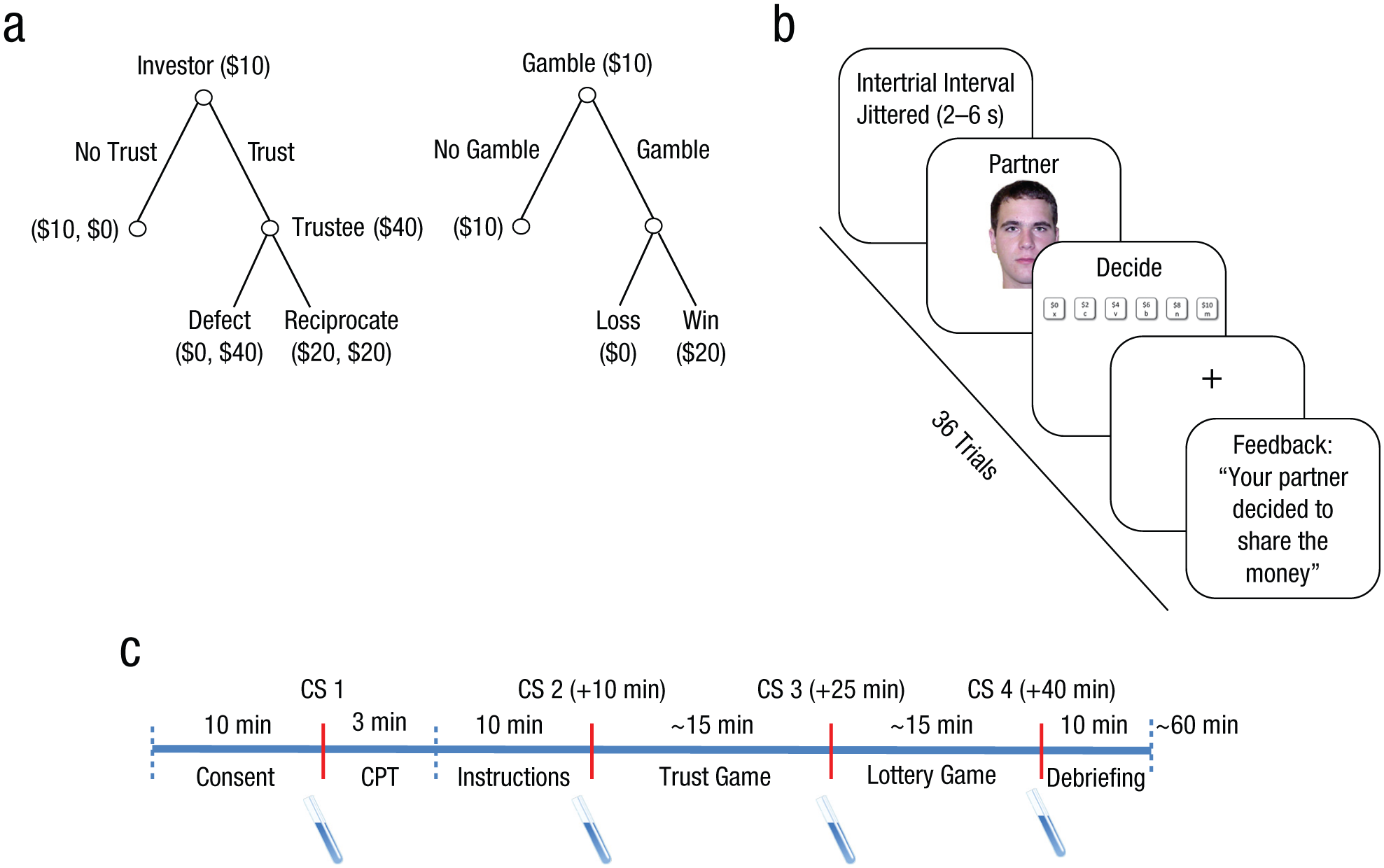
Tasks and experimental protocol. In the trust game (a), subjects (investors) were endowed with money and decided whether to send none, some, or all of that money to their ostensible partner (the trustee). If the decision was to send money to the trustee (trust), the money was quadrupled. The trustee (in reality, a computer algorithm) then either reciprocated by splitting the money or defected by keeping all the money. The decision tree shows the monetary amounts the investor (first player) and the trustee (second player) had at the end of the trial. The lottery game (gambling task) was identical in all respects except for the social component. On each trial of the trust game (b), subjects were shown a picture of their partner, before being asked how much money they would like to trust to their partner (between $0 and $10, in increments of $2). After making a decision, subjects were informed whether their partner had decided to defect or reciprocate (feedback). The timeline (c) illustrates the sequence of events in each experimental session. Cortisol (CS) was measured before the stress or control manipulation (baseline), 10 min after the start of the manipulation, between the two games (which were in counterbalanced order across subjects), and following the final game. CPT = cold pressor task.
In our task, subjects were assigned to be the investor and were informed that they would play 36 trials, each with a different trustee. On each trial, subjects could choose to invest anywhere between $0 and $10, in increments of $2 (i.e., $0, $2, $4, etc.). If a subject decided to invest and the trustee reciprocated the trust, the subject doubled his or her investment; however, if the subject decided to invest and the trustee decided to keep the money, the subject lost the investment. For example, if the subject shared $4 with the trustee, the money quadrupled to $16. The trustee could then either keep the $16 (defect) or split the increased sum with the investor such that each player received $8 (reciprocate). In other words, if trustees chose to reciprocate, subjects would double their earnings. If trustees chose to defect, subjects would lose whatever money they had invested. Although in the eyes of the subjects, whether a trustee would defect or reciprocate was not known, and thus the decision involved ambiguous uncertainty, in reality, the payoff structure was calculated at 50% reciprocation. Subjects were informed that 1 trial would be randomly chosen to determine the earnings paid out at the end of the experiment.
Subjects were told that on each trial, they would be able to view a photo of the trustee before making their investment decision. All the photos were faces of White males, prerated by an independent group (N = 50; Stanley, Sokol-Hessner, Banaji, & Phelps, 2011) and selected according to their level of trustworthiness (within 1 SD from the mean trustworthiness rating). Subjects were further told that these trustees had been previously brought into the lab and interviewed about their willingness to share or keep money with future partners, and that the trustees would also be paid with a mailed check according to the decisions of the investors. In reality, the trustees’ decisions to reciprocate or defect were created by a computer algorithm that was set to reciprocate half the time and defect half the time. Subjects were not given any information about the reciprocation or defection schedule. To ensure that subjects believed they were interacting with real offers from real players, we probed subjects’ beliefs about their partners during a funnel debriefing at the end of the experiment. Subjects who expressed doubts were not included in the behavioral or neuroendocrine analyses.
On each trial, subjects were presented with a photo of a trustee and were given unlimited time to make their investment decision (Fig. 1b). Following their decision, subjects were presented with a fixation cross (jittered duration, 2–6 s) and then either positive feedback (“Your partner decided to share the money”) or negative feedback (“Your partner decided to keep the money”) for 3 s. After the feedback, there was an intertrial interval (jittered duration, 2–6 s). The trials were presented in pseudorandom order, such that a subject never experienced more than two reciprocations or two defections in a row.
The lottery game (nonsocial task)
The lottery game was structured in the same manner as the trust game, with the exception that there was no cover story about playing with partners and investing money in trustees (Fig. 1a). In essence, all components of the trust and lottery games were held constant except the social interaction of the trust game. Accordingly, in the lottery game, instead of viewing photos of partners, subjects viewed a stock image of a computer on all trials. Subjects were told that on each trial, they could choose to gamble between $0 and $10 of their $10 endowment, in increments of $2. If they gambled and won the lottery, they would double their money. If they gambled and lost, they would lose their money. Wins and losses followed the same algorithm used in the trust game, and the trial order was pseudorandomized, such that no more than two wins or two losses were presented in a row. Furthermore, as in the trust game, subjects were given no information about the probability of winning or losing a gamble. Thus, in subjects’ eyes, these lotteries involved ambiguous probabilities. In reality, however, the lotteries were reinforced at a 50% win rate.
Stress and control manipulations
Acute stress was induced in the stress condition using the CPT. Subjects were asked to submerge their right forearm, hand through elbow, in ice water (0–4 °C) for 3 consecutive minutes. The CPT has been shown to reliably increase sympathetic nervous system and hypothalamic-pituitary-adrenal (HPA) axis activity by activating thermal and nociceptor afferents (Bullinger et al., 1984; Edelson & Robertson, 1986; Kelly & Cooper, 1998; Velasco, Gomez, Blanco, & Rodriguez, 1997), and it has been used previously to elicit a stress response (Errico, Parsons, King, & Lovallo, 1993; Pascualy et al., 2000). Critically, the CPT does not have any lasting psychological effects typically associated with other types of laboratory stressors (McRae et al., 2006), and thus is an ideal technique for isolating an increased neurohormonal stress response exclusive of ancillary effects that could bias behavior. Subjects in the control condition were instead asked to submerge their right forearm in room-temperature water (32–35 °C) for 3 consecutive minutes.
Physiological stress measurement
To acquire physiological measures of stress, we collected salivary samples and analyzed them for concentrations of both cortisol, a measure of HPA axis engagement, and α-amylase, which indirectly assays noradrenergic activity. The salivary samples were obtained by having subjects place an oral swab beneath their tongue for 2 min. In order to control for circadian rhythms and stress induced by travel, we had all subjects come into the laboratory between 12:00 p.m. and 5:00 p.m. We ensured that baseline cortisol levels were stable by taking the first salivary sample 10 min after subjects arrived at the laboratory. Salivary samples were taken four times during the course of the experiment: at baseline (i.e., 10 min after the subject’s arrival), 10 min after the beginning of the stress or control manipulation (when cortisol was expected to rise in the stress condition), after the first game was completed (approximately 25 min after the stress or control manipulation), and after the second game was completed (approximately 40 min after the stress or control manipulation; see Fig. 1c).
Regression analysis
To explore the effects of stress on individuals’ ability to incorporate feedback, we used linear regression models in which we fit subjects’ choices to trust or gamble (i.e., how much money subjects entrusted and gambled) as a function of feedback on the previous trial (1 = a reciprocation in the trust game or a win in the lottery game, −1 = a defection in the trust game or a loss in the lottery game, 0 = the subject chose not to gamble or trust). Subjects chose to play at the same rate regardless of whether they were in the stress or control condition (p > .05); in both conditions, subjects played approximately 70% of the time (see the Supplemental Material). The parameters were entered into a mixed-effects linear regression for each combination of condition and game; the within-subjects predictors were the intercept and feedback received on the previous trial. This approach enabled us to examine how subjects used feedback to inform subsequent choices in both the social domain (trust) and the nonsocial domain (gambles). (See the Supplemental Material for details on the full regression model and alternative models, including a reinforcement-learning model and a weighted-average model.) We used the lme4 package (Bates, Maechler, Bolker, & Walker, 2015) in the R programming language to run all regressions.
Results
Decisions under uncertainty in social versus nonsocial contexts
Our first question was whether valuation of ambiguous uncertainty is similar in social and nonsocial contexts. Subjects in the control condition spent approximately the same amount of money irrespective of whether they were gambling (lottery game: M = $3.74, SD = 2.40) or entrusting money to a partner (trust game: M = $3.81, SD = 2.1), t(27) = −0.25, p = .80 (paired-samples t test), behaving consistently overall irrespective of context (Fig. 2b). Next, we wanted to investigate whether past, irrelevant feedback is incorporated and used in a similar manner during decisions to gamble and trust. To test this, we modeled decisions in the trust and lottery games as a function of the type of feedback subjects received on the previous trial. We ran a trial-by-trial linear regression in which outcome (win/loss in the lottery game and reciprocation/defection in the trust game) was used as lagged predictor of choice (how much money was gambled or invested on each trial; see the Regression Analysis section).
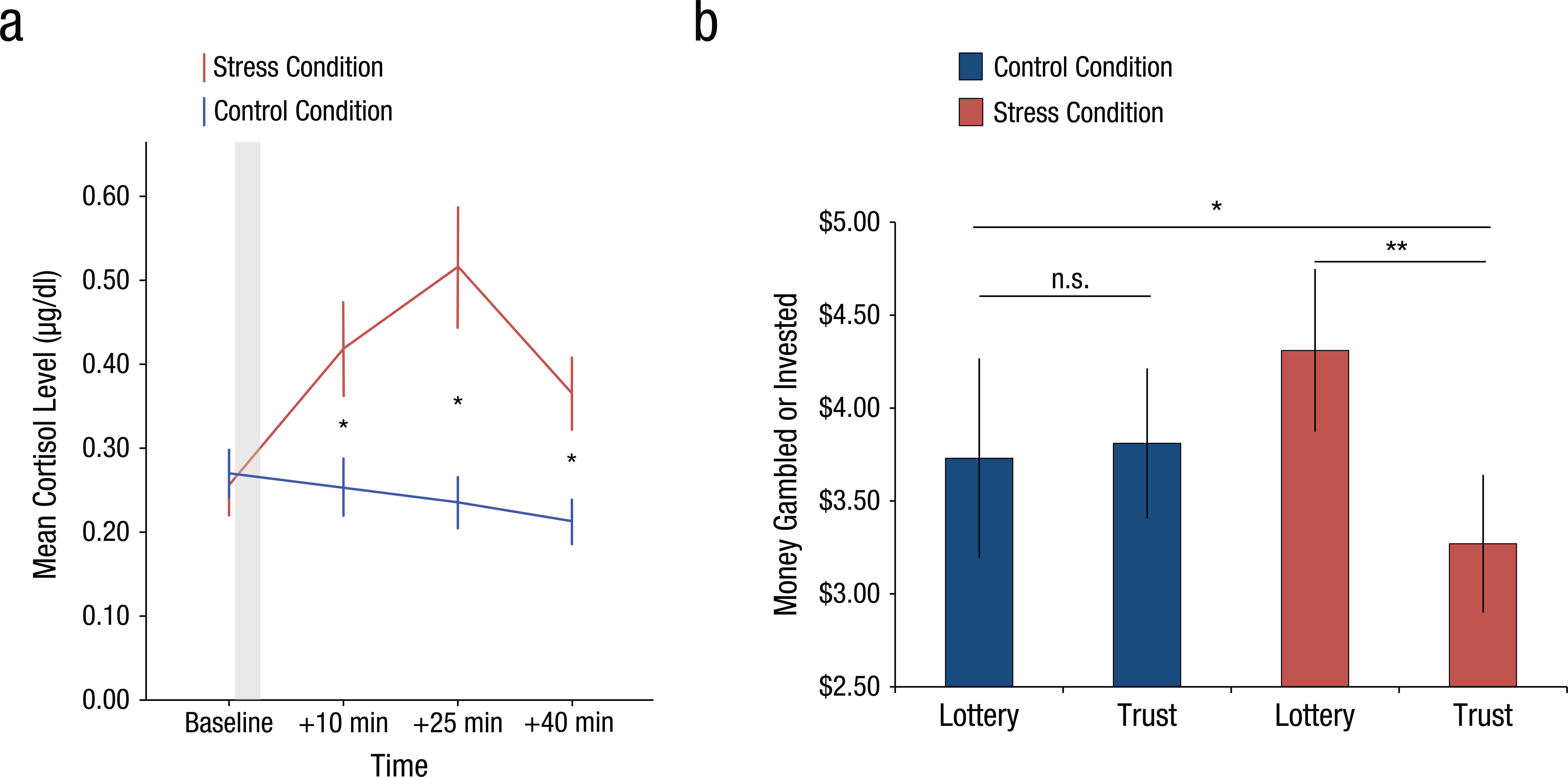
Neuroendocrine and behavioral data. The graph in (a) shows mean cortisol level as a function of time, separately for subjects in the stress and control conditions. The gray bar represents the timing for the stress and control manipulations. The graph in (b) shows mean amount of money gambled in the lottery game and invested in the trust game, separately for subjects in the stress and control conditions. Asterisks indicate significant differences (*p < .05, **p < .01). Error bars represent ±1 SEM.
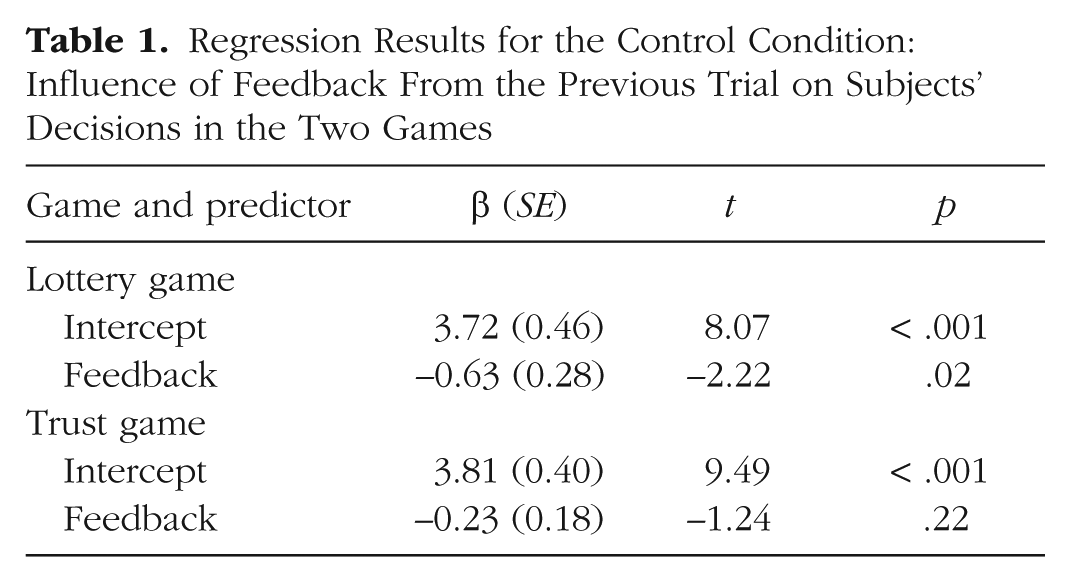
Results revealed that individuals in the control condition gambled more after experiencing a loss than after experiencing a win (Table 1), partaking in the gamblers’ fallacy by believing in the irrational notion that a streak of losses means a greater likelihood of wins for future gambles (Kahneman & Tversky, 1972). This pattern was not observed in the social domain, as individuals in the control condition did not rely on past, unrelated feedback when deciding whether to trust another (Table 1). That is, despite observing their partners’ defection or reciprocation of their initial move to trust, subjects did not use this social feedback to inform their next choice whether to trust a new, unrelated partner, effectively treating each new decision as an independent choice.
Regression Results for the Control Condition: Influence of Feedback From the Previous Trial on Subjects’ Decisions in the Two Games
Neuroendocrine results
To assess the efficacy of the CPT manipulation, we measured salivary cortisol levels (an index of HPA axis activation) and α-amylase levels (an index of sympathetic nervous system activation). As expected, analysis of cortisol levels revealed main effects of time, F(3, 162) = 8.5, p < .001, and condition, F(1, 54) = 7.4, p = .009, as well as a Condition × Time interaction, F(3, 162) = 12.6, p < .001, η p 2 = .14 (Fig. 2a). Independent t tests revealed no differences between conditions at baseline, t(54) = −0.35, p = .73. However, cortisol levels were significantly higher in the stress condition than in the control condition at each time point after the manipulation, +10 min: t(54) = 2.5, p = .01; approximately +25 min: t(54) = 3.57, p = .001; approximately +40 min: t(54) = 2.98, p = .004. These results indicate that the CPT manipulation was successful in increasing subjects’ cortisol and engaging greater HPA activation. We ran a similar analysis on α-amylase levels but did not find any main effects or a Condition × Time interaction, F(3, 162) = 0.56, p = .64, perhaps because the timing of our assessment was not optimal for the relatively rapid response of α-amylase (Maruyama et al., 2012).
Effects of acute stress on valuation of uncertainty in social and nonsocial contexts
To examine the effect of acute stress on social choices compared with nonsocial choices, we conducted a 2 (condition: control vs. stress) × 2 (game: trust vs. lottery) repeated measures analysis of variance on the amount of money invested or gambled. Results revealed an interaction between game and condition, F(1, 54) = 6.2, p = .016, η p 2 = .10 (Fig. 2b), as well as a main effect of game, F(1, 54) = 4.63, p = .036, η p 2 = .08. As noted earlier, subjects in the control condition spent the same amount of money in the lottery and trust games. However, subjects who underwent the stress manipulation exhibited a dissociation, spending significantly more money gambling in the lottery game (M = $4.31, SD = 2.30) than they did trusting their partners in the trust game (M = $3.27, SD = 1.96), t(27) = 3.1, p = .004 (paired-samples t test). This difference was due to acute stress both increasing nonsocial gambling and diminishing social trusting behavior.
Effects of acute stress on sensitivity to feedback: trial-by-trial analysis
Given the evidence that acute stress has differential effects on social versus nonsocial choices under uncertainty, our next aim was to further decompose whether these effects of stress also bias how past, irrelevant feedback is incorporated into future decisions. To do this, we modeled decisions in the trust and lottery games as a function of the feedback received. As before, we ran a trial-by-trial linear regression in which outcome was used as a lagged predictor of choice (see the Regression Analysis section).
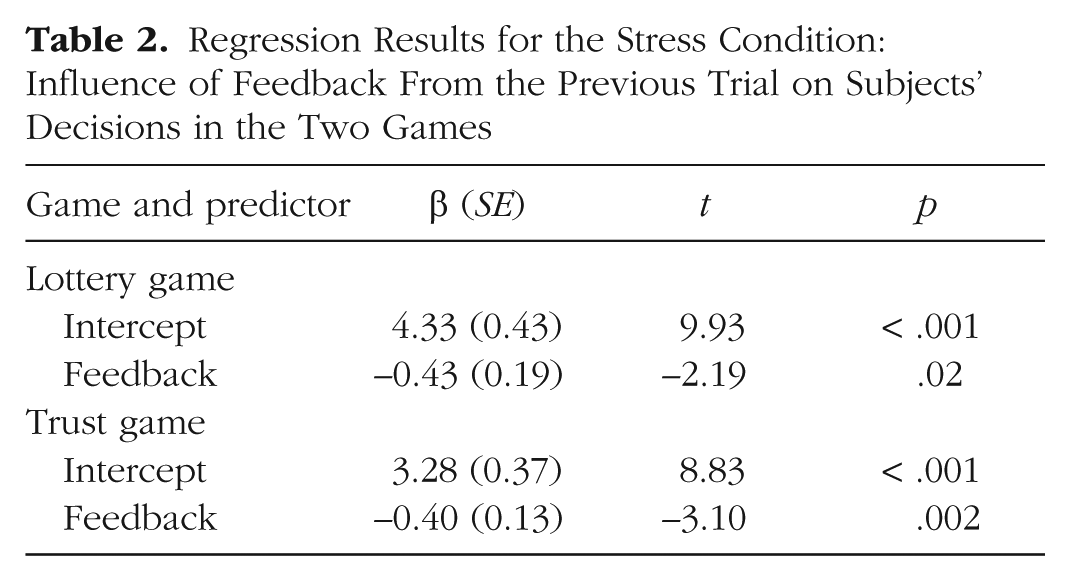
Acute stress selectively affected how individuals incorporated social feedback. As did subjects in the control condition, those in the stress condition used irrelevant, prior experiences to guide their future choices to gamble (Table 2). In other words, stress had no effect on how irrelevant feedback biased choices to gamble. However, decisions to trust were affected by stress. Unlike subjects in the control condition, those in the stress condition used past, irrelevant feedback to guide their choices in the trust game. After a partner defected and did not share the money, subjects subsequently entrusted more money to a new partner on the next trial (Table 2), effectively displaying a pattern of behavior similar to that observed in the gambling task. Simply put, stress compromised subjects’ ability to disregard irrelevant, past information when deciding whether to trust a new partner.
Regression Results for the Stress Condition: Influence of Feedback From the Previous Trial on Subjects’ Decisions in the Two Games
Discussion
There is a wealth of research illustrating that humans are averse to making decisions under uncertainty in nonsocial contexts (Camerer & Weber, 1992) and that stress has mixed effects on individuals’ engagement in decisions involving nonsocial risk and ambiguity (Mather & Lighthall, 2012). Yet, despite the fact that many everyday choices involving uncertainty are made within a social context, little is known about how individuals’ valuation of uncertainty in the social domain compares with their valuation of uncertainty in the nonsocial domain. We found that although individuals who were not stressed gambled and trusted at overall similar rates, past, irrelevant feedback had differential effects depending on context. In the nonsocial domain, unstressed individuals exhibited the gamblers’ fallacy, believing incorrectly that a spate of losses would result in a subsequent win. However, in the social domain, unstressed individuals approximated rational agents and did not use irrelevant past information to guide their subsequent choices to trust another person.
Acute stress had divergent effects on decisions under uncertainty illustrating a qualitative difference between how social and nonsocial uncertainty are processed. In a nonsocial context, stress increased gambling; however, in a social context, stress decreased trusting behavior. We also found that stress differentially influences whether an individual attends to and uses irrelevant feedback, depending on the context. Whereas in a nonsocial context, individuals exhibited the gamblers’ fallacy regardless of their stress levels, in social contexts, stress compromised the adaptive behavioral pattern of treating each new choice independently. Rather, stressed individuals were more likely to trust a new partner after receiving negative feedback (defection) than after receiving positive feedback (reciprocation).
The one study we are aware of that examined the impact of stress on decisions under uncertainty within the social domain demonstrated that acute stress increases trusting behavior (von Dawans et al., 2012). Our findings indicate the opposite: Acute stress dampened subjects’ likelihood of trusting another individual, but increased how often they chose to gamble. One critical difference between our study and the work by von Dawans et al. is the type of stressor used—the CPT versus the Trier Social Stress Test (TSST). Unlike the CPT, the TSST induces psychosocial stress by requiring individuals to undergo social evaluation—for example, speaking in front of a panel of evaluative peers. In fact, individuals who experience the TSST report greater emotional and psychological vulnerability, greater rumination, and an overall decline in mood relative to those who experience the CPT (McRae et al., 2006), which could dictate a need to resuscitate what they perceive to be fragile social ties. Thus, the increased trusting behavior von Dawans et al. observed following the TSST might reflect an attempt to repair putatively compromised social ties by displaying greater trust. However, these behavioral effects cannot necessarily be explained by an increase in the neurohormonal response alone, as other nonspecific effects of social evaluation likely played a role. This confound presents a problem for interpreting whether increases in trusting behavior were due to the physiological response to stress, the psychological effects of the social stressor (i.e., rumination and psychological vulnerability), or both. By using the CPT, we eliminated the putatively confounding psychosocial effects on social behavior and found that inducing nonsocial stress does not increase trusting behavior, but rather attenuates it.
By more closely examining how subjects incorporated irrelevant social and nonsocial feedback when making choices, we were able to further decompose how ambiguity considerations were processed in different contexts. According to classic economic theory, rational agents should not be influenced by past experiences when deciding whether to take a new, independent gamble or to engage in trusting behavior with a new person (Rabin, 2002). That is, every new choice should be treated independently of past, irrelevant experiences. However, there is robust evidence within the literature (Sundali & Croson, 2006; Tversky & Kahneman, 1971, 1974), and from the current study, that individuals routinely violate this principle in nonsocial contexts, systematically engaging in what is known as the gamblers’ fallacy. This effect is so robust that stress appears to have no bearing on the belief that a streak of losses in nonsocial gambles will result in a subsequent win.
In contrast, we found that individuals in the control condition did not violate this principle when deciding whether to trust another person. Effectively, these nonstressed individuals correctly treated each decision to trust a new partner as an independent choice. Thus, unlike in the nonsocial domain, individuals facing ambiguous uncertainty in a social context can successfully make choices without relying on earlier irrelevant information. Given that all components of the trust and lottery games were held constant except for the social-interaction component, these divergent behavioral patterns constitute powerful evidence that valuation of ambiguous uncertainty likely relies on distinct cognitive processes in social and nonsocial domains. Furthermore, these divergent behavioral patterns were observed within individuals; that is, the same individuals who exhibited the gamblers’ fallacy in the nonsocial domain were able to rationally and adaptively make decisions without relying on irrelevant past information in the social domain.
The finding that individuals are better at making decisions in ambiguous situations involving people than they are at making decisions in ambiguous situations devoid of any social component suggests that ambiguous uncertainty is differentially valued depending on whether it is embedded in a social context or not. One explanation may be that people do not typically generalize a trait such as trustworthiness across all individuals. Indeed, assuming that every individual can be trusted to the same degree would be highly maladaptive. Our data suggest that current relevant information—such as which person one is deciding to invest money in—is more highly weighted, or at least differentially valued, than unconnected prior nonsocial experiences. One important caveat is that any systematic violation of trust should cause an individual to be wary of trusting another. In our experiment, we attempted to approximate the level of trustworthy behavior observed outside the laboratory, where trustworthiness is highly variable across individuals.
Decision making under uncertainty is ubiquitous to human life, and thus it is not surprising that for decades, researchers have explored how humans process uncertainty. In the laboratory, uncertainty is typically studied within a neutral, nonsocial context. This approach, however, likely fails to capture the dynamic factors that influence decisions involving uncertainty in the real world. Making decisions in uncertain environments during everyday life requires individuals to constantly assess risk and ambiguity under various shifting social contexts and varied emotional states. In the study reported here, we found that social context and mild acute stress independently, and jointly, contribute to the processing of uncertainty preferences.
Footnotes
Declaration of Conflicting Interests
The authors declared that they had no conflicts of interest with respect to their authorship or the publication of this article.
Funding
This work was supported by a grant from the National Institute of Aging.

References
Supplementary Material
Please find the following supplemental material available below.
For Open Access articles published under a Creative Commons License, all supplemental material carries the same license as the article it is associated with.
For non-Open Access articles published, all supplemental material carries a non-exclusive license, and permission requests for re-use of supplemental material or any part of supplemental material shall be sent directly to the copyright owner as specified in the copyright notice associated with the article.
