




Abstract
Memory is critical for learning, cognition, and cognitive development. Recent work has suggested that preschool-age children are vulnerable to catastrophic levels of memory interference, in which new learning dramatically attenuates memory for previously acquired knowledge. In the work reported here, we investigated the effects of consolidation on children’s memory by introducing a 48-hr delay between learning and testing. In Experiment 1, the delay improved children’s memory and eliminated interference. Results of Experiment 2 suggest that the benefit of this delay is limited to situations in which children are given enough information to form complex memory structures. These findings have important implications for understanding consolidation processes and memory development.
Memory is central to animal and human behavior because it enables organisms to deploy what was learned in the past in the service of current and future goals. Memory is also related to new learning, and these relations are often reciprocal: Memory for past experiences affects current learning, and current learning affects past memories. Although often these effects are facilitative (i.e., previous knowledge is useful or even necessary for acquiring new knowledge; Beier & Ackerman, 2005; Schlichting & Preston, 2014), there are many situations in which memory and learning interfere with each other. Sometimes, memory for prior experience interferes with learning of new experiences (proactive interference). For example, after observing an object being repeatedly hidden in one location, infants may continue searching in this location even after watching an experimenter hide the object in a new location (Diamond, 1985).
Other times, new learning attenuates memory for past experiences (retroactive interference). Recent work has demonstrated severe retroactive interference in children but not in adults (Darby & Sloutsky, 2015). Given that retroactive interference is a major cause of forgetting (Wixted, 2004), understanding reasons for such drastic retroactive interference in children and its decrease in development is important for understanding memory and was the goal of the current research.
Why Does Retroactive Interference Occur?
An extreme example of retroactive interference comes from the connectionist-modeling literature. In some early connectionist networks, memory for existing knowledge was quickly overwritten when new learning was introduced (McCloskey & Cohen, 1989; Ratcliff, 1990). This severe form of retroactive interference was called catastrophic interference (McCloskey & Cohen, 1989) because previously learned information was entirely forgotten. This result challenged the validity of some connectionist architectures, because retroactive interference effects are typically modest in human adults (French, 1999). In an attempt to address these challenges, McClelland, McNaughton, and O’Reilly (1995) proposed an influential theory positing interactions between cortical and hippocampal memory systems. These interactions explained relatively small retroactive interference effects in humans and led to reduced retroactive interference in computational models.
Although retroactive interference effects in human adults are typically modest, there is new evidence that these effects may reach catastrophic levels in children. In a recent study (Darby & Sloutsky, 2015), we gave 5-year-olds and adults a learning task in which individual stimuli could not predict an outcome, but pairs of stimuli could. In Phase 1, participants learned that AB → X (i.e., stimuli A and B were associated with outcome X) and CD → X. In Phase 2, they learned that AC → Y and BD → Y. When presented in Phase 3 with the initial set of items shown in Phase 1, participants faced a conflict: A, B, C, and D were equally likely to be associated with X and Y (see Fig. 1a). Five-year-olds (but not adults) exhibited catastrophic-like interference in Phase 3, which pointed to important developmental differences in memory and interference effects.
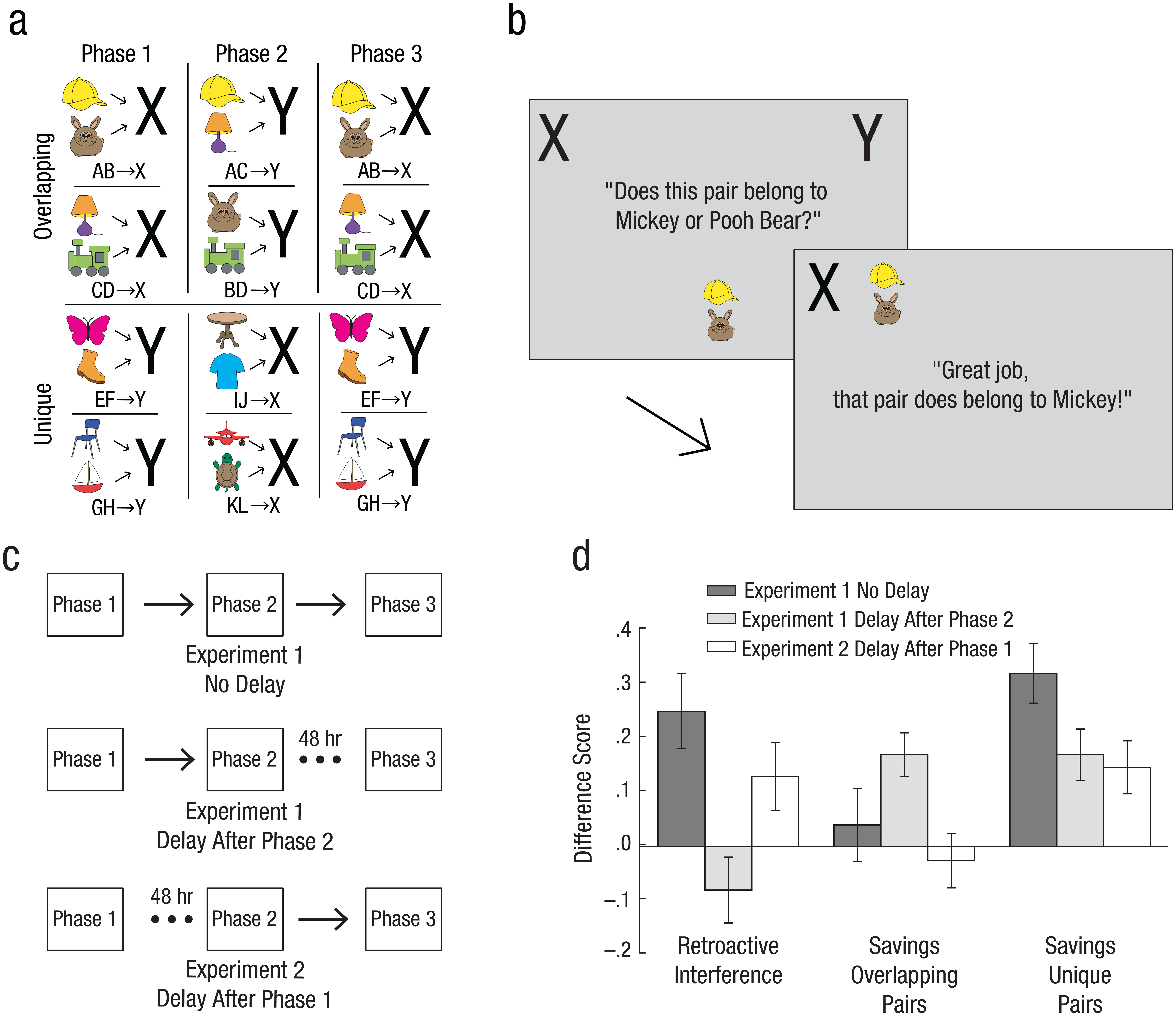
Experimental design, procedure, and results of Experiments 1 and 2. In each of three phases, children saw pairs of stimuli (a) that were associated with one of two outcomes (cartoon characters: Mickey Mouse, represented here by an X, or Winnie the Pooh, represented here by a Y). Some pairs were overlapping in that different pairs were associated with the same outcome in Phase 1, but pair members were recombined and associated with a different outcome in Phase 2. Other pairs were unique in that the two objects in a given pair always appeared together and were always associated with the same outcome. In Phase 3, the pairs from Phase 1 were presented again. On each trial (b), participants saw one pair of objects at the bottom of the screen, and the experimenter asked which of the two characters at the top of the screen the items belonged to. After the participant chose, the items appeared next to the correct character, and the experimenter provided verbal feedback. Across the two experiments, there were three conditions (c), which differed only in the length of the delays between phases—short (1 min; solid arrows) and long (48 hr). The graphs (d) show difference scores for the three conditions. Positive values indicate higher scores. Retroactive interference was calculated by taking the difference in accuracy (proportion of correct responses) in Phase 1 Block 5 and Phase 3 Block 1 separately for overlapping and unique pairs and then determining the difference between results for each pair type. Savings was defined as the difference in accuracy between Phase 1 Block 1 and Phase 3 Block 1, separately for overlapping and unique pairs. See Figure 2 for raw accuracy. Error bars represent ±1 SEM.
In particular, catastrophic-like interference in Phase 3 suggests that children learned elementary associations (i.e., A → X and B → X in Phase 1, followed by A → Y and B → Y in Phase 2). In contrast, binding the items together and forming configural memories of object pairs (i.e., [A-B] → X and [C-D] → X in Phase 1, followed by [A-C] → Y and [B-D] → Y in Phase 2) should have resulted in little or no retroactive interference in Phase 3, as each pair uniquely predicted an outcome. Catastrophic interference could also be prevented by binding each item and a context, such as [A-Context1] → X and [A-Context2] → Y. In general, binding individual elements into configural memory structures should reduce overlap between similar memories and, as a result, reduce vulnerability to interference compared with more simple structures (Darby & Sloutsky, 2015; Humphreys, Bain, & Pike, 1989; O’Reilly & Rudy, 2001; Yim, Dennis, & Sloutsky, 2013). The reported developmental differences in retroactive interference suggest that adults, but not young children, encoded stimulus information configurally.
Why did 5-year-olds fail to form configural memory traces? One possibility is that 5-year-olds cannot do so in principle, perhaps because of immaturity of the hippocampus. There is evidence that 4-year-olds have difficulty binding information in memory (Lloyd, Doydum, & Newcombe, 2009; Sluzenski, Newcombe, & Kovacs, 2006). However, 4.5-year-olds have succeeded in a configural memory task when training was presented over multiple days (Rudy, Keith, & Georgen, 1993).
Therefore, another possibility is that young children fail to form configural memory traces on-line but are capable of forming such traces with the passage of time. There is much evidence suggesting that in a variety of hippocampus-dependent tasks, the passage of time (or perhaps a combination of the passage of time and sleep) results in memory consolidation and subsequently in improved task performance (Bauer, Larkina, & Doydum, 2012; Stickgold, 2005; Wilhelm, Prehn-Kristensen, & Born, 2012; Wixted, 2004). For example, after learning individual premises (e.g., A > B, B > C) of transitive inference problems (A > B > C > D > E), adults were less likely to solve inference-based problems (e.g., B ? D) when tested almost immediately than when tested after 12- or 24-hr delays (Ellenbogen, Hu, Payne, Titone, & Walker, 2007; Werchan & Gómez, 2013).
Therefore, it is possible that whereas both children and adults can form configural memories preventing catastrophic interference, only adults can form such memories on-line. If this is the case, then introducing a delay between training and testing may give children an opportunity to form configural memories (i.e., [A-B] → X) and, as a result, reduce interference effects. Here, we tested this counterintuitive possibility.
Experiment 1: Catastrophic Interference in Children and Consolidation Over Time
In Experiment 1, 5-year-olds in two conditions learned sets of contingencies between pairs of objects and an outcome (a cartoon character). There were three learning phases. Phases 1 and 3 presented identical contingencies, and Phase 2 presented different contingencies. Some of these contingencies had the same elements recombined across phases (overlapping pairs), whereas other contingencies had elements that were not repeated across phases (unique pairs; see Fig. 1a). In the no-delay condition (which was similar to that presented in Darby & Sloutsky, 2015), there was a 1-min break between the phases. In the delay condition, there was a 1-min break between Phases 1 and 2, but a 48-hr delay between Phases 2 and 3 (see Fig. 1c). If a delay results in consolidation of a configural memory trace, we should replicate catastrophic levels of interference in the no-delay condition and observe attenuation of interference (and perhaps even memory improvement) in the delay condition.
Method
Participants
Forty preschool-age children (mean age = 5.2 years, SD = 0.3, range = 4.6–5.8; 22 girls, 18 boys) participated in the no-delay condition, and 42 children (mean age = 5.2 years, SD = 0.3, range = 4.5–5.8; 20 girls, 22 boys) participated in the delay condition. Children were recruited from day-care centers in the Columbus, Ohio, area and received a small reward for participating.
Stimuli
Experimental stimuli consisted of illustrations of 12 everyday objects (such as a turtle, an airplane, and a baseball cap) as well as two characters familiar to children (Winnie the Pooh and Mickey Mouse). Stimuli were presented throughout the task on a light gray background (see Fig. 1b) using OpenSesame software (Mathôt, Schreij, & Theeuwes, 2012).
Procedure
The task consisted of three phases, in which objects were presented to participants in pairs and were linked to a character. Phases 1 and 3 consisted of the same set of contingencies, whereas a different set was introduced in Phase 2. Each set contained four pairs of objects, two of which were associated with each character. There were two types of pairs—overlapping and unique. Overlapping pairs were composed of four objects that were recombined and associated with different characters across sets. Unique pairs were composed of the other eight objects, which were different across the two sets (see Fig. 1a). For unique pairs, individual items were predictive of the correct character in each phase. In contrast, individual items in the overlapping pairs were not predictive of the outcome across the phases, but the pairs were. Therefore, to avoid interference in Phase 3, overlapping pairs had to be encoded configurally (i.e., as pairs). Assignment of objects to set and pair type was randomized for each participant.
Each phase included five blocks with eight trials per block, four overlapping and four unique; the entire task consisted of 120 trials. On each trial, participants saw a pair of objects near the bottom of the screen and the two characters, one on each top corner (see Fig. 1b). Participants were told before the task began that each pair of objects belonged to one of the characters and that their task was to predict which character the pair belonged to. Once the participant made a prediction, the objects disappeared from the bottom of the screen and, regardless of the participant’s response, immediately reappeared by the correct character (the incorrect character disappeared from the screen after a choice was made in order to highlight the correct response). In addition to this visual feedback, auditory feedback was given in the form of a high or low tone for correct or incorrect responses, respectively. Children also received verbal feedback from the experimenter on every trial (e.g., “Great job, that pair does belong to Mickey!” or “Uh oh, that pair actually belongs to Pooh Bear.”). Each pair of objects was seen twice per block, with the spatial position of each object (top or bottom) counterbalanced within each block. The spatial position of the two characters (left or right) was consistent across the task but was randomized for each participant. All phases were completed in one session in the no-delay condition, whereas a 48-hr delay was introduced between Phases 2 and 3 in the delay condition (see Fig. 1c).
Results
Three children in the no-delay condition were excluded from the analysis: 1 asked to stop the task, and 2 were excluded because of experimenter error. Twelve children in the delay condition were dropped from the analysis: 7 were absent from school on the day of the second session, 1 asked to stop the task, and 4 were excluded because of experimenter error. We also implemented learning criteria: Participants were required to achieve an overall accuracy of 70% or better, as well as 60% accuracy or higher for both overlapping and unique pairs, averaged across Blocks 2 through 5 of Phase 1. The reason for these criteria was to ensure learning in Phase 1—without such learning, it would have been more difficult to interpret changes in accuracy in Phases 2 and 3. As a result of the learning criteria, we excluded 5 children from the delay condition and 12 children from the no-delay condition. The final sample consisted of 25 children in the no-delay condition (mean age = 5.2 years, SD = 0.3, range = 4.5–5.8; 15 girls, 10 boys) and 25 children in the delay condition (mean age = 5.2 years, SD = 0.3, range = 4.8–5.8; 11 girls, 14 boys). This sample size was identical to that in our previous study reporting catastrophic-like retroactive interference in young children (Darby & Sloutsky, 2015).
We define retroactive interference as a drop in accuracy between the final block of Phase 1 and the first block of Phase 3 (cf. Darby & Sloutsky, 2015). If no interference or memory decay occurred, accuracy should be the same for these blocks because both contained the same set of contingencies. We also examined savings effects, which we define as an increase in accuracy in the first block of Phase 3 compared with the first block of Phase 1: If participants benefitted from having learned the same information previously, accuracy should be higher in the beginning of Phase 3 than in the beginning of Phase 1. We compared accuracy for overlapping and unique pairs to control for fatigue, memory decay, and other task effects. We expected interference to be greater for overlapping than for unique pairs, since overlapping pairs consisted of the same objects recombined across phases, whereas objects in unique pairs were different across the first and second phases.
Accuracy (the mean proportion of correct responses) for all blocks and phases is presented in Table 1. Figure 1d presents difference scores of the magnitudes of retroactive interference and savings. Figure 2 presents mean accuracy in the first and last blocks of Phase 1, as well as the first block of Phase 3; these means were used to calculate difference scores.
Proportion of Correct Responses in Experiment 1
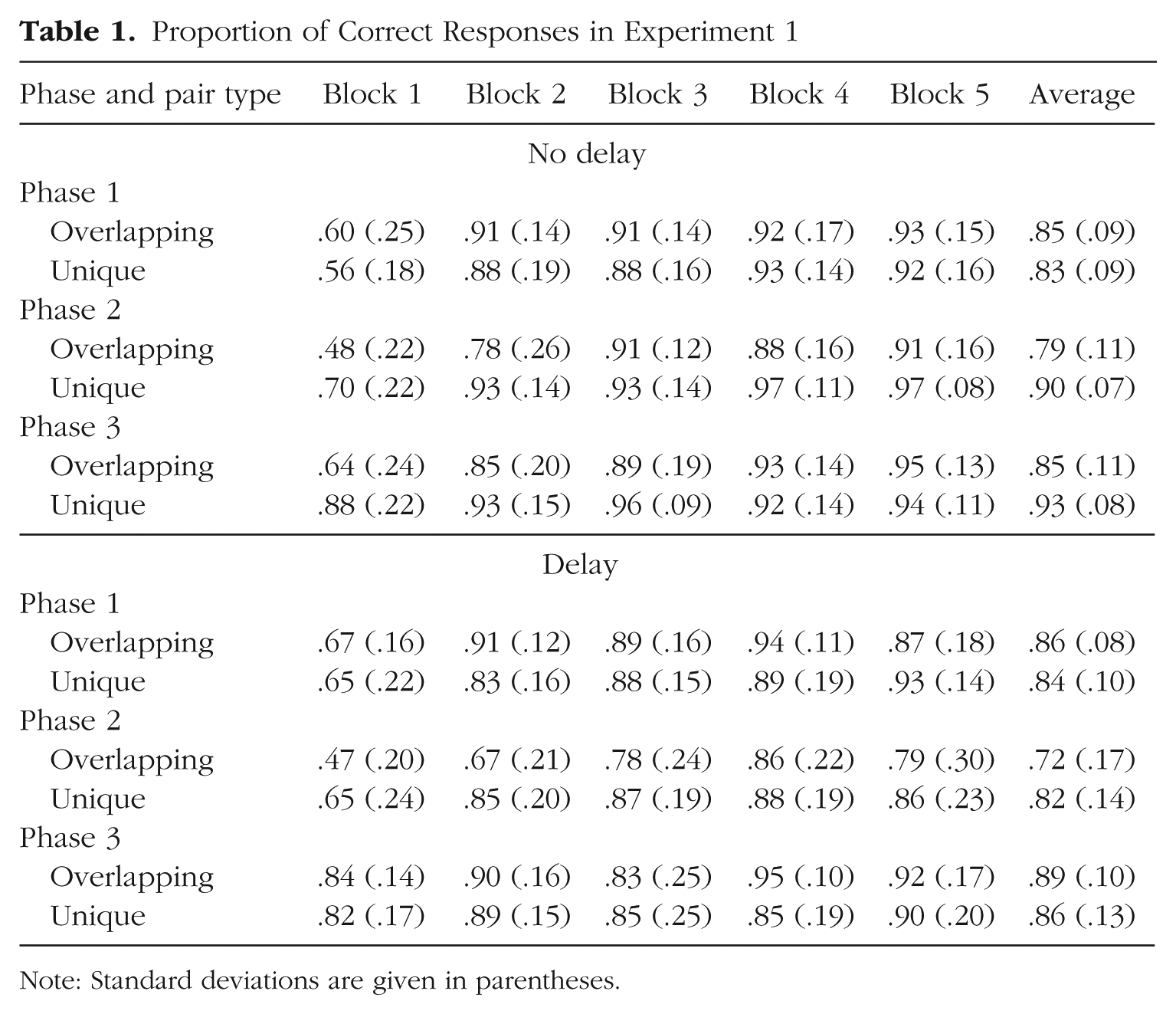
Note: Standard deviations are given in parentheses.

Mean proportion of correct responses for overlapping and unique pairs in the first and last blocks of Phase 1, as well as the first block of Phase 3. Results are shown separately for the two conditions in Experiment 1 and for Experiment 2. Error bars represent ±1 SEM.
No-delay condition
Results in the no-delay condition pointed to substantial retroactive interference, which was confirmed by a 2 (phase: 1 vs. 3) × 2 (pair type: overlapping vs. unique) repeated measures analysis of variance (ANOVA), which revealed a significant interaction, F(1, 24) = 13.04, p = .001, η p 2 = .35. Planned comparisons indicated that accuracy significantly decreased for overlapping pairs, t(24) = 6.82, p < .001, Cohen’s d = 1.39, but not for unique pairs, p = .46.
To determine the extent of retroactive interference effects on children’s memory, we also measured savings effects. Results pointed to savings for unique but not for overlapping pairs: A 2 (phase: 1 vs. 3) × 2 (pair type: overlapping vs. unique) repeated measures ANOVA revealed a significant interaction, F(1, 22) = 12.02, p = .002, η p 2 = .33, with savings transpiring for unique pairs, t(24) = 5.82, p < .001, d = 1.19, but not for overlapping pairs, p = .56. Substantial retroactive interference coupled with no savings for overlapping pairs points to catastrophic-like levels of retroactive interference, which replicates our previous findings (Darby & Sloutsky, 2015).
Delay condition
In contrast to participants in the no-delay condition, those in the delay condition exhibited no retroactive interference after 48 hr, with no Phase × Pair Type interaction, p = .20. Also, there were substantial savings for both overlapping and unique pairs, with a significant main effect of phase, F(1, 24) = 29.39, p < .001, η p 2 = .55, indicating significant savings for both unique pairs, t(24) = 3.60, p = .001, d = 0.72, and overlapping pairs, t(24) = 4.24, p < .001, d = 0.85. No other effects or interactions approached significance. This is a novel finding suggesting that a delay may reduce retroactive interference in children.
To directly compare retroactive interference effects in the delay and no-delay conditions, we performed a mixed ANOVA with phase (1 vs. 3) and pair type (overlapping vs. unique) as within-subjects factors and condition (no delay vs. delay) as a between-subjects factor. The three-way interaction was significant, F(1, 48) = 12.84, p = .001, η p 2 = .21, which indicates that children in the delay condition experienced significantly less retroactive interference than those in the no-delay condition.
We also compared children’s performance in the delay condition with adults’ performance in our previous study (Darby & Sloutsky, 2015; Experiment 2) using a mixed ANOVA with phase (1 vs. 3) and pair type (overlapping vs. unique) as within-subjects factors and age (children vs. adults) as a between-subjects factor. Notably, the three-way interaction was significant, F(1, 57) = 6.11, p = .016, η p 2 = .10, which suggests that children experienced less retroactive interference after a delay than adults did when tested immediately. Although cross-experiment analyses must be treated with caution, this counterintuitive finding points to an important role of consolidation in preserving memories.
Remarkably, when tested in Phase 3 after the delay, children exhibited better memory in the first block of Phase 3 (mean proportion correct = .84) than when tested immediately (mean proportion correct = .64), t(48) = 3.58, p = .001, d = 1.02. Therefore, a 48-hr delay resulted in substantially improved memory for overlapping information. This is another novel finding suggesting that in the absence of any intervention between study and test, memory can improve over time (see Henderson, Devine, Weighall, & Gaskell, 2015, for findings of improved word learning following delays). This improvement of memory over time indicates that at the time of study, children encoded enough information to form a configural memory trace during the delay.
Discussion
These results indicate that delaying testing for 48 hr both eliminates retroactive interference effects and improves memory for overlapping information in children. These remarkable findings point to a powerful role of consolidation on children’s memory. We suspect that consolidation can eliminate interference by contributing to the formation of configural memory structures. Note that, in contrast to children, adults demonstrated small retroactive interference even when tested immediately (Darby & Sloutsky, 2015), which suggests that adults are able to form configural memories on-line.
Overall, Experiment 1 demonstrated that children’s memory was improved and catastrophic-like retroactive interference effects were eliminated following a 48-hr delay. We suggest that the delay facilitated consolidation of configural memory traces for overlapping elements. However, it is also possible that the passage of time affected performance in a nonspecific way. For example, it is possible that delays facilitate configural memories for all pairs, regardless of overlap. If this is the case, then including a delay prior to the introduction of overlapping material (i.e., before Phase 2) should also eliminate interference and improve memory.
The goal of Experiment 2 was to address this possibility by introducing a 48-hr delay between Phases 1 and 2. In this case, no overlapping information was presented until after the delay. If the delay affected performance in a nonspecific way, no retroactive interference and better memory than in the no-delay condition should again be observed. However, if observing stimulus overlap is necessary for forming a configural code and thus reducing interference, then retroactive interference should transpire in this condition.
Experiment 2: The Effect of Information Structure on Consolidation
Method
Participants
Forty preschool-age children (M = 5.4 years, SD = 0.3, range = 4.8–6.0; 20 girls, 20 boys) participated. As in Experiment 1, children were recruited from day-care centers in the Columbus, Ohio, area and received a small reward for participating.
Stimuli and procedure
The stimuli and procedure were identical to those of Experiment 1, except that in this experiment, all children performed Phase 1 in one session and Phases 2 and 3 in a second session 48 hr later.
Results
Five children were excluded from the analysis after not completing the experiment, 2 because they asked to stop and 3 because they were absent from school on the day of the second session. As in Experiment 1, we also excluded children who failed to meet a learning criterion of at least 60% accuracy for both overlapping and unique pair types and 70% accuracy overall, averaged across all but the initial block of Phase 1. Six children were excluded as a result of this learning criterion. The final sample included 29 children (mean age = 5.4 years, SD = 0.3, range = 4.9–6.0; 19 girls, 10 boys).
Results point to substantial retroactive interference, which was confirmed by a significant Phase × Pair Type interaction, F(1, 28) = 4.24, p = .049, η p 2 = .13 (see Fig. 2; Table 2 presents accuracy from all blocks and phases). Planned comparisons indicated that accuracy attenuated significantly for overlapping pairs, t(28) = 7.35, p < .001, d = 1.39, as well as for unique pairs, t(28) = 3.09, p = .005, d = 0.58, although attenuation was greater for overlapping pairs (mean difference = .28) than for unique pairs (mean difference = .16), t(28) = 2.06, p = .049, d = 0.39.
Proportion of Correct Responses in Experiment 2
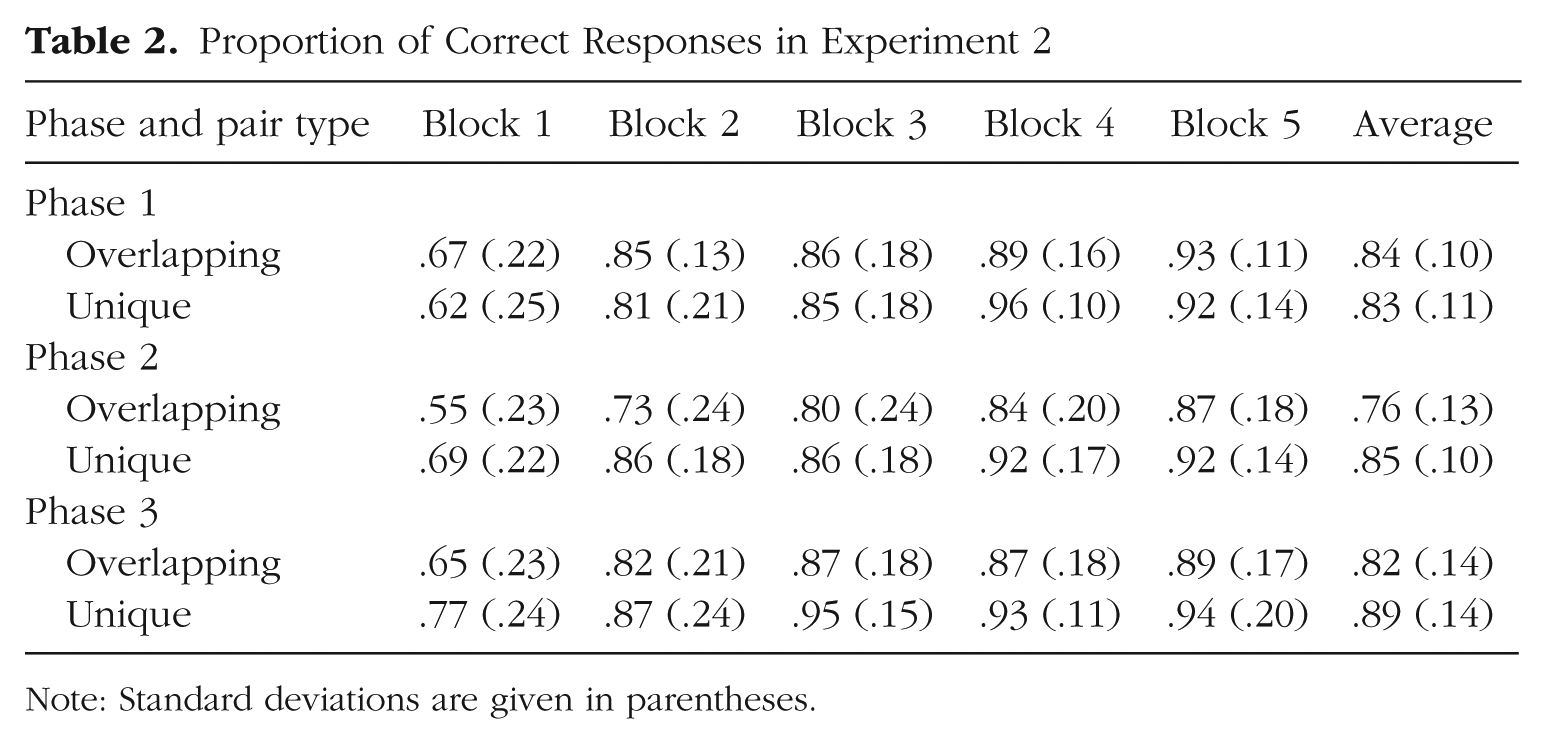
Note: Standard deviations are given in parentheses.
Results also suggest no savings for overlapping pairs coupled with substantial savings for unique pairs, which was confirmed by a significant Phase × Pair Type interaction, F(1, 28) = 6.21, p = .02, η p 2 = .18 (Fig. 2). Paired samples t tests indicated that savings were significant for unique pairs, t(28) = 3.00, p = .006, d = 1.19, but not for overlapping pairs, p = .61. These results point to marked retroactive interference coupled with no savings, which is similar to the no-delay condition of Experiment 1 but is in a sharp contrast to the delay condition of Experiment 1 (i.e., when the delay was introduced after Phase 2). This finding suggests that children’s memory may benefit from time delays only when overlapping information is encoded prior to the delay.
To further examine the specificity of the effects of delays, we compared memory for overlapping and unique sources of information across experiments. Figure 3 presents accuracy in the first block of Phase 3 for both pair types across Experiments 1 and 2. We performed a mixed ANOVA on these data with pair type (overlapping vs. unique) as a within-subjects factor and condition (Experiment 1 no delay vs. Experiment 1 delay vs. Experiment 2) as a between-subjects factor. The interaction between these factors was significant, F(2, 76) = 5.60, p = .005, η p 2 = .13, which indicates that changes across delays were not the same for overlapping and unique pairs. These analyses were followed up by one-way ANOVAs for each pair type. For the overlapping pairs, memory in Experiment 1 after the delay was better than in the other two conditions, as evidenced by a significant quadratic trend (p = .001). In contrast, for the unique pairs, delays resulted in (at least numerically) lower memory, and the linear trend approached significance, p = .078. This suggests that whereas accuracy for overlapping pairs was increased by a delay following Phase 2, perhaps because of the formation of a configural code, accuracy may have decreased following delays for unique pairs because of nonspecific sources of interference or memory decay. The finding that memory did not uniformly improve across delays indicates that forgetting does occur across delays in many situations (Hardt, Nader, & Nadel, 2013) and that benefits of consolidation may be specific to overlapping information. Therefore, a simple passage of time is not sufficient to eliminate catastrophic-like interference.
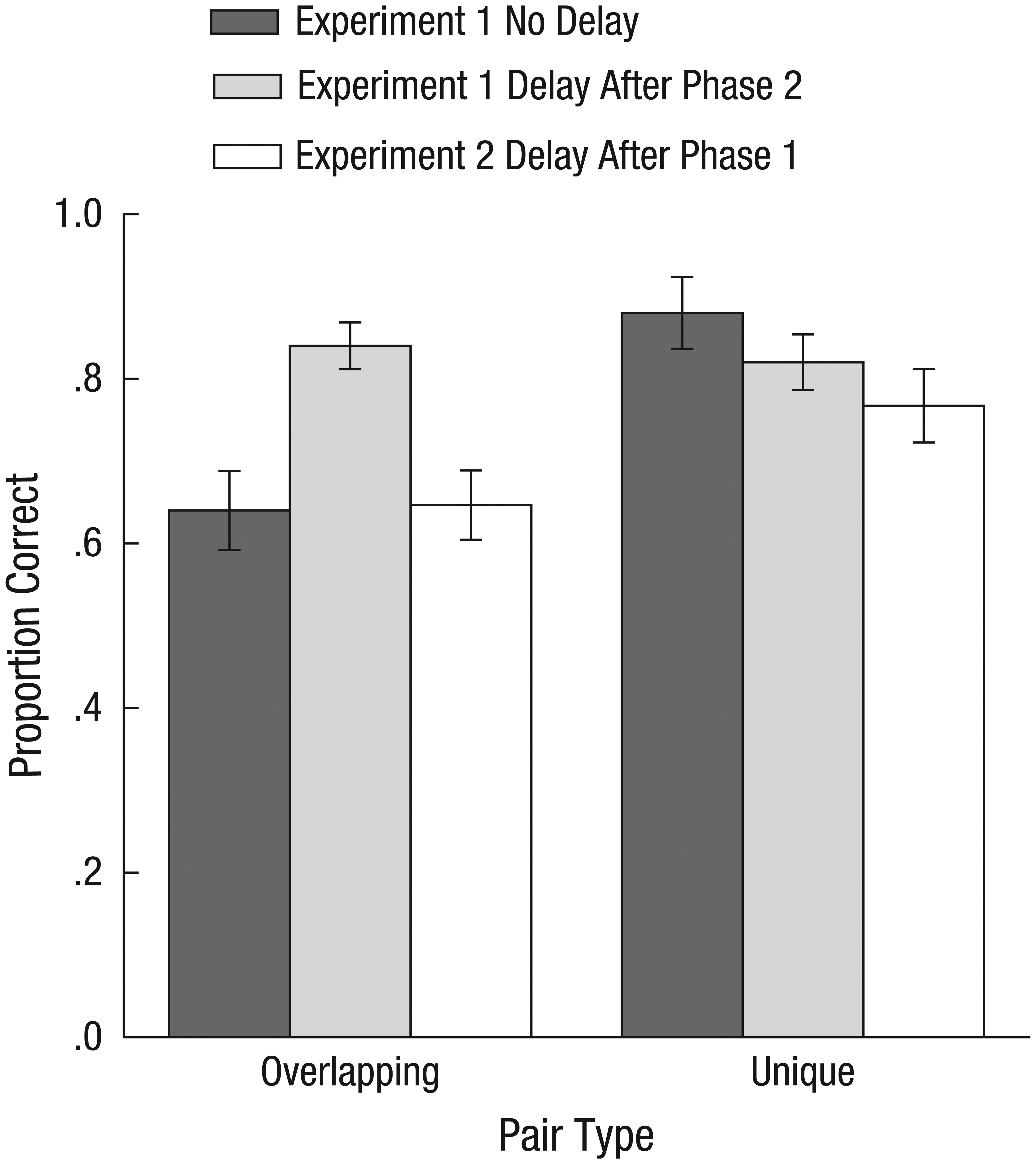
Mean proportion of correct responses for overlapping and unique pairs in the first block of Phase 3. Results are shown separately for the two conditions in Experiment 1 and for Experiment 2. Error bars represent ±1 SEM.
General Discussion
This study found that giving children a 48-hr delay between learning of overlapping information and testing improved their memory and eliminated effects of catastrophic interference. In contrast, when no delay was provided, children experienced catastrophic-like retroactive interference effects. Remarkably, children’s memory after the 48-hr delay was better than memory without the delay. These results suggest that although children may fail to form a configural memory code on-line, they can do so over a protracted period of time. Therefore, early in development, consolidation may protect memory from interference effects.
Consolidation, as discussed previously, is the process of memory stabilization (see McGaugh, 2000, for a review). This stabilization is the result of interactions between networks of information represented in the hippocampus and cortical areas (McClelland et al., 1995; Nadel & Hardt, 2011; Nadel, Hupbach, Gomez, & Newman-Smith, 2012). Many have provided evidence that much of this process takes place during sleep (see Stickgold, 2005, for a review), although little is known about the roles of sleep and wakefulness in reducing interference effects.
Why would consolidation reduce retroactive interference? One intriguing possibility is that consolidation creates more stable configural memory traces in the hippocampus (Hardt et al., 2013). The finding that children experience much greater retroactive interference than adults immediately following learning (Darby & Sloutsky, 2015) suggests that the neural function subserving the creation of a configural memory code on-line may be immature in children, such that consolidation is required to form such a code.
Notably, consolidation did not eliminate retroactive interference in all experiments: Retroactive interference remained high when children were provided with a delay after learning only Phase 1 information but not the entire set. We suggest, therefore, that knowledge of the overlapping stimulus structure (in conjunction with a delay) may be necessary to eliminate retroactive interference. Although accuracy for overlapping pairs was increased by a delay following Phase 2, accuracy for unique pairs was somewhat decreased by delays. Unique pairs, then, may have been subject to general interference (Wixted, 2004) or decay (Hardt et al., 2013), whereas overlapping pairs may have been protected by the formation of a configural code. This difference between pair types in conjunction with the results of Experiment 2 suggests that consolidation does not improve memory for all elements, but it may have more selective effects that form a configural memory code for overlapping sources of information (see Hardt et al., 2013, and Nadel et al., 2012, for discussions of consolidation and decay processes as selective and as affecting memory only for some information).
Implications for memory development
If retroactive interference is a major cause of forgetting (Wixted, 2004), understanding retroactive interference has important implications for memory development. Previous work suggests that children are highly vulnerable to retroactive interference effects from learning of overlapping information (Darby & Sloutsky, 2015), but results of the present experiments suggest that Phase 2 did not permanently erase children’s memory for Phase 1: Children encoded all the necessary information on-line, but binding of this information into a configuration required time.
Notably, consolidation may have a detrimental impact on children’s ability to generalize learning to new instances. Werchan and Gómez (2014) recently found that 2.5-year-old children were able to generalize word learning following 4 hr of wakefulness but not following 4 hr of sleep. These authors suggested that consolidation processes during sleep may have helped children remember specific instances of word-learning items but that this may have actually made it more difficult to extract the relevant category information during generalization. In contrast, children in the wakefulness condition may have forgotten some irrelevant details of the learning task while retaining relevant commonalities, leading to better generalization. It is for future research to directly investigate the relationships between retroactive interference, generalization, and consolidation, but an intriguing hypothesis is that consolidation may help children form configural memory traces and thus avoid interference, although these more stable and precise memory traces may decrease children’s ability to generalize this learning to new instances. Future research would need to also examine the precise developmental time course of these effects by including multiple age groups and identifying memory parameters accounting for developmental change (cf. Howe, Brainerd, & Kingma, 1985; Yim et al., 2013).
Conclusions
This study demonstrates remarkable effects of time delays on children’s memory: Providing children with a 48-hr delay following learning eliminated catastrophic-like retroactive interference effects and resulted in better memory than when no delay was provided. This suggests that during consolidation, children are able to form configural memory structures that protect information from retroactive interference effects. Although additional research is needed, these results have implications for better understanding the mechanism of memory and its development.
Footnotes
Declaration of Conflicting Interests
The authors declared that they had no conflicts of interest with respect to their authorship or the publication of this article.
Funding
This research was supported by National Institutes of Health Grant No. R01HD078545 to V. M. Sloutsky.
Open Practices
All data and materials have been made publicly available via Harvard Dataverse and can be accessed at https://dx-doi-org.web.bisu.edu.cn/10.7910/DVN/HDMGLY and https://dx-doi-org.web.bisu.edu.cn/10.7910/DVN/8N3H88, respectively. The complete Open Practices Disclosure for this article can be found at http://pss.sagepub.com/content/by/supplemental-data. This article has received badges for Open Data and Open Materials. More information about the Open Practices badges can be found at https://osf.io/tvyxz/wiki/1.%20View%20the%20Badges/ and  .
.
References
Supplementary Material
Please find the following supplemental material available below.
For Open Access articles published under a Creative Commons License, all supplemental material carries the same license as the article it is associated with.
For non-Open Access articles published, all supplemental material carries a non-exclusive license, and permission requests for re-use of supplemental material or any part of supplemental material shall be sent directly to the copyright owner as specified in the copyright notice associated with the article.
