




Abstract
In the present article, we introduce the concept of metaphorical conflict—a conflict between the concrete and abstract aspects of a metaphor. We used the association between the concrete (spatial) and abstract (ideological) components of the political left-right metaphor to demonstrate that metaphorical conflict has marked implications for cognitive processing and social perception. Specifically, we showed that creating conflict between a spatial location and a metaphorically linked concept reduces perceived differences between the attitudes of partisans who are generally viewed as possessing fundamentally different worldviews (Democrats and Republicans). We further demonstrated that metaphorical conflict reduces perceived attitude differences by creating a mind-set in which categories are represented as possessing broader boundaries than when concepts are metaphorically compatible. These results suggest that metaphorical conflict shapes social perception by making members of distinct groups appear more similar than they are generally thought to be. These findings have important implications for research on conflict, embodied cognition, and social perception.
Keywords
Concrete physical terms are often used metaphorically to describe abstract concepts and ideas (e.g., “He is a warm person”; Barsalou, 2008; Lakoff & Johnson, 1980; Morris, Sheldon, Ames, & Young, 2007). Previous research has emphasized that the correspondence between the physical and psychological components of a metaphor is crucial in guiding social perception (e.g., Ackerman, Nocera, & Bargh, 2010; Slepian, Weisbuch, Rule, & Ambady, 2011; Williams & Bargh, 2008). For example, holding a physically warm cup leads people to judge an ambiguous target person as having a psychologically warmer personality (Williams & Bargh, 2008). In this article, we introduce the idea of metaphorical conflict and propose that the physical and abstract aspects of a metaphor can be placed in conflict.
Internal conflicts occur when contradicting alternatives are simultaneously present (e.g., Emmons & King, 1988; Kleiman & Hassin, 2011, 2013; Petty, Tormala, Briñol, & Jarvis, 2006; Stern & Kleiman, 2015), and a person must consider these alternatives before making a judgment. Put differently, conflict is generally conceptualized as the misalignment between two alternatives that inherently clash (e.g., partying vs. studying on a Friday night). Integrating theories on conflict and embodied cognition, we propose that the traditional conceptualization of conflict can be expanded to include a unique form of conflict—metaphorical conflict—that refers to the misalignment between two concepts (concrete and abstract) that are culturally linked. Building on previous conflict research and using the metaphorical association between the physical (spatial) and abstract (ideological) dimensions of left and right (i.e., liberal-left and conservative-right; Oppenheimer & Trail, 2010), we demonstrated that metaphorical conflict has important consequences for social perception via alterations in cognitive processing.
Previous research suggests that creating conflict activates a general reasoning process (mind-set) that, once accessible, can be applied to subsequent judgments (Gollwitzer, 1990; Kleiman & Hassin, 2013; Mussweiler, 2014; Savary, Kleiman, Hassin, & Dhar, 2015). Specifically, when people are placed in a situation in which they consider multiple (possibly contradictory) perspectives, the cognitive system reacts by broadening the scope of information considered in new domains (Crisp & Turner, 2011; Hernandez & Preston, 2013; Kleiman & Hassin, 2013; Rees, Rothman, Lehavy, & Sanchez-Burks, 2013). Building on this idea, Huang and Galinsky (2011) argued that conflict could lead people to consider the possibility that objects belonging to distinct categories are more similar than they initially perceived them to be. Specifically, they found that people placed in a conflict (e.g., smiling while imagining a sad event) expanded their boundaries of distinctive categories and incorporated atypical exemplars into their category representations (e.g., including a wristwatch that is typically construed as belonging to the category of “jewelry” in the category of “clothing,” which suggests that people perceived a wristwatch as more similar to other objects typically construed as “clothing”). Taken together, previous studies suggest that conflict creates a general reasoning process that broadens the perceived boundaries of distinct categories, rendering them more similar.
In the present research, we proposed that metaphorical conflict might similarly create a mind-set that broadens the representation of category boundaries and facilitates perceiving distinct categories as less different. In turn, people may be more likely to perceive members of those categories as more similar. Specifically, we examined whether metaphorical conflict between the physical and ideological left and right affects perceived differences between the beliefs of members of opposing political parties. Americans perceive members of the Democratic and Republican parties as possessing antithetical beliefs (Westfall, Van Boven, Chambers, & Judd, 2015). Examining how metaphorical conflict shapes perceptions of attitude differences between party members is therefore a fruitful domain for testing our predictions. Additionally, previous research has demonstrated that conflict between groups can exacerbate perceptions of group differences (Riketta & Sacramento, 2008; Tajfel & Turner, 1979). We provided a novel advancement to intergroup-perception research by testing whether conflict within an individual attenuates perceptions of group differences.
In Study 1, we examined whether metaphorical conflict reduces perceived differences between presidential candidates’ attitudes. In Study 2, we examined whether metaphorical conflict also reduces perceived differences between typical members of the Democratic and Republican parties, and we ruled out an alternative explanation for Study 1’s findings. In Study 3, we demonstrated that metaphorical conflict reduces perceived differences and that metaphorical compatibility does not increase perceived differences. In Study 4, we directly tested our proposed mechanism, namely, whether metaphorical conflict creates a mind-set in which people expand distinct category boundaries, which in turn reduces perceived differences between politicians.
Study 1
In this study, we tested our basic hypothesis that metaphorical conflict reduces perceived differences between members of distinct groups. We examined perceptions of two political candidates leading up to the 2012 U.S. presidential election: Barack Obama and Mitt Romney. We predicted that participants in whom metaphorical conflict was created would perceive Obama and Romney as holding more similar beliefs than would participants in whom no conflict was created.
Method
Participants
Two hundred thirty-nine participants (116 female, 123 male; mean age = 35.21 years, SD = 13.13) were recruited from Amazon’s Mechanical Turk. All participants completed the study in October of 2012 (1 month before the 2012 elections). We selected a target sample size of 240 on the basis of an a priori power analysis indicating that such a sample size would provide approximately 80% power to detect a small to medium effect (d ≈ 0.35). 1 Thirteen additional participants completed this study but were excluded from analyses because they either failed an attention check (8 participants) or failed to accurately complete the study task (5 participants). 2 All participants reported being fully fluent in English.
Procedure
Metaphorical-conflict manipulation
Participants were first asked to quickly and accurately categorize pictures of Barack Obama and Mitt Romney. Five photographs of each of the candidates (displaying only the candidates’ upper torso and head) were obtained online and standardized to the same size. 3 Photographs were shown one at a time in random order. Each photograph appeared 10 times, for a total of 100 trials. Participants’ task was to categorize each photograph as either Obama or Romney.
To manipulate metaphorical conflict, we randomly assigned participants to categorize the targets using a key on the side of the keyboard that was either metaphorically compatible or metaphorically incompatible with the candidate’s ideology. Participants randomly assigned to the compatible condition (n = 122) used their left hand (“Q” key) to categorize a photograph as Obama and their right hand (“P” key) to categorize a photograph as Romney. Participants assigned to the incompatible condition (n = 117) had the opposite assignment of candidate to response hand. Thus, in the compatible condition, the physical action was performed with the hand (and at the physical location) that is metaphorically compatible with the candidate’s ideology (e.g., left for Obama), while in the incompatible condition, the physical action and the candidate’s ideology were metaphorically incompatible (e.g., right for Obama).
Perceptions of candidates’ beliefs
Next, to measure perceptions of the candidates’ ideologies, we asked participants to separately indicate the social, economic, and general ideologies of the candidates using scales from 1 to 9 (1 = extremely liberal, 5 = moderate, 9 = extremely conservative). For example, to assess perceptions of Obama’s social ideology, we asked participants to respond to the question, “Where on the following scale would you place Barack Obama’s beliefs about social and cultural issues?” The order in which participants provided their perceptions of each candidate (i.e., Obama first or Romney first) was counterbalanced. We created a single ideology score for each candidate by combining the three ratings (α = .89 and α = .82 for Obama and Romney, respectively).
Participants also indicated their perceptions of the candidates’ stances on 10 specific political issues (e.g., gun control) using scales from 1 (the candidate completely disagrees) to 7 (the candidate completely agrees). All issues, taken from Carter, Ferguson, and Hassin (2011), are listed in the Supplemental Material available online. For each candidate, we created a composite score of the 10 issues (α = .73 and α = .81 for Obama and Romney, respectively).
For both measures (i.e., general ideologies and specific beliefs), we calculated our dependent variable of the perceived difference between the candidates’ beliefs by subtracting Obama’s score from Romney’s score. Higher numbers indicate that Obama’s and Romney’s attitudes were perceived as further apart.
Results
An independent-samples t test with compatibility condition (compatible vs. incompatible) as the independent variable and the perceived difference between Romney’s and Obama’s general ideologies as the dependent variable showed a significant difference between conditions. Specifically, participants in the incompatible condition perceived the difference between the candidates’ ideologies as smaller than did participants in the compatible condition, t(237) = 2.06, p = .04, d = 0.27, 95% confidence interval (CI) for the mean difference = [0.02, 1.08] (see Table 1 for means and standard deviations). 4 Additionally, participants in the incompatible condition perceived the difference between the candidates’ stances on specific political issues as smaller than did participants in the compatible condition, t(237) = 2.38, p = .02, d = 0.31, 95% CI for the mean difference = [0.08, 0.82] (see Table 1).
Mean Perceived Difference Between the Two Candidates’ Political Attitudes
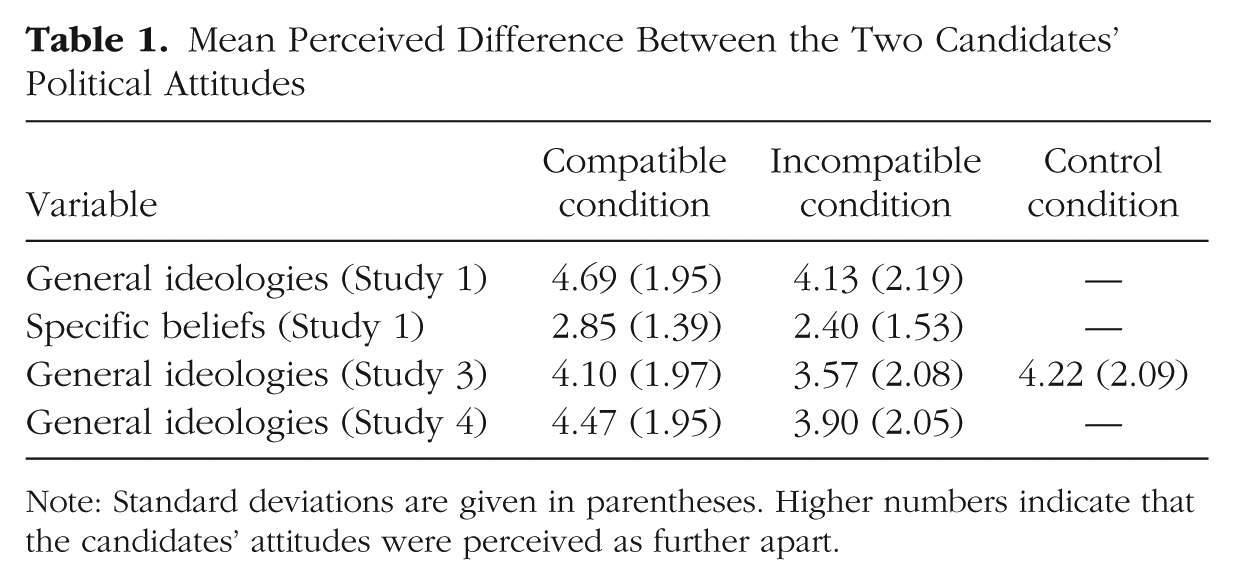
Note: Standard deviations are given in parentheses. Higher numbers indicate that the candidates’ attitudes were perceived as further apart.
Study 2
The results of Study 1 left open the possibility that the categorization task (which consisted of 100 trials) created new associations (i.e., Obama-right and Romney-left) that produced the observed effect. Study 2 was designed to conceptually replicate our effect using a different paradigm while ruling out this alternative explanation. Specifically, rather than having participants repeatedly complete a task in which they could learn new associations, we asked participants to estimate the ideology of the typical Democrat and Republican using a scale that was either compatible or incompatible with the metaphorical association linking spatial locations to political ideologies. Although new associations can be learned on a single trial (e.g., an odor can be linked with an aversive shock; Moriceau & Sullivan, 2006), changing preexisting associations that are culturally pervasive (e.g., liberal-left) generally necessitates the completion of large numbers of trials (Forbes & Schmader, 2010; Kawakami, Phills, Steele, & Dovidio, 2007; Wiers, Eberl, Rinck, Becker, & Lindenmeyer, 2011). Therefore, this single assessment of partisans’ beliefs was unlikely to create new associations. We expected that participants who provided responses using the incompatible scale would perceive partisans as holding more similar beliefs than would participants who used the compatible scale.
Method
Participants
Three hundred ninety-one participants (202 female, 189 male; mean age = 33.57 years, SD = 11.53) were recruited from Amazon’s Mechanical Turk. We selected a target sample size of 380 on the basis of an a priori analysis indicating that such a sample size would provide at least 80% power to detect the weighted average of the effects from Study 1 (d = 0.29). Three additional participants completed this study but were excluded from analyses for failing an attention check. All participants reported being fully fluent in English.
Procedure
Participants were told that we were interested in their perceptions of people’s beliefs. Drawing from previous research examining perceptions of partisans’ attitudes (e.g., Graham, Nosek, & Haidt, 2012), we asked all participants to indicate their perceptions of the typical Republican’s political attitudes and, separately, their perceptions of the typical Democrat’s political attitudes. Participants assigned to the compatible condition (n = 197) responded on a horizontally displayed scale ranging from 1 (extremely liberal) to 9 (extremely conservative). Note that this scale maintained the traditional spatial assignment of liberal views on the left and conservative views on the right. Participants assigned to the incompatible condition (n = 194) provided their response on a horizontally displayed scale with the values in the opposite sequence, that is, from 1 (extremely conservative) to 9 (extremely liberal). Note that this scale reversed the traditional spatial assignment and placed liberal views on the right and conservative views on the left, which metaphorically puts the physical location and ideology in conflict. The midpoint of the scale (5) was labeled moderate for all participants. We counterbalanced the order in which participants provided their perceptions of the typical Republican and typical Democrat.
To create the dependent variable of the perceived difference between the typical Republican’s and typical Democrat’s attitudes, we first reverse-coded responses in the incompatible condition so that higher scores would indicate more conservative attitudes in all conditions. We next subtracted perceptions of the typical Democrat’s attitudes from perceptions of the typical Republican’s attitudes. Higher numbers indicate that partisans’ attitudes were perceived as more different.
Results
An independent-samples t test revealed that, consistent with predictions, participants who rated their perceptions on the incompatible scale (M = 3.85, SD = 2.48) perceived the typical Republican’s and typical Democrat’s attitudes as more similar than did participants who rated their perceptions on the compatible scale (M = 4.41, SD = 2.32), t(389) = 2.33, p = .02, d = 0.24, 95% CI for the mean difference = [0.09, 1.04].
Study 3
In Study 3, we sought to rule out the possibility that metaphorical compatibility rather than conflict was driving the observed effect. Specifically, it is possible that compatibility leads people to perceive politicians as more different, rather than that conflict leads to perceptions of greater similarity. To account for this possibility, we added a control condition that did not involve the left-right metaphor to examine whether conflict, compatibility, or both were changing perceived differences.
Method
Participants
Four hundred ten participants (184 female, 226 male; mean age = 36.90 years, SD = 12.05) were recruited from Amazon’s Mechanical Turk. We selected a target sample size of 400 on the basis of an a priori analysis indicating that such a sample size would provide around 80% power to detect a small to medium effect (f = .16) in an omnibus analysis of variance with three conditions.
In Study 3, we assessed perceptions of highly recognizable politicians (Bill Clinton and George W. Bush). However, because these politicians were not currently running in a national election, their political party may not have been as widely known. Our theoretical argument is that a metaphorical conflict will occur only if participants know the politician’s political party. At the end of the study, we therefore asked participants which political party Clinton and Bush had belonged to during their presidency. We excluded participants if they did not correctly identify both politicians’ parties (31 participants). Thirteen additional participants completed this study but were excluded from analyses for either failing an attention check (7 participants) or failing to accurately complete the study task (6 participants).
Procedure
Metaphorical-conflict manipulation
The categorization task was identical to the task in Study 1, except that pictures of former presidents Bill Clinton and George W. Bush replaced pictures of Barack Obama and Mitt Romney, respectively. Specifically, participants assigned to the compatible condition (n = 136) used their left hand (“Q” key) to categorize a photograph as Clinton and their right hand (“P” key) to categorize a photograph as Bush. Participants assigned to the incompatible condition (n = 136) had the opposite assignment of candidate to response hand. Participants assigned to the control condition (n = 138) used the “T” key to categorize a photograph as Clinton and the “V” key to categorize a photograph as Bush. We chose these two keys because they are vertically aligned, and so using them to categorize liberal and conservative politicians would not prime any metaphorical association between spatial location and political beliefs. Additionally, we did not instruct participants to use any particular hand to categorize the candidates to further avoid priming the spatial-ideological metaphorical association. At the end of the study, participants reported which hand they used to categorize each candidate. Hand usage did not moderate the results (p = .30) and so is not discussed further.
Perceptions of candidates’ beliefs
To measure perceptions of the former presidents’ ideologies, we had participants separately indicate the social, economic, and general ideologies of Clinton and Bush using scales ranging from 1 to 9 (1 = extremely liberal, 5 = moderate, 9 = extremely conservative). We created a single ideology score for each former president by combining the three ratings (α = .88 and α = .89 for Clinton and Bush, respectively). We then calculated our dependent variable of the perceived difference between the former presidents’ beliefs by subtracting Clinton’s score from Bush’s score. Higher numbers indicate that Clinton’s and Bush’s attitudes were perceived as more different.
Results
We conducted a one-way analysis of variance with experimental condition (incompatible vs. compatible vs. control) as the independent variable and the perceived difference between the former presidents’ ideologies as the dependent variable. The effect of condition was significant, F(2, 407) = 3.95, p = .02, η2 = .02 (see Table 1 for means and standard deviations). Participants in the incompatible condition perceived the difference between the former presidents’ ideologies as smaller than did participants in the compatible condition, t(407) = 2.13, p = .03, d = 0.21, 95% CI for the mean difference = [0.04, 1.02], and those in the control condition, t(407) = 2.66, p = .008, d = 0.26, 95% CI for the mean difference = [0.17, 1.14]. Participants’ ratings in the compatible and control conditions did not significantly differ, t(407) = −0.51, p = .61, d = 0.05, 95% CI for the mean difference = [−0.61, 0.36].
Study 4
We had two main goals in Study 4. First, previous research has found that the metacognitive experience of difficulty reduces reliance on judgment heuristics (Alter, Oppenheimer, Epley, & Eyre, 2007). To rule out the possibility that difficulty explains our observed effects, we assessed the perceived difficulty of the task used to create metaphorical conflict. Second, we sought to provide evidence for the proposed mechanism by which metaphorical conflict reduces perceived differences between members of distinct groups. To reiterate our hypothesis, we reasoned that metaphorical conflict (in a similar way as other types of conflict; e.g., Huang & Galinsky, 2011; Kleiman & Hassin, 2013) activates a general mind-set in which people expand category boundaries and consider the possibility that stimuli belonging to these categories are more similar than when no such conflict exists. To measure this type of general mind-set, we used Rosch’s (1975) well-established category-inclusiveness task and assessed the extent to which people included atypical exemplars in their representations of distinct categories. We expected that activating this type of mind-set via creating metaphorical conflict would explain, in part, why such conflict leads people to perceive smaller differences between partisans than does creating metaphorical compatibility.
Method
Participants
Three hundred twenty-seven participants (170 female, 157 male; mean age = 34.96 years, SD = 11.69) were recruited from Amazon’s Mechanical Turk. We selected a target sample size of 340 on the basis of an a priori analysis indicating that such a sample size would provide around 80% power to detect the weighted average of the effect sizes from Study 1 (d = .29). 5 As in Study 3, we excluded participants if they did not correctly identify both politicians’ parties (44 participants). Twenty additional participants completed this study but were excluded from analyses for failing an attention check (16 participants), reporting low fluency in English (3 participants), or failing to accurately complete the study task (1 participant).
Procedure
Metaphorical-conflict manipulation
The categorization task was identical to that of Study 3, except that we did not include the control condition to simplify the design. Participants were randomly assigned to either the compatible condition (n = 163) or the incompatible condition (n = 164). Following the categorization task, we administered a category-breadth assessment to examine the extent to which metaphorical conflict created a general mind-set in which participants expanded their boundaries of distinct categories. Participants were shown 54 different items, each on a separate screen. For each item, participants were asked to rate the extent to which the item belonged to a general category that appeared above the item, using a scale from 1 (definitely does not belong to the category) to 10 (definitely does belong to the category). Eighteen items were presented for each of the categories of “vehicle,” “clothing,” and “furniture.” All items for a given category were shown before continuing to the items of the next category.
We randomized the presentation order of the categories and the order of items within each category (e.g., the presentation order of the clothing items). Within each category, six items were highly typical exemplars, six were moderately typical, and six were atypical (e.g., in the furniture category, “chair” and “table” were highly typical, “lamp” and “clock” were moderately typical, and “fan” and “telephone” were atypical). The typicality of the items was based on normed responses (Rosch, 1975). As in previous research (e.g., Isen & Daubman, 1984; Smith & Trope, 2006), we considered people to possess broader category boundaries if they included exemplars in a category to which they are not generally viewed as belonging. As such, inclusiveness ratings of the atypical exemplars were considered to be the critical items. The moderately and highly typical exemplars were already viewed as members of their respective categories and so acted as fillers. Following previous research (e.g., Huang & Galinsky, 2011), we created a composite of responses to the atypical exemplars to serve as a measure of category breadth. Higher numbers indicate a general reasoning process characterized by broadening the boundaries of distinct categories.
Perceptions of candidates’ beliefs
We measured perceptions of the former presidents’ ideologies in the same way as in Study 3 (α = .84 and α = .85 for Clinton and Bush, respectively). We then calculated our dependent variable of the perceived difference between the former presidents’ beliefs by subtracting Clinton’s score from Bush’s score. Higher numbers indicate that Clinton’s and Bush’s attitudes were perceived as more different. To assess metacognitive difficulty, we asked participants to indicate how difficult they found the categorization task using a scale from 1 (not at all difficult) to 7 (very difficult).
Results
Difficulty of categorization task
Participants in the incompatible condition reported that categorizing the pictures was marginally more difficult than did participants in the compatible condition, t(325) = −1.83, p = .068, d = 0.20. Importantly, all reported results remained unchanged when perceived difficulty was included as a covariate, which suggests that difficulty does not explain our observed effects.
Perceived partisan belief differences
The findings of Study 4 conceptually replicated those of Studies 1 and 3: Participants in the incompatible condition perceived the difference between the former presidents’ ideologies as smaller than did participants in the compatible condition, t(325) = −2.59, p = .01, d = 0.29, 95% CI for the mean difference = [0.14, 1.01] (see Table 1 for means and standard deviations).
Category breadth
We conducted an independent-samples t test with compatibility condition (compatible vs. incompatible) as the independent variable and perceived category breadth as the dependent variable. Consistent with predictions, results showed that participants in the incompatible condition (M = 3.97, SD = 1.57) perceived the distinct categories as broader than did participants in the compatible condition (M = 3.56, SD = 1.46), t(325) = 2.44, p = .02, d = .27, 95% CI for the mean difference = [0.08, 0.74]. 6
Mediation analysis
We next examined whether metaphorical conflict reduced the perceived difference between the former presidents’ beliefs through broadening the perceived boundaries of distinct categories (Fig. 1). We used Hayes’s (2013) Model 4 (a model specification with one exogenous variable, one mediator, and one outcome variable) in the PROCESS macro with 5,000 bootstrap resamples. The 95% confidence interval of the indirect effect did not include 0 [−0.0871, −0.0021], which indicated significant mediation (α = .05). Thus, participants in the incompatible condition perceived the political beliefs of Clinton and Bush as being closer together than did participants in the compatible condition, in part because they were more likely to think about distinct categories as possessing broader boundaries.

Schematic of the model showing the influence of the metaphorical-conflict manipulation on the perceived difference between former presidents Clinton’s and Bush’s ideologies, as mediated by the expansion of category boundaries (Study 4). Values inside parentheses are for direct paths; values outside parentheses are for paths after all variables were included in the model. Asterisks indicate significant paths (p < .05).
General Discussion
In four studies, we found evidence that a novel form of conflict—metaphorical conflict—produced marked effects on cognitive processing and social perception. After conflict was created between physical and abstract concepts that were metaphorically linked, participants perceived the attitudes of members of distinct groups as being less different than when concepts were compatible. We ruled out the alternative explanations that perceived differences might be reduced by learning novel associations (Study 2) or by metacognitive difficulty (Study 4) or that perceived differences might be increased as a result of compatibility (Study 3). We also demonstrated that metaphorical conflict reduced perceived differences in part through creating a general mind-set in which distinct categories are represented as possessing broader boundaries than generally supposed (Study 4).
In the present research, we examined category breadth as a mechanism through which metaphorical conflict affects social perception. This proposed mechanism is consistent with previous findings showing how conflict shapes cognitive processing (Huang & Galinsky, 2011; Kleiman & Hassin, 2013). However, because psychological processes can occur through multiple mechanisms (Higgins, 1998), it is important to consider additional routes through which metaphorical conflict might reduce perceived differences. For example, Marguc, Förster, and Van Kleef (2011) recently found that encountering a goal obstacle requires people to consider alternative ways to achieve the goal and, in turn, leads them to expand category boundaries. As such, creating conflict might foster a more global processing style, which in turn could reduce perceived group differences. In addition, considering alternative perspectives may be related to how systematically people process information. However, a person can engage in systematic thinking that does not involve considering alternatives (e.g., deeply processing only one perspective), which exaggerates perceptions of group differences (Darley & Gross, 1983; Kunda & Oleson, 1995; Wegener, Clark, & Petty, 2006). Therefore, we believe that conflict is unique in that it expands the breadth (rather than depth) of information considered.
The integrative nature of the present research contributes to several areas of psychological inquiry. First, we expanded the modal conceptualization of conflict and demonstrated that conflicts can also occur between concepts (physical and abstract) that have been culturally linked but are not inherently mutually exclusive. Metaphors and culturally constructed ideas are a pervasive component of language for structuring a complex social world (Barsalou, 2008). Therefore, understanding whether conflicts among culturally produced ideas shape cognitive processing in a similar way as do more concrete zero-sum conflicts opens a new area of inquiry concerning how conflict influences perceptions of reality. Second, our theoretical framework contributes to research on embodied cognition. Specifically, previous theorizing has focused on how concordance between concrete and abstract components of a metaphor links physical experiences to social perception (Ackerman et al., 2010; Slepian et al., 2011). By bridging research on conflict and embodied cognition, we demonstrated that whether the components of a metaphor are aligned or not has important implications for understanding how metaphors shape social judgment. Additionally, while we tested our question using a metaphor learned through contact with cultural discourse, it is possible that similar processes could also occur for “embodied” metaphors learned through physical experience (e.g., associating physical warmth with emotional positivity through experiencing interpersonal warmth; Williams & Bargh, 2008).
Finally, our framework contributes to research on intergroup relations. We demonstrated that in contrast to the finding that conflict between groups increases perceptions of group differences (Tajfel & Turner, 1979), conflict within a person can instead create a mind-set that fosters the consideration of alternative perspectives and attenuates perceptions of group differences. This finding holds important implications for promoting positive intergroup relations given that perceiving groups as holding antithetical beliefs undermines efforts to “reach across the aisle” and build collaborative networks (Turner, 1982). Moreover, because people are likely not as aware of how metaphorical conflict shapes their judgments (Kleiman & Hassin, 2013; Savary et al., 2015) as they are of how more explicit prompts do so (Saguy, Tausch, Dovidio, & Pratto, 2009), it is less likely that conscious goals (e.g., the desire for intergroup differentiation) would lead people to react against or correct for the influence of the conflict.
Footnotes
Declaration of Conflicting Interests
The authors declared that they had no conflicts of interest with respect to their authorship or the publication of this article.
Open Practices
All data have been made publicly available via Open Science Framework and can be accessed at https://osf.io/vq4ak/. The complete Open Practices Disclosure for this article can be found at http://pss.sagepub.com/content/by/supplemental-data. This article has received the badge for Open Data. More information about the Open Practices badges can be found at https://osf.io/tvyxz/wiki/1.%20View%20the%20Badges/ and  .
.
Notes
References
Supplementary Material
Please find the following supplemental material available below.
For Open Access articles published under a Creative Commons License, all supplemental material carries the same license as the article it is associated with.
For non-Open Access articles published, all supplemental material carries a non-exclusive license, and permission requests for re-use of supplemental material or any part of supplemental material shall be sent directly to the copyright owner as specified in the copyright notice associated with the article.
