



Abstract
Troy, A. S., Shallcross, A. J., & Mauss, I. B. (2013). A person-by-situation approach to emotion regulation: Cognitive reappraisal can either help or hurt, depending on the context. Psychological Science, 24, 2505–2514. (Original DOI:
This article examined joint effects of ability to use cognitive reappraisal (CRA), stress severity, and stress controllability on depression symptoms, as measured by the Beck Depression Inventory (BDI; Beck & Steer, 1984). It has come to the authors’ attention that the BDI scores of 7 participants (4% of the sample of 170) were slightly underestimated because they were exported from Internet data-collection software with a scale from 0 to 3, rather than the scale from 1 to 4 used for the rest of the sample. The correlation (r) between the corrected set of BDI scores and the originally reported set is .98 (N = 170). The authors have rerun all analyses reported in the article using the corrected scores. The results are unchanged except for slight changes in specific values for slopes and accompanying p values; in many cases, betas have changed by increments of 0.01 or less. The primary results of interest—three-way interactions of CRA, stress severity, and stress controllability, and their accompanying simple slopes—remain unchanged in terms of significance, effect size, and direction with one exception: One simple slope (the effect of CRA, as indexed by skin conductance, in the context of low control and high stress) that had been marginally significant (p = .07) is now statistically significant (p = .04). All main effects and two-way interactions remain unchanged in terms of significance, effect size, and direction, with the exception of a two-way interaction between stress severity and stress controllability that was not significant before (p = .06) and is now significant (p = .02; see Table 2). This interaction is not of theoretical significance to this article. In sum, the substantive results, their interpretation, and the conclusion remain completely unchanged.
Results of Regression Analyses Predicting Level of Depression From Stress Severity, Stress Controllability, and Two Measures of Cognitive-Reappraisal Ability (CRA)
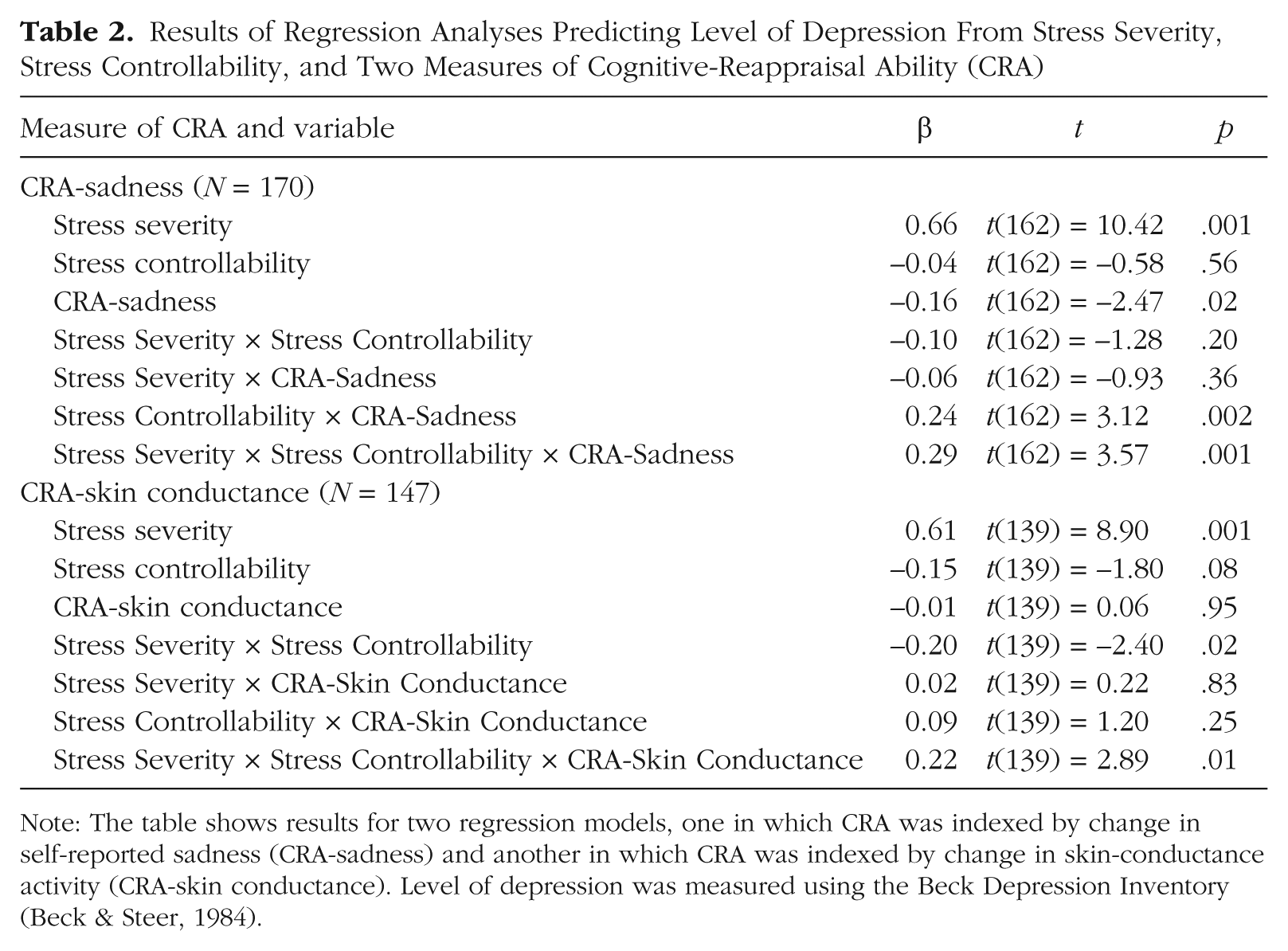
Note: The table shows results for two regression models, one in which CRA was indexed by change in self-reported sadness (CRA-sadness) and another in which CRA was indexed by change in skin-conductance activity (CRA-skin conductance). Level of depression was measured using the Beck Depression Inventory (Beck & Steer, 1984).
The Primary Analyses section of this article, and the accompanying table and figures, should read as follows:
Primary analyses
CRA-sadness
A multiple regression was conducted with level of depression as the dependent variable and CRA-sadness, stress severity, stress controllability, and all two- and three-way interactions among them as the independent variables. In the multiple-regression models, all main effects were mean-centered before we calculated interaction terms. Results are shown in Table 2. There were main effects of CRA-sadness and stress severity, a two-way interaction between CRA-sadness and stress controllability (see Additional Analyses and Fig. S1 in the Supplemental Material), and a three-way interaction between CRA-sadness, stress severity, and stress controllability. To examine the three-way interaction, we plotted values 1 standard deviation above and below the mean for each predictor according to the procedures outlined by Aiken and West (1991; see Fig. 1).
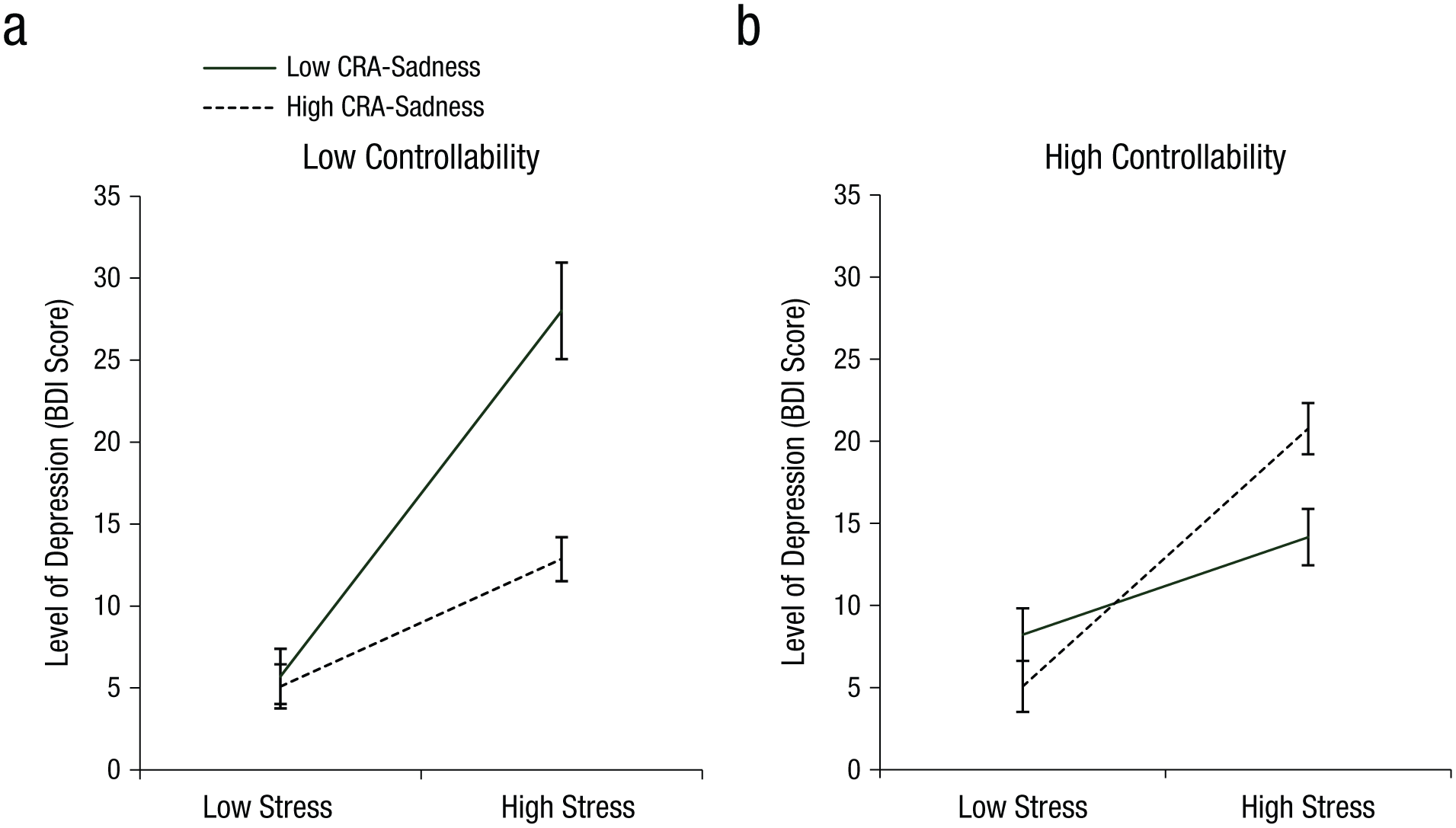
Mean level of depression as a function of stress severity and change in self-reported sadness during cognitive reappraisal (CRA-sadness). Results are shown separately for participants who experienced situations in which stress controllability was independently rated as (a) low and (b) high. High and low values in stress controllability, CRA-sadness, and stress severity refer to values 1 standard deviation above and below the mean, respectively. Level of depression was measured using a modified version of the Beck Depression Inventory (BDI; Beck & Steer, 1984); higher scores indicate greater depression. Error bars show standard errors of the mean.
In the context of low stress controllability, simple-slopes analyses revealed that the effect of stress was significantly greater than zero for participants with low levels of CRA-sadness, β = 1.1, t(162) = 5.8, p < .01, and for participants with high levels of CRA-sadness, β = 0.4, t(162) = 2.8, p < .01. However, the effect of CRA-sadness on level of depression in the context of low stress controllability and low stress severity was not significantly different from zero, β = −0.03, t(162) = −0.3, p = .79, whereas the effect of CRA-sadness in the context of low stress controllability and high stress severity was significantly less than zero, β = −0.8, t(162) = −3.6, p < .01. Thus, in the context of low stress controllability and high stress severity, greater CRA-sadness was associated with significantly lower levels of depression.
In the context of high stress controllability, the effect of stress was significantly greater than zero for participants with low levels of CRA-sadness, β = 0.3, t(162) = 2.6, p = .01, and for participants with high levels of CRA-sadness, β = 0.8, t(162) = 5.7, p < .01. However, the effect of CRA-sadness in the context of high stress controllability and low stress severity was not significantly different from zero, β = −0.2, t(162) = −1.5, p = .14, whereas the effect of CRA-sadness in the context of high stress controllability and high stress severity was significantly different from zero, β = 0.3, t(162) = 2.6, p = .01. This positive slope indicates that in the context of high stress controllability and high stress severity, greater CRA-sadness was associated with significantly higher levels of depression.
CRA-skin conductance
The same multiple regression model that was used to analyze CRA-sadness was run again, this time with change in skin-conductance activity as the index of CRA. Results are shown in Table 2. There was a main effect of stress severity, a two-way interaction between stress controllability and stress severity, and a three-way interaction among stress controllability, stress severity, and CRA-skin conductance. The three-way interaction is shown in Figure 2.
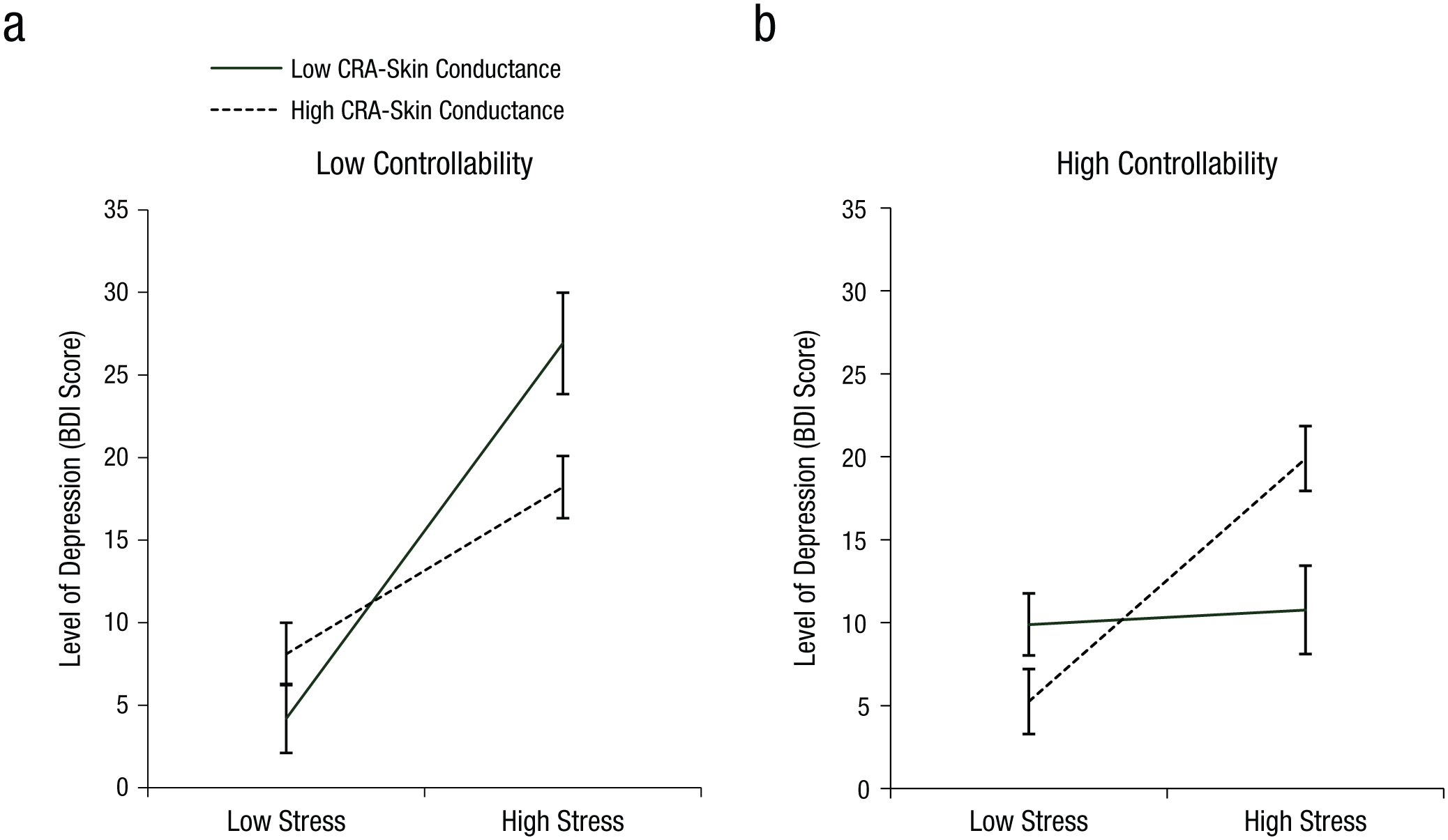
Mean level of depression as a function of stress severity and change in skin-conductance activity during cognitive reappraisal (CRA-skin conductance). Results are shown separately for participants who experienced situations in which stress controllability was independently rated as (a) low and (b) high. High and low values in stress controllability, CRA-skin conductance, and stress severity refer to values 1 standard deviation above and below the mean, respectively. Level of depression was measured using a modified version of the Beck Depression Inventory (BDI; Beck & Steer, 1984); higher scores indicate greater depression. Error bars show standard errors of the mean.
In the context of low stress controllability, the effect of stress on level of depression was significantly greater than zero for participants with low levels of CRA-skin conductance, β = 1.2, t(139) = 5.9, p < .01, and for participants with high levels of CRA-skin conductance, β = 0.5, t(139) = 3.07, p < .01. The effect of CRA-skin conductance on level of depression in the context of low stress controllability and low stress severity was not significantly different from zero, β = 0.2, t(139) = 1.2, p = .23, whereas the effect of CRA-skin conductance in the context of low stress controllability and high stress severity was significantly less than zero, β = −0.4, t(139) = −2.0, p = .04. Thus, this pattern is similar to that found for CRA-sadness: In the context of low stress controllability and high stress severity, greater CRA-skin conductance was associated with lower levels of depression.
In the context of high stress controllability, the effect of stress on level of depression was not significantly different from zero for participants with low levels of CRA-skin conductance, β = 0.04, t(139) = 0.24, p = .81, whereas the effect of stress was significantly greater than zero for participants with high levels of CRA-skin conductance, β = 0.7, t(139) = 4.7, p < .01. In the context of high stress controllability and low stress severity, the effect of CRA-skin conductance was not significantly different from zero, β = −0.2, t(139) = −1.6 p = .10, whereas in the context of high stress controllability and high stress severity, the effect of CRA-skin conductance was significantly greater than zero, β = 0.5, t(139) = 2.4, p = .02. Thus, in the context of high stress controllability and high stress severity, greater CRA-skin conductance was associated with significantly greater levels of depression.3