




Abstract
When people cannot get what they want, they often satisfy their desire by consuming a substitute. Substitutes can originate from within the taxonomic category of the desired stimulus (i.e., within-category substitutes) or from a different taxonomic category that serves the same basic goal (i.e., cross-category substitutes). Both a store-brand chocolate (within-category substitute) and a granola bar (cross-category substitute), for example, can serve as substitutes for gourmet chocolate. Here, we found that people believe that within-category substitutes, which are more similar to desired stimuli, will more effectively satisfy their cravings than will cross-category substitutes (Experiments 1, 2a, and 2b). However, because within-category substitutes are more similar than cross-category substitutes to desired stimuli, they are more likely to evoke an unanticipated negative contrast effect. As a result, unless substitutes are equivalent in quality to the desired stimulus, cross-category substitutes more effectively satisfy cravings for the desired stimulus (Experiments 3 and 4).
Substitutes are stimuli that can satisfy the same underlying need as the desired stimulus one cannot have (Nicholson, 1998). Substitution typically occurs within the same nominal category (within-category substitution), but stimuli from different categories can satisfy the same need (cross-category substitution; Russell et al., 1999). A graduate who fails to become an investment banker, for example, might take a job as a loan officer (within-category substitution) or a lawyer (cross-category substitution). A vegetarian with a hamburger craving might satisfy it by eating a veggie burger (within-category substitution) or a pizza (cross-category substitution). Although cross-category substitution is relatively common (Park & Gupta, 2011; Ratneshwar, Pechmann, & Shocker, 1996), little is known about the relative efficacy of within- and cross-category substitutes. We suggest that people prefer within-category substitutes to cross-category substitutes because of the former’s greater similarity to the desired stimulus, but that the greater similarity of within-category substitutes typically leads them to be less satisfying than cross-category substitutes.
Categorical structures in memory help classify, interpret, and evaluate stimuli and their substitutes by limiting and defining the set of alternatives with which a stimulus is compared (Barsalou, 1985; Loken, Barsalou, & Joiner, 2008). Barsalou (1983, 1985) has suggested that people utilize two types of categories. Taxonomic categories are used to classify stimuli such as cars, furniture, or foods on the basis of shared attributes (e.g., sedans, chairs, or chocolate). Goal-derived categories are constructed ad hoc for achieving goals, such as a list of possible snacks to eat at a ball game (e.g., peanuts and Cracker Jacks). Cross-category substitutes share relatively few features with the desired stimulus but belong to the same goal-derived category because they satisfy the same general need or consumption purpose (Ratneshwar, Barsalou, Pechmann, & Moore, 2001; Ratneshwar & Shocker, 1991). By contrast, within-category substitutes share many features with the desired stimulus and belong to its taxonomic category. Because taxonomic categories are well established in memory but goal-derived categories are typically created ad hoc, taxonomic category information should be more accessible when forming consideration sets in general and when selecting substitutes in particular (Ross & Murphy, 1999). We hypothesized that people thus prefer within- to cross-category substitutes.
We also hypothesized that this preference is usually a mistake. We suggest that the greater similarity of within-category substitutes to desired stimuli paradoxically makes them less satisfying than cross-category substitutes. Evaluations of a stimulus are influenced by comparison standards, such as salient stimuli in the present context, previously encountered stimuli retrieved from memory, and counterfactual alternatives generated at the time of judgment (e.g., Kahneman & Miller, 1986; Kassam, Morewedge, Gilbert, & Wilson, 2011; Morewedge, 2016). If differences between the stimulus and the comparison standard are noticed, the comparison can induce a contrast effect (Buechel, Zhang, Morewedge, & Vosgerau, 2014; Martin, Seta, & Crelia, 1990). Contrast effects are most likely to occur when comparison is easy—when the target and the standard are similar (Carter & Gilovich, 2010; Gentner & Markman, 1997; Morewedge, Gilbert, Myrseth, Kassam, & Wilson, 2010; Raghunathan & Irwin, 2001; Zellner, Rohm, Bassetti, & Parker, 2003).
Because within-category substitutes are more similar than cross-category substitutes to desired stimuli, they should be more likely to evoke a negative contrast effect when both are inferior to the desired stimulus. As most substitutes are inferior to the desired stimulus on at least one important attribute (e.g., quality), cross-category substitutes should generally be more satisfying than within-category substitutes. We tested our hypotheses in four experiments in the domain of food.
Experiment 1
In Experiment 1, we examined whether people believe that (more similar) within-category substitutes are more satisfying than (less similar) cross-category substitutes as surrogates for desired foods.
Method
Participants
Sample size was set to 100 participants. One hundred one workers from Amazon Mechanical Turk (45 women, 56 men; mean age = 36.02 years, SD = 11.17) completed a study on “human judgment and decision making” and received $1 as compensation. We restricted participation to respondents located in the United States with a 95% or higher approval rating.
Procedure
Each participant saw 10 separate sets of three foods: one desired food and two substitutes. For each set, they first indicated which of two foods would better satisfy their craving for the desired food if it were not available: a within-category substitute or a cross-category substitute (e.g., if the desired food was “a Chipotle burrito,” they could choose “a store-brand frozen burrito” or “KFC fried chicken” as the within- and cross-category substitute, respectively; see Table 1 for all stimuli). Sets, and choice options within sets, were presented in random order. Stimuli were chosen such that within-category substitutes were more similar than cross-category substitutes to the desired foods but were expected to be less enjoyable to consume (i.e., of lower quality). Participants were given the following information before seeing the stimulus sets: In some cases, we describe foods as a “store-brand” or “gas-station-brand” food. Please assume these foods are store-brand foods sold by your local supermarket, drug store, or gas station. For example, CVS milk chocolate would be a store-brand food.
Expected Enjoyment of All Stimuli and Choice Share of Within-Category Versus Cross-Category Substitutes in Experiment 1
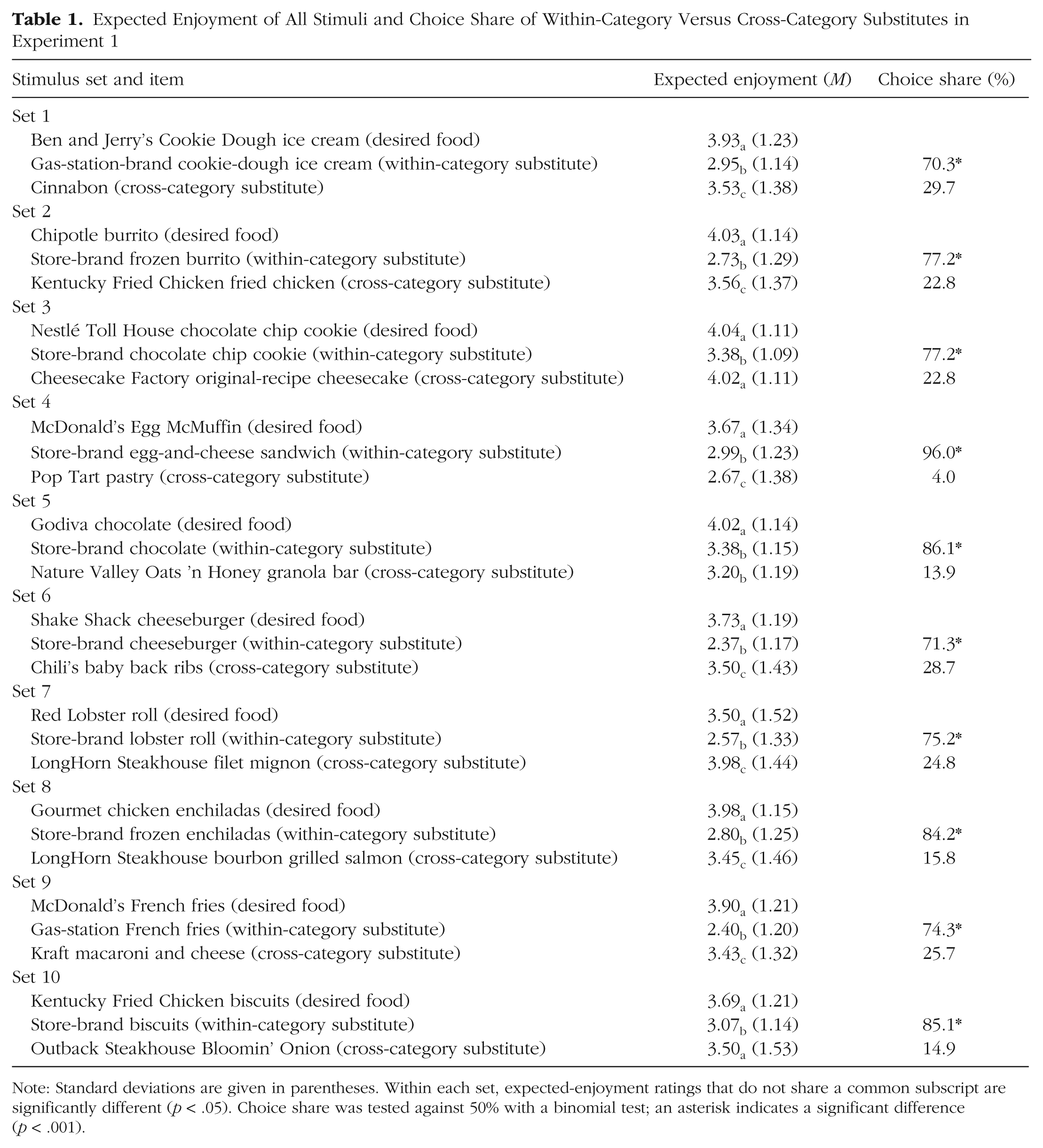
Note: Standard deviations are given in parentheses. Within each set, expected-enjoyment ratings that do not share a common subscript are significantly different (p < .05). Choice share was tested against 50% with a binomial test; an asterisk indicates a significant difference (p < .001).
Participants then indicated how much they expected they would enjoy eating each food in the set (i.e., desired food, within-category substitute, and cross-category substitute) and rated which of the two substitutes was more similar to the desired food. Participants rated the extent to which they expected to enjoy each food on a 5-point scale from 1, not at all, to 5, very much. Participants rated which of the two substitutes was more similar to the desired food on a 7-point scale with values closer to 1 indicating that the within-category substitute was more similar to the desired food, values closer to 7 indicating that the cross-category substitute was more similar to the desired food, and values at the midpoint (4) indicating that the two substitutes were equally similar to the desired food. Rating order was counterbalanced across participants.
Results
Manipulation checks
To test whether participants perceived the within-category substitutes to be more similar than the cross-category substitutes to the desired foods, we tested each of the 10 similarity ratings against the scale midpoint (4; they are equally similar). As expected, participants judged all within-category substitutes to be more similar than all cross-category substitutes to the desired foods (M = 1.68, SD = 0.92, range = 1.43–1.89), all ps < .001. On average, participants expected to enjoy eating the desired foods (M = 3.85, SD = 0.83) more than the cross-category substitutes (M = 3.48, SD = 0.81), and they expected to enjoy both more than the within-category substitutes (M = 2.86, SD = 0.90), all t(100)s > 7.53, all ps < .001. See Table 1 for item-by-item comparisons.
Preferences for substitutes
Despite expecting to enjoy eating within-category substitutes less than cross-category substitutes, participants more often chose within-category substitutes than cross-category substitutes to satisfy their craving for the desired foods (mean choice share for within-category substitutes = 79.7%); test against 50%: z = 5.97, p < .001. Choice shares were similar when we excluded the stimulus sets in which the within-category substitute was expected to be more enjoyable to eat than the cross-category substitute (i.e., Sets 4 and 5; M = 76.9%); test against 50%: z = 5.38, p < .001.
As a more rigorous test of whether similarity determined choices of substitutes, we regressed choices (0 = cross-category substitute, 1 = within-category substitute) on similarity and enjoyment ratings for the within- and cross-category substitutes in a logit model, with participants as random effects, Wald χ2(3, N = 101) = 108.98, p < .001. The intercept was significant (β = 4.70, SE = 0.68, z = 6.89, p < .001), which indicated that participants chose the within-category substitute significantly more often than the cross-category substitute. Participants were more likely to choose the within-category substitute to mitigate their craving for the desired food (a) the more they expected to enjoy eating the within-category substitute (β = 1.09, SE = 0.15, z = 7.43, p < .001), (b) the less they expected to enjoy eating the cross-category substitute (β = −0.91, SE = 0.12, z = −7.75, p < .001), and (c) the more similarly they rated the within-category substitute and the desired food (β = −0.98, SE = 0.17, z = −5.91, p < .001). The coefficients were essentially the same when Stimulus Sets 4 and 5 were excluded from the analysis.
In sum, across 10 sets of a variety of different foods, people believed within-category substitutes would be more likely than cross-category substitutes to satiate their cravings for desired foods, even though they anticipated those within-category substitutes would be less enjoyable to eat than the cross-category substitutes.
We next tested whether people would prefer less desirable within-category substitutes to more desirable cross-category substitutes when they would have to eat a substantial portion of the substitute they chose (Experiment 2a). We also tested whether their preference of substitute would change if they had experienced both substitutes before making their decision (Experiment 2b).
Experiment 2a
Method
Participants
We aimed for a minimum sample of 40 participants. Forty-four students at Carnegie Mellon University (27 women, 17 men; mean age = 20.07 years, SD = 1.58) received course credit for participating.
Procedure
Participants received a small portion of a gourmet chocolate (i.e., Ritter Sport chocolate with hazelnuts; 6.36 calories per gram) to whet their appetite for it (Wadhwa, Shiv, & Nowlis, 2008) and then chose and subsequently consumed a within- or cross-category substitute. Giant Eagle chocolate peanuts (a supermarket brand of chocolate; 5.25 calories per gram) served as the within-category substitute, and Nature Valley Oats ’n Honey granola bars (4.52 calories per gram) served as the cross-category substitute.
Participants in a “snack study” first ate one piece of the gourmet chocolate. Using analog scales, they then rated how much they liked that chocolate (from 0, dislike extremely, to 100, like extremely) and how much they craved another piece of it (from 0, not at all, to 100, very much). Next, participants chose the food (to consume)—the within-category substitute or the cross-category substitute—that would better satisfy their craving for the gourmet chocolate. Participants then ate 20 g of the substitute that they chose. After eating their chosen substitute, participants made similarity ratings for all three possible pairs of stimuli (i.e., gourmet chocolate and within-category substitute, gourmet chocolate and cross-category substitute, within- and cross-category substitutes) on 7-point scales from 1, very different, to 7, very similar. Finally, participants reported demographic information.
Results
Manipulation check
Participants rated the similarity of the desired food and the within-category substitute to be greater (M = 4.66, SD = 1.26) than the similarity of the desired food and the cross-category substitute (M = 1.98, SD = 1.02), F(1, 43) = 119.84, p < .001.
Chosen substitute
As predicted, the majority of participants (72.7%) chose to eat the within-category substitute rather than the cross-category substitute (test against 50%: z = 3.01, p = .003). We next examined whether reported craving for the gourmet chocolate influenced subsequent choice of substitutes. Reported craving was computed as the average of reported liking of and craving for the gourmet chocolate, r(42) = .70, p < .001, both measured after participants ate one small piece of it. We conducted a logistic regression with substitute choice as the dependent variable (0 = cross-category substitute, 1 = within-category substitute) and craving for the gourmet chocolate as a continuous independent variable. Participants who reported a greater craving for the gourmet chocolate were more likely to choose and consume the within-category than the cross-category substitute (β = 0.05, SE = 0.02), Wald χ2(1, N = 44) = 8.11, p = .004.
Experiment 2b
Method
Participants
We aimed for a minimum sample of 100 participants. One hundred three students at Boston University (55 women, 46 men, 2 who preferred not to specify gender; mean age = 19.50 years, SD = 0.82) received course credit for participating.
Procedure
As in Experiment 2a, participants first ate one piece of a gourmet chocolate (Ritter Sport chocolate with hazelnuts; 6.25 g, 39.8 calories) and rated the chocolate on the same scales as did participants in Experiment 2a. Participants were then randomly assigned to two conditions. Participants in the control condition did not taste either substitute before choosing one. Participants in the knowledgeable condition tasted one bite of each substitute before choosing one: the within-category substitute (a milk-chocolate-covered peanut; about 4.4 g, 23.1 calories) and the cross-category substitute (a piece of a Nature Valley Oats ’n Honey granola bar; about 5.3 g, 22.5 calories). The order of the two substitutes was counterbalanced.
All participants then chose which substitute would better satisfy their craving for the gourmet chocolate. Afterward, participants made similarity ratings for all three possible pairs of stimuli (i.e., gourmet chocolate and within-category substitute, gourmet chocolate and cross-category substitute, within- and cross-category substitutes) on 7-point scales from 1, very different, to 7, very similar. Finally, participants reported their age and gender.
Results
Manipulation check
To test whether participants perceived the within-category substitute to be more similar to the gourmet chocolate than to the cross-category substitute, we conducted a 2 (condition: control vs. knowledgeable; between participants) × 2 (similarity rating of substitute: within-category vs. cross-category; within participants) mixed analysis of variance (ANOVA) on their similarity ratings. A significant main effect of similarity was observed: Participants rated the within-category substitute (M = 4.70, SD = 1.39) to be more similar than the cross-category substitute (M = 2.30, SD = 1.18) to the gourmet chocolate, F(1, 101) = 201.48, p < .001. The main effect of condition was not significant, F < 1. The Condition × Similarity Rating interaction was significant, F(1, 101) = 5.81, p = .02. Participants in the control condition perceived the substitutes to be more different from each other (within category: M = 4.96, SD = 1.35; cross category: M = 2.09, SD = 1.20), F(1, 101) = 122.41, p < .001, than did participants in the knowledgeable condition, who tasted both substitutes before rating them (within category: M = 4.50, SD = 1.40; cross category: M = 2.47, SD = 1.14), F(1, 101) = 79.46, p < .001.
Chosen substitute
Choice share of the substitutes differed significantly between the two experimental conditions, χ2(1, N = 103) = 16.07, p < .001. As in Experiment 2a, the majority of control participants (88.9%) chose the within-category substitute (test against 50%: z = 5.07, p < .001). By contrast, knowledgeable participants were no more likely to choose the within-category substitute (51.7%) than the cross-category substitute (48.3%), z = −0.13, p = .90.
As in Experiment 2a, we tested the effect of postconsumption craving for the gourmet chocolate on the subsequent choice of the substitutes by averaging the measures of liking and craving for the gourmet chocolate (r = .70, p < .001) and then conducting a logistic regression with substitute choice as the dependent variable (0 = cross-category substitute, 1 = within-category substitute) and craving for the gourmet chocolate and experimental condition (0 = control, 1 = knowledgeable) as independent variables. Participants who had greater craving for the gourmet chocolate were marginally more likely to choose the within-category than the cross-category substitute (β = 0.02, SE = 0.01), Wald χ2(1, N = 103) = 3.46, p = .06. The results also confirmed that participants in the knowledgeable condition were less likely than participants in the control condition to choose the within-category substitute (β = −2.00, SE = 0.56), Wald χ2(1, N = 103) = 13.12, p < .001.
Discussion
Whereas the clear majority of control participants who had not tasted the substitutes preferred the within-category substitute to the cross-category substitute, knowledgeable participants who had tasted both substitutes before choosing were as likely to choose the within-category substitute as the cross-category substitute. The results suggest that people do not expect the negative contrast between the within-category substitute and the desired stimulus. Only if they have directly experienced the contrast by tasting the substitutes beforehand do they realize that the within-category substitute is less satisfying than expected and consider choosing the cross-category substitute.
Experiment 3
People prefer a within-category substitute to a cross-category substitute to satisfy their craving for a desired stimulus (Experiments 1, 2a, and 2b), unless they experience the negative contrast that the within-category substitute induces before they choose it (Experiment 2b). In Experiment 3, we tested the wisdom of this preference. We whetted the appetite of participants for a gourmet chocolate. We then randomly assigned them to eat a measured amount of one of three foods used in Experiments 2a and 2b: more of the gourmet chocolate, a within-category substitute (a store-brand chocolate), or a cross-category substitute (a granola bar). Without forewarning, participants were then given an opportunity to consume the gourmet chocolate again, this time ad libitum. We predicted that participants who consumed the within-category substitute would exhibit a stronger residual craving for the gourmet chocolate than would participants who consumed the cross-category substitute. They should thus consume a larger amount of the gourmet chocolate when they regained access to it.
Method
Participants
We aimed for 40 participants per experimental condition and collected data until the end of the semester. One hundred thirty-two residents of or students in Pittsburgh, Pennsylvania (70 women, 62 men; mean age = 24.42 years, SD = 8.43), were recruited and participated for $5 or partial course credit.
Procedure
All participants first ate one piece of the gourmet chocolate (i.e., Ritter Sport chocolate with hazelnuts). Next, participants rated how much they liked it on a 5-point scale from 1, not at all, to 5, very much, and answered filler questions about the extent to which it tasted sweet, salty, sour, and crunchy on 5-point scales from 1, not at all, to 5, very much.
Participants were then randomly assigned to three conditions. Participants in the desired-stimulus-repetition condition consumed an additional three pieces of the gourmet chocolate (i.e., 19 g, 120.9 calories). Participants in the within-category-substitute condition consumed 19 g (99.75 calories) of Giant Eagle chocolate peanuts. Participants in the cross-category-substitute condition consumed 19 g (85.95 calories) of Nature Valley Oats ’n Honey granola bars. In this portion of the experiment, participants were instructed to eat all 19 g of the food that they received.
All participants were then given a bowl containing 50 g (318 calories) of the gourmet chocolate and were told to eat as much as they liked. When participants finished, they notified the experimenter, who removed the bowl and surreptitiously weighed its contents. The amount participants ate was the primary dependent measure. Participants then rated the similarity of all three possible pairs of stimuli (i.e., gourmet chocolate and within-category substitute, gourmet chocolate and cross-category substitute, within- and cross-category substitutes) on 7-point scales from 1, very different, to 5, very similar. Finally, participants reported demographic information, their current affective state on the Positive and Negative Affect Schedule (Watson, Clark, & Telegren, 1988), and when and what they last ate before the experiment.
Results
No responses were classified as outliers (i.e., no one ate more than 3 SDs from their cell means). The following analyses include the full sample.
Manipulation check
Random assignment to condition appeared to be successful, as the initial liking of the gourmet chocolate, after consuming one piece, was not significantly different between conditions, F < 1. Participants perceived the within-category substitute to be more similar to the gourmet chocolate (M = 3.82, SD = 1.62) than to the cross-category substitute (M = 2.10, SD = 1.51), F(1, 131) = 87.17, p < .001.
Efficacy of the substitute
We analyzed the amount of the gourmet chocolate that was consumed ad libitum across the three conditions with a between-participants ANOVA, which yielded a significant main effect of condition, F(2, 129) = 3.37, p = .04, η p 2 = .05 (see Fig. 1). Planned comparisons revealed that participants in the within-category-substitute condition ate more of the gourmet chocolate (M = 20.82 g, SD = 14.95) than did participants in both the cross-category-substitute condition (M = 13.96 g, SD = 10.61), F(1, 129) = 5.42, p = .02, and the desired-stimulus-repetition condition (M = 14.43 g, SD = 15.46), F(1, 129) = 4.69, p = .03. The amount consumed in the cross-category-substitute and desired-stimulus-repetition conditions did not differ significantly, F < 1, n.s. Condition assignment did not influence the extent to which participants reported experiencing positive or negative affect, all Fs < 1.
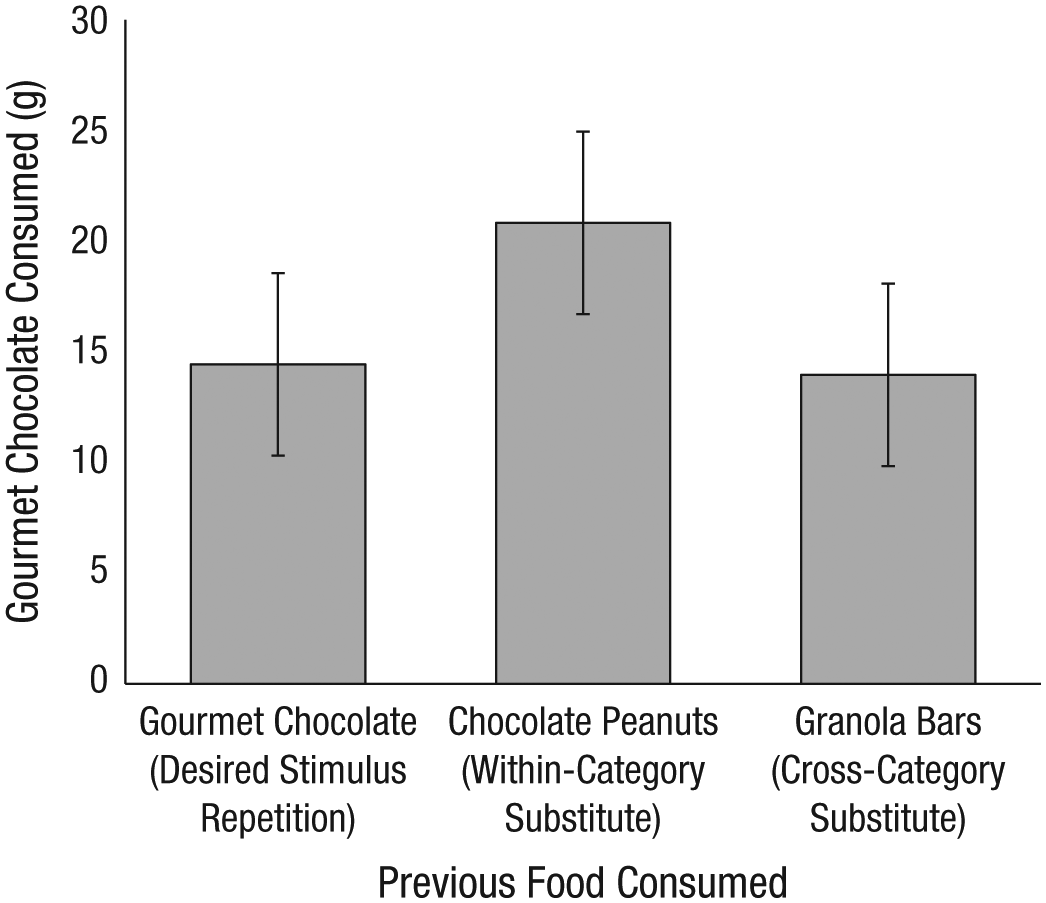
Amount of gourmet chocolate participants consumed ad libitum as a function of the type of food they were previously required to eat (Experiment 3). Error bars indicate 95% confidence intervals.
Discussion
By contrast to the predictions of participants in the previous experiments, participants in Experiment 3 who ate the cross-category substitute exhibited less residual craving for the desired stimulus than did participants who ate the within-category substitute. Indeed, participants who ate the cross-category substitute did not have a greater craving for the desired stimulus than did participants who ate the desired stimulus itself. In other words, the cross-category substitute was not only more satisfying than the within-category substitute, but it also appears to have been as good a substitute for the desired stimulus as that stimulus itself. In addition, this finding suggests that the greater efficacy of the cross-category substitute was not due to its consumption priming a health goal. If a health goal had been primed, participants who ate the cross-category substitute should have subsequently consumed less of the desired stimulus than participants in the desired-stimulus-repetition condition.
Experiment 4
Experiment 4 tested our process account of the greater efficacy of cross-category substitutes than within-category substitutes: that within-category substitutes are more likely to evoke a negative comparison with the desired stimulus. We varied the quality of the within- and cross-category substitutes so participants consumed a substitute that was either inferior or equivalent in quality to a desired food. We predicted that the quality of only the within-category substitutes would moderate subsequent craving for the desired food. The inferior within-category substitute should less effectively satisfy craving for the desired food than the within-category substitute of equivalent quality, because it should be more likely to evoke a negative comparison. The efficacy of cross-category substitutes should not be moderated by their quality, because neither cross-category substitute should evoke comparison to the desired food.
Method
Stimulus pretest
Twenty-seven residents of Pittsburgh, Pennsylvania (15 women, 12 men; mean age = 23.85 years, SD = 6.32), participated in a stimulus pretest for $5. Each participant tasted six different kinds of chocolate and five different granola bars. After tasting each food, participants indicated how much they liked it on a 7-point scale from 1, not at all, to 7, very much. On the basis of pairwise comparisons of the ratings, we chose Hershey’s milk chocolate with almonds as the desired chocolate (M = 6.48, SD = 1.58); Brach’s peanut clusters with chocolate as the within-category substitute of equivalent value (M = 6.07, SD = 1.75); Giant Eagle chocolate nonpareils as the within-category substitute of inferior value (M = 5.19, SD = 2.06); Nature Valley dark chocolate, peanut, and almond granola bar as the cross-category substitute of equivalent value (M = 5.81, SD = 2.42); and Giant Eagle trail-mix granola bar as the cross-category substitute of inferior value (M = 4.85, SD = 2.09). The desired chocolate did not significantly differ in quality from the substitutes of equivalent value—desired chocolate versus equivalent within-category substitute: t(26) = 1.17, p = .25; desired chocolate versus equivalent cross-category substitute: t(26) = 1.41, p = .17—and was superior in quality to the substitutes of inferior value—desired chocolate versus inferior within-category substitute: t(26) = 3.02, p = .006; desired chocolate versus inferior cross-category substitute: t(26) = 4.08, p < .001.
Participants
We aimed for 40 participants per experimental condition and collected data until the end of the semester. One hundred fifty-three residents of or students in Pittsburgh, Pennsylvania (68 women, 85 men; mean age = 23.40 years, SD = 7.69), were recruited and participated for $5 or partial course credit.
Procedure
All participants first sampled one piece (6 g, 31.67 calories) of the desired chocolate to whet their appetite (Wadhwa et al., 2008). Each participant then consumed one 100-calorie serving of one of the four substitutes (i.e., 19 g of Brach’s chocolate, 21 g of the Giant Eagle chocolate, 22 g of Nature Valley granola, or 25 g of the Giant Eagle granola), to which they were randomly assigned. Next, each participant was given a bowl containing 37 g or 74 g of the desired chocolate and consumed as much as he or she wanted. Initially, we gave 37 g of the desired chocolate to 89 participants. However, 27% of those participants ate all 37 g of the desired chocolate, so to avoid a ceiling effect, we increased the amount to 74 g for the remaining 64 participants. The change in the amount given was coded (0, 1) and included as a covariate in the analysis. The amount participants ate was our dependent measure.
Results
The responses of 3 participants were classified as outliers (i.e., they ate more than 3 SDs from their respective cell means) and therefore not included in the subsequent analyses. We examined the amount of the desired chocolate consumed in a 2 (category: within- vs. cross-category substitute) × 2 (quality: equivalent vs. inferior substitute) analysis of covariance with amount of the desired chocolate offered included as a covariate (which did not significantly influence the results, F < 1). The analysis revealed a significant main effect of quality, F(1, 145) = 4.33, p = .04, no significant main effect of category, F(1, 145) = 1.49, p = .22, and a significant Quality × Category interaction, F(1, 145) = 4.45, p = .04 (see Fig. 2). As predicted, participants who consumed the inferior within-category substitute subsequently consumed more of the desired chocolate (adjusted M = 27.14 g, SE = 2.33) than did participants who had consumed the equivalent within-category substitute (adjusted M = 17.65 g, SE = 2.36), F(1, 145) = 8.90, p = .003, η p 2 = .06. No differences in the amount consumed were found between participants who had consumed the inferior cross-category substitute (adjusted M = 20.38 g, SE = 2.39) and participants who had consumed the equivalent cross-category substitute (adjusted M = 18.71 g, SE = 2.39), F < 1. 1

Amount of the desired chocolate participants consumed as a function of whether they previously consumed a within-category or cross-category substitute, and whether the substitute was of equivalent or inferior quality to the desired chocolate (Experiment 4). Error bars indicate 95% confidence intervals.
Analyzing the data using nonparametric tests and including the three outliers yielded similar findings: Participants who had consumed the inferior within-category substitute consumed more of the desired chocolate than did participants who had consumed the equivalent within-category substitute, Mann-Whitney U = 525, p = .027. There was no difference between the amounts consumed by participants who had consumed the inferior and equivalent cross-category substitutes, Mann-Whitney U = 768.5, p = .485.
Discussion
Supporting our contrast account, the quality of the within-category substitute moderated its efficacy as a substitute for the desired stimulus, whereas the quality of the cross-category substitute did not. Participants continued to crave a desired chocolate more after eating the inferior within-category substitute than after eating the equivalent within-category substitute, but participants exhibited an equal craving for the desired chocolate after eating the inferior or the equivalent cross-category substitute. Thus, the inferior within-category substitute appeared to have evoked a negative contrast by comparison with the desired stimulus, whereas the inferior cross-category substitute did not.
General Discussion
Substitutes are usually inferior to the stimulus they are intended to replace. The results of the experiments we report here suggest that the heuristic people use to choose substitutes is usually misguided. Participants believed that within-category substitutes would more effectively satisfy their craving for a desired stimulus than would cross-category substitutes of similar or superior quality. By contrast, cross-category substitutes were more satisfying than within-category substitutes when both were inferior to the desired stimulus.
As indicated by their predictions and real choices, participants believed that within-category substitutes would more effectively satisfy their craving for a variety of foods than would cross-category substitutes, even though the cross-category substitutes were (generally) more desirable (Experiments 1, 2a, and 2b). Indeed, participants exhibited a stronger preference for the within-category substitute when they had a stronger craving for the desired stimulus (Experiments 2a and 2b). Participants appeared to exhibit this preference because they did not anticipate the negative contrast effect that the within-category substitute would evoke. Experiencing that contrast before choosing between a within- and a cross-category substitute significantly reduced the preference for the within-category substitute (Experiment 2b).
Contrary to participants’ belief that within-category substitutes are more satisfying, a cross-category substitute more effectively reduced cravings for a desired stimulus than did a within-category substitute in Experiment 3. Indeed, consuming the cross-category substitute was as effective at reducing cravings for the desired stimulus as consuming the desired stimulus itself. Experiment 4 replicated this effect and demonstrated that cross-category substitutes appear to be more satisfying because they are less likely to evoke a negative comparison to the desired stimulus. When substitutes were of lower quality than the desired stimulus, a cross-category substitute was more effective than a within-category substitute in satisfying craving for the desired stimulus.
The results of Experiment 4 also indicate a boundary condition for the greater efficacy of cross-category than within-category substitutes. When substitutes were equivalent in quality to a desired stimulus, a within-category substitute was as effective as a cross-category substitute in satisfying craving for that desired stimulus. Presumably, the comparison evoked by the within-category substitute did not evoke a negative contrast. Substitutes are usually inferior to the desired stimuli they are intended to replace, but these results suggest that a within-category substitute will be as satisfying as a cross-category substitute when both are equivalent in quality to the desired stimulus.
Previous research in this area has examined how personal and situational goals can influence category representations of consumer products (e.g., Ratneshwar et al., 2001). To our knowledge, this is the first research to examine how these different forms of categorization (taxonomic and goal derived; Barsalou, 1983, 1985) influence preferences for and the efficacy of substitutes. Our findings imply that categorization may guide people to construct consideration sets and exhibit preferences that result in suboptimal decisions. We found that people prefer within-category substitutes sharing taxonomic-category membership with desired stimuli, but cross-category substitutes belonging to the same goal-derived category better satisfied their cravings in the domain of food. When similar alternatives to a desired stimulus are inferior, people may be better off satisfying their desires with more dissimilar alternatives fulfilling the same high-level goal. We expect these findings to extend to other consequential domains, such as jobs, benefits, and consumer goods. Of course, cross-category substitutes have to meet the same needs or serve the same function as the desired stimulus. For example, we assume that people who want a 60-in. television will be more satisfied if they choose a 42-in. television as its substitute rather than an expensive coffeemaker.
Substitutes are typically equivalent or inferior to desired stimuli with respect to at least one important attribute. In these experiments, we examined substitute efficacy as a function of a single attribute, quality based on taste. Future research could extend our findings by examining the interplay of categorization with multiple attributes, such as price and quality. When substitutes are inferior to a desired stimulus on one attribute but superior on other attributes, there may be interesting cases in which within-category substitutes are more desirable than cross-category substitutes because they are easier to compare with the desired stimulus. Greater ease of comparison may make it more satisfying to be “forced” to purchase an expensive but higher quality luxury good, for instance, when it is the only available substitute for the product one desires.
Footnotes
Acknowledgements
This article is based on a part of the first author’s dissertation. We thank Tina Aliprando, Katherine Cuti, Alejandro Reyes-Morales, and Taylor Turrisi for help with data collection, and Thomas Otter for helpful comments.
Action Editor
Gretchen B. Chapman served as action editor for this article.
Declaration of Conflicting Interests
The authors declared that they had no conflicts of interest with respect to their authorship or the publication of this article.
Open Practices
All data and materials have been made publicly available via the Open Science Framework and can be accessed at https://osf.io/maf3d and https://osf.io/mxnea, respectively. The complete Open Practices Disclosure for this article can be found at http://pss.sagepub.com/content/by/supplemental-data. This article has received the badges for Open Data and Open Materials. More information about the Open Practices badges can be found at https://osf.io/tvyxz/wiki/1.%20View%20the%20Badges/ and  .
.
Notes
References
Supplementary Material
Please find the following supplemental material available below.
For Open Access articles published under a Creative Commons License, all supplemental material carries the same license as the article it is associated with.
For non-Open Access articles published, all supplemental material carries a non-exclusive license, and permission requests for re-use of supplemental material or any part of supplemental material shall be sent directly to the copyright owner as specified in the copyright notice associated with the article.
