



Abstract
In four experiments, we tested the community-of-knowledge hypothesis, that people fail to distinguish their own knowledge from other people’s knowledge. In all the experiments, despite the absence of any actual explanatory information, people rated their own understanding of novel natural phenomena as higher when they were told that scientists understood the phenomena than when they were told that scientists did not yet understand them. In Experiment 2, we found that this occurs only when people have ostensible access to the scientists’ explanations; the effect does not occur when the explanations exist but are held in secret. In Experiment 3, we further ruled out two classes of alternative explanations (one appealing to task demands and the other proposing that judgments were mediated by inferences about a phenomenon’s understandability). In Experiment 4, we ruled out the possibility that the effect could be attributed to a pragmatic inference.
People depend on one another for support, succor, friendship, and assistance. They also depend on one another to think. When reading a poem, for example, people’s thoughts are governed—or at least stimulated—by the author’s thoughts. But the dependence of a person’s thoughts on those of other people may go deeper than that. In the experiments reported here, we investigated the hypothesis that people fail to distinguish the knowledge that resides in their own heads from the knowledge that resides in other people’s heads.
In a classic article, Putnam (1975) argued forcefully that the meanings of natural-kind terms do not reside in the head but rather in the community of speakers (see also Kripke, 1972). A speaker might say, “Molybdenum has a high melting point” and believe that this statement is true, despite being unable to pick out a single instance of molybdenum. The truth of the statement derives from the belief that experts can identify the referent of the word molybdenum and provide evidence for the assertion. Putnam’s view is called essentialism. Medin and Ortony (1989; see also Gelman, 2003) have argued for psychological essentialism, the claim that people’s concept of a natural kind includes knowledge about the category’s most central feature (i.e., the essence; but see Sloman, Lombrozo, & Malt, 2007).
Psychological essentialism’s claim is about what people know; specifically, it is about the structure of concepts. But the philosophical hypothesis has another aspect, externalism, the claim that meaning depends on other people’s knowledge. Does externalism hold in the domain of conceptual knowledge (as opposed to word meaning)? Do people’s thoughts about concepts depend on others’ knowledge? The claim that much of what people know resides in their physical bodies and in the environment is now familiar (for review, see M. Wilson, 2002). In the current discussion, we focus on whether people’s sense of what they know depends on what other people know.
Wegner’s (1987, 1995) transactive-memory hypothesis asserts that it does; the memory of a group includes the communication that takes place between individuals. Giuliano (cited by Wegner, 1987) and Wegner (1987) found not only that each member of a couple defers to the other’s expertise to store and recall items relevant to that expertise, but also that the effort one member makes to remember is inversely proportional to his or her partner’s expertise. Ward (2013) found that people tend to confuse whether responses to trivia questions come from their own knowledge or from a familiar Internet resource. Moreover, people recall less of what they have learned when they know the information is stored on a computer (Sparrow, Liu, & Wegner, 2011; Storm & Stone, 2015).
R. A. Wilson and Keil (1998) argued that people make claims that are underwritten by other people’s knowledge. They referred to such underwriting of one person’s concepts by another person’s concepts as a community of knowledge (a phrase found in Welbourne, 1981, and an idea foreshadowed by Hardwig, 1985). Indirect support for the claim comes from the illusion of explanatory depth (Rozenblit & Keil, 2002). Asking for a detailed explanation of how common devices work tends to reveal participants’ lack of knowledge, reducing their ratings of their own understanding. Fernbach, Rogers, Fox, and Sloman (2013) extended the effect to the domain of social policy, and Alter, Oppenheimer, and Zemla (2010) showed that the effect was due to an abstract construal of the objects of judgment. One account of this illusion is that people confuse their own understanding with that of others who do understand. The fact that others understand gives participants a sense of understanding that is shattered by their failure to explain.
In the current experiments, we tested the hypothesis that people do not enforce a sharp separation between their own understanding and that of others. We did so by asking participants how well they understood a novel phenomenon while manipulating whether participants were told that other people did or did not know the explanation for it. The fact that one person knows why a phenomenon occurs should have no bearing on another person’s understanding. Our prediction that it would was based in part on other demonstrations of minimally relevant information influencing judgments of explanation quality. Weisberg, Keil, Goodstein, Rawson, and Gray (2008) found that novices and students rated bad explanations as being more satisfying when information irrelevant to the explanations was added (this finding was replicated by Michael, Newman, Vuorre, Cumming, & Garry, 2013, and extended by Fernandez-Duque, Evans, Christian, & Hodges, 2014, and Weisberg, Taylor, & Hopkins, 2015). Related results have been reported by Tal and Wansink (2014), Haard, Slater, and Long (2004), McCabe and Castel (2008), and Keehner, Mayberry, and Fischer (2011), but see Gruber and Dickerson (2012), Schweitzer, Baker, and Risko (2013), and Hook and Farah (2013). There is also evidence that the greater sense of understanding caused by adding irrelevant information to relevant information is independent of actual understanding (Ikeda, Shinji, Takahashi, Hattori, & Ito, 2013). In the current experiments, we tested whether simply telling people that scientists understand a phenomenon was sufficient to increase ratings of understanding.
Experiment 1
When a previously unknown natural phenomenon is discovered, there is no communal knowledge about how it works until somebody comes up with a convincing account of it. Experiment 1 tested the community-of-knowledge hypothesis by eliciting ratings of understanding for newly discovered natural phenomena while varying whether a group of scientists understood it. We predicted low ratings of understanding overall, given the unfamiliarity of the stimuli, but higher ratings for items that were said to be understood by scientists.
Method
Eighty-two U.S. residents (40% female, 60% male; mean age = 31.3 years) were recruited using Amazon’s Mechanical Turk and participated in return for a small payment. Sample size was chosen to satisfy counterbalancing schemes and was in keeping with related prior research. The instructions, adapted from Rozenblit and Keil (2002), explained in detail how to use a rating scale to reflect a sense of causal understanding. A cover story suggested that the study concerned recent scientific discoveries. Participants read four fictional descriptions of newly discovered natural phenomena and rated their understanding (“How well do you understand how ___ works?”) on a scale from 1 to 7 (1 = little to no understanding, 4 = moderate understanding, and 7 = detailed and deep understanding). Each participant read two descriptions indicating that a given phenomenon had been thoroughly explained by the discovering scientists (communal knowledge, or CK, condition) and two indicating that it had not yet been explained (no-CK condition; see Table 1 for examples). The order of items and conditions was fully counterbalanced. Details about the scientists and reporting journals were included to camouflage the manipulation, but the descriptions contained no causal or explanatory information. Participants then answered a question about mood that was incorporated as an attention check.
Example Stimuli From Each Experiment
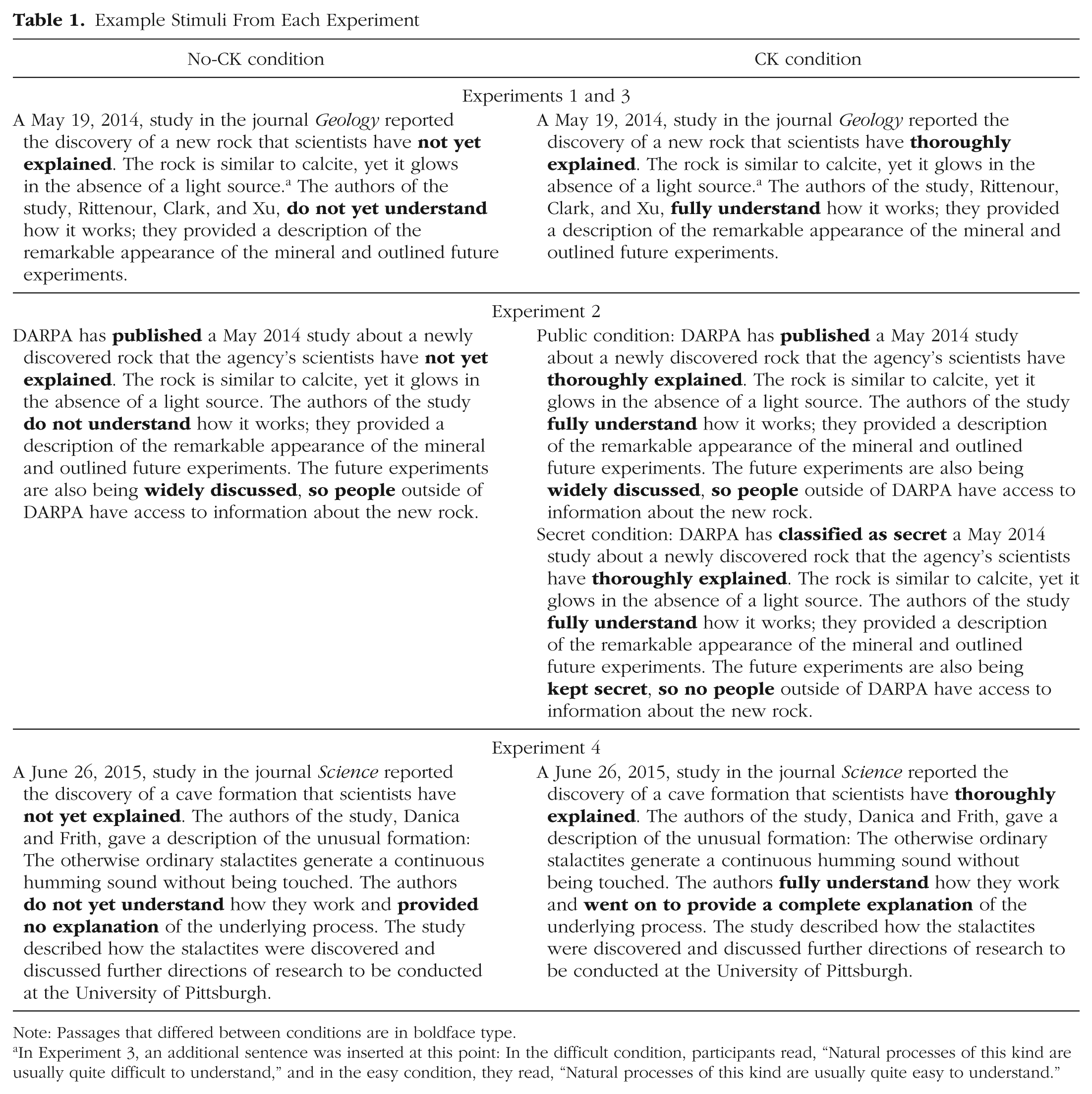
Note: Passages that differed between conditions are in boldface type.
In Experiment 3, an additional sentence was inserted at this point: In the difficult condition, participants read, “Natural processes of this kind are usually quite difficult to understand,” and in the easy condition, they read, “Natural processes of this kind are usually quite easy to understand.”
Results
Data from participants who failed the attention check (n = 12) were excluded. As expected, ratings tended to be low on the scale (Ms = 1.79 and 2.42 in the no-CK and CK conditions, respectively), yielding a positively skewed distribution. We therefore used a log transformation to increase the normality of the scores. A paired-samples t test of the log-transformed ratings of understanding revealed that they were significantly higher in the CK condition (M = 0.28, 95% confidence interval, or CI = [0.21, 0.35]) than in the no-CK condition (M = 0.20, 95% CI = [0.15, 0.25]), t(69) = −3.40, p = .001, Cohen’s d = 0.43. All four individual items showed differences in the predicted direction (i.e., no-CK ratings were lower than CK ratings; for untransformed means; see Table 2).
Results From Experiments 1 through 3: Mean Ratings of Understanding for Each Item
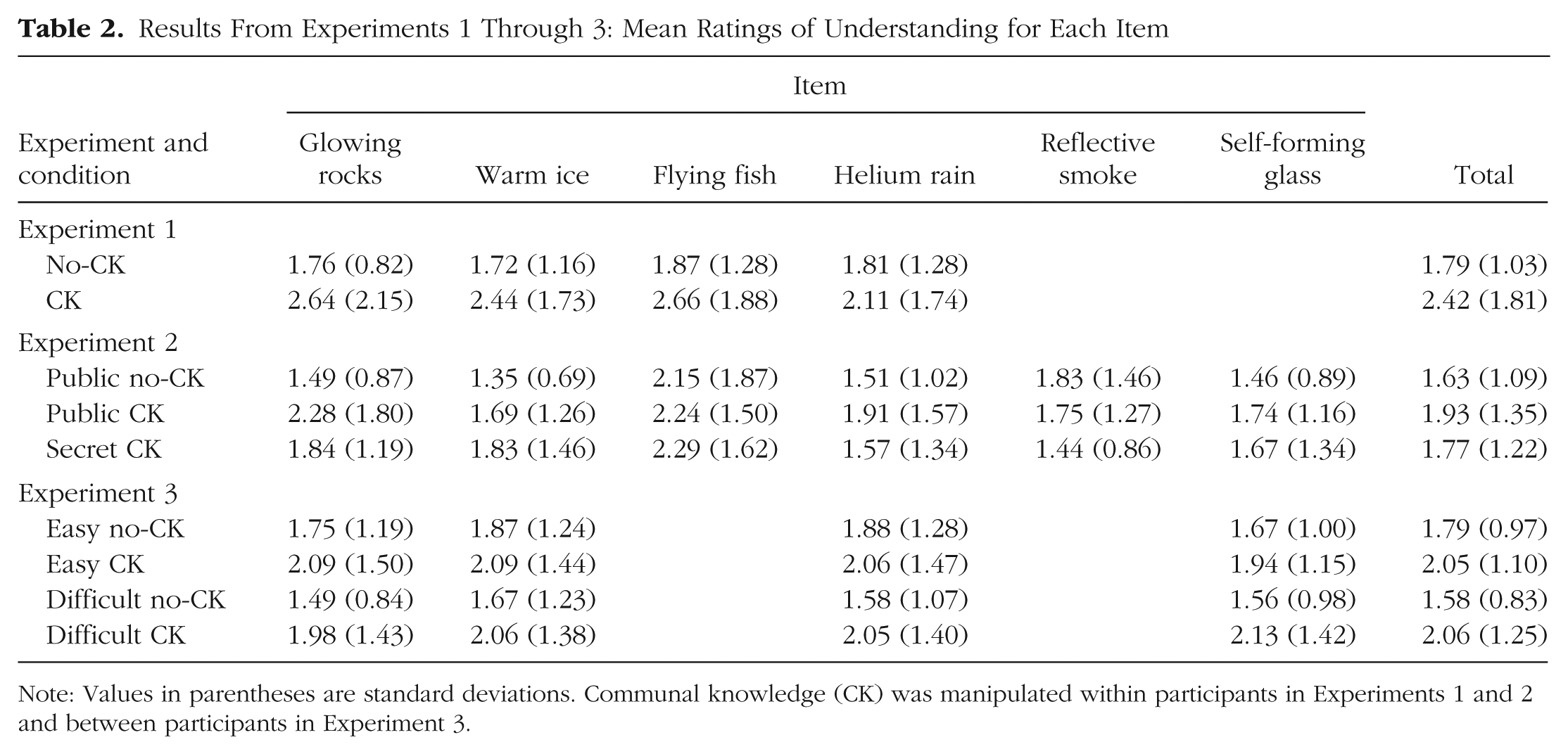
Note: Values in parentheses are standard deviations. Communal knowledge (CK) was manipulated within participants in Experiments 1 and 2 and between participants in Experiment 3.
Ratings of understanding were generally low but consistently higher when scientists were said to understand the objects of judgment. The results suggest that the existence of understanding in a community of knowledge creates the impression of understanding in oneself.
Experiment 2
The results of Experiment 1 suggested that an individual’s sense of understanding is greater when he or she is told that other people in the community understand the object of judgment. Is the mere existence of others’ knowledge sufficient to create this impression, or must the individual have access to the knowledge? In Experiment 2, we added a condition in which the discovering scientists understood the phenomena, but the explanations were classified and inaccessible. If access to communal knowledge is necessary, then secret-but-explained and unexplained phenomena should both elicit lower ratings of understanding than phenomena that are explained publicly. If the existence of communal knowledge is sufficient for the effect, then varying secrecy should not influence judgments.
In Experiment 2, we also tested two alternative explanations of the community-of-knowledge effect. First, the effect could have been due to task demands from social pressure: Told that someone else understands a phenomenon, people may not experience increased understanding but merely feel pressured to say that they do to appear knowledgeable. Alternatively, the effect could have resulted from inferences about understandability: Knowledge that someone else has explained a phenomenon may imply that it is easier to understand than a phenomenon that no one has explained. This inference could have driven judgments if participants had interpreted the question about their understanding to include understandability. According to both of these alternative accounts, the mere existence of the explanation is all that matters, so manipulating access to the explanation should have no effect.
Method
One hundred forty-six U.S. residents (56% female, 44% male; mean age = 33.9 years) were recruited using Amazon’s Mechanical Turk, screened for participation in the previous experiment, and given a small payment. Sample size was chosen to satisfy counterbalancing schemes and was in keeping with related prior research. Participants received the same instructions as in Experiment 1, except for one modification: The cover story claimed that the study concerned recent scientific discoveries “made by DARPA, the research agency of the U.S. military,” an entity chosen for its power to keep scientific knowledge absolutely secret. Participants rated their understanding of six fictional natural phenomena (an example is shown in Table 1). Each participant read two descriptions of phenomena that had been thoroughly explained by the discovering scientists in a published article (public CK condition); two descriptions of different phenomena that had not yet been explained but that had been described in a published article by the scientists who discovered it (public no-CK condition); and two descriptions of still other phenomena that had been thoroughly explained but only in classified documents (secret CK condition). The descriptions contained no causal or explanatory information. Items were counterbalanced across conditions and across two random presentation orders. For reasons unrelated to our current purposes, each participant then generated a step-by-step causal explanation for two of the phenomena and rerated understanding of the two items. They also answered a question incorporated as an attention check and were asked if they had consulted external Web sites during the experiment.
Results
Data from participants who failed the attention check or admitted to using other Web sites (n = 40) were excluded. The means were again near the low end of the scale (1.93, 1.63, and 1.77 in the public CK, public no-CK, and secret CK conditions, respectively), so we again applied a logarithmic transformation. A repeated measures analysis of variance (ANOVA) on the log-transformed ratings of understanding revealed a main effect of condition on understanding, F(2, 210) = 5.62, p = .004, η p 2 = .051. Planned comparisons showed that ratings in the public CK condition (M = 0.21, 95% CI = [0.16, 0.25]) were significantly higher than those in the public no-CK condition (M = 0.15, 95% CI = [0.11, 0.19]), t(105) = −3.20, p = .002, and nearly significantly higher than those in the secret CK condition (M = 0.18, 95% CI = [0.13, 0.22]), t(105) = −1.96, p = .052. The means for the public no-CK and secret CK conditions were not significantly different, t(105) = −1.51, p = .134. Five of the six means for the individual items from the public no-CK condition and four of the six means for the individual items from the secret CK condition showed differences in the predicted direction (see Table 2).
As in Experiment 1, ratings of understanding for the fictional phenomena were appropriately low, but they were higher when communal knowledge was ostensibly accessible than when it was inaccessible or nonexistent. The results suggest that both existence of knowledge and access to knowledge are necessary for the community-of-knowledge effect. The fact that access is necessary cannot easily be explained by the task-demand or understandability accounts, although one interpretation of the understandability account remains viable. It could be that keeping an explanation secret implies that it is harder to understand than an explanation not kept secret because there is no reason to bother keeping a really simple explanation secret; it would be discovered anyway. Testing this explanation was one of our goals in Experiment 3.
Experiment 3
Experiment 3 provided a further test of the task-demand and understandability explanations. We adapted a technique devised by Widner, Smith, and Graziano (1991) by telling participants that our phenomena were either very hard or very easy to understand in order to manipulate social pressure. If social-pressure task demands explain the results from Experiments 1 and 2, then stating that the phenomena are hard to understand should alleviate some pressure and reduce differences in ratings of understanding between the no-CK condition and the CK condition. In contrast, stating that phenomena are easy to understand should increase social pressure and cause even bigger differences. If understandability inferences explain the results, then ratings of understanding should be higher when participants are told phenomena are easy to understand than when they are told the phenomena are hard to understand because the stated ease of understanding should have a bigger effect than should inferences from more subtle cues.
We also added a second dependent measure: ratings of the understandability of the phenomena. This provided a second means to assess whether participants interpreted ratings of understanding as judgments of understandability. If they did, results for the two ratings would be similar and would track one another across conditions. This experiment differed from the previous ones in that the manipulation was entirely between participants. It thus tested whether the observed effect arose because participants correctly guessed our hypothesis and responded cooperatively.
Method
Two hundred eighty-eight U.S. residents (56% female, 44% male; mean age = 33 years) were recruited using Amazon’s Mechanical Turk, screened for participation in the previous experiments, and given a small payment. Sample size was chosen to satisfy counterbalancing schemes and was in keeping with related prior research. Participants received the same instructions as in Experiments 1 and 2 except that a clause was added at the end of the instructions stating that the phenomena were either “very hard” or “fairly easy” to understand. Descriptions of fictional natural phenomena from the previous experiments were used (see Table 1), with the phrase “Natural processes of this kind are usually quite difficult [easy] to understand” added to strengthen the manipulation. Black-and-white diagrams depicting the content of the descriptions but conveying no causal information accompanied each stimulus. These were included out of concern that floor effects could mask the pattern in a complex design because scientific words and images have been shown to increase understanding judgments regardless of whether the words or images convey important information (Haard et al., 2004; Tal & Wansink, 2014). Participants were randomly assigned to one of four conditions (difficult no-CK, difficult CK, easy no-CK, and easy CK). Participants rated their own understanding of four phenomena (“How well do you understand how ___ works?”) and the understandability of those phenomena (“A different question: How understandable in principle is the phenomenon of ___?”). Stimulus order was counterbalanced. The experiment concluded with an attention check and a question about use of external Web sites during the experiment.
Results
The mean ratings of understanding and understandability are shown in Figure 1. Data from participants who failed the attention check or used other Web sites during the experiment (n = 46) were excluded. To examine the effect of the difficulty manipulation on ratings of understanding, we conducted a 2 (difficulty: difficult, easy) × 2 (communal knowledge: no-CK, CK) ANOVA on log-transformed ratings of understanding. The ANOVA revealed a significant main effect of communal knowledge (no-CK: M = 0.18, 95% CI = [0.14, 0.22]; CK: M = 0.25, 95% CI = [0.21, 0.29]), F(1, 238) = 6.89, p = .009, ηp2 = .028, but no effect of difficulty (easy: M = 0.23, 95% CI = [0.19, 0.27]; difficult: M = 0.20, 95% CI = [0.16, 0.24]), F(1, 238) = 1.29, p > .250, η p 2 = .005, and no interaction between difficulty and communal knowledge, F(1, 238) = 0.56, p > .250, ηp2 = .002. All individual-item means showed differences in the predicted direction (see Table 2).
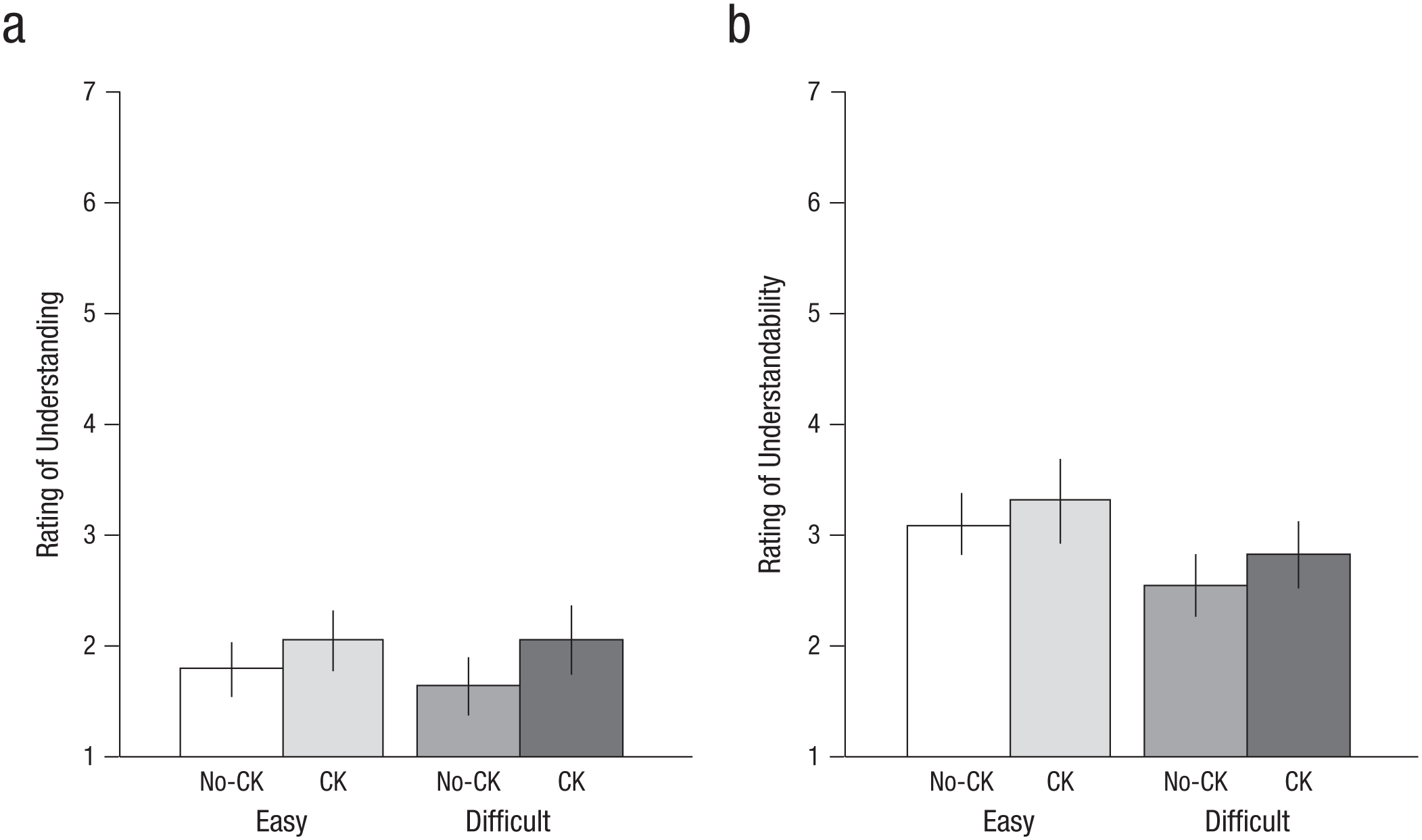
Results for Experiment 3: ratings of (a) understanding and (b) understandability in the four conditions created by crossing our manipulations of difficulty (difficult, easy) and communal knowledge, or CK (CK, no-CK). Error bars show 95% confidence intervals.
As in the previous experiments, asserting the existence of communal knowledge caused higher ratings of understanding. These results are not consistent with the social-pressure explanation, which predicts no differences in understanding in the low-pressure (difficult) conditions and dramatic differences in the high-pressure (easy) conditions. Rather, the differences in means followed the opposite pattern. Evidence that ratings of understanding were not influenced by any assessment of the perceived understandability of the phenomena comes from the lack of effect of difficulty and the fact that difficulty did not affect the community-of-knowledge effect (i.e., there was no interaction between them).
A 2 (difficulty: difficult, easy) × 2 (communal knowledge: no-CK, CK) ANOVA on the log-transformed understandability ratings revealed a complementary pattern: a significant main effect of difficulty (easy: M = 0.46, 95% CI = [0.43, 0.50]; difficult: M = 0.38, 95% CI = [0.35, 0.42]), F(1, 238) = 9.04, p = .003, ηp2 = .037, but no effect of communal knowledge (no-CK: M = 0.41, 95% CI = [0.37, 0.45]; CK: M = 0.43, 95% CI = [0.40, 0.47]), F(1, 238) = 0.95, p > .250, ηp2 = .004, and no interaction between difficulty and communal knowledge, F(1, 238) = 0.99, p > .250, ηp2 = .004. This serves as a validity check on our difficulty manipulation and on the meaningfulness of the understandability ratings. Phenomena that are described as difficult to understand should be rated as less understandable, by definition, than phenomena that are easy to understand. The fact that results for ratings of understanding did not track with those for understandability ratings reinforces the conclusion that participants’ ratings of understanding do not simply reflect their perceptions of understandability. Moreover, the inclusion of both question types makes it unlikely that participants interpreted one question to mean the other. Obtaining the community-of-knowledge effect using a between-participants design eliminates the possibility that it was due to participants guessing our hypothesis and responding cooperatively. Finally, when we compared means from this experiment with those from the previous experiments, there was no suggestion that images increased ratings of understanding despite our expectation that they would do so.
Experiment 4
Another alternative account that would explain some of our results is that the text passages in the no-CK and CK conditions had different pragmatic implications. Our manipulation (i.e., indicating whether or not scientists have thoroughly explained a phenomenon) appeared immediately before the minimal description of the phenomenon (e.g., “the rock is similar to calcite, yet it glows in the absence of a light source”). Perhaps some participants thought this description was an explanation, an interpretation that would make more sense for the CK condition than for the no-CK condition. If such participants treated the understanding question as a reading comprehension test, then their ratings could reflect greater true understanding (supported by what they believed were the explanations) rather than an inflated false sense of understanding. 1 This alternative account is challenged by the difference between the results of the secret CK and public CK conditions in Experiment 3 because the wording of the descriptions was identical in those two conditions. Nevertheless, in Experiment 4, we examine this possibility further by reducing even the minimal descriptions of previous experiments and cueing respondents to the distinction between description and explanation.
Method
We constructed novel fictional natural phenomena to test the generality of the effect (see Table 1). Stimuli were phrased to control for two potential demand characteristics related to the pragmatic explanation. First, the explanations of the phenomena were explicitly stated to be either nonexistent (no-CK condition) or present in the scientists’ articles but not in the texts being read (CK condition). Second, the descriptions of the phenomena were explicitly labeled as such and restricted to summaries of immediate, perceptual characteristics (e.g., stalactites that hum). Pilot studies using these materials revealed that the resultant minimal descriptions exacerbated an existing problem with our paradigm: Ratings that were already close to the floor became even lower, and this resulted in floor effects. To minimize these effects, we implemented the following changes to our procedure.
First, we expanded the stimulus set to include four nonsense items of the same form as our critical items but with unrecognizable labels (e.g., “Kreps type-II lysine currents”) and four real natural phenomena (e.g., cloud formations). These were added to provide contrasting items that participants might want to rate lower or higher, respectively, than the critical items. Because we could not claim that real phenomena were not understood by scientists, real items were identical across conditions and thus provided a means to normalize how participants were using the rating scale. Second, we relabeled the scale so that the label for the lowest value was I have absolutely no understanding of the description of or explanation for this phenomenon and the label for the highest value was I have a deep and complete understanding of both the description of and explanation for this phenomenon. We did this to make the bottom of the scale reflect a complete lack of understanding and to remind participants of the distinction between descriptions and explanations at each judgment. Instructions were changed accordingly. Third, to determine whether the response scale itself was responsible for floor effects, we tested two kinds of scales: a scale from 1 to 7, as in previous experiments, and a scale from 0 to 100. Fourth, because our pilot work suggested that floor effects were reducing the size of our effect, we increased our sample size to 281 (n = 160 for the original scale; n = 121 for the 100-point scale; 48% female, 52% male; mean age = 33.1 years). Communal knowledge was manipulated between subjects. As before, the experiment concluded with an attention check and a question about use of external Web sites.
Results
Data from participants who failed the attention check or used other Web sites (n = 24) were excluded. A linear transformation was used to place all scores from the 100-point scale onto the 7-point scale. Means were again near the low end of the scale for all fictional phenomena, but they were in the predicted direction only for critical items (no-CK: M = 1.90; CK: M = 2.10) and not for nonsense items (no-CK: M = 1.71; CK: M = 1.67). Means for real items were considerably higher, as expected (no-CK: M = 4.27; CK: M = 4.11). An independent-samples t test of log-transformed ratings of understanding confirmed that critical item means were higher in the CK condition (M = 0.27, 95% CI = [0.22, 0.30]) than in the no-CK condition (M = 0.20, 95% CI = [0.16, 0.24]), t(255) = −2.0, p = .047, Cohen’s d = 0.25. By contrast, there were no observed differences by condition for log-transformed ratings of understanding of nonsense items (no-CK: M = 0.15, 95% CI = [0.11, 0.19]; CK: M = 0.15, 95% CI = [0.12, 0.19]), t(255) = −0.17, p > .250, Cohen’s d = 0.02, or real phenomena (no-CK: M = 0.60, 95% CI = [0.58, 0.63]; CK: M = 0.58, 95% CI = [.55, .61]), t(255) = 1.09, p > .250, Cohen’s d = 0.14. Again, all the critical items showed differences in the predicted direction (see Table 3).
Results From Experiment 4: Mean Ratings of Understanding for Each Item
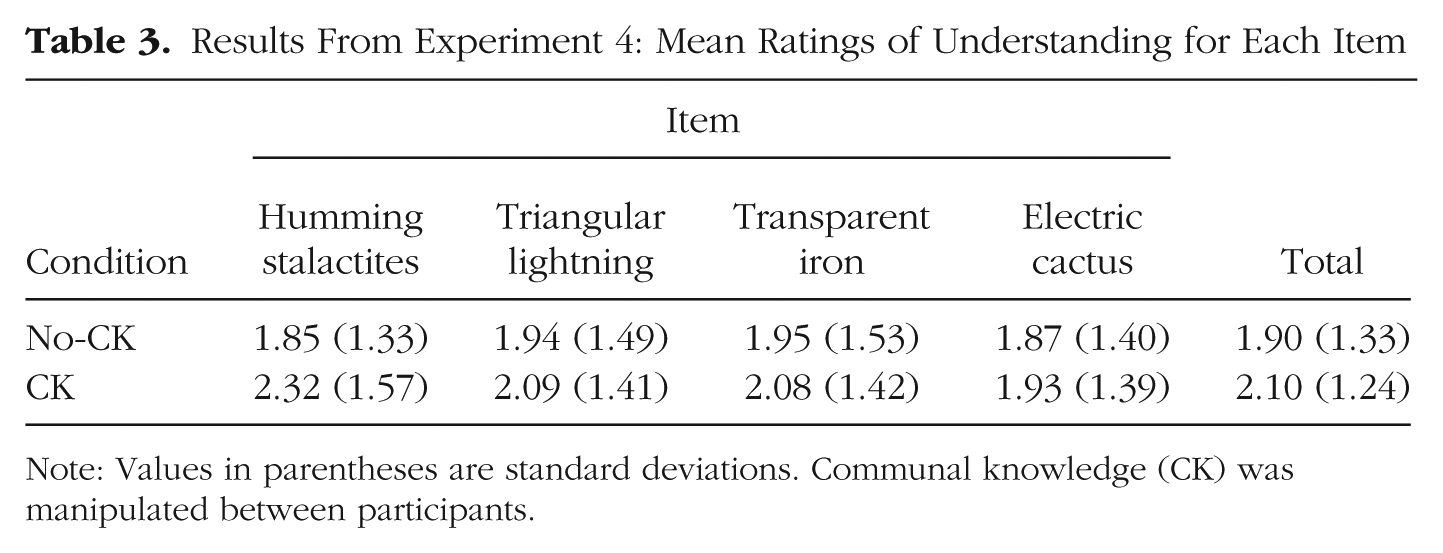
Note: Values in parentheses are standard deviations. Communal knowledge (CK) was manipulated between participants.
To ensure that these effects were not due to how participants treated the response scales, we ran an analysis of covariance in which we partialed out ratings of the real phenomena. In this analysis, the effect of communal knowledge was highly significant, F(1, 252) = 5.61, p = .019, η p 2 = .022; however, neither the effect of scale type, F(1, 252) = 0.046, p > .250, η p 2 < .001, nor the interaction between communal knowledge and scale type, F(1, 252) = 0.01, p > .250, η p 2 < .001, were close to significant. Treating nonsense-item ratings as a covariate revealed an identical pattern—main effect of communal knowledge: F(1, 252) = 11.64, p = .001, η p 2 = .044; main effect of scale type: F(1, 252) = 0.60, p > .250, η p 2 = .002; interaction: F(1, 252) = 0.00, p > .250, η p 2 < .001.
The means in this experiment remained close to the floor, but the effect of scientists’ understanding nevertheless came through, albeit weakly. The pattern seen in previous experiments was again observed: Participants rated their own understanding slightly higher when they believed that someone else understood the object of judgment. Critically, this occurred when potential explanatory details were omitted and when the difference between descriptions (which were given) and explanations (which were not) was made salient in both the stimuli and the scale. It remains possible that the previous results were affected by inferences from pragmatic implications. But it is clear that an effect of scientists’ understanding remains even when such inferences are highly unlikely.
General Discussion
Knowing that experts understand a phenomenon gives individuals the sense that they understand it better themselves, but only if they believe they have access to the experts’ explanation. This would be true if people live in a community of knowledge: They take cognitive credit for other people’s knowledge. People fail to draw a sharp boundary between the knowledge they possess and the knowledge to which they have access in their community.
It is already known that the converse holds. People suffer from the curse of knowledge, the inability to think about an issue from the perspective of someone who is less informed (Camerer, Loewenstein, & Weber, 1989; see Nickerson, 1999). Children do this even when explicitly informed that other people do not share their knowledge (Wellman & Bartsch, 1988). Adults show a similar bias when predicting the behavior of others (Birch & Bloom, 2007) and are influenced by their own discrepant knowledge when judging what others know (Apperly, Back, Samson, & France, 2008). Most relevant to the current study is that people confuse their own ability to distinguish subtle differences of word meanings with the knowledge of how to access those meanings through other people (Kominsky & Keil, 2014).
The role of access predicts an enhanced effect when knowledge is perceived as easy to obtain. Support for this assertion comes from the finding that self-assessments of question-answering ability increase after people search the Internet for unrelated explanations (Fisher, Goddu, & Keil, 2015). Although the present data cannot address whether the effect holds for any sort of knowledge, people more often claim knowledge of a nonexistent concept when they believe it is from their area of expertise (Atir, Rosenzweig, & Dunning, 2015); this finding suggests some domain specificity in the effect (see also Fisher & Keil, 2015).
Our hypothesis is distinct from the idea that people excel at understanding the intentions and other mental states of interlocutors (e.g., Baron-Cohen, 1991). We have shown that an individual’s understanding depends on beliefs about the knowledge in other people’s minds regardless of whether that individual knows anything about those people’s mental states. The two ideas may be related, in that the ability to read other people’s mental states helps to establish common ground, and some common ground may be a prerequisite for a community of knowledge. But the roles of common ground in both mental-state inference and the community of knowledge are still largely unknown.
The major motivation for a community of knowledge is to provide a fair and effective division of cognitive labor. Keil, Stein, Webb, Billings, and Rozenblit (2008) reported evidence suggesting that the distribution of expertise in the world guides learning beginning at a very young age in children. To make use of and contribute to a community of knowledge, one must know the broad clusters in which expertise resides; one need not have all the expertise oneself.
People rely on each other for much more than emotional and physical support. The very act of thinking can make people confused about what they know as opposed to what others know. Epistemic dependence on others (see Hardwig, 1985) should make us intellectually humble, and the power that we get by sharing in a social mind should make us very proud, perhaps not as individuals, but as participants in human activity.
Footnotes
Acknowledgements
We thank Nadia Chernyak, Jeffrey Zemla, Mark Ho, Joseph Austerweil, and Michael Frank.
Action Editor
Marc J. Buehner served as action editor for this article.
Declaration of Conflicting Interests
The authors declared that they had no conflicts of interest with respect to their authorship or the publication of this article.
Funding
This work was supported by the Thrive Center for Human Development and the Varieties of Understanding Project at Fordham University and the John Templeton Foundation. The opinions expressed in this article are the authors’ and do not necessarily reflect the views of the Varieties of Understanding Project, Fordham University, or the John Templeton Foundation.
Open Practices
All data and materials have been made publicly available via the Open Science Framework and can be accessed at https://osf.io/24kvu/. The complete Open Practices Disclosure for this article can be found at http://pss.sagepub.com/content/by/supplemental-data. This article has received the badges for Open Data and Open Materials. More information about the Open Practices badges can be found at https://osf.io/tvyxz/wiki/1.%20View%20the%20Badges/ and  .
.
Notes
References
Supplementary Material
Please find the following supplemental material available below.
For Open Access articles published under a Creative Commons License, all supplemental material carries the same license as the article it is associated with.
For non-Open Access articles published, all supplemental material carries a non-exclusive license, and permission requests for re-use of supplemental material or any part of supplemental material shall be sent directly to the copyright owner as specified in the copyright notice associated with the article.
