




Abstract
It is a fundamental human need to secure and sustain a sense of social belonging. Previous research has shown that individuals who are lonely are more likely than people who are not lonely to attribute humanlike traits (e.g., free will) to nonhuman agents (e.g., an alarm clock that makes people get up by moving away from the sleeper), presumably in an attempt to fulfill unmet needs for belongingness. We directly replicated the association between loneliness and anthropomorphism in a larger sample (N = 178); furthermore, we showed that reminding people of a close, supportive relationship reduces their tendency to anthropomorphize. This finding provides support for the idea that the need for belonging has causal effects on anthropomorphism. Last, we showed that attachment anxiety—characterized by intense desire for and preoccupation with closeness, fear of abandonment, and hypervigilance to social cues—was a stronger predictor of anthropomorphism than loneliness was. This finding helps clarify the mechanisms underlying anthropomorphism and supports the idea that anthropomorphism is a motivated process reflecting the active search for potential sources of connection.
Humans have a primary need for social connection; as Baumeister and Leary (1995) note, people’s need to maintain a minimum number of positive, significant interpersonal relationships is supported by their readiness to form relationships, their resistance to relationship dissolution, and the sadness that ensues when close bonds are broken. Most people have experienced the painful consequences of social disconnection, but the effects go beyond psychological ill-being: Meta-analytic studies indicate a strong association between social relationships and morbidity and mortality (Holt-Lunstad, Smith, & Layton, 2010). Given such high stakes, it is not surprising that social disconnection prompts efforts to forge new bonds (e.g., Maner, DeWall, Baumeister, & Schaller, 2007); what is more remarkable, however, is the flexibility and ingenuity of some of these attempts. For example, people look to pets (McConnell, Brown, Shoda, Stayton, & Martin, 2011; Paul et al., 2014), “para-social relationship(s)” (Horton & Wohl, 1956; p. 215) with television or other media figures, as well as various other social surrogates, to fulfill belonging needs (Gardner, Pickett, & Knowles, 2005; Greenwood & Long, 2011). Some people even anthropomorphize inanimate objects to serve as sources of social connection—specifically, Epley, Akalis, Waytz, and Cacioppo (2008) found that lonely people (compared with nonlonely people) were more likely to ascribe humanlike traits (e.g., free will) to an alarm clock, battery charger, air purifier, and pillow. If the need to resort to such extremes arises from feelings of social disconnection, then instilling feelings of social connection should diminish such anthropomorphic tendencies.
In the current experiment, we investigated whether reminding people of relationships characterized by closeness and care diminished the tendency to anthropomorphize. Epley, Akalis, et al. (2008) showed that rejection increases anthropomorphism. However, to our knowledge, no one has shown that augmenting belonging reduces anthropomorphic tendencies—although Waytz and Epley (2012) showed that social connection enables dehumanization, which suggests that social connection would also reduce anthropomorphism.
We also used this opportunity to replicate the association between social disconnection and anthropomorphism in a larger sample and to investigate the effects of other indices of social connection—in particular, attachment anxiety. As Mikulincer and Shaver (2003) note, attachment anxiety reflects one of two “secondary strategies” (p. 67) people use when significant others are perceived to be unavailable or unresponsive. In such instances, efforts to maintain proximity are intensified and, importantly, attention is preferentially directed toward attachment-related cues. The assumption underlying this hyperactivation strategy is that closeness can be attained if enough effort is deployed. This strategy can be contrasted with that of attachment avoidance, in which seeking proximity is not seen as viable (no matter how much effort is expended); consequently, the attachment system is deactivated by, for example, denying attachment needs, emphasizing self-reliance, and orienting attention away from attachment-related cues (Mikulincer & Shaver, 2003). Because anthropomorphism is thought to be a motivated process arising from increased attention to social cues and increased search for potential sources of connection (Epley, Waytz, Akalis, & Cacioppo, 2008), and because attachment anxiety is characterized by a strong desire for closeness and hypervigilance to social cues, we hypothesized that anxiously attached individuals might be especially likely to anthropomorphize.
Method
Study overview
To test our hypotheses, we followed the method of Epley, Akalis, et al. (2008) and conducted an online study run through the crowd-sourcing Web site CrowdFlower (http://www.crowdflower.com). Participants were told that the purpose of the study was to investigate the interplay between personality, memory, social cognition, and visual perception. Interested participants were given a link to an online survey administered via FluidSurveys (http://www.fluidsurveys.com). After giving informed consent, participants completed a demographic questionnaire and self-report questionnaires measuring individual differences in social connection and other interpersonal processes (see the Questionnaires section).
Participants then underwent a manipulation in which they thought of a close, supportive relationship (the close-relationship-prime condition) or a more casual relationship (the control-relationship-prime condition). This was followed by an animacy-perception task (the procedure and results for this task are not reported here) and the anthropomorphizing task. In addition to the main prime, we administered a “booster” prime between the animacy and anthropomorphism tasks (see the Relationship-Prime Manipulation section). At the end of the survey, participants were debriefed and received a code that they could input into CrowdFlower to be compensated (participants were compensated $0.90, which is standard for crowd-sourcing Web sites such as CrowdFlower). Because there was an element of deception (about the purpose of the prime), participants had to reconsent to have their data used at the end of the study. All study procedures were approved by the McGill University Research Ethics Board.
Sample-size determination and stopping procedure
Following the recommendation of Vazire (2016), we aimed to have a sample of approximately 90 participants per cell (180 total). Because this was an online study, we expected that a sizable portion of our sample might not fully comply with study procedures; consequently, we recruited a sample that was approximately 2 times our projected sample. All analyses were conducted after the study was closed to enrollment.
Quality-control procedures
Because this study was conducted online and participants could not be monitored, we instituted two quality-control measures. First, five attention-check questions (e.g., “Please leave this question blank”) were inserted throughout the survey; participants who failed any of these questions were excluded. Second, surveys had to be completed in a certain time frame. We used completion time as a quality-control measure for two reasons: On the one hand, we worried that participants who completed the study too quickly were not likely to have been fully engaged in or attending to the study procedures (even if they passed the attention-check questions). On the other hand, we worried that people who took too long to complete the survey may have taken a break; the concern was that the effects of the experimental prime (which occurred at the beginning of the study) on our main dependent variable (which was measured at the end of the study) could weaken considerably. Completion-time cutoffs were determined a priori. We excluded participants with completion times that were 2 SD greater than the group mean and participants who completed the survey in less than 20 min. 1
Participants
In total, we collected data from 340 participants; however, 81 participants did not complete the study, 15 did not consent to have their data used during the second consent process, and 39 failed at least one of our five attention-check questions. In addition, we excluded 27 participants on the basis of completion time. The final sample consisted of 178 male and female participants (mean age = 39.50 years, SD = 13.06, age range = 20–75 years). The sample was geographically diverse; participants were located in 33 different states or provinces in North America. See Table 1 for additional demographic information on the participants.
Demographic Characteristics of the Sample

Relationship-prime manipulation
In the close-relationship-prime condition, we used a well-validated priming procedure from the attachment literature (Baldwin, Keelan, Fehr, Enns, & Koh-Rangarajoo, 1996; Bartz & Lydon, 2004). Participants were asked to recall an “important” and “meaningful” relationship: Please think about a relationship you have had in which you have found that it was relatively easy to get close to the other person and you felt comfortable depending on the other person. In this relationship you didn’t often worry about being abandoned by the other person, and you didn’t worry about the other person getting too close to you.
Participants were then asked to list six traits that described the person they had in mind. To augment the priming effects, we had participants undergo a brief guided visualization in which they were asked to get a visual image of the person in their minds and remember a time they were actually with the person; prompts included: “What would he or she say to you?” “What would you say in return?” “How do you feel when you are with this person?” and “How would you feel if they were here with you now?” Finally, participants were asked to write a few sentences about their thoughts and feelings regarding themselves in relation to this person. Note that participants were told that this part of the study assessed memory and visual imagery; in addition to deterring expectancy effects, this cover story allowed us to administer booster primes at later points during the study by asking participants to recall the traits they had listed about the individual (McClure, Bartz, & Lydon, 2013).
The control-relationship-prime condition was very similar to the close-relationship-prime condition; however, rather than thinking of a close, supportive other, participants were instructed to recall an acquaintance, defined as “a person you know casually but not someone you would consider to be a close friend . . . someone you sometimes interact with but not someone you know particularly well or someone that you would confide in or turn to for help.”
Questionnaires
Experience in Close Relationships Scale
The Experience in Close Relationships scale (Brennan, Clark, & Shaver, 1998) is a 36-item self-report assessment tool that is widely used to measure adult attachment. Eighteen items assess anxiety (excessive preoccupation with intimate relationships and hypervigilance for cues of rejection, measured with such items as “I worry that people won’t care about me as much as I care about them”); the other 18 items assess avoidance (dislike or fear of closeness and dependency, measured with such items as “I get uncomfortable when people want to be very close to me”). In the current sample, Cronbach’s α values were .95 for anxiety and .93 for avoidance.
UCLA Loneliness Scale
The UCLA (University of California, Los Angeles) Loneliness Scale (Peplau & Cutrona, 1980) contains 20 items designed to assess subjective feelings of loneliness or social isolation. Participants answer such questions as “I am unhappy doing so many things alone” and “There is no one I can turn to” on a scale from 0 (I never feel this way) to 3 (I often feel this way); higher scores on this scale reflect higher levels of loneliness. Cronbach’s α in the current sample was .96.
Rosenberg Self-Esteem Scale
The Rosenberg Self-Esteem Scale (Rosenberg, 1965) is a 10-item self-report assessment tool widely used to measure global self-esteem. The scale includes such items as “I feel that I’m a person of worth, at least on an equal plane with others” and “At times, I feel I’m no good at all” (reverse coded); the rating scale ranges from 1 (strongly disagree) to 4 (strongly agree). Cronbach’s α in our sample was .93.
Need to Belong Scale
The Need to Belong Scale (Leary, Kelly, Cottrell, & Schreindorfer, 2013) is a 10-item tool used to assess participants’ desire for social connection. It includes such items as “I want other people to accept me,” rated on a scale from 1 (strongly disagree) to 5 (strongly agree). Cronbach’s α was .80.
Prime-manipulation check
In a manipulation check, we asked participants to rate the importance of their relationship with the person they had in mind on a scale from 1 (not at all important) to 7 (extremely important). In addition, because the close-relationship-prime condition was based on an attachment-security priming procedure, we administered a 7-item version of the Experience in Close Relationships Scale (Bartz & Lydon, 2004) at the end of the study to assess whether the prime altered people’s chronic attachment style. Cronbach’s α values were .88 for attachment anxiety (e.g., “I worry that others won’t care about me as much as I care about them”) and .77 for attachment avoidance (e.g., “I prefer not to show others how I feel deep down”).
Anthropomorphizing tasks
Gadgets task
This task was designed to measure the tendency to anthropomorphize nonhuman objects. Performance on this task was our primary outcome variable because it was the dependent variable that was associated with loneliness in Epley, Akalis, et al. (2008). As in that study, participants read descriptions of four technological gadgets (e.g., Clocky, a wheeled alarm that rolls away so that one must get up to turn it off) and then rated those gadgets on a number of social and nonsocial dimensions. The five social dimensions assessed the tendency to ascribe humanlike traits to the gadgets (e.g., the extent to which the gadget had “a mind of its own” or “free will”). The three nonsocial dimensions, which served as filler and control items, assessed the gadgets’ attractiveness, strength, and efficiency. Following the method of Epley, Akalis, et al., we created a composite scale for the anthropomorphism ratings by averaging ratings for the five social-dimension items across all four gadgets (α = .83).
Pets task
In addition to the gadgets task, we included the pet-anthropomorphization task used in Study 3 of Epley, Akalis, et al. (2008). In this task, participants were asked to think of a pet that they either own or know well; participants were then presented with a list of 14 traits and asked to pick the three traits that best describe the pet. This list includes 3 anthropomorphic traits related to the provision of social support (e.g., thoughtful, considerate), 4 anthropomorphic traits less related to social support (e.g., embarrassable, jealous), and 7 nonanthropomorphic traits (e.g., agile, lethargic). Following the method of Epley, Akalis, et al., we calculated the proportion of traits selected for each trait category out of the total number of traits for that category. This task was considered exploratory given that its association with trait loneliness is unknown (although the results of Study 3 in Epley, Akalis, et al. showed that priming social disconnection by having participants watch the film Cast Away—Zemeckis & Broyles, 2000—increased people’s tendency to ascribe humanlike characteristics to a pet).
Results
Before testing our main hypotheses, we assessed the effects of our prime manipulation. As predicted, the relationships nominated in the close-relationship-prime condition were rated as more important (M = 6.34, SD = 1.03) than those nominated in the control condition (M = 4.36, SD = 1.92), t(124.12) = −8.45, p < .001 (note that results of Levene’s test indicated that relationship-importance variability was significantly different in the two relationship-prime conditions, so we report the t test for which equal variances were not assumed). The prime did not, however, alter our postexperiment assessment of attachment anxiety, t(176) = 0.06, p > .250, or avoidance, t(176) = 0.75, p > .250; these findings indicated that the relationship prime did not alter chronic attachment.
To test our main hypotheses regarding the effects of loneliness and our experimental manipulation on gadget anthropomorphism, we fit a series of regression models with loneliness (mean-centered) and condition (dummy coded: close-relationship prime = 1; control prime = 0) as predictors of anthropomorphism. As in Epley, Akalis, et al. (2008), we also included the nonsocial attributes as a predictor to confirm that any effects we observed were specific to social attributions or anthropomorphizing. Finally, we also included gender (dummy coded: male = 1; female = 0) as a covariate because gender was unexpectedly associated with anthropomorphism. In addition to assessing these main effects, we also tested for all relevant interactions; no significant interaction effects were observed, so these were not included in the final model.
Our results showed that the overall model was significant, R2 = .30, F(4, 173) = 18.23, p < .001, and that it accounted for approximately 30% of the variance in anthropomorphizing scores. There was a significant main effect of loneliness on anthropomorphizing, b = 0.27, 95% confidence interval (CI) = [0.03, 0.51], t(173) = 2.23, p = .027, partial r = .17. Specifically, we showed that lonely people were more likely to anthropomorphize than were nonlonely people (Table 2); our findings thus replicated those of Epley, Akalis, et al. (2008). Moreover, as predicted, there was a significant main effect of condition on anthropomorphizing: Participants in the close-relationship-prime condition were significantly less likely to anthropomorphize than those in the control-relationship-prime condition, b = −0.35, 95% CI = [−0.68, −0.01], t(173) = −2.05, p = .042, partial r = −.15.
Results From the Regression Analyses Predicting Gadget Anthropomorphism
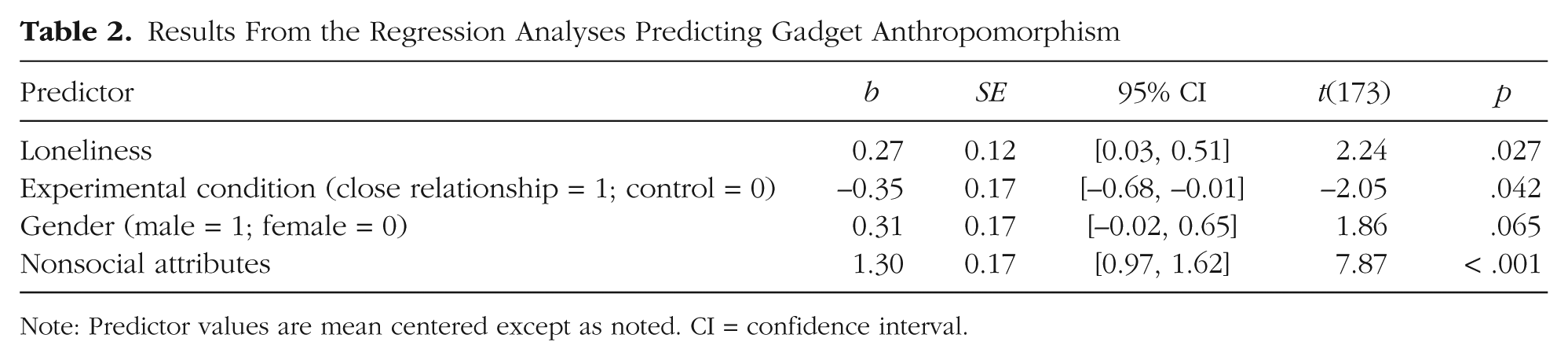
Note: Predictor values are mean centered except as noted. CI = confidence interval.
Having replicated the basic effect shown by Epley, Akalis, et al. (2008), we then tested whether the other measures of social disconnection were related to anthropomorphism. The model was very similar to the one described earlier, except that we included all self-report measures of social disconnection (i.e., loneliness, attachment anxiety, attachment avoidance, need to belong, and self-esteem, all mean-centered). Our results showed that attachment anxiety was significantly related to anthropomorphizing, b = 0.23, 95% CI = [0.03, 0.44], t(169) = 2.26, p = .025, partial r = .17. Except for a trend-level effect of self-esteem, b = −0.28, 95% CI = [−0.58, 0.01], t(169) = −1.87, p = .063, partial r = −.14, none of the other self-report questionnaires were related to anthropomorphism, all ps > .11 (see Table S1 in the Supplemental Material available online). Again, there was also a main effect of condition. After we dropped the nonsignificant predictors, the final, trimmed model consisted of attachment anxiety, attachment avoidance (because anxiety and avoidance are typically correlated, it is standard in attachment research to include the alternate dimension in statistical analyses), gender, condition, and ratings of nonsocial attributes (Table 3).
Results From the Final Regression Analysis Predicting Gadget Anthropomorphism

Note: Predictor values are mean centered except as noted. CI = confidence interval.
Finally, we conducted separate analyses to test the effects of social disconnection and our experimental manipulation on the extent to which participants anthropomorphized pets (i.e., the pets task). Again, we fit a series of regression models with condition and individual differences in social disconnection as predictors, and we used the proportions of social-anthropomorphic, nonsocial-anthropomorphic, and behavioral traits selected by participants as outcomes. (As in the models predicting gadget anthropomorphization, we originally included gender as a predictor; however, the effect of gender was not significant, so it was dropped and the models were rerun without gender.) None of the predictors had any significant effects on social- or nonsocial-anthropomorphic traits in the model with loneliness and condition (all ps > .250) or in the full model, which included all measures of social disconnection (the Need to Belong Scale was the closest to being a significant predictor of social-anthropomorphic traits, p = .113; all other ps > .250). 2
Discussion
We aimed to replicate the association between social disconnection and anthropomorphism reported by Epley, Akalis, et al. (2008) and to extend this work by showing that reminding people of a close, supportive relationship can attenuate anthropomorphism. Lonely people were more likely to ascribe humanlike characteristics (e.g., free will) to such inanimate objects as a pillow or an alarm clock. Note that our sample was almost 9 times that of the original study and showed considerable demographic variability, which highlights the reliability and generalizability of the effect.
It is noteworthy that attachment anxiety was a better predictor of anthropomorphism than loneliness was. Anxiety is associated with a desire for closeness and the hope that closeness is attainable with enough effort; accordingly, the attachment system is hyperactivated, resulting in increased vigilance to social cues. This observation is consistent with the notion (Epley, Waytz, et al., 2008) that anthropomorphism is a motivated process that arises from increased attention to social cues and increased search for sources of connection. Note that avoidance was not associated with anthropomorphism; this is unsurprising considering that avoidant individuals use deactivation strategies to cope with thwarted belonging and downplay the importance of and attention to close relationships. The lack of an avoidance effect may explain why anxiety was a better predictor of anthropomorphism than loneliness. Loneliness probably affects both anxious and avoidant individuals (loneliness was correlated with both in this study); if avoidant individuals do not regulate belongingness needs through anthropomorphizing, that could attenuate the association between loneliness and anthropomorphism.
In addition to replicating the findings of Epley, Akalis, et al. (2008), we found that reminding people of a close, supportive relationship attenuates anthropomorphism. This observation provides experimental evidence that anthropomorphism arises from an unmet need for social connection (and when people meet this need, anthropomorphism can be reduced). Although anthropomorphism is one of the more creative ways people try to meet belonging needs, it is nevertheless difficult to have a relationship with an inanimate object. Reliance on such a compensatory strategy could permit disconnected people to delay the riskier—but potentially more rewarding—steps of forging new relationships with real people. These findings highlight a simple strategy that could help get lonely people on the road to reconnection.
We have a few final points: First, we used an established attachment-security priming procedure to prime a close, supportive relationship, and research is needed to determine the boundary conditions for this effect. According to Baumeister and Leary (1995), belongingness needs can be satisfied by many kinds of relationships, so long as the relationship involves frequent interactions and evidence of caring; thus, we suspect that priming other close, nonattachment relationships would produce similar effects. Second, our study (like that of Epley, Akalis, et al., 2008) lacked the control of a laboratory investigation; however, we think this speaks to the effect’s robustness. Third, the association between loneliness and anthropomorphism did not extend to pet evaluations; although these null results could indicate no actual effect, our ability to detect an effect may have been undermined by other factors (e.g., number of pet-owning participants, or that the gadgets task affected pet evaluations).
In sum, the drive to secure a sense of belonging is a fundamental human need; when starved for social connection, some individuals may view even nonhuman agents as potential sources of support. Critically, however, remembering a satisfying intimate relationship can decrease reliance on this compensatory strategy.
Footnotes
Action Editor
Eddie Harmon-Jones served as action editor for this article.
Declaration of Conflicting Interests
The authors declared that they had no conflicts of interest with respect to their authorship or the publication of this article.
Funding
This research was supported by faculty start-up funds provided by McGill University (to J. A. Bartz) and by the Natural Sciences and Engineering Research Council of Canada (to J. A. Bartz).

Notes
References
Supplementary Material
Please find the following supplemental material available below.
For Open Access articles published under a Creative Commons License, all supplemental material carries the same license as the article it is associated with.
For non-Open Access articles published, all supplemental material carries a non-exclusive license, and permission requests for re-use of supplemental material or any part of supplemental material shall be sent directly to the copyright owner as specified in the copyright notice associated with the article.
