



Abstract
How does volitional photo taking affect unaided memory for visual and auditory aspects of experiences? Across one field and three lab studies, we found that, even without revisiting any photos, participants who could freely take photographs during an experience recognized more of what they saw and less of what they heard, compared with those who could not take any photographs. Further, merely taking mental photos had similar effects on memory. These results provide support for the idea that photo taking induces a shift in attention toward visual aspects and away from auditory aspects of an experience. Additional findings were in line with this mechanism: Participants with a camera had better recognition of aspects of the scene that they photographed than of aspects they did not photograph. Furthermore, participants who used a camera during their experience recognized even nonphotographed aspects better than participants without a camera did. Meta-analyses including all reported studies support these findings.
Photo taking has become a ubiquitous activity (Okabe & Ito, 2003). An important reason people take photos is to capture fleeting moments to remember later (Lux, Kogler, & del Fabro, 2010). Although revisiting photos may help cue past memories (Koutstaal, Schacter, Johnson, Angell, & Gross, 1998), people actually rarely review their photos (Whittaker, Bergman, & Clough, 2010). Therefore, we are interested in how photo taking affects people’s memory of their experiences when they do not revisit their photos.
The limited research on the effect of technology in general, and photography in particular, on memory suggests that photo taking can diminish memory. Much as having access to the Internet can reduce memory for factual information (Sparrow, Liu, & Wegner, 2011), having access to photos may reduce memory for one’s experiences. That is, photographed content may be committed less deeply to memory than nonphotographed content because one can “look it up later.” Indeed, Henkel (2014) found that taking photos reduced people’s ability to recognize objects they had photographed, compared with objects they had not, presumably because they treated photos as external memory.
Here, we offer a different perspective. We argue and demonstrate empirically that taking photos as part of an experience can in fact boost memory for visual content. Our reasoning differs from that underlying prior investigations in several important ways. When people volitionally take photos of their experiences, this activity commonly involves objectives and attentional processes that were not examined in the prior research. First, although people may happily take photos instead of remembering specific information (e.g., where they parked), experiences are central to the self (Howe & Courage, 1997) and are important in their own right. Although prior research suggests that photos are taken to offload memory, we argue that people often take photos of experiences specifically to remember, not offload, what is captured in their photos.
Second, in previous work, participants were told which objects to photograph and which to merely examine (Henkel, 2014). Although this approach provided experimental control, it eliminated a distinct attentional process inherent to natural photo taking: In order to decide what to photograph, people must search for aspects of an experience that they may wish to capture. Consequently, volitional photo taking requires attention to visual aspects of an experience, which should improve memory for visual content. Indeed, the negative effect of nonvolitional photo taking on memory is no longer observed when participants are asked to zoom into details of an object (Henkel, 2014, Study 2), likely because of increased attention to visual aspects of the experience. Further, prior work using eye tracking (Diehl, Zauberman, & Barasch, 2016, Study 6) showed that volitional photo taking increased visual attention (measured by the duration and frequency of fixations) specifically to aspects of an experience that were likely to be photographed. Hence, we suggest that people’s visual memory will be better when they take photographs volitionally than when they cannot take photographs (e.g., when they do not have a camera).
The current research also adds to prior research because we simultaneously investigated the effect of photo taking on memory for nonvisual, specifically auditory, aspects of experiences. We did so for several reasons. First, auditory and other nonvisual sensory aspects are often integral to one’s experiences. Second, whereas visual information is captured through photo taking, nonvisual information is not, and hence cannot be revisited. Third, examining the effect of photo taking on memory for information not captured in photos provided a test of the hypothesized attention-based process underlying the effect of volitional photo taking on memory.
If photo taking directs greater attention to experiences in general, it should improve memory for all types of information. However, we predicted an interaction between photo taking and memory content: To the extent that attention is shifted toward visual aspects of experiences, photo taking should improve visual memory only and should not help, or might even diminish, auditory memory. This reasoning led to our first hypothesis:
Hypothesis 1: When people take photos volitionally, they will have heightened memory for visual but not auditory aspects of an experience, compared with people who do not have a camera.
Another important comparison focuses specifically on individuals with a camera and contrasts their visual memory for aspects of an experience that they photographed with their visual memory for aspects they did not photograph. Extending the logic underlying our first hypothesis, we reasoned that visual attention should be more strongly directed toward aspects of an experience that people decide to photograph, compared with aspects that they decide not to photograph. This led to our second hypothesis:
Hypothesis 2: When people take photos volitionally, they will have heightened memory for visual aspects of the experience that they photographed, compared with visual aspects that they did not photograph.
We next present four studies and a meta-analysis that tested Hypothesis 1, comparing memory between participants with a camera and those without a camera. We then present additional analyses, including a second meta-analysis, that tested Hypothesis 2 and, using within-subjects comparisons, examine whether participants who did have a camera differed in their memory for photographed and nonphotographed aspects of an experience. We also present between-subjects comparisons that tested whether participants who did have a camera and those who did not have a camera differed in their memory for both photographed and nonphotographed aspects of an experience. These key analyses provided both control and a strong test of the effect of having a camera on visual memory.
Study 1
In this study, participants experienced an actual museum exhibit either with (camera condition) or without (no-camera condition) the ability to take photos. Those in the camera condition used their own devices, and they themselves selected what to photograph, just as they would in real life. Participants viewed the exhibit while listening to an audio guide; this enabled us to test the predicted interaction of photo taking and memory type.
Method
We recruited 297 participants (57.9% female; mean age = 20.4 years, SD = 2.1), who were paid $10. Our target sample size was 300, which was based on effect sizes from earlier studies we conducted, and we stopped collecting data after 6 days, as we anticipated we would reach approximately the target sample size at that time. Participants started their tour 20 min apart, so that they experienced the exhibit independently.
Participants first read detailed instructions (see the Supplemental Material available online) explaining that they would go on a self-guided tour of two museum exhibits: The first was the focal exhibit, featuring Etruscan artifacts, and the second served as a filler task. Participants also received a map of the two exhibits that outlined the order in which they should view them.
Participants were assigned to either the no-camera or the camera condition on the basis of their time slot. The condition was randomly determined for the first hour and alternated each hour afterward. In the no-camera condition, participants left all belongings, including their cell phones, with a research assistant and were instructed to view the exhibits as they normally would. In the camera condition, participants also left their belongings behind, but kept their camera devices. They were instructed to take pictures of anything they wanted during their visit and to take at least 10 photos. Two participants who did not have their own devices were given cameras but were excluded from our analyses. Results did not change when their data were included.
All participants also received an audio guide that provided factual information that could not be found within the focal exhibit, such as details regarding the artifacts and general facts about the time period (e.g., Etruscan gods, the societal hierarchy). They could pause the guide, but had to listen to all the tracks about the 11 display cases in a specified order. Following the last track, the guide directed participants to view the second exhibit while listening to a 3-min clip of instrumental music. They were told to return to the sign-in desk once the music had finished. This ensured that all participants viewed that exhibit for approximately the same amount of time. One participant was excluded from our analyses because of an iPod malfunction.
After viewing both exhibits and returning to the sign-in desk, participants answered questions about visual and auditory information from the focal exhibit using a laptop. Note that because they had not been informed about the memory test before touring the exhibits, participants in the camera condition did not take photos in anticipation of being tested. We eliminated any potential memory cues during the test by collecting instruction sheets and audio guides, and by instructing participants in the camera condition to keep their devices out of sight.
We created one visual and one auditory recognition question for each display case covered in the tour of the focal exhibit, excluding the first and last cases to avoid potential primacy or recency effects. All 18 memory questions used a forced-choice, multiple-choice response format. Each visual memory question asked participants to identify which of three similar objects they had seen (see Fig. 1). The two foils were objects from museum exhibits participants did not visit, and were similar in lighting and style to the target objects. Each auditory memory question asked participants to choose which of three answers correctly completed a factual statement in the audio guide. Participants first answered the 9 auditory questions in random order and then answered the 9 visual questions in random order. (See the Supplemental Material for all the memory questions.)
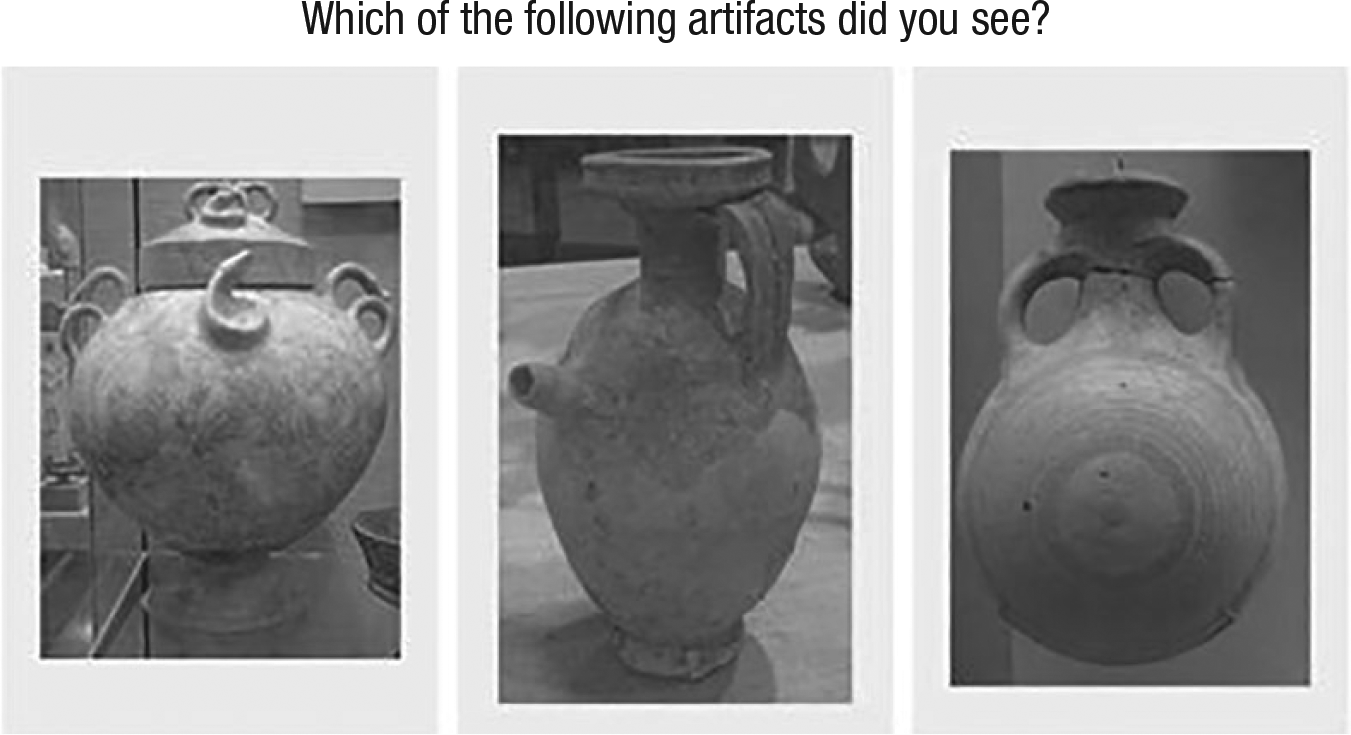
Example of a visual recognition question used in Study 1.
Participants in the two conditions took the same total amount of time to tour the exhibits and to complete the survey (camera: M = 21.86 min, SD = 12.96; no camera: M = 20.29 min, SD = 10.44), F(1, 290) = 1.31, p = .25. These were the only timing data we collected. Controlling for time spent did not alter our results (see the Supplemental Material).
After completing the survey, participants in the camera condition were asked to e-mail any photos they had taken to the experimenter (75.7% complied; M = 6.4 photos, SD = 2.5). In the survey, participants in the camera condition reported having taken 7.1 photos on average. Note that 81.7% of participants took fewer than the requested 10 photos. Our results held, and if anything became stronger, when we restricted the analysis to only those who had fully complied with the instructions (see the Supplemental Material).
Results
The analyses reported here included the data from 294 participants (i.e., as noted, we excluded 3 participants who lacked their own cameras or experienced an equipment malfunction). Our primary dependent variable was the percentage of each type of memory question (visual or auditory) answered correctly. We report results from mixed-design Camera Condition × Memory Type analyses of variance (ANOVAs). 1
Participants recognized more auditory (M = 76.64%, SD = 16.54) than visual (M = 63.15%, SD = 16.44) information, F(1, 292) = 108.01, p < .001, η p 2 = .27. There was no main effect of camera condition, F(1, 292) = 2.15, p = .143. As predicted, we found a significant Camera Condition × Memory Type interaction, F(1, 292) = 12.79, p < .001, η p 2 = .04 (see Fig. 2). Participants in the camera condition recognized more visual information (M = 66.51%, SD = 15.98) than did participants in the no-camera condition (M = 59.83%, SD = 16.27), F(1, 292) = 12.61, p < .001, η p 2 = .04. Further, participants in the camera condition recognized auditory information (M = 75.34%, SD = 17.68) approximately as well as did participants in the no-camera condition (M = 77.93%, SD = 15.28), F(1, 292) = 1.80, p = .181.
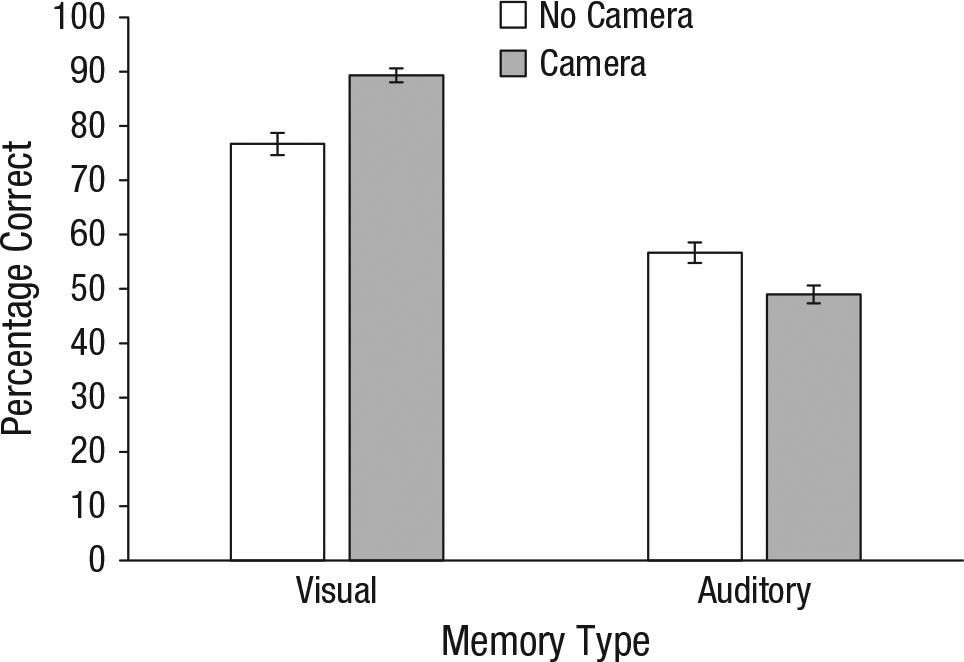
Visual and auditory memory performance of participants in the no-camera and camera conditions in Study 1. Error bars represent ±1 SE.
Discussion
In a natural setting, we found that volitional photo taking affected visual and auditory memory differently. Participants who took photos remembered visual, but not auditory, aspects of their experience better than did participants who did not take photos. Notably, these results suggest that participants were not using photos as external memory (cf. Henkel, 2014; Sparrow et al., 2011). This effect of photo taking on visual memory cannot be explained by a lack of effort in the no-camera condition, which would predict worse performance for both visual and auditory content in that condition.
Auditory memory was worse in the camera condition than in the no-camera condition, but this difference was not significant, perhaps because memory was overall better for auditory than for visual information, which left less room for a simple effect. In our subsequent studies, we addressed this calibration issue.
Study 2
In our next study, we used a computer-based laboratory paradigm that mimicked key features of first-person experiences. Doing so allowed us to hold the experience constant across conditions, which isolated the effect of photo taking on memory and provided a direct test of our hypothesized attention-based mechanism.
Method
We recruited 312 participants (47.5% female; mean age = 34.0 years, SD = 10.3) on Amazon’s Mechanical Turk (MTurk). They were paid $1. All participants were over the age of 18 and U.S. residents. Our target sample size was 300, which was based on effect sizes from earlier studies we conducted.
This study used a unique computer interface that provided participants with videos of several art-gallery tours from a first-person perspective. All participants were told to imagine that they were actually experiencing these tours in person. Participants were randomly assigned to simply experience the tours (no-camera condition) or to take photos of the experience (camera condition). Participants in the camera condition could take photos by clicking an on-screen button (see Fig. 3). Note that all participants experienced the same tours for the same duration, regardless of condition. Our software recorded the photos participants took, so we could identify which aspects of the experience they photographed. Participants never saw any of these photos either during or after the experience. As in Study 1, the instructions framed this study to be about experiences and did not mention a memory test.
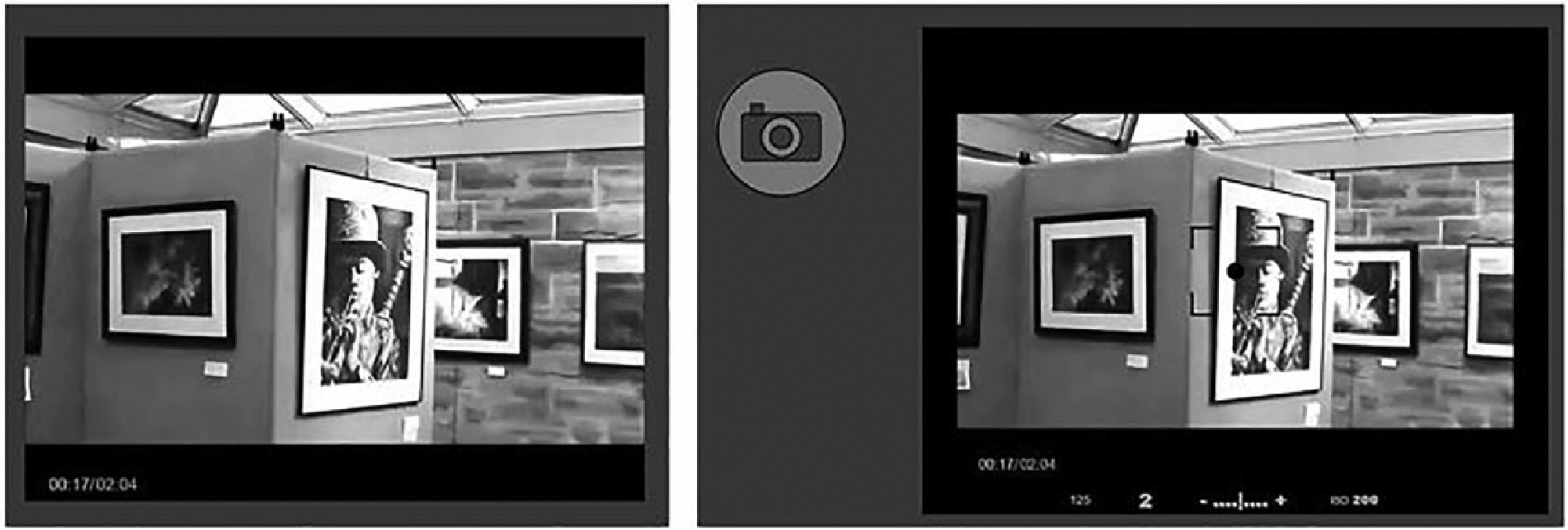
Screenshots of the computer interface in the no-camera (left panel) and camera (right panel) conditions of Studies 2 through 4 at the same moment in the focal experience.
The focal experience was a 90-s tour of a printmaking collection. Participants in the camera condition took an average of 8.1 photos during this experience. During the tour, all participants heard a guide providing information about the prints. Participants also viewed two additional, similarly narrated gallery tours of comparable length, one before and one after the focal experience. These additional tours both allowed for familiarization with the interface and prevented primacy or recency effects. After experiencing all three galleries, participants read a short text as a filler task. They were then given an attention-check question. Fourteen participants (4.5%) failed the attention check and thus did not continue with the study. This left a final sample of 298 participants. Then, as a continuation of the filler task, participants answered four questions about the text. Participants were then asked seven visual and eight auditory memory questions, presented in random order. These questions were similar in format to those in Study 1. (See the Supplemental Material for the auditory memory questions.)
Results
As in Study 1, our primary dependent variable was the percentage of each type of memory question (visual or auditory) answered correctly. Participants recognized visual information (M = 82.88%, SD = 21.92) better than auditory information (M = 52.89%, SD = 21.99), F(1, 296) = 431.39, p < .001, η p 2 = .59. There was no main effect of camera condition, F(1, 296) = 1.53, p = .217. As predicted, we found a significant Camera Condition × Memory Type interaction, F(1, 296) = 48.89, p < .001, η p 2 = .14 (see Fig. 4). Although participants in the camera condition recognized significantly more visual information (M = 89.33%, SD = 15.81) than did participants in the no-camera condition (M = 76.69%, SD = 25.03), F(1, 296) = 26.93, p < .001, η p 2 = .08, they recognized significantly less auditory information (M = 48.97%, SD = 19.99) than did those in the no-camera condition (M = 56.66%, SD = 23.19), F(1, 296) = 9.36, p = .002, η p 2 = .03.

Visual and auditory memory performance of participants in the no-camera and camera conditions in Study 2. Error bars represent ±1 SE.
Notably, the visual memory questions covered all artwork in the experience and were created a priori, without knowing what participants would photograph. Still, some objects are photographed more frequently than others, potentially because of many factors (e.g., they are more interesting, unusual, etc.). In order to assess whether having a camera had an effect independent of any such factors, we analyzed recognition for both the most and the least photographed objects.
When we analyzed visual memory for only the three most photographed objects, results were replicated; participants in the camera condition recognized these objects significantly better (M = 92.69%, SD = 18.57) than did participants in the no-camera condition (M = 80.70%, SD = 30.09), F(1, 296) = 16.98, p < .001, η p 2 = .05. Thus, photo taking affected memory over and above any effects associated with the reasons that might have led people to photograph these objects more frequently than others. When we analyzed visual memory for only the three least photographed objects, results also were replicated; participants in the camera condition recognized these objects significantly better (M = 90.18%, SD = 18.01) than did participants in the no-camera condition (M = 78.51%, SD = 28.30), F(1, 296) = 17.89, p < .001, η p 2 = .05. Thus, the ability to take photos affects memory even for objects that are least likely to be photographed. The same pattern of results was obtained when we tested the one and two most and least photographed items (see the Supplemental Material, which also includes parallel analyses for Study 1 and other reported studies).
To address a possible concern that the narration in Studies 1 and 2 directed attention to aspects of the experience highlighted by the guide, causing them to be remembered more than other aspects, we conducted two additional studies (S1 and S2) using a different stimulus: a London bus tour without any narration (these studies are fully reported in the Supplemental Material). In Study S1, participants were tested with multiple-choice recognition questions, as in Studies 1 and 2. Once again, participants in the camera condition exhibited better visual memory (M = 68.20%, SD = 18.82) than did participants in the no-camera condition (M = 53.65%, SD = 21.38), F(1, 296) = 38.71, p < .001, η p 2 = .12. To ensure that our results generalized to other memory measures, in Study S2 we used forced-choice, binary-choice questions asking whether or not a given object had been seen (e.g., Jang, Wixted, & Huber, 2009). Again, participants in the camera condition recognized more objects (M = 80.12%, SD = 12.77) than did those in the no-camera condition (M = 70.00%, SD = 12.38), F(1, 349) = 44.13, p < .001, η p 2 = .11.
Discussion
Supporting our first hypothesis and replicating Study 1, Study 2 demonstrated that taking photos during an experience affects memory of auditory and visual aspects of that experience differently. People who took photos during their tour remembered more visual aspects but, in this study, fewer auditory aspects than did those who did not take photos. Jointly, our findings support the idea that across different contexts and measurement approaches, volitional photo taking directs attention toward visual aspects of an experience and away from other aspects, and that participants do not “offload” memory of their experiences to their photos.
Study 3
We argue that when people volitionally take photos of their experiences, they do not offload their memories, even when it is possible to do so (e.g., in Study 1, participants used their own devices and knew they could access their photos later). In Study 3, we further tested this argument. Following previous work (Sparrow et al., 2011), we manipulated whether participants expected that their photos would be saved or deleted. We predicted that our previous findings would hold even when the possibility of offloading was salient.
Method
Over two sessions, we recruited 802 participants from MTurk (45.1% female; mean age = 33.9 years, SD = 10.8) in exchange for $1.20. 2 All participants were over age 18 and U.S. residents. Fifty-one participants (6.4%) who failed an attention check administered before the memory test did not proceed, which left a final sample of 751 participants.
Participants engaged in the same gallery tours as in Study 2 and subsequently answered the same visual and auditory recognition questions. They were randomly assigned to one of three conditions. Participants in the no-camera condition were simply told to experience the events. The two camera conditions, which were closely modeled after Sparrow et al. (2011), differed only in the explanations of what would happen with participants’ photos. In the photos-saved condition, participants were told that their photos would be saved, whereas in the photos-deleted condition, participants were told that their photos would be deleted (see the Supplemental Material for the condition-specific instructions). The number of photos taken did not differ between the two camera conditions (photos saved: M = 7.1, SD = 5.9; photos deleted: M = 7.5, SD = 4.9), F(1, 507) = 0.65, p = .42.
Results
As before, our primary dependent variable was the percentage of each type of memory question (visual or auditory) answered correctly. Participants recognized more visual information (M = 82.57%, SD = 20.69) than auditory information (M = 52.71%, SD = 22.11), F(1, 748) = 973.81, p < .001, η p 2 = .57. There was no main effect of condition, F(2, 748) = 0.63, p = .53, but, as predicted, there was a significant Condition × Memory Type interaction, F(2, 748) = 20.87, p < .001, η p 2 = .05 (see Fig. 5).

Visual and auditory memory performance of participants in the no-camera condition and the two camera conditions (photos saved and photos deleted) in Study 3. Error bars represent ±1 SE.
Planned contrasts analyzing visual memory showed that participants in the photos-saved condition recognized significantly more visual information (M = 84.22%, SD = 21.34) than did participants in the no-camera condition (M = 77.51%, SD = 21.37), F(1, 748) = 13.23, p < .001, η p 2 = .02. Participants in the photos-deleted condition also recognized significantly more visual information (M = 85.71%, SD = 18.50) than did participants in the no-camera condition, F(1, 748) = 20.30, p < .001, η p 2 = .03. Further, visual recognition did not differ between the two camera conditions, F(1, 748) = 0.68, p = .41. Together, these results do not support the notion that people offload memory for their experiences to photographs.
Planned contrasts analyzing auditory memory showed that participants in the photos-saved condition recognized significantly less auditory information (M = 50.30%, SD = 22.07) than did those in the no-camera condition (M = 56.56%, SD = 22.75), F(1, 748) = 9.94, p = .002, η p 2 = .01. Participants in the photos-deleted condition also recognized significantly less auditory information (M = 51.44%, SD = 21.12) than did participants in the no-camera condition, F(1, 748) = 6.83, p = .009, η p 2 = .01. Auditory recognition did not differ between the two camera conditions, F(1, 748) = 0.34, p = .56.
Discussion
We replicated the finding that volitional photo taking improves memory for visual aspects but reduces memory for auditory aspects of an experience. This was the case regardless of whether participants thought their photos would be saved or deleted. These findings provide additional support for our arguments that people do not treat photos as external memory when photographing an experience and that photo taking shifts attention toward visual and away from other aspects of the experience.
Study 4
We argue that volitional photo taking affects memory by shifting attention. If this is correct, it is not the physical act of taking photos, but rather how individuals approach the experience when taking photos, that should affect memory. In Study 4, we examined whether merely mentally taking photos has similar memory effects.
Method
We recruited 372 participants from MTurk (51.3% female; mean age = 35.6 years, SD = 11.3) in exchange for $1.20. All participants were over age 18 and U.S. residents. Our target sample size was 350, which was based on effect sizes observed in studies we conducted previously. Twenty-three participants (6.2%) failed an attention check and did not proceed to answer any memory questions. This left a final sample of 349.
Study 4 used the same gallery stimuli as in Study 2. In addition to the camera and no-camera conditions, we included a mental-photo condition, in which participants were asked to mentally take a photo whenever they saw something they would photograph in real life. The computer interface was the same for the no-camera and the mental-photo conditions. After each tour, participants in the mental-photo condition indicated how many mental photos they had taken, so we could assess whether they had followed instructions. In the focal experience, participants in the mental-photo condition reported taking 4.4 photos on average (SD = 2.7), whereas participants in the camera condition took 6.9 photos on average (SD = 5.1), F(1, 222) = 21.52, p < .001. Participants in all conditions answered the same visual and auditory recognition questions as in Studies 2 and 3.
Results
Participants recognized more visual information (M = 86.29%, SD = 18.37) than auditory information (M = 55.09%, SD = 20.13), F(1, 346) = 617.27, p < .001, η p 2 = .64. There was no main effect of condition, F(2, 346) = 0.79, p = .45, but the Condition × Memory Type interaction was significant, F(2, 346) = 11.95, p < .001, η p 2 = .06 (see Fig. 6).
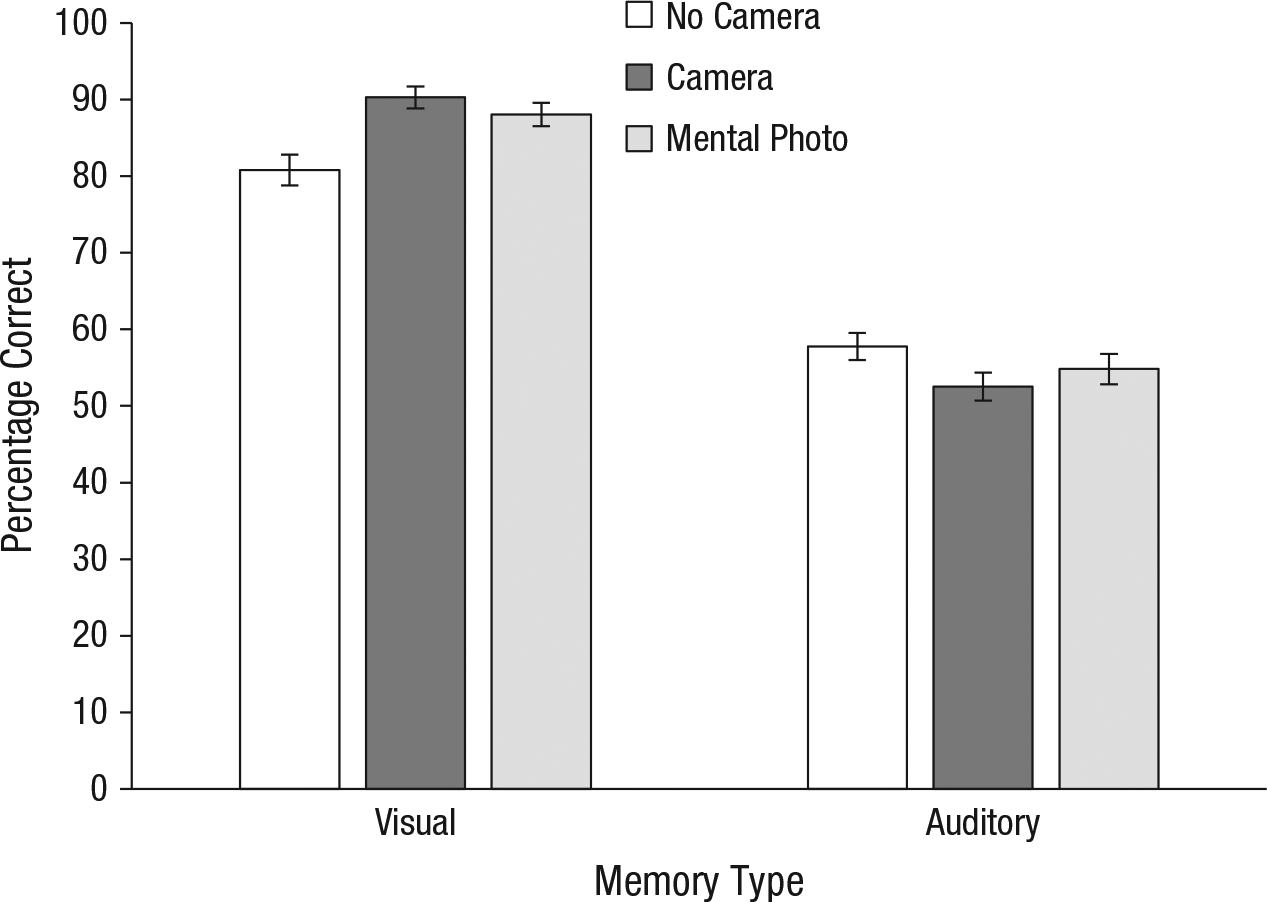
Visual and auditory memory performance of participants in the no-camera, camera, and mental-photo conditions in Study 4. Error bars represent ±1 SE.
Replicating previous findings, planned contrasts analyzing visual memory showed that participants in the camera condition recognized significantly more visual information (M = 90.27%, SD = 15.06) than did participants in the no-camera condition (M = 80.79%, SD = 21.64), F(1, 346) = 16.11, p < .001, η p 2 = .04. Participants in the mental-photo condition also recognized significantly more visual information (M = 88.03%, SD = 16.34) than did participants in the no-camera condition, F(1, 346) = 9.58, p = .002, η p 2 = .03, and exhibited visual memory comparable to that of participants in the camera condition, F(1, 346) = 0.89, p = .35. These results support the proposition that the mental process rather than the mechanics of photo taking heightens memory.
Planned contrasts analyzing auditory memory revealed that participants in the camera condition recognized significantly fewer auditory aspects of their experience (M = 52.54%, SD = 19.56) than did those in the no-camera condition (M = 57.77%, SD = 19.19), F(1, 346) = 3.93, p = .048, η p 2 = .01. Auditory recognition was similar for participants in the mental-photo condition (M = 54.81%, SD = 21.39) and those in the no-camera condition, F(1, 346) = 1.29, p = .26. Auditory memory also did not differ between the mental-photo and camera conditions, F(1, 346) = 0.73, p = .39.
Discussion
This study again replicated our finding that taking photos of experiences increases memory for visual aspects of those experiences while decreasing memory for auditory aspects. Further, simply taking photos mentally similarly heightens visual memory. These findings support the proposed attention-based process and rule out the possibility that mechanical aspects of photo taking, such as clicking a button, drive the effects.
Meta-Analysis: Effect of Having (vs. Not Having) a Camera on Visual and Auditory Memory
To further examine the effect of having (vs. not having) a camera on visual and auditory memory, we conducted a meta-analysis on all four studies fully reported here plus the two supplemental studies (see the Supplemental Material; methods from Lipsey & Wilson, 2001). This analysis showed that photo taking had a reliable positive effect on visual memory (d = 0.54, 95% confidence interval, CI = [0.45, 0.63]) and a smaller but reliable negative effect on auditory memory (d = 0.26, 95% CI = [0.16, 0.36]). Figure 7 provides a visual depiction of the effect sizes in the individual studies and overall.

Forest plots of effect sizes of having (vs. not having) a camera in the four main studies and two supplemental studies, along with the overall weighted effect sizes. Results for visual memory and auditory memory are on the top and bottom, respectively. The analysis for Study 3 combined the two camera conditions (photos saved and photos deleted). The mental-photo condition in Study 4 was not included in this meta-analysis. Error bars indicate 95% confidence intervals.
Effect of Taking (vs. Not Taking) Photos on Visual Memory
We next examined how actually taking photos affects visual memory for photographed versus nonphotographed aspects of an experience. We did so in both within-subjects and between-subjects analyses across the four main studies as well as the two supplemental studies. The within-subjects analysis focused only on the camera conditions and compared visual memory for photographed versus nonphotographed aspects of the experience. This analysis directly tested Hypothesis 2. The between-subjects analysis compared visual memory in the no-camera condition with both memory for photographed aspects and memory for nonphotographed aspects in the camera conditions. Table 1 presents both within- and between-subjects ANOVA results for each study, as well as the combined weighted effect size across all the studies. (Results from repeated measures binary logistic models of the same data are in the Supplemental Material and yielded similar conclusions.)
Descriptive Statistics and Results of Within- and Between-Subjects Analyses (Including Meta-Analyses) of the Effect of Photo Taking on Visual Memory
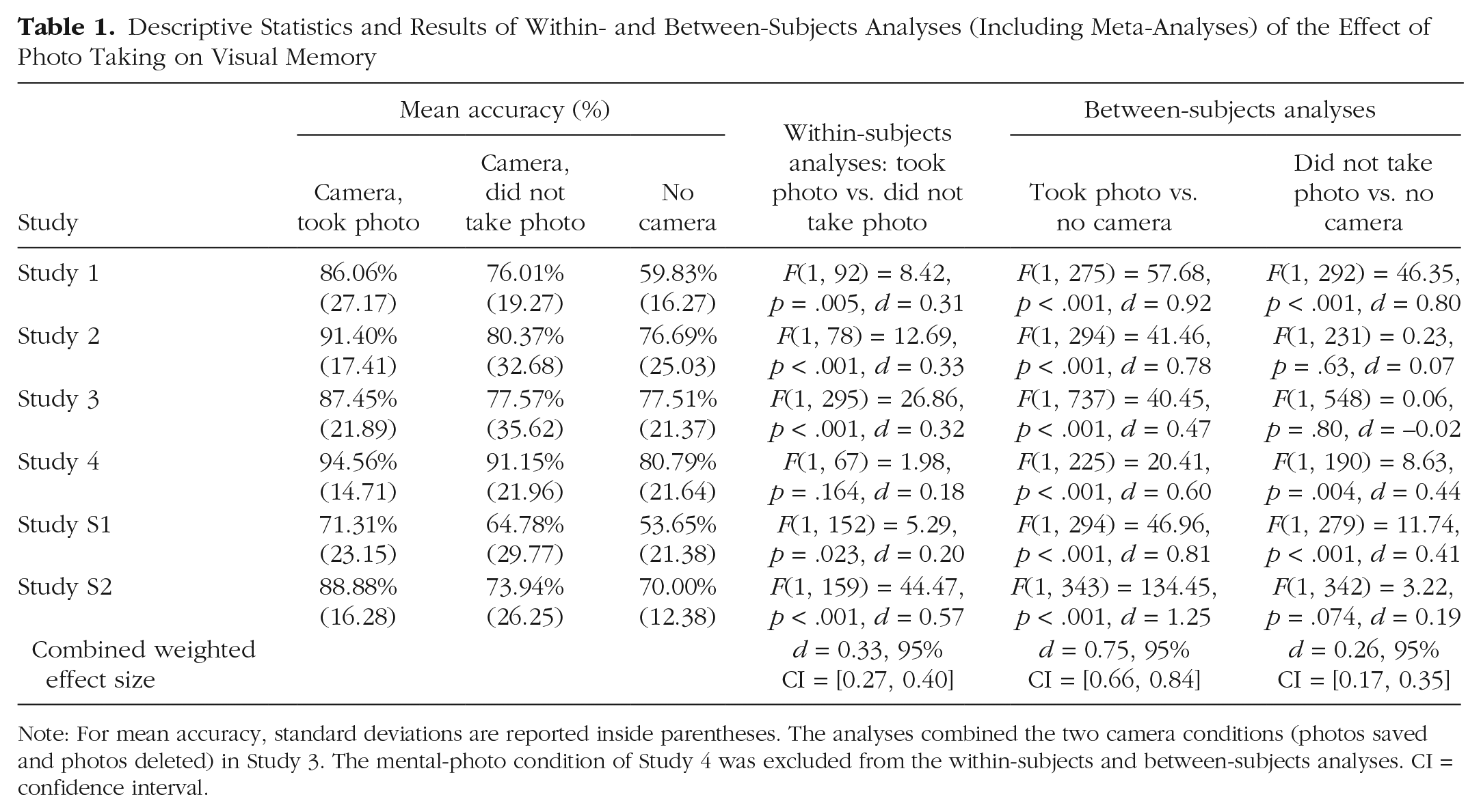
Note: For mean accuracy, standard deviations are reported inside parentheses. The analyses combined the two camera conditions (photos saved and photos deleted) in Study 3. The mental-photo condition of Study 4 was excluded from the within-subjects and between-subjects analyses. CI = confidence interval.
The within-subjects analyses supported our second hypothesis. Visual memory was significantly better for photographed aspects than for nonphotographed aspects in all but one study. A meta-analysis of all the studies showed that for participants with a camera, having taken a photo (vs. not having taken a photo) produced a small but consistent increase in visual memory (d = 0.33, 95% CI = [0.27, 0.40]; results are fully reported in the Supplemental Material).
Results of the between-subjects analyses were consistent with our first hypothesis. We found that in all the studies, memory for photographed aspects was significantly better than visual memory in the no-camera condition; the combined weighted effect size across all the studies was large and significant (d = 0.75, 95% CI = [0.66, 0.84]). Furthermore, even memory for nonphotographed aspects in the camera conditions was significantly better than memory in the no-camera condition in half the studies; across all the studies, this effect was small but reliable (d = 0.26, 95% CI = [0.17, 0.35]).
These analyses support our second hypothesis and further substantiate our proposal that volitional photo taking triggers an attention-driven process that enhances visual memory. Our finding that participants had better memory for aspects of the experience that they photographed than for aspects they did not photograph is consistent with the idea that photo taking directs attention toward what is photographed. Note that compared with participants who did not have a camera, those who had a camera had significantly better visual memory even for nonphotographed aspects of the experience. This comparison serves as an important control and strong test of the positive effect of having a camera on visual memory.
General Discussion
In this article, we have examined the effect of volitional photo taking on memory for visual and auditory aspects of experiences. In certain situations, people may use photos to offload the responsibility of remembering specific details, which may reduce memory for such content. However, we argue that people in fact take photos in order to engage with and remember those experiences that are self-relevant. We demonstrated that, even without revisiting any photos, people who had a camera and intended to take photos remembered more visual but less auditory information, compared with people who did not have a camera. These effects were not limited to the physical act of taking photos; taking mental photos had similar effects. Additional analyses, including meta-analyses, showed that visual memory was strongest for photographed aspects of the experience, but participants with a camera remembered even nonphotographed aspects better than participants without a camera did.
These results demonstrate a process in which photo taking improves visual memory by directing attention to photo-worthy aspects of experiences, in essence rendering visual content primary. In the contexts we studied, visual information was naturally salient. Photo taking might in fact have a smaller effect in such contexts than in contexts where visual aspects are naturally less salient. Further, when attention was diverted from auditory aspects of an experience, this reduced memory for those aspects. This effect of attention diversion should not be unique to photo taking; for example, when a technology focuses people’s attention toward nonvisual content, as when they record a sound clip, the same mechanism should improve auditory memory while reducing visual memory.
We examined the effect of volitional photo taking on participants’ memory when they did not revisit any photos and experienced a relatively short delay before their memory was tested. The persistence of this effect should be tested in future research. Further, in real life, people take photos to revisit later, and revisiting may affect, and even distort, memory over time (e.g., Koutstaal et. al, 1998). As we have shown, photographed aspects of experiences are remembered better than nonphotographed aspects to start with, and are also preserved in the photos. In contrast, nonphotographed aspects are remembered less well initially and also cannot be revisited through photos, which makes these details even more likely to fade from memory over time.
These and other open questions suggest that many of the nuanced effects of photography on human behavior are yet to be well understood. Given the increasing centrality of photography in everyday life, addressing these open questions will be both theoretically interesting and relevant to people’s lives.
Footnotes
Acknowledgements
The authors thank Raghuram Iyengar and Christophe van den Bulte for their feedback on this work, Metropolitan Gallery 250 for access to their exhibits, Robert Botto and Shawn Zamechek for their technical expertise and support, and the Wharton Behavioral Lab, as well as the University of Pennsylvania Museum of Archaeology and Anthropology, for their assistance in data collection.
Action Editor
Kathleen McDermott served as action editor for this article.
Declaration of Conflicting Interests
The authors declared that they had no conflicts of interest with respect to their authorship or the publication of this article.
Funding
This work was supported by a Marketing Science Institute research grant given to K. Diehl and G. Zauberman.
Open Practices
All data and many of the materials have been made publicly available via the Open Science Framework and can be accessed at https://osf.io/hrzgs. Because of copyright considerations, the tours and some of the memory questions used could not be made publicly available. The complete Open Practices Disclosure for this article can be found at http://journals.sagepub.com/doi/suppl/10.1177/0956797617694868. This article has received the badge for Open Data. More information about the Open Practices badges can be found at  .
.
Notes
References
Supplementary Material
Please find the following supplemental material available below.
For Open Access articles published under a Creative Commons License, all supplemental material carries the same license as the article it is associated with.
For non-Open Access articles published, all supplemental material carries a non-exclusive license, and permission requests for re-use of supplemental material or any part of supplemental material shall be sent directly to the copyright owner as specified in the copyright notice associated with the article.
