



Abstract
Considerable research has shown that planning plays an important role in goal pursuit. But how does the way people plan affect goal pursuit? Research on this question is scarce. In the current research, we examined how planning the steps required for goal attainment in chronological order (i.e., forward planning) and reverse chronological order (i.e., backward planning) influences individuals’ motivation for and perceptions of goal pursuit. Compared with forward planning, backward planning not only led to greater motivation, higher goal expectancy, and less time pressure but also resulted in better goal-relevant performance. We further demonstrated that this motivational effect occurred because backward planning allowed people to think of tasks required to reach their goals more clearly, especially when goals were complex to plan. These findings suggest that the way people plan matters just as much as whether or not they plan.
Planning can improve goal-congruent behavior and future pursuit of goals (Gollwitzer & Sheeran, 2006; Kruger & Evans, 2004; Patterson & Mischel, 1976); for example, planning lessens people’s tendency to underestimate the amount of time it takes to complete a task (Kruger & Evans, 2004). Planning also leads to greater self-control (Patterson & Mischel, 1976), higher adherence to medical advice (Gollwitzer & Oettingen, 2007), and better performance in school work (Gollwitzer & Brandstätter, 1997). Furthermore, extensive research on implementation intentions suggests that specifying an action to perform and the situation in which to perform it (i.e., if-then plans) is beneficial to goal attainment (Gollwitzer & Sheeran, 2006).
Although planning generally improves people’s performance on goal-directed tasks, research has identified some boundary conditions for the beneficial effects of planning, such as goal distance, number of goals, and mind-set abstraction (Dalton & Spiller, 2012; Townsend & Liu, 2012; Ulkumen & Cheema, 2011). For example, Townsend and Liu (2012) suggest that concrete implementation plans aid self-control when people are close to a goal but hinder self-control when people are far from the goal. In a similar vein, Dalton and Spiller (2012) contend that planning for multiple goals draws people’s attention to the difficulty of accomplishing multiple goals and thus impairs their commitment to those goals. Despite the abundance of research demonstrating that planning affects goal pursuit, research has paid little attention to the impact of how people construct plans.
One approach to plan construction is forward planning, or planning the steps required to reach a goal in chronological order, starting with the step temporally closest to the present and ending with the step furthest from the present (Buehler & Griffin, 2003; Hayes-Roth & Hayes-Roth, 1979; Powers, Koestner, & Topciu, 2005). For example, a student can prepare for an exam in chronological order by first considering the action to perform in the nearest future (e.g., reading the first chapter) and then working his or her way up to the last action to perform immediately before the exam (e.g., final review of notes). An alternative approach, which has received much less attention, is backward planning, or planning the steps in reverse chronological order, starting with the step furthest in time from the present and ending with the step closest in time (Holmberg & Robert, 2000; Rollier & Turner, 1994; Wiese, Buehler, & Griffin, 2016). Accordingly, a student would first consider the last action to perform right before the exam and work his or her way back to the activities that are temporally closer to the present.
We hypothesize that these different orders of planning affect people’s motivation for and perceptions of goal pursuit. Two lines of research inform our hypotheses. First, when thinking about a future event, people can adopt either a prospective perspective—considering an event that has not yet occurred and predicting the possibilities related to it—or a retrospective perspective—considering the event as if it has already occurred and explaining the ingredients required to make it happen (Ebert, Gilbert, & Wilson, 2009; Mitchell, Russo, & Pennington, 1989; Rollier & Turner, 1994). Research suggests that taking a retrospective perspective in strategic planning facilitates the visualization of a future event, which makes it easier to analyze the event and comprehend necessary steps to make it happen (Rollier & Turner, 1994; Weick, 1979). Ebert et al. (2009) also found that temporal perspectives on a future event affect people’s predictions about the impact of the future event. People expect a future event to have a greater hedonic impact when considering first their feeling in a future period and then how this feeling might be different if the event occurs (i.e., “backcasting”) than when considering first how they would feel at the time the event occurs and then how those feelings might change over time (i.e., forecasting). Together, this line of research suggests that shifts in temporal perspectives on future events influence people’s perceptions of and cognition about the events.
Second, research on imagination shows that mental simulation—imitative representation of an event—facilitates goal-directed performance (Taylor, Pham, Rivkin, & Armor, 1998; Taylor & Schneider, 1989). For example, Pham and Taylor (1999) found that envisioning the steps needed for goal achievement leads to increased confidence, decreased anxiety, and more effortful actions. People also feel closer in time to a goal and perform better when anticipating success rather than failure (Peetz, Wilson, & Strahan, 2009). Furthermore, research on fantasy realization posits that mentally contrasting a desired future (e.g., obtaining a desired grade) with the present reality that stands in the way of attaining the desired future (e.g., reading textbook chapters) helps people differentiate reachable and unreachable goals, leading to selective goal commitment and effective management of their resources (Oettingen, 2000). It is noteworthy that mental contrasting has benefits only when people elaborate first on a desired future and then on the present reality, thus considering reality an obstacle impeding the realization of the desired future. Thinking in the reverse order makes people less likely to perceive the present reality as an impediment; instead, people experience the desired future as a relief to the given reality, thus failing to consider the necessity of acting (Oettingen, Pak, & Schnetter, 2001).
In light of these findings, we hypothesize that backward planning, in which people first mentally picture the time when a goal is accomplished and then think of detailed actions to perform before reaching the goal, will enable retrospective thinking and a clear view of the steps necessary to reach the goal (Rollier & Turner, 1994; Weick, 1979). Mentally contrasting the future attainment of desired goals with the present reality will help people clearly see the reality to overcome and selectively commit to essential steps for goal achievement (Oettingen et al., 2001). Furthermore, imagining goal completion itself will make people who plan backward feel more confident about and closer in time to achieving the goal (Peetz et al., 2009; Taylor et al., 1998). To the extent that backward planning leads to a clearer view of the steps necessary for goal achievement and that envisioning goal achievement enhances positive perceptions of goal pursuit, we expect backward planning to result in greater motivation, higher goal expectancy (i.e., expectation that the goal will be reached), and less time pressure in goal pursuit (Fig. 1).

Conceptual framework: the effects of planning order on perceived clarity of the plan and the consequent motivation, goal expectancy, and time pressure.
In contrast, forward planning involves extrapolating from the present to the future and thus requires consideration of all the steps to be performed before goal achievement. This prospective thinking will make it difficult to visualize all sequentially related actions for goal achievement because when considering a few future alternatives, different possibilities might begin to emerge exponentially (Rollier & Turner, 1994). In paying attention to numerous potential actions to perform to move toward an envisioned future, people who plan forward may lose sight of the essential steps necessary to achieving their goal. This vague view of steps to follow in goal pursuit will in turn make them feel uncertain about how much time to spend on each step and whether they could successfully perform it and move on to the next step (Tubbs & Ekeberg, 1991). Moreover, considering present impediments first and then future goal achievement removes the motivational benefits of mental contrasting (Oettingen et al., 2001). Thus, compared with backward planning, forward planning should lead to less motivation, lower goal expectancy, and greater time pressure (Fig. 1).
Research suggests that backward planning is particularly helpful for complex problems and planning under uncertain circumstances (Dreborg, 1996; Holmberg & Robert, 2000). When goal pursuit involves complex programming of timing and sequencing of steps that are contingent on each other, a retrospective perspective facilitates visualization of the goal pursuit because people first imagine the goal as if it has already been achieved. This perspective constrains the number of sequences that come to mind, which improves the clarity of plan construction. In contrast, a prospective perspective hinders visualization of the goal pursuit because people first consider multiple first steps toward reaching their goal. These first steps further lead to numerous different sequences of goal attainment, which undermines the clarity of plan construction. Accordingly, we further predict that backward planning will be beneficial to goal pursuit when goals are complex (i.e., when goal pursuit involves steps that are ambiguous and difficult to coordinate; Byrne & Bovair, 1997; Campbell, 1988; Wood, 1986) and that perceived clarity of plan will mediate the planning-order effects only when goal complexity is high.
Study 1: Effect of Planning Order on Motivation
Study 1a
Method
We designed this study to have power of .80 to detect an effect (Cohen’s d) of .90 with an α of .05. This required a minimum sample size of 21 for each condition, which we rounded to 25. Fifty-three undergraduate students (41.5% female, 58.5% male; mean age = 20.98 years, age range = 19–28 years) at a U.S. university ultimately participated in partial fulfillment of their course requirements. In Study 1a, we used an academic paradigm to test our prediction. Participants were asked to construct a study plan for an exam in a course in which they were actually enrolled at the time of the experiment. To control for the content of planning, we provided participants with 15 specific activities that we derived from students’ study plans in a pilot study. Participants in the backward-planning condition were instructed to plan the 15 activities in reverse chronological order, starting with things to do on the day before the exam. Participants in the forward-planning condition were instructed to plan the 15 activities in chronological order, starting with things to do on the first day they would begin studying for the exam. After constructing their study plans, participants responded to two questions measuring motivation (“How much effort will you allocate to study for the exam?” and “How much will you strive to get your desired grade?”) on a scale from 1 (a little bit) to 7 (very much). We excluded 9 participants who did not incorporate all 15 activities in their plans or who did not plan the activities in the order instructed. In the final sample, data from 44 participants (43.2% female, 56.8% male; mean age = 20.74 years, age range = 19–28 years) remained for analysis; there were 20 participants in the backward-planning condition and 24 in the forward-planning condition.
Results
The two measures of motivation were strongly correlated (r = .74, 95% confidence interval, or CI = [.57, .85], p < .001), so we averaged the two measures to form a motivation index and conducted an analysis of variance (ANOVA) on that index. The results showed that, compared with participants who planned forward (M = 5.58, 95% CI = [5.20, 5.96]), those who planned backward (M = 6.40, 95% CI = [5.98, 6.82]) intended to exert more effort to achieve their desired grades, F(1, 42) = 8.58, p = .005, d = 0.91, 95% CI = [0.28, 1.53].
Study 1b
Method
Sixty students (70% female, 30% male; mean age = 23.39 years, age range = 21–28 years) at a Chinese business school participated in the study in exchange for a cash payment. We applied a method similar to that used in Study 1a to determine sample size. However, we used a different, nonacademic planning paradigm. Specifically, participants were first asked to imagine that they had a job interview at their dream company and that it would be an important opportunity for them to impress the employer and get the job. They were then provided with 15 activities to perform to prepare for the job interview and were instructed to plan the activities in either chronological or reverse chronological order. After the planning task, participants answered two questions measuring motivation. Participants completed this study in the local language. After we excluded participants who did not follow instructions as requested, data from 51 participants (68.6% female, 31.4% male; mean age = 23.39 years, age range = 21–28 years) remained for analysis; there were 27 participants in the backward-planning condition and 24 in the forward-planning condition.
Results
The two measures of motivation were strongly correlated (r = .85, 95% CI = [.75, .91], p < .001), so we averaged the two measures to form a motivation index. We performed an ANOVA on the motivation index, which revealed a marginally significant main effect of planning order, F(1, 49) = 3.76, p = .058, d = 0.55, 95% CI = [−0.01, 1.11]. As in Study 1a, participants in the backward-planning condition (M = 6.43, 95% CI = [6.11, 6.74]) reported a higher intention to allocate effort and strive for the job interview than those in the forward-planning condition (M = 5.98, 95% CI = [5.64, 6.32]). Study 1b replicated the planning-order effect on motivation in a nonacademic planning paradigm.
Study 2: Effect of Planning Order on Goal Progress
To overcome the limitations of self-reporting inherent in Studies 1a and 1b, we set out to measure participants’ actual goal progress multiple times after backward planning and forward planning in Study 2.
Method
Sixty-two undergraduate students (16.1% female, 77.4% male; mean age = 20.93 years, age range = 19–26 years) at a U.S. university participated in this 7-day-long study in partial fulfillment of their course requirements. We applied a method similar to that used in Studies 1a and 1b to determine sample size. Four participants who did not provide demographic information were excluded from the demographic analysis.
This study consisted of two phases. We conducted the first phase in a lab. Participants were instructed that during the lab session, they would complete a questionnaire in which they created a 7-day study plan to fulfill the requirements of the courses they were taking at that time and that follow-up questions would be sent to them in the next 7 days. Specifically, in the questionnaire, participants provided the number of courses they were taking at that time and the corresponding course requirements (e.g., group projects, assignments, quizzes) that would be due in the next 7 days. Next, participants constructed a 7-day study plan by specifying every academic task (e.g., meet team members, finalize a team project, copy down key concepts, read the textbook, study online quizzes) they needed to perform to complete those course requirements. They indicated the dates (e.g., April 2, April 5) on which they would perform each task. Participants in the backward-planning condition listed the tasks in reverse chron-ological order, whereas participants in the forward-planning condition listed the tasks in chronological order. After constructing their study plans, participants provided information about demographic variables and their e-mail addresses. At the end of the first phase, participants were given instructions for completing the second phase of the study, and they were informed that they would receive three online follow-up surveys via e-mail in the next 7 days. They were told that the purpose of the study was to understand how well students stick to their study plans and that their study activities would be recorded for a week.
During the second phase, participants received a follow-up survey at the end of Days 1, 4, and 7 in the 7-day period. In each of the follow-up surveys, participants also received the 7-day study plan they had constructed in the lab, and they indicated their progress on each of the tasks listed in the plan as percentages (i.e., 100% meant that the task was completed). For each participant, we computed a rate of progress at each follow-up check, so each participant had three progress indices. We calculated rate of progress at each follow-up check by averaging the participants’ progress (0%–100%) toward each task (e.g., tasks scheduled for April 2 through April 5) they had planned to accomplish by the date of the follow-up survey (e.g., April 5).
Fifty-two students (17.3% female, 76.9% male; mean age = 20.90 years, age range = 19–26 years) continued with the follow-up surveys and thus were included in the analyses; 31 were in the backward-planning condition, and 21 were in the forward-planning condition. Thirty-six of the 52 participants completed all three follow-up studies. Participants in the backward-planning condition had a higher participation rate in the follow-up studies (77%) than those in the forward-planning condition (57%).
Results
Number of planned tasks
To examine the possibility that participants who plan backward are less fluent than their counterparts who plan forward and thus generate fewer steps, which might affect subsequent motivation and goal pursuit, we compared the number of planned tasks between the two conditions. One person did not report the number of courses he or she was taking. There was no significant difference in the number of courses being taken in the two conditions (backward-planning condition: M = 4.63, 95% CI = [4.27, 4.99]; forward-planning condition: M = 4.29, 95% CI = [3.86, 4.72]), F(1, 49) = 1.55, p = .219. We also found no significant difference in the number of tasks included in the study plans from the backward-planning group (M = 9.87, 95% CI = [8.53, 11.22]) and the forward-planning group (M = 9.81, 95% CI = [8.18, 11.44]), F(1, 50) = 0.003, p > .250.
Progress of the plan
We first tested the motivational influence of backward relative to forward planning by comparing participants’ overall progress on the 7-day study plan in the two planning conditions. We used participants who completed all three follow-up surveys to conduct a repeated measures ANOVA on the progress indices, with planning order as a between-participants variable and follow-up survey as a within-participants variable. The ANOVA results revealed only a significant main effect of planning order that did not interact with the timing of the follow-up survey; backward planning (M = 90.98, 95% CI = [85.11, 96.85]) led to an overall higher level of completion than forward planning (M = 78.97, 95% CI = [70.50, 87.44]), F(1, 35) = 5.60, p = .024, d = 0.85, 95% CI = [0.14, 1.57].
Next, we included participants who completed any of the follow-up surveys and compared the progress indices between the backward- and forward-planning conditions for Day 1, Day 4, and Day 7 separately (Fig. 2). We found that the difference in rate of progress between the two planning conditions was directionally consistent with our hypotheses and was statistically significant for Day 4 (backward planning: M = 92.40, 95% CI = [86.67, 98.13]; forward planning: M = 80.48, 95% CI = [73.13, 87.84]), F(1, 43) = 6.64, p = .013, d = 0.81, 95% CI = [0.19, 1.44], but not for Day 1 (backward planning: M = 88.15, 95% CI = [77.81, 98.49]; forward planning: M = 78.25, 95% CI = [65.26, 91.24]), F(1, 47) = 1.44, p = .236, d = 0.36, 95% CI = [−0.22, 0.94], or for Day 7 (backward planning: M = 94.27, 95% CI = [88.37, 100.16]; forward planning: M = 87.77, 95% CI = [80.12, 95.43]), F(1, 41) = 1.84, p = .182, d = 0.44, 95% CI = [−0.19, 1.06].
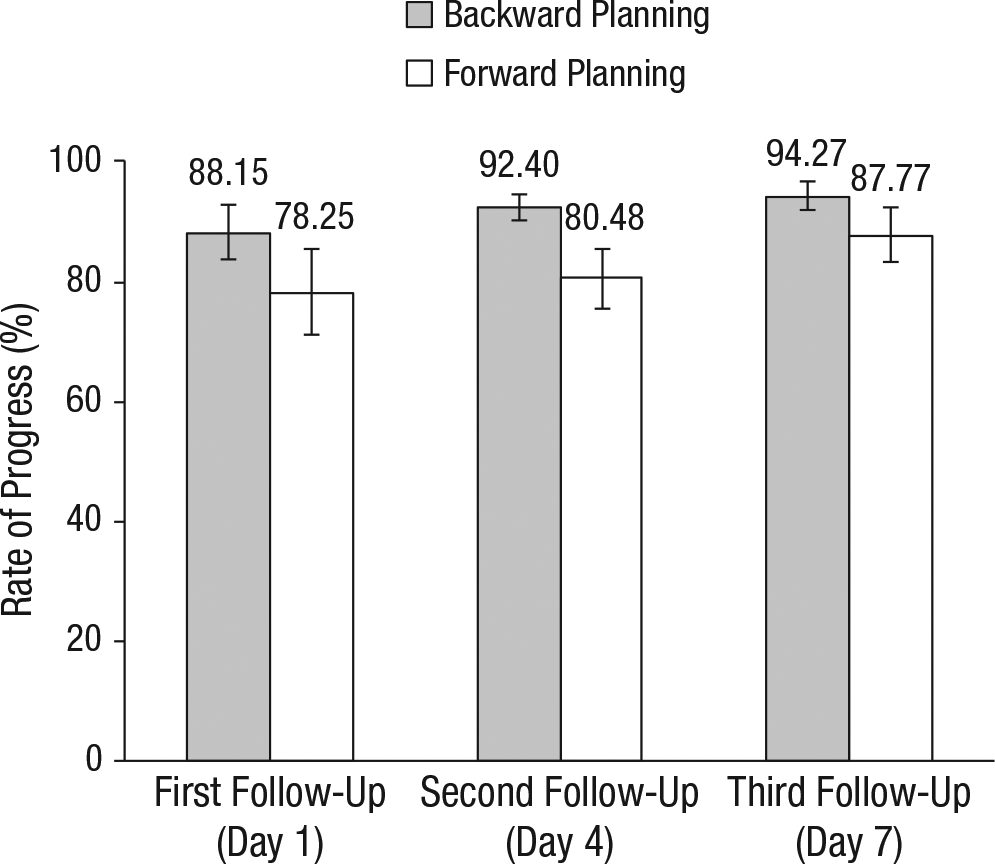
Results from Study 2: rate of progress on each follow-up day, separately for the two planning-order conditions. Error bars represent ±1 SE.
Study 3: Effect of Planning Order on Actual Academic Performance
In Study 3, we observed participants’ actual performance on a school examination.
Method
Students at a Korean university (n = 48; 60.4% female, 39.6% male; mean age = 22.96, age range = 20–28 years) and at a Chinese business school (n = 63; 58.7% female, 41.3% male; mean age = 23.33, age range = 21–31 years) participated in the study in partial fulfillment of their course requirements. We applied a method similar to those used in Studies 1 and 2 to determine sample size. Participants completed two surveys related to the final term exam in a course in which they were actually enrolled at the time of the experiment. In the first survey, participants indicated their desired percentage grade (0–100) for the exam. As in Study 1, participants then were provided with a fixed number of activities to perform to prepare for the exam and were instructed to plan the activities in either chronological or reverse chronological order. After the planning task, participants responded to two questions measuring their level of involvement (“I was very involved in performing the planning task” and “I paid a lot of attention when listing my study plans”) using a scale from 1 (strongly disagree) to 7 (strongly agree). The two measures of involvement were strongly correlated (r = .83, 95% CI = [.75, .89], p < .001), so we took the average of the measures to form an involvement index. Participants also indicated whether they followed the instructed order of planning. To remind students of their study plan, constructed in either chronological or reverse chronological order, we ran a follow-up survey in which participants were provided with a copy of the study plan they had constructed in the first survey and were asked to review the plan. We observed the real performance of participants during the exam and used the grade (0%–100%) they earned as the dependent variable.
We combined data from the two schools into a single sample because data collection followed the same procedures and the pattern of the planning-order effect on performance was consistent between the two groups (Judge, Bono, Erez, & Locke, 2005). We excluded 20 participants who did not plan the activities in the order instructed and 8 participants who did not complete the follow-up survey. In the final sample, data from 83 participants (60.2% female, 39.8% male; mean age = 23.01 years) remained for analysis; there were 38 participants in the backward-planning condition and 45 in the forward-planning condition.
Results
We compared mean levels of variables between the two schools to discern any important differences. There were no significant mean-level differences in involvement between the Korean group (M = 5.47, 95% CI = [5.07, 5.88]) and the Chinese group (M = 5.70, 95% CI = [5.35, 6.05]), F(1, 81) = 0.73, p > .250. The mean desired grades at the two schools were significantly different, F(1, 81) = 6.77, p = .011, d = 0.58, 95% CI = [0.14, 1.03]; the Korean group (M = 94.42, 95% CI = [92.94, 95.89]) expected a higher exam grade than did the Chinese group (M = 91.85, 95% CI = [90.56, 93.14]). The means of actual exam grades at the two schools were also significantly different, F(1, 81) = 37.27, p < .001, d = 1.37, 95% CI = [0.89, 1.85]; the Korean group (M = 89.03, 95% CI = [85.18, 92.88]) obtained a higher exam grade than the Chinese group (M = 73.34, 95% CI = [69.97, 76.71]).
We found that desired grades were significantly correlated with actual exam grades, b = 1.04, 95% CI = [0.41, 1.66], t(81) = 3.28, p = .002. The mean levels of desired grades in the forward-planning condition (M = 93.64, 95% CI = [92.29, 95.00]) and the backward-planning condition (M = 92.16, 95% CI = [90.68, 93.64]) were not significantly different, F(1, 81) = 2.18, p = .144. To control for the impact of desired grades and possible differences between the schools, we performed an analysis of covariance on the actual exam grade with the school and desired grade as covariates. The results showed that, compared with participants in the forward-planning condition (M = 77.42, 95% CI = [74.12, 80.71]), those in the backward-planning condition (M = 83.38, 95% CI = [79.78, 86.97]) performed better on the exam, F(1, 79) = 5.83, p = .018, d = 0.23, 95% CI = [−0.20, 0.66].
Study 4: Goal Complexity as a Moderator and Perceived Clarity as a Mediator
In Study 4, we directly manipulated the level of goal complexity. Furthermore, we measured participants’ perceived clarity during plan construction in hopes of providing evidence for the proposed underlying mechanism, and we examined the influence of planning order on goal expectancy and perceived time pressure.
Method
Ninety-nine undergraduate students (37.4% female, 60.6% male; mean age = 21.13 years, age range = 19–33 years) at a U.S. university participated in this study in partial fulfillment of their course requirements. Participants were from a large subject pool consisting of students enrolled in one of multiple sessions of an introductory marketing course. The method used to determine sample size was the same as that used in Study 1a.
To test the moderation effect of goal complexity in a realistic setting, we manipulated the complexity level of a focal goal using two real exams, a noncomprehensive midterm exam and a comprehensive final exam for the same course. The noncomprehensive exam covered only a few chapters in the textbook, whereas the comprehensive exam included all the materials covered in class (i.e., all the chapters in the textbook and articles assigned in class). We expected planning and coordination to be more complex for the comprehensive exam than for the noncomprehensive exam. In the case of the comprehensive exam, the acts performed in one stage of exam preparation were more likely to be contingent on acts performed at other stages (e.g., students needed to review the old material and study the new material before integrating all material). In addition, some acts needed to be performed simultaneously (e.g., studying material that is naturally cumulative, some from earlier chapters and some from later chapters; these required complex scheduling and sequencing of performance, which made planning for the comprehensive test more complex than planning for the noncomprehensive test (Wood, 1986).
We assumed these two exams to be equally important to students because they carried the same weight in determining the final grade for the course. Furthermore, we expected that using exams for the same course would control for potential confounds involved in different courses (e.g., instructor, importance of course, course requirements). To control for temporal distance to the target exam, different groups of participants from a large subject pool from an introductory marketing course were recruited at two points of time during the semester at approximately the same time (i.e., about 1 month) before the midterm exam and the final exam. When collecting the data for the comprehensive exam, we asked participants not to take the study if they had participated in the earlier study about planning for the noncomprehensive exam, to avoid having the same participants in the two goal-complexity conditions. Each participant was randomly assigned to either the backward- or forward-planning condition.
Thus, in a 2 (planning order: forward vs. backward) × 2 (goal complexity: high vs. low) between-participants design, participants were instructed to construct a plan for an upcoming noncomprehensive exam (i.e., Exam 2) or comprehensive exam (i.e., the final exam) by specifying what to do and when to do it, step by step in either forward or backward order. Participants were told that they could stop at any time when they had specified all the steps they would perform. After creating their study plans, participants responded to one item (“To what extent do you feel that the things you need to do in order to prepare for Exam 2 [the final exam] are clear to you?”) on a scale from 1 (not at all) to 7 (very much). Participants then reported their motivation using the items from Studies 1a and 1b. Then, using a 7-point scale (1 = not at all, 7 = definitely), they responded to questions about goal expectancy (“What is the probability that you will earn your desired grade?” and “Are you optimistic about getting your desired grade?”; Louro, Pieters, & Zeelenberg, 2007) and perceived time pressure (“Do you feel that you are short of time in attaining your desired grade?” and “Do you think you have sufficient time to complete all the plans?”; the latter item was reverse-coded; Durham, Locke, Poon, & McLeod, 2000). They also indicated their agreement (1 = strongly disagree, 7 = strongly agree) with two statements assessing complexity of the planning task (i.e., “It was difficult to plan things to do in chronological [reverse chronological] order” and “It was easy to establish the study plan in chronological order [reverse chronological] order”; the later item was reverse-coded).
We excluded participants who listed only one step or who did not specify the corresponding time for performing each step. In the final sample, data from 80 participants (41.8% female, 58.2% male; mean age = 21.13 years, age range = 19–33 years) remained for analyses; there were 39 participants in the backward-planning condition and 41 in the forward-planning condition.
Results
Planning difficulty
The measures of difficulty and ease of planning (the latter reverse coded) were strongly correlated (r = .81, 95% CI = [.72, .87], p < .001), so we averaged the measures to provide an index of planning difficulty. A 2 (planning order) × 2 (goal complexity) ANOVA revealed only a significant main effect of goal complexity. Planning for a comprehensive exam (M = 3.35, 95% CI = [2.83, 3.88]) was more difficult than planning for a noncomprehensive exam (M = 2.43, 95% CI = [1.95, 2.92]), F(1, 76) = 6.55, p = .012, d = 0.59, 95% CI = [0.14, 1.04]. This confirmed our assumption about the greater complexity of the planning task for a comprehensive exam.
Motivation, goal expectancy, and time pressure
The measures of motivation (r = .75, 95% CI = [.64, .83], p < .001), goal expectancy (r = .60, 95% CI = [.44, .72], p < .001), and time pressure (r = .82, 95% CI = [.73, .88], p < .001) were strongly correlated, so we averaged the measures to form indexes of motivation, goal expectancy, and time pressure, respectively. We conducted three separate 2 (planning order) × 2 (goal complexity) ANOVAs and found significant interaction effects of order of planning and goal complexity on motivation, F(1, 76) = 4.40, p = .039; expectation of goal attainment, F(1, 76) = 6.45, p = .013; and perceived time pressure, F(1, 76) = 7.79, p = .007. To examine the nature of the two-way interac-tions, we examined the data separately by goal complexity.
Among the participants in the high-goal-complexity condition, there was greater motivation among the participants in the backward-planning condition (M = 6.42, 95% CI = [5.97, 6.87]) than among the participants in the forward-planning condition (M = 5.84, 95% CI = [5.40, 6.28]), and the difference was marginally significant, F(1, 35) = 3.43, p = .073, d = 0.63, 95% CI = [−0.03, 1.29]. As we predicted, participants’ goal expectancy was higher for those in the backward-planning condition (M = 5.78, 95% CI = [5.31, 6.25]) than for those in the forward-planning condition (M = 4.92, 95% CI = [4.46, 5.38]), F(1, 35) = 7.04, p = .012, d = 0.90, 95% CI = [0.22, 1.57]. In addition, less time pressure was perceived by participants in the backward-planning condition (M = 3.58, 95% CI = [2.78, 4.39]) than by those in the forward-planning condition (M = 4.58, 95% CI = [3.79, 5.37]), and the difference was marginally significant, F(1, 35) = 3.22, p = .082, d = −0.61, 95% CI = [−1.27, 0.05] (Fig. 3).

Results from Study 4: (a) motivation, (b) goal expectancy, and (c) time pressure as a function of goal complexity and planning order. Error bars represent ±1 SE.
Among the participants in the low-goal-complexity condition, there were no corresponding effects of planning order on motivation (backward planning: M = 5.71, 95% CI = [5.28, 6.15]; forward planning: M = 6.05, 95% CI = [5.62, 6.47]), F(1, 41) = 1.23, p > .250, or goal expectancy (backward planning: M = 5.36, 95% CI = [4.95, 5.77]; forward planning: M = 5.59, 95% CI = [5.19, 5.99]), F(1, 41) = 0.67, p > .250. However, an unexpected and significant main effect of planning order on time pressure emerged; participants in the backward-planning condition felt greater time pressure (M = 3.62, 95% CI = [2.86, 4.38]) than did participants in the forward-planning condition (M = 2.48, 95% CI = [1.74, 3.22]), F(1, 41) = 4.72, p = .036, d = 0.68, 95% CI = [0.06, 1.29] (Fig. 3).
Perceived clarity of plan
A two-way ANOVA showed a marginally significant interaction effect of orders of planning and goal complexity on clarity of the steps of goal pursuit, F(1, 76) = 3.62, p = .061. As predicted, planning order had no effect on clarity when the goal complexity was low (backward planning: M = 5.91, 95% CI = [5.46, 6.36]; forward planning: M = 6.05, 95% CI = [5.61, 6.49]), F(1, 41) = 0.20, p > .250. However, when the goal complexity was high, participants in the backward-planning condition (M = 6.00, 95% CI = [5.50, 6.50]) felt clearer about the steps in goal pursuit than those in the forward-planning condition (M = 5.26, 95% CI = [4.78, 5.75]), F(1, 35) = 4.66, p = .038, d = 0.73, 95% CI = [0.06, 1.40].
Mediation of perceived clarity of plan
We conducted a moderated mediation analysis by following the bootstrapping techniques for conditional indirect effects suggested by Preacher and Hayes (2004). The results confirmed our mechanism predictions. We found a significant indirect effect among the participants in the high-goal-complexity condition: Backward planning enhanced motivation through increased perceived clarity of the steps of goal pursuit (95% CI = [.0369, 1.0226]; see Fig. 4). There was no corresponding indirect effect among the participants in the low-goal-complexity condition (95% CI = [−.2184, .0645]).

Results from Study 4: the effect of planning order on motivation, as mediated by perceived clarity of the plan, separately for the (a) high-goal-complexity condition and (b) low-goal-complexity condition. On the paths from planning order to motivation, the values above the arrows are from the models without the mediator, and the values below the arrows are from the models that included the mediator. The symbols indicate the significance of the path coefficients (†p < .10; *p < .05; **p < .001).
Number of steps
We subjected the number of steps included in a study plan to a two-way ANOVA, as with the other measures. Consistent with the findings in Study 2, there was no significant difference in the number of steps between the backward-planning condition (M = 4.56, 95% CI = [3.70, 5.35]) and the forward-planning condition (M = 4.61, 95% CI = [3.75, 5.36]), F(1, 76) = 0.002, p > .250, which suggests that fluency is unlikely to drive the planning-order effects. The two-way interaction effect was also not significant, F(1, 76) = 0.25, p > .250.
We were surprised to find that more steps were listed by the noncomprehensive-exam group (M = 5.16, 95% CI = [4.37, 5.94]) than by the comprehensive-exam group (M = 3.92, 95% CI = [3.08, 4.77]), F(1, 76) = 4.56, p = .036, d = 0.49, 95% CI = [0.05, 0.94]. Follow-up tests revealed that the main effect of goal complexity on the number of steps was driven mainly by the difference in the forward-planning conditions (noncomprehensive: M = 5.32, 95% CI = [4.22, 6.42]; compre-hensive: M = 3.79, 95% CI = [2.61, 5.00]), F(1, 76) = 3.57, p = .063, d = 0.55, 95% CI = [−0.07, 1.18], rather than by the difference in the backward-planning conditions (noncomprehensive: M = 5.00, 95% CI = [3.88, 6.12]; comprehensive: M = 4.06, 95% CI = [2.84, 5.27]), F(1, 76) = 1.20, p > .250. Perhaps the vague view of steps to goal achievement in forward planning hindered plan articulation and thus resulted in fewer steps. Indeed, follow-up tests on clarity of the steps of goal pursuit showed that participants who planned forward regarded the things necessary to do to prepare for the exam as less clear for the comprehensive exam (M = 5.26, 95% CI = [4.79, 5.73]) than for the noncomprehensive exam (M = 6.05, 95% CI = [5.61, 6.48]), F(1, 76) = 5.89, p = .018, d = 0.83, 95% CI = [0.19, 1.47].
General Discussion
Previous research has focused on the relative consequences of planning and not planning, but the effects of how plans are constructed are poorly understood. To our knowledge, the current research is the first to explore how order of planning affects motivation and performance in goal pursuit. Across five studies using various planning paradigms, we demonstrated that backward planning leads to greater motivation and better goal-directed behavior than does forward planning. Furthermore, relative to forward planning, backward planning allows people to more clearly anticipate the necessary steps and follow the original plan to reach the set goal; backward planning also leads to higher goal expectancy and less time pressure when coordinating the steps required to accomplish the goal is complex.
We expect our findings to be generalizable to various self-regulatory domains. We tested our hypotheses in several settings and found consistent results as long as the situation was relatively complex. Furthermore, we varied the operationalization of plan construction across our studies. Participants in Study 1 constructed their study plans using a fixed number of tasks that was externally provided, whereas participants in Study 4 freely generated tasks they wished to include in their study plans. The consistent results suggest that our findings will be generalizable to situations in which people construct plans either by using self-generated tasks or by following so-called experts’ advice for essential preparation steps.
A recent study also examined order of planning and found that (relative to forward planning) backward planning allows people to clarify important steps as well as potential obstacles to goal achievement (Wiese et al., 2016). At first glance, the anticipation of obstacles in backward planning appears to contradict our finding that backward planning leads to higher goal expectancy and less time pressure. However, we expect that, in line with fantasy-realization theory (Oettingen & Gollwitzer, 2010; Oettingen et al., 2001), backward planning allows a clear view of essential steps, including obstacles, and effective management of goal pursuit, ultimately leading to higher goal expectancy and lesser time pressure than an unclear view predicted in forward planning.
In Study 2, we found that planning order has a significant impact in the middle of goal pursuit. Bonezzi, Brendl, and De Angelis (2011) suggest that people switch reference points for monitoring goal progress throughout goal pursuit and that their motivation to reach a goal decreases about halfway to the end state, the point at which the perceived marginal value of progress is the lowest. This suggests that the benefits of backward planning are strongest when people most suffer from decreased motivation—the middle of goal pursuit. However, given that the interaction effect with timing was not significant and that we observed this effect in only a single study, we stress that it should be interpreted cautiously. In addition, the relative effectiveness of backward planning compared with forward planning over time awaits future research.
This research also had some limitations. First, although using a noncomprehensive midterm exam and a comprehensive final exam in the same course helps control for idiosyncratic instructor and student motivational differences in different courses, the design in Study 4 inevitably involved potential confounds, such as the difference in when the exam occurred. Second, we did not test the role of individual differences, but previous research indicates that differences in temporal perspectives are associated with individual demographic factors or personal experiences (El Sawy, 1983; Gonzalez & Zimbardo, 1985). Thus, individual differences in terms of the disposition of backward or forward planning could exist. Further research needs to examine whether these individual dispositions affect goal pursuit.
Given that individuals frequently construct plans for goal pursuit, our findings shed light on the importance of the order of plan construction and show that manipulating the order of planning through situational interventions can increase goal motivation and performance. A variety of goals, such as academic degrees, career choices, and financial planning, require complex plans to accomplish. Our findings indicate that planning in reverse chronological order may not only help people have a clearer view of tasks to execute but also improve their actual performance.
Footnotes
Action Editor
Marc J. Buehner served as action editor for this article.
Declaration of Conflicting Interests
The authors declared that they had no conflicts of interest with respect to their authorship or the publication of this article.
Open Practices
All materials have been made publicly available via the Open Science Framework and can be accessed at https://osf.io/2uzmw/. The complete Open Practices Disclosure for this article can be found at https://journals-sagepub-com.web.bisu.edu.cn/doi/suppl/10.1177/0956797617715510. This article has received the badge for Open Materials. More information about the Open Practices badges can be found at  .
.
References
Supplementary Material
Please find the following supplemental material available below.
For Open Access articles published under a Creative Commons License, all supplemental material carries the same license as the article it is associated with.
For non-Open Access articles published, all supplemental material carries a non-exclusive license, and permission requests for re-use of supplemental material or any part of supplemental material shall be sent directly to the copyright owner as specified in the copyright notice associated with the article.
