



Abstract
Given the central role of anger in shaping adversarial policy preferences in the context of intergroup conflict, its reduction may promote conflict resolution. In the current work, we drew on psycholinguistic research on the role of language in generating emotions to explore a novel, extremely subtle means of intervention. Specifically, we hypothesized that phrasing conflict-relevant policies in noun form (vs. verb form) would reduce anger and impact policy support correspondingly. Results across three experimental studies in the context of the Israeli-Palestinian conflict supported these expectations for both support for concessions (Studies 1–3) and retaliatory policies (Study 3), with reduction in anger mediating the salutary impact of noun form (vs. verb form) on policy support. These results expand our understanding of the influence of language on emotions and policies in the context of conflict and have applied relevance for conflict-resolution efforts.
Keywords
Emotions play a cardinal role in driving and shaping intractable conflicts and their resolution (Bar-Tal, 2013; Halperin & Reifen Tagar, 2017; Maoz & McCauley, 2005). Distinct emotions entail unique cognitive appraisals and arouse specific emotional goals, which lead individuals to endorse or oppose certain conflict-related policies (Halperin, 2016; Lerner, Gonzalez, Small, & Fischhoff, 2003). One of the most central and prevalent emotions in this context is anger (Halperin & Gross, 2011; Lerner et al., 2003; Reifen Tagar, Federico, & Halperin, 2011). Anger stems from the perception that other people are carrying out an action that is unjust, unfair, or contrary to acceptable societal norms (Averill, 1982) and is associated with the goal of actively challenging the injustice and confronting the agents responsible, both at the interpersonal level (Frijda, Kuipers, & ter Shure, 1989; Roseman, Wiest, & Swartz, 1994) and intergroup level (Scherer, Schorr, & Johnstone, 2001; Shuman, Halperin, & Reifen Tagar, 2017). Importantly, in the context of intergroup conflict, anger has largely been found to decrease support for concessions and increase support for aggressive policies toward adversaries (Bar-Tal, 2013; Halperin & Gross, 2011; Sabucedo, Duran, Alzate, & Rodríguez, 2011).
Given the important role played by anger in shaping policy preferences in conflict situations, its reduction may serve as a tool toward conflict resolution. For example, a recent study has demonstrated that regulating anger (through cognitive reappraisal, a well-established emotion-regulation strategy) can change people’s support for policies that may escalate or de-escalate a political conflict (Halperin, Porat, Tamir, & Gross, 2013). The challenge with this kind of intervention is that it relies on people’s motivation to regulate their anger. However, in the context of conflict, people often lack the motivation to regulate emotions constructively (Tamir, 2009). In the current work, drawing on psycholinguistic research, we examined a subtle means to reduce levels of anger and correspondingly increase support for constructive policy preferences that is not contingent on motivation, namely, by articulating the policies using noun form versus verb form.
Evidence from social, cognitive, neuropsychological, and cross-cultural studies is consistent with the psychological constructionist view that language helps constitute emotion (Barrett, Lindquist, & Gendron, 2007; Lindquist & Gendron, 2013). Distinct linguistic forms automatically activate social meaning independently of their explicit semantic content (Fiedler, 2008; Formanowicz, Roessel, Suitner, & Maass, 2017). When social meaning associated with a specific linguistic form overlaps with appraisals underlying specific emotions, the linguistic cue can evoke the corresponding emotion (Barrett et al., 2007; Lindquist & Gendron, 2013). Research shows that even the mere use of a distinct grammatical category (e.g., adjective vs. noun form) can activate different construals, affecting judgment and behavioral preferences (Cimpian, Arce, Markman, & Dweck, 2007; Fausey & Boroditsky, 2010; Graf, Bilewicz, Finell, & Geschke, 2013; Wakslak, Smith, & Han, 2014).
What kind of linguistic cue, then, is likely to activate such construal that would overlap with the unique appraisals underlying anger within the context of violent and intractable conflicts? We suggest that using noun versus verb form in articulating intergroup policies might offer one such cue (e.g., “I support the division of Jerusalem” vs. “I support dividing Jerusalem”). Specifically, a major distinction underlying these two grammatical categories is the level of focus on the agent causing the outcome (Formanowicz et al., 2017): Whereas noun labels are stative (e.g., the division of Jerusalem), verb labels emphasize the agency of the actor (e.g., dividing Jerusalem). Given that anger is driven largely by the appraisal that a specific actor is responsible for causing the wrongdoing at hand, we expected that policies articulated in noun form (vs. verb form) should reduce levels of anger and, correspondingly, opposition to concessions and support for retaliatory policies toward the out-group.
A further relevant distinction between nouns and verbs is the level of concreteness of the concept represented. Noun labels profile bounded constructs that are experienced as abstract (Cichocka, Bilewicz, Jost, Marrouch, & Witkowska, 2016; Semin, Gorts, Nandram, & Semin-Goossens, 2002; Walton & Banaji, 2004), and abstraction has been associated with greater psychological distance (Trope & Liberman, 2010). Verb labels, on the other hand, describe processes and have been shown to stimulate action simulation in the mind (Aziz-Zadeh, Wilson, Rizzolatti, & Iacoboni, 2006; Glenberg & Robertson, 1999), thus creating a more vivid and immediate image of the action or event. Therefore, any differences in levels of anger between noun and verb form might also arise from the more abstract quality of noun form versus the greater vividness of verb form.
Initial suggestive indications for the potential of noun form (vs. verb form) to impact political policy preferences is provided in a recent study (Cichocka et al., 2016) examining the association between political ideology and preference for noun use in verbal communication. Findings across three different political contexts and languages indicated an association between conservative political orientation (on social but not economic issues) and a linguistic preference for nouns. The authors attributed this association to conservatives’ higher epistemic need for stability and corresponding resistance to change (Jost, Glaser, Kruglanski, & Sulloway, 2003), being satisfied by the noun form’s more stative and abstract characterization. It is precisely this characterization of the noun form that we expected would lead people to experience reduced levels of anger and correspondingly reduced resistance to costly concessions and support for retaliatory policies in the context of intractable intergroup conflict.
The Current Research
We set out to test the impact of noun form versus verb form on anger and corresponding support for conflict-related policies in the context of the Israeli-Palestinian conflict—one of the more intractable conflicts today (Bar-Tal, 2013). In the first two studies, we explored the impact of noun versus verb form on anger and support for concessions. In Study 3, in addition to anger, we tested the impact of this grammatical form on other emotions (fear, hope, and guilt) to examine whether the effects are unique to anger. Furthermore, in Study 3, we broadened the domain of policy preferences considered, introducing, in addition to support for concessions, support for retaliatory policies.
Study 1
The goal of Study 1 was to provide a first test of the idea that presenting concessions in the context of intractable conflict using noun form (vs. verb form) would reduce anger regarding the implementation of such policies and corresponding objection to those policies.
Method
Participants
One hundred twenty-nine Jewish Israeli college students (66 female, 43 male, 20 not reported; mean age = 23.11 years, SD = 2.16) completed a paper-and-pencil questionnaire; 61.2% self-identified as rightists, 21.7% as centrists, and 17.1% as leftists. A minimum sample size of 128 was targeted on the basis of an a priori sample-size calculation using G*Power 3 software (Faul, Erdfelder, Lang, & Buchner, 2007), for a medium effect size (d = 0.5) in a t test and aiming for 80% power. The questionnaire was voluntarily completed at the end of class. 1 All students were debriefed during a later class.
Procedure and measures
The study was presented as a study on sociopolitical attitudes. Each student was assigned to one of two conditions. 2 In both, participants were asked to rate their level of support for different concessions regarding the Israeli-Palestinian conflict. In one condition, the concession items were presented using noun labels (e.g., “I am for the division of Jerusalem within a permanent status agreement”); in the other condition, the concession items were presented using verb labels (e.g., “I am for dividing Jerusalem within a permanent status agreement”). Both forms are natural and acceptable in Hebrew. Following each of the five concession items, participants were asked to indicate the extent to which they experienced anger toward the state with regard to the implementation of the specific policy.
Support for concessions
Participants’ positions on five different concessions in the context of the Israeli-Palestinian conflict were assessed (return to 1967 borders, return of Palestinian refugees, division of Jerusalem, releasing Palestinian prisoners, negotiations with Palestinians; see the Supplemental Material available online for full translations of concession items in the two conditions). Responses were recorded using a Likert-type scale, ranging from 1 (totally disagree) to 6 (totally agree), and collapsed to a single measure, with higher scores representing greater support (α = .62).
Anger toward the state
Following each concession item, participants were asked to indicate the extent to which they experienced anger toward the state with regard to the implementation of the given concession, using a Likert-type scale with responses options ranging from 1 (totally disagree) to 6 (totally agree; α = .75).
Political ideology
Participants’ general political ideology was assessed, for control purposes, using a single item: “What is your political position regarding security and foreign policy?” Responses were made on a Likert-type scale ranging from 1 (extreme right) to 7 (extreme left). We used this measure to capture participants’ ideology specifically with regarding to their positions on the Israeli-Palestinian conflict. This conceptualization, in which the ideological left is associated with dovish positions on security and foreign policy and the ideological right is associated with hawkish positions, is characteristic of ideological self-placement in the Israeli context (Arian & Shamir, 2011).
Results
Preliminary analysis
Given the centrality of ideology in predicting emotions and policy preferences in the context of the Israeli-Palestinian conflict (Bar-Tal, 2013), we controlled for political ideology throughout all analyses to demonstrate the impact of linguistic cues beyond this traditional measure (see the Supplemental Material for analyses without controlling for political ideology). In addition, given the centrality of political ideology in this context, we first verified whether participants did not differ in this regard across conditions. To this end, we ran an independent-samples t test, which revealed no differences (M = 3.21, SD = 1.41 vs. M = 3.12, SD = 1.31, respectively), t(127) = 0.38, p = .706. For exploratory analyses of the moderating role of political ideology on the effects of linguistic cues, see the Supplemental Material. For means, standard deviations, and bivariate correlations for all study variables, see Table 1.
Means, Standard Deviations, and Bivariate Correlations for All Variables in Study 1
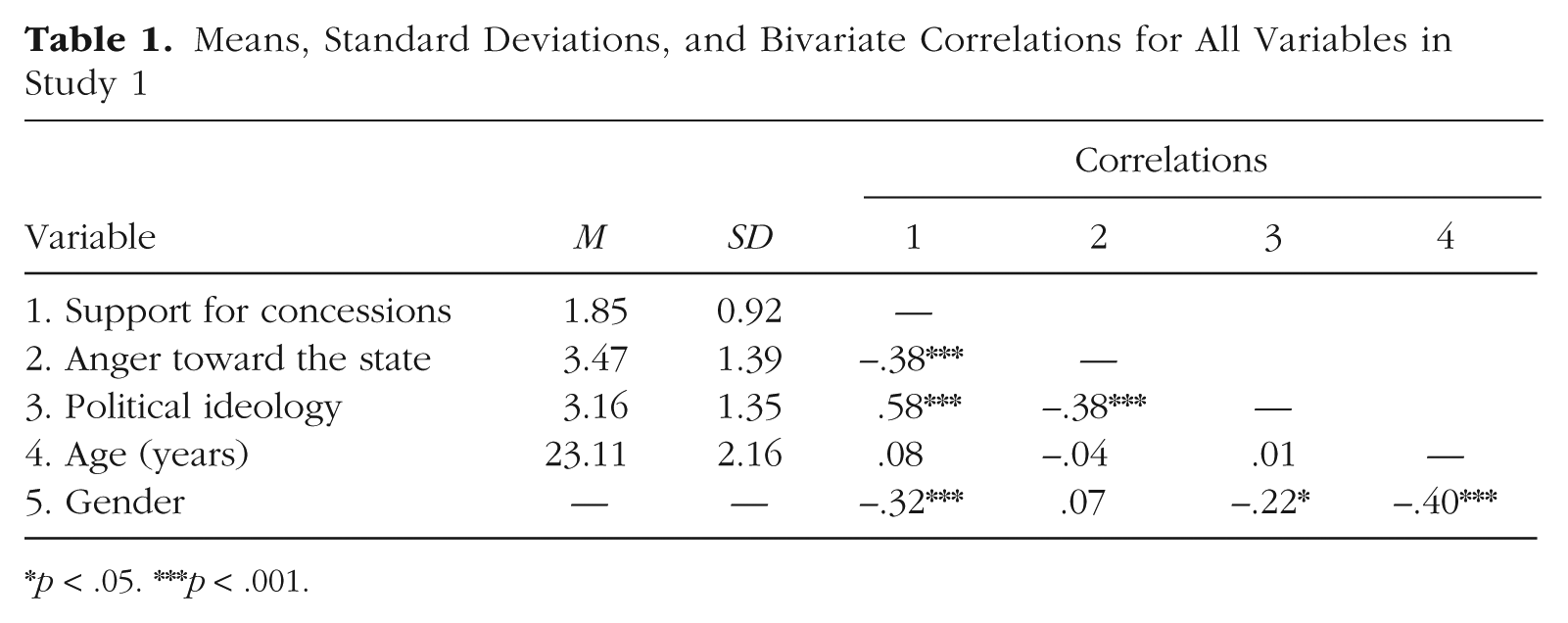
p < .05. ***p < .001.
Effects of linguistic cue (noun vs. verb form) on anger toward the state and on support for concessions
Participants in the noun condition reported significantly less anger toward the state (M = 3.21, SD = 1.30) than did participants in the verb condition (M = 3.67, SD = 1.43), F(1, 126) = 4.21, p = .042, Cohen’s d = 0.34. Additionally, participants in the noun condition reported significantly greater support for concessions (M = 2.02, SD = 0.99) than did participants in the verb condition (M = 1.72, SD = 0.85), F(1, 126) = 5.13, p = .025, Cohen’s d = 0.33.
Anger toward the state as a mediator of the effect of linguistic cue on support for concessions
To test the mediating role of anger toward the state in the relation between linguistic cue and support for concessions, we used Hayes’s (2013) PROCESS bootstrapping command with 5,000 iterations (Model 4). The analysis revealed that the total effect of the linguistic cue on support for concessions was reduced after the mediator, anger toward the state, was introduced into the model, and the indirect effect through anger (0.03) was significant, SE = 0.02, 95% confidence interval (CI) = [0.003, 0.07]. The model (see Fig. 1) suggests that the use of noun labeling relative to verb labeling reduced levels of anger toward the state, which in turn increased support for concessions. 3
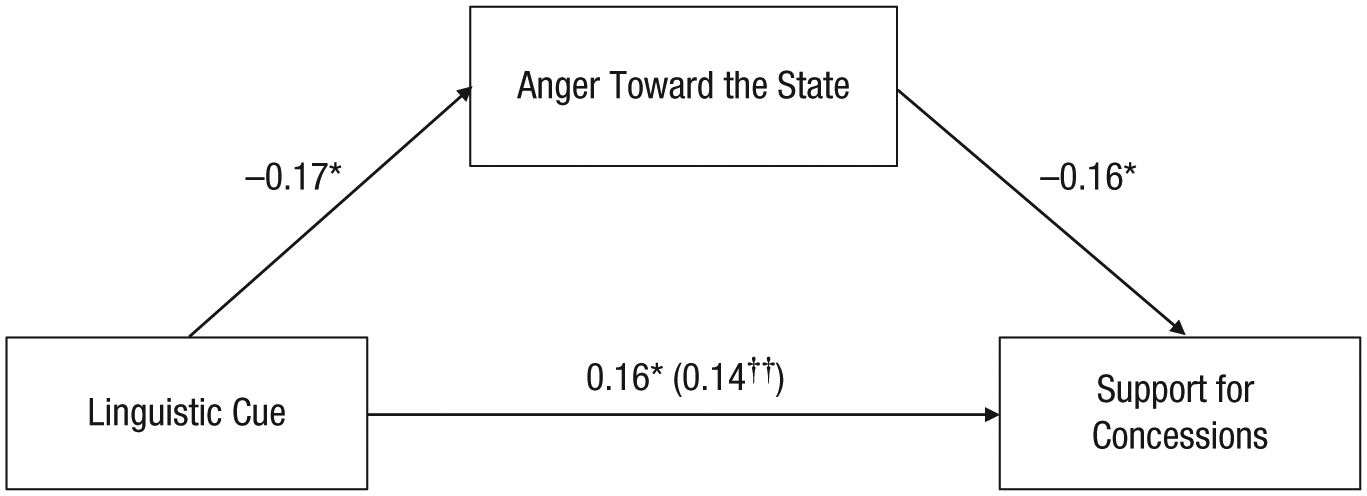
Anger toward the state as a mediator of the effect of linguistic cues (coded as 0 = verb and 1 = noun) on support for concessions (Study 1). Standardized coefficients are shown. Along the path from linguistic cue to support for concessions, the number in parentheses represents the coefficient when anger toward the state was entered into the analyses. Symbols indicate marginally significant (††p = .06) and significant (*p < .05) paths.
Results of Study 1 provided initial support for the hypothesis that presenting concessions in noun form (vs. verb form) would reduce levels of anger and correspondingly increase support for concessions in the context of intractable conflict. As this was a first demonstration of this effect, replication was paramount. Furthermore, though at times group-level anger is directed toward the in-group (in this case, the state), predicting an aspiration to right a perceived wrong (Maitner, Mackie, & Smith, 2007), the main type of group-level anger studied in the context of intergroup conflicts in relation to reduced support for concessions is anger toward the out-group (Mackie, Devos, & Smith, 2000).
Study 2
The first goal of Study 2 was to test whether the causal impact of linguistic cue (noun vs. verb) on reducing anger and, correspondingly, on increasing support for concessions in the context of conflict would be replicated. The second goal was to test whether the target of anger would be of consequence, considering both anger toward the state and anger toward the out-group (in this context, Palestinians).
Method
Participants and procedure
One hundred ninety-two Jewish Israeli college students (117 female, 71 male, 4 not reported; mean age = 25.14 years, SD = 3.18) completed a paper-and-pencil questionnaire; 28.1% self-identified as rightists, 37.0% as centrists, and 34.9% as leftists. On the basis of the results of Study 1, using G*Power 3 software (Faul et al., 2007), we determined that the minimum total sample size to detect the smallest effect size from Study 1 (d = 0.33) and aiming for 80% power was 230. We set out to collect as close a number as we could before the end of the academic year, reaching a sample of 192 participants. We targeted classes across different educational institutions in Israel in which the student sample is traditionally of diverse ideological convictions. The procedure was identical to that of Study 1.
Measures
All measures were identical to those in Study 1, with the addition of five items regarding anger toward Palestinians. Following each of the five concession items (α = .85), participants were asked to indicate the extent to which they experienced “anger toward Palestinians” (in addition to anger toward the state; α = .85) with regard to the implementation of the given concessions. Responses were recorded using a Likert-type scale ranging from 1 (totally disagree) to 6 (totally agree; α = .93).
Results
Preliminary analysis
To examine whether the conditions did not differ in terms of participants’ political orientation, we ran an independent-samples t test, which revealed no difference between the noun and verb conditions (M = 4.18, SD = 1.42 vs. M = 4.14, SD = 1.25, respectively), t(190) = 0.21, p = .835. All further analyses were conducted controlling for political ideology. For means, standard deviations, and bivariate correlations for all study variables, see Table 2.
Means, Standard Deviations, and Bivariate Correlations for All Variables in Study 2
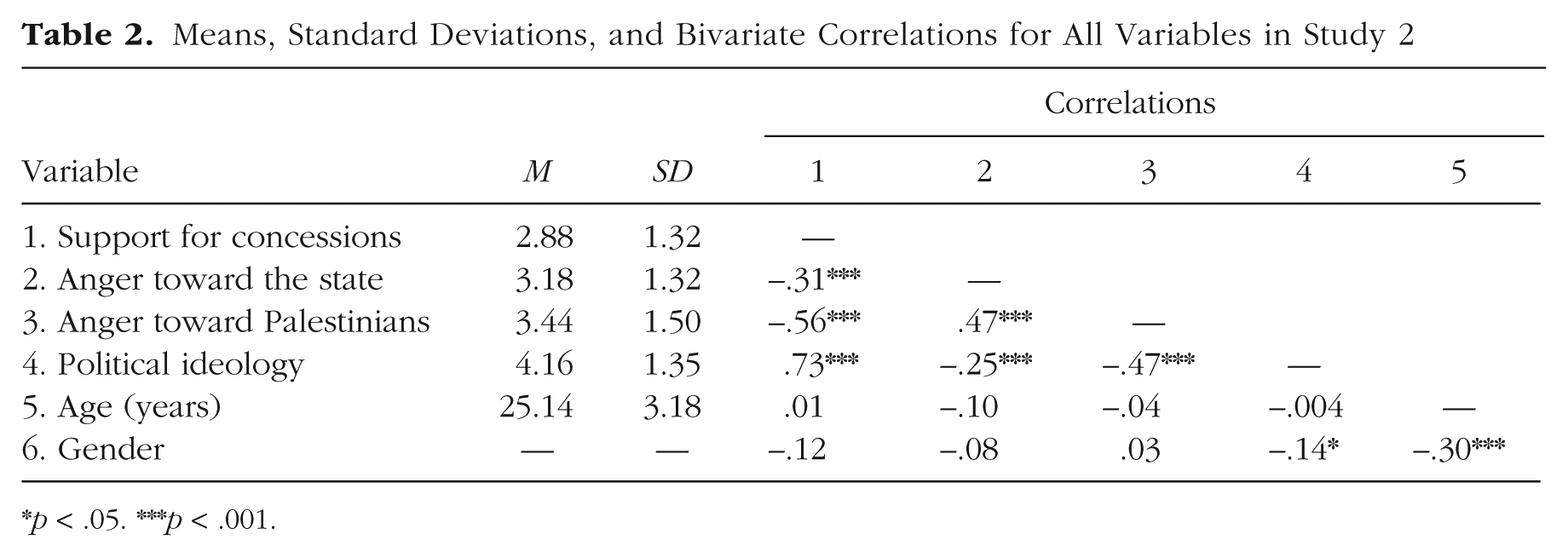
p< .05. ***p < .001.
The effects of linguistic cue (noun vs. verb form) on anger toward the state, anger toward Palestinians, and support for concessions
Participants in the noun condition reported marginally significantly less anger toward the state (M = 3.04, SD = 1.32) than did participants in the verb condition (M = 3.37, SD = 1.29), F(1, 189) = 3.09, p = .080, Cohen’s d = 0.25. Additionally, participants in the noun condition reported significantly less anger toward Palestinians (M = 3.12, SD = 1.49) than did participants in the verb condition (M = 3.89, SD = 1.40), F(1, 189) = 16.84, p < .001, Cohen’s d = 0.53. Furthermore, participants in the noun condition reported marginally significantly greater support for concessions (M = 2.97, SD = 1.37) than did participants in the verb condition (M = 2.74, SD = 1.23), F(1, 189) = 3.11, p = .080, Cohen’s d = 0.18.
Anger toward the state and anger toward Palestinians as mediators of the effect of linguistic cue on support for concessions
To test the mediating role of anger toward the state and the role of anger toward Palestinians in the relation between linguistic cue and support for concessions, we used Hayes’s (2013) PROCESS bootstrapping command with 5,000 iterations (Model 4). The analysis revealed that the total effect of the linguistic cue on support for concessions was reduced after the mediators anger toward the state and anger toward Palestinians were introduced into the model, and the indirect effect through anger toward Palestinians (0.06) was significant, SE = 0.02, 95% CI = [0.02, 0.12]. The indirect effect through anger toward the state (0.01) was not significant, SE = 0.01, 95% CI = [−0.004, 0.03]. The model (see Fig. 2) suggests that the use of noun labeling (vs. verb labeling) reduced levels of anger toward Palestinians, which in turn increased support for concessions. It is worth noting that when anger toward the state was introduced in the model without anger toward Palestinians, its indirect effect (0.02) was marginally significant, SE = 0.01, 90% CI = [0.002, 0.04].
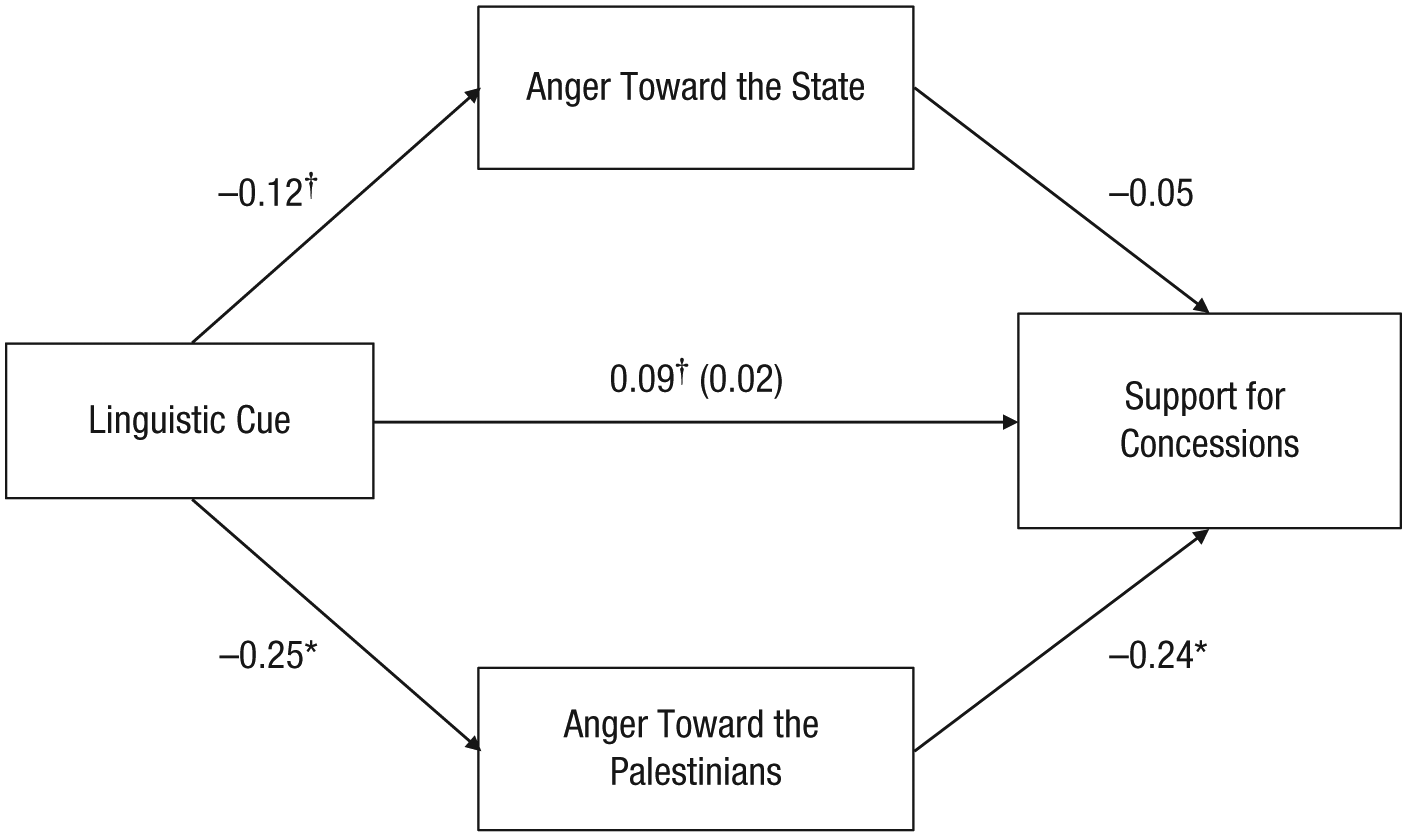
Anger toward Palestinians and anger toward the state as mediators of the effect of linguistic cues (coded as 0 = verb and 1 = noun) on support for concessions (Study 2). Standardized coefficients are shown. Along the path from linguistic cue to support for concessions, the number in parentheses represents the coefficient when anger toward Palestinians and anger toward the state were entered into the analyses. Symbols indicate marginally significant (†p = .08) and significant (*p < .05) paths.
The results of Study 2 provided additional support for the hypothesis that noun labeling (vs. verb labeling) of different concessions would reduce levels of anger, leading to increased support for concessions in the context of intractable conflict. In the current work, we explored two targets of anger—the state and Palestinians—and found that anger toward the latter was the meaningful mediator for the impact of linguistic cue on support for concessions. Anger toward the out-group plays a central role in shaping policy preferences in the context of conflict (Halperin, 2016), and therefore we expected that it might also be moved by the manipulation. At the same time, the policy items at issue were all actions the state was to initiate, thus we expected that objection to them would continue to be associated with anger toward the state. We were thus surprised that this was not the case. We explored this further in Study 3. Studies 1 and 2 focused on the role of anger in the current model; however, it is possible that the impact of noun versus verb form is not unique to anger and may extend to emotions more generally. Also, Studies 1 and 2 focused solely on concessions. Therefore, an examination of the applicability of the current model beyond this policy domain was merited.
Study 3
The goal of the third study was to extend the understanding of the impact of noun versus verb form in presenting policy preferences in the context of intractable conflict in three ways. First, we examined whether the effects found in the first two studies were unique to anger by introducing three additional emotions of central consequence in intractable conflict: fear (Maoz & McCauley, 2005), guilt (Schori-Eyal, Reifen Tagar, Saguy, & Halperin, 2015), and hope (Cohen-Chen, Crisp, & Halperin, 2015). Second, we examined whether the effects extended beyond the domain of support for concessions, testing the model also regarding support for retaliatory policies in response to Palestinian aggression. Finally, we further explored the relevance of the target of anger having considered policy domains that differ specifically in the initiating target, namely, concessions as initiated by the state versus retaliatory policies in response to Palestinian-initiated aggression. We expected that anger toward the state would be central to the former, whereas anger toward Palestinians would be central to the latter. Accordingly, Study 3 was divided into two parts. Part 1 examined the impact of framing concessions in noun versus verb forms on four emotions and support for concessions. Part 2 examined the same with regard to support for retaliatory policies.
Method
Participants and procedure
Two hundred seventy Jewish Israeli college students (138 female, 117 male, 15 not reported; mean age = 24.17 years, SD = 3.40) completed a paper-and-pencil questionnaire; 46.3% self-identified as rightists, 17.4% as centrists, and 36.3% as leftists. Twelve participants completed only Part 1 of the survey. As in Study 2, the minimum total sample size we aimed for was 230, and data were collected until the end of the semester. The procedure was identical to the procedure of Studies 1 and 2.
Measures
Study 3 was composed of two parts. Part 1 was identical to Study 2 with the addition of measures of guilt, fear, and hope. Part 2 was the same as Part 1, except that the outcome measure gauged was support for retaliatory policies instead of support for concessions. These parts were analyzed separately, as each of the emotions measured directly related to a specific corresponding policy item, and thus the emotions were measured twice—once corresponding to the concession items and then corresponding to the retaliatory policies. Again, all analyses controlled for political ideology, measured in an identical fashion to that reported in Study 1.
Part 1
Following each of the five concession items (α = .84), participants were asked to indicate the extent to which they experienced anger toward the state (α = .75), anger toward Palestinians (α = .72), fear of Palestinians (α = .80), guilt toward Palestinians (α = .83), hope for a better future (α = .87), and hope for a solution to the Israeli-Palestinian conflict (α = .89), all with regard to the implementation of the given concession. The two items relating to hope were combined because they were highly correlated (r = .91, p < .001). Responses were recorded using a Likert-type scale ranging from 1 (totally disagree) to 6 (totally agree).
Part 2
In Part 2, we assessed participants’ support of four different retaliatory policies in response to Palestinians aggression (e.g., demolishing homes of those involved in terrorist activities; see the Supplemental Material for the full wording of the items in the two conditions). Responses were recorded using a Likert-type scale ranging from 1 (totally disagree) to 6 (totally agree) and collapsed to a single measure, with higher scores representing greater support (α = .76). 4
Following the four items, participants were asked to indicate the extent to which they experienced anger toward the state (α = .80), anger toward Palestinians (α = .81), fear of Palestinians (α = .91), guilt toward Palestinians (α = .86), hope for a better future (α = .89), and hope for a solution to the Israeli-Palestinian conflict (α = .91) with regard to the implementation of the given retaliatory policy against Palestinians. The two items relating to hope were combined because they were highly correlated (r = .88, p < .001). Responses were recorded using a Likert-type scale ranging from 1 (totally disagree) to 6 (totally agree).
Results
Preliminary analysis
To verify that conditions did not differ in terms of participants’ political orientation, we ran an independent-samples t test, which revealed no difference between the noun and verb conditions (M = 3.96, SD = 1.52 vs. M = 3.66, SD = 1.56, respectively), t(268) = 1.57, p = .117. All further analyses were conducted controlling for political ideology. For means, standard deviations, and bivariate correlations for all study variables, see Table 3.
Means, Standard Deviations, and Bivariate Correlations for All Variables in Study 3
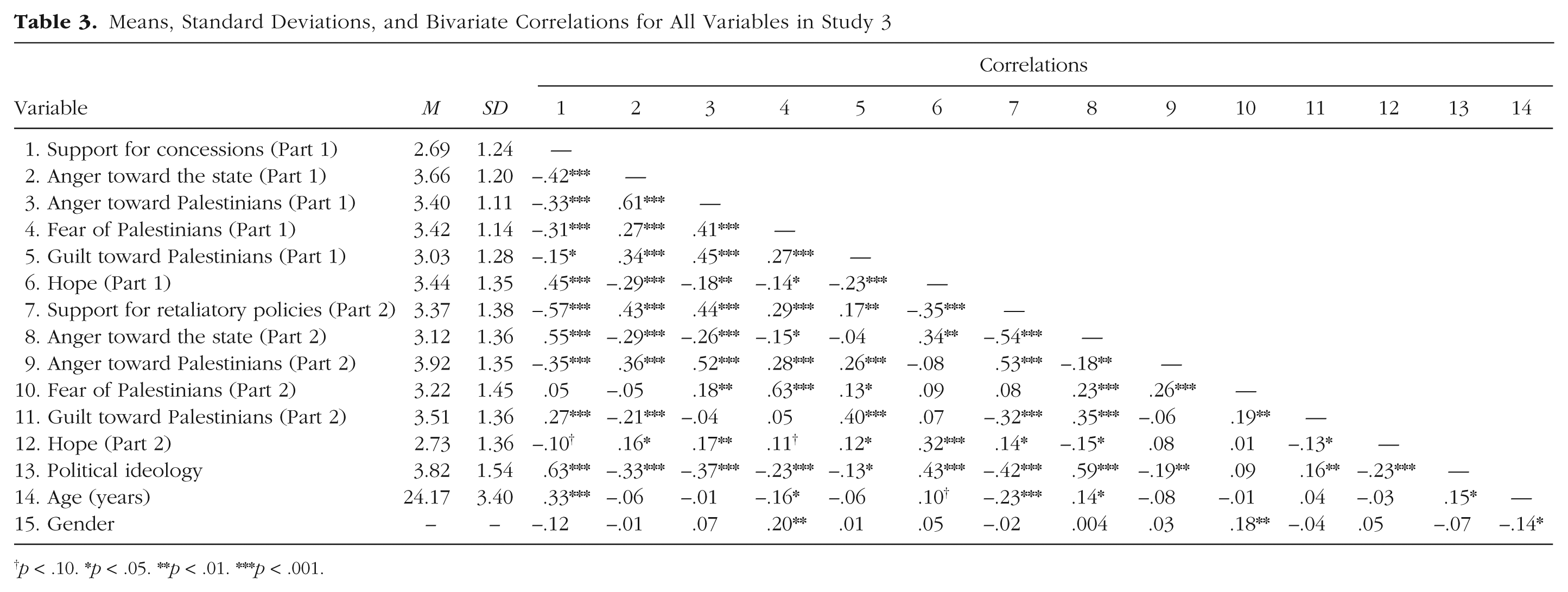
p < .10. *p < .05. **p < .01. ***p < .001.
Part 1: Support for concessions
The effects of linguistic cue (noun vs. verb form) on emotions and support for concessions
Participants in the noun condition reported significantly less anger toward the state (M = 3.47, SD = 1.19) than did participants in the verb condition (M = 3.88, SD = 1.16), F(1, 267) = 9.24, p = .003, Cohen’s d = 0.35. No significant effect was found on anger toward Palestinians (noun condition: M = 3.33, SD = 0.96; verb condition: M = 3.49, SD = 1.25), F(1, 267) = 1.71, p = .192, Cohen’s d = 0.14. Participants in the noun condition reported significantly less fear of Palestinians (M = 3.28, SD = 1.08) than did participants in the verb condition (M = 3.60, SD = 1.18), F(1, 267) = 5.71, p = .018, Cohen’s d = 0.28. Additionally, participants in the noun condition reported significantly less guilt toward Palestinians (M = 2.89, SD = 1.14) than did participants in the verb condition (M = 3.19, SD = 1.41), F(1, 267) = 3.82, p = .052, Cohen’s d = 0.23. No significant effects were found on hope (noun condition: M = 3.55, SD = 1.27; verb condition: M = 3.31, SD = 1.42), F(1, 267) = 2.51, p = .114, Cohen’s d = 0.18. Importantly, participants in the noun condition reported significantly greater support for concessions (M = 2.94, SD = 1.36) than did participants in the verb condition (M = 2.41, SD = 0.97), F(1, 267) = 22.12, p < .001, Cohen’s d = 0.45.
However, as emotions in conflict are often highly correlated (Halperin, 2011), an increase of any one emotion is likely to lead to movement in additional related emotions. Therefore, to gauge the impact of the manipulation uniquely on each of the emotions moved, we created a measure of the residual of each emotion regressed on the other emotions that were impacted by the manipulation. 5 Reanalyses using the residualized measures of each emotion revealed that only anger toward the state was uniquely impacted by the noun frame (vs. verb frame), F(1, 267) = 4.26, p = .040, whereas the impact on fear of Palestinians and on guilt toward Palestinians became nonsignificant, F(1, 267) = 2.09, p = .149; F(1, 267) = 0.53, p = .469, respectively.
Anger toward the state as mediator of the effect of linguistic cue on support for concessions
To test the mediating role of anger toward the state in the relation between linguistic cue and support for concessions, we used Hayes’s (2013) PROCESS bootstrapping command with 5,000 iterations (Model 4), specifying the residualized measure of anger toward the state as mediator. The analysis revealed that the total effect of the linguistic cue on support for concessions was reduced after the mediator was introduced into the model, and the indirect effect through it (0.02) was significant, SE = 0.01, 95% CI = [0.002, 0.05]. That is, as in Studies 1 and 2, change in anger mediated the relation between linguistic cue and support for concessions. Specifically, the model (see Fig. 3) suggests that the use of noun form (vs. verb form) reduced levels of anger toward the state, which in turn increased support for conciliatory policies (see the Supplemental Material for mediation analyses using the nonresidualized measures of anger toward the state, fear, and guilt).
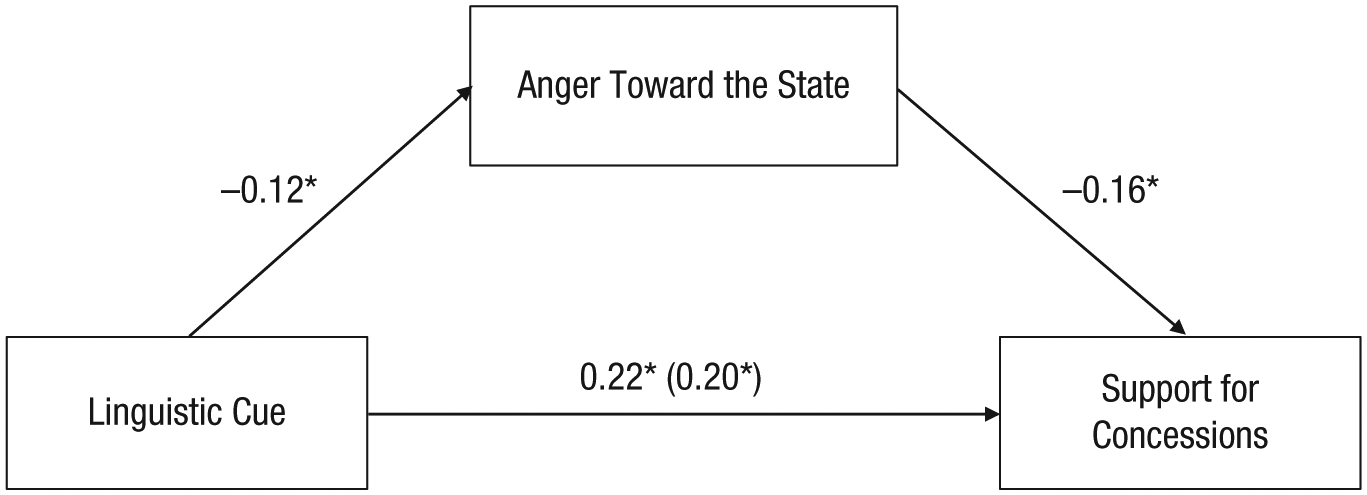
Anger toward the state as a mediator of the effect of linguistic cues (coded as 0 = verb and 1 = noun) on support for concessions (Study 3, Part 1). Standardized coefficients are shown. Along the path from linguistic cue to support for concessions, the number in parentheses represents the coefficient when anger toward the state was entered into the analyses. Asterisks indicate significant paths (p < .05).
Part 2: Retaliatory policies
The effects of linguistic cue (noun vs. verb form) on emotions and support for retaliatory policies
Participants in the noun condition reported significantly less anger toward Palestinians (M = 3.65, SD = 1.28) than did participants in the verb condition (M = 4.20, SD = 1.35), F(1, 255) = 11.26, p < .001, Cohen’s d = 0.42. No significant effect was found on anger toward the state (noun condition: M = 3.19, SD = 1.46; verb condition: M = 3.09, SD = 1.23), F(1, 255) = 0.56, p = .456, Cohen’s d = 0.07. Participants in the noun condition reported significantly less fear of Palestinians (M = 3.05, SD = 1.39) than did participants in the verb condition (M = 3.47, SD = 1.46), F(1, 255) = 5.68, p = .018, Cohen’s d = 0.29. No significant effects were found on guilt (noun condition: M = 3.60, SD = 1.40; verb condition: M = 3.44, SD = 1.52), F(1, 255) = 0.85, p = .356, Cohen’s d = 0.11. The same was found for hope (noun condition: M = 2.66, SD = 1.28; verb condition: M = 2.75, SD = 1.40), F(1, 255) = 0.26, p = .611, Cohen’s d = 0.07. Importantly, participants in the noun condition reported significantly less support for retaliatory policies (M = 2.92, SD = 1.34) than did participants in the verb condition (M = 3.91, SD = 1.18), F(1, 255) = 47.37, p < .001, Cohen’s d = 0.78.
As in the analyses of the first part of Study 3, to gauge the impact of the manipulation uniquely on each of the emotions moved, we created a measure of the residual of each emotion regressed on the other emotions that were impacted by the manipulation. Reanalyses using the residualized measures of each emotion revealed that only anger toward Palestinians was uniquely impacted by the noun frame (vs. verb frame), F(1, 255) = 7.73, p = .006, whereas the impact on fear of Palestinians became nonsignificant, F(1, 255) = 2.32, p = .129.
Anger toward Palestinians as a mediator of the effect of linguistic cue on support for retaliatory policies
To test the mediating role of anger toward Palestinians in the relation between linguistic cue and support for retaliatory policies, we used Hayes’s (2013) PROCESS bootstrapping command with 5,000 iterations (Model 4), specifying the residualized measure of anger toward Palestinians as mediator. The analysis revealed that the total effect of the linguistic cue on support for retaliatory policies was reduced after the mediator anger toward Palestinians was introduced into the model and that the indirect effect through anger (−0.07) was significant, SE = 0.03, 95% CI = [−0.13, −0.02]. The model (see Fig. 4) suggests that the use of noun form (vs. verb form) reduced levels of anger toward Palestinians, which in turn decreased support for retaliatory policies (see the Supplemental Material for mediation analyses using the nonresidualized measures of anger toward Palestinians and fear).

Anger toward Palestinians as a mediator of the effect of linguistic cues (coded as 0 = verb and 1 = noun) on support for retaliatory policies (Study 3, Part 2). Standardized coefficients are shown. Along the path from linguistic cue to support for retaliatory policies, the number in parentheses represents the coefficient when anger toward Palestinians was entered into the analyses. Asterisks indicate significant paths (p < .05).
The results of Study 3 provide further support for the expectation that using the noun form (vs. the verb form) would reduce levels of anger and correspondingly impact policy support in intractable conflict. Study 3 also expanded on this by demonstrating a similar pattern of results even with regard to a different conflict-relevant policy domain. Furthermore, results across the two policy domains highlighted the prominence of anger versus fear, guilt, and hope in the current model. Finally, the target of anger emerged as meaningful; specifically, in relation to state-initiated policies (concessions), the state was the meaningful target of anger, whereas in relation to policies enacted in response to Palestinian-initiated action, Palestinians were the meaningful target of anger.
To gauge the overall effect of anger regarding concessions toward each of the targets across studies, we ran a mini meta-analysis (Goh, Hall, & Rosenthal, 2016) on the three studies that examined anger toward the state (Studies 1, 2, and 3a) and a second mini meta-analysis on the two studies that examined anger toward Palestinians (Studies 2 and 3a) with regard to concessions. For each, we used fixed effects in which the mean effect size (i.e., mean correlation) was weighted by sample size. We first converted our Cohen’s d into Pearson’s correlation for ease of analyses. All correlations were then transformed via Fisher’s z for analyses and converted back to Pearson correlations for presentation. With regard to anger toward the state, the effect across studies was significant (mean r = .16, Z = 3.69, p < .001, two-tailed); nouns reduced levels of anger toward the state, compared with verbs. With regard to anger toward Palestinians, the effect across studies was similarly significant (mean r = .15, Z = 3.26, p = .001, two-tailed); nouns reduced levels of anger toward Palestinians, compared with verbs. Together, the results suggest that both anger toward the state and anger toward Palestinians with regard to concessions were similarly impacted by the manipulation. Across studies, the effects ranged from small to medium in strength, and the overall effect based on the mini meta-analysis emerged as small. As one might expect, the manipulation is not the panacea to resolve harsh intergroup conflicts. However, the robustness of this effect, found in three separate studies, suggests that a simple linguistic cue (i.e., using nouns instead of verbs) can reduce levels of anger and consequently promote a conciliatory orientation.
General Discussion
In the current work, we drew on both psycholinguistic research on the power of language in shaping emotions and psychological research on the power of emotions in shaping policy preferences, exploring an extremely subtle means of inducing change in anger and corresponding policy preference in the context of intergroup conflict. Specifically, consistent with expectations, results across three studies in the context of the Israeli-Palestinian conflict showed that phrasing support for concessions (Studies 1–3) as well as retaliatory policies toward the out-group (Study 3) in noun form (vs. verb form) reduced levels of anger and, correspondingly, opposition to the former and support for the latter policies.
We also examined whether the target of anger was of consequence in this model. We expected that anger toward the state would be meaningful in relation to support for state-initiated policies such as concessions, whereas anger toward the out-group would be meaningful in relation to policies perceived as reactions to Palestinian-initiated action, such as retaliatory policies. This was the case, with the exception of Study 2, in which both anger toward the state and anger toward Palestinians were impacted by the manipulation, with the latter playing the more meaningful role in mediating the impact on policy support. A mini meta-analysis across studies revealed that with regard to concessions, anger toward both targets was similarly impacted by the manipulation. This might be interpreted as Israelis’ perception that concessions by the state are driven not only by the state but also in reaction to Palestinian demands and pressures.
We further considered the possibility that this effect is not unique to anger or to its impact on support for concessions. In the third study, in addition to retesting anger, we examined the impact of using noun form (vs. verb form) on fear, guilt, and hope in relation to both concessions and retaliatory policies. For both policy domains, though fear and guilt were impacted by the linguistic cue, anger was the only emotion impacted uniquely—that is, after accounting for the variance explained by the other emotions. This pattern of results sheds light, at least suggestively, on the mental process underlying the identified mechanism of anger reduction. Specifically, in developing this research, we considered two relevant qualities distinguishing noun and verb form that might account for their distinct impact on anger: first, the stative nature of noun form versus the agentic nature of verb form and, second, the abstractness of noun form versus the vividness entailed in verb form. Less vividness of the policies, one might expect, should have led to a similar impact across different emotions, whereas less focus on agency would be likely to increase anger uniquely. As anger was clearly the dominant emotion impacted by the manipulation, it seems the latter explanation is more probable. Future work should test these underlying mental processes empirically.
Overall, these findings inform both psycholinguistic research and political psychological research by demonstrating the causal role of noun form versus verb form on anger and policy preferences in the context of intergroup conflict. The findings expand the understanding that mere use of distinct grammatical form can activate concept-knowledge relevant to different emotional experiences and point to the down-the-line impact on event construal and the shaping of behavioral preferences through emotion, with real-world consequences. These findings are also of applied relevance, introducing a new domain (linguistic form) in which to explore the development of interventions toward conflict resolution and peace, and they should be considered in unison with relevant findings on the impact of language on intergroup perceptions (e.g., Graf et al., 2013). This is of special importance considering how resistant to change people living in societies inflicted with violent, entrenched conflict tend to be (Bar-Tal, 2013).
As this is the first experimental exploration of the role of noun versus verb form on emotional intensity and policy preferences in intractable conflict, future work should be conducted in at least three directions. First, this relation should be explored in additional contexts and languages to examine the breadth of its applicability and relevant boundary conditions. Second, the current work focused on the impact of defining one’s own policy preferences in noun versus verb form. However, use of linguistic category has also been shown to impact perceptions of other people (Wakslak et al., 2014). Therefore, future work should examine the impact of the presentation of others’ policy preferences in different grammatical form. This could be relevant, for example, in the context of negotiations or political persuasion. Finally, though we tested several pertinent emotions in the current work, the list of relevant emotions, especially across different stages of conflict (Halperin & Reifen Tagar, 2017), is much larger, and a systematic exploration is merited of the types of appraisal overlap between different emotions and different linguistic cues (even beyond the noun/verb distinction—e.g., different subtypes of verbs: states, processes, actions, and action processes; Semin et al., 2002). The current work, we believe, reveals the potential of this new line of inquiry.
Supplemental Material
IdanSupplementalMaterial – Supplemental material for A Rose by Any Other Name? A Subtle Linguistic Cue Impacts Anger and Corresponding Policy Support in Intractable Conflict
Supplemental material, IdanSupplementalMaterial for A Rose by Any Other Name? A Subtle Linguistic Cue Impacts Anger and Corresponding Policy Support in Intractable Conflict by Orly Idan, Eran Halperin, Boaz Hameiri, and Michal Reifen Tagar in Psychological Science
Footnotes
Acknowledgements
B. Hameiri is grateful to the Azrieli Foundation for the award of an Azrieli Fellowship. The authors wish to thank Michal Al-Yagon for assistance in collecting data.
Action Editor
Bill von Hippel served as action editor for this article.
Author Contributions
The theoretical question was proposed by O. Idan and developed by O. Idan, M. Reifen Tagar, and E. Halperin. All authors contributed to the study design. The data were collected by O. Idan and analyzed and interpreted by all authors. O. Idan, M. Reifen Tagar, and B. Hameiri drafted the manuscript, and E. Halperin provided critical revisions.
Declaration of Conflicting Interests
The author(s) declared that there were no conflicts of interest with respect to the authorship or the publication of this article.
Funding
This work was supported by a European Research Council grant (335607) to E. Halperin.

Open Practices
The data and material for these studies have not been made publicly available, and the design and analysis plans for the studies were not preregistered.
Notes
References
Supplementary Material
Please find the following supplemental material available below.
For Open Access articles published under a Creative Commons License, all supplemental material carries the same license as the article it is associated with.
For non-Open Access articles published, all supplemental material carries a non-exclusive license, and permission requests for re-use of supplemental material or any part of supplemental material shall be sent directly to the copyright owner as specified in the copyright notice associated with the article.
