



Abstract
When crafting a message, communicators may turn to moral rhetoric as a means of influencing an audience’s opinion. In the present research, we tested whether the persuasiveness of explicitly moral counterattitudinal messages depends on how much people have already based their attitudes on moral considerations. A survey of the literature suggests several competing hypotheses that we tested across two studies. The results support a persuasive-matching pattern: A moral appeal was more persuasive than a nonmoral appeal to the extent that initial attitudes were based on moral concerns (i.e., attitudes were moralized), but the opposite was true when initial attitudes had less of a moral basis. Exploratory analyses also showed that these effects were mediated by valenced thoughts about the message and moderated by political orientation. These findings add new insight to literatures on both the effects of moral arguments and moralized attitudes.
Keywords
In December 2017, extensive debate over a new U.S. tax plan emerged in the weeks leading up to a vote in Congress. Although plenty of conversation concerned the plan’s practicality and economic efficacy, many people argued about whether it was moral. Opponents called it “morally appalling” (Nuccitelli, 2017, para. 1) and proponents claimed “tax cuts are the morally right thing to do” (Raleigh, 2017). But do moral appeals succeed in convincing audiences that currently hold the opposing opinion? In the present research, we tested whether the persuasive effects of explicitly moral (vs. nonmoral) counterattitudinal messages depend on how much the audience views their attitudes on the issue as a matter of morality to begin with.
Moral Messages
Moral rhetoric is relatively common, appearing across topics, issues, and communication channels (Euchner, Heichel, Nebel, & Raschzok, 2013; Ferraiolo, 2014; Mucciaroni, 2011). Some evidence suggests that moral rhetoric boasts a persuasive advantage. Longitudinal analyses show associations between moral language in the news media and changing public opinion (Clifford & Jerit, 2013), and lab experiments show that moral appeals, compared with nonmoral appeals or nonmessage controls, can encourage cooperative, prosocial, and honest behavior (Chen, Pillutla, & Yao, 2009; Dorris, 1972), as well as more message-consistent attitudes and moral judgments (Ferrari & Leippe, 1992; Leidner, Kardos, & Castano, 2018). However, some studies fail to show an advantage of moral appeals or even show reduced persuasion by moral appeals, compared with controls (Leidner et al., 2018; Täuber & Van Zomeren, 2013; Tittle & Rowe, 1973). These conflicting results suggest that a moderator could be at work.
Research on moral reframing has examined the persuasiveness of different kinds of moral arguments. Specifically, arguments that speak to more liberal or conservative moral values (as suggested by moral-foundations theory; Graham et al., 2013) tend to be more persuasive to liberals or conservatives, respectively (Day, Fiske, Downing, & Trail, 2014; Feinberg & Willer, 2013, 2015; Voelkel & Feinberg, 2017; Wolsko, Ariceaga, & Seiden, 2016). Notably, these studies compare messages that differ in which moral values are invoked, but they have not compared messages that differ in whether moral versus nonmoral arguments are used. These messages also do not explicitly argue for the morality of an issue per se and instead indirectly reflect moral rhetoric by appealing to values designated as “moral,” such as purity or harm.
Furthermore, moral-persuasion research has tended to focus on messages advocating for relatively uncontroversial positions, such as the importance of donating blood (Ferrari & Leippe, 1992). Even cases presented as counterattitudinal persuasion, such as arguing against torture (Leidner et al., 2018) and in favor of environmental conservation (Wolsko et al., 2016), may have used less objectionable messages than intended, judging by attitudes in no-message control conditions, which lie on the side of the scales consistent with the messages. We were especially interested in examining the effects of moral appeals that take clearly counterattitudinal positions.
Moral Attitudes
Critically, extant research on moral appeals has not considered how much recipients already see their attitudes as grounded in morality. Although it may seem that some issues are inherently more moral than others, two people can hold identical attitudes but differ in how much they see those attitudes as morally based (i.e., the degree to which they have moralized attitudes; Skitka, 2010). This variation in perceived moral relevance poses an intriguing and theoretically relevant question about the efficacy of counterattitudinal moral rhetoric.
First, what we term the moral-matching hypothesis predicts that moral (vs. nonmoral) appeals would be especially persuasive for audiences with more morally based attitudes. By directly targeting the core basis of recipients’ attitudes, a message can be more effective. Such matching effects have emerged for the success of messages that use relatively emotional versus rational appeals when they match whether the recipient’s existing attitude was primarily based on affect or cognition (e.g., Edwards, 1990; Fabrigar & Petty, 1999).
By contrast, the moral-strength hypothesis predicts that the more people’s attitudes are based in morality, the more they will resist persuasion, regardless of the nature of the message. When people perceive that an attitude reflects their core moral principles, they tend to experience it as an absolute truth and thus maintain their position when challenged, resisting change in the face of social influence and nonmoral persuasive arguments (Aramovich, Lytle, & Skitka, 2012; Hornsey, Majkut, Terry, & McKimmie, 2003; Hornsey, Smith, & Begg, 2007; Luttrell, Petty, Briñol, & Wagner, 2016). The same may be true even with a message that appeals to morality.
Finally, a more extreme version of moral strength is the moral-rejection hypothesis, whereby moral (vs. nonmoral) arguments that oppose an existing attitude may be even more objectionable when that attitude has a highly moral basis. That is, people may be especially offended when moral attitudes are challenged with moral appeals, so moral conviction may be associated with even more resistance in the face of such arguments.
Overview of the Present Research
As an initial test of these competing hypotheses, we considered attitudes toward recycling. Because most people hold prorecycling attitudes, we could create moral and nonmoral persuasive arguments against recycling programs to serve as clearly counterattitudinal messages. Recycling also relates to environmental issues, which has been a common subject in moral-persuasion research (e.g., Feinberg & Willer, 2013). We conducted two similar independent studies using recycling as the topic and subsequently conducted a replication with marijuana legalization as the topic, on the basis of pilot testing showing this to be a topic for which people’s attitudes are similarly moralized.
Our primary hypotheses center on attitude change, but we also included several exploratory measures. First, to assess participants’ thoughtful engagement with the message, we asked them to list the thoughts they had while reading. If persuasion effects are mediated by message-relevant thoughts, that suggests a relatively elaborative process, whereas if effects are unmediated by thoughts, that suggests a more heuristic process (Petty, Schumann, Richman, & Strathman, 1993). This is relevant because some perspectives characterize moral judgments as quick intuitions (Haidt, 2001), suggesting relatively heuristic or peripheral persuasion processes (Chaiken, Liberman, & Eagly, 1989; Petty & Cacioppo, 1986). However, persuasive-matching (Wheeler, Petty, & Bizer, 2005) and resistance (Blankenship & Wegener, 2008) effects can occur thoughtfully, and if moral issues seem personally relevant, responses to moral appeals could be similarly thoughtful.
Finally, given the growing literature on moral persuasion and political orientation, we also explored ideology’s role. It seemed possible that relatively liberal participants would be particularly closed to an antirecycling or antilegalization position because these positions challenge common liberal values, limiting variation in persuasion. In contrast, relatively conservative participants who held the same initial positions as liberals might be more open to considering such arguments, creating greater opportunity to find variation in persuasion.
Study 1
Method
We initially tested our three competing hypotheses in a preregistered experiment (https://aspredicted.org/yp5az.pdf). The results of Study 1a supported the matching hypothesis, and to confirm this result, we conducted Study 1b, a preregistered direct replication with minor modifications (https://aspredicted.org/n3pd9.pdf). Study 1b resulted in the same matching pattern as Study 1a, so to maximize power for our focal analyses as well as an exploratory three-way interaction with political orientation, we combined the data from both studies and present the results across both samples. None of the effects that we report were further moderated by study (ps > .10). All procedures were nearly identical across the two studies, and any differences are noted. For the full results of Study 1a and Study 1b separately, see the Supplemental Material available online.
Participants
We recruited 227 participants in Study 1a and 217 participants in Study 1b through Amazon’s Mechanical Turk (252 males, 188 females, 4 who identified as “genderless” or preferred not to say; age: M = 34.46 years, SD = 10.39 years) in exchange for $1. For Study 1a, we did not have an a priori expectation about the target effect size, so we preregistered a target sample size of 200, which provided 80% power to detect an interaction effect ( f 2) as small as .04. We then submitted the actual effect size for the Moral Attitude Basis × Message Type interaction in Study 1a to a power analysis and found that a sample of 157 would provide 80% power to detect the original effect. For consistency and to allow for the possibility that Study 1a overestimated the effect size, we again preregistered 200 participants for Study 1b. In both studies, we recruited slightly more than our goal sample size with the understanding that data from several participants would not be included in our final analyses because they would meet our exclusion criteria.
According to our preregistered exclusion criteria, 13 participants (8 in the moral-argument condition, 5 in the practical-argument condition) were excluded from analyses because they already had negative attitudes toward recycling (i.e., scoring below the midpoint on the premessage attitudes measure). Also, because these data were collected online, we noticed a small number of duplicate Internet protocol (IP) addresses, so as a precaution, we excluded 16 additional participants (3.71% of the total sample) whose IP addresses were duplicates of previous participants’. The final sample size across studies was 415. Results of a sensitivity analysis showed that this sample size provided 80% power (α = .05) to detect a small two-way interaction ( f 2 = .02).
Procedure
Participants first read a brief introduction to the topic of recycling and then reported their attitudes toward recycling and the degree to which their attitudes were based in moral or practical concerns. Each participant was then randomly assigned to read an essay arguing against recycling using either a moral or practical appeal. After reading the message, participants again reported their attitudes toward recycling, listed their thoughts about the message, and finally completed measures of political orientation and ratings of the message.
Independent variables
Premessage attitudes
Participants rated their attitudes toward recycling using three 9-point semantic-differential scales, ranging from −4 (bad, dislike, and negative) to 4 (good, like, and positive). Since these items had high internal reliability (α = .95), they were averaged to form an aggregate measure of premessage attitudes.
Perceived attitude bases
Participants reported the degree to which their attitudes toward recycling were based on their core moral beliefs or on practical concerns using 5-point scales (ranging from not at all to extremely). These items were modeled after items previously used to assess moral conviction (see Skitka, 2010). These items were presented within a small set of randomly ordered questions about people’s bases for their recycling attitudes so participants would not suspect that the study was specifically about the moral basis for those attitudes. One of these other bases was “emotions,” which we included because moral conviction has been proposed to constitute especially emotion-based attitudes (Skitka, 2010), and emotion has been a common variable in the persuasive-matching literature (e.g., Fabrigar & Petty, 1999). Thus, we thought it would be important to control for emotion in examining the impact of moral versus practical messages. The other bases—“knowledge” and “what other people think”—were intended as fillers.
Political orientation
Participants reported their political orientation on two items measuring ideology for social and economic issues. The items were measured on 5-point scales ranging from very liberal to very conservative. Since the reliability of these two items was quite strong (α = .86), we combined them into one political-orientation scale. Our samples were relatively liberal overall (M = 2.55, SD = 1.16).
Counterattitudinal message
We created two versions of an antirecycling essay that appealed either to moral or to practical concerns. The moral appeal, entitled “Recycling: Harmful and Immoral,” framed its antirecycling position in moral terms (e.g., “Supporting recycling programs would be a grave moral transgression”) and cited particular moral reasons against recycling programs (e.g., “precious pets and animals [are] mercilessly killed by fumes produced in the recycling process”). By contrast, the practical appeal, entitled “Recycling: Costly and Unfeasible,” framed its antirecycling position in pragmatic terms (e.g., recycling is an “inefficient and unfeasible endeavor for most municipalities to adopt”) and cited particular economic and pragmatic concerns (e.g., “An increase in trucks greatly increases traffic, both on the highways and on city roads”). We chose a practical appeal as the comparison because it reflects a common type of nonmoral persuasive argument (e.g., Mucciaroni, 2011) that could be similarly substantive. Messages were similar in length (426–428 words) and in number of arguments, and they were designed to be equally cogent to the sample overall.
In a pilot study preceding Study 1a, Mechanical Turk participants (N = 100) saw either the moral or the practical antirecycling appeal and assessed it using the same measures we used as manipulation checks in the full studies, in addition to several other measures. The moral message was indeed perceived as appealing more to moral concerns than the practical message was, t(98) = −7.20, p < .001, whereas the practical message was perceived as appealing more to practical concerns than the moral message was, t(98) = 4.29, p < .001. The messages did not differ in how strong the arguments seemed, t(98) = 1.53, p = .13. However, compared with people who saw the practical message, people who saw the moral message perceived it as making more emotional arguments, t(98) = −6.80, p < .001, and less rational arguments, t(98) = 2.59, p = .01, consistent with the presumed role of emotion in influential moral language (e.g., Brady, Wills, Jost, Tucker, & Van Bavel, 2017).
We originally created the moral message without any intention of appealing to particular moral foundations, but the result was an essay that spoke primarily to concerns of harm (e.g., recycling programs produce more air pollution, which is “harmful to the wildlife and people that live in surrounding areas”). However, harm-related arguments are especially common among real-world moral appeals (e.g., Clifford & Jerit, 2013), and recent research suggests that harm is perhaps the most critical dimension of morality (Schein & Gray, 2018). Nevertheless, we used the moral-foundations linguistic dictionary (Graham, Haidt, & Nosek, 2009) to analyze our messages following Study 1a and made subtle changes for Study 1b to ensure that the practical messages contained no moral language and to include a few references to loyalty and purity in the moral message, which would appeal more to conservative readers.
Following these tweaks, we conducted additional pilot testing (N = 52) following the same procedure as in the first pilot test, finding that the revised moral message was indeed perceived as appealing more to moral concerns than the revised practical message was, t(50) = −3.92, p < .001, and that the revised practical message was perceived as appealing more to practical concerns than the revised moral message was, t(50) = 3.20, p = .002. Once again, the messages did not differ overall in perceived strength, t(50) = 0.14, p = .89. However, compared with the practical message, people still perceived the moral message as making more emotional arguments, t(50) = −4.00, p < .001, and less rational arguments, t(50) = 3.03, p = .004.
We provide data and a full report of all pilot studies on the project’s Open Science Framework (OSF) page (https://osf.io/96s4v/). The linguistic analyses and full message texts are available in the Supplemental Material.
Dependent measures
Thought listing
Participants next listed the thoughts they had while reading the antirecycling message. Participants were given six thought-listing boxes and told to enter one thought per box; however, they were not required to fill all six. These thoughts were subsequently rated by two independent coders for overall valence (i.e., whether each thought was promessage, antimessage, neutral to the message, or unrelated to the message), following common practice (Cacioppo, Harkins, & Petty, 1981; see the Supplemental Material for the full instructions). The total numbers of positive, negative, neutral, and unrelated thoughts rated by each coder were computed for each participant. The two coders were in agreement at the participant level, indicating highly correlated numbers of thoughts rated as positive, r(413) = .73, p < .001; negative, r(413) = .76, p < .001; neutral, r(413) = .59, p < .001; and unrelated, r(413) = .76, p < .001. To create single measures of each valence of interest and to account for any discrepancies between coders, we computed three valence variables by averaging the numbers of negative, positive, and neutral thoughts, respectively, provided by each coder. A summary index of valenced thoughts was calculated as the difference in quantity of positive versus negative thoughts as a proportion of the total number of relevant thoughts (see Cacioppo et al., 1981, for more detail). The result is an index of how much each person produced thoughts that agreed (vs. disagreed) with the message.
Postmessage attitudes
After reading the message, participants once again reported their attitudes toward recycling, using the same items used to measure premessage attitudes. The items once again had high internal reliability (α = .97) and were therefore combined to create one index of postmessage attitudes.
Message ratings
To ensure that participants perceived the messages as intended, we asked how much the message seemed to make arguments related to moral and practical concerns, each on 7-point scales ranging from not at all to very much.
Results
Manipulation check
Data were submitted to t-test analyses to determine whether the messages were perceived as intended. Participants perceived the moral message as appealing more to morality (M = 4.93, SD = 1.77) than the practical message (M = 2.81, SD = 1.70), t(413) = 12.43, p < .001, d = 1.22. Likewise, participants perceived the practical message as appealing more to practical concerns (M = 5.81, SD = 1.40) than the moral message (M = 4.10, SD = 1.79), t(413) = −10.82, p < .001, d = −1.06. 1 Likewise, dependent-samples t tests showed that the moral message was perceived to appeal more to morality than practicality, t(207) = 5.28, p < .001, d = 0.37, and the practical message was perceived to appeal more to practicality than to morality, t(206) = −19.30, p < .001, d = −1.34.
Persuasion effects
We assessed attitude change by testing persuasion effects on postmessage attitudes while entering premessage attitudes as a covariate. 2 Because the persuasive message argued against recycling, we decided, for ease of interpretation, to reverse-score each attitude index such that higher values corresponded to attitudes consistent with the message (i.e., antirecycling). Thus, higher values indicate more agreement with the message (persuasion), and lower values indicate more resistance.
The data were submitted to a multiple regression analysis predicting postmessage attitudes in which premessage attitudes, moral attitude basis, and message type were entered in the first step of the model and the Moral Attitude Basis × Message Type interaction term was entered in the second step. Message type was effects coded so that −1 corresponded with the moral-argument condition and +1 corresponded with the practical-argument condition. Results for these predictors are interpreted in the first steps of the model in which they appear. First, premessage attitudes corresponded with postmessage attitudes, b = 0.53, 95% confidence interval, or CI = [0.35, 0.71], t(411) = 5.76, p < .001. There was no overall effect of message type (p = .39), but there was an overall effect of moral attitude basis: The more people perceived a moral basis for their prorecycling attitudes, the more their postmessage attitudes opposed the message, b = −0.34, 95% CI = [−0.52, −0.16], t(411) = −3.77, p < .001. Most relevant to our hypotheses, however, was a significant interaction between message type and moral attitude basis, b = −0.27, 95% CI = [−0.42, −0.11], t(410) = −3.34, p < .001, f 2 = .03 (Fig. 1).
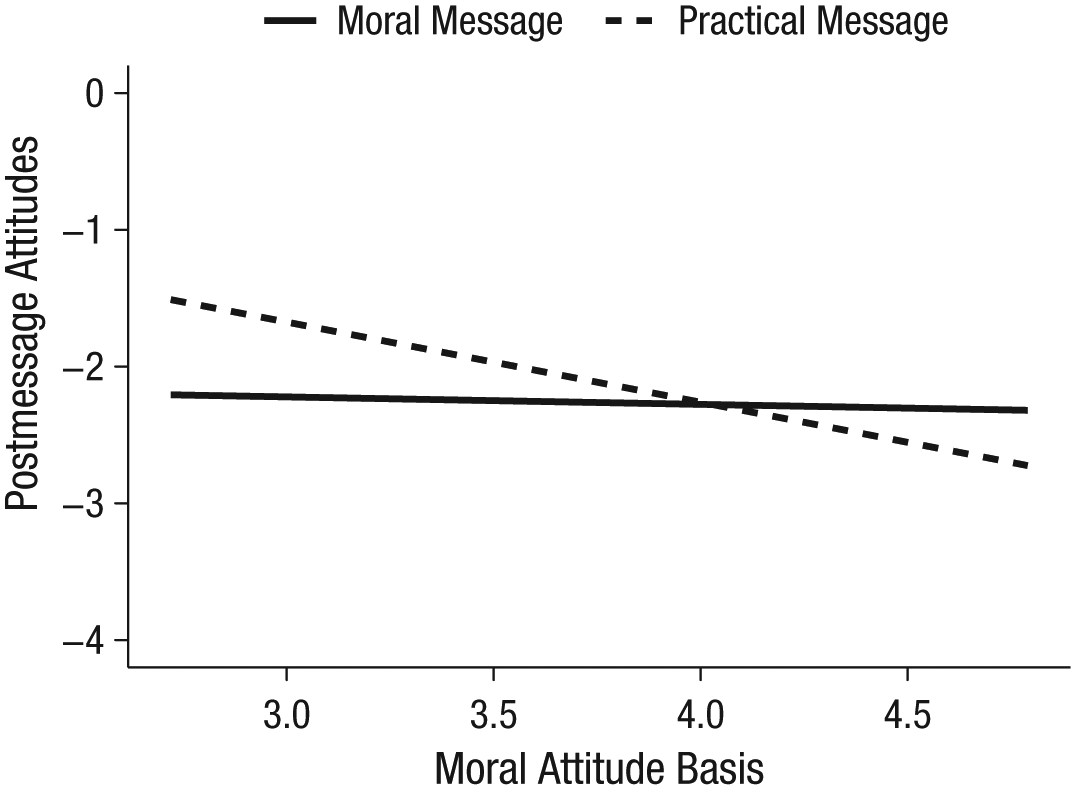
Effect of the Moral Attitude Basis × Message Type interaction on postmessage attitudes, controlling for premessage attitudes (Study 1). Moral bases are capped at 1 standard deviation above and below the mean.
In the practical-argument condition, we replicated the typical effect of moral attitude basis on resistance to persuasion, as participants with higher moral bases to their attitudes reported less message-consistent attitudes, b = −0.59, 95% CI = [−0.81, −0.36], t(410) = −5.07, p < .001. This relationship, however, was eliminated when the message appealed to moral concerns, as higher moral attitude bases were no longer associated with resistance, b = −0.05, 95% CI = [−0.30, 0.19], t(410) = −0.44, p = .66. In support of the moral-matching hypothesis, results showed that participants with a low moral attitude basis (1 SD below the mean) were more persuaded by the practical appeal than the moral appeal, b = 0.35, 95% CI = [0.12, 0.58], t(410) = 2.99, p = .003, whereas participants with a high moral attitude basis (1 SD above the mean) were marginally more persuaded by the moral appeal than the practical appeal, b = −0.20, 95% CI = [−0.43, 0.03], t(410) = −1.74, p = .08. Notably, probing the interaction at the maximum level of moral attitude bases (5 on the 1−5 response scale, which was the response given by 26% of participants) revealed a significant advantage of the moral message over the practical message in producing message agreement, b = −0.26, 95% CI = [−0.51, −0.01], t(410) = 2.01, p = .05.
Mediation by valenced thoughts
Because the measure of valenced thoughts showed the same Moral Attitude Basis × Message Type interaction as observed for attitude change, b = −0.07, 95% CI = [−0.12, −0.03], t(411) = −3.11, p = .002, f 2 = .02, we sought to determine whether valenced thoughts mediated the persuasion effect. We computed the indirect effect and CIs with nonparametric bootstrapping (10,000 iterations) using the mediation package in R (Tingley, Yamamoto, Hirose, Keele, & Imai, 2014). We tested the indirect effect on postmessage attitudes, controlling for premessage attitudes, setting the Moral Attitude Basis × Message Type interaction term as the predictor; valenced thoughts as the mediator; premessage attitudes, moral attitude basis, and message type as covariates; and postmessage attitudes as the outcome variable. More positive thoughts indeed predicted more message-consistent final attitudes, b = 1.56, 95% CI = [1.27, 1.84], t(409) = 10.81, p < .001, but the Moral Attitude Basis × Message Type interaction effect on persuasion remained significant even after we controlled for valenced thoughts as a mediator, b = −0.15, 95% CI = [−0.29, −0.01], t(409) = −2.11, p = .04. Nevertheless, the indirect effect of the Moral Attitude Basis × Message Type interaction on persuasion through valenced thoughts was statistically significant, b = −0.12, 95% CI = [−0.20, −0.04], p = .003, suggesting that the more the message matched the moral basis of the attitude, the more positive thoughts were generated and the more attitude change resulted.
Effects of other attitude bases
We also measured how much people saw their attitudes as grounded in other concerns that might be relevant to the message manipulation. We explored these effects as well. The following analyses tested the interaction of each alternative basis with message type on postmessage attitudes, controlling for premessage attitudes. First, we considered the effect of perceived practical attitude bases, which could serve as a match to the pragmatic appeal. The Practical Basis × Message Type interaction, however, was not reliable, b = −0.11, 95% CI = [−0.29, 0.06], t(410) = −1.25, p = .21.
Next, we considered perceived emotional bases and found a significant Emotional Basis × Message Type interaction, b = −0.20, 95% CI = [−0.33, −0.06], t(410) = −2.84, p = .005. The pattern mirrored the moral-basis effect: The practical appeal produced more message-consistent attitudes than the moral appeal when attitudes were based relatively little on emotion (1 SD below the mean), b = 0.37, 95% CI = [0.11, 0.63], t(410) = 2.83, p = .005, but the moral appeal was somewhat more persuasive than the practical appeal when emotional bases were relatively high (1 SD above the mean), b = −0.21, 95% CI = [−0.46, 0.05], t(410) = −1.56, p = .12. Nevertheless, when we entered moral attitude basis and the Moral Attitude Basis × Message Type interaction as additional simultaneous predictors, the Moral Attitude Basis × Message Type interaction remained a reliable predictor of postmessage attitudes, b = −0.21, 95% CI = [−0.38, −0.04], t(408) = −2.48, p = .01, whereas the emotion interaction was no longer statistically significant, b = −0.13, 95% CI = [−0.27, 0.02], t(408) = −1.75, p = .08. This suggests that the effect of attitudes was driven more by moral than by emotional bases. Knowledge and consensus bases similarly showed no unique interactions with message type, ps > .10.
Moderation by political orientation
Although political orientation was uncorrelated with initial attitude extremity toward recycling, r(412) = −.07, p = .17, the more conservative participants saw their recycling attitudes as somewhat less grounded in morality than the more liberal participants, r(412) = −.16, p = .001. To assess whether political orientation moderated the Moral Attitude Basis × Message Type interaction, we subjected the data to a hierarchical multiple regression model that tested a three-way interaction on postmessage attitudes. Moral attitude basis, message type, and political orientation were entered in the first step of the model, all two-way interaction terms were entered in the second step, and the three-way interaction term was entered in the third step. Premessage attitudes were entered as a covariate for each step. Results for these variables are interpreted in the first steps of the model in which they appear.
There was a main effect of political orientation on postmessage attitudes; specifically, greater identification as conservative was associated with more message-consistent final attitudes, b = 0.30, 95% CI = [0.16, 0.44], t(409) = 4.14, p < .001. This is likely because an antienvironmental message is more associated with conservative positions in contemporary politics. As before, greater moral attitude basis was associated with more resistance to the message, b = −0.29, 95% CI = [−0.47, −0.11], t(409) = −3.24, p = .001. Premessage attitudes were also a reliable independent predictor of postmessage attitudes, b = 0.53, 95% CI = [0.35, 0.71], t(409) = 5.89, p < .001. There was still no overall effect of message type, p = .65. The Moral Attitude Basis × Message Type interaction remained significant in this model, b = −0.25, 95% CI = [−0.41, −0.10], t(406) = −3.21, p = .001, but no other two-way interaction was significant, ps > .10. Political orientation did, however, moderate the Moral Attitude Basis × Message Type effect, b = −0.15, 95% CI = [−0.28, −0.02], t(405) = −2.28, p = .02, f 2 = .02.
We tested the Moral Attitude Basis × Message Type interaction at 1 standard deviation below the mean on ideology (extremely liberal: 1.39 on a scale ranging from 1−5) and at 1 standard deviation above the mean on ideology (moderate/leaning toward conservative: 3.71 on a scale ranging from 1−5). For participants who identified as highly liberal, there was no Moral Attitude Basis × Message Type interaction, p = .68. However, for participants who identified as relatively more conservative, there was a significant Moral Attitude Basis × Message Type interaction, b = −0.40, 95% CI = [−0.59, −0.20], t(405) = −3.95, p < .001. When people with relatively conservative views had highly moral prorecycling attitudes (1 SD above the mean), they were significantly more persuaded by the moral arguments against recycling than the practical arguments, b = −0.38, 95% CI = [−0.71, −0.06], t(405) = −2.32, p = .02, whereas for those with relatively nonmoral recycling attitudes (1 SD below the mean), the practical appeal was significantly more persuasive than the moral appeal, b = 0.44, 95% CI = [0.15, 0.72], t(405) = 3.01, p = .003. Framed differently, when the more conservative participants read the moral message, greater moral bases were not significantly associated with postmessage attitudes and even began to have a positive effect, b = 0.08, 95% CI = [−0.23, 0.39], t(405) = 0.50, p = .62. When they read the practical message, however, greater moral bases were associated with less message-consistent final attitudes, b = −0.71, 95% CI = [−0.98, −0.45], t(405) = −5.28, p < .001.
Figure 2 presents an alternative way of breaking down this interaction by plotting the estimated Moral Attitude Basis × Message Type interaction at each of the five levels of political ideology represented on our response scales. As shown in the figure, the more conservative the person was, the stronger was the matching effect on persuasion.

Effect of the Moral Attitude Basis × Message Type interaction on ideology in Study 1. The estimated effect of the Moral Attitude Basis × Message Type interaction on postmessage attitudes (a) is shown for each level of ideology. Moral bases are capped at 1 standard deviation above and below the mean. To aid interpretation of (a), we binned frequencies of each level of ideology into five categories and plotted the results as a histogram (b); a rug plot along the x-axis illustrates occurrences for all possible ideology values.
In sum, the results of Study 1 showed that the resistance to influence commonly associated with moral attitudes held only in the face of a message using a nonmoral appeal, and moralized attitudes were no longer associated with resistance when the message used a moral appeal, especially among less politically liberal participants. Nevertheless, it may be relatively unusual to see someone argue against recycling, so the observed results may be confined to situations in which the message’s position is quite novel. In the following study, we aimed to replicate these results using a topic for which positions both against and in favor have been commonly communicated.
Study 2
Method
Topic selection
For Study 2, we wanted to use a topic about which (a) attitudes tend to be highly moralized but vary in the degree to which they are and (b) there is considerable public disagreement so the persuasive message would not state a surprising position on the issue. We assembled a list of 15 topics that have been used before in research on moralized attitudes (e.g., universal health care, genetically modified foods, legalization of voluntary euthanasia) and conducted a pilot study on Mechanical Turk (N = 152; age: M = 35.04 years) in which people provided their attitudes and the degree to which those attitudes were based on moral concerns, using measures similar to those in Study 1. Notably, the topic from Study 1 (recycling) ranked seventh in average degree of moralizing, between “increasing the United States military budget” and “legalizing abortion,” reinforcing its appropriateness as a target of moral cognition. See this project’s OSF page (https://osf.io/96s4v/) for data and results of this pilot study.
For Study 2, we ultimately selected marijuana legalization as the topic because it scored relatively high on a 5-point scale reflecting perceived moral attitude bases (M = 3.68, SD = 1.28). This topic had an additional advantage in that although it is not unusual for someone to argue against marijuana legalization, a majority of this sample (80%) expressed positive attitudes. Thus, we would need to exclude relatively few participants to examine reactions to a counterattitudinal message.
Participants
An a priori power analysis showed that 396 participants provided 80% power to find the effect size of the Moral Attitude Basis × Message Type interaction in Study 1, so we aimed to have about 400 participants for Study 2 after implementing necessary exclusions. Because the persuasive message in this study argued against marijuana legalization, we planned to exclude participants for whom this message would be proattitudinal, as we did in Study 1. Because 80% of pilot participants reported positive attitudes on this issue, we recruited 502 participants through Amazon’s Mechanical Turk (250 males, 250 females, 2 who identified with an alternative gender label; age: M = 37.26 years, SD = 11.05 years) in exchange for $1.
Following preregistered criteria, 78 participants (42 in the moral-argument condition, 36 in the practical-argument condition) were excluded from analyses because they already had negative attitudes toward marijuana legalization (i.e., scoring below the midpoint on the premessage attitudes measure). Also, considering the exclusion criterion added in Study 1, we preregistered our intent to exclude cases in which IP addresses were duplicates of previous participants’ (n = 7, or 1.65% of the remaining sample).
Finally, after collecting the data, we noticed some extreme outliers on the key dependent variable (postmessage attitudes toward marijuana legalization). Following recommended practice, we used a modified z-score based on median absolute deviations to flag outliers, aiming to avoid issues with using standardized scores for this purpose (see Leys, Ley, Klein, Bernard, & Licata, 2013). Essentially, this method uses the median absolute deviations from the median to index the units of extremity for each score (just as typical z scores use mean absolute deviations from the mean—standard deviations—as units of extremity). We used 4 as our cutoff, which is slightly more conservative than previous suggestions (Iglewicz & Hoaglin, 1993, suggest 3.5). We chose a cutoff of 4 because it resulted only in two participant deletions, whereas a cutoff of 3.5 would have resulted in four deletions—though, as noted, the effects remain the same with either criterion. The Supplemental Material reports robustness analyses showing that the particular outlier cutoff selected has little impact on the reported regression effects. No observations in Study 1 exceeded a modified z of 3.5. Deleting the two outliers in Study 2 left a final sample size of 415, which still exceeded our goal.
Procedure
The procedure was nearly identical to that in Study 1. Participants first read a brief introduction to marijuana legalization and then reported their attitudes toward the topic and the degree to which their attitudes were based on moral or practical concerns. Each participant was then randomly assigned to read an essay arguing against marijuana legalization using either a moral or a practical appeal. After reading the message, participants again reported their attitudes toward legalization, listed their thoughts about the message, completed measures of political orientation and message ratings, and finally coded the thoughts they listed about the message.
Independent variables
Premessage attitudes and perceived attitude bases
Premessage attitudes and perceived attitude bases were measured as they were in Study 1, replacing “recycling” with “marijuana legalization.” These items had high internal reliability (α = .96) and were averaged to form a measure of premessage attitudes.
Counterattitudinal message
We created two versions of an anti−marijuana-legalization essay that appealed either to moral or practical concerns. The moral appeal, entitled “Legalizing Marijuana: Harmful and Immoral” framed its position in moral terms (e.g., “In the rush to legalize, we haven’t fully thought through some of the ethical consequences of legalization”) and cited particular moral reasons against legalization (e.g., “A large marijuana industry is likely to unjustly sacrifice the welfare of consumers in order to increase profits”). By contrast, the practical appeal, entitled “Legalizing Marijuana: Unwise and Impractical,” framed its antilegalization position in pragmatic terms (e.g., “In the rush to legalize, we haven’t fully thought through some of the pragmatic consequences of legalization”) and cited particular economic and pragmatic concerns (e.g., “Repealing current laws will generate additional costs due to increases in marijuana use and dependence”). Arguments were adapted from scholarly analyses of journalistic and legislative texts regarding marijuana decriminalization, which found that actual arguments made for this topic have appealed to both moral and instrumental concerns (Ferraiolo, 2014).
Messages were similar in length (468 and 470 words) and in number of arguments, and they were designed to be equally cogent overall. Linguistic analyses like those used in Study 1 showed that the messages differed in moral language and that the moral message appealed to a range of moral foundations—although, again, it contained more harm-focused language than any of the other four foundations.
In a pilot study, Mechanical Turk participants (N = 100) saw either the moral or the practical antilegalization appeal and assessed it on a number of measures in addition to those used in Study 1’s pilot tests. To more closely approximate the conditions of the full study, we excluded responses from participants who reported negative attitudes toward legalization (n = 17). The moral message was indeed perceived as appealing more to moral concerns than the practical message, t(81) = −6.96, p < .001, whereas the practical message was perceived as appealing more to practical concerns than the moral message, t(81) = 4.73, p < .001. The messages did not differ, however, in perceived strength, rationality, relevance, writing quality, and centrality to the issue, ps > .10. The moral message was, however, perceived as more emotional than the practical message, t(81) = −4.16, p < .001, as was the case in Study 1. See the Supplemental Material for full details on this pilot test, the linguistic analysis, and the full message texts.
Political orientation
Political orientation was measured with the same two items from Study 1 (α = .85; M = 2.61, SD = 1.16).
Dependent measures
Thought listing
Participants listed the thoughts they had while reading the message using the same procedure as in Study 1. However, rather than rely on independent coders, we instead had participants code their own thoughts. Prior research has shown that participants’ ratings of thought valence are very similar to judges’ ratings (see Cacioppo et al., 1981). At the end of the survey, participants saw all of the thoughts they had previously provided and were asked to categorize whether each one was generally in favor of, against, neutral toward, or unrelated to marijuana legalization. A summary index of valenced thoughts was again calculated as the difference in quantity of positive (message-consistent) versus negative (message-opposing) thoughts as a proportion of the total number of relevant thoughts. The result was an index of how much each person produced thoughts that agreed (vs. disagreed) with the message.
Postmessage attitudes
The same items used to measure premessage attitudes were again administered (α = .97) and were combined to create one index of postmessage attitudes.
Message ratings
In addition to rating how much the message appealed to morality and practicality, as in Study 1, participants rated how strong they thought the arguments were on a 7-point scale ranging from very weak to very strong. This measure allowed us to again check whether one version of the message generally seemed stronger than the other, and it also provided an opportunity to test our key predictions with a slightly different indicator of persuasion. That is, we examined whether the hypothesized matching effects on message agreement extend to perceived message strength, consistent with prior research treating similar subjective message evaluations as the key outcome of persuasion (e.g., Luttrell, Petty, & Xu, 2017).
Results
Manipulation check
Participants who received the moral message perceived it to appeal more to morality (M = 5.13, SD = 1.77) than did participants who received the practical message (M = 3.06, SD = 1.80), t(413) = 11.81, p < .001, d = 1.16. Likewise, participants who received the practical message perceived it to appeal more to practical concerns (M = 5.28, SD = 1.71) than did participants who received the moral message (M = 3.77, SD = 1.77), t(413) = −8.84, p < .001, d = −0.87. Neither of these message differences was moderated by participants’ degree of moral conviction (ps > .60). Dependent-samples t tests also showed that the moral message was perceived to appeal more to morality than practicality, t(205) = 8.56, p < .001, d = 0.60, and the practical message was perceived to appeal more to practicality than to morality, t(208) = −12.54, p < .001, d = −0.87.
Persuasion effects
We tested effects on message agreement using the same approach as in Study 1 (including reverse scoring the attitudes measures). There was no main effect of message type (p = .24), but there was an overall effect of moral bases; specifically, greater moralizing was associated with less message-consistent final attitudes, b = −0.12, 95% CI = [−0.20, −0.04], t(411) = −2.88, p = .004, supporting an overall resistance effect. Premessage attitudes also predicted postmessage attitudes, b = 1.00, 95% CI = [0.92, 1.07], t(411) = 25.74, p < .001. Most relevant to our hypotheses, however, there was a marginally significant interaction between message type and moral attitude basis, b = −0.07, 95% CI = [−0.15, 0.00], t(410) = −1.87, p = .06, f 2 = .01 (Fig. 3), that was of the same form as in Study 1.
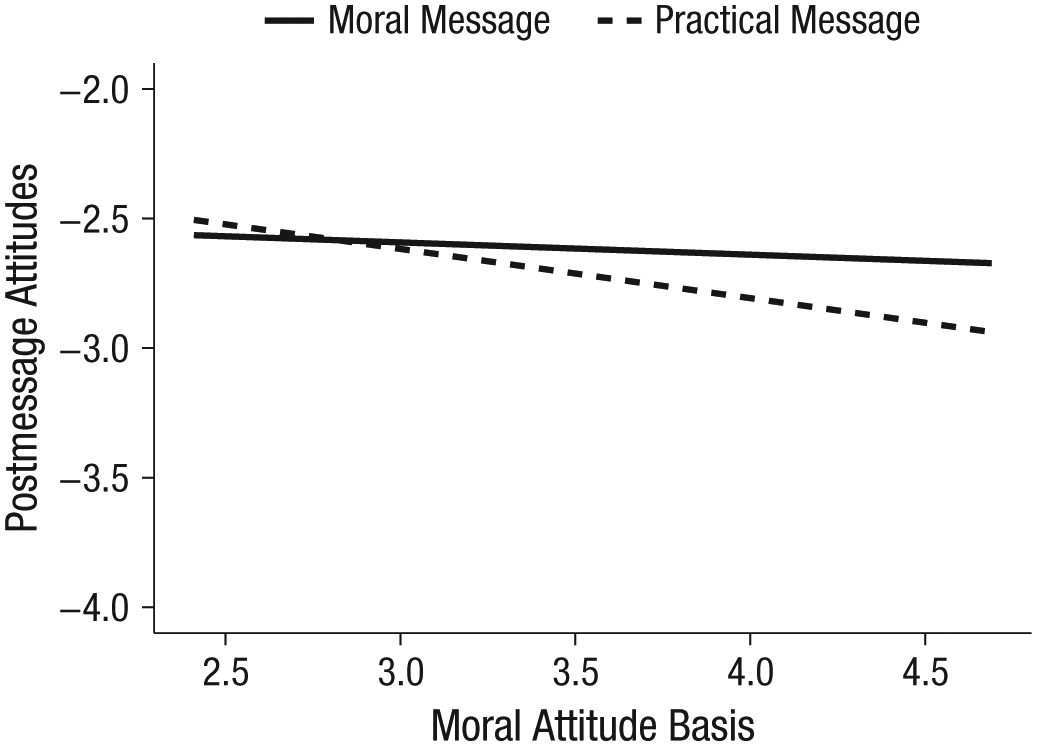
Effect of the Moral Attitude Basis × Message Type interaction on postmessage attitudes, controlling for premessage attitudes (Study 2). Moral bases are capped at 1 standard deviation above and below the mean.
In the practical-argument condition, we again replicated the typical effect of moral attitude basis on resistance to persuasion, as participants with higher moral bases to their attitudes continued to have more positive attitudes toward the issue, b = −0.19, 95% CI = [−0.30, −0.08], t(410) = −3.39, p < .001. This relationship, however, was eliminated when the message appealed to moral concerns; higher moral attitude bases were not predictive of attitudes following the moral message, b = −0.05, 95% CI = [−0.16, 0.06], t(410) = −0.84, p = .40. In support of the moral-matching hypothesis, participants with high moral bases (1 SD above the mean) were more persuaded by the moral (vs. practical) appeal, b = −0.13, 95% CI = [−0.25, −0.01], t(410) = −2.16, p = .03, whereas the two appeals did not significantly differ among participants with low moral bases (1 SD below the mean), b = 0.03, 95% CI = [−0.09, 0.15], t(410) = 0.48, p = .63.
Mediation by valenced thoughts
Valenced thoughts again showed the same Moral Attitude Basis × Message Type interaction we observed for attitude change, b = −0.05, 95% CI = [−0.10, 0.00], t(411) = −2.09, p = .04, f 2 = .01, so we tested the indirect effect of the Moral Attitude Basis × Message Type interaction on postmessage attitudes via message-relevant thoughts, as in Study 1. More positive thoughts indeed predicted more message-consistent final attitudes (controlling for premessage attitudes), b = 0.46, 95% CI = [0.31, 0.61], t(409) = 5.96, p < .001, and the Moral Attitude Basis × Message Type interaction dropped to nonsignificance (p = .16) when valenced thoughts were included in the model. The indirect effect of the Moral Attitude Basis × Message Type interaction on postmessage attitudes through valenced thoughts was marginally significant, b = −0.02, 95% CI = [−0.04, 0.00], p = .07.
Effects of other attitude bases
As in Study 1, the Practical Basis × Message Type interaction on postmessage attitudes was not reliable, b = −0.02, 95% CI = [−0.11, 0.07], t(410) = −0.43, p = .67, suggesting once again that pragmatic arguments do not necessarily benefit from a matching effect. Unlike Study 1, Study 2 revealed no evidence for an Emotion Basis × Message Type interaction, b = −0.02, 95% CI = [−0.09, −0.05], t(410) = −0.61, p = .54, and the Moral Attitude Basis × Message Type interaction persisted even when we controlled for an Emotion Basis × Message Type interaction, p = .06. Knowledge and consensus bases similarly did not interact with message type, ps > .50.
Moderation by political orientation
Participants who were more liberal were slightly more in favor of legalization, r(413) = −.14, p = .005; however, there was no correlation between political orientation and degree of moralizing on this issue, r(413) = −.03, p = .57. We tested whether political orientation moderated the Moral Attitude Basis × Message Type interaction, using the same method as Study 1, and found that the three-way interaction was once again significant, b = −0.09, 95% CI = [−0.16, −0.03], t(406) = −2.75, p = .006, f 2 = .02.
We again tested the Moral Attitude Basis × Message Type interaction at 1 standard deviation below the mean on ideology (extremely liberal: 1.45 on a scale ranging from 1−5) and at 1 standard deviation above the mean on ideology (moderately conservative: 4.00 on a scale ranging from 1−5). For participants who identified as highly liberal, there was no Moral Attitude Basis × Message Type interaction, p = .54. However, for participants who identified as relatively more conservative, there was a significant Moral Attitude Basis × Message Type interaction, b = −0.19, 95% CI = [−0.29, −0.08], t(406) = −3.41, p < .001. When people with relatively more conservative views had highly moral pro−marijuana-legalization attitudes (1 SD above the mean), they were significantly more persuaded by the moral arguments than the practical arguments, b = −0.27, 95% CI = [−0.44, −0.10], t(406) = −3.11, p = .002, whereas for those with relatively nonmoral legalization attitudes (1 SD below the mean), the practical appeal was marginally more persuasive than the moral appeal, b = 0.15, 95% CI = [−0.02, 0.33], t(406) = 1.76, p = .08. Framed differently, when the more conservative participants read the moral message, greater moral bases were associated with more message-consistent final attitudes, indicating greater persuasion by the moral message, b = 0.17, 95% CI = [0.00, 0.34], t(406) = 1.93, p = .05. In the practical-argument condition, however, greater moral bases were associated with less message-consistent attitudes, indicating greater resistance to the practical message, b = −0.20, 95% CI = [−0.34, −0.06], t(406) = −2.90, p = .004. Figure 4 presents this three-way interaction by plotting the Moral Attitude Basis × Message Type effect at each level of political-orientation responses.

Effect of the Moral Attitude Basis × Message Type interaction on ideology in Study 2. The estimated effect of the Moral Attitude Basis × Message Type interaction on postmessage attitudes (a) is shown for each level of ideology. Moral bases are capped at 1 standard deviation above and below the mean. To aid interpretation of (a), we binned frequencies of each level of ideology into five categories and plotted the results as a histogram (b); a rug plot along the x-axis illustrates occurrences for all possible ideology values.
Perceived argument strength
As in the pilot test, Study 2 showed no overall difference in perceived argument strength between the two message conditions, t(413) = −0.51, p = .61. However, as we noted earlier, we could also examine whether perceived moral attitude bases moderate the effect of message type on perceived argument strength. We thus conducted an additional set of multistep regression models similar to the previous analyses, except with perceived message strength as the outcome variable instead of postmessage attitudes. As noted previously, we did not covary premessage attitudes in these analyses, but results were not appreciably different with initial attitudes as a covariate (see the analysis records on OSF: https://osf.io/96s4v/).
First, we found a significant Moral Attitude Basis × Message Type interaction on perceived argument strength, b = −0.19, 95% CI = [−0.35, −0.04], t(411) = −2.45, p = .01, f 2 = .01. For the practical message, greater moral attitude bases were associated with perceiving the arguments as weaker, b = −0.55, 95% CI = [−0.76, −0.33], t(411) = −4.98, p < .001, but moral bases were unrelated to the perceived strength of the moral arguments, b = −0.16, t(411) = −1.39, p = .17. At low degrees of moralizing one’s attitude (1 SD below the mean), the practical message was perceived to be stronger than the moral message, b = 0.29, 95% CI = [0.04, 0.54], t(411) = 2.28, p = .02, but at high degrees of moralizing (1 SD above the mean), the moral message was seen as stronger than the practical message, though not significantly, b = −0.15, 95% CI = [−0.40, 0.10], t(411) = −1.19, p = .24. In addition, valenced thoughts mediated the Moral Attitude Basis × Message Type interaction on perceived argument strength, b = −0.06, 95% CI = [−0.12, 0.00], p = .04.
The Moral Attitude Basis × Message Type effect was further qualified by a three-way interaction with political orientation, b = −0.17, 95% CI = [−0.31, −0.03], t(407) = −2.41, p = .02, f 2 = .02. As with the effect on attitudes, the Moral Attitude Basis × Message Type interaction was stronger among more politically conservative participants (1 SD above the mean), b = −0.39, 95% CI = [−0.61, −0.17], t(407) = −3.51, p < .001, than among more politically liberal participants (1 SD below the mean), b = 0.00, t(407) = 0.00, p = .996.
Internal Meta-Analysis
Because Study 1 combined two samples and Study 2’s effect size was smaller than Study 1’s, we conducted a meta-analysis of Studies 1a, 1b, and 2 to further test the size and reliability of the reported effects. For each study, we computed standardized partial correlations from the regression results for the key interaction effects (see the Supplemental Material for a full report of the method and results of the meta-analysis). In brief, the Moral Attitude Basis × Message Type effect on postmessage attitudes, partial r = −.13, 95% CI = [−.21, −.05], Z = −3.34, p < .001 (Fig. S2A), and on valenced thoughts, partial r = −.12, 95% CI = [−.19, −.05], Z = −3.52, p < .001 (Fig. S2B), was reliable across studies. In addition, the Moral Attitude Basis × Message Type × Political Orientation interaction on postmessage attitudes was reliable across studies, partial r = −.12, 95% CI = [−.18, −.05], Z = −3.35, p < .001 (Fig. S2C).
General Discussion
Across two studies using essentially the same procedures with different topics, we showed that relatively moralized attitudes are more resistant to change, replicating prior research. Importantly, our novel finding was that this was only the case for messages making nonmoral arguments. For messages appealing to moral concerns, attitude moralization was no longer associated with resistance. The statistical interaction between degree of moral attitude basis and type of message delivered was consistent with the moral-matching hypothesis: Relatively moralized attitudes changed more when faced with moral (vs. practical) counterattitudinal messages. This process appears to be relatively thoughtful, because the interaction was mediated by the valenced thoughts people had while reading the message.
We also found an intriguing interaction: The moral-matching effect was stronger for more politically conservative participants. Participants who were more conservative may have been more open to the advocated positions in our studies because even though the positions were counterattitudinal for everyone, they were relatively more consistent with current normative conservative opinion, potentially making conservative individuals more open to the arguments matching their attitudes’ moral bases. Participants who were more liberal may have instead been closed to any antirecycling or legalization arguments, regardless of how well those arguments matched their attitude’s basis. Future research should test the role of political orientation and openness in persuasive-matching effects. Importantly, conservatives were not more open to moral persuasion than liberals in general, but they were more open when their attitudes had a relatively moral basis.
Notably, individuals who perceived themselves to have more practical attitude bases were not more persuaded by practical (vs. moral) arguments. Thus, matching effects may not necessarily extend across all types of attitude bases. Practical bases may seem less central than moral bases, or people may not naturally identify attitudes along a practical continuum as they do a moral continuum. Alternatively, participants’ attitudes may have encompassed specific practical concerns not communicated in our practical message. To our knowledge, the question of which attitude bases can produce matching effects has not been explored, and future research should consider the efficacy of messages tailored to less centrally relevant attitude bases.
We suspect that even when targeting an audience that sees the issue as moral, the effectiveness of moral appeals may further depend on the specific moral content of that message. That is, when people view their attitude as morally grounded, the moral appeal that speaks to their particular moral values may be the most impactful (e.g., “purity” appeals to political conservatives; Feinberg & Willer, 2015), a proposition consistent with the moral-reframing literature. Nevertheless, we aimed to include moral content in our messages that would be appealing across the political spectrum—emphasizing harm, which is universally important. It is still possible that any moral appeal—even one not closely aligned with one’s ideology—is more persuasive than a nonmoral appeal when people approach an issue from a moral perspective. We invite further research on this possibility.
These studies also contribute to theories of moral attitudes. Although morally based attitudes are typically construed as inherently resistant to change, we did not observe this for messages appealing to morality. Thus, perceiving a moral basis for one’s attitude is not necessarily associated with an unwillingness to change but instead reflects greater weight put on moral considerations, and many attempts to influence that attitude may simply focus on other points, leaving the attitude unchallenged. Indeed, previous research showing the durability of moral attitudes did not challenge attitudes with morally relevant considerations. When morality seems especially relevant to an issue, people are more attentive and open to new moral considerations because those concerns seem more relevant to their attitude (See, Petty, & Fabrigar, 2013). Together, these implications raise compelling questions about the role of morality in persuasion, and future work should examine these relationships.
Supplemental Material
Luttrell_Materials – Supplemental material for Challenging Moral Attitudes With Moral Messages
Supplemental material, Luttrell_Materials for Challenging Moral Attitudes With Moral Messages by Andrew Luttrell, Aviva Philipp-Muller and Richard E. Petty in Psychological Science
Supplemental Material
Luttrell_OpenPracticesDisclosure_rev – Supplemental material for Challenging Moral Attitudes With Moral Messages
Supplemental material, Luttrell_OpenPracticesDisclosure_rev for Challenging Moral Attitudes With Moral Messages by Andrew Luttrell, Aviva Philipp-Muller and Richard E. Petty in Psychological Science
Supplemental Material
Luttrell_SupplementalAnalyses – Supplemental material for Challenging Moral Attitudes With Moral Messages
Supplemental material, Luttrell_SupplementalAnalyses for Challenging Moral Attitudes With Moral Messages by Andrew Luttrell, Aviva Philipp-Muller and Richard E. Petty in Psychological Science
Footnotes
Acknowledgements
We thank The Ohio State University Attitudes & Persuasion Lab for their helpful comments.
Action Editor
Jamin Halberstadt served as action editor for this article.
Author Contributions
A. Luttrell and R. E. Petty developed the study concept. All authors contributed to the study design. Data were collected and analyzed by A. Luttrell and A. Philipp-Muller. A. Luttrell and A. Philipp-Muller drafted the manuscript, and R. E. Petty provided critical edits. All authors approved the final version of the manuscript for submission.
Declaration of Conflicting Interests
The author(s) declared that there were no conflicts of interest with respect to the authorship or the publication of this article.
Funding
This work was supported by grants from the Society for Personality and Social Psychology and the Ball State University Digital Scholarship Laboratory.
Open Practices
Anonymized data for all main studies and pilot studies along with data-analysis scripts have been made publicly available via the Open Science Framework and can be accessed at https://osf.io/96s4v/. The design and analysis plans for the main studies were preregistered at (Study 1a: https://aspredicted.org/yp5az.pdf; Study 1b: https://aspredicted.org/n3pd9.pdf; Study 2: https://aspredicted.org/a4rw8.pdf). The complete Open Practices Disclosure for this article can be found at https://journals-sagepub-com.web.bisu.edu.cn/doi/suppl/10.1177/0956797619854706. This article has received the badges for Open Data, Open Materials, and Preregistration. More information about the Open Practices badges can be found at  .
.
Notes
References
Supplementary Material
Please find the following supplemental material available below.
For Open Access articles published under a Creative Commons License, all supplemental material carries the same license as the article it is associated with.
For non-Open Access articles published, all supplemental material carries a non-exclusive license, and permission requests for re-use of supplemental material or any part of supplemental material shall be sent directly to the copyright owner as specified in the copyright notice associated with the article.
