



Abstract
Levels of moral condemnation often vary with outcome severity (e.g., extreme destruction is morally worse than moderate damage), but this is not always true. We investigated whether judgments of purity transgressions are more or less sensitive to variation in dosage than judgments of harm transgressions. In three studies, adults (N = 426) made moral evaluations of harm and purity transgressions that systematically varied in dosage (frequency or magnitude). Pairs of low-dosage and high-dosage transgressions were presented such that the same sets of modifiers (e.g., “occasionally” vs. “regularly,” “small” vs. “large”) or amounts (e.g., “millimeter” vs. “centimeter”) were reused across moral domains. Statistical interactions between domain and dosage indicated robust distinctions between the perceived wrongness of high-dosage and low-dosage harms, whereas moral evaluations of impure acts were considerably less influenced by dosage. Our findings support the existence of a cognitive distinction between purity-based and harm-based morals and challenge current wisdom regarding relationships between intentions and outcomes in moral judgment.
More is more, generally speaking, and this is typical of many moral evaluations. Greater wrongdoings tend to yield harsher appraisals: Serial killers are judged more severely than murderers of a single victim (Boehm, 2012), and allowing a trolley to hit five innocent people is evaluated as worse than diverting it toward one person (Greene, 2013). Yet in certain contexts, moral evaluations display a striking insensitivity to magnitude or frequency (e.g., Baron & Spranca, 1997; Hsee, Rottenstreich, & Xiao, 2005). In this article, we show that evaluations of harm transgressions (e.g., violence, maltreatment) are highly sensitive to variations in frequency and magnitude, whereas evaluations of purity transgressions (e.g., sacrilege, deviant sexual acts) are relatively insensitive to variations in frequency and magnitude.
Although the diverse content of morality has been well documented (Flanagan, 2016; Haidt, 2012; Shweder, Mahapatra, & Miller, 1987), controversy exists regarding the extent to which the nature of moral judgments varies across different content domains (e.g., Graham, 2015; Gray & Keeney, 2015; Piazza, Sousa, Rottman, & Syropoulos, 2018; Sinnott-Armstrong & Wheatley, 2014). A domain-general hypothesis would predict that outcome variation impacts moral evaluations similarly for harm and purity violations (e.g., Gray & Keeney, 2015; Powell & Horne, 2017; Shenhav & Greene, 2010). Here, we evaluated this domain-general hypothesis alongside two additional hypotheses that predict opposing domain-specific ways in which outcomes should differentially impact evaluations of harm transgressions and purity transgressions.
Scholars have previously noted that outcomes become less important for evaluating moral transgressions as other factors, such as intentions, become more important (Cushman, 2008; Hamlin, 2013; McNamara, Willard, Norenzayan, & Henrich, 2019; Piaget, 1932; Young, Cushman, Hauser, & Saxe, 2007). We call this the trade-off hypothesis. Crucially for the present research, previous studies have demonstrated that intent is a highly influential factor for moral judgments of harms (Cushman, 2008; Guglielmo, Monroe, & Malle, 2009; Young et al., 2007), but intent is much less important for moral judgments of impure, taboo, or disgusting acts (Barrett et al., 2016; Chakroff et al., 2016; Young & Saxe, 2011). Therefore, according to the trade-off hypothesis, outcomes should matter more for evaluating purity violations than for evaluating harms.
In contrast to the domain-general and trade-off hypotheses, we propose the mere-trace hypothesis. This hypothesis proposes that judgments of purity violations uniquely hinge on assessments of whether any amount of a transgression occurs and are only minimally affected by considerations of rate or quantity. Thus, evaluations of purity violations should be less sensitive to variations in outcomes than evaluations of harms, even at very low levels of dosage (i.e., a mere trace of impurity and a larger amount of impurity should elicit similar perceptions of contamination and in turn should yield similar evaluations of moral wrongness). We favor the mere-trace hypothesis for three reasons. First, moral judgments of purity violations—and the associated emotion of moral disgust—are generally unaffected by a wide range of potentially mitigating or aggravating factors (Russell & Giner-Sorolla, 2013; see also Douglas, 1966). Because the insensitivity of moral disgust can be observed across a range of extenuating circumstances (Piazza, Russell, & Sousa, 2013; Russell & Giner-Sorolla, 2011), variation in outcomes may similarly fail to impact the harshness of purity judgments.
Second, moral judgments of purity violations largely involve an assessment of underlying character traits rather than assessments of the actions themselves or their subsequent outcomes (Uhlmann & Zhu, 2014). Whereas harmful actions are more likely to be attributed to situational factors, impure actions are more readily attributed to stable dispositions (Chakroff & Young, 2015). Because virtues and vices can be assessed independently of outcomes, this feature of moral purity can lead to a surprising inattentiveness to outcomes in certain situations. In some cases, purity transgressions are condemned even when they are merely imagined and produce no effects at all. Whereas the mere act of imagining a harmful behavior in a fictional context is judged to be considerably less wrong than engaging in real-world harm, a person who imagines engaging in a fictional purity violation (without any tangible outcome) is judged to be nearly as bad as a person who engages in an actual purity violation (Sabo & Giner-Sorolla, 2017).
Third, assessments of pollution generally exhibit dose insensitivity and operate according to a step function. The introduction of a small contaminant or imperfection into a system can produce extreme aversion, as if the system were maximally laden with contaminants (see Rozin & Royzman, 2001). Thinking about wearing a sweater previously owned by an unsavory individual is judged to be extremely disagreeable, even if the sweater has been thoroughly laundered, suggesting that the amount of contamination is irrelevant for deeming an object to be highly impure (Rozin, Nemeroff, Wane, & Sherrod, 1989). Because tiny amounts of impurity—and even an immaterial essence of impurity—can render an entity irrevocably and absolutely impure, the mere-trace hypothesis predicts that evaluations of purity violations, compared with evaluations of harms, will be relatively unaffected by changes in the frequency or magnitude of outcomes.
The three hypotheses introduced above generate opposing predictions as to whether and how moral judgments of harms and impurities will be differentially sensitive to outcome severity. The domain-general hypothesis straightforwardly predicts that, all else being equal, outcome variation should affect moral judgments similarly for harms and purity violations. The trade-off hypothesis proposes that the reduced influence of intent on judging purity violations (as uncovered in prior work) should yield a corresponding increase in the relevance of outcomes for judging purity violations. Finally, the mere-trace hypothesis, which we favor, proposes that in addition to being relatively unaffected by intentions, evaluations of purity violations should be relatively unaffected by outcomes.
In three studies, we tested these competing hypotheses by manipulating the frequency and magnitude of harmful and impure actions. Participants judged a range of moral violations designed to exemplify the harm and purity domains. Each violation had a low-dosage and a high-dosage version, and these were exactly matched across harm and purity violations. In Studies 1 and 2, this was accomplished by reusing the same sets of modifiers (e.g., “occasionally” vs. “regularly,” “small” vs. “large”) for each moral domain (e.g., if a purity transgression were manipulated to occur “once” or “frequently,” these same adverbs were used for a corresponding harm transgression). In Study 3, the same quantities (e.g., “a gram” vs. “a quarter pound”) were reused across each moral domain. For all studies, we report all measures, conditions, data exclusions, and procedures for sample-size determination.
Study 1
Method
Participants
A target sample size of 200 total participants was determined a priori. 1 The final sample consisted of 177 U.S. residents (79 female; 147 White; age: M = 33.65 years, SD = 11.00) who were tested on Amazon Mechanical Turk. Twenty-four additional participants completed the study, but 12 were excluded for failing attention checks—they provided responses from 0 to 49 (on a 100-point scale) when evaluating the moral wrongness of “A person destroys the entire planet” (n = 4) or from 51 to 100 when evaluating the moral wrongness of “A person gives money to a charitable organization” (n = 8). Another 12 participants were excluded for having worker IDs that duplicated those from a pilot study.
Materials and procedure
After providing consent to participate in the study, each participant was presented with 16 violations that varied by domain (harm vs. purity), dosage (low vs. high), and dosage type (magnitude vs. frequency). Participants saw two violations from each of the eight possible combinations of these variable levels (see Table 1). The presentation of these violations was counterbalanced across participants such that each participant saw either a low- or a high-dosage version of each violation and saw the opposite dosage from a corresponding violation in the other content domain. For example, participants who judged “A person throws a large rock at a farm animal” did not see “A person throws a small rock at a farm animal” but instead saw “A person eats a small amount of flesh from a dead person.” The two attention-check questions were also randomly presented within this sequence. After each moral violation was presented, participants were asked, “How morally wrong was this action?” and were prompted to respond on a slider scale from 0 (not at all) to 100 (extremely). Participants were then asked to provide basic demographic information and were debriefed.
Sets of Harm and Purity Violations Presented to Participants for Evaluation in Studies 1 and 2

Note: For each set of terms in brackets, the first term was used in the low-dosage version of the stimulus, and the second was used in the high-dosage version of the stimulus. In Study 1, each participant saw one of two sets of stimuli, which contained a single variant of each item (16 transgressions total), divided so that each participant saw each modifier once. In Study 2, participants saw both variants of all items, for a total of 32 transgressions.
The harm and purity violations were carefully matched for overall severity during stimulus construction, thus reducing the potential for confounding factors (Gray & Keeney, 2015), and their equivalence was confirmed in a pilot study (see the Supplemental Material available online). Because atypicality is a feature of the purity domain (i.e., impurity is often a function of the perceived unnaturalness of actions; Giner-Sorolla, Bosson, Caswell, & Hettinger, 2012; Graham, 2015), actions were not matched on this dimension.
Results
The difference in wrongness ratings between the high-dosage and low-dosage versions of the scenarios was substantially higher for the harm transgressions (mean difference = 14.605; SD = 20.395) than for the purity transgressions (mean difference = 4.185; SD = 16.060); the average difference between these differences was 10.419 (SD = 25.767), as can be seen in Figure 1.

Results from Study 1: violin plot representing probability densities for ratings of wrongness as a function of domain and dosage. Error bars indicate 95% confidence intervals.
To more carefully examine the interaction between domain and dosage, we analyzed the data with a linear mixed model fitted using restricted maximum likelihood. The model was specified to predict moral judgments from the fixed effects of domain (harm vs. purity) and dosage (low vs. high), the two-way interaction between these variables, and the random intercepts of scenario and participant. The model initially included dosage type as an additional factor, along with all interactions involving this factor. This analysis yielded a significant three-way interaction, b = 9.491, SE = 3.630, p = .009, driven by a decrease in wrongness for low-magnitude harms, which rendered the estimates of main effects and two-way interactions uninterpretable. Because we had no predictions about the effects of dosage type, this variable was dropped from the model. Including random intercepts for scenario and participant provided the ability to generalize these findings to a broader range of stimuli and individuals (Judd, Westfall, & Kenny, 2012), precluding arguments that the results are an artifact of the particular scenarios that were presented or the particular sample that was tested. The random effect of participant additionally accounted for the nonindependence of multiple judgments being made by each participant.
Crucially, there was a significant interaction between domain and dosage, b = 9.599, SE = 1.821, p < .001, reflecting participants’ greater sensitivity to dosage for harm-based transgressions. Examining simple effects, we found that there was an effect of dosage both for harm transgressions, b = 13.999, SE = 1.288, p < .001, and for purity transgressions, b = 4.400, SE = 1.288, p = .001. Notably, however, the effect size of dosage for purity transgressions (d = 0.139) was less than one third of the effect size of dosage for harm transgressions (d = 0.441).
Rerunning this model without the interaction term (to ensure more interpretable main effects) indicated that there was no overall effect of domain, b = 3.400, SE = 6.803, p = .625, thus revealing that the harm and purity transgressions were well matched for severity. Unsurprisingly, there was a clear effect of dosage, b = 9.199, SE = 0.915, p < .001, as high-dosage transgressions were judged to be more wrong than low-dosage transgressions.
Overall, these results provide strong support for the mere-trace hypothesis. Evaluations of purity transgressions were strikingly less sensitive to variations in magnitude and frequency than evaluations of harm transgressions. This suggests that transgressions from different moral domains are evaluated differently, providing evidence against the domain-general hypothesis, and that evaluations of purity violations are less affected by outcome information than evaluations of harms, providing evidence against the trade-off hypothesis.
Study 2
Study 2 served as a replication of Study 1 but with two primary differences. First, in addition to evaluating moral wrongness, participants were asked to appraise the harmfulness and impurity of each transgression. Second, participants were presented with both levels of each stimulus (i.e., the high- and low-dosage versions).
Method
Participants
Because each participant evaluated twice as many transgressions as did Study 1 participants, we aimed for a sample that was half the size of the previous study. The final sample consisted of 81 U.S. residents (45 female; 62 White; age: M = 37.75 years, SD = 13.07) who were tested on Amazon Mechanical Turk. Five additional participants completed the study but were excluded for failing the same attention checks as in Study 1 (“A person destroys the entire planet”: n = 3; “A person gives money to a charitable organization”: n = 2), and another 18 participants were excluded for having worker IDs that duplicated those from the pilot study or Study 1.
Materials and procedure
The same stimuli from Study 1 were used, but this time all 32 items from Table 1 were presented to each participant. However, because judgments of different degrees of moral transgressions are rarely simultaneous in everyday life, we did not fully juxtapose these versions. Rather, the stimuli were split into the two sets that were presented between subjects in Study 1, such that participants did not see both versions of each transgression back to back, and one attention-check question was included in each set. Between the two sets, there was a brief delay in the form of a short transcription task (participants were asked to type 65 words of handwritten text about pen pals). In addition to being asked “How morally wrong was this action?” for each transgression, participants were asked “How harmful is this action?” and “How impure is this action?” They responded to each question on a slider scale from 0 (not at all) to 100 (extremely). Participants were then asked to provide basic demographic information and were debriefed.
Results
The harm transgressions were rated as more harmful (M = 68.418, SD = 17.034) than the purity transgressions (M = 55.275, SD = 23.609), t(80) = 6.178, p < .001, d = 0.686. Conversely, the purity transgressions were rated as more impure (M = 69.581, SD = 24.320) than the harm transgressions (M = 50.828, SD = 28.121), t(80) = 7.333, p < .001, d = 0.815. Thus, these items were appropriately categorized.
Overall, the difference in wrongness ratings between high-dosage and low-dosage versions of the scenarios was substantially higher for the harm transgressions (mean difference = 11.991, SD = 10.426) than for the purity transgressions (mean difference = 2.877, SD = 7.148); the average difference between these differences was 9.114 (SD = 11.950), as can be seen in Figure 2.

Results from Study 2: violin plot representing probability densities for ratings of wrongness as a function of domain and dosage. Error bars indicate 95% confidence intervals.
As in Study 1, the data were analyzed with a linear mixed model fitted using restricted maximum likelihood. The model was again specified to predict moral judgments from the fixed effects of domain (harm vs. purity) and dosage (low vs. high), the two-way interaction between these variables, and the random intercepts of scenario and participant. Because we had no predictions about the effects of dosage type (frequency vs. magnitude), this variable was again dropped from the model to improve the interpretability of other effects.
Crucially, there was a significant interaction between domain and dosage, b = 9.114, SE = 1.910, p < .001, which was once again caused by participants’ greater sensitivity to dosage for harm-based transgressions. Examining simple effects, there was an effect of dosage both for harm transgressions, b = 11.991, SE = 1.351, p < .001, and for purity transgressions, b = 2.877, SE = 1.351, p = .033. Notably, however, the effect size of dosage for purity transgressions (d = 0.088) was less than one quarter of the effect size of dosage for harm transgressions (d = 0.368).
Rerunning this model without the interaction term (to ensure more interpretable main effects) yielded no main effect of domain, b = 1.421, SE = 5.594, p = .803, and a robust main effect of dosage, b = 7.434, SE = 0.959, p < .001, as high-dosage transgressions were judged to be more wrong than low-dosage transgressions overall.
Finally, item-wise analyses were conducted to determine whether appraisals of harm predicted larger effects of dosage or whether appraisals of impurity predicted smaller effects of dosage. The average harmfulness rating of each item (collapsed across high- and low-dosage versions) and the average impurity rating of each item (collapsed across high- and low-dosage versions) were in turn correlated with the average dosage effect of each item (operationalized as the difference score in wrongness between the high and low versions of the transgressions). These correlations indicated that the harmfulness of a transgression does not predict the extent to which moral judgments will be influenced by varying dosage, r(14) = −.213, p = .428, but the more impure a transgression is perceived to be, the less likely it is for moral judgments to be influenced by varying dosage, r(14) = −.689, p = .003. These two correlations did not significantly differ from each other, however, z = 1.607, p = .108. The perceived harmfulness and impurity of these transgressions were orthogonal, r(14) = .064, p = .813.
The results in Study 2 were again consistent with the mere-trace hypothesis and not consistent with either the trade-off hypothesis or the domain-general hypothesis. Indeed, the findings were strikingly similar to those yielded by the Study 1 data set, indicating that an interaction between domain and dosage is robust and replicable.
Study 3
The mere-trace hypothesis suggests that evaluations of purity violations should be consistently insensitive to variations in dosages—even very small dosages. In Study 3, we tested this prediction by presenting participants with a new set of moral violations that involved changes at very low levels of dosage.
Method
Participants
On the basis of a power calculation involving Monte Carlo simulations of the Study 1 data (Green & MacLeod, 2016) and accounting for smaller anticipated effects with dosage levels that were less differentiated than those of the previous studies, we aimed for a total sample of 180 participants. The final sample consisted of 168 U.S. residents (101 female, 2 nonbinary; 127 White; age: M = 35.35 years, SD = 9.68) who were tested on Amazon Mechanical Turk. Ten additional participants completed the study but were excluded for failing the same attention check used in the previous studies (“A person destroys the entire planet”: n = 4; “A person gives money to a charitable organization”: n = 6), and another 2 participants were excluded for having worker IDs that duplicated those from one of the previous studies. All sampling, exclusion, and analytic decisions for this study were preregistered at https://osf.io/bd9ea.
Materials and procedure
After providing consent to participate in the study, participants were presented with 16 violations that varied by domain (harm vs. purity) and dosage (low vs. high). Participants saw four violations from each of the four possible combinations of these variable levels (see Table 2). As in Study 1, the presentation of these violations was counterbalanced across participants so that each participant saw either a low- or high-dosage version of each violation and saw the opposite dosage from a corresponding violation in the other content domain. The two attention-check questions were also randomly presented within this sequence. After each transgression was presented, participants were asked to rate “How morally wrong is this action?” “How harmful is this action?” and “How impure is this action?” They responded a slider scale from 0 (not at all) to 100 (extremely). Participants were then asked to provide basic demographic information and were debriefed.
Sets of Harm and Purity Violations Presented to Participants for Evaluation in Study 3
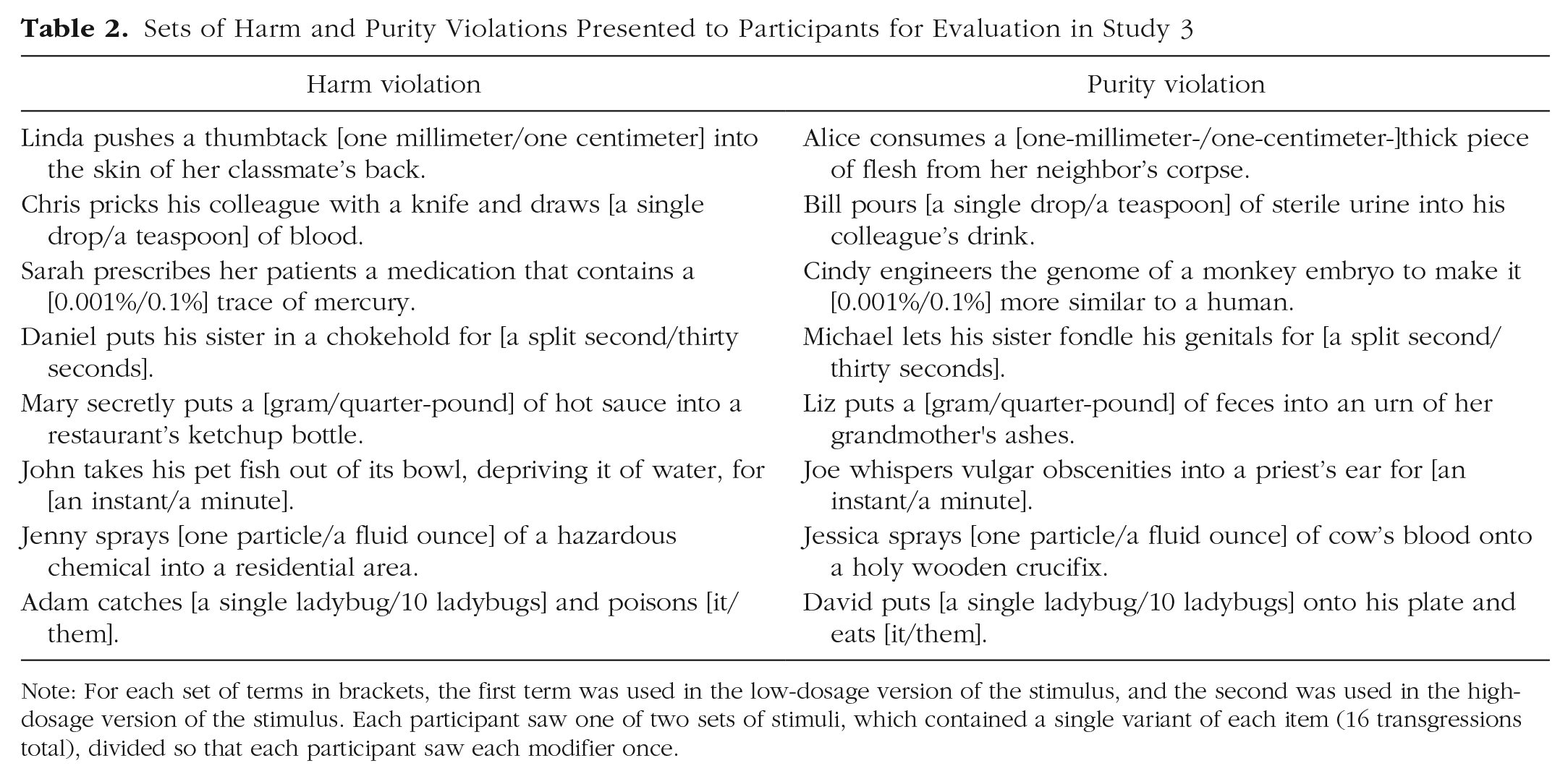
Note: For each set of terms in brackets, the first term was used in the low-dosage version of the stimulus, and the second was used in the high-dosage version of the stimulus. Each participant saw one of two sets of stimuli, which contained a single variant of each item (16 transgressions total), divided so that each participant saw each modifier once.
Results
The harm transgressions were rated as more harmful (M = 57.743, SD = 21.079) than the purity transgressions (M = 42.912, SD = 23.466), t(167) = 11.764, p < .001, d = 0.908. Conversely, the purity transgressions were rated as more impure (M = 67.297, SD = 21.213) than the harm transgressions (M = 55.484, SD = 23.790), t(167) = 8.590, p < .001, d = 0.663. Thus, these items were appropriately categorized.
Overall, the difference in wrongness ratings between high-dosage and low-dosage versions of the scenarios was higher for the harm transgressions (mean difference = 9.379, SD = 19.647) than for the purity transgressions (mean difference = 4.360, SD = 16.745); the average difference between these differences was 5.019 (SD = 25.789), as can be seen in Figure 3.

Results from Study 3: violin plot representing probability densities for ratings of wrongness as a function of domain and dosage. Error bars indicate 95% confidence intervals.
As in the previous two studies, the data were analyzed with a linear mixed model fitted using restricted maximum likelihood. The model was again specified to predict moral judgments from the fixed effects of domain (harm vs. purity) and dosage (low vs. high), the two-way interaction between these variables, and the random intercepts of scenario and participant.
Crucially, there was a significant interaction between domain and dosage, b = 5.220, SE = 2.015, p = .010, as dosage was once again a more potent factor for harm-based transgressions. Examining simple effects, we found that there was an effect of dosage both for harm transgressions, b = 9.518, SE = 1.425, p < .001, and for purity transgressions, b = 4.299, SE = 1.425, p = .003. Notably, however, the effect size of dosage for purity transgressions (d = 0.121) was less than half of the effect size of dosage for harm transgressions (d = 0.268).
Rerunning this model without the interaction term (to ensure more interpretable main effects) replicated the previous studies by yielding no main effect of domain, b = 2.008, SE = 8.764, p = .822, and a robust main effect of dosage, b = 6.908, SE = 1.009, p < .001, as high-dosage transgressions were judged to be more wrong than low-dosage transgressions overall.
Finally, item-wise analyses were conducted to determine whether appraisals of harm predicted larger effects of dosage or whether appraisals of impurity predicted smaller effects of dosage. Again, there was no relationship between the relative harmfulness of a transgression and the influence of dosage on moral judgments of that transgression, r(14) = .075, p = .781. However, unlike in Study 2, there was no relationship between the relative impurity of a transgression and the influence of dosage on moral judgments of that transgression, r(14) = −.121, p = .655, indicating that the significant result in the previous study should be interpreted with caution. The perceived harmfulness and impurity of these transgressions were more related to each other in Study 3 than in Study 2, r(14) = .447, p = .083.
Once again, the results of Study 3 provide support for the mere-trace hypothesis. Even when people judge violations that involve miniscule quantities, their moral evaluations of harms are more sensitive to changes in dosage than moral evaluations of purity violations.
Discussion
In three studies, adult participants judged the moral wrongness of harm and purity transgressions that varied in frequency (e.g., occasionally vs. regularly) or magnitude (e.g., small vs. large) with the same sets of modifiers or the same quantities (e.g., a single drop vs. a teaspoon) repeated across content domains. All studies found that evaluations of purity violations were considerably less sensitive to variations in scope than evaluations of harms, yielding robust statistical interactions between domain and dosage.
These findings provide direct empirical support for the mere-trace hypothesis, which proposes that moral judgments of impure actions are relatively less responsive to outcomes than moral judgments of harmful actions. The results therefore align with prior indications that disgust-eliciting moral transgressions are evaluated categorically and rigidly (Russell & Giner-Sorolla, 2013). Thus, people who engage in activities that are considered depraved or unchaste will tend to be condemned regardless of their intent or the extremity of the outcome (see also Uhlmann & Zhu, 2014). These findings dovetail with previous research on contagion (e.g., Rozin et al., 1989), implying that even slight contamination will render a person “tainted.” This stigma will tend to surround them nearly as much as if they had engaged in an action many times over or many times more severely.
Our finding that judgments of purity violations are less sensitive to outcomes than judgments of harms mirrors previous findings that judgments of purity violations are less sensitive to intent than judgments of harms (e.g., Young & Saxe, 2011). Together, these findings contradict the trade-off hypothesis. The present research therefore necessitates a rethinking of the relationship between intent and outcome in moral judgment (see also Cushman, 2015). In particular, rather than a competition existing between intentions and outcomes, with people focusing largely on one or the other for moral judgment, moral impurity may simultaneously reduce focus on both of these factors. Moral judgments of harms may involve balancing considerations between intent and outcome, but this trade-off model of moral cognition does not apply to the purity domain.
These findings do not support the domain-general hypothesis either. Compared with moral judgments of harms, moral judgments of purity violations were significantly less sensitive to variations in dosage. This effect is unlikely to be a methodological artifact of the study design, particularly because we controlled for severity across purity violations and harms (Gray & Keeney, 2015). Our research is therefore consistent with the existence of multiple moral domains associated with distinct cognitive signatures (Graham et al., 2013). We note, though, that our evidence against the domain-general hypothesis is not definitive; purity violations are not completely insensitive to variation in dosage, indicating that the difference between domains may be quantitative rather than qualitative.
Further studies should investigate the mechanisms driving the present effect. Because purity judgments typically focus on a person’s character and his or her adherence to local cultural norms (Chakroff & Young, 2015), one explanation for our findings is that character assessments were similar across high- and low-dosage versions of purity violations but not across high- and low-dosage versions of harms, and participants may have evaluated perpetrators’ character rather than their behavior. Another possible explanation is that the purity violations were more viscerally disturbing, and thus participants assessed them in the grip of strong feelings, a state previously associated with magnitude insensitivity (Hsee & Rottenstreich, 2004). Notably, however, results from an exploratory pilot study are inconsistent with these explanations. These pilot data indicate that character judgments are similarly influenced by dosage across harm and purity domains, and both harm and purity transgressions elicit similarly strong emotional reactions (see the Supplemental Material for details). Therefore, it is unlikely that our results are wholly due to differences in character assessments or affect between domains. Future research is needed to uncover other candidate mechanisms underlying this effect. One intriguing possibility is that the perceived amount of reparation required to “set things right” is more differentiated between low- and high-dosage harm transgressions than between low- and high-dosage purity transgressions.
Beyond informing theoretical models of moral cognition, this research has practical implications. The mere-trace hypothesis is chillingly reminiscent of the one-drop rule from the antebellum South, which proclaimed that “racial purity” was negated by having a distant African ancestor. Additionally, there is a widespread belief that “sexual purity” is irrevocably lost after one’s first sexual experience. Scope insensitivity in the purity domain may also lead people to misconstrue the ecological impacts of environmentally “pure” choices (Kim & Schuldt, 2018) or to feel licensed to pollute natural ecosystems that are already slightly degraded. Although folk moral intuitions may resonate with these precepts and practices, a better understanding of our intuitive tendencies could facilitate a search for more optimal and just strategies for assessing perceived wrongdoing.
Supplemental Material
RottmanSupplementalMaterial_rev – Supplemental material for Specks of Dirt and Tons of Pain: Dosage Distinguishes Impurity From Harm
Supplemental material, RottmanSupplementalMaterial_rev for Specks of Dirt and Tons of Pain: Dosage Distinguishes Impurity From Harm by Joshua Rottman and Liane Young in Psychological Science
Supplemental Material
Rottman_OpenPracticesDisclosure_rev – Supplemental material for Specks of Dirt and Tons of Pain: Dosage Distinguishes Impurity From Harm
Supplemental material, Rottman_OpenPracticesDisclosure_rev for Specks of Dirt and Tons of Pain: Dosage Distinguishes Impurity From Harm by Joshua Rottman and Liane Young in Psychological Science
Footnotes
Acknowledgements
We are grateful to Danel Draguljic, Maggie Stanton, Jordan Theriault, and Henrik Singmann for statistical advice and to members of the Franklin & Marshall College Developing Moral Values Lab, Fiery Cushman, and Lysa Adams for helpful discussions and feedback.
Action Editor
Michael Inzlicht served as action editor for this article.
Author Contributions
J. Rottman designed the research in consultation with L. Young. J. Rottman performed the research, analyzed the data, and wrote the article; L. Young provided essential feedback. Both authors approved the final manuscript for submission.
Declaration of Conflicting Interests
The author(s) declared that there were no conflicts of interest with regard to the authorship or the publication of this article.
Open Practices
All data and analysis code for Studies 1 to 3 have been made publicly available via the Open Science Framework and can be accessed at https://osf.io/zxp9k/. All stimuli can be found in Tables 1 and 2 of this article, and all rating and attention-check questions can be found in the main text. The design and analysis plans for Study 3 were preregistered at https://osf.io/bd9ea (Studies 1 and 2 were not preregistered). The complete Open Practices Disclosure for this article can be found at http://journals.sagepub.com/doi/suppl/10.1177/0956797619855382. This article has received the badges for Open Data, Open Materials, and Preregistration. More information about the Open Practices badges can be found at  .
.
Notes
References
Supplementary Material
Please find the following supplemental material available below.
For Open Access articles published under a Creative Commons License, all supplemental material carries the same license as the article it is associated with.
For non-Open Access articles published, all supplemental material carries a non-exclusive license, and permission requests for re-use of supplemental material or any part of supplemental material shall be sent directly to the copyright owner as specified in the copyright notice associated with the article.
