



Abstract
Models are central to the practice and teaching of science. Yet people often fail to grasp how scientific models explain their observations of the world. Realizing the explanatory power of a model may require aligning its relational structure to that of the observable phenomena. In the present study, we tested whether relational scaffolding—guided comparisons between observable and modeled events—enhances children’s understanding of scientific models. We tested relational scaffolding during instruction of third graders about the day/night cycle, a topic that involves relating Earth-based observations to a space-based model of Earth’s rotation. Experiment 1 found that participants (N = 108) learned more from instruction that incorporated relational scaffolding. Experiment 2 (N = 99) found that guided comparison—not merely viewing observable and modeled events—is a critical component of relational scaffolding, especially for children with low initial knowledge. Relational scaffolding could be applied broadly to assist the many students who struggle with science.
Keywords
Science portrays a world governed by invisible entities and processes. The orbiting of electrons around the nucleus of an atom or of planets around the sun in our solar system cannot be directly observed. One is imperceptibly small, the other incredibly vast. Belief in the existence of these invisible systems is hardly a matter of common sense. Indeed, revolutionary scientific breakthroughs—such as the heliocentric model of the solar system, evolution by natural selection, and the germ theory of disease—have drastically restructured our understanding of the world (Kuhn, 1962). The advancement of these and other fundamental scientific ideas has involved creating, testing, and refining models that represent the hidden nature of reality (Nersessian, 2010).
Science education aims to support model-based learning from a young age (American Association for the Advancement of Science, 2009; National Research Council, 2012). Yet students often emerge from school with incomplete and incorrect ideas about the way the world works (Chi, Roscoe, Slotta, Roy, & Chase, 2012; McCloskey, 1983; Shtulman, 2017). To realize the explanatory power of a scientific model, a student must grasp its relation to observable phenomena. This is straightforward when models depict familiar objects in idealized form or events happening more slowly or quickly than usual. It is far more challenging when models portray invisible entities and processes, whose relationship to observable phenomena is nonobvious and often counterintuitive.
Like interpreting an analogy, making sense of a scientific model can involve relating seemingly disparate sets of information. Hence, also like analogy, the mapping between observations and model may depend on a process of structural alignment, in which correspondences are established in accordance with a deeper, shared system of relations (Gentner & Markman, 1997). With scientific models, causal attribution is also crucial; the model explains what is observed. Given these parallels, theory and research on analogical thinking could provide a basis for new approaches to model-based science instruction.
Our aim was to test a support for model-based learning—relational scaffolding—that involves guiding a student through systematic comparisons between observable phenomena and corresponding modeled events. Comparing analogous cases brings common relational structure into focus (Gentner & Markman, 1997). When cases lack surface similarity, explicit comparison supports analogical retrieval and mapping (Goldwater & Gentner, 2015; Holyoak & Koh, 1987; Kurtz, Miao, & Gentner, 2001). Thus, relational scaffolding should be most effective when models involve entities and processes that bear little resemblance to observable phenomena.
Applying relational scaffolding throughout a complex system of relations could illuminate the system’s structural coherence—its systematicity—and discourage students from fragmented, incoherent explanations (Gentner & Toupin, 1986). Comprehensive visual comparisons also reduce the burden of mentally representing and aligning observed and modeled events during instruction (Mayer & Moreno, 2003; Richland, Zur, & Holyoak, 2007). Thus, relational scaffolding should especially benefit students with little prior knowledge, who often misinterpret scientific explanations and experience cognitive overload during instruction (Kalyuga, 2007; McNamara, Kintsch, Songer, & Kintsch, 1996; Vosniadou & Skopeliti, 2017).
The present research tested relational scaffolding with a fundamental and notoriously challenging topic: the day/night cycle. Children in the United States are expected to understand this topic between third grade and fifth grade (National Research Council, 2012). However, many third and fifth graders are confused about the connection between Earth’s motion and the day/night cycle, stating, for example, that the Earth orbits the sun in a single day (Vosniadou & Brewer, 1994). Even seventh- and eighth-grade U.S. students frequently endorse incorrect explanations (Sadler et al., 2010).
Grasping the scientific model of the day/night cycle involves reconciling observations from an Earth-based perspective—including sunrise, midday, sunset, and midnight—with models that adopt a large-scale space-based perspective of the Earth–sun system (see Fig. 1). In relational scaffolding, instructors support structural alignment by showing video footage of these two perspectives simultaneously (in a split-screen display) and indicating the relevant temporal, spatial, and causal correspondences.
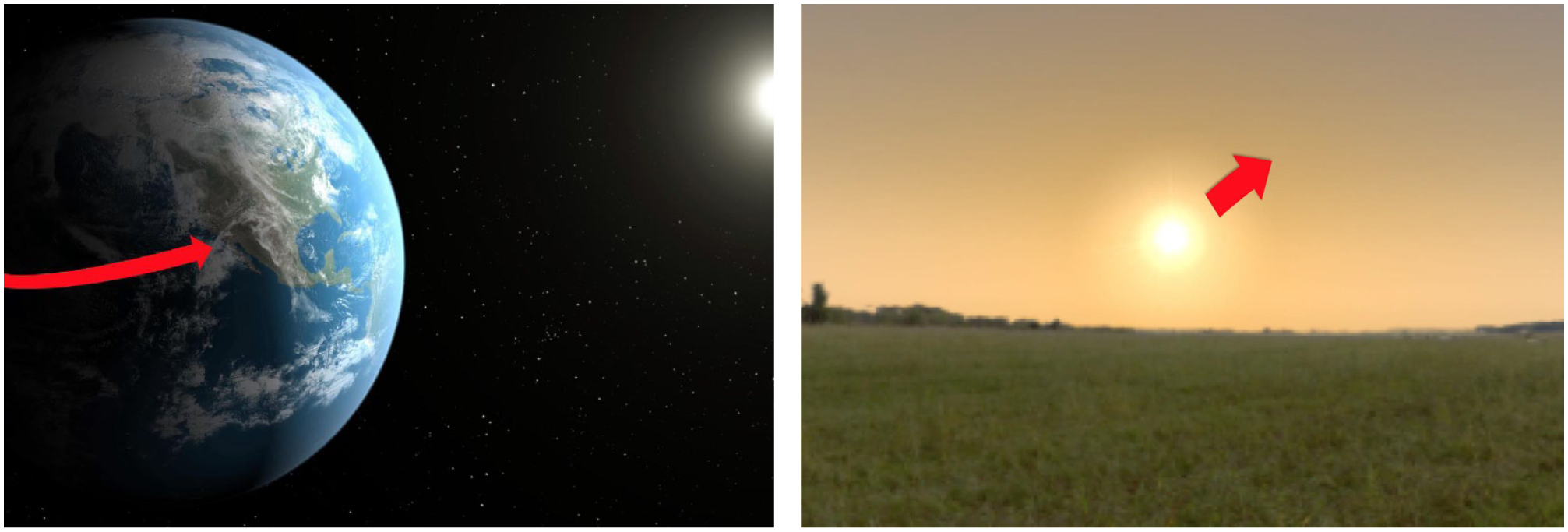
Earth’s rotation from a space-based perspective (left) and the apparent motion of the sun from an Earth-based perspective (right). The images were obtained from nasa.gov (left) and stellarium.org (right); arrows have been added here to indicate the direction of motion.
Relational scaffolding is intended to supplement rather than replace model-based science instruction. We therefore tested it in a sequence of instruction that progressed from a familiar frame of reference—an embodied simulation in which the student enacted Earth’s rotation—to a space-based simulation using a physical 3-D model. Embodied simulation was intended to provide an intuitive, bridging analog for the external model (Clement, 1993) and to clarify the alignment between apparent and actual motion through direct physical experience (Kontra, Lyons, Fischer, & Beilock, 2015). Relational scaffolding incorporated video footage of each simulation activity, recorded from a third-person/space-based perspective and a first-person/Earth-based perspective, as shown in Figure 2.

Screen captures of relational-scaffolding video footage from an embodied simulation (top row) and a 3-D model simulation (bottom row). In the embodied simulation, the student enacted Earth’s rotation in relation to the yellow ball representing the sun (top left). In the 3-D model simulation, the student watched from a third-person perspective as the model of Earth rotated on its axis (bottom left). Images on the right were captured by a GoPro camera mounted on the participant’s head (top right) and on model Earth (bottom right). Arrows indicate paths of motion or apparent motion.
We tested the effects of relational scaffolding in two experiments. In Experiment 1, third-grade participants were randomly assigned to four conditions. One group completed the sequence of instruction outlined above, progressing from an embodied to a 3-D model-simulation activity with supplementary relational scaffolding (relational-scaffolding condition). A second group completed the same two simulations but without relational scaffolding (no-relational-scaffolding condition). A third group repeated the 3-D model simulation several times (models-only condition). A fourth group received no instruction (control). We interviewed students about the day/night cycle before and after instruction. We reasoned that if relational scaffolding helps students relate their observations to a scientific model, participants in the relational-scaffolding condition should acquire the most knowledge. Moreover, if relational scaffolding is especially effective for students with little prior knowledge, any advantage of the relational-scaffolding condition should be greater for low-knowledge participants.
To assess changes in broader domain knowledge, we included items from a space-science-concept inventory (Sadler et al., 2010) at pretest and posttest. Given the role of language in conceptual learning (e.g., Gentner, Anggoro, & Klibanoff, 2011) and of spatial thinking in space-science understanding (e.g., Plummer, Kocareli, & Slagle, 2014), we assessed verbal and spatial abilities prior to instruction and included these factors in the analyses of student learning outcomes. Spatial tests were also administered at a delayed posttest to explore potential changes resulting from the spatially intense instruction.
Experiment 1
Method
Participants
A total of 147 third-grade children were recruited from public elementary schools in Worcester, Massachusetts. Thirty-six (24%) left the study before the Session 6 posttest (attrition is discussed further in the Supplemental Material available online). Three participants were removed from the data set for scoring more than 2 standard deviations below age level on a vocabulary assessment (the Peabody Picture Vocabulary Test; see below). The remaining sample consisted of 108 third graders (62 female, 46 male; age: M = 8.6 years, SD = 0.5). This sample size provided power of greater than .90 to detect a medium-to-large effect size (Cohen’s ƒ2 ≥ .25) for our planned linear multiple regression analysis (G*Power; Faul, Erdfelder, Buchner, & Lang, 2009). Each participant was randomly assigned to one of the four conditions (27 per condition).
Knowledge measures
Day/night-cycle interview
The day/night-cycle interview was our primary measure of understanding. Interviewers followed a script of questions and follow-up questions (see Pretest Interview Script at osf.io/kszge). Several questions required a verbal response. Others involved the use of 3-D objects (rubber balls representing Earth and the sun) to model specific events in the day/night cycle.
Items from the Astronomy and Space Science Concept Inventory (ASSCI)
The ASSCI measures students’ mastery of astronomical concepts found in national standards (Sadler et al., 2010). We selected nine items (seven for kindergarten–Grade 4 and two for Grades 5–8) broadly related to, but not covered in, our instruction. Further details on the instrument and selected items can be found in the Supplemental Material.
Cognitive-ability measures
Verbal ability
The Peabody Picture Vocabulary Test, fourth edition (Dunn & Dunn, 2007), measures receptive vocabulary. Four pictures are presented on each trial. The test administrator says a word, and the participant must point to the picture to which it corresponds.
Mental rotation
The spatial-relations subtest of the Primary Mental Abilities Test (Thurstone & Thurstone, 1962) measures mental-rotation ability. On each trial, the participant must identify a rotated shape that forms a complete square with a second part.
Perspective taking
The Perspective Taking Test for Children (Frick, Möhring, & Newcombe, 2014) involves identifying from a set of four options the picture taken by a toy photographer within a simple scene. The objects in the scene and the photographer’s position vary across trials.
Instructional activities
Embodied simulation
The embodied-simulation activity followed a script based on the lesson plan for Kinesthetic Astronomy (Morrow, 2000). After orienting the participant to his or her role as Earth (see Fig. 2, top left), the researcher guided the participant through a simulated 24-hr day. The participant’s first-person observations were recorded using a head-mounted GoPro camera (see Fig. 2, top right). A video recorder on a tripod captured the session from a third-person perspective. At the end of the activity, the participant performed one slow, careful rotation that supplied video footage for relational scaffolding.
3-D model simulation
This activity involved a physical 3-D model with a sun and rotating Earth (see Fig. 2, bottom left). The simulation followed a detailed script similar in content and structure to the embodied simulation. The participant was prompted to look out from behind model Earth to adopt an Earth-based perspective for key events.
Relational scaffolding
Relational Scaffolding 1 used video of the embodied simulation. The participant’s third- and first-person videos were edited to create an approximately 20-s to 30-s split-screen video of Earth’s rotation as seen from each perspective. A trained researcher guided the participant through footage of midday, sunset, midnight, and sunrise, shown on a 13-in. MacBook Pro computer (see the Relational Scaffolding 1 script at osf.io/kszge). The researcher pointed at and between the videos to convey the correspondences, repeating key events several times (for an excerpt, see Fig. 3).
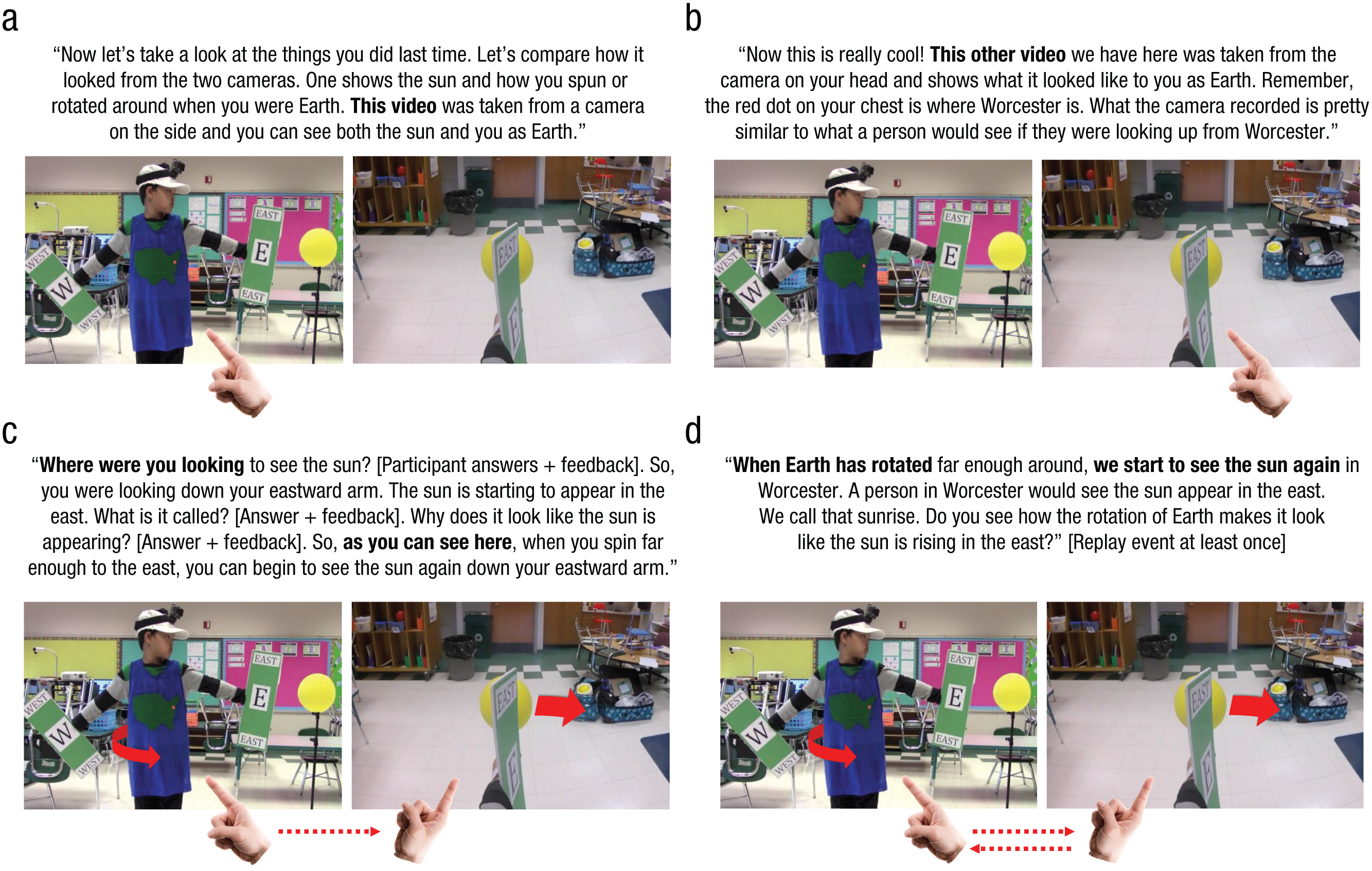
Schematic diagram of Relational Scaffolding 1. This excerpt is about sunrise. Each panel shows a screenshot from video of the third-person/space-based perspective (on the left) and the first-person/Earth-based perspective (on the right). Text from the session script is quoted above the images. Bold text signifies when the researcher pointed to one of the perspectives. In the bottom row, arrows indicate the participant’s motion (third person) and the model sun’s apparent motion (first person) as they appeared in the video. A single hand indicates a pointing gesture from the researcher. The dotted arrow in (c) indicates a sequential gesture between the two videos. The two dotted arrows in (d) indicate back-and-forth gesturing between the videos. The format for this diagram is based on the work of Yuan, Uttal, and Gentner (2017).
Relational Scaffolding 2 used video from both the embodied and 3-D model simulations. The footage was displayed on a 13-in. MacBook Pro computer in a 2 × 2 matrix, as shown in Figure 4. A trained researcher followed a script (see the Relational Scaffolding 2 script at osf.io/kszge) that highlighted corresponding perspectives (see Figs. 4a and 4b) and the higher-order relations between the simulations (see Figs. 4c and 4d).
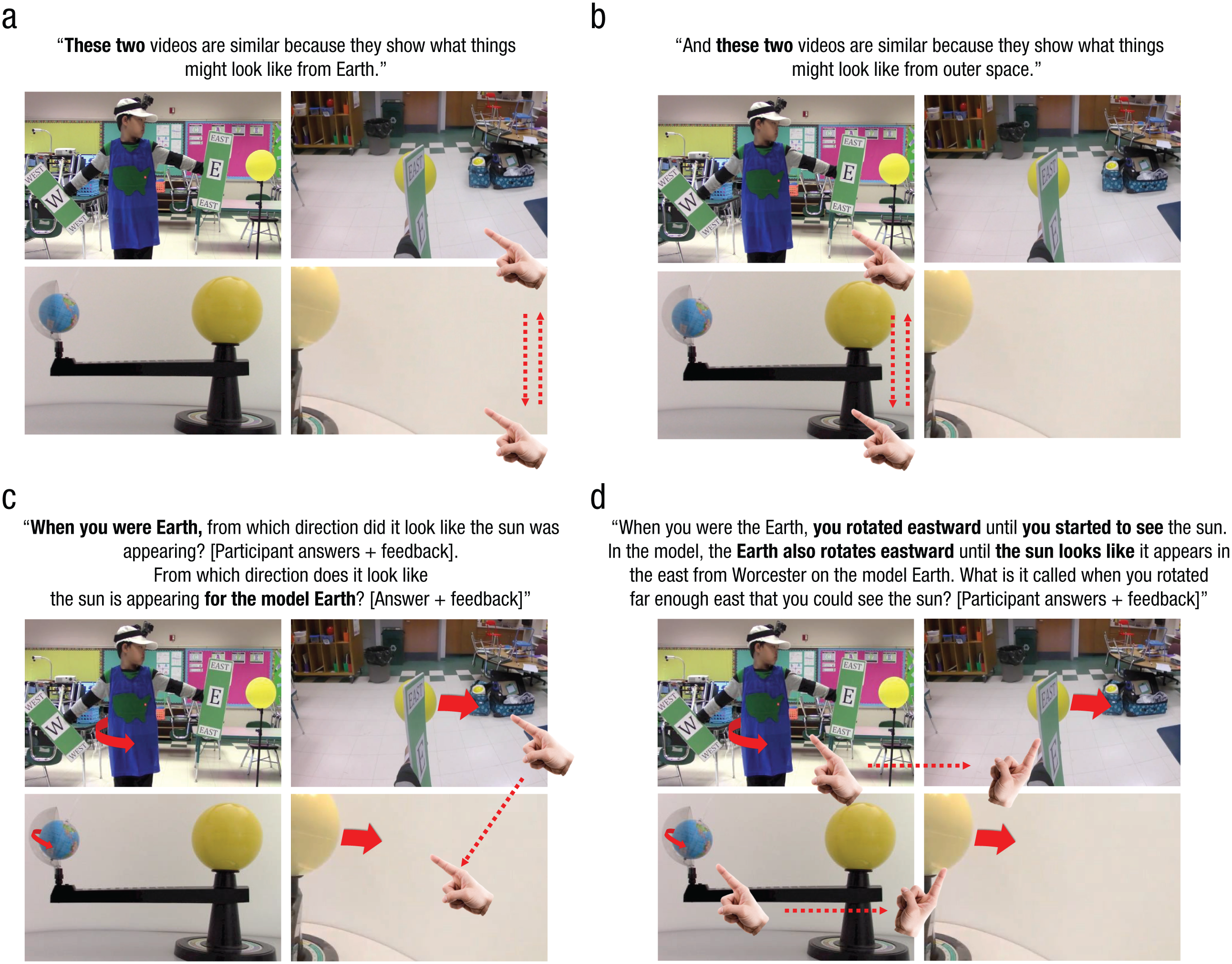
Schematic diagram of Relational Scaffolding 2. This excerpt is about sunrise. Each panel shows a screenshot of the 2 × 2 display from video of the embodied simulation and 3-D model simulation of the third-person/space-based perspective (on the left) and the first-person/Earth-based perspective (on the right). Text from the session script is quoted above the images. Bold text signifies when the researcher pointed to an event from one of the perspectives. Solid arrows indicate the participant’s motion (third person) and the model sun’s apparent motion (first person) as they appeared in the video. A single hand indicates a pointing gesture from the researcher. The dotted arrows in (c) and (d) indicate sequential gestures between the two videos. The two dotted arrows in (a) and (b) indicate back-and-forth gesturing between the videos. The format for this diagram is based on the work of Yuan, Uttal, and Gentner (2017).
Procedure
Participants completed one study session per day, twice a week for 3 weeks at their school during after-school hours. The delayed posttest occurred about 6 to 7 weeks later. Participants met with the same researcher in a quiet room (usually a classroom) each day. Each session lasted about 20 to 30 min. The sessions were videotaped (with parental permission).
In Session 1, participants completed the verbal-ability test and mental-rotation test. Session 2 consisted of the day/night-cycle-understanding interview (pretest), ASSCI items, and the perspective-taking test. Sessions 3 to 5 varied among conditions. Participants in the relational-scaffolding condition completed the embodied simulation in Session 3, Relational Scaffolding 1 in Session 4, and both the 3-D model simulation and Relational Scaffolding 2 in Session 5. Participants in the no-relational-scaffolding condition completed the embodied simulation in Session 3 and again in Session 4, followed by the 3-D model simulation in Session 5. Participants in the models-only condition completed the 3-D model simulation in Sessions 3, 4, and 5. Participants in the control condition did not complete instructional sessions. They remained in a supervised classroom during this time. In all conditions, Session 6 consisted of the day/night-cycle-understanding interview (posttest) and ASSCI items. Session 7 included the day/night-cycle-understanding interview (delayed posttest), the mental-rotation test, and the perspective-taking test. Equivalent forms of the mental-rotation test, perspective-taking test, and ASSCI items were administered in counterbalanced order across participants in each condition. Figure 5 provides an overview of the procedure.
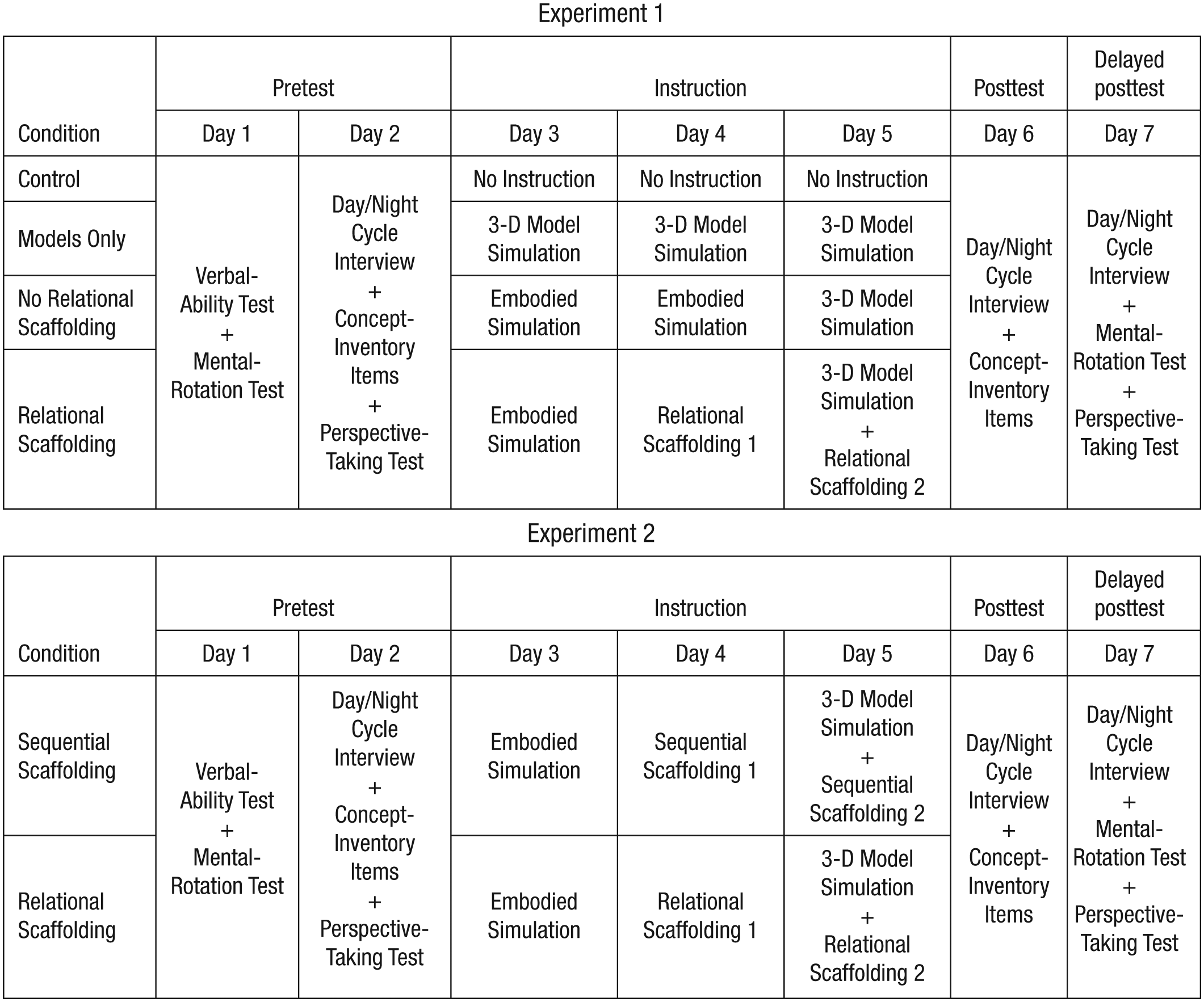
Overview of procedure for Experiments 1 and 2.
Coding the day/night-cycle interviews
We created a 27-component coding rubric, building on prior measures of space-science understanding (e.g., Plummer et al., 2014; Vosniadou & Brewer, 1994). The components represent scientifically consistent ideas scored as correct/present versus incorrect/absent on the basis of the participant’s interview responses. The internal consistency (Cronbach’s α) of the rubric was .80 at pretest, .88 at posttest, and .86 at delayed posttest. The 27 components and information about the coding process are provided in the Supplemental Material.
Results
Table 1 shows the results for the demographic, cognitive-ability, and knowledge measures. There were no preinstruction differences between conditions on any variable—gender: χ2 = 2.58, p = .46; all other measures: Fs < 1.40, ps > .25.
Means for Demographic and Cognitive Variables for Experiment 1
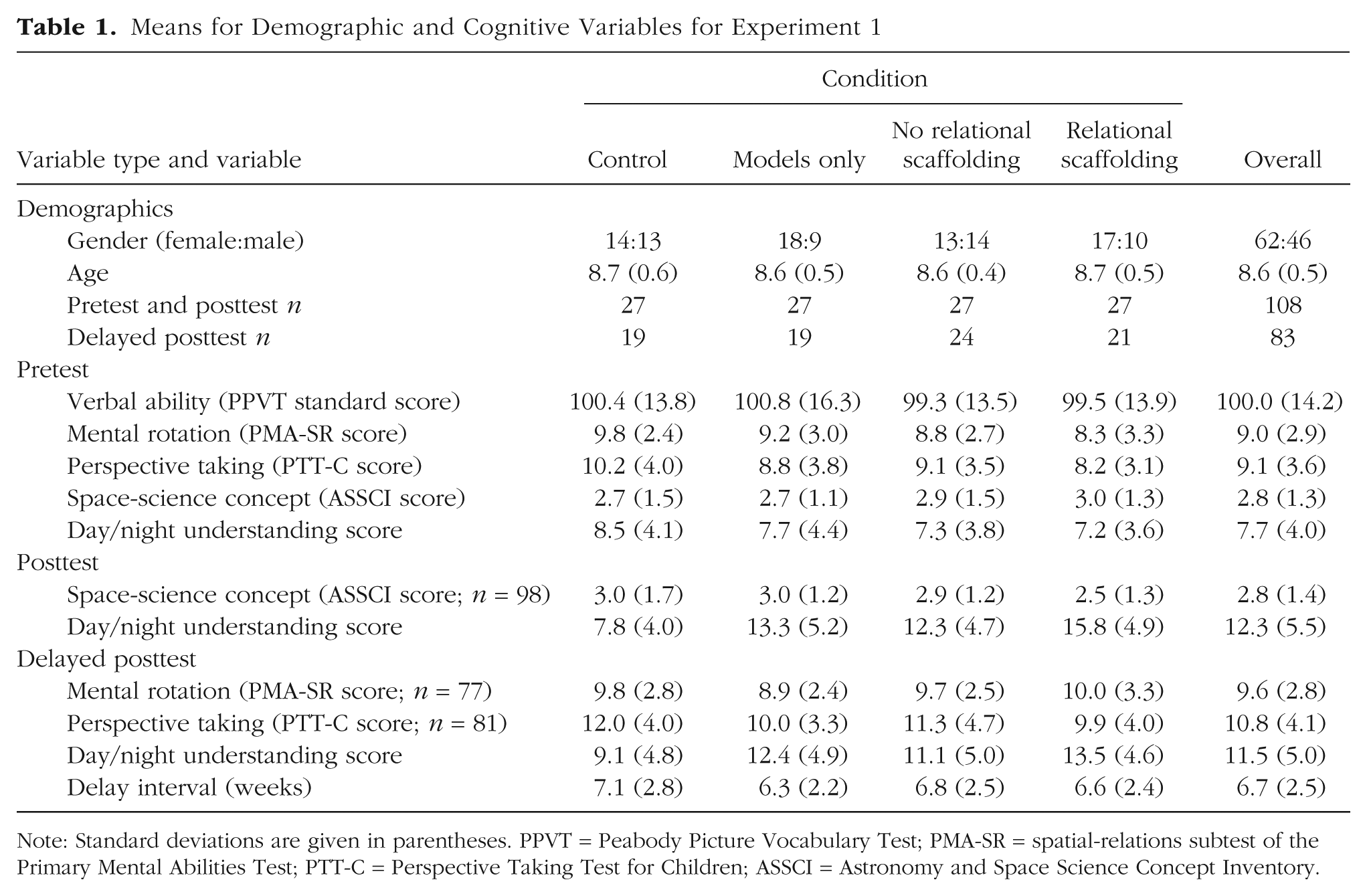
Note: Standard deviations are given in parentheses. PPVT = Peabody Picture Vocabulary Test; PMA-SR = spatial-relations subtest of the Primary Mental Abilities Test; PTT-C = Perspective Taking Test for Children; ASSCI = Astronomy and Space Science Concept Inventory.
We conducted a multiple regression analysis to predict posttest day/night-cycle understanding (score on the 27-component rubric) from the participant’s age; gender (male = 0, female = 1); pretest verbal-ability, mental-rotation, and perspective-taking scores; and pretest day/night understanding. Table 2 shows the zero-order correlations between variables. We also included a set of orthogonal contrasts in the regression model (Davis, 2010) to test (a) the effect of receiving instruction versus none at all (instructional conditions vs. control), (b) the effect of receiving embodied and 3-D model simulation versus 3-D model simulation alone (no relational scaffolding and relational scaffolding vs. models only), and (c) the effect of receiving relational scaffolding specifically (no relational scaffolding vs. relational scaffolding). Because the no-relational-scaffolding-versus-relational-scaffolding contrast directly tested the relational-scaffolding effect, we crossed this factor with pretest understanding to test the hypothesized Relational Scaffolding × Prior Knowledge interaction (West, Aiken, & Krull, 1996). We included this interaction in the regression along with two others that crossed no relational scaffolding versus relational scaffolding with pretest mental-rotation and perspective-taking scores. All predictors were mean centered for the analysis.
Pearson Correlations Between Experiment 1 Variables

Note: Gender was coded 0 for male and 1 for female. The fourth edition of the Peabody Picture Vocabulary Test (PPVT) measured verbal ability, the spatial-relations subtest of the Primary Mental Abilities Test (PMA-SR) measured mental rotation, the Perspective Taking Test for Children (PTT-C) measured perspective taking, and the Astronomy and Space Science Concept Inventory (ASSCI) measured children’s space-science concept.
p < .05. **p < .01.
The regression model accounted for 53% of the variance in posttest understanding, F(12, 95) = 9.02, standard error of the estimate (SEE) = 3.98, p < .0001. Figure 6 conveys the main findings of the orthogonal contrasts. Participants in the instructional conditions learned more than control participants (β = 0.55; 95% confidence interval, or CI = [0.40, 0.69], p < .0001, partial r2 = .38). Participants who received embodied simulation (no relational scaffolding and relational scaffolding) learned about as much as models-only participants (β = 0.09, 95% CI = [–0.05, 0.23], p = .20, partial r2 = .02). Importantly, participants in the relational-scaffolding condition acquired the greatest understanding, significantly more than no-relational-scaffolding participants (β = 0.24, 95% CI = [0.09, 0.38], p = .002, partial r2 = .10). We confirmed in a post hoc analysis—restructuring the orthogonal contrasts—that relational-scaffolding participants also achieved higher understanding than models-only participants (β = 0.20, 95% CI = [0.06, 0.34], p = .009, partial r2 = .07). Pretest day/night understanding was also a significant predictor in the model (β = 0.39, 95% CI = [0.22, 0.55], p < .0001, partial r2 = .19); however, no other factor or interaction was a significant predictor, including Relational Scaffolding × Prior Knowledge (βs = −0.03 to 0.11, ps > .20).
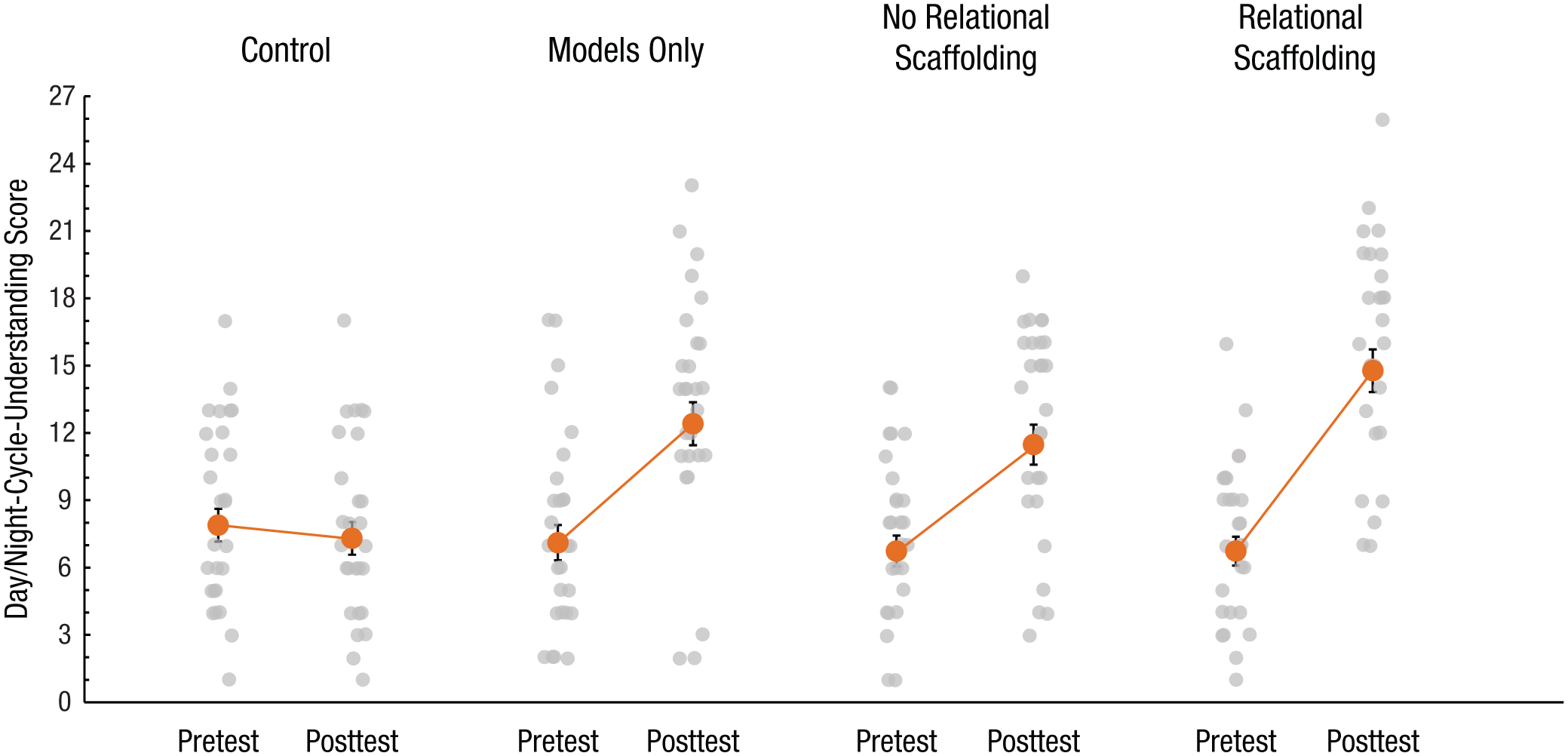
Pretest and posttest understanding scores for the day/night-cycle interview, separately for each of the four experimental conditions. Individual participant scores are shown in gray; condition means are in orange. Error bars show standard errors. Individual scores were jittered to produce separation on the x-axis.
Participants’ broader space-science knowledge changed little (see ASSCI means in Table 1). A 2 (test session) × 4 (condition) mixed analysis of variance (ANOVA) found no significant difference in mean scores on the ASSCI items from pretest to posttest, F(1, 94) < 1, p = .87, η p ² < .01, nor was there a difference between conditions, F(3, 94) < 1, p = .97, η p ² < .01, or a Test Session × Condition interaction, F(1, 94) = 1.0, p = .32, η p ² = .03.
Eighty-three participants (77%) completed the delayed posttest. Day/night-cycle-understanding scores were analyzed in a multiple regression analysis. To preserve statistical power, we included as predictors only those variables that were significant in the posttest analysis: pretest understanding, the instructional-conditions-versus-control contrast, and the no-relational-scaffolding-versus-relational-scaffolding contrast. (An analysis that included all of the posttest predictors yielded the same pattern of results.) Delay interval (weeks between posttest and delayed posttest) was added as a predictor. All variables were mean centered for the analysis.
The regression model accounted for 35% of the variance in delayed-posttest day/night-cycle-understanding scores, F(4, 78) = 5.89, SEE = 10.64, p < .0001. The results mirrored those at posttest. Participants in the instructional conditions maintained higher understanding than those in the control condition (β = 0.30, 95% CI = [0.12, 0.49], p < .01, partial r2 = .12). Participants in the relational-scaffolding condition had higher understanding than no-relational-scaffolding participants (see Table 1); however, this difference diminished and was not statistically significant (β = 0.18, 95% CI = [–0.01, 0.36], p = .06, partial r2 = .05). Pretest understanding was a significant predictor (β = 0.52, 95% CI = [0.33, 0.71], p < .0001, partial r2 = .28). Delay interval was not significant (β = −0.13, 95% CI = [−0.32, 0.06], p = .18, partial r2 = .02), although understanding scores decreased with longer intervals.
We also analyzed participants’ spatial-test performance before and after instruction for both Experiments 1 and 2. The details are provided in the Supplemental Material. In short, we found no change in mental-rotation performance in either experiment. Perspective-taking scores increased significantly in both experiments; however, the control and instructional conditions showed about the same level of improvement.
Discussion
Participants in the instructional conditions greatly increased their understanding of the day/night cycle (although not of space-science concepts more broadly). Participants who received relational scaffolding gained the most knowledge. These effects were somewhat attenuated by the delayed posttest (6–7 weeks after instruction), but the general pattern remained.
The results are consistent with our hypothesis that systematic comparison of observable and modeled events facilitates understanding of scientific models. Yet further experimentation is required to separate the effects of comparison from other aspects of the relational-scaffolding condition that may enhance learning. Notably, only the relational-scaffolding condition included videos of observable and modeled events. Viewing this footage could reduce extraneous cognitive load (Sweller, 1994), enabling a student to devote limited mental resources to sense-making processes (Mayer & Moreno, 2003). It is precisely for topics that require attention to relations within a system (high element interactivity) that a reduction in extraneous load should be especially beneficial (Sweller, 1994).
Experiment 2
Experiment 2 teased apart guided comparison from the viewing of video footage. We compared the relational-scaffolding condition with a condition in which videos of observable and modeled events were presented sequentially, without explicit comparison. If guided comparison is integral to the relational-scaffolding effect, then the relational-scaffolding condition should produce greater understanding than the sequential-scaffolding condition. Zeroing in on the role of guided comparison also permits a more direct test of the hypothesis that comprehensive, guided comparisons are especially helpful for students with little prior understanding. If so, any advantage of the relational-scaffolding condition should be most pronounced among lower-knowledge students.
In Experiment 2, a new group of third-grade participants received day/night-cycle instruction, supplemented with either relational scaffolding or sequential scaffolding, in which videos of observable (Earth-based) and modeled (space-based) events were presented one after the other. In Experiment 2, we also varied whether the scaffolding involved video of the participant’s own embodied simulation (self footage) or a research assistant’s simulation (stock footage). If relational scaffolding requires personalized footage, it would be challenging to implement in formal educational settings. The footage variable was crossed with the scaffolding manipulation to create four experimental conditions.
Method
Participants
A total of 128 third-grade children were recruited at elementary schools in Worcester, Massachusetts. Twenty-eight children (22%) dropped out before the posttest. One child was removed from the data set because the child’s Peabody Picture Vocabulary Test score was more than 2 standard deviations below age level. Our remaining sample included 99 third graders (59 female, 40 male; age: M = 8.6 years, SD = 0.4). This sample size provided power of greater than .90 to detect a medium to large effect (Cohen’s ƒ2 ≥ .25) for our planned analysis (Faul et al., 2009). Each participant was randomly assigned to one of the four conditions (25 per condition; the sequential-scaffolding/self-footage condition had 24).
Materials
Experiment 2 used the measures and instructional activities from Experiment 1 and two new sequential-scaffolding activities. Sequential Scaffolding 1 used footage of the embodied simulation, either self or stock. The first-person perspective was shown first. The participant was prompted to attribute the sun’s apparent motion to Earth’s rotation (third-person perspective), although the sun and Earth were not shown simultaneously. The third-person perspective was shown second and likewise referenced the first-person perspective. Sequential Scaffolding 2 presented video of the 3-D model simulation, first from an Earth-based perspective and then from a space-based perspective. The activity used a similar script to that for Sequential Scaffolding 1. When stock footage was shown, the script adopted a third-person perspective (e.g., “Remember what they recorded from the camera on their head”). Scripts for Sequential Scaffolding 1 and Sequential Scaffolding 2 can be accessed at osf.io/kszge.
Procedure
Participants completed the procedure at their school during after-school hours. They completed one session per day, twice a week for 3 weeks. The delayed posttest was about 4 weeks later (sooner than in Experiment 1 to accommodate a school break). Sessions 1 and 2 (pretest), 6 (posttest), and 7 (delayed posttest) were the same as in Experiment 1. The instructional sessions (Sessions 3–5) for the relational-scaffolding condition were equivalent to those for the relational-scaffolding condition from Experiment 1. Participants in the sequential-scaffolding condition completed the embodied simulation in Session 3, Sequential Scaffolding 1 in Session 4, and both the 3-D model simulation and Sequential Scaffolding 2 in Session 5. Figure 5 provides an overview of the procedure. To code the day/night-cycle interviews, we used the 27-component rubric from Experiment 1. The internal consistency (Cronbach’s α) of the instrument was .81 at pretest, .85 at posttest, and .83 at delayed posttest.
Results
Table 3 shows the results for the demographic and other variables. There were no preinstruction differences between conditions in gender composition, χ2 = 0.89, p = .35, or any other variable, ts < 1.25, ps > .20.
Means for Demographic and Cognitive Variables for Experiment 2

Note: Standard deviations are given in parentheses. PPVT = Peabody Picture Vocabulary Test; PMA-SR = spatial-relations subtest of the Primary Mental Abilities Test; PTT-C = Perspective Taking Test for Children; ASSCI = Astronomy and Space Science Concept Inventory.
We conducted a multiple regression analysis to predict posttest understanding from age; gender (male = 0, female = 1); pretest verbal-ability, mental-rotation, and perspective-taking scores; pretest understanding; video condition (stock = 0, self = 1); and comparison condition (sequential scaffolding = 0, relational scaffolding = 1). In this model, comparison condition directly tested the effect of guided comparison. We crossed this factor with pretest understanding to test the hypothesized Guided Comparison × Prior Knowledge interaction. We also crossed comparison condition with pretest mental-rotation and perspective-taking scores to explore possible interactions with spatial ability. Predictors were mean centered for the analysis. Table 4 shows the zero-order correlations between variables.
Pearson Correlations Between Experiment 2 Variables

Note: Gender was coded 0 for male and 1 for female. The fourth edition of the Peabody Picture Vocabulary Test (PPVT) measured verbal ability, the spatial-relations subtest of the Primary Mental Abilities Test (PMA-SR) measured mental rotation, the Perspective Taking Test for Children (PTT-C) measured perspective taking, and the Astronomy and Space Science Concept Inventory (ASSCI) measured children’s space-science concept.
p < .05. **p < .01.
The regression model accounted for 31% of the variance in posttest day/night-cycle understanding, F(11, 87) = 3.52, SEE = 4.79, p < .001. The main finding was a significant Comparison Condition × Pretest Understanding interaction (β = −0.41, 95% CI = [−0.73, –0.09], p = .01, partial r2 = .07). Figure 7 (left panel) shows mean posttest day/night-cycle understanding scores for relational-scaffolding and sequential-scaffolding participants who scored below and above the median on the pretest (i.e., low initial knowledge vs. high initial knowledge). For low-knowledge (but not high-knowledge) participants, there was a clear advantage of relational scaffolding over sequential scaffolding. Neither manipulated variable—video condition (β = −0.07) or comparison condition (β = 0.07)—was itself a significant predictor (ps > .45). Pretest understanding was significant (β = 0.72, 95% CI = [0.40, 1.00], p < .0001, partial r2 = .19); however, no other variable was significant (βs = 0.01–0.12, ps > .25), nor was there another interaction (βs = 0.01, ps = .96).

Posttest and delayed-posttest day/night-cycle-understanding scores for participants who scored below and above the median on the pretest. Results are shown separately for sequential scaffolding (SS) and relational scaffolding (RS). Individual participant scores are shown in gray; means are in orange. Error bars show standard errors. Individual scores were jittered to produce separation on the x-axis. SS = sequential scaffolding; RS = relational scaffolding.
Participants’ scores on the ASSCI increased slightly, by about 0.5 items (see Table 2). A 2 (test session) × 2 (comparison condition) × 2 (video condition) mixed ANOVA revealed that this increase was significant, F(1, 90) = 11.96, p < .001, η p ² = .12, but there was no effect of comparison condition or video condition (Fs < 1, ps > .60, η p ²s < .01) and no interactions (Fs < 1.95, ps > .15, η p ²s < .03).
Seventy participants (71%) completed the delayed posttest. An analysis of spatial-test performance before and after instruction can be found in the Supplemental Material. We analyzed delayed-posttest day/night understanding in a multiple regression analysis. To preserve power, we included as predictors only those variables involved in the significant Pretest Understanding × Comparison Condition interaction from posttest: pretest understanding, comparison condition, and the interaction term. We also added delay interval (in weeks) as a predictor. All variables were mean centered for the analysis.
The regression model accounted for 23% of the variance in delayed-posttest day/night-cycle understanding, F(4, 65) = 4.94, SEE = 4.61, p < .01. The Pretest Understanding × Comparison Condition interaction was not significant (β = −0.32, 95% CI = [−0.67, 0.03], p = .07, partial r2 = .05). Instead, comparison condition emerged as a significant predictor (β = 0.27, 95% CI = [0.06, 0.49], p < .05, partial r2 = .09). Figure 7 (right panel) shows that mean delayed-posttest understanding was higher overall in the relational-scaffolding condition, although this relational-scaffolding advantage was especially pronounced among low-knowledge participants. Pretest understanding was also a significant predictor (β = 0.60, 95% CI = [0.24, 0.95], p < .01, partial r2 = .15), but delay interval was not (β = −0.13, 95% CI = [−0.35, 0.09], p = .25).
Discussion
Experiment 2 found that participants with relatively low initial knowledge benefited from explicit, guided comparisons between videos of Earth- and space-based perspectives—the relational-scaffolding condition. Viewing the same videos without comparison—the sequential-scaffolding condition—was inferior. This relational-scaffolding advantage emerged across levels of prior knowledge by the delayed posttest, although low-knowledge participants remained the primary beneficiaries.
The second manipulated variable—whether scaffolding involved the participant’s personal observations (self footage) versus another person’s (stock footage)—was unrelated to learning outcomes. We note that the stock footage showed the same materials, setup, and sequence as the participant’s own embodied simulation. It is possible that stock footage would be less effective if these properties were altered. That said, the results are encouraging for the prospect of implementing relational scaffolding in educational contexts, such as classrooms, where individualized footage is unfeasible.
General Discussion
Our findings demonstrate that relational scaffolding—systematic, guided comparison of observable and corresponding modeled events—supports students’ understanding of scientific models. We tested relational scaffolding in the context of instruction about the day/night cycle, a fundamental science topic that involves linking Earth-based observations to a space-based model of planetary motion. Across two experiments, relational scaffolding was found to enhance third graders’ understanding of the day/night cycle, especially among students with little prior knowledge.
This research speaks to the potential of extending theories of analogical thinking to fundamental issues in science education (see also Goldwater & Schalk, 2016; Jee et al., 2010). When a scientific model has no obvious connection to observable phenomena, structural alignment may be crucial for comprehension. Relational scaffolding facilitates the alignment process through several coordinated supports. Explicit comparisons illuminated shared relational structure (Goldwater & Gentner, 2015). A trained researcher pointed at and between videos of observed and modeled events to clarify key correspondences (Richland et al., 2007; Yuan, Uttal, & Gentner, 2017). The scaffolding was comprehensive, underscoring the coherence of the scientific model and discouraging inaccurate, piecemeal explanations (Au & Romo, 1996; Chi et al., 2012). This systematic approach may be most effective when models are complex, unfamiliar, or counterintuitive. Future applications of relational scaffolding should therefore consider the subject matter, students’ background knowledge, and common conceptions that might impede (or promote) science learning (Shtulman, 2017; Vosniadou & Skopeliti, 2014).
Relational scaffolding is well suited to novices, who lack conceptual knowledge for inferring relational structure (McNamara et al., 1996) and are susceptible to cognitive overload during instruction (Sweller, 1994). An intriguing possibility is that relational scaffolding can help level the playing field for children who are poorly prepared for science education. Science-achievement gaps emerge in the early school years and often persist, largely because of disparities in students’ basic science knowledge (Morgan, Farkas, Hillemeier, & Maczuga, 2016). Methods that assist underprepared students would profoundly impact many children and, ultimately, increase the pool of qualified candidates for careers in science.
Important questions remain about the model-based instruction that accompanies relational scaffolding. Our Experiment 1 found that embodied simulation did not increase student learning beyond models-only instruction. This seems at odds with evidence that physical experience improves learning of science concepts (e.g., Kontra et al., 2015). However, rather than passively observing, participants repeatedly adopted an Earth-based perspective (looking out from model Earth) during the 3-D model activity. A fully enacted simulation may be unnecessary when physical (or virtual) modeling is immersive, providing sensorimotor feedback linking model-based observations to embodied actions (DeSutter & Stieff, 2017; Lindgren, Tscholl, Wang, & Johnson, 2016). Nonetheless, our findings leave open the possibility that embodied simulation helps students understand an external model when the two are explicitly aligned—that is, through relational scaffolding. Further experimentation is required to explore this and other questions about how model-based instruction contributes to the relational-scaffolding effect.
The day/night cycle was a prime candidate for testing relational scaffolding. Yet many other fundamental scientific models portray invisible entities and processes with no obvious connection to observable phenomena. Seasonal change relates to Earth’s tilt and orbit, energy transfer and state changes involve invisible molecular activity, and illness and immunity relate to microscopic viruses, vaccines, and immune cells. Nonscientific conceptions are widespread for each of these topics (Shtulman, 2017). Each is thus a promising subject for future tests of the relational-scaffolding approach.
Supplemental Material
Jee_OpenPracticesDisclosure_rev – Supplemental material for Relational Scaffolding Enhances Children’s Understanding of Scientific Models
Supplemental material, Jee_OpenPracticesDisclosure_rev for Relational Scaffolding Enhances Children’s Understanding of Scientific Models by Benjamin D. Jee and Florencia K. Anggoro in Psychological Science
Supplemental Material
Jee_SupplementalMaterial_rev – Supplemental material for Relational Scaffolding Enhances Children’s Understanding of Scientific Models
Supplemental material, Jee_SupplementalMaterial_rev for Relational Scaffolding Enhances Children’s Understanding of Scientific Models by Benjamin D. Jee and Florencia K. Anggoro in Psychological Science
Footnotes
Acknowledgements
We thank David Uttal, Cherilynn Morrow, and Dedre Gentner for providing valuable feedback throughout the project. We thank the project coordinators and research assistants from College of the Holy Cross and Worcester State University who assisted with data collection and coding. We are grateful to the schools, teachers, parents, and students who took part in the research.
Action Editor
Erika E. Forbes served as action editor for this article.
Author Contributions
Both authors created the study concept, developed the study design and materials, and supervised the training of research assistants. B. D. Jee developed the data coding and analyzed and interpreted the data. F. K. Anggoro recruited the participants and managed the data collection. B. D. Jee drafted the manuscript, and F. K. Anggoro provided critical revisions. Both authors approved the final manuscript for submission.
Declaration of Conflicting Interests
The author(s) declared that there were no conflicts of interest with respect to the authorship or the publication of this article.
Funding
This research was supported by the Institute of Education Sciences, U.S. Department of Education, through Grant R305A150228 to the College of the Holy Cross. The opinions expressed are those of the authors and do not represent the views of the Institute of Education Sciences or the U.S. Department of Education.
Open Practices
All data and materials have been made publicly available via the Open Science Framework and can be accessed at osf.io/kszge. The design and analysis plans for this study were not preregistered. The complete Open Practices Disclosure for this article can be found at http://journals.sagepub.com/doi/suppl/10.1177/0956797619864601. This article has received the badges for Open Data and Open Materials. More information about the Open Practices badges can be found at  .
.
References
Supplementary Material
Please find the following supplemental material available below.
For Open Access articles published under a Creative Commons License, all supplemental material carries the same license as the article it is associated with.
For non-Open Access articles published, all supplemental material carries a non-exclusive license, and permission requests for re-use of supplemental material or any part of supplemental material shall be sent directly to the copyright owner as specified in the copyright notice associated with the article.
