



Abstract
Prosociality increases when decisions are made under time pressure. Here, we investigated whether time pressure increases socially desirable responding outside social interactions (Study 1). Finding that it did, we then examined whether this is because people align their responses with the concept of their “true” self or because of an intuitive tendency to comply with norms (Study 2). In Study 1, we randomly assigned each of 1,500 Americans to answer a measure of social-desirability bias either quickly or slowly and found that quick responding increased social desirability. In Study 2, we recruited a similar sample and tested whether fast-responding effects were moderated by the extent to which people display a good-true-self bias. A greater tendency to ascribe good behaviors to the true self predicted social desirability, but this relationship disappeared under time pressure. These results of socially desirable behavior under time pressure do not reflect people’s deep-down good selves but, rather, their desire to present themselves favorably to other people.
Keywords
One of the oldest reflections on the human psyche is that there is a divided mind: an intelligent driver working to constrain the passions (Evans & Stanovich, 2013; Freud, 1923/1962; Kahneman, 2011; Plato, 370 BCE/1917; Strack & Deutsch, 2004, 2015) or an outward persona masking a “true” inner self (Johnson, Robinson, & Mitchell, 2004; Schlegel, Hicks, Arndt, & King, 2009). A number of methods have been used to get to the inner workings of the divided mind, but none has a longer history than asking for speeded, nonreflective responses (Jung, 1910, p. 220), which has been theorized to reveal people’s intuitive or automatic responses (e.g., Wilson, Lindsey, & Schooler, 2000).
One surprising outcome of requiring speeded judgments is that it enhances cooperation and generosity in assorted economic games (Cappelletti, Güth, & Ploner, 2011; Everett, Ingbretsen, Cushman, & Cikara, 2017; Isler, Maule, & Starmer, 2018; Rand, Greene, & Nowak, 2012; Rand et al., 2014). Why does fast responding have these prosocial effects? Are people good at their core, or do speeded judgments reveal a more nuanced characterization of people’s prepotent inclinations?
One explanation—the social-heuristics hypothesis (Bear & Rand, 2016; Rand et al., 2014)—proposes that people’s default responses arise from internalization of behaviors that are generally advantageous in daily social interactions. We learn over a history of social interactions that behavior that is judged favorably by other people elicits reciprocity and benefits one’s reputation—until doing so becomes a habitual response. Accordingly, people automatically respond in a socially desirable way under conditions of time pressure, whereas defying social norms requires more time and deliberation. Notably, the social-heuristics hypothesis does not imply that individuals are intrinsically good deep down but merely implies that they are motivated to appear good to others.
An alternative explanation is that under time pressure, people behave in a way that is aligned with their true self, a person’s concept of who they are “deep down.” Given that people tend to believe that the true self is fundamentally good (the good-true-self bias; Newman, Bloom, & Knobe, 2014), this account implies that speeded judgments are reflecting people’s virtuous deep-down nature. Accordingly, if time pressure aligns responses with people’s concept of the true self, most people should respond in a more socially desirable way. However, the more a person’s true-self concept includes both good and bad sides, the less he or she should be affected by time-pressure manipulations.
We conducted two studies to test the effect of time pressure on social desirability and the role that the true-self concept may play. In Study 1, we tested the hypothesis that people are more likely to give socially desirable answers under speeded conditions. Whereas previous studies have found that time pressure increases cooperation in social interactions, the finding that such behavior reflects motivation to appear socially desirable has been only indirectly inferred. We examined whether time pressure directly increases socially desirable responding outside a social interaction, when participants are merely asked to agree or disagree with statements describing themselves. In Study 2, we tested the hypothesis that time pressure increases social-desirability bias because it aligns responses with participants’ good-true-self concept. We used a social-judgment task to measure participants’ tendency to ascribe good and bad behaviors to the true self, testing whether the extent of the good-true-self judgments moderated the effect of time pressure on socially desirable responding. Both studies were conducted with a large representative sample of the American adult population and were preregistered prior to data collection at https://osf.io/rt6un/.
Study 1
Method
Participants
We collected data from 1,500 participants drawn in a stratified way with unequal probabilities of selection so that participants resembled the nation’s adult population. This sample size was chosen to maximize the possibility of discovering the effect as part of a project involving set sample sizes to discover new effects; data collection stopped when the total number had been reached. Participants were invited to complete the study through a survey company (Critical Mix; https://www.criticalmix.com). The sample size was determined a priori to maximize power and not on the basis of any power analysis because the expected effect size was unknown.
Procedure
Each participant was randomly assigned to answer questions from the short version of the Social Desirability Scale in either a fast or a slow condition. All participants were first told, We are going to ask you 10 true or false questions on one page at a time. These statements are about your personal attitudes and characteristics. Please read each statement carefully and indicate whether it is true or false, that is, whether it applies to you or not.
On the next page, participants were told (on the basis of condition), Please continue reading
This screen automatically moved on after 15 s. This was done to increase compliance with the fast or slow manipulations (following Isler et al., 2018). All participants were paid regardless of their compliance.
Measure
One page at a time, participants were given the short 10-item Social Desirability Scale (Vésteinsdóttir, Reips, Joinson, & Thorsdottir, 2017). These questions were presented in completely random order (see Table 1). The total score on the scale was the dependent variable. We randomly assigned the positions of the true/false response options (e.g., true on the right side vs. true on the left side) across participants. This was done because it was suggested that time pressure may make people click on one side of a screen more often. 1
Items Administered From the Short Social Desirability Scale

Note: All questions were answered “false” or “true.” False was coded 0 and true coded 1 unless the item was reverse scored (R).
Results
We tested whether asking participants to answer quickly versus slowly causes an increase in social-desirability bias. We did not predict an effect of left/right orientation or an interaction between the two. Regardless, we ran a fully crossed 2 × 2 analysis of variance (ANOVA) with 10,000 bootstrapped resamples to take into account any possible nonnormalities in the data.
There has been discussion about compliance in the speeded-judgment literature (e.g., Rand, 2017). The most conservative and unbiased approach to compliance in experimental trials is the intention-to-treat (ITT) analysis, which simply ignores compliance and analyzes the participants in the groups to which they were assigned. The benefit of this approach is that it preserves randomization across conditions (see Gelman & Hill, 2006). Thus, we pursued an ITT analysis. All procedures, data decisions, and analysis code were preregistered prior to data collection (https://osf.io/rt6un/).
A manipulation check showed that, on average, participants answered questions faster in the fast condition (M = 4.77 s, SD = 6.827) than in the slow condition (M = 11.98 s, SD = 15.469), β(1498) = −0.29, p < .001. 2 They showed greater compliance with time instructions (averaged over all 10 questions) in the fast group (97%) than in the slow group (43%). Because our analysis plan used only the ITT estimate, noncompliance would serve only to weaken our hypothesized effects. Results from an instrumental-variables analysis accounting for compliance on social desirability returned the same results as reported below.
Comparison of the magnitude of socially desirable responses in the quick and slow conditions confirmed the hypothesized effect. Asking people to answer quickly causes them to give more socially desirable responses (M = 5.069, SD = 2.55) than asking them to answer slowly (M = 4.722, SD = 2.358), F(1, 1496) = 7.559, p = .006, d = 0.142, 95% confidence interval (CI) = [0.243, 0.04] (see Fig. 1).
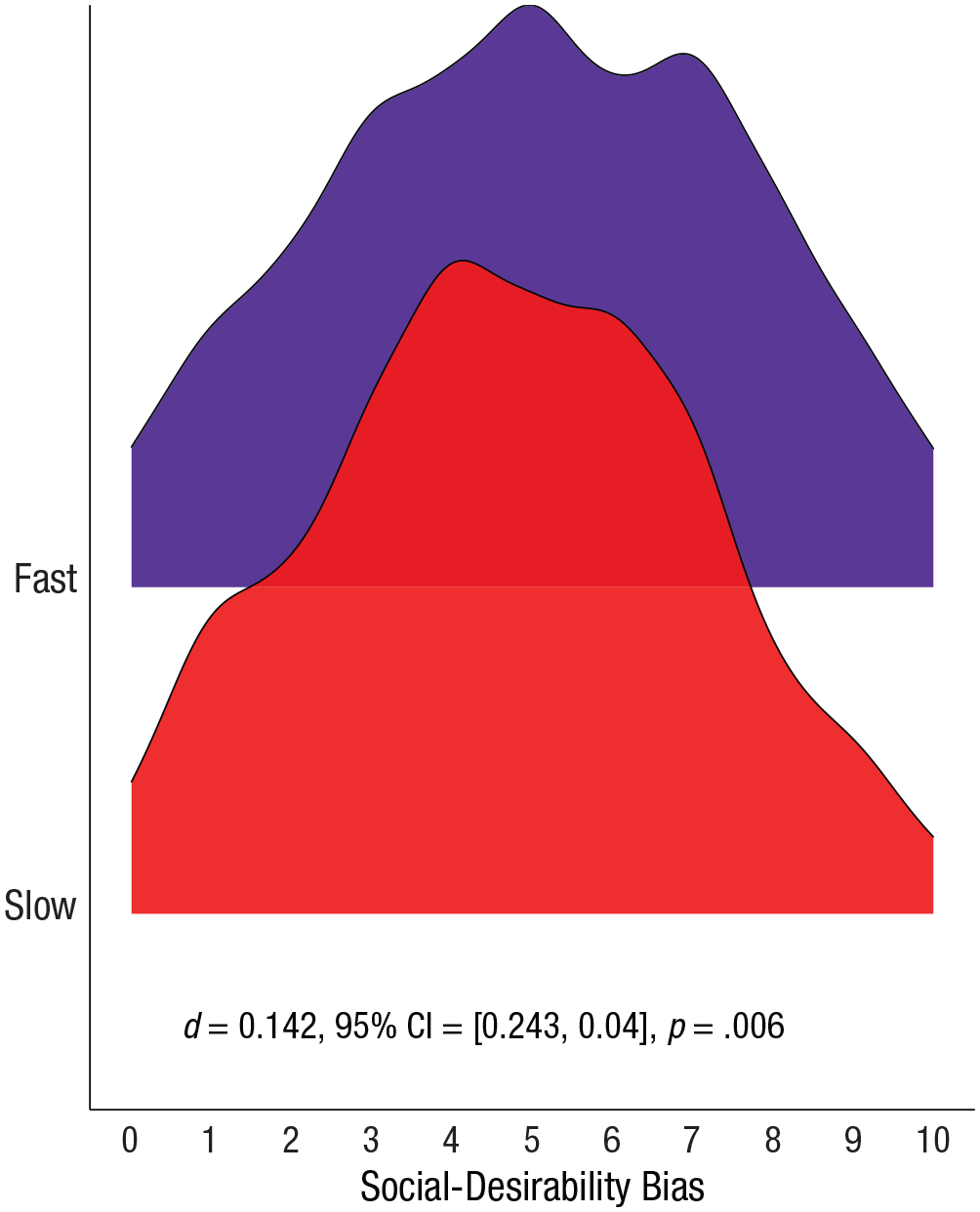
Study 1 results: density plots showing the distribution of social-desirability-bias scores among participants who were randomly assigned to answer the questions under a time constraint (fast condition) and with a delay (slow condition). Results come from the intention-to-treat analysis of assignment. CI = confidence interval.
Switching the socially desirable response to the left or right side did not change the results, nor was there an interaction between time pressure and whether “true” was on the left or right (both ps > .48; cf. Holbrook, Krosnick, Carson, & Mitchell, 2000; Recalde, Riedl, & Vesterlund, 2018). Importantly, when the Social Desirability Scale was administered without reference to time at all (although in a different sample), allowing participants to answer as quickly or as slowly as they pleased, the scores on social desirability were the same as when participants were asked to answer slowly in this sample (M = 4.48, SD = 2.51; Bayes factor, or BF = 3.543 in favor of the null; all BFs were calculated from the relevant t-test statistics using default priors in the BayesFactor package (Version 0.9.12.4.2) in the R programming environment; e.g., Rouder, Speckman, Sun, Morey, & Iverson, 2009). 3 Thus, it is not that asking participants to answer slowly decreases social desirability. To further verify this in a direct comparison, we ran a replication with the basic procedure of Study 1 with each of 1,500 participants randomly assigned to only the slow condition or no instructions (https://osf.io/kpbg3/). Results were not significantly different between the groups (slow: M = 4.553, SD = 2.534; control: M = 4.717, SD = 2.387), separate-variance t(1493.591) = 1.285, p > .19, BF = 7.599 in favor of the null hypothesis.
Accounting for noncompliance
Compliance was calculated by averaging the amount of time participants spent on each question. Participants were coded as compliers if their average time was less than 11 s in the speeded condition or greater than 11 s in the delayed condition. We then constructed a two-stage least-squares analysis, an instrumental-variables approach in which the instrument is the group randomization, which is truly random (by design in this study). The analysis regresses compliance on the group assignment and then regresses social desirability on the modeled predictions for compliance. This is the approach used in encouragement designs and is applicable here.
The results of this compliance analysis showed the same basic effect. Answering quickly when encouraged to do so caused an increase in social desirability (M = 5.086) compared with answering slowly when encouraged to do so (M = 4.44), instrumental-variable regression: b = 0.647, p = .007, 95% CI = [0.178, 1.116]. Thus, the results are robust to noncompliance with the timing manipulation.
Does the time-pressure effect occur on only some items?
One concern is that the effect of the speeded judgment was increasing socially desirable responding on some but not all items. This could be because the responding was affecting only the negatively framed items or activities that were more or less frequent. To investigate this possibility, we conducted a series of tests of measurement invariance to determine whether the speeded manipulation affected the latent social-desirability factor or some other aspect of the measurement process (e.g., on only some items). This procedure tested whether, given the same latent score on the measure, there were equal factor loadings or (more germanely) difference intercepts on the individual items. Violations of intercept invariance would suggest that some items were being affected by the manipulation over others. To test this, we fitted a series of models decreasing in equivalence parameters. We started with a strict invariance model, testing the two groups in a multigroup confirmatory factor analysis because the groups were created through randomization and did not naturally occur.
We fitted the same single-factor model to the data and reduced the equivalence parameters, testing for decrements in model fit. We followed the convention that a change in comparative fit index (ΔCFI) greater than .01 or a change in the root-mean-square error of approximation (ΔRMSEA) greater than 0.015 (Cheung & Rensvold, 2002) indicates that model fit significantly worsened after equal factor loadings and intercept constraints were imposed. The results showed that constraining factor loadings to be equal among the groups did not cause a significant change in model fit (baseline CFI = .905, configural CFI = .905; baseline RMSEA = 0.067, configural RMSEA = 0.067). Further restricting the loading and intercepts to be invariant between the groups also did not show a significant reduction in model fit (strict CFI = .901, strict RMSEA = 0.065). Thus, we can confidently say that the same construct was being measured similarly in both groups. Furthermore, the effect of time pressure on social desirability from the strict invariance model with 10,000 bootstrapped CIs was nearly identical (β = 0.177, p = .004, 95% CI = [0.057, 0.297]) to the simple summary-score analysis (d = 0.142, p = .006, 95% CI = [0.040, 0.243]).
Thus, the effect of increasing socially desirable responding is not an artifact of acquiescence bias (Tourangeau, Rips, & Rasinski, 2000) because positively and negatively coded items were equally affected. This supplementary analysis also shows that the manipulation did not operate on only some items (such as items describing more or less frequent or stereotypical behaviors) because it would cause a violation of intercept invariance, which was not seen here. Furthermore, the equal factor structure shows that time constraints did not cause participants to answer randomly. Were participants to start answering randomly, the covariance between the items would be lessened because answers on one item would not predict answers on another item (under random answering). This would strongly reduce the common factor loadings. Because no such reduction in loadings took place (restricting equal loadings between groups did not lead to a large decrease in model fit), we can be confident that the time pressure did not increase random responding.
In answer to the question, “What does making people respond quickly do?” we found that the evidence here suggests that time pressure causes an increase in socially desirable responding.
Discussion
The results of Study 1 show that asking participants to answer quickly causes an increase in socially desirable responding. This is in line with a number of findings showing that the “decide fast” manipulation increases cooperation in social interactions (e.g., Everett et al., 2017; Isler et al., 2018; Rand et al., 2012; Rand et al., 2014). Next, we examined whether this effect is driven by people’s tendency to ascribe virtue to the true self: the good-true-self hypothesis. In Study 2, we tested whether the effect of slow versus fast responding on social desirability was moderated by participants’ tendency to view the true self as fundamentally good and by the extent to which they believe they live authentically, in line with their beliefs and values.
Study 2
Method
Participants
We collected data from 1,500 participants, recruited in the same manner as in Study 1. The sample size was again determined a priori to maximize power and not on the basis of a power analysis. Furthermore, no Study 1 participants were allowed to take part in Study 2.
Procedure
First, following the same procedure as in Study 1, we randomly assigned each participant to answer the same short Social Desirability Scale either quickly or slowly. Then, participants performed a social-judgment task designed to assess the degree to which people ascribe morally good and bad behavior to a person’s true self.
Participants read seven vignettes (taken from the study by Newman et al., 2014), presented in random order, describing either a person with a history of morally good behavior suddenly acting uncharacteristically bad or a person with a history of bad behavior suddenly acting uncharacteristically good. For each participant, three vignettes described sudden good behavior, and four described sudden bad behavior, or vice versa. Each vignette started with, “Imagine an individual named [XXX]. [XXX] is different from you in almost every way—[he/she] has a different occupation and prefers different things than you.” After each vignette, participants were asked, “Now that [XXX] does [good/bad] things, to what extent is [he/she] being true to the deepest, most essential aspects of [his/her] being?” Participants responded using a 9-point scale from (1) not at all to (9) very much so (following Newman et al., 2014).
To calculate the extent to which participants showed a tendency for good-true-self judgments (i.e., predominantly ascribing morally good behaviors to the true self), we averaged participants’ judgments for vignettes describing good behavior and their judgments for vignettes describing bad behavior and computed difference scores between the two. Higher positive true-self judgment scores indicate a greater good-true-self bias.
Measures
In addition to the Social Desirability Scale and the social-judgment task, we also administered the Authenticity Scale (Wood, Linley, Maltby, Baliousis, & Joseph, 2008), a 12-item scale designed to measure the extent to which people live in accordance with their own values and beliefs; an example item is, “I think it is better to be yourself than to be popular.” All data decisions, measures, and analyses were preregistered prior to data collection at https://osf.io/2eaup/.
Results
We first tested whether we replicated the effect of asking participants to answer quickly versus slowly on social desirability. As in Study 1, we pursued an ITT analysis and performed a 2 × 2 ANOVA with 10,000 bootstrapped resamples to test the effect of condition on social-desirability scores. We again found that asking people to answer quickly causes them to give more socially desirable responses (M = 4.886, SD = 2.521) than asking them to answer slowly (M = 4.606, SD = 2.477), F(1, 1498) = 4.708, p = .03, d = 0.11, 95% CI = [0.213, 0.011].
The role of the true self
Next, we tested whether the degree to which participants made good-true-self judgments moderated the role of time pressure on socially desirable responding. We first tested whether we replicated the good-true-self bias. To do this, we performed a repeated measures ANOVA with valence of the behavior described in the vignette that participants judged (morally good vs. morally bad) as the within-subjects factor. This was to establish that participants, overall, showed the good-true-self bias, as indicated by a greater likelihood to ascribe morally good behaviors to the true self (M = 6.461, SD = 1.660) compared with morally bad behaviors (M = 4.176, SD = 2.197), F(1, 1483) = 1,023.833, p < .001, d = 1.661, 95% CI = [1.779, 1.543]. Thus, we replicated the basic good-true-self bias (Newman et al., 2014).
Next, to test the good-true-self hypothesis as an explanation for the time-pressure effect, we performed a regression analysis on social desirability with the factors condition (encouraging fast responding vs. encouraging slow responding) and true-self judgments (continuous), as well as their interaction term. We found the predicted interaction of fast instructions increasing socially desirable responding, moderated by good-true-self judgments, β = −0.106, t(1448) = −2.519, p = .012, 95% CI = [−0.213, −0.027]. However, the interaction was in the opposite direction from what would be expected on the basis of the good-true-self hypothesis. When participants responded at their natural rate, more socially desirable responding correlated with the extent to which people show a good-true-self bias, β(1, 719) = 0.160, t(1448) = 4.358, p < .001, 95% CI = [0.079, 0.209]. When people were encouraged to respond quickly, however, this relationship was no longer present, β(1, 729) = 0.026, p = .479, 95% CI = [−0.043, 0.091], BF = 9.582 in favor of the null hypothesis (see Fig. 2). Even individuals who view the true self as encompassing both good and bad sides now tended to respond in a socially desirable way. Thus, the observed interaction shows that time pressure increases socially desirable responding among individuals who view the true self as bad. Furthermore, the more that someone shows a social-desirability bias (not under time pressure), the more they are likely to show the good-true-self bias as well (see Fig. 2).

Study 2 results: conditional relationship between good-true-self bias (> 0 = believes the true self is good) and socially desirable responding. Results are shown separately for the slow condition (red solid line and data points) and the fast condition (blue dashed line and data points). Gray bands indicated 95% confidence intervals.
Authenticity
Finally, we tested whether responses on the Authenticity Scale moderated the effect of time pressure on social desirability. A regression analysis with condition, authenticity scores, and their interaction term yielded no significant interaction, β(1467) = 0.054, t(1448) = 0.345, p = .73, 95% CI = [−0.307, 0.438], and only a main effect of authenticity, β(1467) = 0.195, t(1448) = 5.269, p < .001, 95% CI = [0.456, 0.996], indicating that people who are more apt to show a social-desirability bias in responding say they view themselves as living a more authentic life in accordance with their values and beliefs.
Discussion
The results of Study 2 replicate our finding that asking participants to answer quickly causes an increase in socially desirable responding. We further found that this tendency was moderated by the extent to which participants believe the true self is virtuous. The nature of the interaction, however, was different from that predicted by the good-true-self hypothesis. When people are given time to deliberate, believing in the concept of a good true self is associated with more socially desirable responding. This may occur because the good true self is itself a socially desirable belief or because participants who strongly ascribe to the good-true-self concept reinterpret the statements of the Social Desirability Scale as statements about their true—rather than actual—self. Thus, while responding to statements such as, “I have never deliberately said something that hurt someone’s feelings,” such high good-true-self believers may be answering for who they think they are deep down. More importantly, the relationship between good-true-self judgments and social desirability is abolished when participants are asked to respond quickly. This goes against the good-true-self hypothesis and supports the social-heuristics hypothesis. That is, under time pressure, participants do not respond in a way that is aligned with their true-self concept, but they do respond in line with internalized social norms (Everett et al., 2017; Isler et al., 2018; Rand et al., 2012; Rand et al., 2014). The most parsimonious explanation for the finding that self-reported authenticity seems to be associated with social desirability but does not interact with time pressure is that both similarly reflect a habitual tendency toward positive self-presentation.
General Discussion
Previous observations that time pressure stimulates prosocial behavior, even at the cost of personal self-interest, have been interpreted in the context of the social-heuristics hypothesis. According to this view, most people have internalized prosocial behavior as their default response because they have learned over their history of social interactions that it is advantageous over the long run (Everett et al., 2017; Isler et al., 2018; Rand et al., 2012; Rand et al., 2014). Time pressure brings out internalized “habits of virtue” (Peysakhovich & Rand, 2015). Central to this view is the premise that the prosocial behavior evoked by speeded judgments does not reflect people’s core goodness per se but, rather, their motivation to present themselves favorably to others. Accordingly, this view predicts that an internalized habit could lead individuals to present themselves in a socially desirable manner even when they are outside of social interactions and even when such presentations represent inaccurate characterizations of themselves.
Here, we considered an alternative view, namely, that time pressure aligns people’s responses with who they think they really are deep down—their true-self concept. In the context of social interactions, people may intuitively cooperate because they are, deep down, morally good and also because they believe that other people are fundamentally good. This would explain why they cooperate even against their self-interest and even with an anonymous stranger or out-group member (e.g., Everett et al., 2017). This could likewise explain why people under time pressure present themselves in a socially desirable way outside of social interactions when responding to simple statements about themselves. Without time for deliberation, people may simply think of what applies for their idealized selves. An individual’s true self may be a fundamentally virtuous person who is a good listener, admits when he or she makes a mistake, and never takes advantage of other people. For a person with this kind of good-true-self concept, reflecting on the totality of his or her good and bad behaviors may require more deliberation.
Our results favor the social-heuristics hypothesis. Although people overall do believe in the good true self, this belief affects their responses only when they are given time to deliberate. Under time pressure, the mind revealed is not the true self but, rather, the social self concerned with appearing good to other people. These findings indicate that when rushed, people are not revealing their true good selves but, rather, their automatic willingness to misrepresent themselves to appear virtuous to others. Researchers employing the oft-used speeded-judgment paradigm should be wary of its tendency to reflect self-presentational concerns.
Supplemental Material
Protzko_OpenPracticesDisclosure_rev2 – Supplemental material for Rushing to Appear Virtuous: Time Pressure Increases Socially Desirable Responding
Supplemental material, Protzko_OpenPracticesDisclosure_rev2 for Rushing to Appear Virtuous: Time Pressure Increases Socially Desirable Responding by John Protzko, Claire M. Zedelius and Jonathan W. Schooler in Psychological Science
Footnotes
Action Editor
Eddie Harmon-Jones served as action editor for this article.
Author Contributions
J. Protzko and C. M. Zedelius contributed equally to the ideas in this article and the writing of the manuscript. All the authors developed the study ideas, J. Protzko collected the data, and J. Protzko and C. M. Zedelius analyzed the data. All the authors wrote and edited the manuscript and approved the final manuscript for submission.
Declaration of Conflicting Interests
The author(s) declared that there were no conflicts of interest with respect to the authorship or the publication of this article.
Funding
This work was supported by Fetzer Franklin Fund Grant No. 44069-59380 and by John Templeton Foundation Grant No. 60844.
Open Practices
All data and materials have been made publicly available via the Open Science Framework and can be accessed at https://osf.io/rt6un (Study 1) and https://osf.io/kzmr5/ (Study 2). The design and analysis plans were preregistered at https://osf.io/jdqbz/wiki/home/ (Study 1) and https://osf.io/vdqrj/wiki/home/ (Study 2). The complete Open Practices Disclosure for this article can be found at http://journals.sagepub.com/doi/suppl/10.1177/0956797619867939. This article has received the badges for Open Data, Open Materials, and Preregistration. More information about the Open Practices badges can be found at  .
.
Notes
References
Supplementary Material
Please find the following supplemental material available below.
For Open Access articles published under a Creative Commons License, all supplemental material carries the same license as the article it is associated with.
For non-Open Access articles published, all supplemental material carries a non-exclusive license, and permission requests for re-use of supplemental material or any part of supplemental material shall be sent directly to the copyright owner as specified in the copyright notice associated with the article.
