



Abstract
We compared the extent to which people discounted positive and negative events in the future and in the past. We found that the tendency to discount gains more than losses (i.e., the sign effect) emerged more strongly for future than for past outcomes. We present evidence from six studies (total N = 1,077) that the effect of tense on discounting is tied to differences in the contemplation emotion of these events, which we assessed by measuring participants’ emotions while they either anticipated or remembered the event. We ruled out loss aversion, uncertainty, utility curvature, thought frequency, and connection to the future and past self as explanations for this phenomenon, and we discuss why people experience a distinct mixture of emotions when contemplating upcoming events.
Keywords
Imagine that you are a contestant on a game show on which you compete to be the last one remaining on a desert island. After days of eating only paltry rice rations, you win a competition that entitles you to a delicious steak dinner. You would likely have a much stronger preference for a dinner later that evening than later that month (suggesting delay discounting of the desired event). In contrast, imagine that an upcoming competition requires that you eat a live cockroach. In this case, your distaste for your fate would likely be similar regardless of whether it is happening in a few hours or a few weeks (suggesting minimal delay discounting of the dreaded event). Indeed, a large body of work on temporal discounting has demonstrated that people discount future positives more than future negatives, a phenomenon known as the sign effect (Mischel, Grusec, & Masters, 1969; Read, 2004; Thaler, 1981). Thus, although the perceived impact of both good and bad events decreases as the time to their occurrence increases, time delay will weaken the mental impact of eating an upcoming steak more than eating an upcoming cockroach.
The sign effect has implications for evaluating a broad range of distant events, and yet it remains unknown whether the sign effect is unique to the anticipatory nature of future gains and losses or whether it is related to a more general discrepancy in the subjective impact of positive and negative events. To distinguish between these two possibilities, we explored whether the sign effect also occurs in the evaluation of past outcomes. If the sign effect is driven by a general difference in the perceived subjective impact of positive and negative events, we would expect to see evidence of the sign effect when participants judge both past and future outcomes. In contrast, if the sign effect is instead tied to the process of prospective thought, we might expect to see the sign effect only when participants are making judgments about future events. In examining this research question, we aimed both to advance our understanding of the mechanism underlying the sign effect and to better delineate contexts in which it affects consequential decisions.
The Psychology of the Sign Effect
Two prevailing accounts have been offered to explain the sign effect. The loss-aversion account suggests that increased sensitivity to the magnitude of negative outcomes leads to lower discounting. In general, perceived change in utility from a loss is larger than that from an equivalent gain (Kahneman & Tversky, 1979). Therefore, losses seem consistently more impactful, and are discounted less, than gains of equivalent magnitude (Baucells & Belleza, 2017; Loewenstein & Prelec, 1992). This possibility is supported by evidence of an inverse association between loss discounting and neural activation associated with the magnitude of negative events (Tanaka, Yamada, Yoneda, & Ohtake, 2014; Xu, Liang, Wang, Li, & Jiang, 2009).
The contemplation-emotion account instead suggests that the sign effect is driven by the greater relative emotional impact not of a distant negative event itself but of the process of waiting for it to occur. This possibility is supported by people’s preference for expediting negative experiences associated with high amounts of dread (i.e., high amounts of negative emotion during the intervening time period, such as seen with electric shocks; see Berns et al., 2006; Loewenstein, 1987). This preference indicates minimal discounting; if a dreaded event were discounted with time, one would choose to delay it, and yet people instead choose to “get it over with” immediately. In contrast, people do prefer to delay negative experiences that are comparatively low in anticipatory discomfort (e.g., losing money), which reflects a behavior pattern consistent with classic delay discounting for negative events (Berns et al., 2006; Harris, 2012). According to this account, these differences occur because the intervening experience of contemplating the event is the main driver of discounting behavior rather than the perceived magnitude of the event itself.
In contrast to discounting of negative events, discounting of positive events is reflected by the desire to expedite the event (because we would rather experience a positive event when it is perceived to be more impactful rather than weakened with the passage of time). Emotions experienced while waiting for a positive event can also counteract discounting; for example, enjoyment derived from waiting for a positive event, such as a vacation, may lessen our desire to expedite the event and reduce discounting (Loewenstein, 1987). However, an important feature of waiting for a gain is that enjoyment is often mixed with future-oriented negative emotions, such as impatience. As a result of these mixed emotions, the overall enjoyment of contemplating a positive event may be less impactful than the overall pain of waiting for a bad experience, which tends to be more uniformly negative (Hardisty & Weber, 2019; Nowlis, Mandel, & McCabe, 2004). Thus, although contemplating both positive and negative future events may be associated with emotions that reduce discounting, asymmetry in the net strength of these emotions might produce the sign effect.
Comparing Future and Past
We performed a critical test to differentiate between the loss-aversion account and the contemplation-emotion account by systematically comparing the asymmetry in discounting of future positive and negative outcomes with the discounting of identical past positive and negative outcomes. Although the discounting of past events has been less extensively studied and is perhaps less intuitive than the discounting of future events, there is some evidence that the perceived impact of a past event also decreases as distance from the event grows (e.g., Yi, Gatchalian, & Bickel, 2006). Therefore, examining determinants of time preferences for past events can reveal information about the cognitive mechanisms driving discounting more generally.
In our experimental paradigm, we held constant the perceived magnitude of outcomes and measured the extent to which discounting was driven by the intensity of participants’ emotional experience while contemplating each type of event. Building on previous research linking discounting with the intensity of anticipatory emotion (as distinct from predicted experience of the outcome itself; e.g., Berns et al., 2006; Harris, 2012), we focused on assessing the emotional quality of the intervening period between the present moment and the event’s occurrence. We extended this assessment to past events by examining the emotional intensity that participants experienced while remembering the event (as distinct from recalled experience of the event itself). We compared the emotional experience of contemplating positive and negative events by measuring the net intensity of valence-congruent emotion; in other words, the degree of net positive emotion associated with contemplating positive events was compared with the degree of net negative emotion associated with contemplating negative events.
If the sign effect is attributable to a general positive–negative emotional asymmetry in which negative events are more impactful in general than positive events (i.e., loss aversion), we would expect to see the sign effect for both past and future. Furthermore, under this account, controlling for loss aversion by equating the subjective value of present outcomes should eliminate the sign effect in both past and future.
In contrast, if the difference in discounting is driven by a specific pattern of emotion related to anticipatory thought about future positive (vs. negative) events (Hardisty & Weber, 2019), we would expect the sign effect to be unique to future events and emerge even when controlling for perceived magnitude of the outcomes themselves. But we would expect to see little difference in discounting and intensity of emotion when comparing past gains and losses.
We suggest that the differences in contemplation emotion may indeed be related specifically to the nature of emotions evoked by upcoming events. Namely, the positive intensity of contemplating an upcoming positive event is reduced by impatience (an emotion commonly called on in the discounting literature and unique to events that have not yet occurred). However, the negative intensity of contemplating an upcoming negative event is not tempered, but rather is likely to be strengthened, by anxiety (also an emotion closely associated with events that have not yet occurred). Although experiencing the memory of past events may also be accompanied by emotion that contrasts the valence of the event, we had no a priori reason to predict that these countervailing emotions would demonstrate the same asymmetrical pattern for positive versus negative events as their future counterparts. On the basis of this account, we expected to see the sign effect exclusively, or at least more strongly, for future events rather than past events.
We made three predictions for our current research. First, on the basis of research documenting some differences in the valuation and emotional intensity of future versus past outcomes (e.g., Caruso, 2010; Caruso, Gilbert, & Wilson, 2008; Caruso & Van Boven, 2019; He, Huang, Yuan, & Chen, 2012; Van Boven & Ashworth, 2007), we predicted that past events would be discounted more than future events. Second, we expected to replicate the basic sign effect, whereby people discount positive future events more than negative future events (Mischel et al., 1969; Read, 2004; Thaler, 1981). Third, most critically, we predicted that the sign effect would be larger for future events than for past events and that this difference would be associated with more intense net emotion related to the contemplation of future negative (vs. positive) events. We tested these predictions in six studies.
Study 1a
Method
Participants
One hundred eighty-four participants 1 from Amazon’s Mechanical Turk (MTurk; 45.7% female; mean age = 32 years) completed this online study in return for $1.50 compensation.
Procedure
Instructions at the top of each screen asked participants to imagine gaining or losing money in the past or future. Each participant completed all four cells of a 2 (gain vs. loss) × 2 (past vs. future) design in counterbalanced order. Within each block, participants were presented with two columns. The right-hand column contained 20 rows with a fixed gain ($10) or loss ($5) at a distant time point of 1 year in the future or 1 year in the past, depending on condition. Monetary values were chosen on the basis of pretesting so that they would have equivalent subjective present impact. 2 This was done to control for differences in emotional experience arising from perceptions of the outcomes themselves (loss aversion) rather than to differences in experience of the intervening waiting period. The left-hand column presented ascending or descending amounts in 5% intervals of the right-hand amount, occurring at 1 hr in the future or past (modeled after the method of Yi et al., 2006; for sample stimuli, see the Supplemental Material available online). Participants made a choice from each row.
Although the repeated measures nature of our discounting-elicitation method had some drawbacks because of the possibility of carryover effects across questions, we aimed to minimize the impact of these effects on our results by (a) testing for order effects across blocks (discussed further in the Results section) and (b) presenting discounting questions within blocks in both ascending and descending order to mitigate the effects of anchoring on earlier questions within a block. Furthermore, previous research on discounting methodology has noted the presence of carryover effects with instruments with multiple questions. However, “titration” measurement procedures, which present participants with a series of choices in order to narrow down the point at which they become indifferent to smaller sooner versus larger later rewards, are generally viewed as among the most accurate ways of eliciting meaningful discount rates (e.g., see Hardisty, Thompson, Krantz, & Weber, 2013; Li, Wall, Johnson, & Toubia, 2016).
After completing the discounting measures, participants reported their subjective feelings of anticipation or memory (contemplation-emotion measure) for the distant fixed amount in that block ($10 gain or $5 loss). They were asked, “How psychologically pleasurable or displeasurable would the [anticipation/memory] of [event] be? In other words, how would you feel while [waiting for/remembering] it?” They responded on a sliding scale ranging from −50 (strongly dislike the feeling of [waiting/remembering] ) to 50 (strongly like the feeling of [waiting/remembering] ).
Discounting computation
We identified each participant’s indifference point for each block as the row in which he or she switched to preferring the amount in the fixed (distant) column. 3 A simple ratio measure of discounting was then calculated by dividing the distant amount by the proximal amount in the row corresponding to the participant’s indifference point. In this paradigm, higher values indicate greater discounting of the temporally distant amount. The overall discounting value for each condition was computed as the average of the participant’s values from ascending and descending versions of each block.
Results
Order effects
Several effects related to order of presentation of the gain-loss and past-future blocks were observed on both the discounting measure and contemplation-emotion measure. However, none of these order effects significantly affected the focal Tense × Valence interaction. Thus, order effects will not be discussed further in the main text of this article. Order effects from this study are presented in the Supplemental Material.
Discounting measure
We observed a main effect of tense, F(1, 183) = 19.61, p < .001, η p 2 = .10, with participants generally discounting past outcomes (M = 11.95, SD = 14.73) more than future outcomes (M = 8.85, SD = 12.97), and a main effect of valence, F(1, 183) = 5.38, p = .021, η p 2 = .03, with participants generally discounting gains (M = 11.54, SD = 14.86) more than losses (M = 9.25, SD = 12.92). Furthermore, we observed a significant Tense × Valence interaction, F(1, 183) = 5.54, p = .020, η p 2 = .03. Specifically, participants discounted the future gain (M = 10.71, SD = 14.56) significantly more than the future loss (M = 6.99, SD = 10.88), F(1, 183) = 12.92, p < .001, η p 2 = .07, but discounted the past gain (M = 12.38, SD = 15.14) and past loss (M = 11.52, SD = 14.35) to an equal extent, F(1, 183) = 0.46, p > .250, η p 2 < .01 (Fig. 1). This pattern demonstrates the sign effect for future, but not past, outcomes.
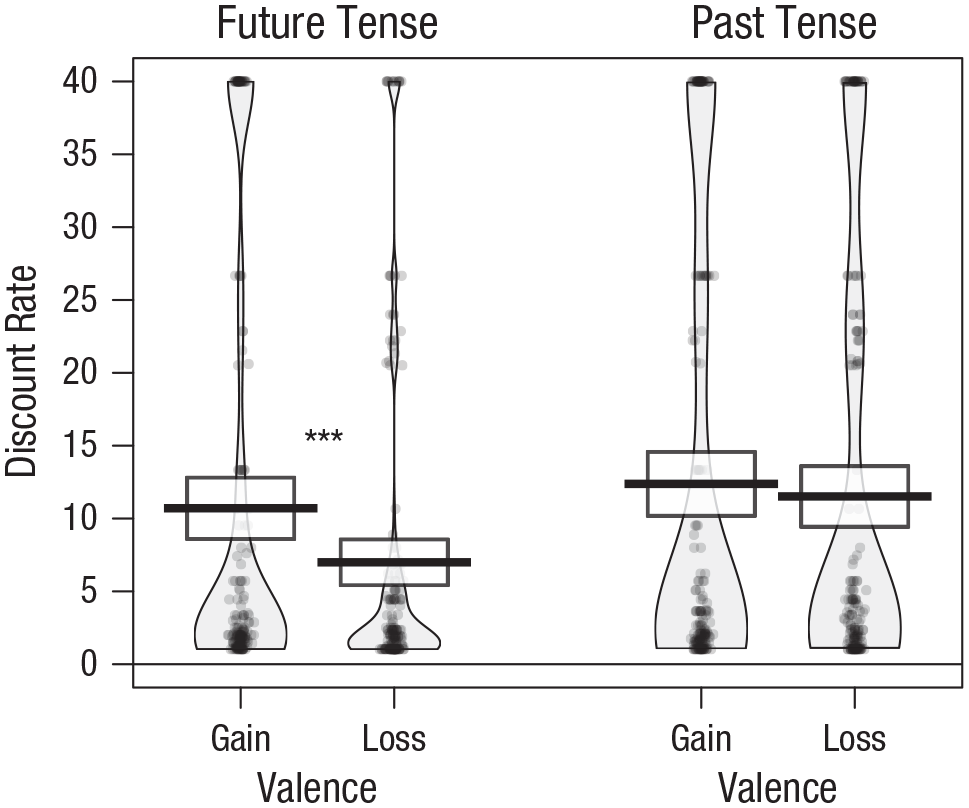
Discount rate for past and future outcomes (gains vs. losses) in Study 1a. Horizontal bars show means, bands (around the means) show 95% confidence intervals, dots show raw individual data, and beans show smoothed density curves. Asterisks indicate a significant difference between outcomes (p < .001).
Contemplation emotion
To directly compare the intensity of contemplation emotion for positive and negative events, we reverse-scored the emotion ratings for losses (so that more negative emotion was represented by higher values). We observed a main effect of tense, F(1, 183) = 65.20, p < .001, η p 2 = .26, with higher contemplation emotion for past outcomes (memory; M = 15.58, SD = 16.34) than future outcomes (anticipation; M = 6.51, SD = 22.73), and a main effect of valence, F(1, 183) = 52.42, p < .001, η p 2 = .22, with higher contemplation emotion for losses (M = 16.54, SD = 16.78) than gains (M = 5.55, SD = 21.97). These were qualified by a significant Tense × Valence interaction, F(1, 183) = 126.21, p < .001, η p 2 = .41. For future events, contemplation emotion associated with losses (dread; M = 17.45, SD = 17.22) was significantly stronger than that for gains (positive anticipation; M = −4.43, SD = 22.33), F(1, 183) = 115.85, p < .001, η p 2 = .39. We note that the contemplation emotion for future gains was in fact significantly below zero, t(183) = −2.69, p = .008, d = 0.199, suggesting that, on average, anticipating future gains was associated with negative (rather than positive) emotion. In contrast, the contemplation emotion associated with past losses (M = 15.62, SD = 16.32) was no higher than that of past gains (M = 15.54, SD = 16.40), F(1, 183) = 0.003, p > .250, η p 2 < .01 (Fig. 2).
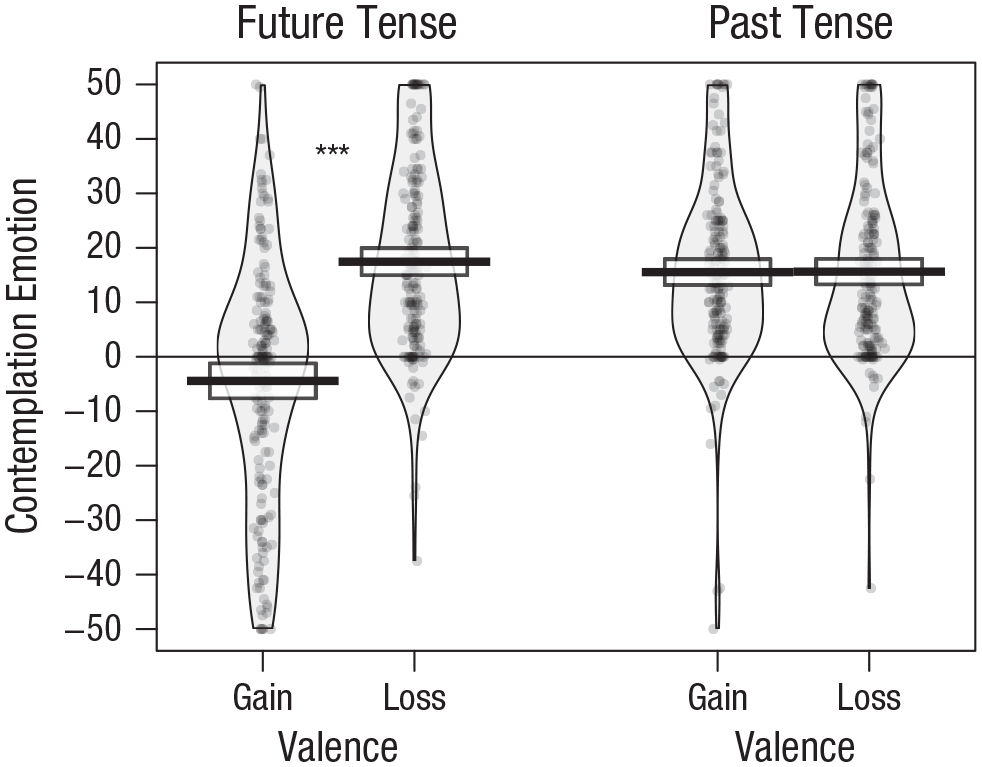
Contemplation emotion related to past and future outcomes (gains vs. losses) in Study 1a. Horizontal bars show means, bands (around the means) show 95% confidence intervals, dots show raw individual data, and beans show smoothed density curves. Asterisks indicate a significant difference between outcomes (p < .001).
Mediation analysis
A mediated moderation model (Muller, Judd, & Yzerbyt, 2005) was used to examine whether the interactive effect of tense and valence on discounting was mediated by contemplation emotion. A mediation effect of this form would suggest that the sign effect is associated with the differing impact of contemplating distant positive and negative events. As seen in Figure 2, this effect emerged only when these events were located in the future.
A bootstrapping model with 5,000 samples revealed the following values for the indirect effect of the Tense × Valence interaction on discounting via contemplation emotion, b = 1.09, 95% bias-corrected confidence interval (CI) = [−0.048, 2.58], p = .053 (Fig. 3). Although not statistically significant, the pattern of results suggests that contemplation emotion may be related to the observed relationship between Tense × Valence and discounting. In other words, the weaker contemplation emotion of positive (compared with negative) events is unique to the future and accompanies a discounting difference (contributing to the sign effect for future events but not past events).
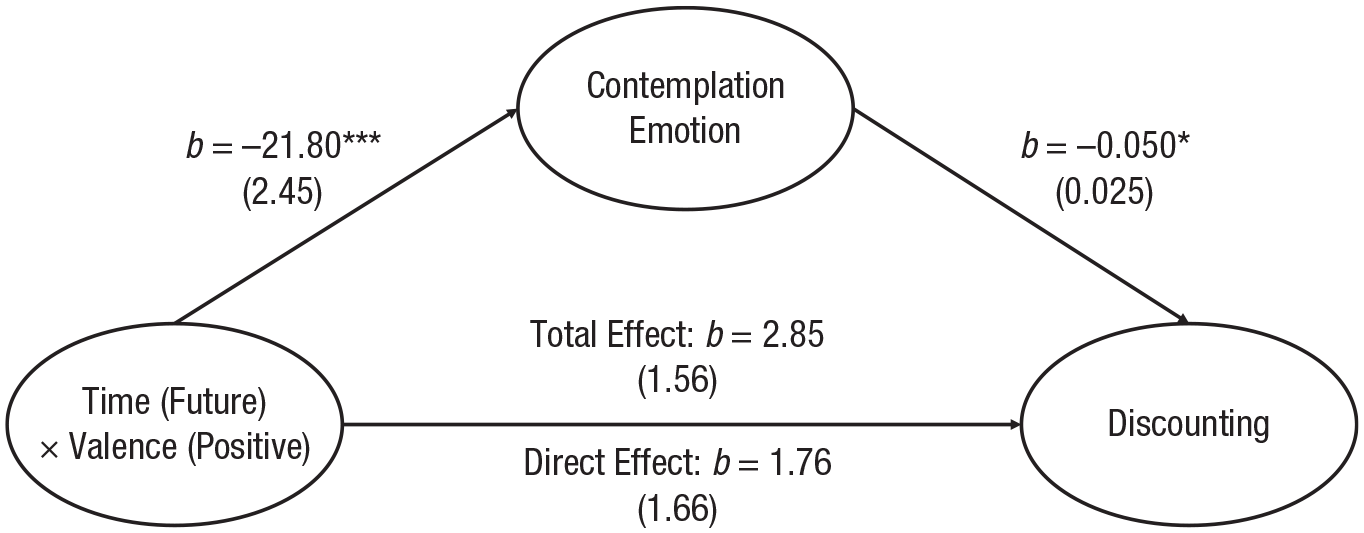
Mediation model from Study 1a showing the interactive effect of tense and valence on discounting, as mediated by contemplation emotion. Standard errors are in parentheses. Asterisks indicate significant paths (*p < .05, ***p < .001).
Study 1b
To generalize beyond monetary gains and losses, we tested nonmonetary hedonic events in Study 1b.
Method
Participants
One hundred eighty-six participants from MTurk (39.8% female; mean age = 35.1 years) completed this online study in return for $1.50. We excluded 9 participants from analysis for reporting in a screening question that they would perceive our intended negative event as pleasurable or our intended positive event as displeasurable.
Procedure
The procedure and method of calculating discount rates were identical to those of Study 1a, except that the monetary gains and losses were replaced with hedonic events. The events of fixed magnitude were “receiving a pleasant 1 hour massage” and “receiving an unpleasant (but non-harmful) 1 minute electric shock,” occurring either 1 year in the future or 1 year in the past. These events were chosen because each is associated with a time-limited hedonic experience that has few lasting implications other than the contemplation emotion associated with anticipating or recalling its occurrence. A column containing the distant fixed event was paired with a column containing the same event type occurring 1 hr in the future or past, and with event duration varying by 5% of the fixed amount in ascending or descending order (for sample stimuli, see the Supplemental Material). Participants made a choice for each pair, which was used to calculate their indifference point for the discounting measure as in Study 1a.
Results
Order effects
As in Study 1a, some effects related to order of presentation of the positive-negative and past-future blocks were observed on both the discounting measure and contemplation-emotion measure. These did not significantly affect the main Tense × Valence interaction of interest and are presented in the Supplemental Material.
Discounting measure
We again observed a main effect of tense, F(1, 176) = 41.45, p < .001, η p 2 = .19, with participants discounting past outcomes (M = 13.34, SD = 15.79) more than future outcomes (M = 8.10, SD = 11.95), and a main effect of valence, F(1, 176) = 12.18, p = .001, η p 2 = .06, with participants generally discounting positive events (M = 12.53, SD = 15.93) more than negative events (M = 8.91, SD = 12.07). We also observed a significant Tense × Valence interaction, F(1, 176) = 8.13, p = .005, η p 2 = .04. Specifically, participants discounted the future massage (M = 10.89, SD = 15.13) significantly more than the future shock (M = 5.32, SD = 6.46), F(1, 176) = 23.43, p < .001, η p 2 = .12. However, participants discounted the past massage (M = 14.17, SD = 16.57) and the past shock (M = 12.50, SD = 14.98) to a similar extent, F(1, 176) = 1.57, p = .213, η p 2 = .01 (Fig. 4). This result is again consistent with the existence of the sign effect for future, but not past, events.
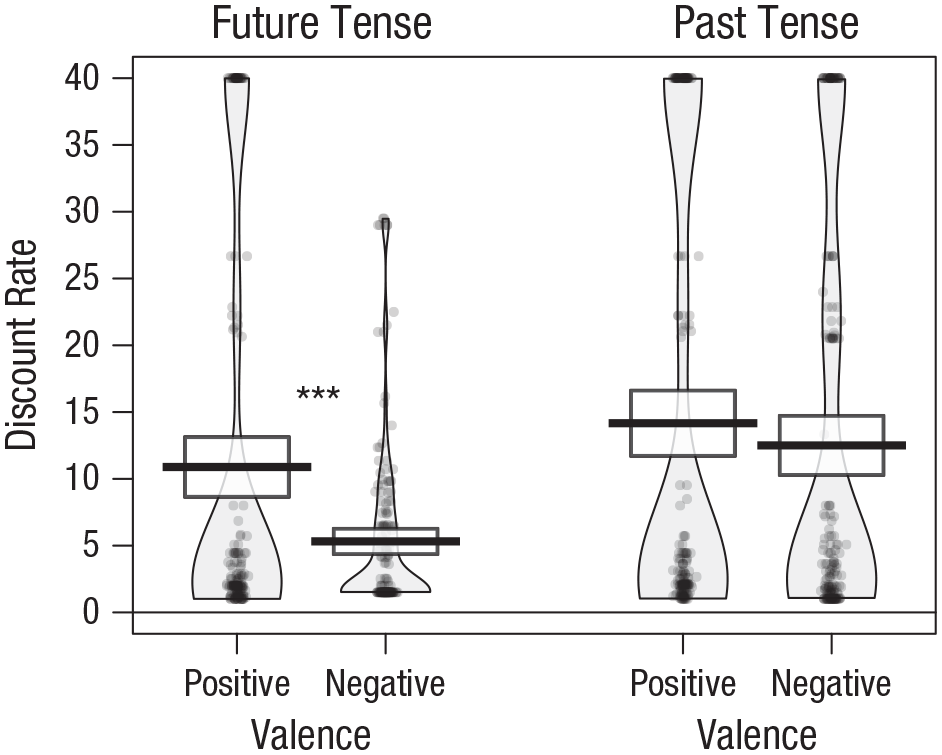
Discount rate for past and future outcomes (positive vs. negative) in Study 1b. Horizontal bars show means, bands (around the means) show 95% confidence intervals, dots show raw individual data, and beans show smoothed density curves. Asterisks indicate a significant difference between outcomes (p < .001).
Contemplation emotion
As in Study 1a, we found that contemplation emotions were higher for past events (M = 28.69, SD = 16.61) than future events (M = 17.46, SD = 25.91), F(1, 176) = 65.53, p < .001, η p 2 = .27, and higher for negative events (M = 31.41, SD = 18.38) than positive events (M = 14.74, SD = 23.09), F(1, 176) = 115.70, p < .001, η p 2 = .40. We also found a significant Tense × Valence interaction, F(1, 176) = 131.84, p < .001, η p 2 = .43. For future events, contemplation emotion associated with the massage (positive anticipation; M = 2.55, SD = 23.07) was significantly weaker than that associated with the shock (dread; M = 32.38, SD = 19.14), F(1, 176) = 176.83, p < .001, η p 2 = .50. When past events were recalled, contemplation emotion associated with the massage was again lower (M = 26.93, SD = 15.42) than that associated with the electric shock (M = 30.44, SD = 17.59), F(1, 176) = 5.16, p = .024, η p 2 = .03, but the significant interaction effect indicates that this difference was significantly smaller than it was for future events (Fig. 5).
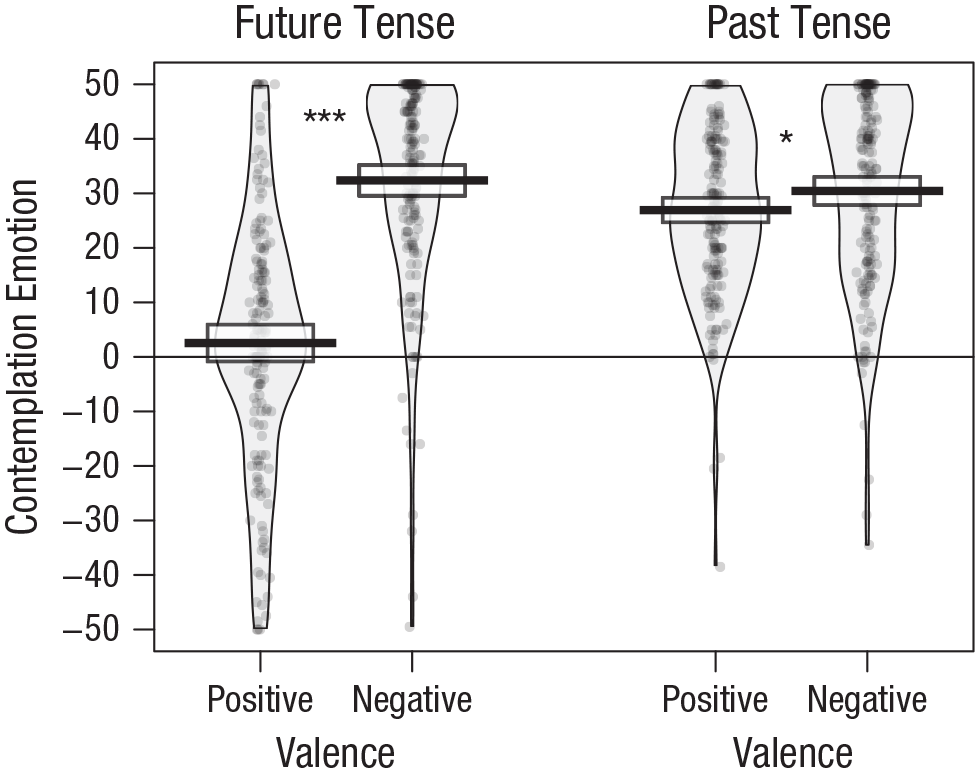
Contemplation emotion associated with past and future outcomes (positive vs. negative) in Study 1b. Horizontal bars show means, bands (around the means) show 95% confidence intervals, dots show raw individual data, and beans show smoothed density curves. Asterisks indicate significant differences between outcomes (*p < .05, ***p < .001).
Mediation analysis
As in Study 1a, we examined whether the interactive effect of tense and valence on discounting was mediated by contemplation emotion. A bootstrapping model with 5,000 samples revealed a significant indirect effect of the Tense × Valence interaction on discounting via contemplation emotion (b = 1.59, 95% bias-corrected CI = [0.345, 2.996], p = .025), and the direct effect of the Tense × Valence interaction on discounting was reduced from 3.91 to 2.32 when we included contemplation emotion in the model (Fig. 6). This pattern suggests that the sign effect in future discounting is associated with differences unique to anticipatory thoughts.
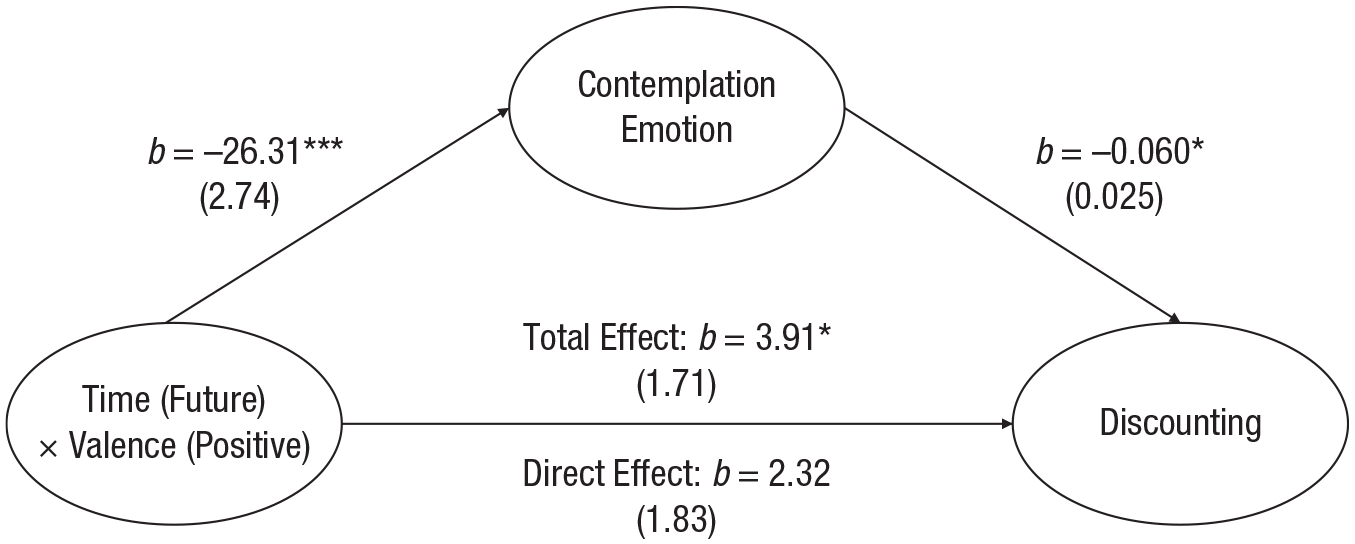
Mediation model from Study 1b showing the interactive effect of tense and valence on discounting, as mediated by contemplation emotion. Standard errors are in parentheses. Asterisks indicate significant paths (*p < .05, ***p < .001).
Study 2a
Studies 2a and 2b had several goals: (a) Discount rates were measured with a dynamic algorithm to improve range and precision, (b) loss aversion was measured for each participant and incorporated into the measure of discounting, (c) utility curvature for gains and losses was measured and controlled for, and (d) thought frequency and connection to the future and past self were assessed as alternative mediators of the sign effect.
Method
Participants
Two hundred six participants from MTurk (38% female; mean age = 35.5 years) completed this online study in return for $2.00 compensation. One participant indicated in the comments that she misunderstood the materials and was excluded from the data set prior to all analyses, leaving 205 participants for further analysis.
Procedure
First, participants answered a series of 20 questions designed to measure loss aversion. The first question asked, “Would you accept the following gamble: 50% chance of receiving $10 and 50% chance of losing $10?” Participants answered “yes” or “no.” The next 19 questions incrementally reduced the amount of the loss by $0.50, down to “50% chance of receiving $10 and 50% chance of losing $0.50?” On the next page, the same 20 questions were asked in the opposite order (ascending vs. descending, counterbalanced between subjects). The point at which participants switched between rejecting and accepting the gamble was identified as their indifference point. The indifference points from the two scales (ascending vs. descending) were averaged and used as the measure of loss aversion for each participant. Then, participants read an introduction and answered example questions similar to those that they would answer soon in the main survey.
Next, each participant completed all four conditions of a 2 (gain vs. loss) × 2 (past vs. future) design in counterbalanced order. Within each block, participants first were informed that “all gains or losses would be guaranteed to occur at the specified time.” They then completed the three-option adaptive discount-rate (ToAD) measure to compute their discount rate (Yoon & Chapman, 2016). For gains, the base outcome was $10 with a delay of 365 days. For losses, the base outcome ($X in 365 days) was individually input on the basis of each participant’s indifference point, calculated earlier in the loss-aversion scale. On each of 10 questions, the participants faced a choice among three options. The option with the longest delay used the base outcomes (e.g., $10 in 365 days), but both the magnitude and delay were jittered from question to question by using values randomly selected from a Gaussian distribution with mean equal to the base value and standard deviation of .3, yielding a result such as “Receiving $9.45 in 348 days.” The other two options were an immediate option with minimal delay, such as “Receiving $1.74 later today" and an intermediate option between the two, such as “Receiving $5.68 in 146 days.” Depending on the participant’s choices, the immediate and intermediate options were systemically adjusted according to a series of dynamic CIs for the log of the hyperbolic discount rate. If the CIs indicated that discount rates were likely zero or negative, special probe questions assessed these, following the standard ToAD procedure (for the computational and procedural details, see Yoon & Chapman, 2016).
Next, within each block, participants answered a series of questions about the base outcome (e.g., about receiving “$10 one year from now”). First, they estimated the positive experience emotion of the event: “Imagine that you will receive $10 one year from now. How pleasurable or positive would the experience of the event be at that time?” which they answered on a scale from 0 (Experience would be not at all pleasurable) to 100 (Experience would be extremely pleasurable). Next, they estimated the negative experience emotion of the event: “Imagine that you will receive $10 one year from now. How displeasurable or negative would the experience of the event be at that time?” which they answered on a scale from 0 (Experience would be not at all displeasurable) to 100 (Experience would be extremely displeasurable).
After that, within each block, participants indicated their contemplation emotion. They were given the following instruction: “Please think about how you would feel right now while [waiting for/remembering] the described event.” They were first asked, “How pleasurable or positive would the [anticipation/memory] of this event be? In other words, how would you feel right now while [waiting for/remembering] it?” and they responded on a scale ranging from 0 ([waiting/remembering] would be not at all pleasurable) to 100 ([waiting/remembering] would be extremely pleasurable). Next, participants were asked, “How displeasurable or negative would the [anticipation/memory] of this event be? In other words, how would you feel right now while [waiting for/remembering] it?” and they responded on a scale ranging from 0 ([waiting/remembering] would be not at all displeasurable) to 100 ([waiting/remembering] would be extremely displeasurable).
Next, within each block, participants were asked, “How frequently would you think about this event? In other words, how often would it cross your mind in the time [before/since] it occurred?” and they answered on a scale from 0 (It would never be on my mind) to 100 (It would always be on my mind).
Last, within each block, participants were instructed as follows: Think about the important characteristics that make you the person you are now—your personality, temperament, major likes and dislikes, beliefs, values, ambitions, life goals, and ideals. Please indicate your opinion about the degree of connectedness or overlap held between the person you are now and the person you [will be one year from now/were one year ago].
Participants were shown diagrams to illustrate the concept (following the method of Bartels & Rips, 2010) and answered on a scale from 0 (no overlap) to 100 (complete overlap).
After completing all four blocks, participants answered questions that allowed us to assess their utility curvature for financial gains and losses. Following the procedure recommended by Chapman (1996), we asked participants a series of indifference questions, starting with the following: Consider the following two events. Imagine that each of these events occurs in the present moment. A: You expect to receive $0 but instead learn you are about to receive $2.50. B: You expect to receive $2.50 but instead learn you are about to receive ___. In the blank space above, please indicate the amount that you would have to receive so that the impact of Event B would be the same as that of Event A. In other words, write an amount in the space such that experiencing Event B would bring you the same amount of pleasure or displeasure as experiencing Event A would. Please enter numbers only (decimal points are okay).
4
This was followed by three additional questions of the same nature, with the amounts filled in dynamically on the basis of participants’ answers to the previous questions. Next, participants went through the same utility-measurement procedure for financial losses, with the initial amount determined uniquely for each participant on the basis of his or her earlier answers to the loss-aversion questions. Finally, participants provided their age, gender, and income and had an opportunity to describe any questions or problems they had with the survey.
Discounting computation
Natural logarithm (ln) hyperbolic discount rates were dynamically estimated by the ToAD measure (Yoon & Chapman, 2016). In this paradigm, higher values indicate greater discounting of the temporally distant amount. Because the ToAD measure was designed to measure ln discount rates between −7 and +2 (equivalent to untransformed discount rates between approximately .001 and 7.39; Yoon & Chapman, 2016), we capped all discount rates to this range, with any result with an ln discount rate of higher than +2 being assigned a value of +2, and any result with an ln discount rate of less than −7 being assigned a value of −7. As a result, participants whose answers indicated no time preference (e.g., $10 today equivalent to $10 in 1 year) or “negative” time preference (e.g., $10 today equivalent to $9 in 1 year) were assigned the minimum value of ln(k) = −7 (untransformed discount rate of .001). 5
Results
Order effects
There were no main effects or interactions with order when predicting discount rates or contemplation emotion (all ps > .10).
Discounting measure
As seen in Figure 7, we observed a main effect of valence, F(1, 204) = 58.53, p < .001, η p 2 = .22, with participants generally discounting gains (M = −1.94, SD = 1.88) more than losses (M = −3.40, SD = 2.76), but no main effect of tense, F(1, 204) = 1.60, p = .21, η p 2 = .01. Furthermore, we observed a significant Tense × Valence interaction, F(1, 204) = 6.81, p = .01, η p 2 = .03, indicating that the sign effect was stronger in the future, t(204) = 7.96, p < .001, d = 0.56, than in the past, t(204) = 5.07, p < .001, d = 0.35. Thus, the sign effect was reduced, but not eliminated, for past outcomes.
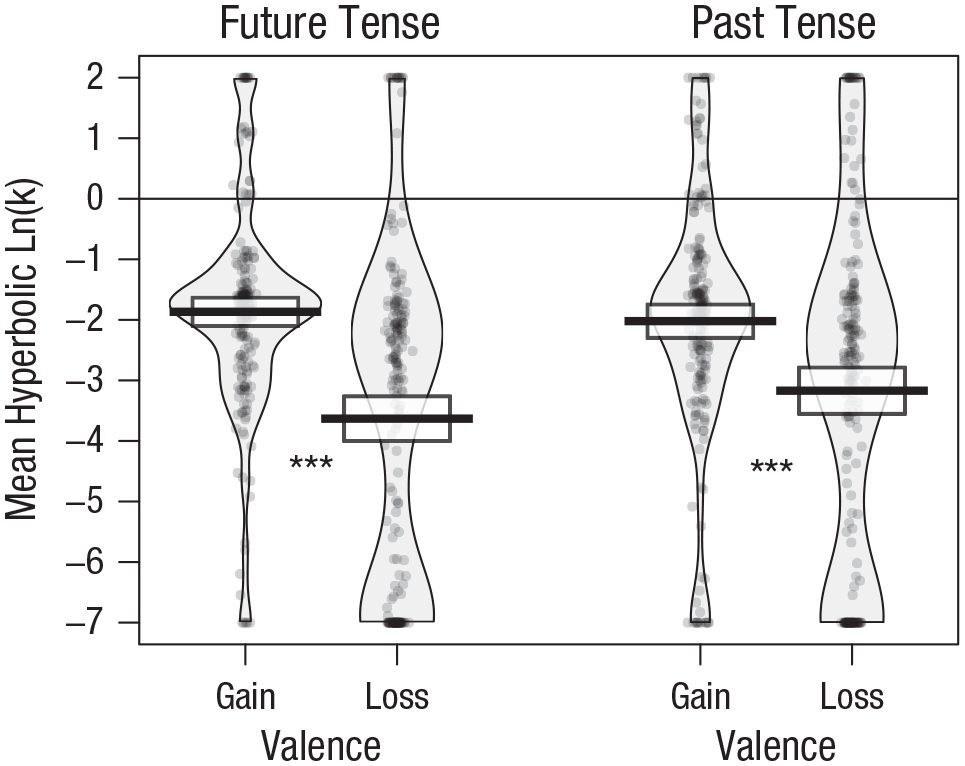
Natural logarithm (ln) hyperbolic discount rate for past and future outcomes (gains vs. losses) in Study 2a. Horizontal bars show means, bands (around the means) show 95% confidence intervals, dots show raw individual data, and beans show smoothed density curves. Asterisks indicate significant differences between outcomes (p < .001).
As seen in Table 1, discount rates were correlated across tense but not across sign. In other words, future and past discounting were correlated more strongly than were gain and loss discounting. This is consistent with previous correlation results for gains versus losses (Hardisty et al., 2013; Hardisty & Weber, 2009) and suggests that discounting for gains versus losses is driven by qualitatively different processes, casting doubt on a simple loss-aversion account of the sign effect.
Correlations Between Discount Rates in Study 2a
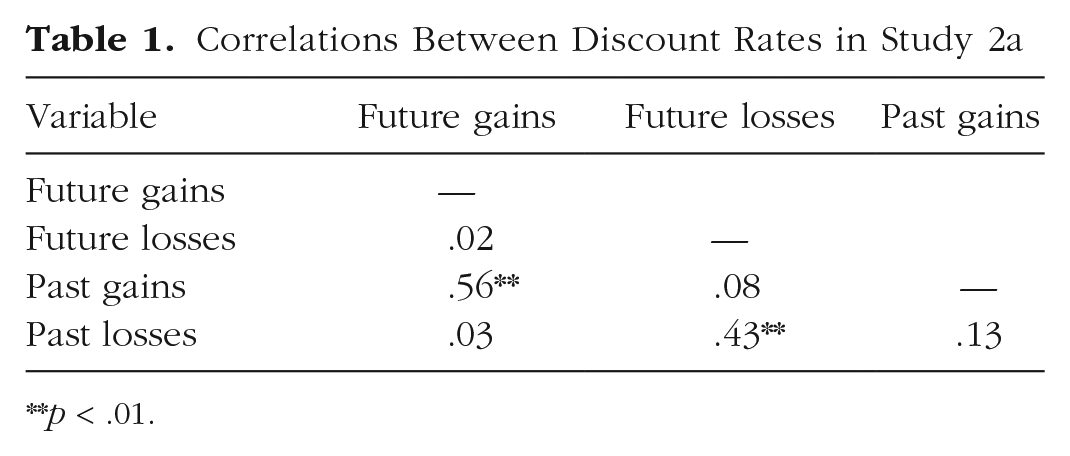
p < .01.
Contemplation emotion
To directly compare the intensity of contemplation emotion for gains and losses, we first computed a net score (positive emotion – negative emotion), and then we reverse-scored the emotion ratings for losses (so that more negative emotion was represented by higher values). We observed a main effect of tense, F(1, 204) = 45.94, p < .001, η p 2 = .18, with greater net contemplation emotion for past outcomes (memory; M = 27.34, SD = 36.24) than future outcomes (anticipation; M = 13.21, SD = 37.43), and no main effect of valence, F(1, 204) = 0.15, p = .70, η p 2 = .00, with roughly equal net contemplation emotion for losses (M = 19.78, SD = 34.78) compared with gains (M = 20.77, SD = 40.05).
These findings were qualified by a significant Tense × Valence interaction, F(1, 204) = 25.26, p < .001, η p 2 = .11. For future events, net contemplation emotion of losses (dread; M = 17.83, SD = 34.85) was significantly stronger than net contemplation emotion of gains (positive anticipation; M = 8.59, SD = 39.38), t(204) = 2.47, p = .01, d = 0.17. However, the contemplation emotion of past events reversed this pattern, with the contemplation of past losses (M = 21.74, SD = 34.68) being weaker than the contemplation of past gains (M = 32.94, SD = 36.98), t(204) = −4.25, p < .001, d = 0.30 (Fig. 8).
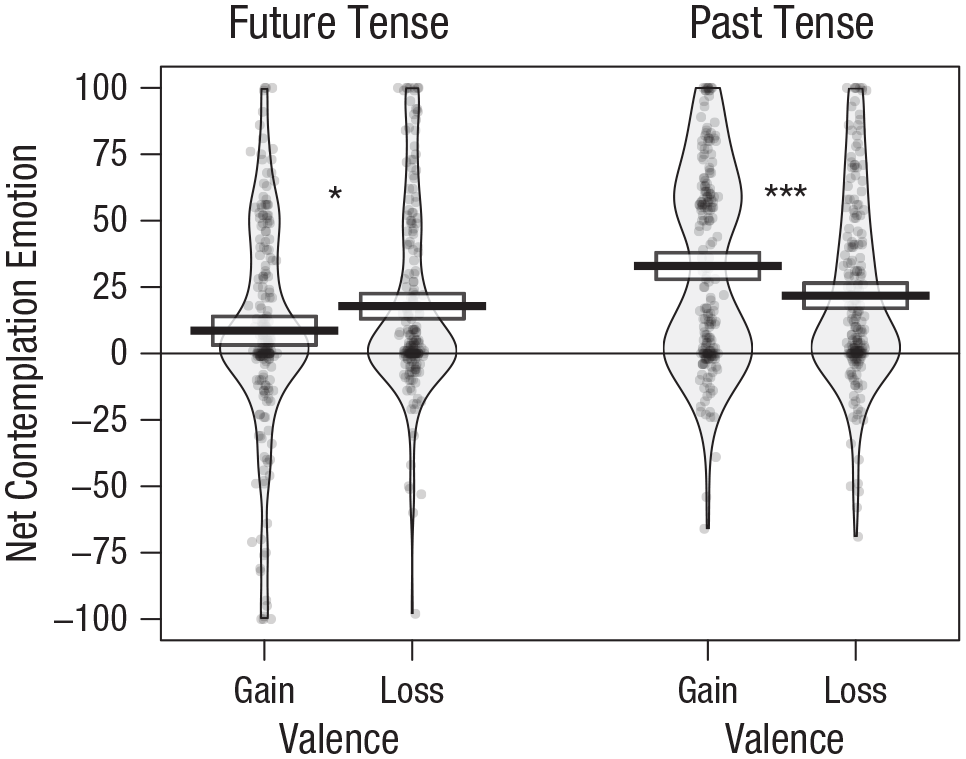
Net contemplation emotion associated with past and future outcomes (gains vs. losses) in Study 2a. Horizontal bars show means, bands (around the means) show 95% confidence intervals, dots show raw individual data, and beans show smoothed density curves. Asterisks indicate significant differences between outcomes (*p < .05, ***p < .001).
Mediation analysis
As in Study 1, a mediated moderation model (Muller et al., 2005) was used to examine whether the interactive effect of tense and valence on discounting was mediated by contemplation emotion. A bootstrapping model with 5,000 samples revealed that the indirect effect of the Tense × Valence interaction on discounting via contemplation emotion was significant (b = 0.03, 95% bias-corrected CI = [0.009, 0.061], p = .005; Fig. 9). These results suggest that contemplation emotion may partially mediate the observed relationship between Tense × Event Valence and discounting. In other words, the weaker contemplation emotion of positive (compared with negative) events was unique to the future, which was associated with a discounting difference (the sign effect for future events but not past events).
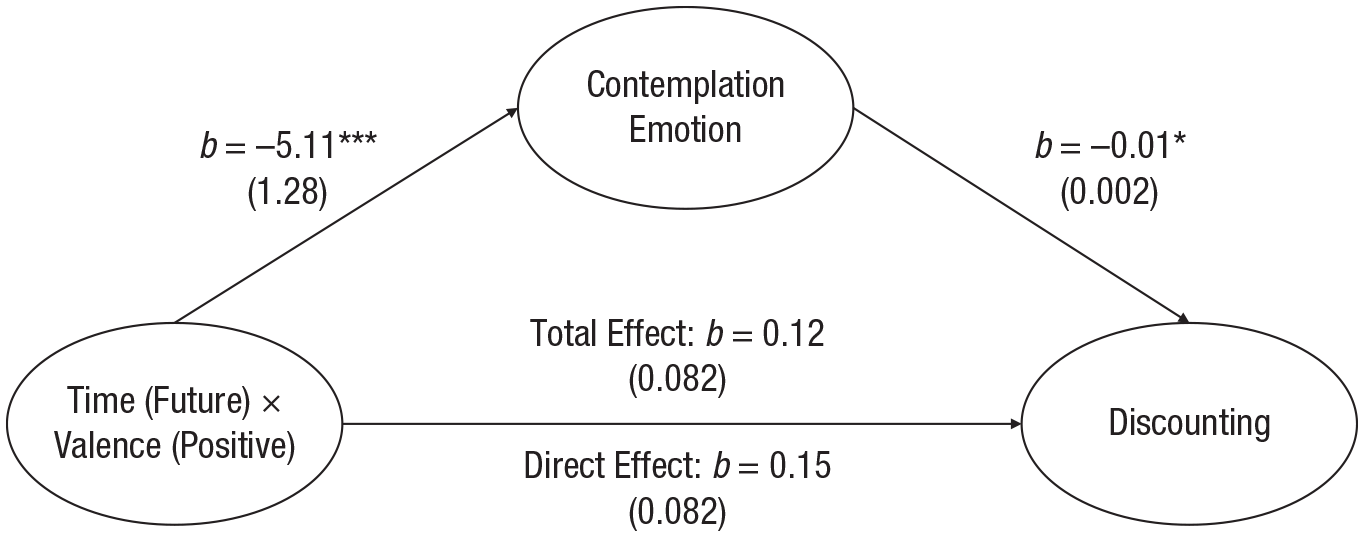
Mediation model from Study 2a showing the interactive effect of tense and valence on discounting, as mediated by contemplation emotion. Standard errors are in parentheses. Asterisks indicate significant paths (*p < .05, ***p < .001).
Frequency
Participants reported that they would think about gains (M = 28.92, SD = 28.75) more frequently than they would think about losses (M = 25.66, SD = 28.55), F(1, 204) = 14.88, p < .001, η p 2 = .07, and that they would think about things in the future (M = 28.74, SD = 28.86) more than things in the past (M = 25.83, SD = 28.43), F(1, 204) = 9.49, p < .01, η p 2 = .04, but there was no interaction, F(1, 204) = 0.03, p = .86, η p 2 = .00.
Frequency of thoughts predicted discount rates in a mixed model, β = 0.008, F(1, 818) = 6.29, p = .01; the more frequently participants thought about the distant event, the more strongly they discounted it. When we added fixed effects for sign, tense, and their interaction to the model, the predictive power of thought frequency remained significant, β = 0.006, F(1, 815) = 4.74, p = .03. Note that this account is inconsistent with a “savoring” effect for gains, whereby people might want to delay a pleasant event in order to enjoy the process of thinking about it; rather, it suggests that frequently thinking about a distant positive outcome is associated with a desire to accelerate its occurrence. Taken together, these results suggest a complementary explanation for the sign effect: People believe that they will think about gains more frequently than losses, and this greater thought frequency is associated with higher discount rates. However, given the lack of a Tense × Valence interaction, thought frequency did not explain the difference between the size of the sign effect in the future versus in the past, and the mediation pathway was not significant (b = 0.000, 95% bias-corrected CI = [−0.016, 0.013], p > .99).
Although thought frequency was positively correlated with greater positive contemplation (r = .44, p < .001) and greater negative contemplation (r = .49, p < .001), it was not correlated with overall (net) contemplation emotion (r = −.05, p = .17) or with reverse-scored contemplation emotion (reverse-scoring the losses; r = −.04, p = .23). Thus, thought frequency does not explain the differences in contemplation emotion that we observed between gains and losses.
Connection to the distant self
Participants reported being more connected to their temporally distant self when considering gains (M = 71.62, SD = 26.01) than when considering losses (M = 68.66, SD = 28.43), F(1, 204) = 14.88, p < .001, η p 2 = .07. However, participants reported similar levels of connection to the future self and past self, F(1, 204) = 0.47, p = .49, η p 2 = .00, and there was no interaction between sign and tense, F(1, 204) = 0.65, p = .42, η p 2 = .00. Therefore, mediation of the focal Sign × Tense interaction was not significant (b = 0.003, 95% bias-corrected CI = [−0.017, 0.025], p = .70). Connection to the distant self was negatively correlated with discount rates (r = −.10, p = .01); the more connected someone felt to his or her distant self, the less he or she discounted distant outcomes, consistent with the findings of previous research (Bartels & Rips, 2010; Bartels & Urminsky, 2011, 2015). Moreover, in a mixed model with sign, tense, their interaction, and connection predicting discount rates, the effect of connection remained significant, β = −0.01, F(1, 815) = 11.83, p = .001. The overall model here actually indicates significant suppression of the sign effect (rather than mediation): Being in the gain domain increased the connection to the distant self, and connection reduced discount rates, yet gains were discounted more than losses (especially in the future). The indirect suppression pathway (main effect of sign predicting greater connection, in turn predicting lower discount rates) was significant (b = −0.725, 95% bias-corrected CI = [−1.124, −0.308], p < .001).
Utility curvature
The median participant was indifferent about a gamble with a 50-50 chance of gaining $10 or losing $5, consistent with previous findings on loss aversion. The individually titrated loss-magnitude values were dynamically carried through the rest of the survey for each participant, with the experimental design controlling for loss aversion.
We calculated utility-curvature-adjusted discount rates for all participants, through the following steps. First, we created median dollar/utility-data coordinates: We set $0 equal to 0 utility, the largest gain (Mdn = $12.50) equal to 1 utility, and the largest loss (Mdn = −$3.00) equal to −1 utility. The remaining median coordinate pairs were inferred through linear interpolation (consistent with the method of Chapman, 1996), with utility values evenly spaced at increments of .2 and the dollar values provided by participants’ answers, as can be seen in Figure 10. The result clearly shows loss aversion but is otherwise fairly linear. Third, we converted the dollar values from the intertemporal choice task into utility values using linear interpolation where necessary (rather than imposing a particular functional form on the utility curve). Fourth, we calculated discounted utility rates on the basis of current versus distant utility values (in place of dollar values). 6

Median utility values in Study 2a. Values on the y-axis (utility) are fixed at increments of .2, and values on the x-axis show the median dollar equivalence measured from participants.
The utility-curvature-adjusted discount rates were very highly correlated with their corresponding nominal discount rates (all rs = .99, p < .001). We recalculated the key inferential statistics for discounting and contemplation emotion and found essentially the same results: including the main effect of sign on discounted utility, F(1, 204) = 43.18, p < .001, η p 2 = .18, and the Sign × Tense interaction on discounted utility, F(1, 204) = 6.55, p = .01, η p 2 = .03. In a mixed model, contemplation emotion predicted discounted utility on its own, β = −0.006, F(1, 818) = 5.61, p = .02. When we included tense, sign, and their interaction, contemplation emotion remained significant, β = −0.006, F(1, 815) = 6.50, p = .01, and the Sign × Tense interaction was reduced, β = 0.503, F(1, 815) = 2.17, p = .14 (consistent with mediation). Using a bootstrapping mediation model with 5,000 replications, the indirect effect was significant (b = 0.12, 95% bias-corrected CI = [0.035, 0.259], p = .004). The fact that our results remained robust when we examined discounted experience (rather than discounted outcomes) suggests that our focal result was not produced by systematic differences in experience in the gain versus loss domain.
Study 2b
Method
Participants
Two hundred participants from MTurk (55% female; mean age = 33.6 years) completed this online study in return for $2.00 compensation.
Procedure
First, participants answered a series of 20 questions designed to measure subjective utility and control for loss aversion. The first question asked, “Would you accept the following gamble: 50% chance of receiving a 1 hour massage and 50% chance of receiving a 1 second electric shock?” Participants answered “yes” or “no.” The next 19 questions incrementally increased the amount of the shock in increasing increments (from seconds to minutes), up to a maximum of “50% chance of receiving a 1 hour massage and 50% chance of receiving a 1 hour electric shock?” On the next page, the same 20 questions were asked in the opposite order (ascending vs. descending, counterbalanced between subjects). The point at which participants switched between rejecting and accepting the gamble was identified as their indifference point. The indifference points from the two scales (ascending vs. descending) were averaged and used as the measure of equivalent subjective utility for each participant. Then, participants read an introduction and answered example questions similar to those that they would answer soon in the main survey.
Next, each participant completed all four conditions of a 2 (massage vs. shock) × 2 (past vs. future) design in counterbalanced order. Within each block, participants were first informed that “all events would be guaranteed to occur at the specified time.” Next, participants completed the ToAD measure (Yoon & Chapman, 2016). For massage, the base outcome was a 1-hr massage with a delay of 365 days. For shocks, the base outcome (X seconds in 365 days) was individually input on the basis of each participant’s indifference point calculated earlier in the utility titration scale. On each of 10 questions, participants faced a choice between three options: the base option (jittered), such as “Receiving a 55 minute pleasant massage in 408 days”; an immediate option, such as “Receiving a 5 minute and 23 second pleasant massage later today”; and an intermediate option, such as “Receiving a 31 minute pleasant massage in 188 days.” Depending on the participant’s choices, the immediate and intermediate options were systemically adjusted according to a series of dynamic CIs for the log of the hyperbolic discount rate. If the CIs indicated that discount rates were likely zero or negative, special probe questions assessed these, following the standard ToAD procedure (Yoon & Chapman, 2016).
Next, within each block, participants answered a series of questions about the base outcome (e.g., about receiving “a 60 minute pleasant massage one year from now”). First, they estimated the positive experience emotion of the event: “Imagine that you will receive a 60 minute pleasant massage one year from now. How pleasurable or positive would the experience of the event be at that time?” which they answered on a scale from 0 (Experience would be not at all pleasurable) to 100 (Experience would be extremely pleasurable). Next, they estimated the negative experience emotion of the event: “Imagine that you will receive a 60 minute pleasant massage one year from now. How displeasurable or negative would the experience of the event be at that time?” answered on a scale from 0 (Experience would be not at all displeasurable) to 100 (Experience would be extremely displeasurable).
After that, within each block, participants indicated their contemplation emotion. They were given the following instruction: “Please think about how you would feel right now while [waiting for/remembering] the described event.” They were first asked, “How pleasurable or positive would the [anticipation/memory] of this event be? In other words, how would you feel right now while [waiting for/remembering] it?” and responded on a scale ranging from 0 ([waiting/remembering] would be not at all pleasurable) to 100 ([waiting/remembering] would be extremely pleasurable). Next, participants were asked, “How displeasurable or negative would the [anticipation/memory] of this event be? In other words, how would you feel right now while [waiting for/remembering] it?” and responded on a scale ranging from 0 ([waiting/remembering] would be not at all displeasurable) to 100 ([waiting/remembering] would be extremely displeasurable).
Next, within each block, participants were asked, “How frequently would you think about this event? In other words, how often would it cross your mind in the time [before/since] it occurred?” They answered on a scale from 0 (It would never be on my mind) to 100 (It would always be on my mind).
Last, within each block, participants were instructed as follows: Think about the important characteristics that make you the person you are now—your personality, temperament, major likes and dislikes, beliefs, values, ambitions, life goals, and ideals. Please indicate your opinion about the degree of connectedness or overlap held between the person you are now and the person you [will be one year from now/were one year ago].
Participants were shown diagrams to illustrate the concept (following the method of Bartels & Rips, 2010) and answered on a scale from 0 (no overlap) to 100 (complete overlap).
After completing all four blocks, participants answered questions to assess their utility curvature for massages and electric shocks, following the same procedure used in Study 2a (modeled after the method of Chapman, 1996). For example, the first shock question asked the following: Consider the following two events. Imagine that each of these events occurs in the present moment. A: You expect to receive a 0 second electric shock but instead learn you are about to receive a 0 minute and 1.31 second unpleasant (but non-harmful) electric shock. B: You expect to receive a 0 minute and 1.31 second electric shock, but instead learn you are about to receive a ___ minute and ___ second unpleasant (but non-harmful) electric shock. In the blank spaces above, please indicate the amount (in minutes and seconds) that you would have to receive so that the impact of Event B would be the same as that of Event A. In other words, write an amount such that experiencing Event B would bring you the same amount of pleasure or displeasure as experiencing Event A would.
7
Finally, participants provided their age, gender, and income and had an opportunity to describe any questions or problems they had with the survey.
Discounting computation
We dynamically estimated ln hyperbolic discount rates using the ToAD measure and capped them at −7 and +2 in the same manner as Study 2a.
Results
Order effects
There was a small but significant order effect on discount rates; the size of the focal Sign × Tense interaction depended on the order in which sign and tense were presented—interaction: F(1, 196) = 4.66, p = .03, η p 2 = .02. Specifically, the Sign × Tense interaction was strongest when participants first considered the future massage. We split the data into the four different order conditions and found that the focal Sign × Tense interaction predicting discount rates was in the same direction and was significant in all four order conditions (all ps ≤ .02, all η p 2s ≥ .11). When we looked at contemplation emotion, the effect of order on the focal Sign × Tense interaction was not significant, F(1, 196) = 3.40, p = .07, η p 2 = .02. Even so, we split the data into the four order conditions and found that the focal interaction was in the same direction and was significant in all four order conditions (all ps ≤ .05, all η p 2s ≥ .07). Therefore, given that the patterns of results for discounting and contemplation emotion were the same in all order conditions and significant in all order conditions (and given that the order effect sizes are small), we collapsed results across order in the analyses reported below.
Discounting measure
As seen in Figure 11, we observed a main effect of valence, F(1, 199) = 383.39, p < .001, η p 2 = .66, with participants generally discounting gains (M = −1.19, SD = 1.44) more than losses (M = −4.10, SD = 2.18), and a main effect of tense, F(1, 199) = 54.51, p < .001, η p 2 = .22, indicating that the past (M = −2.29, SD = 2.07) was discounted more than the future (M = −3.00, SD = 2.56). Furthermore, we observed a significant Tense × Valence interaction, F(1, 199) = 47.66, p < .001, η p 2 = .19, indicating that the sign effect was stronger in the future, t(199) = 19.79, p < .001, d = 1.40, than in the past, t(199) = 12.68, p < .001, d = 0.90. Thus, the sign effect was reduced, but not eliminated, for past outcomes.

Natural logarithm (ln) hyperbolic discount rate for past and future outcomes (positive vs. negative) in Study 2b. Horizontal bars show means, bands (around the means) show 95% confidence intervals, dots show raw individual data, and beans show smoothed density curves. Asterisks indicate significant differences between outcomes (p < .001).
As seen in Table 2, discount rates were correlated across tense but not across sign. In other words, future and past discounting were correlated more strongly than were massage and shock discounting. This is consistent with the previous correlation results for gains versus losses in Study 2a and suggests that discounting for massage versus shocks is driven by qualitatively different processes, casting doubt on a simple loss-aversion account of the sign effect.
Correlations Between Discount Rates in Study 2b

p < .01.
Contemplation emotion
To directly compare the intensity of contemplation emotion for the massage and shock events, we first computed a net score (positive emotion – negative emotion), and then we reverse-scored the emotion ratings for losses (so that more negative emotion was represented by higher values). As seen in Figure 12, we observed a main effect of tense, F(1, 199) = 81.46, p < .001, η p 2 = .29, with greater net contemplation emotion for past outcomes (memory; M = 48.99, SD = 42.58) than future outcomes (anticipation; M = 29.28, SD = 46.58), and a main effect of valence, F(1, 199) = 38.95, p < .001, η p 2 = .16, with greater net contemplation emotion for shocks (M = 49.13, SD = 41.92) compared with massage (M = 29.14, SD = 43.32). These findings were qualified by a significant Tense × Valence interaction, F(1, 199) = 66.92, p < .001, η p 2 = .25.
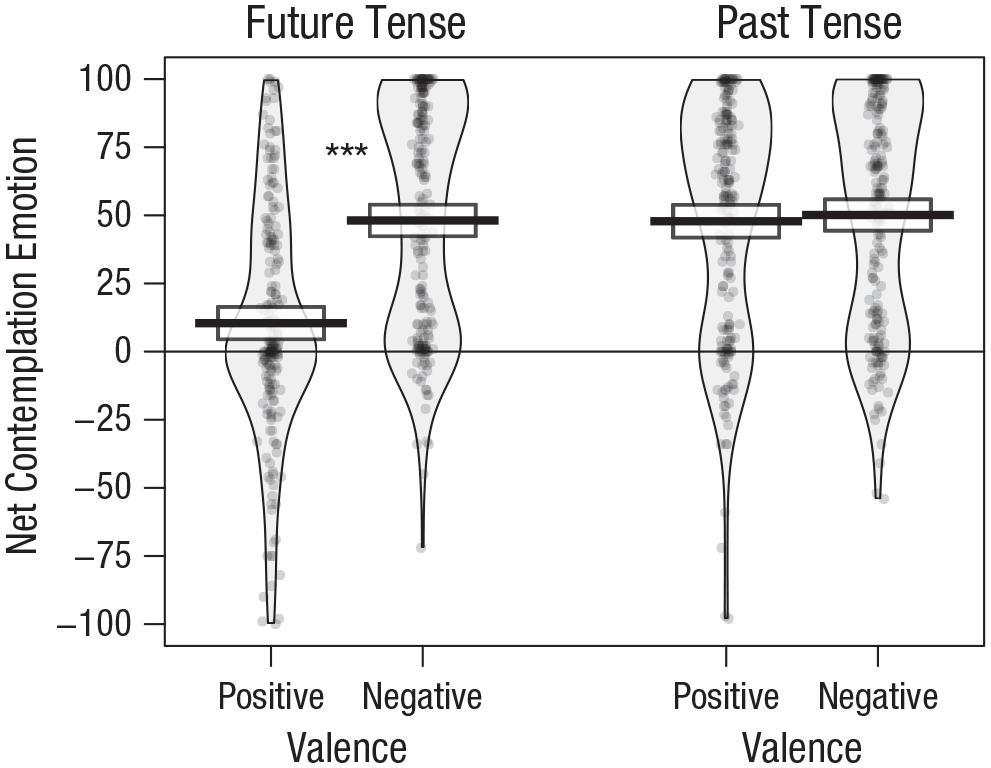
Contemplation emotion associated with past and future outcomes (positive vs. negative) in Study 2b. Horizontal bars show means, bands (around the means) show 95% confidence intervals, dots show raw individual data, and beans show smoothed density curves. Asterisks indicate a significant difference between outcomes (p < .001).
For future events, net contemplation emotion of shocks (dread; M = 48.13, SD = 41.88) was significantly stronger than net contemplation emotion of massage (positive anticipation; M = 10.43, SD = 47.15), t(199) = 8.88, p < .001, d = 0.63. However, the net contemplation emotion of past events was roughly equivalent, with the contemplation of past shocks (M = 50.13, SD = 41.64) being similar to the contemplation of past massage (M = 47.85, SD = 43.58), t(199) = 0.66, p = .51, d = 0.05 (Fig. 12).
Mediation analysis
As in Study 2a, a mediated moderation model (Muller et al., 2005) was used to examine whether the interactive effect of tense and valence on discounting was mediated by contemplation emotion. A bootstrapping model with 5,000 samples revealed that the indirect effect of the Tense × Valence interaction on discounting via contemplation emotion was significant (b = 0.057, 95% bias-corrected CI = [0.028, 0.096], p < .001; Fig. 13). These results show that contemplation emotion partially mediated the observed relationship between Tense × Event Valence and discounting. In other words, the weaker contemplation emotion of positive (compared with negative) events was unique to the future, which was associated with a discounting difference (the sign effect for future events but not past events).
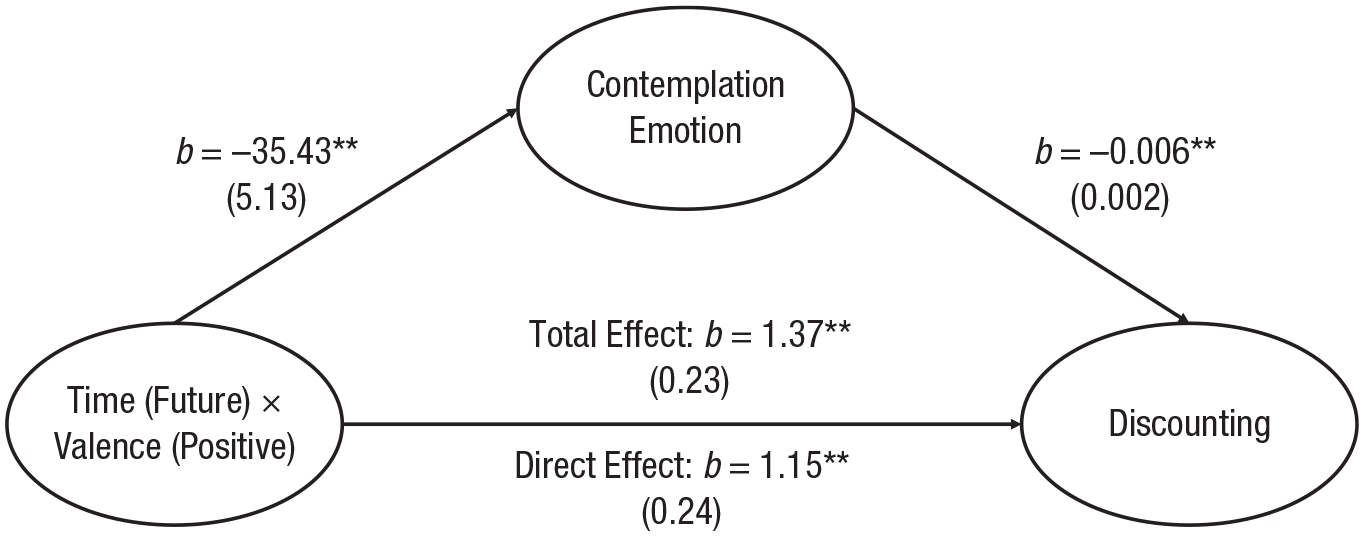
Mediation model from Study 2b showing the interactive effect of tense and valence on discounting, as mediated by contemplation emotion. Standard errors are in parentheses. Asterisks indicate significant paths (p < .01).
Frequency
Participants reported that they would think about massage (M = 44.93, SD = 28.56) equally as often as they would think about shocks (M = 44.77, SD = 28.81), F(1, 199) = 0.01, p = .93, η p 2 = .00, but that they would think about things in the future (M = 51.62, SD = 28.11) more than things in the past (M = 38.08, SD = 29.26), F(1, 199) = 74.40, p < .001, η p 2 = .27. However, these main effects were qualified by a Sign × Tense interaction, F(1, 199) = 16.78, p < .001, η p 2 = .08; when looking forward, people would think about future shocks (M = 53.66, SD = 28.95) more than future massage (M = 49.57, SD = 27.27), but when looking backward, people would think about past massage (M = 40.29, SD = 29.85) more than past shocks (M = 35.87, SD = 28.66).
Frequency of thoughts did not predict discount rates in a mixed model, β = −0.002, F(1, 798) = 0.77, p = .38. When we added fixed effects for sign, tense, and their interaction to the model, the predictive power of thought frequency remained nonsignificant, β = 0.001, F(1, 795) = 0.21, p = .64. Therefore, the effect of the Sign × Tense interaction on discount rates was not mediated by reported thought frequency, and thought frequency did not mediate the effect of the Sign × Tense interaction on discounting (b = −0.002, 95% bias-corrected CI = [−0.017, 0.007], p > .99).
Finally, thought frequency was not correlated with strength of contemplation emotion (reverse-scoring the losses; r = −.03, p = .38). Thus, thought frequency did not explain the differences in contemplation emotion that we observed between gains and losses.
Connection to the distant self
Participants reported being more connected to their temporally distant self when considering massage (M = 70.16, SD = 24.33) than when considering shocks (M = 68.11, SD = 25.54), F(1, 199) = 4.17, p = .04, η p 2 = .02. However, participants reported similar levels of connection to the future self and past self, F(1, 199) = 0.00, p = .99, η p 2 = .00, and there was no interaction between sign and tense, F(1, 199) = 1.29, p = .26, η p 2 = .01. Connection to the distant self was not correlated with discount rates (r = .00, p = .99). Therefore, connection to the distant self did not account for the effect of the Sign × Tense interaction on discount rates, and the mediation was not significant (b = −0.001, 95% bias-corrected CI = [−0.014, 0.003], p > .99).
Utility curvature
The median participant was indifferent about a 50% chance of receiving a 1-hr massage and a 50% chance of receiving a 10-s electric shock. The individually titrated values were dynamically carried through the rest of the survey for each participant, with the experimental design controlling for loss aversion (and subjective utility more generally).
We calculated utility-curvature-adjusted discount rates for each participant using the same procedure as in Study 2a. The utility curves were again quite linear. Therefore, the utility-curvature-adjusted discount rates were very highly correlated with their corresponding nominal discount rates (all rs ≥ .99, all ps < .001). We recalculated the key inferential statistics for discounting and contemplation emotion and found essentially the same results: including the main effect of sign on discounted utility, F(1, 199) = 477.13, p < .001, η p 2 = .71; the main effect of tense, F(1, 199) = 53.43, p < .001, η p 2 = .21; and the Sign × Tense interaction on discounted utility, F(1, 199) = 45.75, p < .001, η p 2 = .19. In a mixed model, contemplation emotion predicted discounted utility on its own, β = −0.013, F(1, 798) = 51.90, p < .001. When we included tense, sign, and their interaction, contemplation emotion remained significant, β = −0.007, F(1, 795) = 20.31, p < .001, and the Sign × Tense interaction was reduced but remained significant, β = 1.109, F(1, 795) = 18.94, p < .001 (consistent with partial mediation). The indirect effect of Sign × Tense through contemplation emotion to predict discounted utility was significant (b = 0.234, 95% bias-corrected CI = [0.117, 0.387], p < .001). Again, the fact that our results remained robust when we examined discounted experience (rather than discounted outcomes) suggests that our focal result was not produced by systematic differences in experience in the positive and negative domains.
Study 3
Whereas Studies 1 and 2 employed hypothetical scenarios, Study 3 measured contemplation emotion of actual events and explicitly distinguished contemplation emotion from predicted and recalled experience. We also specifically examined the occurrence of mixed emotions in different conditions.
Method
Participants
One hundred college students completed a 45-min study in a campus lab in exchange for $9. Four participants were excluded because they did not complete the dependent measures.
Procedure
On the basis of the results of a pretest (for more details, see the Supplemental Material), we selected four flavors of novelty jelly beans to represent good and bad flavors of matched intensity: watermelon, orange sherbet, dirt, and rotten egg.
Participants were informed of their randomly assigned jelly bean flavor (manipulated between subjects) and told that they would be eating this jelly bean in 15 min. They answered two questions about how pleasurable and displeasurable they thought the future experience of eating this jelly bean would be (predicted-experience measure) as well as both the pleasure and displeasure associated with their current feelings while waiting to eat the jelly bean (contemplation emotion). All answers were provided by placing a mark on a line with a total length of 16.5 cm, with the left end point marked “neutral” and the right end point indicating either extreme liking or extreme disliking (for sample questionnaires, see the Supplemental Material).
After completing a filler task for 15 min (word puzzles or mazes), participants consumed the jelly bean and answered questions regarding how pleasurable and displeasurable they perceived the current experience of eating the jelly bean to be (experience measure). After another 15 min of filler tasks, participants reported how pleasurable and displeasurable the past experience of eating the jelly bean was (recalled-experience measure) as well as the pleasure and displeasure associated with their current feelings while remembering this experience (contemplation emotion).
Results
For each measure, we calculated the net contemplation emotion by taking the difference between ratings of pleasure and displeasure (for participants assigned to a good-tasting jelly bean) or the difference between ratings of displeasure and pleasure (for participants assigned to a bad-tasting jelly bean). We observed a significant Tense × Valence interaction on contemplation emotion across past, present, and future conditions, F(2, 188) = 7.27, p = .001 (Greenhouse-Geisser adjusted p = .002), η p 2 = .07. Looking at the simple effects of valence within future and past events, we found that participants reported significantly lower net contemplation emotion for future positive events compared with future negative events, t(93) = −3.39, p = .001, d = 0.69, but similar contemplation emotion for past positive and negative events, t(92) = −0.37, p > .250, d = 0.08 (Fig. 14).

Contemplation emotion related to past and future outcomes (positive vs. negative) and experience emotion related to present outcomes (positive vs. negative) in Study 3. Horizontal bars show means, bands (around the means) show 95% confidence intervals, dots show raw individual data, and beans show smoothed density curves. Asterisks indicate a significant difference between outcomes (p < .001).
The Tense × Valence interaction remained significant when we controlled for both pre- and postconsumption perceptions of the actual experience of eating the jelly bean (i.e., our predicted- and recalled-experience measures), F(2, 188) = 7.75, p < .001, η p 2 = .07. The mean predicted- and recalled-experience measures often differed from the corresponding contemplation-emotion measures, and correlations (rs) between these two types of measures ranged from .26 to .75 (Table 3). Thus, participants were generally able to distinguish the impact of contemplating the event from their imagined or recalled experience of the event itself. Importantly, the condition in which contemplation emotion was the lowest (positive anticipation) was not accompanied by a corresponding drop in the predicted-experience measure. Furthermore, the magnitude of the predicted- and recalled-experience measures did not differ on the basis of whether the flavor was positive or negative, as reported either 15 min before tasting the bean, t(89) = 0.60, p > .250, d = 0.12, or 15 min after tasting the bean, t(94) = 0.26, p > .250, d = 0.05. These findings suggest that differences in discounting stem from the phenomenological impact of contemplating an upcoming event rather than from differing perceptions of the nature of the experience itself.
Comparison Between Measures of Contemplation Emotion and Predicted or Recalled Experience From Study 3
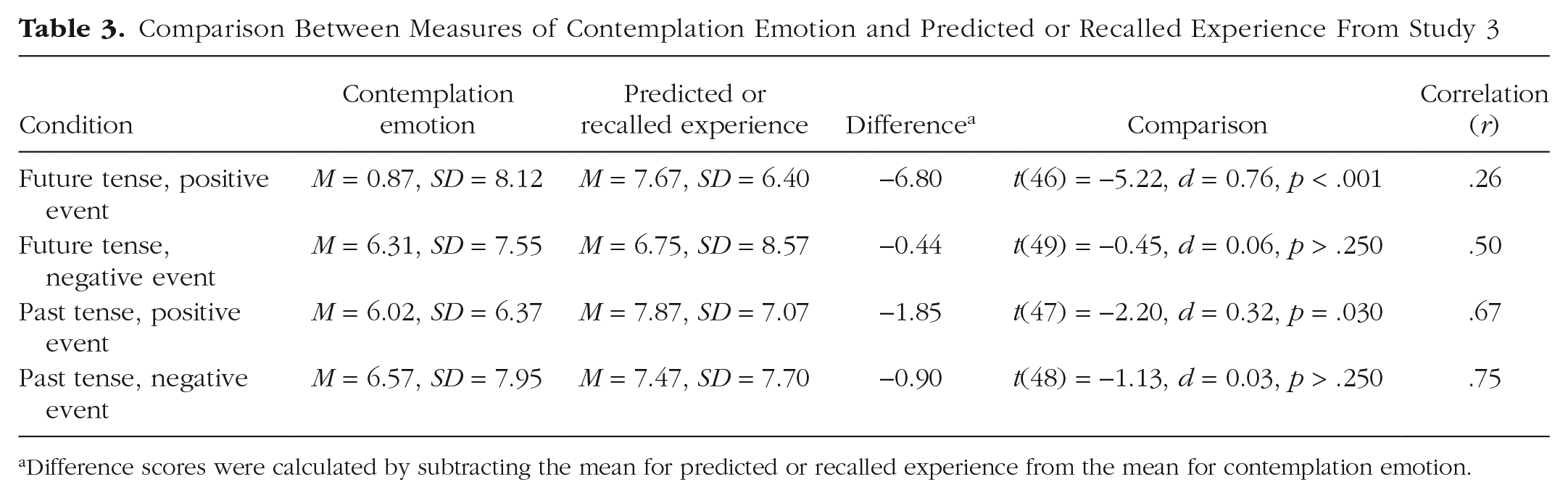
Difference scores were calculated by subtracting the mean for predicted or recalled experience from the mean for contemplation emotion.
We measured positive and negative emotion on separate unipolar scales, which allows us to compare the mix of both emotions for each event. A mixed analysis of variance revealed a significant three-way interaction among tense, event valence, and type of emotion measured (i.e., positive or negative), F(2, 188) = 12.79, p < .001, η p 2 = .12 (Fig. 15). Notably, when comparing past and future positive events, we found a significant interaction between tense and type of emotion measured, F(1, 46) = 14.27, p < .001, η p 2 = .24. The amount of anticipatory negative emotion associated with positive events (M = 4.43, SD = 4.88) was just as high as the amount of anticipatory positive emotion (M = 5.30, SD = 5.38), t(91) = −0.82, p > .250, d = 0.17. This suggests that the contemplation emotion of future positive events is a mixed state characterized by both positive and negative emotion. In contrast, the contemplation emotion of past positive events was predominantly characterized by positive emotion (M = 7.40, SD = 5.59) over negative emotion (M = 1.37, SD = 2.51), t(64) = 6.74, p < .001, d = 1.39.

Contemplation emotion related to past and future outcomes (positive vs. negative) and experience emotion related to present outcomes (positive vs. negative) in Study 3, separately for jelly beans with good flavor and bad flavor. Horizontal bars show means, bands (around the means) show 95% confidence intervals, dots show raw individual data, and beans show smoothed density curves. Asterisks indicate significant differences between outcomes (p < .001).
However, there was no analogous interaction between tense and type of emotion measured for negative events, F(1, 48) = 0.04, p > .250, η p 2 < .01. In this case, the amount of positive emotion associated with the contemplation emotion of negative events (M = 1.99, SD = 3.63) was significantly lower than the amount of negative emotion (M = 8.43, SD = 5.95) across both tenses, F(1, 48) = 53.88, p < .001, η p 2 = .53. Thus, it seems that the mixed emotional state was unique to future positive events. This resulted in a net lowering of associated positive emotion in the contemplation of positive future events, which is consistent with the greater discounting of positive (vs. negative) upcoming events.
Study 4
Study 4 again used actually experienced events and also included time-preference measures. In addition, uncertainty about event occurrence and reaction to the event were examined as possible alternative explanations.
Method
Participants
Two hundred one participants from MTurk (58.7% female; mean age = 36 years) were recruited through TurkPrime (Litman, Robinson, & Abberbock, 2017) and completed this online study in return for $1.70 compensation.
Procedure
Each participant was randomly assigned to either the puppy condition or the cockroach condition. Participants first read the instruction, “Near the middle of this study (in about 5 minutes), you will look at 10 photos of [puppies/cockroaches].” On the next page, participants were given an attention check: “Quiz: What will you see in the photos?” which they answered with a fill-in-the-blank free response.
Next, participants answered questions about uncertainty, time preference, and contemplation emotion for the future puppy or cockroach photos (listed in Table 4). Participants then completed a 5-min distractor task, which involved watching a video that showed various neutral sentences being typed out on the screen, one letter at a time (e.g., “I drove my car to the supermarket today. I would estimate that there were something like one thousand peaches”), and then answering questions about the sentences. Then, participants viewed 10 photos of puppies or cockroaches, as appropriate. After the photos, participants completed another 5-min distractor task, with another video of neutral sentences and questions. After the 5 min had passed, participants answered questions about uncertainty, time preference, and contemplation emotion for the past puppy or cockroach photos (listed in Table 4).
Questions, Response Options, and Mean Responses About the Puppy and Cockroach Photos in Study 4
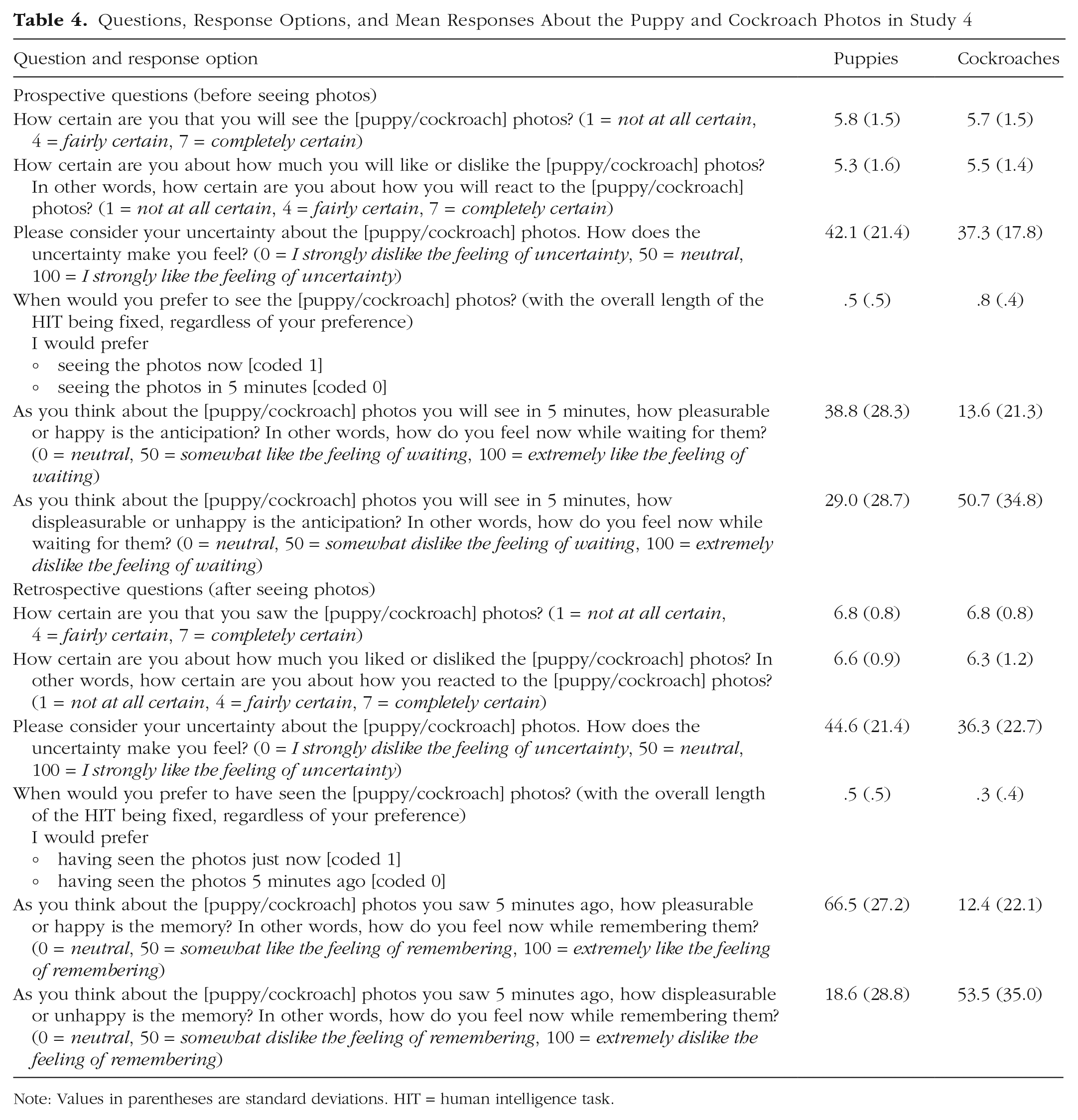
Note: Values in parentheses are standard deviations. HIT = human intelligence task.
Finally, participants completed the 15-item brief version of the Need for Cognitive Closure (NFC) scale (Roets & Van Hiel, 2011) and the 23-item Multiple Stimulus Types Ambiguity Tolerance (MSTAT) scale (McLain, 1993). They also indicated their gender and age.
Results
Answers to the attention check were marked correct if participants mentioned puppies or cockroaches, as appropriate to their condition; 99% of participants answered correctly, and all are included in the analyses below.
Time preferences
As seen in Table 4, people had different time preferences for puppies than for cockroaches, depending on whether they were looking forward or backward. In prospection, 52% preferred to see the puppy photos immediately, whereas only 20% preferred to delay the cockroach photos (z = 4.74, p < .001). This is consistent with previous research on the sign effect: People want immediate positives more strongly than they want to postpone negatives. In retrospection, 49% preferred to have just seen the puppies, whereas 73% preferred to have seen the cockroaches further in the past (z = −4.12, p < .001). This shows a reversal of the sign effect: When looking backward, people want to have bad things farther away in time more strongly than they want to have good things near in time.
Contemplation emotion
As is apparent in Table 4, there is an asymmetry between the contemplation of future puppies and the contemplation of future cockroaches. Contemplation of future puppy photos brought a combination of positive contemplation (M = 38.8, SD = 28.3) and negative contemplation (M = 29.0, SD = 28.7), paired-samples t(97) = 2.51, p = .01, d = 0.25, whereas contemplation of future cockroaches mainly felt negative (M = 50.7, SD = 34.8) and not positive (M = 13.6, SD = 21.3), paired-samples t(102) = 9.90, p < .001, d = 0.98. In contrast, when participants looked backward, the contemplation of puppies versus cockroaches was more symmetric. Recalling puppies mainly felt positive (M = 66.5, SD = 27.2) and not negative (M = 18.6, SD = 28.8), paired-samples t(97) = 11.79, p < .001, d = 0.98, whereas recalling cockroaches mainly felt negative (M = 53.5, SD = 35.0) and not positive (M = 12.4, SD = 22.1), paired-samples t(102) = 10.22, p < .001, d = 1.01. Thus, as in Study 3, the pattern of mixed positive and negative emotion was most pronounced when participants contemplated future positive events.
We calculated net contemplation-emotion scores for each participant by subtracting negative contemplation from positive contemplation and reverse-scoring the cockroach scores so that we could compare the strength of contemplation emotion for positive (puppy) versus negative (cockroach) events (as in previous studies). When participants looked forward, net contemplation emotion of the cockroach photos (M = 37.10, SD = 38.02) was stronger than net contemplation emotion of the puppy photos (M = 9.78, SD = 38.52), t(199) = 5.06, p < .001, d = 0.71. In retrospection, net contemplation emotion of the puppy (M = 47.88, SD = 40.20) and cockroach (M = 41.16, SD = 40.83) photos was about equally strong, reverse-scored t test, t(199) = 1.18, p = .24, d = 0.17. An overall analysis of variance found a Sign × Tense interaction, F(1, 199) = 32.01, p < .001, η p 2 = .14, confirming the overall pattern seen in Figure 16.
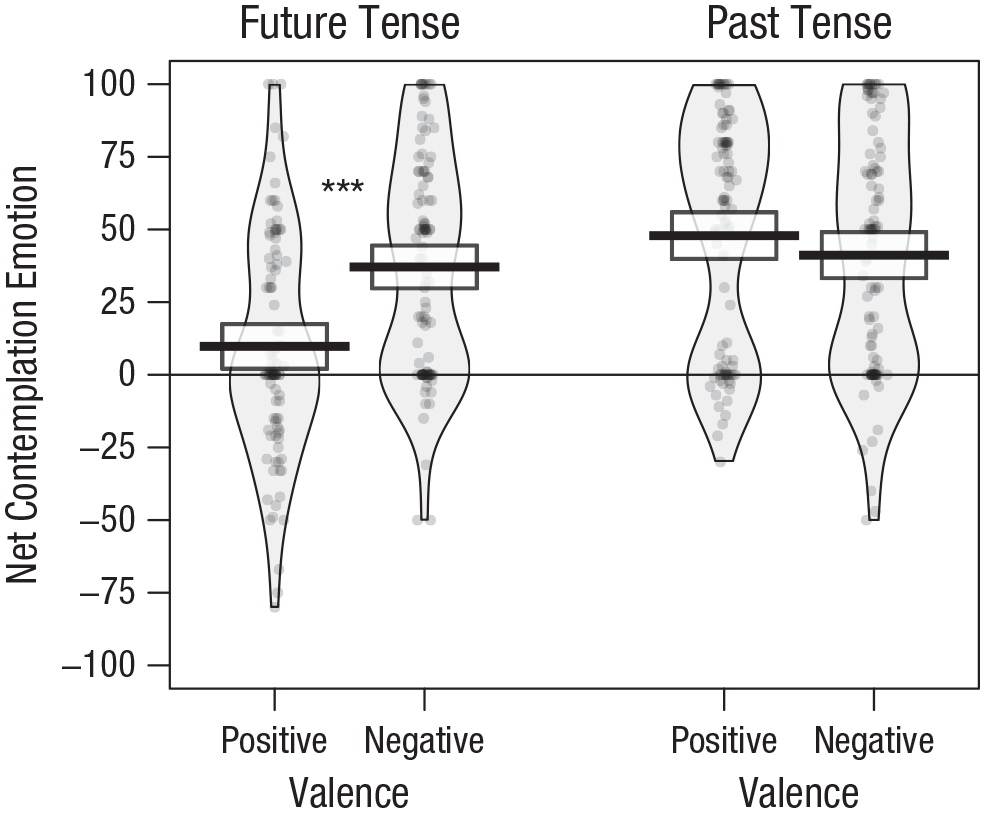
Net contemplation emotion related to past and future outcomes (positive vs. negative) in Study 4. Horizontal bars show means, bands (around the means) show 95% confidence intervals, dots show the raw individual data, and beans show smoothed density curves. Asterisks indicate a significant difference between outcomes (p < .001).
Furthermore, contemplation emotion was a significant predictor of discounting. A mixed model with sign, tense, their interaction, and contemplation emotion as fixed factors predicting discounting found a significant effect of contemplation emotion, b = −0.002, F(1, 397) = 11.37, p = .001. The indirect pathway of a mediation model (going from the Sign × Tense interaction to contemplation emotion to discounting) using a bootstrapping test with 5,000 replications was significant (b = 0.017, 95% bias-corrected CI = [0.007, 0.032], p < .01).
Uncertainty
As seen in Table 4, we asked three questions about uncertainty: uncertainty about the event (“Will it happen?”), uncertainty about the participant’s reaction (“Will I like it?”), and feelings about uncertainty (“How does the uncertainty make me feel?”).
Regarding outcome uncertainty, people were more certain about the past (M = 6.84, SD = 0.78) than about the future (M = 5.76, SD = 1.52), main effect F(1, 199) = 80.39, p < .001, η p 2 = .29, but there was no difference in outcome uncertainty between the puppy and cockroach conditions, F(1, 199) = 0.24, p = .63, η p 2 = .00, and no interaction effect, F(1, 199) = 0.42, p = .52, η p 2 = .00. Furthermore, ratings of outcome uncertainty do not predict time preferences: A mixed model with sign, tense, their interaction, and outcome uncertainty predicting discounting revealed no effect of outcome uncertainty, b = −0.01, F(1, 397) = 0.46, p = .50.
Regarding reaction uncertainty, participants were more sure of their reaction for the past (M = 6.46, SD = 1.11) than the future (M = 5.42, SD = 1.54), main effect F(1, 199) = 83.09, p < .001, η p 2 = .30, but there was no overall difference between feelings about puppies and cockroaches, F(1, 199) = 0.10, p = .75, η p 2 = .00. This was qualified by a Sign × Tense interaction, F(1, 199) = 6.09, p = .01, η p 2 = .03, indicating that the difference in reaction uncertainty for future versus past was larger for puppies than for cockroaches. When looking forward, people were equally certain about their reaction to puppies (M = 5.30, SD = 1.63) and cockroaches (M = 5.53, SD = 1.45), t(199) = −1.10, p = .27, d = −0.16, but when looking backward, people were more certain about their reaction to puppies (M = 6.63, SD = 0.94) than cockroaches (M = 6.30, SD = 1.24), t(199) = 2.13, p = .03, d = 0.30. Reaction uncertainty did not predict discounting, however, b = 0.004, F(1, 397) = 0.05, p = .83.
Regarding feelings about uncertainty, participants disliked feelings of uncertainty overall, with an average rating (M = 40.00, SD = 18.46) below the scale midpoint of 50, t(201) = −7.69, p < .001. Moreover, participants enjoyed the feeling of uncertainty about puppies (M = 43.37, SD = 21.40) more than the feeling of uncertainty about cockroaches (M = 36.79, SD = 21.40), main effect F(1, 199) = 6.56, p = .01, η p 2 = .03, but there was no difference between future and past, F(1, 199) = 0.26, p = .61, η p 2 = .00, and no interaction, F(1, 199) = 1.43, p = .23, η p 2 = .01. Moreover, feelings of uncertainty did not predict discounting, F(1, 397) = 0.04, p = .84, η p 2 = .00. However, feelings of uncertainty did moderately predict contemplation emotion (r = .24, p < .001); participants who enjoyed feelings of uncertainty (e.g., feeling excitement about the unknown) also tended to enjoy contemplating temporally distant events.
Finally, turning to individual-differences measures of attitudes toward uncertainty, we found that the need for cognitive closure (NFC scale) and intolerance for ambiguity (MSTAT scale) were highly correlated with each other (r = .84, p < .001). Both the NFC scale and the MSTAT scale predicted lower contemplation emotion (r = −.24, p < .001, and r = −.23, p < .001, respectively). In other words, people who need closure (and do not like ambiguity) do not enjoy the feeling of thinking about distant events. However, the NFC and MSTAT scales did not predict time preferences, whether in aggregate or when we looked separately at every combination of future versus past or positive versus negative (all ps ≥ .11). Neither did the NFC scale or MSTAT scale moderate the effects of sign, tense, or the Sign × Tense interaction: All interactions with the NFC scale or the MSTAT scale were nonsignificant (ps ≥ .14).
In summary, none of the measures of uncertainty explained the sign effect in future discounting and its reversal in past discounting, but attitudes toward uncertainty did contribute to contemplation emotion.
General Discussion
People’s tendency to discount gains more than losses emerges more strongly and consistently for future events than for past ones, even when positive and negative events are equated on subjective present impact. This suggests that the sign effect is not driven by loss aversion. Rather, our work reveals that the sign effect is uniquely related to the mixed nature of the contemplation emotion of future positive events.
Although we have shown that contemplation is associated with time preferences, there are, of course, many other factors that determine the overall utility of, and time preferences for, an event. For example, research suggests that future losses loom closer in time, which is consistent with lower discount rates for losses (Bilgin & LeBoeuf, 2010). An important boundary condition is that we designed our stimuli so we could study the discounting of time-limited events. Judgments about people may well show different patterns, for a variety of reasons (Brandimarte, Vosgerau, & Acquisti, 2018).
Because current actions can affect future, but not past, outcomes, it may make sense that people are generally more invested in experiences that are forthcoming rather than foregone. Beyond a mere difference in intensity, this asymmetry can also lead to a difference in the composition of emotions. For instance, after a reward has already been secured, one may be purely happy in remembering the achievement. When one attempts to secure a future reward, however, both positive and negative emotions could be useful: The unpleasant experience of impatience may actually aid in focusing attention on potential future rewards that need to be secured sooner rather than later. Just as the tendency to value the future more than the past may serve an adaptive function (Caruso & Van Boven, 2019; Suhler & Callender, 2012), so too may the unique presence of varying emotions related to upcoming positive events, thus contributing to the sign effect in anticipatory thought.
Supplemental Material
Molouki_OpenPracticesDisclosure – Supplemental material for The Sign Effect in Past and Future Discounting
Supplemental material, Molouki_OpenPracticesDisclosure for The Sign Effect in Past and Future Discounting by Sarah Molouki, David J. Hardisty and Eugene M. Caruso in Psychological Science
Supplemental Material
Molouki_Supplemental_Material_rev – Supplemental material for The Sign Effect in Past and Future Discounting
Supplemental material, Molouki_Supplemental_Material_rev for The Sign Effect in Past and Future Discounting by Sarah Molouki, David J. Hardisty and Eugene M. Caruso in Psychological Science
Footnotes
Acknowledgements
We thank Dale Griffin and Daniel Read for helpful suggestions on an earlier draft of this article.
Action Editor
Timothy J. Pleskac served as action editor for this article.
Author Contributions
All the authors developed the study concept and design. Data were collected and analyzed by S. Molouki and D. J. Hardisty, who also drafted the manuscript. E. M. Caruso provided critical revisions. All the authors approved the final manuscript for submission.
Declaration of Conflicting Interests
The author(s) declared that there were no conflicts of interest with respect to the authorship or the publication of this article.
Funding
This research was supported by the Social Sciences and Humanities Research Council of Canada, the Charles E. Merrill Faculty Research Fund at The University of Chicago Booth School of Business, and a grant from the John Templeton Foundation to E. M. Caruso. Opinions expressed in this publication are those of the authors and do not necessarily reflect the views of the John Templeton Foundation.
Open Practices
All data and materials have been made publicly available via the Open Science Framework and can be accessed at osf.io/v4qys. The design and analysis plans for these studies were not preregistered. The complete Open Practices Disclosure for this article can be found at http://journals.sagepub.com/doi/suppl/10.1177/0956797619876982. This article has received the badges for Open Data and Open Materials. More information about the Open Practices badges can be found at  .
.
Notes
References
Supplementary Material
Please find the following supplemental material available below.
For Open Access articles published under a Creative Commons License, all supplemental material carries the same license as the article it is associated with.
For non-Open Access articles published, all supplemental material carries a non-exclusive license, and permission requests for re-use of supplemental material or any part of supplemental material shall be sent directly to the copyright owner as specified in the copyright notice associated with the article.
