




Abstract
Sex differences in misperceptions of sexual interest have been well documented; however, it is unclear whether this cognitive bias could be explained by other factors. In the current study, 1,226 participants (586 men, 640 women) participated in a speed-dating task in which they rated their sexual interest in each other as well as the sexual interest they perceived from their partners. Consistent with previous findings, results showed that men tended to overperceive sexual interest from their partners, whereas women tended to underperceive sexual interest. However, this sex difference became negligible when we considered potential mediators, such as the raters’ sociosexual orientation and raters’ tendency to project their own levels of sexual interest onto their partners. These findings challenge the popular notion that sex differences in misperceptions of sexual interest have evolved as a specialized adaptation to different selection pressures in men and women.
Keywords
In theory, accurately detecting sexual interest from members of the opposite sex should be evolutionarily adaptive for species with mutual mate choice, such as humans. Doing so allows individuals to increase their adaptive fitness by investing effort into potential mates who are likely to reciprocate sexual interest while avoiding those who are unlikely to yield a sexual opportunity or not be committed to a relationship, depending on each individual’s goals.
When investigating perceptions of sexual interest, we can distinguish between two forms of accuracy and inaccuracy—tracking accuracy and mean-level bias. First, little is known about whether and to what extent individuals can distinguish more and less sexually interested potential mates (i.e., an individual’s tracking accuracy regarding his or her perceptions of sexual interest), especially in the context of brief interactions. If there are universal cues of sexual interest, we might expect high tracking accuracy, but if cues are more idiosyncratic, these cues may not be readily interpretable in brief interactions, and tracking accuracy may be poor or absent. Second, regardless of their ability to distinguish more and less sexually interested potential mates, individuals may exhibit mean-level biases such that they tend, on average, to overestimate or underestimate others’ sexual interest. Indeed, previous research has consistently found that, on average, men overperceive sexual interest from women, and women underperceive sexual interest from men (Abbey, 1982; Farris, Treat, Viken, & McFall, 2008; Fletcher, Kerr, Li, & Valentine, 2014; Perilloux, Easton, & Buss, 2012).
This sex difference in sexual-interest perception has been explained by appealing to error-management theory, which stipulates that cognitive biases can evolve over generations when the cost of one type of error is larger than the other type (i.e., a false hit vs. a miss; Haselton & Buss, 2000). In the context of sexual-interest perceptions, the sex differential in the minimum effort required to produce offspring (Trivers, 1972) means it is evolutionarily more costly for men to miss a mating opportunity with an interested woman than for women to miss a mating opportunity with an interested man, whereas it is more costly for women to engage in sex with a man who is uncommitted than for men to engage in sex with an uncommitted woman (Haselton & Buss, 2000; Haselton & Nettle, 2006). Error-management theory suggests that these sex-differentiated selection pressures led each sex to evolve to bias its perceptions of sexual interest from others in favor of the error that is less costly.
Although the observed sex differences in sexual-interest perception fit nicely within the framework of error-management theory, there has been limited exploration of potential mediators of the sex difference. Lemay and Wolf (2016) found, in the context of opposite-sex friendships, that factors such as self-perceived attractiveness or an individual’s own sexual interest predicted perceived sexual interest from his or her opposite-sex friend. Traits such as these, which potentially differ between the sexes and are also linked to perceptions of sexual interest, could lead to a situation in which the sex difference in sexual-interest perception is mediated by its association with other traits, which could complicate or challenge the error-management explanation. In the current study, we investigated three potential mediators: those examined by Lemay and Wolf (2016) as well as sociosexual orientation.
Men, compared with women, tend to show a greater preference for pursuing a short-term mating strategy (Gangestad & Simpson, 2000) and tend to be more open to engaging in uncommitted sexual encounters (Penke & Asendorpf, 2008; Schmitt, 2005). Sociosexual orientation may also be associated with sexual-interest perceptions; Perilloux et al. (2012) found that short-term orientation in men was associated with greater perceptions of sexual interest from women (although no significant relationship was found between women’s short-term orientation and sexual-interest perceptions from men), whereas Howell, Etschells, and Penton-Voak (2012) found that short-term orientation was associated with overperception of sexual interest regardless of sex. One could imagine the link between these traits being an adaptation. It may be more adaptive for individuals, regardless of their sex, who are pursuing a short-term mating strategy to overperceive sexual interest from others to avoid missing mating opportunities. It also may be more adaptive for those pursuing a long-term strategy to underperceive sexual interest from others to avoid partners uninterested in a committed relationship.
Another possible mediator of the sex difference in sexual-interest perception is self-rated attractiveness. This possible mediation could occur if individuals who think they are attractive tend to assume that others do as well (i.e., individuals assume that self-appraisals are similar to others’ appraisals of them; see S. L. Murray, Holmes, & Griffin, 2000). Alternatively, individuals may possess insight into their own attractiveness on the basis of previous interactions, which would lead previously successful individuals to both increase their own perceptions of self-attractiveness and overperceive interest from potential partners in future interactions. Indeed, individuals who perceive themselves as more attractive tend to overperceive sexual interest from a partner (Kohl & Robertson, 2014; Lemay & Wolf, 2016), and men tend to have higher self-perceptions of attractiveness compared with women (Feingold & Mazzella, 1998; Hayes, Crocker, & Kowalski, 1999).
Another possibility is that the sex difference in misperception of sexual interest is explained by men having a greater sexual interest in women than vice versa. It is known that men, compared with women, are more likely to be interested in a given potential partner (Henningsen, Henningsen, & Valde, 2006). It is also known that individuals’ sexual interest in a friend is associated with individuals’ perception of interest from the friend (Lemay & Wolf, 2016). The latter association was interpreted in terms of projection of one’s own sexual interest onto others because longitudinal analysis did not indicate reverse causality whereby individuals first detect interest from someone and then become more interested in that person (Lemay & Wolf, 2016); in addition, Maner et al. (2005) found that experimentally activating a mate-search goal increased perception of sexual arousal in attractive opposite-sex facial photos. Therefore, a sex difference in misperception of sexual interest could be a by-product of men being more interested in other individuals and projecting that interest onto them. Although Lemay and Wolf (2016) found support for the idea that projection explains sex differences in misperceptions of sexual interest within friendship pairs, in which feelings would have had the opportunity to manifest (or not) and misperceptions could be reinforced through repeated exposure, it is unclear whether projection explains the sex difference in misperception between strangers. Note that although we adopt the terminology of projection for concision, we do not infer any specific psychological processes or rule out other causal possibilities.
Our study had two aims: First, we investigated whether individuals can distinguish between sexually interested and uninterested strangers in a short meeting, and second, we explored possible mediators of the sex difference in mean-level bias. We conducted a speed-dating study in which we measured individuals’ (raters’) perception of their partners’ sexual interest as well as the partners’ self-reported sexual interest in each rater. Accuracy was operationalized as the correspondence between raters’ perception of partners’ sexual interest and partners’ actual reported interest; specifically, tracking accuracy refers to whether participants reported higher perceived interest from partners who also gave higher interest ratings, whereas mean-level bias refers to raters’ overall tendency to overestimate or underestimate their partner’s sexual-interest ratings. We analyzed the data using linear mixed-effects modeling, which allowed us to account for the dyadic nature of the data and investigate mean-level bias and tracking accuracy of perceptions of sexual interest simultaneously. First, we tested whether individuals possessed a degree of tracking accuracy for sexual-interest perceptions and whether traits of the raters or their partners influenced this tracking accuracy. Second, we assessed sex differences in perception of sexual interest and whether this association was mediated by traits of the rater, such as the raters’ age, sociosexual orientation, and self-rated attractiveness, or was mediated by a sex difference in raters’ own interest in the partners.
Method
Participants
Participants were 1,226 individuals (586 men, 640 women; mean age = 19.77 years, SD = 2.88 years) who were enrolled in a first-year psychology course between 2012 and 2018 and recruited as part of a larger study. All participants recruited between these years who met the following criteria were included in the final sample. Participation was conditional on identifying as heterosexual, not being in a committed relationship, and being open to answering personal questions regarding one’s sexual history. Participants signed up to testing sessions advertised as a “speed-meeting study” with a maximum of 5 men and 5 women per session; however, there was variation in session size either because of fluctuation in sign-up rates or because participants did not attend sessions they had signed up for. The total number of sessions was 187; the average number of participants in a testing session was 3.17 men and 3.44 women, which yielded 3,850 interactions. The sample size for the current study was much larger than in previous research with a similar design (e.g., Perilloux et al., 2012).
Measures
Sociosexual Orientation Inventory (SOI) Revised
The SOI (Penke & Asendorpf, 2008) measures participants’ willingness to engage in uncommitted sex across three domains: past behavioral experiences, attitudes toward uncommitted sex, and desire for sex. Each subscale consists of three items rated on a 9-point scale. Participant’s SOI score was calculated by summing all items across all three domains; higher scores indicated more willingness to engage in uncommitted sex (i.e., individuals were sociosexually unrestricted).
Self-rated attractiveness
Participants were asked to separately rate their facial attractiveness, bodily attractiveness, personality attractiveness, and overall attractiveness, each on a 7-point scale (1 = not at all, 7 = extremely). Self-rated attractiveness was calculated by summing these four items. These items were adapted from the work of Perilloux et al. (2012), except that we added the personality-attractiveness item.
Procedure
After arriving at the lab, participants first completed an initial questionnaire, which included demographic information and the measure of self-rated attractiveness. During this time, men and women were separated in different rooms.
After all participants completed the questionnaire, they were told they would be meeting each member of the opposite sex who had also signed up for the testing session. For each meeting, they were given 3 min and were told they were free to discuss whatever topic they liked. At the end of the 3-min period, a bell rang, which acted as a cue for participants to finish their interaction and rate their partner on various traits. Traits pertinent to the analyses reported here were participants’ ratings of sexual interest in their speed-dating partner as well as the perceived sexual interest of their partner (each rated on a 7-point scale from 1, not at all, to 7, extremely). These items were taken from the work by Perilloux et al. (2012). After all participants completed their ratings, one sex (chosen randomly for each session) would rotate to the next interaction until all male and all female participants had met each other. After the speed-dating task, participants were again separated by sex and completed a final questionnaire, which included the SOI.
Statistical analysis
The data were analyzed using linear mixed-effects modeling in the lme4 (Version 1.1-19; Bates, Mächler, Bolker, & Walker, 2015) and lmerTest (Version 3.0-1; Kuznetsova, Brockhoff, & Christensen, 2017) packages in the R programming environment (R Core Team, 2013). To test the potential influences of sexual interest on perception, we ran five models. For all models, the outcome variable was raters’ perception of their partner’s sexual interest in them. Model 1 (base model) included only rater sex, rater age, and partner’s actual interest as predictors; this model was conducted to establish base estimate sizes of partners’ actual interest and raters’ sex on perceptions of sexual interest. In Model 2, we added each of the potential mediators as predictors: sociosexual orientation, self-rated attractiveness, and raters’ own sexual interest in the partner (we refer to this as the full model). In each of the remaining models, we removed one of the potential mediators from the full model to test for potential mediation while controlling for the other variables. All predictors were z scored at the appropriate group level before being entered into the model (i.e., age, sociosexual orientation, and self-rated attractiveness at the rater level; partners’ actual sexual interest and raters’ own sexual interest at the rater–partner interaction level, i.e., grand-mean centered). As a result, estimate sizes can be interpreted as the change in the 7-point scale of the outcome variable for every 1-standard-deviation increase in the predictor. Raters’ sex was effect coded (−.5 for female, .5 for male).
Terms for the interaction between partners’ actual sexual interest and all rater-level variables were included to test whether traits of the rater influenced the tracking accuracy of perceptions of sexual interest. To account for nonindependence, we specified random intercepts for each rater, partner, and speed-dating session. Random slopes were specified maximally following the recommendations of Barr, Levy, Scheepers, and Tily (2013) and Barr (2013). We assessed for causal mediation via bootstrapping using the mediate package in R (Tingley, Yamamoto, Hirose, Keele, & Imai, 2014) with a simplified random-effects structure. For full model specifications and results, including estimated random effects, see the Supplemental Material available online. We ran an additional model that included raters’ mean interest as an additional predictor to control for potential between-rater effects (e.g., differences in scale usage). Results from this model did not change the interpretation of the data; therefore, this model is given in the Supplemental Material. We also ran a model including additional predictors of partner traits to test whether perceptions of sexual interest were more accurate for certain partners (e.g., do sociosexually unrestricted partners give more easily interpretable cues of sexual interest?); this additional analysis is reported in the Supplemental Material. The data set, analysis code supporting this study, and full model results are publicly available on the Open Science Framework at https://osf.io/je4h7/.
Results
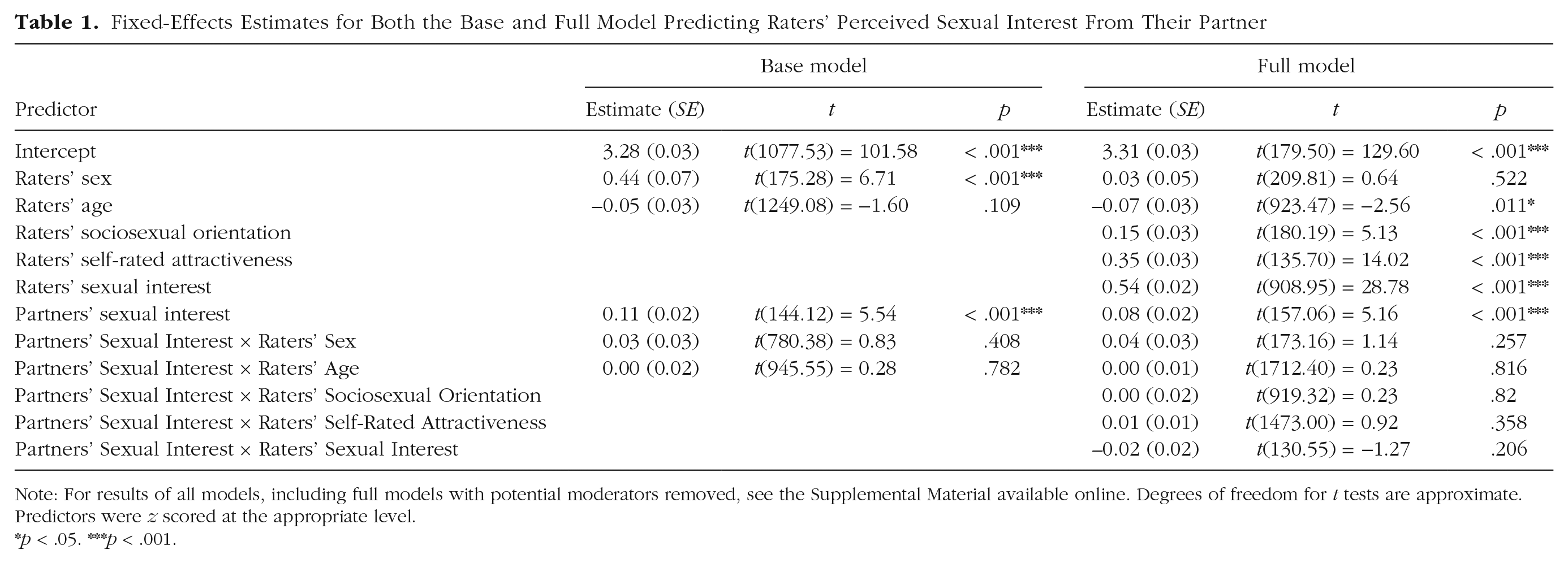
Correlations between all participant-level predictors were less than .33, which indicates that levels of multicollinearity were not problematic (see the Supplemental Material for full details). Fixed-effects estimates for the base and full models are reported in Table 1 (see the Supplemental Material for full results for all models).
Fixed-Effects Estimates for Both the Base and Full Model Predicting Raters’ Perceived Sexual Interest From Their Partner
Note: For results of all models, including full models with potential moderators removed, see the Supplemental Material available online. Degrees of freedom for t tests are approximate. Predictors were z scored at the appropriate level.
p < .05. ***p < .001.
Tracking accuracy
In all models, there was a small but significant main effect of partners’ actual sexual interest on raters’ perceived sexual interest, which suggests that raters were somewhat accurate in perceiving the sexual interest of their partners. However, none of the interactions between raters’ traits (sex, age, sociosexual orientation, and self-rated attractiveness) and partners’ actual sexual interest were significant; that is, none of the raters’ traits included in the model were significantly related to the tracking accuracy of perceptions of sexual interest. In addition, there was no significant interaction between raters’ own sexual interest and partners’ actual sexual interest, which indicates that being interested in a partner was not significantly associated with increased accuracy of sexual-interest perceptions.
Mean-level bias
When investigating mean-level bias in perceptions of sexual interest, we found that there was a significant main effect of sex in the base model (i.e., the model without any potential mediators): Men perceived higher levels of sexual interest from their partners than did women; this is consistent with previous research suggesting that men are more likely than women to overperceive sexual interest. We also found that there were significant main effects of raters’ age; younger participants perceived higher levels of sexual interest from their partners.
In the full model (i.e., which included raters’ own sexual interest and all potential mediators as predictors), there were significant main effects of raters’ sociosexual orientation and self-perceived attractiveness: Participants who were oriented toward short-term relationships and those who rated themselves as more attractive perceived higher levels of sexual interest from their partners. The largest effect was a significant main effect of raters’ own sexual interest on raters’ perceived interest from a partner, consistent with raters projecting their own interest onto their partner. With these potential mediators in the model, the main effect of rater sex on perceptions of sexual interest found in the base model was no longer significant. This suggests that this sex difference can be collectively explained by the potential mediators.
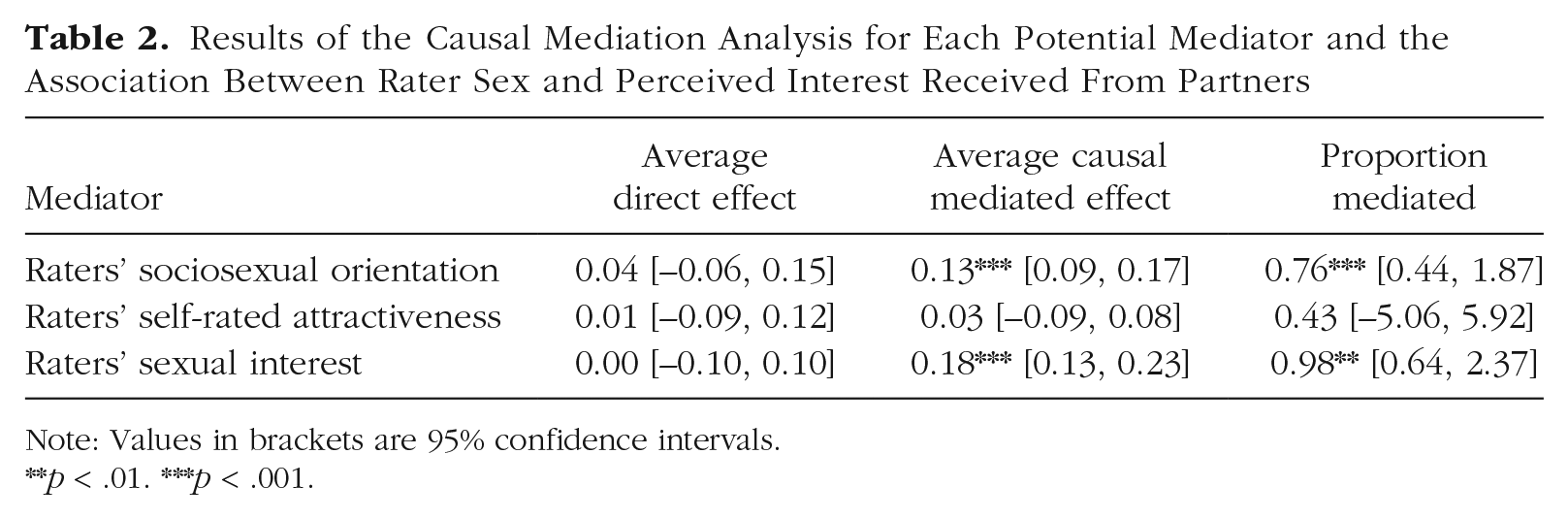
To test the influence of each individual mediator, we created three additional models, in each of which one mediator was dropped. If the dropped mediator helped explain the sex difference in perceived sexual interest, we expected to see an increase in the sex effect when compared with the full model. Indeed, for all three predictors, the sex effect became significant when the mediator was dropped from the model. However, causal mediation analyses found that only sociosexual orientation and rater’s own sexual interest significantly mediated the association between sex and perceived sexual interest (see Table 2). Collectively, these findings suggest that the sex difference in misperceptions of sexual interest can be explained by a combination of (a) men scoring higher than women on sociosexual orientation, which in turn was positively associated with perceptions of sexual interest, and (b) men being more interested in their partners and this interest being associated with perceived interest from their partners. Main effects (representing factors influencing mean-level bias) for all models are shown in Figure 1.
Results of the Causal Mediation Analysis for Each Potential Mediator and the Association Between Rater Sex and Perceived Interest Received From Partners
Note: Values in brackets are 95% confidence intervals.
p < .01. ***p < .001.
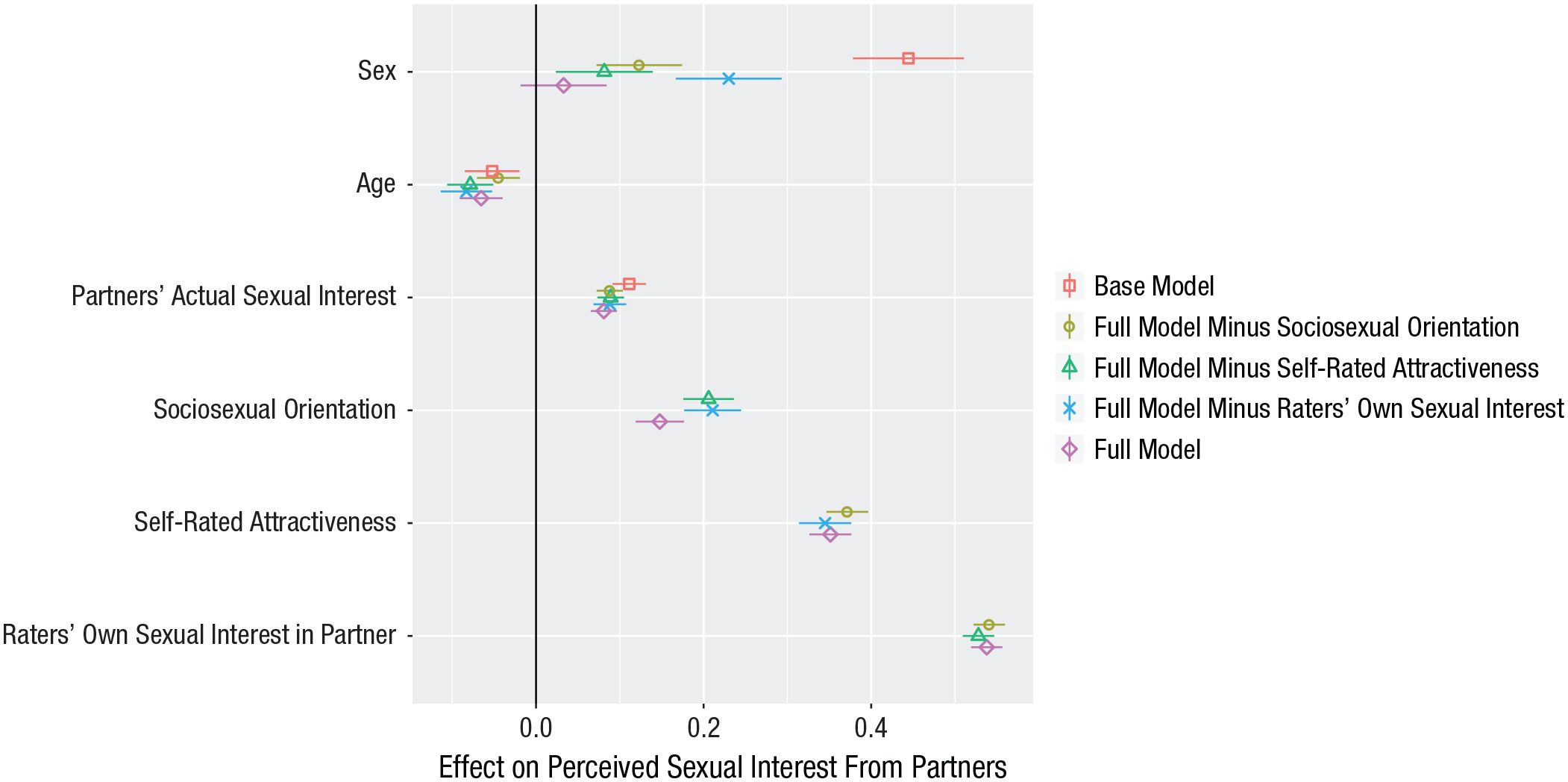
Fixed-effects estimates for main effects of key variables on raters’ perceived sexual interest from their partner, separately from the base model, full model, and models without each potential mediator. Predictors were z scored at the appropriate level. Error bars show standard errors.
Discussion
When we assessed the tracking accuracy of sexual-interest perceptions, we found a significant association between raters’ perceived interest from their partner and the partners’ actual interest. This suggests (a) that raters can accurately perceive cues of sexual interest from their partners and (b) that these cues could be detected from brief interactions with strangers, which suggests either that such cues have commonalities across individuals or that idiosyncratic cues of interest are easily interpretable even after limited acquaintance. However, in comparison with the other predictors in the model, the effect size of partner’s actual interest was smaller than of any rater-level predictors or the effect of rater’s own interest in the partner. This suggests that partners’ actual sexual interest (and therefore, tracking accuracy) plays a relatively minor role in perceptions of sexual interest from brief interactions with strangers.
When we investigated mean-level bias in perceptions of sexual interest, we found that men, more so than women, tended to overperceive sexual interest from partners, consistent with previous findings (Abbey, 1982; Farris et al., 2008; Fletcher et al., 2014; Perilloux et al., 2012). However, this sex difference was not significant after sociosexual orientation, self-rated attractiveness, and raters’ own sexual interest in their partner were included in the model. The estimated effect of sex in the full model was 6.8% the size of the sex effect of the base model, and given the large number of observations, the confidence interval around this estimate was small. Further examination showed that the association between sex and perceptions of sexual interest was significantly mediated by raters’ sociosexual orientation and raters’ own levels of sexual interest in their partner. In addition, in all cases, the direct effect of sex on perceptions of sexual interest was nonsignificant. Overall, these findings suggest that any residual effect of sex is likely to be very small or zero.
We found that sociosexual orientation was also positively associated with perceptions of sexual interest; specifically, a greater orientation to short-term, uncommitted relationships was associated with perceiving more sexual interest from partners. This is consistent with error-management theory because it suggests that individuals may bias their perceptions of sexual interest according to their sexual strategy. For instance, individuals open to uncommitted sex may overperceive sexual interest to maximize mating opportunities, whereas individuals oriented toward long-term relationships may underperceive interest to avoid partners uninterested in a committed relationship. Given that sociosexual orientation also significantly mediated the association between sex and perceptions of sexual interest, our results suggest that the sex difference in overperception of sexual interest is, in part, due to sex differences in sociosexual orientation. This may be adaptive, given that a short-term mating strategy is thought to be more evolutionarily beneficial for men than for women (Gangestad & Simpson, 2000). A separate analysis of the subcomponents of the SOI found that the main effect of sociosexual orientation was driven by the behavior and desire subcomponents but not the attitudes subcomponents (full results of this model are reported in the Supplemental Material).
However, the mediator with the largest influence on perceptions of partner interest was raters’ own interest in the partner, in line with previous findings in friendship pairs (Lemay & Wolf, 2016). This finding is not consistent with the popular notion that the sex difference in misperception of sexual interest has evolved via sex-specific specialized adaptations because it is advantageous for men to overperceive and women to underperceive sexual interest. Error-management theory does not predict that sexual-interest perceptions in a person should depend on one’s own sexual interest in the person; when this unpredicted effect is accounted for, the predicted sex difference disappears (this is evident by comparing the full model with the full model minus raters’ sexual interest in Fig. 1). It could be argued that projection is just the proximate mechanism for the evolved sex difference in sexual-interest perception; however, this seems unlikely to us given that directly shifting the sex-specific means in sexual interest perceptions requires only quantitative changes—a straightforward outcome of sex-specific selection on existing quantitative variation. In contrast, for sex-specific selection to create a sex difference that works via projection, the evolution of a new, qualitatively different psychological mechanism to link perceptions of a person’s sexual interest to one’s own interest in that person would be required. A more parsimonious evolutionary explanation for projection would be that the tendency for individuals to assume that potential partners reciprocate their sexual interest led to increased mating success regardless of sex (e.g., by decreasing the chances of missing mating opportunities with mates with good genetic quality or good resource-provisioning potential). However, we note that the mediating effect of projection existed even when analyses controlled for the effect of sociosexual orientation, which suggests that this effect is, at least in part, independent of mating strategy. Alternatively, this bias may not reflect a specialized adaptation at all but instead reflect a broader tendency for individuals to assume that others think like themselves (e.g., the false-consensus bias or the assumed-similarity bias; for a review, see Marks & Miller, 1987).
Although we have taken the perspective that raters’ sexual interest influences their perception of partners’ sexual interest, another interpretation is that individuals first detect interest from a partner (accurately or not) and as a result become more interested in them. Such a process may be adaptive because it may motivate individuals to direct mating efforts toward likely potential partners. However, a causal mediation analysis of the relationship between raters’ sex and raters’ sexual interest found that only 25.5% of this association was mediated by perceived interest received from the partner (considerably lower than the mediated percentage found in line with the projection explanation; full results are reported in the Supplemental Material). In addition, Lemay and Wolf (2016) did not find support for this reverse causal effect when they conducted a longitudinal analysis on perceptions of sexual interest among friendship pairs.
Raters who perceived themselves as attractive were more likely to overperceive sexual interest from their partner. This effect persisted even when analyses accounted for the partners’ actual interest, which suggests that this bias is invariant to actual cues of interest displayed by the partners. A simple explanation for this association is that individuals who perceive themselves as more attractive expect to receive greater interest from potential partners. If we assume that individuals have some insight into their own attractiveness (indeed, self-rated attractiveness was positively associated with received sexual interest from partners in our sample), this finding could suggest a learning effect in which individuals who have received interest in the past raise their internal representation of their own attractiveness, which in turn influences their perceptions of sexual interest from potential partners in future interactions. Whereas removing self-rated attractiveness from the full model led to a significant main effect of sex, we did not find that this was a significant mediation.
Although we found that individuals possessed modest tracking accuracy in sexual-interest perceptions even after brief interactions, this was not significantly influenced by any of the individual-differences traits measured in the current study. We also did not find a significant influence of raters’ own interest on the accuracy of sexual-interest perceptions, which suggests that being interested in a potential partner does not make individuals more able to attend to or interpret possible cues of sexual interest.
Whereas we have interpreted the correspondence between partners’ actual interest and raters’ perceived interest as “accuracy,” one criticism of studies such as ours that investigate the purported sex difference in misperception of sexual interest is that the effect could in principle reflect women underreporting their own interest rather than men overperceiving women’s interest (Engeler & Raghubir, 2018; Perilloux & Kurzban, 2015; but see D. R. Murray, Murphy, von Hippel, Trivers, & Haselton, 2017). However, this alternative explanation is difficult to reconcile with the current findings given that the sex difference in misperception can be fully accounted for by the mediators in the full model, and it is unlikely that men projecting their interest or being more sociosexually unrestricted led to women more accurately reporting their sexual interest. Another consideration is the potential disconnect between participants’ actual beliefs about perceived sexual interest and how these perceptions have been measured (i.e., a behavioral response on a Likert-type scale), the latter potentially being influenced by external factors (e.g., demand characteristics), which may obscure true effects.
Previous theories for the purported sex differences in misperceptions of sexual interest emphasize that men and women have evolved different psychologies because of sex-specific selection pressures. Our findings challenge this popular notion by showing that the sex difference can be completely explained by the mediators in the full model, in which raters’ own sexual interest had the strongest mediating effect. Defenders of the interpretation consistent with error-management theory would need to explain how these results could reasonably be incorporated in that theory’s predictions.
Supplemental Material
Lee_OpenPracticesDisclosure_rev – Supplemental material for Sex Differences in Misperceptions of Sexual Interest Can Be Explained by Sociosexual Orientation and Men Projecting Their Own Interest Onto Women
Supplemental material, Lee_OpenPracticesDisclosure_rev for Sex Differences in Misperceptions of Sexual Interest Can Be Explained by Sociosexual Orientation and Men Projecting Their Own Interest Onto Women by Anthony J. Lee, Morgan J. Sidari, Sean C. Murphy, James M. Sherlock and Brendan P. Zietsch in Psychological Science
Supplemental Material
Lee_Supplemental_Material_rev – Supplemental material for Sex Differences in Misperceptions of Sexual Interest Can Be Explained by Sociosexual Orientation and Men Projecting Their Own Interest Onto Women
Supplemental material, Lee_Supplemental_Material_rev for Sex Differences in Misperceptions of Sexual Interest Can Be Explained by Sociosexual Orientation and Men Projecting Their Own Interest Onto Women by Anthony J. Lee, Morgan J. Sidari, Sean C. Murphy, James M. Sherlock and Brendan P. Zietsch in Psychological Science
Footnotes
Transparency
Action Editor: Steven W. Gangestad
Editor: D. Stephen Lindsay
Author Contributions
A. J. Lee and B. P. Zietsch developed the study concept. A. J. Lee, M. J. Sidari, and B. P. Zietsch designed the study. Testing and data collection were performed by A. J. Lee, M. J. Sidari, and J. M. Sherlock. A. J. Lee, M. J. Sidari, S. C. Murphy, and B. P. Zietsch analyzed and interpreted the data. A. J. Lee drafted the manuscript; the rest of the authors provided critical revisions. All of the authors approved the final manuscript for submission.

References
Supplementary Material
Please find the following supplemental material available below.
For Open Access articles published under a Creative Commons License, all supplemental material carries the same license as the article it is associated with.
For non-Open Access articles published, all supplemental material carries a non-exclusive license, and permission requests for re-use of supplemental material or any part of supplemental material shall be sent directly to the copyright owner as specified in the copyright notice associated with the article.
