




Abstract

Around the globe, negotiators often meet to divide a resource, barter goods, or make mutually beneficial trade-offs. In many cultures, negotiators “break bread” before negotiating by sharing food. Although breaking bread has biblical origins, it has come to symbolize shared eating as a pathway to increased cooperation. Building off this reasoning, Woolley and Fishbach (2019) empirically confirmed that shared eating leads to higher cooperation than separate eating.
The present research conceptually replicated Woolley and Fishbach’s findings and extended them in fundamental ways. First, Woolley and Fishbach’s studies involved isolated, sequential decisions made with zero communication. Although their paradigm elegantly captured cooperation versus competition decisions, rarely do negotiations or decisions happen without any back-and-forth communication. Therefore, we conducted two face-to-face negotiation experiments in which negotiators verbally and nonverbally communicated with each other and made decisions jointly.
Furthermore, Woolley and Fishbach’s studies involved a single issue (e.g., strike days), whereas the negotiations in the present research involved eight issues, thus increasing the complexity of negotiating. The introduction of multiple issues not only makes the present negotiations closer to real-life negotiations but also enabled us to explore the efficient integration of resources, known colloquially as “expanding the pie” or “increasing joint gain” and known technically as Pareto efficiency. When a Pareto-efficient agreement is reached, “no [other] agreement is possible that would be preferred by both negotiators or would be preferred by one and to which the other would be indifferent” (Tripp & Sondak, 1992, p. 279). By focusing on face-to-face negotiations involving multiple issues, we explored whether prior shared-eating effects can be extended to more complex forms of human interactions that resemble most negotiations.
Experiment 1
We randomly assigned participants to candidate and recruiter roles in an eight-issue job-offer negotiation exercise and had them prepare for the negotiation independently. We then manipulated shared eating versus separate eating by having participants complete a “food-tasting study,” in which they tasted crackers from either a shared plate or two separate plates. We also included a baseline no-eating condition. The data and analysis codes for this experiment are available at https://osf.io/e8xnz/.
Method
Participants and design
We used G*Power (Faul, Erdfelder, Lang, & Buchner, 2007) to determine the sample size needed for a medium-large effect size (f = .30). The estimated effect size was consistent with the one in Study 2 of Woolley and Fishbach. We found that 111 dyads were required for the experiment to be powered at 80%. A total of 240 undergraduate students (120 dyads) completed the experiment. We excluded seven dyads in which at least one participant had negotiation training in the past (Brett, Shapiro, & Lytle, 1998) and excluded another dyad in which one participant did not complete the separate-eating manipulation. Accordingly, we retained 224 participants (112 dyads) for our subsequent analyses (age: M = 19.96, SD = 1.56; 54.7% female; 59.6% Asian, 4.0% Black, 6.3% Hispanic/Latino, 26.0% White, and the remaining from other ethnic groups). We randomly assigned participants to the shared-eating, separate-eating, and no-eating conditions within each day of data collection.
Procedure
Introduction and preparation
On arrival, participants were asked to freely choose their seat and sit at a small round table with another participant. The majority of participants chose to sit with another person of the same gender. If their partner was of a different gender, we switched their seat when we could rematch them with a same-gender partner. Our goal was to pair participants with a same-gender partner as much as possible to control for gender effects. As a result, the majority of the dyads had the same gender (88%, based on participants’ self-reported gender).
After being informed about the purpose of the study, participants answered questions about individual differences 1 and read the materials of the New Recruit negotiation (Neale, 1997) between a recruiter and a candidate. The negotiation simulation involved a job offer that included eight issues. Each participant was randomly assigned to the role of either the recruiter or the candidate. Both completed multiple comprehension checks to ensure their accurate understanding of the materials and were allowed to proceed only if they passed all the comprehension checks.
Eating manipulation
Before starting the negotiation, participants in the shared-eating and separate-eating conditions were told to take part in a marketing study involving food tasting. In the shared-eating condition, both participants in each dyad were instructed to select a small pack of crackers from the same plate and taste them. In the separate-eating condition, we provided two plates on each table, one for each participant within the dyad. Thus, the only difference between the two eating conditions was whether participants took a small pack of crackers from a shared plate or from two separate plates. Participants were not allowed to communicate with each other while tasting the crackers and were told to provide independent evaluations. In keeping with our cover story of marketing research, we had participants complete a short questionnaire regarding the crackers. In the no-eating condition, participants did not complete this part.
Negotiation
Participants completed the New Recruit negotiation simulation (Neale, 1997) within 25 min, and all of them reached an agreement. Two of the eight negotiation issues were purely distributive (the parties’ preferences were in complete opposition), two issues were compatible (the parties’ preferences were identical), and the remaining four issues had integrative potential (the candidate had a stronger preference for two of these issues, whereas the recruiter had a stronger preference for the other two). Negotiation agreements had higher Pareto efficiency when participants traded the two issues of low importance to their counterpart in exchange for the two issues of high importance to them and when they maximized the compatible issue. All participants were debriefed and thanked for their participation. 2
Measure of Pareto efficiency
We used their final agreement (i.e., the options they agreed on for each of the eight issues) to compute Pareto-efficiency scores; thus, Pareto efficiency was calculated objectively rather than on the basis of subjective evaluations. Specifically, we used the Excel file “Negotiation Scoring Tool” (Version 1.24, revised in 2005), which was originally developed in 2002 for Gerardo Okhuysen by Chris Pounds and used (Version 1.11) by Okhuysen, Galinksy, and Uptigrove (2003), to calculate Pareto efficiency for each dyad, which could range from 0 to 1,000 (Tripp & Sondak, 1992; see also Galinsky, Leonardelli, Okhuysen, & Mussweiler, 2005). Pareto efficiency represents how well two negotiators integrated their interests and created value. If two negotiators achieved a Pareto-efficiency score of 950, for example, this means they achieved 95% efficiency in integrating their interests.
Results
We first identified extreme outliers on the basis of the different cutoff values (three times the interquartile range below the lower quartile; i.e., 25th percentile – 3 times [75th percentile – 25th percentile]; Tukey, 1997) generated by standard box-and-whisker plots within each of the three conditions. Extreme outliers of Pareto efficiency are particularly problematic because they are almost always asymmetric (i.e., on the low end) and can imply little effort in the negotiation. One dyad in the shared-eating condition and six in the no-eating condition were identified as extreme outliers and removed from our analyses. We used unequal variances in our analyses because a Levene’s test strongly established heterogeneity of variances between the conditions, p < .001.
Following Woolley and Fishbach, we conducted contrast analyses. Replicating Woolley and Fishbach’s finding, our analyses found that the dyads in the shared-eating condition (n = 41, M = 951.18, SD = 65.35) had higher Pareto-efficiency scores than those in the separate-eating condition (n = 32, M = 871.41, SD = 194.70), t(36.47) = 2.22, p = .033, d = 0.58. Notably, this effect size was comparable with those reported in Woolley and Fishbach’s seven studies. We next compared the two eating conditions with the no-eating condition. We found that the dyads in the shared-eating condition and the no-eating conditions (n = 32, M = 971.85, SD = 39.30) had similar Pareto-efficiency scores, t(67.08) = −1.67, p = .099. Dyads in the separate-eating condition had lower Pareto-efficiency scores than those in the no-eating condition, t(35.52) = −2.86, p = .007, d = 0.72. Figure 1 displays the results across the three conditions.
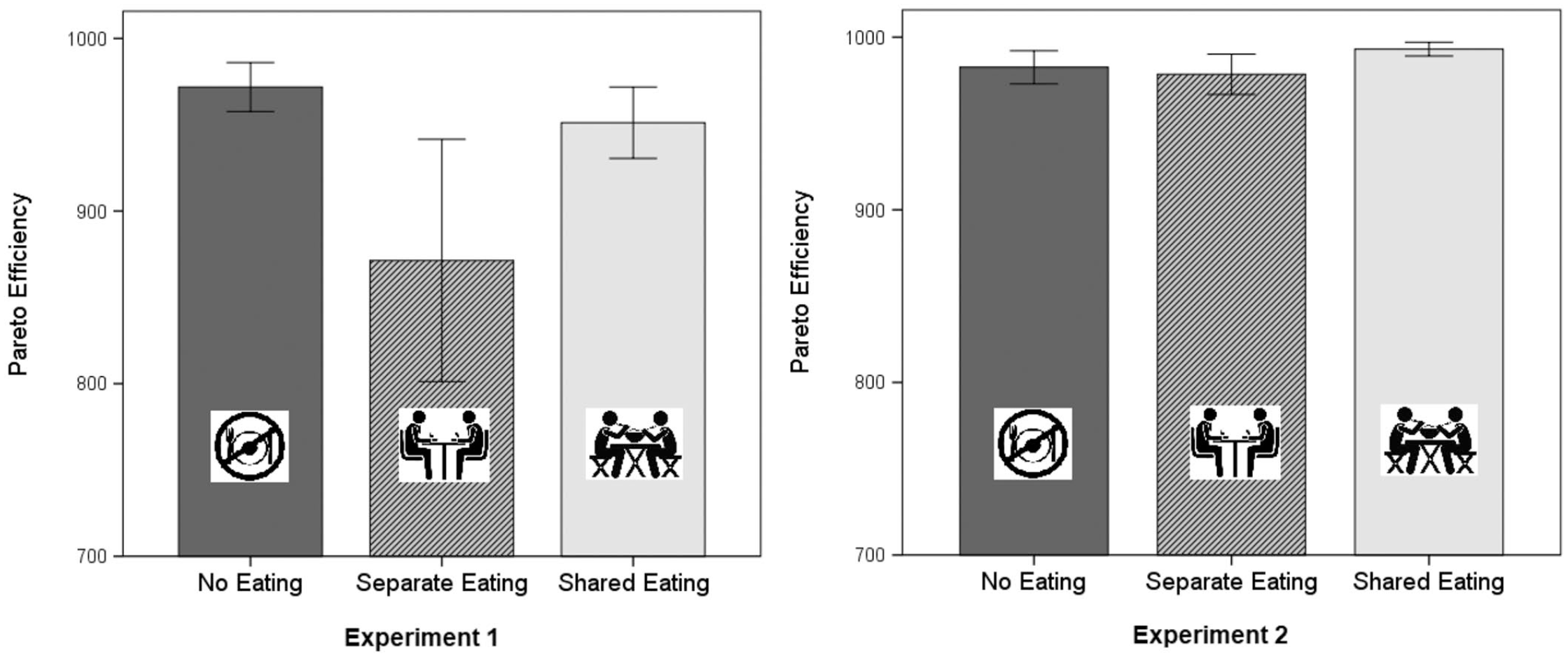
Pareto efficiency in the no-eating, separate-eating, and shared-eating conditions in Experiments 1 and 2. Error bars represent 95% confidence intervals. The icons shown were obtained from the Noun Project: The icon for the no-eating condition was created by Muhammad Riza, the icon for the separate-eating condition was created by Adrien Coquet, and the icon for the shared-eating condition was created by Gan Khoon Lay.
Discussion
Experiment 1 found evidence that shared eating led to higher Pareto efficiency compared with a separate-eating condition. However, the shared-eating condition was not significantly different from a baseline no-eating condition. This was likely because our shared-eating manipulation was weaker than that in Woolley and Fishbach’s studies. In Experiment 2, we strengthened the shared-eating manipulation.
Experiment 2
Experiment 2 was a preregistered experimental replication of Experiment 1, with two critical improvements. First, we made Experiment 2 double blind to eliminate any concerns that experimenter effects drove the results of Experiment 1 (i.e., we made the experimenter administering the negotiation exercise blind to the eating conditions). Second, we strengthened the shared-eating manipulation by making participants more involved in the process of shared eating. The data and analysis codes for this experiment are available at https://osf.io/e8xnz/. The experiment was preregistered at https://aspredicted.org/c4ds4.pdf.
Method
Participants and design
Following our preregistration, we planned to recruit 300 participants because 288 participants (144 dyads) were needed for the study to be powered at 90%, given the same estimated effect size used in Experiment 1 and by Woolley and Fishbach (f = .30). However, because of the outbreak of COVID-19, all data collection at the university was suspended. Fortunately, we were able to collect data from 224 participants in 112 dyads before all in-person research was shut down. The sample size was similar to that of Experiment 1 (N = 240). Following the data-screening criteria described in the preregistration, we excluded 10 dyads in which at least one participant did not complete the eating manipulation. We made one small departure from Experiment 1 and our preregistration: To preserve as many dyads as possible for our analyses given that our data collection was cut short, we only excluded dyads in which both participants had prior negotiation training (n = 5) instead of excluding dyads in which one or both participants had prior negotiation training (n = 33). Importantly, we made this decision before analyzing the data. Accordingly, we retained 97 dyads (194 participants) for our subsequent analyses (age: M = 19.82, SD = 1.47; 45.4% female; 48.5% Asian, 3.6% Black, 10.8% Hispanic/Latino, 30.9% White, and the remaining from other ethnic groups).
As in Experiment 1, participants were randomly assigned to the shared-eating, separate-eating, and no-eating conditions each day. The study procedure was almost identical to that of Experiment 1, except for a double-blind design and an enhanced shared-eating manipulation.
Double-blind procedure
To make the experimenter administering the negotiation exercise blind to the two eating conditions, we included two experimenters. The main experimenter was responsible for everything but the eating manipulation. When the time came to administer the eating manipulation, the main experimenter left the room, and the supporting experimenter conducted the manipulation. When the manipulation was finished and the supporting experimenter had eliminated any traces of the eating manipulation, the main experimenter returned to the room and continued the experiment. Thus, the main experimenter never knew the condition to which participants were assigned and could not influence the results.
Eating manipulation
To strengthen the shared-eating manipulation, we asked each participant in the shared-eating condition to take a pack of crackers from a shared bowl on the table, open the pack, put all the crackers in the shared bowl, and eat crackers from the shared bowl. In the separate-eating condition, participants followed the same procedure but with their separate bowls. In other words, the only difference between the two conditions was whether participants ate the crackers from a shared bowl or two separate bowls.
Measure of Pareto efficiency
We used the same measure of Pareto efficiency from Experiment 1. 3
Results
Following our preregistration plan, we first identified extreme outliers using box-and-whisker plots within each condition as in Experiment 1. Six dyads in the shared-eating condition, three in the separate-eating condition, and four in the no-eating condition were identified as extreme outliers and thus were excluded from the subsequent analyses. As in Experiment 1, we used unequal variances in our analyses because a Levene’s test strongly established heterogeneity of variances between the conditions, p = .001.
Following our preregistration, we performed contrast analyses. Consistent with Woolley and Fishbach’s study and Experiment 1, our analyses found that the dyads in the shared-eating condition (n = 25, M = 993.09, SD = 9.70) had higher Pareto-efficiency scores than those in the separate-eating condition (n = 27, M = 978.56, SD = 29.51), t(31.95) = 2.42, p = .021, d = 0.65. In contrast to Experiment 1, however, our analyses found that the dyads in the shared-eating condition had higher Pareto-efficiency scores than those in the no-eating condition (n = 32, M = 982.59, SD = 26.59), t(40.93) = 2.06, p = .045, d = 0.50. The difference between the dyads in the separate-eating and no-eating conditions was not significant, t(52.97) = −0.55, p = .587. Figure 1 displays the results across the three conditions.
Discussion
Our preregistered experiment replicated the finding from Experiment 1 that the shared-eating condition had higher Pareto efficiency than the separate-eating condition. By using a double-blind experimental procedure, we eliminated the concern that experiment effects might have driven the results of Experiment 1. In addition, we increased the strength of the shared-eating manipulation and found that shared eating led to higher Pareto efficiency compared with the no-eating condition.
General Discussion
Across two experiments, one of which was preregistered, we found that shared eating helped negotiators achieve higher Pareto efficiency in a multi-issue negotiation. Although the shared-eating condition was not significantly different from the baseline no-eating condition in Experiment 1, in our preregistered experiment involving a strengthened shared-eating manipulation, the shared-eating condition was different from both the separate-eating and baseline conditions. Overall, the results suggest that shared eating increases negotiation Pareto efficiency.
Our findings extend the results of Woolley and Fishbach to a more complex negotiation involving multiple issues and face-to-face communication. Woolley and Fishbach used tasks in which participants made the decisions independently with no verbal or nonverbal communication. We found that the positive effect of shared eating versus separate eating can be extended to situations involving rich verbal and nonverbal communication. This is a critical extension because communication is a defining feature of negotiations (Pruitt, 1981).
Our studies also extend Woolley and Fishbach’s studies by investigating a more complex form of cooperation. In their tasks, cooperation involved not competing or choosing options that hurt both sides, such as increasing strike days. In contrast, in multi-issue negotiations with integrative potential, cooperation is not the bipolar opposite of competition but rather involves efficient integration of both sides’ interests via effective information exchange (Galinsky, Maddux, Gilin, & White, 2008; Galinsky & Schweitzer, 2015). We found the benefit of shared eating over separate eating can be extended to this more complex form of cooperation. Although we did not identify any intermediary mechanism, future research should identify potential mechanisms (e.g., information exchange or conflict resolution).
The results across the two experiments suggest that the strength of the shared-eating manipulation matters. In Experiment 1, participants in the shared-eating condition took only crackers from the shared plate once, whereas participants in Experiment 2 took crackers from the shared bowl repeatedly. The different strength of this manipulation may have contributed to the fact that Pareto efficiency was significantly higher in the shared-eating condition than in the no-eating condition in Experiment 2, but the two conditions did not differ in Experiment 1.
Our findings have implications for the psychology of ritual. Research suggests that rituals can increase cooperation (Brooks et al., 2016; Fischer, Callander, Reddish, & Bulbulia, 2013; Schroeder, Risen, Gino, & Norton, 2019). Eating with another person, whether from a shared plate or separate plates, can be construed as a form of ritual. However, we found that these two forms of this ritualistic behavior had different effects on Pareto efficiency. These results suggest that rituals do not always increase cooperation and may depend on their form. If a ritual highlights a sense of separateness, such as separate eating, it may decrease cooperation. Indeed, a sense of oneness is a critical driver underlying the effect of rituals on cooperation (Fischer et al., 2013).
The current results both conceptually replicate the main finding of Woolley and Fishbach’s studies and extend their results to more complex, mixed-motive interactions. Overall, the present findings suggest that breaking bread can lead to bigger negotiation pies.
Supplemental Material
Cao_OpenPracticesDisclosure_rev – Supplemental material for Breaking Bread Produces Bigger Pies: An Empirical Extension of Shared Eating to Negotiations and a Commentary on Woolley and Fishbach (2019)
Supplemental material, Cao_OpenPracticesDisclosure_rev for Breaking Bread Produces Bigger Pies: An Empirical Extension of Shared Eating to Negotiations and a Commentary on Woolley and Fishbach (2019) by Jiyin Cao, Dejun Tony Kong and Adam D. Galinsky in Psychological Science
Supplemental Material
Cao_Supplemental_Material_rev – Supplemental material for Breaking Bread Produces Bigger Pies: An Empirical Extension of Shared Eating to Negotiations and a Commentary on Woolley and Fishbach (2019)
Supplemental material, Cao_Supplemental_Material_rev for Breaking Bread Produces Bigger Pies: An Empirical Extension of Shared Eating to Negotiations and a Commentary on Woolley and Fishbach (2019) by Jiyin Cao, Dejun Tony Kong and Adam D. Galinsky in Psychological Science
Footnotes
Transparency
Action Editor: D. Stephen Lindsay
Editor: D. Stephen Lindsay
Author Contributions
J. Cao and D. T. Kong contributed equally to this article. J. Cao and D. T. Kong developed the study concept. All authors contributed to the study design. J. Cao collected, deidentified, and compiled the data. D. T. Kong analyzed the data with the assistance and double checks of J. Cao. J. Cao and D. T. Kong checked the data sets, which were shared within the research team. J. Cao and D. T. Kong drafted the manuscript, and A. D. Galinsky provided suggestions and critical revisions. All of the authors approved the final version of the manuscript for submission.

Notes
References
Supplementary Material
Please find the following supplemental material available below.
For Open Access articles published under a Creative Commons License, all supplemental material carries the same license as the article it is associated with.
For non-Open Access articles published, all supplemental material carries a non-exclusive license, and permission requests for re-use of supplemental material or any part of supplemental material shall be sent directly to the copyright owner as specified in the copyright notice associated with the article.
