



Abstract
We investigated how gender is represented in children’s books using a novel 200,000-word corpus comprising 247 popular, contemporary books for young children. Using adult human judgments and word co-occurrence data, we quantified gender biases of words in individual books and in the whole corpus. We found that children’s books contain many words that adults judge as gendered. Semantic analyses based on co-occurrence data yielded word clusters related to gender stereotypes (e.g., feminine: emotions; masculine: tools). Co-occurrence data also indicated that many books instantiate gender stereotypes identified in other research (e.g., girls are better at reading, and boys are better at math). Finally, we used large-scale data to estimate the gender distribution of the audience for individual books, and we found that children are more often exposed to stereotypes for their own gender. Together, the data suggest that children’s books may be an early source of gender associations and stereotypes.
Beliefs about gender-related characteristics develop early in childhood. By 24 months (girls) or 31 months (boys), children already exhibit knowledge of behaviors that are stereotypically feminine (e.g., vacuuming), masculine (e.g., building), and neutral (e.g., sleeping; Poulin-Dubois et al., 2002). By the age of 3 years, children distinguish individuals by gender, race, and age (Shutts et al., 2010). By age 5, children have developed a “constellation of stereotypes about gender (often amusing and incorrect) that they apply to themselves and others” (Martin & Ruble, 2004, p. 67). For example, preschoolers act in accordance with the stereotype that girls are better at reading whereas boys are better at math (Cvencek et al., 2011) and that girls are less likely than boys to be “very, very smart” (Bian et al., 2017).
The sources of this knowledge are less well understood. Children’s interactions with adults and their observations of adult interactions are one source (Hilliard & Liben, 2010). Toys and activities are often gender stereotyped in home, day care, and preschool social settings (Weisgram et al., 2014). Gendered information is also conveyed via language. Children commonly receive verbal feedback from adults about gender-normative activities (e.g., girls hear more often about appearance and helping behaviors, and boys hear about their size and physical skills; Chick et al., 2002). Children are also sensitive to seemingly small differences in gender-related language (e.g., Chestnut & Markman, 2018; Moty & Rhodes, 2021). For example, Cimpian and Markman (2011) found that when a novel game was introduced to children using a generic gendered subject (“Girls are really good at a game called ‘gorp’”), children were more likely to associate the game with the gender than when it was introduced with a specific gendered subject (“There is a girl who is good at . . .”).
We examined a potentially rich yet underrecognized source of information about gender: children’s books. Reading to children (also called shared reading) has been widely encouraged because of its numerous benefits (Bus et al., 1995; Duursma et al., 2008; High & Klass, 2014). Shared reading marks the child’s entrée to literacy and facilitates its development (Snow et al., 1998). It also promotes learning about aspects of language and the world beyond a child’s immediate experience (Dickinson et al., 2012; Mol & Bus, 2011). Reading with children could therefore be an important potential source of beliefs about gender.
Much previous work on how gender is represented in books has used content-analysis methods that emphasize detailed analyses of a small number of texts. For example, Diekman and Murnen (2004) examined 20 books for middle-schoolers categorized as “sexist” or “nonsexist.” College students each answered a 72-item questionnaire about one book. Questions probed whether books conveyed gender stereotypes and inequalities (e.g., “Males, but not females, are shown as dominant,” and “The book depicts female characters as the natural servants of male characters”; Diekman & Murnen, 2004, pp. 382–383). The results suggested that gender differences and inequalities were expressed even in books intended to be nonsexist.
Our goal was to conduct a broader analysis of gender representation in a large sample of common books for young children (0–5 years old) and to gain evidence about exposure to books by gender. We focused on the extent to which words in texts are associated with males versus females, which we term the words’ gender bias. Some of these gender biases reflect well-known stereotypes, such as “pretty” (female) or “large” (male). By using both behavioral data and automated analyses of text characteristics, our approach provides a scalable and reproducible method of estimating gender bias without requiring explicit judgments of prespecified properties of texts (as in the study by Diekman & Murnen, 2004).
We begin by describing the construction and properties of the Wisconsin Children’s Book Corpus (WCBC). We first quantified gender biases in individual books and the corpus as a whole using two methods. Study 1 employed adult word-genderedness judgments; Study 2 employed statistical co-occurrences of words. The results indicated that books vary widely in degree of gender bias, ranging from strongly male to strongly female. Study 3 used analyses of gendered language in book reviews to estimate whether the books are being read primarily to boys or girls. Finding that books exhibiting male biases are more often read to boys and that books exhibiting female biases are more often read to girls would suggest that books may offer extensive as well as different opportunities for learning about gender.
Statement of Relevance
Beliefs about gender, including stereotypes such as that girls are better at reading and boys are better at math, originate in early childhood. Shared reading is an important source of information about language and the world. It is therefore important to understand how gender is represented in books for young children (0–5 years old). The results from multiple analyses of a large set of popular books indicate that they are a rich source of information about gender and that many express gender stereotypes more strongly than adult fiction. These findings suggest that popular children’s books may be an underrecognized, inadvertent vehicle for perpetuating gender stereotypes and other gendered associations.
Children’s Book Corpus
The WCBC consists of 247 books marketed for children 5 years old and under. These are books that caregivers commonly read with children; some are also read independently by older children. We selected books from four sources: (a) the top-selling books for children in this age range from Amazon.com at the time of collection, (b) titles collected by Hudson Kam and Matthewson (2017) from a survey of Canadian respondents, (c) Time magazine’s “100 best children’s books of all time” (D’Addario et al., n.d.), and (d) books in the corpus compiled by Montag et al. (2015). The union of these four sets yielded 247 books. The corpus contains the complete text of each book and basic metadata (author, title, etc.). In total, the corpus contains 202,445 word tokens (M = 819.62 per book, minimum = 7, maximum = 23,352, SD = 2,082.69) and 10,174 types (distinct orthographic forms; M = 222.11 per book, minimum = 2, maximum = 2,575, SD = 283.47). The corpus currently is not publicly available because of copyright issues.
Study 1: Measuring Gender Bias: Behavioral Evidence
Study 1a: gender bias in words
As a first step, we asked adult English speakers to rate the genderedness of words in these books using a 5-point scale ranging from masculine to feminine (Scott et al., 2019). This procedure yields systematic data with good face validity: Words such as “axe” and “engine” were rated as masculine, words such as “cuddle” and “pink” were rated as feminine, and words such as “exactly” and “nose” were rated as neutral.
Method
Participants (N = 426) were recruited on Amazon Mechanical Turk. Participants who answered any of six integrity-check items incorrectly (e.g., “The word red has two letters”) were excluded (n = 80). One participant who responded with the midpoint on almost all items, as well as six nonnative English speakers, were also excluded. The final sample consisted of 339 participants (174 who identified as male, 162 as female, and 3 as “other”) and had a mean age of 36.40 years (SD = 10.70). The study was approved by the institutional review board. 1
Because it was not feasible to collect gender norms for all 10,174 unique words, ratings were obtained for a large subset of the most important content-bearing words (N = 2,373). This subset was largely composed of nouns (51.7%) and verbs (26%). We also included the names of all characters in the books (e.g., “Amelia,” “Yertle”). A short context was provided to indicate a specific meaning of homonyms—for example, “pin (hold down),” “creep (move slowly),” “act (part of a play),” and “act (to take action).” The norms included 82.5% of the tokens in the corpus, excluding stop words, and at least 30% of the tokens in each book (M = 83.2%, SD = 9.5%; types: M = 78.4%, SD = 10.7%).
Participants rated the gender of each word on a scale ranging from 1 to 5 with the intervals labeled “Very masculine,” “Somewhat masculine,” “Neither masculine nor feminine,” “Somewhat feminine,” and “Very feminine,” respectively. (Note that we operationalize gender as a continuum ranging from masculine to feminine throughout and use the terms “masculine” and “feminine” interchangeably with “male” and “female.” This approach ignores many aspects of gender that are not central to the present research.) The instructions did not provide definitions of masculine or feminine; raters were encouraged to use their intuition. Each participant rated 90 to 97 words. Words were quasirandomly assigned to participants to ensure that each word received at least 10 ratings; mean number of ratings per word was 13.58 (SD = 1.79).
Results
The overall mean gender rating was 2.98 (95% confidence interval [CI] = [2.95, 3.01]), which was very close to the midpoint; 30% of the words were significantly female biased (larger than the overall mean; p < .05) and 24% significantly male biased (p < .05). There was a marginal effect of participant gender: Female participants (M = 2.99, 95% CI = [2.96, 3.02]) rated words as more feminine, on average, compared with male raters (M = 2.98, 95% CI = [2.95, 3.01]), paired-samples t(2372) = 1.98, p = .05, d = 0.02, 95% CI = [−0.03, 0.08]. Gender ratings for 1,001 of our words were also obtained by Scott et al. (2019), and the two sets of ratings were highly correlated, r = .91, 95% CI = [.89, .92], p < .001. These data can be explored interactively in the supplemental information available at https://mlewis.shinyapps.io/SI_WCBC_GENDER/. For analyses of the relationship between gender ratings and other word properties (frequency, concreteness, arousal, valence, and age of acquisition), also see the supplemental information.
To examine the kinds of words rated as masculine or feminine, we identified semantic neighborhoods of words using a word-embedding model (Mikolov et al., 2013). Such models generate semantic representations of words based on co-occurrences in a text corpus, on the assumption that words that occur in similar contexts are similar in meaning (Firth, 1957; Landauer & Dumais, 1997). Semantic representations extracted in this way capture important aspects of meaning and correlate with human judgments of semantic similarity (Hill et al., 2015), although not without limitations (Chen et al., 2017). We obtained semantic coordinates for each word in our sample (a 300-dimensional vector) from a word-embedding model pretrained on English Wikipedia (Bojanowski et al., 2017) and reduced the dimensionality of these coordinates to two using the t-distributed stochastic neighbor embedding (t-SNE) algorithm (t-SNE is similar to principal component analysis but better suited for high-dimensional spaces; van der Maaten & Hinton, 2008). We then obtained 100 clusters of words on the basis of their coordinates using k-means clustering. Clustering is an unsupervised machine-learning method for dividing observations into k clusters by minimizing within-cluster distance and maximizing across-cluster distance. We determined the gender bias of each cluster by comparing the mean-rated genderedness of the words in the cluster with the mean-rated genderedness of all words in our sample.
The clustering procedure yielded semantically coherent clusters, each containing an average of 23.21 words (SD = 8.94). Of the 100 clusters, 21 were female biased, 19 were male biased, and the remaining 60 were neutral. Table 1 shows examples of female-biased, male-biased, and neutral clusters along with representative words (for complete results, see the supplemental information). Many of the gendered clusters instantiate gender stereotypes. Female clusters were associated with mental states (e.g., feelings, beliefs) and interactions with other people (e.g., communicating, caregiving). Male clusters were more closely associated with physical rather than mental events (e.g., sports, tools, transportation). These findings indicate that clusters of semantically related words in these texts are associated with gender, many reflecting gender stereotypes.
Examples of Clusters From Multidimensional Embeddings (Study 1a)
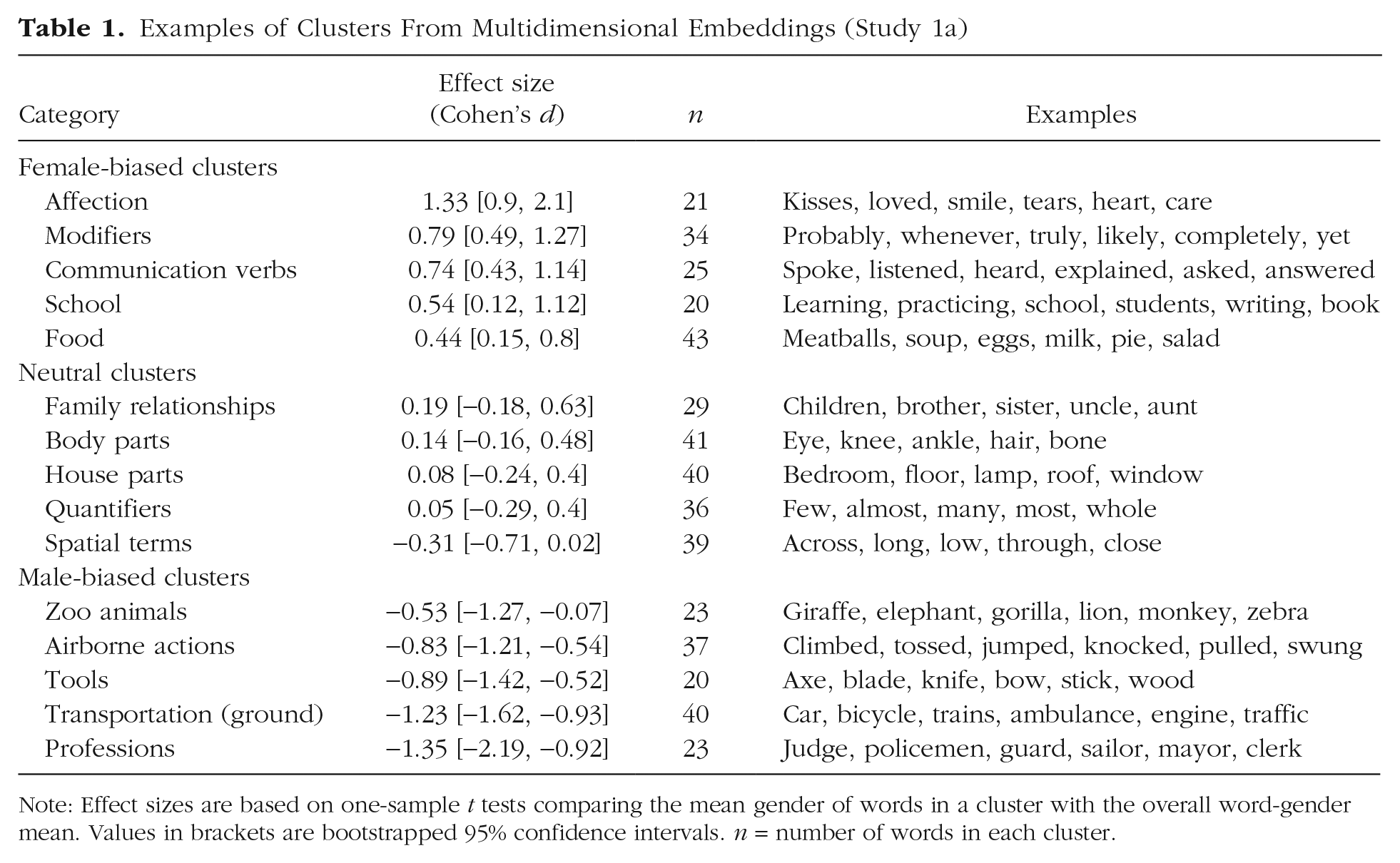
Note: Effect sizes are based on one-sample t tests comparing the mean gender of words in a cluster with the overall word-gender mean. Values in brackets are bootstrapped 95% confidence intervals. n = number of words in each cluster.
Study 1b: gender bias in books
We next used the word gender-bias judgments reported in Study 1a to quantify the genderedness of individual books.
We calculated an overall gender-bias score for each book as the mean gender-bias score of all the normed words (tokens) in the text. On average, there were gender norms for 79.1% (95% CI = [77.7%, 80.4%]) of all tokens in the books (for details and additional analyses, see the supplemental information). The overall average gender score did not exhibit a strong bias (M = 2.98, 95% CI = [2.96, 3.01]), but there was substantial variability (SD = 0.20), with some books showing much greater masculine or feminine bias.
Figure 1 shows the 20 books with the highest feminine-bias scores, the 20 with the highest masculine-bias scores, and 20 from the neutral range. Measured in this way, the books clearly vary in genderedness, falling along a continuum (for data for all books, see the supplemental information). Books at the feminine end include Chrysanthemum, Brave Irene, and Amelia Bedelia; the masculine end includes Curious George, Dear Zoo, and Goodnight, Goodnight, Construction Site; neutral books include The Polar Express, In the Night Kitchen, and Hippos Go Berserk (Table 2).
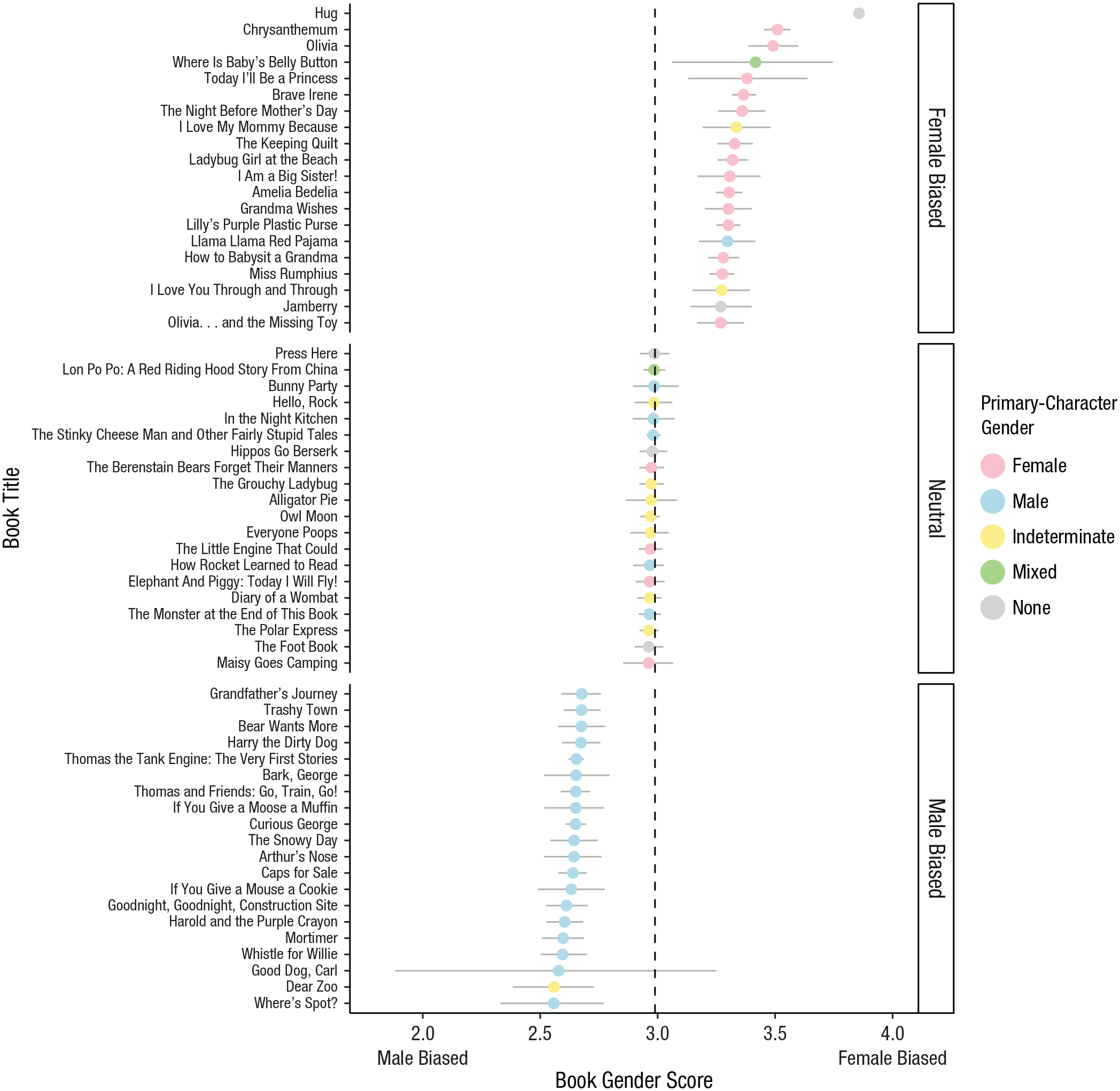
Mean gender bias of a subset of books from Study 1b as a function of the gender of the book’s primary character. The subset contains the 20 books with the highest feminine-bias scores, the 20 with the highest masculine-bias scores, and 20 from the neutral range. Bias scores were calculated from the mean gender ratings of words in each book (tokens). The dashed line indicates the overall mean across books. Error bars show bootstrapped 95% confidence intervals.
Representative Female-Biased, Neutral, and Male-Biased Books (Study 1b)

Note: The last row gives the 25 most frequent nouns and verbs in each book. Letters in parentheses denote word gender bias based on human judgments in Study 1a (f = female, m = male).
Overall gender bias could be due to words that express concepts, such as “pretty,” but also the frequency of intrinsically gendered words, such as names (e.g., “Amelia”), pronouns (e.g., “her”), and relational/generic gender terms (e.g., “mom,” “lady”). We therefore calculated bias separately using intrinsically gendered words referring to characters (the character gender score) and using the remaining content words (content gender score). Character and content scores were moderately correlated (r = .27, 95% CI = [.13, .4], p < .001): Books with more gender-biased content tended to have more names, pronouns, and kinship terms of that gender (Fig. 2a). Thus, the word gender biases reported by adults could arise, in part, from their association with gendered characters.
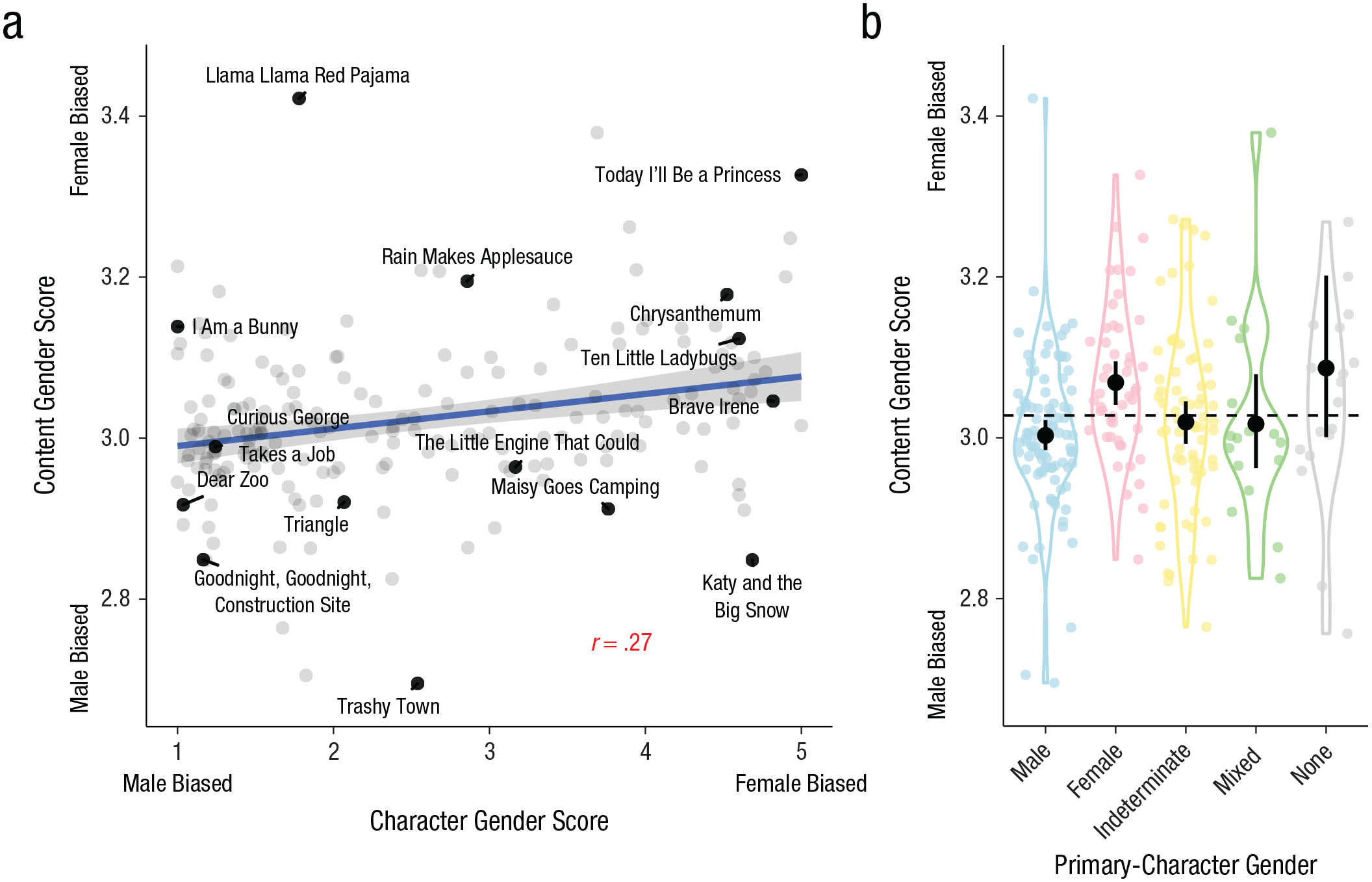
Gender content bias as a function of character gender (Study 1b). The scatterplot (a) shows the relation between mean content gender score for each book and mean character gender score. The solid line shows the best-fitting linear regression, and the error band shows standard errors. The violin plots (b) shows the distribution of content gender score across books as a function of the gender of the book’s primary character. Colored points show individual books (one point is excluded for visibility). The dashed line shows the grand mean content gender score. Black points show means, and error bars show bootstrapped 95% confidence intervals. The width of each violin indicates the density of the data.
Whereas the character gender score reflects the extent to which males and females are directly mentioned in a book, the gender of the story protagonist may be particularly salient for children. For each book, we manually coded the name of the primary protagonist and their gender as determined from text (i.e., pronouns). Text rather than illustrations was used to determine character gender because it was less ambiguous. A character was considered a protagonist if they were the primary agent of the story, in some cases in a collaborative fashion with another protagonist. The main character (or characters) were classified as female, male, mixed, or indeterminate (Wagner, 2017). A book was coded as “mixed” if there was more than one primary character and their gender composition was heterogeneous; if a given primary character had a gender that could not be determined from the text, the book was coded as “indeterminate.” Two research assistants and the second author coded character gender. Coders agreed on the protagonist type for 97% of books. Discrepancies were resolved through discussion.
About half of the books (142 of 247; 57.5%) had gendered primary characters that were exclusively male or exclusively female. Two thirds of these books had male primary characters (n = 94), χ2(1) = 14.9, p < .001, d = 0.68, 95% CI = [0.34, 1.03]. Of the remaining books, 69 (28%) had main characters of indeterminate gender, 17 (7%) had main characters of mixed genders, and 19 (8%) had no main characters. These results are broadly consistent with those seen previously in a smaller sample of books (Wagner, 2017).
We then examined book genderedness as a function of the gender of the primary character using both content and character scores. There was a large degree of variability in content scores across books (female: SD = 0.72; male: SD = 0.69; e.g., books with female characters had both female- and male-biased content words). Notably, however, books with female primary characters tended to have higher female-content scores (M = 3.07, 95% CI = [3.04, 3.1]), t(47) = 2.96, p = .005, d = 0.43, 95% CI = [0.17, 0.72], compared with the overall averages, whereas books with male primary characters tended to have higher male-content scores (M = 3.00, 95% CI = [2.98, 3.02]), t(93) = −2.52, p = .01, d = −0.26, 95% CI = [−0.5, −0.05] (see Fig. 2b). This difference, albeit small in an absolute sense, exists despite the fact that there was a high degree of variability across books in content gender bias and the fact that the difference reflects the grand average of words in a book, most of which did not display a gender bias (e.g., “exactly”). Finally, there was a trend for more recently published books to have proportionally fewer male main characters and more main characters with indeterminate gender (Fig. 3; for additional analyses, see the supplemental information).
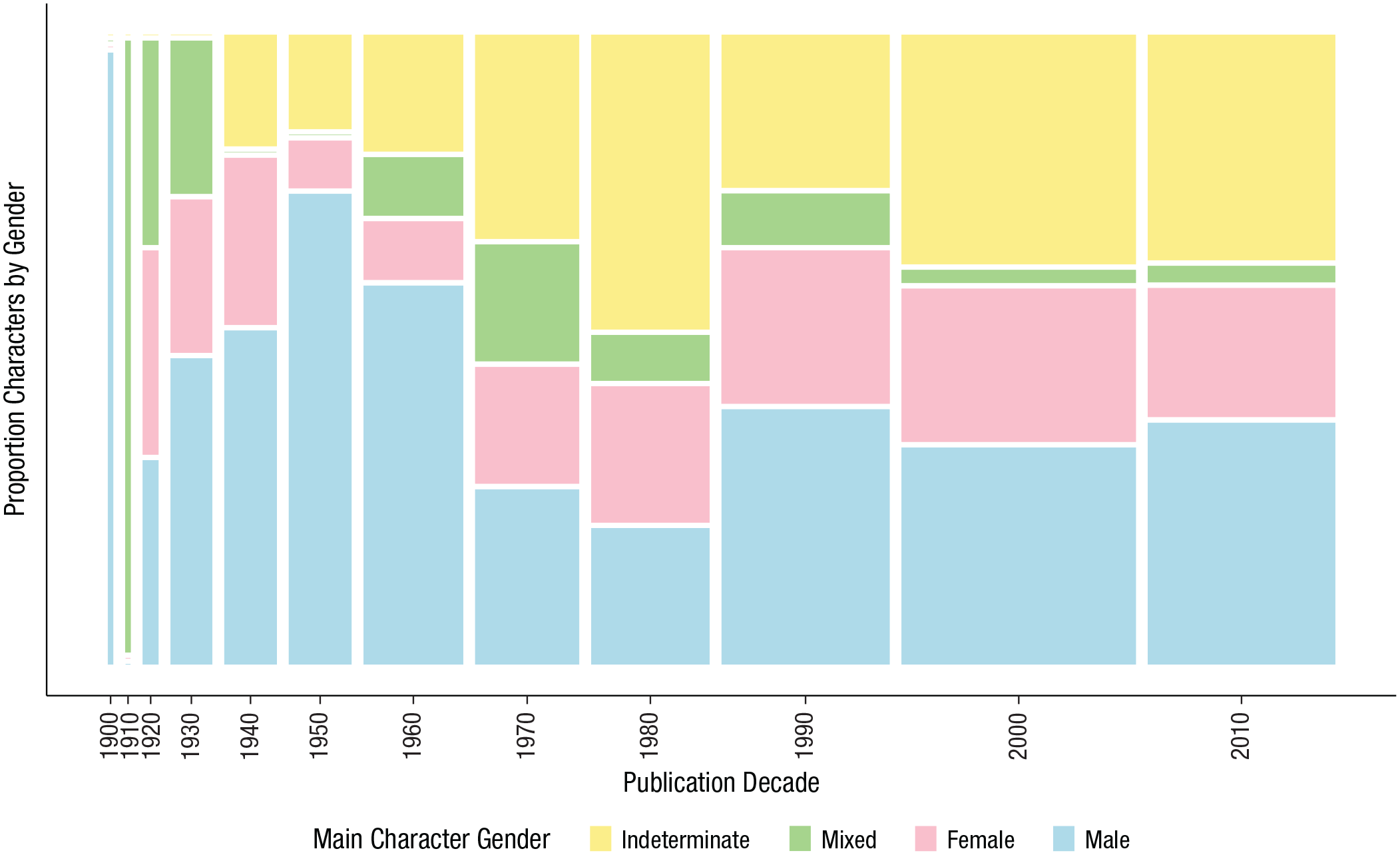
Proportion of books with main characters in each gender category (male, female, mixed, and indeterminate) as a function of publication decade (Study 1b). Bar width corresponds to the number of books in the Wisconsin Children’s Book Corpus published in that decade.
Our findings suggest that books vary considerably along gender lines, not only in terms of characters (i.e., those having only male or only female characters), which is expected, but also in terms of gendered content words. Critically, books also vary in the extent to which the gender bias of the content words matches the gender of the characters. On average, books with female characters tend to have content (e.g., artifacts, actions, descriptors) that is more associated with females, whereas books with male characters tend to have content on average more associated with males. The fact that older published books tend to have more male characters likely reflects the strong historical tendency for males to be treated as the default gender (e.g., using “man” to refer to all people).
Study 1c: validation of book-gender-bias measure
We estimated each book’s gender bias using a simple average of the gender bias of the words comprising them. Of course, the words occur in contexts that could modulate their bias. For example, the gender bias of “brave” would be the same whether it occurred in the sentence “Sally is brave” or “Sally is not brave.” To address this concern, we asked a new group of adult participants to provide information about main characters after reading the complete text of a book. We could then determine whether these participant-generated descriptions exhibited the gender biases identified using the simpler word-based measure. The two should diverge if book genderedness as estimated by averaging isolated words is unrepresentative of the story context.
Method
We recruited 152 adult participants from Amazon Mechanical Turk. Eighty-one identified as female, 65 identified as male, and 6 did not provide a response. The study was approved by the institutional review board.
We divided the books in our corpus into quintiles on the basis of the average gender score described in Study 1b, and we selected 15 books each from the first (female biased: M = 3.23, SD = 0.06), third (neutral: M = 2.96, SD = 0.03), and fifth quintiles (male biased: M = 2.64, SD = 0.03) to be evaluated. We excluded books that were either very short or very long (less than 100 words or more than 900 words) or those without a gendered main character.
Participants were presented with the complete text of a book and told that they would be asked questions about the characters in it. After reading the text, participants were asked to list two to five main activities of a specified character (e.g., “List 2-5 main activities Thomas does in the story”). The full text of the book was displayed on the same page so that participants did not have to rely on memory to answer the question. Next, participants were asked to complete a similar procedure but provide descriptions of the character’s traits (e.g., “List 2-5 words to describe Thomas in the story”). This procedure was repeated for all main and secondary characters in a book. Each participant provided responses for both character activities and character traits for three books.
On average, participants generated 3.83 responses per question (SD = 1.24). Responses were lemmatized and corrected for spelling, and in cases in which a multiword phrase was listed (e.g., “builds a castle”), the first word was selected for analysis. We identified the part of speech for the first word and excluded responses of the wrong class, analyzing only verbs for the activity question and adjectives, adverbs, and nouns for the trait question. We also excluded responses that were very long (more than 35 characters), as these were likely to be full sentences rather than activity or trait words. In total, 4% of responses were excluded, leading to a final sample of 4,889 responses and 947 unique lemmas. We then analyzed the gender bias of the activity and trait words using previously collected human judgments of word gender bias, which covered 67% of the word tokens used to describe characters and their activities. We collected an additional set of human judgments (N = 251; M = 11.33 ratings per word, SD = 0.95) so gender-bias estimates were available for all words produced more than once in Study 1c (93% of tokens; see the supplemental information).
Results
The main question was whether the descriptions of book characters’ traits and their actions, as generated by participants who read the books, exhibited the same gender biases derived by averaging the gender scores for words in the texts. We fit mixed-effect linear regression models predicting the gender biases of characters’ traits and actions from the averaged word gender of a book. The averaged word gender of a book was treated as a continuous fixed effect, and book and participant were included as random intercepts. The averaged word gender of a book predicted the gender bias of both the activity (β = 0.13, SE = 0.05, t = 2.74) and trait words generated by participants (β = 0.24, SE = 0.05, t = 5.12; see Fig. 4). Averaged word gender based exclusively on content words predicted activity (β = 0.22, SE = 0.04, t = 5.43) and trait words (β = 0.21, SE = 0.05, t = 4.42) to a similar extent, whereas averaged word gender based exclusively on character words predicted trait words (β = 0.21, SE = 0.05, t = 4.01) but not activity words (β = 0.05, SE = 0.05, t = 1.07; for full model results, see the supplemental information). These results suggest that the averaged word-gender measure described in Study 1b captured aspects of book gender bias, even after the broader context of the book text was taken into account. Further, the difference in the genderedness of traits associated with male and female primary characters was substantially larger than the effect observed in Study 1b. For example, male characters were more than twice as likely as female characters to be described as “playful” or “fun,” whereas female characters were more than twice as likely as male characters to be described as “caring” or “quiet.”
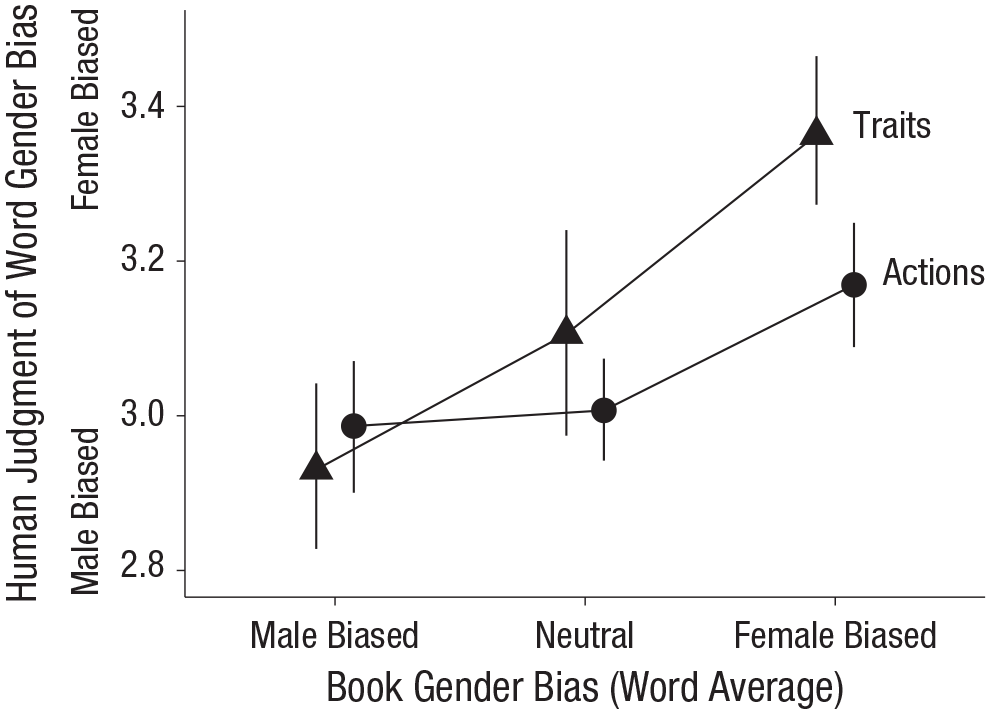
Average human judgment of gender bias of main character’s traits (triangles) and actions (circles) as a function of a book’s overall gender-bias score (male biased, neutral, or female biased; Study 1c). Error bars show bootstrapped 95% confidence intervals.
Study 2: Measuring Gender Bias Through Co-occurrence Statistics
Thus far we have presented findings about gendered information in children’s books based on adult gender norms and semantic representations derived from adult text. The results are relevant to the beliefs of adults who read books with children—beliefs that they may convey during shared reading. In this study, we sought to measure genderedness independently of adult ratings. To do this, we trained word-embedding models on the full text of the WCBC. Despite the smaller size of the children’s book corpus, the word embeddings yielded coherent patterns and clear evidence for gender biases similar to those identified from adult texts and norms. Overall, children’s books exhibited stronger gender stereotypes than comparable adult texts.
Study 2a: word–gender associations in the children’s book corpus
Method
A word-embedding model was trained on the full corpus of text from all 247 books (for training details, see the supplemental information). We then estimated the gender association for each word by calculating its mean semantic similarity (cosine distance) to a set of unambiguously female anchor words (“woman,” “girl,” “sister,” “she,” “her,” and “daughter”) and a corresponding set of male words (“man,” “boy,” “brother,” “he,” “him,” and “son”; Caliskan et al., 2017; Lewis & Lupyan, 2020). A female gender score was calculated for each word as the mean female similarity minus the mean male similarity. For comparison, we also estimated these scores from models trained on an identically sized corpus of adult fiction published from 1990 to 2017 (Davies, 2008) and a much larger corpus of Wikipedia data (Bojanowski et al., 2017). We then examined how these estimates of word gender bias derived from language statistics compared with the gender norms we had previously collected from participants.
Results
There were 1,893 words common across the word-embedding models and human gender-norms data set. Estimates of word-embedding gender bias from the WCBC were correlated with adult judgments of word bias (r = .27, 95% CI = [.23, .31], p < .001): Words that adult participants rated as more feminine (or masculine) tended to be similarly biased in the language statistics of the WCBC. Estimates of gender bias from the WCBC were also correlated with word-embedding gender bias from a model trained on adult fiction (r = .36, 95% CI = [.32, .4], p < .001), as well as the model trained on Wikipedia (r = .32, 95% CI = [.28, .36], p < .001; for all pairwise correlations, see the supplemental information). The moderate size of these correlations is likely due in part to the relatively small size of the WCBC corpus, as this relationship tends to be much larger in larger corpora (cf. Lewis & Lupyan, 2020).
These findings suggest that some of the word-level gender associations that emerge in adulthood begin to appear in the statistics of children’s texts and could potentially be learnable from exposure to children’s books.
Study 2b: specific gender stereotypes in children’s books
We next examined gender bias beyond the word level, asking whether children’s books instantiate specific gender stereotypes.
Method
We focused on four gender stereotypes seen in studies of adults and children: (a) women as good, men as bad; (b) women as better at language skills, men as better at math skills; (c) women as better at art skills, men as better at math skills; and (d) women as family oriented, men as career oriented. Each of these stereotypes has been demonstrated in behavioral studies using both explicit measures (e.g., asking “How strongly do you associate career and family with males and females?”) and implicit measures, such as the Implicit Association Test (IAT; Greenwald et al., 1998; Table 3). The IAT quantifies these associations using reaction time in a word-categorization task (e.g., women–good, men–bad vs. women–bad, men–good), though not without criticism about its validity (Greenwald et al., 2021; Oswald et al., 2013). Faster responses are taken to indicate that two categories are more closely cognitively associated.
Four Implicit Association Tests (IATs) Used to Study Gender Bias (Study 2b)
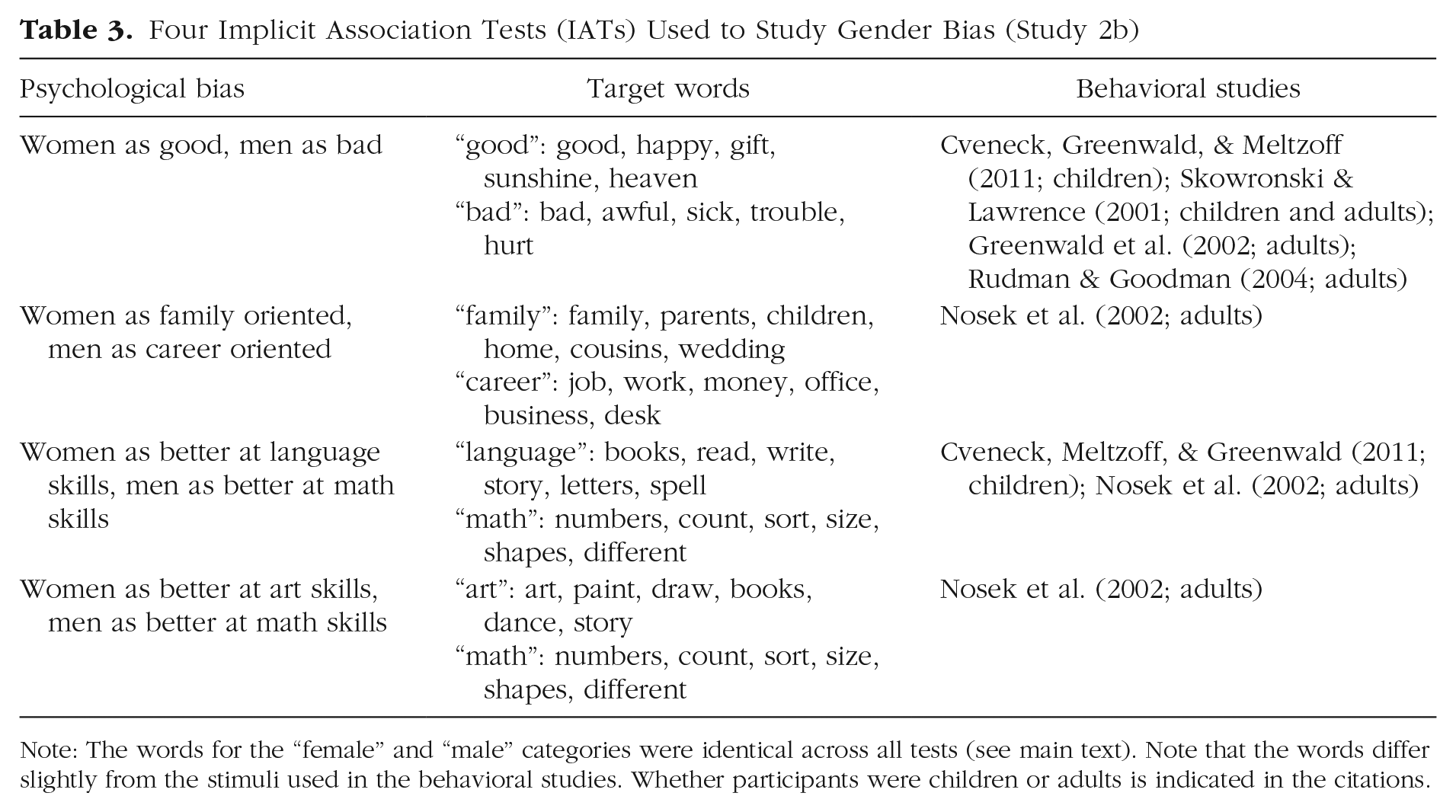
Note: The words for the “female” and “male” categories were identical across all tests (see main text). Note that the words differ slightly from the stimuli used in the behavioral studies. Whether participants were children or adults is indicated in the citations.
The biases found in the IAT are also present in the distributional semantics of language (Caliskan et al., 2017; Lewis & Lupyan, 2020). A bias can be quantified in a word-embedding model as an effect size using the same set of word items as in the behavioral IAT. The effect size is calculated as the relative (cosine) similarity of male words (e.g., “men”) to male-stereotyped words (e.g., “work”), compared with the relative similarity of female words (e.g., “women”) to female-stereotyped words (e.g., “family”; for formal effect-size description, see the supplemental information). Stereotypes that are revealed in the IAT as measured by reaction time (e.g., men–work; women–family) tend to be reflected in word-embedding models, as measured by cosine distance.
We used this method to examine whether the four gender-related biases are also present in the language statistics of the WCBC. Target-category items are listed in Table 3, along with references for the corresponding IAT experiments with children and adults. Gender-category word items were identical to those used in Study 2a. We took other items from the corresponding behavioral experiments, replacing items with more child-friendly alternatives when the target word did not occur in the WCBC (e.g., “algebra” was changed to “numbers”). We conducted this analysis on a model trained on the WCBC as well as on models trained on a sample of the adult fiction matched in size to the WCBC (Davies, 2008) and a model trained on Wikipedia (Bojanowski et al., 2017). The starting point for the text from the adult-fiction book was randomly determined. We trained 10 models each on the Corpus of Contemporary American English (COCA) and WCBC and estimated the average effect size for each IAT type.
Results
Figure 5 shows the effect size for each of the four biases from models trained on each of the three corpora. Positive values indicate a bias to associate women with the stereotypical female category (e.g., women–family). Three of the four gender biases were present in the co-occurrence statistics of the WCBC: language–math, arts–math, and family–career. Importantly, these biases were larger in children’s books than in corpora containing mostly adult-directed language. This finding that behaviorally measurable gender biases are present in an exaggerated form in books for young children provides additional evidence that these books instantiate gender stereotypes that may influence children’s learning of gender stereotypes.
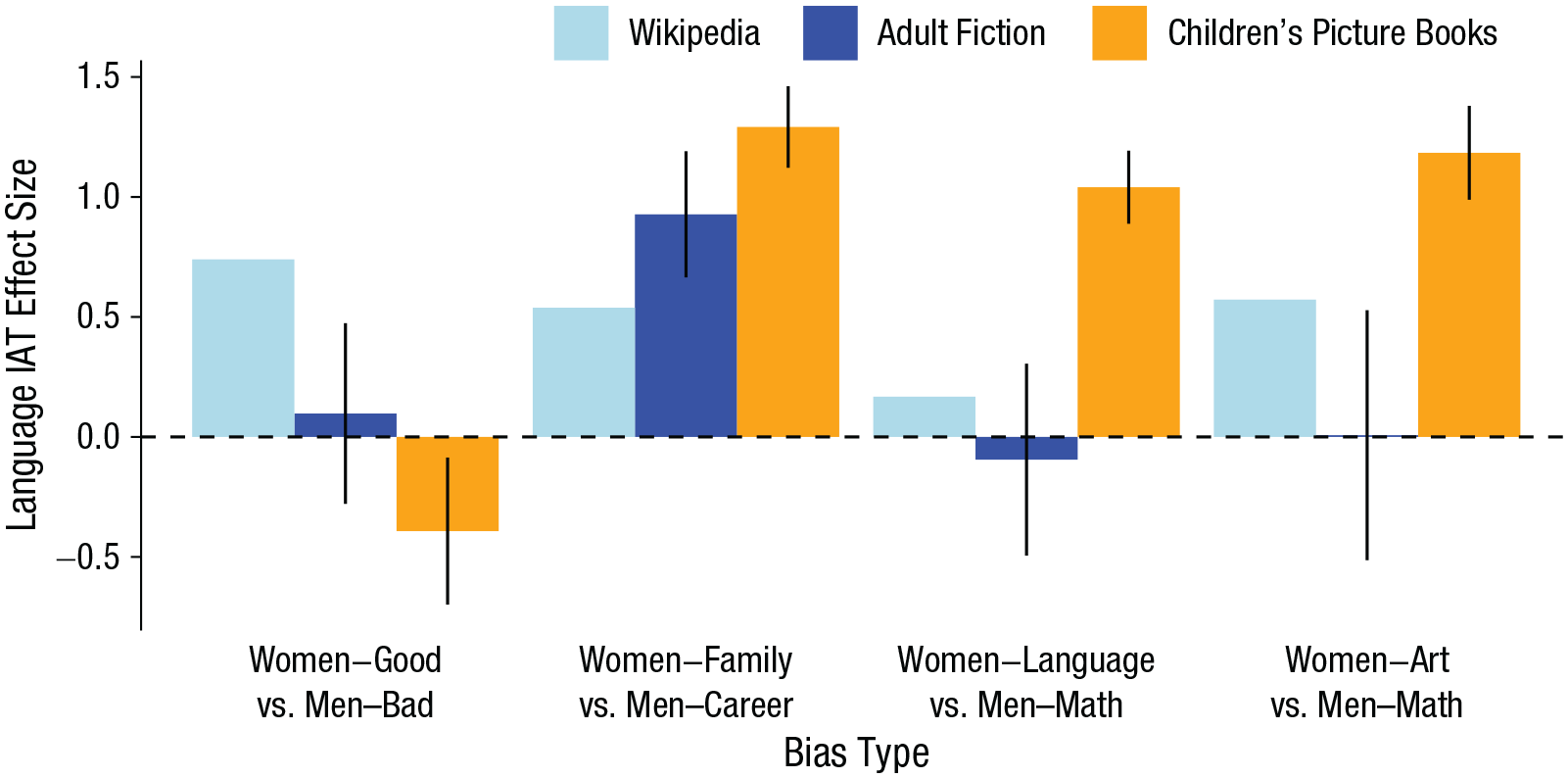
Estimated magnitude of four gender biases in word-embedding models trained on children’s books, adult fiction, and Wikipedia (Study 2b). Biases were determined by applying the Implicit Association Test (IAT) to the word-embedding models (for full descriptions of biases, see Table 3). Positive effect sizes indicate a bias to associate women with the stereotypical category (e.g., “family”); negative effect sizes indicate a bias to associate women with the nonstereotypical category (e.g., “career”). Data for children’s and adults’ books were obtained from the Wisconsin Children’s Book Corpus and the Corpus of Contemporary American English, respectively. Error bars show 95% confidence intervals.
Discussion
In summary, Studies 2a and 2b show that both adult word–gender associations and specific gender stereotypes observed in behavioral studies with adults and children are reflected in the co-occurrence statistics of the children’s book corpus. These findings are broadly consistent with prior work showing similar biases in a historical corpus of children’s books published around 1900 (Charlesworth et al., 2021).
Study 3: Book Gender and Child Gender
The results so far suggest that the texts of popular children’s books contain rich information about gender. In this final study, we sought to better understand the processes through which this information might influence children’s socialization into gender stereotypes by examining who is being exposed to which books. We created a novel measure based on the content of book reviews on a large online bookstore and validated this measure using existing survey data directly measuring the audience of a book. These data indicate that children’s books more frequently read to girls tend to have both more female content and more female characters, and children’s books more frequently read to boys tend to have both more male content and more male characters.
Method
For each book in the WCBC, we collected a sample of the most recent reviews on Amazon.com. There were reviews for all but two books (average = 473.96 reviews per book, SD = 194.53, minimum = 1, maximum = 1,290). The content of each review was coded for the presence of 16 gendered-kinship terms (e.g., “son,” “daughter,” “nephew,” “niece”; for the full list, see the supplemental information). We selected these target words because they had a high likelihood of referring to the child for whom the book was purchased (e.g., “My son loves Goodnight Moon”) rather than referring to a book character. All but two books had reviews containing at least one of our target gendered-kinship terms. Overall, 27.6% of reviews per book contained at least one target gendered-kinship term (SD = 0.08). For each review, we calculated an audience gender score as the proportion of female-kinship terms (tokens) present relative to all target-kinship words and then averaged across reviews from the same book to get a book-level estimate of the gender of book addressees (M = .49, SD = .19; for supplemental models predicting book gender at the review level, see the supplemental information).
We validated our computed audience gender score by comparing it with survey data collected by Hudson Kam and Matthewson (2017), who asked a sample of 1,107 Canadian caregivers to list the five books most frequently read to their male or female child. Of the books with at least five survey responses, 103 were also in the WCBC. Our review-based gender measure was positively correlated with Hudson Kam and Matthewson’s survey-based measure (r = .58, 95% CI = [.44, .7], p < .001), suggesting that book reviews can be used to estimate whether a given book is primarily read to boys or girls.
Results
We compared our audience gender score for each book with the measures of book genderedness described above. Both the content gender scores (r = .37, 95% CI = [.26, .48], p < .001) and book-character gender scores (r = .53, 95% CI = [.41, .62], p < .001; see Fig. 6a) were correlated with audience gender scores: Books that contained more female-biased content words and more female characters tended to be read more often to girls. In an additive linear model predicting audience gender with both types of gender scores, both content gender scores (β = 0.67, SE = 0.12, Z = 5.47, p < .001) and character gender scores (β = 0.07, SE = 0.01, Z = 7.32, p < .001) predicted independent and roughly equal variance. Together they accounted for 37% of the total variance in audience gender.
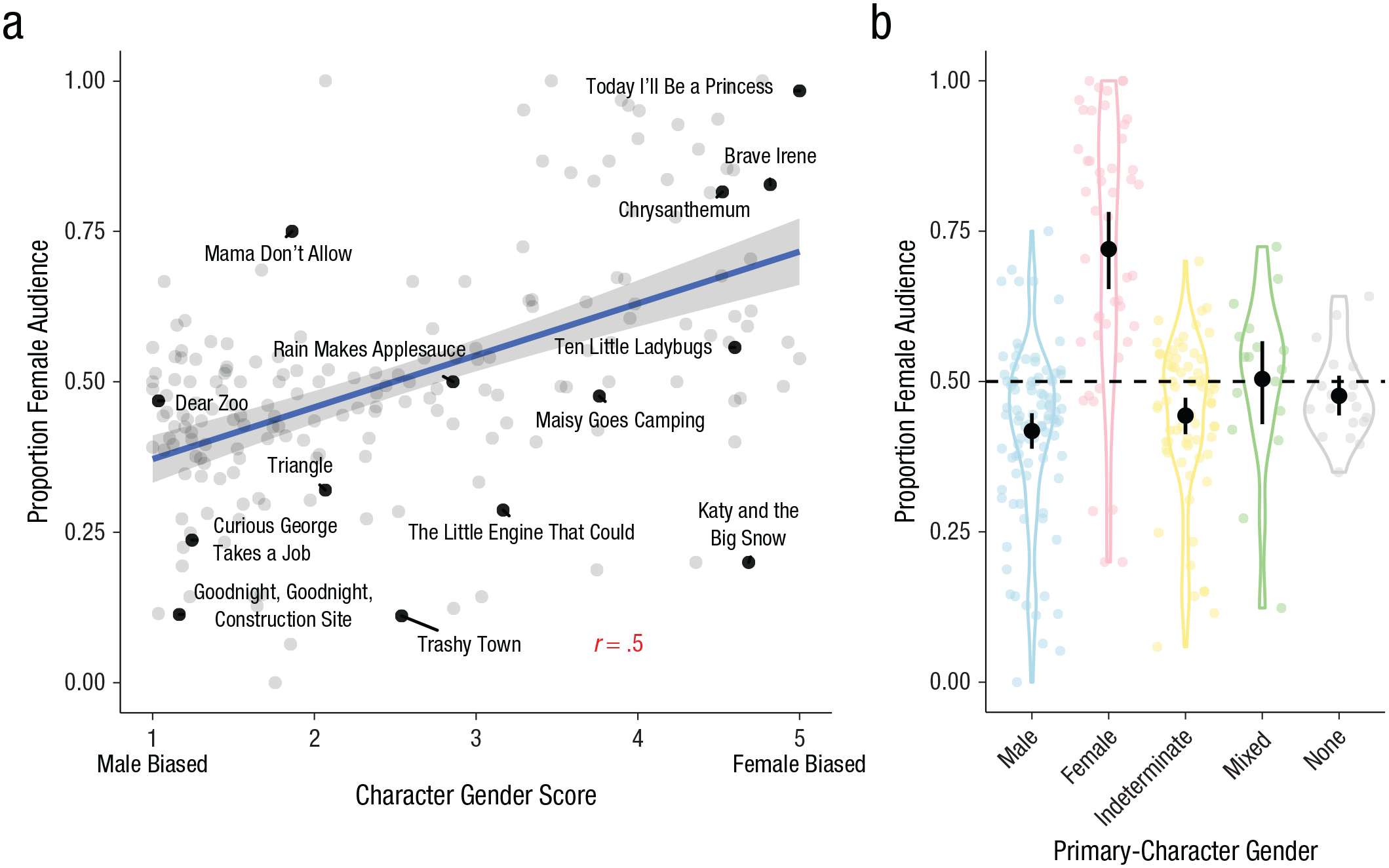
Proportion of female audience as a function of character gender (Study 3). The scatterplot (a) shows the relation between the female audience for each book and the book’s mean character gender score. The solid line shows the best-fitting linear regression, and the error band shows standard errors. The violin plots (b) show the distribution of female audience members across books as a function of primary-character gender. Colored points show individual books. The dashed line corresponds to an audience that is half female. Black points show means, and error bars show bootstrapped 95% confidence intervals. The width of each violin indicates the density of the data.
Consistent with this general pattern, results showed that books with female primary characters also tended to be more often read to girls, compared with the overall average, t(46) = 7.04, p < .001, d = 1.03, 95% CI = [0.68, 1.53] (see Fig. 6b). Books with male primary characters, t(92) = −5.08, p < .001, d = −0.53, 95% CI = [−0.72, −0.35], or gender-indeterminate primary characters, t(68) = −3.2, p = .002, d = −0.39, 95% CI = [−0.58, −0.18], tended to be more often read to boys. Notably, the effect size for girls was more than twice that of boys, suggesting that there was a stronger bias to read books with female characters to girls, relative to a bias to read books with male characters to boys. There was no bias in audience gender for books with multiple primary characters of different genders, t(16) = 0.26, p = .8, d = 0.06, 95% CI = [−0.36, 0.83], or books without primary characters, t(18) = −1.03, p = .32, d = −0.24, 95% CI = [−0.94, 0.2].
In summary, these findings suggest that children’s books featuring a particular gender and content associated with that gender tend to be read disproportionately to children of that gender.
General Discussion
What gender messages are conveyed by popular children’s books, and who is being exposed to them? We constructed a corpus of 247 contemporary children’s books and analyzed the extent to which the books contain biased gender associations. Using adult judgments of individual words, we found that over half of the words in the corpus tended to be associated with a particular gender and tended to cohere in gender-stereotypical categories. At the book level, we found that books varied in their gender associations and that the associations tended to reflect gender stereotypes (e.g., girl characters tended to do stereotypically girl activities). Further, the language statistics of the corpus itself paralleled word gender biases seen in adult judgments and specific gender stereotypes (e.g., boys are better at math, and girls are better at reading). These biases were more exaggerated in the children’s book corpus relative to adult fiction. Finally, we derived a novel metric for measuring the gender distribution of a book’s audience using automated analysis of book reviews. Children tended to be exposed to books that conveyed gender stereotypes about their own gender. Our work provides the first quantitative assessment of how gender is represented in contemporary children’s books and reveals that they contain many statistical regularities that could inform children’s development of gender stereotypes.
A notable pattern across our results is that female biases tend to be larger than male biases. In Study 1, books tended to have content that was biased toward the gender of the primary character (books with female characters have female content; books with male characters have male content), but this effect was larger for female characters than male characters. Similarly, participants tended to associate male characters with gender-neutral actions and traits but female characters with female-biased actions and traits. This tendency was also seen in the audience of books: Girls were far more likely to be read a book with a female primary character than boys were to be read a book with a male primary character. One interpretation of this general pattern is that “male” is conceptualized as the default, unmarked gender. This is consistent with the tendency for languages to treat “male” as the unmarked gender in their morphology (e.g., the word “female” is derived by adding a prefix to “male”), as well as numerous other empirical phenomena, such as the tendency for male word forms to refer to all people (e.g., “Man” in The Descent of Man; Darwin, 1896).
There are several reasons to think that the statistical regularities we identified in children’s books may be shaping children’s gender stereotypes. First, many of the stereotypical patterns that we report are implicit in text statistics rather than conveyed via explicit statements (“boys are better at math than girls”). The implicit nature of these messages may make them particularly difficult for adult readers to track or explicitly contradict. Second, children are exposed to books with a caregiver (more often than they perform other activities with a caregiver, e.g., watching TV). The caregiver’s presence may signal implicit endorsement of these stereotypes as correct or desirable and lead the child to make stronger inferences (Lewis & Frank, 2016; Xu & Tenenbaum, 2007). Third, our data suggest that children tend to be exposed to books that contain own-gender-consistent associations. This may make gender-inconsistent preferences less familiar to children and therefore more difficult to emulate (Bussey & Bandura, 1999). Filtered through children’s cognitive and social biases, children’s books may therefore be a potent means of teaching children about gender stereotypes.
One unanswered question from our data is how children learn stereotypes about other genders, given that they largely read storybooks containing stereotypes aligning with their own gender. One possibility is that they gain this information from other sources, such as media and direct interactions. Alternatively, children may in fact receive more information about their own gender than about others and, consequently, have less precise intuitions about stereotypes related to other genders. It is also an open question whether the tendency for children to be read books matching their own gender is due to caregiver or child preferences. This question is important in light of recent data on gender development in transgender children who show strong identity with the gender they feel they are by age 3 (Gülgöz et al., 2019). If transgender children play an active role in their own socialization (Martin & Ruble, 2004), our data suggest that children’s books could be an early source of gender information for them.
Our work characterizes the gendered content of children’s books and their potential role in development, but causal links between the properties we observed and the gender associations that children form remain to be addressed. Reviews of the impact of shared reading on language and literacy development have concluded that learning effects are small (Noble et al., 2019; Scarborough & Dobrich, 1994). How much is learned about gender in particular is a further question. Moreover, little is known about how children themselves perceive the messages contained within these books. In the work presented here, we primarily measured word gender bias via adult judgments, yet children do not have the extensive knowledge and experience that underlie adult judgments. The fact that word-embedding models trained exclusively on the statistics of the children’s book corpus reflect adultlike word gender biases suggests that adult gender biases could in principle begin to be learned from children’s book texts, but whether they are remains an open question. Future work could more directly address these questions by eliciting child judgments of word gender and by experimentally manipulating the statistics of children’s linguistic input about gender.
Finally, there are limits to the generalizability of our findings. The books in our corpus were selected on the basis of their popularity with English-speaking North American audiences, and word ratings were elicited from native English speakers. It is quite likely that the patterns we report here vary across book genres, languages, and cultures (Lewis & Lupyan, 2020). This variability could be systematically studied in future work by applying our methods to other corpora.
There is no doubt that shared reading has numerous benefits. However, our data show that contemporary children’s books also convey systematic information about gender, often (though not always) instantiating gender stereotypes—indeed, some more strongly than in adult-directed literature. Caregivers may inadvertently promote the development of gender stereotypes via shared reading of books. Exposure to these language-embedded biases may lead to beliefs that help entrench gender biases and disparities. However, the variability of gender biases across books also suggests that caregivers may be able to influence children’s development of beliefs about gender through choice of books, an important issue for future research.
Footnotes

Transparency
Action Editor: Leah Somerville
Editor: Patricia J. Bauer
Author Contributions
All the authors contributed to study conception, study design, and data collection. M. Lewis analyzed the data. M. Lewis, G. Lupyan, and M. S. Seidenberg wrote the manuscript, and all the authors approved the final manuscript for submission.