




Abstract
Whom do individuals blame for intergroup conflict? Do people attribute responsibility for intergroup conflict to the in-group or the out-group? Theoretically integrating the literatures on intergroup relations, moral psychology, and judgment and decision-making, we propose that unpacking a group by explicitly describing it in terms of its constituent subgroups increases perceived support for the view that the unpacked group shoulders more of the blame for intergroup conflict. Five preregistered experiments (N = 3,335 adults) found support for this novel hypothesis across three distinct intergroup conflicts: the Israeli-Palestinian conflict, current racial tensions between White people and Black people in the United States, and the gender gap in wages in the United States. Our findings (a) highlight the independent roles that entrenched social identities and cognitive, presentation-based processes play in shaping blame judgments, (b) demonstrate that the effect of unpacking groups generalizes across partisans and nonpartisans, and (c) illustrate how constructing packed versus unpacked sets of potential perpetrators can critically shape where the blame lies.
Keywords
Whom do individuals blame for intergroup conflicts and disputes? Do people attribute responsibility for intergroup conflict to the in-group or the out-group? Blaming detracts from the image of the blamed party, decreasing its perceived warmth and competence (Chaudhry & Loewenstein, 2019). Therefore, people are generally motivated to distance themselves and their in-groups from blame, and they do so by blaming the out-group for intergroup conflict more than they blame the in-group. This tendency is consistent with the ubiquity and robustness of intergroup bias (Hewstone et al., 2002). Indeed, the desire to maintain a positive image of the in-group (Brown, 2000) often leads individuals to blame the out-group rather than the in-group for intergroup violence (Lickel et al., 2006; Nagar & Maoz, 2017a, 2017b; Staub & Bar-Tal, 2003).
Social identities undoubtedly play an important role in shaping moral judgments in intergroup contexts (Graham et al., 2009). There is, however, an additional process of theoretical and practical import that has received little attention to date in the intergroup-relations literature and merits thoughtful consideration. In particular, research on judgment and decision-making raises the possibility that extraneous (i.e., irrelevant) factors also shape moral judgments (Danziger et al., 2011). In this article, we complement motivated accounts of moral judgment in intergroup contexts by advancing a cognitive account of blame judgments in intergroup conflict.
Building on support theory (Tversky & Koehler, 1994), we propose that in judging blame, individuals consider not only who the parties are but also how they are presented. Put differently, judgments of blame in intergroup conflict are based on descriptions of the parties to the conflict, separate from the identities of the conflicting parties and the identities of the judges. If true, this proposition means that we can powerfully sway judgments of blame in intergroup conflict by changing how we describe the parties involved in the conflict.
Here, we tested a novel hypothesis, namely, that individuals attribute more blame to a group involved in an intergroup conflict when it is explicitly unpacked (i.e., described in terms of its constituent subgroups) than when its constituents remain packed (i.e., unified). We propose that this effect occurs separately from the common tendency to distance one’s in-group from blame. Hence, we expect the allocation of blame in intergroup conflict to be independently shaped by judges’ social identities as well as by the explicit unpacking of a group into its constituent subgroups.
Partition Dependence and the Calculus of Blame
Our prediction is consistent with a judgmental phenomenon known as partition dependence (Fox & Rottenstreich, 2003; See et al., 2006). Partition dependence captures people’s tendency to allocate more units to a particular category when it is unpacked into subcategories. Consider, for example, the findings of a study in which participants were asked to evaluate the likelihood of death from a natural cause (Tversky & Koehler, 1994, Study 1). When participants made one global judgment about the category as a whole, they evaluated the likelihood of death from a natural cause as significantly lower than when the category was unpacked to specific causes and participants had to explicitly consider each component (e.g., heart disease, cancer). This study also found that the effect of unpacking on judgments was larger when the unpacked list involved more rather than fewer components.
Groups involved in an intergroup conflict can be described either in a packed form or in an unpacked form. Unpacking one of the groups into its constituent subgroups adds more entities to which individuals reason they should assign a percentage of the blame. Thus, it increases perceived support to the view that the unpacked group shoulders more of the blame for the intergroup conflict (Tversky & Koehler, 1994). Hence, prompting individuals to explicitly consider the responsibility shouldered by each subgroup separately increases the overall blame assigned to the unpacked group relative to presenting the same subgroups in a packed form.
Statement of Relevance
Overcoming intergroup conflict is one of humanity’s greatest challenges. People have long thought that moral judgments in the context of intergroup conflict are immovable, in part because such judgments tend to align with deep-seated social identities. In this research, we investigated whether a relatively subtle change in how groups are presented can shift moral judgments in intergroup conflict. We found that seemingly slight modifications to how we presented groups yielded predictable and powerful effects: Participants believed that groups shouldered a significantly greater percentage of the blame for intergroup conflict when we broke groups down to their constituent subgroups than when we presented them as a single, unified entity. This finding calls into question the idea that moral judgments in intergroup conflict are immutable and shows that narratives of intergroup conflict can be meaningfully changed with wise interventions that modify how we present “us” and “them.”
The Current Research
Empirical evidence corroborating support theory comes primarily from studies that elicited subjective probability assessments in contexts that rarely involve either entrenched social identities or moral evaluation, such as unpacking potential causes of a car malfunction (Fischhoff et al., 1978) and unpacking health hazards into distinct risks (Johnson et al., 1993). In contrast, the current research focused on moral judgment in the context of ongoing, large-scale intergroup conflicts (Halevy et al., 2015, 2020). Specifically, we tested our novel hypothesis across three distinct intergroup contexts—the Israeli-Palestinian conflict, racial tensions between White people and Black people in the United States, and the gender gap in wages. In each of these intergroup contexts, we expected that unpacking a group into its constituent subgroups would increase judgments of blame for the unpacked group. Because this judgmental phenomenon is independent from the motivated desire to distance one’s in-group from blame, we expected this effect to emerge both among individuals who consider conflicts that involve their in-group and among individuals who consider conflicts that do not involve their in-group. Overall, we report findings from five preregistered experiments with adult participants. For each experiment, we report all manipulations, measures, and data exclusions. Complete materials and data for the experiments are available on OSF at https://osf.io/5y4z6/. The research was approved by the Stanford University Institutional Review Board.
Experiment 1: The Israeli-Palestinian Conflict
Experiment 1 was conducted in the context of the protracted Israeli-Palestinian conflict (Halevy et al., 2006; Maoz, 2011; Maoz & McCauley, 2008).
Method
Participants and procedure
Because the effect size was unknown, our target sample size was 100 participants per experimental condition, for a total of 200 participants. Because of situational constraints, we collected responses from Israeli participants only.
We recruited 212 adults through an online panel company in Israel (https://www.panel4all.co.il/). Following our preregistered exclusion criteria for this experiment (https://aspredicted.org/ku8ev.pdf), we excluded three observations because the same person or persons attempted to complete the experiment multiple times and 14 participants because they completed a previous, related study. Four participants exited the survey before they were assigned to a condition and did not respond to any measures. Thus, the final sample available for analyses consisted of 191 participants, of whom 190 self-identified as Israeli Jews and one identified as “Other-Israeli” (49.2% male; age: M = 38.8 years, SD = 12.3). Sensitivity analysis in G*Power (Version 3.1; Faul et al., 2009; α = .05, power = .95) indicated that the smallest effect size that could be detected using this sample size was a Cohen’s d of 0.52. Participants completed the Qualtrics-hosted experiment online.
Design and materials
We randomly assigned each participant to one of two conditions: Israeli side unpacked or Palestinian side unpacked. After providing consent, all the participants read the following instructions (in Hebrew): This study examines perceptions of the Israeli-Palestinian conflict. A permanent solution to the Israeli-Palestinian conflict has yet to be found. Who do you blame for the absence of a permanent solution?
Participants in the Israeli-side-unpacked condition subsequently read the following: In the table below you will find four groups listed. Please indicate how much you think each one is to blame for the absence of a permanent solution to the conflict. Note—the percentages must add up to 100%.
The four groups were the Israeli right-wing bloc, the Israeli center bloc, the Israeli left-wing bloc, and the Palestinians.
Participants in the Palestinian-side-unpacked condition read the same instructions but were given the following set of groups: the Palestinian Hamas movement, the Palestinian Fatah movement, the Palestinian Islamic jihad movement, and Israel. In both conditions, the order in which groups appeared on the screen was randomly determined for each participant. After allocating 100% of blame across the four groups, which served as our dependent measure, participants in both conditions reported their identification with the nation (the importance subscale of identification with the nation; Roccas et al., 2008; four items, e.g., “Being an Israeli is an important part of my identity”; Cronbach’s α = .94), demographic characteristics, and political orientation (1 = strongly identifies with the political right wing, 7 = strongly identifies with the political left wing).
Results
As Figure 1 shows, there was a remarkable shift in blame judgments between the two conditions. When the Israeli side of the conflict was packed and the Palestinian side was unpacked, only a small fraction of the blame was assigned to Israel (participants’ national in-group; M = 15.78%, SD = 19.61). However, when the Israeli side of the conflict was unpacked and the Palestinian side was packed, a substantially larger percentage of the blame was assigned to the Israeli side (participants’ national in-group; M = 51.70%, SD = 29.69). This large effect was highly significant, t(168.99) = −9.91, p < .001, Cohen’s d = −1.43.
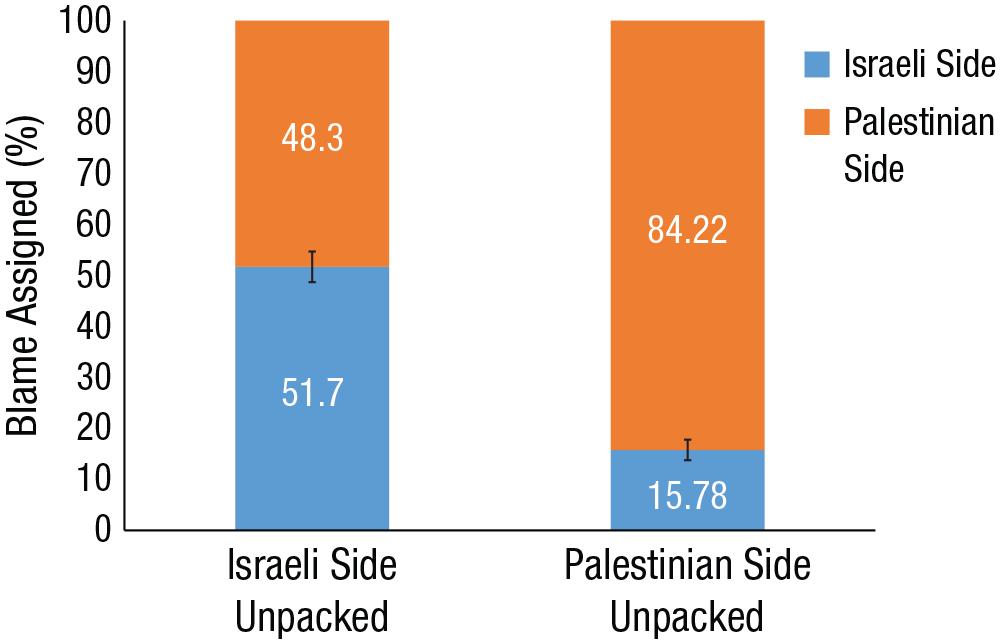
Percentage of blame assigned to each side in the Israeli-Palestinian conflict by Israeli participants as a function of unpacking condition (Experiment 1). Error bars represent standard errors.
Experiment 1 also found evidence for a motivated tendency to distance blame from one’s national group and political subgroup. Across both conditions, the more participants identified with Israel, the less blame they assigned to Israel, r(189) = −.16, p = .029. Additionally, analyses within the Israeli-side-unpacked condition showed that the more strongly participants identified with the Israeli left-wing bloc, the less blame they assigned to it, r(96) = −.27, p = .008, and the more blame they assigned to the Israeli right-wing bloc, r(96) = .42, p < .001. Participants’ political orientation was unrelated to the percentage of blame assigned to the Israeli center bloc, r(96) = −.09, p = .39. 1
Discussion
Experiment 1’s findings lend initial support to our hypothesis in the context of a violent and intractable intergroup conflict. Blame judgments were significantly higher when a group was unpacked into its constituent subgroups than when it remained packed. The findings also document the motivated tendency to distance blame from groups with which one identifies (i.e., participants’ national group and political subgroup).
Experiment 2: Reflecting on the Israeli-Palestinian Conflict From Afar
In Experiment 1, the participants belonged to one of the national groups involved in the conflict as well as to one of the political subgroups to which we unpacked their national group. If the effect of unpacking groups on blame judgments observed in Experiment 1 is indeed caused by a cognitive process consistent with support theory and the phenomenon of partition dependence, then it should also emerge in a sample of third-party observers who are not directly affiliated with the national groups involved in the conflict. Finding evidence for the effect of unpacking groups on blame judgments in a sample of participants whose social identities are considerably less involved with the dynamics of the intergroup conflict in which they make blame judgments would demonstrate that the effect of cognitive, presentation-based processes on blame judgments emerges also in contexts that are largely devoid of motivated reasoning.
Method
Participants
The preregistration for Experiment 2 is available at https://aspredicted.org/vt7u7.pdf. Following our preregistered plan, we opened the experiment to 200 U.S. adults classified as “CloudResearch approved participants” on Amazon’s TurkPrime platform. Sessions were started on Qualtrics by 226 participants. Twenty participants exited the survey before they were assigned to a condition and did not respond to any measures. Four additional participants did not report their citizenship and were excluded from the analyses, consistent with the preregistration. No participants had to be excluded because of repeated participation. This resulted in a final sample of 202 U.S. citizens for analyses (age: M = 37.1 years, SD = 10.2; 39.1% female; race: 75.2% White/Caucasian, 10.9% Black/African American, 6.9% Hispanic/Latinx, 5.4% Asian/Asian American, 1.5% other). Sensitivity analysis in G*Power (Version 3.1; α = .05, power = .95) indicated that the smallest effect size that could be detected using this sample size was a Cohen’s d of 0.51.
Design, procedure, and dependent measure
After providing consent, participants read the same instructions employed in Experiment 1, and each participant was randomly assigned to one of the same two conditions as in Experiment 1. Participants in both conditions allocated 100% of the blame for the Israeli-Palestinian conflict across the four options available to them in their respective condition.
Additional measures
Participants subsequently indicated how much they felt connected to and knowledgeable about the Israeli-Palestinian conflict by responding to six items using scales ranging from 1 (strongly disagree) to 7 (strongly agree). The six items, which were presented in random order, were “I feel personally invested in the Israeli-Palestinian conflict,” “I have family and/or friends in Israel/Palestine,” “I care about the outcomes of the Israeli-Palestinian conflict,” “I know a lot about the Israeli-Palestinian conflict,” “I regularly follow the news about the Israeli-Palestinian conflict,” and “I am very familiar with the history of the Israeli-Palestinian conflict.” The six items loaded on a single factor and showed high reliability (Cronbach’s α = .88).
Participants subsequently responded to the question, “How would you describe your personal position in the context of the Israeli-Palestinian conflict?” This question was presented twice—once with response options that ranged from 1 (not at all pro-Israeli) to 7 (very much pro-Israeli) and a second time with response options that ranged from 1 (not at all pro-Palestinian) to 7 (very much pro-Palestinian). Participants subsequently reported their demographic characteristics and exited the survey. No other manipulations or measures were included in the survey.
Results
As in Experiment 1, to evaluate the total percentage of the blame assigned to a particular national group, we summed the blame assigned to each of its subgroups when it was unpacked and used the single value assigned to it when it was packed. Lending support to our hypothesis, and replicating the findings from Experiment 1 with a sample of participants who were not directly affiliated with the national groups involved in the conflict, results showed that unpacking national groups into their political subgroups had a strong and highly significant effect on blame allocation, F(1, 200) = 85.92, p < .00001, η p 2 = .30. As Figure 2 shows, blame judgments completely reversed between the two conditions. When the Israeli side was packed and the Palestinian side was unpacked, the Israeli side was assigned less of the blame (M = 37.58%, SD = 25.47) than the Palestinian side (M = 62.42%, SD = 25.47). In contrast, when the Israeli side was unpacked and the Palestinian side was packed, the Israeli side was assigned more of the blame (M = 68.06%, SD = 21.20) than the Palestinian side (M = 31.94%, SD = 21.20). The effect of unpacking groups on blame assignment remained highly significant when analyses also adjusted for individual differences in participants’ preexisting attitudes toward the parties and their feelings of connection to and knowledge about the Israeli-Palestinian conflict, F(1, 197) = 112.99, p < .00001, η p 2 = .301.
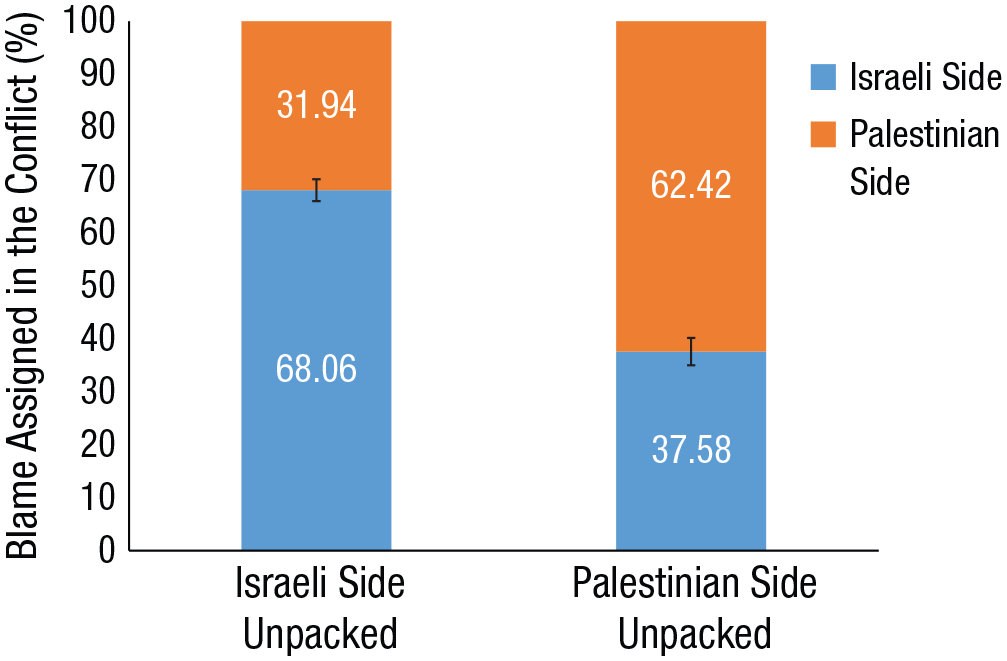
Percentage of blame assigned to each side in the Israeli-Palestinian conflict by U.S. participants as a function of unpacking condition (Experiment 2). Error bars represent standard errors.
Finally, consistent with the motivated account of moral judgment in intergroup contexts, results showed that both participants’ preexisting attitudes toward the parties and their feelings of connection to and knowledge about the Israeli-Palestinian conflict correlated significantly with blame judgments. Specifically, the percentage of blame assigned to the Israeli side correlated positively with holding a pro-Palestinian position, r(200) = .41, p < .001; negatively with holding a pro-Israeli position, r(200) = −.51, p < .001; and negatively with feeling connected to and knowledgeable about the conflict, r(200) = −.17, p = .017.
Discussion
Experiment 2 replicated the findings of Experiment 1. The unpacked national group received approximately two thirds of the overall blame, whereas the packed group received approximately one third of the blame. The fact that these findings emerged with a sample of U.S. citizens who are not directly affiliated with the national groups involved in the conflict or with their political subgroups lends support to the cognitive-partition-dependence account of the phenomenon, in line with support theory (Tversky & Koehler, 1994). This effect emerged even when models adjusted for participants’ attitudes toward the parties, indicating that the cognitive-partition dependence exists alongside and independently of motivational processes that shape blame judgments, consistent with Experiment 1’s findings.
Experiment 3: Racial Tensions in the United States
We had three goals in Experiment 3. First, we sought to examine the generalizability of the effect of unpacking groups on blame judgments in the context of a different intergroup conflict. Second, we sought to collect data from members of both sides of the conflict rather than members of only one side (Experiment 1) or third-party observers (Experiment 2). Third, we sought to further explore the complementary roles that cognitive and motivational processes play in shaping blame judgments in intergroup conflict. To achieve these goals, we focused in Experiment 3 on racial tensions between White people and Black people in the United States and examined the extent to which unpacking each of these categories to political subgroups (e.g., White Republicans, Black Democrats, Black independents) influenced blame judgments.
Method
Participants
The preregistration for Experiment 3 is available at https://aspredicted.org/jm34j.pdf. Following our preregistered plan, we opened the experiment to 1,200 adults on the survey platform Prolific (https://prolific.co/). Our sampling process used Prolific’s preexisting demographic categories to target only U.S. citizens who self-reported their race to be either White or Black when they joined Prolific. We made the experiment available in stages to members of different racial and political groups on the basis of Prolific’s demographic categories, thereby ensuring participation of both Black and White participants as well as random assignment to conditions within each targeted population. We set a large target sample size because of the 2 × 2 × 2 between-participants design described below as well as the possibility of having to exclude observations on the basis of our preregistered criteria.
Sessions were started on Qualtrics by 1,248 participants. We excluded 22 observations from participants who attempted to take the experiment multiple times. Despite posting the experiment only for participants who indicated that they were U.S. citizens and either White or Black in their Prolific intake survey, we had to exclude from the analyses three observations from individuals who did not identify as U.S. citizens and six observations from individuals who self-identified as members of other racial categories in the demographics section of our survey (three Asian American, two Hispanic, and one “other”). We then excluded 16 observations from participants who left the survey before being assigned to a condition. Thus, our final sample consisted of 1,201 valid observations from either Black or White U.S. citizens who completed the experiment (age: M = 33.7 years, SD = 12.4; 51.4% female; race: 66.6% White/Caucasian, 33.4% Black/African American). Sensitivity analysis in G*Power (Version 3.1; α = .05, power = .95) indicated that the smallest effect size (f) that could be detected using this sample size was.10.
Design and procedure
After providing consent, participants reported their demographic characteristics, and then each participant was randomly assigned to one of four conditions in a 2 (White people: packed vs. unpacked) × 2 (Black people: packed vs. unpacked) between-participants design. Participants’ race was a third between-participants factor. When racial categories were packed, they were referred to as “Whites” and “Blacks.” When racial categories were unpacked into their constituent subgroups, we presented participants with racial subgroups on the basis of political orientation: “Whites who are strong Republicans,” “Whites who are moderate Republicans,” “Whites who are strong Democrats,” “Whites who are moderate Democrats,” “Independent Whites,” “Blacks who are strong Republicans,” “Blacks who are moderate Republicans,” “Blacks who are strong Democrats,” “Blacks who are moderate Democrats,” and “Independent Blacks.”
When both racial categories were packed, participants divided 100% of the blame between two groups. When one of the two racial categories was packed and the other was unpacked, participants divided 100% of the blame between six groups. Finally, when both racial categories were unpacked, participants divided 100% of the blame between 10 groups. In all conditions, the order in which different groups were presented on the screen was randomly determined for each participant.
The instructions that preceded our main dependent measure read as follows: Recent months witnessed an increase in racial tensions between Blacks and Whites across the United States. Who do you blame for current racial tensions between Blacks and Whites in the United States? Below you will find [two/six/ten] groups. Please indicate how much of the blame you attribute to each of them for the current racial tensions between Blacks and Whites in the U.S. Note: The percentages you allocate below must add up to a total of 100%. Please indicate your own personal views below.
Additional measures
For all additional measures and the analyses involving them, see the Supplemental Material available online.
Results
A three-way (i.e., “White People” Unpacked × “Black People” Unpacked × Participant Race) analysis of variance (ANOVA) on the percentage of blame attributed to White people found a significant effect of unpacking the group “White people” into separate subgroups, F(1, 1193) = 83.54, p < .00001, η p 2 = .065; a significant effect of unpacking the group “Black people” into separate subgroups, F(1, 1193) = 69.02, p < .00001, η p 2 = .055; and a significant effect of participant race, F(1, 1193) = 37.89, p < .00001, η p 2 = .031. Consistent with the motivational processes discussed earlier, results showed that White people assigned less blame to White people, r(1199) = −.16, p < .00001. None of the two-way interactions or the three-way interaction were significant (Fs < 2, ps > .24). (Results for additional attitudinal measures can be found in the Supplemental Material.)
Given that participant race had a main effect on blame judgments but did not interact with the experimental unpacking manipulations, we followed our preregistered analysis plan and subsequently collapsed across participant race and conducted a two-way ANOVA focusing on the effects of our experimental unpacking manipulations on blame judgments. As Figure 3 shows, participants blamed White people for racial tensions more when the group “White people” was unpacked into separate subgroups (M = 77.4%, SD = 23.1) than when it was not (M = 63.2%, SD = 28.0)—main effect of “White people” unpacked: F(1, 1197) = 98.32, p < .00001, η p 2 = .076. Additionally, participants blamed White people less when the group “Black people” was unpacked into separate subgroups (M = 64.4%, SD = 28.4) than when it was not (M = 76.3%, SD = 23.3)—main effect of “Black people” unpacked: F(1, 1197) = 69.58, p < .00001, η p 2 = .055. The interaction was not significant, F(1, 1197) = 0.76, p = .38, η p 2 = .001.
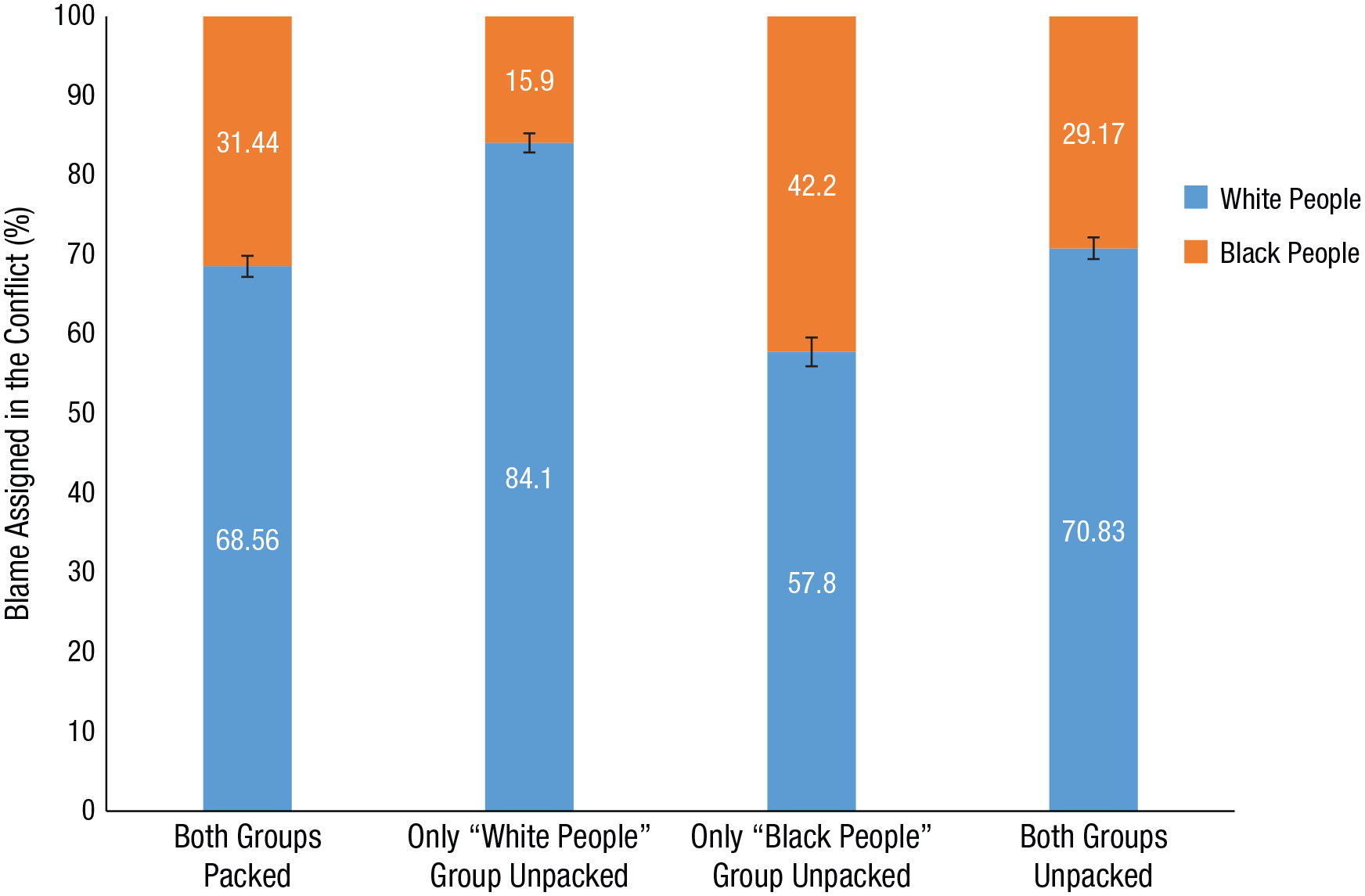
Percentage of blame assigned to each racial category in the context of racial tensions between Black people and White people in the United States as a function of unpacking condition (Experiment 3). Error bars represent standard errors.
For all results pertaining to group entitativity, group identification, and within-group differentiation, see the Supplemental Material. Put briefly, the experimental unpacking manipulation did not significantly influence these identity-related measures, in line with the proposed independence of motivated identity-based processes and cognitive, presentation-based processes in judging blame in intergroup conflict.
Discussion
Experiment 3 demonstrated that the effect of unpacking groups on blame judgments generalizes to the context of racial tensions between White people and Black people in the United States. The fact that such a high-powered experiment did not find evidence for effects of unpacking groups on social-identity-related measures (see the Supplemental Material) highlights the separation between the cognitive processes suggested by support theory and parallel motivated processes that shape blame judgments in intergroup conflict (participant race had a significant main effect on blame judgments as well as on the social-identity-related measures).
Experiment 4: Disrupting the Cognitive Blame-Judgment Process
We designed Experiment 4 to explore whether the naturally occurring cognitive process suggested by support theory can be disrupted with an experimental intervention. Specifically, we examined whether focusing participants’ attention on different baselines would moderate the effect of unpacking groups on blame judgments in the context of racial tensions between White people and Black people in the United States.
Method
Participants
The preregistration for Experiment 4 is available at https://aspredicted.org/jr9e4.pdf. Following our preregistered plan, we opened the experiment to 1,200 adults on Prolific. We used the same sampling process as in Experiment 3 to ensure participation of both Black and White participants as well as random assignment to conditions within each targeted population. We set a large target sample size because of the 2 × 3 × 2 between-participants design noted below as well as the possibility of having to exclude observations on the basis of our preregistered criteria.
Sessions were started on Qualtrics by 1,272 participants. We excluded 83 observations that came from participants who tried to complete the experiment multiple times. Despite posting the experiment only for participants who indicated that they were U.S. citizens and self-reported their race as either White or Black in their Prolific intake survey, we had to exclude from the analyses one participant who did not identify as a U.S. citizen and seven observations from individuals who identified as members of other racial categories in the demographics section of our survey (two Hispanic and five “other”). Finally, following our preregistration, we excluded 226 additional participants who failed an attention check. Thus, our final sample consisted of 955 valid observations from either Black or White U.S. citizens who completed the experiment (age: M = 34.2 years, SD = 12.4; 50.5% female; race: 68.7% White/Caucasian, 31.3% Black/African American). Sensitivity analysis in G*Power (Version 3.1; α = .05, power = 0.95) indicated that the smallest effect size (f) that could be detected using this sample size was .12. For results and a discussion pertaining to the attrition from Experiment 4, see the Supplemental Material.
Design and procedure
After providing consent, participants reported their demographic characteristics, and then each participant was randomly assigned to one of six conditions in a 2 (unpacked group: “White people” unpacked vs. “Black people” unpacked) × 3 (process intervention: equal baseline vs. unequal baseline vs. no intervention) between-participants design. Participants’ race was a third between-participants factor in the design.
In all six conditions, participants saw one racial category that was packed (either Whites or Blacks, depending on the condition), whereas the other racial category was unpacked into five subgroups on the basis of political orientation as in Experiment 3 (e.g., “Blacks who are moderate Republicans,” “Whites who are strong Democrats”). Thus, in all six conditions, participants allocated 100% of the blame across six groups. The order in which different groups were presented on the screen was randomly determined for each participant.
We used the same instructions employed in Experiment 3. In the two no-intervention conditions, the instructions were identical to the instructions used in the asymmetric conditions in Experiment 3 (i.e., one racial category was packed and the other was unpacked). In the two equal-baseline conditions, these instructions were followed by text that read as follows: “For example, one way to allocate the blame in the task below is to assign equal proportions of the blame to all six groups below.” In the two unequal-baseline conditions, these instructions were followed by text that read as follows: “For example, one way to allocate the blame in the task below is to assign 100% of the blame to Whites/Blacks and 0% of the blame to the other five groups.” To direct participants’ attention to the example in these four process-intervention conditions, we presented the text in capital letters and red font throughout and followed it with a large image illustrating the allocation described in the text.
Participants then allocated blame across the six groups available in their condition, which was our dependent measure. They subsequently responded to an attention-check item on the following survey page, reported their Prolific ID, and exited the survey. No additional manipulations or measures were included in the survey.
Results
A three-way (i.e., “White People” or “Black People” Unpacked × Process-Intervention Condition × Participant Race) ANOVA on the percentage of blame assigned to White people found a significant effect of unpacking condition (consistent with the findings of our previous experiments), F(1, 943) = 227.31, p < .00001, η p 2 = .194; a significant effect of process-intervention condition, F(2, 943) = 4.38, p = .013, η p 2 = .009; and a significant interaction between unpacking condition and process-intervention condition, F(2, 943) = 5.80, p = .003, η p 2 = .012. A significant effect of participant race also emerged, F(1, 943) = 7.45, p = .006, η p 2 = .008. Results supported the motivated account of moral judgment in intergroup contexts: White people assigned less blame to White people, r(953) = −.09, p = .006. None of the interactions involving participant race (either the two-way interactions or the three-way interaction) were significant (Fs < 2, ps > .15).
Given that participant race did not interact with the experimental manipulations, and following the preregistered analysis plan, we subsequently collapsed across participant race and conducted a two-way ANOVA focusing on the effects of our experimental unpacking and process-intervention manipulations on blame judgments. As Figure 4 shows, participants blamed White people for racial tensions more when “White people” as a group was unpacked into separate subgroups (M = 85.82%, SD = 15.59) than when it was not (M = 59.26%, SD = 31.32), and this main effect of unpacking condition was both large and highly significant, F(1, 949) = 246.81, p < .00001, η p 2 = .206. There was also a significant main effect of process-intervention condition, F(2, 949) = 5.29, p = .005, η p 2 = .011. The two main effects were qualified by an Unpacking Condition × Process-Intervention Condition interaction, F(2, 949) = 7.53, p = .001, η p 2 = .016. Specifically, as Figure 4 shows, the process-intervention condition had no effect on the overall percentage of blame assigned to each group when “White people” was unpacked (blame assigned to White people ranged from 84.20% to 87.04% across the three conditions) but had a considerable effect on the overall percentage of blame assigned to each group when “Black people” as a group was unpacked into separate subgroups (blame assigned to White people ranged from 52.25% to 66.35% across these three conditions). Further information on the simple effects of this interaction can be found in the Supplemental Material.
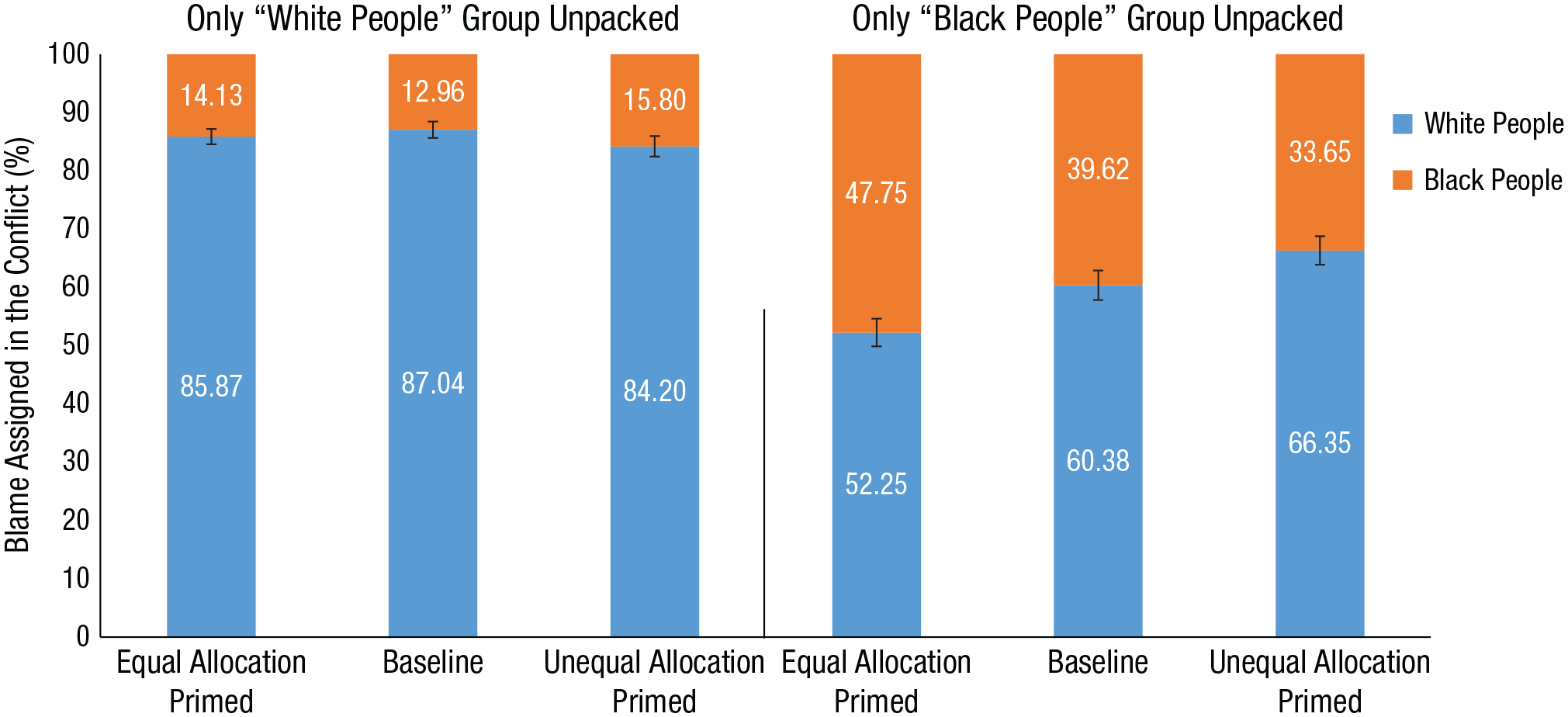
Percentage of blame assigned to each racial group in the context of racial tensions between Black people and White people in the United States as a function of unpacking condition and process-intervention condition (Experiment 4). Error bars represent standard errors.
Although we did not formulate an a priori hypothesis concerning a differential effect of our process intervention on assignment of blame to Black people versus White people, we believe it is worthwhile to offer a post hoc interpretation of the pattern of findings that emerged in Experiment 4. We acknowledge that alternative informed speculations may be as plausible as the proposed interpretation. Revisiting the experimental design helps illuminate this interaction effect. In both unpacking conditions, the unequal baseline was primed by assigning 100% of the blame to the packed group. Thus, when the group “White people” was unpacked, 100% of the blame was assigned to Black people (the packed group in this condition), whereas when the group “Black people” was unpacked, 100% of the blame was assigned to White people (the packed group in that condition). The asymmetric influence of the process-intervention manipulation shows that participants effectively dismissed the unequal-baseline prime in the former condition, possibly because assigning 100% of the blame to Black people seemed unreasonable or unjust. In contrast, participants’ judgments of blame were influenced by the unequal-baseline prime when the group “Black people” was unpacked, as indicated by the fact that the greatest percentage of blame was assigned to White people following the unequal-baseline prime (when 100% of the blame was assigned to White people in the example that we asked participants to consider).
Discussion
Experiment 4 replicated the robust effect of unpacking groups, which explained more than 20% of the variance in blame judgments in Experiment 4. The findings concerning the effectiveness of the process-intervention manipulation should be interpreted with caution, given that relatively fewer participants passed the attention check in the condition with the unequal baseline (see the Supplemental Material). Nonetheless, the findings are consistent with the proposed cognitive account of blame judgments in showing that the naturally occurring cognitive process observed in Experiments 1 to 3 can be disrupted by directing judges’ attention to different baselines.
Experiment 5: The Gender Wage Gap
We had two main goals in Experiment 5. First, we sought to replicate the effect of unpacking groups on blame judgments in a less explicitly volatile, although highly consequential, intergroup context, namely, the gender wage gap in the United States (England et al., 2020; O’Neill, 2003). Second, given that national groups (in Experiments 1 and 2) and racial categories (in Experiments 3 and 4) were consistently unpacked into political subgroups, we sought to demonstrate that the effect is not unique to unpacking groups along political fault lines. Hence, in Experiment 5, we unpacked gender categories (men and women) to racial subgroups. Doing so enabled us to demonstrate that the same dimension that serves as the superordinate category in one context (the racial tensions studied in Experiments 3 and 4) can serve as the subordinate dimension for the unpacking manipulation in a different context (the gender wage gap studied in Experiment 5).
Method
Participants and procedure
We opened the experiment to 800 adults on TurkPrime. Sessions were started in Qualtrics by 857 participants. Following our preregistered exclusion criteria for this experiment (https://aspredicted.org/uu2xu.pdf), we excluded 39 observations because the same individuals attempted to complete the experiment multiple times. Although we did not state this in our preregistration, we also had to exclude 32 observations from participants who did not report their gender or identified with a nonbinary gender because we could not categorize their gender in-group or out-group in this experiment. Thus, the final sample available for analyses consisted of 786 participants (59.0% male; age: M = 36.4 years, SD = 10.3; race: 65.4% White/Caucasian, 21.9% Black/African American, 5.9% Asian/Asian American, 5.3% Hispanic/Latinx, 1.5% other). Sensitivity analysis in G*Power (Version 3.1; α = .05, power = 0.95) indicated that the smallest effect size (f) that could be detected using this sample size was .13. Participants completed the Qualtrics-hosted experiment online.
Design and materials
Following Experiment 3’s design, we randomly assigned each participant in Experiment 5 to one of four conditions in a 2 (male gender category: packed vs. unpacked) × 2 (female gender category: packed vs. unpacked) between-participants design. Participants’ self-reported gender served as a third between-participants factor in this design. All the participants read the following prompt: “Across the United States, there is a marked gender gap in pay: Women are often paid less than men for the same job. Who do you blame for the gender gap in wages?”
Participants in the condition in which both the male and female gender categories were packed subsequently read, “Below you will find two groups. Please indicate how much of the blame you attribute to each of them for this gender gap. Note—the sum of percentages must add up to 100%.” The two groups listed were “women” and “men.” Participants in the condition in which both the male and female gender categories were unpacked read the same instructions, with the exception that we replaced “two groups” with “ten groups.” The 10 groups listed were “White men,” “Black/African American men,” “Asian/Asian American men,” “Hispanic men,” “men of other racial groups,” “White women,” “Black/African American women,” “Asian/Asian American women,” “Latina women,” and “women of other racial groups.” In the two conditions in which only one of the gender categories was unpacked, participants saw six groups. When only the male gender category was unpacked, the groups were “women” and the five male subgroups listed above. When only the female gender category was unpacked, the groups were “men” and the five female subgroups listed above. In all four conditions, the order in which the different groups were presented on the screen was randomly determined for each participant. Participants in all conditions subsequently reported their demographic characteristics, including gender and race. No other measures were included in the survey.
Results
We first conducted a three-way ANOVA examining the main and interactive effects of unpacking the gender category of “men,” unpacking the gender category of “women,” and participant gender on blame judgments. This analysis indicated a significant main effect of unpacking the male gender category, F(1, 778) = 73.59, p < .001, η p 2 = .086, and a significant main effect of unpacking the female gender category, F(1, 778) = 47.65, p < .001, η p 2 = .058. A significant main effect of participant gender also emerged, F(1, 778) = 49.84, p < .001, η p 2 = .060—consistent with the motivated, identity-based process, results showed that women blamed women less than men did, r(784) = −.23, p < .00001. The interactions between unpacking the male gender category and participant gender, unpacking both the male and female gender categories, and the three-way interaction were not significant (Fs < 2.1, ps > .30); the interaction between unpacking the female gender category and participant gender was only marginally significant, F(1, 778) = 3.65, p = .06, η p 2 = .005. Given the absence of significant interactions with participant gender, we followed the previous experiments and subsequently collapsed the data across participant gender and report the results of a two-way ANOVA focusing on the effects of the experimentally manipulated unpacking factors.
The two-way ANOVA found a significant main effect of unpacking the male gender category, F(1, 778) = 75.54, p < .001, η p 2 = .088; a significant main effect of unpacking the female gender category, F(1, 778) = 48.76, p < .001, η p 2 = .059; and no interaction, F(1, 778) = 0.010, p = .92, η p 2 = .00. As Figure 5 shows, when both gender categories were packed, participants assigned on average 34.74% (SD = 24.09) of the blame to women and 65.26% of the blame to men. Similarly, when both gender categories were unpacked, participants assigned on average 31.12% (SD = 29.63) of the blame to women and 68.88% of the blame to men. Replicating the effects observed in Experiments 1 to 4, analyses revealed that participants attributed a significantly larger percentage of the blame to women when only the female gender category was unpacked (and the male gender category was packed; M = 49.30%, SD = 39.25) than when only the male gender category was unpacked (and the female gender category was packed; M = 16.13%, SD = 23.66).
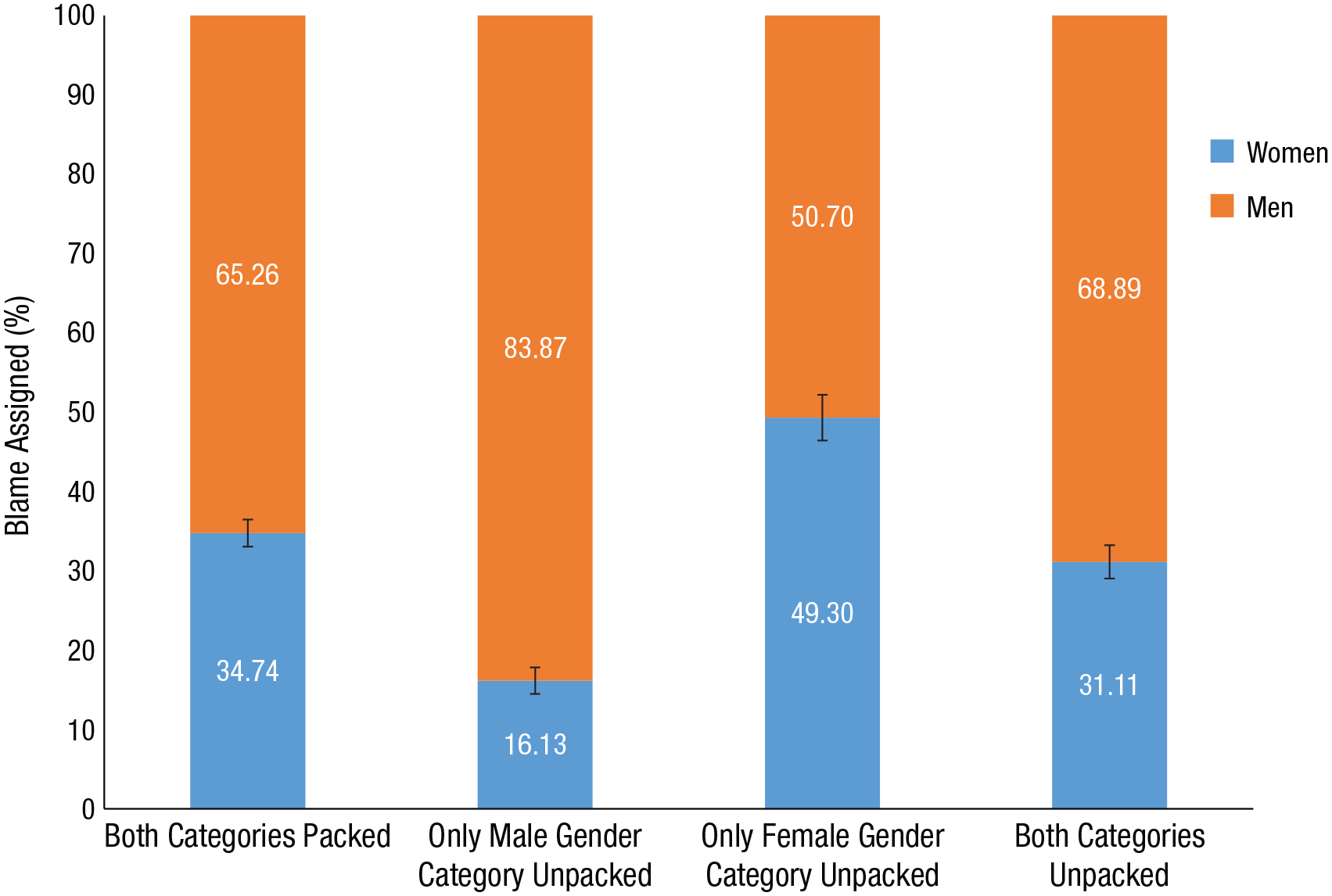
Percentage of blame assigned to each gender category in the context of the gender gap in wages in the United States (Experiment 5). Error bars represent standard errors.
Discussion
Experiment 5’s findings generalize the robust effect of unpacking groups on blame judgments to the context of the gender gap in wages in the United States. They also show that a dimension of social categorization that serves as the superordinate dimension in one context (i.e., racial categories in Experiments 3 and 4) can serve as the subordinate dimension in a second context (racial subgroups in Experiment 5).
General Discussion
Five experiments provide converging evidence that judgments of blame in intergroup contexts critically depend on the overall set of groups and subgroups that an individual considers. When we unpacked one of the groups involved in the intergroup conflict by explicitly presenting it in terms of its constituent subgroups, perceived support for the idea that the unpacked group shoulders more of the blame for the intergroup conflict was bolstered in judges’ minds. This robust effect emerged consistently across our five experiments, which spanned three distinct contexts: the Israeli-Palestinian conflict, racial tensions between White people and Black people in the United States, and the gender gap in wages in the United States.
Theoretical implications
Previous research has demonstrated individuals’ preferences for distributed allocations over concentrated allocations (e.g., Sharps & Schroeder, 2019). Extending previous research, the current study makes three contributions to the literatures on judgment and decision-making, moral reasoning, and intergroup relations. First, it demonstrates that an exogenous factor that is unrelated either to moral convictions and principles or to entrenched social identities exerts a predictable causal effect on judgments of blame in intergroup conflict. Our studies demonstrate that how groups are presented—in packed or unpacked form—often explains a substantial percentage of the variance in blame judgments.
Second, our findings demonstrate the relative independence of motivated, social-identity-based processes and cognitive, presentation-based processes in shaping blame judgments in intergroup conflicts and disputes. Our experiments demonstrated that independence in several distinct ways. First, although we consistently found that individuals distance their groups and subgroups from blame by attributing more blame to the out-group than the in-group, participants’ social identities (e.g., participants’ race) did not interact with our unpacking manipulations to shape blame judgments. Rather, we consistently found distinct and simultaneous main effects of participants’ identities and of our unpacking manipulations on blame judgments. Second, even a highly powered experiment (Experiment 3) found no effect of the unpacking manipulation on several constructs related to participants’ social identities (see the Supplemental Material). Finally, Experiment 2 demonstrated that the effect of unpacking groups on blame judgments generalizes also to third-party observers who make blame judgments in an intergroup conflict that does not directly involve their membership group.
Third, the current research extends the scope of established judgment and decision-making phenomena by demonstrating their relevance for moral judgments and their applicability in the domain of intergroup relations. Unlike previous research inspired by support theory, which often focused on probability assessments in situations devoid of moral context or social identities, the current research documented the power of unpacking in a socially rich context. As noted in the introduction, distinct lines of previous research have established individuals’ motivated desire to shift blame away from the in-group (with some exceptions; e.g., Roccas et al., 2006) and the effect of unpacking categories on evaluations of their constituent parts (e.g., Fox & Rottenstreich, 2003). The contribution of the current work comes from the theoretical and empirical integration of these established effects in a novel and consequential context.
Practical implications
Our findings highlight the malleability of blame judgments in the context of intergroup conflict. These findings add to burgeoning research on the role that different cognitive processes (e.g., analogical reasoning; Shulman et al., 2020) play in shaping intergroup relations. Acknowledging the role that intragroup processes and divisions potentially play in maintaining or exacerbating intergroup conflict (e.g., Halevy, 2008) may aid in managing and resolving intergroup conflicts and disputes (Halevy & Cohen, 2019).
The effects of unpacking groups on judgments of blame in intergroup conflict are practically important for two additional reasons. First, to the extent that assigning greater blame to the in-group results in feelings of collective guilt, they can inspire acts of reparation (Brown et al., 2008), thereby facilitating forgiveness and reconciliation between groups. In contrast, to the extent that assigning greater blame to the out-group results in enhanced animosity and hatred (Sternberg, 2003), they can fuel increased intergroup aggression. Thus, understanding the factors that shape blame judgments in intergroup conflict enables leaders and policymakers to potentially influence intergroup emotions and behavior.
Second, understanding blame judgments in the context of intergroup conflicts and disputes is important given the increasing tendency to investigate and adjudicate intergroup conflicts at the International Criminal Court in The Hague (Halbfinger, 2019). Our findings suggest that by unpacking groups into multiple subgroups, prosecutors can powerfully shape judgments so that these groups shoulder more of the blame for intergroup conflict. Journalists can play a similar role in the court of public opinion: By unpacking some groups more than others in their narratives, they can change judgments of blame in intergroup contexts and influence public discourse. Constructing different sets of potential perpetrators—packed versus explicitly unpacked—can critically shape where the blame lies. Knowing how the questions shape the answers (e.g., Schwarz, 1999) can hopefully make us more informed consumers of narratives of intergroup conflict.
Conclusion and future directions
Five preregistered experiments that used highly powered and racially and politically diverse samples provide consistent evidence that judgments of blame in intergroup contexts are shaped not only by the identities of the parties and the identities of the judges but also by how each of the parties is presented. Although our experiments spanned three intergroup contexts and two national cultures, future research is required to establish the generalizability of this effect as well as its boundary conditions. For example, future research may systematically vary the dimensions along which groups are unpacked within the same intergroup context. Doing so may illuminate the limits of unpacking to influence judgments of culpability. Additionally, future research may extend the current findings by examining downstream consequences of blame judgments, thereby demonstrating their significance in the lives of individuals and groups.
Supplemental Material
sj-docx-1-pss-10.1177_09567976211026982 – Supplemental material for Where the Blame Lies: Unpacking Groups Into Their Constituent Subgroups Shifts Judgments of Blame in Intergroup Conflict
Supplemental material, sj-docx-1-pss-10.1177_09567976211026982 for Where the Blame Lies: Unpacking Groups Into Their Constituent Subgroups Shifts Judgments of Blame in Intergroup Conflict by Nir Halevy, Ifat Maoz, Preeti Vani and Emily S. Reit in Psychological Science
Footnotes
Transparency
Action Editor: Kate Ratliff
Editor: Patricia J. Bauer
Author Contributions
N. Halevy and I. Maoz developed the initial idea for the study, and all the authors contributed to the designs of the experiments. N. Halevy and I. Maoz led the data collection. P. Vani and E. S. Reit led the data analyses. All the authors interpreted the results, drafted the manuscript, and approved the final manuscript for submission.

Notes
References
Supplementary Material
Please find the following supplemental material available below.
For Open Access articles published under a Creative Commons License, all supplemental material carries the same license as the article it is associated with.
For non-Open Access articles published, all supplemental material carries a non-exclusive license, and permission requests for re-use of supplemental material or any part of supplemental material shall be sent directly to the copyright owner as specified in the copyright notice associated with the article.
