




Abstract
Past research has established that observing the outcomes of forgone alternatives is an important driver of regret. In this research, we predicted and empirically corroborated a seemingly opposite result: Participants in our studies were more likely to experience regret when they did not observe a forgone outcome than when it was revealed. Our prediction drew on two theoretical observations. First, feelings of regret frequently stem from comparing a chosen option with one’s belief about what the forgone alternative would have been. Second, when there are many alternatives to choose from under uncertainty, the perceived attractiveness of the almost-chosen alternative tends to exceed its reality. In four preregistered studies (Ns = 800, 599, 150, and 197 adults), we found that participants predictably overestimated the forgone path, and this overestimation caused undue regret. We discuss the psychological implications of this hidden source of regret and reconcile the ostensible contradiction with past research.
Keywords
Do you ever wonder what it would have been like if you had gone to the other university for your degree? What if you had chosen the other career path? What if you had married your high school sweetheart? (Or what if you had not?) People naturally reflect on their bygone decisions, and when their past choices look like mistakes, they feel regret.
Psychological research has produced a rich literature on regret in decision-making (e.g., Connolly & Butler, 2006; Kahneman & Miller, 1986; Roese et al., 2009; Zeelenberg & Pieters, 2007). A fundamental insight from that literature is that we feel regret when a choice results in an outcome that compares unfavorably with one that could have otherwise been obtained (Connolly & Zeelenberg, 2002; Zeelenberg, 1999). Indeed, decision-makers both anticipate and experience greater regret when they can observe the consequences of unchosen options (e.g., Boles & Messick, 1995; Coricelli et al., 2005; Inman et al., 1997; Larrick & Boles, 1995; Ritov, 1996; Zeelenberg et al., 1996). This robust finding suggests that the direct comparison between the outcomes of chosen and unchosen options is what generates feelings of regret and that observing the forgone outcome is thus an important driver of regret (e.g., Gigerenzer & García-Retamero, 2017; Golman et al., 2017; Janis & Mann, 1977; Zeelenberg, 1999).
In this research, we predicted and empirically corroborated a seemingly opposite result: Participants in our studies were more likely to experience regret when they did not observe the outcome of the forgone alternative than when it was revealed. Our point of departure was the observation that feelings of regret frequently stem from comparing a chosen option’s outcome with one’s belief about what the forgone alternative’s outcome would have been. This observation raises the question of what occurs when beliefs about an unchosen option are systematically biased and when revealing its outcome can correct that misperception. We theorized—and found in four preregistered studies—that under predictable circumstances, people systematically overestimate the path not chosen and that this overestimation leads to more feelings of regret.
A Counterfactual Emotion
Regret has been described as a counterfactual emotion that arises when a decision lacks ex post justification or results in an outcome that falls short of a standard of comparison (Connolly & Zeelenberg, 2002; Kahneman & Miller, 1986; Zeelenberg & Pieters, 2007). Typically, this standard of comparison is determined by the concrete outcomes of unchosen options. A calculus of anticipated regret, in which decision-makers consider the potential regret that they might experience if an unchosen option were to result in a better outcome, has been formalized in both economic (Loomes & Sugden, 1982) and psychological (Gigerenzer & García-Retamero, 2017) regret theories. Under the assumption that people are generally regret averse, it can explain behavioral patterns in settings as diverse as gambling in the Dutch national lottery (Zeelenberg & Pieters, 2004) and in functional MRI scanners (Coricelli et al., 2005), salary negotiations (Larrick & Boles, 1995), and auctions for spectrum licenses and electric power (Engelbrecht-Wiggans & Katok, 2007). Regret can even be regulated by avoiding outcome feedback and information regarding paths not chosen (Zeelenberg & Pieters, 2007; Gigerenzer & García-Retamero, 2017). Based on these findings, previous regret research has emphasized that a forgone alternative’s concrete, observable outcome represents a starker standard of comparison for the chosen alternative than unknown or uncertain counterfactuals.
We complement this work by showing how revealing a forgone alternative’s outcome has a second important consequence: It can correct misperceptions of the forgone alternative’s value or attractiveness. This effect is important because, as we will explicate below, the perceived attractiveness of an almost-chosen alternative will frequently exceed its reality. Strikingly, when our beliefs about an uncertain counterfactual exhibit positive bias, we are likely to feel more regret when its true outcome remains unknown than when it is revealed.
Noisy Judgments, Biased Beliefs, and Regret
To see why beliefs about forgone alternatives may frequently be biased, consider a decision-maker with imperfect, noisy expectations about several options that he or she is choosing between. The decision-maker may symmetrically overestimate the attractiveness of some options and underestimate the attractiveness of others. But importantly, overestimating an option’s attractiveness makes that option more likely to be selected—whereas underestimating an option decreases the chance of selection (Smith & Winkler, 2006). When the decision-maker chooses between many alternatives, this asymmetry has an interesting implication that people tend to be naive toward: Those options that look best at the time of choice are more likely than not being overestimated (Tong et al., 2018). As a result, the best-looking options often disappoint because they are less attractive than we expect them to be.
Statement of Relevance
Reflecting on our past decisions can often make us feel regret. Previous research suggests that feelings of regret stem from comparing the outcome of our chosen path with that of the unchosen path. We present a seemingly contradictory finding: Participants in our studies were more likely to experience regret when they did not observe the forgone outcome than when they saw it. This effect arises because when there are many paths to choose from, and uncertainty exists about how good each would be, people tend to overestimate the almost-chosen path. An idealized view of the path not taken then becomes an unfair standard of comparison for the chosen path, which inflates feelings of regret. Excessive regret has been found to be associated with depression and anxiety, and our work suggests that there may be a hidden source of undue regret—overestimation of forgone paths—that may contribute to these problems.
Now consider a decision-maker who starts with a large consideration set, narrows it down to two final contenders, and finally chooses one of them. We use the term forgone alternative to refer to the second-most preferred option from the large consideration set, that is, the final contender that was ultimately rejected. By the logic given in the previous paragraph, both the chosen option and the forgone alternative—being the two best-looking options from the large set—were likely being overestimated. Moreover, an asymmetry emerges: Whereas the decision-maker will observe, experience, and learn about the chosen option, the forgone alternative remains unknown. Although the “Top Two” in the consideration set were likely both overestimated, experience thus corrects this bias only for the chosen path. In contrast, the biased belief about the forgone path persists.
We predicted that even though people would be frequently disappointed with the chosen option, they would fail to appreciate that they had probably also overestimated the forgone alternative. An idealized view of the path not taken can then become an unfair standard of comparison for the chosen path. In particular, we hypothesized that a persistent bias by which people overestimate the attractiveness of the forgone alternative leads them to experience regret. We report four preregistered studies that provide evidence in support of this hypothesis and psychological mechanism.
Study 1
According to our theory, decision-makers experience regret after the true outcome of their chosen option is revealed because they tend to overestimate the attractiveness of the forgone alternative. This theory predicts that observing not only the chosen option’s outcome but also that of the forgone alternative should correct this misperception and lead to less regret. Study 1 tested this prediction in a two-cell, between-participants experiment.
Method
Participants
For our preregistered target of 800 participants, we recruited U.S. residents on Amazon Mechanical Turk (MTurk) using TurkPrime (Litman et al., 2017). Our participants averaged 33.4 years of age, 394 (49.3%) were female, and 76 (9.5%) self-identified as Asian, 60 (7.5%) as African American, 594 (74.3%) as Caucasian or White, 47 (5.9%) as Hispanic, 17 (2.1%) as multiracial, four as Native American, and one as Pacific Islander. One participant did not disclose their gender or race. No responses met our preregistered exclusion criteria (e.g., duplicate Internet protocol addresses), so all analyses reported below are based on the complete sample of 800 responses. 1
Procedure
The experiment consisted of Qualtrics Web forms. After a brief attention check, participants were informed that they would be “playing a virtual dating app simulation” in which they would “see faces of people and consider which person you think is the most attractive.” Participants then indicated whether they wanted to see faces of men or faces of women. To familiarize participants with the photo stimuli—which we describe in the Materials section—we subsequently showed them a representative set of five photos ranging from relatively unattractive to relatively attractive in previous ratings.
In the main part of the experiment, participants in both conditions saw nine photos. These photos were also representatively sampled from across the attractiveness distribution (see the Materials section). Unlike the five example photos, however, the nine photos in the main part were blurred, so that participants could not discern their exact features. Participants were instructed to choose their “Top Two” favorites from the nine blurred photos. These two photos were then presented once more to the participants, along with the instruction to select the one that they thought would be the most attractive when unblurred (see Fig. 1).

Screenshot from Study 1 showing the choice between two blurred photos that a participant had selected from the initial set of nine.
On the subsequent screen, we revealed their chosen face with the blur removed. The screen also showed participants the other photo from their top two. Participants randomly assigned to the alternative-blurred condition saw only their chosen photo without the blur, and the other photo remained blurred. In contrast, participants randomly assigned to the alternative-revealed condition saw both photos without the blur. In other words, we manipulated whether the forgone alternative was revealed along with the chosen option, which was always revealed.
In both conditions, we then asked participants, “After seeing the person that you chose, how much regret do you feel from passing on the other person in your Top Two?” They responded on a 7-point scale ranging from none at all (0) to a lot (6). On the following screens, we asked participants, “How attractive do you think your chosen person is?” and then either “How attractive do you think the other person from your Top Two is?” (alternative-revealed condition) or “If the picture was unblurred, how attractive do you think the other person from your Top Two would be?” (alternative-blurred condition). Participants responded to these questions on 7-point scales ranging from not attractive at all (0) to extremely attractive (6). The study concluded with a short demographic questionnaire asking participants to report age, ethnicity, gender, and relationship status. It did not include any measures or conditions that are not reported here.
Materials
The photo stimuli that we used for the study were taken from the Chicago Face Database, developed and maintained by Ma et al. (2015). The database provides high-resolution, standardized photographs of male and female faces of varying ethnicities between the ages of 17 and 65 years. Importantly, it comes with norming data featuring age and attractiveness ratings from more than 1,000 independent judges. From the complete database, we extracted all photos of faces rated to be between 20 and 30 years of age. This resulted in a base set of 170 male faces and 213 female faces.
We then constructed, for each gender, a representative example set that we could show participants to familiarize them with the stimuli. For each gender, the example set included the five photos with ratings exactly at the 10th, 30th, 50th, 70th, and 90th percentiles of the rated attractiveness distribution.
Next, we constructed the stimulus sets for the main part of the experiment. For each gender, we created nine equal-size bins containing faces with attractiveness ratings near the 10th, 20th, 30th, 40th, 50th, 60th, 70th, 80th, or 90th percentiles (for further details on this process, see the Supplemental Material available online). From each of these bins, we then randomly sampled one photo for each of the four ethnicities in the database (Asian, Black, Latinx, and White). We thus ultimately had a total of 72 photos in our experiment (nine attractiveness bins × two genders × four ethnicities). In the experiment, each participant chose which gender they wanted to see, and we showed them a representative consideration set by randomly selecting one face from each attractiveness bin.
Preregistration
We preregistered our experimental design, data-collection procedures, and statistical methodology at https://aspredicted.org/blind.php?x=kw2jp6 (February 16, 2021).
Results
We first compared the proportion of participants in each condition who reported regretting their choice (i.e., those who did not respond with “none at all” when asked how much regret they felt). As shown in Figure 2, participants were significantly more likely to report feeling regret if the photo they had shortlisted but not chosen was left blurred (285/402, or 70.9%) than if it was unblurred (245/398, or 61.6%), as predicted in our preregistration, χ2(1, N = 800) = 7.80, p < .01, odds ratio (OR) = 1.52, 95% confidence interval (CI) for the OR = [1.13, 2.04], ϕ = .099. This effect also was obtained—and with virtually the same effect size—in a logistic regression with fixed effects for the chosen photos, condition: b = 0.42, SE = 0.16, z = 2.57, p = .01, OR = 1.53, 95% CI for the OR = [1.11, 2.11]. That is, even when we held the revealed, chosen photo constant across conditions, significantly more participants regretted their choice if the photo they had shortlisted but not chosen remained blurred. Table S1 in the Supplemental Material shows that the effect was further robust to controlling for the perceived attractiveness of the chosen photo and for age, ethnicity, gender, and relationship status. Our hypothesis that participants would be more likely to regret their choice when the forgone alternative remained uncertain rather than being revealed thus found strong support in the data.
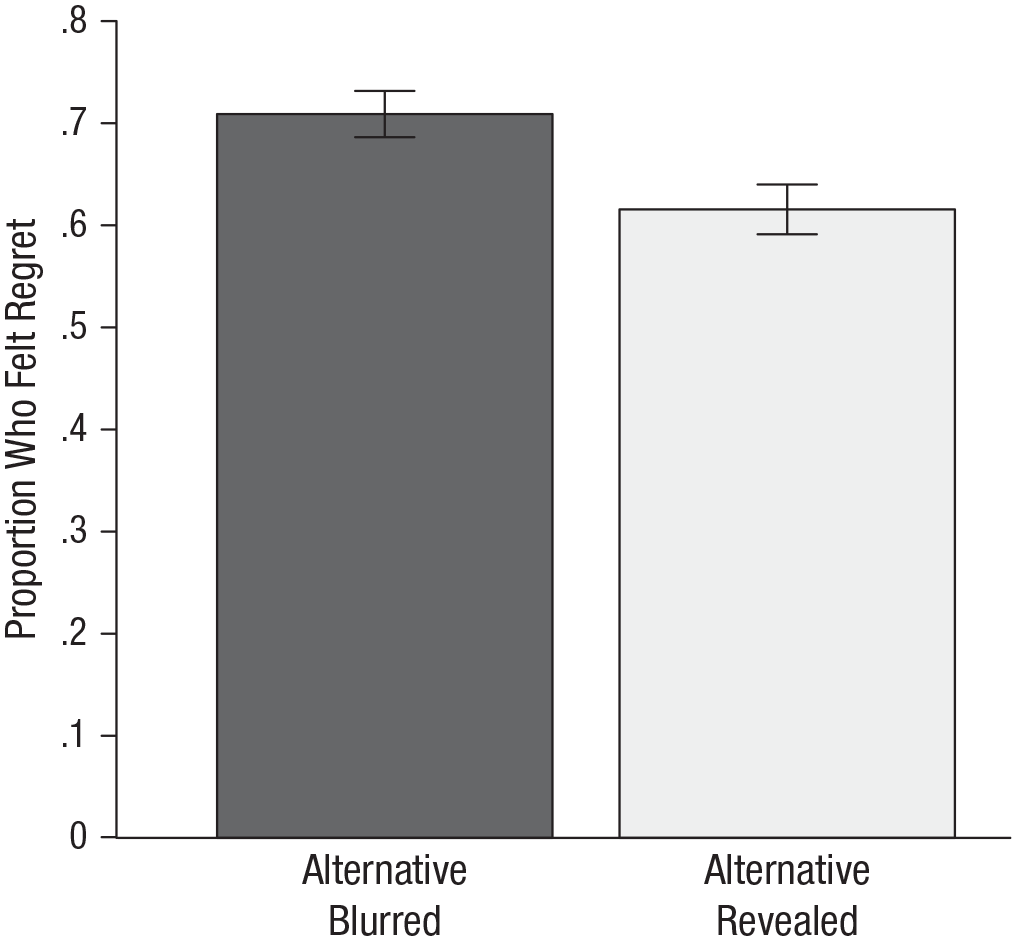
Proportion of participants in Study 1 who felt regret after choosing a photo when their second-most preferred photo remained blurred (alternative-blurred condition) and when it was unblurred (alternative-revealed condition). Error bars represent the standard errors of the proportions.
We then compared mean regret across conditions. On average, regret was slightly higher if the photo that participants had shortlisted but not chosen was left blurred (M = 1.97, SD = 1.84) than if it was unblurred (M = 1.89, SD = 1.93), although not significantly so, t(798) = 0.55, p = .58. Table S2 in the Supplemental Material shows that mean regret remained slightly but nonsignificantly higher when the forgone alternative remained blurred in ordinary least squares (OLS) regressions with fixed effects, or controls for the perceived attractiveness of the chosen photo, age, ethnicity, gender, and relationship status. Thus, in terms of regret intensity, our prediction found only directional support in Study 1.
Next, we examined whether beliefs about the attractiveness of the forgone alternative—the shortlisted photo that was not chosen—differed across conditions. This post hoc analysis tested our theoretical assumption that participants overestimated the attractiveness of the forgone alternative when they could not observe its outcome. Indeed, participants in the alternative-blurred condition expected the forgone shortlisted photos to be significantly more attractive if the blur were to be removed (M = 3.74, SD = 1.02) than their counterparts in the alternative-revealed condition perceived the actual, unblurred forgone shortlisted photos to be (M = 3.45, SD = 1.46), t(798) = 3.20, 95% CI for difference in means = [0.11, 0.46], p < .01, d = 0.23. We include histograms of the perceived attractiveness of the forgone shortlisted photos for each condition in Figure S1 in the Supplemental Material. In contrast, and further in line with our theory, the chosen option—which was unblurred in both conditions—was perceived to be about equally attractive by participants whose forgone alternative remained blurred (M = 4.00, SD = 1.43) and participants whose forgone alternative was unblurred (M = 3.94, SD = 1.29), t(798) = 0.60, p = .55.
Lastly, we examined the relation between regret and the photos’ perceived attractiveness to corroborate that the effects we observed were indeed driven by regret and did not reflect a more general positive response to the photo stimuli. A set of OLS regressions, described in detail in Table S3 in the Supplemental Material, shows that, consistent with our theory, participants who rated the forgone shortlisted photo as more attractive reported feeling more regret (p < .0001). This effect was significantly larger when the photo was unblurred (p < .01). Also in line with the observed effects being driven by regret, participants who rated their chosen photo as more attractive reported feeling less regret (ps < .0001), and this association was about equally strong in both conditions (p = .21).
On the whole, Study 1 provided initial support for our prediction that participants would overestimate the attractiveness of a forgone alternative when they could not observe its outcome and that this overestimation could lead to feelings of regret.
Study 2
In a different setting with a completely different set of stimuli and with monetary incentives, our second study replicated the finding that observing the outcome of a forgone alternative can reduce regret.
Method
Participants
Our preregistered target sample was 600 participants, recruited through MTurk. We opened the call to U.S. residents and collected data from 599 participants. The participants in our final sample averaged 38.5 years of age (one did not disclose age); 251 (41.9%) were female, 342 (57.1%) male, and four (0.7%) nonbinary (two did not disclose gender); and 29 (4.8%) self-identified as Asian, 83 (13.9%) as African American or Black, 412 (68.8%) as Caucasian or White, 25 (4.2%) as Hispanic, and five (0.8%) as Native American.
Procedure
We implemented a variation on the experimental task used by Tong et al. (2018). Participants assumed the role of chief recruiter at a consulting firm, were presented with a set of 10 job candidates, and were tasked with hiring the candidate with the highest “ability” for a job opening. These hiring choices were incentivized with a monetary bonus payment described below.
Participants were informed that the candidates’ abilities were normally distributed with an average ability of 200 and a standard deviation of 20. With a graphical summary in terms of a histogram and with explanations in nontechnical, everyday language, we aimed to make this information maximally accessible. Importantly, participants could not observe the ability of the candidates they could choose from. They instead observed two noisy signals of each candidate’s ability: the “interview score” and the “test score.” These signals provided participants with two independent measures of ability. Participants were informed that, on average, the two measures were equal to a candidate’s true ability and that they were equally accurate. But they were also informed that “each score will usually be somewhat higher or somewhat lower than the candidate’s true ability, because they are not perfect measures.” In particular, they were told that both scores tracked ability with measurement errors that were normally distributed with an average of 0 and a standard deviation of 45, again alongside a histogram and explanations in nontechnical, everyday language.
From these distributions for ability and measurement errors, the experimental software then randomly generated 10 candidates with their respective abilities, interview scores, and test scores. On the basis of the observable interview and test scores, we instructed participants to first create a shortlist consisting of the two candidates whom they thought had the highest ability. On the subsequent screen, which again featured the two shortlisted candidates’ interview and test scores, participants decided which of the two to hire.
After making their choice, participants were told that several months after the hiring decision, the human resources office had learned the (previously unobservable) chosen candidate’s true ability. At this point, each participant was randomly assigned to either the alternative-concealed or the alternative-revealed condition. Participants in the alternative-concealed condition were reminded of their other shortlisted candidate—the forgone alternative—and were shown that candidate’s interview and test scores alongside their chosen candidate’s true ability. Participants in the alternative-revealed condition were shown both candidates’ true abilities instead. In both conditions, participants were then asked, “After finding out your chosen candidate’s true ability, how much regret do you feel from passing on the other shortlisted candidate?” They responded on a 7-point scale ranging from none at all (1) to a lot (7).
The study’s final screen informed participants of the monetary bonus payment they would receive. Participants received a 1¢ bonus for each unit that the chosen candidate’s ability exceeded 175. Finally, participants reported their age, ethnicity, gender, highest completed level of education, and current country of residence.
Preregistration
We preregistered our experimental design, data-collection procedures, exclusion criteria, and statistical methodology at https://aspredicted.org/blind.php?x=hk48rp (January 13, 2021).
Results
In line with our preregistered prediction, results showed that average regret was significantly higher among participants who could not observe the true ability of the candidate they had shortlisted but ultimately rejected (M = 3.67, SD = 2.28) than among participants who could observe both candidates’ true abilities (M = 3.16, SD = 2.10), t(597) = 2.81, 95% CI for difference in means = [0.15, 0.85], p < .01, d = 0.23. This difference in regret across conditions remained of similar magnitude, and was still statistically significant, when we controlled for the revealed true ability of the chosen candidate in an OLS regression, condition: b = 0.43, t(596) = 2.62, 95% CI for b = [0.11, 0.76], p < .01.
The same pattern of results was obtained for the binary measure of the likelihood of regret (0 = no regret, 1 = at least some regret) that we had also preregistered. As shown in Figure 3, participants were significantly more likely to report regretting their choice of candidate if they could not observe the true ability of the candidate they had shortlisted but ultimately rejected (232/299, or 77.6%) than if they could observe both candidates’ true abilities (166/300, or 55.3%), as predicted in our preregistration, χ2(1, N = 599) = 33.3, p < .0001, OR = 2.80, 95% CI for the OR = [1.96, 3.98], ϕ = .24. Tables S4 and S5 in the Supplemental Material show that these effects also held when we controlled for age, ethnicity, and gender and when we did not apply the preregistered exclusion criteria.
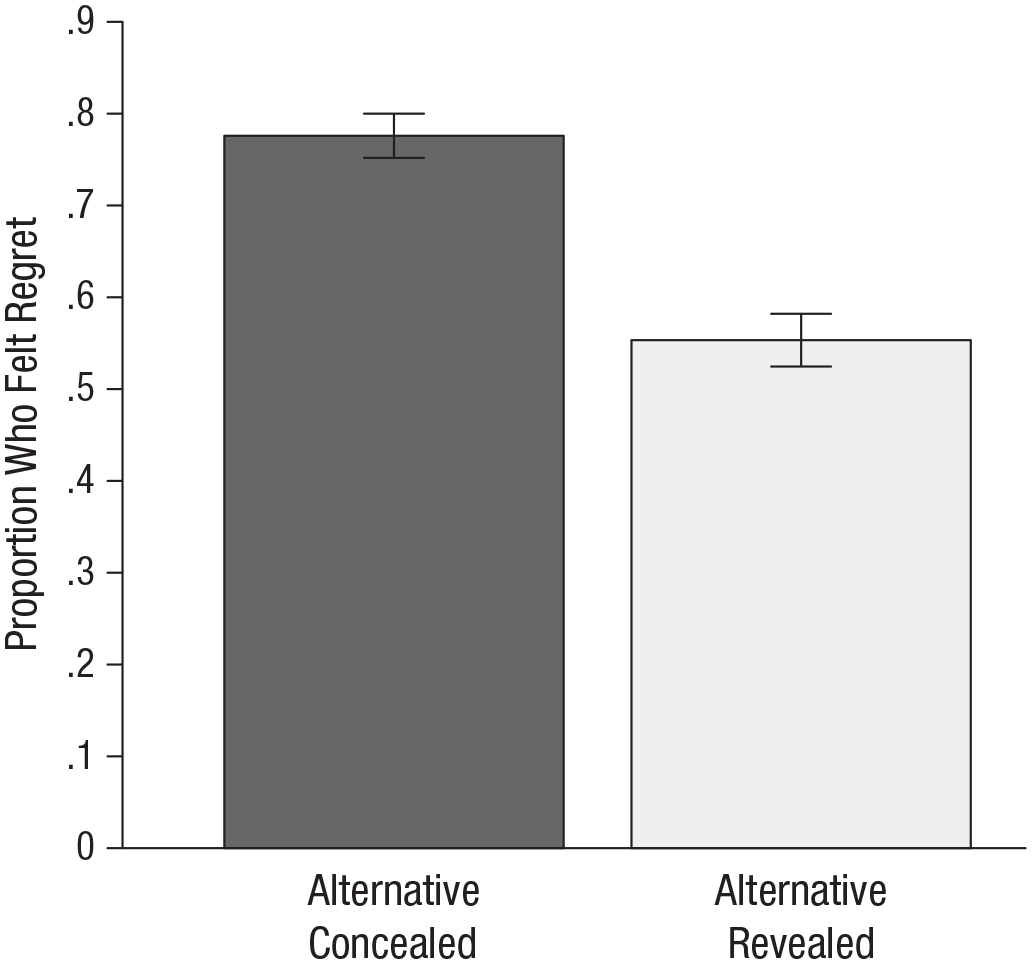
Proportion of participants in Study 2 who felt regret after choosing their candidate when they could not observe their second-most preferred candidate’s true ability (alternative-concealed condition) and when they could observe both candidates’ true abilities (alternative-revealed condition). Error bars represent the standard errors of the proportions.
Study 2 thus provides additional, robust support for our hypothesis that when beliefs about forgone alternatives are likely to be biased high, observing the outcome of a forgone alternative can reduce feelings of regret.
Study 3
In this study, we directly measured the proposed mechanism. As in the previous studies, we measured regret after the chosen alternative was revealed. In addition, we had participants explicitly estimate the attractiveness of the forgone alternative. This enabled us to test our hypothesis that beliefs about the forgone alternative are positively biased and that this bias is associated with greater regret.
Method
Participants
Our preregistered target sample was 150 participants, recruited through MTurk. We opened the call to U.S. residents between 18 and 65 years of age and collected data from 157 participants. Following our preregistered exclusion conditions, we winsorized the sample at 2.5 standard deviations for both the dependent variable (five exclusions) and response time (two exclusions). All results below and their statistical significance remained qualitatively unchanged when all data were included. The 150 participants in our final sample averaged 36.0 years of age, 57 (38.0%) were female, and nine (6.0%) self-identified as Asian, seven (4.7%) as African American or Black, 121 (80.7%) as Caucasian or White, seven (4.7%) as Hispanic, five (3.3%) as multiracial, and one (0.7%) as Native American.
Procedure
The procedure was almost identical to the alternative-concealed condition in Study 2, but we added a second dependent measure to that design. Specifically, all participants first shortlisted two candidates, then selected one of them, and were later asked whether they felt any regret from passing on the other shortlisted candidate after their chosen candidate’s—but not the other shortlisted candidate’s—true ability was revealed to them. Unlike in Study 2, participants were at this point also asked to estimate the ability of the forgone, shortlisted candidate (with a possible monetary accuracy bonus described below). The regret measure and the ability estimate were elicited on two separate screens that appeared in randomly counterbalanced order.
The study’s final screen revealed the forgone candidate’s true ability and informed participants of the monetary bonus payment they would receive. The bonus consisted of two parts. The first part corresponded to the initial hiring decision and paid 1¢ for each unit that the chosen candidate’s ability exceeded 175. The second part corresponded to the estimate of the forgone candidate’s ability and paid 30¢ minus 1¢ per unit that the estimate deviated from the forgone candidate’s true ability. Finally, participants reported their gender, age, ethnicity, highest completed level of education, and current country of residence.
Preregistration
We preregistered our study design, data-collection procedures, exclusion criteria, and statistical methodology at https://aspredicted.org/blind.php?x=sw3t7a (October 16, 2018).
Results
Following our preregistration, we first tested for positive bias in participants’ beliefs about the forgone alternative—that is, the forgone candidate they had shortlisted but ultimately rejected. Second, we tested whether inflated beliefs about the forgone alternative were associated with greater regret after the chosen candidate’s true ability was revealed.
The preregistered paired-samples t test revealed that, on average, participants’ estimates of the forgone candidate’s ability were significantly higher than the candidate’s true ability (M = 6.91, SD = 23.11), t(149) = 3.66, 95% CI for difference in means = [3.18, 10.64], p < .001, d = 0.30. At the individual level, 96 participants (64.0%) provided estimates higher than the candidate’s true ability, which is significantly higher than chance (binomial test, p < .001). In line with our theory, results showed a positive bias in beliefs about the forgone candidate.
We also found evidence for the predicted association between positive beliefs about the forgone candidate and feelings of regret. The preregistered OLS regression revealed an association between higher estimates of the ability of the forgone candidate and greater regret, albeit just shy of statistical significance, ability: b = 0.014, t(148) = 1.79, 95% CI for b = [–0.001, 0.029], p = .076. But this effect was more pronounced, and was statistically significant, when we controlled for the revealed ability of the chosen candidate, ability: b = 0.026, t(148) = 3.39, 95% CI for b = [0.010, 0.041], p < .001. This coefficient estimate translates to sizeable differences in regret: For the range of estimates of the forgone candidate’s ability observed in the data and for the average revealed ability of the chosen candidate, the regression predicted values of regret that ranged from merely 1.7 for the minimal estimate of the forgone candidate’s ability to 4.1 for the maximal estimate. Tables S6 and S7 in the Supplemental Material show that this effect also held for a binary measure of regret and when we controlled for age, ethnicity, and gender and when we made no exclusions (deviating from our preregistration). A histogram of participants’ estimates of the forgone candidate’s true ability can be found in Figure S2 in the Supplemental Material.
Consistent with our theory, beliefs about the forgone candidate were inflated because participants tended to shortlist those candidates whose interview and test scores exaggerated their true ability: On average, the two scores’ average was a positively biased signal relative to the forgone candidates’ true ability (M = 22.39, SD = 23.76), paired-samples t(149) = 11.54, 95% CI for difference in means = [18.56, 26.23], p < .0001, d = 0.82. But although their estimates of the forgone candidate were biased high (see above), participants were not completely naive to this dynamic. In particular, they tended to adjust their estimates downward from the average of the interview and test scores (M = 15.48, SD = 27.97), paired-samples t(149) = 6.78, 95% CI for mean difference = [10.97, 19.99], p < .00001, d = 0.50. Participants thus made significant adjustments, but their adjustments were insufficient to fully account for the positive bias in the observed signals.
Study 3 provides direct evidence for inflated beliefs about a forgone alternative. Moreover, these inflated beliefs were associated with greater regret.
Study 4: Debiasing
In this study, we directly manipulated the hypothesized mechanism with a debiasing intervention that allowed us to calibrate participants’ beliefs about the forgone alternative. Recalibrating participants’ expectations about the forgone candidate should lessen their regret, according to our theory. We also measured the effect of this debiasing intervention on the extent to which participants wished they had chosen the other shortlisted candidate.
Method
Participants
Our preregistered target sample was 200 participants. We recruited U.S. residents between 18 and 65 years of age through MTurk and collected 203 responses. Following our preregistered exclusion condition, we winsorized the sample at 2.5 standard deviations for response time (six exclusions). All results reported below, and their statistical significance, remained qualitatively unchanged when all data were included. The 197 participants in our final sample averaged 35.4 years of age, 74 (37.6%) were female, and eight (4.1%) self-identified as Asian, 15 (7.6%) as African American or Black, 162 (82.2%) as Caucasian or White, six (3.0%) as Hispanic, and six (3.0%) as multiracial.
Procedures
The procedures in this study were identical to those in Study 3, with the following exceptions. Importantly, each participant was randomly assigned to one of two conditions in a two-cell between-subjects design (debias vs. control). As in Study 3, participants in both conditions shortlisted two candidates from a randomly generated set of 10 candidates and finally hired one of the two shortlisted candidates. After they made their choices, however, and after the chosen candidate’s ability was revealed, participants in the debias condition were shown the optimal, Bayesian estimate of the forgone candidate’s ability given the interview and test scores. In contrast, participants in the control condition were simply shown the forgone candidate’s interview and test scores again. Other than that, the conditions were identical.
As in Study 3, participants answered how much regret they felt from passing on the forgone candidate (on a scale from 1, none at all, to 7, a lot) after learning their chosen candidate’s true ability. Additionally, in this study, they also reported the extent to which they wished they had chosen the other candidate on their shortlist (on a scale from 1, not at all, to 7, very much). The only other difference from the previous study was that there was no estimate of the forgone candidate’s ability.
Preregistration
We preregistered our experimental design, data-collection procedures, exclusion criteria, and statistical methodology at https://aspredicted.org/blind.php?x=yx5zj6 (September 24, 2018).
Results
Following our preregistration, we first compared regret across the experimental conditions. As predicted, participants in the debias condition felt significantly less regret (M = 2.99, SD = 2.04) than those in the control condition (M = 3.61, SD = 1.94), t(195) = 2.17, p = .031, d = 0.31. This difference in regret across conditions remained virtually unchanged, and was statistically significant, when we controlled for the revealed true ability of the chosen candidate in an OLS regression, condition: b = 0.62, t(194) = 2.48, 95% CI for b = [0.13, 1.11], p = .014. We also considered a binary measure of regret akin to that from Study 1 (0 = no regret, 1 = at least some regret). In line with our predictions, results showed that 39 of 98 participants (39.8%) in the debias condition reported feeling no regret, compared with 22 of 99 in the control condition (22.2%), χ2(1, N = 197) = 7.11, p < .01, OR = 2.31, 95% CI for the OR = [1.24, 4.31], ϕ = .19 (see Fig. 4). Tables S8 and S9 in the Supplemental Material show that these effects also held when we controlled for age, ethnicity, and gender and when we did not apply the preregistered exclusion criteria. Overall, we thus found strong support for our preregistered prediction that debiasing beliefs about the forgone alternative can weaken feelings of regret.
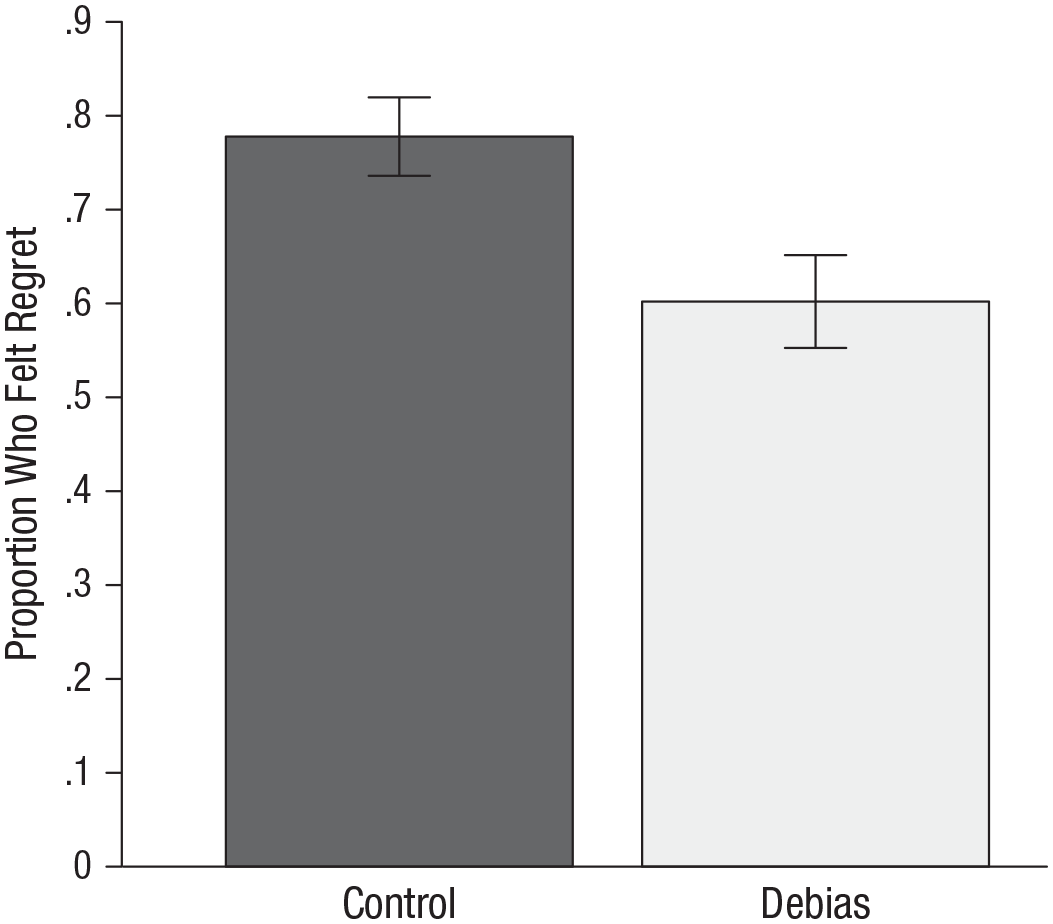
Proportion of participants in Study 4 who felt regret after choosing a candidate when provided with a Bayesian estimate of the forgone candidate’s true ability (debias condition) and when not provided with this estimate (control condition). Error bars represent the standard errors of the proportions.
Participants’ wishes to have chosen differently showed a similar, if somewhat weaker, pattern. Although participants in the control condition wished they had chosen the forgone alternative (rather than the chosen option) more than did those in the debias condition, the difference was small (Ms = 3.67 vs. 3.38) and not statistically significant, t(195) = 0.97, p = .33. We once again tested the effect of debiasing on a binary version of the variable (0 = not at all, 1 = otherwise). In the debias condition, 37 of 98 participants (37.8%) reported feeling no wish to have chosen the other candidate, compared with 18 of 99 participants in the control condition (18.2%), χ2(1, N = 197) = 9.38, p < .01, OR = 2.73, 95% CI for the OR = [1.42, 5.25], ϕ = .22. Our preregistered prediction that debiasing would decrease the wish to have chosen the forgone candidate thus found partial support overall.
In sum, participants were more likely to feel regret in the control condition than in the debias condition. Recalibrating their beliefs about the ability of the forgone alternative decreased regret—as predicted by a theory in which biased beliefs about a forgone alternative are a key driver of regret.
Discussion
We hypothesized that people frequently experience regret because they overestimate the attractiveness of forgone alternatives. In line with this hypothesis, results in Studies 1 and 2 showed that the absence of feedback about a forgone alternative can increase regret. In Study 3, we measured the mechanism, showing a positive bias in estimates of the forgone alternative and establishing an empirical association between these beliefs and felt regret. Finally, we directly manipulated the mechanism in Study 4: When we debiased estimates by recalibrating participants’ beliefs about the forgone alternative, regret was significantly decreased.
Our findings are robust across two markedly different experimental paradigms. In Study 1’s dating-app simulation, participants sought the most attractive face among blurred photos, not unlike the experience of looking for a match in the “noise” of social media. Participants in Studies 2 to 4, on the other hand, played chief recruiter at a consulting firm and aimed to hire the best talent on the basis of imperfect information about candidates’ ability. For the generalizability of our results, this robustness is reassuring. At the same time, both paradigms featured large choice sets, relatively high uncertainty about the attractiveness of alternatives, and forgone alternatives that acted as a natural basis for comparison. This points to potential boundary conditions. Appraisals of sufficiently simple forgone alternatives (i.e., those with low uncertainty), for instance, may be quite accurate, leaving little room for overestimation to cause regret. And if other standards of comparison become more salient than a forgone alternative (Huang & Zeelenberg, 2012; Lin et al., 2006), the effect we observed may also diminish. Another limitation is that all of these data are from MTurk workers in the United States.
In seeming contradiction with our findings, previous work has identified feedback about unchosen options as a key ingredient for regret (e.g., Coricelli et al., 2005; Larrick & Boles, 1995; Zeelenberg et al., 1996). This difference can be reconciled by understanding how the decision environment shapes the experience of regret. As foreshadowed above, there are two important environmental factors to consider: the size of the choice set and the uncertainty associated with the possible outcomes.
Much foundational work on regret features choices between two options. Moreover, these options usually have only one or two possible outcomes, which the classic paradigms typically describe in detail, along with the precise probabilities associated with them (e.g., Boles & Messick, 1995; Coricelli et al., 2005; Zeelenberg et al., 1996). Such choice environments are an ideal test bed for studying the risk and anticipation of regret because they provide specificity regarding potential future regret. Feedback about unchosen options raises the possibility of acute regret in these environments if a forgone alternative turns out to be highly desirable (e.g., Larrick & Boles, 1995; Zeelenberg et al., 1996).
In contrast, we have studied choice environments with larger choice sets and greater uncertainty (or even ambiguity) regarding the outcomes. In these more complex choice environments, forgone alternatives that turn out to be highly desirable may still generate the acute regret that extant research has focused on. In Study 1, for instance, the association between regret and the perceived attractiveness of the forgone shortlisted photo was stronger when the photo was unblurred. But in complex choice environments, beliefs will not always be unbiased—and the absence of feedback about unchosen options raises the possibility of regret when a forgone alternative is erroneously idealized. Our studies documented how in larger choice sets with substantial uncertainty or ambiguity, forgone alternatives become unfair standards of comparison for chosen options and predictably generate regret. But according to our theory, this will generally not occur in choices between few, precisely described options, where beliefs about forgone alternatives are much more likely to be unbiased. The ostensible contradiction between our findings and classic regret research is thus resolved when the role of the environment is accounted for, adding to our rich understanding of the complex dynamics of regret (Zeelenberg & Pieters, 2007).
Our research may be seen as adopting an information-sampling perspective on regret (Fiedler, 2000; Fiedler & Juslin, 2006; Kareev et al., 2002; Le Mens et al., 2016). In repeated decisions, overly negative initial impressions are likely to last because they decrease the likelihood that decision-makers will try an alternative again and correct the underestimation by acquiring additional experience (e.g., Denrell & Le Mens, 2007). But other decisions occur infrequently and provide little room for repetition or experiential learning. Only rarely do we choose a life partner or a career path, for example, and when we do, changing our minds to learn about forgone alternatives is difficult or costly. In these one-shot decisions, our results suggest that overly positive initial beliefs are likely to last—and to cause regret—because decision-makers cannot always try a forgone alternative and correct the overestimation by acquiring experience.
Finally, is overestimating the paths we do not take causing us too much regret? Although regret can have benefits for experiential learning, it is an inherently negative emotion and has been found to be associated with depression and excessive anxiety (Kocovski et al., 2005; Markman & Miller, 2006; Roese et al., 2009). Because the regret in our studies was driven by biased beliefs, it may be excessive—after all, better-calibrated beliefs about forgone alternatives would cause less regret. Whether calibrating beliefs about forgone alternatives could also help in alleviating regret’s harmful psychological consequences is an important question for future research.
Supplemental Material
sj-pdf-1-pss-10.1177_09567976211032657 – Supplemental material for The One That Got Away: Overestimation of Forgone Alternatives as a Hidden Source of Regret
Supplemental material, sj-pdf-1-pss-10.1177_09567976211032657 for The One That Got Away: Overestimation of Forgone Alternatives as a Hidden Source of Regret by Daniel Feiler and Johannes Müller-Trede in Psychological Science
Footnotes
Transparency
Action Editor: Leah Somerville
Editor: Patricia J. Bauer
Author Contributions
D. Feiler and J. Müller-Trede contributed jointly to the study design, data collection, data analysis, and writing and editing of the manuscript. Both authors approved the final manuscript for submission and contributed equally to this article.

Notes
References
Supplementary Material
Please find the following supplemental material available below.
For Open Access articles published under a Creative Commons License, all supplemental material carries the same license as the article it is associated with.
For non-Open Access articles published, all supplemental material carries a non-exclusive license, and permission requests for re-use of supplemental material or any part of supplemental material shall be sent directly to the copyright owner as specified in the copyright notice associated with the article.
