



Abstract
Adults are biologically responsive to context, and their responses to particular situations may differ across cultures. However, are preschoolers’ biological systems also responsive to situational contexts and cultures? Here, we show that children’s neurobiological stress responses, as indexed by salivary cortisol, are activated and responsive to psychosocial stressors relevant to their sociocultural emphases. By examining cortisol changes across different contexts among 138 preschoolers living in the United States, China, and Japan, we found that an achievement-related stressor elicited an increased cortisol response among Chinese preschoolers, whereas interpersonal-related stressors elicited an increased cortisol response among Japanese preschoolers. By contrast, U.S. preschoolers showed decreased cortisol responses after these stressors but consistently higher levels of anticipatory responses to separation at the beginning of each session. Our findings suggest that children’s neurobiological stress systems may be a critical biological mechanism allowing societal-level cultural phenomena to be embodied in individual-level responses, even among preschoolers.
Glucocorticoids (i.e., cortisol in humans), the end product of hypothalamic-pituitary-adrenocortical (HPA) axis activation, play an important role in the modulation and activation of responses to stressful challenges (Sapolsky et al., 2000). Despite the prevalent use of salivary cortisol as a biological indicator of stress in adults, findings are inconsistent in children. Indeed, most lab-based psychosocial stressors do not evoke a change in salivary cortisol in typically developing young children (Gunnar et al., 2009; Tolep & Dougherty, 2014). To explore this further, we examined whether preschoolers’ neurobiological stress systems are responsive to situational contexts and whether these responses might differ in children from different countries (China, Japan, and the United States) and, by inference, different cultures (Schwartz, 2004).
Although psychosocial stressors trigger the activation of physiological responses designed to ensure survival of the organism (i.e., fight-or-flight responses), the extent to which stressors are perceived as potential threats is influenced by both context and cultural learning (Sasaki & Kim, 2017). Over generations, cultural norms establish values, practices, and behavioral routines that are essential for helping individuals become successful members of society and achieve biological adaptation (Kitayama & Uskul, 2011). To support cultural learning, neurobiological stress systems need to become responsive to contexts that pose challenges to one’s ability to respond in culturally normative ways (Dickerson & Kemeny, 2004).
In typically developing children, environmental experiences have been found to elicit cortisol responses from infancy onward (Friedlmeier et al., 2015; Gunnar et al., 2010). Although no investigators have yet examined whether typically developing young children are responsive to specific sociocultural emphases, studies with rodents have demonstrated high levels of sensitivity in stress responses as a function of differences in early experiences (McGowan et al., 2009). Nonetheless, it is unclear when or whether young children’s neurobiological stress responses vary on the basis of situational contexts within or across cultures.
To examine these questions, we examined cortisol responses across varying contexts among preschoolers living in the United States, China, and Japan using stress paradigms designed to induce challenges relevant to differing themes. The first paradigm was an envelope-sorting task. It was designed as a control task and had no particular cultural emphasis, but it could elicit a stress response because it was always administered on the first day of the 3-day study. The second paradigm was a frustrating computer task designed to make children fail at what they had previously experienced as an easy game. This task was designed to induce frustration because of the impossibility of achieving the desired goal, and it presented an achievement-related stressor. The third paradigm was a disappointing-prize task in which an unfamiliar adult presented an undesirable prize after children were told by a familiar adult experimenter that they would receive the prize they had ranked as most desirable. This last paradigm can elicit social anxiety and disrupt interpersonal harmony, given that children had previously ranked the prize they received as the least desirable and were led to expect a different outcome by a familiar, responsible experimenter. 1 Although early childhood is a period in which behavioral responsivity to culture and parental socialization is increasing (Raval & Walker, 2019), it is unclear whether this can be observed at a neurobiological level.
Social psychologists have found that China is a country with large power-distance dynamics (Hofstede, 2011) but low social mobility (World Economic Forum, 2020). Given these factors, Chinese cultures have emphasized the importance of self-improvement and achievement in their populations from an early age (Chao & Tseng, 2002; Stevenson et al., 1990). Ethnographic research conducted by Tobin and colleagues (2009) found that Chinese preschool focuses on educational preparation, mastery, and performance. Chinese parents put pressure on teachers and children to excel academically, and preschool socialization is expected to provide children with an early start and to ensure that they are “not left behind at the starting line” (Tobin et al., 2009, p. 39). Relatedly, Chinese parents have higher involvement in their children’s homework relative to American and Japanese families (Stevenson et al., 1990). The Confucian emphasis on improving oneself also shapes contemporary parental beliefs regarding success and failure. With high expectations and standards for achievement, Chinese parents downplay children’s successes and emphasize children’s failures, whereas U.S. parents do the opposite (Ng et al., 2007). Correspondingly, Chinese children feel more negatively about their achievement failures, and U.S. children feel more positively about their successes (Ng et al., 2007). If the HPA axis is responsive to cultural contexts and if these cultural contexts have become salient by the preschool period, we would expect Chinese preschoolers to show greater cortisol responses to an achievement-related stress paradigm than to other conditions. Alternatively, if the HPA axis is not responsive to culturally relevant contexts, we would expect to observe no differences in cortisol activation among conditions.
Statement of Relevance
Cortisol is important for regulating stress. However, we do not know when or how humans begin to show culturally specific responses to stress. To address this, we examined cortisol reactivity among preschoolers living in the United States, China, and Japan. Children begin to be socialized to culturally relevant activities during their preschool years. Chinese preschools, for instance, emphasize the importance of achievement; Japanese preschools emphasize the cultivation of interpersonal relationships; and U.S. preschools focus on establishing independence. Correspondingly, we found that Chinese preschoolers were most responsive to an achievement-related stressor, whereas Japanese preschoolers showed increased cortisol levels in response to an interpersonal-related stressor. U.S. preschoolers showed decreased cortisol levels after these stressors but showed an anticipatory stress response. These findings suggest that culture is deeply embedded in our neurobiological systems and that it influences neuroendocrine responses and furthers our potential for cultural learning. Children may be differentially reactive to psychosocial stressors that are salient to their cultural upbringing.
Japanese preschoolers may also be reactive to achievement-related contexts, but there has been less research on achievement emphasis in young children and more research on the importance of interpersonal relationships (Hayashi et al., 2009). Several studies have shown that a central tenet during the preschool years is the cultivation of interdependency (e.g., expression of loneliness to promote a desire for social connection) and responsiveness to other people’s needs (Hayashi et al., 2009; Rothbaum et al., 2006). Direct observations of Japanese preschoolers also have shown that Japanese teachers, relative to Chinese and U.S. teachers, promote the desirability of social connections (Tobin et al., 2009). In some schools, learning how to anticipate the needs of other people is built into the preschool curriculum for toddlers (Tobin et al., 2009). Given this strong cultural emphasis on interdependency and understanding the needs of other people, we may expect that Japanese preschoolers would be particularly responsive to contexts that involve disruption in social connection (e.g., violating the needs of others) and show a greater increase in cortisol in response to an interpersonal-relationship-related stressor, relative to other potentially stress-inducing paradigms.
In contrast, the goals of preschool-age socialization in the United States are to cultivate self-esteem, self-expression, and individual agency (Miller et al., 2012). For example, ethnographic interviews of U.S. mothers revealed that the promotion of self-esteem to foster positive self-regard is a key child-rearing goal during early childhood (Miller et al., 2012). Direct observations of U.S. preschoolers revealed that teachers also promoted the importance of individual choices in group settings (Tobin et al., 2009). Moreover, the expression of self in individualistic cultures such as the United States is often invariant across contexts, whereas the expression of self in interdependent cultures (i.e., Chinese and Japanese) is situation bound (Markus & Kitayama, 1991). Thus, we would expect U.S. preschoolers to show less of a response to achievement-related or interpersonal-related stressors than Chinese and Japanese children. In addition, they may show less variability to contexts when compared with a baseline (control) stress-inducing paradigm.
Method
Participants
Children were recruited primarily from full-time university and community preschools in suburban communities of Beijing, China, and Tokyo, Japan, as well as in semiurban areas of southeastern Michigan, United States. No prior studies have compared cortisol responses among preschoolers in three cultures using three stress paradigms, so we could not calculate estimated sample sizes on the basis of previously published literature. However, Gunnar et al. (2009) conducted a review of stress paradigms used with infants, children, and adolescents in developmental psychology studies, in which nine studies were conducted with preschool-age samples. The mean sample size for these studies were 54 (SD = 13.8). On the basis of this review, we aimed to recruit at least 50 participants from each of the three cultures (see Table 1 for descriptive statistics).
Comparison of Demographic Statistics in Each Sample
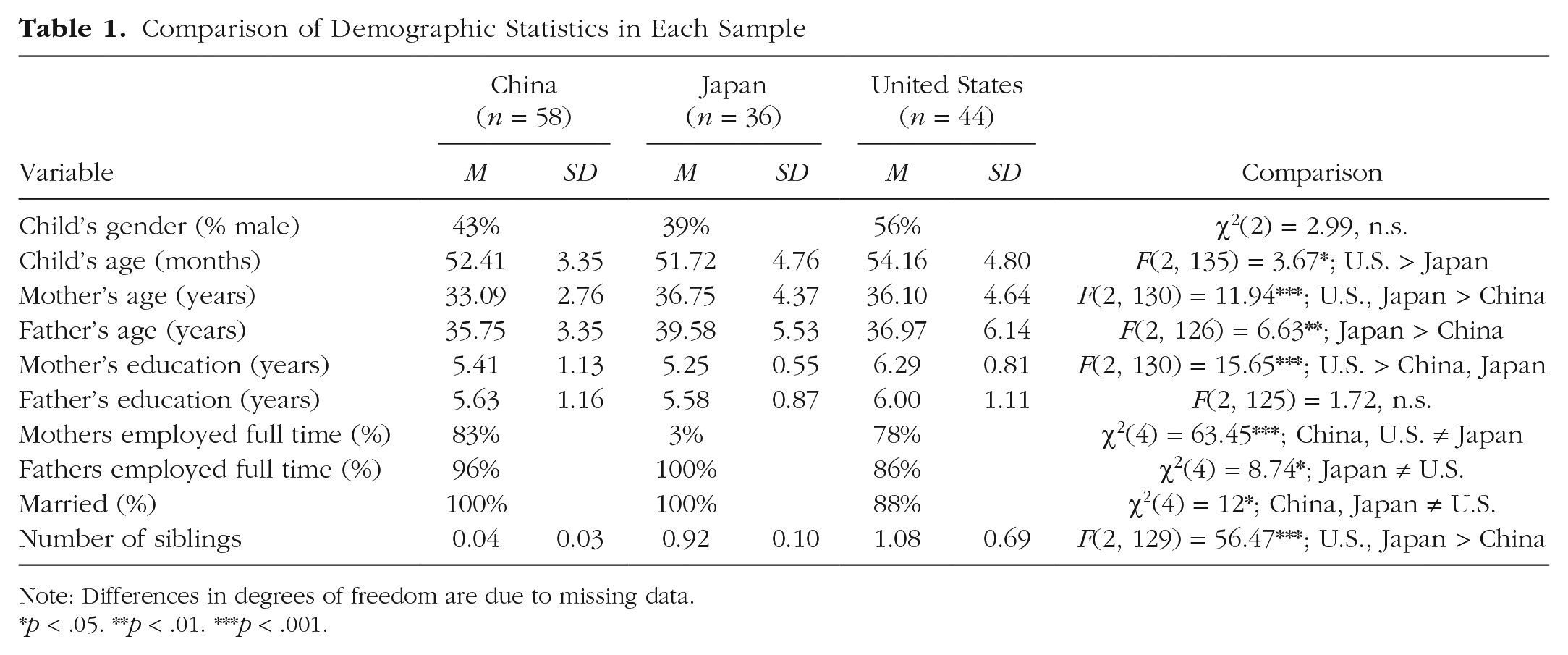
Note: Differences in degrees of freedom are due to missing data.
p < .05. **p < .01. ***p < .001.
China
Sixty-one Chinese children were recruited from three preschools in the southern and western districts of Beijing. Two participants dropped out of the study without completing all 3 days of the protocol, and one participant with diurnal cortisol more than 4 standard deviations above the mean was removed as an outlier. A total of 58 children were included in analyses. As shown in Table 1, Chinese parents were in their mid-30s. Their education ranged from middle school to graduate-level training, and they had a mean of approximately 2 years of technical college. The majority of fathers and mothers reported being employed full time. Fathers’ occupations were coded using the Erikson-Goldthorpe-Portocarero social-class schema—a commonly used method of comparing class differences across industrialized societies (Erikson & Goldthorpe, 1992). For fathers and mothers (n = 45) who reported their occupations, 73% of the fathers and 89% of the mothers were nonmanual workers (i.e., professionals, supervisors, sales and services), 20% of the fathers and 2.5% of the mothers were skilled or semiskilled manual workers, and 7% of the fathers and 8.9% of the mothers were self-employed workers. All parents were married, and because of the one-child policy in China, most of the Chinese children in our sample had no siblings.
Japan
Fifty Japanese children were recruited from two preschools in Musashino-shi and Suginami-ku, primarily residential middle-class neighborhoods in northwestern Tokyo. However, only 36 children had available cortisol data because of differences in costs of purchasing and analyzing the same cortisol kits in Japan at the time. As shown in Table 1, Japanese parents were in their mid- to late 30s. Their education ranged from high school to graduate-level training, and they had a mean of approximately 2 years of technical college. All fathers but very few mothers reported being employed full time. For fathers (n = 36) and mothers (n = 10) who reported their occupations, 83.3% of the fathers and 60% of the mothers were nonmanual workers, 8.3% of the fathers were skilled or semiskilled manual workers, and 8.3% of the fathers and 40% of the mothers were self-employed workers. All couples were married, and the majority of Japanese children (77.8%) in our sample had at least one sibling.
United States
Fifty-eight U.S. children were recruited from 15 preschools in and around Ann Arbor, Michigan, a midsized urban area. We excluded 13 children who did not have cortisol data or had conditions that would influence cortisol levels (e.g., asthma, medications), children of Asian backgrounds, and one participant with a diurnal cortisol greater than 4 standard deviations above the mean. The final sample contained 44 children, of which 86.7% were Caucasian and 13.3% were African American. As shown in Table 1, U.S. parents were in their mid-30s. Their educational backgrounds ranged from high school to graduate-level training, and they had a mean of approximately 4 years of college. The majority of fathers and mothers reported being employed full time. For fathers (n = 32) and mothers (n = 33) who reported their occupations, 68.8% of the fathers and 94% of the mothers were nonmanual workers, 21.9% of the fathers and 6% of the mothers were skilled or semiskilled manual workers, and 9.4% of the fathers were self-employed workers. Eighty-eight percent of the parents were married, and the majority of children had at least one sibling.
Cross-cultural differences
As shown in Table 1, there were no child gender differences across cultures. U.S. preschoolers were slightly older than Japanese preschoolers. U.S. and Japanese mothers were slightly older than Chinese mothers, whereas Japanese fathers were slightly older than Chinese fathers. U.S. mothers also reported significantly higher levels of education than Japanese and Chinese mothers, although there were no differences in fathers’ educational levels. Chinese children had fewer siblings than U.S. and Japanese children.
Procedure
Children participated in study activities for 2-hr periods on 3 consecutive days. Activities occurred in the morning before lunch or in the afternoon after naptime. The time of participation was consistent for each child across all 3 study days. Most children in the United States and China were tested in a quiet room at preschool; some were tested at the child-behavior laboratory at each participating university. All of the children in Japan were tested at the child-behavior laboratory at the participating university. 2 On each day, children began with 30 min of quiet play with a research assistant examiner. The children then engaged in a series of tasks with the same examiner, including one of the stress tasks, followed by approximately 30 min of quiet time watching an age-appropriate calming cartoon (e.g., Caillou) and then by individual psychological assessments. Mothers completed demographic and other questionnaires while their children were being tested. All procedures were administered in the child’s home language, and examiners in each country were trained to reliability on each part of the protocol by the study’s principal investigator. No child reported difficulty understanding the protocol. All methods and procedures were reviewed and approved by the institutional review board at each site.
Envelope task
On the first day of the 3-day study, all children completed an envelope task designed as a control task that we hypothesized to be irrelevant to cultural emphasis. During this task, children were shown a pile of envelopes and a pile of papers and were instructed to stuff each envelope with one sheet of paper while the experimenter left the room for 3 min. Children were told that if they helped the experimenter by stuffing as many envelopes as they could, they would get to choose a prize from an attractive grab bag.
Computer task
During the second or third day of testing (counterbalanced across participants), children played a computer game that was initially easy but then became impossible to win, thus inducing a sense of failure because of an inability to complete the task. Children were instructed to lasso cattle that strayed from a path leading to corrals in a barn. If the children did not lasso the straying cattle, the cattle headed off into a stream instead of to the corrals. During the practice session, the experimenter played the game with each child individually to ensure that they won. The child was then left alone to play the game and was told that they would receive a prize if they won the game. The game became progressively more difficult, and a no-win mode, in which the lasso button stopped working intermittently, was activated. Once three cattle landed in the stream, a loud buzzer sounded, and a large red frowny face appeared to signify that the child had lost. This phase of the task took approximately 2 to 3 min. Sixty seconds after hearing the loud “game over” buzzer, the experimenter returned and asked the child if they had won the game and expressed concern if the child said they had not. A second experimenter then entered the room and told the first experimenter that the game was broken and needed to be fixed and that she should not have used that game. The first experimenter then apologized to the child for using the wrong game and gave the child their present.
Prize task
During the second or third day of testing (counterbalanced across participants), children completed the disappointing-prize task adapted from Cole (1986). This task is designed to elicit threat or distress because of a violation of interpersonal harmony. In this task, children ranked a group of prizes from most preferred (e.g., fire trucks and bubbles) to least preferred (e.g., broken combs and bottle caps) with a familiar experimenter. The familiar experimenter told the child that a second experimenter would return and bring the first-choice prize, then left the room while the child waited (60 s). An unfamiliar experimenter 3 then entered the room, told the child they had won the highest-ranked prize, and handed the child the lowest-ranked prize instead. The unfamiliar experimenter acted unaware that any error had been committed and sat down, ignoring the child for 60 s. The unfamiliar experimenter then left the room without interacting with the child, and the child was left alone for an additional 60 s. The original familiar experimenter then returned to the room, asked the child if they had received their preferred gift, apologized if the child said they had not or did not respond, and gave the child the option of trading the lowest-ranked for the highest-ranked prize. The unfamiliar experimenter then entered the room and apologized to the child for the mistake.
Cortisol sampling during stress paradigms
Salivary cortisol was collected using Salivettes (Salimetrics, State College, PA) 30 min prior to the beginning of each task and then at 0, 10, 20, 30, 40, 50, 60, 75, and 90 min after each stress paradigm. The purpose of taking a sample 30 min prior to the onset of each stressful paradigm was to observe cortisol levels and to better identify baseline cortisol samples that were not affected either by potentially arousing activities that took place in the children’s preschool prior to the study or by any anticipatory anxiety (e.g., separation distress) or excitement the children might have prior to each stress paradigm (Kryski et al., 2011; Lopez-Duran et al., 2009; Tolep & Dougherty, 2014).
Following a standard procedure, we collected a minimum of 200 µl of saliva from each sample. Saliva was absorbed in cotton dental rolls (without flavoring or stimulant to avoid chemical interference) by asking children to gently chew the dental rolls for 60 s. Research assistants chewed dental rolls in parallel with the children and, as motivation to increase compliance, used sticker charts and pretended that the cotton roll was their favorite ice cream flavor. The cotton dental rolls were then inserted into a plastic Salivette and refrigerated until centrifuged. Each sample was centrifuged at 3,000 rpm for 5 min within 24 hr of collection and stored at −20° C until assayed. Moreover, because import regulations and licensing issues across the three different countries prevented us from purchasing cortisol kits from the same batch, and because we were also analyzing these samples in different laboratories, we included an additional control. First, all samples were assayed in duplicate using commercial kits (High Sensitivity Salivary Cortisol Enzyme Immunoassay Kit, Salimetrics, State College, PA) at each of the project sites independently. Interassay variability was less than 5% across all sites. Second, 10 of the U.S. samples were assayed in all three locations to determine intersite reliability. For these analyses, Pearson correlations averaged .95, and there was no systematic variation in cortisol levels for these samples across sites.
Imputation of missing cortisol data
The amount of missing cortisol data for was small (1.5%), and a few subjects had incomplete data in different tasks. We imputed missing values and used the complete data set for all the analyses. Missing cortisol data were imputed using the IVEware software package (Version 0.3; Raghunathan et al., 2016) in SAS following a multivariate sequential-regression approach. Missing values were imputed sequentially on the basis of the observed values within and across tasks. Data were log transformed for the imputation process to improve normality and transformed back to the original scale after imputation. Because of overall differences in the mean cortisol values across each country, the imputation was performed separately for each country.
Diurnal morning cortisol and timing of cortisol collection
Children’s diurnal morning cortisol samples, collected at home 30 min after waking and at the onset time of each stress task, were measured on Days 1, 2, and 3 following the same procedure and using the same model of assay kit. Day (Days 1, 2, and 3) × Culture (U.S., Chinese, Japanese) analyses of variance were conducted to examine potential within- and between-cultures differences on (a) morning cortisol levels and (b) onset time of each stress paradigm across 3 days.
Children’s morning cortisol did not differ across days, F(2, 129) = 1.08, p = .34, η p 2 = .016, or cultures, F(2, 130) = 3.27, p = .04, η p 2 = .05 (pairwise comparison did not reach significance), nor was there a significant Day × Culture interaction, F(4, 258) = 0.12, p = .97, η p 2 = .002, ruling out the concern that cross-cultural differences in cortisol responses to acute stressors may be influenced by differences in children’s morning cortisol across days and cultures. The onset of each stress paradigm did not vary by days within each culture, F(1.6, 198) = 0.20, p = .77, η p 2 = .002, but Japanese children had a later onset time on the stress paradigms than their U.S. and Chinese counterparts, F(2, 122) = 10.51, p < .001, η p 2 = .15 (see Table S1 in the Supplemental Material available online); however, there was no Day × Culture interaction, F(3.2, 198) = 0.10, p = .97, η p 2 = .002. Because cortisol collection occurred in the morning and in the afternoon sessions across all 3 days (see Table S1), we examined whether cortisol reactivity varied across the time of the day, in accordance with the known circadian rhythm of the HPA system. The timing of the collection for the stressor was negatively associated with pretask cortisol levels across the three stress paradigms (envelope: r = −.27, p = .002; prize: r = −.21, p = .01; computer: r = −.33, p < .001), but not with posttask cortisol levels in different time points and total levels as indexed by the area under the curve with respect to ground (AUCg; all ps > .05), consistent with findings in adults (Kudielka et al., 2004) and children (Obradović et al., 2010).
Preliminary data and data-analysis plan
Substantial skewness was found in the cortisol data. A natural log transformation was used in all analyses, as recommended by Tabachnick and Fidell (2007). Nonetheless, additional analyses revealed that all results are consistent with or without log transformation. For ease of interpretation, untransformed cortisol values are shown in the three figures below.
To ensure that baseline cortisol was not inflated by high levels of cortisol arising from physiological reactivity to novelty or pretask activities during the acclimation period, we used cortisol obtained 10 min after task completion as a baseline to capture cortisol responsivity across varying contexts. This was done for all analyses because meta-analytical evidence suggests that mean salivary cortisol levels reach their peak approximately 21 to 40 min following stressor onset (Dickerson & Kemeny, 2004) and because we included only a short acclimation period (30 min). Separate analyses were conducted to examine pretask cortisol changes (from 30 to 0 min before the task) each day for each culture (see below).
Total cortisol output
To examine total cortisol output for each paradigm by culture, we computed the AUCg on the basis of established formulas and guidelines (Pruessner et al., 2003). AUCg is assumed to index total hormonal output, and therefore higher AUCg indicates higher cortisol output (Fekedulegn et al., 2007). AUCg was calculated using the time window between 10 min and 90 min after task completion. Comparisons were conducted using a Culture (U.S., Japanese, and Chinese) × Task (envelope, computer, and prize tasks) × Gender analysis of covariance with maternal age as a covariate. Specifically, maternal age was considered as a potential confounding factor because (a) Pearson correlations showed that maternal age was associated with AUCg in the computer task (r = −.21, p = .02), and (b) maternal age differed across samples. There were no other significant associations between demographic variables and cortisol levels.
Stress-paradigm-induced changes in cortisol
Our primary goal was to understand how children’s HPA axes (as indexed by cortisol changes) in each culture would respond to stress paradigms relevant to particular stress-eliciting situations (i.e., achievement-related stressors vs. interpersonal-related stressors). To take full advantage of the multiple sampling time points, we conducted generalized estimating equation (GEE) models to identify time points with cortisol changes (relative to baseline) and to identify specific paradigms within the same model that could elicit cortisol changes for each culture. We used two points of reference to examine cortisol responsivity across different paradigms: (a) baseline cortisol (10 min after task completion) within each paradigm and (b) the control paradigm to examine differences across paradigms. To examine whether there would be a significant interaction effect between culture and stress paradigm on cortisol levels, we first conducted a GEE model with culture (U.S., Japanese, and Chinese), task (envelope, computer and prize tasks), time point (10–90 min), child’s gender, all two-way interactions, and the three-way interaction of Culture × Task × Time Point entered as predictors to estimate children’s cortisol levels relative to baseline. Maternal age was entered as a covariate in this model. If the three-way interaction was deemed significant, three separate models (one for each culture) were then conducted with task, time point, and the interactions of Task × Time Point entered as predictors to estimate children’s cortisol levels relative to the control paradigm. Our primary goal was to identify specific stress paradigms’ time points within each culture that could elicit cortisol changes. Covariates that were not significant from the first model were also dropped to ensure that we had sufficient power to detect the effect of interest. A first-order autoregressive, AR(1), correlation matrix was used for all GEE analyses because it had the best goodness of fit, as indexed by the quasi-likelihood-under-independence-model criterion (QIC) and corrected quasi-likelihood-under-independence-model criterion (QICC).
Pretask-related changes in cortisol (acclimation period)
In addition, we also examined cortisol changes during the pretask period (from 30 to 0 min before stress paradigms) by each day and culture to understand how children may react to the beginning of the experiment or novelty. A Culture × Day × Time Point GEE model was created to estimate cultural differences in changes of cortisol during the pretask period. Maternal age and timing of cortisol collection were entered as covariates in the model.
Results
Total levels of cortisol (AUCg) by task and culture
There was a significant main effect of task, F(2, 126) = 3.6, p = .03, η p 2 = .05, and culture, F(2, 127) = 13.85, p < .001, η p 2 = .18, but no significant two-way or three-way interactions. The computer task elicited higher levels of total cortisol (as indexed by AUCg) than the envelope (control) task. In addition, Chinese preschoolers had higher total cortisol levels across all three tasks than U.S. and Japanese preschoolers (see Fig. 1).
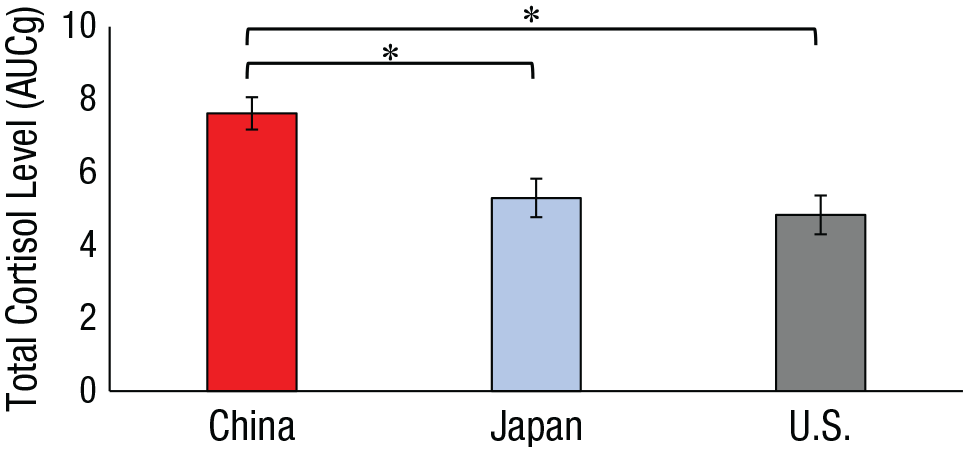
Total cortisol level in each culture. Error bars represent standard errors. Asterisks indicate significant between-culture differences (p < .05). AUCg = area under the curve with respect to ground.
Stress-paradigm-induced changes in cortisol by culture
Our primary goal was to examine whether children in each culture would show higher levels of cortisol responsivity to stress paradigms (relative to baseline) that were differentially relevant to their cultural contexts. As shown in Table 2, there were significant main effects of culture and time point and significant Culture × Task and Culture × Task × Time Point interactions. Given the significant three-way interaction, three GEE models (one for each culture) were also created to examine time points in the stress paradigms that would elicit cortisol responsivity within each culture relative to the control task. Maternal age was not associated with cortisol levels in the GEE models and was dropped from subsequent analyses.
Results From the Generalized Estimating Equation (GEE) Model Predicting Children’s Cortisol Levels

p < .08. *p < .05. ***p < .001.
Control (envelope-stuffing) task
For all children in all cultures, the envelope (control) task did not elicit an increased level of cortisol response relative to baseline (10 min after task completion). In fact, cortisol was lower 30 min after task completion, relative to baseline, for Chinese preschoolers. No change was found for either Japanese or U.S. children (Fig. 2a–2c), thus providing support for the use of the envelope task as a control paradigm across cultures.
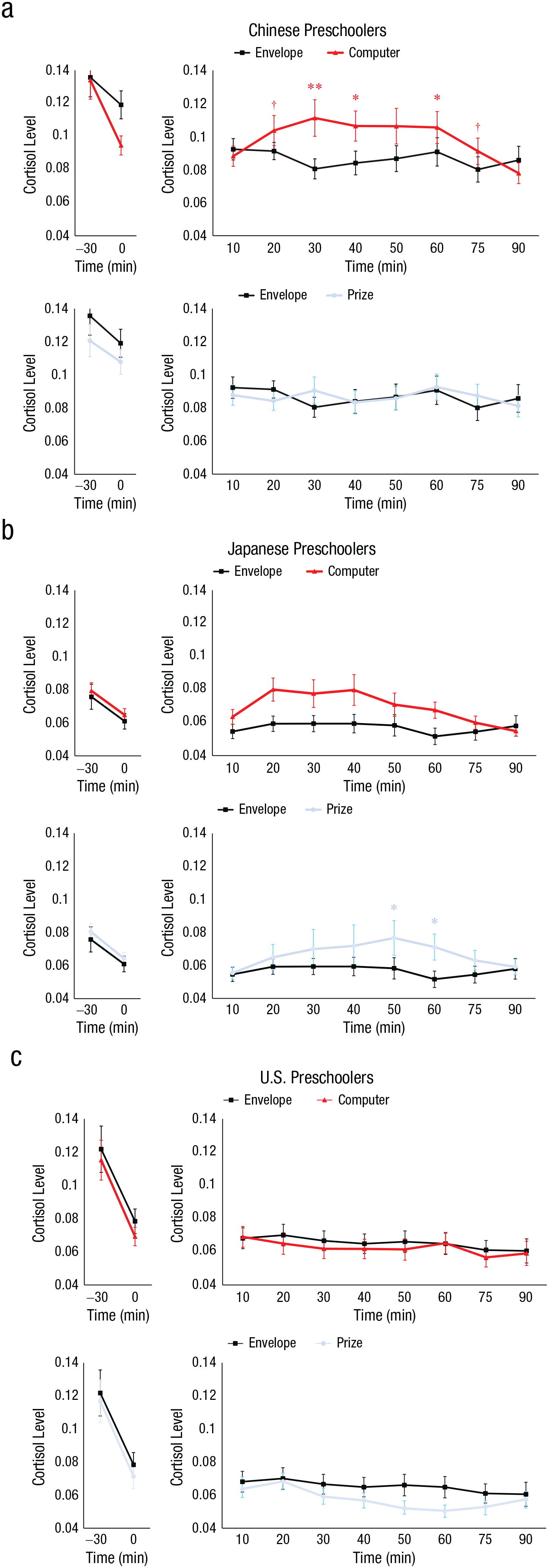
Mean cortisol level across pretask time points (left columns) and posttask time points (right columns), separately for comparisons between the envelope (control) task and each experimental task (computer, prize). Results are shown separately for (a) Chinese preschoolers, (b) Japanese preschoolers, and (c) U.S. preschoolers and are derived from generalized estimating equation (GEE) models. Error bars represent standard errors. Symbols indicate significant between-condition differences (†p < .08, *p < .05, **p < .01).
Chinese preschoolers
We hypothesized that Chinese children’s neurobiological stress system (i.e., the HPA axis) may be particularly responsive to achievement-related stressors. Supporting this, our results showed that Chinese preschoolers exhibited a significant increase in cortisol only after the frustrating computer (achievement-related) task, as indexed by a significant main effect of time point, Wald χ2(7) = 25.68, p < .001, and a significant Task × Time Point interaction, Wald χ2(14) = 32.00, p = .004, in the GEE model. In particular, the GEE model revealed that Chinese children showed significant increases in cortisol levels 20, 30, and 60 min after the computer task, relative to baseline, and significant cortisol increases at 30, 40, and 60 min relative to the control task (Fig. 2a; see also Table S2 in the Supplemental Material). They did not show significant increases, relative to either baseline or the envelope control task, for the prize task.
Japanese preschoolers
We hypothesized that Japanese children’s cortisol responses may be particularly sensitive to the interpersonal-related stressor. Supporting this hypothesis, we found that Japanese preschoolers exhibited significant increases in cortisol after the prize (interpersonal-related) task, as indexed by significant main effects of task, Wald χ2(2) = 7.43, p = .02, and time point, Wald χ2(7) = 16.67, p = .02, and a significant Task × Time Point interaction, Wald χ2(14) = 61.81, p < .001. In particular, GEE modeling revealed that Japanese children showed significant increases in cortisol after performing the prize task at 50 min, relative to baseline, and at 50 and 60 min after the prize task relative to the control task (Fig. 2b; see also Table S2).
Moreover, Japanese children also exhibited higher cortisol levels 20 min after the frustrating computer (achievement-related) task, relative to baseline, although there were no significant increases in cortisol relative to the control task (Fig. 2b; see also Table S2).
U.S. preschoolers
Finally, given previous studies using laboratory-induced stressors with U.S. preschoolers, we were uncertain whether our U.S. participants would react to our laboratory-based paradigms or whether they might show cross-task differences. U.S. adults, in general, are less context sensitive in their reactions than East Asian adults (Markus & Kitayama, 1991), and thus we considered it possible that our U.S. preschoolers would be less sensitive to the context-specific task manipulations. Moreover, the particular contexts that we chose as stressors (in order to be sensitive to cultural differences in what might be stressful for Chinese and Japanese children) may not be as salient for U.S. children, who are more focused on independence than on achievement or interpersonal harmony (Tobin et al., 2009). Accordingly, we found no significant increases in cortisol levels in any of the stress paradigms among U.S. preschoolers relative to baseline (see Fig. 2c and Table S2) or relative to the control task. In fact, they showed decreased levels of cortisol at 40, 75, and 90 min after the computer task, relative to baseline, and at 75 min after the prize task—Task × Time Point interaction: Wald χ2(14) = 37.55, p < .001. No significant changes were found when these results were compared with those of the control task. However, we did notice an interesting and consistent reaction in the U.S. children’s cortisol responses before the tasks began.
Pretask-related changes in cortisol (acclimation period)
Our initial purpose of including a pretask acclimation period in the 30 min window before the task began was to account for physiological reactivity due to anticipatory stress (i.e., being separated from caregivers or established school environments). We did not predict any cultural differences for this period. However, GEE modeling revealed significant main effects of culture, Wald χ2(2) = 19.53, p < .001, and time, Wald χ2(1) = 59.88, p < .001, and a significant Culture × Time Point interaction, Wald χ2(2) = 16.67, p < .001, but no main effect of day, Wald χ2(2) = .62, p = .73, or Day × Time Point × Culture interaction, Wald χ2(4) = 4.10, p = .39. In particular, we found that both Japanese and U.S. preschoolers, but not Chinese preschoolers, consistently reacted during this anticipatory period across all 3 days of testing. Moreover, U.S. preschoolers reacted more strongly (as indexed by a larger slope) than either the Chinese or the Japanese preschoolers (see Fig. 3).
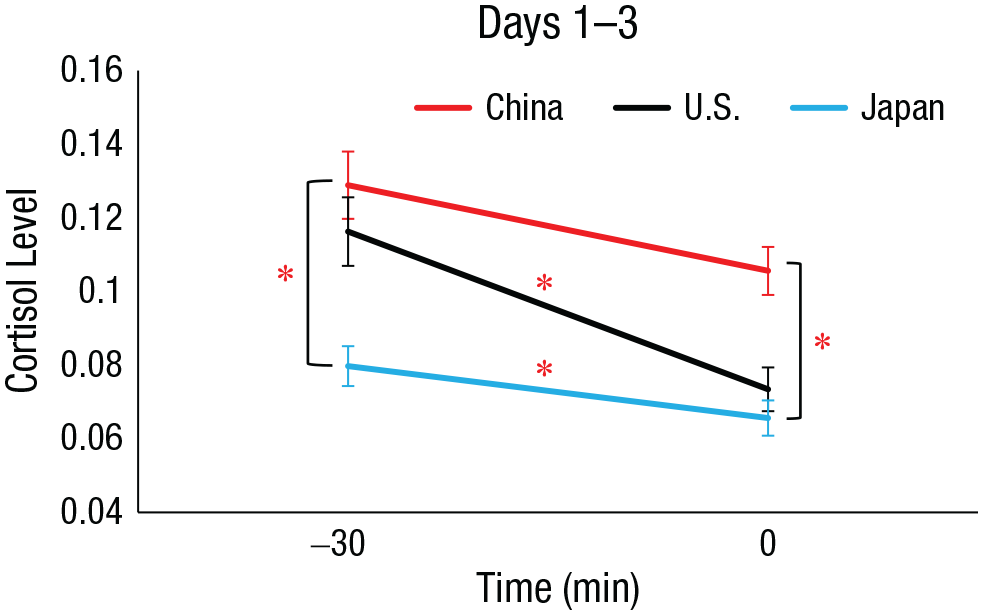
Mean cortisol level at the beginning of each day (from 30 min to 0 min before the start of the stress paradigms) in each culture. Results are derived from generalized estimating equation (GEE) models. Error bars represent standard errors. Asterisks above slopes indicate significant differences between time points, and asterisks next to brackets indicate significant differences between cultures (p < .05).
Discussion
Young children’s cortisol responses showed consistent differences across cultures and situations, suggesting that biological adaptations to culture may occur early in development. With cultural emphases on self-improvement and achievement from an early age (Chao & Tseng, 2002; Stevenson et al., 1990), an achievement-related stressor elicited an increased cortisol response among Chinese preschoolers, suggesting that they may have already internalized achievement failure as a salient threat to their representation of self (Ng et al., 2007). Given the cultural emphasis on social connections among Japanese preschoolers, the stressor related to interpersonal harmony elicited an increased cortisol response. This finding is consistent with research on the importance of interdependent self-constructs in Japanese adults (Markus & Kitayama, 1991), suggesting that Japanese children may have already internalized this value. We also found some evidence that Japanese children may react to achievement-related stressors (relative to baseline), although this result was not significant when compared with those of the control task. Collectively, it remains possible that achievement-related stressors may evoke a stronger reactivity of the HPA axis among Chinese and Japanese preschoolers relative to U.S. preschoolers. Nevertheless, children’s biological responsivity to culturally relevant stressors suggests that culture is deeply embedded in biological systems and that it influences neuroendocrine responses and furthers our potential for cultural learning.
U.S. preschoolers showed a decreased level of cortisol across both achievement-related and interpersonal-relationship-related stressors relative to baseline, which is consistent with the findings of some prior studies showing decreased cortisol following exposure to a laboratory stressor in young children (e.g., Dougherty et al., 2011). However, U.S. children were more reactive than others to anticipatory stress during the acclimation period, which may have inflated the baseline cortisol level given that elevated cortisol levels may require a prolonged period for recovery (Liu et al., 2017). Consistent with our findings, results from a study by Lopez-Duran et al. (2009), who controlled for participants’ cortisol levels on their arrival to the lab, showed that typically developing American children showed a decrease from 30 min prior to the stressor and did not show changes in cortisol from 0 to 60 min after fear- or frustration-based stressors. Indeed, U.S. children showed higher cortisol levels when samples were collected in a novel laboratory setting, relative to the home environment (Gunnar & Talge, 2008), and an increased cortisol response in the laboratory only when the stress paradigm was administered with an unfamiliar and unfriendly experimenter (Roos et al., 2017). They also exhibited increased levels of cortisol in day-care settings that were positively correlated with their anxiety levels (Gunnar et al., 2010). It is possible that U.S. preschoolers in moderate-sized communities may react to novelty and anticipatory stress to a greater extent than Chinese (Beijing) and Japanese (western suburbs of Tokyo) children who live in much denser environments and may be more used to seeing and interacting with people outside their immediate family or preschool settings. Alternatively, an impending period of separation from one’s caregiver may in fact be a culturally relevant stressor to the U.S. preschoolers, and, to some extent, to the Japanese preschoolers in our sample.
Notably, we found that Chinese preschoolers had higher overall cortisol levels than U.S. and Japanese preschoolers (Fig. 1). It is possible that the higher cortisol levels among Chinese preschoolers might have been influenced not by cultural factors per se but by the quality and number of children in the day-care environment, longer or more crowded commuting experiences, or other factors related to population density and rapid urbanization that are not systematically measured in our study. Nevertheless, our findings are consistent with accumulating research demonstrating that East Asian infants (e.g., Chinese American) are less behaviorally reactive but showed higher cortisol responses than Caucasian American infants to a variety of stressors (Friedlmeier et al., 2015; Kagan & Fox, 2006). Cross-cultural research suggests that North American children expressed more negative emotions than Asian children (e.g., Ip et al., 2021; Lewis et al., 2010). These cross-cultural differences may be related in part to differences in parental socialization of emotional expression (Raval & Walker, 2019).
Several caveats and future considerations apply. First, small sample sizes render our conclusions preliminary. Future research with larger samples is needed to examine individual differences in cortisol reactivity among children within each culture. Second, our sample was mostly middle class and was recruited from relatively urban areas with predominantly mainstream majority families. Findings may not generalize to children from other sociodemographic backgrounds or to those living in other areas within these countries. Third, although our findings suggest that cultural contexts may influence cortisol responsivity, our study did not directly assess cultural values in these families. Fourth, following prior studies conducted in North America (Kryski et al., 2011; Tolep & Dougherty, 2014), we included a 30-min acclimation period. However, our empirical data suggest that a longer (i.e., 60-min) acclimation period would be more ideal for capturing a true baseline for acute stress responses and for eliminating cortisol reactivity during this period.
Finally, it is difficult to disentangle social fear and disappointment in our gift paradigm, so this issue requires further investigation. Replications and longitudinal follow-up studies with multiple levels of analysis (e.g., self-report, heart rate) are needed to further examine the reliability and validity of these tasks as well as to demonstrate cultural validity (Olson et al., 2019). It would be invalid to repeat the same tasks for children within a sample because the tasks involve an unexpected outcome that would be predictable if repeated. Nonetheless, our findings highlight the importance of understanding the psychological underpinnings of psychosocial stressors that elicit heightened neuroendocrine responses in young children.
Supplemental Material
sj-docx-1-pss-10.1177_0956797621994233 – Supplemental material for Are Preschoolers’ Neurobiological Stress Systems Responsive to Culturally Relevant Contexts?
Supplemental material, sj-docx-1-pss-10.1177_0956797621994233 for Are Preschoolers’ Neurobiological Stress Systems Responsive to Culturally Relevant Contexts? by Ka I Ip, Barbara Felt, Li Wang, Mayumi Karasawa, Hidemi Hirabayashi, Midori Kazama, Sheryl Olson, Alison Miller and Twila Tardif in Psychological Science
Footnotes
Transparency
Action Editor: Patricia J. Bauer
Editor: Patricia J. Bauer
Author Contributions
T. Tardif, L. Wang, M. Karasawa, S. Olson, and B. Felt designed the study. Testing and data collection were performed by L. Wang, M. Karasawa, H. Hirabayashi, M. Kazama, S. Olson, and T. Tardif. The data were analyzed and interpreted by K. I Ip under the supervision of T. Tardif and S. Olson. K. I Ip drafted the manuscript, and all authors provided critical revisions. All authors approved the final version of manuscript for submission.

Notes
References
Supplementary Material
Please find the following supplemental material available below.
For Open Access articles published under a Creative Commons License, all supplemental material carries the same license as the article it is associated with.
For non-Open Access articles published, all supplemental material carries a non-exclusive license, and permission requests for re-use of supplemental material or any part of supplemental material shall be sent directly to the copyright owner as specified in the copyright notice associated with the article.
