




Abstract
Most humans believe in a god or gods, a belief that may promote prosociality toward coreligionists. A critical question is whether such enhanced prosociality is primarily parochial and confined to the religious ingroup or whether it extends to members of religious outgroups. To address this question, we conducted field and online experiments with Christian, Muslim, Hindu, and Jewish adults in the Middle East, Fiji, and the United States (N = 4,753). Participants were given the opportunity to share money with anonymous strangers from different ethno-religious groups. We manipulated whether they were asked to think about their god before making their choice. Thinking about God increased giving by 11% (4.17% of the total stake), an increase that was extended equally to ingroup and outgroup members. This suggests that belief in a god or gods may facilitate intergroup cooperation, particularly in economic transactions, even in contexts with heightened intergroup tension.
Most people believe in gods that care about and police moral behavior (Johnson, 2015; Lang et al., 2019; Norenzayan, 2013), and such beliefs may promote prosociality among coreligionists (Lang et al., 2019; Norenzayan, 2013). However, people diverge in their religious identities and their understanding of the nature of gods, and these divides are important markers of group boundaries. Religiously inspired prosociality is often thought to be parochial and to exacerbate religious division (Armstrong, 2014; Atran & Ginges, 2012; Bloom, 2012; Dawkins, 2006; Hitchens, 2008; Lang et al., 2019; Neuberg et al., 2014; Norenzayan et al., 2016; Purzycki et al., 2016; White et al., 2019). However, it is also possible that prosociality inspired by belief in God extends across intergroup boundaries to facilitate cooperation and trade (Ginges et al., 2016; McKay & Whitehouse, 2016; Pasek et al., 2020; Smith et al., 2022). We addressed this debate by asking whether thinking about one’s god fosters prosocial behavior toward people with differing religious beliefs and identities.
Commitment to one’s god is theorized to promote prosociality within religious group boundaries (Norenzayan et al., 2016). If so, increasing the salience of god beliefs should increase prosociality within but not across religious boundaries. This parochiality hypothesis stems from ideas that humans are parochial (Balliet et al., 2014; Bernhard et al., 2006; Böhm et al., 2020; Kinzler et al., 2007; Tajfel, 1982) and beliefs about gods might have diffused through the human population by fortifying social cohesion and conferring selective advantage in intergroup competition and conflict (Norenzayan et al., 2016). Studies show that war and conflict encourage prosociality that is parochial (Bauer et al., 2014), religious participation (Henrich et al., 2019), and a belief in a punitive god (Caluori et al., 2020), perhaps to promote tighter adherence to group norms (Gelfand, 2021). Yet scant research has examined the critical question of whether belief in God increases parochiality, and hardly any work has directly tested how thinking about God affects the treatment of religious ingroups and outgroups.
It is possible that god beliefs promote prosociality that transcends ingroup boundaries to include religious outsiders (Ginges et al., 2016). Humans, more than other species, engage in cooperative intergroup encounters (Brooks et al., 2018; Horan et al., 2005; Pisor & Surbeck, 2019). Such cooperation provides access to vital resources via trade, promotes knowledge exchanges, and enables political alliances (Diamond, 1997; Pisor & Surbeck, 2019). Thus, humans must balance parochiality with the benefits of intergroup cooperation (De Dreu & Gross, 2019). Because intergroup interactions are more fragile and dangerous than within-group interactions (Sahlins, 1972), they may depend on the diffusion of cultural ideas that facilitate tolerant and cooperative encounters (Pisor & Surbeck, 2019). Religious traditions explicitly encourage some cooperative intergroup interactions, even if in circumscribed contexts, such as by regulating hospitality toward strangers (Sahlins, 1972). Thus, belief in gods that encourage broad prosociality may have facilitated intergroup trade and migration (Stark, 1996). If so, this extended-prosociality hypothesis predicts that activating god beliefs will encourage believers to extend prosociality across religious divides.
The existing literature paints an inconclusive picture that makes it difficult to discriminate between these hypotheses. Experiments with American Christians demonstrate that religiosity positively predicts generosity and that signals of religiosity increase signalers’ perceived trustworthiness across group boundaries (Everett et al., 2016; Hall et al., 2015; Preston & Ritter, 2013; Stagnaro et al., 2020). However, these studies did not provide causal evidence regarding the influence of god beliefs (Everett et al., 2016; Hall et al., 2015; Stagnaro et al., 2020), did not measure prosociality behaviorally (Hall et al., 2015), used small sample sizes (Preston & Ritter, 2013), or did not assess the influence of belief on generosity toward religious outgroups (Preston & Ritter, 2013; Stagnaro et al., 2020). Moreover, like many psychological studies, this work sampled Western Christian majorities in a low-conflict setting, leaving unclear whether findings will generalize across cultures or intergroup contexts.
Statement of Relevance
Religious differences have frequently been associated with intergroup antagonism throughout human history. One oft-proposed explanation is that commitment to one’s God promotes a form of parochial prosociality that benefits the religious ingroup but exacerbates antipathy between members of different religious groups. Indeed, such beliefs are widely theorized to have spread via cultural evolution by conferring an advantage in intergroup competition. In contrast to this account, findings here suggest that thinking about God may promote prosociality across religious divides. Results have implications for debates about the role of religion and religious diversity in contemporary intergroup contexts.
One set of cross-cultural studies demonstrates that people assume that God prefers more equal valuation of ingroup and outgroup lives than they themselves do (Ginges et al., 2016; Pasek et al., 2020; Smith et al., 2022). This and other work (Clingingsmith & Khwaja, 2009) suggests that thinking about God might promote extended prosociality. However, none of these studies investigated whether and how god beliefs influence behavior.
Another cross-cultural study investigated the relation between moralizing god beliefs and generosity toward distant coreligionists and outgroup members across 15 societies (Lang et al., 2019). However, results pertaining to outgroups were ambiguous. This could be due to inconsistency in how outgroups were selected across contexts (not all outgroups were religious in nature, and some religious outgroups were confounded with other attributes). It could also be because experiments used a variety of subtle priming methods across sites, none of which directly evoked moralizing god beliefs (Lang et al., 2019). For example, some studies manipulated context by assigning some participants to complete the study inside a temple, whereas others used religious iconography or objects as primes. Thus, despite intense scholarly and popular interest in whether prosociality encouraged by belief in gods is extended or parochial, the question remains unanswered.
The lack of clear answers provided by prior work was reflected in our group at the beginning of this research. We had divided predictions as to whether activating belief in God would inspire parochial or extended prosociality.
Cross-Cultural Behavioral Experiments
Addressing these limitations, we designed a research program to test how increasing the salience of belief in God influences prosociality within and between religious groups. We ran eight preregistered high-powered behavioral experiments with Muslims, Christians, Hindus, and Jews in three sites. In the Middle East, where we studied interactions between Jewish Israelis and Muslim Palestinians in the West Bank, groups are involved in an asymmetric, chronically violent conflict (Halperin et al., 2009) and share no common superordinate identity. In the United States, where we studied Christians’ prosociality toward Muslims and atheists, groups share a common national superordinate identity. Although there is significant bias against Muslims and atheists, violence is relatively rare. In Fiji, where we studied interactions between indigenous Christian iTaukei and Muslim and Hindu Indo-Fijians, intergroup relations oscillate between cooperation and conflict, with groups sharing citizenship but no common national identity.
By investigating the causal influence of thinking about God on prosociality within and between groups, this work advances the literature beyond correlational research documenting the association between moralizing god beliefs and prosociality toward only coreligionists (Purzycki et al., 2016) and beyond prior experimental work that did not manipulate recipients’ religious affiliation (White et al., 2019) or was inconclusive regarding the relationship between god beliefs and intergroup prosociality (Lang et al., 2019).
We tested whether thinking about God in a dictator game encourages prosociality that is parochial or prosociality that is extended to outgroups. Because ingroup biases are endemic to group life (Tajfel, 1982), we deemed it unlikely that thinking about God would erase ingroup preferences. However, we were ambivalent in our predictions of whether thinking about God would encourage prosociality only to religious ingroups (supporting the parochiality hypothesis) or to religious outgroups as well (supporting the extended-prosociality hypothesis).
We also tested three theory-driven potential moderators: (a) that parochial effects may be more likely in contexts with more tense intergroup relations and among individuals who perceive more threat from target outgroup members (such as in Israel and Palestine), (b) that extended-prosociality effects would be more likely among people who perceive high commonality with religious outgroup members (such as Christians with fellow believing Muslims compared with atheists), and (c) that extended-prosociality effects would be more likely among proselytizing religions with cultural norms favoring extended prosociality as an opportunity for religious conversion (such as Christianity and Islam).
Open Practices Statement
Separate preregistrations were created for each study and site (preregistrations, data, and code are available on OSF at https://osf.io/uyv64/). Preregistered analyses for each study can be found in the Supplemental Material available online. Here, we report results from integrated analyses, pooling data across studies, which allowed powerful tests of potential moderators. Studies 1, 2, 3, 6, and 7 were approved by the ARTIS International Institutional Review Board; the other studies were approved by the University of British Columbia Institutional Review Board.
Method
Participants and populations
Participants (N = 4,753) were religious adults who overwhelmingly believed in a moralizing god who knows and cares about how people act and treat each other, rewards good deeds, and punishes morally bad behavior (Table S1 in the Supplemental Material). Participants were not told that the study would involve religious beliefs specifically, although in online experiments, participants answered screening questions that included measures of religiosity. Two experiments were run in the Middle East: one field study in the West Bank with Muslim Palestinians and one online study with religious Israeli Jews recruited via www.ipanel.co.il. Three field experiments were run in Fiji: one with indigenous Christian iTaukei and one each with Hindu and Muslim Indo-Fijians. Three online experiments were run in the United States. Two were conducted using Christians of any denomination on Amazon’s Mechanical Turk. The third was conducted using evangelical Christians recruited through Qualtrics panels. Evangelical Christians tend to hold more negative views about religious outgroups, such as Muslims and atheists, than do members of other Christian denominations (Froese et al., 2017), making them a more stringent test group for the extended-prosociality hypothesis. The diversity of samples was valuable for two reasons. First, it allowed us to test theory-driven predictions about the differences between locales and religions. More generally, it heeds the frequent, justified calls among psychologists of religion to expand on the often narrow focus on North American Christians, avoid treating religion as a monolith, and be more sensitive to between-religion and even between-denomination differences (Mercier et al., 2018; Norenzayan, 2016; Saroglou & Cohen, 2013). See Table 1 for sample sizes and demographics by study and population. For more information on study sites and samples, see the Supplemental Material.
Sample Sizes and Demographics by Study and Population
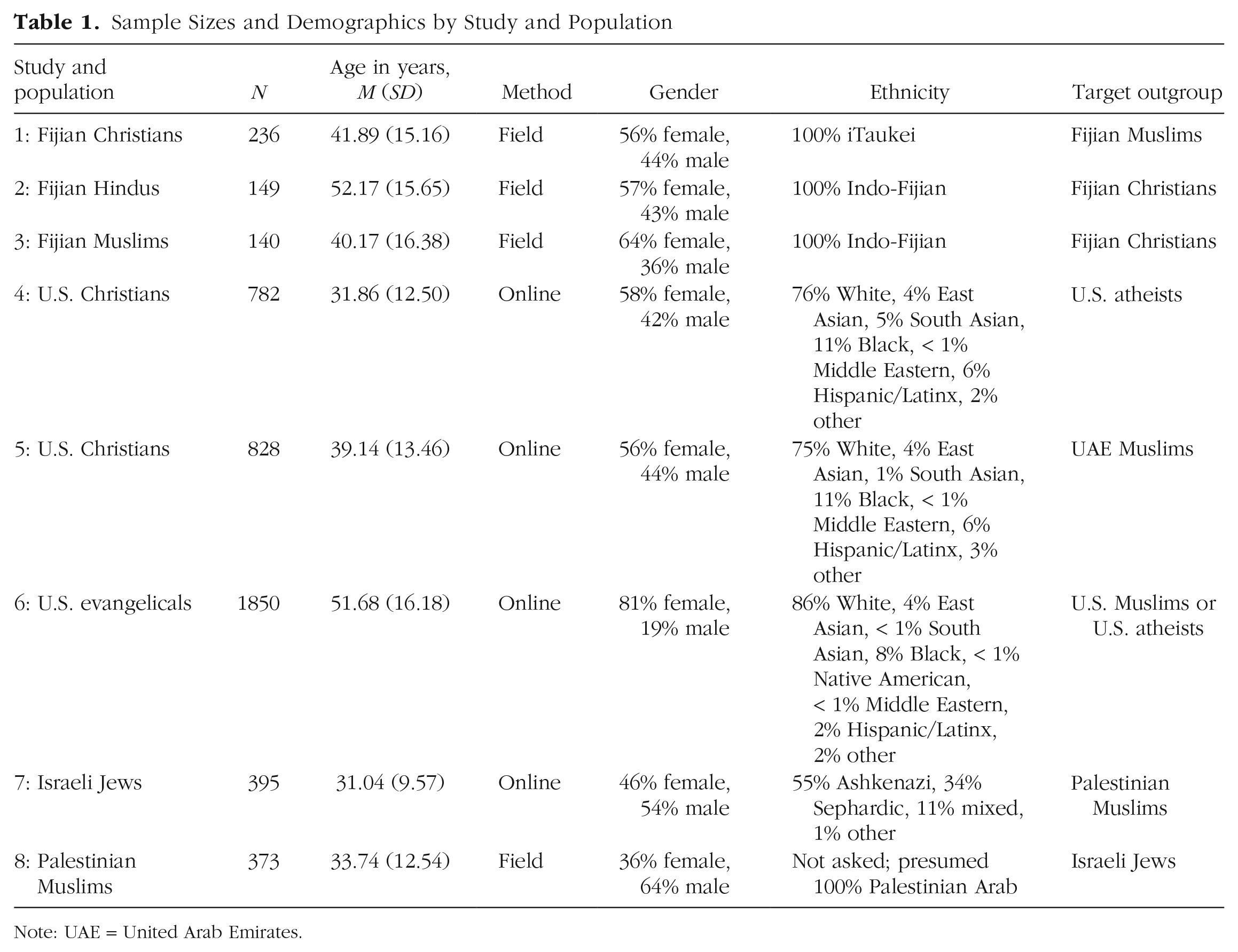
Note: UAE = United Arab Emirates.
Procedure
Experimental protocol
Our experimental paradigm involved an economic game, variations on which have been successfully deployed in large-scale cross-cultural studies (Henrich et al., 2010; Lang et al., 2019). Participants played multiple rounds of a real-stakes dictator game in which they divided a sum of money between themselves and different individual recipients. As shown in Figure 1, participants in field studies distributed actual coins. Online studies involved a conceptually identical task.

Protocol of the field studies (Studies 1–3 and 8). The diagram depicts the protocol for one individual round.
All studies used a 2 (between subjects) × 2 (within subjects) mixed design. Participants were randomly assigned to always be paired with strangers who were either members of their ethno-religious ingroup (n = 2,104) or ethno-religious outgroup (n = 2,649). Table 1 shows the target outgroups selected for each study and population. To test whether thinking about God influences parochial and/or extended prosociality, we manipulated, within subjects, whether participants were asked to think about God before making their decisions. In initial rounds, participants were asked to think carefully before making their choice. In later rounds, they were asked to think about God before making their choice. We opted not to counterbalance conditions because we suspected that it would be difficult to undo the effect of thinking about God once our experimental manipulation made God salient, rendering it hard to obtain a baseline measure. Notably, prior research demonstrates that effects of similar within-subjects god manipulations were not artifacts of an order effect (Smith et al., 2022; White et al., 2019).
All studies used similar protocols, with subtle variations. For example, in Fiji and the Middle East, participants were asked to “think about what God would want you to do before making your decision,” whereas in Studies 4 and 5, both conducted with U.S. Christians, participants were instructed to “think about God.” This difference was due to Studies 1 to 5 being conducted by two independent research teams before we combined our efforts. In Study 6, which both teams conducted together, evangelical U.S. Christians were randomly assigned to each of these prompts, leading to comparable results (see Results). Palestinian and Fijian Muslims were asked to think about Allah; Fijian Hindus were asked to think from the perspective of Bhagwan, seen by Fijian Hindus as the one universal god; Israeli Jews were asked to think about Elohim; and Fijian and American Christians were asked to think about God.
No deception was used in Studies 1 to 3 and 6 to 8, in which the recipients were real members of the described religious and demographic groups who received the full allocations pledged by participants. Deception was employed for logistical reasons in Studies 4 and 5. In Study 4, although the recipients were real and of the described religious affiliation (Christians and atheists), other demographic information (age and gender) was fictitious. In Study 5, the recipients of the game were fictitious. In both studies, participants were debriefed about deception.
Approach to field work
In Fiji and the West Bank, we began fieldwork by establishing strong community relations to build knowledge of local cultures and recruit qualified research assistants from each ethno-religious group who became partners in our work. Where necessary, this meant securing permission (e.g., from Fiji’s Ministry of Education, Heritage and Arts and Ministry of iTaukei Affairs) and partnering with local government (e.g., Nadroga-Navosa Provincial Council in Fiji). We conducted focus groups with research teams (separately for each ethno-religious group), through which we codeveloped materials, codesigned experimental procedures, and translated measures. We trained research assistants to conduct field interviews, and they trained us in cultural norms. Data were collected by research assistants via house-to-house interviews in participants’ native language. For online studies (Jewish Israelis and Christian Americans), our core research team included members of the groups we studied, ensuring cultural sensitivity.
Materials
Here, we describe measures relevant to integrated analyses. Additional materials relevant to study-by-study preregistered analyses are presented in the Supplemental Material. Materials were translated into Hebrew for Israeli Jews, Levantine Arabic for Palestinian Muslims, Bau (national dialect of Fiji) for Christian iTaukei in Fiji, and Hindustani (a local dialect of Hindi) for Fijian Hindus and Muslims of Indian descent.
Number of rounds and stakes
In Fiji and the Middle East, participants completed a total of four rounds—two rounds per within-subjects condition (baseline vs. God). The total stake that participants distributed at baseline and after receiving the god manipulation was always equivalent. But in each condition, the stake was randomly distributed between the two rounds. In each round, participants were given at least three coins. Randomly varying the stake for each round was meant to prevent participants in field studies—who manually distributed coins—from easily tracking their allocations across rounds. In the United States, where studies were all conducted online, participants completed only one round per within-subjects condition. Stakes for each within-subject condition were adjusted according to the format of the study (online vs. in the field) and norms. In the West Bank, Muslim Palestinians distributed 16 individual new Israeli shekel coins in each within-subjects condition (16 new Israeli shekels = ~$4.50 U.S.). In Israel, Jews (using a virtual coin-distribution task) distributed 12 individual new Israeli shekel coins in each within-subjects condition (12 new Israeli shekels = ~$3.50 U.S.). In Fiji, in each within-subjects condition, all groups distributed 12 individual coins, each worth half a Fijian dollar (6 Fijian dollars = ~$3 U.S.). In the United States, rather than physically dividing coins, participants simply indicated the amount of money they wanted to share in each within-subjects condition. For U.S. studies conducted on Mechanical Turk (Studies 4 and 5), the stake per within-subjects condition was $0.40. For the U.S. study conducted through a Qualtrics panel (Study 6), the stake per within-subjects condition was $1.50.
Dependent variable
We calculated the dependent variable as the percentage of money participants gave away in each within-subjects condition. For example, in Fiji, where the total stake per within-subjects condition was 6 Fijian dollars, we divided the amount participants shared (at baseline and after thinking about God’s preferences) by 6. In field studies, where physical coins were allocated, there were rare instances in which a participant did not allocate or keep a coin, likely because they did not see it (e.g., it was found wedged in the corner of an envelope). In these instances, we reduced the denominator accordingly. Throughout our results, we report the percentage of money (out of the total stake) that participants shared. Likewise, we report changes in giving in terms of raw percentages of the total stake as opposed to relative percentage increases or decreases in giving, unless otherwise specified.
Perceived religious threat and commonality
To test whether the influence of thinking about God depended on perceptions of intergroup relations, we included equivalent measures of perceived threat from and commonality with the outgroup in studies with Jewish Israelis, Muslim Palestinians, and evangelical Christians in the United States. In the evangelical Christian sample, our full commonality scale was measured only for participants paired with Muslims (threat was measured for participants paired both with atheists and with Muslims). We also included measures of religious threat and commonality for Fijian samples that are not included here because of measurement differences (see the Supplemental Material for separate analyses for these studies).
Threat
Four items (adapted from Canetti-Nisim et al., 2008) assessed the perception that one’s target outgroup posed a threat to the ingroup’s (a) economic welfare, (b) security, (c) culture, and (d) existence. Items were rated from 1 (not at all true) to 5 (very true). The mean reliability across studies in which this scale was assessed was .81. See Figure 2 for descriptive statistics.
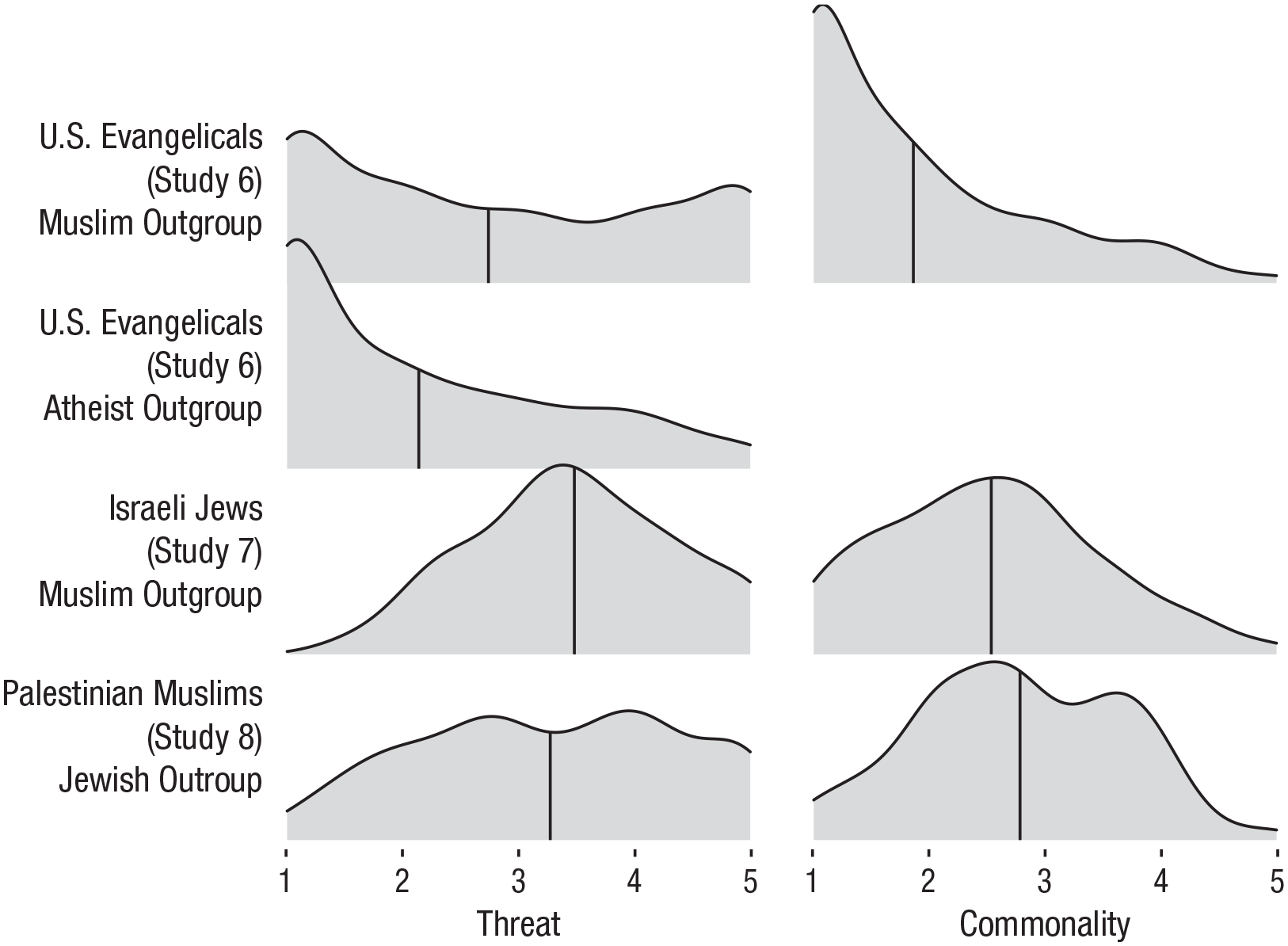
Threat and commonality density plots for Studies 6 to 8. The distributions display the degree to which participants perceived threat from (left) and commonality with (right) target outgroups in each study. Vertical bars indicate means.
Commonality
Four items assessed the degree to which participants thought their ingroup and outgroup (a) prayed to the same god, (b) shared common religious values, (c) shared common values (in general), and (d) shared a common identity. Common-identity items were developed in focus-group and translation workshops in Palestine and in Fiji and seem to have been well understood by our participants. Items were rated from 1 (not at all true) to 5 (very true). The mean reliability across studies in which this scale was assessed was .74. For our evangelical U.S. Christian sample, we were not able to use this same scale to measure commonality toward atheists because Items 1 and 2 do not translate to a nonreligious outgroup (see the Supplemental Material). For moderation analyses, we focus only on outgroups for whom our full commonality scale was assessed. See Figure 2 for descriptive statistics.
Results
General analytic approach
To provide the best test of our hypotheses, we report integrated analyses that pool together all eight experiments (Curran & Hussong, 2009). We note that this was not preregistered. However, all experiments were individually preregistered, and preregistered analyses (that are consistent with the integrated analyses presented here) can be found in the Supplemental Material. We created a master data set with data from each individual experiment and used multilevel models, conducted with the packages lme4 (Bates et al., 2015) and lmerTest (Kuznetsova et al., 2017) in R (R Core Team, 2016) to account for variance by study and, in subsequent models, to explore context and population effects. All statistical tests are two-tailed. For key null effects, we quantified evidence for or against the null by conducting Bayesian model-comparison tests in the R package BayesFactor (Morey et al., 2015). Default Jeffreys priors and Markov chain Monte Carlo settings were used. We describe specific models used to test each research question below.
Thinking about God increased prosociality equally to ingroups and outgroups
To estimate effects across studies, we conducted a multilevel model regressing the percentage of money (out of the total stakes) participants gave away on (a) the god manipulation (baseline = 0, God = 1, entered at Level 1 to account for the within-subject nature of the variable), (b) whether participants were paired with ingroup (0.5) or outgroup (–0.5) members (entered at Level 2 to account for the between-subjects nature of the variable), and (c) their cross-level interaction. Our intergroup condition contrast coding allowed us to estimate the effect of our god manipulation collapsed across intergroup conditions while preserving a 1-unit difference between intergroup conditions for easy model interpretation. Random intercepts for participant and study and random slopes for participant accounted for the within-person nature of the god manipulation and study-level variance.
Across experiments and sites, participants showed more generosity toward strangers after thinking about God, and giving increased to an equal extent whether recipients were religious ingroup or outgroup members (Fig. 3). Participants gave an average of 37.43% of their stake prior to the manipulation and 41.61% of their stake following the manipulation. Thus, thinking about God led to an 11% increase in giving relative to baseline (an increase of 4.17 percentage points of the total stake), t(4748.99) = 14.00, p < .001, 95% confidence interval (CI) = [3.59, 4.76].
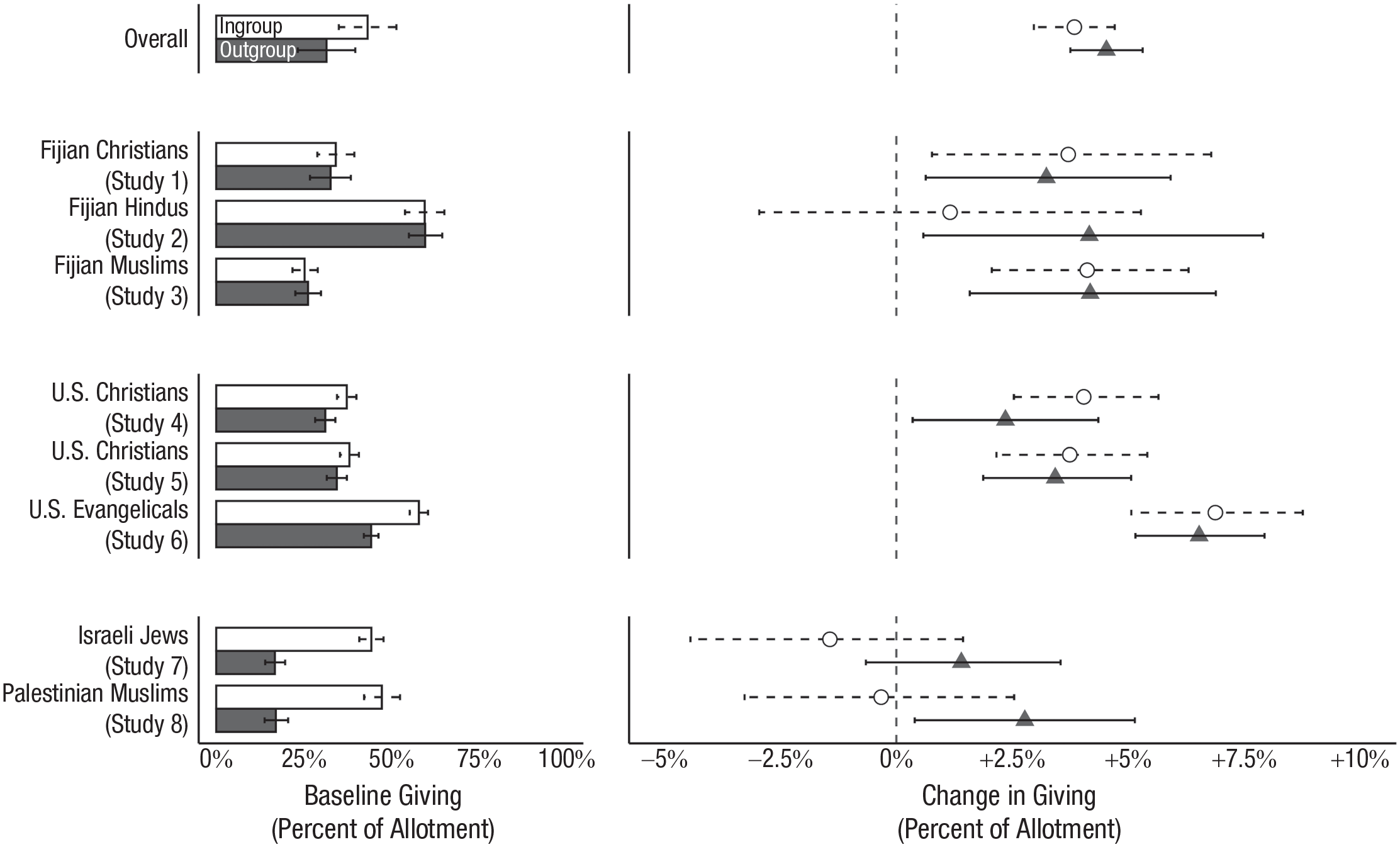
Effect of thinking about God on giving to religious ingroup and outgroup strangers. Model estimates based on integrated data analyses are displayed for overall results in Studies 1 to 8. Results for individual studies are based on raw data with bootstrapped confidence intervals (CIs). Results are displayed separately for ingroup and outgroup conditions. The left panel displays the percentage of total allotment given at baseline to ingroup (white) and outgroup (gray) members. The right panel displays change in giving after thinking about God, in raw percentage points, for religious ingroups (white circles with dashed error bars) and religious outgroups (gray triangles with solid error bars). Error bars represent 95% CIs.
Supporting the extended-prosociality hypothesis, analyses showed no interaction between manipulation and recipient identity. Although participants showed ingroup bias at baseline, the effect of thinking about God on increasing generosity did not differ on the basis of the religious identity of the recipient, b = −0.69, t(4748.99) = −1.16, p = .246, 95% CI = [−1.86, 0.48] (Fig. 3). See Table S2 in the Supplemental Material for results of the full regression model. To calculate a Bayes factor (BF), we compared a null model containing main effects only with an alternative model that included the God × Recipient Religion interaction. We calculated a BF of 0.05, which provides strong evidence (by a factor of 20) in favor of a null interaction (Lee & Wagenmakers, 2014). Thus, the main result supported the extended-prosociality hypothesis: Thinking about God inspired statistically indistinguishable increases in giving to religious ingroup and outgroup members.
Thinking about God led to extended prosociality across and within research sites
We explored whether results differed between and within contexts by adding theory-informed orthogonal contrasts (Level 2) to the fixed-effect portion of the above-reported model (removing study as a random factor), also adding all two- and three-way interactions. Unlike dummy codes, which require a single reference group, orthogonal contrasts allowed us to partition variance in a parsimonious way to make theory-driven comparisons (Rosenthal & Rosnow, 1985). We employed orthogonal contrasts to test whether effects differed by context as well as how effects differed by ethno-religious group within each context (e.g., as a function of proselytizing vs. nonproselytizing traditions). Because we had eight samples, we specified seven orthogonal contrasts. For each entered contrast, we assigned theory-driven values to each sample. To maintain orthogonality, we ensured that the specific values assigned to each sample differed both as a function of the number of samples being compared in each contrast and the number of samples that were grouped together for each theory-driven comparison.
Two contrasts specifically tested for differences in the degree of conflict across research sites. Contrast 1 compared participants from our two Middle East samples (coded +3)—who live in a particularly intense interreligious conflict—with participants from our three Fijian and three U.S. samples (coded −1), for whom conflict is more muted. Contrast 2 compared participants from the United States (coded +1) with participants from Fiji (coded −1), the latter of which has a history of greater ethno-religious conflict, albeit to a lesser extent than that between Israelis and Palestinians. Jewish Israelis and Muslim Palestinians were coded 0 for this contrast.
We also included five contrasts to decompose within-context variance. Contrast 3 compared Fijian Hindus (coded +2) with Fijian Christians and Muslims (coded −1). Samples from the United States and Middle East were coded 0. Contrast 4 further decomposed variance within Fiji by comparing Fijian Christians (coded +1) with Fijian Muslims (coded −1), with all other samples coded 0. Contrast 5 compared U.S. evangelicals (coded +2) with the other U.S. Christian samples (coded −1), with all other samples coded 0, and Contrast 6 further decomposed U.S. variance by comparing the other U.S. Christian samples with each other (Study 4 was coded 1, Study 5 was coded −1, and all other samples were coded 0). Finally, Contrast 7 decomposed variance among our Middle Eastern samples; Muslim Palestinians were coded +1, Jewish Israelis were coded −1, and all other samples were coded 0.
We note that parameter estimates must be interpreted with respect to the range between contrast-specific values. For example, to interpret the magnitude of an effect for Contrast 1 (which compared Middle Eastern samples with Fijian and U.S. samples), a hypothetical parameter estimate of b = 1 would need to be divided by 4 (the range from +3 to −1).
Results were similar across sites that differed in levels of intergroup conflict
We found context-level differences in ingroup-bias levels before participants were asked to think about God—Middle East > Fiji and United States: b = 6.25, t(4735.02) = 9.26, p < .001, 95% CI = [4.92, 7.57]; United States > Fiji: b = 3.82, t(4735.07) = 2.53, p = .011, 95% CI = [0.86, 6.78]—and differences in the effect of thinking about God overall—Middle East < United States and Fiji, b = −0.84, t(4734.93) = −3.78, p < .001, 95% CI = [−1.27, −0.40]. However, context did not moderate the principal finding that increased generosity after thinking about God was extended to recipients regardless of their religious identity—Middle East vs. Fiji and United States: b = −0.73, t(4735.37) = −1.65, p = .100, 95% CI = [−1.60, 0.14], BF = 0.143, Fiji vs. United States: b = 0.82, t(4737.02) = 0.83, p = .409, 95% CI = [−1.12, 2.76], BF = 0.116.
Results were similar within sites for proselytizing and nonproselytizing religions
We focused on two within-context contrasts to test whether results were moderated by whether participants belonged to proselytizing religions. One hypothesis is that the relation between the salience of god beliefs and extended prosociality would be stronger or only occur within proselytizing religious traditions (Norenzayan et al., 2016). Two contrasts allow us to test this question within two contexts. Specifically, Contrast 3 compared Fijian Hindus (who are members of a nonproselytizing religion) with Fijian Christians and Muslims (who are members of proselytizing religions), and Contrast 7 compared Israeli Jews (who are members of a nonproselytizing religion) with Palestinian Muslims (who are members of a proselytizing religion).
In both Fiji and the Middle East, members of proselytizing and nonproselytizing religions showed similar generosity increases (regardless of the identity of recipients) after thinking about God (ps > .400). Thus, contrary to previous theorizing, our results showed no evidence in favor of this proselytizing hypothesis (Table S3 in the Supplemental Material).
Although evangelical Christians were more biased than other Christians in the United States, they exhibited similar increases in extended prosociality when thinking about God
Contrast 5 allowed us to examine differences between evangelicals sampled in Study 6 and Christians of all denominations sampled in Studies 4 and 5. Evangelical Christians exhibited more ingroup bias at baseline, b = 2.88, t(4736.13) = 3.99, p < .001, 95% CI = [1.46, 4.30]. Despite this, no three-way interaction emerged between the contrast comparing evangelical Christians with other Christian samples, the effect of thinking about God, and intergroup condition, b = −0.23, t(4735.01) = −0.48, p = .635, 95% CI = [−1.15, 0.70], BF = 0.114. Thus, even though we included evangelical Christians as a way to test potential boundary conditions of the extended-prosociality hypothesis, no such boundary condition emerged.
The effect of thinking about God on intergroup generosity was not moderated by perceptions of intergroup relations
It is plausible that thinking about God promotes parochial prosociality in the presence of perceived intergroup conflict or between groups who knowingly hold divergent religious beliefs. Conversely, parochiality might give way to more impartial treatment of others when intergroup relations are seen as positive and nonthreatening or when groups share a meaningful common identity (Norenzayan et al., 2016). For example, if participants believe that members of different relevant religions pray to the same god or gods, making these deities salient might highlight similar group identities, encouraging adherents to extend generosity norms associated with moralizing deities across group lines.
We tested these ideas by pooling data from three studies (both studies in the Middle East and Study 6 with U.S. evangelicals) in which we used similar intergroup threat and commonality measures (Fig. 2). We used data only for participants paired with outgroup members for two reasons. First, our primary questions concerned whether threat and/or commonality moderated the effect of thinking about God on outgroup giving. Second, we did not measure commonality with target outgroups among U.S. evangelical Christians paired with ingroup members. We regressed the total percentage of money given to outgroup members (out of the total allotment) on whether participants were responding before or after thinking about God (baseline = 0, God = 1), threat/commonality (in separate models, grand-mean centered and entered at Level 2), and their cross-level interaction. Because there were only three studies, studies were included as fixed effects with two orthogonal contrasts (Contrast 1: Jewish Israelis and Muslim Palestinians = −0.5, U.S. evangelical Christians = 1; Contrast 2: Jewish Israelis = −0.5, Muslim Palestinians = 0.5, U.S. evangelical Christians = 0). Two- and three-way interactions between these contrasts and both our god manipulation and threat/commonality were also included in the model to adjust estimates for unequal sample sizes. Random intercepts and slopes were included for participants.
Perceived intergroup threat
Perceived intergroup threat did not moderate the positive effect of thinking about God on generosity toward members of religious outgroups, b = −0.71, t(1602.00) = −0.88, p = .381, 95% CI = [−2.29, 0.87] (Table S4 in the Supplemental Material). A BF of 0.001—computed by comparing models excluding and including the two-way Threat × Thinking About God and three-way interactions—provides very strong evidence against threat moderation. Results are consistent with separate preregistered analyses for each study, which also show that perceived intergroup threat did not moderate the effects of thinking about God on prosociality (see the Supplemental Material).
Perceived intergroup commonality
Perceived commonality did not moderate the effect of thinking about God on generosity toward members of religious outgroups, b = 0.34, t(977.00) = 0.41, p = .681, 95% CI = [−1.29, 1.97] (Table S5 in the Supplemental Material). A BF of 0.001—computed by comparing models excluding and including the two-way Commonality × Thinking About God and three-way interactions—provides very strong evidence against commonality moderation.
We also conducted a focused ancillary analysis with evangelical Christians from Study 6, who were randomly paired with either Muslim or atheist outgroup members. We wondered whether thinking about God would exert stronger effects among evangelicals paired with Muslims, who share a belief in God, than it would among evangelicals paired with atheists, who reject such beliefs. We regressed the percentage of money participants gave (out of the total allotment) on our god manipulation (baseline = 0, God = 1), intergroup condition (Level 2: Contrast 1: ingroup = 1, outgroups = −0.5; Contrast 2: atheist outgroup = −0.5, Muslim outgroup = 0.5). Random intercepts and slopes were specified for participants. Far from finding higher levels of prosociality toward the outgroup with common god beliefs, results showed that thinking about God increased giving more strongly toward atheist recipients, b = 8.38, t(1845.49) = 8.57, p < .001, 95% CI = [6.47, 10.30], than Muslim recipients, b = 4.59, t(1845.49) = 4.63, p < .001, 95% CI = [2.65, 6.53]; interaction: b = −3.79, t(1845.49) = −2.72, p = .007, 95% CI = [−6.52, −1.06]. See Table S6 in the Supplemental Material.
Results held regardless of manipulation wording
We tested whether our results were robust to differences in manipulation wordings by conducting focused analyses with Study 6 participants, who were randomly assigned to receive one of the two versions of our manipulation. We regressed the percentage of money participants chose to give away (out of the total stakes) on perspective, intergroup condition, and a contrast comparing these two manipulations (thinking about God = −0.5, thinking about God’s preferences = 0.5). Random intercepts and slopes were specified for participants. Whereas participants who were asked to think about God’s preferences (as opposed to asked to think about God) showed a greater increase in giving, collapsed across intergroup conditions, b = 4.88, t(1844.94) = 4.10, p < .001, 95% CI = [2.55, 7.21], simple-effects tests showed that both manipulations increased giving significantly. Participants told to think about God gave, on average, 4.24% more of the total allotment away, t(1844.44) = 5.06, p < .001, 95% CI = [2.60, 5.88]. Participants told to think about God’s preferences gave, on average, 9.12% more of the total allotment away, t(1845.44) = 10.80, p < .001, 95% CI = [7.46, 10.77]. See Table S9 in the Supplemental Material for full results. This indicates that different manipulations may have contributed to slightly different effect sizes across studies, although in both cases, the direction and statistical significance of the effect remained consistent.
Discussion
Field and online experiments with diverse ethno-religious populations in three political and cultural contexts found that asking believers to think about God increased generosity that extended to people who belonged to a different religion and to those who disavowed the existence of a god. Although sites with more intense levels of conflict showed more ingroup bias at baseline and although participants perceiving greater outgroup threat were less generous to outgroup members at baseline, positive effects of thinking about God on prosociality persisted regardless of conflict or perceived threat or conflict levels. These effects held across different versions of the manipulation (although effects were stronger when the manipulation was more explicit) and held only among believers (see the Supplemental Material for Study 4).
We argue that the extended-prosociality effect likely results from norms and preferences that believers attribute to God. One potential alternative mechanism is that thinking about God could promote intergroup generosity by enhancing the salience of superordinate identities (e.g., “human”) and decreasing the salience of subordinate identities (e.g., “Muslim”). Had thinking about God decreased ingroup bias, we would be unable to distinguish between these explanations. However, as one would expect given humans’ penchant for ingroup favoritism (Tajfel, 1982), ingroup bias emerged in most sites and was not decreased following the manipulation. Thinking about God facilitated comparable increases in prosociality regardless of the religious identity of the recipient, but without decreasing prior ingroup biases. This implies that religious identities, and differences between them, were equally salient after participants thought about God, effectively ruling out the superordinate-identity explanation.
Although results show that activating belief in God can facilitate extended prosociality, it is unlikely that such beliefs invariably promote harmony. Religion is often implicated in intergroup conflict and warfare (Austin et al., n.d.; Armstrong, 2014), and aspects of religion aside from belief in God—in particular, social solidarity engendered by some collective rituals—may exacerbate conflict (Ginges et al., 2009; cf. Clingingsmith & Khwaja, 2009). Future work might investigate whether specific conditions encourage supernatural beliefs that enhance intergroup hostility (Neuberg et al., 2014). Such work is needed to understand when commitment to God promotes tolerance or conflict. Our results suggest that this is unlikely to be a consequence of general levels of threat or commonality between groups. This insight would not have been possible had we constrained our sample to Christians in the United States, as is common in much psychological research on religion. More plausibly, different situations promote different moral norms that are accentuated by thinking about gods.
We note several potential limitations to generalizability that might stimulate future work. First, we studied the impact of thinking about God in a two-player dictator game, which might make generosity and fairness norms salient. This may help to explain the lack of intergroup bias in our Fijian samples. Other situations may make ingroup loyalty norms salient, perhaps increasing ingroup bias. Second, although we found evidence of bias in most study sites, our studies cannot speak to whether this bias stems from religion itself or other social categories that intersect with religion in our study sites, such as ethnicity or nationality. Third, we operationalized conflict and threat in two ways: contexts with more versus less conflict and individual perceptions of threat. Future research should also test whether personal experiences of conflict might moderate the effect of thinking about God on outgroup prosociality. Fourth, we confined our populations to religionists who believed in moralizing gods, which both theory (Norenzayan, 2013) and research (Purzycki et al., 2016) suggest drive prosociality. In the Supplemental Material, we discuss how future work should explore how findings generalize to other cultures and religions.
Belief in a god or gods distinguishes religion from other belief systems that group humans into parochial units (secular ideologies, social classes, ethnolinguistic groups). Thus, it is noteworthy that thinking about God encouraged prosociality across religious divides. In contrast to the idea that belief in a god or gods fuels divisiveness between ethno-religious groups, such belief may encourage generosity beyond the ingroup. Results add a crucial piece to a rich multidisciplinary discussion about the belief in moralizing gods, large-scale cooperation, and the cultural evolution of religion (e.g., Armstrong, 2014; Norenzayan et al., 2016). Rather than spreading exclusively because of parochial prosociality, belief in moralizing gods may plausibly have also spread by encouraging norms of extended prosociality.
Supplemental Material
sj-docx-1-pss-10.1177_09567976231158576 – Supplemental material for Thinking About God Encourages Prosociality Toward Religious Outgroups: A Cross-Cultural Investigation
Supplemental material, sj-docx-1-pss-10.1177_09567976231158576 for Thinking About God Encourages Prosociality Toward Religious Outgroups: A Cross-Cultural Investigation by Michael H. Pasek, John Michael Kelly, Crystal Shackleford, Cindel J. M. White, Allon Vishkin, Julia M. Smith, Ara Norenzayan, Azim Shariff and Jeremy Ginges in Psychological Science
Footnotes
Acknowledgements
We acknowledge contributions from teams in Fiji (Adiama Israel, Meli Vuilabasa, Seru Ratu, Vennyanna Israel, Jone Biaunikoro, Natasha Nisha, Sofia Nisha, Zoya Ali, Mezaan Ali, Rita Chand, Umesh Sharma, Renuka Naidu, Latchmaiya Naidu, and Ranjana Chand) and the West Bank (Mohammed Awad, Zaytoon Musleh, Manar Nabut, Younes Samman, Mai Shaheen, Salah Shaheen, and other researchers who requested anonymity).
Transparency
Action Editor: Mark Brandt
Editor: Patricia J. Bauer
Author Contributions

References
Supplementary Material
Please find the following supplemental material available below.
For Open Access articles published under a Creative Commons License, all supplemental material carries the same license as the article it is associated with.
For non-Open Access articles published, all supplemental material carries a non-exclusive license, and permission requests for re-use of supplemental material or any part of supplemental material shall be sent directly to the copyright owner as specified in the copyright notice associated with the article.
