




Abstract
Grandiose narcissism is defined as increased motivation for status and viewing oneself as entitled and superior to others. We hypothesized that these tendencies might be associated with basal levels of testosterone because testosterone is considered the most social hormone—driving dominance and the motivation to achieve social status. We distinguished between two facets of grandiose narcissism: agentic (i.e., the tendency to self-promotion in order to win others’ admiration and social influence) and antagonistic (i.e., a reactive strategy used to restore threatened status). In 283 adult men, we examined the association between these facets of narcissism and blood-tested and self-reported testosterone levels. Agentic narcissism—the default narcissistic strategy—was positively associated with both testosterone indicators. Moreover, self-reported and objectively measured testosterone were positively correlated. These findings extend previous work by showing that the facets of narcissism have distinct hormonal underpinnings.
Most societies are organized hierarchically. Typically, hierarchies provide more advantages for individuals near the top of the hierarchy than for individuals closer to the bottom (Cheng et al., 2013). However, people may differ in how much they are concerned with their status in the social hierarchy. One of the individual-differences characteristics essential for status pursuit is narcissism, especially its grandiose form (Zeigler-Hill et al., 2018), which is defined through increased motivation for status pursuit and viewing oneself as superior to others (Grapsas et al., 2020). In the current study, we sought biological correlates of these narcissistic tendencies. Specifically, we examined the association between narcissism and testosterone levels because testosterone is viewed as the most social hormone, one that drives dominance behaviors and the motivation to achieve social status (Eisenegger et al., 2011).
The core characteristics of narcissism as a subclinical personality trait are entitlement and an increased sense of self-importance (Krizan & Herlache, 2018). The most prototypical manifestation of this tendency is grandiose narcissism—a blend of agentic (i.e., assertiveness, grandiosity, and feelings of superiority) and antagonistic (i.e., arrogance, quarrelsomeness, and exploitativeness) facets (Back et al., 2013). Another manifestation—vulnerable narcissism—consists of antagonistic but also of neurotic facets (i.e., shyness, distrust, and shame; Miller et al., 2021). Although both narcissistic manifestations are equally important in terms of the structural organization (Rogoza et al., 2022), only grandiose narcissism is linked to status pursuits (Zeigler-Hill et al., 2018).
Grandiose narcissism may be described in terms of a dynamic self-regulatory system, where the overarching goal is to maintain favorable self-views (Back et al., 2013; Morf & Rhodewalt, 2001). Individuals with elevated levels of grandiose narcissism use various strategies to maintain grandiose beliefs about themselves. For instance, they pursue external validation by elevating their social status, viewing themselves as superior to others and as entitled to special privileges (Zeigler-Hill et al., 2018). Their desire of status manifests itself in the tendency to exaggerate their competence (Zajenkowski et al., 2020), display wealth (Sedikides et al., 2007), affiliate with high-status romantic partners (Campbell, 1999), and pursue leadership positions (Grijalva et al., 2015). However, the dual nature of grandiose narcissism implies that the pursuit of status might take agentic or antagonistic forms (Grapsas et al., 2020). Specifically, the default agentic strategy in grandiose narcissism reflects the tendency to self-enhancement and self-promotion with the aim of winning people’s admiration and social influence (Back et al., 2013). When the self-promotion does not guarantee the desired outcome, the antagonistic strategy is activated, manifesting in devaluation of others (Back et al., 2013).
Among the potential biological correlates of the narcissistic attitude, the reproductive hormone testosterone may have the most in common with grandiose narcissism. Although testosterone is often associated with aggression, its psychological function might be broadly associated with dominance behaviors, and the aggressive reactions are just a by-product of status-seeking tendencies (Eisenegger et al., 2011). Testosterone influences the motivation to pursue high status, which might be achieved in various, including nonaggressive, ways (Mazur & Booth, 1998). The psychological outcomes of testosterone fit well with the description of grandiose narcissism, as both are associated with dominance and status pursuits.
An evolutionary perspective may provide a conceptual framework as to why basal testosterone serves as a hormonal underpinning for narcissistic behavior. In this way, testosterone nudges people to hold certain attitudes and behave in certain ways consistent with behavioral patterns that provide reproductive benefits through short-term mating (Holtzman & Strube, 2011). Consequently, we hypothesized that testosterone leads to personality traits such as grandiose narcissism. Moreover, because grandiose narcissism correlates with tendencies toward self-enhancement on attributes perceived as agentic (Grijalva & Zhang, 2016), it may lead to views about oneself as testosterone laden. Indeed, folk wisdom links testosterone with agentic behavior (Eisenegger et al., 2010).
Statement of Relevance
Understanding narcissism has important implications for researchers and the public. Whereas most studies focus on the structure of narcissism, its origins are still unclear, and the research on it is limited. In the current study, we examined how aspects of narcissism identified in prior research are associated with testosterone, which is considered a social hormone that drives dominance behaviors and motivations. In a sample of men, we found that one facet of narcissism—agentic—is associated with elevated rates of testosterone. Additionally, we found that men have some insight into their testosterone rates. Those with higher agentic narcissism positively assessed their testosterone level. These findings reveal the hormonal underpinning of one kind of narcissism but not another, further distinguishing them and providing insight into where they may originate and what they may create in the world.
Despite the theoretical link, the empirical research on the association between narcissism and testosterone has yielded mixed results. Whereas some studies have reported a positive association between grandiose narcissism and basal testosterone (Pfattheicher, 2016), others failed to find a significant effect (Czarna et al., 2022; Dane et al., 2018; Lobbestael et al., 2014). However, grandiose narcissism has been found to be positively associated with testosterone reactivity (e.g., after an aggression-evoking task; Lobbestael et al., 2014). The inconsistency in the results might stem from several factors. First, prior studies were underpowered (e.g., N = 25; Dane et al., 2018) to detect small effects. Second, they did not consider the multidimensional nature of grandiose narcissism. The existing literature suggests that the agentic facet of grandiose narcissism might be considered the “default mode,” whereas the antagonistic facet represents a reactive mode used to deal with threat to ego or status (Back et al., 2013): an important consideration with respect to the measurement of testosterone—basal versus reactive. Correspondingly, agentic narcissism correlates positively with self-esteem, whereas antagonistic narcissism is linked to unstable and reactive self-esteem (Geukes et al., 2017). Prior research on testosterone used a global grandiose narcissism indicator and, therefore, failed to differentiate between agentic and antagonistic facets. According to the dual model of grandiose narcissism (Back et al., 2013), one might expect the agentic facet to be positively associated with basal testosterone, whereas the antagonistic facet would be more likely to correlate with testosterone reactivity (e.g., after provocation). This is in line with the findings that although the desire for status correlates with both facets of narcissism, it is especially strong for agentic narcissism (Zeigler-Hill et al., 2019).
In the current study, we tested the hypothesis that agentic narcissism would be positively associated with basal testosterone (Hypothesis 1). Additionally, we measured self-assessed testosterone as narcissists tend to self-enhance their agentic attributes (Grijalva & Zhang, 2016), including body attributes that are perceived as attractive (Moskowitz et al., 2009). This tendency to overestimate agentic attributes is more greatly associated with agentic, rather than antagonistic, narcissism (Gignac & Zajenkowski, 2021). Thus, we expected that agentic narcissism would be positively associated with self-assessed testosterone (Hypothesis 2). We also tested the hypothesis of testosterone self-enhancement, that is, that narcissism would predict the degree of overestimation in self-assessed testosterone (Hypothesis 3).
Open Practices Statement
We analyzed data from a larger study that was designed to address several research questions. No articles based on that study have been published yet. The project was preregistered (https://osf.io/fkhb2/). However, in the current article, we tested only one hypothesis included in the preregistration: the hypothesis about the positive association between agentic narcissism and basal testosterone (Hypothesis 1, described above). The preregistration includes a list of all measures and study variables. Because we were interested only in the association between narcissism and testosterone in the current study, we did not include any registered control variables (i.e., personality traits, intelligence, chronotype, and depression). Additionally, we obtained two indicators of basal testosterone (i.e., total and free); however, in the preregistration, we did not specify that our hypothesis is relevant only to free testosterone. We explain this below in the Blood Sampling and Testosterone Evaluation section. Finally, two measures were added after the study started (i.e., 12 participants had already been tested): self-assessed testosterone and a newly developed scale measuring communal narcissism. Therefore, the preregistration did not include hypotheses about self-assessed testosterone tested in the current study. We report how we determined our sample size, all measures, and data exclusions. Data and code are available at https://osf.io/whzcx/.
Method
Participants
We assumed a small to medium effect size (r = .18) based on prior research (i.e., Pfattheicher, 2016). Using the R package pwr, we estimated the required sample size at 240 participants with a power of .80 (two-tailed α level = .05). We collected data from 301 Polish adult men in May to June 2022. However, 18 participants were missing either free-testosterone data (n = 4) or self-assessed testosterone data (n = 14) and were excluded from the analyses. Data were missing at random—Little’s missing completely at random test, χ2(10, N = 301) = 10.77, p = .376. The final sample of 283 men had a mean age of 22.84 years (Mdn = 22.00, SD = 3.17, range = 18–44). We tested men only, as the role of testosterone in narcissism-related behaviors is less ambiguous in men than women (Mazur & Booth, 1998). Of the sample, 64% were undergraduate students, 17.3% held a bachelor’s degree, 7.8% held a master’s degree, and the remaining participants had completed high school. The study was approved by an institutional ethics committee, and we obtained written consent from all participants.
Measures
Narcissism
We administered several popular measures of narcissism that have previously been found to capture its three facets: agentic, antagonistic, and neurotic. We included the following scales. The Narcissistic Personality Inventory (NPI; Raskin & Hall, 1979, in the Polish adaptation by Bazińska & Drat-Ruszczak, 2000) is composed of 34 items with a 5-point response scale (1 = does not apply to me, 5 = applies to me); the Polish adaptation mainly captures agentic narcissism because it lacks items related to exploitativeness. The Narcissistic Admiration and Rivalry Questionnaire (NARQ; Back et al., 2013; Polish adaptation: Rogoza et al., 2016) is composed of 18 items with a 6-point response scale (1 = strongly disagree, 6 = strongly agree); it was created to measure agentic and antagonistic facets of narcissism. The short version of the Five Factor Narcissism Inventory (FFNI; Glover et al., 2012; Polish adaptation: Rogoza et al., 2021) is composed of 60-items with a 5-point response scale (1 = strongly disagree, 5 = strongly agree), from which the composite scores of agentic, antagonistic, and neurotic narcissism can be calculated. The Hypersensitive Narcissism Scale (HSNS; Hendin & Cheek, 1997; Polish version: Czarna et al., 2014) is composed of 10 items with a 5-point Likert-type (1 = strongly disagree, 5 = strongly agree) and mainly captures neurotic narcissism. In summary, we had three measures of agentic narcissism (NPI, NARQ-Admiration, FFNI-Agentic), two measures of antagonistic narcissism (NARQ-Rivalry, FFNI-Antagonistic), and two measures of neurotic narcissism (FFNI-Neurotic, HSNS).
Blood sampling and testosterone evaluation
All participants were asked to come to a laboratory for venous blood sampling between 7:30 a.m. and 9:30 a.m. (actual time: M = 8:40 a.m., Mdn = 8:42 a.m., SD = 45 min). They were instructed in writing before the study to abstain from alcohol for at least 24 hr prior to the blood sampling; any beverage, food, or drug containing caffeine as well as physical exercises for at least 15 hr beforehand; and smoking for at least 3 hr beforehand. Blood was entered into tubes, and serum was separated by centrifugation and divided into two separate aliquots for estimation of free testosterone. In the current study, we obtained two indicators of basal testosterone: total and free. According to research supporting the free-hormone hypothesis, free testosterone is the most bioactive testosterone fraction (Antonio et al., 2016) and therefore was targeted in the present analyses. Free basal testosterone was measured using ELISA kits (Euroimmun Medizinische Labordiagnostika, Lübeck, Germany). The manufacturer provides a lower limit of detection equal to 0.018 pg/ml and an intra-assay precision ranging from 4.8% to 6.7%.
Self-assessed testosterone
We measured self-assessed testosterone in a manner consistent with self-assessed intelligence (Zajenkowski et al., 2020). Specifically, participants read, “Men differ in their testosterone and may have low, medium, or high level of testosterone.” Next, participants rated their testosterone level after the following instruction: “Using the following scale, please indicate where you can be placed compared to other men” (1 = very low, 25 = very high).
Procedure
Advertisements to participate in the study were spread through social media. Men interested in participating contacted the experimenter, who then briefed them regarding the procedure in a written form. After participants agreed to be part of the study, we set the day for blood sampling and psychological assessment. After the blood sampling, participants received a link to Qualtrics that allowed for online completion of psychometric measures in the presence of research assistants on Zoom. The questionnaires were completed on the same day that the blood sampling took place. After completing the procedure, participants received financial renumeration.
Results
All three agentic narcissism measures correlated with higher rates of basal testosterone (rs ≈ .16) and self-assessed testosterone (rs ≈ .29), suggesting that higher levels of objectively determined and subjectively determined testosterone were associated with higher levels of agentic narcissism, supporting Hypotheses 1 and 2 (see Table 1). By contrast, antagonistic and neurotic narcissism failed to significantly associate with either testosterone measure. All three agentic narcissism scales intercorrelated positively (r > .65), suggesting the presence of a common factor (see Table 1 for 95% confidence intervals [CIs]). In fact, on the basis of a single-factor model, we found that all three agentic narcissism scales loaded onto an agentic narcissism latent variable: NARQ-Admiration: λ = 0.85, 95% CI = [0.80, 0.89], p = 002; NPI: λ = 0.99, 95% CI = [0.97, 1.02], p = .001; agentic λ = 0.81, 95% CI = [0.75, 0.85], p = .001. Therefore, we used structural equation modeling with an agentic narcissism latent variable to test our hypotheses further.
Descriptive Statistics and Pearson Correlations for the Association Between Narcissism and Testosterone
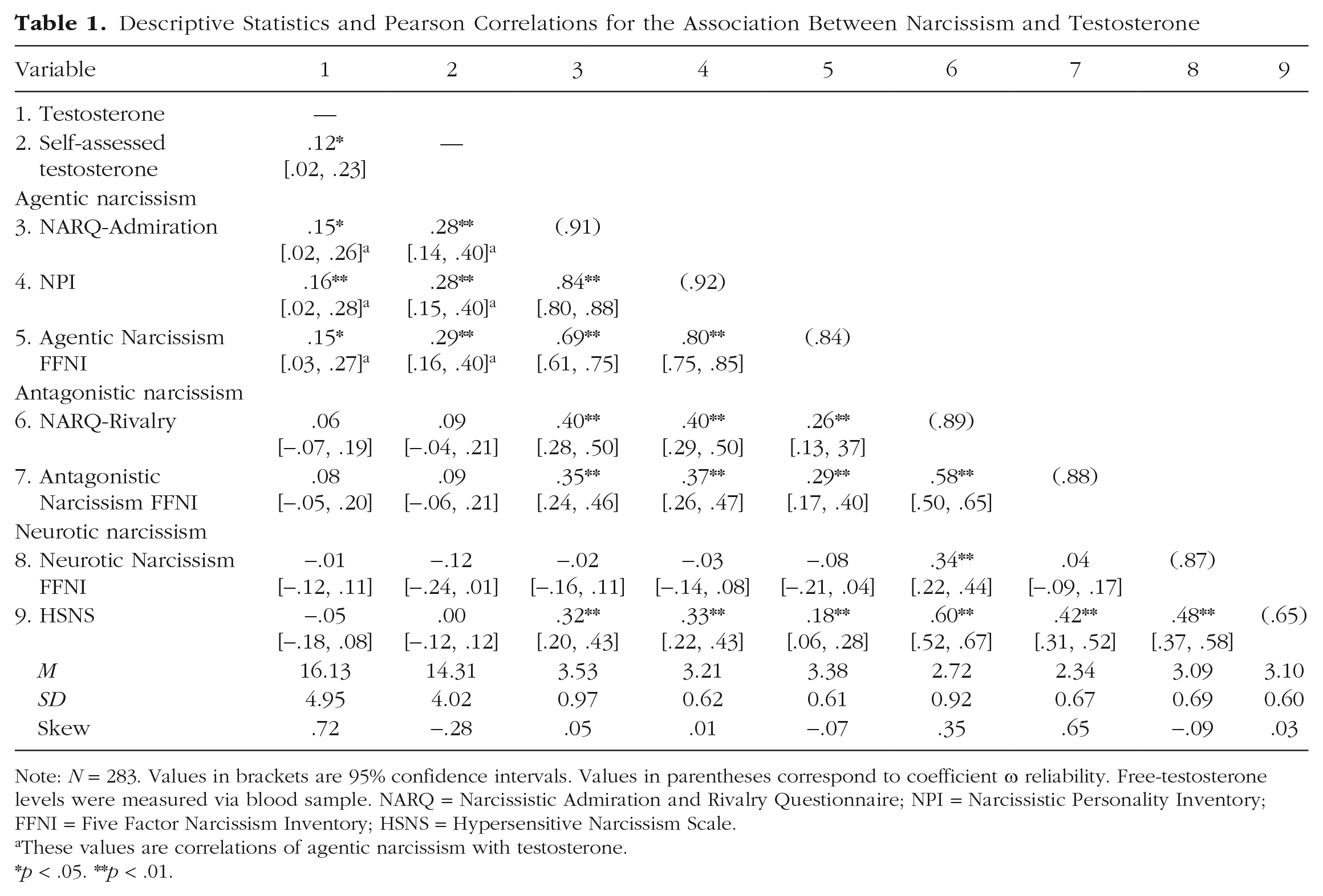
Note: N = 283. Values in brackets are 95% confidence intervals. Values in parentheses correspond to coefficient ω reliability. Free-testosterone levels were measured via blood sample. NARQ = Narcissistic Admiration and Rivalry Questionnaire; NPI = Narcissistic Personality Inventory; FFNI = Five Factor Narcissism Inventory; HSNS = Hypersensitive Narcissism Scale.
These values are correlations of agentic narcissism with testosterone.
p < .05. **p < .01.
Across two separate models, we estimated the association between latent agentic narcissism and both basal testosterone level and self-assessed testosterone. In the first model, basal testosterone levels were positively associated with the agentic narcissism latent variable (β = 0.16, 95% CI = [0.04, 0.28], p = .012), supporting Hypothesis 1. In the second model, agentic narcissism was positively associated with self-assessed testosterone (β = 0.29, 95% CI = [0.15, 0.40], p = .002), supporting Hypothesis 2. The correlation between an antagonistic latent variable and basal testosterone levels was nonsignificant (r = .09, 95% CI = [−.08, .21], p = .230). Furthermore, a multiple regression model with latent agentic and latent antagonistic narcissism predicting basal testosterone yielded a near-zero antagonistic narcissism beta weight (β = 0.01, 95% CI = [−0.17, 0.19], p = .953).
Next, we found that self-assessed testosterone was positively associated with basal testosterone (β = 0.12, 95% CI = [0.01, 0.23], p = .043). Thus, as a nonpreregistered analysis, we predicted agentic narcissism with basal testosterone and self-assessed testosterone. As can be seen in Figure 1, both free testosterone (β = 0.13, 95% CI = [0.02, 0.24], p = .023) and self-assessed testosterone (β = 0.27, 95% CI = [0.14, 0.39], p = .002) yielded positive, unique effects on agentic narcissism. A total of 10% of the variance in grandiose narcissism was predicted (R2 = .10, 95% CI = [.03, .19], p = .002). 1
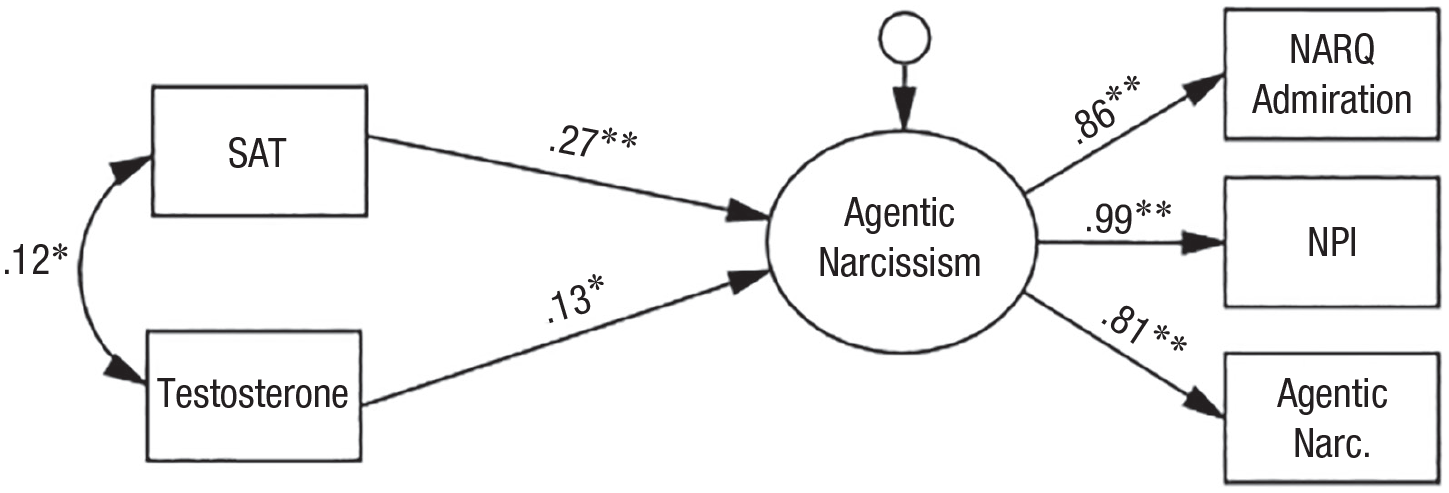
Structural equation model depicting the unique predictive effects of self-assessed testosterone (SAT) and basal testosterone on agentic narcissism (N = 283). Agentic narcissism was indexed via the Narcissistic Admiration and Rivalry Questionnaire (NARQ) Admiration subscale, Narcissistic Personality Inventory (NPI), and Agentic Narcissism Five Factor Narcissism Inventory. Free-testosterone levels were measured via blood sample. Values on single-headed arrows are standardized coefficients; the value on the double-headed arrow is a correlation. The empty circle pointing to agentic narcissism is a residual term. Asterisks indicate significant paths (*p < .05, **p < .01). The model fitted the data well, χ2(4) = 4.31 p = .365.
We also tested a supplementary model in which agentic narcissism predicted self-assessed testosterone controlling for basal testosterone (see Fig. 2). As can be seen in Figure 2, basal testosterone failed to yield a direct effect on self-assessed testosterone (β = 0.08, 95% CI = [−0.04, 0.18], p = .187). The effect between agentic narcissism and self-assessed testosterone remained significant (β = 0.28, 95% CI = [0.14, 0.40], p = .002). However, a bootstrapped (bias-corrected and accelerated; 2,000 resamples) condition-based regression analysis (see Humberg et al., 2019) failed to support Hypothesis 3, ∆β = −0.15, 95% CI = [−0.36, −0.08], p = .184, suggesting a lack of evidence in favor of self-enhancement.

Latent variable model depicting the indirect effect between basal testosterone and self-assessed testosterone (SAT) via grandiose narcissism (N = 283). Agentic narcissism was indexed via the Narcissistic Admiration and Rivalry Questionnaire (NARQ) Admiration subscale, Narcissistic Personality Inventory (NPI), and Agentic Narcissism Five Factor Narcissism Inventory. Free-testosterone levels were measured via blood sample. Values on single-headed arrows are standardized coefficients. The empty circle pointing to agentic narcissism is a residual term. Asterisks indicate significant paths (*p < .05, **p < .01). The model fitted the data well, χ2(4) = 4.31 p = .365; the direct effect between free testosterone and SAT was not significant, p = .187.
Discussion
We examined the associations between narcissism and testosterone rates sampled from men’s blood. We found support for our main hypothesis that one specific facet of grandiose narcissism (i.e., agentic) was positively and significantly associated with levels of basal testosterone. Moreover, agentic narcissism was positively correlated with self-assessed testosterone. Thus, agentic narcissists hold positive beliefs about their testosterone level, in line with their other self-assessments in the agentic domain (Grijalva & Zhang, 2016; Zajenkowski et al., 2020).
The current research supports and extends previous work suggesting that grandiose narcissism is a multidimensional construct (Back, 2018). We found that the two facets of grandiose narcissism—agentic and antagonistic—might have distinct biological underpinnings. This is because only agentic narcissism was uniquely associated with basal testosterone. Agentic narcissism reflects the tendency for assertive self-enhancement, high self-esteem, and an approach orientation (Back, 2018). It manifests through active self-promotion, that is, bragging and showing the world how great one is. The aim of agentic narcissists is to gain popularity, social interest, and status (Back, 2018). Thus, their social boldness and approach behavior, in turn, might be potentially driven by their elevated testosterone. This is because testosterone facilitates status pursuits not only via dominance but also via prestige-related influence, where social rank results from freely conferred deference to others who possess valued skills and abilities (Cheng et al., 2013; Eisenegger et al., 2010). Correspondingly, both facets of narcissism are associated with dominance-based status pursuit; however, only agentic narcissism correlates with prestige-based status seeking (Zeigler-Hill et al., 2019). Neurologically speaking, testosterone is involved in mechanisms inhibiting acute fear and promoting approach behaviors (Terburg & van Honk, 2013). Furthermore, winning a competition—or just believing one has won—increases testosterone levels in the blood (Longman et al., 2018). This, in turn, increases confidence and risk-taking and improves chances of winning again, leading to a positive-feedback loop known as the winner effect. Thus, elevated levels of testosterone may predispose agentic narcissists to actively seek situations they perceive as opportunities to attain glory. Success in such situations (whether real or illusory) may, in turn, boost their testosterone and motivate them to seek more self-enhancement occasions. Ultimately, this behavioral dynamic might increase agentic narcissists’ popularity and safeguard their position in the social hierarchy. Additionally, narcissism fluctuates from moment to moment, meaning that a person may vary in the extent to which they feel narcissistic over time (Edershile & Wright, 2021). Consequently, it is likely that momentary changes in testosterone associated with competition (e.g., following a victory) entail changes in state agentic narcissism.
We also examined self-reported levels of testosterone, a hormone with socially desirable qualities (Eisenegger et al., 2010). We found a small, albeit significant, positive correlation between objectively measured (blood) testosterone and self-assessed testosterone. Thus, men, at least to some extent, can accurately estimate their testosterone level. Their self-perception of testosterone might be influenced by the fact that testosterone is one of the most widely discussed hormones in the popular press (Eisenegger et al., 2010). There is also evidence that folk wisdom links testosterone with antisocial behavior and approach-oriented emotions (Eisenegger et al., 2010). However, the social perception of testosterone might be broader, as it correlates with sexual drive, competitiveness, dominance, and status pursuit (Eisenegger et al., 2010). Because this behavior is highly agentic and approach oriented, it might be perceived as an attractive attribute for agentic narcissists. Correspondingly, we found that agentic narcissism positively correlated with the degree of testosterone perception. Positive self-views in the agentic domain play an important role in the self-regulatory system in agentic narcissism because their function is to maintain high levels of self-esteem and positive feelings (Back et al., 2013; Morf & Rhodewalt, 2001). It seems that beside intelligence, leadership, and attractiveness (Grijalva & Zhang, 2016; Zajenkowski et al., 2020), testosterone is an important attribute for men with high levels of agentic narcissism.
Limitations
Although our study provided new insights into the hormonal correlates of narcissism, it was nonetheless limited. Most importantly, we tested only men, and, thus, our results generalize only to the male population. The association between testosterone and status is well documented among men, whereas its role in women is ambiguous (Mazur & Booth, 1998). It is likely that estradiol—not testosterone—influences status pursuits in women (Stanton & Schultheiss, 2009). Estradiol, the major female sex hormone, which peaks during the ovulatory phase of the menstrual cycle, is associated with self-confidence, assertiveness, and intrasexual competitiveness (Blake et al., 2017). Thus, it may be an essential characteristic for agentic narcissism in women. Future studies could investigate fluctuations in state narcissism across the menstrual cycle (i.e., more narcissistic behaviors would be expected during the fertile phase) or agentic narcissism in women as a function of individual differences in naturally occurring estradiol levels (e.g., hormonal contraceptives vs. naturally cycling women).
Second, our findings may not generalize beyond our Polish, relatively young, and self-selected participants. Future studies should include diverse samples that better represent the general population. Finally, we assessed only basal testosterone. However, previous studies revealed associations between grandiose narcissism and momentary changes in testosterone levels (e.g., Lobbestael et al., 2014). Additionally, agentic and antagonistic narcissism correlated with stronger reactivity to different kinds of status perceptions (i.e., the perceived assignment of status and attack on status, respectively; Kroencke et al., in press). Thus, future experimental designs could examine the link between facets of grandiose narcissism and the type of situational cues that evoke changes in testosterone. Whereas agentic narcissism might be associated with increases in testosterone as a reaction to successful self-enhancement (e.g., winning a competition), changes in the relationships between antagonistic narcissism and testosterone might be triggered by perceived ego threat (e.g., social disapproval).
Conclusion
Taken together, our results provide new insights into the psychological correlates of the hormone testosterone. We found that agentic narcissism—representing the default narcissistic strategy—is positively associated with testosterone. Crucially, these findings concern the latent construct of agentic narcissism, independent of the measurement method. Additionally, the use of a self-assessed testosterone measure revealed that men have some insight into their hormonal functioning and that those with high agentic narcissism rate their testosterone level positively.
Footnotes
Transparency
Action Editor: Daniela Schiller
Editor: Patricia J. Bauer
Author Contributions
