



Abstract
Efficient search of the environment requires that people attend to the desired elements in a scene and ignore the undesired ones. Recent research has shown that this endeavor can benefit from the ability to proactively suppress distractors with known features, but little is known about the mechanisms that produce the suppression. We show here in five experiments (N = 120 college students) that, surprisingly, identification of a sought-for target is enhanced when it is grouped with a suppressed distractor compared with when it is in a different perceptual group. The results show that the suppressive mechanism not only downweights undesired elements but also enhances responses to task-relevant elements in competition for attention with the distractor, fine tuning the suppression. The findings extend the understanding of how people efficiently process their visual world.
For one to make sense of a complex visual world, it is necessary to organize scenes into collections of objects by grouping together elements that appear to belong together. Studies of perceptual grouping have shown that elements that are grouped together (e.g., enclosed within the same contour or close to one another) tend to be processed jointly. In particular, when attention is directed to or captured by one element in a group, other elements in that group also enjoy an attentional advantage (e.g., Egly et al., 1994; Humphreys & Riddoch, 1993; Palmer & Beck, 2007). Distractors have also been shown to be more distracting when they are grouped with a target (Cosman & Vecera, 2012; Kerzel & Cong, 2022; Kramer & Jacobson, 1991), and activity in early visual brain areas more strongly represents stimuli in the same perceptual group as a cued object (Müller & Kleinschmidt, 2003).
To date, effects of grouping on attention have been studied only by examining effects of attentional selection. However, it has recently been shown that people process complex scenes in part by actively suppressing salient but task-irrelevant items when attributes of the distracting items are known in advance (e.g., Gaspelin et al., 2015; Ma & Abrams, 2023). Importantly, it is not known whether or how perceptual grouping affects the suppression. Because suppression has been shown to occur proactively—implemented prior to display onset (Gaspelin & Luck, 2019)—it is possible that suppression would not be influenced by grouping, which necessarily occurs after stimulus onset. Nevertheless, it is also possible that suppression does affect elements grouped with the suppressed item, as has been shown for attentional selection and capture. We examined the issue here by having participants search displays in which a predefined search target was sometimes contained in the same perceptual group as a salient, to-be-suppressed, task-irrelevant, distractor—and sometimes in a different group. Surprisingly, in contrast to attentional selection—which leads to spreading of enhancement within a group—we found that elements that are grouped with suppressed items are not also suppressed but are instead enhanced during the search. The pattern suggests that suppression not only affects salient distractors but also alters the representation of other elements in the scene: Distractor downweighting boosts the attentional priority of relevant items competing for attention. The findings provide new insights into the mechanisms underlying attentional suppression.
Open Practices
The data, code, and materials for this study have been made publicly available via the Open Science Framework and can be accessed at https://osf.io/tgn7f/. This article has received the badge for Open Data. More information about the Open Practices badges can be found at http://www.psychologicalscience.org/publications/badges. The study was not preregistered.
Experiment 1a
In our first experiment, we had participants perform a typical search task through an array that sometimes included a salient color-singleton distractor of known color. By drawing two rectangular outlines in the display, we forced pairs of elements to be grouped together, with the target sometimes in the same perceptual group as the distractor and sometimes in a different one. Of interest is the manner in which target detection differs when it is grouped with the suppressed distractor.
Method
Participants
Earlier experiments on suppression (Gaspelin et al., 2015, Experiments 2–4) yielded a dz of 0.78 for the effect of a color-singleton distractor on reaction time (RT). A sample size of 20 would permit detection of such an effect with power of 0.90 (Erdfelder et al., 1996). Allowing for potential participant exclusion, we tested 24 undergraduate students who participated for course credit (nine male, 15 female). All participants had normal color vision, had normal or corrected-to-normal visual acuity, and provided informed consent. All experiments in the present study were reviewed and approved by the institutional review board at Washington University in St. Louis to ensure adequate protections of participants.
Stimuli
The experiment was presented on an LCD monitor with a black background at a viewing distance of approximately 50 cm. A fixation cross (0.7° in height) appeared at the center of the display throughout each trial. As shown in Figure 1a, the search array consisted of four shapes, presented 4.7° above, below, to the left, and to the right of center. Each array consisted of one circle (1.4° × 1.4°), one diamond (1.2° × 1.2°), one square (1.2° × 1.2°), and one hexagon (1.5° × 1.5°). A black dot (0.2° × 0.2°) was superimposed on each shape, 0.5° to the left or right of center. Additionally, two white rectangular frames (10° × 3.3°, border width 5 pixels) were displayed, rotated 45° clockwise from vertical, enclosing the left and top shapes in one frame, and the right and bottom shapes in the other. All items in the search array except the distractor were red for one half of the participants and green for the others. When a color-singleton distractor was present, it was in the alternate (green or red) color.
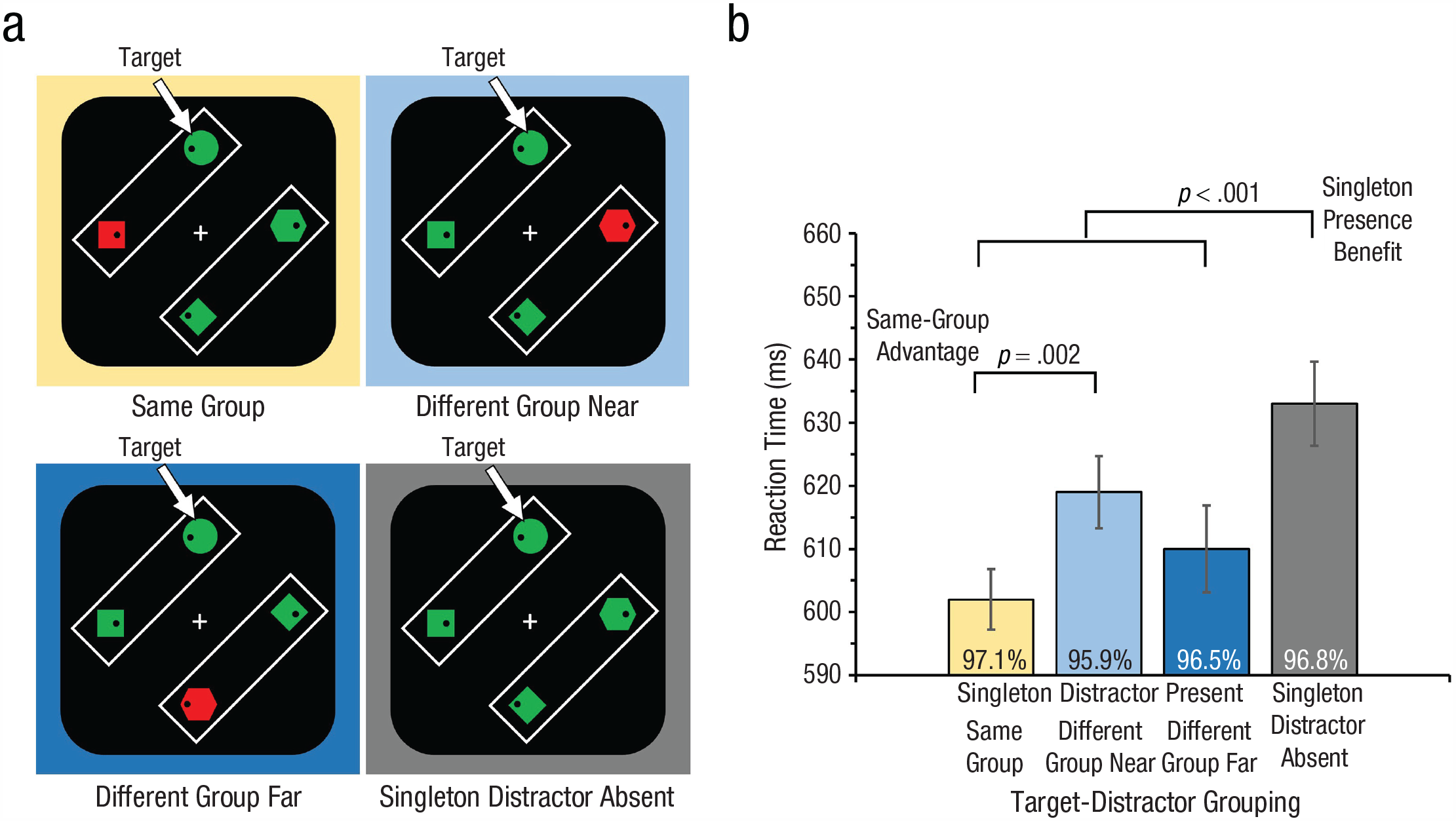
Method and results from Experiment 1a. (a) Examples of search displays in each of the experimental conditions are shown. Participants reported the location of the dot on the prespecified shape (a circle for one half of the participants, a diamond for the others), sometimes in the presence of a color-singleton distractor. Labels indicate the spatial relation between the distractor and the target. (b) Mean reaction time and accuracy (numerical values in the bars) reveal suppression of the distractor (singleton presence benefit) and greater benefits of suppression when target and distractor were in the same perceptual group (same-group advantage). Key differences in reaction time are noted in the figure; others are reported in the text. Error bars represent within-subjects standard errors (Cousineau, 2005).
Statement of Relevance
Most visual scenes contain more information than we are able to process, and as a result, people must attend to elements in a scene that are relevant to them and suppress elements that are unimportant. Recent research has studied attentional suppression but has yet to identify the nature of the mechanisms involved. In the reported experiments, we had participants search for target objects that were sometimes grouped with to-be-suppressed distractors and sometimes in a different perceptual grouping. Targets that were in the same group as a distractor were more quickly identified than targets that were in a different group. The results show that the suppression is accomplished in part by a bias in the visual system that enhances representation of task-relevant items competing for attention, revealing properties of the underlying brain mechanisms.
Procedure
Each trial began with the display of a fixation cross and the two rectangular frames for 1,000 ms, which remained on the screen until the trial ended. Then, the search array was presented until the participant made a response or 2,000 ms had elapsed. The task was to find a prespecified target shape, which was either a circle or a diamond for different groups of participants, and to report the location of the superimposed dot (left or right). Participants were instructed to respond by pressing an arrow key on a computer keyboard as quickly and accurately as possible. An incorrect or absent response was followed by an error message of “Incorrect!” or “Too slow!” for 1,000 ms, accompanied by a 200-Hz error tone. The next trial began after a 1,000-ms blank screen.
Design
Red and green colors were separately assigned as the target color and the distractor color, with the assignment counterbalanced between participants. On one third of the trials, all elements in the array were presented in the target color (color-singleton-absent condition); on two thirds of the trials, one of the non-target shapes was presented in the distractor color (color-singleton-present condition). Participants were explicitly told to ignore the color-singleton distractor. The target shape assignment (circle or diamond) was counterbalanced between participants, crossed with the color assignment; the singleton distractor, when present, was equally likely to be any of the non-target shapes. After completing a practice block of 24 trials, participants completed three test blocks containing 108 trials each. Each test block included 36 color-singleton-absent trials and 72 color-singleton-present trials. The target shape appeared equally often at each of the four locations. The color-singleton distractor, when present, appeared equally often in the same rectangle (same-group condition), at a nearby location but in a different rectangle (different-group-near condition), or at a more distant location in a different rectangle (different-group-far condition). The locations of the non-target, non-color-singleton shapes were selected pseudorandomly. The target and the color-singleton distractor, when present, were equally likely to contain a left-side or right-side dot, and the dots on the two shapes were equally often on the same or different sides. The locations of the dots on the other shapes were pseudorandomly chosen to ensure that on each trial, two of the four shapes contained left-side dots, and the other two shapes contained right-side dots. Trial order was randomized within each block.
Results
Trials with RTs more than 2 standard deviations away from each individual participant’s mean RT (separately for each of the four conditions: color singleton absent, same group, different group near, and different group far; 3.7% of trials) and trials with incorrect or missing responses (3.4% of trials) were not included in the analysis. All participants met an 80% overall accuracy criterion to be included.
The results are shown in Figure 1b. A paired-samples t test showed that participants were significantly faster to respond to the target when the color-singleton distractor was present (610 ms) than absent (633 ms), t(23) = 4.27, p < .001, dz = 0.87. This singleton presence benefit indicates that participants effectively suppressed the salient distractor. To examine the effects of perceptual grouping, we submitted RTs from the four target-distractor-location conditions (including the color-singleton-absent condition) to a one-way repeated measures analysis of variance (ANOVA). A significant main effect of condition was found, F(3, 69) = 9.87, p < .001, η p 2 = .30. Post hoc t tests showed that all three target-distractor-location conditions containing a color-singleton distractor had significantly faster RTs than the color-singleton-absent condition—same-group condition: 602 ms, t(23) = 6.18, p < .001, dz = 1.26; different-group-near condition: 619 ms, t(23) = 2.23, p = .036, dz = 0.45; different-group-far condition: 610 ms, t(23) = 3.18, p = .004, dz = 0.65. This confirms effective suppression of the salient distractor regardless of its position relative to the target.
Most important is the comparison between the same-group condition and the different-group-near condition. In those conditions, the target was equidistant from the color-singleton distractor but differed in perceptual grouping. Responses to the target were significantly faster when it was in the same perceptual group as the color-singleton distractor compared with when presented equidistant from the distractor but in a different group, t(23) = 3.43, p = .002, dz = 0.70. The differences between the same-group condition and the different-group-far condition and between the different-group-near condition and the different-group-far condition were not significant: t(23) = 1.39, p = .177, dz = 0.28, and t(23) = 1.39, p = .179, dz = 0.28, respectively.
The same set of analyses was conducted on accuracy. There were no differences in accuracy when the color-singleton distractor was present (96.5%) versus absent (96.8%), t(23) = 0.71, p = .483, dz = 0.15. Accuracies from the four target-distractor-location conditions including the color-singleton-absent condition were submitted to a one-way repeated measures ANOVA. The main effect of condition was not significant, F(3, 69) = 2.07, p = .112, η p 2 = .08.
Discussion
The present experiment showed that target identification in the presence of a suppressed salient distractor is enhanced when the target is in the same perceptual group as the distractor. This pattern is opposite from the typical effect noted earlier in which distractors are more distracting when in the same group as a target (e.g., Cosman & Vecera, 2012) or closer to the target (Kerzel & Cong, 2022), presumably because grouped elements compete more strongly with each other for representation. Instead, because the benefits of feature-based suppression were greater within a perceptual group, the present results suggest that distractor suppression also enhances the representation of elements that compete for attention against the distractor. The visual system enhances elements that are grouped with a suppressed distractor, presumably to increase the contrast between desired and undesired elements and fine tune the suppression. A similar pattern has not been observed in previous studies of suppression (Gaspelin et al., 2017) because the absence of specific grouping there may have caused participants to regard each element as separate from all others, limiting the competition between them.
The present results also allow us to rule out one alternative interpretation that has been offered for findings that reveal suppression of salient distractors. According to the alternative, the singleton presence benefit in experiments such as the present one stems from the fact that the search task is a difficult one in which participants must inspect each element of the search array individually (i.e., a serial search; Theeuwes, 1991). Participants can thus choose to never inspect the distractor—yielding a singleton presence benefit but not one that was caused by active suppression of the distractor. That possibility can be ruled out in the present experiment because mere avoidance of the distractor would not be expected to lead to prioritization of the element grouped with the distractor, as we have observed.
Experiment 1b
Experiment 1a revealed enhanced target identification when the target was in the same perceptual group as a suppressed distractor. We attributed the result to the perceptual grouping in the scene; however, because the grouped objects were fixed in place throughout the experimental session, it is possible that the results were in part influenced by strategic choices made by the participants and by the history of search element grouping during the session. To rule out those possibilities, we repeated the experiment here, but we randomly changed the object grouping from trial to trial.
Method
Participants
A new group of 24 undergraduate students participated for course credit (four male, 20 female). All participants were screened using the same criteria as in Experiment 1a.
Stimuli, procedure, and design
The stimuli, procedure, and design were identical to those of Experiment 1a, except that the orientation of the two rectangular frames varied from trial to trial, as shown in Figure 2a. On one half of the trials, the frames were in the same orientation as in Experiment 1a, with the left and top shapes in one group and the right and bottom shapes in another. On the other half of the trials, the top and right shapes were grouped together, as were the bottom and left shapes. Trials with different rectangle orientations were presented in random order.

Method and results from Experiment 1b. (a) Examples of search displays with the two different groupings that were used are shown. (b) Mean reaction time and accuracy (numerical values in the bars) reveal suppression of the distractor (singleton presence benefit) and greater benefits of suppression when target and distractor were in the same perceptual group (same-group advantage). Key differences are noted in the figure; others are reported in the text. Error bars represent within-subjects standard errors (Cousineau, 2005).
Results
The results are shown in Figure 2b. Trials with RTs more than 2 standard deviations away from each participant’s mean RT (separately for each of the four conditions; 3.5% of trials) were removed from RT analysis, as were trials with incorrect or missing responses (2.2%). All participants met the 80% overall accuracy criterion to be included.
The results of Experiment 1b mirrored those of Experiment 1a. A paired-samples t test showed that participants were significantly faster to respond to the target when the color-singleton distractor was present (621 ms) than absent (643 ms), t(23) = 6.18, p < .001, dz = 1.26. This singleton presence benefit indicates effective suppression of the salient distractor. To examine the effects of perceptual grouping, we submitted RTs from the four target-distractor-location conditions (including the color-singleton-absent condition) to a one-way repeated measures ANOVA. A significant main effect of condition was found, F(3, 69) = 25.52, p < .001, η p 2 = .53. Post hoc t tests showed that all three target-distractor conditions with a color-singleton distractor had significantly or marginally significantly faster RTs than the color-singleton-absent condition—same-group condition: 607 ms, t(23) = 7.10, p < .001, dz = 1.45; different-group-near condition: 619 ms, t(23) = 6.64, p < .001, dz = 1.35; different-group-far condition: 635 ms, t(23) = 1.76, p = .092, dz = 0.36. This confirms effective suppression of the salient distractor regardless of its position relative to the target. The critical comparison between the same-group condition and the different-group-near condition showed that responses to the target were significantly faster when it was in the same group as the color-singleton distractor compared with when presented equidistant but in a different group, t(23) = 2.59, p = .016, dz = 0.53. Additionally, the different-group-far condition was significantly slower than both the same-group condition, t(23) = 6.70, p < .001, dz = 1.37, and the different-group-near condition, t(23) = 3.34, p = .003, dz = 0.68, revealing a decreasing benefit of distractor suppression with increasing distance from the distractor.
Analyses of accuracy revealed no differences between conditions. There was no effect of distractor presence on accuracy (present: 97.9%, absent: 97.5%), t(23) = 1.11, p = .278, dz = 0.23. A one-way repeated measures ANOVA of accuracies from the four target-distractor-location conditions also revealed no differences, F(3, 69) = 0.60, p = .616, η p 2 = .03.
Discussion
The present experiment replicated the findings from Experiment 1a: We found an enhanced benefit of a suppressed distractor when it was in the same perceptual group as the target, consistent with a suppressive mechanism that biased the competition of attention against the distractor and in favor of task-relevant elements. Additionally, when the distractor and target were in different groups, distractor suppression was more beneficial when it was closer to the target. In the present case, the results were obtained under conditions in which the perceptual groups in the scene changed from trial to trial, indicating that group membership is spontaneously processed when a scene was viewed.
Experiment 2a
We have attributed the enhanced same-group attentional selection to a mechanism that prioritizes task-relevant elements competing for attention against a suppressed distractor. We consider here an alternative explanation. Specifically, it is possible that participants preferentially chose to search first for the target in the group containing the distractor because that group included only one potential target item, whereas the other group included two. Note that such a strategy might be expected to be counterproductive because the target, which was equally likely to appear at any of the three non-distractor locations, was actually twice as likely to be contained in the group with no distractor. Nevertheless, to rule out that possibility, we altered the display in the present experiment so that the perceptual group containing the distractor sometimes contained more potential target locations (two) than the other perceptual group (which contained only a single item).
Method
Participants
A new group of 24 undergraduate students participated for course credit (four male, 18 female, two unreported). All participants were screened using the same criteria as in Experiment 1a.
Stimuli, procedure, and design
The stimuli, procedure, and design were identical to those of Experiment 1a, with two exceptions. First, the data for Experiment 2a were collected online through Pavlovia (https://pavlovia.org). Participants used their own electronic devices to complete the study. At the beginning of the experiment, to obtain the display parameters of the monitor in use, participants were asked to resize a credit card image on the screen to match that of an actual credit card. The sizes of all stimuli appearing in the experiment were calibrated to be equivalent for all participants regardless of screen size and resolution. Second, as shown in Figure 3a, the two rectangular frames from Experiment 1a were replaced with a single L-shaped frame that was formed by joining two rectangles. The location of the frame remained fixed throughout the experiment. Three search elements were presented within the frame, and one was presented outside of it. We refer to the situation in which the target and the color-singleton distractor were both inside the frame as the same-group condition. When either of the two stimuli were outside the frame, we refer to that as the different-group condition. Near and far index the distance between target and distractor, with near referring to any two adjacent locations regardless of enclosure by the frame, and far referring to locations that are on opposite sides of fixation. The L-shaped boundary was displayed accompanying the fixation cross for 1,000 ms and then accompanying the search array for up to 2,000 ms.
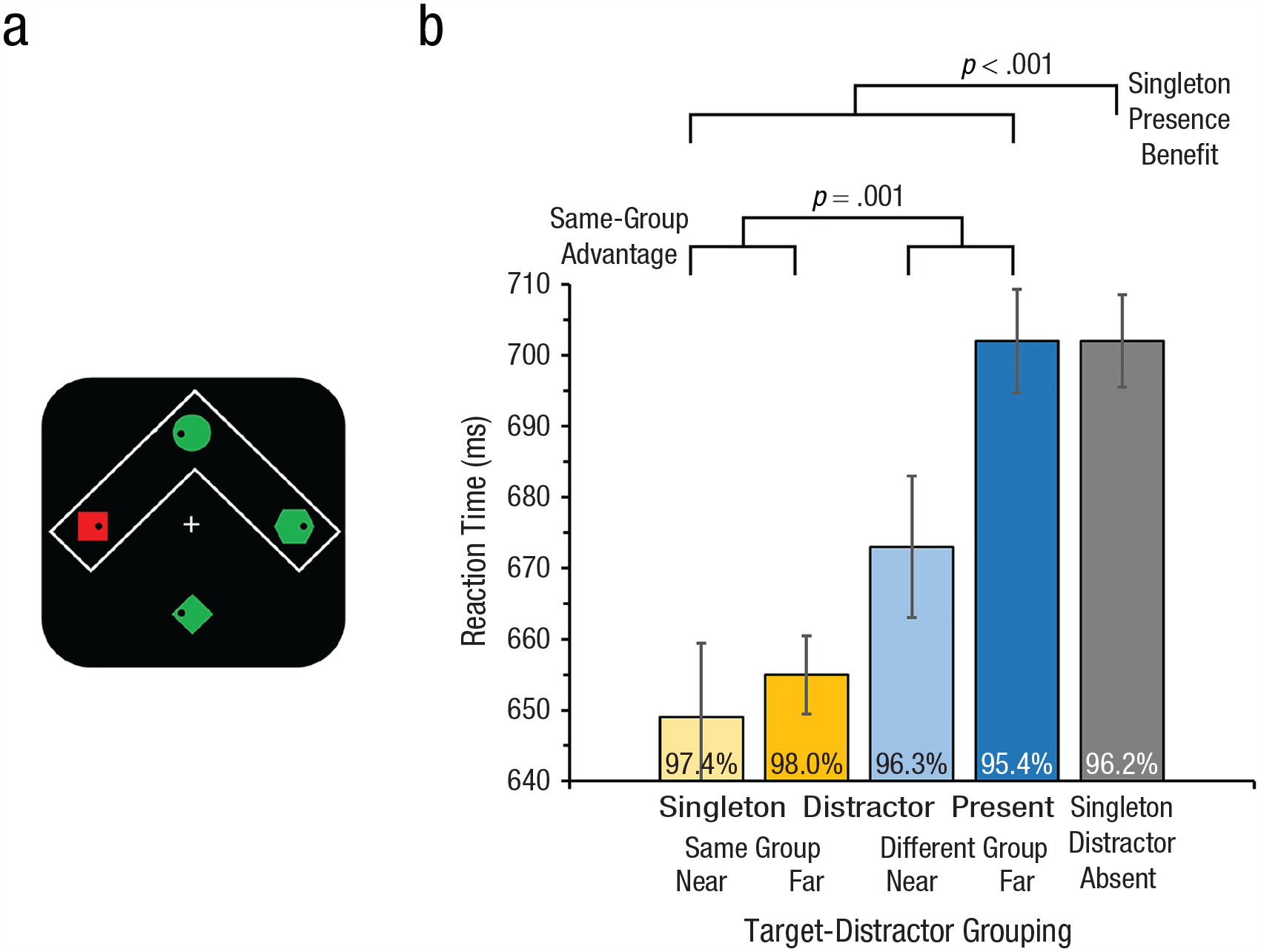
Method and results from Experiment 2a. (a) Example of the search display is shown. (b) Mean reaction time and accuracy (numerical values in the bars) reveal suppression of the distractor (singleton presence benefit) and greater benefits of suppression when target and distractor were in the same perceptual group (same-group advantage). Key differences are noted in the figure; others are reported in the text. Error bars represent within-subjects standard errors (Cousineau, 2005).
Results
The results are shown in Figure 3b. Trials with RTs more than 2 standard deviations away from each individual participant’s mean RT (separately for each combination of target-distractor grouping [same or different] and distance [near or far] conditions, and the color-singleton-distractor-absent condition; 4.0% of trials) were removed from RT analysis. Trials with incorrect or missing responses were not included in RT analysis (3.4% of trials). Twenty of the 24 participants met the 80% overall accuracy criterion to be included in the analysis.
A paired-samples t test showed that participants were significantly faster to respond to the target when the color-singleton distractor was present (666 ms) than absent (702 ms), t(19) = 6.54, p < .001, dz = 1.46. This singleton presence benefit indicates effective suppression of the salient distractor. To examine the effects of perceptual grouping, we submitted RTs from color-singleton-present trials to a 2 (target-distractor grouping: same, different) × 2 (distance: near, far) repeated measures ANOVA. A significant main effect of grouping was found; participants were faster to respond on same-group trials (651 ms) than on different-group trials (682 ms), F(1, 19) = 25.96, p < .001, η p 2 = .58. The main effect of distance was also significant, revealing faster responses when target and distractor were near (661 ms) than when they were far (678 ms), F(1, 19) = 14.74, p = .001, η p 2 = .44. These advantages in target selection when the color-singleton distractor appeared in the same group as or close to the target are consistent with the explanation that suppression of the distractor also enhances the representations of competing elements in the scene. The interaction between target-distractor grouping and distance was not significant, F(1, 19) = 3.12, p = .093, η p 2 = .14.
The same set of analyses was conducted on accuracy, yielding consistent results. There were no differences in accuracy when the color-singleton distractor was present (96.8%) or absent (96.2%), t(19) = 1.01, p = .327, dz = 0.22. Accuracies from color-singleton-present trials were submitted to a 2 (target-distractor grouping: same, different) × 2 (distance: near, far) repeated measures ANOVA. There was a significant main effect of grouping; participants were more accurate on same-group trials (97.6%) compared with different-group trials (96.0%), mirroring the effects for RT, F(1, 19) = 7.89, p = .011, η p 2 = .29. The main effect of distance was not significant, F(1, 19) = 0.10, p = .751, η p 2 = .01; there was no difference in accuracy between near (96.8%) and far (96.7%) trials. The interaction between grouping and distance was also not significant, F(1, 19) = 2.26, p = .149, η p 2 = .11.
Discussion
The present results replicated the findings from the earlier experiments showing an enhanced benefit of suppression when target and distractor were in the same perceptual group. The findings rule out a potential search strategy in which participants prioritize the group in which target localization would have been easiest: Here, participants were fastest to identify the target when it was contained in the same group as the distractor despite the fact that the group with the distractor contained two locations to be searched, whereas the other group contained only one. The present experiment also revealed a greater suppression benefit when target and distractor were near each other (as also seen in Experiment 1b), regardless of group membership. Both findings are consistent with a suppressive mechanism that enhances the desired elements in competition for attention with the distractor.
Experiment 2b
Experiment 2a used an L-shaped frame to group together three elements of the search array, leaving a single “orphan” element outside of that perceptual group. The results showed a target-identification advantage when both the target and the distractor were in the framed perceptual group. However, because the frame served as a placeholder for a subset of the search elements, it is possible that the frame itself biased attentional prioritization of the array elements. Thus, the same-group advantage that we observed might have been caused by a biased search favoring the framed elements and was not due to the residual effects of distractor suppression, as we have suggested. To address this concern, we repeated Experiment 2a with the addition of a placeholder frame for the single orphan element. In addition, as in Experiment 1b, we also randomly changed the locations grouped together from trial to trial.
Method
Participants
A new group of 24 undergraduate students participated for course credit (eight male, 16 female). All participants were screened using the same criteria as in Experiment 1a.
Stimuli, procedure, and design
The stimuli, procedure, and design were identical to those of Experiment 2a, with three exceptions. First, the experiment was conducted in-person under the same testing conditions as Experiments 1a and 1b. Second, as shown in Figure 4a, a square-shaped white boundary (3.3° × 3.3°, border width 5 pixels) was used to frame the stimulus located outside of the L-shaped boundary. The square boundary and the L-shaped boundary were displayed accompanying the fixation cross for 1,000 ms and then accompanying the search array for up to 2,000 ms. Third, the orientation of the two frames varied from trial to trial, as shown in Figure 4a. On one half of the trials, the boundaries were in the same orientation as in Experiment 2a, with the shapes to the left, right, and above the fixation in one group and the bottom shape in another. On the other half of the trials, the shapes to the left, right, and below fixation were grouped together, leaving the top shape in another group. Trials with different boundary orientations were presented in random order.

Method and results from Experiment 2b. (a) Examples of the search displays are shown. (b) Mean reaction time and accuracy (numerical values in the bars) reveal suppression of the distractor (singleton presence benefit) and greater benefits of suppression when target and distractor were in the same perceptual group (same-group advantage). Key differences are noted in the figure; others are reported in the text. Error bars represent within-subjects standard errors (Cousineau, 2005).
Results
The results are shown in Figure 4b. Trials with RTs more than 2 standard deviations away from each individual participant’s mean RT (separately for each combination of target-distractor grouping [same or different] and distance [near or far] conditions, and the color-singleton-distractor-absent condition; 3.9% of trials) were removed from RT analysis. Trials with incorrect or missing responses were not included in RT analysis (3.9% of trials). Twenty-three of the 24 participants met the 80% overall accuracy criterion to be included in the analysis.
A paired-samples t test showed that participants were significantly faster to respond to the target when the color-singleton distractor was present (583 ms) than absent (607 ms), t(22) = 4.75, p < .001, dz = 0.99. This singleton presence benefit indicates effective suppression of the salient distractor. To examine the effects of perceptual grouping, we submitted RTs from color-singleton-present trials to a 2 (target-distractor grouping: same, different) × 2 (distance: near, far) repeated measures ANOVA. A significant main effect of grouping was found; participants were faster to respond on same-group trials (571 ms) than on different-group trials (600 ms), F(1, 22) = 30.68, p < .001, η p 2 = .58. The main effect of distance was also significant, revealing faster responses when target and distractor were near (580 ms) than when they were far (591 ms), F(1, 22) = 7.70, p = .011, η p 2 = .26. These advantages in target selection when the color-singleton distractor appeared in the same group as or close to the target are consistent with the explanation that suppression of the distractor enhances the representations of competing elements in the scene. The interaction between target-distractor grouping and distance was not significant, F(1, 22) = 0.88, p = .358, η p 2 = .04.
The same set of analyses was conducted on accuracy, yielding consistent results. There were no differences in accuracy when the color-singleton distractor was present (96.3%) or absent (95.7%), t(22) = 1.31, p = .203, dz = 0.27. Accuracies from color-singleton-present trials were submitted to a 2 (target-distractor grouping: same, different) × 2 (distance: near, far) repeated measures ANOVA. There was a marginally significant main effect of grouping; participants were more accurate on same-group trials (97.1%) compared with different-group trials (95.7%), mirroring the effects for RT, F(1, 22) = 3.51, p = .074, η p 2 = .14. The main effect of distance was not significant, F(1, 22) = 1.55, p = .226, η p 2 = .07; there was no difference in accuracy between near (96.1%) and far (96.8%) trials. The interaction between grouping and distance was also not significant, F(1, 22) = 0.04, p = .845, η p 2 = .00.
Discussion
In this experiment, we provided a placeholder for the isolated search element and randomly changed the specific object groupings from trial to trial, eliminating two potential display attributes that might have affected attentional allocation in Experiment 2a. The results closely replicated those from Experiment 2a, revealing an advantage for identifying targets that are in the same perceptual group as, or nearer to, a suppressed distractor.
Experiment 3
In the preceding experiments, attentional suppression of the salient color-singleton distractor was indexed by faster target-identification times on singleton-present trials. Whereas that singleton presence benefit suggests suppression of the distractor, it still remains possible that attention was initially captured by, and then rapidly disengaged from, the distractor (see Theeuwes, 2010). Indeed, if the distractor had initially attracted attention, the observed advantage for a same-group target is precisely what would be expected (Egly et al., 1994). In Experiment 3, we tested this possibility with the use of a probe task, a technique that has been commonly used to measure the initial attentional allocation to different elements of a search array (e.g., Gaspelin et al., 2015; Ma & Abrams, 2023). The experiment was identical to Experiment 1a, with the inclusion of infrequent probe trials (in addition to the typical search trials). On a probe trial, the shapes in the display did not contain dots; instead, each element of the array contained a briefly presented letter, and participants were instructed to abandon the search and report the letters that they had seen. Because the probe letters appeared only briefly at the onset of the search array, the letter report rates serve as an index of the initial allocation of attention.
Method
Participants
A new group of 24 undergraduate students participated for course credit (12 male, 12 female). All participants were screened using the same criteria as in Experiment 1a.
Stimuli, procedure, and design
The experiment consisted of interleaved search trials and probe trials. The search trials were identical to those of Experiment 1a, with each trial displaying an array of four shapes grouped by two diagonally arranged rectangular frames whose orientation remained stable throughout the task. The participants’ task was to report, by a speeded keypress, the location of the dot inside the prespecified target shape. The probe trials retained all the display elements from the search trials except that, instead of a dot, each shape appeared with a white letter (1.2° in height) superimposed at its center for 150 ms, as shown in Figure 5a. The letters were then replaced with a pound-sign mask for 500 ms. Following the offset of the array, participants were prompted to report as many letters as they remembered, regardless of the shapes containing the letters. Responses were entered using mouse clicks to select letters from an alphabet displayed on the screen, in an unspeeded manner. The four letters on each trial were randomly selected from the alphabet. The shapes and colors of the arrays on the probe trials were generated on the basis of the same rules as the search trials. Seventy-one percent of the total trials were search trials, whereas the less frequent probe trials accounted for the remaining 29%. After 30 practice trials, participants completed three blocks of 152 trials each. Each block contained 108 search trials and 44 probe trials. Within each block, a color-singleton distractor was present on 72 of the 108 search trials, as in Experiment 1a, and on 33 of the 44 probe trials. The trials within each block were presented in random order.
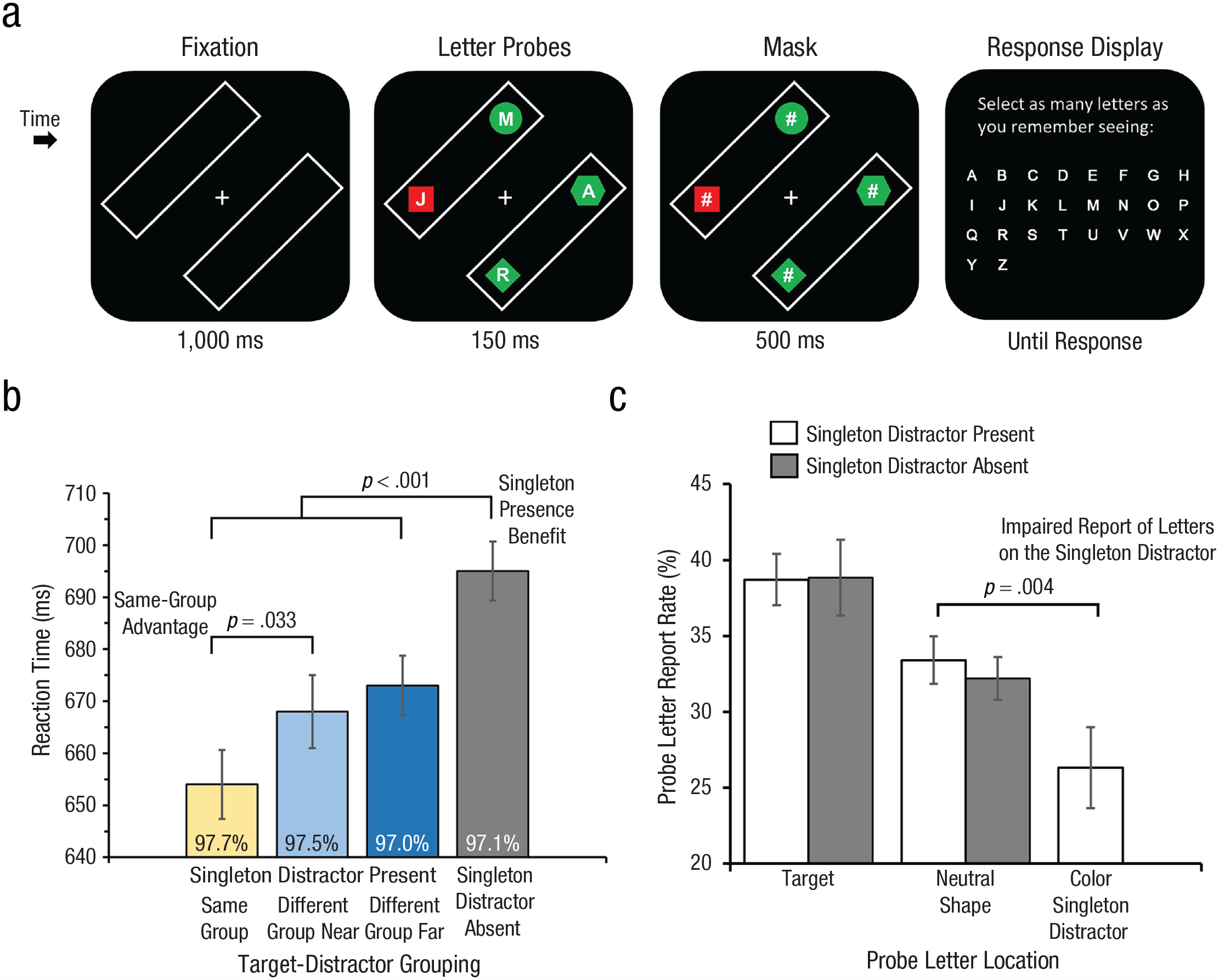
Method and results from Experiment 3. (a) Sequence of events on the probe trials is shown. (b) Mean reaction time and accuracy (numerical values in the bars) on the search trials reveal suppression of the distractor (singleton presence benefit) and greater benefits of suppression when target and distractor were in the same perceptual group (same-group advantage). (c) Probe letter report rates on the probe trials reveal impaired reporting of the letters on the singleton distractor. Key differences are noted in the figure; others are reported in the text. Error bars represent within-subjects standard errors (Cousineau, 2005).
Results
The results are shown in Figures 5b and 5c. For the search task, trials with RTs more than 2 standard deviations away from each participant’s mean RT (separately for each of the four conditions: color singleton absent, same group, different group near, and different group far; 2.7% of trials) were removed from RT analysis, as were trials with incorrect or missing responses (3.9%). Each participant had to meet both the 80% overall accuracy criterion in the search task and an average letter report rate of 0.8 or greater per trial in the probe task to be included. Two participants were removed because of a low probe letter report rate, leaving 22 participants in the analysis.
Search task analysis
The search task results from Experiment 3 mirrored those of Experiments 1a and 1b. A paired-samples t test showed that participants were significantly faster to respond to the target when the color-singleton distractor was present (665 ms) than absent (695 ms), t(21) = 5.28, p < .001, dz = 1.13. This singleton presence benefit indicates effective suppression of the salient distractor. To examine the effects of perceptual grouping, we submitted RTs from the four target-distractor-location conditions (including the color-singleton-absent condition) to a one-way repeated measures ANOVA. A significant main effect of condition was found, F(3, 63) = 13.04, p < .001, η p 2 = .38. Post hoc t tests showed that all three target-distractor conditions with a color-singleton distractor had significantly faster RTs than the color-singleton-absent condition—same-group condition: 654 ms, t(21) = 5.72, p < .001, dz = 1.22; different-group-near condition: 668 ms, t(21) = 3.47, p = .002, dz = 0.74; different-group-far condition: 673 ms, t(21) = 4.05, p < .001, dz = 0.86. This confirms effective suppression of the salient distractor regardless of its position relative to the target. The critical comparison between the same-group condition and the different-group-near condition showed that responses to the target were significantly faster when it was in the same group as the color-singleton distractor compared with when presented equidistant but in a different group, t(21) = 2.28, p = .033, dz = 0.49. The same-group condition was also significantly faster than the different-group-far condition, t(21) = 2.88, p = .009, dz = 0.61. The different-group-near condition was numerically but not significantly faster than the different-group-far condition, t(21) = 0.81, p = .428, dz = 0.17.
Analyses of accuracy revealed no differences between conditions. There was no effect of distractor presence on accuracy (present: 97.4%, absent: 97.1%), t(21) = 0.79, p = .438, dz = 0.17. A one-way repeated measures ANOVA of accuracies from the four target-distractor-location conditions also revealed no differences, F(3, 63) = 0.51, p = .676, η p 2 = .02.
Probe task analysis
On average, participants reported 1.53 letters per trial, 86.5% of which were actually present in the probe display. Similar numbers of letters were reported on singleton-present trials (1.53) and on singleton-absent trials (1.56), indicating equivalent motivation to report letters regardless of the presence of the color-singleton distractor.
We separately calculated the probability of the letters being correctly reported when they appeared on different types of array elements: the target shape (38.8%), the color-singleton-distractor shape (26.3%), and the non-target, non-color-singleton shapes—referred to as neutral shapes (32.8%). A 2 (element type: target shape, neutral shape) × 2 (singleton presence: present, absent) repeated measures ANOVA showed a significant main effect of element type, with the letters on the target shape reported at a higher rate than letters on the neutral shape, F(1, 21) = 14.61, p < .001, η p 2 = .07. This verifies the effectiveness of the probe method in tracing attentional allocation to individual array elements. The main effects of singleton presence and the interaction between element type and singleton presence were not significant—main effect: F(1, 21) = 0.39, p = .541, η p 2 = .00; interaction: F(1, 21) = 0.31, p = .587, η p 2 = .00. Importantly, to examine whether initial attentional allocation to the color-singleton distractor was prevented early at the display onset, a paired-samples t test showed that the letters on the singleton distractor were reported significantly less frequently than letters on the neutral shapes, t(21) = 3.18, p = .004, dz = 0.68. The impaired ability to identify the letters on the salient distractor compared with a baseline-level report rate suggests that attention did not initially select the distractor.
We also examined the effect of perceptual grouping in the probe task by calculating the letter report rate as a function of the relative location of the letters to the color-singleton distractor on singleton-present trials: same-group location (36.9%), different-group-near location (35.1%), and different-group-far location (33.5%). A one-way repeated measures ANOVA showed that letter report rate differed significantly as a function of relative location to the distractor, F(2, 42) = 4.76, p = .014, η p 2 = .19. A post hoc t test showed that letters at the same-group location were reported significantly more frequently than letters at the different-group-far location, t(21) = 3.71, p = .001, dz = 0.79. However, letter report rate did not differ between the same-group and the different-group-near locations or between the different-group-near and different-group-far locations, t(21) = 1.48, p = .153, dz = 0.32, and t(21) = 1.39, p = .180, dz = 0.30, respectively. Note that the difference between the same-group and different-group-near conditions (i.e., the same-group advantage) was numerically in the same direction as that in the search trials in all of the reported experiments. The absence of a significant difference could be due to the relatively low number of probe trials in the present experiment.
In addition, we compared the probe report rates in the rectangle containing the color-singleton distractor (63.2%) and in the rectangle with no distractor (68.6%) on singleton-present trials. A paired-samples t test showed that letter report rate was marginally significantly lower for the distractor-containing rectangle, t(21) = 2.03, p = .056, dz = 0.43. This suggests that participants not only did not strategically prioritize the group containing the salient distractor but avoided it to an extent, corroborating the findings of Experiments 2a and 2b. Without overall prioritization of the group containing the distractor, the same-group advantage can be attributed to a biased representation away from the distractor and toward the other element in the group.
Discussion
Using a probe task that measured early attentional allocation to individual array elements, the present experiment found that the letter probes on the color-singleton distractor were reported below the rate of non-singleton distractors. This suggests that the singleton distractor was proactively suppressed and rules out the possibility that participants initially attended to, and then rapidly disengaged from, the distractor. Meanwhile, the search task results replicated those from the preceding experiments, showing prioritized attentional selection for the element grouped with the suppressed distractor.
It is also worth noting that recent results have suggested that probe tasks similar to the one used here may overestimate the extent to which the singleton distractor is suppressed. Kerzel and Renaud (2023) have shown that at least a portion of the reduction in the probe letter report rate for the singleton distractor can be attributed to a decision-level bias (as opposed to perceptual suppression) against reporting letters on the distractor. Conversely, if such a bias is sensitive to perceptual grouping effects similar to those that have been reported (e.g., Egly et al., 1994), then the bias might be expected to also reduce the letter report rate for non-singleton elements that are grouped with the distractor—a result that is contrary to the pattern that we found. It will be helpful for future work to validate the usefulness of the probe task in assessing suppression.
The present findings support the conclusion that attentional suppression of the salient distractor enhanced the representation of stimuli competing for attention against the distractor. The search task results also showed a numerical, but not significant, effect of distance irrespective of group membership, with nearer locations enjoying an attentional advantage. The probe letter reports also revealed a similar numerical effect of distance from the distractor.
General Discussion
Multiple visual elements in a scene must compete for representation in the visual system. Attentional mechanisms can bias that competition by strengthening the representation of desired elements as well as weakening the representation of undesired ones. As has been known for some time, selection of one element in a perceptual group also prioritizes other members of the group (Egly et al., 1994). Surprisingly, our findings suggest that feature-based suppression of elements in a scene has a very different effect on other grouped items: Whereas suppression weakens the representation of undesired elements, it also simultaneously enhances representation of others in the same group.
Our conclusions specifically focus on perceptual grouping, but perceptual grouping also increases competition between display elements, so the results might apply to competition more generally. In particular, items that are closer together are known to compete more strongly for representation (Eriksen & Hoffman, 1972; Luck et al., 1997), so it might be expected that elements close to the distractor would be enhanced relative to those that are farther away, regardless of perceptual grouping. Indeed, in four of the five experiments reported (statistically significantly in three), targets in the group without the distractor were identified more quickly when they were closer to the suppressed distractor compared with when they were farther away. Additionally, in Experiments 2a and 2b in which some trials contained two potential target locations grouped with the distractor, target identification was faster for targets that were closer to the distractor. These aspects of the results suggest that the enhancement that we reported might apply to competing stimuli in general, with greater enhancement for relevant elements that are grouped with and/or closer to a suppressed distractor. That conclusion must be qualified somewhat because we did not observe an effect of distance in all experiments. One reason for the limitation might be that the distances between display elements in the present experiments (either 6.6° or 9.4°) were relatively large compared with the distances that have been shown in the past to evoke strong competition between stimuli (e.g., 1.35°; Hopf et al., 2006). Future work with closer distances might reveal even more about the underlying mechanisms.
Because the participants in our experiments were undergraduate students, it is not known to what extent the present findings would generalize to other populations. Studying that issue would be important for further research.
It is also worth considering an alternative explanation for our findings that does not require proposing a special suppressive mechanism. According to the alternative, people may be able to suppress the color-singleton distractor by imposing a top-down bias against elements with the (known) distractor color—a type of influence that is well explained by models such as Guided Search (Wolfe, 2021). We suggest this possibility despite claims that other researchers have made (e.g., Gaspelin et al., 2015) that suppression of a salient singleton is mediated by a unique mechanism. Additionally, to account for the enhancement of same-group elements reported here, it may be that attention was somehow cued by the salient singleton to the object containing the distractor, yielding a same-object advantage for target identification. Although this account does not require a special mechanism to produce suppression, nor does it require that the suppressive mechanism yields enhanced selection of elements grouped with the distractor, it leaves open the question of how a salient and irrelevant color singleton can both serve as a spatial cue and not disrupt search for the target. The mechanism also on the surface seems inconsistent with some of the probe results from Experiment 3. In particular, those participants were less likely to report letters in the object containing the distractor compared with the other object. We hope that more work can clarify the issue.
Finally, our findings of enhanced representation of stimuli competing for attention with a suppressed distractor are conceptually similar to reports of a center-surround organization in which a zone surrounding an attended object is inhibited to fine tune the selectivity (Boehler et al., 2011; Hopf et al., 2006; Lee & Pitt, 2022; Müller & Kleinschmidt, 2004). Such arrangements effectively enhance the contrast between undesired and desired elements in a scene, facilitating efficient searches of the environment. The mechanism revealed here accomplishes a similar goal. Suppressing a distractor not only protects visual search from distraction but also has a silver lining: boosting the representation of competing items of interest.
Footnotes
Transparency
Action Editor: Rachael Jack
Editor: Patricia J. Bauer
Author Contribution(s)
