



Abstract
Understanding how initiatives to support Black-owned businesses are received, and why, has important social and economic implications. To address this, we designed three experiments to investigate the role of antiegalitarian versus egalitarian ideologies among White American adults. In Study 1 (N = 199), antiegalitarianism (vs. egalitarianism) predicted viewing initiatives supporting a Black-owned business as less fair, but only when the business was competing with other (presumably White-owned) businesses. In Study 2 (N = 801), antiegalitarianism predicted applying survival-of-the-fittest market beliefs, particularly to Black-owned businesses. Antiegalitarianism also predicted viewing initiatives supporting Black-owned businesses as less fair than initiatives that targeted other (presumably White-owned) businesses, especially for tangible (vs. symbolic) support that directly impacts the success of a business. In Study 3 (N = 590), antiegalitarianism predicted rejecting a program investing in Black-owned businesses. These insights demonstrate how antiegalitarian ideology can have the effect of maintaining race-based inequality, hindering programs designed to reduce that inequality.
Constrained economic opportunities are a core component of racial inequality in America. From the deadly destruction of Black businesses and communities (e.g., the Greenwood District in Tulsa, Oklahoma; Messer et al., 2018), to housing policies limiting Black wealth accumulation (e.g., redlining; Rothstein, 2017), to discrimination in banking and business loans (Bone et al., 2014; Fairlie et al., 2021) and the sharing economy (Edelman et al., 2017), the marketplace is a context where systemic racism manifests (Johnson et al., 2019; Nkomo, 1992). These and other structural inequalities exist despite the benefits of a more equitable marketplace to the overall economy. For example, equitable lending to Black entrepreneurs would have resulted in an additional $13 trillion in GDP revenue from 2000 to 2020 and would have created 6.1 million jobs per year (Peterson & Mann, 2020).
Statement of Relevance
Initiatives supporting Black-owned businesses have become increasingly visible because of growing awareness of historical and current racial economic injustices. These initiatives have the potential to improve the livelihoods of Black Americans and the economy overall. Therefore, understanding how these initiatives are received, and why, has important social and economic implications. We find that antiegalitarianism (endorsement or acceptance of social hierarchies and inequality) among White U.S. adults predicted viewing initiatives supporting Black-owned businesses particularly negatively when the Black-owned business was competing with other businesses and when the support was more tangible (e.g., offering resources, such as making purchases or offering grants that more directly translate to business success). Overall, even moderate levels of antiegalitarianism were associated with attitudes and beliefs that can perpetuate marketplace racial inequality. These insights demonstrate how covert discrimination in the form of antiegalitarian ideologies might serve to maintain race-based inequality, hindering programs designed to reduce that inequality.
Targeted and programmatic solutions are necessary to overcome structural inequalities in the marketplace (e.g., Bates, 2015; Chatterji et al., 2014; Nopper, 2011). In recent years, heightened awareness of these inequities has led to efforts to support Black-owned businesses (Bates et al., 2021; Bradford, 2014). For example, “Buy Black” initiatives encourage consumers to buy from Black-owned businesses or leave positive reviews, venture capital firms intentionally invest in Black-owned businesses, and various grants specifically support Black entrepreneurs (Ludwig & Heaslip, 2021; Pollard, 2023).
The growing visibility of such initiatives increasingly shapes the marketplace and public-policy conversations (Johnson et al., 2019), so public opinion on these initiatives has meaningful societal and economic consequences. Given the social, economic, and political power afforded to Whites as a group, how they respond to these initiatives may be particularly consequential. Notably, responses have been mixed. For example, searches for Black-owned businesses on Yelp increased over 7,000% from 2020 to 2021 (Gross, 2020). On the other hand, when the Target corporation launched a campaign supporting Black-owned businesses, there were attempts from predominantly White shoppers to harm the brand through boycotts and negative reviews (Smith et al., 2021).
Understanding these mixed reactions is critical given the recent emphasis on supporting Black-owned businesses to increase economic equality. Although research in other fields has begun to explore racism in consumer and business-support contexts (e.g., Crockett, 2021; Doleac & Stein, 2013; Ogbolu & Singh, 2019; Poole et al., 2021; Younkin & Kuppuswamy, 2019), psychological science has been largely silent on the issue, despite its wealth of theories and perspectives that can help explain inequality in the marketplace.
The current research uniquely identifies ideological and situational factors that increase resistance to initiatives supporting Black-owned businesses. Given that these initiatives attempt to address inequality, we examine how antiegalitarianism—one’s preference for social hierarchies—influences White individuals’ reactions to these initiatives. In doing so, we provide insights into a dynamic that maintains race-based inequality in the marketplace.
Resisting Initiatives to Support Black-Owned Businesses
Although members of advantaged groups often express support for equality, they frequently do not favor policies that reallocate resources or support diversity. Past work has found that members of advantaged groups perceive equality and diversity initiatives as harming their in-group’s access to resources—even when explicitly told otherwise (Brown et al., 2022; Brown & Jacoby-Senghor, 2022). Given this zero-sum mindset, we posit that antiegalitarianism among White Americans—members of an advantaged race group in the United States—will predict their resistance to policies supporting Black-owned businesses.
Antiegalitarianism, Market Preferences, and Resistance to Initiatives to Support Black-Owned Businesses
Antiegalitarianism (vs. egalitarianism) reflects a relative preference for hierarchical differences (vs. equality) between groups (Duckitt, 2001; Jost et al., 2003). Antiegalitarianism is often understood by measuring individual differences in social dominance orientation, which reflects a motivation to establish and maintain group-based inequality (Ho et al., 2015; Pratto et al., 1994; Sidanius & Pratto, 1999). Through past work on social dominance orientation, we know that antiegalitarianism reflects a zero-sum “competitive jungle” worldview, where lower-status groups gain resources and status at the expense of the dominant group (Duckitt, 2006; Esses et al., 1998); therefore, antiegalitarianism is associated with beliefs and attitudes that justify inequality and maintain group dominance. For example, those higher in antiegalitarianism endorse stereotypes that legitimize the lower status of out-groups, which then justifies denying them resources (Esses et al., 1998; Ho et al., 2015).
Capitalism is often seen as a survival-of-the-fittest competition, and the marketplace can be a site for brokering power and accessing resources (Johnson et al., 2019). Although marginalized groups can potentially gain wealth and status via the market, many hierarchy-enhancing policies, such as redlining and segregation, have subverted these gains (Johnson et al., 2019). Therefore, as the dominant system for distributing power and resources, the market is highly relevant to antiegalitarian beliefs about intergroup inequality.
Past research has shown that the association between antiegalitarianism and policy approval depends on the policy’s potential to maintain versus attenuate hierarchy (e.g., whom the policy benefits; Lucas & Kteily, 2018). Consistent with this, we propose that for those higher in antiegalitarianism, beliefs about markets and supporting businesses will reflect a motivation to maintain hierarchy and inequality. For example, endorsing a ruthless survival-of-the-fittest market is particularly consistent with antiegalitarian motivations when applied to Black-owned (vs. White-owned) businesses. Similarly, because initiatives supporting Black-owned businesses are designed to help overcome structural barriers in the marketplace, antiegalitarianism should predict seeing these initiatives less favorably and in more zero-sum terms, versus when similar initiatives benefit White-owned businesses. Conversely, those who are more egalitarian should favor initiatives supporting Black-owned businesses because of heightened concerns for equality.
Last, the type of support may also play a role. Initiatives to support Black-owned businesses often include symbolic support—low- or no-cost behaviors that are supportive but do not directly transfer resources and are less finite (e.g., following a business on social media, or leaving a positive review). Initiatives can also include tangible support—actions that more concretely contribute to a business’s success, often by providing finite resources (e.g., making purchases, offering loans). These qualities give tangible support for Black-owned businesses greater hierarchy-attenuating potential. Given antiegalitarian sensitivity to perceived threats to status and resources (Stephan & Stephan, 2000), those higher in antiegalitarianism should be particularly resistant to tangible-support initiatives that allocate resources to Black-owned businesses.
Overview
Study 1 tested the link between antiegalitarianism and rejection of efforts to support a Black-owned business, and whether this link varies on the basis of the competitiveness of the business environment. Studies 2 and 3 then manipulated whether support initiatives were directed toward Black-owned or other (presumably White-owned) businesses and were designed to rule out potential alternatives emerging from Study 1’s design (e.g., inferences about the businesses’ size, status, quality, neighborhood). Study 2 tested the moderating role of support type (symbolic vs. tangible). Study 3 varied our stimuli further by measuring favorability and zero-sum beliefs about a funding program. Moreover, Study 3 measured participants’ antiegalitarianism several months before the main study, ensuring that scores could not be affected by Study 3’s stimuli.
Open practices statement
The data for all studies are accessible on the Open Science Framework. All study materials are available in the appendix in the Supplemental Material available online. Study 1 was not preregistered; Studies 2 and 3 were preregistered on aspredicted.org (Study 2: https://aspredicted.org/H75_76K; Study 3: https://aspredicted.org/KLY_1BG).
Study 1
Study 1 manipulated whether a Black-owned business is competing with other (presumably White-owned) businesses and measured antiegalitarianism and support for initiative fairness. Given antiegalitarianism’s competitive worldview, antiegalitarianism should predict seeing initiatives to support a Black-owned business as less fair, and this result should then attenuate when the business is not competing with other (White-owned) businesses.
Method
Participants
The research (including subsequent studies) was approved by the Institutional Review Board at the lead author’s institution. Two hundred participants were recruited through Prolific (www.prolific.com). Sample size was determined on the basis of estimates from previous data collections using the Social Dominance Orientation scale. Prolific’s prescreening tool was used to include only White American adult participants. In the study, 1 participant selected “Hispanic, Latino, or Spanish Origin” for ethnicity; this participant was removed from analyses, but significant results are not dependent on that exclusion (N = 199; 94 men, 98 women, five did not identify as either, two did not report gender; Mage = 34.94 years; median income = $50,000–$59,999).
Procedure
Participants were told that we were interested in people’s thoughts on how consumers and society might support Black-owned businesses. Participants were then presented with information about a coffee shop that needs funds for business promotion, along with a quote from the owner. In the low-competition condition, participants read, “There are no other coffee shops in this area. We offer a product and price that’s as good or better than anywhere else, and we want people to know that there’s actually a place to get quality coffee here.” In the high-competition condition, the text instead said, “There are lots of coffee shops in this city. We offer a product as good or better than anywhere else, and we want people to know that we’re a place for them to get quality coffee.” In both conditions, an image further communicated that it was a Black-owned business.
Given that our predictions are rooted in antiegalitarian sensitivity to intergroup competition, we ran a posttest (N = 93 White American participants, recruited from MTurk) to test our assumption that participants in the high-competition condition would either tacitly or explicitly think of the other “coffee shops in this city” as White-owned. The results were consistent with our assumption. When participants were asked what came to mind when thinking about these other coffee shops, “Large chains like Starbucks” best fit what came to mind (M = 3.85), followed by “Nothing in particular/other coffee shops in general” (M = 2.93), “Other coffee shops that probably have white owners” (M = 2.58), and last, “Other Black-owned coffee shops” (M = 1.83). Responses were provided on a Likert-type scale ranging from 1 (not at all) to 5 (completely); all means were significantly different from one another, ts > 3.32, ps < .002. Large chains like Starbucks are generally White-owned, and we reasoned that “coffee shops in general” would be tacitly imagined as White-owned, given that whiteness is often treated as a cultural neutral or default (Burton, 2009; Davis, 2017). Explicitly thinking of the other coffee shops as White-owned also came to mind more than thinking of them as Black-owned. Thus, the posttest supported our assumptions. The posttest also explored different inferences that might be made about the target coffee shop (e.g., quality) and the neighborhood (e.g., income, race; see the appendix in the Supplemental Material for details). These possible inferences are further addressed in subsequent studies.
As our dependent variable, participants were asked how fair different forms of support are: offering a business loan, people volunteering time to create awareness about the business, a local marketing firm offering their services at a reduced rate, and local graphic-design students designing promotional materials for course credit (1 = very unfair, 7 = very fair; M = 5.82, SD = .85, SE = 0.061, α = .74).1,2
A four-item manipulation check asked whether the coffee shop wants to compete with other coffee shops, whether it wants to take customers from other businesses, whether it wants to bring coffee to the local community (reverse coded), and whether directing support to this business will hurt other businesses (1 = strongly disagree, 7 = strongly agree; M = 3.27, SD = 1.16, SE = 0.082, α = .74).
Participants then reported their ethnicity, gender, age, political orientation (1 = very liberal, 9 = very conservative), and income. To measure endorsement of antiegalitarian (vs. egalitarian) ideology, we then had participants complete a four-item social dominance orientation scale (e.g., “It’s probably a good thing that certain groups are at the top and other groups are at the bottom,” Kteily et al., 2011; 1 = strongly oppose, 7 = strongly favor, M = 1.73, SD = 1.04, SE = 0.074, α = .86).
Results
The PROCESS macro for SPSS (Model 1; Hayes, 2017) was used to test the two-way interaction between social dominance orientation and condition (low vs. high competition). Simple effects of condition were tested using floodlight analyses (also using PROCESS; Hayes, 2017), which better reflects the full range of data and is increasingly used as an alternative to testing simple effects of condition at ±1 SD. Floodlight analysis estimates the effect of condition across the range of scores on a continuous variable (Spiller et al., 2013); in this case, indicating when the effect of condition is significant at scores above or below a certain point on the social dominance orientation scale. Regions of significance are provided in the final Results section, and the interaction is plotted in Figure 1, with shaded areas representing the 95% confidence bands for each condition. Subsequent figures follow this format.
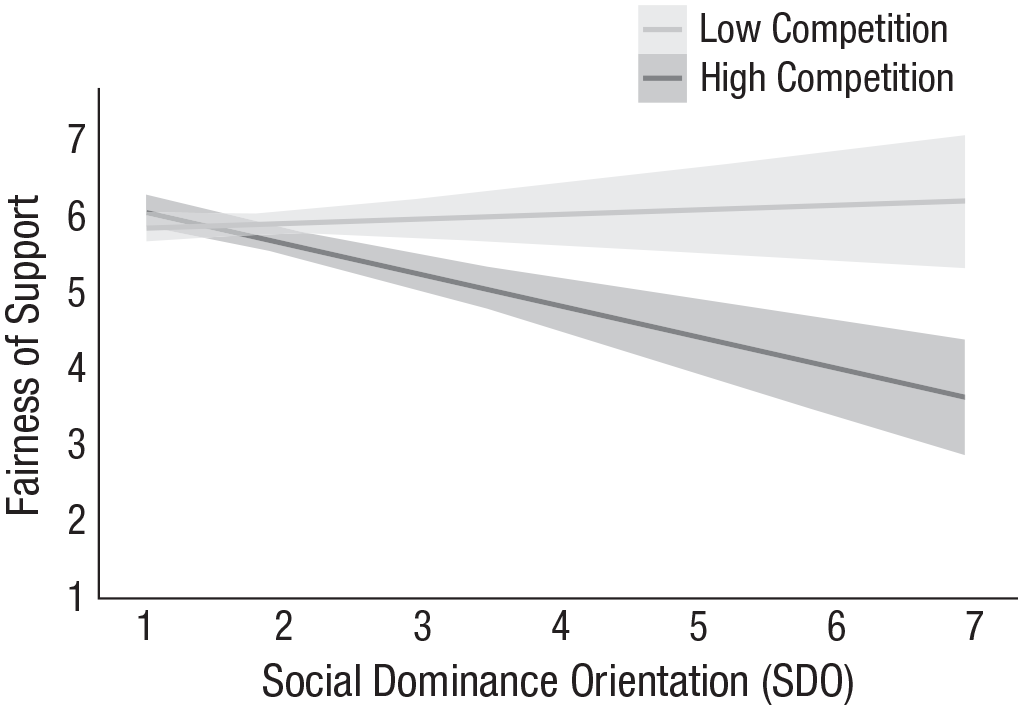
Effect of antiegalitarianism (Social Dominance Orientation) and condition (low vs. high competition) on perceived fairness of initiatives to support a black-owned coffee shop. Shaded areas represent 95% confidence intervals.
Manipulation check
There was a main effect of condition, b = 1.26, SE = 0.13, t = 9.59, p < .00, 95% confidence interval (CI) = [1.002, 1.521], with the business being seen as competing with other businesses more in the high-competition condition than in the low-competition condition. There was also a main effect of social dominance orientation, with respondents higher on the social dominance orientation scale reporting higher perceived competition, b = 0.29, SE = 0.06, t = 4.52, p < .001, 95% CI = [.1610, .4110]. The interaction between social dominance orientation and condition (low vs. high competition) was not significant, b = −0.21, SE = 0.13, t = −1.60, p = .11, 95% CI = [−.4634, .0477].
Fairness
Results were virtually identical when removing outliers (±3 SDs on social dominance orientation or any relevant measure), and so the reported results include those data. This is consistent with our preregistrations for Studies 2 and 3.
There was a significant main effect of social dominance orientation: Higher social dominance orientation was associated with lower fairness ratings, b = −0.23, SE = 0.06, t = −4.13, p < .001, 95% CI = [−.3414, −.1208]. 3 There was no main effect of condition (low vs. high competition), b = −0.12, SE = 0.12, t = −1.03, p = .31, 95% CI = [−.3482, .1097]. This was qualified by the predicted interaction, b = −0.47, SE = 0.11, t = −4.24, p < .001, 95% CI = [−.6844, −.2501]. In the high-competition condition, higher social dominance orientation was associated with lower perceived fairness, b = −0.41, SE = 0.07, t = −6.01, p < .001, 95% CI = [−.5477, −.2771]. However, when it was clear that the Black-owned coffee shop existed in isolation and was not competing with other businesses, the effect of social dominance orientation was no longer significant, b = 0.05, SE = 0.09, t = 0.64, p = .53, 95% CI = [−.1151, .2247].
Floodlight analysis showed that efforts to support the Black-owned coffee shop were seen as less fair in the high- (vs. low-) competition condition when social dominance orientation scores were above 1.95 (30.65% of the data). The effect of condition (low vs. high competition) did not significantly reverse within any range of lower social dominance orientation scores, suggesting that those low in social dominance orientation did not show the same defensive response to the Black-owned business seeking to compete with other businesses. Thus, unless participants fully, or nearly fully, rejected antiegalitarian ideology (as measured by the social dominance orientation scale), efforts to support the Black-owned coffee shop were seen as less fair when it was competing with others. These participants only saw supportive efforts as relatively fair when the Black-owned business was not competing. These findings are consistent with antiegalitarian beliefs about zero-sum competition and the motivation to maintain hierarchy.
Study 2
Study 2 (preregistration: https://aspredicted.org/H75_76K) built on Study 1 by manipulating whether participants rated initiatives supporting Black-owned businesses or another common target of probusiness initiatives: “American businesses” (see the Procedure section for our rationale for this decision). Critically, we also tested support type by measuring the perceived fairness of symbolic and tangible support. Last, Study 2 also measured ruthless market beliefs. We predicted that antiegalitarianism would be associated with more ruthless market beliefs and with viewing initiatives—especially those offering tangible (vs. symbolic) support—as less fair when considering Black-owned (vs. American) businesses.
Method
Participants
Eight hundred and one participants were recruited on Prolific (www.prolific.co; 400 men, 400 women, one missing data; Mage = 45.86 years). Prolific’s prescreening tool was used to recruit a sample of White American participants that is approximately representative of the adult U.S. population with regard to sex and age. Sample size was based on an earlier iteration of Study 2, which was adequately powered (98.6%) to detect the predicted two-way interactions with a sample of 296 participants (average effect size: f2 = .0556). We reasoned that increasing the sample to 800 would be sufficient to test the predicted interactions and simple effects.
Pretest
A pretest (N = 30) was conducted on MTurk (via CloudResearch) to ensure that different support behaviors could be categorized as more tangible or more symbolic and that tangible (vs. symbolic) support is more associated with increasing the competitiveness and success of a business. For various support behaviors, participants rated (a) how symbolic or tangible the support is (1 = much more symbolic, 5 = much more tangible) and (b) the extent to which it is likely to increase the ability of a business to compete and succeed (1 = not at all, 5 = very much). Eight types of support (four tangible, four symbolic) were chosen for inclusion in the main study (with some minor wording edits; items listed in the Procedure section below). The four chosen tangible-support behaviors were seen as more tangible and less symbolic (M = 4.20, SD = 0.76) than the four chosen symbolic-support behaviors (M = 3.00, SD = 0.98), t = 5.70, p < .001. The tangible-support behaviors were also seen as more likely to increase a business’s ability to compete and succeed (M = 4.05, SD = 0.66) than the symbolic behaviors (M = 2.90, SD = 0.99), t = 6.37, p < .001. Thus, if antiegalitarian resistance to initiatives supporting Black-owned businesses is related to a motivation to maintain social hierarchies, then antiegalitarian beliefs should be particularly resistant to more tangible (vs. symbolic) forms of support.
Procedure
Between subjects, participants were told that we were interested in people’s thoughts on different ways that consumers and society can support Black-owned businesses or American businesses. We chose the term “American businesses” because asking about “White-owned businesses” might seem unusual to participants. Although “American businesses” clearly includes Black-owned businesses, participants were expected to interpret this as “White-owned businesses,” given the posttest results from Study 1 and the implicit association between “American” and “White” (Devos & Banaji, 2005), whiteness being treated as a cultural neutral or default (Burton, 2009; Davis, 2017). Quotations around the term “American businesses” are therefore implied if not present throughout this article.
Participants were then presented with four symbolic and four tangible forms of support, in random order. Tangible support included helping the businesses develop and optimize a website, creating grants and funds to support businesses, making business loans more accessible, and trying to buy products from these businesses specifically. Symbolic support included “liking” or following them on social media, leaving a positive review online, signing up for their newsletter or emails, and sending them a positive message or completing a customer-satisfaction survey.
To measure fairness, participants rated each form of support on a scale ranging from 1 (very unfair) to 7 (very fair) on the question “How unfair or fair do you think it is to direct this support specifically to American [Black-owned] businesses?” (tangible: M = 5.36, SD = 1.35, SE = 0.048, α = .89; symbolic: M = 5.89, SD = 1.13, SE = 0.04, α = .93).
To measure ruthless market beliefs about American [Black-owned] businesses, participants read “Regarding American [Black-owned] businesses in the marketplace . . .”, followed by three items: “We should accept the reality that some will do well but many will fail,” “These businesses only deserve to exist if they can thrive in a market where it’s ‘survival of the fittest,’” and “Their success should be based on survival in a “dog-eat-dog” economy, not on the generosity and kindness of consumers” (1 = strongly disagree, 7 = strongly agree; M = 4.35, SD = 1.41, SE = 0.05, α = .84). Item wording was inspired by Duckitt’s (2001) Competitive-Jungle Worldview scale.
Last, antiegalitarianism was measured using a five-item scale (e.g., “This country would be better off if we worried less about how equal people are,” “We have gone too far in pushing equality in this country”; Hatemi et al., 2014; 1 = strongly disagree, 7 = strongly agree), M = 3.05, SD = 1.69, SE = 0.06, α = 0.93. Consistent with previous antiegalitarianism research (Kteily et al., 2017; Lucas & Kteily, 2018), items are coded such that higher scores reflect greater endorsement of antiegalitarian (vs. egalitarian) ideology. Previous research has found that this measure correlates very highly with social dominance orientation (r = .85, N = 1,207 in Lucas & Kteily, 2018) and replicates social dominance orientation effects (Kteily et al., 2017; Lucas & Kteily, 2018).
Results
We first report the effect of Antiegalitarianism × Condition (“American businesses” vs. Black-owned businesses) on general ruthless market beliefs. We then report the effect of Antiegalitarianism × Condition on fairness ratings for tangible and symbolic support. Results were virtually identical when removing outliers (±3 SDs on antiegalitarianism or any dependent variable), and so, consistent with our preregistered plan for handling data, the reported results include those data. Twelve participants also failed a multiple-choice attention check. Excluding them had no meaningful impact on the results. Because this was not specified in our preregistration, the reported results include all cases.
Ruthless market beliefs
There was a significant main effect of antiegalitarianism, with higher antiegalitarianism predicting increased endorsement of ruthless market beliefs, b = 0.40, SE = 0.03, t = 15.24, p < .001, 95% CI = [.3450, .4470]. There was no significant main effect of condition (“American” vs. Black-owned businesses), b = −0.12, SE = 0.09, t = −1.32, p = .19, 95% CI = [−.2889, .0563]. As predicted, this was qualified by a significant two-way interaction, b = 0.30, SE = 0.05, t = 5.92, p < .001, 95% CI = [.2016, .4014] (Fig. 2). Antiegalitarianism more strongly predicted ruthless market beliefs in the Black-owned businesses condition, b = 0.54, SE = 0.04, t = 15.26, p < .001, 95% CI = [.4740, .6140], than in the “American businesses” condition, b = 0.24, SE = 0.04, t = 6.68, p < .001, 95% CI = [.1712, .3138]. Floodlight analysis showed that ruthless market beliefs were higher in the Black-owned businesses condition (vs. “American businesses” condition) at antiegalitarianism scores above 4.09 (25.47% of the data). When antiegalitarianism scores were below 2.87 (54.06% of the data), ruthless market beliefs were lower in the Black-owned businesses condition compared to the “American businesses” condition. In other words, even those showing modest levels of antiegalitarianism endorsed a more ruthless market in general, but this was heightened when applied to Black-owned businesses. Conversely, relatively egalitarian participants tended to reject the idea of a ruthless market, especially when considering Black-owned businesses specifically.

Effect of antiegalitarianism and business type on ruthless market beliefs. Shaded areas represent 95% confidence intervals.
Fairness of tangible support
Higher antiegalitarianism was associated with seeing tangible support as less fair, b = −0.38, SE = 0.06, t = −6.10, p < .001, 95% CI = [−.5031, −.2575], and fairness ratings were lower in the Black-owned (vs. “American”) businesses condition, b = −0.42, SE = 0.09, t = −4.77, p < .001, 95% CI = [−.5913, −.2466]. These main effects were qualified by the predicted two-way interaction, b = −0.59, SE = 0.05, t = −12.37, p < .001, 95% CI = [−.6817, −.4950] (Fig. 3a): Antiegalitarianism predicted lower fairness ratings in the Black-owned businesses condition, b = −0.58, SE = 0.03, t = −17.33, p < .001, 95% CI = [−.6426, −.5118], but not in the “American businesses” condition, b = 0.01, SE = 0.03, t = −0.33, p = .74, 95% CI = [−.0555, .0778]. Tangible support fairness was lower in the Black-owned (vs. “American”) businesses condition at antiegalitarianism scores above 2.62 (51.19% of the data). Conversely, when antiegalitarianism scores were below 2.03 (36.33% of the data), tangible support was seen as more fair in the Black-owned (vs. “American”) businesses condition. Thus, except for those who strongly rejected antiegalitarian ideology, tangible support for Black-owned businesses was seen as less fair compared to the same support being extended to “American businesses.”
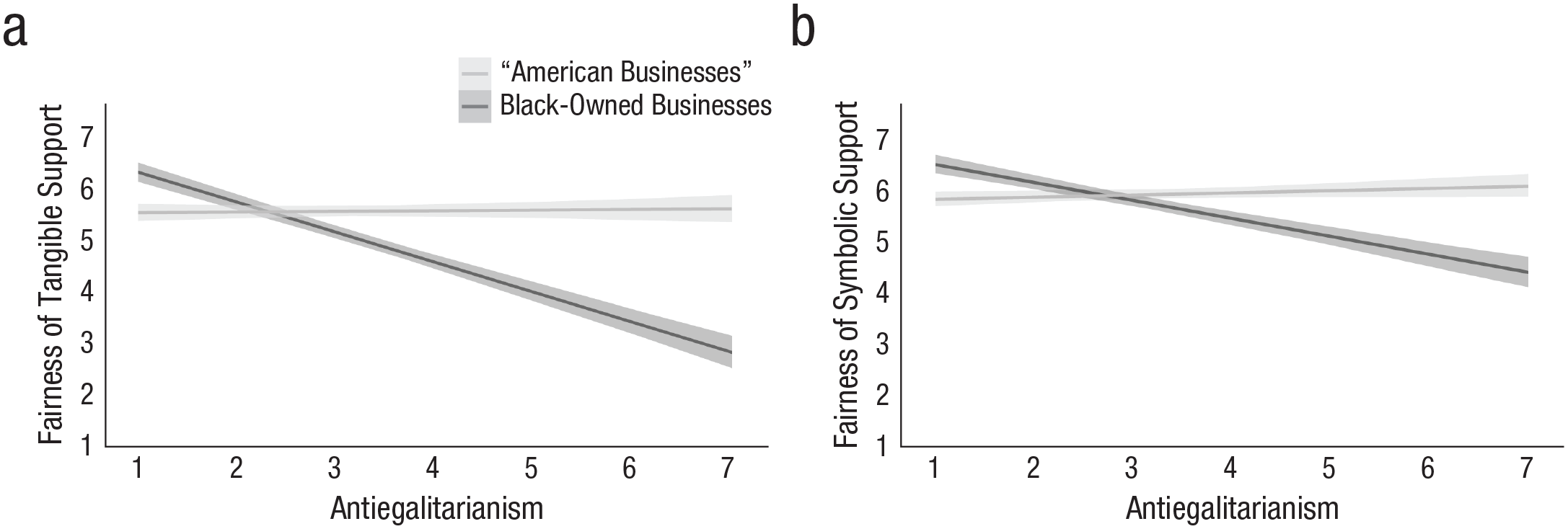
Effect of antiegalitarianism and business type on fairness of (a) tangible support and (b) symbolic support. Shaded areas represent 95% confidence intervals.
Fairness of symbolic support
The main effect of antiegalitarianism was again significant (higher antiegalitarianism = lower fairness), b = −0.16, SE = 0.02, t = −6.85, p < .001, 95% CI = [−.2023, −11.21]. There was no main effect of condition (“American” vs. Black-owned businesses) and fairness, b = −0.13, SE = 0.08, t = −1.66, p = .10, 95% CI = [−.2811, .0239]. The two-way interaction was significant, b = −0.39, SE = 0.04, t = −8.99, p < .001, 95% CI = [−.4798, −.3079] (Fig. 3b), with antiegalitarianism predicting lower symbolic-support fairness ratings in the Black-owned businesses condition, b = −0.35, SE = 0.03, t = −11.43, p < .001, 95% CI = [−.4107, −.2903], but not in the “American businesses” condition, b = 0.04, SE = 0.03, t = 1.39, p = .17, 95% CI = [−.0180, .1047]. Symbolic-support fairness was lower in the Black-owned businesses (vs. “American businesses”) condition at antiegalitarianism scores above 3.09 (41.70% of the data). Conversely, when antiegalitarianism scores were below 2.32 (41.20% of the data), symbolic-support fairness was higher in the Black-owned (vs. “American”) businesses condition.
Three-way interaction: antiegalitarianism, condition, and support type (within-subjects) on fairness
Antiegalitarianism predicted viewing tangible and symbolic support as less fair when directed to Black-owned s (vs. “American”) businesses. However, we also predicted that this response would be stronger for tangible support than for symbolic support. We therefore tested the three-way interaction between antiegalitarianism, condition, and the within-subjects factor of tangible- versus symbolic-support fairness (using MEMORE and PROCESS macros for SPSS, by Montoya, 2019, and Hayes, 2017, respectively). The three-way interaction was significant, b = −0.19, SE = 0.04, t = −5.24, p < .001, 95% CI = [−.2675, −.1216]. As expected, the effect of antiegalitarianism was stronger for tangible support than for symbolic support within the Black-owned businesses condition, b = −0.23, SE = 0.03, t = −8.71, p < .001, 95% CI = [−.2778, −.1756]. Said differently, as antiegalitarianism increased, tangible support for Black-owned businesses was seen as less fair relative to symbolic support. This was not the case in the “American businesses” condition, where the effect of antiegalitarianism on fairness was comparable for both tangible and symbolic support, b = −0.03, SE = 0.03, t = −1.21, p = .23, 95% CI = [−.0842, .0199].
Discussion
Study 2 further illustrates how antiegalitarianism can contribute to racial inequality in the marketplace. Even those who modestly endorsed antiegalitarianism saw support for Black-owned (vs. “American”) businesses as less fair and held more ruthless beliefs about Black-owned businesses in the marketplace. Antiegalitarianism predicted seeing tangible (vs. symbolic) support as especially unfair; this is also consistent with antiegalitarianism and with its zero-sum worldview and concern for maintaining hierarchy. Egalitarian beliefs (i.e., low antiegalitarianism) predicted the opposite effects, potentially reflecting a desire to address inequality in the marketplace.
Study 3
Study 3 (preregistration: https://aspredicted.org/KLY_1BG) manipulates the eligibility criteria of a private funding program. We predicted that antiegalitarianism would be associated with rejecting the program (and seeing it as more zero sum) when “Black-owned” is part of the eligibility criteria (vs. when it is not).
Method
Participants
Six hundred White American participants were recruited through MTurk using CloudResearch (Litman et al., 2017). Ten failed an attention check that asked what type of businesses the investment firm was funding, leaving 590 participants (299 men, 289 women, 2 who did not identify as either; Mage = 44.47 years; median income = $60,000–$69,999). On the basis of our earlier studies and a pilot study for Study 3, we reasoned that 600 participants would be appropriate to test the predicted two-way interaction effects.
Participants were recruited from a pool of over 2,000 MTurk users who had previously completed our measure of antiegalitarianism (Hatemi et al., 2014; Kteily et al., 2017; Lucas & Kteily, 2018) as well as demographic information that included age, gender, income, race/ethnicity, and political ideology (1 = very liberal, 7 = very conservative). This data was collected 5 to 7 months before the launch of Study 3. We oversampled those higher in antiegalitarianism 4 by creating two different postings for the study that each recruited 300 participants. One was only available to those who scored 4 or lower on the antiegalitarianism measure, and the other was only available to those who scored above 4.
Procedure
Participants were told that we were interested in people’s thoughts on how to support restaurants as they recover from the economic effects of the COVID-19 pandemic. Participants were introduced to an American investment firm that invests in smaller independent businesses in the United States by offering grants, loans, and other resources. Numerous such programs exist, including programs that provide support for Black-owned businesses specifically (Ludwig & Heaslip, 2021). We manipulated the eligibility criteria for the funding program. In the Black-owned businesses condition, the firm was specifically investing in Black-owned restaurants and was offering resources to Black restaurant owners. In the control condition, the firm was instead investing in “restaurants.” For reasons explained earlier, participants in the control condition were likely to assume a White default when reading “restaurants” without further description.
Participants were told that the investment firm had identified several ZIP codes in the United States as investment opportunities, and they were shown a map of one such ZIP code. The map was actually from a Canadian city and contained no street or landmark labels, so the map should not be identifiable to U.S. participants. To help ensure that inferences about race or income would be similar across conditions, we described the ZIP code as being in an upper-middle class suburb. The map also identified several national retailers consistent with this description (e.g., Costco, Target, Whole Foods, Lululemon).
Participants were then told that there are in this area many successful independent restaurants, which were represented by blue and orange dots on the map (three each). To ensure that the quality of the restaurants would be seen as comparable, we described all as having average customer ratings of 4.2 (out of 5) or higher. In the Black-owned businesses condition, the blue dots were said to represent three Black-owned restaurants within the ZIP code that were therefore eligible for the firm’s funding program, whereas the orange dots represented three restaurants in the ZIP code that were not Black-owned and were therefore ineligible. In the control condition, the map was identical except that the orange dots were simply moved across the street, placing them just outside of the designated ZIP code. The blue dots were said to represent three restaurants within the designated ZIP code that were therefore eligible for the program, whereas the orange dots represented three restaurants that were outside of the designated ZIP code and were therefore ineligible. The restaurants and the national chains were distributed around the map so that participants would not infer, for example, that there were predominantly White versus Black areas or lower versus higher income areas within (or outside) the ZIP code.
In short, the funding program included certain restaurants and excluded others. In the control condition, it included restaurants that were inside the designated ZIP code and excluded those just outside it. In the Black-owned businesses condition, the program included Black-owned restaurants inside of the designated ZIP code and excluded those in the designated ZIP code that were not Black-owned.
To measure approval (vs. rejection) of the funding program, participants rated the program on four items using 7-point scales: completely reject vs. completely support, completely unfair vs. completely fair, completely disapprove vs. completely approve, and completely unacceptable vs. completely acceptable. The four items were averaged to create an average approval score (M = 4.33, SD = 1.75, SE = 0.072, α = .98).
To measure zero-sum beliefs, participants rated their agreement with four statements. Two statements were about the restaurants that were eligible for funding and about whether receiving this funding (a) would make it less likely that the other restaurants will succeed and (b) would make it more likely that the other restaurants will go out of business. Two statements were about the restaurants that were ineligible for funding and whether this ineligibility (a) would harm their business and (b) would make them less able to compete. The four items were averaged to create an average zero-sum-beliefs score (M = 4.03, SD = 1.39, SE = 0.057, α = .90).
Antiegalitarianism was measured using the same five-item measure as in Study 2 (Hatemi et al., 2014; M = 3.89, SD = 1.81, SE = 0.074, α = .93). The measure was completed 5 to 7 months before the study as part of unrelated data collection.
Results
We first report the effect of Antiegalitarianism × Condition (ZIP code-based funding eligibility vs. race-based funding eligibility) on funding-program approval, followed by zero-sum beliefs.
Approval for the funding program
There were main effects of condition and antiegalitarianism: Program approval was generally lower in the Black-owned businesses condition, b = −0.38, SE = 0.14, t = −2.66, p = .008, 95% CI = [−.6532, −.0992], and higher antiegalitarianism was associated with less approval, b = −0.20, SE = 0.04, t = −5.10, p < .001, 95% CI = [−.2756, −.1222]. These main effects were qualified by the predicted Condition × Antiegalitarianism interaction, b = −0.78, SE = 0.07, t = −10.89, p < .001, 95% CI = [−.9164, −.6364] (Fig. 4). As predicted, in the Black-owned businesses condition, higher antiegalitarianism was associated with less approval for the funding program, b = −0.60, SE = 0.05, t = −11.72, p < .001, 95% CI = [−.7021, −.5005]. In contrast, higher antiegalitarianism was associated with higher approval in the control condition, b = 0.175, SE = 0.05, t = 3.54, p < .001, 95% CI = [.0780, .2723]. Floodlight analysis tested the simple effect of condition across antiegalitarianism scores. Approval for the program was lower in the Black-owned businesses condition (vs. the control condition) when antiegalitarianism scores were above 3.73 (55.95% of the data). Conversely, when antiegalitarianism scores were below 3.04 (38.61% of the data), approval was instead higher in the Black-owned businesses condition (vs. the control condition). In short, antiegalitarianism (vs. egalitarianism) did not predict having a principled opposition to a firm selectively funding specific businesses on the basis of given criteria; instead, antiegalitarianism was associated with greater opposition only when the firm selectively funded Black-owned businesses.

Effect of antiegalitarianism and eligibility criteria on approval for the funding program. Shaded areas represent 95% confidence intervals.
Zero-sum beliefs
There was a main effect of condition, such that zero-sum beliefs were lower in the Black-owned businesses condition, b = −0.44, SE = 0.11, t = −3.89, p < .001, 95% CI = [−.6650, −.2190]. There was no main effect of antiegalitarianism, b = 0.02, SE = 0.03, t = 0.72, p = .47, 95% CI = [−.0390, −.0844]. As expected, the two-way interaction was significant, b = 0.50, SE = 0.06, t = 8.37, p < .001, 95% CI = [.3810, .6147] (Fig. 5); in the Black-owned businesses condition, higher antiegalitarianism was associated with seeing the program as more zero-sum, b = 0.28, SE = 0.04, t = 6.55, p < .001, 95% CI = [.1961, .3642]. In contrast, higher antiegalitarianism was associated with seeing the program as less zero-sum in the control condition, b = −0.22, SE = 0.04, t = −5.27, p < .001, 95% CI = [−.2989, −.1365]. Zero-sum beliefs were higher in the Black-owned businesses condition (vs. the control condition) at antiegalitarianism scores above 5.31 (25.25% of the data). Conversely, zero-sum beliefs were lower in the Black-owned businesses condition (vs. the control condition) at antiegalitarianism scores below 4.34 (54.41% of the data). In other words, those higher in antiegalitarianism were less inclined to think that funding restaurants slightly inside the designated ZIP code would necessarily hurt the ineligible restaurants slightly outside of the ZIP code. However, when the funding program was specific to Black-owned restaurants, antiegalitarianism was associated with increased zero-sum thinking (i.e., concluding that funding the Black-owned restaurants would hurt the non-Black-owned restaurants). Conversely, egalitarianism—that is, low antiegalitarianism—was associated with the opposite perspective (i.e., participants concluding that supporting the Black-owned restaurants would not have a negative impact on other restaurants that do not get the same support).
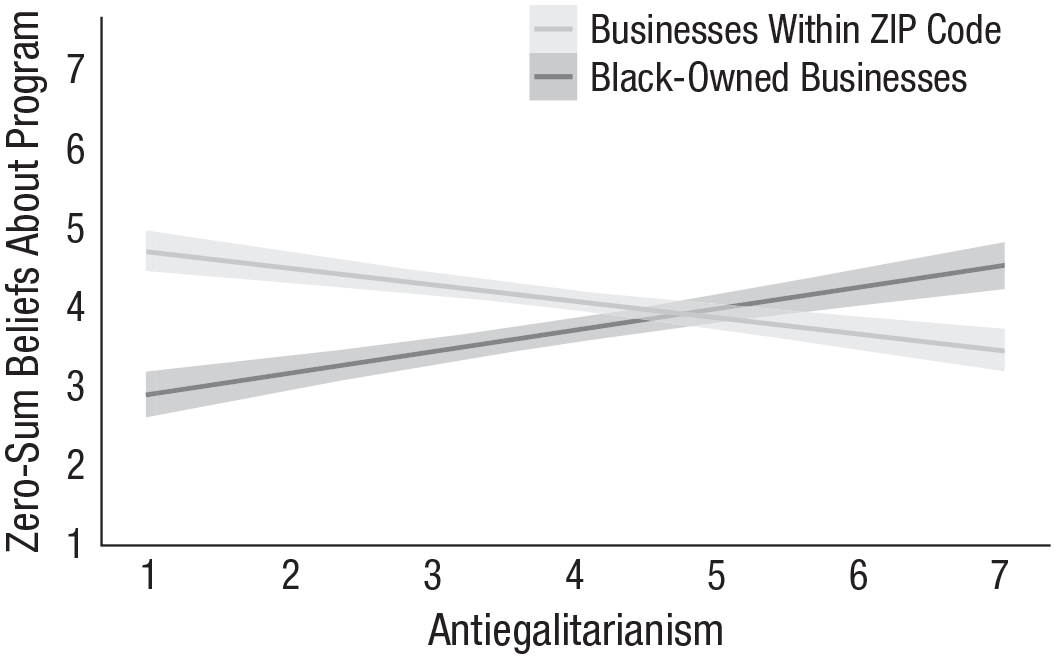
Effect of antiegalitarianism and eligibility criteria on zero-sum beliefs about the funding program. Shaded areas represent 95% confidence intervals.
General Discussion
Our research identifies psychological and ideological processes contributing to White Americans’ support for and resistance to hierarchy-attenuating efforts to help Black-owned businesses. We found that beliefs about how individuals and the economic system should support businesses were dependent on one’s ideology as well as on who would receive the support. Antiegalitarianism was associated with rejecting initiatives that support Black-owned businesses, seeing those initiatives as zero-sum, and having a more ruthless competitive orientation toward Black-owned businesses in the marketplace. This was particularly observed when in competitive environments (vs. no competition; Study 1) and when support was more tangible (vs. symbolic; Study 2), providing further nuance to our understanding of how antiegalitarianism can operate in the marketplace and contribute to inequality. Moreover, consistent results were found when holding constant neighborhood and business characteristics (Study 3).
Limitations
We focused on racial-majority-group members’ responses to supporting Black-owned businesses in the United States. Future research might test similar processes in other cultural contexts with other racial, ethnic, or marginalized groups. Although our samples were diverse in age, gender, and income, they were not entirely representative of the White U.S. population, and responses were based on self-reports from online samples. Future research might test similar processes with field experiments to observe actual behavior. An additional limitation is our focus on specific types of businesses in Studies 1 and 3 (e.g., coffee shops and restaurants). Future research might test similar processes in domains that are ascribed more status or those less likely to be racialized (e.g., investment banking, law firms).
Implications
These findings have social and economic implications as economic inequality becomes increasingly salient and calls to support Black-owned businesses gain momentum. Although the marketplace offers opportunities for marginalized groups to gain status, it has also been used to maintain racial inequality (Johnson et al., 2019). Consistent with this, we found that even moderate antiegalitarianism results in backlash toward initiatives supporting Black-owned businesses. This aligns with the consumer and political backlash facing many firms after supporting Black-owned businesses or the Black Lives Matter movement. Target was accused of being divisive and racist toward White people when it supported Black-owned suppliers (Smith et al., 2021), perhaps reflecting the broader sentiment of 4 in 10 White Americans who see the Black Lives Matter movement as divisive and dangerous (Horowitz et al., 2023). Similar trends can be observed with other causes. For example, several firms received abuse and threats in response to their pro-LGBTQ marketing, leading some retailers to pull products from the shelves (Hartmans & Musumeci, 2023). Thus, antiegalitarian sentiment might contribute to a sociopolitical climate that suppresses firms’ and policymakers’ commitment to hierarchy-attenuating initiatives. However, the responses of relatively egalitarian individuals in our studies suggest there is also support for these initiatives.
By looking at consumer and private-sector initiatives for reducing inequality, we complement existing antiegalitarianism research that mainly focuses on government initiatives (e.g., social assistance, affirmative action; see Ho et al., 2015). On the surface, consumer and private-sector initiatives seem consistent with antiegalitarianism and its general support for laissez-faire capitalism (Azevedo et al., 2019), in that people are making free choices about their personal resources on the basis of their preferences and perceived opportunities. However, our findings suggest that those higher in antiegalitarianism do not see these initiatives as palatable alternatives to government policies.
Zero-sum beliefs about supporting Black-owned businesses may be further exacerbated by broader economic factors. For example, a finite amount of federal funds was allocated for businesses during the COVID-19 pandemic. Though Black-owned businesses were disproportionately affected by the pandemic (Washington, 2021), our findings indicate that resistance to supporting Black-owned businesses may increase when it is most needed.
Supplemental Material
sj-docx-1-pss-10.1177_09567976241237700 – Supplemental material for When and Why Antiegalitarianism Affects Resistance to Supporting Black-Owned Businesses
Supplemental material, sj-docx-1-pss-10.1177_09567976241237700 for When and Why Antiegalitarianism Affects Resistance to Supporting Black-Owned Businesses by Steven Shepherd, Rowena Crabbe, Tanya L. Chartrand, Gavan J. Fitzsimons and Aaron C. Kay in Psychological Science
Footnotes
Transparency
Action Editor: Patricia J. Bauer
Editor: Patricia J. Bauer
Author Contributions

Notes
References
Supplementary Material
Please find the following supplemental material available below.
For Open Access articles published under a Creative Commons License, all supplemental material carries the same license as the article it is associated with.
For non-Open Access articles published, all supplemental material carries a non-exclusive license, and permission requests for re-use of supplemental material or any part of supplemental material shall be sent directly to the copyright owner as specified in the copyright notice associated with the article.
