



Abstract
Laypeople believe that sharing their emotional experiences with others will improve their understanding of those experiences, but no clear empirical evidence supports this belief. To address this gap, we used data from four daily life studies (N = 659; student and community samples) to explore the association between social sharing and subsequent emotion differentiation, which involves labeling emotions with a high degree of complexity. Contrary to our expectations, we found that social sharing of emotional experiences was linked to greater subsequent emotion differentiation on occasions when people ruminated less than usual about these experiences. In contrast, on occasions when people ruminated more than usual about their experiences, social sharing of these experiences was linked to lower emotion differentiation. These effects held when we controlled for levels of negative emotion. Our findings suggest that putting feelings into words through sharing may only enable emotional precision when that sharing occurs without dwelling or perseverating.
Keywords
After an emotional event, people commonly share their emotions with others, a process termed social sharing (Rimé et al., 1992). People frequently try to regulate their emotions using social sharing (Brans et al., 2013), but sharing does not always aid emotional recovery as measured by people’s subsequent emotional experience (e.g., Curci & Rimé, 2012). Indeed, the relationships between sharing and emotional outcomes obtained in prior research have been mixed. In daily life, sharing emotions was related to increases in both positive and negative emotions (Brans et al., 2013), and sharing hassles was associated with emotional costs and benefits (Rauers and Riediger, 2023). In an experiment, sharing was not related to emotional recovery, but participants self-reported that sharing provided help and relief (Zech & Rimé, 2005). This suggests that there are benefits of sharing not reflected in emotional experience. People self-report sharing emotions to find clarity and meaning (Duprez et al., 2014), suggesting benefits may inhere in emotional understanding.
Theory supports this idea, suggesting that sharing can help people to comprehend a situation and organize and structure emotional experience (Rimé, 2009). Specifically, sharing may help clarify ambiguous sensations experienced after an emotional event, and using language to explain an experience could help to “unfold” and label it (Rimé, 2009). This idea is shared by researchers who have done work on affect labeling, which suggests that labeling emotions after a stressful event provides the opportunity to attach meaning to the event (Stanton & Low, 2012). Relatedly, expressive-writing studies have shown that disclosing emotions results in greater insight through the generation of narrative accounts (Stroebe et al., 2001). Taken together, this evidence suggests that social sharing may aid emotional understanding through clarifying ambiguous emotions and that sharing may improve emotion differentiation, defined as the ability to experience and label emotions with a high degree of complexity (Kashdan et al., 2015).
When showing low emotion differentiation, people use specific emotional labels with the same valence interchangeably (e.g., “feeling both sad and angry”), reflected in high covariation between emotions (Erbas et al., 2015). When showing high differentiation, people use distinguishable emotion labels to describe their emotional experience (e.g., “feeling sad but not angry”), reflected in low covariation. Emotion differentiation is associated with well-being (Seah & Coifman, 2022) and has mostly been investigated as a traitlike concept (Thompson et al., 2021). However, recent evidence shows that differentiation also varies dynamically within individuals (Erbas et al., 2022).
In addition to general evidence that sharing may facilitate emotional understanding, theory suggests that sharing should enable emotion differentiation specifically. First, differentiation encompasses the capacity to “put feelings into words” (Kashdan et al., 2015), meaning that to differentiate emotions, emotional experiences should be translated into language, which is often achieved through talking with others (e.g., Nook et al., 2017; Rimé, 2009). Second, sharing emotions may also enable sharers to use language to more directly link their emotions with the context in which they occur, and in doing so, help sharers to more precisely label their emotions. Linking emotions with the situation provides the information to identify the discrete emotions most appropriate for that situation, resulting in higher emotion differentiation (cf. Barrett, 2017; Hoemann et al., 2023). Taken together, research and theory suggest that social sharing will improve emotion differentiation.
Statement of Relevance
Social sharing, or talking with others about one’s emotions, is common. One suggestion for this frequency is that sharing helps people to describe their emotions in a more differentiated manner. Across four studies, we tested whether social sharing predicted changes in emotion differentiation and whether this relationship was shaped by how people deal with their emotions (i.e., by ruminating or dwelling on their emotions). Social sharing predicted better emotion differentiation only when rumination was low. When rumination was high, sharing was associated with poorer emotion differentiation. Theory suggests that sharing has benefits for understanding one’s inner world, and in its first direct test we show that these benefits exist but are contingent on rumination. This research has practical implications: People often turn to others for help when experiencing emotions. Our research suggests that our social world could potentially be harnessed to improve emotion differentiation, but only under specific conditions.
The Potential Role of Rumination
People share their emotions for many reasons, not only to gain emotional understanding, but also to vent and rehearse negative feelings (Duprez et al., 2015), suggesting that sharing may not always enable emotion differentiation. Indeed, theory links sharing with rumination (Rimé, 1995), which is repetitive and prolonged negative thinking (Watkins, 2008). Rumination can manifest interpersonally in co-rumination, as people dwell on an emotion together (Rose, 2002, 2021). 1 Both rumination and co-rumination are associated with emotional costs (e.g., Spendelow et al., 2017; Tudder et al., 2023).
Given these costs, rumination may negate the potential benefits of sharing to emotion differentiation. Sharing alongside rumination may involve speaking about emotions in more repetitive and less open ways, eliciting less nuanced listener responses. Sharing alongside rumination may also begin a co-rumination cycle, in which both sharer and listener dwell on negative emotions. Therefore, we also investigated whether the link between sharing and emotion differentiation was moderated by rumination. We initially tested the direct link between sharing and differentiation and investigated rumination post hoc to understand unexpected findings.
The Current Studies
Across four studies, we tested whether social sharing positively predicted emotion differentiation, and later, whether this relationship was moderated by rumination. We focused on negative-emotion differentiation because it is particularly important for well-being (Erbas et al., 2014) and also because people report that they share to find clarity and meaning primarily for negative emotions (Duprez et al., 2014). 2 In all analyses, we controlled for the intensity of momentary negative emotions, meaning that effects were not driven by how negative participants were feeling at that moment. We assessed sharing not only in regular daily life (Studies 1 and 2) but also in the context of stress, during which stronger negative emotions are experienced (Studies 3 and 4).
Open Practices Statement
The data sets used in Studies 1, 2, and 3 have been used to investigate questions not related to this research. That work is reported in previous publications listed on the Open Science Framework at https://osf.io/aq8r9. Studies 1 to 3 were not preregistered. For Study 4, the study design of the larger project was preregistered at https://osf.io/j4x65/, and the specific hypotheses and data-analytic plan of this study were preregistered at https://osf.io/h9rmt. There is one publication utilizing these data, and it can be found on https://osf.io/aq8r9. Relevant code and data to conduct all reported analyses can be found at https://osf.io/aq8r9.
Method
Participants and procedure
We analyzed data from four studies: Data for the first three were originally collected for different purposes, and data for the last study were collected specifically to test the present research questions. Across studies, participants were recruited through advertisements and social media. In each study, participants responded once daily (Study 1) or multiple times a day (Studies 2–4). Table 1 summarizes the participants and procedures for each study. All studies received ethical approval from the universities at which they were conducted.
Information About Each Study

Note: Ω represents the multilevel omega reliability, with Ωwith representing the within-person variability and Ωbetw representing the between-person variability. EMS = experience-sampling method. aThis was the final sample after methodological exclusions and removing negative values for emotion differentiation.
Study 1
Participants (N = 121) were asked daily for seven consecutive days at a fixed time point (7:00 p.m.) about their most negative event of the day, allowing us to capture meaningful emotional events in a community sample on a timescale of days. The sample was stratified on neuroticism because neuroticism is implicated in responding to emotional events (see Kalokerinos et al., 2017, for more details on this process and the study). To obtain enough power to detect medium between-person correlations (r = .30) at 80% power (when α = .05), we aimed to recruit 120 participants; this allowed for some attrition, given concerns about compliance when recruiting in an online environment.
In general, compliance was high, with participants responding to 95% of the diaries. Data from 7 participants were excluded: One missed more than 50% of the attention checks, and 6 were missing more than 50% of the daily data. This left a final sample of 114. The design of this study allowed us to examine only changes in emotion processes over days, rather than momentary fluctuations, which were investigated in Studies 2, 3, and 4.
Study 2
In a three-wave longitudinal experience-sampling study, participants (N = 202) responded to 10 questionnaires per day for 7 consecutive days. Participants were prompted between 10:00 a.m. and 10:00 p.m. using a stratified random-interval scheme (the 12-hr period was divided into 10 equal intervals, and one beep was programmed randomly in each interval). This design allowed us to assess emotions on a timescale of hours, with an average interval of 71.1 min between consecutive prompts. Wave 2 occurred 4 months after Wave 1, and Wave 3 occurred 12 months after Wave 1, and consisted of the same design.
We sampled participants about to start their first year at university in 2012 who varied in terms of emotional well-being as assessed by their depressive symptoms, indicated by the Center for Epidemiologic Studies Depression Scale (CES-D). Like neuroticism, depression is implicated in responding to emotional events (for more detail, see Erbas et al., 2018). We chose to sample new university students because the transition to university is a time of change, and therefore particularly relevant to studying emotion processes (Tamir et al., 2007). To obtain enough power to detect small to medium effect sizes (d = 0.30, α = .05), we aimed to recruit 200 participants (allowing for 25% attrition over the course of the study).
Overall, compliance was high across waves (87.27% in Wave 1, 87.87% in Wave 2, 88.35% in Wave 3). In Wave 1, two participants had low compliance with the experience-sampling method (ESM) protocol, with each completing less than 50% of surveys, and their data were therefore excluded from further analyses, leaving a total sample of 200 participants. Wave 2 retained 190 participants, and Wave 3 retained 177 participants. The design of this study allowed us to capture emotion dynamics on a shorter timescale than in Study 1. However, the sample was relatively young and homogenous because it was restricted to students. Further, the repeated assessments through normal daily life meant that strong negative emotions might be rare. To address this drawback, we captured emotions in more tumultuous circumstances in Study 3 and Study 4.
Study 3
Students (N = 101) were receiving exam results in their first semester of university studies. For 9 days, including days both before and after finding out their exam results, participants reported 10 times a day on their emotional experiences and social sharing specific to this emotional event (for more detail, see Kalokerinos et al., 2019). Exams are an acutely stressful event (e.g., McAndrew et al., 1998), and these exams were difficult, with 83% of participants failing at least one exam. As in Study 2, participants were prompted between 10:00 a.m. and 10:00 p.m. according to a stratified random-interval scheme.
We aimed to recruit at least 100 participants to achieve more than 80% power to detect medium-sized between-person effects (r = .30, α = .05). There was high compliance (90.5%), and no participants were excluded from this study. This study captures an acute emotional time, which might also imply that the data are less generalizable to other emotional events and samples.
Study 4
Participants (N = 209) resided in Melbourne and Sydney, Australia, and were experiencing one of the longest COVID-19 lockdowns in the world (Zhuang, 2021). For much of this time, residents were allowed to leave isolation for only 1 hr each day for specific reasons (Murray-Atfield & Dunstan, 2020). Participants responded to 10 questionnaires per day on using a mobile device for 7 consecutive days. Participants were prompted between 9:00 a.m. and 9:00 p.m., according to a stratified random-interval scheme. We initially aimed to recruit 200 participants, allowing 80% power to detect small level-1 effects in multilevel analyses and allowing for 15% attrition (α = .05; Murayama et al., 2022).
On average, participants replied to 71.34% of prompts. We initially recruited 237 participants, but our final sample size was 209: Data from 28 participants were excluded because those participants were located outside of the Australian Eastern Standard Time zone (N = 7), were signed up to another ESM study concurrently (N = 2), or had formally withdrawn (N = 6); others had technical difficulties (N = 2), failed attention checks (N = 8), completed no ESM surveys (N = 1), or were under the age of 18 (N = 2).
This preregistered study followed a large and demographically diverse community sample during a chronically stressful time. The larger data collection was preregistered (https://osf.io/j4x65/), as were the analyses for this specific study (https://osf.io/h9rmt).
Measures
Negative emotion
The intensity of experienced negative emotion was measured daily (Study 1) or at each ESM time point (Studies 2–4), using different sets of emotions in all studies (see Table 1) because the studies had not been set up in parallel. In all studies, the selection of emotions was based on the circumplex model of affect, capturing both low- and high-arousal emotions (Russell, 2003) consistent with much past work on emotion differentiation (e.g., Barrett et al., 2001).
Participants rated the intensity of their emotional experience using specific negative-emotion items on a Likert or visual-slider scale, with responses ranging from not at all to very intense/very much. Details of each scale may be found in Table 1. The emotion items were anchored to different experiences in each study, referring to the most negative event they had experienced that day (Study 1: “To what extent did you feel each of the following emotions during the event you recalled?”), negative emotion associated with their exam results (Study 3: “When thinking about your grades right now, how [emotion] are you feeling?”) or their momentary emotional state (Study 2 and Study 4: “Right now, how [emotion] do you feel?”). Thus, except for Study 1, emotions were assessed in the present moment. Scores on specific negative-emotion items were averaged to form one mean score for negative emotion. See Table 1 for multilevel reliabilities, calculated using multilevel structural equation modeling (Geldhof et al., 2014). The lower within-person reliability shows that there is within-person variability in how much people differentiate their negative emotions.
Emotion differentiation
Traditionally, emotion differentiation is operationalized as a trait variable by calculating the intraclass correlation (ICC) of specific emotion items across measurements for every participant (e.g., Erbas et al., 2016). This score is then reverse-coded, so that higher values represent higher levels of differentiation. We applied the momentary emotion-differentiation index derived directly from this ICC proposed by Erbas et al. (2022), calculated using the R package emodiff (available on GitHub at https://github.com/seanchrismurphy/emodiff; “m_ed” refers to the momentary emotion-differentiation index).
To calculate the momentary emotion-differentiation index, each momentary emotion item was first person-mean centered so that each score reflected moment-to-moment deviations from a person’s average level of that emotion. Next, means of the centered emotions were calculated for each time point, and these means were multiplied by the number of emotions and the product squared, resulting in the numerator of the equation. Subsequently, the variance for each of the centered emotions was computed and its sum was calculated, resulting in the denominator of the equation. Consistent with previous research, negative values were not allowed as they are uninterpretable. Negative values represent only a small proportion of the data (Study 1: N = 24; Study 2: Wave 1, N = 0; Wave 2, N = 4; Wave 3, N = 8; Study 3: N = 1; Study 4, N = 12). The final samples included in the analyses after these negative values were removed can be found in Table 1.
The resulting quotient was multiplied by −1 so that higher values represented higher levels of differentiation. After this multiplication, the minimum differentiation score ranged from −200 to −18, depending on the specific scale used in the study, and the maximum was 0 in every study.
Social sharing
At each measurement occasion, participants indicated the extent to which they had engaged in social sharing using a Likert or visual-slider scale, with responses ranging from not at all to very much (see Table 1). In Study 1, participants rated the extent to which they had talked with others about the most negative event or emotions that happened that day. In Study 2, participants rated the extent to which they had talked with others about their emotions since the last beep. In Study 3, participants rated the extent to which they had talked with others about their grades and associated emotions since the last beep. In Study 4, participants rated the extent to which they had talked with others about their emotions in the last hour. Specific instructions differed according to the specific nature and goal of each study, but all were consistent with social-sharing assessments in the emotion-regulation literature (e.g., Brans et al., 2013).
Rumination
Rumination was assessed on each measurement occasion by asking participants to indicate the extent to which they had “ruminated (or dwelled on)” their emotions using a Likert or visual slider scale, with responses ranging from not at all to very much/almost all of the time (Brans et al., 2013). In Study 1, participants rated the extent to which they had ruminated about the most negative event or emotions that happened that day. In Study 2, participants rated the extent to which they had ruminated since the last beep about (a) something in the past or (b) something in the future (these two items were averaged together to form an index of rumination, in line with previous research using these data; e.g., Kalokerinos et al., 2019). In Study 3, participants rated the extent to which they had ruminated about their grades and associated emotions since the last beep. In Study 4, participants rated the extent to which they had continually thought about what was making them emotional in the last hour.
Table 2 reports the descriptives for the uncentered negative emotion, emotion differentiation, social sharing, and rumination indices.
Between-Person Means, Within-Person Standard Deviations, Between-Person Standard Deviations, and Intraclass Correlation Coefficients of Negative Emotion, Emotion Differentiation, Social Sharing, and Rumination Indices
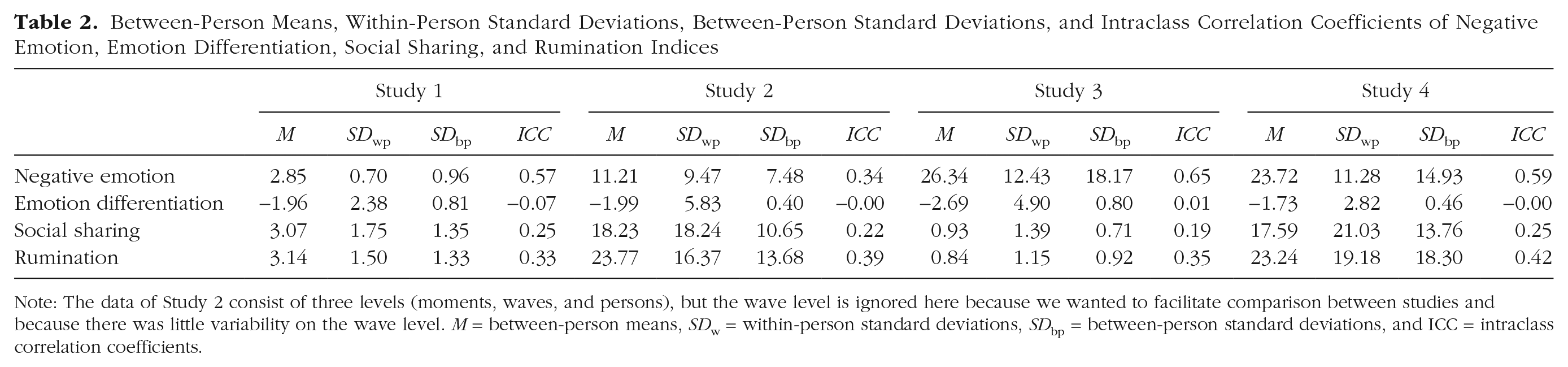
Note: The data of Study 2 consist of three levels (moments, waves, and persons), but the wave level is ignored here because we wanted to facilitate comparison between studies and because there was little variability on the wave level. M = between-person means, SDw = within-person standard deviations, SDbp = between-person standard deviations, and ICC = intraclass correlation coefficients.
Results
Analyses were conducted in R (Version 4.1.1) using package lme4 (Bates et al., 2014) to fit mixed effects-models. 3 For Study 1, convergence issues could not be solved in the package lme4, and therefore, a switch was made to the package nlme, which is more flexible in handling correlation and variance structures (Pinheiro et al, 2017). These models allowed us to account for observations being nested within participants in Studies 1, 3, and 4, and observations nested within waves that occurred for each participant in Study 2 (as this study consisted of three waves). This means that for Studies 1, 3, and 4, we used two-level models, and for Study 2 we used three-level crossed models. Emotion differentiation at time T was predicted by social sharing at time T (the items all asked about social sharing between time T1 and T), controlling for emotion differentiation at time T1 (lagged emotion differentiation, excluding overnight lags for Studies 2–4) and negative emotion at time T. We controlled for lagged emotion differentiation to demonstrate effects of sharing on differentiation over and above previous levels of differentiation—that is, to model change in differentiation over time, or variation at the state level. This sort of autoregressive modeling is common practice in multilevel modeling to assess change and stability over time (Rovine & Walls, 2006).
We controlled for reported negative emotion to account for its associations with both social sharing and emotion differentiation. Specifically, momentary negative emotions and momentary emotion differentiation are related to each other and share variance, because at very low or very high levels of emotion, the ability to show emotion differentiation is limited by the scale boundaries (Dejonckheere et al., 2019; Erbas et al., 2022). Additionally, when more negative emotions are experienced, people both share socially and ruminate more (Brans et al., 2013; Luminet et al., 2000), and we wanted to show predictive patterns for emotion differentiation over and above the shared variance that could be attributed to negative emotion.
All predictors (social sharing, lagged emotion differentiation, and negative emotion) and the outcome (social sharing) were measured at the occasion level. The predictors were person-mean centered, removing most of the variance associated with between-person differences. Intercepts and slopes were allowed to be random, modeling the variation between persons. We aimed to include random slopes associated with all momentary predictors where possible, to best map psychological reality (Barr et al., 2013). Because convergence issues arose, several steps were taken: increasing the number of iterations, changing the optimizer, standardizing all predictors and outcomes (after appropriate person-mean centering) so that scaling was identical across variables, and using a simplified random-effects structure if needed. This mainly meant removing random slopes of covariates such as negative emotion. The specific models can be found in the Supplemental Material available online. Because predictors and outcomes were standardized, the coefficient estimates are comparable across studies and variables. Given the number of analyses, we applied the Benjamini-Hochberg adjustment to control the false discovery rate. Code for all analyses and the data used to run these models can be found on the Open Science Framework at https://osf.io/aq8r9.
After conducting models for each specific study, we conducted mixed-effect models using all four studies to obtain more general conclusions. In these models, occasions (Level 1) were nested within participants (Level 2) who were nested in studies (Level 3). We allowed random intercepts and slopes at the individual level (fixing slopes for covariates only if they were needed because of convergence issues), and we allowed a random intercept for each study. We included the same predictors as in the models for the separate studies. Specific models can also be found in the Supplemental Material.
Exact statistics may be found in Table 3. In two out of four studies, social sharing unexpectedly negatively predicted emotion differentiation. That is, when people had talked about their emotions with other people more than usual, they were worse at differentiating between specific negative emotions. This was the case when they had talked about a specific acute stressor (Study 3) or when they were experiencing a chronic stressor (Study 4). These findings were not driven by greater experienced negativity, because we controlled for negative emotion. This association between social sharing and emotion differentiation was not observed when participants’ emotional experiences were assessed on a day level (Study 1) or in regular daily life (Study 2). In an overall model conducted across studies, we observed a significant negative association between social sharing and emotion differentiation, showing that across studies, people were worse at differentiating their emotions when they had talked to others about their emotions more than usual.
Results for Main Analyses: Multilevel Models of Social Sharing Predicting Negative Emotion Differentiation
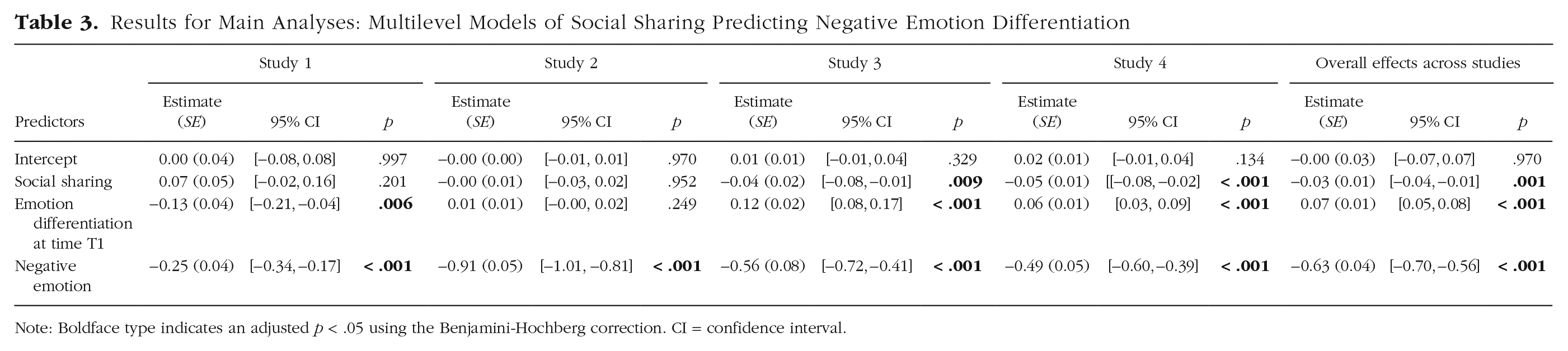
Note: Boldface type indicates an adjusted p < .05 using the Benjamini-Hochberg correction. CI = confidence interval.
Exploratory analyses: the role of rumination
Although we expected that social sharing would positively predict emotion differentiation, we found that, when there were significant results, social sharing negatively predicted emotion differentiation. To explain these findings, we investigated the potential moderating role of rumination. Specifically, we included the extent to which people reported ruminating since the last moment as a main effect, as well as the interaction between rumination and social sharing, which was our key effect of interest. We again controlled for negative emotion.
The results of these analyses are in Table 4. In three out of four studies (Studies 2, 3, and 4), we found a negative main effect of rumination, such that more rumination predicted less emotion differentiation. The effects of social sharing depended on levels of rumination. The main effect of social sharing on differentiation was no longer significant in all studies, and instead, in two out of four studies (Study 2 and Study 4), a significant negative interaction effect between social sharing and rumination appeared (see Table 4). The main effect no longer being significant suggests that, after accounting for the extent to which people were ruminating, greater sharing of emotions did not predict how much they differentiated between their emotions. This was also the case for our overall model across studies, which showed no main effect of rumination or social sharing, but did show a significant interaction effect between rumination and social sharing.
Exploratory Analyses: The Interaction Between Social Sharing and Rumination Predicting Subsequent Emotion Differentiation

Note: Boldface type indicates an adjusted p < .05 using the Benjamini-Hochberg correction. CI = confidence interval.
As shown in Figure 1, the interaction effects showed that at low levels of rumination, social sharing positively predicted emotion differentiation. This was in line with our initial hypotheses. However, for high levels of rumination, the relationship reversed, and social sharing negatively predicted emotion differentiation. This is in line with the main effects we were seeing without considering rumination. Indeed, simple-slope analyses for our overall model revealed a positive association between differentiation and sharing at low levels of rumination (B = 0.05, SE = 0.01, p < .001), while showing the reversed relationship at high rumination levels (B = −0.05, SE = 0.01, p < .001).

Interaction effects of rumination with social sharing on emotion differentiation across studies. Lines represent the simple slopes of low (–1 SD) and high (+1 SD) rumination. Analyses were conducted with standardized coefficients. The colors represent 90% confidence intervals.
Supplemental analyses
We also conducted a series of ancillary analyses for each study to investigate artifacts and confounders. These analyses included reverse directional analyses, and control analyses including models omitting lagged variables, models including time as a control variable, and models in which rumination was differently operationalized in Study 2. All analyses are outlined in full in the Supplemental Material, just as overviews of the effects for all different models. Key results are summarized in this section.
Emotion differentiation prospectively predicting sharing
In these analyses, we investigated whether emotion differentiation predicted subsequent social sharing (the opposite direction to our main analyses), obtaining a better understanding of the nature and effects of both social sharing and emotion differentiation over time. We tested a model in which emotion differentiation at time T1 predicted social sharing at time T, adjusting for social sharing at time T1. Again, we controlled for participants’ negative emotion, used person-mean-centered predictors, and where possible allowed intercepts and slopes to be random. In Study 2 and Study 3, and in an overall model conducted across studies, lower emotion differentiation at one moment significantly predicted more sharing at the next moment (see Table S7 in the Supplemental Material). These results extend the results from our main analyses. Although the main analyses showed that when people shared their emotions more, they subsequently reported less emotion differentiation, these reversed analyses show that lower emotion differentiation also predicts subsequent social sharing. This suggests a cycle in which people share their emotions, which may hinder how they differentiate them, and this lower differentiation may prompt them to keep sharing.
We also tested the role of rumination in these models by including rumination as a main effect, and in an interaction with sharing. Rumination predicted increased sharing (in all studies except Study 1, and across studies), and main effects of emotion differentiation were no longer significant when rumination was included. There was no interaction effect between emotion differentiation and rumination except in Study 2 and in the overall model (see Table S8), but further analyses suggested that this effect may not be robust. Taken together, these findings suggest that one reason why people may share more when differentiation is low is because they are ruminating more often.
Control analyses
For the main models in which emotion differentiation was predicted by social sharing, we replicated the association between social sharing and emotion differentiation in Study 3, Study 4, and across studies (i.e., the same pattern of results reported in the manuscript). The only difference in the additional models was that in one of the models, the association became significant for Study 2 as well.
For the exploratory models in which rumination was included as a moderator, we replicated the interaction effects between social sharing and rumination in Study 2, Study 4, and across studies. In addition, in two models omitting the control variable of emotion differentiation at time T1, the interaction effect between social sharing and rumination became significant in Study 3 as well, which captured an acute stressful context.
For Study 2 specifically, analyses including rumination as a main effect and interaction effect were repeated including only the past-oriented rumination item, given the concern that future-oriented rumination may instead index worry. These analyses again showed an interaction effect between rumination and social sharing.
Discussion
Across four daily-life studies, we found unexpectedly that social sharing of emotions predicted reduced emotion differentiation. These findings were clarified by post hoc analyses including rumination. When individuals ruminated about their negative experiences more than they usually did, sharing emotions more than usual was associated with labeling emotions less precisely. Yet when individuals ruminated less than usual, sharing emotions more than usual predicted more precise emotion labeling. In addition, reverse-directional analyses showed that lower emotion differentiation at the previous time point was associated with increased social sharing. This suggests that a vicious downward spiral might appear, in which decrements in differentiation and social sharing reinforce each other. Importantly, all models controlled for momentary negative emotion, meaning effects were not driven by how negative participants were feeling at that moment.
Our findings were misaligned with our predictions that social sharing positively predicts emotion differentiation. However, our predictions were not entirely incorrect, because sharing was associated with improved differentiation when rumination was low, suggesting that sharing may be beneficial when it occurs alongside low rumination. One possibility is that rumination interrupts pathways linking sharing to improved differentiation. First, sharing may help put feelings into words (Kashdan et al., 2015), but the repetitive nature of rumination may mean that sharers dwell on specific parts of an event, providing fewer opportunities to translate feelings into language. Second, sharing may help link emotions to context (Barrett, 2017), but because rumination is associated with reduced context sensitivity (Watkins, 2008), it may attenuate these benefits.
Another explanation for our findings lies in social-support research. In general, sharers seek, and listeners provide, empathetic support (Pauw et al., 2018, 2019), which does not aid emotional recovery but increases closeness (Nils & Rimé, 2012). One possibility is that when ruminating, sharers are even more likely to seek this kind of empathetic support. When ruminating, people rehearse feelings repeatedly, making these feelings resistant to change (Watkins, 2008), and perhaps making them more likely to seek empathetic support to confirm these rehearsed feelings. In turn, listeners may provide this empathetic support, confirming the sharer’s views (Pauw et al., 2019), and may perhaps even join the sharer in co-rumination (Lemay et al., 2020), thus reducing emotion differentiation. In contrast, those who are not ruminating may instead seek the listener’s support to work through their feelings. Listeners may sense this openness to labeling feelings and suggest new and varied labels, thus leading to greater differentiation.
Implications
Given that our findings are novel and that analyses including rumination were exploratory, implications are tentative. However, because people share their emotions frequently (Rimé et al., 1992) even small effects may have practical implications, meaning that further investigation could prove practically useful. If our findings are replicated, they suggest that in clinical settings, creating space for clients to express their emotions alone might not suffice to improve emotion differentiation. Rather, to promote constructive sharing, it may be helpful to promote the goal of considering negative emotions from many perspectives.
Limitations and future directions
Our findings should be interpreted in light of limitations. First, we cannot draw causal conclusions from these temporal analyses, and future research could consider randomly assigning people to share emotions. Second, we used the most common operationalization of emotion differentiation, but it will be important to establish whether findings replicate across other operationalizations (e.g., Ottenstein & Lischetzke, 2020). Additionally, associations between sharing and emotion differentiation were found on a timescale of hours rather than days (as in Study 1). Emotions rarely last longer than hours (Verduyn et al., 2015), which may mean that day-level investigations cannot capture these changes. Study 1 also used retrospective rather than momentary emotion assessment, which may also be less ideal for measuring emotion differentiation. In addition, each study included different emotion items, which might have affected specific results. Third, because we did not directly assess co-rumination, we cannot ensure whether it is the mechanism underlying our effects. Future research should directly examine both rumination and co-rumination, as well as investigating their temporal order to determine which factor is the instigator of the process.
Fourth, given that we cannot determine whether rumination occurred simultaneously with social sharing, a more fine-grained temporal investigation will be important to establish process. For instance, rumination may follow sharing when people ruminate because of how listeners responded to their sharing, and this pattern would suggest that low-quality interactions are the driver of reduced differentiation. Future research is needed to further unravel the underlying mechanisms, ideally being dyadic in nature and including co-rumination, the partner’s validation versus exploration of the emotion, and people’s motives to share their emotions, as these motives may explain why people ruminate as well as share.
Fifth, future research would benefit from considering other factors, including individual differences, such as gender and trait rumination and the role of culture. All studies were conducted in Western countries, and the ways people share (Sing-Manoux & Finkenauer, 2001) and label their emotions (Russell, 1991) differ across cultures.
Conclusion
Across four daily-life studies, we found that social sharing was unexpectedly linked to reduced emotion differentiation. Exploratory analyses showed that sharing was associated with improved differentiation when sharers were ruminating less than usual and with poorer differentiation when sharers ruminated more than usual. Our studies show that emotion differentiation is socially situated and that the way in which sharing emotions predicts emotion differentiation is complex. Therefore, social sharing is a strategy that should be carefully implemented.
Supplemental Material
sj-docx-1-pss-10.1177_09567976241266513 – Supplemental material for The Double-Edged Sword of Social Sharing: Social Sharing Predicts Increased Emotion Differentiation When Rumination Is Low but Decreased Emotion Differentiation When Rumination Is High
Supplemental material, sj-docx-1-pss-10.1177_09567976241266513 for The Double-Edged Sword of Social Sharing: Social Sharing Predicts Increased Emotion Differentiation When Rumination Is Low but Decreased Emotion Differentiation When Rumination Is High by Laura Sels, Yasemin Erbas, Sarah T. O’Brien, Lesley Verhofstadt, Margaret S. Clark and Elise K. Kalokerinos in Psychological Science
Footnotes
Transparency
Action Editor: Paul Jose
Editor: Patricia J. Bauer
Author Contributions

Notes
References
Supplementary Material
Please find the following supplemental material available below.
For Open Access articles published under a Creative Commons License, all supplemental material carries the same license as the article it is associated with.
For non-Open Access articles published, all supplemental material carries a non-exclusive license, and permission requests for re-use of supplemental material or any part of supplemental material shall be sent directly to the copyright owner as specified in the copyright notice associated with the article.
