



Abstract
Mental health and well-being tend to improve with age, and personality differences affect these trajectories. Although it is well established that dispositional traits, such as extraversion and neuroticism, relate to well-being, the incremental validity of other important personality constructs, such as narrative identity, remains unknown. Across 9 years, 157 late-midlife adults (Mage = 56.4 years, SD = 0.96) self-reported their well-being and symptoms of depression each year and wrote an annual narrative account describing their greatest life challenge (Nchallenges = 1,211). The narrative accounts were content-coded for themes of agency and communion. Results showed that themes of agency and communion in narrative identity were significantly and uniquely associated with well-being and depression across time, over and above the effects of traits. The benefits of considering both narrative identity and dispositional personality traits as they jointly apply to mental health are discussed.
As adults move across the life course, they experience a broad range of setbacks, from interpersonal loss to physical decline. Yet a significant body of research shows that people tend to cope better with life’s challenges over time, reflected in improvements in mental health (for meta-analyses, see Bleidorn et al., 2022; Buecker et al., 2023). The robust age-related trend toward increased mental health is influenced by several psychological mechanisms, notably dispositional personality traits, including extraversion and neuroticism (Kokko et al., 2015; Pocnet et al., 2021). However, dispositional traits constitute but one, albeit foundational, domain of personality (McAdams, 2021; McAdams & Pals, 2006). Personality also encompasses the internalized stories people construct to make sense of their lives in time, or what personality psychologists call “narrative identity” (McAdams, 2021; McAdams & McLean, 2013). The current study connected dispositional traits and narrative identity to trajectories of mental health across a decade in late midlife. We examined whether variation in narrative identity explains trajectories of change in depression and well-being above and beyond personality traits and evaluated the distinctive role personal life stories may play in shaping mental health in late midlife. This study is the first to analyze narrative identity over a decade, building comprehensive longitudinal models of long-term associations between narrative identity, traits, and mental health.
Studying Mental Health Prospectively: Traits and Stories
McAdams (1995) and others have identified three distinct domains of personality—dispositional traits, characteristic adaptations, and narrative identity. Dispositional traits constitute the broad, decontextualized dimensions that characterize a social actor’s style of interacting with the world. Included in this first domain are the broad trait dimensions encompassed within the Big Five (Costa & McCrae, 1992) and related taxonomies (e.g., Ashton & Lee, 2007). A substantial body of research links dispositional traits to a wide range of mental-health outcomes, such as well-being (Roberts et al., 2007) and depression (Klein et al., 2011). In particular, higher extraversion, agreeableness, and conscientiousness and lower levels of neuroticism concurrently and prospectively relate to higher well-being (e.g., Cowan, 2019). On the flip side, higher neuroticism and lower extraversion and conscientiousness relate to higher levels of depression across time (Hakulinen et al., 2015; Klein et al., 2011).
Statement of Relevance
Personality psychologists are moving beyond traits to understand how other aspects of personality, notably narrative identity, contribute to mental health and well-being. In this longitudinal study, late-midlife adults’ well-being and depressive symptoms were assessed alongside narrative accounts describing significant life challenges every year for nine years. Narrative themes of fulfilled agency and communion had significant associations with better mental health, even when controlling for traits like neuroticism and extraversion. These findings highlight the importance of narrative identity in understanding mental health trajectories, suggesting that storied agency and communion may offer unique psychological benefits in later life to complement traditional trait-based perspectives on personality and well-being.
If dispositional traits track broad tendencies in the social actor’s socioemotional engagement with the world, narrative identity pertains to the stories that people construct about their lives as autobiographical authors. These internalized and evolving stories of the self speak to how people make meaning of their lives in time. Whereas individual differences in the social actor’s traits begin to emerge even in infancy, narrative identity does not become a factor in personality until adolescence or young adulthood, with the emergence of cognitive skills and social affordances that position the person to be an autobiographical author (McAdams, 2021). At this time, people begin to see their lives as ongoing narratives, tracing back to the past and forward to the envisioned future, and encompassing life chapters, main characters (including the self), and specific key scenes (McAdams & McLean, 2013).
Variation in the content and structure of people’s internalized life stories is associated with well-being (Cowan et al., 2019; McLean et al., 2020; Philippe et al., 2011), even when taking into consideration the effects of dispositional personality traits (Adler et al., 2016). With respect to motivational themes, people narrating life stories showing fulfillment of agency (motivations toward empowerment and self-determination) and communion (motivations toward connection with others) tend to experience elevated subjective well-being compared with those whose life stories feature unfulfilled or thwarted agency and communion (Adler et al., 2015, 2016). This is the case in clinical samples as well, in which thwarted themes of agency and communion are associated with depression (e.g., Adler et al., 2015) and severe psychopathology (e.g., Cowan et al., 2021, 2024; Lind, Vanwoerden, et al., 2022). Notably, when the presence versus absence of agentic and communal themes is measured separately from the fulfillment/unfulfillment of agentic and communal themes, the fulfillment-versus-unfulfillment component has been shown to relate to symptom severity in clinical samples (Holm et al., 2018; Lind, Vanwoerden, et al., 2022).
One notable limitation of this literature is that most research linking narrative identity to well-being and mental health is cross-sectional (Adler et al., 2016). One short-term longitudinal study showed that narrative themes of agency and communion predicted mental-health trajectories over a few years, but the authors did not consider the competing effects of traits (Adler et al., 2015). In another short-term longitudinal study, Adler (2012) examined changes in narrative themes of agency over the course of 12 sessions of psychotherapy, showing that clients’ agency increased during psychotherapy, and increases in agency preceded decreases in symptoms and improvements in well-being. Longitudinal research is needed that incorporates multiple narrative time points across several years to map out more fine-grained trajectories of narrative identity, its relationship with personality traits, and its explanatory power for understanding changes in well-being and depression over time.
Additionally, a recent study has raised the question of whether overall emotional valence may account for relationships between agency, communion, and well-being (Gehrt et al., 2023). Therefore, it is important to include measures of emotional content to test differential associations of motivational themes (i.e., agency/communion) versus affective themes. Longitudinal data can also shed new light on this question by examining relationships between affective and motivational themes at the between- and within-person levels. For instance, these relationships may be more prominent at the within-person level than at the between-person level.
The Current Study
The current study defined trajectories of depression and well-being over time and then tested whether Big Five traits and narrative identity (motivational fulfillment of agency and communion and ending valence) moderated those trajectories. In keeping with research on aging (e.g., Carstensen, 2006), we expected an increase in subjective well-being and a decrease in depression over time. We hypothesized that higher extraversion, agreeableness, and conscientiousness and lower levels of neuroticism would relate to overall levels of well-being throughout the study period and that higher neuroticism, lower extraversion, and lower conscientiousness would relate to higher overall levels of depression. We also hypothesized that motivational fulfillment of agency and communion, expressed in yearly life-challenge narratives, would relate to overall levels of well-being and depression as well as increasing levels of well-being and decreasing levels of depression over the course of the 9 years. The study’s primary analyses concerned the overall fulfillment of motivational themes (i.e., agentic and communal). In secondary analyses, the specific fulfillment of agentic or communal themes was examined separately.
Research Transparency Statement
General Disclosures
Study Disclosures
Method
Participants and procedures
Participants included 157 late-midlife adults who took part in the Foley Longitudinal Study of Adulthood (FLSA): 56 (35.7%) of the participants were males, 101 (64.3%) were females (self-reported sex at birth), and the mean age of the participants when they were recruited for the study was 56.4 years (SD = 0.96). Eighty-eight (56.1%) participants self-identified as White, 66 (42.0%) self-identified as Black or African American, one (0.6%) self-identified as interracial, and two (1.3%) self-identified as other. Seven (4.5%) participants had completed high school only, 37 (23.6%) had completed some college, 43 (27.4%) had completed an undergraduate degree, and 70 (44.6%) had completed some postgraduate education.
The FLSA was a longitudinal study conducted from 2008 to 2017 that aimed to study personality and health changes in late-midlife adults (for more study design details, see also Cowan, 2019). Adults were recruited through community outreach in the Chicago area (conducted by a social-science research firm) and followed for a total of 9 years (for more details, see Cowan, 2019). In each year, participants were asked to complete in-person or telephone interviews and a self-report assessment on, among other facets, subjective well-being, life satisfaction, and symptoms of depression. They were also invited to elaborate on a yearly life challenge. Three times during the 9-year period (Years 1, 5, and 9), participants were also asked to self-report their personality traits. Consistent efforts were made to keep participants engaged with the study through regular phone calls and emails, resulting in a high retention rate (89% over 8 years).
Materials
Mental health
Well-being was assessed as a composite of two measures. The Scales of Psychological Well-Being (PWB; Ryff, 1989) is a 42-item self-report instrument assessing multiple aspects of well-being (i.e., autonomy, environmental mastery, personal growth, positive relations with others, purpose in life, self-acceptance) on a Likert-type scale from 1 (completely disagree) to 6 (completely agree). Because previous research has shown that a general factor accounts for the majority of observed variance in the PWB (e.g., Cowan, 2019), we used the full-scale PWB score in the current study. Multilevel reliability was strong at within- and between-person levels (ωwithin = .85, ωbetween = .96). The Satisfaction With Life Scale (SWLS; Diener et al., 1985) is a widely used five-item self-report scale assessing participants global, subjective satisfaction with their own lives on a scale from 1 (strongly disagree) to 7 (strongly agree). Multilevel reliability (Geldhof et al., 2014) was acceptable at within- and between-person levels (ωwithin = .66, ωbetween = .97). To capture a holistic overall indicator of well-being including subjective/hedonic (life satisfaction) and eudemonic (psychological well-being) elements, a composite well-being score was calculated as the mean of standardized scores on the PWB and SWLS (see also Cowan, 2019).
The Beck Depression Inventory–II (Beck et al., 1996) is a well-validated 21-item self-report scale that evaluates depression symptoms, including sadness and changes in sleeping patterns. The symptoms are experienced over the 2 weeks prior to taking the inventory. Response options range from 0 (not present) to 3 (severe). Multilevel reliability was acceptable at within- and between-person levels (ωwithin = .77, ωbetween = .95).
Personality traits
The NEO Five-Factor Inventory (NEO-FFI) consists of 60 items and assesses the Big Five personality traits: extraversion, agreeableness, conscientiousness, openness, and neuroticism (Costa & McCrae, 1992). Each trait is assessed by 12 items (e.g., extraversion: “I really enjoy talking to people”) rated on a Likert-type scale from 1 (strongly disagree) to 5 (strongly agree). Scores on each trait were averaged across measurements in Years 1, 5, and 9 of the study. Multilevel reliabilities were strong at the between-person level, supporting the use of mean NEO-FFI scores as indicators of between-person variation in personality traits (extraversion: ωbetween = .89; neuroticism: ωbetween = .96; conscientiousness: ωbetween = .95; agreeableness: ωbetween = .85; openness: ωbetween = .82).
Narrative identity
Each year, participants were asked to elaborate on a life challenge from the previous year with the following instruction: “Please identify one key challenge or problem you have faced over this past year.” Participants were invited to write five to 10 sentences about their challenge. One participant exemplified a life challenge: The greatest challenge for me was seeing my son move to another state. I was happy for him because he desperately needed a job. After months of looking for a job he finally received an offer in February 2016. However, it meant he needed to relocate to another state. I am really happy for him, but it is a huge step for me to have my kid move that far away.
Participants had a mean of 7.71 codable yearly narratives (i.e., narratives in which at least one valence rating could be scored for agency or communion fulfillment over the 9-year span; SD = 1.86, Mdn = 9, mode = 9). 1 This resulted in an analytical data set of 1,211 yearly observations. Codable life-challenge narratives had a mean of 126 words (SD = 73).
Narrative-identity coding
Motivational fulfillment
The Surplus and Thwarted Agency and Communion coding manual (Lind, Vanwoerden, et al., 2022) was applied to code for themes of agency and communion in the yearly life-challenge narratives. Unlike other coding systems (see McLean et al., 2020), this coding system focuses particularly on unfulfilled or thwarted themes of agency and communion, thus making the coding system ideal when linked with mental health. Each life challenge was first screened for the presence/absence of themes of agency and communion using a scale from 0 to 1, with 1 indicating the presence of the applicable theme and 0 indicating the absence of this theme. Narratives that involved the presence of agency and/or communion were then coded for the surplus/thwarted agency and communion using a scale from −1 to 1 (see Table 1). A score of −1 was given if the narrative demonstrated thwarted agency or communion, a score of 0 was provided if the narrative showed both fulfilled and thwarted themes of agency and communion, and a score of +1 was provided if the life challenges included a fulfilled narrative theme. Two coders independently coded 20% of the life challenges, consistent with state-of-the-art procedures (Adler et al., 2017). On the basis of excellent interrater reliability established on 20% of all the life challenges (agency themes’ presence and degree: ICC = .74 and .85, respectively; communion themes’ presence and degree: ICC = .86 and .83, respectively), the remaining life challenges were coded by one coder.
Coding Agency and Communion Fulfillment in Yearly Life-Challenge Narratives

Ending valence
The ending valence focused on how the narrator concluded the story (McLean et al., 2020) rated on a 5-point scale, where 1 = very negative, 2 = somewhat negative, 3 = neutral/mixed, 4 = somewhat positive, and 5 = very positive. The coding procedure mirrored the one established for agency and communion. On the basis of excellent interrater reliability determined on 20% of all the life challenges (ICC = .86), the remaining proportion was coded by one coder.
Statistical analysis
Preliminary
Statistical analyses were conducted in R (Version 4.2.2; R Core Team, 2018). R code and data are available on the OSF (https://osf.io/27qc9). We used the preliminary descriptive statistics to examine study variables (narrative-identity themes, personality traits, depression, and well-being). Variables were examined for skewness and kurtosis. Depression was found to be positively skewed (skewness = 1.57, kurtosis = 3.04), which is theoretically consistent with the distribution of depressive symptoms in the general population.
Growth curve models
Overall strategy
For primary analyses, we used a series of growth curve models fitted as multilevel models in lme4 (Version 1.1-31; Bates et al., 2015) to examine within-person change in outcome variables (depression and well-being) over the 9 years of the FLSA study. For each of the two outcome variables, a sequence of models was calculated to fit trends in growth over time and examine the effects of traits and narrative identity. First, a simple growth curve served as a basis for comparison. Second, separate models were calculated for traits and narrative identity, and fit for these models was compared with the growth curve model to determine whether traits/narrative identity were associated with a change in the outcome over time. Third, a combined model with traits and narrative identity was calculated, and fit was compared with the traits-only model and narrative-identity-only model to determine whether the combined predictive utility of traits and narrative identity outperformed traits alone and narrative identity alone.
Preprocessing
In all models, time was centered on the study midpoint (Year 5). Five-factor model (FFM) traits were assessed three times during the study (Years 1, 5, and 9). The three measurements were averaged for each participant and then standardized to the full sample mean and standard deviation. Agency and communion fulfillment scores were decomposed into a between-person component (each participant’s mean score across the study centered on the sample grand mean) and a within-person component (each participant’s yearly deviation from their own personal mean centered on the participant’s personal mean). An overall motivational fulfillment score was calculated as the mean of agency fulfillment and communion fulfillment. For separate analyses of agency and communion, a score of 0 was assigned for observations for which raters determined that agency and communion were absent in the narrative to be consistent with the midpoint on a traditional agency or communion coding scale (e.g., McLean et al., 2020). As noted above, depression scores were positively skewed. A square-root transformation adequately corrected for skewness (skewness = 0.49, kurtosis = −0.07). 2 Depression was therefore square-root-transformed prior to further analysis.
Model sequence
The full model sequence was as follows. The entire model sequence was run three times. First, overall motivational fulfillment was examined defined as the mean of agency and communion fulfillment ratings. Next, fulfillment of distinct agency and communion themes were examined in separate sets of models, with agency or communion fulfillment standing in for the overall motivational fulfillment score (results are detailed in the Supplemental Material available online and summarized in the text). All models included a random slope for time (year in study):
Comparing and examining models
Model fit comparisons were conducted to examine improvements in model fit (traits/narrative-identity models > simple growth curve model; combined model > traits/narrative-identity models). Improvements in model fit test whether the set of predictors added in a more complex model account for a significant amount of variance in the outcome. In other words, they estimate the incremental validity of each step in the model sequence. Improvements in model fit were defined as improvement in at least two of three indicators: the Akaike information criterion, the Bayesian information criterion, and a χ2 test of deviance (α < .05). Models that showed incremental validity as indicated by model fit comparisons, fixed-effects coefficients, confidence intervals, and significance values were examined and plotted to test study hypotheses. Significance tests were conducted as t tests with Satterthwaite’s method of estimating degrees of freedom.
Models omitting ending valence
Finally, as a sensitivity analysis, models were calculated to examine the effects of motivational fulfillment without accounting for ending valence (i.e., the same model sequence as above but omitting ending valence). These models are presented in S3 in the Supplemental Material.
Results
Preliminary analyses
Descriptive statistics for study variables are shown in Table 2. Outcome variables (depression and well-being) are shown in Table 2 as between- and within-person components to facilitate description and comparison to other study variables. However, note that these variables were not decomposed into within- and between-person components in the growth curve models (because the purpose of growth curve modeling is to examine within- and between-person contributions to a given outcome). ICCs for study variables nested within participants (indicating the extent of within-person clustering) were as follows: depression ICC = .72, well-being ICC = .71, agency fulfillment ICC = .11, communion fulfillment ICC = .10, motivational fulfillment ICC = .13, and ending valence ICC = .13.
Descriptive Statistics for Study Variables

Note: For between-person correlations, |r| ≥ .18 was significant at pFDR < .05, and |r| ≥ .22 was significant at pFDR < .01. For within-person correlations, |r| ≥ .08 was significant at pFDR < .05, and |r| ≥ .10 was significant at pFDR < .01. The between-person variables shown here are uncentered; these variables were centered on the sample grand mean for growth curve modeling. Kurt. = kurtosis; SWLS = Satisfaction With Life Scale; PWB = Scales of Psychological Well-Being; FDR = false discovery rate.
Depression is shown here in its original scale; to correct for skew, depression was square-root-transformed for growth curve modeling.
Growth curve models
For descriptive purposes, individual participants’ trajectories of well-being and depression are shown in Figure 1, with simple growth curves (i.e., fixed effect of time in Model 1) overlaid to show trends over time.

Trends over time in depression and well-being. Trends in (a) depression and (b) well-being were calculated as the fixed effect of time in a simple growth curve model (see Table 3, Model 1). The raw data for the 157 participants are shown in colored lines. Trends over time are shown in black lines.
Depression
Model comparisons
As shown in Table 3, Models 2 (traits) and 3 (narrative identity) both improved model fit over Model 1 (simple growth curve), and Model 4 (traits and narrative identity combined) improved model fit over both Models 2 (traits) and 3 (narrative identity). This indicates that traits and narrative identity each accounted for meaningful and nonredundant portions of variance in depression scores over time. Fixed-effects estimates from Model 4 are shown in Table 4 and described here.
Model Fit Comparisons From Growth Curve Models Predicting Depression and Well-Being Over 9 Years

Note: N. par. = number of parameters; AIC = Akaike information criterion; BIC = Bayesian information criterion; NI = narrative identity.
p < .01. ***p < .001.
Fixed-Effects Estimates From Growth Curve Models Predicting Depression and Well-Being as a Function of Personality Traits and Narrative Identity Over 9 Years

Note: Between-person effects represent an individual’s mean level of a variable over the 9 years of the study. Within-person effects represent yearly variation around that mean level. The between-person Variable × Time interactions tested whether trajectories of change over time in the outcome were moderated by the between-person variable; for example, a significant effect for Time × Motivational Fulfillment (between) indicates that trajectories of change in well-being over time differed for individuals who tended to narrate life stories with more or less fulfilled motivational themes of agency and communion. CI = confidence interval.
p < .05. **p < .01. ***p < .001.
Traits
Neuroticism was associated with higher levels of depression throughout the study, estimate = 0.43, 95% confidence interval (CI) = [0.30, 0.55], p < .001, whereas conscientiousness was associated with lower levels of depression throughout the study, estimate = −0.20, 95% CI = [−0.30, −0.09], p < .001. Surprisingly, as shown in Figure 2a, agreeableness interacted with depression such that less agreeable participants reported decreasing levels of depression over time, estimate = 0.02, 95% CI = [0.01, 0.04], p =.010.
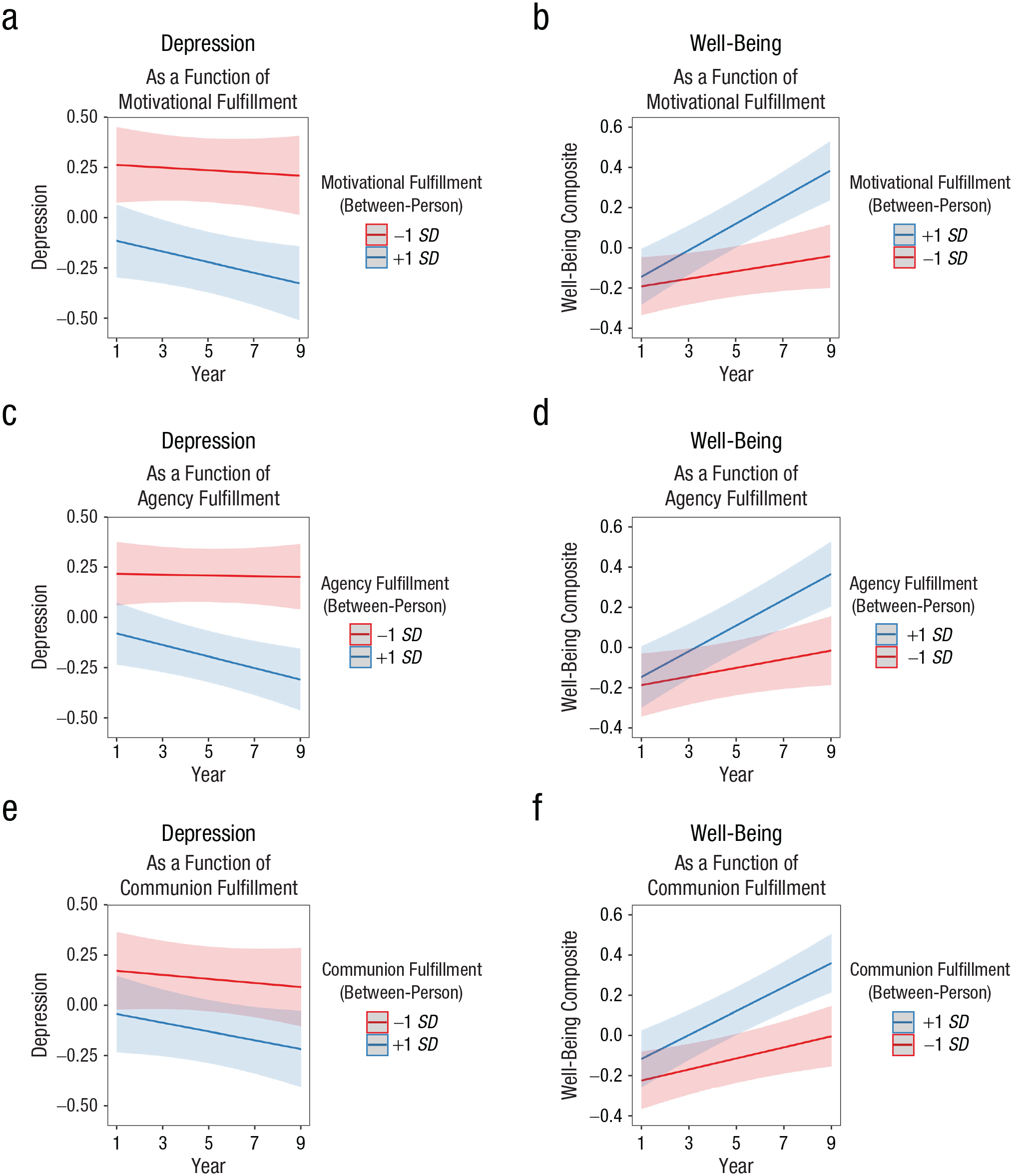
Narration of life challenges. Participants (n = 157) who narrated life challenges with higher motivational fulfillment tended to experience lower overall levels of depression, higher overall levels of well-being, and trajectories of increasing well-being over time. Panels (a) and (b) show the combined effect of agency and communion fulfillment (i.e., the overall effect of fulfilled motivational themes). Panels (c) through (f) show the specific effects of agency (c and d) and communion (e and f). Interactions between motivational fulfillment and time were significant in all well-being models (b: p = .004; d: p = .022; e: p = .048) but not in depression models (all ps ≥ .107). Main effects for motivational fulfillment were significant in all models except (d)—agency main effect p = .057. Fixed-effects estimates were extracted from models holding the effect of Big Five traits and emotional ending valence constant (for a and b, see Table 4; for c and d, see Table S1.2 in the Supplemental Material; for e and f, see Table S2.2 in the Supplemental Material). Time was centered on the study midpoint (Year 5). Depression was assessed by the Beck Depression Inventory–II, and scores were square-root-transformed and standardized for analysis. Well-being was a composite of standardized scores on the Satisfaction With Life Scale and the Scales of Psychological Well-Being.
Narrative identity
Between-person motivational fulfillment was associated with lower levels of depression throughout the study, estimate = −0.56, 95% CI = [−0.86, −0.26], p = .001. In other words, participants who tended to narrative life challenges with more fulfilled motivational themes experienced lower levels of depression throughout the study period. No effects were significant for ending valence. In analyses omitting ending valence (S3 in the Supplemental Material), the within-person effect of motivational fulfillment on depression was significant, estimate = −0.06, 95% CI = [−0.10, −0.01], p = .014, indicating that individuals experienced lower depression in years when they narrated life challenges with particularly fulfilled motivational themes. No other substantive differences were observed.
Specific effects of agency and communion
As shown in S1 in the Supplemental Material, when overall motivational fulfillment was replaced with agency fulfillment or communion fulfillment, no changes were observed in directions or significance levels of effects. One notable difference was that the main effect of agency fulfillment, estimate = −0.65, 95% CI = [−0.95, −0.35], p < .001, appeared to be stronger than the main effect of communion fulfillment, estimate = −0.36, 95% CI = [−0.71, −0.01], p = .045 (see Figs. 2c and 2e).
Well-being
Model comparisons
As shown in Table 3, Models 2 (traits) and 3 (narrative identity) both improved model fit over Model 1 (simple growth curve), and Model 4 (traits and narrative identity combined) improved model fit over both Models 2 (traits) and 3 (narrative identity). This indicates that traits and narrative identity each accounted for meaningful and nonredundant portions of variance in well-being scores over time. Fixed-effects estimates from the traits and narrative-identity model (Model 4) are shown in Table 4 and described here.
Traits
Neuroticism was associated with lower overall levels of well-being throughout the study, estimate = −0.42, 95% CI = [−0.53, −0.32], p < .001, whereas conscientiousness was associated with higher overall levels of well-being throughout the study, estimate = 0.12, 95% CI = [0.03, 0.21], p = .012. No interactions between traits and time were significant, indicating that none of the FFM traits were associated with change over time in well-being.
Narrative identity
Between-person motivational fulfillment was associated with higher overall levels of well-being throughout the study, estimate = 0.33, 95% CI = [0.07, 0.58], p = .013. In addition, as shown in Figure 2c, between-person motivational fulfillment interacted with time, estimate = 0.07, 95% CI = [0.02, 0.11], p = .004. In other words, participants who tended to narrate life challenges with fulfilled motivational themes reported higher overall levels of well-being and increasing levels of well-being over time. Additionally, within-person ending valence appeared to be associated with higher levels of well-being, estimate = 0.03, 95% CI = [0.00, 0.06], p = .045, and between-person ending valence appeared to interact with time, estimate = −0.03, 95% CI = [−0.06, −0.00], p = .042. These effects were barely below the p = .05 threshold and were not present in models analyzing agency and communion separately (within-person ps ≥ .065, interaction ps ≥ .175; S1 and S2 in the Supplemental Material), suggesting that they may not be reliable effects. In analyses omitting the effect of ending valence (S3 in the Supplemental Material), no substantive differences were observed.
Specific effects of agency and communion
As shown in S2 in the Supplemental Material, when overall motivational fulfillment was replaced with agency fulfillment or communion fulfillment, some changes in significance level were apparent for variables that were not the focus of study hypotheses. The within-person effect of ending valence and the interaction between time and ending valence were not significant in the agency or communion models. Additionally, the between-person main effect for communion was significant in the communion model, whereas the between-person main effect for agency was not significant in the agency model. Fixed-effects estimates were in the same direction and of similar magnitude in all models. Notably, focal effects for study hypotheses—interactions between agency fulfillment and time, estimate = 0.05, 95% CI = [0.01, 0.10], p = .022, and communion fulfillment and time, estimate = 0.05, 95% CI = [0.00, 0.10], p = .048—were both significant (see Figs. 2d and 2f).
Discussion
Mental health tends to improve with age, but how does personality, as expressed both in dispositional traits and narrative identity, relate to these trajectories? Notably, both traits and narrative identity explained unique portions of variance in depression and well-being over time in late-midlife adults.
Narrative identity and trajectories of depression and well-being
The study supports extant research (Adler, 2012; Adler et al., 2015) by showing that fulfillment of motivational themes in narrative identity accompanies improvements in well-being and depression over time. This effect was robust, appearing for overall fulfillment of motivational themes, as well as for fulfillment of separate agentic (getting ahead) and communal (getting along) themes and for models that included versus excluded the effect of emotional ending valence. Importantly, previous longitudinal research has shown that narrative themes predict mental-health outcomes on a time scale of weeks (Adler, 2012). The current study fills in this picture on a much longer time scale, showing that fulfilled narrative themes are associated with dynamics and change in depression and well-being over a decade. Tendencies to tell certain types of stories (those with fulfilled motivational themes of agency and communion) were important for depression, as were fluctuations in narrative themes from year to year. For well-being, by contrast, the overall tendency to tell stories higher on motivational fulfillment were more important than yearly fluctuations in narrative style.
Recent research has also suggested that effects of agency and communion on well-being may be accounted for by the effect of emotional tone (Gehrt et al., 2023). Several findings in the current study are relevant for this debate. First, emotional-ending valence correlated more with agency and communion at the within-person level (r = .65) than at the between-person level (r = .47). Second, relationships between motivational fulfillment and longitudinal trajectories of well-being were independent of ending valence. Third, the within-person effect of motivational fulfillment on depression was significant when ending valence was omitted from the model (Table S3.2 in the Supplemental Material) but not when ending valence was included in the model. This pattern suggests that effects of motivational and affective themes may be more shared at the within-person level (reflecting variation in a given story) but more unique at the between-person level (reflecting variation between people across many stories). Importantly, cross-sectional studies cannot disentangle these effects, and distinctions may therefore be most apparent in longitudinal studies.
Symptoms of depression wax and wane over time (Helmich et al., 2020), more so than general well-being, and are known to be influenced by situated or momentary narratives (see also McLean et al., 2007). This may hold crucial therapeutic implications because the type of narratives brought up in therapy are typically situational and more changeable than traits (see, however, Bleidorn et al., 2022) in ways that promote mental health. Notably, connections between narrative identity, depression, and well-being were unlikely to be affected by common method bias because narrative identity was assessed by content-coding interview transcripts, whereas traits, depression, and well-being were self-reported. Yet, as Figure 1 shows quite clearly, participants also demonstrated a large degree of individual variation that was not adequately captured or understood with the current analyses and study design. In its very essence, narrative identity aims to study the person and the unique life (McAdams, 2021). A way to zoom in and truly understand these variations could be through narrative case studies or purely qualitative analyses. Narrative method offers a tool to do just that (Adler et al., 2017).
Traits and trajectories of depression and well-being
As expected, adults lower on neuroticism and higher on conscientiousness (but not extroversion) also reported better mental health. As also indicated in extant literature, individuals higher on neuroticism tend to ruminate, be lower on positive emotion, and show within-person convergence between indicators of well-being, all of which places them at risk of depression and thwarted well-being (Cowan, 2019; Hakulinen et al., 2015; Klein et al., 2011). On the contrary, adults higher on conscientiousness tend to live “safe” and hardworking lives, making them more prone to achieve objectively better lives (e.g., higher financial security: Poropat, 2009; better work-life balance: Liu et al., 2022) and feeling subjectively better than those low on conscientiousness.
Unexpectedly, adults lower on agreeableness appeared to report decreasing levels of depression over time. One explanation might be that individuals low on agreeableness are less prone to follow other people’s expectations and demands, with this behavioral consistency leading to lower risk of burnout and depressive symptoms over time (Hopwood et al., 2021). However, the presence of a significant floor effect in depression scores complicates interpretation.
Limitations
Although this longitudinal study expands on existing narrative-identity research in crucial ways, some limitations must be acknowledged. The sample size was somewhat smaller than many cross-sectional designs in personality psychology, although within-person designs require smaller sample sizes (e.g., Fraley et al., 2022), and the rich narrative data reported in the current study could not have been collected via online survey methods often used in studies with larger sample sizes (Sassenberg & Ditrich, 2019). Additionally, although the sample was well split roughly evenly between White and Black Americans, participants tended to be middle class and were recruited from a single age cohort in a single metro area. Future research should strive to recruit more diverse participants. Finally, participants were asked to write a paragraph for each challenging event, and future research may invite participants to write longer and more detailed narratives. It will also be important to code for other characteristics related to well-being such as coherence.
Supplemental Material
sj-docx-1-pss-10.1177_09567976241296512 – Supplemental material for Narrative Identity, Traits, and Trajectories of Depression and Well-Being: A 9-Year Longitudinal Study
Supplemental material, sj-docx-1-pss-10.1177_09567976241296512 for Narrative Identity, Traits, and Trajectories of Depression and Well-Being: A 9-Year Longitudinal Study by Majse Lind, Sebnem Ture, Dan P. McAdams and Henry R. Cowan in Psychological Science
Footnotes
Transparency
Action Editor: Julia Stern
Editor: Simine Vazire
Author Contributions

Notes
References
Supplementary Material
Please find the following supplemental material available below.
For Open Access articles published under a Creative Commons License, all supplemental material carries the same license as the article it is associated with.
For non-Open Access articles published, all supplemental material carries a non-exclusive license, and permission requests for re-use of supplemental material or any part of supplemental material shall be sent directly to the copyright owner as specified in the copyright notice associated with the article.
