



Abstract
The worldwide expansion of psychiatry as a science at times followed pathways already laid by Christian medical missions to cultures seen as disadvantaged by sponsors. Interracial contacts were one outcome, and racial issues gained visibility in psychiatric inquiry and treatment. Richard S. Lyman gathered socially diverse psychiatric teams at Peking Union Medical College in the 1930s and Duke University in the 1940s, both programs funded by the Rockefeller Foundation. Bingham Dai, a Chinese-born theorist and therapist, and Leo Alexander, Holocaust refugee and later medical investigator for the Nuremberg prosecutors, worked with Lyman at both sites. These itinerant professionals repeatedly struggled to comprehend and influence localities. Lyman’s liberal aim to integrate psychiatry succeeded better in China than in segregated North Carolina.
Keywords
Not long after Richard Lyman arrived in North Carolina in 1940 to start up a psychiatry department at Duke University, he applied for philanthropic funding for ‘our experiment of using selected Negroes as “attendants” on our psychiatric ward at the Duke Hospital’. 1 Privately, Lyman informed correspondents that the plan was nearly a ruse to recruit African Americans into the specialty by the back door. His psychiatric assistants would hold a ‘position which I am trying to elevate somewhat higher than it is’ at Johns Hopkins, where he earned his MD. 2 Here they would acquire ward experience, as well as gain insight into the ‘origins’ and ‘means of control’ of ‘race prejudice’. 3 Any form of black education at a southern white university was socially risky, however, and Lyman’s proposal did show caution. In a region where the colour line signified inequality, he boldly planned equal numbers of black and white, and male and female, trainees. Each race was to come in rotation, however, to avoid integration. This modest stab at social diversity made sense in light of the international psychiatry faculty Lyman was gathering at Duke. He hired two of his former colleagues at Peking Union Medical College in the 1930s: Bingham Dai, Chinese by birth, and Leo Alexander, an Austrian Jew, now both refugees. Other foreign-born psychiatrists joined them. Even so, the professionals did not work in a social vacuum, and the biracial project floundered. It was ‘liberally discussed’ at the Rosenwald Fund in Chicago, but the staff declined to make an award to ‘one of those things which is so far ahead of actualities that we are unable to form a unanimous affirmative opinion’. 4 The Rockefeller Foundation gave only enough support to produce a handful of African American assistants. 5 In 1942 Lyman launched a new plan to replace them with conscientious objectors.
The key feature of this racial initiative was its brief life, and the episode invites reflection on the tangled connection between psychiatry and racial questions at the time. International career paths of mobile professionals were increasing inter-cultural contacts and highlighting human differences often said to have racial roots. Nonetheless, medical specialists of the mind were only modestly trained to understand the sociologies of race and place. As itinerants, moreover, they lacked intimacy with their temporary communities that might have facilitated racial reform.
In this way, Lyman’s theoretical openness and global travels set the stage for both innovation and frustration. He took a cultural view of race. All share ‘a general human biological reaction’ in ‘the depths of the person’, he explained in a lecture at North Carolina College for Negroes in Durham, not far from Duke University. 6 Yet he called for a ‘science of Negro Psychiatry’, presumably because he had already discovered the daunting day-to-day meanings of race in the segregated South. 7 His black assistants could not use the Duke library, and his African American patients, barred by policy from beds in the psychiatric ward, suffered from poverty and poor schooling that limited the usefulness of outpatient therapy. 8 Literally a Connecticut Yankee by birth, Lyman instinctively turned for guidance to his work abroad: ‘I was in Pekin, China, for 5 years’ and ‘saw the opening of the Pekin Municipal Psychopathic Hospital’. Adding that the facility’s staff shortages brought it ‘dangerously near becoming just a custodial institution’, he implied that professional development – the goal of his current project – promised reasonable care amid social disadvantages. 9 Without probing what a race is or wondering if medical strategies effectively migrate between cultures, Lyman acted on his plan. When it did not work, the constant demands of practising psychiatry meant that he did not pause to assess his failure.
Analysis of the racial views of Lyman and his colleagues might stress either their personal accomplishments or their common experiences suggestive of the orientation of their professional cohort. This essay mainly pursues the latter course. Without question, each man earned a place in history. Lyman (1891–1959) was the first psychiatrist fully educated in the specialty to organize Western-style training and treatment in China (Kleinman, 1988: 100). Alexander (1905–85) was the lead medical consultant for the postwar Nuremberg prosecutions of Nazi doctors, and Dai (1899–1996) was the first scholar living in the American South publicly to endorse the psychological damage argument used in Brown v. Board of Education (Rose, 2009: 104; Schmidt, 2004).
Yet all three entered psychiatry at a moment of global expansion, and their historical situation shaped their choices (Hayot, 2009; McCullough, 1995). Trained by the field’s pioneers, they were not so much theory-builders as organizers, and the process of extending the geographic boundaries of psychiatric practice brought them face to face with racial issues. Lyman exemplified this pattern. In 1940 he explained to his mentor, Adolf Meyer of Johns Hopkins, that Meyer’s system of psychobiology was ‘so cleanly in harmony with my own experience’ that Lyman devised no ‘philosophy’ of his own. If lacking in originality, however, Lyman possessed energy and zeal. 10 ‘Restless’ and seeking ‘adventure’ were the words he used to describe himself to Meyer just before he left the USA in 1929 to study in the Russian laboratory of Ivan Pavlov. 11 All in the group that reassembled at Duke were worldly men: curious, observant and adaptive. Their breadth also made them vulnerable. The worldwide political and military disruptions of the interwar and World War II decades arguably have no modern equivalent. Each one of these psych-iatrists fled aggressors, and their careers evolved as much as a series of accidents as deliberate plans (Rose, 2009: 120; Schmidt, 2004: 44-50; see also Bullock, 1980: ch. 8; Lutz, 1971: chs 8–10). When they thought about race, they did so from the perspective of people on the move.
Their travels were not entirely random, however. Beijing and Durham were comparable medical backwaters in the eyes of the Rockefeller Foundation, the sponsor of both new psychiatry programs (Bullock, 1980, 2011; Fosdick, 1962; Lyman, 1947; Rose, 2009; Seipp, 1963). The theory behind the projects was clear: science, health, and social progress were inseparable partners. Speaking in China in 1915, William Welch, dean of medicine at Johns Hopkins, declared that ‘modern science’ opened a ‘new epoch for Western civilization marked by the introduction of exact observation, experiment, and verification of hypothesis’. 12 Welch was part of a Rockefeller team that secured the philanthropy partial control of Peking Union Medical College, founded by missionaries in 1906 (Lutz, 1971: 146). Religion remained integral to his vision. ‘The missionary work that has already been done furnishes a foundation for our efforts’, and scientific ‘love of truth’ in turn was ‘the foundation of true Christian character’, Welch (1915/1920a: 171) affirmed. 13 Although these grand words were silent about racial differences, the missionary heritage exercised an enduring influence on medical contacts at cultural margins, at home and abroad. Christianity and science were both universal truths, the thinking went, and anyone who lacked them – often people of colour – needed remedial care.
This essay argues that psychiatry’s early global migrations encouraged critical self-reflection about race, and yet these mobile professionals were ill-positioned to carry through reforms. They were perpetual outsiders, distant from the centres of medicine and disengaged from localities. They faced unfamiliar cultural situations: the established worldwide network of medical missions, Beijing in the 1930s, and Durham in the 1940s. Of these circumstances, the racial segregation enforced by law and custom in the American South proved most resistant to innovation in psych-iatric practice.
Medical miracles
Among these colleagues, only Lyman was born a Christian, but all practised in places understood by their sponsors and peers to be disadvantaged and where missionary medicine was firmly rooted. 14 Welch had repeated a core principle of Christian outreach: health and faith were allied. ‘Heathen lands are lands of pain’, explained a Southern Baptist Convention (SBC) pamphlet in the 1920s: ‘Scientific medicine has developed only in Christian countries’. 15 Relief of unconverted sufferers within the USA was a kindred duty. For example, to train women for ‘efficient service in foreign and home missions’ was the aim of a new SBC school in Louisville in 1907. 16 It is safe to say that all knew that the work at many global sites involved interracial contacts, but the rhetoric of bodily healing and spiritual conversion made race seem a secondary concern. Although American white supporters of missions had differing opinions about non-white peoples, southerners – Lyman’s eventual neighbours – did not generally question racial inequality as a natural or social condition. It is a telling fact that southern Presbyterians, separated from the northern denomination by secession in 1861, hastened to meet in Georgia that December to plan world missions (Fulton, 1938: 43). Implicitly, racial hierarchy was compatible with Christian uplift.
Western medical care for the mentally ill in China was a direct outcome of missions. John G. Kerr, an Ohio-born Presbyterian, had spent decades in Canton as a doctor before he opened the country’s first mental hospital there in 1898 (Latourette, 1932: 454; Lutz, 1971: 141–2, 157; Pearson, 1991: 133–5). Diverse observers, whether focused on science or faith, acknowledged the facility. Herbert Day Lamson, a sociologist teaching in Shanghai, cited the 726 patients it treated in 1924 as far overshadowing the few psychiatric wards in general hospitals (Lamson, 1935: 434). A missionary who compiled a photo album around the same time included a view of ‘The insane asylum – Canton – Presbyterian Mission’, along with snapshots of ritual objects labelled ‘Idols’ and a man called ‘A Cheerful Beggar’. 17 Whatever the Kerr hospital’s treatments, proselytizing was probably part of the routine, as it was in medical missions elsewhere. One SBC hospital in Wuchow in 1938 had an ‘evangelistic department’ to oversee spiritual counsel, church services and tract distribution. 18 The missionaries’ reason for ambitiously offering physical, mental and spiritual remedies was that Jesus had done no less. ‘The full New Testament program’, stated a 1954 report on Nigeria, after communism had closed China missions, was that ‘preachers are trained, lepers are cleansed, the sick are healed, the lame and blind and halt are being restored, and the gospel is preached to thousands’. 19
How readily missionaries absorbed the medical and social sciences was remarkable, considering ongoing modernist-fundamentalist disputes within nearly every Christian group. One strong motive for staying up to date was that spiritual persuasion depended on successful healing. ‘Those who scoff at the “foreign devil” preacher gladly bring their dear ones ravished by disease to the physician’, one publication noted, and a cure clearly helped to overcome ‘opposition and prejudice’. 20 Although missionary training programs did not provide medical education to doctors, their curricula aimed to make all graduates socially effective. The 1924–5 catalogue of the Methodist Scarritt College for Christian Workers in Nashville listed required courses in ‘Psychology and Religious Education’, ‘Social Science’ and ‘Health and Hygiene’, in addition to study of the Christian Bible, history, doctrine and ethics. 21 The SBC’s Carver School of Missions and Social Work was slower to add the mental sciences, presumably because the Bible seemed sufficient on spiritual matters. A mandatory course sequence in ‘Human Growth and Behavior’ became part of its MA in Missions around 1960. 22 The most theologically liberal missionaries, however, boldly pursued the human sciences. In 1926, the same year as the Quaker Thomas Elsa Jones left the Japanese mission field for the presidency of all-black Fisk University in Nashville, he submitted his dissertation on Japanese mountain villages for a PhD in sociology at Columbia University. He later named the anthropologist Franz Boas and psychiatrist G.M. Stratton as his mentors (Jones, 1973: 72–81).
In all, scientific education, cross-cultural labour and a holistic view of the patient as both body and soul drew the attention of missionary physicians to racial differences. Even so, their denominations, locations and personal reactions to field service were so diverse that there was no single understanding of race. Peking Union Medical College (PUMC), where Lyman and his associates first came together, was an interdenominational project, and some staff continued into the Rockefeller era. Its racial climate may be grasped in the context of three general points about missions and race: denominations entered the field with distinctive racial premisses; China was unusual; and missionaries away from home could bend their sense of correct racial behaviour.
Probably no two Christian missionary organizations took quite the same approach to race. Southern Baptists and Methodists, for example, were startlingly different. Baptist outreach publications were virtually silent about race as a matter of colour or culture. With conversion as the goal, the wording emphasized beliefs. A 1938 report stated that Nigerian schools served ‘heathen and Mohammedan children who may be led to Christ’. 23 Spiritual merit did not imply social equality, however, but this did not have to be said outright. At the height of civil rights activism in the 1960s, a Baptist hospital newsletter in Alabama, The Rebel Review, featured monthly photos of valued African American employees, typically maids and cooks described as family-oriented and churchgoing. 24 Methodist-affiliated Scarritt College, by contrast, engaged racial problems head on. A statement of purpose in the 1920s described ‘Negroes and Indians’ as objects of home missions, and the faculty periodically took up racial justice. 25 In 1943, for example, a professor of Bible lobbied state officials to permit a black teenager convicted of manslaughter to serve his 10-year sentence at a vocational school. 26 It may be that the Methodists’ racial frankness was a product of their greater social and theological liberalism. Denomination, in any event, affected the way missionaries acted on their racial awareness.
The missionaries’ aspiration to universalize their faith introduced further diversity: cultures associated with races varied, and the Chinese impressively stood out. With amazing uniformity, Western visitors were awed by Chinese tradition, before they declared it insufficient and predicted its demise. ‘As man-made systems’, Confucianism and Buddhism were ‘about the best that human philosophy has done’, wrote C. Darby Fulton, director of southern Presbyterian world missions, after an Asian trip in 1937 (Fulton, 1938: 12). Christianity, for Fulton, nonetheless surpassed both religions. For Welch, the pinnacle was science. Although ‘the two great bodies of ancient knowledge are the Greek and the Chinese philosophy’, he explained in Changsha in 1915, the experimental ‘method has allowed us to outstrip you’ (Welch, 1915/1920b: 175, 176). Bertrand Russell, atheist and socialist, likewise praised China’s ‘unbroken tradition of civilization’ just before his visit in 1920, then turned round to blame the country’s failure to modernize for its weakness ‘against the Great Powers’ and ‘Western commercialism’ (Russell, 1919/2000: 70, 73). The American art connoisseur George Kates recalled his 1933–41 residence in Beijing as an enchanting ‘adventure’, but he still called the city ‘a grandly decaying capital’ (Kates, 1952/1967: 1, 24). For all these observers, the Chinese were worthy competitors, if not equals. This logic suggests how Westerners calculated differences among non-white peoples.
The isolation of missionaries from their home bases was another factor to lend unpredictability to their racial understanding. Mission doctors in particular, distant from research centres and collaborators, could demonstrate an independent streak. Andrew H. Woods, Lyman’s predecessor in neurology and psychiatry at PUMC from 1919 to 1928, published pioneering clinical data on Chinese patients, and his work was remarkably eclectic (Anon., 1958). Woods (1929) surveyed pathologies of brain and mind attributable to disease, malnutrition, addiction and circumstances such as ‘intolerable situations in domestic life’ (p. 567). He performed post-mortems, enquired about conjugal habits, and compared national attitudes about masturbation with a sociologist’s detachment. Virginia-born and the son of a Presbyterian minister, Woods arrived in Canton in 1899 as a medical missionary. He was attentive to race in the sense that he saw the Chinese as physically and culturally different, but he affirmed ‘the solidarity of the human race’ in ‘their moral intuitions’ and found his patients suffering from ‘ordinary forms of obsession, morbid compulsions, anxiety neuroses and the “effort syndrome”’ (pp. 566, 569). Hardly a stereotypical missionary, Woods enjoyed Chinese ‘wit and humor’ (p. 566). It seems that he found life in the mission field liberating, and he made the most of his chance to think for himself.
Together, denomination, place and personality influenced how racial questions figured in medical missions. But there was never a doubt that differences of colour and culture would be components of the primary work of cure and Christianization. The missionary legacy was a living force at PUMC when Lyman arrived in 1932. The Rockefeller family, who were northern Baptists, and the hospital administrators were at odds for years over how actively to proselytize (Bullock, 1980: 66–72). Although Lyman stayed out of this fray, he struggled, rather like the missionaries, to address race without losing sight of his fundamental goal: developing psychiatry.
The Chinese patient as a person
Bingham Dai’s essay ‘The patient as a person’ made no mention of the concept of race, but its crisp argument that the mentally ill have a ‘social personality’ identified cultural variety as a psychiatric concern (Dai, 1939: 18). The paper was the theoretical highpoint of clinical work done by Lyman’s team in Beijing, and it was published there in 1939, the year Dai left China as the last of the Western-trained psychiatrists at PUMC (Blowers, 2004). Japanese imperialism, responsible for the military occupation of the city since 1937, cut short their efforts. Lyman had departed that year, whereas Leo Alexander was only there in 1933 and Dai arrived in 1935. Amid this disruption, they could not have anticipated that their cross-cultural psychiatry would be more successful in China than in North Carolina.
When Lyman wrote to recruit Dai in 1935, he had a plan ‘to develop a combination of medical, psychoanalytic, and social approaches to the problems in our community’. 27 However, his purpose took shape in uncertain circumstances, which he managed to exploit. An inveterately generous man, Lyman reached out to others in crisis because he had experienced problems himself. His divorce and remarriage was one reason he had resigned from the University of Rochester in 1929 and worked abroad for three years in Leningrad, Germany and Shanghai. 28 He met Alexander in the clinic of Karl Kleist in Frankfurt in the summer of 1932 and hired him to direct the PUMC neurological laboratory. 29 Lyman paid the salary himself, and when Alexander – ‘who happens to be a Jew’ – was ‘advised to stay out of Germany for awhile’, Lyman arranged for safer employment in the USA. 30 He similarly arranged funding for Dai’s return to China, when Dai, newly married, sought employment while completing his PhD in sociology at the University of Chicago. 31 Rockefeller contacts were influential at every step. Lyman’s MD from Johns Hopkins probably opened the door at PUMC, modelled on the Hopkins medical school. Dai had participated in the Rockefeller-funded Yale seminar on ‘The impact of culture on personality’ led by Edward Sapir in 1932–3. 32 PUMC friends continued to aid Alexander in 1934 when he left an ill-paid job at Worcester State Hospital for Harvard (Schmidt, 2004: 54). Whatever the PUMC psychiatry department achieved, the foundation was personal loyalties within the philanthropic network.
Lyman’s gift as a good-hearted opportunist, however, did not give him the capacity to systematize. His approach to race was haphazard in theory and practice. More positively, the experimental atmosphere he fostered offered colleagues space to develop their own views.
Intellectually, Lyman followed the holistic approach to the patient taken by his teacher Adolf Meyer (1866–1950), and Meyer’s emphasis on synthetic assessment gave racial background a role. ‘Psychobiology’, Meyer wrote in 1934, explores ‘the mentally integrating functioning of the live human organism’ in light of ‘the whole life record’ (Meyer, 1934/1948: 594, 597). So faithful was Lyman to Meyer that he asked him for blueprints of the Johns Hopkins psychiatric clinic to guide construction in Beijing. 33 Meyer, for his part, applauded Lyman’s chance to study ‘another race’. 34 Whereas Meyer was at home in the clinic, Lyman was also drawn to the laboratory, a site Meyer (1948) censored as devoted to minutiae esteemed by ‘a false conception of science’. Lyman’s experiments did indeed seem distracting at a time when China itself stood before him as a subject. ‘My unfinished interests here’, Lyman explained to Meyer in 1937, ‘include the effect of electrolytes with and without electrolysis with electric current in the ventricles, applications of psychometric technic [sic] to various clinical problems, the attempt to find a method of extracting primary factors from a combined social-psychological-physiological survey of personality, further studies of roetgen [sic] effects on nervous tissues, some racial differences affecting behavior with special reference to aphasia among the Chinese, etc.’ 35 Inter-cultural comparisons of personality, although not forgotten, were buried in the list, perhaps because psychiatry’s aspiration to be scientific had shifted emphasis from informed observation to demonstration, as Meyer charged.
Meyer himself was less a writer than a practitioner, immersed in patient care and student training, and Lyman likewise did better as an organizer of people. He aimed ‘to form something of a team’ to achieve ‘a unification of neurology, psychiatry and social service, with close contact with physiology and psychology’. 36 The obstacles were daunting. There were only seven psychiatric beds in the PUMC hospital, and it is unclear whether he ever changed the existing policy that excluded psychotic cases from admission as in-patients. 37 To reach the mentally ill, he contracted with the city to finance reform of the public asylum, now overcrowded and with ‘no baths, insufficient food, no medical attendance’. 38 Once it became the Municipal Psychopathic Hospital, this was a training site for his students. To support the work he opened a school for psychiatric attendants, previously policemen or inmates ‘taken from the Beggars’ Home and forced into service’. 39 Language was another problem. Lyman hoped ‘to call for help from abroad’, including his Russian and German friends, and yet Alexander, for one, initially spoke little or no English. 40 English was a strong second language for medical students such as Tsung-Hwa Suh, educated at the Yale mission in Changsha. 41 To speak with patients, however, Lyman himself used translators (Kao, Ting, and Hsu, 1939: 345).
Lyman’s open-mindedness nonetheless enabled him to work well with Chinese collaborators (see Fig. 1). Social and Psychological Studies in Neuropsychiatry in China (1939), a collection that he edited, consisted of clinical studies by his Chinese students and colleagues. Using social-scientific tests and models, the papers admitted to not answering fully the main question: ‘Do the differences of Chinese civilization change the clinical pictures of Chinese mental patients?’ (Kao et al., 1939: 358). The value of gathering data lay more deeply in the scientific community formed. Lyman repeatedly aided its members, much as he helped Alexander and Dai. In one case in 1941, he paid for the tuition and housing of Chün Ch’un (Katherine) Kao at Duke, where, leaving ‘massacre and destructions over many parts of China’, she came to study psychology. 42 How much Lyman’s socialist leanings drove his practical liberalism is hard to say. Well into the Stalinist era in 1933, he informed Meyer that ‘I am frankly Russophile and almost enthusiastic about the Soviet experimentation’. 43 But his politics were no more precise than his psychiatric theory was, and although he easily crossed racial boundaries as a professional, race was not an explicit concern in his administrative plans.

Richard S Lyman (second row, middle) and Peking Union Medical College staff, 1936 (source: Special Collections, Belk Library and Information Commons, Appalachian State University, Boone, North Carolina)
Perhaps Lyman did well to be open-ended because his job was to start up psychiatry as a new specialty at PUMC. The notion of identity found in the Chinese work of Bingham Dai, in contrast, was theoretically precise. Dai conceived of the individual as more than ‘a biological being’ motivated by ‘instinctual drives’; a person is ‘a social and cultural being’ shaped by ‘interpersonal relations’ and especially ‘the present life situation’ (Dai, 1944a: 337). His statements appeared in an account of his 10-month analysis of a 22-year-old man in Japanese-occupied Beijing. Therapist and patient explored the man’s obsessive-compulsive habits in relation to Chinese family structure, sexual norms and political conflict. Lyman had eagerly sought Dai for precisely this: in-depth verbal therapy by a professional who not only knew the method but also the indigenous language and culture. Psychoanalysed for learning purposes in the USA by Harry Stack Sullivan and Leon Saul, Dai was well suited to teach PUMC students ‘the technique of Psychoanalysis’, as Lyman planned. 44 Dai, in turn, brought with him a devotion to China, where he hoped to pursue ‘my life-interests’ in ‘the field of culture and personality as a scientific study and that of mental hygiene as a humanitarian movement’. 45 That Dai was Chinese, and able to bridge the cultures, Lyman never said outright. The same rhetorical indirection about race characterized Dai’s cultural argument: he disposed of somatic components of human differences largely by ignoring them. However, any scientifically informed reader could see that Dai considered race a social construct.
Although Lyman sensed the multiple ways that dissimilarities between China and the West affected his group, he did not let race dominate its psychiatric program. He would not have imagined his commitment to science to be comparable to a missionary’s loyalty to Christianity, but both systems claimed universality, all the while coping with human variety. Interracial contacts enriched PUMC psychiatry on the whole, and the variables at play – pre-existing racial attitudes, specific location and distance from home – were similar to those affecting missions. More specifically, Lyman displayed personal tolerance, China had a high culture, and Beijing was comfortably far from US racial conventions.
Lyman’s psychiatry initiative was abruptly ended by Japanese soldiers, but its success as an interracial venture never made it an idyll. Despite collegial relationships with the Chinese, Lyman’s ties with the college, city and profession were not problem-free. PUMC as an institution had never easily balanced basic research and public ‘service of a routine nature’, in the words of Franklin McLean, its first director, during one dispute in 1920. 46 By 1935 Lyman considered resigning for administrative reasons, and the Chinese ‘agents and middlemen’ needed to recruit ‘poverty-stricken men for some harmless experiments’ irked him as more bureaucracy. 47 This crude private comment to Meyer betrayed how much social class mediated Lyman’s friendliness and how superficial his familiarity with China really was. He felt cut off from Western medicine as well, so much that in 1937 he judged ‘another five-year appointment here would mean that I would probably have to spend the rest of my professional life in China’. 48 In all, Lyman’s years in Beijing exposed the modest social efficacy of personal goodwill. The lesson was repeated more bluntly in North Carolina.
The southern road to Nuremberg
On the world stage, the most visible accomplishment in the 1940s of the Western-trained psych-iatrists who passed through Beijing was the investigative work of Leo Alexander for the Nuremberg trials of Nazi doctors in 1946–7. Their earlier regrouping in North Carolina may seem like a war-imposed detour through a regional backwater. In fact, paths among global communities understood to be on the periphery of modern medicine were well travelled by agents of missions and philanthropies. The career of Franklin McLean, MD (1888–1968), for instance, also included phases of service to China and the American South. Removed from leadership of PUMC in 1923 by Rockefeller administrators, he laboured at home. Based at the University of Chicago, McLean periodically toured the South to report on segregated medical institutions for their northern charitable sponsors. 49 He was troubled that racial separation blocked the flow of scientific information, and yet he was still fearful in 1953 that social protest would be medically disruptive. He mildly proposed ‘abandoning the policy maintaining “separate but equal” facilities for Negroes as soon as it is deemed feasible to do so’. 50 McLean’s political moderation did not diminish his strenuous devotion to black medicine, demonstrated as a board member for the Rosenwald Fund and the founder of the National Medical Fellowships to train African American doctors (Wrist, 1975). 51 In 1940 a Rockefeller grant to establish psychiatry at Duke University similarly placed Lyman in the midst of racial segregation.
Racial goals were prominent in the predictably sprawling agenda Lyman brought to Durham after several years in Meyer’s laboratory. In September 1941, as he began his second year at Duke and welcomed the first and only class of black ward assistants, he laid out ‘immediate projects of my own’ to a Duke colleague in sociology: ‘work relating to stimulation, in which some of the subjects are negro children in Durham, survey of projects in the south which bring academic, state, or federal and community interests together, … and the whole question of how to get “mental hygiene” to apply to negroes in the south’. 52 Although his regional ambitions and allusions to child nurture gave his list a vague tone, he identified the races with typical American clarity: black or white. Legal segregation of public space in North Carolina supported his view (see Fig. 2), and also suggested the magnitude of his task, even without the distractions of wartime psychiatry.
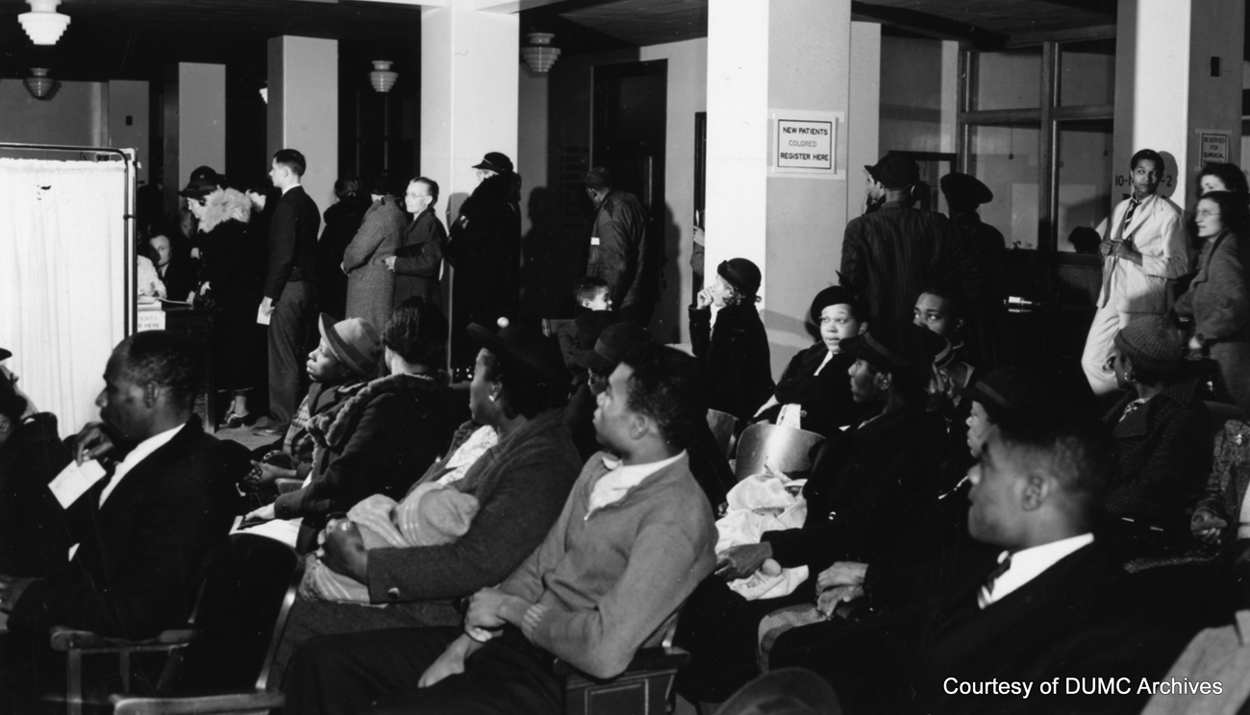
Outpatient waiting area, Duke University Hospital (no date); it was official hospital policy until 1941 to maintain separate outpatient hours for the races: first whites, followed by African Americans (source: Duke University Medical Center Archives, Durham, North Carolina)
Lyman’s interest in racial matters competed with staffing and treatment questions magnified by international war. Building the Duke psychiatry faculty meant resolving visa and licensing problems for its refugee members, as well as coping with the housing needs and military service of nearly all. Lyman corresponded widely and constantly on these subjects. In 1941, when he brought Alexander from Boston, he stepped in to support Alexander’s immigration case at the State Department and also found the family a house. 53 A year and a half later Alexander moved to Fort Bragg and later England as an Army psychiatrist, not long before Dai, who had been teaching at Fisk in Nashville, reached Durham with his family. Lyman himself spent much of 1944–5 working off-campus for the Office of Strategic Services (OSS). 54 In 1945 he and Dai went together to China, officially to conduct psychiatric interviews of Chinese men training as agents and privately to encourage Chinese medical friends to develop psychiatry. 55 Combat stress had indeed increased public awareness of mental health, and in the midst of the Duke staff’s comings-and-goings, Lyman’s correspondence documented an expanding array of psychiatric options ranging from hypnosis and psychoanalysis to electric and insulin shock (Herman, 1995). In this setting, Lyman could not afford to be preoccupied with race relations.
His ward-assistant training program that aimed at eroding the colour line disappeared, and yet Lyman and his coworkers did not forget about race. He demonstrated his pragmatism by moving on, once it was clear that the philanthropies, university and surrounding culture would not support the social risk of producing well-educated African American psychiatric aides. Nevertheless, institutional failure did not end these psychiatrists’ engagement with racial inequality at personal and intellectual levels.
Lyman had shown in China that his ethical streak and outgoing temperament easily connected him with Chinese associates, and he revealed the same facility in the South. In later years he made it a personal goal to teach psychiatry at Rockefeller-funded segregated colleges. He contemplated a move to Tuskegee Institute in Alabama in the late 1940s, and when he retired from Duke in 1951 he spent two years in Nashville as a visiting professor at Meharry Medical College, the only medical school open to black students in the region. 56
Earlier at Duke, he was open and generous with his black trainees, but at the same time respecting racial conventions. When the year ended, he took pains to place his ward assistants, already graduates of the top segregated colleges, in social service jobs or medical schools. He wrote with refreshing candour to one woman who was blocked by prejudice from Johns Hopkins. The doctor there so obviously dragged his feet about allowing ‘“colored students who are not doctors of medicine”’ into his class, Lyman explained, repeating the doctor’s disparagaing phrase, that ‘I suggest that you do not plan just to drop in on’ him. 57 Although his no-nonsense recognition of racism took her into his confidence, he tolerated bias in practice. His letters of recommendation included the candidate’s colour, always ‘light-skinned’ or ‘of light complexion’, irrespective of the recipient’s race. 58 Outside the psychiatric ward, he was just a bit embarrassed by ‘the question of servants’. ‘I do not necessarily mean that the cook is a part of the fixtures of the house’, Lyman told Alexander, after confirming that the domestics employed by the former tenant agreed to stay on. 59 Lyman produced no scholarship about race during his decade in Durham, but the varied social meanings of colour were clearly on his mind. As in China, he comfortably crossed boundaries in relationships with educated co-workers. The difference in the USA was that after 1942 there were no professionals of colour on his ward, with the exception of Dai.
Of these two men, Dai was far more the writer, and his anomalous situation as a Chinese intellectual in the segregated South positioned him to conceptualize black-white relations as one form of global cultural contact. Throughout a long career in the USA that extended to the 1990s, Dai adhered to a basic premiss: personality consists of ego construction influenced by social experience (Atkins, 1977). His steady stream of essays during his first years at Duke revealed his growing awareness of how diversified communities were. Interviews of 90 black students at Fisk in 1942 led him to argue that the ‘American caste system’ of racial separation elicits unhealthy responses ranging from compulsive status-seeking to habits that ‘narcotize their sensitivities’ to inequality (Dai, 1946: 189, 187). In another paper, presented at the prestigious interdenominational Conference on Science, Philosophy, and Religion in New York in 1944, he used his gift for self-observation to comment on the real-life complexities of nationality, ethnicity and race. He confessed that he and ‘his American-born and American-trained Chinese wife’ argue, because she ‘encourages our little girl to fight back when attacked’, contrary to Dai’s advice ‘to bring the dispute to me or other elders in the family for settlement’ (Dai, 1944b: 141). He did not say that the place of conflict was Durham, where his daughter was attending a white school. 60 In this and other instances Dai paid a personal price for his scholarly insights. In 1938 Leon Saul apologized for using him as a representative Chinese subject in Saul’s ‘very disguised’ published account of Dai’s psychoanalysis. 61 The black faculty at Fisk ‘had prejudices among themselves’, Dai’s wife recalled; ‘that’s why we left’. 62 By offering Dai a job in 1943, Lyman gave him no formal opportunity to study race in the USA. Living in the South was nonetheless an education.
Dai’s sensitivity to American racial patterns contrasts with the absence of comment by Duke’s other refugee psychiatrists, most notably Alexander. Lyman’s commission to build psychiatry in Durham grew from the premiss that the South was medically deficient and required outside help. In 1947 he cited the accidents of wartime as the reason for his unusual reliance on ‘foreign-educated psychiatrists’: four trained in Vienna and one each in Germany, Holland, and Chile, in addition to Dai. 63 Some were specialists with narrow interests in catatonic states or insulin therapy. In contrast, Alexander soon became a symbol of human rights advocacy, and yet he left no record of concern about segregation.
Alexander’s European orientation seemed to make him impervious to his residence in the South. He became a prolific author in the USA after his first English-language publication appeared in 1934, and he credited his American mentors with his appreciation of culture. Alexander (1953: v) wrote in the acknowledgements of one book that Lyman taught him ‘the importance of social factors in eliciting, evoking, enhancing, or relieving mental disorder’. Alexander was nonetheless out of place at Duke, except for his whiteness. Among 62 officers in the 65th General Hospital unit of the US Army, formed by Duke doctors, he was the only person educated abroad. 64 The corps’ tone was also distinctly Christian, with one newsletter bearing the title, ‘There’ll always be an Easter’. 65
Caught in these cross-currents, Alexander did not use race as a concept. His postwar analysis of Nazism focused on the perpetrators’ behaviour rather than the Jewish victims’ supposed racial inferiority. Killing the innocent was a test of admission to the Nazi ‘criminal gang’, he explained in an essay borrowing sociological theory (Alexander, 1948: 301). Nor did he make racial observations privately. A letter to Lyman from Fort Bragg in 1943, where Alexander screened as many as 350 recruits daily, calculated the frequency of ‘psychoneuroses’ in different North Carolina counties, but it made no racial comparisons. 66 Alexander’s intention to return to Duke after the war suggests that he had no ethical objection to segregation sufficient to make him look elsewhere. He imagined North Carolina as a home base for his international research. When enquiring about his old job, Alexander wrote to Lyman: ‘I am convinced that more investigative work of a sociologic-neuropsychiatric nature, including personality studies of war criminals, should be done in Germany, and I should like to do it as a civilian consultant’. 67 Black-white issues did not figure in Alexander’s plan.
In the midst of the psychiatrists’ diverse responses to the racial inequality on their doorstep, Lyman lost no time in replacing the black ward attendants with another controversial minority: white conscientious objectors (COs). The success of Civilian Public Service Unit 61 demonstrates how decisively race affected the outcome of a risky social policy. To be sure, the diplomacy Lyman learned from his earlier failure at racial reform now served him usefully. The Selective Service and Methodist Commission on World Peace, together securing about a thousand jobs for COs in mental hospitals by 1943, convinced Lyman that the public doubted the men’s loyalty and resented their freedom. As required, he approached Durham’s American Legion Post, composed of military veterans, and Duke’s student body for their consent. His argument centred on idealism and practicality: as individuals motivated by ‘religious ethics’, the COs would ‘relieve the acute shortage of help at Duke Hospital’. 68 He was socially, and especially racially, cautious. In Maryland, others established a ‘Negro-White Unit’ of COs, where, in the words of a circular letter to all locations, ‘they are making real progress in interracial relationships’. 69 At Columbia University, COs trained for ‘post war [sic] relief administration in foreign lands’. 70 Lyman’s proposal had no racial or cross-cultural goals. Although the men who eventually came had specialized skills and advanced degrees, they were no better educated than the black trainees, but they were white and did not disturb racial custom. In 1946 Lyman wrote gratefully to the Selective Service that the experiment ‘raised the standards of attendants in our hospital’. 71
He left no explicit evidence that at some point he privately concluded that to anchor psychiatry at Duke he needed to jettison racial reform. The facts indicate, though, that he accepted this trade-off. In 1947 he reasonably described his accomplishment to the Rockefeller sponsors as ‘solidifying the department’. 72 In a hospital of more than 600 beds, the number reserved for psychiatry grew modestly during his tenure from 17 to 18. 73 Therapeutic progress was not much more dramatic. Proud that Meyer Ward, named for his mentor, adhered to ‘the “total” approach to the patient … consistent with Meyer’s psychobiology’, he vaguely assured the Rockefeller philanthropy that current practice was not ‘a mere mirror image of his older psychobiological teachings’. 74 In Lyman’s favour, the initiative survived wartime, and yet its racial profile was static. There were some African American patients. In cases where psychiatric social workers assisted in 1947, 45 were black adults and children and 364 were white. 75 No black patient, however, could be admitted to the ward. The only African Americans on the staff were ‘ward helpers’, a category below ‘assistant’. All four were women, and two were ‘Colored’. 76 Segregation in the USA had never meant that blacks and whites would not cross paths, only that social privilege was clear. Duke’s psych-iatry department conformed to its racial culture.
White-oriented in its professional composition and service, the North Carolina unit departed from the biracialism of Beijing. Lyman never doubted the superiority of Western medicine, but he behaved graciously abroad as a rather solitary guest amid Chinese colleagues and patients. At home he accepted the restraints he felt as a member of the white majority. Missionaries might have warned him that an international agent had some social freedom far from the judging eyes of peers. A Presbyterian missionary confessed: ‘The writer has himself preached frequently in public places in the Orient without too much of self-consciousness or embarrassment; but to stand on Peachtree Street, or Canal Street, or Monument Avenue, to be gaped at by passers-by, is a different matter’ (Fulton, 1938: 63). The specific race in question also curtailed Lyman’s options. To most of his white contemporaries, the Chinese on their native ground differed sharply from the descendants of African slaves. Where he found himself in the South, black signified degradation. A speaker from a court-sponsored ‘correctional school’ informed the Duke psychiatrists in 1944 that her white female charges resisted apprenticeships in households because ‘they would have the same position as a Colored maid’. 77 Lyman brought liberal racial attitudes to Beijing and Durham alike. But the details of place and race, variables equally affecting medical missions, made his work in Durham disappointing from the standpoint of racial justice.
Although social uplift was always a collateral goal of both medical missions and scientific outreach, understanding race and transforming racial relationships were never explicit purposes and were often unwanted distractions. In this way, practising psychiatry was the focus for Lyman, Dai and Alexander, but racial matters were also to varying degrees a concern. Lyman retired when he was 60, mainly because he wearied of the bureaucracy connected with rising public acclaim of psychotherapy. When the State Board of Public Welfare asked him to file a card about each patient in 1946, he refused to betray confidences: ‘we have a great deal of difficulty in reconciling our type of psychiatry here with such a personal report on each patient’. 78 Protest did not stop the flow of official forms, however, and he left for Meharry in 1951 solely to teach. 79 Communism, in contrast, aborted Dai’s anticipated return to China. He stayed on at Duke, and because he was a respected theorist of the colour line, he was invited to endorse ‘The effects of segregation and the consequence of desegregation’, a statement submitted to the Supreme Court in 1952 by 32 social scientists in support of Brown v. Board of Education (Rose, 2009). He was the only southerner to sign. For Alexander, the Holocaust refugee, returning to Europe in 1946 as a Nuremberg medical investigator was a moving experience. When he later returned to teach and practise in the Boston area, a keen sense of cultural variety informed his writing on Israeli psychiatry (Alexander, 1968).
Race became a live question for these psychiatrists precisely because they were practitioners at a time when global science and world conflict were advancing together. Their medicine was cross-cultural and, although it was impossible for them to ignore human differences, they remained unsettled about exactly what race meant and how variations in personality from one community to another should be handled by psychiatry as a medical specialty. All along, their attentiveness to race competed with other professional obligations. Nonetheless, they made race a psychiatric issue within limits imposed by their cultural situations and their own outlooks.
Footnotes
Acknowledgements
My research has been generously supported by a Distinguished Professor Research Stipend, College of the Liberal Arts, Penn State University. I thank Andrew Fearnley, who set this work in motion; Susan Hautaniemi Leonard, for an opportunity to present my ideas; Johanna Shields, for her scholarly counsel; and archivists who contributed their expertise and enthusiasm, including Greta Reisel Browning, David Funderburk, Taffey Hall, Stephen Gateley, Marjorie Kehoe, Jessica Roseberry and Adonna Thompson. Special thanks to Meiling Dai and the late Vivian Dai, for sharing their recollections of Bingham Dai and for making his papers available to scholars.