




Abstract
To date, little attention has been paid to the fact that a whole section in Wilhelm Griesinger’s textbook is devoted to suicidality. Griesinger perceived suicide as a distinct entity. In his opinion, only one-third of all suicides were committed by people suffering from mental disorders; heredity and brain anomalies could also be involved. Therapeutically, Griesinger recommended removing all potential means for suicide and admitting people at risk to a psychiatric hospital. Since his textbook was a standard work, his views reveal what young doctors could have learned about suicidality in German psychiatry of the second half of the nineteenth century.
Introduction
On 29 July 2017 we celebrated the 200th birthday of a central and most influential figure in German and international psychiatry: Wilhelm Griesinger (Haas, 1997; Yudofski, 1995).
Hitherto, much scholarship has been devoted to his biography, his psychiatric ideas and his concept of a city asylum, yet his views on suicidality have largely been neglected. Griesinger perceived suicidality or ‘self-murder’, as he called it, as a separate psychiatric entity, and he devoted a whole section to it in his influential textbook Die Pathologie und Therapie der psychischen Krankheiten (1845). A detailed analysis of his ground-breaking views can expand scholarship on this influential German psychiatrist, which has so far focused mainly on two points: his strictly biological approach to psychiatry (and the foundation of a strictly biological school of psychiatry), and his ideas on reforming psychiatric care.
Griesinger became a psychiatrist rather late in his life, after practising mainly in internal medicine and pathology. His medical career was also influential on the way he approached mental disorders (Walser, 1986). On the other hand, he became ‘the most frequently cited and commented on psychiatric author of the 19th century’, even though this reception was most often ‘in an abridged and non-differentiating manner’ (Hoff and Hippius, 2001: 885). Among these distorted descriptions was that of Griesinger perceiving all mental disorders as disorders of the brain (Ackerknecht, 1985). In fact, the whole psychiatric school of the second half of the nineteenth century, which proved influential for the development of psychiatry up to today, referred back to Griesinger and reduced and deformed his ideas. Even in the emerging historiography of psychiatry, which should take a closer look and elaborate on a subject from different angles, Griesinger was depicted in this reduced form (Marx, 1972). Alexander and Selesnick (1966), in their The History of Psychiatry, celebrated Griesinger as: advancing the cause of psychiatry as a sound medical discipline. . . . Griesinger felt that his mission was to free German psychiatry from the speculation of the Romantics. He realized that Romantic poetical speculations about insanity only produced confusion and wished to propound instead a positive approach to the etiology of mental illness. (p. 152)
Indeed, nineteenth-century brain psychiatry postulated that any given mental disorder was based on pathological changes in brain anatomy or physiology, and it made advances in the microscopic search for these causes. Although it claimed to be following the ideas of Griesinger, in quite a few of these cases, for example that of depression, his conceptualization of individual illnesses bears little resemblance to the modern one. Against this background, many references of twentieth- and even twenty-first-century psychiatrists back to Griesinger, for example his perception of depression as being induced by morbid reflex action resulting from persistent irritation of the brain are not accurate (Fichtel, 1965; Jansson, 2011). More recent research suggests that, in contrast to these inaccurate references, Griesinger in fact demanded that social and psychological factors be considered as integral parts of a comprehensive approach to mental illnesses (Hoff and Hippius, 2001; Marx, 1972; Schröder, 2001).
Karl Bonhoeffer (1868–1948), who was one of Griesinger’s successors as professor at Berlin’s Charité, judged that his effect ‘revolutionized the whole system of mental health care in Germany’ (Bonhoeffer, 1940: 18). Griesinger’s demand for city or urban asylums (Stadtasyl – a name still sometimes used in social psychiatry and closely connected with his name) is mirrored in our modern community care approach. Indeed, it was his aim to overcome the isolation and seclusion of asylums for people suffering from mental disorders and to relocate them into the cities. The asylums would then be part of the everyday environment of potential patients, thus removing the barrier for them to have themselves admitted for psychiatric treatment – either for in-patient or out-patient care. It was equally important that if asylums were perceived to be as common and everyday as somatic clinics, patients could also be taken over from or referred to somatic hospitals. Thus, Griesinger suggested, existing barriers and reservations of medical colleagues and patients could be removed and psychiatry could be acknowledged as an equal medical discipline. Furthermore, Griesinger argued that teaching and training students of medicine and future psychiatrists, as well as further qualification, would be facilitated if mental health institutions were integrated into communities. Griesinger’s programme for reforming and further developing mental health care institutions has been acknowledged, so far, mainly by social psychiatrists (Rössler, 1992; Rössler, Riecher-Rössler and Meise, 1994).
Wilhelm Griesinger (Figure 1) was born on 29 July 1817 in Stuttgart, Germany. From early in his adolescence he was on friendly terms with Carl Reinhold August Wunderlich (1815–77), who became a famous clinician of that period. After completing his studies of medicine at Tübingen and Zurich Universities, Griesinger went on lengthy study visits to Paris and Vienna. In 1843, he became an assistant doctor at the Department of Internal Medicine of Tübingen University, headed by Wunderlich. Following his Habilitation, that is, qualification as a university lecturer, he was appointed professor at the university hospitals in Kiel, Tübingen and Zurich. In between, he also relocated to Cairo for two years, where he worked as a leading executive, both administrative and clinical, in Egypt’s health-care system. When Griesinger was appointed professor at the Cantonal Hospital in Zurich, he also became head of the mental asylum and started teaching psychiatry. On 1 April 1865 he became head of the Medical Department, which included the wards for psychiatric and neurological patients, at Berlin’s Charité. It was in Berlin that Griesinger worked on founding one of the leading German neuropsychiatric journals of his time, the Archiv für Psychiatrie und Nervenkrankheiten. Just one year after leaving his post as director of the Medical Department, in order to dedicate himself exclusively to psychiatry, Griesinger died on 26 October 1868 at the age of 51; his death was due to diphtheria that led to a dispersing polyneuritis, that is, an inflammation of various nerves, causing almost complete paralysis (Kirchhoff, 1924; Westphal, 1868/69; Wunderlich, 1869).
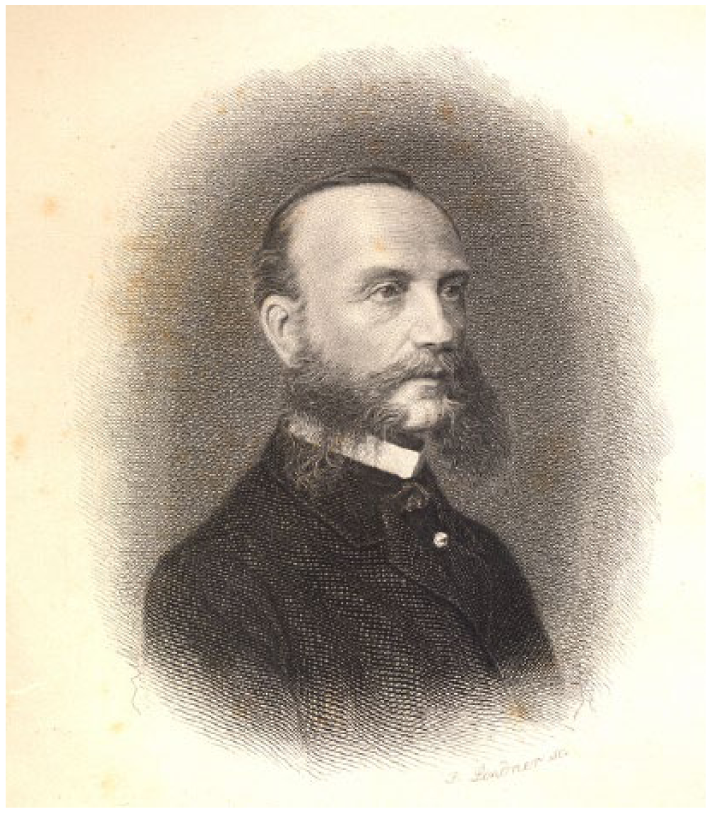
Wilhelm Griesinger: portrait by Georg Engelbach, probably c.1864 (published as frontispiece in Griesinger, 1876).
Griesinger’s thoughts on suicide and suicidality
For working out his contributions to and views on suicidality, the first and second editions of his textbook on Die Pathologie und Therapie der psychischen Krankheiten (Griesinger, 1845, 1861) are of particular interest (the third to fifth editions, published after his death, still carried the same title and his name, but had several other co-authors). The section on ‘Suicide’, or ‘self-murder’ as it was called at the time, is almost the same in the first and second editions, but the latter also gives detailed statistical data on suicide prevalence, and it introduces a differentiation between suicide as a distinct entity and suicide as an epiphenomenon of other illnesses. In the following analysis we will basically refer to the first edition (Griesinger, 1845), only specifying the page number. The approximately 8.5 pages are a subsection of the chapter on ‘Morphology’, which categorizes and describes the individual mental disorders. In the chapter on Psychische Depressionszustände, suicidality is classified in the category of ‘Melancholia with destructive tendencies’; the two subtypes are: ‘melancholia with suicidal tendencies’ and ‘melancholia with destructive and murderous tendencies’ – a melancholic state that erupts in a drive to destroy or hurt others (p. 199). In the section on ‘Suicide’ itself, Griesinger used an approach that was common at the time, providing several case descriptions to illustrate what suicide was. Our work group has recently made a study of the main German textbooks on psychiatry published since 1803, which revealed that, until the textbook published by Tölle, Windgassen and Lempp in 2014, only Griesinger’s textbook dedicated a separate section to suicide (Gnoth, Glaesmer and Steinberg, 2018).
Griesinger (1845) also looks at the possible causes of suicide and its epidemiology, before finally writing about possible therapies for those who had attempted suicide. Among the potential causes that could lead a person to commit suicide, he identifies heredity and anatomical changes in the person as possibilities, but also works out that certain illnesses might lead to suicide. In particular, Griesinger continues, this latter connection was true for ‘all those states of mind, where everything is cold, flat and stale, where the heart has died and the world has emptied’, for such states would usually lead to ‘melancholia, suicide or severe madness (tieferes Irresein)’ (p. 128). Yet at the same time, he makes it clear that suicide was not necessarily the result of an existing mental disorder, but could be brought about by, and be an ‘adequate’ response to, circumstances in a person’s life (critical life events). If, for instance, someone committed suicide in order to not live a life in disgrace or one of constant physical or mental pain, such suicide would be committed deliberately and with prudence. Yet such suicides would be quite rare, and in the majority of cases suicide was the result of an existing melancholy or a general painful perversion of the feelings, that was on the border between mental health and illness. Finally, Griesinger points out that a weak character in general could contribute to a suicide attempt (p. 192).
Whether or not a mental disorder had caused a suicide could be estimated from whether it was fatal. In cases where a lethal method was used, a thorough investigation could often reveal that the person had been suffering from a general black mood – or some other disturbance of mental well-being – for a long time, during which they had repeatedly thought of putting an end to their life; this idea had forced itself onto the person who had been unable to resist it (p. 193). Yet there were, Griesinger continues, cases in which suicide was attempted suddenly, without any previous sign of melancholic feelings or other mental disorder. In these cases, the mind of the person affected was momentarily blurred, immediately before, during and usually also after the suicide attempt (p. 196, case study XIII).
In his discussion, Griesinger refers to statistics published by the French Ministry of Justice which showed that one-third of all people who had committed suicide in 1836, and had been known to suffer from a mental disorder, did so predominantly from severe forms of perverted feelings. The same statistics also revealed that suicide attempts were made by people of all ages, the youngest having been 7 years old, while more men committed suicide than women and predominantly by hanging or drowning themselves rather than using weapons. Most suicide attempts were made in the morning, which ‘may suggest that the last bit of determination in these unhappy human beings is usually gained in the quietness of the night’ (p. 194). Apart from this, there is no further consideration of the differences in the frequency of suicides at different times of day.
Among the possible causes for suicidality, Griesinger identifies fears, despair and hallucinations as the most frequent. The latter, he suggests, would project a dark mood and the idea of destroying or killing oneself onto the hallucinating mind, which in turn would attach special, objectifying value to these hallucinations, since they were perceived as coming in from outside. As a special case, he mentions suicide attempts caused by imperious voices commanding the suicide.
Later in the section, Griesinger explains why those committing suicide developed the idea of destroying or killing themselves. He first mentions a certain genetic component that might play a role, since the inclination to suicide may be inherited. This had been substantiated by the fact that within a family many members show similar character traits and also inclinations, including the sharing of excessive passions. Apart from that, however, both the skulls and the brains of people who committed suicide often showed abnormalities, such as a constricted foramen lacerum posterius and adhesions in the fibrous joints. The first of these changes could, by constricting the jugular vein, lead to a mechanical hyperaemia in the skull’s content. ‘Among other things, such a local increase in the mass of the bones could be one cause for madness emerging’ (Griesinger, 1845: 300). Apart from causing suicide, an earlier adhesion of the fibrous joints is suggested to be a major predisposition for melancholia. Yet anatomical abnormalities could not be the sole reason. Likewise, there is no ‘specific change that would hint at madness’ and ‘by no means could a certain pathological aberration of mind … always be based on one and the same change in the anatomy’ (Griesinger, 1861: 421). Interestingly, in the second edition of his textbook Griesinger no longer mentions anatomical changes as possible causes for suicide.
Apart from heredity or pathological anatomical changes, mental disorder and suicidality could also be caused by life circumstances and even by disturbances in puberty or sexual maturity. This is especially true for sadness and dark mood, which are mainly characterized by far-reaching despair and absorption in oneself – and might lead to world-weariness and suicidality. Griesinger (1845: 53) continues that it is interesting to note that people committing suicide due to these causes show both a ‘quiet decision to kill themselves and a fear of dying’ at the same time.
Similarly, melancholic states might also be a cause for suicide, in particular in children, although older melancholics commit suicide quite often, mainly by refusing to eat and drink and thus putting an end to their lives. Melancholia could also be accompanied by a life full of hardship, destitution and poverty, including little and poor food, cold, and excessive physical strain, which often leads to great despair. If people cannot withstand that despair, they commit suicide (p. 147).
As a totally different cause of suicide, Griesinger identifies pathological drives or passions. These are often accompanied by restlessness and, to stop this urge, people often turn to suicide, homicide or arson. Likewise, excesses often lead to chronic satiety of life, since ‘in general these people’s mental well-being would become exhausted and desolate’ (p. 193) as a result of sexual exhaustion, due to sexual hyperactivity or onanism. This exhaustion could also be caused by an organic disease of the sexual organs (not in onanists, however). Griesinger suggests that it seems ‘as if even slight disturbances in the sexual development not only lead to hypochondriac states, which often occur during puberty, but may also incur in certain individuals the longing to kill themselves’ (p.193).
Apart from all the causes discussed so far, Griesinger identifies intermittent fever as another possible cause for suicidality, since during an attack such fever could lead to intermittent phases of madness like raving madness with rage or to suicide. Such phasic madness could also become chronic. Finally, Griesinger also hints at epilepsy as a possible cause for suicidality, since many epileptics are mentally ill in phases without epileptic attacks and might show irascibility or rage, but can also be melancholic and in such a state might commit suicide.
After analysing the possible causes of suicidality, Griesinger discusses potential methods of treatment. First and foremost, he follows the notion that anybody constituting a threat to themselves or others ought to be admitted to asylums for people suffering from mental disorders, since family or other private care would not suffice to minimize a potential risk. According to Griesinger, ‘the inclination to suicide requires maximum surveillance’ (p. 380), even though – or because – no real medical therapy was available. Apart from surveillance, the key emphasis should be on removing and keeping out of reach any potential means by which the patient could commit suicide. In the second edition of his textbook, Griesinger (1861: 261) also mentioned drawing or letting blood from the head as a potential remedy for world-weariness. In both editions, he says that potentially suicidal patients should be separated from one another and not accommodated together in one room, since it would be dangerous to allow them to be in contact for a long period of time.
Discussion
Jean-Étienne Esquirol (1772–1840), the great pioneer of French and European psychiatry, assumed each suicide to be the consequence of delirium and mental disorder. By contrast, Griesinger thought that suicidality was not necessarily a symptom or consequence of an existing mental disorder. Rather, there would be cases in which ‘a world-weary attitude is adequate to the given circumstances or existing and verifiable outer psychological causes’ (Griesinger, 1845: 192). In these cases, Griesinger concluded, suicide was neither committed in a state of mental disorder nor connected with it. On the other hand, however, he supported the view that one-third of suicides were related to mental disorder, predominantly to severe melancholia or a state of ‘moderate, yet generalized painful melancholic feelings, at the border between mental health and illness’ (p. 193), which Griesinger perceived as being very similar to melancholia. This latter connection was also the reason why he categorized suicide as one form of ‘melancholia featuring destructive impulses’, which in his classification formed one sub-division of ‘states of mental depression’ (p. viii).
Nevertheless, Griesinger postulated heritability as the most important cause for suicidality, which may be due to the fact that around the middle of the nineteenth century, degeneration theory was extremely popular in psychiatry in general. This concept of mental disorders being caused by hereditary degeneration from one generation to the next had been developed by French medical professionals, including neuropsychiatrists and anthropologists. It had convinced many colleagues throughout Europe and had gained popularity, one possible reason being that, at the time, hardly any other ‘real’ cause for the mental disorders had been established. Moreover, this theory fitted in very well with the Zeitgeist idea of a general gradual decline of human civilization.
Yet Griesinger also stated that anatomical and pathological changes in the brain and skull could be related to, and possible causes for, suicidality. This may be seen as another aspect of his strictly biological approach and his emphasis on strengthening an empirical scientific approach to research in general and to medicine in particular. In this latter development Griesinger, who had himself become a psychiatrist from a somatic background, played a key role. Finally, some other remarks on the possible causes for suicide may substantiate the fact (which, coincidentally, has been elaborated only quite recently) that Griesinger also followed a certain approach. When working out the cause of an existing mental condition, he aimed – and said it was essential – to include the particular personal and social circumstances of each individual patient, including psychological aspects such as stress.
From today’s perspective, Griesinger is regarded as a progressive or even visionary psychiatrist of his time. He envisaged developments that were not accepted on a wider basis and did not produce any consequences for medical theory and practice until much later. In particular, this is true for his idea of city asylums as an attempt to keep people suffering from mental disorders within their community.
Griesinger’s ideas on suicidality can be regarded as being similarly visionary, and his dedication of a whole section to it in a general textbook of psychiatry was exceptional. Some of his ideas are equally true today and can be accepted as modern, especially his idea that suicidality can have a multitude of causes – in contrast to many other authors in the 200-year history of psychiatry who attributed suicidality to a single cause. Griesinger strongly supported the notion that there are many reasons why someone might commit suicide and that by no means all suicide attempts were connected with or due to a mental disorder. Rather, there were genetic, neurodynamic, urological and even sexual pathological abnormalities that could play a part in this complex issue of suicide. What was most forward-looking was Griesenger’s view that social factors, and especially the environment and critical life events, could be crucial in a person’s decision to commit suicide. This multifactorial basis of suicidality is a crucial point of current discussions (O’Connor and Nock, 2014; van Heeringen and Mann, 2014).
Another aspect worth mentioning is that Griesinger perceived suicidality as a category in its own right, although for a long time, even modern diagnostic systems such as the Diagnostic and Statistical Manual of Mental Disorders (DSM) or International Classification of Diseases (ICD) did not describe suicide as a separate entity, but rather as a symptom of other mental disorders such as depressive disorders or Borderline Personality Disorder. In fact it was not until 2013 that the DSM 5 (American Psychological Association [APA], 2013) included Suicidal Behavior Disorder as a distinct diagnostic entity in the “Conditions for Further Study” section, and this was perceived as an important step in the scientific and clinical approach to suicidality (Oquendo and Baca-Garcia, 2014). In other words, Griesinger anticipated development in the history of psychiatry by more than 150 years. Today’s perception of suicidality as an independent category is substantiated by the fact that, although 90% of all those who commit suicide are diagnosed as suffering from mental disorders (Cavanagh, Carson, Sharpe and Lawrie, 2003), it is true that most people who suffer from a mental disorder do not commit suicide (Oquendo and Baca-Garcia, 2014). In contrast to present-day estimates, Griesinger rated the frequency of mental disorders in persons committing suicide at about one-third, which is significantly lower. One reason for this difference may be that, when he was a psychiatrist working in an asylum, the majority of people seeking Griesinger’s help suffered from psychoses and severe affective disorders. Also, the percentage composition of people cared for in in-patient psychiatry has changed significantly since his time. As an example, progressive paralysis, which was responsible for a high percentage of admissions in Griesinger’s time, especially in institutions in or near big cities, is now no longer seen in clinics. Likewise, Griesinger referred to other events and experiences as possible reasons for suicidality (e.g. world-weariness, escape from living in disgrace), but today these are frequently conceptualized as critical life events that often result in at least mild depression and/or adjustment disorder and are thus linked with mental disorders.
A final point, which surprisingly coincides with how psychiatry approaches suicide today, is Griesinger’s recommendation to provide in-patient treatment for individuals who are at risk of suicide. He thought that only such in-patient care could effectively prevent patients from harming themselves.
In summary, we can say that Griesinger undoubtedly gave extensive attention to suicidality, although it seems that, apart from the section in his textbook, he did not produce any other monograph or in-depth study of the topic. Of all the leading German-speaking psychiatrists (German, Austrian or Swiss) who published a textbook throughout the 200-year history of psychiatry, Griesinger was the first – and for a long time the only one – to dedicate a separate section to suicide (Gnoth et al., 2018).
Finally, one should not forget that before Emil Kraepelin (1856–1926) published his textbooks of psychiatry and the focus of general attention changed, Griesinger’s book was one of the most influential textbooks of psychiatry and can be regarded as ‘trend-setting’ until around 1900. Hence, studying his textbook more closely makes it possible for us to understand what mid- to late-nineteenth-century psychiatrists knew or were taught about psychiatry in general and about suicidality in particular. It would be an exaggeration to suggest that Griesinger was a specialized suicidality researcher. Yet bearing in mind that it was his 200th birthday last year, it is worth remembering both his surprisingly modern views on suicidality and to recommend Griesinger’s works to the attention of a wider contemporary public.
Footnotes
Funding
This research received no specific grant from any funding agency in the public, commercial or not-for-profit sectors.