



Abstract
After falling into mental illness as a young man, the British artist Richard Dadd (1817–86) spent some 20 years as a patient at Bethlem Hospital in London. A rare example of his writings from these years survives in the form of marginalia in a copy of Lectures on Painting and Design by Benjamin Robert Haydon, held in the Morgan Library & Museum in New York. This article presents a transcription of the notes, along with an introduction setting them in the contexts of Dadd’s career and his relationship with the senior staff at Bethlem.
Introduction
Richard Dadd holds an ever increasing fascination. One of the striking new talents of British art around 1840, the outline of his career is familiar. An extended tour of the Eastern Mediterranean ended in 1843 in an attack of psychosis involving Dadd hearing voices instructing him to kill. His father became his victim, stabbed to death in Cobham Park in Kent. The young man fled to France, where he was arrested and placed under the care of the psychiatrist Eugène Woillez until extradited back to London the following year. Dadd then spent the remainder of his life in Britain’s best-known public asylums, Bethlem in Lambeth and, from 1864, Broadmoor in Berkshire, the newly opened State Criminal Lunatic Asylum. Dadd continued to work, producing exquisitely finished watercolour drawings based on his Eastern sketches, ambitious fairy paintings recalling the subject matter with which he had first made his name, and many strange pictures with mythological and classical themes, some of which seem to reflect upon the nature of madness, cruelty and wisdom. Largely forgotten for most of the twentieth century, although always a legendary figure for some art-world insiders, Dadd was fully rediscovered from the 1960s, largely thanks to the efforts of Patricia Allderidge, Archivist at Bethlem Hospital, who curated the Tate Gallery’s landmark 1974 exhibition (Allderidge, 1974).
It was, from many angles, a compelling story, and Dadd’s life and work have, over recent decades, offered inspiration to a very long list of authors including – to take three different generations – Octavio Paz, Angela Carter and Neil Gaiman. But historical research on Dadd has been extremely scarce in comparison with this lively stream of creative interpretation. The reasons are obvious enough: the documentary evidence relating to Dadd’s 43 years in asylums remains in the archives of institutions where entirely appropriate restrictions attach to granting access to medical records. Dadd’s records, when eventually made available, were, after all, scant. There was no secret collection of Dadd’s papers, only some case notes and scattered administrative data-filing with which to seek to reconstruct a picture of his existence. 1 Crucially, for the interpretation of Dadd’s opaque art, the words of the artist himself are largely absent. A few extracts from his apparently often confusing conversation are recorded in the case notes, but, at Broadmoor at least, more by way of picturesque quotation than in any serious effort to understand his thought processes. The Apothecary (general medical manager) of Bethlem during Dadd’s early years there, William Wood, elicited a valuable written testimony from the artist, relating ‘ideas that had, from time to time, occurred to him’. Wood quoted sparingly from this in a book he published in 1851 (Wood, 1851: 41–2), but Dadd’s original manuscript remains frustratingly unlocated. Dadd also wrote out, again for a senior Bethlem manager, a quasi-poetic account of what is today his most famous painting, The Fairy Feller’s Master-Stroke (c. 1855–64). The picture, and possibly the poem too, was commissioned by George Henry Haydon (1822–91), the Steward (non-medical general manager) of Bethlem from 1853 to 1889. 2 It was again Haydon who was responsible for prompting Dadd to write the notes, which are published here in full for the first time (see below). As an extremely rare example of Dadd’s writings on art in the years after the onset of his illness, his annotations in a copy of B.R. Haydon’s Lectures on Painting and Design held in the Morgan Library & Museum in New York offer a valuable addition to our knowledge of how Dadd thought of himself and his profession during his time at Bethlem. 3 More broadly, this responsive text adds an important document to the corpus of autobiographical writing by nineteenth-century psychiatric patients. 4
Haydon, who had himself been an artist early in life, acquired a copy of his namesake Benjamin Robert Haydon’s Lectures on Painting and Design, apparently in 1859, and lent it to Dadd, who made extensive marginal comments and responses to the text in pencil at some time before his transfer to Broadmoor five years later. An inscription on the half-title page of the book (Figure 1) explains that G.H. Haydon later reinforced, or simply copied, Dadd’s notes in ink as the original pencil text was ‘growing fainter & fainter’. This was done in 1877 ‘at Dr. W.W.’s suggestion’, which must be a reference to the William Wood already mentioned as a producer of the artist’s lost autobiography. Wood had left Bethlem as part of a general purge of the management in 1852 and by the 1870s was running his own successful private asylum, The Priory in Roehampton, which survives today and is now arguably even more conspicuous in the general media than either Bethlem or Broadmoor as a haven for the troubled (see Aspin, 2015). 5
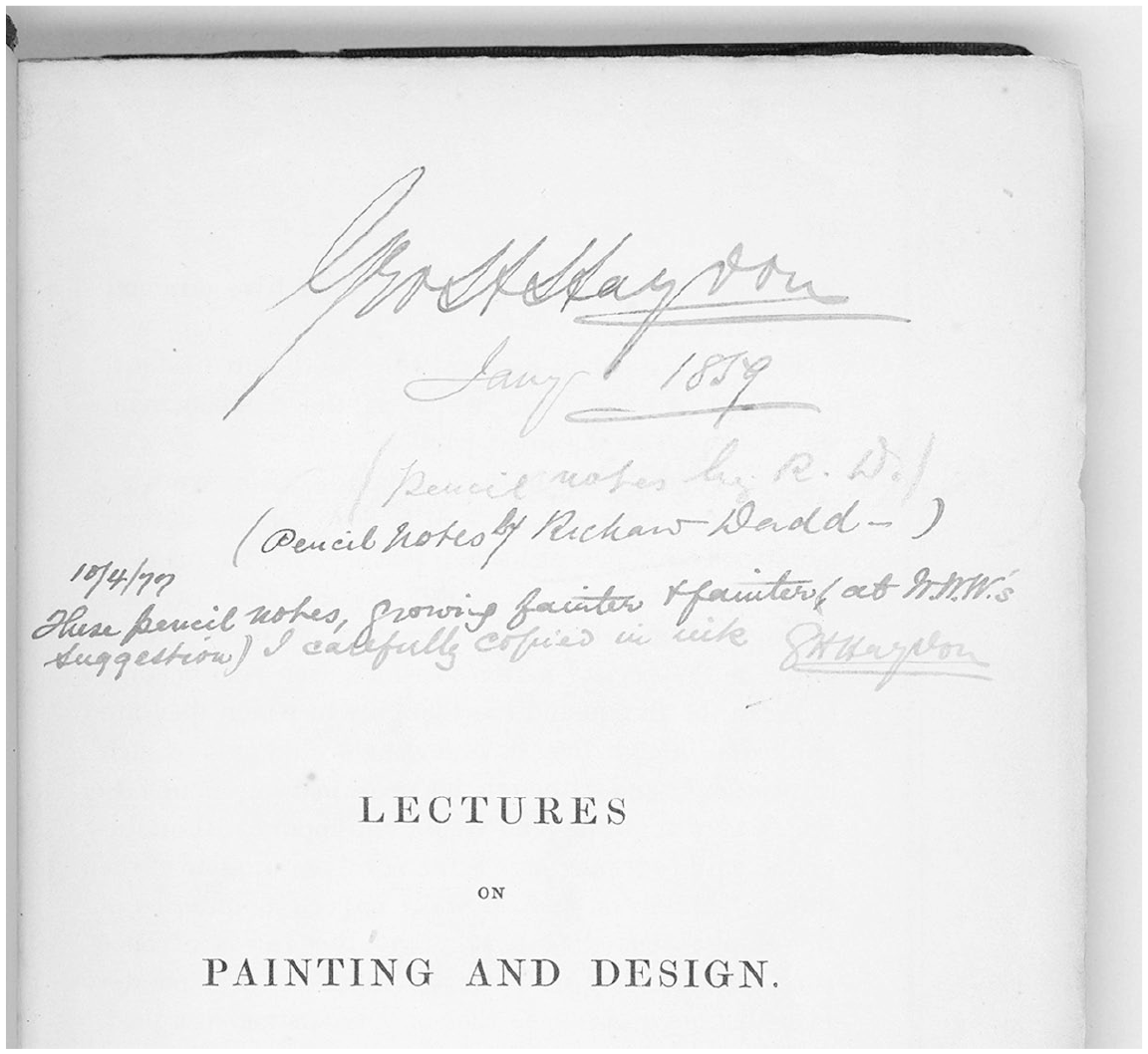
Part of half-title page of Lectures on Painting and Design by B.R. Haydon (1844), with an inscription by G.H. Haydon (The Morgan Library & Museum, New York. PML 67028. Purchased on the Acquisitions Fund, 1975).
B.R. Haydon (1786–1846) was no close relation of G.H. Haydon, as the latter established through enquiry in his native Devon (also the home county of the infamous Romantic painter), but the coincidence of name must have appealed to him, and perhaps to Dadd too. A passionate advocate of British historical painting, B.R. Haydon had great early success before – so it seemed to his contemporaries – an excessively egotistical and combative attitude rendered him professionally impossible. 6 Ongoing money problems and failing eyesight were factors in Haydon’s suicide in 1846, by which time his persona as the champion of high art had already become a moral tale for young artists learning of the perils of taking themselves too seriously. Often a writer and lecturer throughout his career, in the 1830s Haydon took to setting out his thoughts on art in lecture courses for aspiring artists and these were the basis for his 1844 book. It was his testament and legacy to the British School, the distilled wisdom of an embattled genius. 7 Lectures on Painting and Design was dedicated to William Wordsworth, one of Haydon’s celebrity Romantic friends of his early years: in 1817, the year of Dadd’s birth, Haydon had held his ‘immortal dinner’ at which he introduced Wordsworth to Keats. The book also carried an epigraph by another famous friend of the author’s, his fellow painter David Wilkie, on the importance of following Nature in art.
There are ironies in both of these associations. Haydon’s son Frederic Wordsworth Haydon, named after the poet, became his father’s memorialist, editing his Correspondence and Table-Talk in 1876. He himself entered Bethlem as a patient in 1884 where he was diagnosed with general paralysis of the insane (soon to be connected to syphilis), dying in 1886. 8 Frederic was able to add into the Bethlem copy of his father’s Lectures (Haydon, 1844) his own annotation (note to p. x), seeking to explain the author’s death as having been finally provoked by cruel treatment at the hands of one of his patrons, Sir Robert Peel. Wilkie, that most sensible and successful of early nineteenth-century artists, was a very close friend of Haydon’s in their youth, but his alleged conservatism and stolid realism were later used by Haydon to construct a figure antithetical to his own self-image as a compulsive man of genius. 9 The irony here is that, as Dadd’s illness was first making itself known in 1843, his travelling companion, the Welsh lawyer Sir Thomas Phillips, set Dadd to read the newly published Life of Sir David Wilkie by Alan Cunningham (1843) with the idea, we assume, that the cautious Scot’s approach to his career would serve as a steadying model for the young Dadd, who so obviously risked going off the rails. G.H. Haydon, some years later, took a very different approach to the literary tutelage of this brilliant but disturbed artist, now under his joint care, lending to him the work of a notorious controversialist and bankrupt.
George Henry Haydon was – extraordinary as this may have come to sound – an artist who followed a successful career managing Victorian psychiatric hospitals. 10 A large, powerful and it seems endlessly capable and clubbable man, Haydon spent five years in Australia from 1840 to 1845, becoming, according to his biographers, one of Melbourne’s first drawing masters and a newspaper illustrator. Back in England, Haydon was appointed Steward of the Devon County Lunatic Asylum in 1849 before taking up a similar role at Bethlem four years later. Bethlem remained a City charity, as it had been for centuries, and Haydon’s appointment was through an election process in which his bonhominous networking skills would have been decisive (Haydon, 2007: 209). In London his many friends included the leading Punch cartoonists, while his elder brother Samuel, originally a sculptor and later a photographer, became part of the circle around Dante Gabriel Rossetti. Haydon joined Bethlem’s senior management following the changes of 1852, which had seen off the whole of the previous regime to replace it with a new structure presided over by a Resident Physician Superintendent, that is, a medical gentleman not too grand to tackle the daily grind of a large public hospital. The first Superintendent was Dr Charles Hood, not yet 30, who may be the sitter in Dadd’s Portrait of a Young Man of 1853 (Tate). Alongside Hood, Haydon was expected to oversee the hospital according to the now generally accepted principles of moral therapy and non-restraint. His cheery humour, party-going and general social energy were not just charming personal characteristics, but essential requirements for the job of looking after ‘lunatics’ as that role was now conceived. 11 As already noted, it was Haydon who commissioned the Fairy Feller from Dadd, having been impressed by a fairy subject already painted for Hood. That picture, Contradiction: Oberon and Titania (1854–8; private collection), is shown, unfinished, on the easel at which Dadd sits in the portrait commissioned from the Regent Street photographer Henry Hering around 1857 (Figure 2). Haydon was evidently the more artistically inclined of the two key managerial figures at Bethlem, and when the very young Walter Crane gave Hood a painting of Ruth and Boaz in 1863, Hood passed it on to Haydon, presumably thinking it was more his kind of thing. 12 But of course Haydon’s apparently encouraging attitude towards Dadd and his art was not without elements of professional self-interest. Generally, it was useful to him to have evidence of the kindness which he was paid to show to patients. It was useful in a more immediate sense for him to be in possession of works by Dadd, as it meant he could sell them with help from his art-world friends. For example, a batch of watercolours by Dadd was sent to Christie’s for auction in 1871, but with two exceptions these were returned to Haydon at Bethlem, unsold. 13
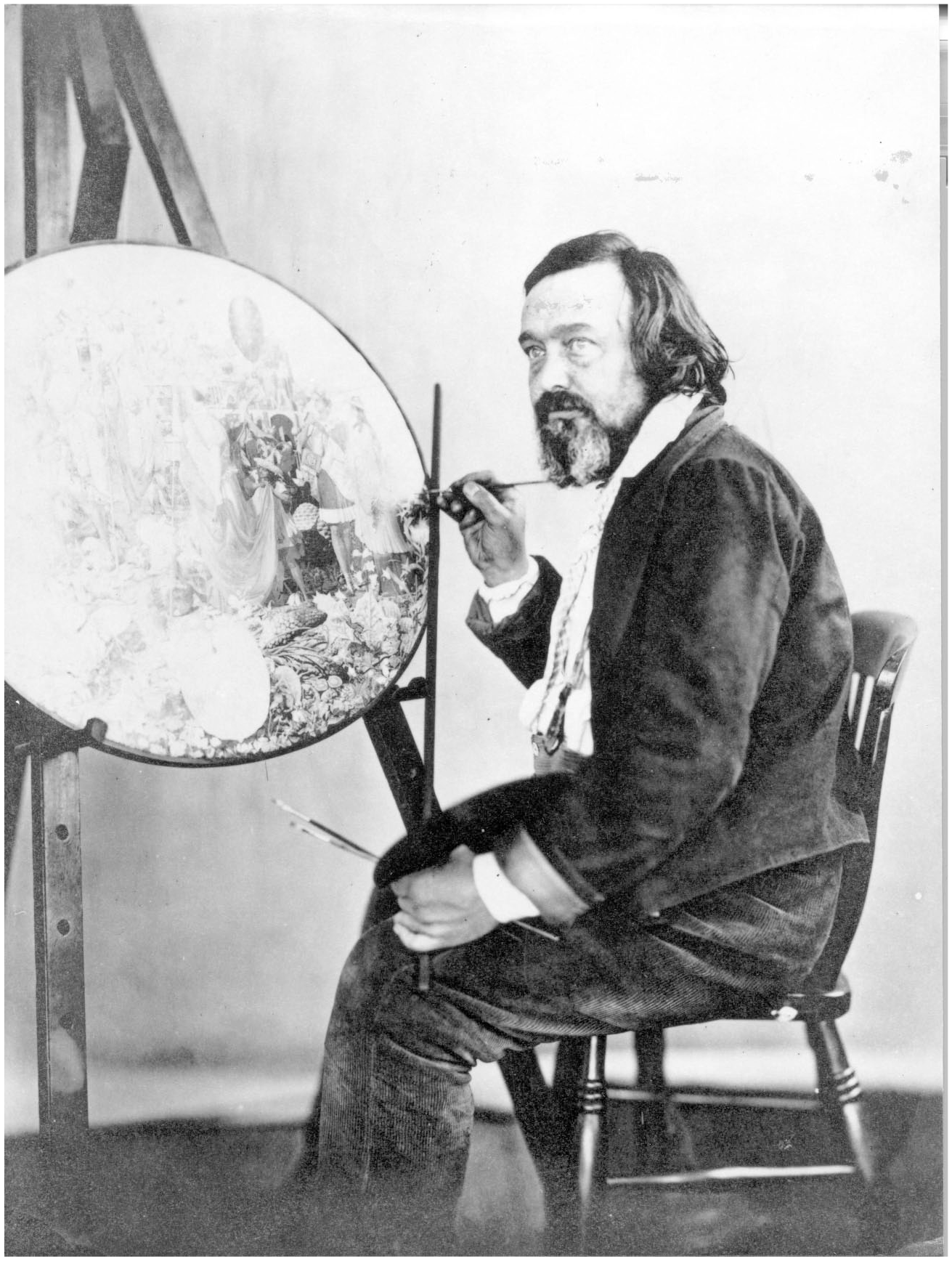
Photograph of Dadd by Henry Hering, c. 1857 (© Bethlem Museum of the Mind).
There seems something provocative in the offering of the Lectures of B.R. Haydon to Dadd. If Hood had encouraged Dadd to return to the concerns of his early career by commissioning a subject from A Midsummer Night’s Dream, then perhaps, by urging a close reading of the Lectures, G.H. Haydon intended to reintegrate Dadd (at some distance, to be sure) with art-world debates around the Parthenon sculptures, anatomical study and the comparative roles of inspiration and application in artistic success, questions that had been part of his formative professional years. Above all, there is the theme of genius, which was central to the aesthetics of both Haydon and Dadd. The word (singular or plural) occurs on some 124 occasions in the Lectures where it has the standard modern meaning, that is (characteristic of) a man of great gifts with the uncompromising ambition to use them. Haydon’s own status as a genius, he felt, legitimized his conduct at more or less all times, even when it led him into trouble, for no law or superstition can ‘prevent men of genius pursuing their own course’; in other words, genius as a trait easily becomes a burden: ‘Genius is a gift which sits on a possessor like a night-mare’ (Haydon, 1844: 22, 195). This notion of genius as oppressor comes close to Dadd’s own view, as he explains in some of his notes in Haydon’s book. Dadd adopted what he understood to be a Greek account of genius, as a forcefully guiding spirit or pair of spirits, compelling a person to behave in one way or another. The genius had a will entirely of its own: ‘the genius might for its own purposes supply the grandeur the artist was too lazy or incompetent to put in’ (note to p. 170). 14 Artists who struggled against their genius were wasting their effort or inviting danger: ‘one’s own second self . . . is perhaps as obstinate and vicious a devil as we could desire to oppose or thwart one and that few can overcome’ (note to p. 171). This attitude was of a part with Dadd’s explanation of the killing of his father. As he had explained in the text written for Dr Wood, he had approved of that act, which he understood to be the execution of a devil, but he was not strictly the act’s author – merely ‘the cat’s paw’, an instrument of a stronger power. In his annotations to the Lectures, Dadd repeatedly references slaves and slavery in an abstracted sense. Conceivably, he was responding to Haydon’s huge and much-publicized group portrait of The Anti-Slavery Society Convention, 1840 (1841; National Portrait Gallery), in relation to which Haydon made a recantation of his earlier published theories of racial hierarchy. 15
Dadd’s musings on genius and the artist’s lack of free will form perhaps the most significant group of his annotations, outlining a philosophy of art that aligned with his experience of losing control of his thoughts and actions. Dadd echoes Haydon’s sense of art’s inevitable defeat by powers external to it. For Haydon this meant the hopeless philistinism of the English, and for Dadd, the spirits (or genii or devils) who make a mockery of the Romantic idea of self-expression which can therefore only end in self-deceit: Perhaps the artist is himself the greatest victim of delusion – self delusion – pleasing ones self is like trying to be satisfied with a gross mistake – if you try to please a Devil – a more implacable customer you cannot meet – and as he is more subtle than most artists – and all men or women have the devil in them how can they please themselves except by fallacies – and what lies what fallacies pictures are – in the grand style of art especially. (note to p. 273)
Dadd’s wit is on show when noting that subtlety was never a forte of the author of the Lectures: ‘Let us do Mr Haydon the justice to say that his writing is like his painting, bold, grand, and unmistakeable – powerful, so that one can see them a mile off’ (note to p. 246). But by the time he comes to write a final note at the very end of the book, Dadd expresses pleasure in the sparring he has undertaken with Haydon, and develops the theme of their shared pessimism. Modern scholarship on Haydon’s writings has stressed how unconvincing his appeals to the civic sense seem, given his overwhelmingly solipsistic rhetoric of genius. John Barrell established this in his 1986 book The Political Theory of Painting where he writes: ‘his insistence on the primacy of genius makes it hard for him to insist, with any great conviction, on the reciprocity of the relations between art and society’ (Barrell, 1986: 309). Equally, Dadd concludes: Haydon has certainly demonstrated the principles of high art but one might fancy pictures are like monks secluded from and very little noticed by the world so that after all what matters about its quality except to the few, the initiated – the great masses if they do notice will still wonder “What is the good of such things?” (Note to p. 331)
That haunting last appeal begs the question of what Dadd thought he was doing in composing marginalia to/for/with/against the tragic Haydon. That literary term is accepted as having been coined by (or for – the prepositional ambiguity is again appropriate) Samuel Taylor Coleridge in 1819 in a brief article that claimed a central place in his oeuvre for such occasional annotations. Such responsive writing, it was proposed, ‘much more nearly than any of his printed works, gives the style of Coleridge’s conversation’. 16 The Romantics hardly invented marginalia as a practice, yet have been credited with appreciating the hypertextual possibilities of the format (Jackson, 2005). B.R. Haydon himself was, unsurprisingly, an extensive inscriber of marginalia, for example in William Richard Hamilton’s Memorandum on the Subject of the Earl of Elgin’s Pursuits in Greece (1811). 17 The Parthenon sculptures were a subject extremely close to Haydon’s heart, one over which he felt something near to ownership. Dadd, who had himself made much of the British Museum fragments at the start of his career, in turn engages Haydon on that topic in his notes to the Lectures (notes to pp. 148–9). Although Haydon prided himself to an embarrassing degree on his dealings with the great Romantic poets, he had little to say about Coleridge, the heroic pioneer of marginalia as an art form, whom he accused of being one of those literary people who annoyed artists by regularly suggesting subjects for them without fully grasping the different requirements of verbal and pictorial narrative. When Haydon complains in the Lectures about the poet’s ignorance, Dadd concurs: ‘Perhaps as true as any thing [in] the book’ (note to p. 318).
Marginalia suggest doing things with books, solving problems with them, setting them tasks. 18 They are, despite their physical inaccessibility, now considered part of their authors’ complete works. Among Victorian specialists in marginalia, the complete annotations of John Stuart Mill are currently being edited in an online edition, while Christina Rossetti appears in a rather separate class of her own, adding copious marginal images into copies of books that were especially dear to her. Dadd’s case is, as ever, special. His marginalia to Haydon’s Lectures provide a rare window into the thinking of one of the century’s most intriguing but most troubled artists. As in the original justification for publishing Coleridge’s marginalia in 1819, we have the sense of coming close to the everyday talk of a powerful mind, albeit one now dislocated. A Broadmoor doctor wrote on 5 April 1878 that Dadd ‘Goes on quietly, sometimes coherent & at others wandering & disjointed in his conversation’ (Tromans, 2011: 198). The marginal mode perhaps provided the best means to capture that style of talk, although, as always in medical history, we must beware how far such apparently satisfying analysis has been, so to speak, pre-packaged for us by those who recorded it. Dadd’s marginalia were facilitated by G.H. Haydon, very likely in part to demonstrate the ‘mad’ qualities of his voice as perceived by Haydon’s medical colleagues. Dadd was a celebrity patient in the very epitome of a ‘total institution’. It is, after all, unlikely that any written records relating to him will have come down to us entirely unmediated through the hospitals in which he was a patient. 19
Footnotes
Funding
The author received no financial support for the research, authorship, and/or publication of this article.
Notes
Dadd’s marginalia
The book containing Dadd’s notes is held by the Morgan Library & Museum, New York, PML 67028: Benjamin Robert Haydon (1786–1846), Lectures on Painting and Design (London: Longman, Brown, Green, and Longmans, 1844); volume 1 only (a second volume followed in 1846); 1 folded leaf of plates, xii, 331 pages; illustrations; 23cm; plate B bound in at front; lacking plate A. Publisher’s brown cloth, stamped in blind, with gold lettering on spine.
Provenance: George Henry Haydon (1822–91); . . .; Sotheby’s, London, 29 October 1975 (140), bt. Paul Grinke; sold to Charles Ryskamp for the Morgan Library & Museum 1975.
With extensive marginalia in pencil by Richard Dadd (1817–86) inked over by G.H. Haydon. On the half-title page (see (Pencil notes by Richard Dadd – ) 10 / 4 / 77 These pencil notes, growing fainter & fainter (at Dr. W.W.’s suggestion) I carefully copied in ink G H Haydon ) lavishly signed in ink: ‘Geo H Haydon, Jany 1859’ and inscribed below in pencil: ‘(Pencil notes by R.D.)’. Below that in ink:
On p. x (last page of the Preface), B.R. Haydon’s son, Frederic Wordsworth Haydon (1827–86), who was a patient at Bethlem Hospital from 1884 to 1886, has added an explanatory note about his father’s death, alleging his father’s suicide was prompted by Sir Robert Peel refusing to pay him for a picture but then spreading the word that the artist had indeed been paid. A correction to the mis-spelling of Sir George Beaumont’s house, Coleorton Hall, on p. 116 also appears to be in Frederic’s hand, with some underlining and marks in blue or red pencil or ink throughout the text.
In the transcription below, which includes all Dadd’s annotations, italic text in square brackets summarizes or quotes from the text by Haydon to which Dadd responds; occasionally a note in square brackets describes where on the page Dadd’s note is written. Punctuation has been added sparingly in a few cases for clarity.
It might be better to say – supply instead of root out. This implies an advantage to be given to a particular concomitant spirit which else could not follow the agent and which after all might be hostile.
This is a difficulty of comprehension it seems as if part of the sentence had been omitted at the semi-colon after the word action – the latter part of the sentence bearing no relation to “none more or less” the first part looks like a statement without deduction – logical or otherwise. The statement also presents a difficulty in “none more or less” at least to common sense.
[along left margin of page]
A child cannot understand it which would seem to me a canon law in art viz. to make all so clear that a slave might understand Excuse me
Painters generally reject so much of first ideas that independent of the above statement, a good critic might be made of the refuse – second thoughts result from criticism – so the critical power is already existing – but I have heard artists say the first thoughts or sketches are best without revision or criticism and this is contradiction of the popular proverb that “second thoughts are best” – be that as it may it does not seem necessary to make a critic, a critic being a spontaneous perfected character jocosely so to say.
This vindication of Greek knowledge might seem like an oblique attempt to prove that they (the Greeks) were not mad or fools, the object of the sculptures themselves being the alleged folly or madness – for if they were so profound as is here projected in the anatomy of the substance – the inference is that they were equally wise or profound in the signification of the matter and that what is true or was true then must be true now in spite of new doctrines and religious suum cuique – as the old man said when he kissed his cow – or might have said if he liked – something however which it does not imply is that if they were not foolish or mad somebody else was.
Oh! Pagan Mister Haydon. How contrary to my reminiscences of drawing from these marbles associated with a feeling of clumsiness which I suppose I must not say was equal to the appearance of the Ilyssus the first thing I operated upon. Haydon would make a fellow laugh his admiration is so uncontrollable seemingly.
May not this be taken as an irrifragable [sic] proof that the insistance [sic] of these markings had an ulterior object to that of mere representation – such as the power to refute or give the lie to recognised principles of policy – like making a long arm to over-reach etc. etc.
This seems odd to include extensors among flexors [‘The extensors of the leg are four’]
Fascialis – query same office as vastus externus? [‘The flexors of the leg are on the outside’]
Query word “four” omitted?
Query – which one is meant here? The vastus internus must be meant as the inner side is afterwards cited as its place – perhaps a misprint.
And a pretty hash they would make of it one pruning here and another pruning there – until all its native character and vigour was gone – one does not approve this, and the other does not approve that, the judicious part so questionable.
How good! It must be pruning a genius and living on the prunings and a successful example how stimulant
It could not be much of a genius that could not find out the elementary part – so commonly diffused – for the rest, let any Sir Oracle open his mouth & see how many dogs there are to bark – de gustibus etc. etc.
All this looks as if some secret sense was deplored when through carelessness or fatigue or some other cause the artist did not excite himself so as to feel grand and consequently the picture was or is mancato [i.e. lost]. If you give nothing you have nothing – nothing for nothing in fact. But the regret is difficult to understand. True the genius might for its own purposes supply the grandeur the artist was too lazy or incompetent to put in.
What fierce truth to some people no doubt.
Well done Mister Haydon where is there then any firmness of execution
Reynolds I believe both admired and practised the square style which is as firm and decided as any perhaps.
Which is a severe thing to say.
I am of opinion that there is a great deal of secret in the matter and that it is explained by one’s own second self which is perhaps as obstinate and vicious a devil as we could desire to oppose or thwart one and that few can overcome it, hence dissatisfaction, &c. There is a confirmation of this in the church ritual which says “If we say we have no sin we deceive ourselves etc. etc.” and a strong genius is mostly likely antagonised by a strong beast or devil a secret worth knowing. However it also occurs to me that Haydon is right and that no remark is necessary.
Notwithstanding people constantly correct their attitudes, as if supposing their instructive expression that way was not so decent or proper as it might be – the second thought may seem always watching how the first does – in this as [continued along right-hand margin] in other matters – some beautiful prize being supposed at issue in the exposition of pretension – every one constantly exhibiting pretences voluntarily and involuntarily of which last etc. etc.
[along left-hand margin]
We may however suppose that the consciousness of grace or physical excellence is not unbecoming if people like to feel little by comparison there it is odious by reason of its lessening self respect.
Whatever the sacrifice may be – the probability ownership of the pretenders might prove a great deal too uncomfortable to abide – and we may also say that necessity is stronger than volition in a majority of cases – many people not knowing that any thing but personal interest is at stake – perhaps all people.
The double nature of human beings was known to the ancient Greeks among whom the Genius was as familiar as Christ with us. The two natures were supposed to be always contending for mastery and [continued along right-hand margin] after death they were weighed “Thou art tried in the balance and found wanting” somewhere in Scripture seems to refer to this doctrine which was doubtless well understood also in the Egyptian – vide Egyptian paintings [along left-hand margin]
The Centaurs and Lapiths express their contention and perhaps its particular moral and physical nature.
Admit this and the Frenchman was unsound the quality being out of reach – but certainly one style corrects another and Reynolds’ deductions seem inevitable to even common observers – except that the last mentioned persons might honestly say “very true, but you don’t know what a lazy fellow I am”.
This reminds one of the representations of God – statues in Egyptian tombs – which are made to suit occasion probably – some accepting one shape some another one Apis another Anubis and so on – perhaps from necessity perhaps because as they make their bed so must they lie on it. Some people have no right to excellence some despise and some contend for it some pursue it as a chimera perhaps all with perhaps not even a vague idea of the virtue that beauty argues or implies.
[‘we cannot help lamenting the infatuation of the genius of Greece, in perpetuating the personal perfection of the wretches they immortalize’ (i.e. the gods).]
Query?
In reflecting on this the argument becomes so complicated and difficult that only superhuman characters could speak with precision – the genius producing might be the victim of his work and the principles represented – supposing the principles to have any effect at all – as to say that in representing Alfred we have all the Saxon angels of his time and of his kidney at work upon our spirits and angels like – and to what end? – we may ask – and ask in vain for who will give his knowledge and experience for nothing and if you get it at that price might it not change to a serpent.
This is rather in favour of the wretches and rather derogating of Christianity – what matter?
That is to say unless you desire to contradict some offensive humdrum you will not depart from general practice – but in that case what his [sic] been left undone?
Notwithstanding the masculine gender is more worthy than the feminine and man is the nobler creature.
That is to say the mere realization of a poet’s poetical idea is a slave to the poet – in a word you must do something the poet did not think of or he will overtake the beauty and make a beast of it – how just!!! how good!!!
This looks as if the sisters would take it out of one another if they could do so – an ill concealed jealousy – Oh Romulus oh Remus – oh Cyrus oh Artaxerxes – oh Cain and Abel – and oh every other brother and sister that ever was – when any thing good is at stake.
Painting seems to be such an immortal nuisance – that any complication or excess of usual quantities is perfectly odious – it is too much trouble to understand – Oh! dear – how could such ugly people retain possession of such a beautiful lady as this art must be – if they were obliged to comprehend and appreciate all that can be expressed in an elaborate way – no they would find us out et cetera – he shall not be allowed to do more than I can master – else he could escape and so on – Well Sir !
A broad distinction between these two masters seems to be that one did and the other did not love, one in sympathy with, and the other a slave driver of the human species. Michel’s figures look as if they would compel Raffaele’s as if they would advise and demonstrate, Michel was fatal and instant, Raffaele merciful and considering.
What are these objections? Does he mean that they were less reasonable in speaking of painting than of sculpture – if so the objections have some degree of validity – the enthusiasm in one case being greater than the other – and supposing enthusiasm says “Stand on one side reason its my turn now and I only allow glimpses of such a person as you are – you are always hunting for mistakes quite odiously”. It seems folly does or might do well by following enthusiasm but however what is enthusiasm commonly if not a up [sic] fancy rushing past reason and judgement as if to say “Oh! I see how it is”, rush at every difficulty like a bull at a gate. Down it goes and then what is there to challenge attention or stop the way?
The Roman enthusiasm in the shape of battering rams upset a great many difficulties and triumphs, reason or no reason.
What a mite of sense seems sufficient to make people look good like gold beaten out to thin leaf. Such a little covers deformity that one cannot tell how much less than a grain suffices any more than one can tell how much less than a grain of sense is sufficient for an artist to crawl on with his labours.
What’s the use of attempting the enlightenment and improving the taste of animals – nature shews us sufficiently what they are and if left alone however much civilized they will relapse to the savage state but then poor beasts they are victims and must do it. What a number of times the destroying angel has triumphed over the different nations of the earth – sucking them up and knocking them down looks like systematic revenge for systematic insult or error.
What a clever angel the genius of painting must be to escape from all these hot pursuits and subdued attentions but once free – not all the arts of any old fellow I suppose can lure back the pretty bird to its own disgrace and bondage – this kind of thing looks like thundering at a dead man’s door to see if he can be awakened and brought back to do his customary amount of slavery for a disgraceful master that is perpetually losing the angels presented to him, by whom? by his partner in sin and iniquity and turn to their advantage the grand the sublime and divinity of nature. Let us hope the divinity never trusted to such rotten sticks as the good sense & principle and good taste of the multitude, that swineth herd.
For if
What is there more thankless, more hopelessly stupid more desperately wicked than a parcel of slaves and what more slavish than painting, what more hopeless?
Let us do Mr Haydon the justice to say that his writing is like his painting, bold, grand, and unmistakeable – powerful, so that one can see them a mile off almost, his writing seems to hit more than may be called the ostensible object – the principles seeming to apply to other arts besides that of painting. If antagonising with him he would be so irresistible – that perhaps no successful plan could be adopted better than that adopted by the English at Waterloo who were ordered to lie down to avoid the tremendous fire of the enemy – and when slackened then to resume the offensive – but who cares about opposing such truths as are here to be found. I fancy the politics are almost as palpable as the art, at all events in reading he sustains the interest and there is nothing frivolous. But it is impossible to please every body and Haydon knew that, no doubt.
This is a great deal too remarkable an expression to pass without notice – the question arising how is it possible for an artist either to profit by or defeat this action.
Query do all persons see alike and may not imperfect sense or self delusion be more excessive in some? Perhaps the artist is himself the greatest victim of delusion – self delusion – pleasing ones self is like trying to be satisfied with a gross mistake – if you try to please a Devil – a more implacable customer you cannot meet – and as he is more subtle than most artists – and all men or women have the devil in them how can they please themselves except by fallacies – and what lies what fallacies pictures are – in the grand style of art especially.
This is one of those pearls which any pig however small his eyes might be would hardly fail to see – it is a secret of philosophy or psychology leading – where?
One might fancy Titian pugging vicious little children’s noses that would viciously obtrude, spoiling his intention. Oh Israel Oh! rebellious children of Israel.
Yet not in one day.
Rubens then could forget in one night Titian required months and then treated the work as an enemy etc. and looked to see where he had the best or worst of it.
Which may be interpreted thus – just at that point the spirit saw something better than the artist’s work – flew away and artist cared no more about it – that would do – you might say anything of it.
Fancy the Venus as rough as a badger.
All this – and all the rest in fact admits of such a solution as this – one of the two women at the mill must be taken – each has claims to distinction and taste as variable and constitutional. Lions breed lions and like lions so with wolves so with different families – gentle blood likes refinement but the savage tosses it away. You like this and I like that – it is impossible to give fair play to all classes and make them think alike, their interests naturally varying – but we deceive ourselves and one another and if we say we have no sin etc. and by consequence how often do we fall.
And this is like the difference between women, one a great strapping woman – another bold and showy – another ladylike and grand – another sedate and reserved – yet all women – all finding admiration in different natures and the more you say of them, the more you may.
It is worth while to remember that very many persons upon seeing a fine picture for the first time cannot accept its impression but appeal one to the other to know if they think it a fine picture. I remember the same feeling personally and have often been appealed to. Critics also contradict each other on the same work, and the words of the men of Judah were fiercer than the words of the men of Israel.
This must mean the poetry of language – not of form – any form definite may be painted with its true sentiment expressed – therefore these definitions mean something independent of form as simile.
One must not look too close at this kind of thing else the texture or components would make us too knowing and we should become dissatisfied those details might prove humbugging – like Mohamed’s veil and &c.
The dramatic may be defined as that which concerns individuals and the historic as that in which national interest is concerned.
and when done pictorially nobody could or cares to understand it unless told expressly its meaning – if not told how many times would they guess at it – relating of course to the people half educated or not so much.
Query – on what authority does Milton describe other than that of excited fancy?
It was a long distance to hear the screams of a man or hero – an immense distance would bother a steam whistle to make itself heard – certainly this is extravagant and not merely this point of it.
And the best imitations are stultified by the vulgar question of “What is this – I could not make it out?” it must be mere spite.
The educated or polite world – what does the swinish multitude know of refined expression or sentiment? Divide the firmaments from the firmaments – and say each member of each is equal to what it lives in – not at all.
Because they generally make themselves out to be lost characters – slaves of eccentricities etc. which great intellect repudiates – in fact that they mean to do what the fool says instead of being rational and to keep this in check perhaps does require a clever wife or soul the credit to the artist being dubious.
And yet Raphael perhaps painted Ananias with greater facility than his portrait of the Pope.
As to say – disgrace me to inferior occupations and see what a slave I’ll be.
In fact something that slips away from the critical clutch – having nothing for it to seize upon.
Oh! Mister Haydon!
Perhaps as true as any thing [in] the book.
This might be like eating cabbage without such accidents as boiling or gravy or vinegar or pepper and salt.
As an instance of unmistakeable description – why not this?
Haydon has certainly demonstrated the principles of high art but one might fancy pictures are like monks secluded from and very little noticed by the world so that after all what matters about its quality except to the few, the initiated – the great masses if they do notice will still wonder “What is the good of such things?”