



Abstract
The late Habsburg period (1867–1918) created a constitutional dual monarchy of Austria-Hungary. This paper discusses the role of psychiatry in Cisleithania, both as a developing profession and as a distinct ‘policy field’. Tension between psychiatry’s academic professionalisation and the creation of public institutions as signature projects by individual crownlands created complex relationships between psychiatry and politics. In federalist Cisleithania, psychiatrists became very ‘political’: whether employed by the state or a crownland influenced their position on policy, despite claiming that their expert knowledge was ‘scientific’ and ‘objective’. The conflicts between asylum-based and academic psychiatrists mirrored those between the central state and the crownlands. This led to intractable delays in mental health law reform, eventually resolved by Imperial decree in 1916.
Keywords
Introduction
Beginning in the nineteenth century, and mirroring developments in Switzerland and Germany, psychiatry in the Habsburg Empire 1 was able to extend consistently its influence on both society and policy (Bernet, 2007: 130). Its political implications, however, did not only rest on the discipline’s preoccupation with social norms (Freis, 2019: 2). Rather, Cisleithanian crownland governments realised that the creation of public mental institutions could be used for political gain in a narrow sense.
The new large villa-style asylums, such as Mauer-Öhling or the Viennese Steinhof, were fashioned as ‘monument[s] to the victory of science’ (Anon., 1907a), whose openings were celebrated with opulent festivities in which the Emperor himself or members of the Imperial court featured prominently. 2 In these festivities, politicians and civil servants were represented as the dominant actors, whereas psychiatrists, alienists or other physicians were curiously absent, despite their formative influence on hospital design. Unexpectedly, the experts remained all but invisible in an age of medical innovation. Psychiatrists however, were in fact involved in the extension of psychiatry as a public service, albeit on the level of policy-design, rather than representation. With psychiatry’s increased influence, its academic professionalisation and the creation of public institutions as signature projects by individual crownlands, psychiatry turned into a whole policy field, resulting in a reciprocal relationship between psychiatry and politics. Psychiatrists themselves became very ‘political’ in the sense that whether they were in the employ of the state or a crownland influenced their position on policy, despite their repeated claim vis-à-vis critics that their expert knowledge was ‘scientific’ and ‘objective’. 3
By invisibility, I thus do not refer to a conceptual absence, or a reduction of psychiatric influence on public policy. To the contrary, as the Lower Austrian example shows, psychiatry as institutionalised welfare became increasingly political, or – as Leslie Topp put it – the asylum turned into a ‘political project’ (Topp, 2017: 39). Consequently, the photographs taken at its opening event focus exclusively on the Emperor or his deputy, regional politicians and crownland officials. Newspapers reporting on the openings likewise mention psychiatrists only in passing, if at all. This leads to representation of the public asylum as a ‘psychiatry without alienists’ and contrasts with the increasing influence of psychiatric expertise in the political domain, such as within the commission on insanity law reform (Irrengesetz-Enquete) of 1901–2. At the same time, however, both the processes of institutionalisation and psychiatry itself turned into an object of public scrutiny, with highly publicised instances of allegedly wrongful admissions to psychiatric treatment.
The role of psychiatrists in the late Habsburg Monarchy was thus ambiguous. On the one hand, the academisation and professionalisation of the discipline over the course of the nineteenth century led to an increasing degree of influence as part of medical science as well as within the realm of politics – not least because the creation of asylums – together with the creation of other institutions of public welfare – was regarded by regional governments as a useful means of self-fashioning its policies as progressive and ‘modern’. On the other hand, the antipsychiatric movement dealt a serious blow to the reputation of both alienists and traditional asylums while serving as a catalyst for a reform of insanity laws.
As a medico-scientific discipline that has always been concerned with public order, psychiatry has always had political implications. This entanglement has been discussed increasingly over the last decades, with Foucault’s works on psychiatry and biopouvoir having a profound influence on the research of psychiatric history (see Foucault, 1964/1988, 2004, 2006). Turning away from conventional institutional and ‘physician-centric’ historiography, scholars have written not only social histories of patients, but also approached psychiatry as a cultural, scientific and bureaucratic practice.
4
Additionally, a number of studies on the emergence and widespread acceptance of eugenics as the basis of ‘public hygiene’ have been produced.
5
Moreover, starting with Frantz Fanon’s Black Skin, White Masks (1996), there are numerous works on the political function of European or ‘Western’ psychiatry in colonial contexts (see Keller, 2007). However, although the relevance of psychiatry as a distinct area of public policy is recognised,
6
few studies have explicitly explored this topic within constitutional polities such as the Habsburg Monarchy after 1867. The usual approach is to analyse issues of power or professional status. In his excellent work on the development of clinical psychiatry in the German Empire, Eric J. Engstrom (2003: 9) writes: Many studies have tended to subordinate professional knowledge and practice to state power. They interpret psychiatry as little more than an appendage to the state and psychiatric expertise as the intellectual and scientific legitimation of the state’s authority to exercise control over marginal social groups.
Interpretations such as these tend to undervalue psychiatry’s role within the public health system and the influence psychiatrists and alienists had in shaping policies and public projects as experts rather than being mere government actors.
As for the Habsburg monarchy, the nineteenth century, and especially the constitutional era of Francis Joseph’s reign, saw not only the professionalisation of psychiatry as a medico-scientific field but also the development of mental health as policy field that was a distinct component of public health and went beyond disciplinary considerations. 7 Constitutionalism led to the development of a system of governance in which policy development was no longer limited to the ‘iron triangle’ of imperial government, bureaucracy and a small number of privileged interest groups. On the contrary, civic actors, the Reichsrat, the crownland governments and the media all attempted to influence policy development, be it in the identification of problems, agenda-setting or the implementation of programmes, whereas the Emperor’s influence on policy development remained in most cases marginal. Within this web of conflicting interests, the psychiatrists’ role was central – less so because they were the ones mainly affected by policy change, but because of their status as experts in the field.
The aim of this article is to analyse the apparent dichotomy of psychiatric invisibility and its influence on policy design. I want to show how psychiatric expertise was integrated into the policy process, what influence conflicting interests within the psychiatric community had and what its effects on policy were. My approach is much indebted to Pieter Judson’s work. In his seminal monograph The Habsburg Empire (Judson, 2016: 270–2) he argued that rather than conceptualise Austria-Hungary as an obsolete polity that was bound to fail due to irreconcilable national(ist) impulses, it is – at least until the outbreak of World War I – better understood as a functional entity, based on political structures and the rule of law. In this context, public health – in unison with social politics (Grandner, 1996) – played a significant role in social and political integration and the ‘modernity’ of psychiatric care was occasionally fashioned as a benchmark for a crownland’s humanitarian achievements. 8 Consequently, I shall argue that the long nineteenth century, and especially the constitutional era of Francis Joseph’s reign, saw the development of mental health as a policy field, in which psychiatric expertise played a significant, yet understated role. In this, I build on Leslie Topp’s concept of ‘the asylum as a political project’ (Topp, 2017: 39) and Loer, Reiter and Töller’s (2015: 247–263) concept of the Politikfeld (policy field).
Interpreting psychiatry as an area of policy has two advantages. First, it emphasises the procedural differences between absolutist and constitutional policy-making; and second, it conceptualises developments within the realm of psychiatry – namely asylum building, professionalisation and legal developments – as thematically related and interconnected rather than distinct, individual policies.
I try to show how, rather than delegitimising psychiatric influence on public policy, public scrutiny paradoxically coincided with its increase. This is partly because the psychiatrists’ roles had changed. The establishment of psychiatry as a medical sub-discipline had provided them with academic authority. In other words: whereas they had once been a mere interest group, they could now claim legitimate expertise. Thus, rather than through public means – such as resolutions or petitions – which they had employed from the 1870s onwards, psychiatrists at the turn of the century were able to plead their case on ministerial commissions or influence the creation of asylums by providing regional governments with their knowledge. Despite their influence, however, their success remained largely limited to regional politics, and for two reasons. The first was that Cisleithanian federalism and the tension between crownlands and the unitary state (Einheitsstaat) 9 made large-scale legal reform difficult. Secondly, there was increasing antagonism between asylum and academic psychiatrists, as the former felt their expertise was unjustly overlooked by the federal government.
Political projects
On 8 October 1907, a large group of politicians, civil servants and several well-known public and religious figures, along with less prominent bürgerlich guests, made their way towards the Baumgartner Höhe, then in the 13th district of Vienna. They were attending the grand opening of what the Neues Wiener Journal called ‘a monument to the victory of science’ (Anon., 1907a: 1): the Steinhof asylum for the mentally ill.
What the newspapers presented as a major ‘scientific’ event was also a political event. Archduke Franz Ferdinand – who stepped in, as the Emperor had fallen ill – inaugurated ‘a monument to the great cultural and humanitarian achievements of the Lower Austrian crownland’. The report in the Wiener Montags-Post (Anon., 1907b) also praised the grand opening that the Lower Austrian government had so splendidly orchestrated. The two newspapers provided exhaustive lists of the illustrious guests attending this ‘monumental’ event, beginning with ‘[Archduke] Franz Ferdinand as the Emperor’s substitute, the [diplomatic] Corps, high officials of the court and the state as well as high-ranking civil servants’ (Anon., 1907a: 5).
An official photograph taken at the event (Figure 1) shows Franz Ferdinand leaving the main building of the Steinhof, apparently in conversation with Leopold Steiner (1857–1927), who, as a member of the regional government, was responsible for the Lower Austrian welfare institutions. Next to him in the picture one can see two civil servants, who had been instrumental in the construction of the Steinhof. 10 One particular group, however, is curiously absent from both the picture and the articles, namely psychiatrists and physicians. 11
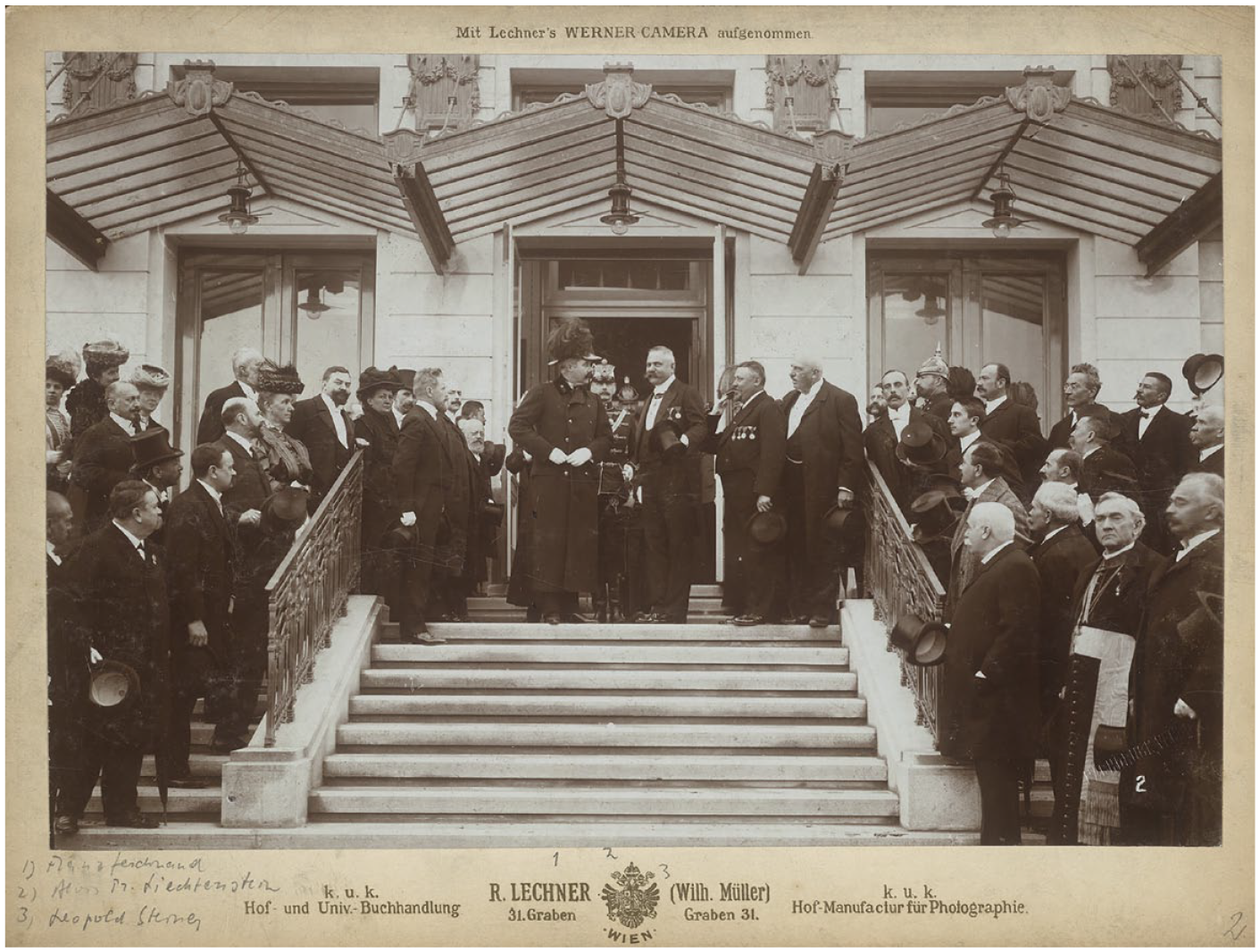
The heir apparent, Franz Ferdinand, during the opening of the Steinhof Asylum on 8 October 1907 (Franz Ferdinand, Erzherzog von Österreich-Este, Austrian National Library, Bildarchiv Austria Pz 1907 10 08 / 1 / 3 – D). Names (handwritten at bottom left): 1. Franz Ferdinand; 2. Aloys Prinz Liechtenstein; 3. Leopold Steiner.
This instrumentalisation of psychiatry as a tool for political gains corresponds with the purpose of other public services the crownlands put forward in this period. John Boyer (1994: 32–4) argued that the Viennese Christian Socials (Christlichsoziale Partei) employed social policies not only as ends in themselves but also as tools to illustrate the alleged efficacy of their politics. Similarly, in her studies on the creation of ‘modern’ villa-style asylums, Leslie Topp shows that crownlands – especially Lower Austria – included psychiatry in their array of signature projects in the realm of social welfare (Topp, 2017: 39–41). Thus, rather than regarding psychiatry as a mere disciplinary institution like prisons, the crownlands considered the creation of asylums to be both politically and socially beneficial, so much so that they went to great lengths to make sure to communicate how important the crownland governments had been in establishing them.
Even though they were invisible in the public representation of these new asylums, psychiatrists were far from uninvolved in their construction. In fact, they were important members of research missions, aimed at visiting and analysing the most ‘progressive’ mental hospitals in other European countries. These missions – of which public officials were very often a part – then led to the publication of books or papers in which psychiatrists dealt with questions of asylum structure and architecture. These publications are of striking detail and they formed the conceptual basis of several asylums. One of these was the Heil- und Pflegeanstalt in Mauer-Öhling, for which Josef Krayatsch’s theories on asylum architecture (Krayatsch, 1895) functioned as its conceptual blueprint (Koller-Glück and Kunerth, 1988). Psychiatric influence, however, was neither limited to those alienists who were in the employ of crownlands, nor limited to the creation of asylums.
In 1907, not only was the Steinhof asylum opened, but also the most ambitious government bill on psychiatric policy in 50 years was introduced. This draft of an Entmündigungsgesetz – a law regulating wardship and wardship procedures – was preceded by an expert commission on insanity law reform called the Irrengesetz-Enquete, in which a number of prominent psychiatrists played an important role. Being the result not only of alleged necessity but also of antipsychiatric agitation, its process exemplifies how both experts and civil society shaped policy development in the late Habsburg Empire, and how public discourse became increasingly relevant in policy evaluation and agenda setting. As such, psychiatry was – despite the significant role the crownlands played in policy implementation – not only a regional project but had significant implications at the level of the unitary state.
Yet it was not only the experts that became increasingly influential in policy design. In fact, the media – and newspapers especially – played a significant role in communicating both the experience of laypeople and facilitating antipsychiatric campaigns. They did this mostly by focusing on those shortcomings of the existing insanity laws that had led to public scandals on which they could capitalise. It was within this network, which consisted of psychiatric experts and self-proclaimed advocates of the victims of the existing insanity laws, that insanity law reform took place and thus anticipated the Irrengesetz-Enquete of 1901–2. This represented a significant change from the Gesundheitspolicey of the (enlightened-)absolutist era, since: [t]he set of policy participants includes not only the traditional ‘iron triangle’ of legislators, agency officials, and interest group leaders, but also researchers and journalists who specialise in that policy area . . . and judicial officials who regularly intervene in a policy subsystem[.] (Sabatier and Weible, 2007: 192)
Insanity-law-reform in discourse: psychiatry and antipsychiatry
Institutional psychiatry has always been faced with a certain amount of public scepticism. From the 1870s onwards, however, criticism was mostly framed in terms of legality. Had psychiatrists even the right to institutionalise patients against their will, or was psychiatry as a whole a threat to the hard-won civil liberties? How did involuntary admissions relate to the rule of law? Conversely, minor adjustments to existing laws that derived from measures defined in the General Civil Code of 1812 (Allgemeines Bürgerliches Gesetzbuch) were made that sought to guarantee the protection of and from the mentally ill. Yet the laws and decrees adopted between 1869 and 1874 did not significantly change the fact that once a person had been declared insane, they lost their legal standing in the courts (Sprachmann, 1994: 58).
Scandals, such as the one surrounding the actors Alexander Girardi and Helene Odilon in 1896, in which she attempted to rid herself of her husband by unsuccessfully orchestrating his institutionalisation, added fuel to the flames of a public discourse about the shortcomings of existing insanity laws. 12 They catalysed the emergent bourgeois antipsychiatric movement that considered the existing wardship procedures inadequate, fearing that they led to many wrongful institutionalisations. The Girardi-Odilon scandal’s relevance for insanity law reform, however, stems from Emperor Francis Joseph’s involvement. Katharina Schratt, a friend of Girardi’s, had asked the Emperor to intervene on his behalf, and Francis Joseph subsequently pushed for a reform of psychiatric policies (Markus, 1998: 173–185).
In the wake of such scandals, the loosely structured antipsychiatric movement started its successful campaign with a public appeal ‘Protection against declarations of insanity’ that appeared in various newspapers on 7 February 1901 (e.g. Burckhard et al., 1901: 2–3). The signatories – Max Burckhard (1854–1912), Ludwig Hörmann (1837–1924), Ferdinand Kronawetter (1838–1913), Leo Munk, 13 Karl Scherzer (1821–1903), Eduard August Schroeder (1852–1928), Emil Schrutka (1852–1918), Eduard Suess (1831–1914) and Friedrich Zoll (1834–1917) – heavily criticised the existing wardship procedures. To emphasise the respectability of the people involved, the article mentioned both their academic credentials and their professions.
Similar critical movements appeared all over the German-speaking countries in the 1890s. A common metaphor for institutionalisation with which they operated in their campaigns were those of being ‘buried alive’ or ‘civic death’ (der bürgerliche Tod) (Bernet, 2007; Schmiedebach, 1996). The Austrian critics of psychiatry employed a similar rhetoric when they wrote of persons being ‘buried in the asylum’ or of the ‘official death of the mind’ (Burckhard et al., 1901: 2). If psychiatric evaluations of a person’s mental state were as unreliable as the critics felt they were, then wardship procedures constituted nothing less than an infringement of those individuals’ rights and a lack of the rule of law for which the liberals had so vehemently fought (Deák, 2015: 170–171). Doubts about psychiatric legitimacy and reliability were thus deeply destabilising, not only to the system of psychiatric care but also to bourgeois society as a whole, since they challenged ‘the liberal subject concept of the mature [mündig] self’ (Bernet, 2007: 119).
The signatories’ personalities emphasise this. For one thing, several of them – Schroeder, Burckhard, Kronawetter, Munk, Schrutka and Zoll – were lawyers. Secondly, all of them were ideologically within the bourgeois liberal or democratic spectrum. This is true, for example, for the former Member of Parliament and geologist Eduard Suess, the diplomat and former 1848 revolutionary Karl Scherzer, and writer and folklorist Ludwig Hörmann, who had been a member of the student corps Rhaetia. Hörmann shared a social and cultural background with Burckhard who had been a member of the Burschenschaft Silesia. Schroeder – a student of the founder of the Austrian School of Economics Carl Menger (1840–1921) – was the most important within this antipsychiatric group, because of his detailed studies of insanity laws, including two critical books on the matter (Schroeder, 1890, 1891).
It was thus Schroeder who was singled out for his criticism of psychiatry. Psychiatrist Julius Wagner-Jauregg (1857–1940) responded with a three-part essay on ‘[t]he Reform of Psychiatry’ in the Wiener Klinische Wochenschrift, and he started with a public attack on Schroeder’s ‘agitation against psychiatrists’ (Wagner-Jauregg, 1901a, 1901b, 1901c).
Accordingly, the first article did not focus on a substantial rebuttal of Schroeder’s arguments, as Wagner-Jauregg dismissed them as personal animosities and not related to honest motivation to reform the system. For this reason, Wagner-Jauregg did not refer to the public appeal of the antipsychiatric movement but concentrated on Schroeder’s books, whose arguments he dismissed by arguing that they were based on misconceptions, errors and misinformation about the state of contemporary psychiatry. Simply put, Wagner-Jauregg aimed at delegitimising Schroeder’s goal by delegitimising his opinion: One has to ask oneself whether arrogance alone, undiluted by any expertise, makes anyone capable of or entitled to being an opinion leader in any subject. It is unlikely that we could expect viable suggestions from such a man. (Wagner-Jauregg, 1901a: 295)
Wagner-Jauregg thus challenged Schroeder’s expertise. Lawyers, he appeared to suggest, are laypeople in psychiatric matters, unable to judge how the mentally ill ought to be treated and what constituted maltreatment. The examples of involuntary institutionalisations were – according to this view – always exaggerated or not representative of the state of institutional psychiatry. These claims were nothing but ‘Psychiaterhetze’ (p. 295).
This did not mean that the medical experts saw no need for reform, as Wagner-Jauregg readily admitted in subsequent articles. Indeed, the Viennese Association for Psychiatry and Neurology had been campaigning for a new ‘insanity law’ since 1873 (Anon., 1873: 173–4). However, antipsychiatric sentiment and highly publicised cases of involuntary institutionalisations did invigorate insanity law reform as government representatives explained in parliamentary committees. 14 Yet the public discourse on the reform of wardship procedures in the early twentieth century was not only a debate between psychiatric experts on the one side and legal experts on the other. It was, in fact, more complicated. Psychiatrists were part of different political networks, namely architecture on the one hand and law on the other. While they remained partly defensive in the latter, they were an explicitly progressive force in the former.
Policy-making: the Irrengesetz-Enquete of 1901/2
In 1898, the Oberste Sanitätsrat had asked Julius Wagner-Jauregg to submit an evaluation of the contemporary insanity laws. 15 His evaluation was part of a larger expert opinion on insanity law reform, which the Oberste Sanitätsrat sent to the Ministry of the Interior in 1900. Referring to earlier attempts at reforming the existing laws that dated back to 1885, the Oberste Sanitätsrat suggested the establishment of a commission of inquiry (Enquete). This commission was to consist of representatives of the Ministry of Justice, the Ministry of the Interior, members of the Oberste Sanitätsrat, members of the Statistische Zentralkommission, if necessary, and psychiatric ‘experts’. 16
Both ministries approved of the initiative, and in early 1901, the first meeting of the Irrengesetzenquete took place in the Ministry of the Interior. Chaired by the head of the department Anton Graf Pace (1851–1923) – an expert in the field of administrative law – the members of the commission were Franz Klein (1854–1926), Hugo Schauer (1862–1920) and Hugo Hoegel (1854–1921) on behalf of the Ministry of Justice, as well as Guido Freiherr von Hardtl (1859–1928) and Josef Daimer (1845–1909) on behalf of the Ministry of the Interior, all of them civil servants. As experts, the Enquete nominated Gabriel Anton (1858–1933), Moriz Benedikt (1835–1920), Johann Hraše, Josef Hinterstoisser, Richard Krafft-Ebing (1840–1902), Gustav Neusser, Arnold Pick (1851–1924), Adalbert Tilkowsky (1871–1907) and Julius Wagner-Jauregg, all of whom were psychiatrists, apart from neurologist Moriz Benedikt. 17 The personal configuration shows that the Enquete functioned as a ‘translating’ tool, to render psychiatric expertise into a political and legal form. Accordingly, the fact that the psychiatrists set the Enquete’s agenda, the professional pride that had led to the heated conflict with antipsychiatric lawyers was all but forgotten.
The Enquete was structured around 28 questions concerning the apparent shortcomings in existing mental health legislation, which the experts attempted to address in individual presentations and subsequent discussions. These 28 questions were based on nine thematic clusters, as proposed by Wagner-Jauregg: (1) Duty of notification; (2) Supervising the treatment of the mentally ill; (3) Creating federal mental asylums; (4) Private sanatoriums; (5) Institutionalisation; (6) Transfer of mentally ill; (7) Release from mental asylums; (8) Incapacitation and wardship; and (9) Treatment of insane criminals and the criminally insane. (Whitrow, 2001: 138)
Their presentations were published in written form as ‘Reports and Proposals on Insanity Law Reform’ in 1904 (Anon., 1904a).
Even though the name Irrengesetz-Enquete suggests otherwise, the committee did not only devote itself to questions of legal regulation but also dealt with topics that had substantial implications for institutional practice, which infringed upon what the crownlands considered to be their own responsibility. With the law on provisional fees in public maternity hospitals and mental asylums from 1864, 18 the Cisleithanian crownlands and kingdoms had gained far-reaching independence as far as the creation and administration of mental institutions were concerned. Not only were the bylaws of public asylums regional laws, but asylum psychiatrists were essentially crownland officials. Crownlands were therefore crucial in the delivery of federal policies. This, together with the federalist structure of the Austrian half of the monarchy, meant that if insanity law reform were to succeed, the Irrengesetzenquete had somehow or other to include the crownlands in the policy process.
In 1904, the commission sent the questionnaire and the experts’ presentations to all crownland governments, asking them to respond with their assessments of the commission’s proposals. Interestingly, the Enquete even informed the Hungarian government about the ongoing Cisleithanian policy process, to which the Hungarian Ministry of the Interior responded by delivering a report on the ‘Hungarian mental asylums in 1903’ (Anon., 1904b).
The crownland governments’ responses to the Enquete always referred to or included statements by the directors of their largest public asylums, who – naturally – were crownland employees. Their reactions, however, were rather cool. Josef Schweighofer (1866–1928), the head of the largest mental hospital in Salzburg, Maxglan, complained about the late inclusion of the crownlands in the policy development process. 19 In the years that followed, other crownlands echoed this criticism, which ultimately led to the claim that asylum psychiatrists had not been included in the Enquete in a satisfactory way.
The professional rift between academic and asylum psychiatrists thus continued on the level of policy formulation and was exacerbated by its federalist implications (Engstrom, 2003: 105–7). While policies formulated by academic psychiatrists sat well with bureaucrats on the state level, the fear of losing influence and status united asylum psychiatrists and crownland governments in their rejection. Ironically, the alienists argued that most of the academic psychiatrists the Enquete had consulted had insufficient expertise in institutional practice to judge the impact of potential legal reform.
Yet the conflict was not only one of psychiatric tradition. Insane asylums were among the few public health institutions for which some crownlands could rightfully claim the provision of satisfactory or even exemplary care for their population. Accordingly, the Lower Austrian member of the regional government Leopold Steiner (1857–1927) wrote to the Ministry of the Interior: [T]he quality of care for the insane has in most kingdoms and countries represented in the Reichsrat, and compared to the quality of other public institutions, not only reached a rather high level but can in some cases be regarded as immaculate.
20
Whereas a confusingly complex web of federal, regional and municipal jurisdiction hindered the development of other institutions within the healthcare system (Osterkamp, 2020: 286–9), ‘modern’ insane asylums were actually being built.
How wary the crownlands were of the proposed changes to the insanity laws is indicated by the time it took them to submit their statements. It took the Lower Austrian government nearly a year to deliver its comment, and the other crownlands were equally slow. While all of them congratulated the commission on its attempt to create a unified set of legal reforms and were sympathetic to some of the experts’ proposals, they took issue with those that threatened to either reduce crownland influence or overburden their budgets. This dilemma can be illustrated by the issue of how and by whom disturbed criminals and the criminally insane ought to be treated.
Wagner-Jauregg and Moriz Benedikt had argued in their proposal that there were three workable solutions to these questions: 1. Treat disturbed criminals and the criminally insane in specialised wards within mental asylums. 2. Create insanity wards inside prisons. 3. Create specialised state-run institutions for the criminally insane. Every crownland argued strongly against treating the criminally insane inside existing psychiatric institutions. Not surprisingly, their reasons were less medical than fiscal (Osterkamp, 2016). 21 A law forcing crownland institutions to treat criminals also would, they feared, lead to a significant rise in expenditures for psychiatric institutions, and such a solution would only be thinkable ‘if the costs were carried by the state, not the crownlands’. 22 In their opposition, regional representatives often framed their arguments in terms of welfare or public health considerations. 23 The Statthalterei in Trieste, for example, rejected the idea of creating insanity wards in prisons on the grounds that crimes committed by disturbed persons should be treated on psychiatric and not primarily legal terms. 24 This shows that the antagonists within the debate on insanity reform were not only state representatives on the one hand and regional representatives on the other. It was also an antagonism of academic psychiatrists and asylum psychiatrists/alienists.
If one gets the impression that the obstruction was a coordinated attempt to block policies that – they felt – violated crownland interests, then that is because it was. The alienists of Cisleithania’s public asylums did coordinate their statements and successfully blocked the introduction of a unified Irrengesetz. This advocacy coalition worked well until the 1910s, when – on the April 24, 1910 – they met in Linz to draft a joint statement where they objected to the proposition for an insanity law and demanded the creation of a new Irrengesetz-Enquete, in which alienists (Anstaltsärzte) would play a more central role. 25
The use of academic rather than asylum psychiatrists as experts was probably no accident. Using the progressivist rhetoric as seen in the opening of the Steinhof, and being associated with men of science, rather than mere alienists, helped position the Enquete as an ‘objective’ endeavour, rather than an obvious extension of the alienist influence that had been so heavily criticised. It reflects the description by Engstrom (2003: 105–75) of the German Empire, namely that ‘academic psychiatry was repositioning itself to address social questions and simultaneously extending its jurisdictional reach in subtle, new, though perhaps less visible ways.’
Nevertheless, in the face of crownland resistance the commission abandoned the idea of reforming psychiatric legislature with a single unified law and concentrated instead on the issue of legal wardship and the protection of patients’ personal rights. Consequently, the Enquete refocused its efforts on changing those legal shortcomings that had facilitated scandals such as the Girardi-Odilon-affair in the first place. Once again, it was Wagner-Jauregg who served as psychiatric advisor in the development of the Entmündigungsgesetz (Wagner-Jauregg, 1940). Due to the fact that the crownlands themselves felt slighted by their late inclusion, however, even these more specialised attempts at insanity law reform were off to a bad start.
From Entmündigungsgesetz to Entmündigungsordnung
A government bill proposing a law regulating both wardship and involuntary psychiatric admission was presented to the Austrian Chamber of Deputies on 19 December 1907, 11 years after the Girardi-Odilon scandal and 6 years after the commission had started working on insanity law reform.
26
As the bill’s commentary explained: Over the course of the preparations, the necessity was discovered to deal with each question separately. . . . The part of the insanity law reform dealing with the protection of the civil rights of the mentally ill could be completed, however, and can now be realised as part of the proposed Entmündigungsgesetz.
27
The commentary argued that a swift realisation of the Entmündigungsgesetz was necessary, among other reasons because ‘the public explicitly demands a reform in this area not least because biased reports on occasional wardship cases have repeatedly caused widespread worry[.]’ 28
Swiftness, of course, is a rather relative term. The parliament’s rules of procedure allowed government proposals and other motions to be assigned to a committee without a preparatory parliamentary debate – the so-called omission of the first reading. In fact, the government presented the bill four times between 1907 and 1911, when a first, albeit rather short, reading took place that included only one speaker: Stanislav Dnistrianskyj (1870–1935), member of the Ruthene and later Ukrainian faction, who criticised the policy process and considered the law to be a dry, bureaucratic draft, free from expert input. 29
The government’s weakness was its instability. Between 1907 and 1911, Cisleithania had four different minister-presidents, 30 which contributed to the delay of any in-depth political debate. It was not until Karl Stürgkh became head of government after the September revolt of 1911 that the Entmündigungsgesetz was finally discussed.
The Entmündigungsgesetz addressed a number of issues psychiatrists and legal scholars had been criticising for years. The bill differentiated between two varieties of Entmündigung: full disability and partial disability. Adults with severe cases of mental illness were to be put under full disability, whereas partial disability was meant to include adults who were considered able to care for themselves if supervised by a legal guardian. More technically, adults under full disability were legally on the same level as children below the age of seven and adults under partial disability were considered under-age persons, i.e. below the age of 24. In this, the Entmündigungsgesetz found precedent in respective French, Italian and English laws. However, not only the ‘insane’ could be put under partial disability. The government proposed temporary wardship for not only alcoholics and habitual abusers of narcotics but also spendthrifts, whose behaviour might jeopardise their families or others. 31
The law also defined rules and regulations on how potential wardship cases were to be evaluated – the Entmündigungsverfahren. If the prosecution or another party in the lawsuit considered the examination of a defendant’s mental state necessary for safety reasons or because it could be of public interest, they could plead the court to question witnesses, mental health experts and the defendants themselves. Based on these testimonies, a judge could then freely decide whether the defendant was to be put under full or partial disability. Once this had happened, the defendant’s ward had 14 days to appeal against the decision. The appeal proceedings were public trials, consisting of a chair, two judges and two jurymen. 32 According to the Entmündigungsgesetz, asylums – regardless of whether they were public or private – had to inform the authorities on any involuntary admissions within 24 hours. 33
Richard Krafft-Ebing’s (1840–1902) proposal on wardship reform had focused mostly on increasing the speed of wardship trials, as psychiatric knowledge postulated the importance of timely treatment within the confines of a mental institution. In his view, the protection of a patient’s personal rights should be guaranteed by an additional differentiation between full and partial wardship, through the introduction of temporary wardship. Additionally, he argued that asylums ought to be able to appeal cases in which a judge had ruled that a person was completely capable of taking care of his own affairs, with which the Lower Austrian Landesausschuss generally agreed. 34 In this view, a person’s rights were sufficiently maintained by increasing the complexity and quality of the existing system. The idea to introduce means of challenging psychiatric opinion and expertise, however, had not occurred either to psychiatrists or crownland representatives. Although the proposed law did cater for psychiatric sentiments, it only partly did so.
The debate on the Entmündigungsgesetz epitomised the tensions that existed between legal and psychiatric expertise. Its draft improved the legal status of potential wardship cases and was a direct attempt at addressing antipsychiatric criticism. Additionally, the proposed integration of lay judges in the legal process would have resulted in a democratisation of the wardship process, while at the same time reducing the influence of medical opinion. Despite their formative influence on the Enquete’s agenda, psychiatrists considered the proposed law a shocking disregard of their expertise. What they overlooked was that the proposal attempted to integrate propositions of legal experts as well. Accordingly, liberal and social democrats applauded this draft of an Entmündigungsgesetz for its attempt to modernise existing disability laws. ‘One would wish’, the social democratic attorney Isidor Ingwer (1866–1942) wrote in the Arbeiter Zeitung in January 1908, ‘that, after having made the necessary amendments, this proposal was swiftly put into practice’ (Ingwer, 1908: 2). In addition to the tensions that existed between psychiatric and legal expertise, the law thus also exemplified the difficulty of balancing democratisation and expertise proper (Collins and Evans, 2007: 8).
Ingwer’s generally favourable comment on the government bill concentrated mostly on the reformed wardship procedures. In his view, whether or not a person was to be put under disability depended at that time entirely on the ‘indifference or eccentricity or insane authoritarianism’ of judges and psychiatrists (Ingwer, 1908: 2). The new bill, on the other hand, allowed for much fairer disability trials, not least because appeals were held in public and included two jurymen, which reduced the concentration of authority in the hands of judges and psychiatrists and was thus considered inclined to prevent arbitrary verdicts. For the social democrats, the introduction of jurymen was in fact a core issue. Their introduction in disability trials, they hoped, would set a precedent for a general introduction of jury trials in courts of law: ‘Of course it has to be ensured that also workers may serve on a jury. The time of privileges within the legal system comes to an end; it must be the last hour of the legal privileges of the ruling classes’ (Ingwer, 1908: 3).
The psychiatrists, on the other hand, were less convinced. In 1908, the Yearbook of Psychiatry and Neurology, edited by the Viennese Verein für Psychiatrie und Neurologie, one of the largest and most important psychiatric associations, published a wide-ranging critique of the government bill (von Sölder, 1908). This critique, originally presented at the 1908 Austrian Alienist Convention in Vienna by neurologist Friedrich von Sölder (1867–1943), congratulated the government on finally acknowledging the need for mental health policy reform, which ‘the Austrian alienists have been advocating for five decades, to no avail’ (p. 370). He argued that the proposed Entmündigungsgesetz focused too much on the rights of people under wardship and not enough on the protection of society from potentially dangerous mentally ill individuals. Furthermore, the psychiatrists’ opinions on the new wardship procedures were diametrically opposed to Ingwer’s. In their view, the government bill constituted a complete disregard of psychiatric expertise and an unnecessary emphasis on the opinion of laypeople (p. 371).
Challenging the Entmündigungsgesetz aligned the interests of academic and asylum psychiatrists as well as crownlands. In 1910, the heads of the Cisleithanian public asylums drafted a resolution, in which they positioned themselves firmly in opposition towards the direction insanity law reform had taken. They were not alone. Within months, the resolution was officially endorsed by several Statthaltereien, among them Lemberg/Lwiw and Brünn/Brno. 35
In order to oppose developments at state level, regional governments and institutional psychiatrists concerted their efforts to obstruct and petition the reform process in the Reichsrat. Their petition – which explicitly refers to both Landesausschüsse and asylum psychiatrists as initiators – demanded several changes to the proposed Entmündigungsgesetz. 36 Their demands were consistent with von Sölder’s criticism insofar as they argued for a revaluation of expert opinions in the wardship process and reduced influence of patients’ representatives. In addition, the opponents of the Entmündigungsgesetz introduced five parliamentary resolutions, in which they demanded that the crownlands were to be included in future reform processes and they re-emphasised their criticism of including lay judges in the appeal proceedings of wardship cases. 37
Asylum psychiatrists had not always been solely on the defensive. In the creation of the villa-style institutions in Kroměříž, Mauer-Öhling and Vienna, alienists had featured prominently, sharing the government officials’ drive to study ‘international cutting-edge practice in a conscious effort not only to learn from them but to surpass them in terms of modernity, exemplarity, and administrative rationality’ (Topp, 2017: 50–1). Accordingly, the head of the Steinhof asylum, Heinrich Schlöß, remarked in 1911 that apart from a general mistrust vis-à-vis psychiatrists, rather than resolve unwarranted criticism, the reform process could potentially damage the reputation of alienists and asylums: Asylum psychiatrists are not overly sensitive insofar as they feel offended by every control of their work, every supervision of the asylums by state institutions . . ., every protective measure created for the mentally ill[.] [O]n the contrary, they know that this control, supervision and protective measures, even when they are legitimate and not motivated by mistrust, or shameful and dishonourable, create outlets, through which distrust against alienists and asylums can find their way. (Schlöß, 1911: 362)
According to this argument, the reform of insanity laws could cause antipsychiatric sentiment and compromise the psychiatrists as well as the asylums themselves. Regional governments could hardly support developments that could potentially discredit their signature projects in which they had heavily invested. Not least, however, both asylum psychiatrists and crownlands feared that insanity-law-reform might reduce their professional or political influence.
Within the legal committee, the government representative Hugo Schauer explained the government’s willingness to make concessions toward the crownlands if that meant a swift passage of the bill. 38 Schauer had already been part of the Irrengesetz-Enquete of 1901/2 and – having since been promoted to head of department – had supervised the policy’s development from the beginning.
In 1913, the Entmündigungsgesetz had been under parliamentary review for eight years, which is why most parliamentarians within the legal committee had no further plans for major revisions of the law. Two committee members, the German nationalist Arthur Stölzel (1868–1933), who ‘emphatically argued in favour of the regional governments’, and the Christian Socialist Victor von Fuchs (1840–1921), had other plans. 39 These two members of parliament, who were both lawyers, argued that based on their experience in legal practice, the proposed patients’ representatives ought not to be part of the Entmündigungsgesetz, a motion that the committee had already rejected before. They emphasised that such patients’ representatives would seriously compromise the work of the public asylums, and were detrimental to the health of their patients. 40 Coincidentally, both Stölzel and Fuchs came from the crownland of Salzburg, whose asylum director Josef Schweighofer had heavily criticised the Enquete for its late inclusion of the crownlands in the policy development process. Furthermore, Schweighofer’s asylum was located in the town of Maxglan, whose mayor Arthur Stölzel had been between 1897 and 1900. 41
The legal committee rejected most of the changes the institutional psychiatrists and regional governments had proposed. With a simple majority, however, the committee decided to erase the rules on the patients’ representatives from the Entmündigungsgesetz. Minister of Justice Viktor Hochenburger (1857–1918) was ready for this kind of concession, even though ‘the deletion of the rules on the patients’ representatives does not improve the law in any way’, not least, because similar rules already existed, as regulated by Article 217 of the General Civil Code. 42
Stölzel continued to argue in favour of the crownlands until the very end. Even after the government’s concessions and the rejection of most of the crownland proposals, he put forward a resolution that was identical to the one institutional psychiatrists and crownlands had posted, arguing again for their inclusion in further policy development. 43 Opposing this, the social democratic members of parliament Karl Renner (1870–1950) and Herman Liebermann (1869–1941), as well as the liberal democrat Julius Ofner (1845–1924), forwarded minority proposals to reintroduce patients’ representatives into the government bill. 44 Even though the committee also rejected Stölzel’s resolution, its debate shows how sensitive the issue of patients’ representatives had become. For asylum psychiatrists and the crownlands, they symbolised a threat to their influence; for the social democrats and some liberals they constituted an important element in the democratisation of the wardship process.
The Entmündigungsgesetz was not realised until 1916, when, during the war, Francis Joseph used the bill as the foundation for an imperial decree, the Entmündigungsordnung. 45 Twenty years after the Girardi-Odilon scandal had ignited the public debate on wrongful psychiatric admissions and furthered antipsychiatric sentiment, the matter was finally resolved. The authoritarian war-dictatorship enabled Francis Joseph to break the obstructionist stance of the crownlands and their psychiatrists. That being said, however, imperial decrees still required parliamentary approval after the reestablishment of parliamentarianism in 1917 when the Entmündigungsordnung was approved unanimously and remained in place until 1984 (Pilgram, 2009: 88).
Conclusion
There are several works dealing with the apparent antagonism between alienists and psychiatrists, or – more appropriately – asylum and academic psychiatrists. 46 Although both belonged – in a sense – to the same scientific community, both groups had developed distinct identities and distinct opinions on psychiatric policies. This rift echoes the antagonism between the crownlands and the central state. Both asylum psychiatrists and regional governments bemoaned their lack or imminent loss of influence at a time when psychiatric initiatives were fashioned as ‘monuments to the victory of science’.
At the same time, academic psychiatrists played a decisive role in policy development on the state level, featuring prominently in the Irrengesetz-Enquete and being repeatedly called upon as experts. Ironically, despite their influence on policy design, their proposals were never actually made into law. Asylum psychiatrists might have envied them for their apparent influence, when on the regional level they themselves were in fact far more successful in seeing their expertise being translated into concrete asylum projects.
For all their inclusion in the policy process, however, psychiatrists were never able to bask in their success. The grand openings of asylums such as Mauer-Öhling or the Steinhof all seemed to ignore the role the experts had played in realising them. Similarly, the Irrengesetz-Enquete and its propositions were discussed in psychiatric circles. Once the legislative process in parliament was started, however, they were again entirely absent. Psychiatrists thus paid for their influence with symbolic absence, as far as the creation of ‘progressive’ structures was concerned as well as legal reform. Their role was peculiar in that both the regional governments as well as the state government relied on their expertise in promoting policies that they considered opportune, if not downright helpful. Yet public officials seemed wary of too close an association with alienists, both symbolically and rhetorically. The Steinhof was a monument to the victory of ‘science’, not medicine or psychiatry. Rhetorically the article in the Neues Wiener Journal suggests that rather than just a new version of a ‘mad-house’, the Steinhof was an entirely different institution altogether: [T]his institution, which is the only one of its kind in the whole world, both in terms of size and modernity, shall eliminate all memories of how the mad used to be treated, memories that still have the most ruinous influence on the public impression of today’s scientific practice. (Anon., 1907a: 1)
The history of the Entmündigungsgesetz shows that psychiatry in the Habsburg Empire had developed into a distinct area of policy, in which a complex interplay of political processes influenced policy as much as political actors themselves. Unused to their heightened status as medical experts, psychiatrists seemed to have overlooked the fact that wardship was not only a psychiatric but also a legal issue. It was a policy field precisely because it was not just one interest group that had the most formative influence on policy design. The imperial decree – the Entmündigungsordnung – on the other hand shows that participatory development processes were not irreversible but required parliamentarians and the media as a metaphorical hinge between themselves and civil society.
However, the two opposing parties were not only psychiatric experts on the one hand and representatives of civil society – the antipsychiatric movement – on the other. On another level, the debate on the Entmündigungsgesetz also led to antagonism between the central government and the crownland governments. Argumentative alliances subsequently focused either on the promotion of insanity law reform or on its prevention. They consisted of government representatives, academic psychiatrists, lawyers, journalists such as Isidor Ingwer, as well as the members of parliament Renner, Liebermann and Ofner on one side, and crownlands, institutional psychiatrists, as well as the members of parliament Stölzel and Fuchs on the other. These advocacy coalitions indicate a systemic contrast to the procedural logics of the Gesundheitspolicey from the earlier absolutist period before 1867. As a political paradigm, the ‘Policey’ not only aimed at the establishment of durable rules of public order, it also saw their definition and creation exclusively within the realm of the ‘iron triangle’ of Emperor, bureaucracy and privileged interest groups (Dietz, 2003: 592).
The existence of areas of policy constitutes a significant change in the ‘cultures of decision-making’ (Pfister, 2019: 12), as it was no longer the Emperor who was the most central actor but a shared decision-making process in which a variety of actors participated. The governmental system within which psychiatry as an area of policy developed was, as Helmut Rumpler wrote, . . . neither ‘parliamentarian’ nor ‘absolutist’, not ‘pseudo-constitutional’ or ‘secretly absolutist’, but ‘constitutional’, albeit in a special way that was adjusted to the specific conditions of a nationally, culturally and economically diverse union of lands. (Rumpler, 2000: 1)
Francis Joseph’s role within the area of policy mirrors this complex configuration. On the one hand, he took no part in policy development as promoted by the Irrengesetz-Enquete. On the other hand – as the Girardi-Odilon scandal shows – he occasionally served as a catalyst for policy development, in which he had an active role in setting the agenda for insanity law reform. Ultimately, he did not just formally put the Entmündigungsgesetz into law in 1916, but went further when the policy process came to a grinding halt in 1913, by issuing an imperial decree. On another level, the Emperor served as a powerful symbol within the context of charity and welfare, as the opening of the Steinhof asylum shows, even though he was represented on the day by the heir to the throne. ‘Through Franz Joseph, the revitalised Habsburg state displayed its commitment to improving the lives of all citizens’ (Unowsky, 2005: 116). This is indicated by the explicitly political character of the Steinhof celebrations but also by the fact that its prototype, opened five years earlier in Mauer-Öhling, Lower Austria, was named the Kaiser Franz-Joseph Landes-Heil- und Pflegeanstalt.
The development of the Entmündigungsordnung as a policy subsystem shows how this transformation influenced policy development. Within this process that anticipated ‘modern’ statehood, the emperor – at least in phases of parliamentary activity – was no longer the central actor in shaping policies; however, he was more than a ‘signature machine’ (Vocelka and Vocelka, 2015: 261) whose political influence was reduced to mere formalities. The role of the experts was much more fluid. On the one hand, their knowledge was necessary within a complex area of policy such as public health; on the other, public officials were very keen on keeping their influence invisible to the public eye.
Footnotes
Declaration of conflicting interests
The author declared no potential conflicts of interest with respect to the research, authorship and/or publication of this article.
Funding
The author disclosed receipt of the following financial support for the research, authorship and/or publication of this article: This research was partly funded by the University of Vienna’s Uni:Docs-programme.
