



Abstract
This article analyses performance in the work of French project artist Sophie Calle, focusing in detail on the major installation Prenez soin de vous (2007). It argues that performance, which is key to debates about postmodern self-narrative and central to an understanding of Calle’s corpus from the outset, is taken into new terrain with this project, since its scope, variety and ambitious collective dimension become ways not of scrutinising but rather of evacuating the autobiographical subject. The article connects the performativity of Prenez soin de vous with recent post-feminist returns to the romance narrative, explores its indebtedness to representations of the scene of reading in Western art, and also argues for an evaluation of the comic in Calle’s work. Its detailed assessment of Prenez soin de vous as performance is based on the installation as curated in the Salle Labrouste of the former Bibliothèque nationale de France (2008) and an argument is presented for the special significance of this location to Calle’s project.
Je prends un rôle: je suis celui qui va pleurer; et ce rôle, je le joue devant moi, et il me fait pleurer: je suis à moi-même mon propre théâtre.
In June 2007 a pair of highly theatrical photographic portraits of Sophie Calle taken by Jean-Baptiste Mondino appeared in Télérama to accompany an interview with the artist (Desplanques and Félix, 2007). The photograph on the magazine’s front cover was overlaid with the caption ‘Sophie Calle plasticienne: sa vie est un roman’. In both portraits Calle appears to be crying. She gazes into the middle distance, seemingly lost in her own pain, while the camera in turn gazes at her meticulously made-up face. The focal point in each image is provided by exaggerated evidence of tears: Calle’s eyelashes look wet and carefully choreographed streaks of diluted kohl stain her cheeks. Clearly what we are asked to respond to here are not photographs of Calle crying but photographs of Calle as a crying woman, which is something quite different. The distinction is the same as that we are compelled to make when looking at the group photograph ‘Le Faux Mariage’ (Calle, 2002: 68–9), which is not a wedding photograph but a photograph of Calle as a woman getting married: not the document of a real event but an elaborate performance. Télérama’s front-page photograph in particular emphasises artifice. Here Calle’s head is draped in a headscarf, evoking iconography proper to the pietà as if to reframe her, ironically, as ‘Our Lady of the Sorrows’. 1 The sky behind her is unnaturally blue, the roses that frame the image unnaturally pink. The whole, redolent with a kitsch worthy of Martin Parr, has the hallmark of a studio photograph pretending (badly) to be taken outdoors in a natural setting.
Mondino’s portraits patently address not Calle so much as her art. They remind us that any autobiographical route into understanding her work is a fausse piste. Instead they encourage consideration of the dimension of performance which has come to be so central to contemporary practices of autobiography and photography alike. Interestingly the Télérama interview referenced above was timed to coincide with the launch of Calle’s major exhibition Prenez soin de vous at the 2007 Venice Biennale, an installation which highlights performance, but in which Calle herself is seldom visible. Here it is no longer Calle who is ‘[son] propre théâtre’; instead she orchestrates the performances of an extensive cast of other women. It is on this installation that my article will focus, following some brief observations on performance in Calle more generally.
Calle and performance
Concepts of performance, self-revelation and concealment have been at the fore of Calle’s projects from the outset. Notable iterations include her early appearances as a strip-tease artist in the Pigalle area of Paris (Calle, 2002: 16–19); the intimate video film No Sex Last Night (Calle and Shephard, 1992), which records/performs her failing relationship with Greg Shephard; and the intricately cathartic narrative of romantic disappointment in Douleur exquise (Calle, 2003). All show a predilection for interactivity, play and role-play and a desire to construct evidence-driven self-narratives (the evidence may be photographic, textual or other material reminders of events). The idea of straight evidence, though, is persistently blown out of the water by Calle. Take, for instance, La Filature (1981), a hide-and-seek project in which she arranges to have a private detective trail her and produce evidence of her everyday activities: what kind of documents are these furtively obtained photographs of a woman who was not caught unawares but was instead performing for a prearranged stalker whom she herself was stalking? Is this, we might ask, a self-conscious acting-out of some of the mechanisms and interrelationships at work in contemporary autofiction? Indeed Calle’s work repeatedly highlights the inherently performative nature of autofictional production as well as the vexed debates about authenticity, exhibitionism, vulnerability, ethics and sometimes vulgarity that complicate its reception. In this sense it is singularly contemporary.
Not only does Calle’s work resonate with debates about written or intermedial autofiction, it is also consistent with current theory on the nature of photography, especially with explorations of how the medium is enmeshed in both indexicality and invention and with what Michel Poivert characterises as ‘l’image performée’ (Poivert, 2010). Poivert observes that performed or theatrical images constitute an important philosophy of image-making and the most significant development in photography of the 2000s. Such photography does not excise a portion of reality but instead creates a mood or a mental landscape. It stands in relationship to painting or to film stills rather than to the documentary image, and it invites new kinds of interactive relationships with spectators, unleashing their imagination precisely because of its indeterminacy (it is a fictional construct yet in a medium which still remains associated with fact). To return for a moment to Mondino’s front-page photograph of Calle crying, we might observe that this performed image is a case in point. It gains its effect by entering into simultaneous dialogue with the iconography of religious art and with the stills in Cindy Sherman’s Untitled Film Stills of the 1970s and 1980s, which feature melodramatically weeping women (Sherman and Galassi, 2003). In my analysis of Prenez soin de vous the idea of the staged or performed photograph and the photograph’s relationship to carefully composed genre paintings will both be important.
Calle’s reiterative and investigative staging of key episodes from lived experience – usually painful ones involving rejection, loss and mourning – is progressively concerned more with ethnographic than with autobiographical accuracy, more with the shared than the particular. Increasingly, she very deliberately creates space for others (Montémont and Simonet-Tenant, 2006), deflecting attention from herself as autobiographical centre through performances of common scripts, adopting the role of the waiting, desiring or jilted woman as something generic (Jordan, 2007). Her story is every woman’s story; a re-enactment of something shared. The shorthand, elliptical nature of her narratives, as well as their fragmentariness and lack of connective tissue, make her work particularly porous and transitive. It is in this sense that the artefacts, texts and photographs assembled in Calle’s installations might be thought of not as ‘evidence’ but as ‘props’, hence shifting the idea of authentic documentation of a particular life to that of a common theatre of collective experience. It is this melding of the particular and the generic, this giving over of self to other, that lends Calle’s work its distinctive appeal: it is little wonder that the performativity and theatricality inherent in her projects were seized upon recently by the experimental theatre group ‘Forced Experience’ for a staging of Douleur exquise. 2 Further, as Daphne Merkin observes, through the ways in which she externalises intimate experience Calle’s work ‘manages in its deliberate and singular accessibility to resound with the inner performative self in all of us’ (Merkin, 2008).
One of the major scripts which Calle interrogates through re-enactment is, as my epigraph from Barthes suggests, that of the (heterosexual) romance. Romance is repeatedly declined in her work as a vexed centre of conflicted experience and post-feminist inquiry. In this respect too, Calle is singularly contemporary, for romance, after being declared bankrupt by second-wave feminism, has recently become a legitimate centre of cultural enquiry and academic analysis. Diana Holmes, for example, explores the persistent attractions of romance for women readers, noting that its appeal endures in spite of feminist concerns about its coercive provision of scripts which all too easily replicate the gendered power divide of patriarchy (Holmes, 2006). Calle’s repeated insistence on (failed) romance underscores both its perennial lure and its unreliability as a ‘plot’ for twenty-first-century women who need rather to ‘look after themselves’. The residual power of traditional love stories is evoked in Calle by the theatrical prop of the wedding dress, which is a recurrent feature of her work, and by the photographs of unworn outfits or empty beds which are shorthand references to disappointment. For the purposes of the major installation Prenez soin de vous the romance script once again takes centre stage: this is a project in which women explore romantic disillusionment, sometimes through fictional or critical writing and sometimes through performance.
My argument in this article is that Calle’s major installation Prenez soin de vous requires us to reconsider the nature of performance in her work. The most overtly performative, collaborative and theatrical of her projects to date, it takes performance to a new level and in new directions. It draws on a range of traditions and modes of performance. It requires that we be attentive to theatricality, melodrama, props, scripts and comedy since it is also indisputably the most humorous of Calle’s pieces to date. It allows us to clarify what we might claim for Calle’s work by engaging with it through the idea of performance. If Calle lingers at what Julia Watson and Sidonie Smith refer to as the ‘visual/textual and performative interface’ (Watson and Smith, 2005: 18) in order to probe the stakes of self-narrative for women in particular, her practice in this instance moves further towards collaborative production than any discussed in their study. Here, Calle’s habit of orchestrating a work’s mise en scène while avoiding the spotlight reaches new heights as her project enacts a cathartic cure through commissioning, in response to a jilting message from her lover, a riotous and ingenious collection of responses from 107 other women. Thus Calle contests more convincingly than ever the criticisms of narcissism that less intelligent analyses bring to bear on her work, while putting romance in post-feminist perspective by engineering a mass dismantling of its status as imperative script.
Au pied de la lettre
Key to the depiction of love relationships in Western art and literature, the letter is an essential narrative device. It fosters empathy, produces suspense, paces discovery and deepens the understanding of character. It creates an essentially dramatic space where wish fulfilment hangs in the balance and the dependence of reader on sender is illustrated. Numerous writers, painters and photographers have been inspired to work with the scene of reading, most particularly with the theme of the woman reading, and the gender politics inherent in these representations have given rise to a good many studies.
3
Prenez soin de vous dialogues actively with the tradition of the letter in art. Here is how Calle outlines the inception and evolution of her project:
J’ai reçu un mail de rupture. Je n’ai pas su répondre. C’était comme s’il ne m’était pas destiné. Il se terminait par les mots: ‘Prenez soin de vous’. J’ai pris cette recommandation au pied de la lettre. J’ai demandé à 107 femmes, choisies pour leur métier, d’interpréter la lettre sous un angle professionnel. L’analyser, la commenter, la jouer, la danser, la chanter. La disséquer. L’épuiser. Comprendre pour moi. Répondre à ma place. Une façon de prendre le temps de rompre. À mon rythme. Prendre soin de moi.
The work originates, then, in an ending: an email sent by Calle’s lover to break off the relationship. A refinement of Calle’s obsession with written documents (letters, telegrams, diaries, notes and post-its all figure widely in her corpus), the project dwells with unrelenting intensity on one particular moment – that of the receipt and reading of the message – and on one particularly theatrical prop – the message itself. The exhibition shares much with the earlier piece Douleur exquise, which might be regarded as a companion. Both are set in a long tradition of waiting for news of love and mourning its lost possibility. In both, a communication from the lover is a key narrative device and a key exhibit. In both, the communication is shoddy, upsetting and inadequate: the romantic art of letter-writing is replaced in Douleur exquise with a note scribbled by an intermediary on hotel notepaper (the lover will not come to join Calle in her New Delhi hotel as arranged), followed by a brief telephone conversation, and in Prenez soin de vous with an apparently disingenuous, self-exonerating email in which the lover swears undying love but ends the affair because he cannot live without seeing other women. 4 Both emphasise the moment and place of receipt of the letter. The mise en scène of this instant is very literally central to Douleur exquise, as the reader is invited in the (spatial and chronological) middle of the installation into the setting of loss: the exact copy of Calle’s hotel bedroom. In this exhibition’s final part, Calle marshals a number of devices to help the pain subside. These involve repeated narrations (with variants) of her story and an extensive collection of stories of the pain of others. There is a great deal of feminist (self-)irony underpinning many of Calle’s tactics. For instance, tropes related to a passive/active dichotomy are distributed throughout, including Calle’s depiction of herself as a woman who waits for news from the outside world to determine her destiny (significantly, her narrative is embroidered on cloth), whereas in reality Douleur exquise sees her undertaking a long and adventurous journey while her lover stays at home. Here Calle ironically embroiders herself out of grief through performing a variety of exercises de style on the fundamentals of her narrative and, more particularly, through turning to other people and thereby transcending the personal. In this second part of the exhibition, Calle’s private history is diffused and melded with a swell of other stories of grief (99 to be precise). It becomes insignificant by contrast, and is subject to theatrical – sometimes comic – reworking by Calle herself.
The remainder of this article explores how in Prenez soin de vous Calle arranges multiple re-enactments of the moment of reading, wrenching it from the intimate space/time of private reception, exhibiting it and opening it to public scrutiny, representation and performance. If the satisfaction of the romance script is not available in Calle’s piece, there is nevertheless a different script which supplants it: that concerning the pleasures of a larger community of women and the vigorously therapeutic power of women’s conversation and narrative. Calle’s reception of the message is repeatedly replayed, discussed and reconfigured. Many of the women involved respond to the message by subjecting it to scrutiny according to their professional specialism: it is analysed by an anthropologist, a judge, an astrologer, an accountant, a crossword-puzzle setter, a psychoanalyst, a life-style consultant, a sexologist, a lawyer, a researcher in lexicography and a Talmudic exegete. A proofreader corrects it; a criminologist draws up a portrait-robot of the author; a head-hunter assesses his employability; an eighteenth-century historian translates the message into the libertine and gallant language of that time, thus reminding us of its paradigmatic nature as well as underscoring the pervasive allusions in Prenez soin de vous to the fascination for letters demonstrated in the painting and literature of earlier periods (of which more later). The writer Marie Desplechin invents an elaborate fairytale, ‘La Plume du diable’, based on Calle’s situation; a sociologist provides an erudite essay on ‘L’Exacerbation de l’amour hétérosexuel en Occident’; while an ethno-methodologist skilfully explores the impact of electronic communication on intimate epistolary exchanges evaluating, in an essay entitled ‘Rupture sentimentale, rupture technologique’, the effects of Calle receiving and reading the message on her mobile telephone. All provide accomplished appropriation, reworking and assessment of the message, thus replacing its authority with their own.
Consistent with the dual sense of the French interpréter, many responses to the message are provided by specialists in the performing arts including actresses, singers, dancers, a clown, a magician, a mime artist and a puppeteer. They not only analyse and inflect the message, but imaginatively reperform Calle’s reception of it. They do so in an exaggerated manner, often to the point of parody (either parody of romantic disappointment, or of the tactics and style of the letter itself). This intensive incorporation of performance is one of the major distinguishing features of Prenez soin de vous. Calle’s own performance here is reduced to a minimum: it is a project ‘où je ne m’exprime pas’ (Desplanques and Félix, 2007: 20). Instead she is the orchestrator of a circus, a cabaret, a greater theatre. That theatre attains its resonance, in part, by Calle’s self-conscious inscribing of the exhibition within a long tradition of pictorial representations of women reading: one thinks of the blushing women mesmerised by letters in Chardin, Boucher, Fragonard, Terborch, and most notably in Vermeer whose letter paintings seem to be Calle’s persistent – if unacknowledged – intertext. For the purposes of dramatic representation the lover’s email is given physical embodiment as a sheet of white paper and we are encouraged to read Prenez soin de vous as a postmodern, performative addition to the tradition of letter paintings and scenes of reading in Western art.
(Un)doing Vermeer
Vermeer’s canonical paintings on the theme of the letter, notable for their quiet discretion, are eloquent in terms of the painterly conventions of representing love and intimacy. The surviving works that focus on women reading, Girl Reading a Letter at an Open Window (c. 1657) and Woman in Blue Reading a Letter (c. 1663–4) depict solitary women absorbed in letters they have just received. Others show the tense anticipation of receipt: in Mistress and Maid (c. 1667), a lady is interrupted by her maidservant and seems flustered at her proffering of a letter; a similar scenario is played out in The Love Letter (c. 1669). Behind the lady at her lute hangs a painting of a ship (= the lover) at sea (= love). The motif of the absent husband, popular in Dutch art of the period, was often alluded to by a sea painting or a map representing the perils of the outside world (Leymarie, 1961: 39). In the foreground to the right of the doors leans a sweeping brush and in the centre is a pair of mules, abandoned in disorderly fashion. These too signify disorder in love. Vermeer’s scenes are intimate, almost erotically so: there is a voyeuristic frisson in our being allowed to inhabit the periphery of the reader’s inner world. Nevertheless, there are numerous blocking devices that stress our exclusion from it, in turn creating a sense of intense privacy: we need visually to negotiate a number of obstacles such as doorways, tables or curtains which Vermeer famously places between our desiring gaze and the reading women whose emotional involvement with the letter is such a powerful draw. A quiet sense of domestic imperatives predominates: it is clear that just as we are cut off from the female reader, so she is cut off from the world beyond her home. She is dependent on others to take care of her, and this is part of the subtext of the painting, as is the emergence of the female reader as a focus for male erotic imaginings. In each picture the focus on the letter itself clearly translates Vermeer’s fascination with the production, circulation, reception and exchange of intimate material and with writing as ‘a new technology of privacy’ (Wolf, 2001: 31).
We might say that in Prenez soin de vous Calle and her company of women are performing Vermeer, doing and undoing the painter’s scenes of women reading, restaging their staple elements so that they remain present as predecessors, asking that we measure the full distance between early (seventeenth-century) and late (twenty-first-century) iterations of the same event and engendering a combined sense of echo and disjuncture which is part of the installation’s humour. The photographs that Calle takes of her collaboratrices demonstrate beyond doubt that she is mindful of Vermeer’s compositional and iconographic traits and desirous to write Prenez soin de vous into an art historical tradition. These images are unmistakeably reminiscent of Vermeer: her photograph of Christine Macel, Conservateur du Patrimoine, for instance, seems to be a direct quotation of his iconic Woman in Blue. She emulates the containment and subtle drama of his paintings, asking most of her subjects to inhabit an interior setting, to stand or sit near to a window, thus retaining the feature which, in his visual schema, separated the woman from the world while reminding us of its importance to her destiny. Further, she shows meticulous attention to detail and texture, to colour and tonality, to the exquisite quality of diffused light in Vermeer, and the eloquent chiaroscuro of Flemish interiors. Sensitive to structure and its enhancement of affect, she creates an atmosphere similarly pregnant with interiorised emotion: just as Vermeer’s sitters were absorbed in the letter with their heads or faces turned towards it and away from the viewer, so Calle preserves the sitter’s anonymity, frequently hiding parts of her face behind the letter. This device is so frequent as to be unmistakeably deliberate: in fact so many faces are hidden and so many women depicted from behind that the photographs as a whole seem to be coyly and exaggeratedly out-Vermeering Vermeer (Figure 1). Women are recessed and firmly contained in these often spare interiors, occupying the centre of Calle’s simple, tightly cropped compositions. Her photographs linger on the eloquence of a neck or shoulder, of posture, or of the hands, hair or skin of the subject. There is a stillness here and a silence; the women are locked into the letter, into the composition and into their environment. Intimacy remains, as it was in Vermeer, fascinating and magnetically inaccessible. 5
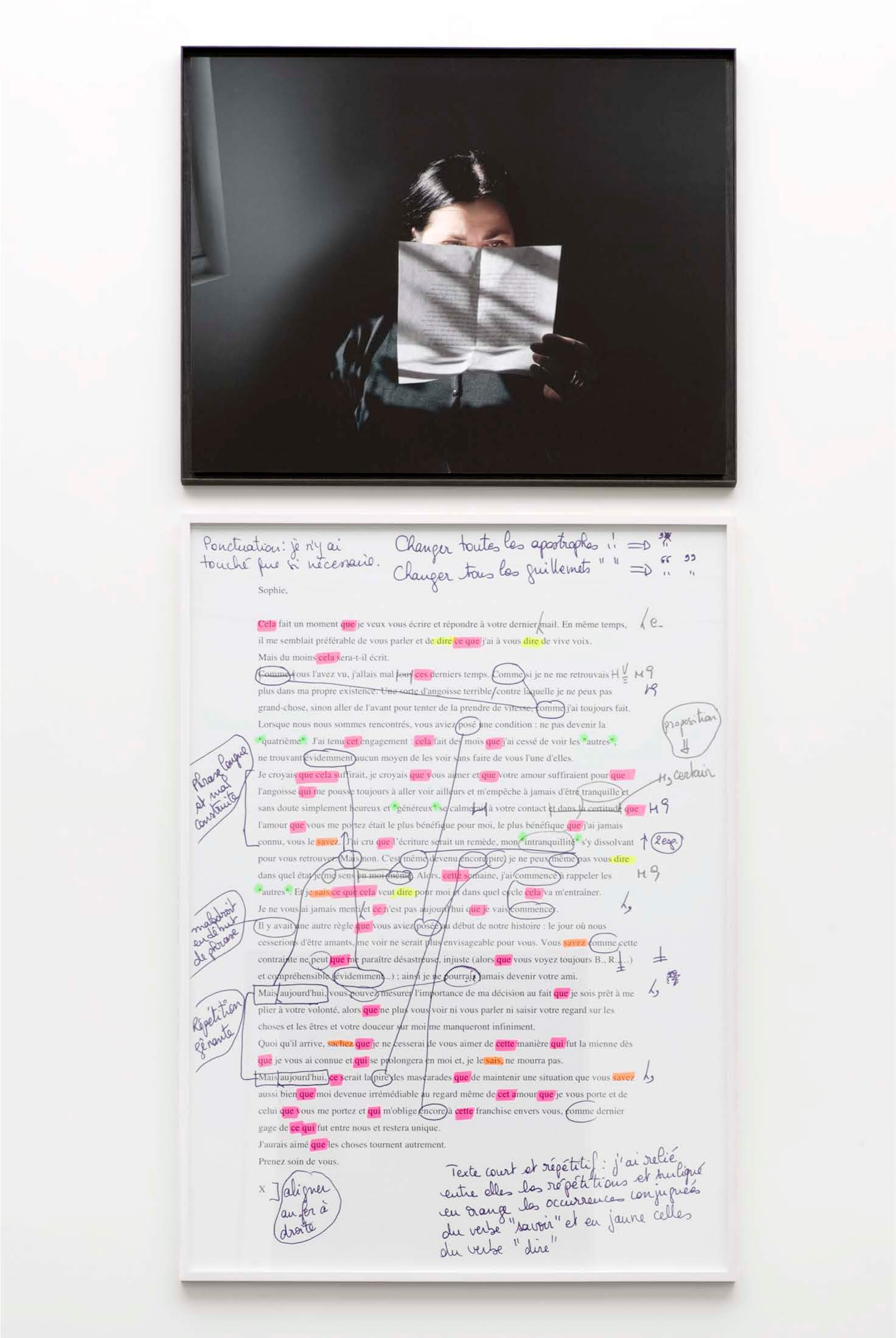
Out-Vermeering Vermeer. Sophie Calle, Prenez soin de vous. Correctrice, Valerie Lermite. ©ADAGP, Paris and DACS, London 2013.
On the one hand, then, we cannot help but bring to these photographs the gender ideologies we know to be embodied in Vermeer (the strong link between woman and home; the industriousness a woman was meant to show as she passed her time in the absence of her husband; and in terms of affect, a woman’s proper restraint and disciplining of her feelings). On the other hand, the medium, artist and context disallow a like-for-like reading and cast an ironic shadow over such ideologies. There is here another narrative about women, space, privacy and the letter: one of unruly performativity. The quiet containment of Vermeer’s canvases is ultimately eschewed and the carefully restrained content made to spill out. Where in Vermeer the letter itself is kept private, excluding us from that charged closed circuit between letter and reader, Calle punctures the dramatic tension by making the text of the email available in its entirety. The letter is thus circulated, exchanged and publicly discussed. The emotional energy it generates overflows in an exuberant, proliferating performance which spills over beyond domestic space. The women represented may be mainly in interiors, but they are no longer locked into domesticity: they are out in the world, reading the letter in offices, studios, rehearsal spaces or public buildings. Several conduct their reading outdoors, in nature, on rooftops or on the street. In addition, and critically for my study of performance, many of the women enlisted in Calle’s project appear not merely in photographs but also as animated presences, and they respond to the letter aloud.
This moving-image variant on the theme of the letter stands in sharp contrast to the integrated, fine-art-influenced photographic exhibition. The frozen moment of receiving the letter melts and is allowed to become something other: a noisy, postmodern undoing of Vermeer. 6 We cannot help imagining his Woman in Blue raising her downcast eyes and turning to address us, sharing with full-throated immodesty the contents of her missive. By performing their response Calle’s company of women address us frontally and draw us in; they break the inaccessible, often anxious closed circuit between love letter and reader by sharing. Like Vermeer’s paintings they maintain the freshness of an implied first reading, but here the reading woman becomes a responsive mediator; rather than eroticised object she is a subject characterised not by availability but by agency. Calle’s reading women invite us to trace their relationship to the beaux arts, but we also see emerging a wider typology in the stock of images of women receiving and reading letters. From essentially passive and meditative, the imaginary of the scene of reading becomes active and reactive, exploding the trope of domesticity and producing through performance a vibrant expression of feminine authority.
The company of women
Turning away now from the staged photographic readings which ‘perform’ Vermeer-like scenes, let us focus instead on the filmed performances of reading in Prenez soin de vous. Strikingly, the others upon whom Calle’s narrative art frequently relies are in this instance sometimes equally famous. Those with a cameo role in this variety show range from American composer Laurie Anderson to Indian dancer Priyadashini Govind, to fado singer Mísia or actresses Jeanne Moreau and Miranda Richardson. Each performs with apparent spontaneity as if seeing the letter for the first time, producing a raw and rough-edged response. Each takes her time, pausing to digest the content. Some are sombre; some laugh ruefully or wryly; some are outraged. Some demonstrate impatience and skim parts of the text, preferring to work with selected aspects rather than the whole so that the rapt fascination linking woman to letter in the still image, her submissiveness to it and the paradoxical way in which this makes her feel ‘available’ to the viewer, are broken. Some perform a hushed, ‘straight’ reading devoid of irony, as if they were directly concerned by the letter. Yolande Moreau reads quietly to herself, sitting in her chair with fine linen curtains at the window behind her and a vase of roses in the foreground. The camera is immobile, the aesthetic painterly; this is Vermeer in motion. Some bring melodrama to the reading, weeping and falling; thus Elli Medeiros slumps to the floor in fake despair in an underground car park. Other performances are less beholden to the letter, failing to give it their full attention. Luciana Littizzetto is multi-tasking in her kitchen, peeling an onion as she reads: is it the onion or the lover’s words that make her cry? Whatever the case, she ends her deflationary performance by blowing her nose into the letter. The singer Camille provides a riveting capella improvisation based on the message. Natalie Dessay delivers a short operatic version beginning off-camera with a haunting call to ‘Sophie’ and ending with an intensely intimate close-up, almost delivering a passionate kiss to the lens for the letter’s closing words. Soul singer Sussan Deyhim gives a magnificent improvisation from her bathroom, probing the letter’s contradictory themes of ‘masquerade’ and ‘frankness’ while seated on her toilet. Often the performance involves commentary on the letter, or at least implicit critique. Several women fail conspicuously to take it seriously. Fado singer Misia tries to create an authentic-feeling performance but her laughter keeps breaking through: ‘C’est pas possible’, she protests, ‘Cette letter n’a aucune poésie, aucune spiritualité; c’est pas possible de faire un Fado avec cette lettre.’ Emma the Clown (Meriem Menant) ridicules the letter’s discourse and tactics, produces monstrous yawns whilst reading it, then falls asleep. A cat sits beside Miranda Richardson for the duration of her reading, manifesting deflationary indifference, the bell on its collar jingling as it licks the fur between its legs. The letter, then, is curiously voided of its power and becomes merely a catalyst for creativity: a pretext for the performers to do what they do best (Figure 2).
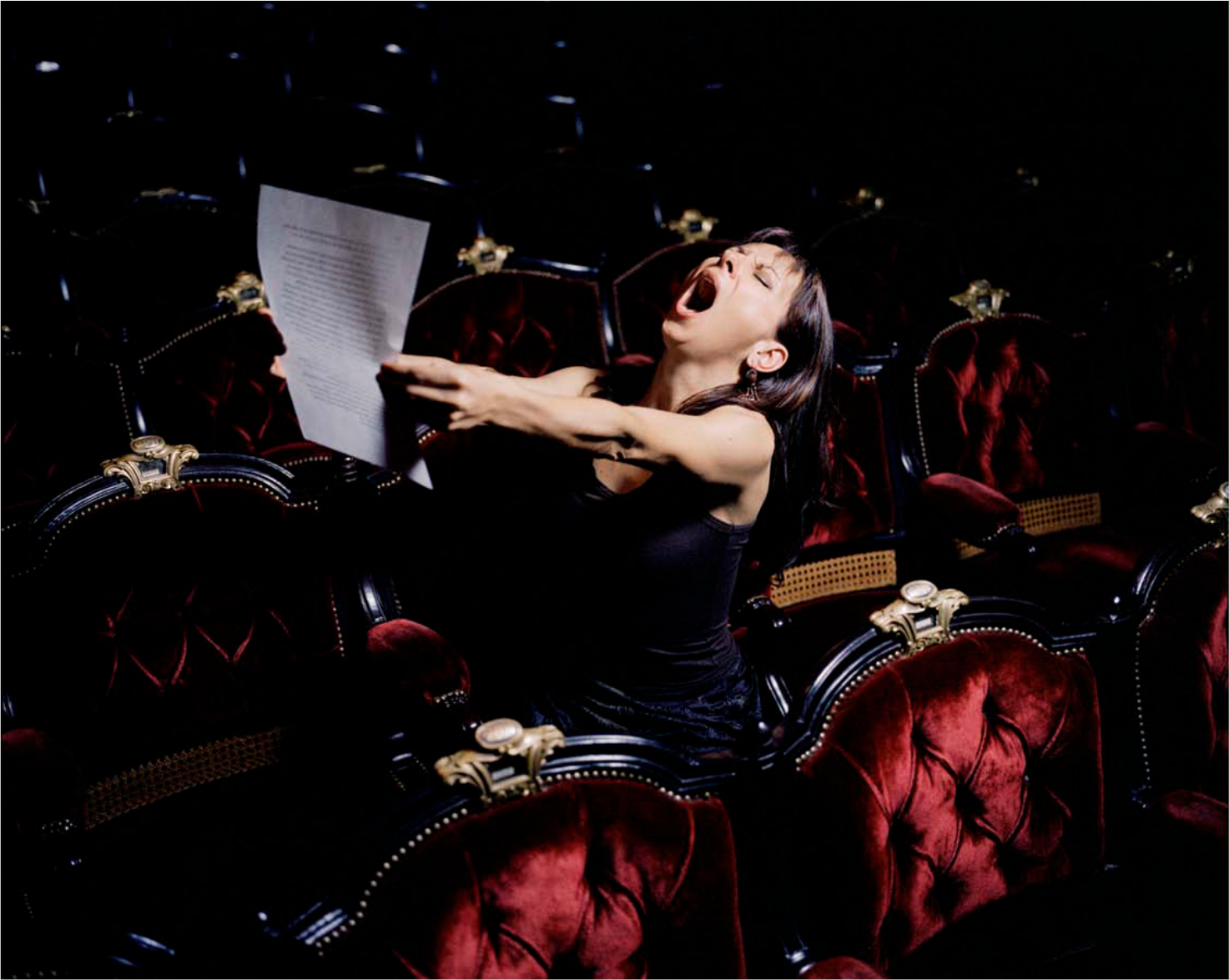
Performing the letter. Sophie Calle, Prenez soin de vous. Artiste lyrique, Nathalie Dessay. ©ADAGP, Paris and DACS, London 2013.
As this brief exploration of some of the performances in Prenez soin de vous has suggested, one of the installation’s peculiarities is that it is not only funny but very funny indeed, something that is perhaps quite rare in contemporary conceptual art. The acting-out of the letter through various scenarios is even more effective than its analysis in puncturing the sender’s presumptions. Further, not only is the text of the letter critiqued ad infinitum, but the letter itself as physical entity becomes a theatrical prop and is literally crushed. No longer the magnetic centre of the still composition and the luminous guarantor of its tension, it becomes instead subject to a range of destructive practices. In Vermeer the most that happens is that the letter is folded. Here each dynamic performance, running cyclically on its own video monitor in a ceaselessly reiterative loop, ends with tearing up the letter, crumpling it into a ball or letting it float away in the air or on water. Miranda Richardson’s performance culminates in an exaggerated shredding while she hums a tune to camera. British rifle shooter Sandy Morin uses the letter for target practice. Brenda the parrot, whose supremely comic performance provides the last word in the (necessarily sequence-driven) book form of Prenez soin de vous, shreds the screwed-up letter in her beak and performs a magnificent delayed reaction of indignation, puffing out her feathers and raising her crest. The letter has literally been ‘done to death’, each performance providing a mise en abyme of the larger performative project to which it contributes.
The startlingly exhaustive, multilingual scope of the installation is a further joke at the lover’s expense, for it alludes to universality, underscoring the formulaic nature of his missive. The letter is reproduced in a plethora of fonts and codes, including an encrypted version and a version in Braille. It is performed and interpreted across languages and cultures, by women speaking Arabic, Italian, English, German and Russian. It becomes ubiquitous: comprehensible to all. Its circulation among 107 women (108 including Calle) resonates (accidentally?) with elements from Eastern mythology, Buddhism and Hinduism. In Buddhist iconography, the lotus (which grows in mud but emerges pure and intact to float on the surface of the water and which is supposed to bring women luck) has 108 petals; the number 108 is associated with repeated action (the prayer beads used in Hinduism number 108 so that when they are used 108 prayers are made). Ironically the goddess Sati, who threw herself on the funeral pyre of her husband overwhelmed by grief, has 108 avatars. The number is also associated with the goddess of financial well-being, Laxmi (undoubtedly one of the levels on which Calle ‘takes care of herself’!) Prenez soin de vous, then, gives us 108 instances of women faced with evidence of abandonment, each one responding by letting go and ‘taking care of herself’ with an intelligent and independent creative gesture.
For Calle there is an especially generous letting-go, for she at once owns her project and relinquishes authorship. She is not pictured reading the letter 7 and does not comment on it herself. Further, once she has passed it on for performance she is not interventionist: even if the renditions are not all to her taste, nothing has been altered. Calle works behind the scenes in this instance. Her sole personal appearances in the installation are in a filmed séance de mediation (taking place with a médiatrice de famille and with the folded letter placed, in the absence of its author, on an empty chair and comically addressed as ‘Monsieur’) and as a protagonist (‘Sophie’) alongside Aurore Clément in ‘Numéro 86’, a superb mini film by Laetitia Masson.
Staging the installation
We have seen that Calle’s cabaret accumulates a multiplicity of self-contained micro-dramas. Some of these are openly dependent on traditional spaces of rehearsal and performance such as dance and music studios or the Palais Garnier, down whose grand marble staircase Natalie Dessay glides as she performs her astonishing soprano lament. We think too of the miniature proscenium stage of the guignol whose plush red curtains sweep across to punctuate, and then bring an end to, the ‘stock’ melodrama-cum-comedy action (Guignol writing a letter in Act 1; Madelon receiving it, then fainting, in Act 2). Performance also takes place in everyday spaces with the result that a range of performance arenas are juxtaposed and the idea of performance seeps into every facet of life. Performance, in short, is seen to be omnipresent. What, though, of the performance spaces which house Calle’s installation?
In this final part of my study I want to explore the theatrical impact of Prenez soin de vous, not in its first iteration in Venice but in its subsequent run in France, which was housed, thanks to a combination of curatorial ingeniousness and unique circumstance, in the extraordinary masterpiece of nineteenth-century metallic architecture, the (then disused) Salle Labrouste at the former Bibliothèque nationale de France, rue Richelieu (Figure 3). 8 I argue here that the distinctive dramatic tenor of Calle’s installation attained a new level of theatricality through its mise en scène in this very particular performance space. As distant from a neutral white cube as it is possible to get, this setting not only had its own personality but its own built-in ‘props’, since it was replete with all the fittings which indicated its original purpose. Thus it made still more demands on the work it housed than do history-laden installation spaces which have been voided, such as the popular and versatile Grand Palais, while its intricate specificity set it apart from the other major French heritage site in which Calle has ‘performed’, the Eiffel Tower. 9
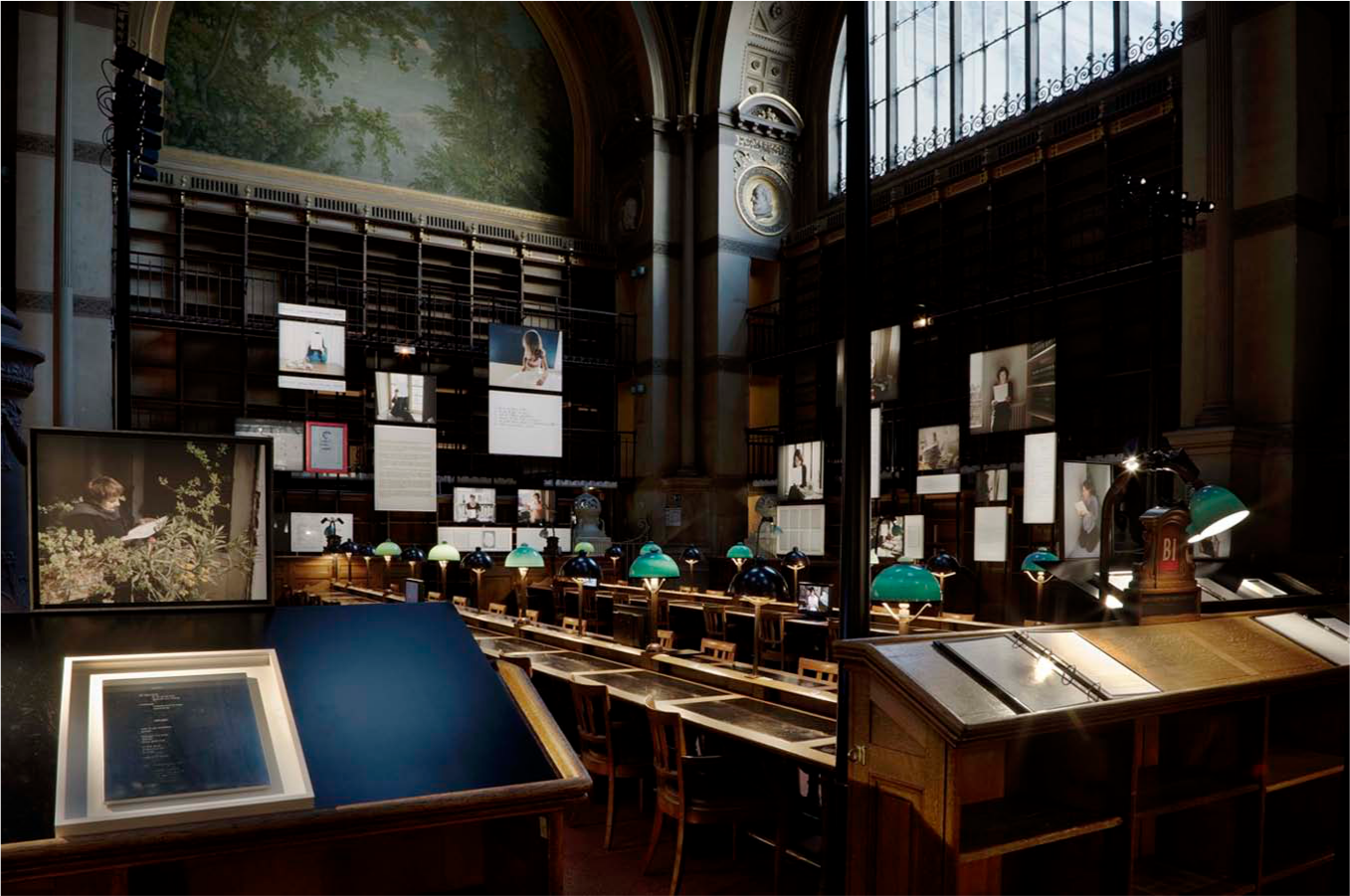
View of the exhibition Sophie Calle, Prenez soin de vous, Bibliothèque Nationale de France, Site Richelieu, Paris, 2008. Photo: Florian Kleinefenn / Aia Productions @Adagp, Paris 2013. Courtesy Galerie Perrotin, Hong Kong and Paris.
The choice of venue was considered controversial and even sacrilegious by some critics, as if it were an invasion. Arts critic Olivier Cena, misreading the installation as a piece of narcissistic autofiction, laments the use of the august setting for the mise en scène of an intimate story (Cena, 2008: 18). Yet the multiple thematic convergences as well as the ironic disjuncture that become part of the performance’s meaning in this setting surely require a more subtle interpretation. As several critics observe, this prestigious setting was not only spectacular in its own right, but provided an example of uncommon resonance between a work and its place of display. Harry Bellet (2008) observes that ‘l’œuvre semble ici chez elle’. For Daniel Buren, the curator, the new context seemed ideal, as nothing needed to be hidden or changed: ‘Faire comme si tout cet ensemble architectural avait été construit pour le travail en question et qu’il l’attendait depuis des lustres!’ (Bellet, 2008). Calle too recognised not only the inherent challenges but the ideal relation and unusually tight symbiosis between set and exhibition (Neri, 2009: 152). First, it was singularly appropriate given the scene of reading on which the installation is founded. The reading room, long since emptied of books, became once more a stage for the study of texts, for textual analysis and interpretation, and indeed the letter received by Calle is repeatedly studied, analysed by specialists from multiple points of view. Second, the ‘interruption’ staged in the Salle Labrouste echoed the performative disruption of private reading which the installation so deliberately operates. Third, the reappropriation of this seat of scholarly pursuit centring on the study of one solitary, short, stylistically impoverished text provided the final overarching act of derision directed at the text itself.
The installation, while carefully structured, appeared direction-free by comparison with its earlier counterpart Douleur exquise. Calle’s 2003 response to the pain of being jilted follows a rigorously determined order, leading the visitor physically through a linear narrative of loss and recovery in three parts (three rooms), then looping back into its central theatrical hub, the mock-up of the New Delhi hotel room where Calle received the fatal telephone call. This room is not so much a place of exhibition as an invitation to enter a theatre of raw experience, replete with the props required for the re-enactment of Calle’s pain. It also serves as a rhetorical device to indicate the irresistible return to the moment of wounding. 10 In Prenez soin de vous, re-enactment of the moment of wounding is spatially diffused. Visitors familiar with the reading room may have been somewhat disorientated by the new sense of spatial freedom: roaming from desk to desk to watch the videos showing on small monitors near the iconic green reading lights; browsing on the various lecterns to read the texts placed there; tracing trajectories around the periphery to read still more texts and enjoy the large-format photographs on the walls and around two balconies of the upper stacks; sitting inside the semicircle along with a small group of people wearing headphones to listen to the sound track of the filmed séance de mediation. The licence to circulate seemed overwhelming. The incorporation of so much layered, moving-image performance and the suffusion of the reading room in the installation material led Calle away from the habitual ‘pagination’ of her installations, which previously guided the visitor through more linear, book-like sequences, and towards a newly layered configuration redolent with loops, overlaps and echoes and crafted to interweave with the intricacies of the set and its fittings. 11
Prenez soin de vous, then, provisionally transformed the Salle Labrouste into a surprising, post-feminist entre-femmes: a place of sharing, imaginative and affective investment and celebration. It displayed the talents and skills not only of Calle but of many other professional women from numerous and very diverse walks of life, who came together to perform a jouissif antidote to romantic disappointment. Little wonder that Bellet (2008) entitled his account of the installation for Le Monde ‘Solidarité feminine autour de Sophie Calle’. 12 A further factor to consider is the refusal of Calle’s company of women to be silenced. Reading rooms are traditionally locations intolerant of disruptions and dedicated to silent reading, but with this mass demonstration of talent the Salle Labrouste exploded not only into colour and moving images, but also into sound which suffused the space from dome to desk. Whereas Cena (2008) complains that ‘Ce qui devait être une sorte de tissage de voix devient, par les effets de résonance, une cacophonie’, one might instead remark with pleasure that this sonorous chaos – one further rejection of the discreet interiorising of feeling – was paradoxically intensified by the acoustic properties of the setting itself. In numerous ways, then, the sense of performance inherent in Prenez soin de vous – and indeed the project’s comic value – were heightened by this very particular setting.
A final point concerns the singular significance assumed by this performance in terms of cultural policy. Not only was Calle’s reiterative work on love and loss further embedded in France’s high-art cultural establishment by the astonishing one-off privilege of performing on this august stage, but her installation also constituted a performative gesture which inflected the very narrative of the renovation of the former Bibliothèque nationale. If Calle’s mixed-media installation challenges the book (historically the staple unit of the Salle Labrouste), it also provides a clarion call. Closed to the public for ten years and still somewhat dusty during the installation’s run, the reading room seemed through this dramatic gesture to be already embracing the new mission that is plotted out for this historic site: one which will be keen to demonstrate that it is as open to contemporary art as it is to the past.
Conclusion
I have presented Prenez soin de vous as an installation layered with overlapping, ritualised performances: one whose theatricality and saturation in performance are exaggeratedly pronounced. I have argued that the project revisits and ingeniously inflects the history of the letter in representations of affairs of the heart and that its cast of women appropriate, transform and exhaust the letter’s potency, thereby negating ideas of their dependency on its message. I have also underlined the importance of humour in Calle’s corpus, noting that this has as yet been a relatively neglected aspect of her work but that the jubilant, jouissif tenor of Prenez soin de vous requires us to address its functions (there is perhaps scope now for a (serious) study of humour in Calle). If Douleur exquise occasionally raises a wry smile of recognition generated by Calle’s obsession with her pain, in this later installation the melodrama of romantic disappointment repeatedly gives way to full-blown comedy generated by the inventiveness and the feverish pace of the letter’s recycling.
Ultimately Prenez soin de vous takes women’s autobiographically driven performance in a fresh direction, for it ceases to rely on the performance of a life event or emotion by an autobiographical subject. Instead a life event is diluted and refracted, echoed and interpreted, farmed out and entrusted to others. Uninterested in self-representation, Calle effects a shift beyond the self, continuing to expand the boundaries of performativity as she casts her net ever wider in search of commonalities. Calle has always been keen to find the connecting points between the personal and the collective and to enmesh the ordinariness of her experiences in the common fabric. Prenez soin de vous is the latest example of the ascendancy of that fabric in her work.