




Abstract
This article takes Colette as a case study to explore the role of the press in the literary world of the belle époque. Like Colette, many literary authors worked in journalism, a commercial career that often clashed with ideals of creative autonomy and genius. Yet the close connection between the literary world and the press was more complex and productive than has previously been acknowledged by either cultural historians and historians of the press. This analysis offers new perspectives, not only by examining Colette’s overlooked journalistic career, but also by looking at the role of money, publicity and how the press shaped the politics and poetics of writers. This paper argues that the press played a crucial and under-examined role in French literary life of the belle époque and that the study of the press contributes to a better understanding of the institutional context of cultural production.
After Colette took up a regular appointment at Le Matin in 1910, her mother Sido warned her that nothing ruined writers more than journalism: ‘C’est la fin de tes œuvres littéraires, tes romans. Rien n’use les écrivains comme le journalisme’ (Sido to Colette, 31 October 1910, cited in Bonal and Maget, 2010: 17). Yet Colette simply said about her job in 1914: ‘il faut vivre’ (letter to Christiane Mendelys, 20 August 1914, cited in Pichois and Forbin, 1961: 107). Even though Colette downplayed her journalistic career, she was a prolific and seemingly enthusiastic journalist all her life. She was not alone. Many contemporary literary colleagues, including Proust, Gide, Jean Lorrain and Anatole France, pursued careers in journalism, and this was a reflection of the prominent position the press had come to occupy in French society towards the end of the nineteenth century.
In fact, until 1914, the French – together with the Americans – were the world’s biggest consumers of newspapers (Albert, 1990: 31). Liberal press laws, low prices, technological advances, cheaper transportation, better education, as well as increased literacy among the French population all contributed to this fact. Around 1900, 2400 titles, both periodicals and newspapers, were being published every day in Paris. By 1914 there were 80 daily newspapers with five and a half million copies issued in Paris alone (Albert, 1990: 32). Costing between 5 and 10 centimes, French newspapers were also the cheapest in the world. The period between 1890 and 1914 was indeed the golden age of the press (Bellanger et al., 1972: 239–405).
A specific characteristic of the French press was that the big names in journalism were almost all literary figures. Historians of journalism (Albert, 1990; Ferenczi, 1993; Martin, 1997; Chalaby, 1998; Delporte, 1999) have observed that French journalism was more a journalism of expression and opinion than of observation. Preference was given to the chronicle that centred on personal commentary over reportage that valued objectivity. 1 Newspapers prided themselves in having literary stars on their payroll. L’Écho de Paris, for example, labelled itself a ‘journal littéraire et politique’. The Baedeker tourist guide to Paris even warned tourists against the opinionated and biased Parisian press, explicitly listing L’Écho de Paris, Le Figaro and Le Journal as ‘littéraire’ (1900: 32). But even the more popular newspapers such as Le Petit Parisien or Le Petit Journal reserved a place for literary columnists and serial literature.
However, Colette’s mother was not alone in her concern. Negative views of journalism were commonplace and sprang out of concerns about the declining importance of literature in the face of mass culture. Throughout the nineteenth century this supposedly harmful role of journalism in cultural life had become a real literary trope (Curatolo and Schaffner, 2010: 13–15), central, for example, in Balzac’s Illusions perdues, Maupassant’s Bel-Ami and Goncourt’s Charles Demailly. In Mon cœur mis à nu (1887) Baudelaire wrote rather dramatically: ‘Je ne comprends pas qu’une main pure puisse toucher un journal sans une convulsion de dégoût’ (1975, 1: 706). Octave Mirbeau called the journalistic chronicle this ‘vieille prostituée’, ironically in a chronicle (cited in Curatolo and Schaffner, 2010: 4), while Edmond de Goncourt wrote in his journal on 21 January 1895: ‘J’ai bien peur que les rares fabricateurs de livres de ce jeune monde soient mangés par le journalisme, où se touchent de grosses payes avec le tintamarre de la gloire’ (1956: 721). That kind of thinking – opposing the untouched purity of literature to the ink-stained newspapers – has persisted throughout the twentieth century. Bourdieu, for example, argued that ‘the journalistic field tends to reinforce the “commercial” elements at the core of all fields to the detriment of the “pure”’ (Bourdieu, 1998: 70).
However, in recent years scholars have argued that these ideologically fuelled views on newspapers and mass culture have often hindered a closer look at the role of journalism in literary modernity (Campbell, 2004: 3) and do not do justice to the pluriformity and literary nature of journalism in France (Thérenty, 2007), or Europe in general (Broersma, 2007). What has often been neglected is that journalism is a form of writing and should therefore, as Thérenty (2003) has also proposed, be studied within the context of literary history rather than purely in the domains of history, sociology and journalism studies. This is particularly true for the belle époque when the press played an undeniably great role in the publishing industry and in authors’ careers. More recently, and in particular in France, scholars have begun to map the cultural history of the press in the nineteenth century (Kalifa et al., 2012) while Leroy and Bertrand-Sabiani (1998) have provided a brief overview of the role of the press in the literary field.
Colette’s journalistic career has also been somewhat overlooked. There is surprisingly little written on her ‘parallel oeuvre, unjustly forgotten in the archives of the press’ as Bonal and Maget (2010: 11) have remarked. 2 Yet her work and career are perfect examples of the close ties between literary writers and the press around 1900. She contributed reportage, reviews and stories to popular dailies such as Le Matin or Le Journal, to literary periodicals and to various magazines. Many of her novels were pre-published in periodicals and her professional and personal lives were widely reported in the press. Colette’s case reveals some of the ways writers were involved with the press – whether for financial, publicity, political or creative reasons. Her case also shows that the boundaries between the journalistic and the literary world were never as clear-cut as some, including authors themselves, have made them out to be. Studying Colette’s involvement with the world of newspapers and periodicals revises several ideas about her as a writer and a journalist. Her case also shows how the press shaped writers’ careers and reputations, their politics and their poetics and its influential role in the belle époque literary world.
Il faut vivre: money
For many writers money was a primary reason to get involved with journalism. In a letter to her lover Missy from February 1910 Colette made it clear that she needed journalism to make a living: Madame et Monsieur demande un article sur le Printemps (la saison, pas le magasin) pour le numéro de Pâques, on me donnera 3 louis, alors je ne peux pas refuser, le journal est toujours très aimable pour moi. Le numéro de Pâques devant être illustré somptueusement, il faut que je fasse l’article tout de suite, et puis la chronique sur Bruxelles pour Paris-Journal, qu’est-ce que tu veux, le roman attendra un peu, ce n’est pas de ma faute. (quoted in Bordji and Maget, 2009:12)
At the time, 3 louis was 80 francs, which would now roughly convert to 300 euros. To put this in perspective: around 1900 a servant, depending on position and hierarchy, earned between 1 and 10 francs a day (Winock, 2003: 160) and the monthly rent of a mid-range, furnished apartment in Paris was about 150 to 200 francs (Baedeker,1900: 12). If we take into account the number of publications Colette regularly wrote for between 1895 and 1923, it becomes apparent that journalism provided her with a substantial additional income. 3
It is clear from her letters of 1910 that Colette seemed to be working on an article almost on a daily basis alongside the novel she was trying to finish. ‘Hier j’ai fait un petit début de chronique pour Paris-Journal, mais demain je vais me remettre au roman’, she said in February 1910 (quoted in Bordji and Maget, 2009: 103), while in March she wrote: ‘Je viens de mettre au net sept ou huit pages de ‘‘tournées’’ pour Comœdia’ (Bordji and Maget, 2009: 127). Apart from contributing articles, Colette also benefited from the pre-publication of her novels and stories in the press. In that same year, 1910, Colette received 500 francs for the serial publication of her novel La Vagabonde – around 1840 euros today. She would probably also have received an extra pay-per-line revenue from reproduction in provincial papers. This is not even counting any royalties she might have earned from the book publication.
Yet money was precisely the reason for the mistrust of journalism, as Goncourt’s words once again make clear: Oh! la jeunesse des lettres, je la trouve bien pressée de jouir du succès, bien avide de l’argent, bien incapable de travailler de longs mois dans la retraite, le silence, la maigre rétribution de son labeur, ce qu’a fait notre génération. (1956: 721)
Goncourt opposes the idea of commercial writing (‘avide de l’argent’) and the myth of the creative, autonomous and impoverished genius (‘la maigre rétribution’). He conveniently forgets to mention, however, that many of his generation – Zola and Maupassant, among others – were in fact prolific journalists. Even Goncourt himself contributed to newspapers, and many of his novels were pre-published as serials in the press. More importantly, Goncourt also had a private income and could afford to work independently.
For many others, journalism was simply a necessity. Alphonse Allais expressed a more pragmatic attitude towards journalism, stating with his characteristic sense of humour: ‘mon traité avec Le Journal me garantissant une somme fixe pour mes chroniques, qu’on rie ou qu’on ne rie pas’ (1895). In the early years of her career Colette was going through a divorce, was in debt, and had no inheritance or other financial support. Women had limited career options around 1900, so journalism provided a welcome source of income and independence. For authors like Colette or Allais, Goncourt’s theoretical concerns about ivory tower autonomy were a luxury they could simply not afford.
Publicity and belle époque media culture
The magazine Madame et Monsieur that had paid Colette 3 louis in 1910 for an article had also recently interviewed her. Colette was just as much an object for the press as she was an active contributor. ‘Y-a-t-il beaucoup de coupures de journaux?’ Colette asked Missy in February 1910 (Bordji and Maget, 2009: 115), acutely aware of the need for reviews. She regularly checked L’Argus de la presse, a service that, together with the Courrier de la presse, delivered articles and reviews on demand. She also actively engaged with her critics at a time when she was making a name for herself as an author, as Poskin (2000) has discussed. She courted publicity or at the least was not afraid to use it. Due to the rapid rise of the press, the belle époque had become a true celebrity culture, and literary authors were photographed for magazines and discussed as much in the society columns as they were in literary reviews (Mesch, 2013). Colette gave regular interviews and posed for photographers. Her theatre career and personal life were fodder for gossip journalists. Photographs of Colette published in the press at the time of her theatre career convey someone who is acutely aware of the camera and of the ins and outs of publicity and self-promotion.
Colette had begun her career as the wife of critic and journalist Willy (pseudonym of Henri Gauthier-Villars), who mastered the art of self-publicity. He also produced best-selling novels like clockwork, thanks to his army of young ghost writers in need of money. Willy knew how to create a media event and, thanks to the Claudine books, Colette was, reluctantly or not, a part of this. Claudine cigarettes, Claudine playing cards, Claudine paper fans, Claudine perfume: all kinds of merchandising were created to boost sales. Colette, Willy and Polaire who played Claudine on stage, publicly dressed up and were photographed or caricatured as their literary alter egos in the press. They consciously transgressed the boundaries between public and private and cleverly marketed the works as autobiographical.
The press offered writers many options for publicity apart from just book reviews. Jean Lorrain, immensely successful as a journalist and novelist, also knew how to publicise himself. Even a more avant-garde author like Alfred Jarry wrote his own blurbs in literary journals or invited friends to cause a stir at the premiere of Ubu Roi in 1896. The saturated media culture of the belle époque was always hungry for a scandal or a good story. In 1909 Colette contributed an article to the Christmas special of Paris-Théâtre, the same magazine that had publicised her very public divorce battle with Willy. Colette also contributed to Fantasio, a satirical periodical that had published gossipy articles about her and Missy.
Unsurprisingly perhaps, Colette’s constant exposure in the press meant that she was not always taken seriously as a literary author at the start of her career. Fellow author Lucie Delarue-Mardrus said that she seemed ‘perpétuellement en train de jouer la centième de Claudine’ (1938: 141), even though Mardrus was very much a media celebrity herself. As Lucey (2006: 12) has also pointed out, André Gide in his Journal condemned the ‘exhibition éhontée’ of Colette’s Moulin Rouge performance in 1906 (1996: 547). He clearly could not reconcile Colette’s media exposure with his ideas of literary autonomy. Yet, like Goncourt, Gide was less dependent on the press for money. Lucey (2006: 78) suggests that Gide’s ability to ‘incarnate literary disinterestedness’ – as opposed to Colette’s extracurricular activities in the press and in the theatre – might be the reason why Gide’s literary reputation has remained stronger over the years than Colette’s.
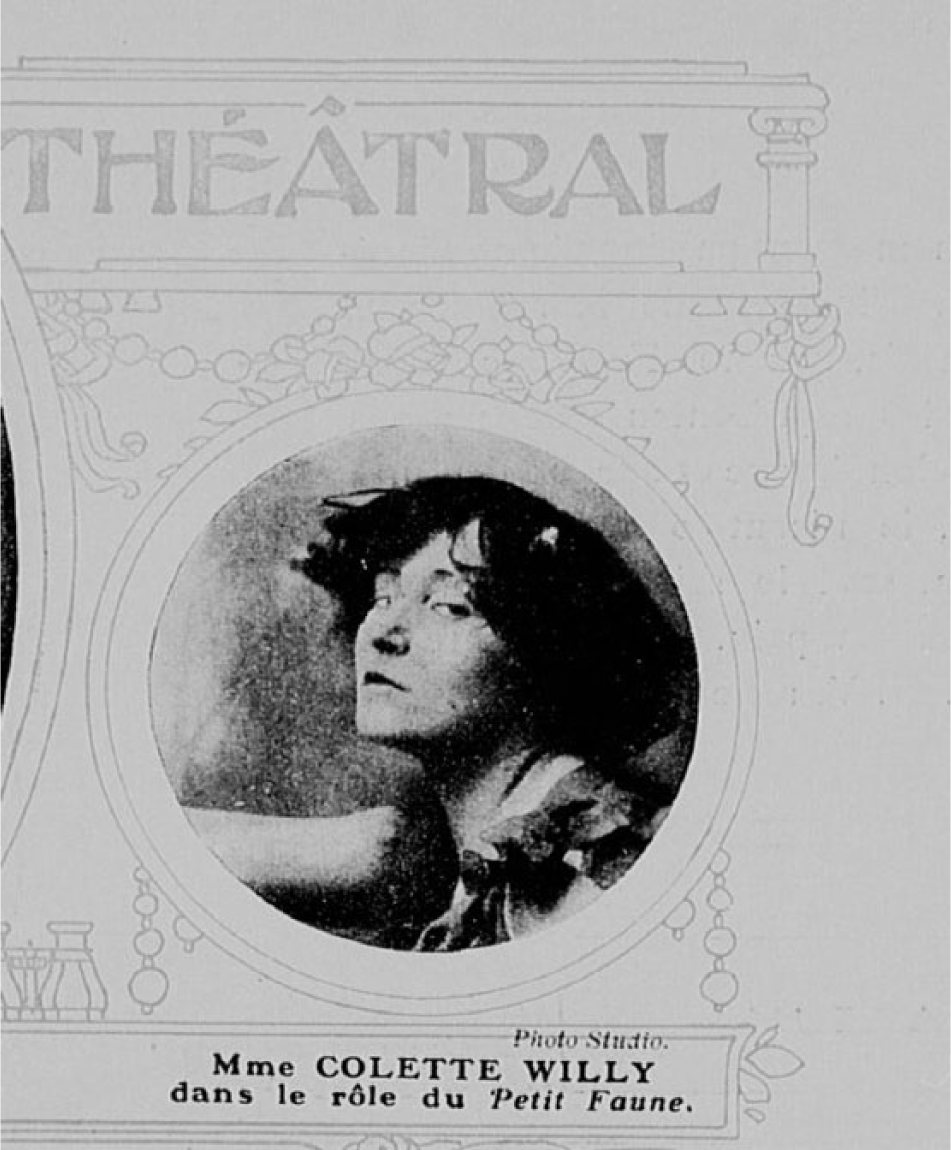
La Revue illustrée, 20 February 1906. Source: BnF/Gallica.
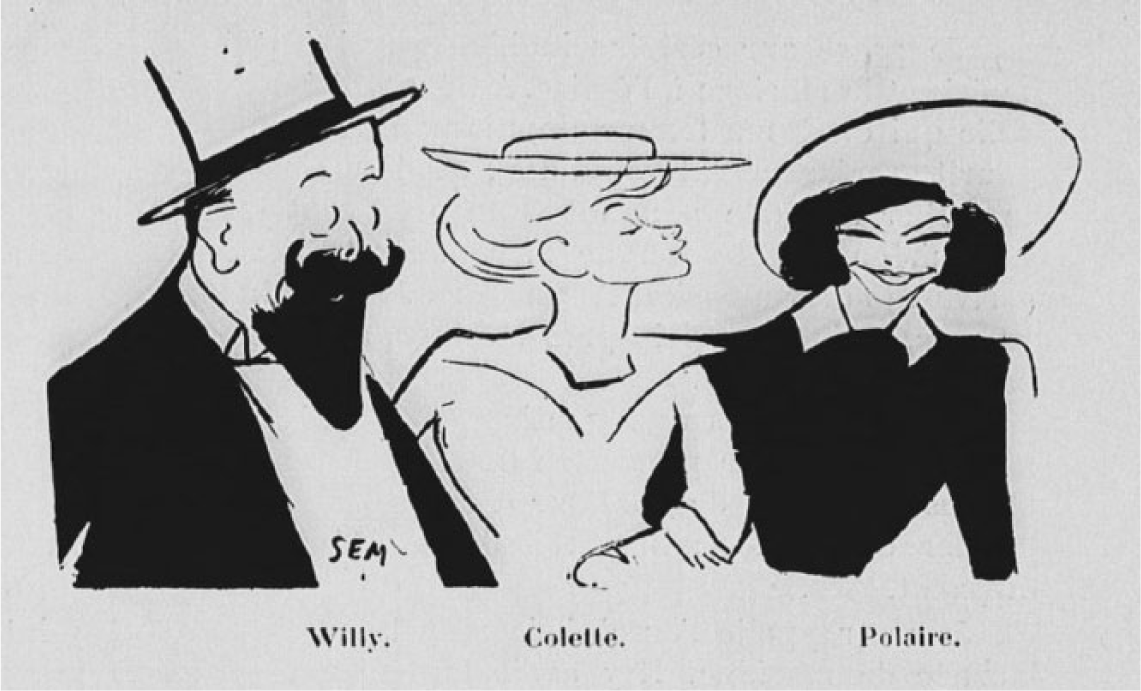
Caricature by Sem during the success of the Claudine series, La Revue illustrée, 15 July 1902. Source: BnF/Gallica.
The transgression of public and private spheres, the blurring of boundaries between fiction and autobiography, made Colette attractive to the press. Colette in turn made good use of the publicity the press provided since it sold copy and made her money. For authors of modest means, male or female, scandal with a big spoonful of self-promotion was a quick way to achieve success or fame. Even though that publicity did not always sit well with some of Colette’s literary contemporaries, it did not just bring her notoriety. The press also provided her with an important platform for her views and her writing.
Women, journalism and politics
The press offered authors a political, public voice, a space outside their literary work to engage with the public and discuss current events. Yet for women this proved complicated. Female authors were judged differently and put into the separate category of ‘femmes de lettres’. 4 Recently Mesch (2013) has demonstrated how belle époque women’s magazines like Femina and La Vie Heureuse celebrated the achievements of modern women writers, while still accentuating and promoting their traditional female qualities and roles.
These roles did not include a political one. Political culture in France was generally hostile towards women, who were deemed to belong the private, not the public sphere (McMillan, 2000: 45–93). Ideology, politics and ‘serious’ journalism were considered the domain of men. Major literary names such as Zola, France, Mirbeau or Barrès all enjoyed prestigious positions as political opinion-makers who regarded journalism as a force for influence and change. The impact of these intellectuals became particularly clear during the Dreyfus Affair. There were some notable women who wrote about the Affair, including Séverine, Gyp, or the female journalists of La Fronde. However, women writing about politics always risked being dismissed as frumpy feminists, bas bleus, a recurring target of ridicule and satire in the press, however progressive or Republican the publication (Chenut, 2012). For women to be accepted and taken seriously as a novelist or poet in the belle époque, politics seemed mostly off-limits, both in their literary work and in their journalism. When a female author explored social and political ideas in her work, critics often responded negatively (Izquierdo, 2009: 82–9). Lucie Delarue-Mardrus, for example, wrote reportage and articles for Femina, Le Journal and Le Matin, yet hardly ventured into the political domain, and when she did she was commissioned to write several anti-feminist pieces for Le Matin (Plat, 1994: 128–9). In general newspaper editors preferred women to write for the women’s pages about ‘women’s subjects’, or at best as literary critics.
In 1909 Colette was asked to write a short piece on contemporary fashion for Comoedia, even though she admitted not knowing much about the subject (letter April 1909, cited in Bordji and Maget, 2009: 63). Like many of her colleagues, including Séverine and Gyp, Colette posed for homely, non-threatening photographs in women’s magazines. She and other female authors carefully balanced their public role with the traditional gender roles and concepts of femininity society imposed on them (Mesch, 2013: 5–6, 56).
As a result, women writers often had to create their own space to participate in political debate, such as in the feminist newspaper La Fronde which campaigned in favour of Dreyfus and followed the model of daily newspapers. Yet women were often limited to specialist or ‘low-brow’ newspapers and periodicals that had considerably less political influence. In Colette’s case this meant writing for women’s magazines such as Femina or La Vie Heureuse or periodicals specialising in the world of entertainment and gossip – Paris-Journal, La Vie Parisienne or Comœdia – which press historians have categorised as ‘diverse’ or ‘grivois’ (Albert, 1990: 3). Bellanger calls them the ‘feuilles de la vie parisienne, grivoises et littéraires’, not to be confused with the more serious daily newspapers (Bellanger et al., 1972: 380).
Since fighting the literary establishment was often career suicide, many female authors outwardly accepted this status quo. It was often a survival strategy or, as Roberts (2002) argues, part of a subversive tactic to circumvent the feminist backlash of the period. For example, Colette could voice her anger over being judged on her womanhood when Femina published her article on motherhood with the subtitle ‘impressions de maman’. In a letter to the editor she wrote ‘Que je sois mère, cela ne regarde pas le lecteur … c’est l’auteur qui paraît devant lui, ce n’est pas la femme’ (letter to editor Pierre Lafitte, 1 February 1914, cited in Pichois and Brunet, 1999: 217). At other times she seemed decidedly anti-feminist. In an interview with Walter Benjamin in 1927, Colette was quoted as saying that women should ‘never really participate actively in public life’ (cited in Thurman, 1999: 417). Having matured at a time when women authors were celebrated only if they wrote within certain parameters, when women did not have the right to vote and had limited financial independence, such conflicting statements are hardly surprising.
However, Colette did of course participate in public life. Just before the First World War, Colette started working for Le Matin, which by 1913 was the second-biggest newspaper in France after Le Petit Parisien, selling almost a million copies a day. Colette wrote a weekly column entitled ‘Le journal de Colette’ for this newspaper, the title emphasising the personal, autobiographical nature of the stories. Interestingly, in its mission statement on 26 February 1894, Le Matin had presented itself explicitly as ‘un journal qui ne dépendra d’aucune coterie littéraire … un journal d’informations télégraphiques universelles et vraies’. Unlike other prominent newspapers such as L’Écho de Paris, Le Journal or Le Figaro, Le Matin sought to be a non-literary, unaffiliated, informative newspaper modelling itself on Anglo-American inspired reportage.
While the more literary oriented newspapers would have perhaps dismissed Colette’s kind of writing as lacking big ideas, and as offering too much reportage and too little commentary for their front page chronicles, Le Matin preferred the sort of personal, participatory reportage and non-partisan observation Colette excelled in. Her articles written during the war are especially fascinating. Colette had travelled to Verdun in the autumn of 1914 to join her husband, who was fighting with the French army. Colette mainly wrote about the human cost of war, such as in an article from January 1915: ‘Les enfants dans les ruines’, which starts: ‘L’automobile emporte, avec nous, des paniers de cadeaux de Noël. Pour les soldats? Non. Les soldats ont tout ce qu’il faut et davantage’ (see Figure 3).

‘Le journal de Colette’, Le Matin, 6 January 1915. Source: BnF/Gallica.
This small quotation is typical of her journalistic style. The narrative starts right in the action, with Colette as both narrator and protagonist bringing Christmas presents to children affected by the war. She reports in a seemingly personal capacity, as a woman and a mother, engaging the reader emotionally, but also almost as an anthropologist. Colette proceeds to describe the village where half the houses have been destroyed and the children and women left without homes, food or clothes. Colette criticises the fact that while officers are enjoying their Christmas wine and fruit, these villagers have nothing left, making a clear political statement about the devastating effects of the war on ordinary people as well as about class inequality.
As Dumont (2012), Tilburg (2009) and Holmes (1991) have also argued, Colette’s work was never as apolitical as she herself made it out to be. She voiced a lot of political themes, whether it was writing about the cost of war or arguing for women’s financial independence, workers’ rights and sexual freedom. Colette’s journalism was geared more towards what we would now call human interest. ‘Je n’aime pas beaucoup les idées générales’, Colette wrote in an article for Comœdia on 15 February 1909, conforming again to the dominant vision that women belonged in the private sphere (Colette, 1909). Yet Colette was able to comment on current issues while still claiming a purely subjective perspective, thus turning the presumptions of the feminine perspective to her advantage. Like other high-profile women writers at the time, she cleverly fused ‘contestation and conformity’ (Holmes and Tarr, 2006: 19). Colette blended the ‘reportage’ style of newspapers such as Le Matin with her distinct literary style, instead of copying the much more male-dominated tradition of the partisan chronicle. That strategy even allowed her, as the fragment above shows, to implicitly criticise the French army at a time of war.
It is not a coincidence that Colette’s career in reportage really took off just before and during the First World War. During this time Andrée Viollis also began to contribute war reportage to Le Petit Parisien and Lucie Delarue-Mardrus wrote for Le Journal while volunteering in army hospitals. Women suddenly found themselves with more opportunities in society as a whole. Interestingly, that general shift in social attitudes appears to have coincided with a shift in journalistic writing around this time, later also described by the American journalist and sociologist Helen MacGill Hughes (1940) in News and the Human Interest Story. She observed that while journalism initially focused on what a select group of (white, middle-class) men wanted to read – politics and economics – with the emancipation of new groups of readers and writers in the early twentieth century, perspective and approach shifted.
Creative opportunities
Colette’s articles on the First World War would eventually be published in the collection Les Heures longues in 1917 which Colette herself – with typical false modesty – called ‘pauvres choses journalistiques’ (letter to Francis Carco, July 1918, cited in Gilet, 1997: 205). Yet she carefully selected the articles, and the collection was considered by André Billy to be ‘une nouvelle forme de journalisme, un journalisme lyrique’ (L’Œuvre, 27 January 1918, cited in Gilet, 1997: 205). Many of Colette’s journalistic articles appeared in published collections or formed the basis for later short stories or novels. For Colette, her journalistic and literary styles were never entirely separate.
In a letter to Missy from 1910 Colette said about an article she had submitted to La Vie Parisienne: ‘Et ce petit article n’a rien de si épatant qu’il faille l’insérer dans le roman’ (cited in Bordji and Maget, 2009: 116). This quotation is particularly significant because of what she does not say. The fact that Colette explicitly states that she did not want to include this particular article in one of her novels implies that she often did precisely that. Colette had already started writing for this weekly magazine back in 1904. La Vie Parisienne devoted its pages to gossip, fashion, theatre and literature, and also published quite a lot of columns, short stories and serialized fiction. In this periodical Colette published extracts from almost all her early works (Dialogues des bêtes, L’Envers du music-hall, Les Vrilles de la vigne) as well the integral text of the novels La Vagabonde and L’Entrave. La Vagabonde was published between May and October 1910 to much critical acclaim and helped cement Colette’s literary reputation.
Writing for La Vie Parisienne, Paris-Journal, Femina and other ‘low-brow’ publications meant that in these early years of her career Colette was less dependent on publishers, literary journals, salons or critics. Colette had not yet achieved the critical success as an author she would gain some years later. Yet journalism meant she could earn a living and write on a regular basis.
Colette also cleverly used her personal life and theatre career in her articles for the entertainment magazines, which loved these inside stories. Her article on ‘La folie des minceurs’ for Paris-Journal from 1910, for example, starts off with a scene set in her theatre dressing-room: ‘Mon amie Valentine s’habille. J’ai devant moi le spectacle, ‘éminemment suggestif’, assurent ces messieurs, d’une jeune femme en corset. Suggestif ? heu … Je lui reprocherais surtout de n’avoir rien d’éminent’ (Colette, 1910).
Whether writing about the craze to be thin or the effects of war, Colette always draws the reader into a similar, apparently personal, setting, using colloquial, intimate language before she embarks on the discussion of the actual theme: a narrative technique similar to those deployed in her literary works. ‘Mon amie Valentine’ also appears in the stories of Les Vrilles de la vigne. Colette’s success as a journalist was perhaps partly due to the clever way she used her personal literary perspective in her writing. The title given to a published collection of her articles for Le Matin was Dans la foule (1918). Colette claimed to be part of the crowd, of the event she described, yet was simultaneously detached from it – an observer. That literary device enabled her to discuss slightly risqué subjects and to write about socio-political issues without giving an explicit opinion. In one of her later letters to her friend and critic André Billy (April 1928, cited in Pichois and Forbin, 1973: 194) she gently mocked him for claiming that there was a lack of literature in La Naissance du jour, and that the narrator was simply Colette. However, Colette herself played – quite deliberately – with the boundaries of public and private, of fact and fiction.
Colette’s trademark weaving of her life into her work has of course been remarked upon countless times. Her slightly scandalous reputation helped newspapers like Le Matin or periodicals like La Vie Parisienne sell more copy. Yet what has gone unnoticed is that the genre of reportage in which the reporter/narrator is both observer and part of the story actually suited her style quite well. Thérenty (2007: 66) has convincingly shown how journalistic and literary genres merged within newspapers, and how they became a hub for literary modernity. Pinson (2008) has argued the influence of Le Figaro’s society columns in Proust’s writing, for example, while Alfred Jarry created his own semi-journalistic, semi-literary genre (Dubbelboer, 2012). Journalistic reportage proved a natural fit for Colette who, as Freadman (2012) has also argued, experimented with genres to narrate her life throughout her career.
Colette’s success in popular magazines, her growing literary reputation and her subsequent appointment at Le Matin affirmed both her journalistic status and literary reputation. After the First World War she was very much part of the cultural establishment as a journalist, a literary critic and a prize-winning literary author. She continued her journalistic career throughout her life, working for newspapers such as Le Journal as well as for women’s magazine such as Marie-Claire. Even though Colette herself always downplayed her journalism – ‘ça n’a pas d’importance’ she said with apparent indifference when asked about her journalistic work (cited in Bonal and Maget, 2010: 11) – it was thanks to the journalism that her writing career really took off, and without it her literary output would have looked very different.
The press and the literary world
In her introduction to the English translation of La Vagabonde (2001) Colette’s biographer Judith Thurman writes, ‘Had she never written a word of fiction, she would still be remembered as one of the most original French journalists of the century’. Yet Colette is not really remembered as a great journalist in cultural history. Nonetheless Thurman is right in pointing to Colette’s journalistic writings as they are an extraordinary historical document of the first half of the twentieth century and deserve more study. Not only do her articles reveal her to be a more political, socially aware author than has often been acknowledged in studies of her literary work, but the press also played a huge role in shaping and establishing her career, providing her with money, publicity, career opportunities, a political platform, creative opportunities and a place to experiment.
It might be tempting to see the belle époque literary world, to use Bourdieu’s terms, as a place of contestation between literature bowing to either heteronomous principles (money, power) or to the principle of artistic autonomy (Bourdieu, 1996): in other words to see a continuing struggle between best-selling writers who were heavily involved in the press and critically acclaimed and autonomous authors who were not. However, such a distinction does not hold up to closer scrutiny of the belle époque literary world, the press and the individual careers of authors. Colette’s case illustrates the complex bonds between the press and the literary world. She was a best-selling writer, yet critically acclaimed, a media celebrity while still becoming a respected author. Despite an often ideologically driven rhetoric on the press and mass culture as opposed to ideas of the autonomous modern work of art, journalism was for many authors much more than a simple moneymaking exercise. Especially in France around 1900 the press was an integral part of the literary field and journalistic writing and literary writing were never that clearly distinct.
As Thérenty (2007) has argued, journalism in the early twentieth century proved a fertile breeding ground for literary creativity. But the press also shaped the literary world from a sociological perspective. It gave authors like Colette a platform to publish, to publicise and to express their (political) views. Despite restrictions imposed by the press on female authors, journalism nevertheless provided women with more and more opportunities in the years leading up to the First World War. Studying the role of the press in the cultural world provides a better understanding of the institutional and historical context of literary and cultural production in France. Journalism and the press did not ruin Colette, as her mother Sido feared; nor did it destroy the careers of other writers. On that point Colette’s mother turned out to be wrong. Without the platform offered by the press in the belle époque much of Colette’s work and that of other writers would probably never have seen the light of day.
Footnotes
Acknowledgements
This work was supported by a British Academy Postdoctoral Research Fellowship.