




Abstract
Similar to other post-industrial European cities, Marseille has been going through a process of intense urban renewal over the last 20 years. The symptoms of these changes were indicated in the action film series Taxi as early as the 1990s, when the renewal was beginning to take shape. Four films shot between 1998 and 2007, written and produced by Luc Besson, reflect the urgency felt by the government and commerce in Marseille to promote the city as the Mediterranean capital of global finance and tourism. This article first examines the process of urban renovation in Marseille. After a brief discussion on the city’s representation in cinema, the article considers the film industry’s interest in post-industrial urban spaces. Finally, it explores how the Taxi series prefigures the city that the urban renewal aspires to: a Marseille rendered more attractive for investments and tourists thanks to increased security measures and sanitised ethnic diversity.
Marseille was one of the European capitals of culture in 2013, a year abundant with Mediterranean-themed cultural events – ranging from museum openings and exhibitions to concerts, theatrical and dance performances and street parties – that were the fruits of many years of planning, financial and construction work. The Capital of Culture year marks the zenith of the urban transformation plan initiated in the mid 1990s by the French government, along with Marseille city council and business interests. Since then, billions of euros have been invested to renovate the appearance of the city and generate an intense gentrification of the city centre through the establishment of numerous museums, cultural institutions, high-end residences and hotels that have reclaimed Marseille’s post-industrial port area.
As early as the 1990s, the Taxi series portrayed Marseille as on its way to becoming a global investment and tourist attraction. Its sanitised streets and clean roads enable the main character’s car to move smoothly and – as repeated numerous times in the series – faster even than the high-speed train that connects Marseille to Paris. Luc Besson’s production foreshadows the reformulation of the city as a flexible neo-liberal urban space and the refashioning of an already cosmopolitan migrant city into the site of a safer form of diversity ideal for attracting tourists. Furthermore, the series reflects the move in Luc Besson’s career from director to producer of big-budget films, and reveals how his relationship with post-industrial spaces changes as his film locations turn into film-related investments.
The city and its image under construction
In the early 1990s, unlike many large European cities, there were no signs of urban renewal, investment, property speculation or gentrification in Marseille’s inner city (Megerle, 2008). In response to competition from other Mediterranean ports such as Genoa and Barcelona, the French government introduced Euroméditerranée, a top-down urban renewal project, to reverse the city’s economic stagnation and initiate a transformation. Between 1995 and 2012 the project allocated over €500 million of investment to Marseille (Euroméditerranée, 2014a). Like other post-industrial port cities such as London, Belfast, Liverpool and Bordeaux, Marseille was opened up to reconstruction, with initiatives such as turning the derelict waterfront area into art galleries and museums and renovating housing in the city centre. As the city transformed itself from post-industrial to cultural economy, its rehabilitated image, improved connectivity and an increase in the number of high-quality hotels aimed to attract tourism (Euroméditerranée, 2014b).
In his discussion of the politics of urban development David Harvey (2012) points out that cultural and creative industries play a significant role in raising the value of land and property in today’s post-industrial cities. These novel industries make a city space distinctive and unique among other global cities competing to attract tourists and investment. One of the best examples of this phenomenon is Bilbao becoming a global attraction after the construction of the Guggenheim Museum with its signature Gehry architecture. Harvey explains: ‘the knowledge and heritage industries, the vitality and ferment of cultural production, signature architecture and the cultivation of distinctive aesthetic judgments have become powerful constitutive elements in the politics of urban entrepreneurialism in many places (particularly Europe)’ (2012: 106). Indeed in Marseille museums with unprecedented themes such as the first museum dedicated to Mediterranean history and culture (Musée des Civilisations de l’Europe et de la Méditerranée, MUCEM) with its distinctive architecture and waterfront location, other architecturally inventive buildings such as the CMA CGM Tower designed by Zaha Hadid, and space-specific cultural activities (in the Capital of Culture year) have been crucial in the effort to brand the city as an attractive Mediterranean capital. Additionally, the cultivation of ‘distinctive aesthetic judgments’ in the city was facilitated by the arrival of a certain group of Parisians – those whom economist Richard Florida (2012) calls ‘the creative class’ and whom he considers to be the driving force for economic rejuvenation of post-industrial cities – who moved to Marseille, now tightly connected to Paris by the TGV. Between 2001 and 2006 alone, five years after the advent of the TGV, 100,000 people (middle-class, cultured and urban journalists, writers, actors and artists) moved to Marseille (Gasquet-Cyrus, 2013).
This movement was welcomed by one of the mayor’s deputies in a controversial speech in November 2003 during which he announced: ‘We need people who create wealth. We need to get rid of half of the city’s inhabitants’ (Dell’Umbria, 2012: 69). An overwhelming number of the inhabitants of Marseille (75 per cent) believe that the recently built and renovated housing in the inner city serves these new higher-income inhabitants rather than themselves, the local population (Megerle, 2008). The impact of inner-city renovation has been greatest on the most vulnerable populations (the poor, the elderly, the unemployed and minority populations) who lived in the areas destined for Euroméditerranée renewal projects. Most of these low-income residents were forced to move out through various means, including having their water and electricity cut off (Richard and Lacoste, 2008).
While unemployment in Marseille decreased dramatically thanks to the economic stimulation, it continues to be highly concentrated in certain neighbourhoods. The poorest parts in the north do not seem to have received sufficient benefit from Euroméditerranée investment (Langevin, 2007; Andres, 2011). A few months before 2013, when the European Capital of Culture in Marseille took off, an Independent reporter announced, ‘Away from its glamorous tourist centre, 15 men have died this year as the city’s drug war spirals out of control’, emphasising the grave split between the northern and southern parts of the city. The leader of a residents’ association in Bougainville, one of the poorest northern suburbs, underlined, ‘We have been abandoned. Forgotten’. A lawyer who represents the families of the victims of gang violence in the city described Marseille as the permanent location to a crime movie: ‘This is the city of The French Connection. All the organised crime of the Mediterranean basin passes through here – Corsicans, Sicilians’ (Lichfield, 2012).
Filmic representations of Marseille
The lawyer’s analogy of The French Connection, on the one hand, associates the city with international crime; on the other hand, however, it gives the city transnational legibility as a familiar genre film location. The film industry has been an increasingly important part of urban renewal efforts and the post-industrial city’s economic revival through the promotion of culture tourism and branding. As Paul Swann observes, films and the film industry have been crucial in establishing ‘a postmodern inexorability in valuing cities as images rather than as sites of production’ (Swann, 2001: 96). Focusing on Liverpool, Les Roberts (2010) explains that cinematographic tourism works in two ways: it attempts to attract film-induced tourism through various means such as movie-mapping, and it promotes the city itself as a film location. Efforts to draw both film-induced tourism and filmmakers to Marseille may be seen on the municipality’s official website, which declares in English: Marseille loves the movies and cinema, something that becomes it well. It is the most filmed city in France after Paris. Its warm light, blue sea, its rich and varied heritage, and the simplicity of its inhabitants have long attracted filmmakers and inspired scenarists. (Ville de Marseille, 2014a)
The website also showcases the recently built Belle de Mai multimedia centre (a former tobacco factory) as a facility for filmmakers, mentions the construction of La Maison des Cinématographies de la Méditerranée at Marcel Pagnol’s family house, and praises the visual attraction of the city as revealed in the popular French TV series Plus belle la vie, which is shot in the city. The exchange between the city’s visual representation and branding may be best observed through Plus belle la vie, which takes place in a fictional neighbourhood of Marseille, Le Mistral, modelled on the Le Panier neighbourhood: The show has encouraged tourists to flock to Le Panier, where a shop dedicated to merchandise relating to the series recently opened. The quartier’s old bars have been turned into ice-cream parlours, its facades repainted in bright colours. The cardboard neighbourhood of the soap has begun to obscure the real neighbourhood it was supposed to portray. (Dell’Umbria, 2012: 85)
Plus belle la vie advances a certain image of the city as offering the attractions of Mediterranean France akin to Marcel Pagnol’s famous trilogy – Marius (Alexandre Korda, 1931), Fanny (Marc Allégret, 1932) and César (Marcel Pagnol, 1936) – which showcases the singing southern accent, seafaring, the charms of the Old Port and its community spirit coloured with traditional games such as belote and pétangue. Recently, there has been an interest in reviving the Marseille imagined in this trilogy. Channel France 2’s remakes of the trilogy in 2000, Daniel Auteuil’s remakes of Marius (2013) and Fanny (2013) that came out simultaneously in the Capital of Culture year, and finally the restoration of the original trilogy by La Cinémathèque Française for screening at Cannes 2015 reveals the resurgent nostalgia for Pagnol’s image of Marseille. Robert Guédiguian’s film Marius et Jeanette (a clear reference to Pagnol in the film’s title) also promotes Marseille as a city with a colourful community spirit, though with a more class-conscious approach. Shot in 1997, in Marius et Jeanette we see a crumbling industrial space as one of the main film locations. Through the central role that an old cement factory takes in the film (it brings the two protagonists together as the setting where Marius works as the night watchman and where Jeanette’s father died at work) we see the nostalgia for the loss of ‘real labour’ and the dominance of service economy jobs. In the film, the diversity of Marseille is represented through the screening of its most precarious groups in strong solidarity under the duress of de-industrialisation, urban change and impoverishment.
While the films of Pagnol and Guédiguian focus on the local colour of Mediterranean Marseille, another cinematic style has claimed a more global status for the city. In action and noir films shot in Marseille cosmopolitan connections are established though crime where the harbour and later the old and derelict factories and docks become a hotbed of criminal activity. Around the same time as Pagnol’s trilogy came out, Justin de Marseille (Maurice Tournier, 1935) was produced, which opened up a different trajectory for the representation of the city and the harbour – that of the international drug trade, gangsters and crime-related noir films most famously followed by The French Connection (William Friedkin, 1971) and French Connection II (John Frankenheimer, 1975). The representation of Marseille in these films has parallels with that of Chicago, as ‘crime, endemic to filmic representations of these two cities, stamps them as the loci of violence’ (Block, 2013: 5) with more recent crime thrillers such as The Transporter (Louis Leterrier and Corey Yuen, 2002), The Transporter 3 (Olivier Megaton, 2008) and MR 73 (also known as The Last Deadly Mission, Olivier Marchal, 2008), the former two produced by Luc Besson’s production company EuropaCorp.
Besson and the countercultural city
Such dual representations of the city – Marseille with a strong sense of community and a Marseille of action and crime – do not always stand apart from each other, since they are merged in the Taxi series. This duality shows that promotion of the city is not only accomplished by picture-perfect, warm and accommodating images. As Maria Stehle (2012) highlights in her article on films that represent Berlin and Hamburg in the late 1990s, countercultural images of seedy parts of the city and marginal characters that some films show are equally attractive to a different group of tourists and audiences as they perpetuate the image of the edgy, cool and alternative city. Derelict, disused factories, former industrial spaces and harbours are especially recycled as film locations in marketing the countercultural image of the city.
Throughout his career, Luc Besson has had an intimate connection with such countercultural images of cities. According to Susan Hayward, the use of decaying locations along with the abundance of recyclable materials and waste in Besson’s early films such as Le Dernier Combat (1983) and La Femme Nikita (1990), can be explained as a reference to the economic failures of the Mitterrand era in 1980s France, when high unemployment led to a pessimistic cultural environment and ‘emotional deprivation suffered by the youth’ (1998: 26). Le Dernier Combat (1983) was shot mainly in the ‘underbelly of Paris. The half-gutted buildings, the abandoned multi-storey parking lots – the parts of Paris that France’s film industry hardly ever shows’ (Hayward, 1998: 29). For La Femme Nikita’s interior scenes, Besson built sets in a derelict tobacco factory in another Paris suburb, Pantin (Hayward, 1998: 56).
One of the film locations for Le Dernier Combat was the former EDF (Électricité de France) factory situated in the underprivileged Paris suburb of Seine-Saint-Denis. This factory has now been renovated to house the famous Cité du Cinéma film studio complex created by Besson and inaugurated in 2012. Following a similar investment pattern in Marseille, Besson owns a multiplex cinema in the derelict port area within a futuristic cultural event complex that will include a Marriott hotel and convention centre. The co-founder of EuropaCorp explains that the creation of the multiplex was a result of the good relations established with the municipality of Marseille during the shooting of the Taxi series (Le Pogam, 2007). Hence, following Luc Besson’s career trajectory from director to producer, we may conclude that derelict post-industrial locations have been central for him, first as film locations and then as locations of film-related investments. Often Besson’s film locations eventually turn into film industry investments.
Besson’s investment in the marginalised French suburbs and EuropaCorp’s productions such as Yamakasi (Ariel Zeitoun and Julien Sèri, 2001), Banlieue 13 (Pierre Morel, 2004) and Banlieue 13: Ultimatum (Patrick Alessandrin, 2009), which foreground the banlieue architecture through the practice of parkour (free running that took its roots in French banlieues), ‘harness the countercultural charge of the banlieue’ (Pettersen, 2014: 27), and, as the director claims, they may ‘bring the area jobs, tourism, urban development, transportation connections to the rest of France, and perhaps even racial and economic integration’ (in Pettersen, 2014: 29). It is true that major investments, such as the Cité du Cinéma in Paris and the multiplex cinema in Marseille, and Besson’s productions that present the countercultures of these cities create brands that benefit and promote these spaces. However, Besson’s emphasis on the positive consequences of urban development, and the political and economic integration of post-industrialised, marginal areas with the centre need to be taken with a pinch of salt. Incidentally, both Marseille’s port area, where Besson’s multiplex will be situated, and the Seine-Saint-Denis area where the Cité du Cinéma has been built, are going through the process of gentrification, which brings about the evictions of poorer residents and changes in the demography of these neighbourhoods thanks to increasing house prices and new building complexes (Richard and Lacoste, 2008; Collet, 2013). These spaces are indeed being further connected to the centre, but not necessarily along with their underclass residents. Hence, rather than the margins being attached to the centre, they seem to be pushed further out and away from the centre. Additionally, it must not be overlooked that situating the studios on the margins of the city facilitates the access to affordable labour. The film school (École de la Cité) in the Cité du Cinéma is free of charge, and hence it provides an opportunity for marginalised youth who do not have the means of receiving film training. Yet, it is also a good source of free labour through apprenticeships for EuropaCorp (Boutiny, 2014), a company already notorious in the entertainment industry for ‘mak[ing] most use of casual work contracts, to avoid … pay[ing] social benefits to its employees’ (Maule, 2006: 41).
The Taxi series
Besson’s changing relationship with derelict industrial spaces (from film locations to film-related investments) is a result of his changing career. Starting in the 2000s, Besson worked mainly as a producer and much less as a director of his own films. In that sense, the Taxi series marks the beginning of this shift in career, as Besson decided to produce the first film of the series after Gaumont refused to fund the project (Pettersen, 2014: 44). Besson’s productions, however, do ‘not only retain elements of Besson’s directorial style, but also share a set of coherent stylistic traits’: hence the producer shows, even in a limited manner, authorial traits, especially since Besson seems to be involved in very different phases of production, having both ‘creative control and industrial leverage’ (Gleich, 2012: 249). The elusive border between director and producer can be observed in the parallels between The Fifth Element (1997) and Taxi (Gérard Pirès, 1998). Besson directed The Fifth Element immediately before the production of Taxi. In both films action through car chases is a crucial part of the narrative, and there are similarities between the main characters of Korben Dallas (Bruce Willis) and Daniel Morales (Samy Naceri), both street-smart cab drivers.
The Taxi franchise has been successful in terms of ticket sales, especially in France. While for the first film of the series, Taxi, the estimated number of tickets was 6,295,213 in France – which made the film one of the top four films of the year 1 – Taxi 2 (Gérard Krawczyk, 2000) had even better sales and sold over ten million tickets in the year of its premiere in France. Although there was a decrease, Taxi 3 (Gérard Krawczyk, 2003) still reached an audience of a little over six million in France, while four and a half million tickets were sold for the fourth and last film of the series (Taxi 4, Gérard Krawczyk, 2007). In order to facilitate its distribution, Taxi was dubbed in English and promoted in the UK, as ‘Hollywood doesn’t make them like this anymore’ (Mazdon, 2001: 5). The US remake of Taxi, also produced by Luc Besson, featuring Queen Latifah as a speed-loving cab driver in New York (2004) saw almost six million tickets sold, opening in around 3000 cinemas in the US. 2 As film scholar Joseph McGonagle notes, even though the third and fourth films of the series could not live up to the success of the second, the longevity of the series, along with the soundtrack and the computer game that came out of the franchise, reveals its ‘sustained profitability’ (McGonagle, forthcoming). 3
The series revolves around the odd friendship and adventures of the street-smart cab driver Daniel and the clumsy and naïve police detective Émilien (Frédéric Diefenthal). In each film of the series the Marseille police department goes after an organised crime gang or an infamous criminal, often to be caught by plans devised by Daniel following several failures by the city police. The success of the Taxi series can be explained by the mixing of transnational genres, including Hollywood buddy movie, French comedy, and action and crime genres. As an example of the blending of global and local, the second film has elements of both martial arts and parkour. At the centre of the action is always Daniel’s car chases around Marseille, in and out of traditional neighbourhoods with narrow streets and on to the motorways surrounding the city. The centrality of the car stunts can be observed in the choice of Gerard Pirès as the director of the first film, since he had been working mainly as a director of advertisements, most notably of car ads, before he shot Taxi (Witt, 1999).
Car chase scenes have the potential to present the city as a non-distinct, unidentifiable space in passing. According to Baudrillard, ‘the automobile itself – this magnetised sphere which ends up creating an entire universe of tunnels, expressways, overpasses, on and off ramps by treating its mobile cockpit as a universal prototype – is only an immense metaphor of the same’ (Baudrillard, 1991: 315). Along these lines, Ewa Mazierska and Laura Rascaroli suggest that in films shot in Marseille in the late 1980s and 1990s, the city becomes ‘a sort of ‘urban non-place’, where the shapes are so fragmented and framed so indirectly that the story could be set anywhere. This feeling is even further conveyed in Taxi ‘which is set in an even more unrecognisable, postmodern Marseille’ (Mazierska and Rascaroli, 2003: 76). In his review of the film, Witt also suggests that, in Taxi, ‘Marseille is shot to look like San Francisco circa Bullitt (1968), local colour reduced to the glimpses caught beyond the rapidly disappearing asphalt’ (Witt, 1999).
I suggest however, that these ‘glimpses’ of the city’s iconic landmarks and mobility along the ‘disappearing asphalt’ do not just present an ‘unrecognisable’ city; they rather show the desire to portray the transformation of Marseille as the ‘universal prototype’. The car chases show Marseille as on its way to becoming the clean, mobile, global, post-industrial city now open to the world’s gaze and as a location for transnational genre film, with snapshots of iconic sites reminiscent of tourists’ sightseeing photos. In the end, an important goal of the Euroméditerranée renovation project in Marseille has been to provide proper national and global connectivity to the city by altering its visibility through the re-routing of motorway exits away from the underprivileged neighbourhoods through the construction of tunnels. Hence, the official goal has been, à la Baudrillard: ‘creating an entire universe of tunnels, expressways, overpasses, on and off ramps’ within Marseille.
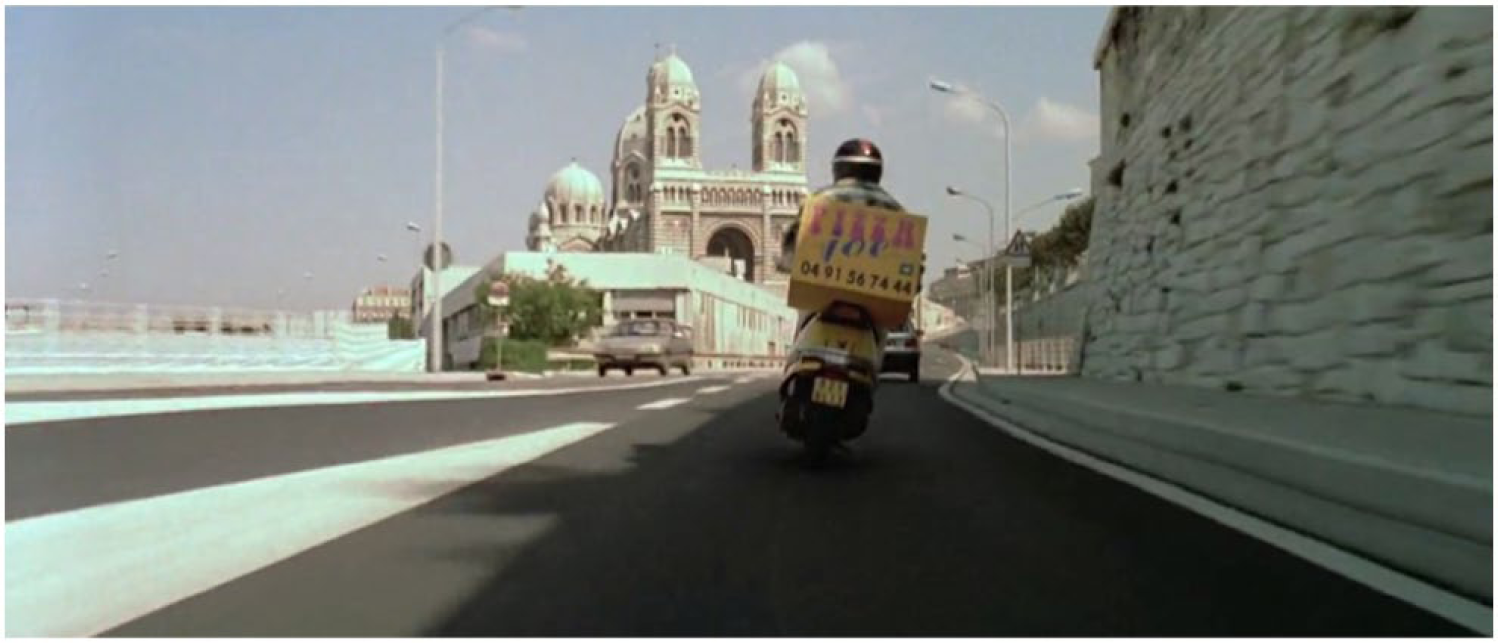
Taxi 1, Daniel driving his motorcycle past the city’s iconic sites through the Euroméditerranée renovation zone (Courtesy of TF1 Production and ARP).
The first film of the series opens with upbeat music followed by the main character Daniel driving his pizza delivery motorcycle. As he speeds through the city streets, Daniel passes the city’s iconic landmarks such as Fort Saint-Jean and the Cathédrale de la Major in the harbour area (Figure 1). His motorcycle moves towards the Euroméditerranée area which is destined for renovation, representing the neighbourhood’s up-and-coming economic dynamism and change. Daniel ends his ride in yet another record time. Soon afterwards he changes jobs, going from two wheels to four as a cab driver in his white Peugeot 406, which has been specially altered for more speed and flexibility. Daniel’s upgrade from one service industry to another (a better one, as he is self-employed) is celebrated with motorcycle stunts.
In all four films, Marseille is portrayed as on its way up, with sanitised streets and docks and clean roads that enable Daniel’s car to move smoothly and faster than even the high-speed train. The analogy between Daniel’s taxi and the high-speed train, which is often voiced in the film, is telling, considering that at the time the TGV was being built to connect Marseille to Paris. It is no surprise that in the first film of the series, the German gang that rob several Marseille banks (depicting the desire of the city to become a global financial attraction) are trapped by Daniel on top of an unfinished motorway bridge, a construction site that will give a new mobility and accessibility to Marseille (Figure 2). The national connectivity of Marseille is already established in the second and third films of the series, as the characters find themselves parachuted into Paris and they drive all the way to the Alps in record time.
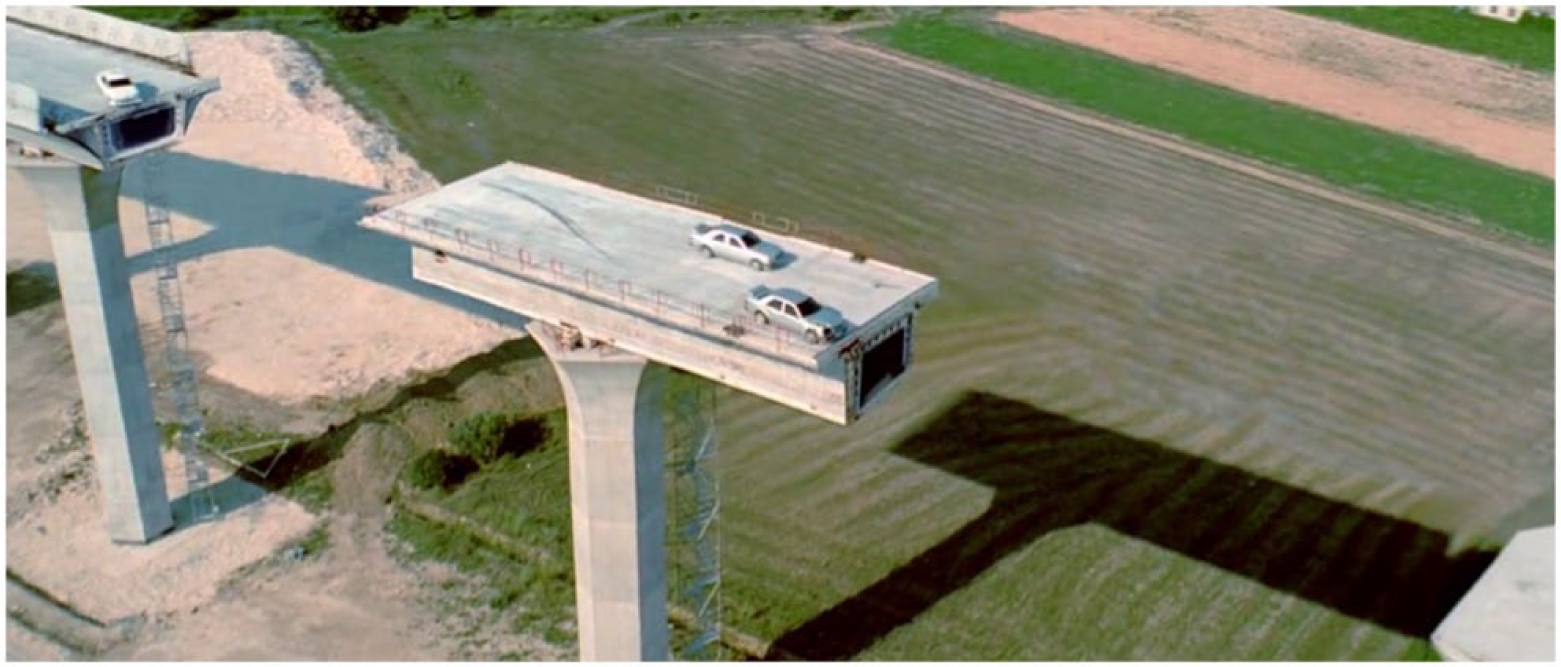
Taxi 1, The German gang trapped on an unfinished motorway bridge by Daniel’s cunning plan (Courtesy of TF1 Production and ARP).
Ackbar Abbas (2003) discusses Ang Lee’s Wo hu cang long (Crouching Tiger Hidden Dragon, 2000) and suggests that the film, with all its technical sophistication and computer enhancements that are used to render the characters’ bodies gracefully weightless, creates a world of light and malleable cyberspace. Hence, Abbas claims that there is a certain parallel between Ang Lee’s film and the government’s efforts to make Hong Kong ‘a global city through projects like the new cyberport and the development of information technology: Hong Kong, too wants to be a crouching tiger’ (2003: 153). Similarly, the Taxi series represents Marseille as a global, malleable and flexible city that can transform its look in a couple of seconds – just as Daniel’s car does – and accelerate to catch up with other European cities in a rush towards being an investment and tourist attraction. Daniel’s car often travels around the Old Port and scenic Le Panier district towards the motorway and the airport – going from local to national and transnational. In the credits of the series, the Marseille Board of Commerce and Industry is the first organisation to be thanked, which shows how the film series’ depiction of Marseille aligns with that of the official desire to present the city as an upcoming global capital of finance and tourism. Moreover, in order to promote the idea of a cool, alternative and countercultural city, these films turn run-down spaces, old harbours and factories into places of organised crime, yet full of action and visual attraction.
In the second film of the series, the chief of police tests his officers by asking them if they know why the Japanese defence minister would visit Marseille. They come up with answers that define Marseille as a ‘glocal’ tourist attraction: the climate, the food, tourist sites such as Château d’If, pastis, and the football team Olympique de Marseille. In fact the Japanese minister is coming to the city to visit an anti-gang training base – with the promise of a global collaboration against crime – only to be kidnapped by the anti-globalisation conservative Japanese mafia. As the film series feeds into the conception of crime-ridden yet alternative Marseille, it simultaneously suggests that the city is on its way to becoming a safer place thanks to the collaboration of the police (represented by Émilien) and the public (portrayed by Daniel). In any case, the origin of crime is always elsewhere. In the first, third and fourth film, the Marseille police chase German, Chinese and Belgian gangs who are organising heists in the banks of Marseille, suggesting that the city is an attractive financial centre of Europe. While the city is at the centre of transnational action and corruption, the source of crime is always imported and the city takes on the role of giving order, clumsily but surely.
Witt (1999) explains that the general ‘police ineptitude’ in the series is a ‘youth-friendly cliché’. In the Taxi series, it is almost always thanks to Daniel’s schemes that the problems are resolved and the criminals are caught. As Daniel moves from the inner city towards the motorway, the police radar finds it difficult to catch him. Meanwhile, the film’s other main character, the clumsy police officer Émilien, tries hard and barely succeeds in getting his driving licence after taking the test more than a dozen times. The police represent immobility and stagnation, often displayed through police cars colliding and blocking each other during the car chase scenes. Throughout the series the police are portrayed as non-threatening, although they are omnipresent.
Research conducted in cities in Europe (Bernd and Helms’ 2003 study on Glasgow and Essen) and in the US (Sharp (2013) covering 180 cities in the US) shows that in entrepreneurial post-industrial cities, the rise of a creative tourist economy comes with the heightening of the maintenance of order and the introduction of zero-tolerance policing. Since the beginning of 2013, the year Marseille was European City of Culture, policing and tracking technologies in the city have been improved by a mushrooming of surveillance cameras 4 and the use of personal digital assistants to track minor offences and infringements electronically. The deputy mayor responsible for public security and the prevention of delinquency introduced the new era of heightened surveillance as follows: ‘the time for prevention has past. We follow a proactive policy of zero tolerance’ (Ville de Marseille, 2014b). In the Taxi series, despite comical failures, the police take centre stage in crime prevention, at times in collaboration with the army, the police in other parts of France, the local population (Daniel and, in Taxi 1 for instance, his friends who deliver pizzas) and international intelligence (the Japanese secret police in Taxi 2). Even though the films treat their leading role in the lightest possible manner, the overwhelming presence of security forces in the series aligns with the post-industrial neo-liberal cityscape of Marseille.
In order to lighten the omnipresence of police in the Taxi series, the protagonist Émilien is depicted not only as clumsy and clueless, but also as seeming to have chosen to become a police officer unwillingly due to his father’s early death and economic need. In the first film Daniel and Émilien stay up all night, talking about their past, their career choices and how they were forced into jobs they did not want, mainly due to their working-class backgrounds. Their bond strengthens as they discover that they attended the same high school before life led them in different directions: Émilien to law enforcement, and Daniel to pizza delivery, cab driving and traffic offences due to his passion for speed.
What brings the two protagonists together against international criminals is supposed to be a common class background, as the ethnicity of Daniel played by Samy Naceri, a famous French actor of Algerian origin, is effaced. For Witt (1999) the film’s ‘principal significance lies less in any intrinsic artistic quality than in the French public’s acceptance of a young non-white French actor, Samy Naceri, in the lead role of a major box-office hit’. It is true that the Taxi series represents the beginning of an era in which ethnicity and the multicultural texture of French society is much more present in popular French films, thereby showing that minorities are no longer marginalised in French cinema. However, as Alec Hargreaves notes, in the Taxi series and many other popular movies of the late 1990s and early 2000s – such as La Vérité si je mens! (Thomas Gilou, 1997) and its sequel, La Vérité si je mens 2 (Thomas Gilou, 2001), Le Fabuleux Destin d’Amélie Poulain (Jean-Pierre Jeunet, 2001) and Astérix et Obélix: Mission Cléopâtre (Alain Chabat, 2002) – although ethnicity is not marginalised, it is integrated and normalised in such a way that ‘the ethnicity of minority ethnic actors is blurred over or elided altogether’ (Hargreaves, 2005: 213). Hargreaves points out that Samy Naceri’s ethnicity is well known to the audience and is raised in the series through his costumes, such as the famous Marseille footballer Zinedine Zidane’s number ten shirt, ‘which could be interpreted as a nod towards the shared Algerian ancestry’ (Hargreaves, 2003: 152). The series, however, ‘hint[s] at the ethnic diversity present in France while at the same time de-problematising that diversity, suggesting that it can be simply if not indeed magically transformed into an inclusive Frenchness’ (2003: 152). Even Daniel Morales’s name suggests an Italian or Spanish origin, ethnic origins that are often celebrated in their contribution to Marseille culture and that do not pose the same post-colonial and historically tense connotations as Algerian origin. McGonagle similarly argues that ‘the casting of Naceri seemingly symbolises France’s, and here especially Marseille’s ethnic diversity but … the character he plays appears to be a rare exception to a vision of Marseille where whiteness is the unspoken ethnic and cultural norm’ (forthcoming). As McGonagle observes, ethnicity in the film is either completely effaced and whitewashed (in scenes such as the Sunday lunch when Daniel listens to his future father-in-law’s past exploits as an army commander in Algeria with much respect and interest in Taxi 2) or highly visible in the form of clichés (such as the black police officer Alain’s pot smoking and listening to reggae); hence, it ‘remains unrepresentative of Marseillaise society’ (McGonagle, forthcoming). Adding to these clichés, the third film of the series presents a highly eroticised Chinese-Swiss femme fatale, while the fourth film represents ethnicity in one of its acceptable forms in France by featuring the famous Ivoirian-French footballer Djibril Cissé.
Not all genre films representing Marseille evade or whitewash its local multiculturalism. Other action/crime thrillers set in the city such as Total Khéops (2002, Alain Bévérini, based on Jean-Claude Izzo’s novel) show the brotherhood of three minorities and how one of them has to struggle with organised crime in Marseille to avenge the other two. Also, in L’Immortel (22 Bullets, Richard Berry, 2010), another EuropaCorp production, a retired member of the mafia (Charly Mattei, played by Jean Reno) who survives 22 bullets after an assassination attempt, is drawn into a fight with a mafia boss even though all he wants is a peaceful life with his family. The film opens and ends with family scenes in sun-filled Marseille houses or on beaches and brings together the sense of community along with action-filled crime thriller. The multicultural community spirit is revered with stereotypical symbols throughout the film, such as the star of David representing a Jewish police officer, Italian opera that tranquillises the repentant Mattei, North African family meals and lavish marriage ceremonies. The film shows Marseille as cosmopolitan and increasingly hospitable and secure as the elements of violence are being eliminated and Italian (white) heritage dominates with its protective guardianship. Hence, when the diversity of Marseille is represented in action/crime/thriller genres, it either works through stereotypes, is associated with conflict and violence, or diversity is represented in a way in which whiteness dominates in a paternalistic manner.
An antidote to such representations of diversity in Marseille is Karim Dridi’s Bye-Bye (1995), shot a couple of years before the first film of the Taxi series. Dridi draws a more multicultural picture of community, and Marseille is defined as a zone of transition between Africa and Europe. The film begins with the arrival of two brothers, Ismael and Mouloud, from Paris to Marseille and ends with their departure towards an unknown distant horizon in the south, possibly Spain. Similar to those in Marius et Jeannette, Dridi’s characters are the underclass of Marseille and the city is represented as an industrial and working-class city with a great ethnic multiplicity – portrayed through the friendship between the main characters Ismael and Jacky who both work on the docks and through scenes such as an interracial wedding party. Dridi is far from idealising interethnic relations though, since both the blanc–beur friendship and the wedding party are spoiled partly by the intervention of a racist group of dockworkers. The city is portrayed as a diverse place of passage, with a rich and diverse local underclass that is at times conflictual, at other times harmonious: cosmopolitan with advantages and drawbacks.
In comparison with Bye-Bye, race dynamics in the Taxi series promotes an aseptic version of a multicultural city. Marseille has often been considered to be a foreign city due to its high number of residents of migrant backgrounds: ‘The city was cited as being “first Arabic city on the Paris–Dakar road race”, the largest Comorian city in the world, the largest Armenian city’ (Bullen, 2010: 76) and ‘for most of the twentieth century, Marseille was ill-thought of in France because of its “métissage”’, its ethno-cultural mixing’ (Dell’Umbria, 2012: 9). Recently, however, its blending of Mediterranean identities has been celebrated and its multicultural texture has been advocated as a pitching point in the bidding process for the City of Culture application. Once the project had been set in motion after the bid, however, the imagined ethnic mixing sanitised the city’s foreignness into a rather sterile kind of multiculturalism that can be easily marketed. The idea of a city’s foreignness is appropriated and domesticated into a Euro-Mediterranean identity in the cultural productions and architecture of the Capital of Culture. The local cosmopolitan texture of the city, as well as lower-class identities and demands, were put aside by emphasising ‘professionalism’ and ‘high-quality’ artistic productions over supporting and showcasing the multicultural diversity of the local cultural producers, works and identities (Bullen, 2010: 136). Such effacing of the city’s local ethnic diversity is once again predicted in the representation, or rather the absence of representation, of ethnicity in Marseille in the Taxi series.
Conclusion
In Marseille the urban renewal process is happening against a backdrop of economic precariousness, securitisation and gentrification that especially impacts its underclass and ethnically diverse populations. Behind the ideal of colourful Mediterranean Marseille as a global capital there is a crisis in the promotion of its ethnic diversity. The Taxi series foreshadowed this representation of limited Marseille diversity in its depiction of a transnational capital of crime – an attraction for crime tourism with heists organised by German or Belgian gangs and operations by the Japanese and Chinese mafias. These emergencies and crisis situations (always imported from abroad) bring together police officer Émilien and taxi driver Daniel Morales, played by a French-Algerian actor whose ethnicity remains taboo in the film. This is not to say that Naceri needs to play his minority ethnicity; yet opting for clichés (such as reggae music booming from black police officer Alain’s car, erotic plays by a Chinese-Swiss femme fatale, or the transferring of Djibril Cissé to Olympique de Marseille) in films shot in Marseille reveals how the diverse make-up of the city is effaced for a sanitised form of ethnic diversity. Marseille is portrayed as on its way to being a global post-industrial tourist attraction with sanitised streets that enable national and global connectivity. It is portrayed as a secure space, thanks to collaboration between the local population and the police in the spirit of community, with its ‘cool’, shady and thrilling docks and derelict port as film locations that prefigure their transformation into cultural events spaces.
The Taxi series put Marseille on the international map of genre film locations and opened it up for the audience as a world city by blending easy mobility with a whitewashed sense of community while the urban renewal efforts were only just beginning to take shape. These action films insightfully reflect the urgency felt by the French government and Marseille commerce to formulate the city as part of a flexible neo-liberal urban space and to refashion an already diverse city into a safe and ‘white’ Euro-Mediterranean town. Focusing on such sensibilities in these films allows us to get a richer sense of the privileged forms of mobility and the fractures in the French imagination of diversity in the urban space. Besson’s productions capture the path of transformation which the groups that shape the image of post-industrial Marseille aspire to: a city that moves from film to film-related investment location and from visual to financial attraction; and a secure global centre of finance and tourism with a domesticated form of ethnic diversity.