




Abstract
Elsa Schiaparelli’s avant-garde designs and her collaborative efforts with surrealist artists are the subject of most analyses of her work, which focus on themes of glamour, gender and the construction of a modern feminine beauty. Yet a number of lesser-known creations from the 1920s and 1930s, equally experimental in nature, reveal other progressive themes in the Italian-born designer’s oeuvre. References to the city in a number of her pieces, for example, provide a commentary on the important relationship between fashion, women and their urban environments. This article examines designs like the skyscraper silhouette, plastic accessories and new synthetic fabrics, echoing contemporary building materials, alongside the changing landscape of interwar Paris. Comparing the imagined city suggested in Schiaparelli’s sartorial creations with the real metropolis where these garments were worn, this study reveals fashion’s potential to express women’s desires for an improved urban reality.
Elsa Schiaparelli and Paris between the wars
The interwar years in France were a transformative time for women. Changes in gender and femininity drastically altered the appearance of young urban females, who came to symbolise recovery from war and the modernisation of an era. La femme moderne, sometimes referred to as la garçonne, was ‘freer in her behaviour than women before the war … Nestled in the arms of her partner, she dances without a corset; she swims in a maillot … Above all, she has a taste or desire for independence’ (Roberts, 1994: 19). Described by the editor of a Parisian literary weekly L’Opinion in 1924, this woman could have been Schiaparelli, who arrived in Paris two years earlier, broke and without a profession. She had filed for divorce from her absent husband and decided to leave New York for France, travelling with her good friend Gabriela Picabia, the ex-wife of Francis Picabia, in order to improve her fortune. Her ‘desire for independence’, and her connections with artists like the Picabias, which facilitated Schiaparelli’s entry into Dadaist and surrealist circles, propelled her to launch a career in clothing design within five years of being in the French capital. The city and its resources offered the Italian-born designer artistic, intellectual and professional opportunities that rendered her one of the most successful interwar fashion designers, rivalling Coco Chanel in achievement and fame (Secrest, 2014: 20, 66). This article focuses on the urban context and its emergence as a theme in a number of Schiaparelli designs. A brief overview of fashion as an important cultural phenomenon and growing industry precedes two analytical sections, the first focusing on Schiaparelli’s vision of the strolling Parisian female, and the second on her idea of the urban voyage.
Since the 1880s Paris had been seeing middle-class women entering the workforce in significant numbers and populating the streets, its sidewalks, cafés, restaurants and cabarets in more stylish garments (Gardey, 2001: 60–2). Part of a wave of workers that tripled white-collar jobs in France, their potential as consumers and their increasing presence in Paris street life transformed the urban landscape. Historian Delphine Gardey provides the example of the shorthand-typist, the emblematic figure of this change. Her research reveals that in Paris in 1886, there were about 50 of them, and by 1900 there were 6000. The exponential increase in female workers in professions like the sténodactylographe, early on shortened to dactylo, underscores the feminisation of the French workforce by the early part of the twentieth century (Gardey, 2001: 79, 82).
By the interwar period, when Schiaparelli was designing and selling her clothes, women were part of the fabric of urban capitalism: they symbolised modernity through their jobs, dress and appearance. In the inter-war period, garments in particular became an outward symbol of women’s rank and power in modern society. Jacques Valdour, an observer of working-class life in 1920s Paris, is able to distinguish the professions of various workers by their garments and hairstyles. He describes the chic appearance of office workers in contrast to their counterparts working at the factory: Dans un certain bar-restaurant, un samedi, prend place, à une table voisine, une femme d’une trentaine d’années; elle porte une élégante toilette à corsage ouvert; sa chevelure s’échafaude en une haute masse ondulée avec minutie. C’est un employée de bureau … A la table [en] fait face, s’est installé un couple ouvrier: la femme, vêtue d’une robe rouge d’une élégance bourgeoise, et l’homme, en chemise noire et complet gris. (1921: 65–6)
While Valdour distinguishes between the different types of working women, these distinctions, due to an expansion of the consumer market for fashion, become less apparent by the end of the decade (Chenut, 2005: 298–307).
Fuelling the democratisation of fashion was the desire to incarnate this image of freedom and sophistication described by Valdour. Sarah Maza, who examines the emergence of female identity within the context of interwar Paris, focusing on one particular working-class family, recounts how this idea of the independent and elegant female seduced a generation of young women who wanted to emulate just that. Maza argues that the ‘emblematic figure of Parisian life … the sexy stylish, working Parisienne’, spurred the famous subject of her book, Violette Nozière, to play the part and live beyond her means. Fashion was so important that Nozière used money intended for school and other necessities to buy clothing her family could not afford, and pretended that she and her mother worked for Paquin, one of the classic Parisian fashion houses (Maza, 2011: 71–2, 90). In a desperate effort to keep up appearances and suppress family conflicts, she poisoned her parents and succeeded in killing her father in 1933. Although Maza’s main focus is the murder and its repercussions, her examination of fashion as a factor in Nozière’s downward spiral underpins its importance for interwar women.
Nozière’s longing to propel herself into a better social situation through dress underscores fashion’s relationship to society and, in particular, women’s rights. But historian Mary Louise Roberts points out that ‘to look emancipated was not to be emancipated’ (1994: 85). Women who looked fashionable did not enjoy the freedoms that their appearance might suggest. Schiaparelli echoes this observation in her memoirs. Describing Paris in the 1920s, when she was settling in to the French capital and right before opening her first boutique there: In Paris life for me was rather dull, with a great deal of solitude. If ever I wished to be a man it was then. The possibility of going out alone at any time, anywhere, has always excited my envy. To wander aimlessly through the night, to sit in cafés and do nothing, are privileges that seem to be unimportant, but in reality they make the taste of living so much more pungent and complete. (2007: 41)
Although women walking alone in the city were common at this time, a drastic change from the turn of the century, when they might have been detained by the police des mœurs, historians like Steven Hause support Schiaparelli’s claim that women’s emancipation was a long process that did not necessarily provide urban women in the 1930s with the kind of advantages they might expect (Hause, 1987: 102). The designer’s wish to have the rights and freedom of men reflect how, despite better career opportunities and innovations in fashion, gender inequality continued to dictate women’s walking habits in the capital.
The act of flânerie, an activity that Schiaparelli considered an impossible privilege, was one of the more important surrealist practices of the interwar years. As described by the editors of a recent journal issue dedicated to alternative versions of surrealism, the movement was ‘Never exclusively a literary or art movement … [but] a way of walking down the street, of engaging oneself in politics, of dreaming and living in the everyday’ (Conley and Tanimiaux, 2006: 1). A number of fictional prose works describe the male urban stroller and his adventures in the city, where he can transform mundane occurrences into metaphysical experiences and where the architecture and culture of Paris become part of an improved reality dictated by the haphazard and serendipity (Aragon, 1926; Breton, 1928).
These male descriptions of flânerie, like numerous other surrealist works of prose and poetry, ignore the female perspective. And when they do offer representations of women in the urban context, they tend to reproduce stereotypes like the streetwalker or the prostitute. Caroline Evans and Robert Belton underscore the gendered bias associated with women and the act of walking the street. Both writers examine the 1938 Exposition Internationale du Surréalisme, which opened in Paris on 17 January, and where a number of surrealists, including one female, Sonia Mossé, collaborated to design a virtual street lined with half-clad mannequins. Salvador Dalí was one of the artists to contribute to this ‘Rue Surréaliste’, designing one of the 17 mannequins in the exhibit. Evans describes Dalí’s mannequin and the display in general: Dalí’s [mannequin] wore a Schiaparelli hat underneath a penguin’s head and a scattering of small spoons over her torso. For the opening the hall was dark, and viewers had to rent a flashlight to look at the mannequins … The ambiguous connection between prostitute, the mannequin and the woman of fashion cannot be missed. (Evans, 1999: 24)
Despite the Schiaparelli accessory and the participation of Sonia Mossé, the ‘Rue Surréaliste’ generally presented a male vision of female urban fashion, where women served as sexualised objects decorating a darkened street. It did not redefine women’s role in the city nor negate the connotations mentioned by Evans (Belton, 1995: 197).
Schiaparelli’s designs, however, distinguish themselves from the work of her surrealist colleagues for their resistance to feminine stereotypes. Thanks in part to the sartorial medium and the discourse surrounding it in the interwar years, fashion designers like Schiaparelli had the potential to challenge entrenched ideas about females in the urban context. Although clothing itself may have provided an ‘illusion of being free’, conversations about its significance actually changed the way people understood women’s social and political roles (Roberts, 1994: 81): Fashion was not ‘politics’ as we are used to conceiving it, but the debates over its meaning in postwar France were profoundly political. The fashions of the modern woman became central to the cultural mythology of the era, instilling at once envy, admiration, frustration, and horror, because they both provided a visual language for upheaval and change, and figured in the political struggle for the definition of female identity. (Roberts, 1994: 87)
Roberts’ concept of fashion as a ‘visual language’ elucidates how garments and their public display can generate a public discourse for change.
The scope of this conversation widened in the 1930s beyond the boyish garconne look of the 1920s to include more traditionally feminine variations of womanhood, including sexy, chic and elegant (Delbourg-Delphis, 1981: 133). The expanding range, according to Dilys Blum, provoked a re-evaluation of what it meant to be a woman in public, and encouraged negotiations of femininity. Blum, in her exhaustive book that accompanied the 2003–4 exhibition on the expansive Schiaparelli collections at the Philadelphia Museum of Art and the Musée de la Mode in Paris, explains: The substitution of chic for beauty during the 1930s was just one aspect of an entire rethinking of what it meant to be feminine. With fashion caught between two extremes – the Marlene Dietrich-type trousered lady and the seductive curves of a Mae West – the whole concept of femininity was called into question. (2003: 153)
The choices Schiaparelli made within this spectrum and the kind of femininity she presented are the subject of a number of articles and books (Baxter-Wright, 2012; Blum, 2003; Evans, 1999; Evans and Thornton, 1991; Gibson, 2003; Papalas, 2015; 2016; Parkins 2011; 2012; Sweeney-Risko, 2015). But questions remain about the relationship between Schiaparelli designs and the city in which they were created, presented and worn. How did Schiaparelli garments contribute to the fabric of Parisian architecture? What kind of woman did the avant-garde designer construct to populate the streets and cosmopolitan world in which she lived? The aim of the following sections is to examine a selection of designs that directly and indirectly reference the city and urban travel in order to reveal Schiaparelli’s vision of the modern female and her role in interwar Paris.
Street visions and urban strolling
Schiaparelli’s rendering of the modern woman was sometimes met with defiance, even among her friends. Cecil Beaton, a writer and photographer who knew Schiaparelli and captured a number of her designs for magazines like Vogue, recalls in his 1954 memoirs that he did not always agree with her aesthetics. He writes: ‘Schiaparelli was, in her own way, something of a genius. She injected a healthy note into the thirties, inventing her own particular form of ugliness and salubriously shocking a great many people’ (2014: 227). This equivocal description of the designer underscores her reputation as both brilliant and controversial. More importantly, Beaton highlights Schiaparelli’s ability to reinvent and redefine beauty, rendering something ‘ugly’ fashionable. This propensity is evident in her first collection, launched in May 1927, which comprised sweaters, an item whose origin references the outdoors and exercise, according to Le Jardin des Modes that same year (Delbourg-Delphis, 1981: 112). Schiaparelli appropriates this rural garment and adapts it to the urban setting, facilitating women’s comfort in the city. The sweaters’ trompe-l’oeil designs and sporty cut rendered them a success in Paris, and also across the Atlantic, where American department stores sold out of them (Secrest, 2014: 75).
This early triumph prompted Schiaparelli to open a boutique in December of that year on rue de la Paix, near the iconic Place Vendôme where she would move permanently in 1935. Its name, indicated on a simple sign in black-and-white letters that read ‘Pour le Sport’, highlighted the designer’s focus on clothing that enabled women to move freely and be active. All of the great designers at the time, however, had evening-wear collections and Schiaparelli soon included them in her own boutique, prompting a name change to ‘Pour la Ville –Pour le Soir’ (Secrest, 2014: 80, 98). The evolution in the name of the boutique, in addition to signifying a shift towards more sophisticated and elegant clothing, demonstrates Schiaparelli’s increasing focus on the urban.
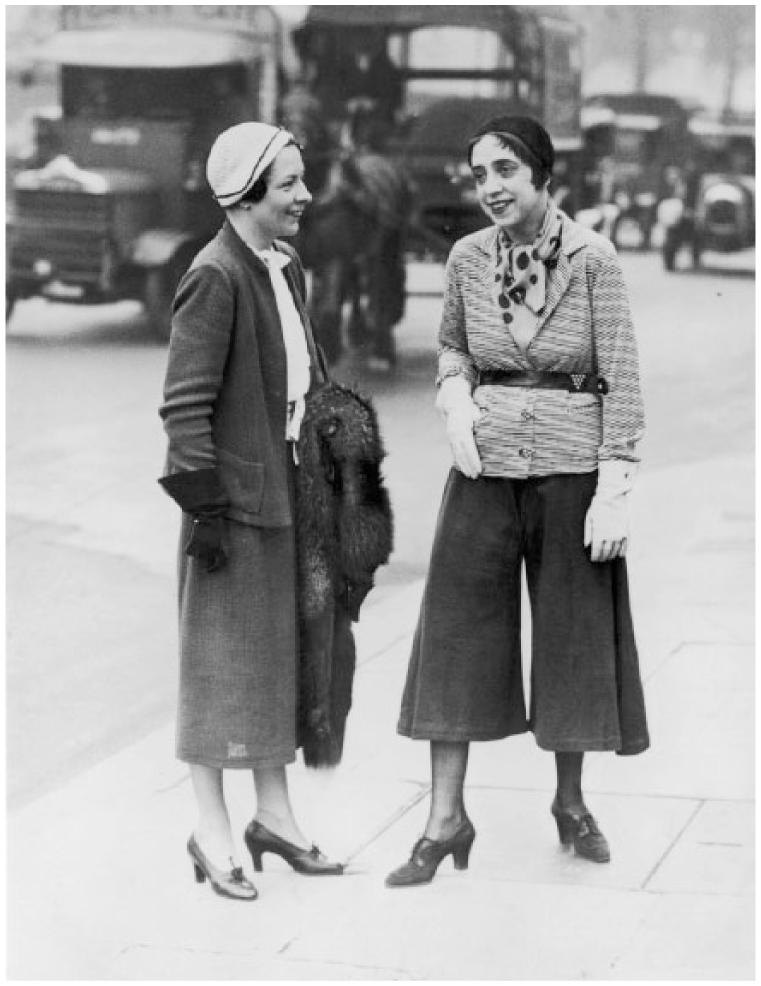
Schiaparelli’s shocking split skirt, 1931. © Getty Images, Hulton Archive.
Despite the inclusion of formal wear, beginning with her first evening dress in 1930, Schiaparelli continued to design clothes that encouraged freedom of movement for all women. Trousers were one example. Beginning in the late nineteenth century, women were wearing them in the city, initially as cycling gear, something forbidden by certain police prefects if not accompanied by a bicycle (Steele, 1998: 176). By the interwar period, a number of designers experimented with the divided skirt, or jupe culotte, which often included an extra layer of fabric or special fold in order to hide the divide (Blum, 2003: 15). Although not the first designer to introduce real trousers (she herself mentions that Paul Poiret had done so earlier), Schiaparelli presented her own version in 1931 and describes them in her memoirs as ‘made for every occasion, travelling, city suits, evening, and sport’. These unabashed pants, which she herself wore in London that spring, shocked society and received a lot of criticism, surprisingly among women, something she relates in her memoirs. She describes the ‘violent’ reaction to a design that opened possibilities for women as ‘unexpected’, but she does not become disappointed or discouraged, and instead focuses on other approaches to urbanising women’s fashion (Schiaparelli, 2007: 53–4).
Schiaparelli also encouraged engagement with the architectural facade of the city. Her showrooms at rue de la Paix did not have a street-level salon to highlight creative window displays, something for which her new address at 21 Place Vendôme, where the boutique was to remain until it closed (reopening again in 2012), became famous (Blum, 2003: 33). Encouraging women to enjoy strolling and spending time in the streets, she devised the ‘Schiap Shop’, whose accessible storefront rendered it inviting and practical in terms of entry for the female urban stroller. It was also appealing because of the merchandise, which consisted of ‘ready-to-be-taken-away items, like shorts, dressing gowns, jewellry, etc.’ (Blum, 2003: 71).
These high-quality haute couture products that define prêt-à-porter today only took off after the Second World War. Schiaparelli was one step ahead of the industry, which had not yet seen a broad democratisation of haute couture. Her first collection, mentioned above, was an example of the kind of quality ready-made fashion that would become standard in the 1960s and 1970s (Green, 1997: 42, 101–2). When Schiaparelli accepted an order for 40 sweaters in two weeks, she contacted her seamstress Mikaëlian Aroosiag or ‘Mike’: [Mike] and I held a council and we scouted through Pairs for Armenian volunteers. The colony must have been unexpectedly large because we gathered quite a number together in no time. They learned quickly, and as long as I paid for the wool they did not mind waiting for their wages. (Schiaparelli, 2007: 44)
Fortunately for Schiaparelli, the Parisian garment industry, which employed 192,853 workers in 1926, more than any other manufacturing sector, had textile workers, many of them immigrants, available to produce in large quantities (Green, 1997: 2, 210). These workers were already providing merchandise for wholesalers and the grand magasins, the first of which opened in the late nineteenth century in Paris (Green, 1997: 77–86, 88). These stores, and their mail-order catalogues for the provinces, catered to a large swath of the consumer population with a variety of merchandise at different price points, often selling imitations of that season’s haute couture designs. The home-sewing instructions found in women’s magazines also enabled women to copy the latest trends on their own (Stewart, 2008: 141–3, 147–9). One significant result was that women, even factory workers, were entering the consumer market for fashionable goods, wearing the same outfits for both work and urban leisure activities that enabled them to look more stylish all of the time (Chenut, 2005: 300–1).
Although many of Schiaparelli’s clients were ladies of high society, international movie stars and royalty, the Schiap Shop concept points to the designer’s attempt to redefine high fashion and make clothes for women with lesser means. She is keenly aware of the shifting role of women and the fact that her clients’ lives had changed after the war, with a growing number of them no longer able to afford servants: One of the things to be most immediately affected by this simplification of life was – underwear. Disappearing fast were the pleatings, real lace, and pure silk. Slowly came in infiltration of much smaller items that women could wash themselves and wear with the minimum of ironing. (Schiaparelli, 2007: 67)
In addition to simple undergarments and ready-to-wear clothing, the boutique sold perfume and other accessories that carried the Schiaparelli brand name, but whose prices were more accessible to women of diverse economic backgrounds. These strategies, Schiaparelli claims, were ‘scorned by the haute couture’ (Schiaparelli, 2007: 65). Christian Dior, embarrassed to associate himself with the ‘downgrading’ of haute couture, proves Schiaparelli’s observation by initially signing his prêt-à-porter line as Monsieur X (Green, 1997: 102). The trend nevertheless had taken off, and as more boutiques like Schiaparelli’s opened in the 1930s, they fed the bourgeois demand for ‘petites pièces’ or small items of high fashion (Delbourg-Delphis, 1981: 142).
Schiaparelli also engaged with the urban woman by focusing on themes that would beckon the passer-by to enter the shop. The first collection presented at the Place Vendôme location in 1935 was called ‘Stop, Look and Listen’, addressing the woman stroller and calling her to come in, inspect and be a part of the fashion experience. Exemplifying the attention-grabbing title of the collection is a series of scarves, beach hats, dresses and blouses made of a cotton or silk print of press clippings on Schiaparelli. These newspaper excerpts layered on to one another were similar to Dadaist and surrealist collages, juxtaposing different images and themes together to form a unique message. Blum applies the words of Tristan Tzara to describe this Schiaparelli fabric which resembled the kind of collages the founder of Dada promoted: ‘A shape cut out of newspaper and incorporated in a design or picture unites the commonplace, a piece of everyday reality, with another reality constructed by the mind’ (2003: 71). Tzara’s quote, while describing the effects of collage in general, explains how this particular Schiaparelli design subtly encourages the construction of a different reality.
Schiaparelli applies this strategy in other designs that juxtapose themes of architecture and fashion where she incorporates elements of the modern city into women’s garments. She captures, for instance, the most recognisable Parisian buildings for one of her dress fabrics in 1936, in honour of the upcoming 1937 Paris International Exposition dedicated to Art and Technology in Modern Life. The fabric, with images of the Eiffel Tower and other famous Paris monuments, references real and specific locations and serves to erase the boundary between the body and the city.
But printed fabric was not the only means for including the city in fashion and identity. Schiaparelli also incorporated urban themes into the materials and shapes of her designs. She explains in an interview of 5 March 1933 for the New York Times during a visit to the US: You see, in design, I consider both clothes and the body architecturally; structure and line are the all-important factors in the construction of fashions. And of course, comfort too! Clothes must look as if they belong to the woman who wears them or they are not right. (Secrest, 2014: 123)
Newspapers and other materials of the city, as well as its structures, became part of the Schiaparelli woman.
The building materials assembled by Schiaparelli for her designs were original and reflected a new way of thinking about construction. She was often the first to use versatile, flexible, comfortable and experimental fabrics, sometimes working with fabric-makers to collaborate on the production of certain prototypes. According to Blum, Schiaparelli was the first to use deep-pile velvets, water-repellent transparent velvets and slit cellulose film. Some of the textured rayon fabrics she launched in May 1933, including ciragril, a lacquered gauze or fine mesh used for evening gowns, were exclusive to her house and often carried her name in various forms. (2003: 34)
Echoing the glass of windows in buildings, Schiaparelli’s plastic designs enabled a transparent layering of textiles, materials and objects that in some ways paralleled developing technology in contemporary construction methods. She often used plastic in her jewellery and accessory designs, as a lighter and more practical replacement for heavy textiles or leather. Her bubbled plastic belt decorated with painted pink metal stars illustrates Schiaparelli’s innovative use of new materials in fashion (see Figure 2).

Evening belt, 1938. © The Metropolitan Museum of Art, New York.
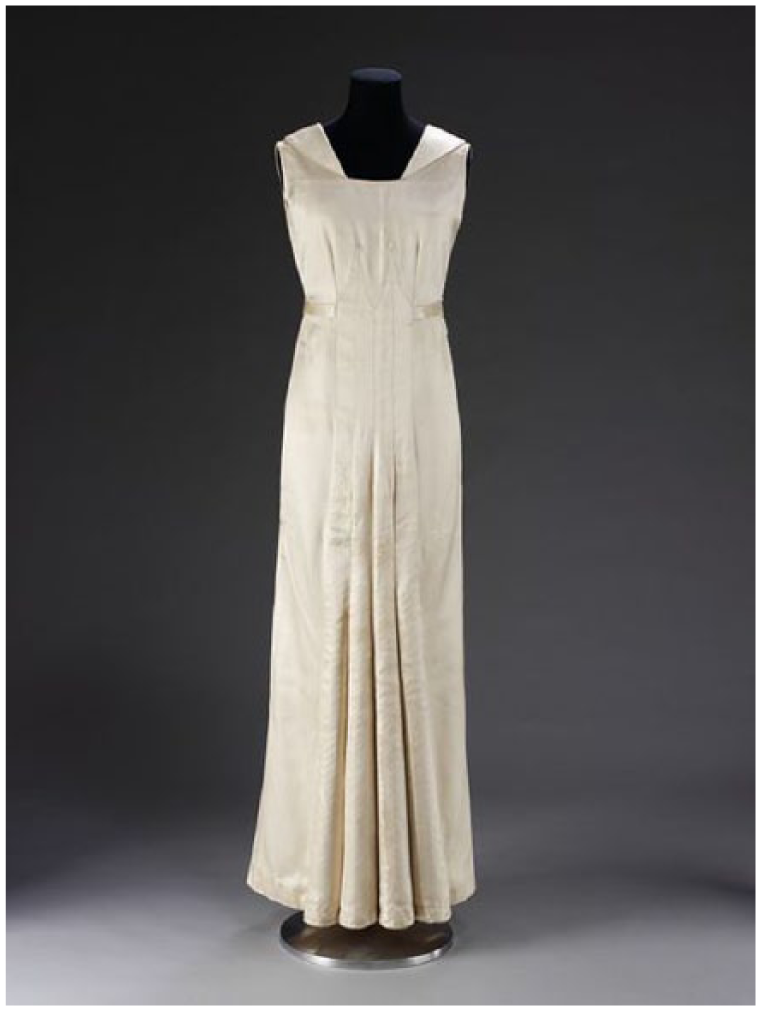
Column dress, 1938. © Victoria and Albert Museum, London.
These efforts rendered the experience of wearing clothes more urban and practical, but they also changed the line of the silhouette and the aesthetic of the look. Schiaparelli introduced shoulder pads in 1931 and for most of the decade designed clothing that broadened the shoulders, resulting in a more squared torso and longer shape, and creating what Schiaparelli’s granddaughter Marisa Berenson described in her memoirs as the ‘skyscraper modernist silhouette’ (Berenson, 2014: 82). In addition to the broad shoulders, other more direct references to architecture, like the 1938 ‘column dress’, simulated actual building components. Like an architect, Schiaparelli built silhouettes that echoed the physical structures of the city, eventually populating it with virtual human buildings. Vogue magazine noticed these themes of construction, and in October of that year described the collection using language from the carpentry profession: ‘Clothes carpenter that she is, Schiaparelli builds up the shoulders, planes them off, and carves a decisive line from under the arms to the hip-bone, gouging in the waist’ (Blum, 2003: 34). Using fashion as a means of urban construction, Schiaparelli built her own city of fashioned females. Her designs entered the cityscape and became part of it, facilitating the integration of women in the interwar French capital.
Constructing the female voyage
In addition to altering the city landscape and facilitating the female experience in it, Schiaparelli also incorporated inter-urban travel in her designs. Unlike her rival Chanel, whose lower-class background denied her international voyages during childhood, the Italian-born designer went to boarding school in Switzerland, sojourned in North Africa with her father, and left for London as a teenager to work as a governess (Schiaparelli, 1954: 33, 26, 37). Throughout her adult life she continued to visit all parts of the world, accumulating knowledge that influenced her designs. Beaton writes: She was the first dressmaker to travel extensively and, wherever she went, brought back representative clothes of that country. On holiday in Switzerland, ‘Schiap’ would make a mental note of the ski instructors; with her return, women would be given thick jerseys with padded square shoulders. (Beaton, 2014: 228)
There are a number of examples where foreign travel and influences marked Schiaparelli’s work, like the line of saris and other wrap dresses inspired by traditional Hindu garments and a visit to Paris by the Indian princess Karam of Kapurthala for her 1935 ‘Stop, Look and Listen’ collection (Watt, 2012: 79–80). Her newspaper prints were also the result of a trip, to Sweden this time, where she observed women scaling fish at the market in Copenhagen covering their heads with newspapers (Schiaparelli, 2007: 68).
While the world influenced Schiaparelli and the garments she created, her extensive travelling compelled her to imagine how life at home might be improved. In her memoirs she wondered how she might bring elements of her travels home: ’I often wonder what is this urge that makes us want to travel. Why not be thoroughly grand, and have the world brought to us?’ (2007: 69). Schiaparelli, in effect, renders travel unnecessary by manipulating the context and transforming it to create another world right at one’s doorstep. The collection that perhaps most effectively accomplishes this is the Circus Collection, presented in 1938 and coinciding with the Exposition Internationale du Surréalisme, which had just opened three weeks before. Both events presented a reimagined rendition of a particular experience. Whereas the surrealists redefined a city street with naked mannequins, scantily decorated in a provocative manner, Schiaparelli redefined the circus experience by bringing it home to her clients. On 4 February the designer opened her show, the most tumultuous and audacious moment of her career (Schiaparelli, 2007: 91–2). One of her biographers describes the event: In February she let loose her Circus Collection, sent the performers skipping up and down the imposing staircase and leaping on and off the vendeuse’s desks in her dignified showrooms, had them jumping in and out of the windows overlooking Napoleon’s Column and Place Vendôme by means of ladders propped up on the pavement against the Louis XIV façade. (White, 1986: 166)
Schiaparelli’s virtual circus signifies a turning point in the industry, where the presentation of the garments becomes as important as the garments themselves. ‘The 1930s and 1940s had seen stage sets, music, and lighting added to the whole fashion show experience, but Schiaparelli was the first to theme her fashion shows, and turn them into extravagant spectacles’ (Worsley, 2011: 92).
Not only was the show itself memorable, the designs of this collection remain today some of Schiaparelli’s best-known work. Fabrics with animal patterns and circus motifs echo the themes of travel, escape and transformation suggested by the circus performers. Models wearing a ‘circus tent’ veil transform into the big top itself, becoming symbols of the exoticism and freedom associated with the carnival. These gowns, with their cloaks and headpieces, also reference the orient, a leitmotif recurring in much of Schiaparelli’s work. Exemplifying this trend in a 1938 publicity photograph for the play Cavalier Seul, the actress Arletty, dressed in a Schiaparelli gown with accompanying cone-shaped fascinator and attached veil, resembles a genie emerged from her bottle (Blum, 2003: 172, 175). The exotic fabrics, original patterns, eastern shapes and accessories of the Circus Collection reference another culture; wearing these clothes simulates the trip there.
This manipulation of context, where clothing and decor replicate a different place, also creates the possibility for a psychological voyage. The wearer of the circus tent veil, for example, becomes someone who is involved in the big show; she becomes another person able to live another reality. The colourful variety of carnival characters, including the sideshow freak the skeleton man, which inspired the ‘Skeleton Gown’, allows the wearer of this dress to slip on a different identity (Blum, 2003: 175). Schiaparelli exploits this in the promotional materials for the collection. An advertisement in Vogue in April 1938 illustrated by Christian Bérard, mixes circus performers and animals with images of women wearing the designs, erasing the boundaries between circus and reality, animal and human. The copy provided by Hortense MacDonald, Schiaparelli’s promotion director, to the 15 February edition of Women’s Wear Daily, one of the most widely circulating fashion-industry trade journals, also echoes these themes: You may jump through hoops in intricately cut acrobat skirts or be as daring as a bareback rider in the sketchiest of ‘jupes’ … You may be a ‘skeleton’ in furs or a ‘fat lady’ in tiers of stiff satin, or if your trend is Dali-esque you may prance in ‘chiffon déchiré’ … You may tie on your hat with a scarf … swing on a trapeze without disturbing a lock … You may lure wild animals from their cages to keep you warm … silver fox, dyed squirrel and black monkey … Instead of ‘chips’ and ‘beignets’ the subtle perfume of Shocking, Salut, Schiap, Soucis, Pagliccio wearing Schiparelli’s new lipstick, Frolica, in the Place Vendome. (Perkins, 1938)
The phenomenon of the carnival and its effects, especially on the collective and group dynamic, is the subject of Mikhail Bakhtin’s seminal essay Rabelais and his World. Bakhtin argues that chaos and disguise have a democratising effect, abolishing social hierarchies and societal laws. An absence of rule and order also facilitates masquerade, transformation into ‘other’, transgression and devious behaviour (1984). This analysis explains MacDonald’s use of the second person to promote the collection: addressing the reader directly allows her to project onto the reader a potential transformation. The Schiaparelli client can ‘jump through hoops’, ‘swing on a trapeze’, or wear the season’s new lipstick colour like a clown. The Circus Collection constructs an alternative world that facilitates personal and social transformation.
Other examples of clothing that encourage a virtual trip are the dresses and skirts of the 1936 Parachute Collection. In her memoirs, Schiaparelli recounts her journey to Russia, where she was impressed by the country’s enthusiasm for parachutes. She witnessed female nurses dive to the ground and set up improvised operating rooms, as well as children in parks imitating parachute jumps. One of the results of the trip is a collection whose lines echo the swelling form of the parachute, and which she describes as having: ‘a small bust [with] billowing skirts cut in panels like a parachute. Women who wore this fashion looked, when they moved, like flowers floating on water’ (2007: 87). In addition to the parachute, Schiaparelli’s interesting description of the women who wore this design stands out as an example of how fashion can change everyday practices. In this instance, the act of walking becomes a floating journey. Like the parachute that inspired its creation, these women glide and hover over the ground, outlining a modern kind of female voyage. Other examples of aerodynamic silhouettes include Schiaparelli’s Airplane Gown, with fabric wings extending like rudders from the skirt.
Schiaparelli not only metaphorically evokes these various means of transportation in her garments; she also designs practical clothing for women pilots. She writes in her memoirs how Amelia Earhart often visited her boutique and how they became good friends. She also outfitted Amy Johnson Mollison in 1936 with a wardrobe for her solo flight from Gravesend, England, to Cape Town, South Africa (Blum, 2003: 34, 74).
One of her last efforts to facilitate a real female voyage was after the war, in 1946. Returning from New York to rebuild her business, Schiaparelli’s first post-war collection was, according to her memoirs, intended to help women look like Parisians again. The collection included several outfits for cycling, ‘the primary means of transport during the war and immediately after’ (Blum, 2003: 257). There was also the ‘Constellation Wardrobe’, ‘designed for air travel and named after the popular Lockheed aircraft used for transcontinental and transatlantic flights … the wardrobe fit neatly into what the New York Times described on 21 February as “the largest handbag known to woman”’ (Blum, 2003: 250). Although this same New York Times article deemed the wardrobe ‘sensational’, Schiaparelli, in her memoirs, regrets it did not sell. She writes: I was still a dreamer and I continued to have a vision of women dressed in a practical yet dignified and elegant way, and I thought of the ancient wisdom of the Chinese and the simplicity of their clothes. I made flat dresses with sloping lines, easily packed, easily carried, light in weight, and becoming to the figure. I made an entire trousseau in a specially designed Constellation bag weighing less than 10 lb, including a reversible coat for day and night, six dresses, and three hats. I considered this the natural answer to the life that faced us, but I was wrong. That collection, which I still think was one of the most intelligent I have done, had a publicity success but no sale. (1954: 159)
Her boutique, which closed eight years later, never regained the artistic eminence and financial success it had attained during the interwar years, something that Schiaparelli hints at in this passage. The commercial failure of the Constellation wardrobe begs the question: did women prefer garments suggestive of a virtual voyage, rather than a real one?
Conclusion
There are a number of explanations for Schiaparelli’s diminished success following the Second World War. Financial factors like the economy and the dilapidated state of the industry, which called for major innovations in both production and design, may have been too much for Schiaparelli to surmount (Green, 1997: 100–1, 104, 121). Her involuntary absence during the war, which left her somewhat disconnected from the city, her clients and her business, did not help (Secrest, 2014: 291, 299). There was also the fact that the designer, like her surrealist colleagues, returned to a changed Europe after exile, where the mood for frivolity and decadence had dissipated. Finally, the idea of aesthetic experimentation presented by the historic avant-garde, of which Schiaparelli was a member, had morphed. A number of other groups emerged, like the Situationists and the writers associated with the journal Tel Quel, who expressed their anti-capitalist and – in the case of the Situationists – anti-consumer sentiments in more aggressive aesthetic, social and political terms. Regardless of the numerous possibilities, the fact remains that the urban identity Schiaparelli offered women after the war had changed. The pre-war successes of her travel-themed garments, which imagined women in more versatile urban roles, more easily walking the city, and eager to embrace the diverse cultures of the globe, underscores a vision for a more liberated female. Designs like the Parachute Dress exemplify how Schiaparelli reimagined the modern woman with creativity and innovation. Admitting in her memoirs to focusing on practicality after the war, she continued to envision a cosmopolitan and travelling woman. But her Constellation Collection presents the modern woman differently. Instead of suggesting a parachute trip by way of the garment’s billowing shape, she designs a wardrobe to be worn on an actual flight. This shift from virtual travel to real travel, a practical and logical approach in the aftermath of World War II, nonetheless fails to imagine improved situations or to construct a feminised urban experience, something her pre-war designs attempted to do. The commercial failure of her Constellation Wardrobe suggests that embracing modernity and jet planes was not enough to satisfy her female clients. Perhaps if Schiaparelli had continued to create garments that facilitated a virtual trip rather than a real one, she would not have closed her boutique in 1954, and her designs would have continued to facilitate a feminist voyage in a superior world.
This theory implies that success in fashion is not always related to the real needs of women, but can appeal instead to their deep-seated dreams and desires, something supported by Ted Lapidus, an experimental fashion designer from the 1960s. He explains this phenomenon and argues that fashion is not a reflection of reality, but more a gauge of subconscious emotions: Un couturier n’habille pas des clients, il habille des subjectivités: les inquiétudes, les tendresses, les anxiétés d’une masse d’hommes et de femmes. La haute couture, c’est un laboratoire, c’est ‘Le Mans vestimentaire’, on fait des recherches, des essais … C’est l’épreuve de la rue. (Quoted in Bourdieu and Delsaut, 1975: 12)
For Lapidus, fashion design is not about dressing bodies, but about dressing the emotions and desires of individuals.
The one existing surrealist tract on fashion, ‘D’un certain automatisme du gout’ by Tristan Tzara, echoes these beliefs. Published in 1933 in the surrealist journal Minotaure, the main vehicle disseminating the group’s ideas in the 1930s, the article showcases a series of Schiaparelli hats photographed by Man Ray and explores the idea of choice and why women prefer certain styles to others. In his usual digressive fashion, Tzara begins the article with musings on poetry, seeming to link certain strategies for understanding that art form with understanding fashion. He writes: ‘la symbolique de la poésie réside dans les mécanismes de la pensée, dans certains procédés ou tournures indépendantes du langage et pourtant contenues dans celui-ci’ (1933: 81).
Focusing on the ‘mechanics of thought’, Tzara draws a parallel between our enjoyment of poetry and our enjoyment of fashion, which is ultimately subjective and very personal. The choice of Schiaparelli hats, which are especially interesting to Tzara because of their unusual shapes resembling female genitalia, exemplifies the way fashion can reflect the most intimate psychological processes. The conscious act of choosing and wearing one of these hats, according to Tzara, is an ‘automatic’ practice that results in the expression of sexuality and libido; the simple act of wearing a hat is a manifestation of those deep-seated desires.
The success of Schiaparelli’s interwar designs, many of which appeared in the pages of Vogue, one of the more widely circulating fashion magazines of the 1930s, can be understood as a reflection of women’s desires for a different lifestyle in a changing urban setting. Designs that suggest a more comfortable urban experience, a more liberated walk through the city, or a virtual trip to an exotic place became some of Schiaparelli’s better-known pieces. These garments exemplify the designer’s attempts to construct modern spaces and create a more inviting world for women. Although they would not be able to vote until 1944, French women wearing Schiaparelli designs in the interwar years nevertheless presented an image of power and urban freedom that in some ways preceded the more real and momentous rights they would attain by the end of the war. These women, through their clothing, manifested the desire for a future where travel both within and outside of the city could redefine and liberate the female experience.