




Abstract
After being closed for renovations for six years, the ‘reinvented’ Musée de l’Homme reopened in October 2015 with a completely new layout and narrative. Its principal account is that, while biological evolution guided human development, culture must be taken into account. With this explanation it makes the new biocultural turn. Throughout, the permanent exhibitions insist that members of humanity, as we know it, are one, and at the same time we are marked by differences. Our article reviews both how successfully the museum presents its story and what is left out. Although the authors agree that the museum is well placed to serve as an institutional form of Foucault’s specialised intellectual on the important questions it addresses, we find weaknesses and omissions in the treatment of gender, ‘race’, ethnic identities, and economic and political power.
The recently reopened Musée de l’Homme proposes to focus the light of science on the current debates in the universities and in society about where we came from, who we are, and where we are going as a species. The ‘reinvented’ museum (hereafter MdH) (Figure 1), which opened its doors on 17 October 2015 after six years of refashioning, presents exhibitions to explain the emergence and changing lives of modern humans. With the mission given to it by its parent, the Muséum national d’Histoire naturelle, and staffed largely by life scientists, this institution leans towards biological issues. But it tries to take into account the crucial role of culture in the process. With its new displays and explanations, this French museum is intervening in the often-fierce current debates, both academic and real-world, about what it is to be human. How much do we owe what we think and what we do to biology and how much to culture? In what follows we examine how successfully the new institution navigates this disjunction, how much clarification it affords us, and what it gets wrong or leaves out – mostly on the level of the role of culture – because of the specific culture in which the MdH is embedded.

The reopened Musée de l’Homme. Photograph by Herman Lebovics.
We begin by some theoretical considerations about how biology and culture work together in human evolution. We then introduce the questions that have guided the remaking of the museum, and a discussion of why the old MdH was an inadequate answer to them. A review of the many successful exhibitions is then followed by our thoughts on the fault line between the story the ‘reinvented’ museum shows about the development of humankind and the past inadequate or false attempts to do so. The penultimate section of this essay deals with the several important things not shown at the current iteration of the MdH: gender, power, race, ethnicity and colonialism. Finally, the museum’s last section, and our own, has a lot to say about globalisation. But, as an example of the workings of globalisation, in displaying a big, beautifully decorated yellow and blue bus that once plied the streets of Dakar in Senegal, we shall argue that the museum missed a chance to address the relationship between colonialism and globalisation in the past, and perhaps today.
The biocultural
The MdH offers visitors a visual interpretation of human development. The exhibits are by and large well done, although some of them can be puzzling. The signing is informative but not too long: not what museum professionals damn as ‘a book on the wall’. The science on display is mostly up to date. The website is elaborate and beautifully designed.
If we think of the earliest expansion of humankind not as the growth of a great tree with a central trunk and branches spreading from it, but rather as an untidy bush growing in all directions, we may grasp the message of the newly reopened museum. While today a globalisation driven by unrestrained capitalism, the worldwide and local movement of people, and the inescapable electronic media seem to threaten the rich diversity of the cultures in our world, how fitting it is to be reminded of the very first globalisation, when African humanity began to populate the world. From the beginning, this humanity lived everywhere socially and collaboratively. Humans hunted and then domesticated animals, different ones in different places. They invented horticulture and then agriculture – probably the women, although the museum does not say so – many times over. They used language, a huge tower of babel of languages. They created signs, symbols and images. They invented gods to help master mystery, danger, the risk to crops, and, especially, to give meaning to life in the face of death. They created technologies and market systems, and succumbed to governments. And, through technologies, organised violence, powerful rulers and market systems, various members of humankind gained dominance over the places where they lived and which they invaded, and began to change both their worlds and themselves. Today, human powers of transformation have attained the ability to create new kinds of beings, post-humans, who, for the first time, are capable of extinguishing life on the planet.
The great scientific strength of the museum is that it tries to tell this story in a more or less biocultural way: the course of the evolution of humankind on earth is told with the contributions of culture and living together in societies considered. A biocultural approach sees human evolution as a permanent process of co-evolution and of co-adaption between biological diversity and cultural diversity. This dialectic relationship has permitted humans to evolve within their environments both genetically and morphologically conjointly with changes in their social, cultural and technological lives. Accordingly, we will use the bountiful word ‘culture’ here to mean not only the ways in which people live together, as anthropology has it, but also the ways, by means of creative mental invention, humans enrich, or diminish, their collective lives as well as the lives of future generations (Boëtsch, 2002).
The museum’s individuality is that the story of humanity it tells is expressed in contemporary France. That narrative is both universal and at the same time it implicitly reflects unresolved issues in contemporary French culture and society.
Humankind lurching towards an uncertain future
To show the birth of the human, the museum puts visitors on a path of discovery that has as it guideposts three short questions. The first question visitors see in big letters on the wall of the permanent exhibition space is ‘Qui Sommes-Nous?’ The second part of the main exhibition asks, ‘D’où Venons-Nous?’ And finally, we arrive at the third and final area dedicated to helping us think about ‘Où Allons-Nous?’
Significantly – in one of the many allusions along the way to the arts and letters – these existential puzzles were famously posed by Paul Gauguin on the upper left-hand corner of one of his best-known works done when he lived in Tahiti in 1897 (Figure 2). 1 The painting, his biggest and favourite, has no formal title other than these words. On the rest of the canvas the artist painted various individuals from different parts of the world, as well as symbols of several world religions. And now, signalling the museum creators’ inclusion of the influences of culture in the narrative of the development of human beings, understood as biocultural, these questions Gauguin put to humanity guide our visit through the different exhibition and information spaces of a scientific museum.

Gaugin painting ‘Who are We?’ Photograph from personal collection of Ethan Lebovics.
This inevitable tripartite division – it is France, after all – is not strictly chronological. The first exhibition area, ‘Qui Sommes-Nous?’ is thematic. Contrary to the hunt that the ancient Greeks launched for the uniqueness of humankind, these exhibits and wall texts take us through some of the specifics of human existence. Biologically we share much with other primates, but our living with culture is an advantage. Our big brains help us think the world in which we live. Our ties to other humans – ‘ce vivre ensemble’ – make our lives possible. We have the biocultural gift of language, of music and of image-making. We come in different cultures, social organisations, languages and, of course, varied skin colours. As the museum guidebook puts it, ‘C’est un portrait en mosaïque de l’humanité qui se dessine, composé d’êtres si différents, et en même temps si semblables’ (Aufaure, 2016).
The middle display area, ‘D’où Venons-Nous?’, tells the story of our biological evolution from our African origins, two to four million years ago, to modern Homo sapiens sapiens, of humans’ increasingly sophisticated adaptability in the natural world, and then of the beginnings of our mastery over it. This narrative is the standard story, with the usual suspects of the movement from Old Stone Age to New Stone Age, with the invention of tools, the fabrication of metals, weapons and ploughs, organised hunting and sharing, and the domestication of plants and animals. And later on, with settled life and the human enlargement of land use (anthropisation) producing surpluses, there is commerce with others as well as wars between groups. Didactic panels (as US museum professionals charmingly term the texts accompanying exhibits) also point out the concomitant rise of social inequalities. Writing was invented, first in the service of commerce and of high authority, as was the institutionalised worship of deities (Scott, 2017). 2
And parallel with the biocultural exhibits, visitors are shown a potpourri of aesthetic images, among which are dramatic displays of the busts and statues of idealised human types done by nineteenth-century artists. These are shown perhaps because there are not many collections displaying human variability in France, although the MdH does not explain how these various artistic renderings of the human cohere. Visitors can also see a fine slide show of cave drawings and carvings found in or near the Pyrenees, as well as remarkable drawings of paintings and carvings – once thought by archaeologist Henri Lhote to have been made by extra-terrestrials – found in the 1930s in Tassili n’Ajjer, Algeria (Keenan, 2003; Lajoux, 1962; Lhote, 1958) (Figure 3). 3 Having been shown the human growth and achievements in this second area, we may now be prepared to consider the last and most difficult question: ‘Où Allons-Nous?’
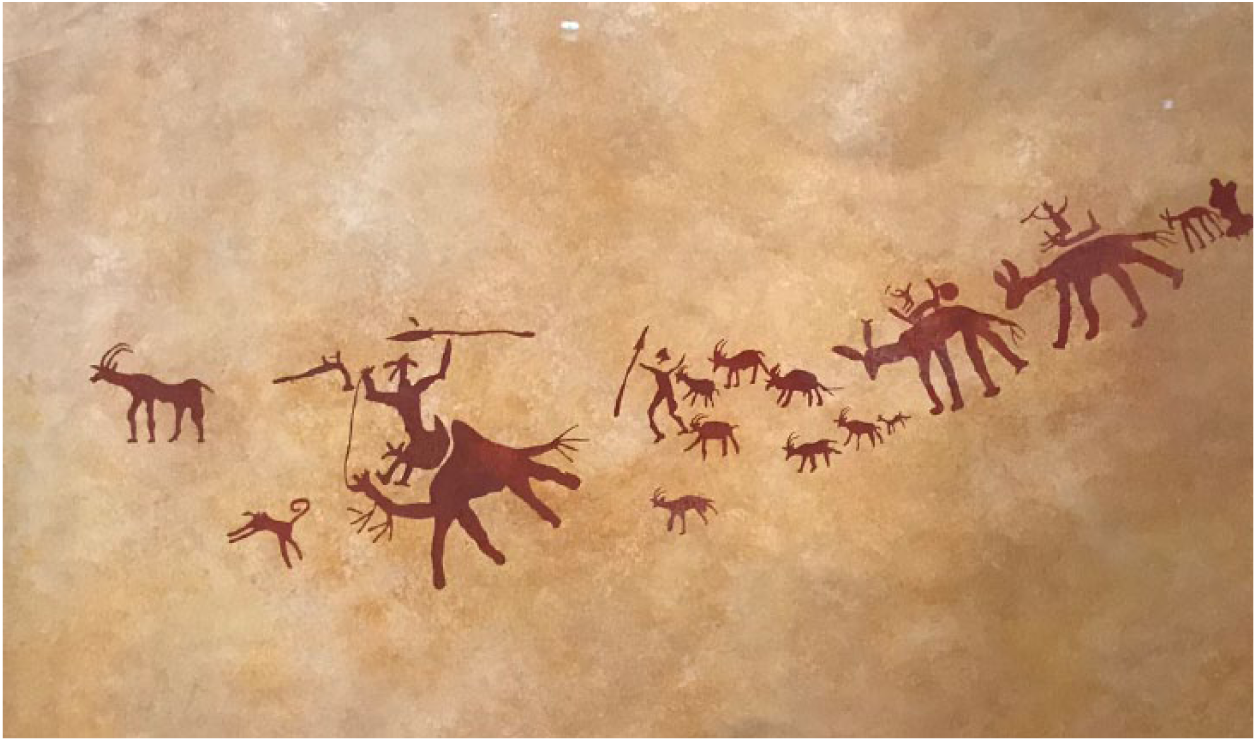
Rubbings of prehistoric figures on rocks in the Algerian desert. Photograph by Herman Lebovics.
In its final set of exhibits, the new Musée de l’Homme emphasises that today, despite significant differences, we are more than ever one humanity. Ecological disaster caused by humans confronts us all. As does all the hopes and fears of the era of the post-human. These last exhibits, based on science, are at the same time calls to action, and are what the makers of the new Musée de l’Homme want visitors to take home with them.
In what follows we will expand the description we have sketched above. For, if not God, certainly Humanity, is in the details. We need to begin with a brief account of why the museum of humankind had had to be ‘reinvented’.
Death and transfiguration
After being closed for six years, on 17 October 2015 the Musée de l’Homme reopened its doors to visitors. Except for a few small details, the outside of the Palais de Chaillot was not changed. But the interior had been completely gutted and redesigned at a cost of 92 million euros. On 20 March 2003, under the Presidency of Jacques Chirac, four ministers in the conservative government of Jean-Pierre Raffarin (Youth and Education, Ecology and Sustainable Development, Culture and Communication, and Research and New Technologies) had presented a mission statement to a committee made up mostly of directors of existing museum laboratoires, most of whom were life scientists. The Mohen Committee as it came to be known, from the name of its chair, was asked to propose major changes in the MdH. The government urged them to keep in mind ‘the identity and the necessity of a reinvented’ Musée de l’Homme. That is a lot of governmental interest, money spent, intense planning and a long period of building to tell a visual story of how our ancestors were African long before they became Gaulois, and even before the artists of the caves in south-western France painted their contributions to it (Zarachowicz, 2015; Mohen, 2004: 139–41; Dupaigne, 2006; Dias, 1991).
The reasons for the shutdown were overdetermined. The layering of scientific, political and cultural factors for the closing foretold what the museum’s new message would be. That these layers of explanation are tightly bonded to each other is, after all, a theme of this essay (Conklin, 2013).
The reorganisation of the museum’s research centres in the mid 1930s, meant in part to pacify turf wars between the scientists working there, had the opposite effect. Like the medieval Tuscan city of San Gimignano, whose feuding noble families defended themselves by building high stone towers (Figure 4), the three autonomous museum laboratoires, that of prehistory, (physical) anthropology and ethnology, jealously guarded their local power and their part of the museum’s treasures. They fought and hoarded not just for honour, as of old, but to capture as much as they could of the insufficient funding allocated by the state (Grognet, 2015b: 203–4). The director of one of the laboratoires was appointed as head of the museum, but, under this tripartite arrangement, this primus inter pares could exercise little or no independent authority. Under Rivet’s strong direction, this shaky balancing act had worked. But after he retired in 1949 the scientists’ feudal baronies fortified their defence works and regularly made war against each other. Consider the now infamous story of the director of the laboratoire of physical anthropology refusing repeated requests to loan its cherished Palaeolithic Venus figurine to the laboratoire of prehistory. The museum was paralysed and, if we may use this word, dilapidated. The government did what hierarchical organisations often do confronted by a malfunctioning unit: it restricted new appointments and cut back funding (Blanckaert, 2015: appendices and chronology), all of which made the MdH ever less attractive to visit (Mohen, 2004). Finally the government decided to close it, transfer most of its holdings to the future Musée du Quai Branly, and to radically ‘reinvent’ the Musée de l’Homme. On the day in 2001 that the transfers of the museum’s holdings to the conservation laboratoires of the future Musée du Quai Branly began, the staff of the MdH went on strike and demonstrated outside the building. But none of the protests, picketing or petitions signed by important French intellectuals could stop the move (Grognet, 2015a: 67–8). The old museum expired not with a bang but a whimper.
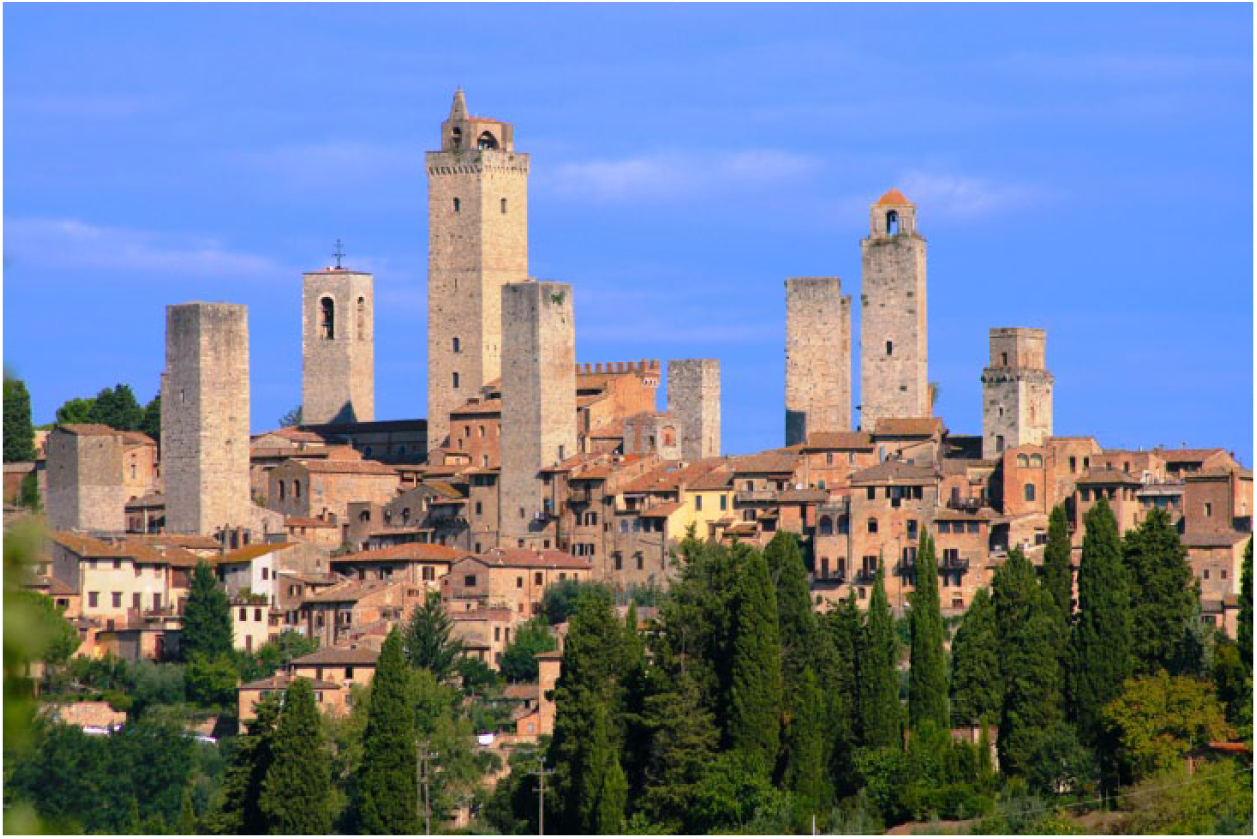
San Gimignano of the Many Towers in Tuscany. Photograph no. 573383758 Standard Licence, Shutterstock.
In the early 1990s the Grande Galerie de Zoologie of the historic Natural History Museum in the Jardin de Plantes had closed its doors to the public. In 1994 it reopened completely reorganised and was renamed the Great Gallery of Evolution. Its theme was the role of humans on the course of the evolution of species. One of the exhibition spaces of this great central hall displayed specimen of extinct species, many of which had been wiped out by human action. Down the middle of the building, commanding the vast centre space of the hall, with a team of scientists, architects, artists, and lighting and sound technicians, the set designer René Allio had installed a spectacular parade of large Africa animals – many of them two by two – all trekking forward to – somewhere. Perhaps this is a playful illusion to the animals on their way to Noah’s ark. Perhaps this procession of Africa wildlife was marching to extinction. Or, most likely, this powerful display was suggesting both possibilities to visitors: animals at risk saved by timely human change of behaviour, or the animals of the African grasslands disappearing in a part of the world with the fastest growing urbanisation. The Natural History Museum’s modern theme of studying and displaying the workings and consequences of animal evolution was meant, someday, to be complemented in a redone Palais de Chaillot focusing on human evolution. A political custom made telling the story of the evolution of human animals possible.
Jacque Chirac, an avid collector of what was then called ‘primitive’ art, and influenced by his friend Jacques Kerchache, a dealer in such objects, wanted to monumentalise his time as president of France with a new state museum. President Georges Pompidou, who loved contemporary art, had set that precedent with the Beaubourg. The new museum of the indigenous art of Africa, Asia, Oceania and America situated on the Quai Branly in Paris, and now called the Musée Chirac, opened its doors in 2006. To fill its glass cases and storage, it took 80 per cent of the collection of the shambling Musée de l’Homme (Zarachowicz, 2015: 30).
No one was coming to the Palais de Chaillot to see its neglected treasures. In 2015 the Eiffel Tower, just across the Seine from the museum, received more than 7.1 million visitors. The chateau of Versailles received 7.4 million. The same year 3.1 million visited the Centre Pompidou, slightly more than the Louvre’s 8.36 million. The Musée d’Orsay had 3.4 million. The relatively new Cité des Sciences in the east of the city had 2.81 million visitors. The Musée du Quai Branly counted 1.03 million entries. About 1.41 million toured the Musée de l’Armée in the Invalides. And because of its recent striking renovation, the visitors to the Grande Galerie de l’Évolution at the Natural History Museum had jumped to 730,000. Lagging poorly behind in public interest, the MdH reported only 111,000 people had visited it in 2001. This was a 16.1 per cent decline in paid entries from the year before. In turn, that year, 2000, had seen a decline of 11 per cent from the numbers in 1999. From 1993 onwards, attendance had followed a sharp path downwards, until the museum closed its doors to the public in 2009 (Mohen, 2004: 58–9).
The science this old institution displayed was well out of date. That, as well as equally important imperatives of the politics of culture, as well as its other face, that of the culture of politics, made it necessary to frame a new story. For not only had the otherwise politically progressive new director of the mid-1930s, Paul Rivet, continued to cling to the idea of race and of racial classifications as valid anthropological theory, but on Rivet’s retirement he was succeeded as head of the museum from 1951 to 1959 by Henri Victor Vallois, whose books theorising scientific race studies continued to sell well into the mid 1970s (Reynaud-Paligot, 2017: 35; Bromberger, 2010; Vallois, 1944, 1951, 1979). 4 In the war years, with Rivet in South American exile, and the Museum de l’Homme’s resistance circle arrested by the Germans, George (sic) Montandon of the Musée de l’Homme was making head measurements of prisoners – mostly Jewish – held in Drancy before their shipment to German concentration camps in Eastern Europe.
Things well shown
We are acutely aware of the near-impossible task that the curators and exhibition-makers confronted when transforming ever-changing scientific theories and hypotheses – some quite abstract – into permanent visual exhibits for a non-scientific public. Therefore, our appreciation of difficult tasks well done is profound. Our critiques of shortcomings that can be improved upon are meant to be helpful. And in the section entitled ‘Perplexity’, assuming the point of view of thoughtful visitors, we wish to ask the planners to rethink, or at least restate, their message(s).
Although the museum’s leitmotif is the account of biological human evolution, it is well nuanced. Let us say here that we honour its mostly physical science creators for having made a quality museum about humanity with the role of culture and society – the biocultural – included, even though these are too often not well, or not at all, visually presented. Most of the topics and exhibits are scientifically accurate, thought provoking and visually excellent. The informative walk-through on humanoid evolution is engaging. Even displaying Descartes’s skull – a bit contrived to be sure – serves the scientific theme that you cannot tell genius from skull size and shape. The slide show of cave paintings is beautifully done and thoughtfully interpreted. The exhibit developers were cunning: visitors who have walked through the whole first level of exhibits and then climbed the stairs to see the continuation come immediately upon this show of splendid prehistoric images (Figure 5). They can rest on cushioned benches while watching the astonishing, but still unexplained, works of art. 5

An iconic image from Lascaux. Photograph by Herman Lebovics.
Unfortunately, the new institution was out of date almost immediately –after its opening – the curse of science museums. Just two important examples. The 7 June 2017 edition of the New York Times, under big headlines, ‘Oldest fossils of homo sapiens found in Morocco, altering history of our species’, concerned a major new find that has to be integrated into the human story (New York Times, 2017; Hublin et al., 2017: 289–92), less than two years after the opening of the MdH. This was not the first prompt for revising the main exhibitions, nor will it be the last one. Most recently we learn that many populations all over the world bear the specific genes for all skin colours. This is further proof, if we need it, that there are no ‘racial types’. Whether and/or which of these genes are expressed, i.e. turned off or on, depends on their exposure to local climatic conditions over long periods of time (Crawford et al., 2017). The MdH addresses such problems of staying current intelligently. In a large alcove on the top floor of the exhibition area, the Balcon des Sciences, there are banks of computer terminals, some with choices of set themes which are updated every four months, and some with universal search capabilities, available to visitors to explore the latest science news and discussions, as well as to gain information on the latest research being done in the laboratoires of the museum itself. The museum has 150 researchers on its staff. There is also a resource centre named after Germaine Tillion, one of the MdH resistance circle (Tillion, 2001). Accessible to the general public, it holds a richness of audio and visual media, as well as periodicals, catalogues, books and even bandes dessinées touching on themes of the MdH. Seating over 150, the Jean Rouch auditorium can show films and videos, as well as serving as a venue for up-to-date public lectures and discussions on the fields the museum covers. The Bibliothèque de Recherche Yvonne Oddon, on the fourth floor, is a specialised document repository and research library on prehistory, physical anthropology, human ecology and ethnobiology. The museum is doing its best to keep visitors abreast.
Finally, among the important exhibitions we wish to single out is the last group dedicated to three present-day and future biocultural issues requiring scientific understanding and the active attention of us all. First, the complicated impact of globalisation on cultures all over the world is on display. The theme – debateable, we think – is that globalisation does not homogenise the world, but rather, as a notice citing Aimé Césaire puts it: ‘Je suis persuadé que, dans la mondialisation et l’uniformisation, l’identité n’est pas morte. Elle se réveillera.’ As evidence, we are shown the continuing creation of traditional arts now made with modern tools and new materials. There is a Central Asian yurt shown modernised with electricity, a switched-on portable computer and a TV. We see a locally embellished Renault bus used for public transport in Senegal. We will come back to this car rapide, called ‘Alhamdouililah’, later.
Second, we are shown exhibits and texts about the urgency of addressing the current human-caused ecological crisis. Fittingly for such a museum, the exhibits especially emphasise the dangers of the erosion of biodiversity.
And third, appropriately for a museum dedicated to a still-evolving humankind, the last theme of the permanent exhibitions speculates on the fascinating topic of the possible future for our species. Now that we have transcended the classic model of biological evolution through interaction with our environment, in what ways, in what directions, and by what means will humanity change? We are radically altering our environment as well as our own genome, which is to say that human adaptation happens both at the individual level and with whole populations. We continue to invent artificial extensions of ourselves both to repair the bodies we have and to augment their capacities – ‘un homme réparé anticipant un homme augmenté’ – machines that let us think better and faster, artificial body parts, increasingly enhanced cyborgs, and even medical alterations of our genes, which can perhaps be passed on to our progeny. We live ‘aux frontières de la condition humaine’, or, as some commentators put it, in the era of the post-human (Aufaure, 2016: 26; Kleinpeter, 2013; Harari, 2017). All this is judicious. It is both good science and a call for serious public attention to future action.
The two stories, both needing editing
Actually, the MdH wants to tell two stories each with a different timeframe. We have said something about the exhibits that show the long-term changes in the human condition discovered by scientific inquiry. But parallel to that story is another, we think, equally important one. That is a history of the successive sciences of humankind themselves. The museum’s account is incomplete, sporadic and even a little sensationalist. For example, we are shown wooden copies of skulls inscribed with the brain areas as was taught by phrenology. But if the dead end of phrenology is on display, why not physiognomy, which rested on analogous principles, and was historically even more important? For this later pseudoscience had a long life in the nineteenth-century criminology of Cesare Lombroso, who claimed to read criminal proclivities from the features of suspects, as well as an afterlife in the phenotypic categorising of racist movements, most famous of which, in the twentieth century, was American eugenics and Nazism (Della Porta, 1988 [1586]; Lavatar, 1775–8; Consigliere, 2017: 93–8).
More punctuated history: visitors are shown a Chinese body model for finding acupuncture points. We see a rather impressive vice-like machine for measuring human head shapes and sizes (Figure 6). But we learn nothing about claims that species have never evolved – called fixism in secular terms and creationism in religious language. In today’s America, at least 38 per cent of people polled in May 2017 said they believed the description in the book of Genesis to be the true story of human origins (Gallup, 2017). The very important debate of the nineteenth into the twentieth century about the multiple origins or single origins of humankind, polygenesis versus monogenesis, the former so important in many racialist discourses, for example, on whether Europeans and Asians share ancestors with Africans, is not to be seen. There is nothing on the interface of physical anthropology (where issues of race are addressed) and biological anthropology (human populations studies). Indeed, race (where questions of phenotype are addressed) – mentioned and systematically rejected in displays – nevertheless passed itself off as a science for centuries. Why do we not learn more in the permanent displays about the theories and consequences of this pseudoscience? See below, where we discuss how this omission is corrected, at least provisionally, in the museum’s first extensive and excellent temporary show, ‘Nous et les autres: des préjugés au racisme’. There are busts and pictures on display of important figures in the development of scientific knowledge in the human sciences on display. We are shown four busts, including one of Buffon, and grouped with them are ten pictures of others – all but one of them French. Yet, curiously, we do not see mentioned the names either of Darwin or Lamarck, each a major theorist of how creatures adapt to their environments and multiply. Mendel should have figured in the scientific genealogy as told by the MdH. Linnaeus’s contribution of moving the study of humans from theology to the field of zoology is not mentioned. And, finally, nowhere is there an explanation of the latest thinking in the burgeoning field of epigenetics, which, simply put, is the science that studies changes in gene expression – when and why they are turned on or off in organisms. This growing new science is a welcome correction to the prior focus on alterations in the genetic codes themselves or, alternatively, claims that they can in no way be altered (Sapolsky, 2017). 6
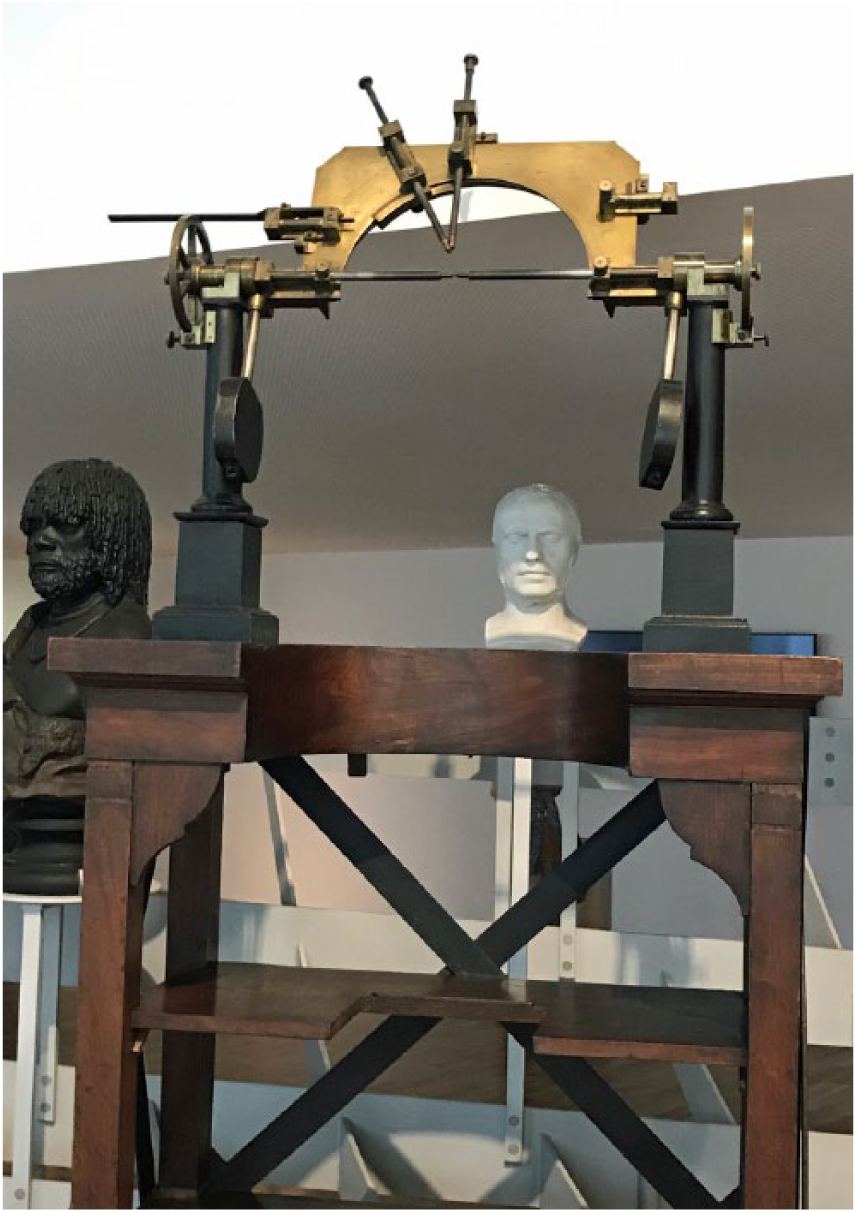
Nineteenth-century measuring device for determining human cephalic index. Photograph by Herman Lebovics.
Further gaps and puzzles show up as we move through the permanent exhibitions. A big two-storey-high vertical framework displaying busts done in the nineteenth century of different modern humans from different parts of the world we suppose is meant to show difference within human unity (Figure 7). It feels very much like sculptures recycled from a cabinet of curiosities. Several busts by mid-nineteenth-century sculptor Charles Cordier shown nearby are there to celebrate his prescient multiculturalism: the museum’s message about this artist is that he committed himself to the positive mission of overcoming Western prejudices by showing how beauty is understood differently in different cultures. However, the context in which these figures were shown in his own day make their charm somewhat ambiguous. Cordier worked the flourishing ethnographic circuit of his century. One of his busts was among the ethnographic exhibits about Berbers done in 1851 on the Champ de Mars. His sculptures of Zulus were shown elsewhere in Paris in1853. The handsome Nubians and Dahomans on display at the MdH were first seen in 1877 and again in 1891 in the Jardin d’Acclimatation. And there are other venues where his fusion of ethnography and art reached a wider public. Was Cordier’s work a simple exercise in biocultural relativism? Or was he contributing to the spectacle of empire, selling colonialism – perhaps unintentionally – by aesthetic means, a standard visual discourse of the era of colonial consolidation (Barthe et al., 2004)?
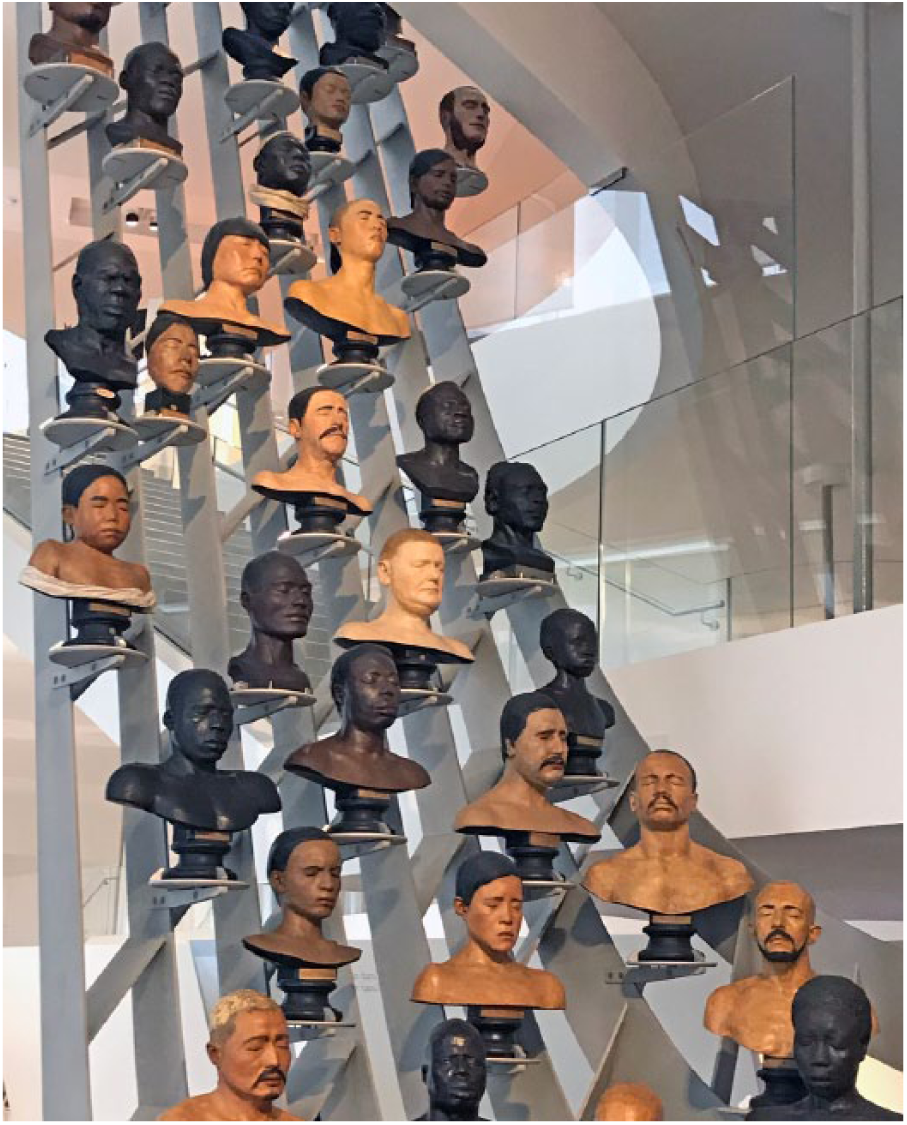
Two-storey framework displaying busts of humans types. Photograph by Herman Lebovics.
In the section where the Cordier busts are shown there are other depictions of human difference as difference in physiognomy. And like the Cordier specimens Europeans are mostly presented anonymously, while the ethnicities of exotic ‘races’ are usually named. Is this an unfortunate trace of lingering eurocentrism? Such representations border too closely on the ‘us and them’ dichotomy.
We were also puzzled by certain omissions. There are good displays on the ecosystem of the Magdalenian age, the last phase of the Palaeolithic, about 17,000 to 12,000
One important difference between humans and their biological relatives is the use of language (Figure 8). A significant difference between humans, the MdH emphasises, is that we speak so many tongues. We use the word ‘tongue’ advisedly, for that theme takes up a long bright-red wall covered with open mouths, every one with big red tongues hanging out – as in the iconic image of Mick Jagger. Each tongue is labelled with the language it speaks. When you pull one, a voice begins to speak that language. It is creepy. Do visitors have to be told that linguistic variation exists? In any case, where displays are activated by visitors – as many other science museums have learned – the hanging tongues will soon get abused or worn out, and the ongoing extinction of the languages of the world will – unintentionally – be reflected in the dwindling exhibit.
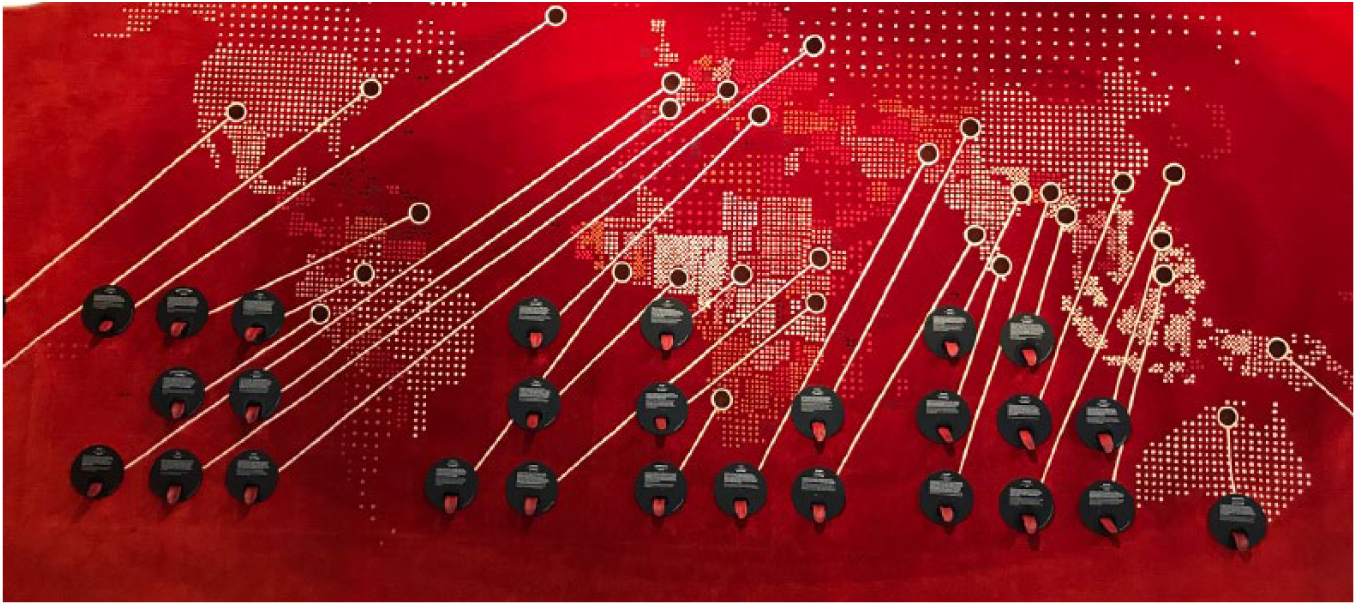
Wall displaying tongues of the world. Photograph by Herman Lebovics.
Things not seen: gender, power, race, ethnicity, colonialism
Some of our concerns relate to the assumptions and principles of the museum-makers. These are important matters we are not given to see in the permanent exhibitions, and their absence evinces serious gaps (Rancière, 2010, 2013; Eco, 1990; Merzoeff, 2011, 2016).
We were prompted to begin our search for evidences of awareness of gender at the entrance of the museum. Looking up at the inherited appellation over its glass doors, Musée de l’Homme, we asked ourselves, what’s in a name? There remains an abiding ambiguity of the word ‘Homme’ in the old and the new museum’s title. The word spelled with a capital H means humankind, with a lower-case h, it means a man. This orthographic subtlety (H/homme) reminds us that, despite the progressive changes, an unfortunate aspect of the museum’s heritage remained in place.
The ‘reinvented’ Musée de l’Homme, like its Third Republic predecessor, remains mostly gender-blind. Yes, women are shown in various displays. The one called ‘Naître humain: Qui fabrique les enfants’ shows an eighteen-century training mannequin of childbirth as well as the Virgin Mary. It also contains a stylised African sculpture of a male with a flaccid penis. Elsewhere we see a poster of an Egyptian tarot card reader; a Chinese female divinity, Guanyin, ‘donneuse d’enfants’; some sculptures by Cordier of women from different cultures; and, of course, the famous ivory Venus figurine of Lespugue with her exaggerated sexual parts. Indeed, a copy of Lucy is displayed. Until recently this young woman was incorrectly believed to be our oldest African ancestor. Nearby a text panel carries a rephrasing of Simone de Beauvoir’s famous statement, here written as ‘On ne naît pas homme ou femme, on le devient.’ 7 A short politically correct text follows explaining that sex may be largely biological, but gender is sociocultural. But what visitors are shown about women is virginity and making babies, their place in religions as it relates to procreation, female magic, examples of their physical beauty, and their intense sexuality. It is true that in the section on the post-human, we see a woman with a prosthetic leg, but that disability or cyborg quality, is not specific to women (Rancière, 2010, 2013). Writing and the exhibits of the Musée de l’Homme – of the word H/homme – too often slide from a simple matter of grammatical clarity to one of gender ontology.
We do not have to credit Marx’s claim that the first division of labour in the human species was between men and women to feel much is lost when the new museum has not systematically thematised the place of gender in human evolution. Soon after it opened, Sylvain Kahn, who does an excellent weekly programme on cultural issues on France Culture entitled Planète Terre, recorded a walk-through of the exhibitions guided by two of the museum’s scientific staff. In the course of the hour-long broadcast on 28 October 2015 entitled ‘Sur les traces de l’espèce humaine: une visite au nouveau Musée de l’Homme’, he suggested that the museum’s use of Homme again in its title may be outdated. The male staff member responded that the planners had not been insensitive to the ambiguity of its name: initially, they had wanted to call the newly opened institution le Musée de l’Humanité. But, he continued, two considerations persuaded them to use its previous title again. First, there was the museum’s long and glorious scientific history under that name, one that the scientific planners wanted to be remembered. Second, he pointed out that the name Musée de l’Homme will be forever linked to the first act of resistance to the German Occupation during the war. (Unfortunately the podcast of this broadcast is no longer available.)
The Musée de l’Homme resistance network was organised almost immediately after the French defeat of 1940. It was made up mostly of museum staff, led by the Russian-born linguist and ethnographer of polar cultures, Boris Vildé. Among other brave acts, the group published and distributed the first resistance newspaper, appropriately called Résistance, copies of which were mimeographed on a machine first kept in the basement of the museum, and later in the apartment of the literary critic, Jean Paulhan. After only a month of the resistance members’ clandestine activities, they were betrayed to the Gestapo by a maintenance worker who also worked at the museum. The Germans arrested most of the circle. They immediately executed seven of the men, including Vildé. Several years later, Renée Lévy, a woman from an old and prominent Jewish family, who had escaped the Gestapo sweep of the Vildé circle and had joined another resistance group, was arrested and murdered. The rest of the women were deported to concentration camps.
Indeed, several of these women had played prominent roles in the circle, among whom was the ethnologist of North Africa, Germaine Tillion, second in command to Vildé. She survived deportation to Ravensbrück to write about the resistance group after the war. The Resource Centre on the first floor of the reorganised interior is equipped with computers giving access to the museum’s films, media and thematically organised databases, as well as to the internet, and staffed by museum professionals there to offer advice. As mentioned above, it is named the Centre de Ressources Germaine Tillion and the research library bears the title Bibliothèque de Recherche Yvonne Oddon. Oddon was a librarian at the museum and another of the resistance group who survived the German camps to work on progressive causes after the Liberation. In May 2015 Germaine Tillion was reinterred in the Pantheon, in the same ceremony as Geneviève de Gaulle-Anthonioz, the niece of Charles de Gaulle, who had also been active in the Musée de l’Homme resistance network (Tillion, 2013; Gildea, 2015). The story of the resistance group at the MdH figures prominently at the top of the museum’s current website.
Other than the museum’s non-scientific detour to the Resistance, where is the biocultural story of power in human societies? The museum’s principle of linking the biological, cultural and societal is an important step forward in the representation of the development of humanity. The planners have refused the arguments of the genetic extremists – e.g. Nikolaas Timberger, E. O. Wilson and Steven Pinker – who have claimed, but have never proved, that most human behaviour can be traced back simply to our genes and evolution. The exhibits where interactions of the multiple dimensions of human development are depicted are instructive. Nevertheless, it is clear that the default science of this establishment, related as it is to the Natural History Museum, is biology. That dimension is usually well explained, but the specific role of social and cultural factors in human evolution are not well shown in most of the permanent displays. As a result of this tilt, in respect of important biocultural situations involving the power of humans over humans, we learn little. It is as if Michel Foucault had never published a word about bio-power. It is as if there had been no economic or political decisions made by those with the power to make them on the macro-level of our environment, or on the micro-level of human morphological changes. And as if the creation of powerful territorial rule could have been done without the surpluses stemming from the agricultural revolution coming under the control of armed elites and rulers. We learn nothing of the incidences or causes of differences around the planet, and within societies, in peoples’ longevity, levels of health, infant mortality, purposely changing ratios of the birth-rates of females to males, or the role of differential nutrition on long-term height and weight changes. On how and why famines happen, which produce both many deaths and large migrations, there is nothing. Amartya Sen, for example, has noted that no famines have ever occurred in a functioning democracy. Some consequences of the organisation, or reorganisation, of the control of land and of labour on farms are briefly mentioned in treating the great river valley empires of antiquity, but never referred to again. Nor are the biocultural consequences of the industrialisation of production and of the creation of the new industrial worker, with all the social and health consequences of that transformation. The main contributors to both global warming and the ecological crisis – the United States, China and Europe – are not named.
Prejudices of all kinds
And now we come to the ‘elephant in the room’ of the study of human biology in societies. The frequently reiterated theme of the MdH – that we are one species with great diversity – unequivocally and systematically rejects race as a legitimate marker of difference (Boëtsch, 2011: 20–1). But, as we mentioned above, in the permanent exhibits there is little explanation for the persistence of this attitude or the pseudoscience invented to support it. We therefore very much appreciated the mounting of the quite extensive and well-made temporary exhibition, ‘Nous et les autres: des préjugés au racisme’ (31 March 2017 to 8 January 2018) (Musée de l’Homme, 2017) (see Figure 9). Racism, we know, means different things in different societies and at different moments. For example, in the United States, a land with over four and a half centuries of racialised slavery, the idea centres mostly on prejudice about skin colour and ‘blood’, but in France the word borders on being a synonym for all forms of exclusion, including cultural (Simon, 2017: 42–3; Reynaud-Paligot, 2017). Texts in the temporary exhibition, for example, call the belief that cultures are fixed, unyielding to new potential participants, racist (Figure 10). The collaboration of the two curators, Evelyne Heyer, a genetic anthropologist, and Carole Reynaud-Paligot, a historian specialising in the history of racism, has brought together the viewpoints of the biological and the social sciences in instructive ways to help visitors understand nuances of meaning and action. The show uses rich new information and inventive display methods to tell its damning account of racism in American history, in contemporary France, and in Rwanda. The Nazi moment is shown, certainly, but the show – focused on addressing the present-day epidemic of hate – does not linger on this sensational act of criminality. Employing both still and moving images, American racial crimes and racist systems are told in a historically accurate and moving way. The Rwanda genocide is troubling to see in image and word. The displays about racism in France are extensive, empirically detailed and very honest.
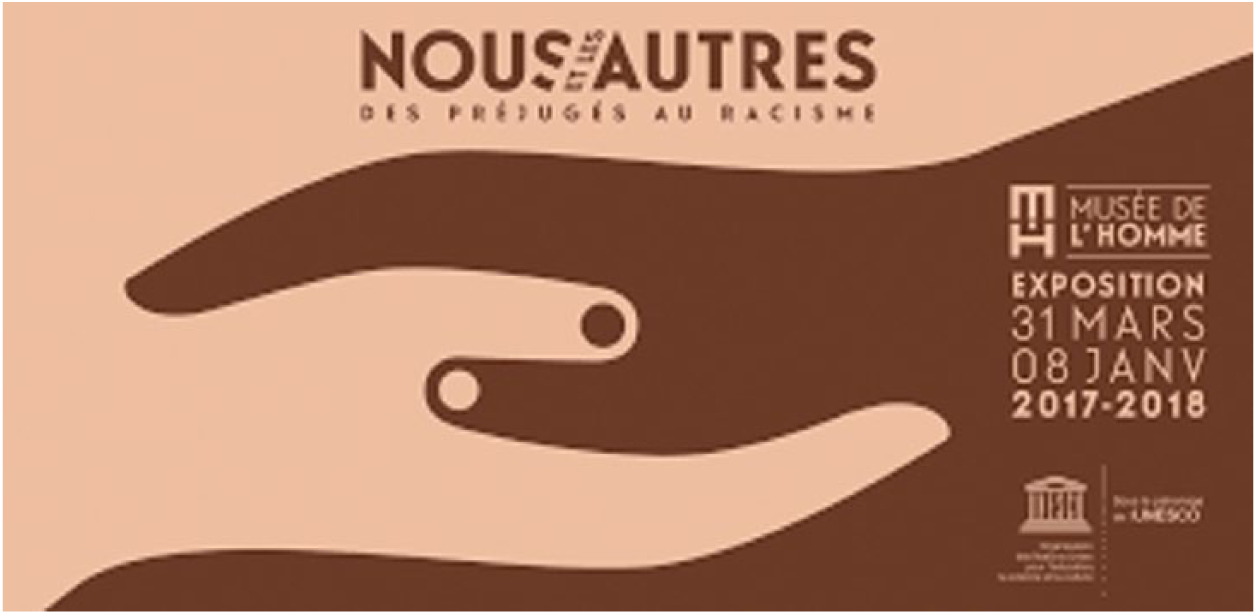
Poster for the first temporary exhibition, ‘Nous et les Autres’. Photograph by Herman Lebovics.
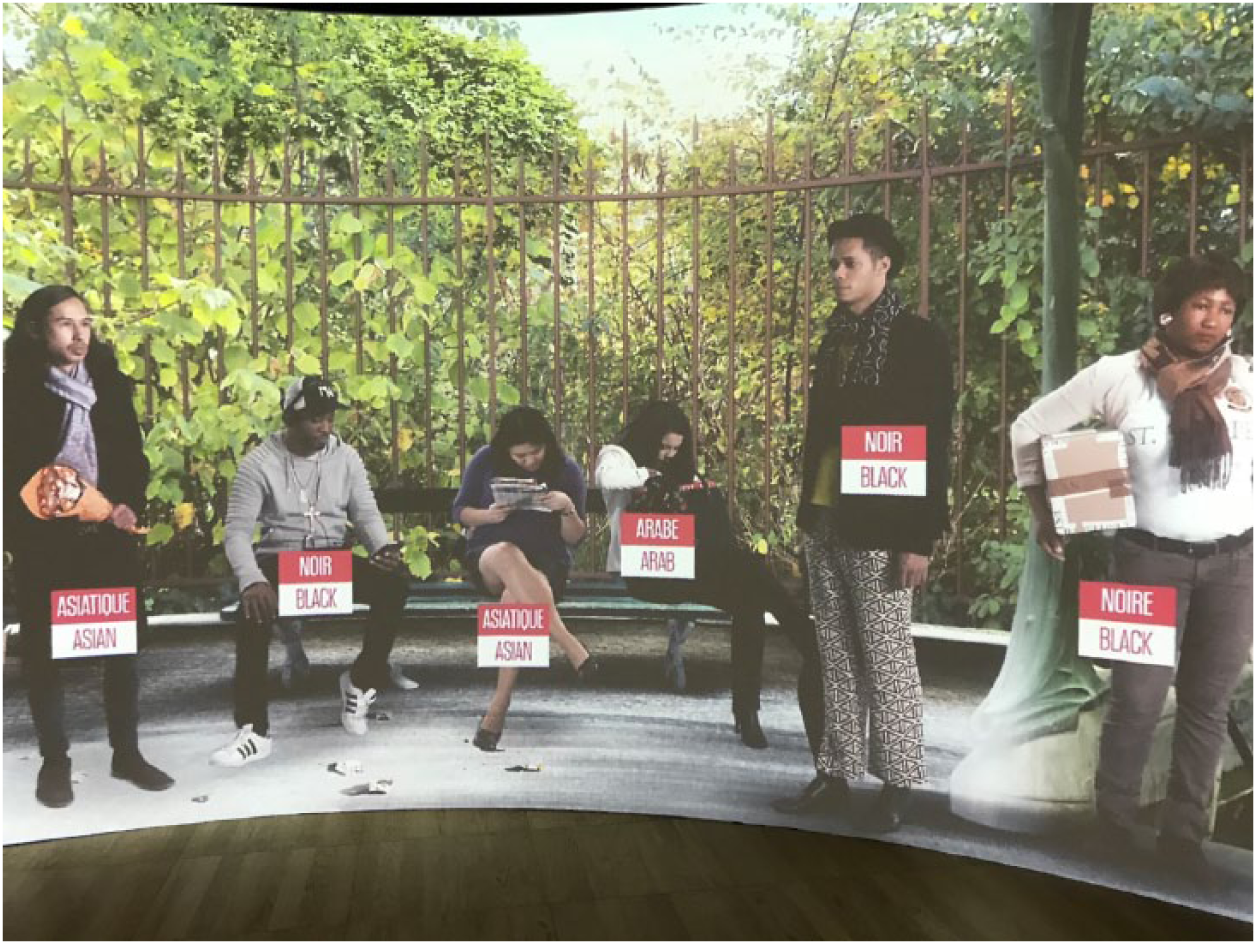
From the exhibition ‘Nous et les Autres’. Photograph by Herman Lebovics.
After recently visiting a remarkably parallel special exhibition at the Science Museum of Minnesota, ‘Race: are we so different?’ Lebovics was struck by a somewhat contrasting style of presenting visitors with evidence of the damage that racial prejudice does in each society. In the much larger MdH exhibition, visitors come upon a quite affecting space, one that could have been very dull: four walls covered floor to ceiling with charts and detailed statistics about unfairness in France in employment, pay, access to housing, education and income, among other violations of l’égalité. Surrounding viewers on all sides with this comprehensive and precise statistical indictment of the injustices of racism is as powerful as the images and film clips. The American museum’s exhibition supports its message by such data, but in limited ways appropriate and narrowly specific to each display. But it does not create the effect of a dramatically totalised message as the MdH room of indictment by scientifically produced data does. However – and this is a major difference of approach – whereas the US show, which has been touring major museums around the country since its creation in 2007, tells its story by pervasively displaying video clips of living individuals from minority groups who give personal witness of their personal injuries and losses caused by racism, at the MdH visitors get much more scientific information: lots of quality data; video interviews with mostly academic experts; four social scientists, one of them Abdellali Hajjat, giving lectures about how ethnicisation – as a negative phenomenon – is fostered in an exhibition entitled ‘Décryptages’. Four other academics are each interviewed about racism in France in the setting of a real café. In this latter video, called ‘l’autre café’, we see in the background people conversing over coffee or working on laptops. Neither the interviewees nor the customers in view are from visibly minority communities. There is a group of videos clips of scenes of protesters and of the brutal response of the authorities. Visitors are shown a timeline from 1915 to 2015 of marches protesting against prejudice in various parts of the world, on behalf of votes for women, gay rights and minority rights (e.g. the Marseilles to Paris march for equality in 1983), against anti-Semitism, for marriage for all, and many against racism. But we do not see individuals speaking to us of their own nuanced stories of bigotry. These differing choices of what we are shown and not shown, and the different strategies of showing, are surely related to cultural differences between the two countries. The import and effectiveness of each approach is good to think with.
Colonialism gets short shrift. The section on the Rwanda genocide is shown under the rubric of ‘colonialism’, but the prejudices engendered in Western societies by the long tyranny over peoples in the South are still at work. Showing Africans killing Africans is not the way to educate visitors, especially the schoolchildren who will be taken to the MdH, about the past and continuing role of colonialism in engendering prejudice (Conklin, 2015).
We wish, finally, to draw attention to a final exhibition, the more important because it is not shown. We have the biological potential for sex but we imbed it in richly varied beliefs and practices. We can all speak languages, but they differ between groups. But racial difference is not a real difference: although people have acted as if race existed, it is fake science and socially destructive. Discussing ethnicity as opposed to race in France is hard. The Republic, like the Catholic faith that preceded it, has little room for exceptions. And, conceptually, the social category of ethnicity lies between the rock and the hard place of race and community. Indeed, recent discussions in France have tried to bridge this conceptual gap by coining the word ‘ethno-raciale’. This usage, we feel, embraces the contradiction in France more than it offers a way of moving beyond it (Préteceille, 2011; Safi, 2013).
Not only does the embrace of ethnicity by minority groups seem to some to violate republican solidarity, but the word was originally used in France during the colonial era. The colonial authorities often arbitrarily attributed an ethnic identity to a group that sometimes saw themselves with quite different affinities from those ascribed to them (Amselle and M’Bokolo, 1985).
Moreover, if we are to take multiculturalism seriously as both a societal fact and as a good thing, how can we argue for exclusive ethnic identities? We know people are not frozen in their attributed identities, and that they change, or meld, their own sense of ethnic belonging as their interests and circumstances change. This ethnic plasticity is well demonstrated in an African example by a group of researchers in which Boëtsch participated (Duboz et al., 2014: 190–8).
The MdH permanent exhibitions do not deal with ethnicity. The temporary one tries to make up for that lack. But there is more to say than several talking heads can do. And this temporary exhibition closed on 8 January 2018. This ambiguity in the universalising message of the MdH is akin to the problem of contemporary French republicanism: all belong in the Republic, yet some are kept out, and many of these excluded search for ethno-cultural identities of belonging. A universalism narrowly defined by the people on top is a fraud, just as an iron-gated culture, said to be open to all, is a sham. Other than race, the MdH carefully avoids more closely defining what is ‘acceptable’ or ‘not acceptable’ difference within the whole. The temporary exhibition condemns the racialisation found within slavery and colonialism, and certain kinds of nationalism. But are strongly held ethnic loyalties legitimate?
Here, the difference in cultural learning of the two authors is most in evidence. We have shown why in France the dilemmas of ethnicity are so difficult, and perhaps why, initially, the MdH did not want to touch this subject (Journet and Trécourt, 2017: 44–5; Amselle and M’Bokolo, 1985). 8 Gilles Boëtsch, with his experience in Africa, knows how much the use of ‘ethnie’, which has biological implications interchangeably with the word ‘tribu’, which is normally self-organised unity, is a heritage of the colonial era, and the role it played in the manipulations of colonised populations (Coquery-Vidrovitch, 1994). But in the United States, with its original indigenous population, and waves of immigration, some groups see claims of ethnic distress or privilege as both admirable and strategic. Native American groups fight hard to be recognised by the government as tribes. Immigrants to the United States from various parts of the world often want their ethnicity honoured. African Americans proclaim that Black is Beautiful and, as Herman Lebovics knows, identity politics is virtually synonymous with electoral politics in the United States. Perhaps Joan Scott’s writings on women’s rights (1997) best expresses the paradox of ‘ethnicity’: women must fight hard for women’s rights in the society and polity to escape the social prison of their being gendered as women. So too, where there is not equality in the republic, one path tempting to those discriminated against can be a sense of biocultural solidarity and ethnic belonging.
What about expressions of sexual identity and practice out of the norms of socially licit expressions of human differences? There are no exhibits dedicated to this question. Sigmund Freud, for example, a neurologist by training, saw homosexuality as a deviance and indeed mental illness. Later medical and cultural scholarship has rejected that characterisation. These issues might be worth the further examination and intelligent guidance of future temporary exhibitions of the MdH.
Le car rapide de Dakar
As visitors reach the final exhibitions, they see what old-time exposition organisers used to call le clou: the highlight of the show. Somehow, on the second floor of the permanent exhibition space, the Galerie de l’Homme, the museum has parked an old, but gorgeously painted, yellow and blue bus (Figure 11). Vehicles of this model started life as vans in the metropole and then when, by European standards, they had outlived their usefulness, they were sold off to local bus operators in Africa to be fixed up, converted and expensively painted to join a fleet of similar buses operating as the main public transport system of Dakar in Senegal. In Dakar, specialist artists, El Hadj Saliou Kane and Pape Omar Pouye, adorned every centimetre of the outside of this bus with symbols, flowers and other images, as well as covering it with phrases in Wolof, Arabic and French. Many of the sayings – some of them from the Koran – and images are to protect the bus and its passengers from jealousy, evildoers, mechanical breakdowns and road accidents. For the museum exhibition, artists have painted the outside of every window with pictures of likely passengers (Figure 12). Just below the windows is proudly painted the final score of a 2002 French–Senegal soccer match that Senegal won 1–0. Also on the side of the bus is pictured a great American eagle with a likeness of President Barack Obama under it and a banner in English inscribed with his election slogan, ‘Yes We Can’ (Figure 13). Next to this symbol of international black solidarity, even more provocatively, another painting shows a white French soldier pointing a pistol at an African French soldier, with a tearful eye painted between them. The picture is titled ‘Camp de Thiaroye 1944’ (Figure 14). This to commemorate the notorious incident at the army base just outside Dakar where Senegalese soldiers of the Free French army were massacred by French tanks to end a siege over better food and pay equal to what the soldiers from France received (Mourre, 2017). 9

Le car rapide de Dakar. Photograph by Herman Lebovics.
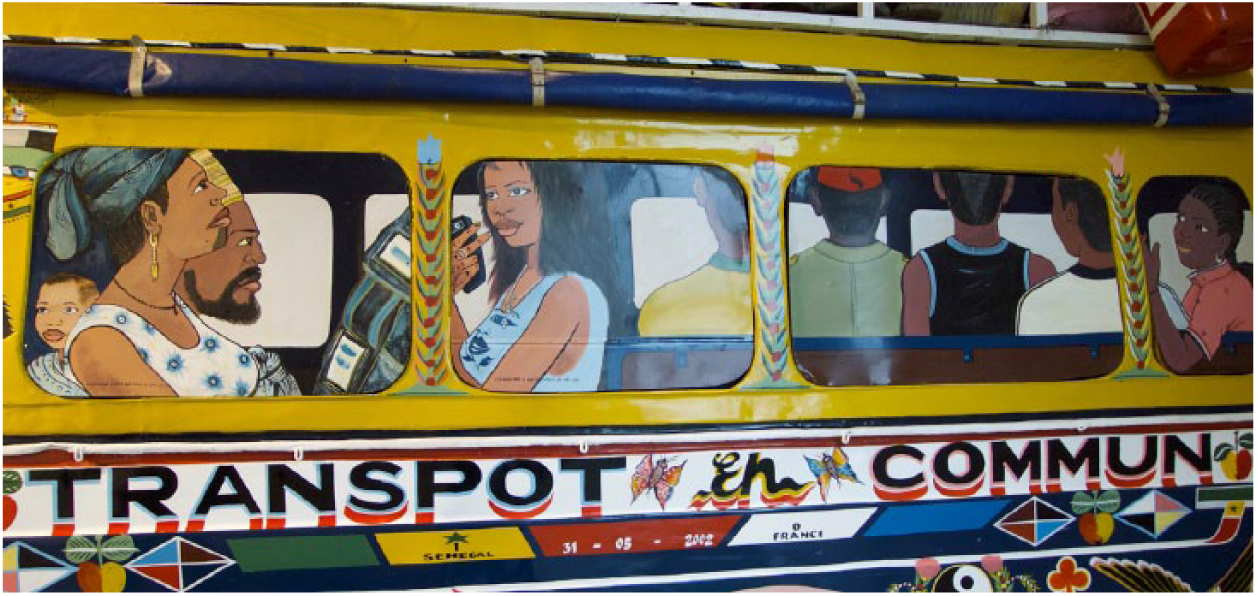
Painted images of bus passengers and the winning score of a France–Senegal football match on the side of the Dakar bus. Photograph by Herman Lebovics.
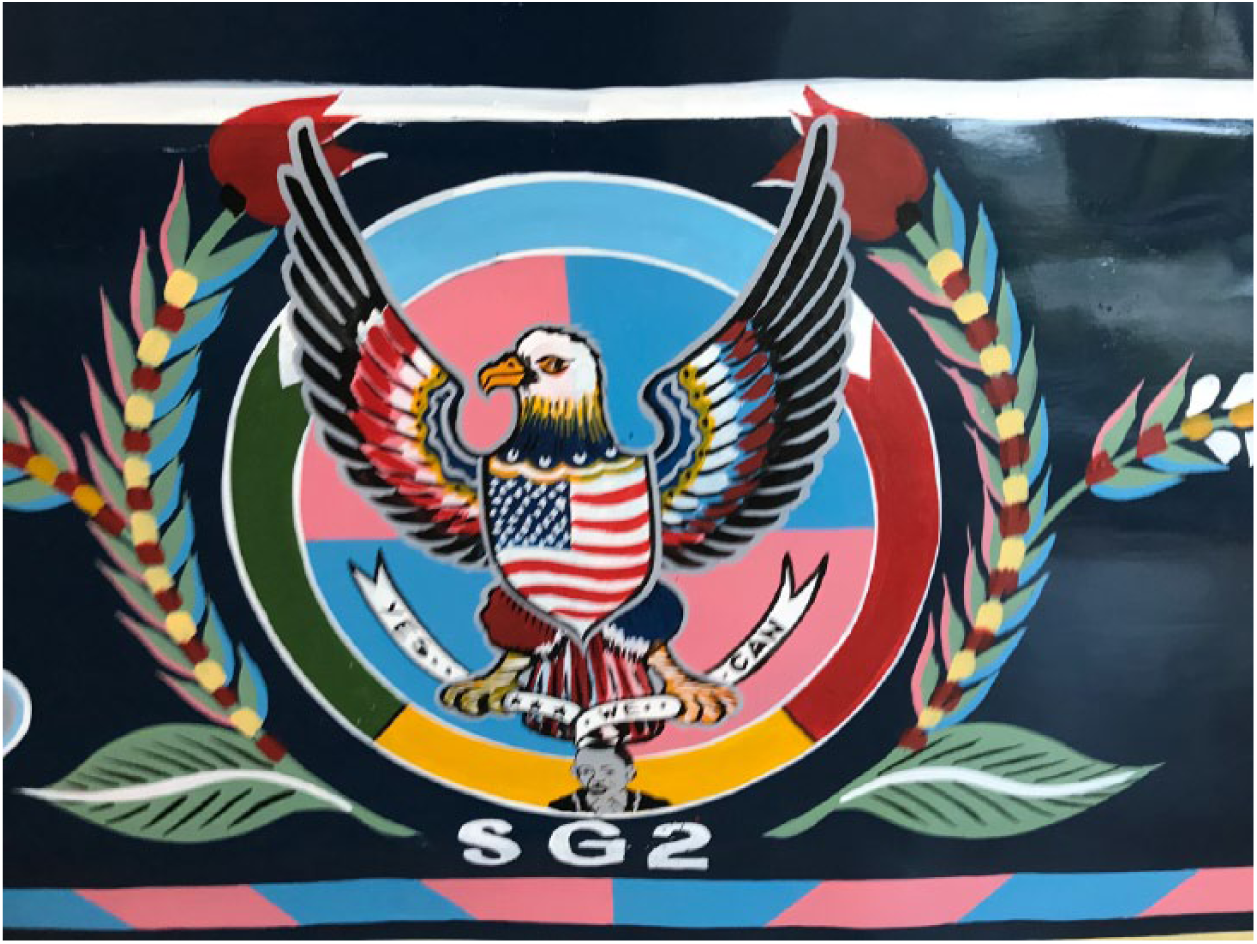
Tribute to President Obama on the side of the Dakar bus. Photograph by Herman Lebovics.

Image of remembrance of the massacre at the Camp de Thiaroye by French military of Senegal soldiers who had fought to liberate France. Photograph by Herman Lebovics.
When a visitor steps in and takes a seat, the inside of the same windows project a continuous video of a bus trip through the busy streets of the big city. Among other things, this mis en scène of a city bus makes the point that the developing world rapidly continues to urbanise. By one estimate, by 2030 over 50 per cent of the population of Africa will be urban, and that percentage will continue to grow rapidly (Cohen, 2006). Seeing this cheerful, brightly coloured bus, festooned all over with both local and global symbols and messages, and picturing something of the life of the people of the city, is a relief to the eyes after looking at so many brown bones, white plaster moulds and stuffed animals. Certainly, this vehicle makes a fine rolling text of contemporary Senegalese urban popular culture (L’Estoile, 2015: 252).
The accompanying panel proposes le car rapide de Dakar as an example of globalisation. It suggests one of the classic anthropologists’ takes on the uneven power of metropole and periphery evidenced in the reception of Western technology and domination. But in the hands of the local mechanics, metalworkers and artists, this artefact of Western technological prowess has been made into a vehicle of the people and their local values. One might say that the display demonstrates the empowerment of the weak by their appropriation of the technology of those who dominated them to make it their own.
But this Renault van, made and run down in France, and then discarded, was used to transport the poor (the fares are low) on the streets of the capital city of a former colony. If we are to see the bus as an example of local empowerment, should we not also see something of the historic colonial situation that brought the bus to Dakar? The text next to le car rapide describes its itinerary from Europe to Dakar as a fine example of a positive value of globalisation. Why do we learn nothing about the history of colonialism, that specific aspect of globalisation, that steered it there? The new Musée de l’Homme says and shows nothing about colonialism or the colonial era. 10
There are so many important things this new museum is bringing up for discussion, even, and especially, in what it does not show or say.
Some conclusions
The Musée de l’Homme takes on a special and valuable role in the array of France’s new museums of society built in the new millennium. It tells visitors scientifically vetted truths about human existence that prejudice, misinformation and the failings of the media have allowed to be ‘debatable’. The faults, omissions and some distortions we have highlighted in no wise disqualify its mission or its message. A museum cannot show everything, we are well aware of that. And, as in the case of other museums of society and art, changing temporary exhibits and updated scientific news are a museological dynamic to give life and new knowledge to museums with a relatively unchanging permanent collection. Its inviting museology captures visitors’ attention. The MdH’s first temporary show touching on racism is an excellent example of how the museum can keep up to date with both new knowledge and exhibitions on unresolved contemporary social tensions. With the passing of the universal intellectual, the person who can speak with authority on the correctness and morality of all things, we are in an era of what Foucault called the specialised intellectual. The Musée de l’Homme, as a collective specialised intellectual, is in a position to speak on issues vital to both the continuation of human life and greater justice on, and to, the planet.
The achievements of the new museum we admired, as well as the deficiencies that we critiqued, reflect the contours in contemporary society that carried through this update of an older paradigm of human origins and development. This museum of humankind is in so many ways a French museum. It celebrates science but makes a place for culture. It emphasises our common humanity, and at the same time tries to elucidate the safe differences in phenotypes, language, cultural practices and the possible future of humankind and of the planet. We write safe because it is relatively silent on issues of colonialism, gender, ethnic loyalties, economic decisions and the roles of power and conflict in societies.
Then there is the ontological problem of museums of society, including this one. Our biology, we know, changes, as does our culture and the environment; and in complicated ways they all change each other. The last section of the permanent exhibition of the MdH suggest the next step for humanity is towards some variety of cyborg existence (Figure 15). But assertions about human identities – both individual and social – were, are and will continue to be so different in time, place and circumstance that it is hard to contain these changes within the framework of a coherent narrative. This last exhibition space is called ‘Vers un Monde Toujours Plus Artificiel’. This hoary distinction between natural and artificial should be retired. When humans began to master fire, make tools and develop agriculture, the ‘artificial’ as an integral component of human existence was already present and life-changing. It could only grow more important with invention in the future. Granting only one biological homo sapiens, we think that the future of our humanity portends rich social and cultural proliferation of difference and diversity, which, in turn can modify our biological humanness.
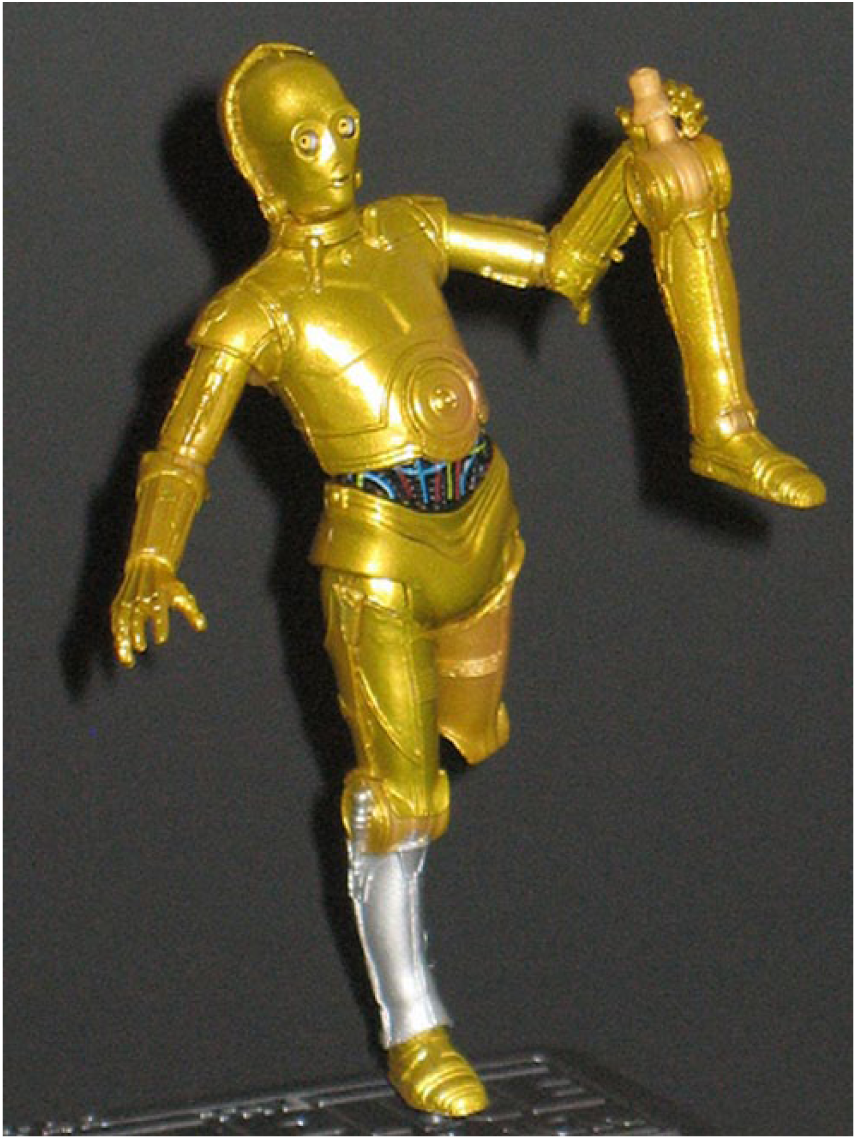
C-3PO from Star Wars holding amputated mechanical leg. Photograph by Herman Lebovics.
A final word about museums of society as places to learn new things about ourselves. The creation of the Musée de l’Homme, dedicated to showing the evolution of humanity, and the Musée du Quai Branly/Chirac, about the aesthetic creativity of the once-colonised, together elide a very French – and not only French – problem. To create the Quai Branly the ethnographic artefacts from overseas societies were removed from the old Musée de l’Homme. 11 They arrived on the other side of the Seine to be displayed as handsome art, but stripped of their human stories (Lebovics, 2010). As a subtle critique – it seems to us – of the museology of the Chirac museum, which mostly exhibits things as existing in a timeless past, the Musée de l’Homme displays several, and changing, works of critical contemporary art both from the South and by contemporary European artists. The MdH’s ethnographic holdings on the vernacular cultures in Europe went to the new Musée de Civilisations de l’Europe et de la Méditerranée in Marseilles. Without its ethnographic collection, the Musée de l’Homme turned to telling us about human origins and the possible future for humankind. Where will French society and visitors learn about how people struggle, hope, and fear in contemporary society (Sen, 1992)? 12 Hopefully, special exhibitions and perhaps conferences, especially at the Musée de l’Homme, which has put up so powerful a first temporary exhibition of racism, will continue our education about the working and malfunctioning of societies, prehistoric as well as contemporary.
Postface
This article is a work of collaboration between Gilles Boëtsch, a French anthrobiologist, and Herman Lebovics, an American historian of French culture. Together we hoped to break down some of the barriers that divide the ‘turfs’ of the sciences humaines from the study of cultural invention, and from the knowledge of how museums tell their stories. We advocate more such collaborations across once forbidding disciplinary divides. We learned a great deal from each other in doing the work. And, in turn, we think we have served readers with our attempt to make the sum of our insights put doubly brighter light on what we have studied.