




Abstract
This article explores how French street artist Mathieu Tremblin’s Tag Clouds satirises mainstream French media’s and right-wing politicians’ representations of the French banlieue. As Tag Clouds erases tags and writes over them in a more legible font, I argue that it performs visual sanitisation to satirise the politics and aesthetics of French visual culture affecting urban settings and banlieues. Politicians’ and media’s amalgamation of banlieue with immigration, violence and poverty extends to banlieue visual culture. Tag Clouds’ erasure of tags, I argue, challenges how French visual culture relies on an ‘economy of sameness’ (Brown, 2006) and the formatting of different cultural, racial and political identities into a unique, transparent model of citizenship. Tag Clouds reveals how sameness affects banlieue environments and visual culture. Ultimately, I demonstrate how Tag Clouds ironically calls for recognising the taggers’ ‘right to opacity’ (Glissant, 1990) and their right to refuse to conform to mainstream French visual culture norms.
In 2016 the internet celebrated French street artist Mathieu Tremblin for his ‘Tag Clouds’ project. Covering old tag signatures with white paint and rewriting the same thing in a uniform font, Tremblin’s Tag Clouds ‘prettifies’ tags and renders them supposedly more aesthetically pleasant to the public eye. According to an anonymous internet user commenting on Tag Clouds, ‘graffiti can be beautiful or ugly, but when it comes to tagging – everyone would agree that it’s the most hideous type of street art. And what’s even more annoying – it’s almost always illegible.’ 1 The categorisation of the tag as a hideous visual production suggests that urban culture fails to reach supposed universal standards of beauty. By pointing out this failure, this comment also recalls that the tag is a cultural production that does not fit into the traditional culture française, which is very protective of the standards of beauty and taste regimented by the Academy of Fine Arts and also by the ideal of belles lettres.
Born in 1980 in Le Mans, France, Tremblin is finishing his PhD in Visual Arts at the University of Strasbourg, where he is currently teaching visual arts at university level. He has worked in many French cities, including Rennes, where he co-founded ‘Les Frères Ripoulain’ with David Renault in 2016. This group aims to explore and revalue the ‘littered’ spaces of cities. Defining himself as an ‘artiste-chercheur, directeur artistique, graphiste indépendant’, Tremblin reclaims artistic methods such as détournement in order to account for, but also distance his work from, the legislation surrounding the individual’s experience of the city. On his own website, Tremblin presents his work as inspired after ‘des pratiques et expressions anonymes, autonomes et spontanées dans l’espace urbain [qui mettent] en œuvre des actions simples et ludiques pour questionner les systèmes de législation, de représentation et de symbolisation de la ville’ (Tremblin, 2010). Interpreting Tag Clouds as visual sanitisation only shifts such questioning – if Tremblin is simply cleaning ‘the most hideous type of street art’, then he is supposedly no longer challenging the systems that design and implement the legislation, representation and symbolisation of the city. Rather, he is reproducing politics and aesthetics of visual sanitisation and therefore no longer targets the official, law-sanctioned, aesthetics of the city.
For Tremblin, interpreting his work as visual sanitisation misses the point he was attempting to make. As the artist states, such comments turned him into ‘the emissary of a solution against graffiti, whereas [his] intent was actually totally the opposite’. 2 Rather, Tremblin, has interpreted Tag Clouds (and his work in general) as a satirical critique of mass advertising which entails ‘a cruel loss of visual alterity for our urban surroundings’. 3 But if Tag Clouds critiques the standardisation of life through mass advertising, I would also argue that the work goes beyond a critique of global capitalism. Indeed, the ‘cruel loss of visual alterity’ implemented by mass advertising also points to a standardisation of French urban visual culture that formats cultural, social and racial heterogeneity into a single model of visibility. Thus if it is undeniable that Tag Clouds erases tags to write over them in more legible font, I argue that such erasure performs visual sanitisation precisely in order to satirise the politics and aesthetics of French visual culture in urban settings. In order to demonstrate the limits of these politics, it becomes necessary for Tremblin to perform what he denounces. As Tag Clouds seemingly erases tags, and thus the visibility of taggers’ communities, it also asks the passer-by to reflect on what has been erased, what was there and is no longer present in its original form, and what such erasure entails for the passer-by’s own gaze.
Erasing and writing over tags in a legible font, I believe, asks one to challenge the way tags have been perceived as a problem demanding a ‘solution’. If French visual culture has problematised tags as infringements of classical beauty and taste, I contend that such problematisation is also one that has to do with socio-racial issues. Indeed, if the tag strikes the passer-by, it is not just for its supposedly unrefined and aggressive visual aspect. In French urban visual culture, the tag is also connoted with the marginalised social environment of the banlieue, which over the last 30 years has become associated with immigration and poverty by mainstream media and right-wing politicians. More recently, the banlieue has become the symbol of the presence of third-generation immigrants, often labelled ‘Arabs’ despite their French citizenship. As such, the banlieue is nowadays strongly associated with issues of both communitarianism and religious extremism. 4 From the immigration wave 60 years ago to the recent urban riots of 2005, the banlieue has become the ‘other France’. This other France is seldom portrayed by the media for more than scenes of violent riots or drug trafficking, and supposedly presents limited hope for personal and professional development. 5 In such a context, French mainstream TV media and press have implicitly yet increasingly associated banlieue visual culture with violence and vandalism. Street art, and in particular tags, have often been considered as background elements to banlieues stories. The news archives from the early 1990s often portray the living conditions of the banlieue population with tags in the background. The association has been made so perniciously that the tag has been a visual trope of the banlieue for over 30 years. 6
Mindful of the association of tags with French banlieues in media representations and political discourses, this article explores the socio-cultural implications of tag production in contemporary French urban spaces. More specifically it investigates the questions of legibility and aesthetic judgement posed by Tremblin’s work, insofar as it appears to ‘beautify’ the suburban scrawl it both erases and enshrines: to what extent does Tag Clouds format the urban visual culture of the banlieue to the exigencies of more ‘legitimate’ French visual culture? What does this erasure tell us when it comes to visual production associated with a social, economic and racial group long considered to be anti-French? To answer these questions, this article takes as a point of departure Tremblin’s claim that Tag Clouds is ‘an invitation to share powers . . . that makes the city playful, poetic and open to appropriation.’ 7 Tremblin has not connected his own work to banlieue visual culture. Yet I believe that it is crucial to consider for whom the city becomes playful, poetic and open to appropriation. French media and political imaginary has associated the tag with the banlieue; such an association, I argue, invites another reading of Tag Clouds, one that explores how its satire of mass consumerism also performs visual sanitisation to reveal the ongoing process of masking, of erasing, banlieue visual culture.
More particularly, I believe that Tag Clouds relies on and subverts what Wendy Brown calls ‘an economy of sameness’ (Brown, 2006). At first visual, this economy of sameness also touches on deeper issues of racial and class identity. In Tag Clouds, the economy of sameness satirically relays the politics of cultural assimilation promoted by French authorities since the first wave of immigration from North Africa in the 1950s. In this article, I thus trace the notion of ‘sameness’ as a critical reflection on the stakes of the contemporary French visual culture of the banlieue. Rather than studying the tag as a finished product, I examine the ecology of the tags Tremblin writes over as participating in the urban visual culture they are inscribed in. In this process, I consider how the spatial and temporal environment of each tag relates to the deeper implications of the tag as socio-racial performance, thereby challenging essentialising definitions of the tag as mere manifestations of vandalism.
As Tag Clouds’ reliance on the economy of sameness asks one to reflect on the process of cultural and visual assimilation, I propose that it ultimately and ironically calls for recognising the taggers’ ‘right to opacity’ (Glissant, 1990), 8 i.e. their right to refuse to conform to French visual cultural norms and therefore to be read transparently. The gesture of erasing tags, as problematic as it may be in terms of ‘cleaning up’ banlieue visual culture, satirises the tendency to consider tagging, and by extension banlieues, as illegible. By doing so, the work simultaneously performs and criticises French politics of cultural assimilation through an economy of sameness that removes any right to opacity. Thus if Tremblin’s erasure of tags seemingly gestures towards transparency, I would argue that such transparency becomes a vehicle for making visible, ironically, the opacity of tagging.
Sharing powers
In order to understand how the French imaginary has essentialised the tag as a racialised production, and how Tag Clouds appears to erase alternative and counter-hegemonic visual productions, it is crucial first to investigate the tag’s historical trajectory from the US to France. Taking its origins in the American hip hop culture, the tag appeared in France in the 1970s. However it was not racialised or associated with the banlieue until the mid 1990s. Indeed French documentaries and news from the early 1990s still looked at the tag from a sociological perspective, exploring taggers’ socio-economic background and own motivations. 9 The tag was seen as an artistic initiative seeking to break down social barriers between urban centres and their peripheries.
For sociologist Michel Kokoreff (1991), for instance, the tag is the manifestation of a desire for visibility, rage and a ‘challenge’ to authorities (1991: 27). In his attempt to understand the relatively new phenomenon that was the tag in 1991, Kokoreff connects this visual art to the rise of violence in urban banlieues, clan masculinity and drug use. Taken from his article ‘Tags et Zoulous’ (1991), the following quote reflects the perception of the tag in French 1990s visual culture:
Pour la plupart des citadins, les tags sont des hiéroglyphes urbains qui salissent. Ils sont de l’ordre de l’innommable – ça –, à la fois hors-sens et hors-langage, en ce qu’ils court-circuitent la réciprocité de l’échange. Pour leurs auteurs, le tag est une signature stylisée. Il s’agit de surnoms ou de pseudonymes qui sont décodés au sein de leur communauté comme la marque (le logo ?) d’une personne d’un groupe. On a donc affaire à une forme d’expression de soi non verbale, implicite, ritualisée, fondamentalement ambivalente en ce qu’elle oscille entre la provocation ostentatoire et le désir de destruction. Une forme d’expression qui se rapproche autant du happening que du cri de détresse ou du hurlement graphique. Paradoxe de notre ‘ère de la communication’: les tagueurs déclarent qu’ils n’ont rien à dire, ils cherchent juste à faire voir qu’ils existent. (1991: 27)
Besides the problematic conclusion that tags are objects of provocation and/or destruction, what Kokoreff does not explain is why the taggers would ‘chercher à faire voir qu’ils existent’. The ‘hurlement graphique’ is being reduced to a visual phenomenon that is not specifically grounded in anything other than the mere wish to provoke or destroy, which offers a reductive and dualistic approach to an artistic production that is yet far more complex. For Kokoreff, then, the tag is ‘innommable’ in that it locates its meaning beyond transparent communication. It is precisely this ‘innommable’ quality that creates a conversation between the tag and the passer-by, between two discourses – one that is looking for sense, the other that marks its presence through illegible signs.
Thus while the tag already bore political implications in 1991, it was not yet interpreted as a racial production. However the rise of the extreme right wing – the Front National – in the 1980s and the banlieue riots in the early 1990s shifted the perception of the tag. No longer viewed as the artistic expression of a youth challenging the aesthetic rigidity of the French Fine Arts Academy, the tag was then associated with rebellious defiance of French Republican values. A decisive factor in this shift of perception was the emergence of the rap band and tag collective Supreme NTM. 10 Famous for its anti-racism and anti-authoritarian positions, Supreme NTM used the tag as a medium for giving visibility to banlieue youth. The banlieue riots in 2005 sealed the reputation of the tag as a form of rejection of French values, as the media abounded with shock images of tagged cars and walls.
Yet, if considered without its environment, the tag in itself does not indicate any explicit anti-authoritarian message. Nor does it indicate the social origins of its tagger, as it is most often anonymous. A ‘stylized signature or logo unique to each graffiti writer’ (Lachmann, 1988: 236), each tag is different from another and does not demonstrate any affiliation with a social, political or religious group. Using different colours, font and names, the taggers use the surface of the wall more as a shared artistic platform than a territorial space. However, over the years, the tag has become essentialised as a form of vandalism and crime. As Faye Docuyanan recalls, the opponents of graffiti and tags tend to consider unauthorised writing on public walls as ‘destructive, disrespectful, disruptive, prone to violence, and detrimental to the interests of the community’ (Docuyanan, 2000: 104). Considering the tag as a threat to public order, these definitions reduce tags to products fixed in time and space, thereby overlooking each tag’s particular story and conditions of emergence. More than a simple visual object on a wall, the tag is the result of a process involving the taggers’ motivation and their socio-economic background. Because it is a process and not just a finished product, the tag does not exist by itself, but in relation to other factors in its creation, such as the location of the wall or the time of the year when it was written.
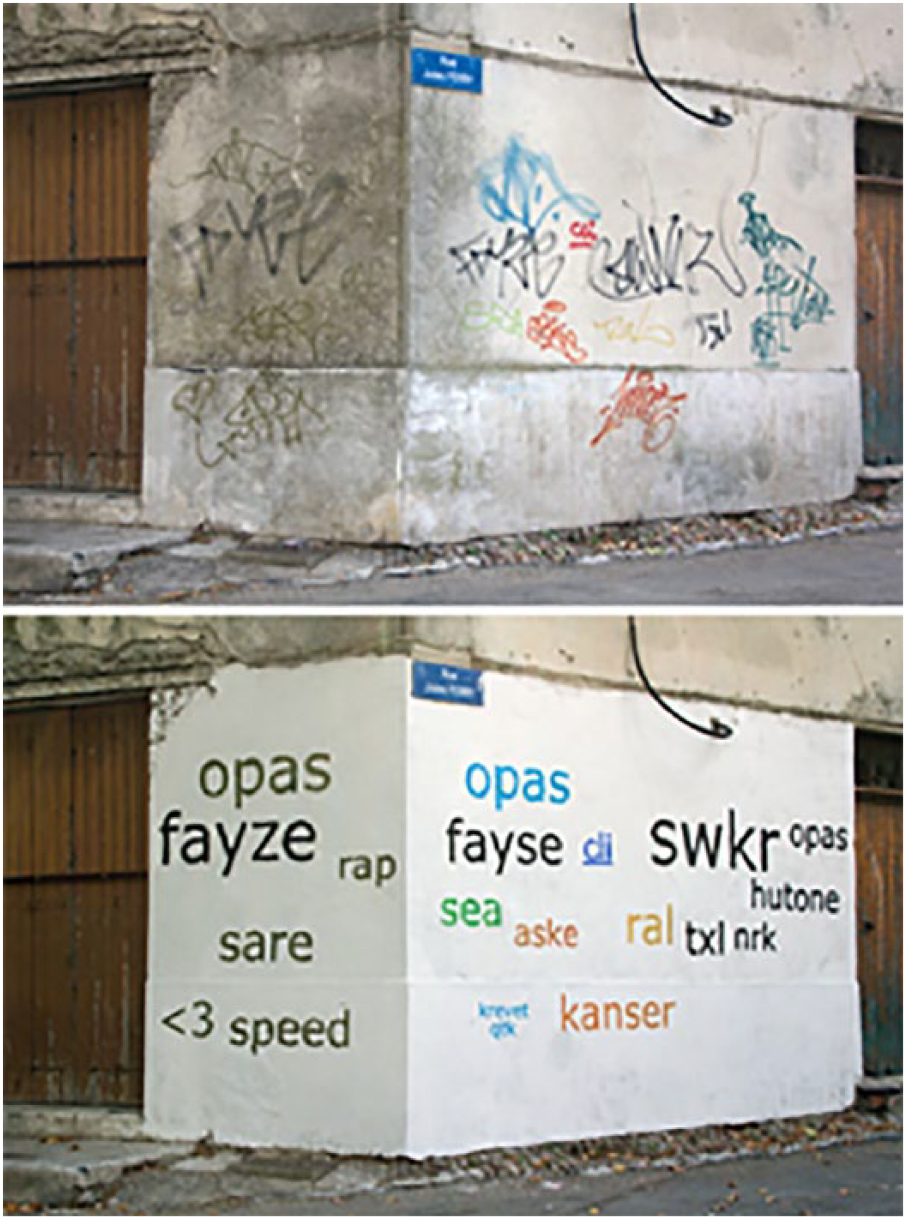
Tag Clouds thus inherits a historical genealogy of the tag informed by reductive definitions. Defining himself as ‘pro-tag’, Tremblin offers a visibility to an urban form of expression categorised as vandalism; yet this visibility is conditioned by a formatting of the original tags. Figure 1 exposes the consequences of this formatting process. While the original wall (at the top) displays illegible writings and leaky tags, the new wall, by contrast, is free of any visual constraint which impedes one’s reading. Tag Clouds involves a conscious and ironic process of masking what was there in the first place and is no longer visible in its new form.
Mathieu Tremblin, Tag Clouds ‘Rue Jules Ferry’, 15 août 2012. Rue Jules Ferry, Arles (France).
Each tag is masked by white paint which leaves a trace on the wall. These traces produce a palimpsest, a multi-layered writing surface which ‘preserves the distinctness of individual texts, while exposing the contamination of one by the other’. 11 The conscious process of masking documents French visual culture’s work of erasure by transforming the original tags into a sanitised, legible and transparent trace of themselves.
In that sense, the process of masking original tags is open-ended. It works towards the very opposite of the preservation of the distinctiveness of individual texts. It impacts not only the tags but also the very identity of the taggers. Because their authentic signatures are formatted in a uniform font, the taggers are perceived to be a homogeneous bloc. Thus, the work seemingly disregards taggers’ own individual motivation, artistic trajectory and their right to opacity. 12 It accepts their difference but only because such difference is now formatted in a transparent and legible way. At the same time, however, Tag Clouds reveals how the new tags, now fully legible to the passer-by, point to the process of gentrification, sanitisation and assimilation that goes on whenever tags are painted over and are viewed as pollution.
It is on such open-endedness, I believe, that the work plays: Tag Clouds pushes to the extreme the aesthetics of ‘proper’ French visual culture and suggests the limits of such culture when it comes to making space for subaltern art forms. The work both mobilises and debunks what Nicholas Mirzoeff calls ‘the right to look’, which defines who can speak and who cannot, who is represented and who is not entitled to visibility. For Mirzoeff,
the right to look claims autonomy, not individualism or voyeurism, but the claim to a political subjectivity and collectivity . . . It means requiring the recognition of the other in order to have a place from which to claim a right and to determine what is right. It is the claim to a subjectivity that has the autonomy to arrange the relations of the visible and the sayable. The right to look confronts the police who say to us, ‘move on, there’s nothing to see here’. (Mirzoeff, 2011: 473–4)
For Mirzoeff, then, the right to look is an authoritarian force legitimised through institutional apparatuses such as the police or the media. This right to look empowers some groups while silencing or stereotyping others in order to perpetuate hegemonic models of culture, identity and politics. In Tag Clouds, the font becomes this apparatus of control and visibility. While changing the font can be considered to be insignificant, this gesture bears socio-racial implications in the French banlieue context. This homogeneous font has the advantage to be readable, but it renders invisible inscriptions which required more engagement from the spectator. Because Tremblin writes over the tag, a visual form of urban culture associated with the banlieue, he appropriates an art form that precisely seeks to resist appropriation and gentrification. While Tremblin’s idea of ‘sharing powers’ suggested a form of negotiation with other taggers, his erasure of tags seems to point to the very opposite of negotiation. In Tag Clouds, tags become a formatted and standardised object reproducible on any wall. Yet I would argue that such a gesture of erasure and standardisation of the original tags points to a critique of mainstream French visual culture, whose policing extends to urban settings. Understanding tags as vandalism, such policing removes them from an independent and multicultural artistic circuit to an economy of sameness.
An economy of sameness
As ethno-sociologist David Lepoutre (2001) recalls, the banlieue has long been under the scrutiny of political and media discourses, which present another France. For Lepoutre, such othering has created a stigmatising exoticism, which has transformed the banlieue into both an object of desire and of repulsion:
À l’engouement culturaliste, il convient d’ajouter l’attrait pour l’exotisme, qui comme d’habitude emboîte le pas aux ethnologues, à moins que ce ne soit le contraire. Si ce besoin de différence fut pendant longtemps orienté vers les sociétés lointaines et ‘primitives’, puis par la suite vers les populations rurales françaises ‘traditionnelles’, ce sont aujourd’hui les espaces urbains, et spécialement les banlieues, qui semblent devoir satisfaire ce désir d’altérité. (2001: 94)
In the case of Tag Clouds, however, the banlieue is not a space of projection for a stigmatising cultural imaginary; whereas the type of discourse Lepoutre identifies views the banlieue population as essentially other, Tremblin’s visual discourse works through and subverts what Wendy Brown (2006) terms a visual economy of sameness. This economy of sameness does not tolerate difference and hinders the cultural expression of banlieue subaltern groups. While some people (such as commissioned street artists, for instance) are accorded civic rights to alter the walls with their writing, others are condemned to anonymity and to express themselves only through transgression. For Brown an economy of sameness displays tolerance, a disguised form of power that works people and their culture through ‘an antagonism toward alterity as well as the capacity for normalisation’ (Brown, 2006: 26). As she recalls, ‘an object of tolerance analytically divested of constitution by history and power is identified as naturally and essentially different from the tolerating subject; in this difference, it appears as a natural provocation to that which tolerates it’ (Brown, 2006: 15).
In Tag Clouds, Tremblin takes on the role of the tolerating subject vis-à-vis an art form historically categorised as a provocation to French cultural hegemony. Satirising mainstream French visual culture’s dissociation and polarisation of acceptable and unacceptable aesthetics, Tag Clouds foregrounds how tags are essentialised as naturally antagonistic to more ‘French-looking’ cultural productions.
Such polarisation perpetuates the binary notion of a centre and its margins, and further stereotypes banlieue minorities on a more structural level. As Tag Clouds presents a homogeneous picture of urban visual culture, I believe that it suggests how the media’s anti-banlieue campaign carries over to banlieue visual culture. This campaign, which started at the end of the twentieth century and has been exacerbated since the 2005 banlieue riots, has considered the banlieue as a threat to the well-being of France. Starting off as a model of modernity and urbanity, the banlieue was soon associated with notions of danger, dirt and, more recently, terrorism. 13 During a visit to a riot site in November 2005, for instance, former Interior Minister Nicolas Sarkozy infamously declared his intention to ‘clean out the city with a power washer’, thereby associating the banlieue population with dirt. Just like stains on a wall, the immigrants and their descendants that resist taking on French identity are to be washed off, erased through a cleansing process. 14
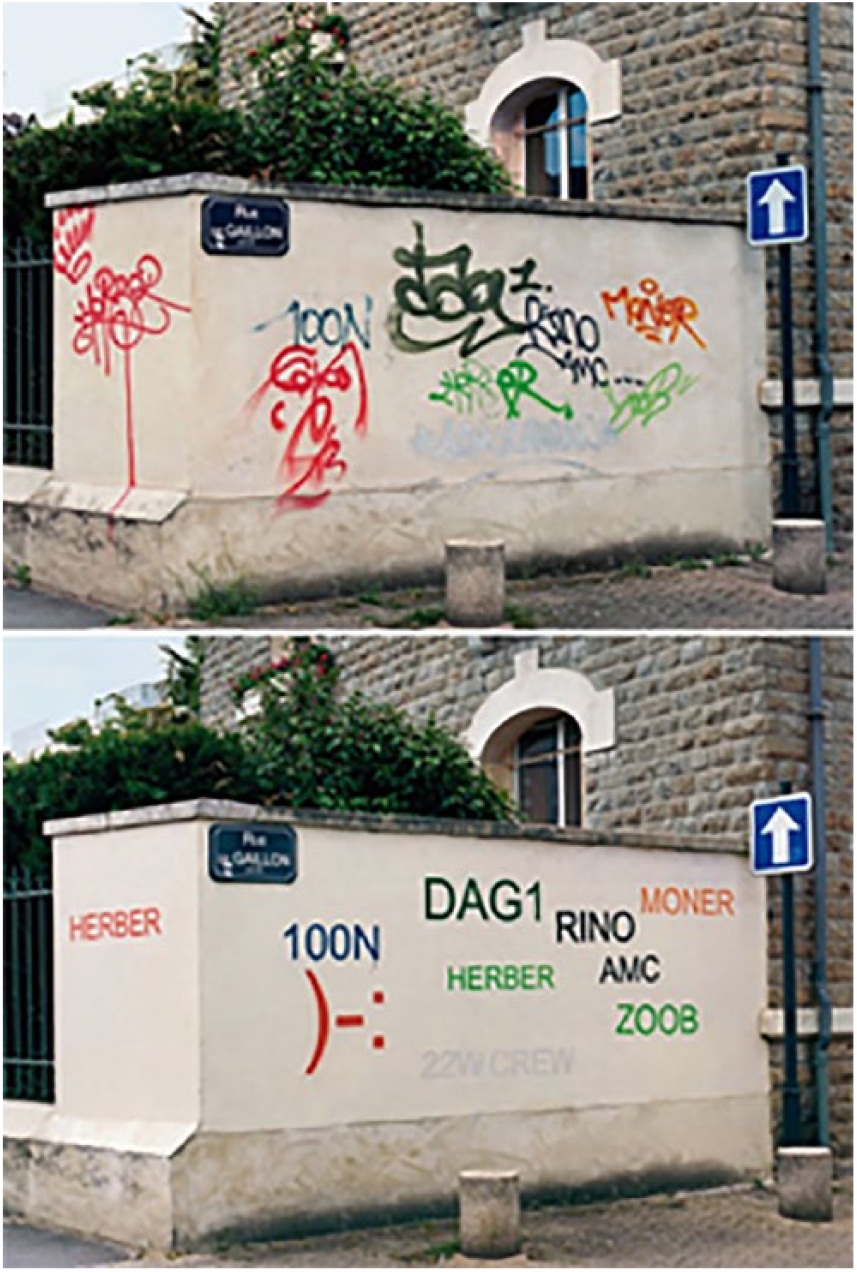
Tremblin is not using a power washer to clean the walls of the banlieue; nor is he whitewashing banlieue populations, although he uses white paint to cover the tags. Yet, working on his Tag Clouds project from 2010 to the present, Tremblin could not possibly ignore the socio-racial issues which permeated the 2012 electoral campaign, which was largely dominated by debates on national identity, security and secularism. On the contrary, I would argue that, as his work intervenes in such socio-political context, it problematises and interrupts the ongoing stigmatisation of banlieues in mainstream French media and politics. Tag Clouds intervenes in a context in which French assimilationist identity politics mask deeply rooted socio-racial tensions under a model of citizenship that fails to account for multiculturalism. More than erasing each tag, Tag Clouds refamiliarises them into writings that do not require any technical reading skill from the passer-by. In order to refamiliarise what otherwise disrupts one’s vision, and to ‘frenchify’ an orthography and a style that are considered not French enough, Tremblin changes not only the visual aspect of the tag but the genre and discourse associated with it. In Figure 2, for instance, the red crown at the top left-hand of the wall has disappeared and only a sad smiley face replaces a signature that is difficult to decipher. The sad smiley face shifts the type of discourse: Tag Clouds is no longer about urban visual culture but about standard text communication coded through emoticons. The smiley face is used in everyday communication; however, as Tremblin transforms the original discourse into a standardised communication genre, his Tag Clouds reveals how such visual standardisation defeats the very purpose of the emoticon – to communicate and exchange information between a sender and a receiver.
Mathieu Tremblin. Tag Clouds, ‘Rue de Gaillon’, 2010. Rennes (France).
Transforming the genre of the tag into standard text communication, Tremblin also adapts the tag to the written conventions of newspapers. Transformed into Helvetica or Times New Roman, the unpolished font of the tag is now legible and formatted to the standard font of a newspaper article. Tag Clouds does not ask us to look at a tag but to passively see it just as one would absorb the content of some article. Rather than engaging in a dialogue with the tagger, the viewer now focuses on the plastic qualities of what seem to be just random words on a wall. In that sense, I believe that the work is critical of how French newspapers – typically right-wing ones – have been presenting the so-called banlieue ‘crisis’ through decontextualised images. Because these words are isolated from each other, although they share the same writing surface, they do not form a coherent communication. In the original tagged wall, one could visually ‘read’ a narrative in which one person tagged a wall and another added their own production later. The faded green writing in the middle of the wall, for instance, suggests that this tag was written before the others. The quality and durability of the sprayed paint establishes a temporality which is not present in the new tag. Rather than engaging with the past-ness of the tags, or their complex intertwined temporalities, Tag Clouds offers a product to be consumed here and now, just as mainstream French media and politics have envisioned tags.
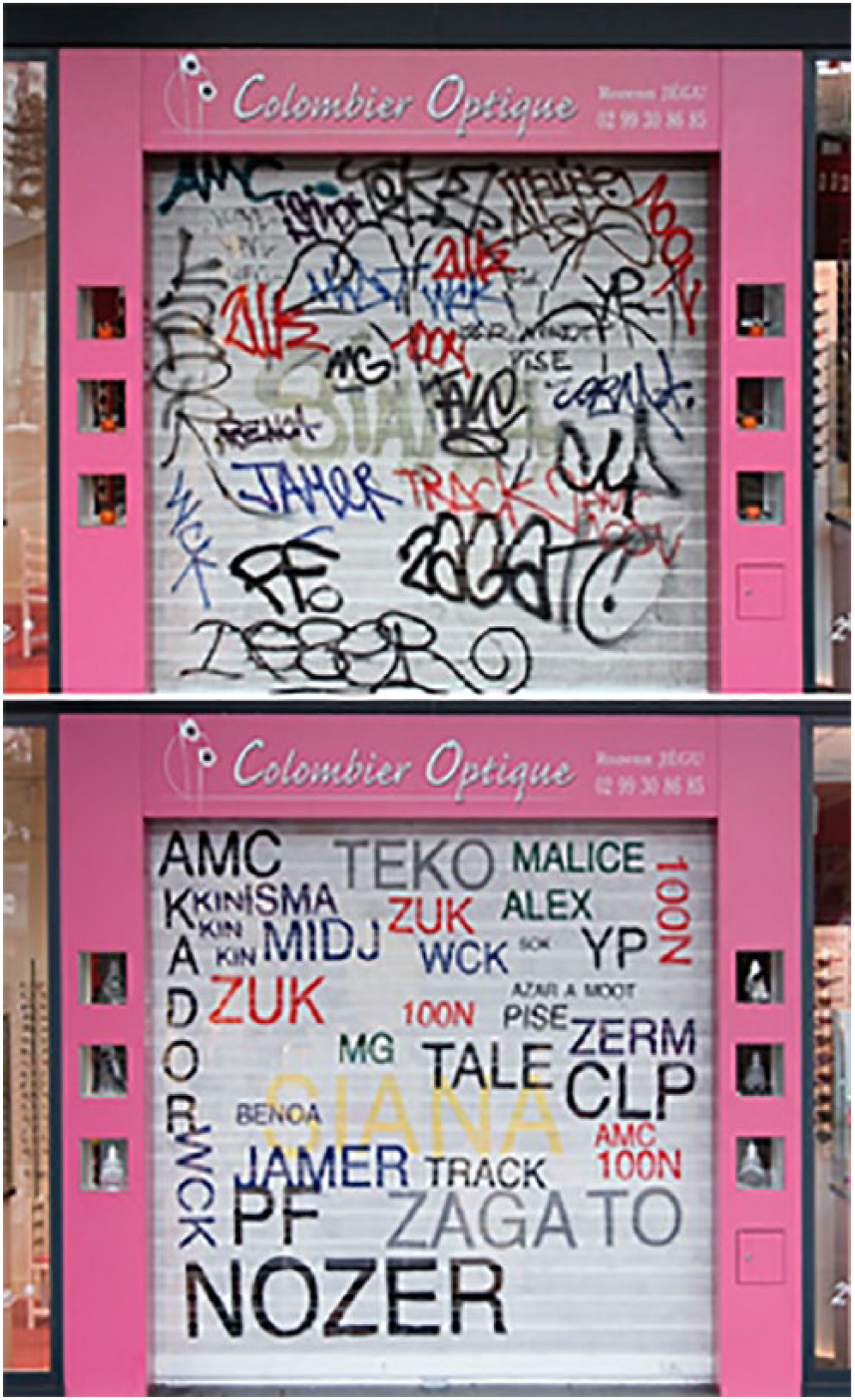
Tag Clouds’ satire of consumerism can be better grasped in Figure 3, in which Tremblin’s work is displayed on the iron curtain of an optician’s shop. Located in one of Rennes’s biggest shopping centres, this Tag Clouds operates the same artistic features as Tremblin’s other Tag Clouds – the same words, the same colours, the same position on the writing surface. Yet the fact that Tremblin should choose an optician’s is an ironic wink at his initiative to format tags in a legible way. It facilitates and orients one’s reading, thereby fixing the vision of the viewer and the aesthetic qualities of the viewed object at the same time. This orientation requires and imposes a single gaze on the tag; the passer-by has no other choice but to embrace a ready-to-use product that has become a commodity, which can also be interpreted as part of the strategic communication of the optician’s shop itself. The original signatures disappear and are sublimated into a more acceptable aesthetics that no longer discourages customers from going to the shopping centre.
Mathieu Tremblin, Tag Clouds ‘Colombier Optique’, 2010. Rennes (France).
The ‘final product’ and disembodied temporality of Tag Clouds contribute to perceiving the tag as an object fixed in time and space, and whose aesthetics does not differ from one tagger to the next. Because of this fixed representation of the tag, the viewer’s perception is fixed too, and fails to grasp the making process behind each production. Such presentness is after all not surprising if one thinks about the principle of a tag cloud. In internet jargon, a tag cloud is a visual representation of text data, which selects the most prominent and recursive words in a given text. A tag cloud is usually determined from a finished work, after a quantitative analysis of the text has been made. While a tag cloud has the advantage of grasping the main words and themes of a text at once, such an analytical approach fails to seize the dynamism at the core of tag production. Just as one can get the themes of a novel just by looking at a tag cloud, the passer-by can see Tremblin’s Tag Clouds without having to read the former tags it covers. In that sense, Tremblin’s Tag Clouds suggests how the normalisation of French visual culture removes access to the former stories of the tags and the affective relationships they create with passers-by. As he virtualises tag signature on material surfaces, Tremblin disrupts the relationship of the passer-by with the original tags. At the same time, however, the passer-by’s attention focuses both on what was there before and is no longer there – an entire network of communication, signification and relationality. As Jennifer Edbauer recalls,
When we encounter writing, it not only signifies to us, but it also combines with us in a degree of affectivity . . . More than figuration, the street tag is also an experience of a strange figure. It strikes you in its obtuse contours that refuse to be/come part of the story . . . Here we begin to see a tension at work between signification and the erratic, obstinate, live operation of affect. (2005: 151)
For Edbauer, the tag is not a discrete object: it is through the inter-affective relationship between the tag and the viewer that the tag comes to life with the full capacity to impact the environment and raise social consciousness. Whether these responses were strong disgust or even anger towards the tagger, they still demonstrated the impact of the material presence of the banlieue population on the inhabitants. ‘You do not view a tag but you suffer it’, Edbauer recalls (2005: 140). While the word ‘suffering’ connotes physical or emotional pain inflicted from an external or internal source, it also embraces the idea of an experience between the one who suffers and the source of pain. The corporeality of such an experience confronts the viewing subject with the necessity of either accepting or rejecting the tag – in other words to react to its visual presence.
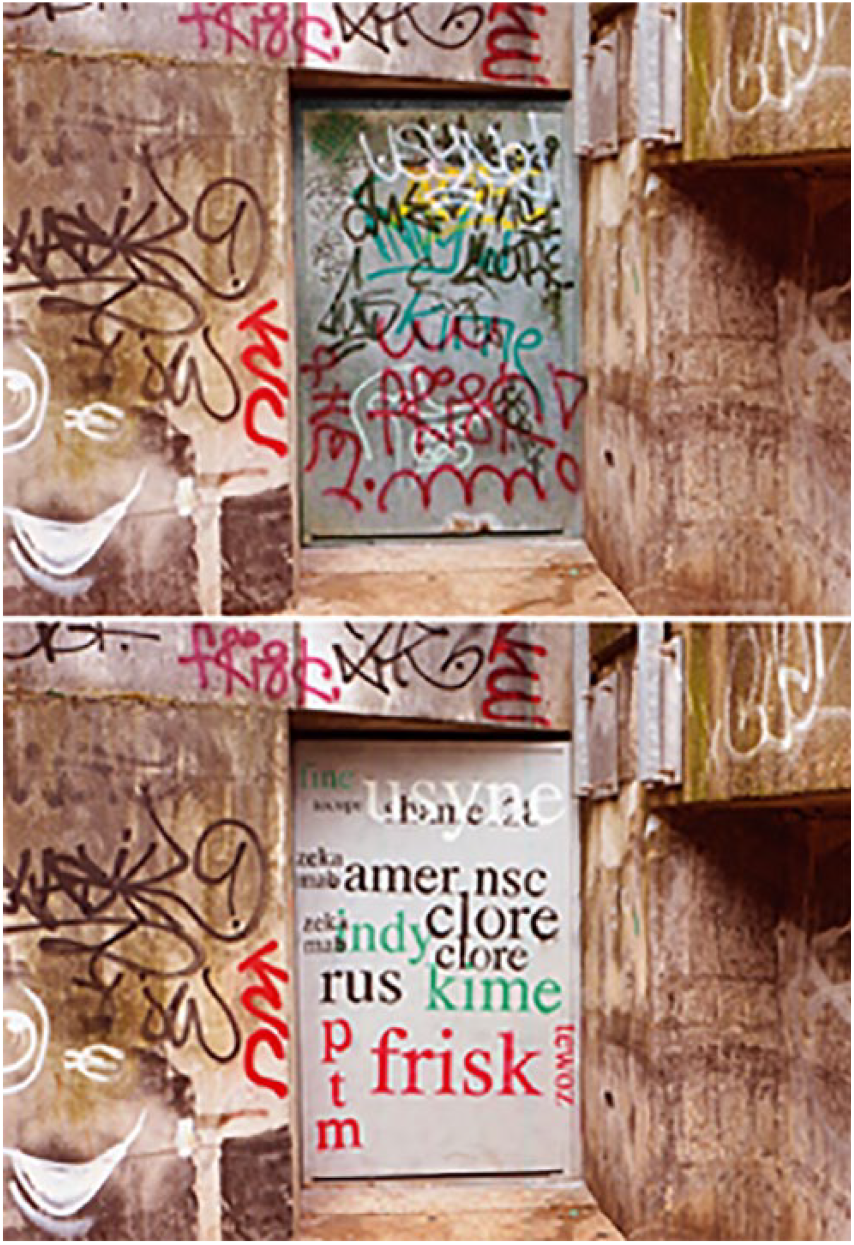
Figure 4 illustrates not only this removal of affect but also the rupture of dialogue between the original tag and the new one. While the top picture is so saturated with tags that it becomes impossible to read them, the bottom picture is, by contrast, free of visual constraint. Puzzled by this contrast, one internet user asked ‘Why didn’t he fix those on the wall?’, as if the tags were some sort of defective decorative layer on the wall. The necessity to homogenise the site is not just a concern for a more aesthetically pleasing art form: the erasure of the original tag suggests that the social fracture should become invisible to the naked eye, erased from the visual urban and political landscape. However, the erasure of the social fracture is replaced by the hierarchy between visual art forms. Instead of continuity and cohesion, Tag Clouds performs a visual hierarchy between the original tags that surround the door and the new tag, to which the eye is immediately drawn. The original tag becomes secondary in the order of things, despite the fact that it still occupies more than 50 per cent of the space. It is thus not because the new tag is superior in terms of quantity, or quality, that the viewer is attracted to the central tag cloud, but because of the recognition it entails. Trained to recognise a uniform font used on the internet, newspaper, text messages or any other textual supports, the viewer’s eye now differentiates and rejects the former tag. While the original tag covered both the background and the foreground of the picture, the new Tag Clouds is on the door which appears in recess; yet, it is visually brought into the foreground, almost operating as an optical illusion. Tremblin’s Tag Clouds is not just both foreground and background at the same time; it is not seen through but as perspective, relegating the former tag to a mere framing function. Such a relegation, I believe, gestures towards the recognition that mainstream French visual culture, legitimised by institutions such as the Fine Arts or urban policies, is predicated upon a centre and its margins. As Tag Clouds purposefully standardises tags into a homogenous and legible font, it implicitly asks the viewer to reflect on their own perception of tags and to question the ways they react to the opacity of such an art form.
Mathieu Tremblin, Tag Clouds ‘Cour des 50 otages’, 2010. Nantes (France).
Without giving any instruction on interpretation to the viewer, Tag Clouds recreates a visual stimulus that associate the tag’s word-image with preconceptions that only lead to either rejection and/or a rupture of affective relationships between the artwork and the passer-by. In that sense Tag Clouds works on two levels: it formats not only the tags themselves, but also the perception of the viewer, by seemingly wiping out any affective responses that would engage a dialogue between them, the taggers, and the banlieue. According to Kelly Oliver, such an affective relationship is achieved through perception, which is trained to recognise what is culturally and socially acceptable:
Vision, like all other types of perception and sensation, is just as much affected by social energy as it is by any other form of energy. This is why theorists can talk about the politics of vision or the visibility or the invisibility of the oppressed . . . All human relationships are the result of the flow and circulation of energy. Social energy includes affective energy, which can move between people. (2001: 14)
As Tag Clouds changes the tag and satirically sanitises it, it parodies the efforts of institutions such as the Academy of Fine Arts to maintain urban visual culture, and in particular that of the banlieue, at the margins of French visual culture. The work formats tags into a supposedly more acceptable type of visibility filtered through legible writing. What Oliver terms ‘social energy’ (2001) is here seemingly suppressed, as if the flow of communication and exchange between different socio-racial categories had been stopped. But as the work erases tags and writes over them, it lends a certain hyper-visibility to the original opaque tags: the passer-by simultaneously sees their absence and becomes aware of their erasure.
Rather than being fixed on a wall, the tag (in its original form) translates into a process of mobility that takes the shape of physical displacement from the periphery to the centre. This mobility also marks a displacement of socio-racial discourses which intersect with each other. Contrary to the assumption that ‘tagging maintains an essential element while ignoring borders, power, hierarchy, social status and other influences’ (Gross et al., 1997: 275), the original tags Tremblin writes over interweave social, racial and economic discourses that are very much aware of these borders and that all aim to bridge the borders of power and hierarchy between urban centres and their ostracised banlieue periphery.
Recovering mobility and making space
The displacement (and visibility) of an art form associated with the marginalised site of the banlieue towards the city centre is thus short-circuited by another art form that conditions its existence through a unique and more tolerable typographic font. According to Emmanuelle Santelli (2012), the banlieue is characterised by a lack of social and spatial mobility. Constrained by high dropout rates in education, low skills levels, and the constant expectation of having to assimilate, the young adults of Maghrebi origins in the banlieue cannot strive towards better living and working conditions. Very often they remain where they grew up, ostracised from the rest of society. In the context of Tag Clouds, and because the tag pertains as much to the visual as to the written culture, it is significant to recall that such ostracism also prevents access to publishing houses. Although young literary talent from the banlieue have been recently recognised and promoted for their literary creations, it is still difficult for them to be published for anything other than sensational accounts of life in marginalised banlieues. 15
In addition to blurring the frontier between public and private, centre and margin, inside and outside, tagging the walls of a city centre allows socio-racial minorities to make space in sites that do not take account of them. For Docuyanan (2000), writing on a public wall is a ‘place-making activity’ that resists the visual aesthetics of the media. Because the tag visually disrupts French cultural homogeneity and hegemony, it becomes ‘a strategic and functional tool used to construct an alternative social universe, a third space’ (Doran, 2007). Although Doran does not apply her argument to tags or banlieue visual culture, her analysis of youth language in French banlieues nevertheless helps us to understand how a visual production associated with this type of language operates a spatial breach that reveals alternative socio-economic and racial discourses. She also recalls that:
male minority youth tend to be singled out as the source of disturbances, depicted as members of a delinquent street culture that wears ‘ghetto’ fashions (baggy jeans, Adidas, Nike, etc.), engages in criminal activities like vandalism, graffiti . . . and shows resistance to assimilating the mainstream French cultural values. (Doran, 2007: 498–9)
One has to wonder what form this third space is taking. For Italia Vitali (2009), it is constructed through ‘l’évolution d’un flottement identitaire, complexe mouvement d’attirance et de répulsion entre deux langues et deux cultures en présence, qui aboutit à la multiplication des instances narratives et des enjeux stylistiques’ (2009 : 181). However this space is not grounded in a physical location; nor does the banlieue language and visual culture empower its population with physical mobility. Yet the displacement of an art form associated with this marginalised site does operate a reclaiming of inaccessible locations such as the city centre, and a re-encoding of its visual aesthetics.
I would argue that the tag actualises what Anne Fournand calls ‘la carte mentale’ of the banlieue. ‘La carte mentale’, Fournand specifies, ‘est une représentation de l’espace vécu, perçu voire rêvé ou imaginé de chaque individu’ (2003: 538). The mental map that Fournand identifies becomes a process of mental mapping in which taggers create a third space that produces meaning. More than a location physically defined by borders, the third space constructed by the tag is performed through the encounter between the tag and its supporting media, the wall, which the tag repurposes as a dialogue screen. As Tag Clouds imposes a singular version of tags, it suggests how mainstream French visual culture destabilises the third space created by taggers. More than wiping out this space, Tag Clouds absorbs it, as it were. The imposition of a uniform font on whitewashed walls has many socio-cultural implications – including the recognition of another visual culture and the deliberate gesture of reformatting it to make it look properly French. Layering a public wall with a marginalised visual art form deepens the material surface with the symbolic inscription of otherwise unseen – or stereotyped – populations. Tags are more than a reclaiming of space; they reclaim the right to visibility through the medium of the wall, which is precisely meant to separate, divide and conceal. The wall becomes the material apparatus that materialises socio-political policies; yet it is reclaimed by those who are behind it, as it were. This reclaiming takes the form of a certain defiance towards authorities who built these material and symbolic walls for the purpose of societal ordering, but also towards anyone who is complicit in preserving social barriers.
For Tremblin, Tag Clouds constitutes neither a reappropriation of the banlieue’s voice and visibility, nor complicity with socio-political authorities and cultural hegemony. On the contrary, Tremblin seeks to engage a dialogue with the taggers: ‘I expect people at least to notice or even destroy my work because vandalism is in itself a way to make (destructive) conversation’ (Byrnes, 2013). The words ‘destruction’ or ‘vandalism’ situate the taggers in a discourse that reproduces enduring clichés of banlieue violence which is not far from what Kokoreff identifies as ‘rage’ (1991). Is there really a conversation between Tremblin and the ‘other taggers’? Figure 5 from Tremblin’s website points to such a dialogue.
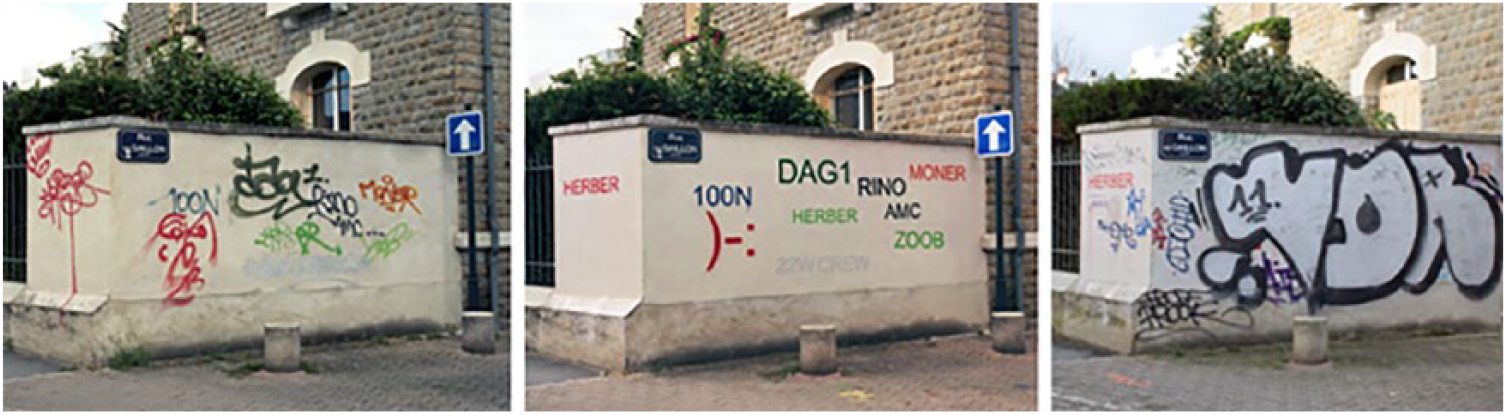
Mathieu Tremblin, Tag Clouds ‘Rue Jules Ferry’, 15 août 2012. Rue Jules Ferry, Arles (France).
Two years after Tremblin wrote over the tags, his Tag Clouds was covered again with signatures, leaky marks and drawings, until a new and bigger tag hid Tremblin’s work entirely. Only the red word ‘Herber’ remains from Tremblin’s work, which is now visually relegated to the background as if it was outdated. No matter how much it is erased, or written over, the tag strikes back. Because Tag Clouds makes it possible for taggers to write over its own tags, I would argue that, despite its own erasure of former tags, it still allows taggers to reinscribe their own right to opacity. Unlike a ‘sanitised’ repainted wall, Tremblin’s work registers the trace of what has been ‘sanitised’ through graphic language of ‘correction’. The work certainly erases tags. But as it makes space for other visibilities to emerge, it also challenges the hierarchy between the normative and the marginal at the heart of the economy of sameness promoted by French politics of cultural assimilation.
‘They have turned me into an anti-graffiti messiah while my intention was the very exact opposite – I am pro-tag, since I am a tagger myself’ (Gillespie, 2016). In 2016, six years after the Tag Clouds project began, Tremblin vehemently reacted against the internet blogs that praised his work for its anti-graffiti qualities, accusing them of misinterpreting his work as a ‘hygienist satire’. Claiming his work was drawing on the internet word ‘cloud’, Tremblin argued that Tag Clouds was a way for him to reconcile the virtual and the actual:
Tag Cloud’s principle is to replace the all-over of graffiti calligraphy by readable translations like the clouds of keywords which can be found on the Internet. It shows the analogy between physical tag and virtual tag, both in the form (tagged walls compositions look the same as tag clouds), and in substance (like keywords which are markers of net surfing, graffiti are markers of urban drifting). (Gillespie, 2016)
While this statement may hold true, it nevertheless radically contrasts with Tremblin’s initial comment on Tag Clouds in 2013:
Tag Clouds removes all alterity or identity and makes it properly decorative and appreciable to any passer-by, which is also the purpose of a graffiti fresco, showing technical skills for decorations . . . This work sounds like a kind of oxymoron, you could understand it as a way to make a dirty signature proper as institutionalised visual communication, sterilizing wild graffiti writing by removing all traces of alterity and at the same time giving the opportunity to anybody to be able to read graffiti script and get in touch with it. (Byrnes, 2013)
Tremblin has not yet explained the reasons for reinterpreting his own work in a new light. Despite the fact that Tremblin seems very well aware of the potential ambiguity of his own work – between the visual sterilisation of tags and open dialogue with taggers – the artist does not attempt to bridge these two irreconcilable interpretations. Insisting more on the technique of tagging that on the socio-racial and economic implications behind it, Tremblin presents tags as an object of visual consumption that can be altered by other taggers. It is precisely on such a paradox that rests the entire irresolvable ambivalence of the work. As the work erases tags and writes over them, it paradoxically reconstructs affective relationships. Erasure partakes in the artist’s initiative to demonstrate how contemporary French visual culture is still predicated upon norms that erase subaltern art forms through appropriation and gentrification.
While Tremblin works primarily in France, it is also interesting to recall his work in Belgium and the Netherlands. 16 Does the satire of visual sanitisation, which is French-specific, also apply to these countries, and is it transferable from one society and culture to another? Integration, assimilation, the banlieue as a ghettoised and racialised space, are French phenomena. Writing over the signature tags in a legible font suggests an aesthetics of French assimilation that, when exported across national boundaries, might simply become ‘white-washing’. If one follows Daniel Gross’s assumption that ‘tagging as an international discourse features opportunism, social struggles, and points of tension’ (Gross et al., 1997: 283), then the export of Tag Clouds abroad still has socio-racial implications. While losing its ‘frenchifying’ aspect, Tremblin’s Tag Clouds in Belgium and the Netherlands may still perform the same satire of homogenising socio-racial dynamics.