



Abstract
Background
Cervical VEMP elicited by air-conducted acoustic stimuli (AC cVEMP) is considered as a valuable test for assessment of saccular function. The dominant component of this response, which is composed of a biphasic positive-negative deflexion, can be recorded from the tensed ipsilateral sternocleidomastoid muscle. It is conveyed by inhibitory connections from the irregular saccular afferents. The contralateral response, which has opposite polarity, is in general not studied in clinical practice. It probably reflects excitatory influences conveyed from irregular afferents of the utricle.
Objective
The purpose of this study was to ascertain whether this contralateral response has any clinical value.
Methods
AC cVEMPs of 117 control subjects and 353 patients with balance problems and/or BPPV were subjected to retrospective analysis. The contribution of the contralateral excitatory response to the whole response (i.e., amplitudes of the contralateral plus ipsilateral responses) was expressed in percentages calculated according to Jongkee’s formula.
Results
There was statistically significant increase in the contribution of the contralateral excitatory component to the whole response in patients.
Conclusions
This may imply somewhat lower vulnerability of the contralateral utricular response to various disease processes and/or aging.
Keywords
Introduction
From the time of their discovery in the 1990s, the vestibular responses in cervical muscles elicited by air-conducted sound (AC) (loud acoustic stimuli) are increasingly used in the assessment of the vestibular function. Loud acoustic stimuli (over 110 dB SPL) are needed to elicit the response.
1
Mostly, AC clicks and 500 Hz AC tone bursts are used to elicit responses, and recordings of the reactions of the sternocleidomastoid muscle (SCM) are used in the clinical practice. When these stimuli are applied at threshold level and just slightly above this level, they selectively activate the irregular saccular afferents.2–7 When higher intensities are used, a small proportion of irregular afferents from the utricle are activated as well. The sacculus has only inhibitory projections to the ipsilateral SCM,8,9 whereas the utricle shows bilateral projections. These projections are of inhibitory nature to the ipsilateral SCM and excitatory to the contralateral SCM.7,9 Thus the result of these anatomical and physiological properties is the dominant ipsilateral positive-negative potential deflexion recorded from the ipsilateral SCM, and a smaller response which occurs at approximately the same time interval with opposite polarity in the contralateral SCM,
10
provided that the responses are recorded during symmetrical activation of both SCMs by means of head elevation. In the course of many years of assessing these cervical vestibular evoked myogenic potentials (cVEMPs) we have gained the impression that the contralateral AC cVEMP response is at least partially preserved even in patients with profoundly decreased dominant ipsilateral potential (Figure 1). For this reason, we decided to test the validity of these empirical observations by applying statistical analysis. The statistical significance was set to p < .05. In accord to conventional expression of p values, we were using a rounded expression to two decimal positions. In effort to prevent the zeroes overflow in the text and in the tables as the values was lower. Example of normal AC cVEMP response to 500 Hz tone (left panel), and decreased AC cVEMP response to click stimulus (right panel). Both panels show responses elicited by stimulation of the left ear. The two traces at the top show the raw data recorded from the ipsilateral SCM and the contralateral SCM, respectively. The two traces at the bottom show the rectified data, which were used for normalization of the raw responses.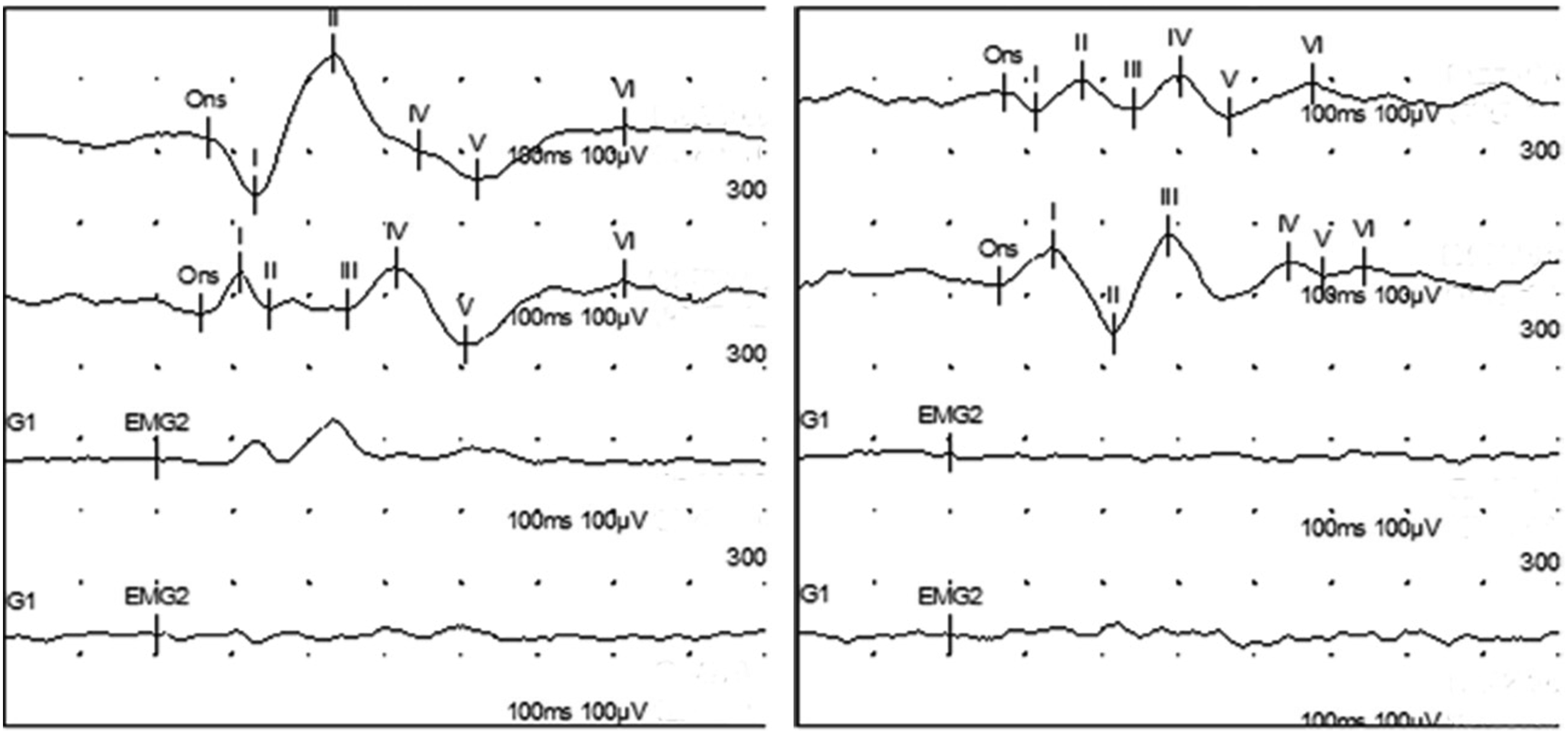
Methods
The present study is based on retrospective analysis of AC cVEMP data elicited by means of clicks and 500 Hz tone bursts, which were collected between the years 2011 and 2017. The data included our normal database (N 117; 83 female; 34 male; mean age 47.89; SD 13.79). These data served as the control responses. They were compared with data from patients with balance problems and/or BPPV (N 353; 255 female; 98 male; mean age 61.22; SD 12.16) who mostly showed abnormal AC cVEMP, that is, their normalized ipsilateral cVEMP amplitude was below the lower limit in the control group either on one side or bilaterally. The lower limit of normalized amplitudes was set at −2 SD of the control group data (1.09; 1.02 and 0.63; 0.67 for the left and right 500 Hz AC cVEMP and click AC cVEMP, respectively). Thus, the term “threshold” in this paper means the lower limit of the normal amplitude of ipsilateral AC cVENP response. Twenty six percent and thirty percent of patient’s ears showed above threshold ipsilateral cVEMP responses to 500 Hz and click stimuli, respectively, on one side or bilaterally. For the purposes of this study, we termed such responses >threshold responses. Those which were below this threshold were termed <threshold responses. The cVEMPs were recorded with the patients in supine position and the head elevated about 30° upward. They were subjected both to 500 Hz 2 ms; 130 dB SPL tone and to 0.1 ms; 110 dB NHL rarefaction click stimuli. The EMG signal was recorded at the border of the upper and middle third of the SCM with reference at the mid-clavicle. The signal with sampling rate of 10 kHz was band-pass filtered at 20 to 2000 Hz. The stimulus was applied with 20 ms delay in relation to the recording onset, at 5/sec repetition rate. 150 trials were averaged two times. The rectified values of the same signal were separately recorded, amplified and averaged in separate channels. The raw amplitudes of the responses displayed in uV were normalized with regard to the magnitude of the EMG signal projected to the recording electrodes. This was done by dividing the ipsilateral P1-N1 and the contralateral N1-P1 amplitude in uV by the mean value of the rectified EMG signal integral recorded during the time interval of 20 ms before the stimulus onset. The contribution of the contralateral excitatory response to the whole response (i.e., normalized amplitudes of the contralateral plus ipsilateral responses) was expressed in percentages (c/w %) calculated according to formula [c/c+i]*100. All data showed log-normal distribution. Differences between groups were analyzed using Kruskal-Wallis ANOVA and when appropriate by the Student’s 2-tailed t-test. The general trends between the age and the VEMP variables and the VEMP variables themselves were approximated by using a linear regression model and where appropriate by logarithmic regression model was used.
Results
Age distribution
Age values of the studied groups.
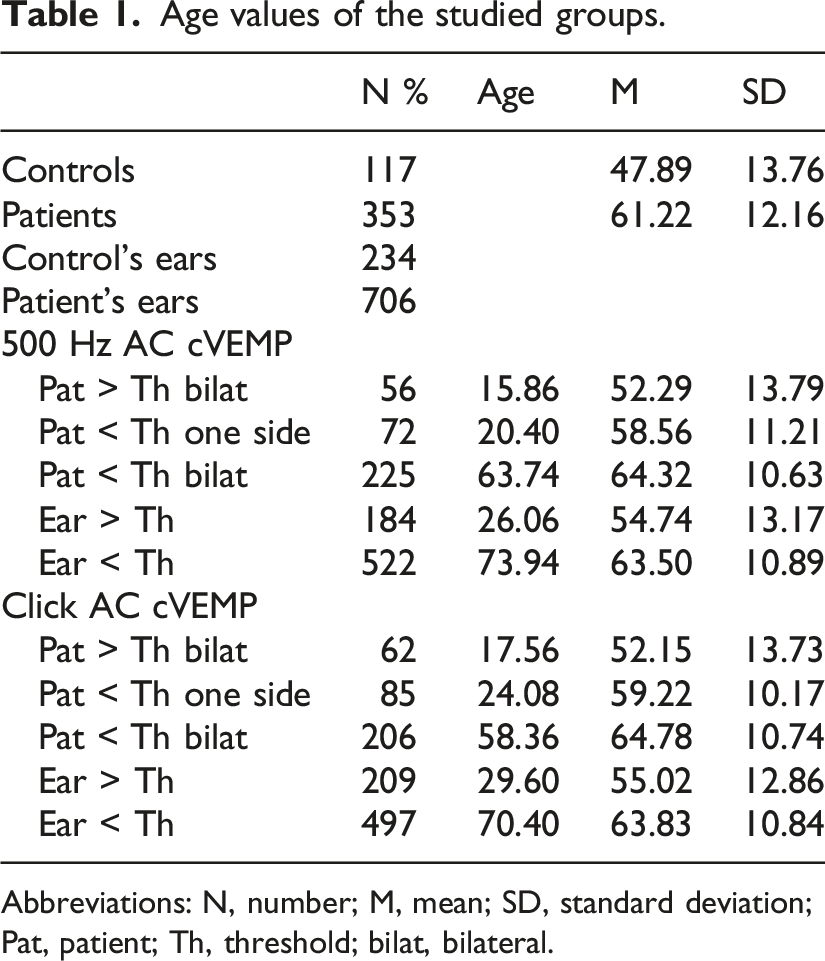
Abbreviations: N, number; M, mean; SD, standard deviation; Pat, patient; Th, threshold; bilat, bilateral.
Amplitudes of the ipsilateral and contralateral responses and their relationships
Descriptive statistics of the VEMPs normalized amplitudes and the contribution of the contralateral excitatory response to whole response expressed in percentage.

Abbreviations: SD, standard deviation; Pat, patient; > Th, patients above threshold AC cVEMP responses; < Th, patients below threshold AC cVEMP responses.
Between groups differences of the normalized amplitudes and the contribution of the contralateral inhibitory responses to whole response expressed in percentage. Multiple comparisons p values (2-tailed t-test in the Kruskal-Wallis ANOVA).
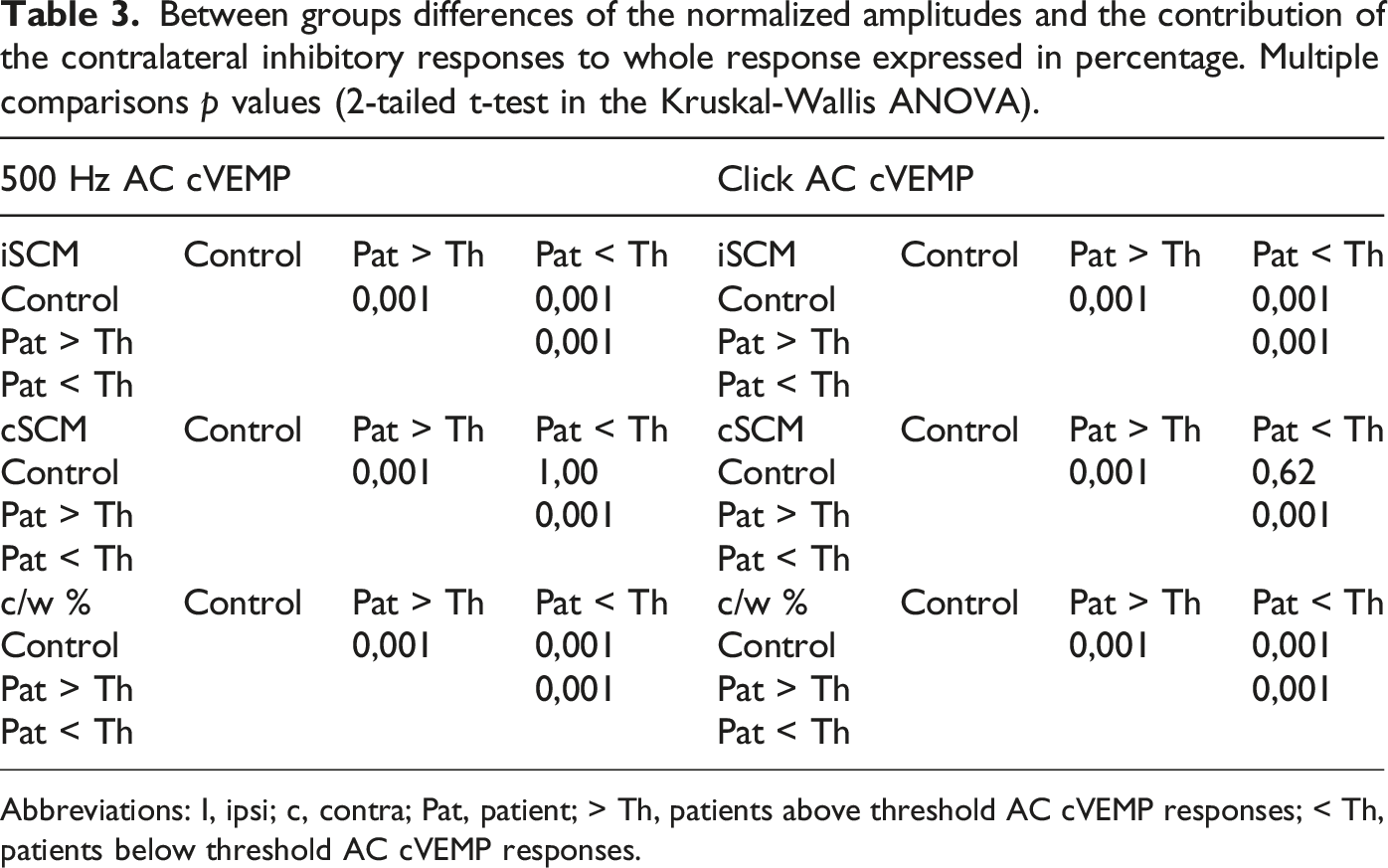
Abbreviations: I, ipsi; c, contra; Pat, patient; > Th, patients above threshold AC cVEMP responses; < Th, patients below threshold AC cVEMP responses.
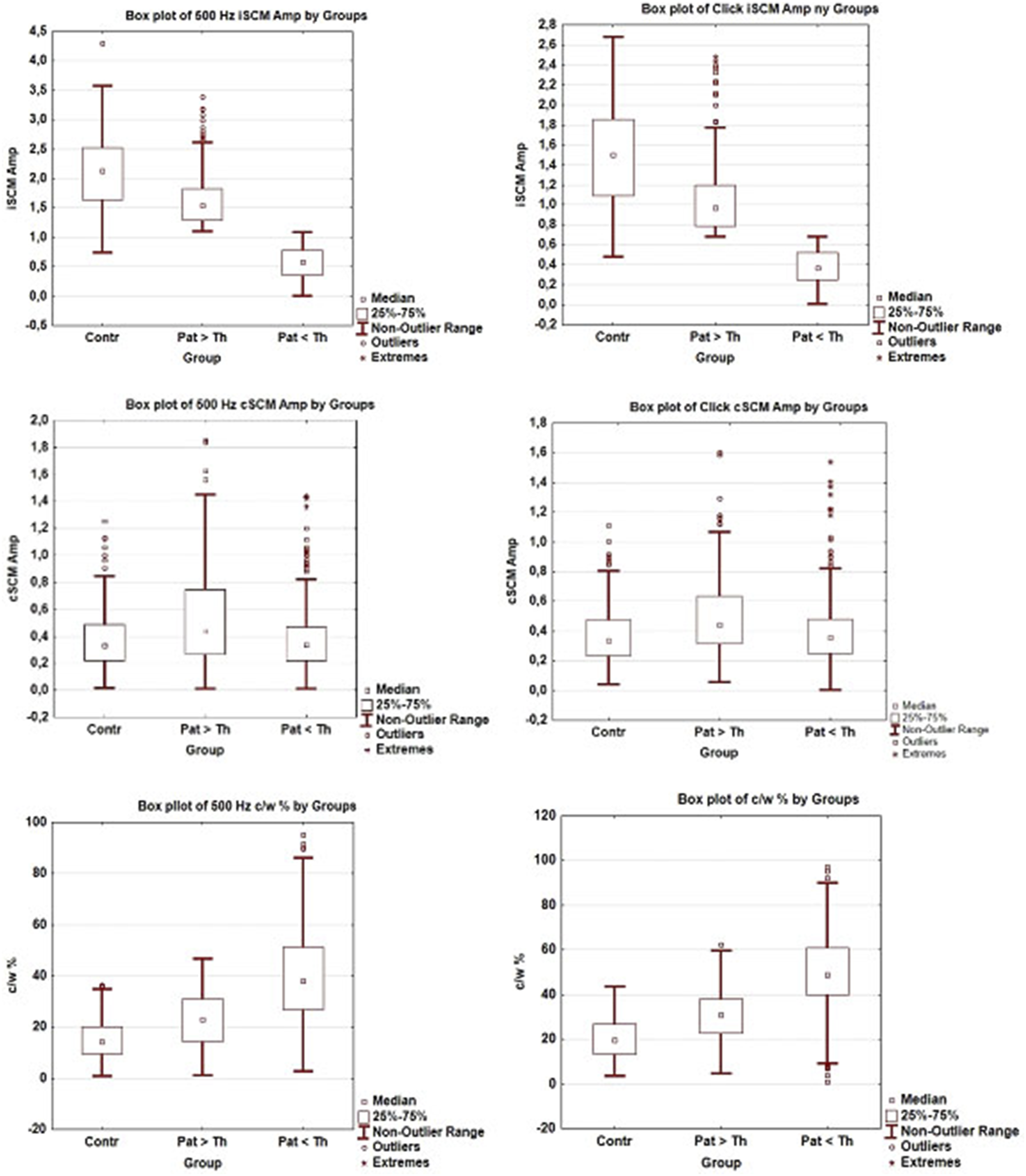
Box plots of ipsilateral and contralateral AC cVEMP responses to 500 Hz tone (left panels) and click stimuli (right panels), and contributions of the contralateral response to the whole response, displayed in percentages (c/w %).
Correlations
The amplitudes of the ipsilateral responses showed a relatively high and significant at p < .001 with negative correlations with age (R −0.53 and −0.54; slopes −0.03 and −0.02) for 500 Hz and click stimuli, respectively. The correlations of the contralateral responses with age were also negative and despite they were low, but they were still significant at p < .001 (R −0.18 and −0.14; slopes −0.003 and −0.002) both for 500 Hz and click stimuli, respectively. Statistical comparison of regressions in the ipsilateral and the contralateral responses versus age has been done by using Student’s 2-tailed t-test. The ipsilateral responses showed much steeper slopes and higher magnitude of R values than the contralateral responses. The difference was highly significant at p < .001 for both 500 Hz and click responses. The correlations between the c/w % and the age were positive. They were at the border of intermediate rank and, they were significant at p < .001 (R 0.29 and 0.33; slopes 0.76 and 0.91) for 500 Hz and click stimuli, respectively. The correlations of c/w % with the amplitudes of contralateral responses were also positive at the moderate low levels, and significant at p < .001 (R 0.45 and 0.47; slopes 30.64 and 39.53) for 500 Hz and click stimuli, respectively. On the other hand, the correlations between the c/w % and the ipsilateral responses showed considerably high negative values, significant at p < .001 (R −0.75 and −0.80 slopes −16.58 and −18.96) for responses to 500 Hz and click stimuli, respectively. In all of the above correlation analyses, we were using a linear model, except of the last. Here, we were using a logarithmic model, because these data showed a strongest logarithmic distribution (Figure 3). Regression analysis of the whole data set (N 940) showing the relationship between the contribution of the contralateral excitatory response to the whole response displayed in percentage 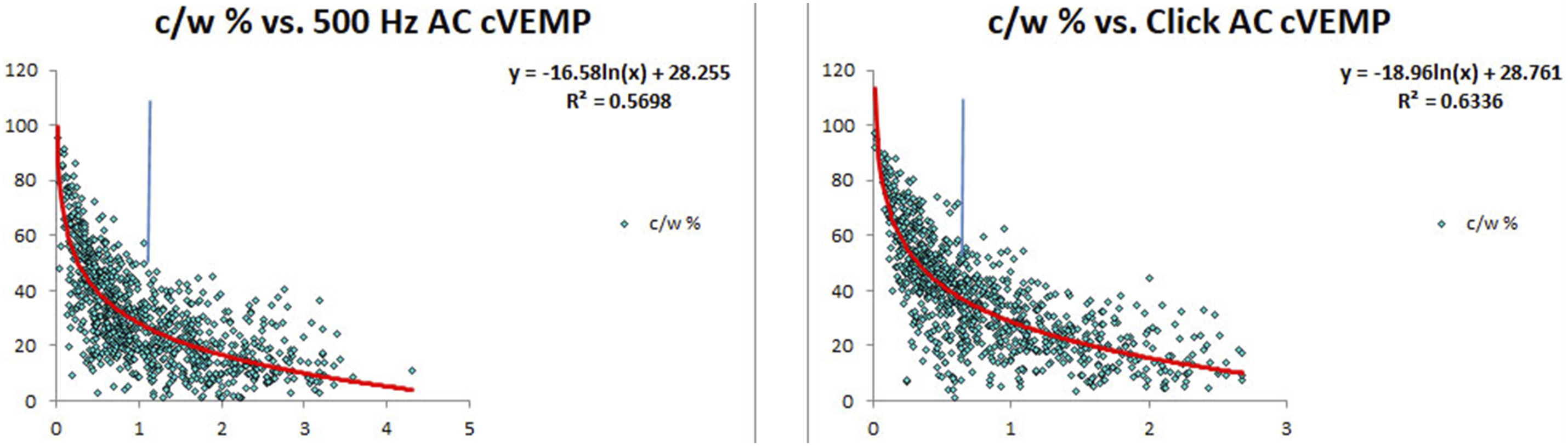
For the classification of the correlation coefficient data, we have used the J. Cohen’s 11 access (0.1 low; 0.3 medium; 0.5 high).
Discussion
Patients with decreased ipsilateral AC cVEMP responses showed some preservation of the contralateral response. The ipsilateral P/N potential reflects the function of ipsilateral inhibitory saccular efferent connections to the SCM.1,8 The contralateral response probably originates from the ipsilateral utricle. 5 The opposite polarity of this response reflects its excitatory effects. The preservation of this excitatory response could be due to lower vulnerability during aging and/or to various disease processes. However, it is well known that the effectiveness of balance system functions is decreasing with aging. The vestibular receptors share a common evolutionary origin and show similar biological features. The effect of age on the AC oVEMP and AC cVEMP amplitudes was shown by other researchers. 12 However, this effect was disproportionate. The saccular dependent AC cVEMPs showed higher magnitude of correlation coefficient and steeper slope decrease then the utricle dependent AC oVEMPs. A disproportional influence of aging on their function might be associated by an effect of some hidden variable.
The logarithmic relationship is common in biology as a “power law.” For receptors such as the vestibular ones, this means a very wide range of input intensities can be coded, while allowing a constant level of sensitivity to changes in intensity. All data in this study showed a log-normal distribution. However, the contribution of the contralateral excitatory responses to the whole responses showed a considerable high negative correlation with amplitudes of the ipsilateral responses in logarithmic regression model. In this study, this was a highest correlation at all.
The disproportional aging effect on the utricles and the saccular functions might be responsible for this. Inhibition of the ipsilateral SCM in response to AC stimulus to the ipsilateral ear causes a slight turn of the head toward the stimulated side. If this inhibition is weak, it could be partly compensated by preserved excitation of the contralateral SCM. Thus, the relative preservation of the utricle can be helpful from the functional viewpoint.
Besides the modest contribution of these findings to the knowledge on vestibular physiology, the assessment of the contralateral excitatory response may be helpful in recognizing ineffective stimulation caused by inadvertent technical problems, or unrecognized medical problems in the path of the acoustic stimulus transmission to the inner ear.
Statements and declarations
Footnotes
Acknowledgements
We are thankful to professor I.S. Curthoys for his help with scientific interpretations of the findings and to I. Gutzelnig, MD, for her help with the manuscript preparation.
Declaration of conflicting interests
The author(s) declared no potential conflicts of interest with respect to the research, authorship, and/or publication of this article.
Funding
The author(s) received no financial support for the research, authorship, and/or publication of this article.