



Abstract
Background
Persistent postural–perceptual dizziness (PPPD) and motion sickness (MS) are associated with disturbances in spatial orientation related to altered multisensory integration. Impaired perception of upright orientation during head tilt may therefore occur in these conditions. Subjective visual vertical (SVV) and subjective visual horizontal (SVH) testing under head-tilted conditions provide quantitative measures of such perceptual errors. We hypothesized that headtilt–induced perceptual errors would be associated with PPPD and with susceptibility to clinically significant MS during non-driving tasks.
Methods
80 participants were enrolled: 27 healthy controls, 36 individuals with high Motion Sickness Susceptibility Questionnaire scores who reported MS during real-world driving, and 17 patients with PPPD diagnosed according to the Bárány Society criteria. SVV and SVH were measured at ±30° and ±60° head-roll tilts in a virtual environment. Perceptual error was defined as the signed deviation from the true vertical or horizontal orientation. Diagnostic accuracy was assessed using receiver operating characteristic analysis.
Results
SVV and SVH errors under head-tilt conditions differed significantly between groups, with healthy controls showing contraversive deviations and both individuals with high-MS and patients with PPPD exhibiting ipsiversive deviations, particularly at ±60° roll tilts, whereas errors in the upright (0°) position were negligible. Several tilt conditions demonstrated excellent diagnostic accuracy (AUC ≥ 0.90). Real-world MS severity correlated with ipsiversive SVV errors but not with questionnaire-based susceptibility scores.
Conclusions
Based on the present findings, further methodological refinement may allow head-tilt SVV/SVH testing to serve as a rapid and sensitive tool for detecting perceptual alterations underlying functional dizziness, with translational potential for MS risk screening in future autonomous vehicle environments.
Introduction
The accurate perception of vertical and horizontal orientations is fundamental to balance control, postural stability, and effective motor planning. Disruptions in this perceptual process can distort spatial orientation, leading to dizziness, unsteadiness, and an increased risk of falls. Recent evidence indicates that patients with persistent postural–perceptual dizziness (PPPD) or chronic dizziness frequently exhibit abnormal tilt errors in subjective visual vertical (SVV) and horizontal (SVH) tests, reflecting impaired multisensory integration and altered internal models of gravity.1–3 Beyond clinical syndromes, disturbances in spatial orientation are also relevant to motion sickness (MS), which arises from visual-vestibular conflicts and erroneous gravitational reference frames. 4 With the rapid development of autonomous vehicles, susceptibility to MS has become a growing concern as reduced motion predictability and the absence of active control in vehicles amplify sensory conflicts.5,6
In particular, discrepancies between otolith-derived signals encoding gravity and linear acceleration and visual cues are thought to underlie disturbances in spatial orientation that contribute to MS in autonomous vehicles. Within this framework, SVV and SVH testing can be viewed as readouts of altered vertical–horizontal perception, with potential utility for assessing susceptibility to MS and functional dizziness, such as PPPD.
Traditional SVV and SVH assessments are typically conducted with the patient in an upright position. However, static head tilts induce characteristic perceptual biases: small to moderate tilts (generally < 30°) produce contraversive deviations, referred to as the E-effect, whereas larger tilts, usually exceeding approximately 60–90°, are associated with ipsiversive deviations, known as the A-effect, in healthy individuals.7–11 These systematic biases reflect the complexity of otolith organ encoding and central weighting strategies, and are accentuated in pathological states, offering diagnostic potential. 12 We speculated that SVV/SVH assessments under head-tilt conditions, rather than in the upright position, may play a more critical role because tilted head angles require more complex computations of gravity. This notion is supported by classical work on otolithic physiology and internal models of spatial orientation, which emphasize the nonlinear encoding of tilt by otolith afferents and central integration mechanisms. 13 Consequently, tilt errors observed under upright conditions may be further amplified or altered in head-tilt paradigms, potentially increasing diagnostic sensitivity to gravity perceptual errors. Recent studies have demonstrated that head-tilt SVV testing can serve as an important screening tool to identify patients with PPPD 3 and other chronic dizziness disorders. 2 Therefore, we hypothesized that alterations in spatial perception are not only intrinsic to vestibular disorders but may also predict MS susceptibility in non-clinical populations. To test this hypothesis, patients with PPPD, diagnosed according to the Bárány Society criteria, 14 were recruited as the functional vestibular pathology group, while individuals with severe MS, identified by pronounced discomfort during real-world driving involving acceleration, were enrolled as a non-clinical comparison group. Using these datasets, we further examined whether head-tilt SVV and SVH measurements could serve as indicators of susceptibility to MS, as well as functional vestibular pathology.
Methods
Participants
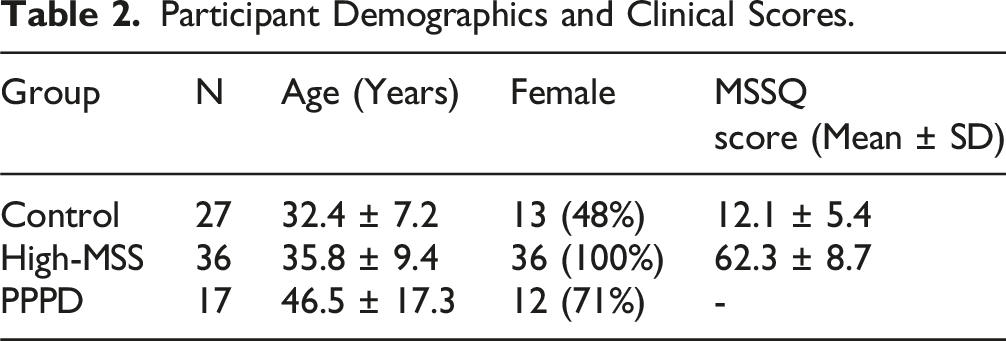
A total of 80 participants were prospectively recruited, comprising 27 healthy controls without a history of recurrent dizziness or MS, 36 individuals with high motion sickness susceptibility (MSS), and 17 patients with PPPD diagnosed according to the Bárány Society criteria. 14 Participants with MS were recruited from the community through advertisements, whereas patients were recruited from a tertiary medical center affiliated with the authors. The high-MSS group was identified from 617 volunteers screened using the Motion Sickness Susceptibility Questionnaire (MSSQ). Based on prior validation studies indicating that MSSQ scores of approximately 50 or higher are associated with reduced tolerance to laboratory-induced motion stimuli, 15 individuals with an MSSQ score ≥ 50 were classified as having high-MSS. All participants in the high-MSS group were female and had no history of major neurological, ophthalmological, vestibular, or psychiatric disorders. Patients with PPPD fulfilled the Bárány Society diagnostic criteria. Exclusion criteria for all participants included uncorrected visual impairment, significant hearing loss, a history of head trauma, and current use of medications affecting vestibular or neurological function.
To further confirm motion sickness susceptibility, participants in the high-MSS group underwent on-road driving, during which the development of MS was systematically observed. Before testing, all participants were instructed to obtain at least 6 h of sleep, refrain from alcohol and caffeine for 24 h, and discontinue relevant medications under medical supervision. Written informed consent was obtained from all the participants. The study protocol was approved by the Institutional Review Board of Hallym University Sacred Heart Hospital, South Korea (IRB No. 2023‐08‐003‐001).
Head-tilt SVV/SVH Tests
Static SVV and SVH were measured using a virtual reality–based vestibular function-testing device (NeuroEars, Inc., Chuncheon, Korea) that incorporated a head-mounted display (HMD) with integrated head-tracking sensors. Within the virtual reality environment, a complete dark-field condition was implemented, such that no visual references were available except for a single luminous adjustable line presented for the task. The luminous line was displayed at randomized initial orientations across trials to eliminate external spatial cues and minimize response bias. A 2-min dark adaptation period was provided prior to testing. Head-roll tilt was defined as active neck (head-on-neck) tilt without whole-body movement. Tilt angles of 0°, ±30°, and ±60° were calibrated and continuously monitored using the HMD’s head-tracking system (positive values indicating rightward head tilt and negative values indicating leftward head tilt). At each head position, a luminous adjustable line was presented repeatedly across five trials, each with a randomized initial orientation, with an inter-stimulus interval of approximately 2–4 s between successive presentations. For SVV, participants aligned the line to the perceived vertical, and for SVH, to the perceived horizontal. Line adjustments were made using handheld controllers, and responses were recorded automatically. The mean value across the five trials for each tilt condition was used for subsequent analyses.
Assessment of Motion Sickness Susceptibility
Baseline susceptibility was assessed using the revised MSSQ,15 which retrospectively evaluates MS experiences during childhood and adulthood across multiple motion contexts, including land, sea, air, and amusement rides, and yields a continuous susceptibility score used for group comparisons. Real-world MS was evaluated under controlled on-road conditions using the Misery Scale (MISC), a 0–10 rating scale (0 = no symptoms, 4 = moderate discomfort, 6 = nausea, and 10 = vomiting). 16 In the present study, a MISC score ≥ 6 was considered indicative of nausea and classified as severe MS.
Driving Experiment Protocol
Experimental Condition Profiles.
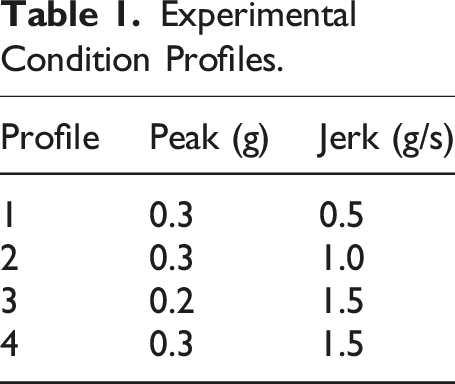
In the high-MSS group (n = 36), each participant completed four driving sessions conducted on separate days. On each day, one of the four predefined acceleration profiles (profiles 1–4; Table 1) was administered, with the order of profiles randomized across participants. MS severity was assessed in real time using the MISC. During each 24-min driving session, participants were prompted by the instructor every 2 min to rate their current symptoms and enter the corresponding MISC score on a tablet device. For each participant, the highest MISC value observed across all driving sessions was defined as the MISC peak score and used for subsequent analyses.
Both the participants and the experiment instructor were seated in the rear passenger seat. To simulate a nondriving-related task, participants watched a neutral video on a tablet PC throughout the ride. External visual references were eliminated by installing curtains on the front partitions and side windows (Figure 1). Experimental setup for motion sickness assessment. Participants were seated in the rear seat of an electric vehicle with their forward view blocked by a curtain. During the on-road experiment, they performed a non-driving-related task by watching a video on a tablet PC while the vehicle followed predefined acceleration motion profiles. Motion sickness severity was assessed every 2 min during the ride using the Misery Scale.
Statistical Analysis
Group and head-tilt effects on SVV and SVH were analyzed using a two-factor repeated-measures analysis of variance (ANOVA), with group (control, high-MSS, and PPPD) as the between-subject factor and head tilt (−60°, −30°, 0°, +30°, and +60°; positive values indicating rightward head tilt and negative values indicating leftward head tilt) as the within-subject factor. Post hoc pairwise comparisons were performed at each tilt angle using Tukey-Kramer test. P-values were adjusted for multiple comparisons using false discovery rate (FDR) correction with the Benjamini–Hochberg method.
Between-group comparisons of SVV and SVH error magnitudes were conducted using independent-samples tests selected according to data distribution characteristics. Receiver operating characteristic (ROC) analyses were performed to evaluate the diagnostic performance of SVV and SVH metrics in distinguishing clinical groups or the high-MSS group from controls. Sensitivity, specificity, and area under the curve (AUC) were calculated, and optimal cut-off angles for each tilt condition were determined by maximizing the Youden index (sensitivity + specificity − 1).
A significance threshold of p < 0.05 was applied. P-values from repeated-measures ANOVAs and post hoc comparisons were adjusted using FDR correction across the 16 head-tilt comparisons. Effect sizes (Cohen’s d) were calculated for group differences in SVV and SVH errors at each tilt angle and were defined as the difference between group means divided by the pooled standard deviation (S
p
):

Additionally, to examine the dose-dependent relationship between MS severity and head-tilt SVV/SVH values, Pearson correlation analyses were performed between SVV/SVH errors and peak MISC scores at all tested tilt angles (0°, ±30°, and ±60°) in the high-MSS group (n = 36). For participants who completed all four driving sessions (n = 24), the observed peak MISC score was used, whereas participants who discontinued driving due to severe nausea and anxiety (n = 12) were assigned a maximum MISC score of 10.
Results
Demographic and Clinical Characteristics
Participant Demographics and Clinical Scores.
Group Comparisons of SVV and SVH Errors Under Head-tilt Conditions
Across all head-tilt conditions, both SVV and SVH errors demonstrated systematic group differences (Figure 2). In the control group, tilt-induced errors were predominantly contraversive, consistent with the classical E-effect. For example, at a 60° head tilt, controls exhibited contraversive SVV errors of −8.0° ± 1.25° during rightward tilt and 5.30° ± 1.42° during leftward tilt. In contrast to controls, both experimental groups exhibited similar ipsiversive error patterns at the same 60° head-tilt condition. Specifically, the high-MSS group showed an ipsiversive SVV error of 1.94° ± 0.90° during rightward tilt, and the PPPD group demonstrated a comparable ipsiversive error of −2.97° ± 1.39° during leftward tilt. At the upright (0°) position, SVV errors were minimal across all groups (mean < 0.30° ± 0.62°). Group-averaged SVV (A) and SVH (B) errors across head-roll tilts (Lt60, Lt30, Zero, Rt30, Rt60) in healthy controls, high motion sickness-susceptible (MSS) individuals, and persistent postural–perceptual dizziness (PPPD) patients. Within the tested tilt range (≤ 60°), controls exhibited consistent contraversive deviations (E-effect) at both moderate (±30°) and extreme (±60°) head-tilt conditions, with larger magnitudes observed at ±60°. In contrast, the high-MSS and PPPD groups showed attenuated E-effects, indicating ipsiversive errors at the same tilt angles. These patterns were consistent across both SVV (A) and SVH (B) measures. At the upright (0°) position, no between-group differences were observed. Error bars represent the standard error of the mean (SEM). Asterisks indicate statistically significant differences between groups based on two-factor repeated-measures ANOVA (group × head-tilt) followed by FDR-corrected simple effects analysis (Benjamini–Hochberg method): *FDR-corrected p < 0.05, **FDR-corrected p < 0.01, ***FDR-corrected p < 0.001. All groups maintained near-zero errors at the upright (Zero) position, confirming intact static otolith function while revealing tilt-specific multisensory integration deficits in experimental populations. Lt60 = 60° left head tilt, Lt30 = 30° left head tilt, Zero = upright, Rt30 = 30° right head tilt, Rt60 = 60° right head tilt. Negative values denote leftward (Lt), and positive values denote rightward head tilt (Rt).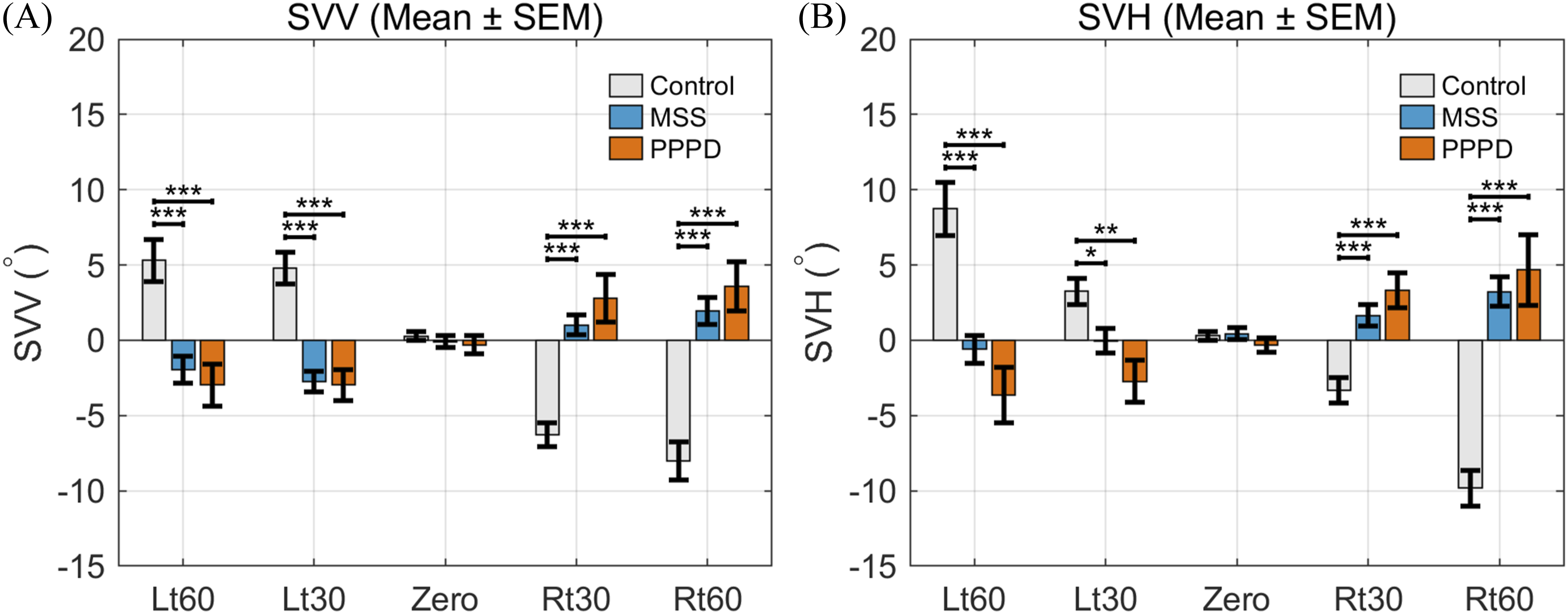
Significant Group × Head-tilt interaction effects were observed for both SVV [F(2, 77) = 14.78, p < 0.001] and SVH [F(2, 77) = 14.42, p < 0.001], demonstrating that head-tilt–induced perceptual error patterns differed significantly between controls and experimental groups. In contrast, the main effect of group was not significant for either measure [SVV: F(2, 77) = 0.83, p = 0.483; SVH: F(2, 77) = 2.24, p = 0.090].
Follow-up FDR-corrected post hoc comparisons revealed significant group differences primarily at ±30° and ±60° head tilts (FDR-corrected p < 0.05), with the most pronounced differences occurring at ±60°.
At these extreme tilt angles, both experimental groups consistently exhibited ipsiversive error patterns that were significantly different from the contraversive responses observed in controls (all FDR-corrected p < 0.001), indicating a shared tilt-dependent perceptual bias in the high-MSS and PPPD groups. In contrast, at the upright (0°) position, no significant group differences or Group × Head-tilt interaction effects were observed for either SVV or SVH (SVV: p = 0.642; SVH: p = 0.421), confirming preserved baseline vertical perception across all groups. Together, these findings indicate that perceptual disturbances in the experimental groups are selectively expressed under head-tilt conditions, reflecting altered processing of graviceptive information rather than a generalized impairment of static vertical perception.
Specifically, at 60° left tilt in SVV (Figure 2(a)), controls (5.30° ± 1.42°) differed significantly from the high-MSS group (−1.94° ± 0.89°; FDR-corrected p < 0.001) and the PPPD group (−2.97° ± 1.39°; FDR-corrected p < 0.001), whereas no difference was observed between the high-MSS and PPPD groups (FDR-corrected p = 0.920). At 60° right tilt, controls (−8.01° ± 1.25°) likewise differed from the high-MSS (1.94° ± 0.90°; FDR-corrected p < 0.001) and PPPD (3.59° ± 1.65°; FDR-corrected p < 0.001) groups, with no significant difference between the two experimental groups (FDR-corrected p = 0.765).
Similar group differences were also evident at moderate tilt angles. At 30° leftward tilt, SVV errors in the high-MSS (−2.76° ± 0.67°) and PPPD (−2.97° ± 1.03°) groups were significantly more ipsiversive than those observed in controls (4.79° ± 1.06°; FDR-corrected p < 0.001 for both comparisons), while no difference was detected between the high-MSS and PPPD groups (FDR-corrected p = 0.987). At 30° right tilt, controls (−6.29° ± 0.78°) again showed larger contraversive SVV errors than the high-MSS (1.01° ± 0.66°; FDR-corrected p < 0.001) and PPPD (2.79° ± 1.59°; FDR-corrected p < 0.001) groups, with no significant difference between the two experimental groups (FDR-corrected p = 0.537).
A similar interaction pattern was observed in SVH (Figure 2(b)). At 60° left tilt, controls (8.73° ± 1.75°) exhibited significantly larger contraversive deviations than both the high-MSS (−0.60° ± 0.92°; FDR-corrected p < 0.001) and PPPD (−3.63° ± 1.83°; FDR-corrected p < 0.001) groups, whereas no significant difference was observed between the high-MSS and PPPD groups (FDR-corrected p = 0.422). At 60° right tilt, controls (−9.83° ± 1.21°) likewise showed larger contraversive SVH errors than the high-MSS (3.23° ± 0.96°; FDR-corrected p < 0.001) and PPPD (4.68° ± 2.35°; FDR-corrected p < 0.001) groups, with no significant difference between the two experimental groups (FDR-corrected p = 0.760).
At moderate tilt angles, a comparable pattern was evident. At 30° left tilt, SVH errors in the high-MSS (−0.03° ± 0.81°) and PPPD (−2.72° ± 1.38°) groups differed significantly from those in controls (3.24° ± 0.87°; FDR-corrected p = 0.042 and p = 0.001, respectively), while no difference was detected between the high-MSS and PPPD groups (FDR-corrected p = 0.222). At 30° right tilt, controls (−3.32° ± 0.82°) again demonstrated larger contraversive SVH errors than the high-MSS (1.65° ± 0.70°; FDR-corrected p < 0.001) and PPPD (3.31° ± 1.16°; FDR-corrected p < 0.001) groups, with no significant difference between the two experimental groups (FDR-corrected p = 0.446).
In the analysis of condition-specific effect sizes using Cohen’s d (Figure 3), all comparisons exceeded the conventional threshold for large effects (d > 0.8). Effect sizes ranged from d ≈ 0.69 (SVV for discriminating high-MSS at Cohen’s d effect sizes for SVV (light/dark blue) and SVH (pink/orange) errors at head‐tilt angles −30°, +30°, −60°, and +60°. Effect sizes are shown for comparisons between high motion sickness susceptibility (high-MSS) and controls, and between persistent postural–perceptual dizziness (PPPD) and controls, as indicated in the legend. The dashed line denotes the conventional threshold for a large effect (d = 0.8). Most comparisons exceeded this threshold, except for SVV at −30° in the high-MSS group. The largest effects were observed at +60° tilt (SVV: d = 2.18 for high-MSS; d = 1.91 for PPPD). Receiver operating characteristic (ROC) curves for subjective visual vertical (SVV) and subjective visual horizontal (SVH) tests across different head-tilt angles in distinguishing patients with persistent postural–perceptual dizziness (PPPD) and individuals with high motion sickness susceptibility (MSS) from healthy controls. The four panels show diagnostic performance for SVV Control versus PPPD (top left), SVV Control versus high-MSS (top right), SVH Control versus PPPD (bottom left), and SVH Control versus high-MSS (bottom right). Each curve represents a different head-tilt angle: +30° (red), −30° (blue), +60° (green), and −60° (orange), with corresponding area under the curve (AUC) values displayed in the legend. The diagonal dashed line represents chance performance (AUC = 0.50). Negative values indicate leftward head tilt, and positive values indicate rightward head tilt.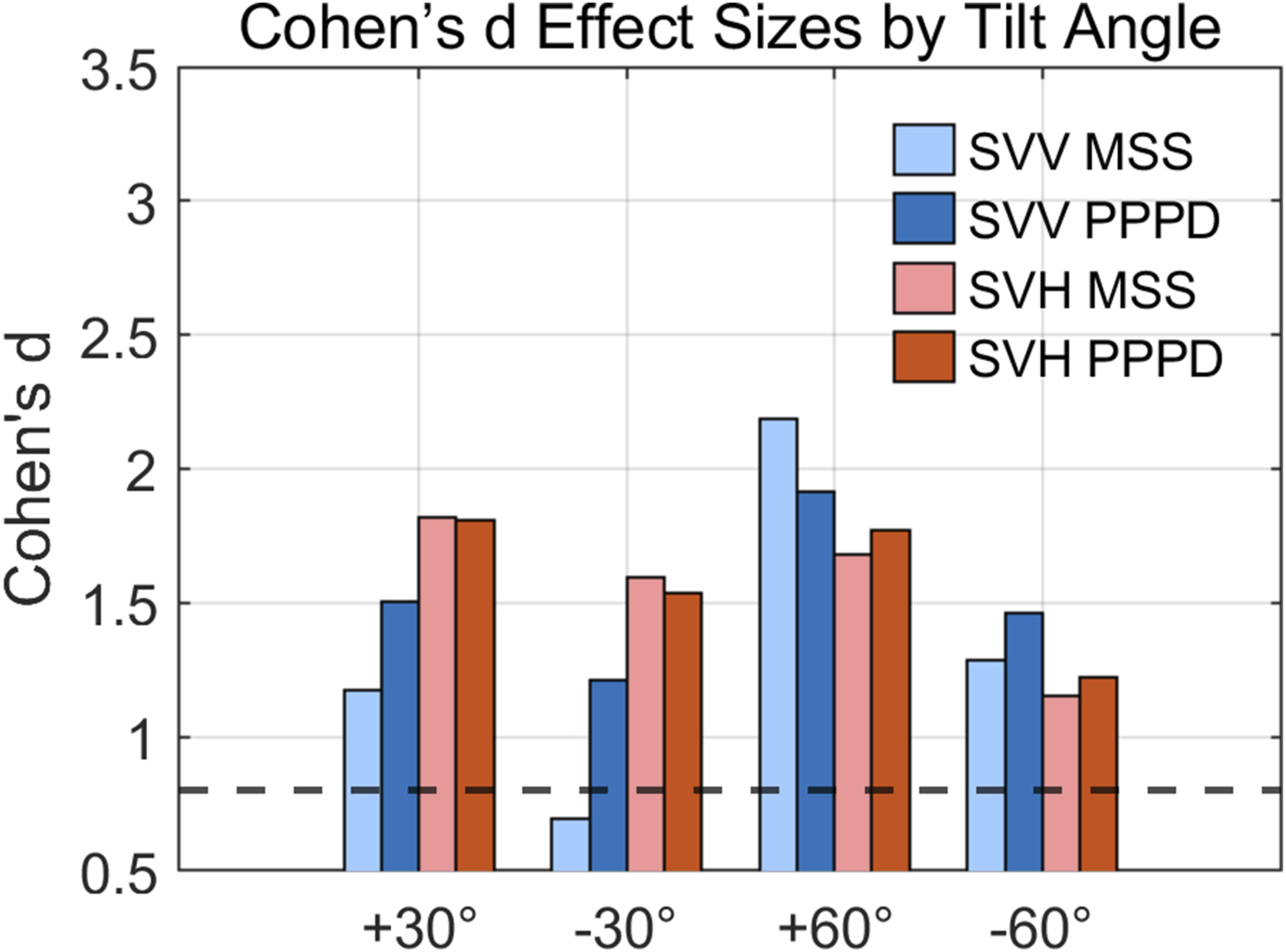

Figure 5 summarizes the diagnostic performance of SVV and SVH across roll head-tilt angles using an AUC heatmap. Diagnostic accuracy varied by test condition, with the highest AUC values observed for SVV at +30° (PPPD: AUC = 0.93 at a cut-off of −2.52°; high-MSS: AUC = 0.91 at a cut-off of −4.00°) and for SVH at +60° (PPPD: AUC = 0.92 at a cut-off of −2.50°; high-MSS: AUC = 0.94 at a cut-off of −2.40°). Overall, most test conditions showed good to excellent diagnostic performance, with five conditions achieving excellent accuracy (AUC ≥ 0.90; optimal cut-offs ranging from −4.00° to 4.80°) and an additional 12 conditions demonstrating good accuracy (AUC = 0.80–0.90). Area under the curve (AUC) heatmap for SVV and SVH test conditions. Rows correspond to test modality and group comparison (SVV–PPPD, SVV–high-MSS, SVH–PPPD, SVH–high-MSS), indicating whether SVV or SVH was used to discriminate PPPD patients or individuals with high-MSS from healthy controls. Columns represent head-tilt angles (−30°, +30°, −60°, +60°). Cell color gradients (purple to yellow) and overlaid white text indicate AUC values. Cells with AUC ≥ 0.90 (n = 5) denote excellent diagnostic performance. Negative values indicate leftward head tilt, and positive values indicate rightward head tilt.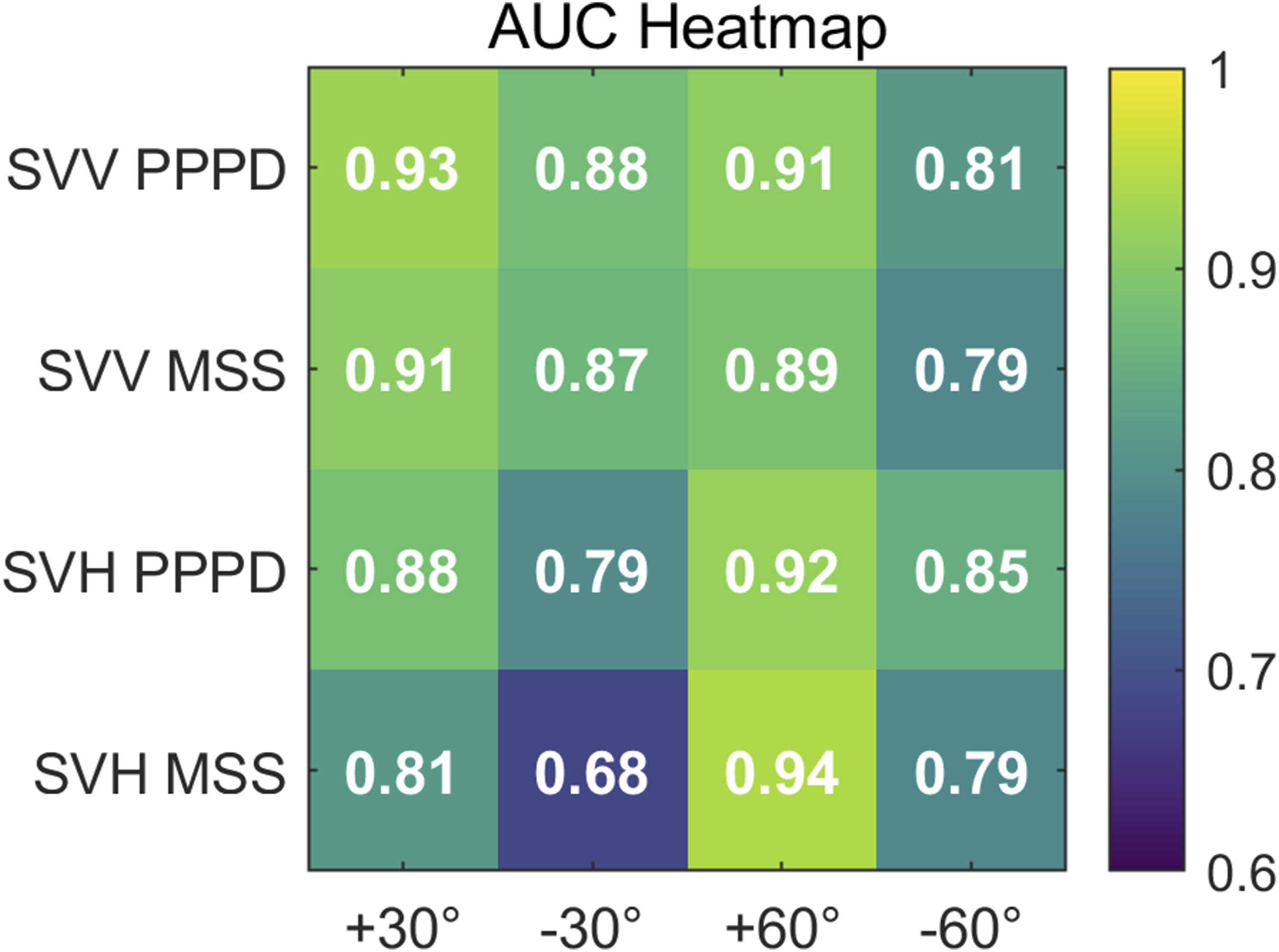
Dose-dependent Motion Sickness During Real-world Driving
In the high-MSS group (n = 36), clinically evident MS was observed during real-world driving. 12 participants (33%) discontinued the experiment during the first acceleration profile due to severe MS and were therefore assigned the maximum MISC peak score of 10 for analysis. The remaining 24 participants completed all four driving profiles, and analyses for these participants were based on their individually observed MISC peak scores.
Continuous correlation analyses demonstrated that MISC peak scores were significantly associated with SVV errors at head-tilt angles of +30° and +60° (Figure 6). Higher MISC peak scores were correlated with larger ipsiversive SVV deviations at +30° (r = 0.353, p = 0.037) and +60° (r = 0.357, p = 0.035). In contrast, no significant correlations were observed between MISC peak scores and SVV or SVH errors at the other tilt angles, including the upright (0°) position. Dose-dependent relationship between motion sickness severity and tilt-induced subjective visual vertical (SVV) errors in the high-MSS group. SVV deviations measured at 30° head tilt (green), and 60° head tilt (magenta) show significant positive correlations with MISC peak scores, indicating that greater motion sickness severity is linearly associated with larger tilt-induced ipsiversive SVV errors.
Notably, MSSQ scores did not show a significant correlation with MISC peak scores (r = 0.088, p = 0.616), indicating that questionnaire-based susceptibility does not reliably predict real-world MS severity during driving. Collectively, these findings suggest that head-tilt SVV measurements may provide more sensitive indicators of MS vulnerability than questionnaire-based assessments.
Discussion
Spatial orientation arises from the integration of vestibular, visual, and somatosensory cues into a coherent representation of head and body positions relative to gravity. Under small head tilts (< 60°), healthy individuals typically exhibit contraversive biases (E-effect), whereas larger tilts elicit ipsiversive biases (A-effect).17–20 In our data, the healthy control group was consistent with this behavior within the tested range, exhibiting contraversive SVV/SVH deviations at both ±30° and ±60°, with larger magnitudes at ±60°. In contrast, clinically distinct response patterns were observed in the experimental groups, as evidenced by significant Group × Head-tilt interaction effects (SVV: F(2, 77) = 14.78, FDR-corrected p < 0.001; SVH: F(2, 77) = 14.42, FDR-corrected p < 0.001). Specifically, both the high-MSS and PPPD groups exhibited ipsiversive error patterns consistent with A-effects at the same tilt angles, suggesting altered multisensory reweighting of graviceptive cues.
At the upright (0°) position, no significant between-group differences or interaction effects were observed (all p > 0.05), supporting the notion that perceptual disturbances in the experimental groups are tilt-dependent rather than reflective of a generalized deficit in static spatial orientation. This pattern is consistent with the clinical characteristics of PPPD, in which dizziness is predominantly triggered or exacerbated by movement. 14
Additionally, MS shares pathophysiological mechanisms similar to those observed in PPPD, including altered visuo-vestibular reweighting or sensitization, heightened visual dependence, and reduced perceptual thresholds for self-motion.21–23 Importantly, individuals exhibiting these features typically demonstrate normal peripheral vestibular function, indicating that their symptoms are primarily driven by abnormalities in higher-order vestibular perceptual processing rather than by peripheral vestibular deficits. Consistent with this framework, the high-MSS group in the present study exhibited nearly identical directional alterations in SVV/SVH across all head-tilt angles (post hoc comparisons: p > 0.05 at most angles; mean differences < 2°), albeit with smaller absolute error magnitudes compared with PPPD. This pattern supports the notion that MS represents a subclinical phenotype of visuo-vestibular perceptual dysfunction.
In contrast to our findings, Zahra et al. reported no significant differences in static SVV performance between MS and control groups across head-tilt angles. 24 However, they observed significantly greater deviations in dynamic SVV across all positions in the MS group, with higher MSSQ scores correlating with larger deviations. Several methodological differences may account for these discrepant findings. Notably, our study selectively recruited participants with high MSSQ scores (≥ 50) and included individuals in whom MS was objectively confirmed under real-world driving conditions, whereas Zahra et al. relied primarily on questionnaire-based classification. This enrichment of MS severity in our cohort likely increased sensitivity to static, tilt-induced perceptual abnormalities.
Interestingly, prior work has demonstrated that the expression of the E-effect during SVV testing can be modulated by the initial orientation of the luminous line relative to the direction of head tilt. 9 In that study, starting positions of the light bar parallel to the direction of head tilt were shown to attenuate or even abolish the expected contraversive bias. In this context, although our study employed randomized initial orientations of the luminous line to minimize response bias, this methodological choice may itself have influenced the expression of E-effects. Accordingly, further methodological refinement, such as systematic control or stratification of the initial bar orientation relative to head-tilt direction, may be required to more precisely characterize tilt-dependent perceptual biases in SVV/SVH testing.
Nevertheless, our results further confirmed the clinical significance of head-tilt SVV/SVH testing. As illustrated in Figure 3, most group comparisons yielded large effect sizes (Cohen’s d > 0.8), with particularly robust discrimination observed for SVV at +60° head tilt (d ≈ 1.91 for PPPD and d ≈ 2.18 for high-MSS). These findings indicate that disturbances in multisensory integration can be reliably captured using the head-tilt paradigm. ROC analyses corroborated these results (Figures 4 and 5), demonstrating excellent diagnostic accuracy across multiple tilt conditions. Five test conditions achieved AUC values ≥ 0.90, most notably SVH at +60° head tilt (AUC = 0.94 for high-MSS; 0.92 for PPPD) and SVV at +30° head tilt (AUC = 0.91 for high-MSS; 0.93 for PPPD).
We further explored whether head-tilt SVV and SVH measurements can predict susceptibility to severe MS experienced during real-world driving when passengers engage in non-driving tasks, as such predictive markers could be applied to assess passenger suitability for upcoming autonomous vehicle environments. As fourth-generation autonomous vehicles are designed to allow passengers to perform non-driving activities during transit, MS has emerged as a critical barrier to their widespread adoption.14,25 Unlike active drivers, who receive proprioceptive feedback from steering and braking and can anticipate vehicle motion, 4 autonomous vehicle passengers experience reduced motion predictability and lack active control, amplifying visual-vestibular conflicts.14,25 Moreover, engaging in non-driving tasks—such as viewing screens or concentrating on work—while being exposed to vehicle acceleration and deceleration creates pronounced sensory mismatches between visual and vestibular inputs. Collectively, these factors substantially increase the risk of severe MS in autonomous vehicles compared with conventional human-driven vehicles.
To address this issue, we conducted a real-world driving experiment in a high-MSS cohort (n = 36) to determine whether perceptual markers derived from head-tilt SVV/SVH testing can predict vulnerability to clinically significant MS experienced during naturalistic driving while engaging in non-driving tasks. In this paradigm, individuals with high-MSS exhibited dose-dependent increases in MS severity, which were selectively associated with tilt-induced SVV errors at +30° and +60° head tilts. Greater real-world MS severity correlated with larger ipsiversive SVV deviations, whereas no such relationships were observed for SVH or for the upright condition. Notably, questionnaire-based susceptibility scores (MSSQ) failed to predict real-world MS severity, underscoring that head-tilt SVV provides a more sensitive and ecologically valid marker of MS vulnerability than self-reported measures. Importantly, among prescreened susceptible individuals, head-tilt SVV may serve as a key predictive marker of clinically significant MS during real-world driving. The greater sensitivity of SVV relative to SVH is likely attributable to its stronger dependence on head orientation relative to gravity. 26 Consequently, vertical perceptual estimation appears to be more sensitive to graviceptive perturbations than horizontal estimation.
This interpretation is consistent with prior work. Fraser et al. demonstrated that SVV exhibits greater sensitivity to head-tilt manipulations, whereas SVH remains comparatively stable, suggesting that these two measures rely on partially distinct internal estimates of gravity. 25 Specifically, their model proposes that SVV predominantly relies on a head-centered reference frame, while SVH reflects a more body-centered reference frame. Within the context of our real-world driving paradigm, this distinction is particularly relevant. Participants’ bodies were restrained by seatbelts and therefore remained relatively stable throughout the driving task, whereas head orientation varied with tilt. Accordingly, MISC peak scores in our study were likely driven primarily by head-related graviceptive perturbations rather than whole-body motion. In addition, the specific acceleration profiles applied during real-world driving may have preferentially engaged head-centered perceptual mechanisms, thereby amplifying SVV-related abnormalities and their association with MS severity.
In our study, we also observed subtle asymmetries in head-tilt–induced SVV/SVH error patterns between rightward and leftward tilts at identical angles. One possible explanation is that, within the experimental paradigm described above, the expected E-effect may have been incidentally attenuated or partially canceled under certain conditions, potentially due to interactions between head-tilt direction and task-related factors, such as initial bar orientation. 9
Interestingly, similar directional asymmetries have been reported in other clinical populations. For example, Winnick et al. observed direction-dependent differences in head-tilt–induced perceptual responses in patients with vestibular migraine, suggesting that both the direction and magnitude of head tilt—for instance, 20° in their study versus 30° and 60° in the present study—as well as condition-specific symptom characteristics may modulate perceptual outcomes in disorders involving altered vestibular processing. 27 Although the mechanisms underlying these directional effects remain unclear, our findings raise the possibility that head-tilt direction represents an additional dimension influencing graviceptive perception, warranting further systematic investigation in future studies.
This study has several limitations. First, real-world driving validation was conducted only in participants prescreened as highly susceptible to MS based on questionnaire responses; therefore, the design did not constitute a full case–control comparison under naturalistic driving conditions. Second, participants were secured with seat belts, as required for real-world safety, which minimized trunk movement and rendered head tilt the dominant source of vestibular perturbation. While this enhanced experimental control and safety, it may have reduced the contribution of whole-body motion to MS responses. Third, participants were instructed to view a monitor during driving sessions, which may not fully capture the diversity of everyday non-driving activities, thereby limiting ecological validity. Fourth, the acceleration profiles employed may not encompass the full range of motion environments expected in future autonomous vehicle settings. In addition, MS susceptibility in patients with PPPD was not independently verified using MSSQ scores or real-world driving outcomes, and thus its potential influence on the observed group differences cannot be entirely excluded. Finally, although the study incorporated repeated motion exposure across different driving sessions, formal longitudinal studies with explicit test–retest intervals and intraclass correlation coefficient analyses are required to establish the long-term stability and reliability of SVV/SVH measures and to further clarify their potential utility as perceptual biomarkers related to MS.
Despite these limitations, our findings underscore the potential clinical and translational relevance of head-tilt SVV/SVH testing. These measures provide sensitive markers of perceptual distortion and robust indicators for identifying individuals with PPPD or high-MSS. Furthermore, they may serve as practical screening tools for detecting perceptual vulnerability associated with MS and for evaluating passenger suitability in the context of emerging autonomous vehicle technologies.
Footnotes

Ethical Considerations
The study protocol was approved by the Institutional Review Board of Hallym University Sacred Heart Hospital, South Korea (IRB No. 2023-08-003-001).
Consent to Participate
All participants provided written informed consent prior to participation.
Author Contributions
All authors had full access to all of the data in the study and take responsibility for the integrity of the data and the accuracy of the data analysis. Concept and design: Hong, Yang, Kim. Acquisition, analysis, or interpretation of data: Na, Lim, Baek. Drafting of the manuscript: Hong, Na. Critical review of the manuscript for important intellectual content: Hong. Statistical analysis: Na, Lim.
Obtained funding: Hong. Administrative, technical, or material support: Hong. Supervision: Hong.
Funding
The authors disclosed receipt of the following financial support for the research, authorship, and/or publication of this article: This work was supported by the Hyundai Motor Company R&D Center and by the National Research Foundation of Korea (NRF) under grant number NRF-2023R1A2C1005171.
Declaration of Conflicting Interests
The authors declared no potential conflicts of interest with respect to the research, authorship, and/or publication of this article.
Data Availability Statement
The data supporting the findings of this study are available from the corresponding author and funder upon reasonable request.
Role of the Funder/Sponsor
The funding organizations had no role in the design and conduct of the study; collection, management, analysis, and interpretation of the data; preparation, review, or approval of the manuscript; and decision to submit the manuscript for publication.