



Abstract

Acoustics, dynamics, and vibration

Research in acoustics, dynamics, and vibration track is directed at the many challenging problems associated with the design and operation of modern engineering structures, ranging from development of fundamental theory and innovative computational tools to application-based research into topics such as offshore structures, vehicles, ground-borne vibration, and musical instruments. We have access to extensive computational and experimental facilities, and we have close ties with industry, research and other academic institutions. Research expertise of our faculties lies in areas related to structural vibration, vibration control, noise control, acoustics, stability, bifurcation and chaos, pattern formation, non-smooth systems, time-detailed systems.
Research areas
Linear and nonlinear modeling of electrodynamic systems;
Anti lock-braking system, traction control system, and electronic stability control;
Effect of nonlinearities on the system behavior;
Vibration characteristics of continuous systems like strings, plates, and shells;
Study of Indian stringed musical instruments;
Instabilities in structures and hydrodynamic systems;
Machine-tool vibrations;
Time-delayed systems;
Reduced order modeling.
For more information, follow the link: https://www.iitk.ac.in/me/acoustics-dynamics-and-vibration
Use of sound waves to stimulate bone growth

Did you know bones weaken in space? Experiencing microgravity, or weightlessness, can be thrilling for astronauts. “But”, says biomedical engineering major, Jacqueline Maynard ‘17, “a side effect is the loss of as much as 40 percent of their bone mass in a single expedition, making fractures and long term complications like osteoporosis very likely”.
To counteract this and potentially help the general population that has degenerative bone conditions, Jacqueline and other students in the College of Engineering, Technology, and Architecture (CETA) are conducting experiments in the University’s new Tissue Engineering Lab. The project is funded by the NASA Connecticut Space Grant Consortium, a federally supported grant, internship, and scholarship program for students pursuing careers in Science, Mathematics, Engineering, and Technology (STEM).
Our students are testing whether the mechanical vibrations of sound can alter the stem cells of mice grown in an artificial environment. Prior research has shown that when mechanical vibrations are applied to the cells at the right frequency, they may increase or maintain bone mass, possibly because sound waves stimulate muscles, much like exercise does. “We believe acoustic waves could be a therapeutic approach we can potentially use to stimulate bone formation and improve bone health”, says Andrea Kwaczala, assistant professor of Civil, Environmental, and Biomedical Engineering.
For more information, follow the link: https://www.hartford.edu/success-stories/current/2017/april/ceta-tissue-lab.aspx
Building acoustics

In the building acoustics module, we focus on the research in the field of sound and vibration transmission into buildings from outside and within the buildings themselves.
Experimental and numerical research aims at understanding the underlying mechanisms in sound and vibration transmission in the built environment and at developing new methods for measuring and predicting sound transmission between rooms and within the buildings.
Special emphasis is put on the investigation of lightweight civil engineering structures. For this purpose, the Laboratory for Acoustics & Noise Control and the Department of Architecture, Wood and Civil Engineering of the Bern University of Applied Sciences have jointly realized a research platform in Duebendorf dedicated to the investigation and study of lightweight structural assemblies. This unique research facility is used to determine the acoustic performance of lightweight civil engineering structures on a real scale and in a multi-room, multi-story experimental setup.
The Room Acoustics team deals with sound propagation in rooms. Class rooms, theaters, concert halls, and churches should ideally possess good musical acoustics and allow speakers to be clearly heard. To achieve this, the best possible conditions for the propagation of the sound of speech and of musical instruments to the audience must be created. In addition, however, one must not forget the importance of the acoustic conditions in rooms used in everyday life such as restaurants, foyers, and living areas.
For more information, follow the link: https://www.empa.ch/web/s509/building-acoustics
Auralisation/psychoacoustics

Empa performs psychoacoustic studies on the perception of noise by humans and operates with the AuraLab, a facility specifically designed for that purpose. With such listening tests, the (acute) perceptive annoyance can be assessed. Besides listening tests, Empa participates in epidemiological, chronobiological (quality of sleep), and socio-acoustic studies.
The auralization of environmental noise is a process which makes noise scenarios in the vicinity of wind farms, road, rail, and air traffic sources audible. The process serves as an aid in communication and as an evaluation tool which can be used during project-planning phases and for studies on the effects of noise. Auralization makes possible an effect-oriented investigation of noise control measures implemented at the noise source and in the propagation path. Good-quality auralization requires a detailed understanding of noise generation, noise propagation, acoustic measurement techniques, signal processing, electro-acoustics, and psychoacoustics.
At Empa psychoacoustics and auralization are highly connected topics. On the one hand, listening tests are performed to assess the quality of synthetic signals. On the other hand, auralized signals are used to vary the characteristics of noise events in order to determine their influence on perception.
For more information, follow the link: https://www.empa.ch/web/s509/auralisation/psychoacoustics
Environmental acoustics
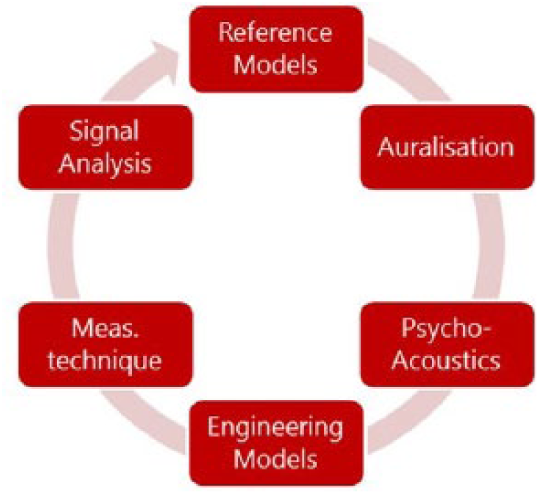
The field of environmental acoustics covers all sorts of outdoor noise, from primarily technical noise sources such as traffic noise, industrial noise, or wind turbines to noise sources such as sports grounds, restaurants, and clubs, where human beings are in general the prime generators of the noise.
Our understanding of noise generation, radiation, and propagation phenomena and our measurement and signal analysis capabilities enable us to evaluate and optimize practical noise situations and to develop predictive computer models. These calculation methods include reference models which are based on wave theoretical sound field simulations as well as software engineering models such as sonRoad, sonRAIL, sonARMS, or sonAIR for the prediction of sound exposure level of the most significant noise sources. In order to evaluate the effect of sound on humans, we conduct psychoacoustic experiments during which recordings of acoustic situations or a synthetic auralization of noise sources are used.
For more information, follow the link: https://www.empa.ch/web/s509/environmental-acoustics
Compact narrowband high-acoustic sound source for particle agglomeration

With its many talented research engineers with advanced degrees in acoustics and vibration, KCF Technologies is an acknowledged leader in developing ingenious noise and vibration controls, whether the task is abatement or converting and refining the noise and vibration into productive sources of usable energy. With funding and support from the Department of Defense, including the US Army and US Naval Air Systems Command, as well as private industry, KCF has made and will continue to make creative strides in these remarkably diverse technologies. Click on a heading below to read selected abstracts of our noise and vibration control and optimization focused research programs.
KCF Technologies is developing a robust and efficient sound generator for separation/isolation of aerosols in heating, ventilation, and air conditioning (HVAC) filters. The primary solution is a new, high-intensity piezoelectric sound generator combined with a Helmholtz resonator. Conventional piezoelectric sound generators experience degradation in performance over long periods of operation, poor electro-acoustic efficiencies at high-amplitude drive levels, and large tolerances in their acoustic performance. KCF is solving these performance limitations with a redesign of the piezo device, boundary condition, acoustic resonator, and system housing. Applications include enhancements to HVAC systems and other air filters in industrial processes.
For more information, follow the link: https://www.kcftech.com/research/noise-vibration.html
Extreme amplitude piezoelectric noise source for HUMVEE air filter cleaning
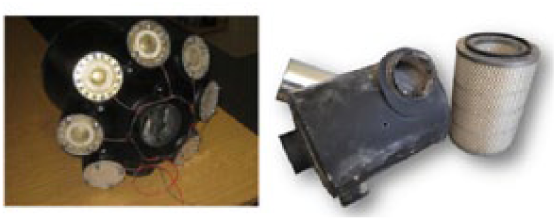
The military has experienced problems with clogging of air filters on its vehicles when operating in desert conditions such as those in Iraq and Afghanistan. The air filter in military vehicles traditionally needed to be removed periodically and tapped against the vehicle’s tire several times to clean it. This operation must be done twice a day in order for the filter to last about 10 days before needing to be replaced. KCF Technologies has developed an acoustic cleaning system for military vehicle air filtration systems. The process involves applying sound vibrations to clean the air filter using a piezoceramic speaker, which is smaller and less bulky than traditional speakers. The technology applies to a variety of applications for high-temperature and high-amplitude applications, including fire alarms, industrial alarms, vehicle back-up alarms, and more.
For more information, follow the link: https://www.kcftech.com/research/noise-vibration.html
High-temperature piezoelectric alarm for personnel safety devices
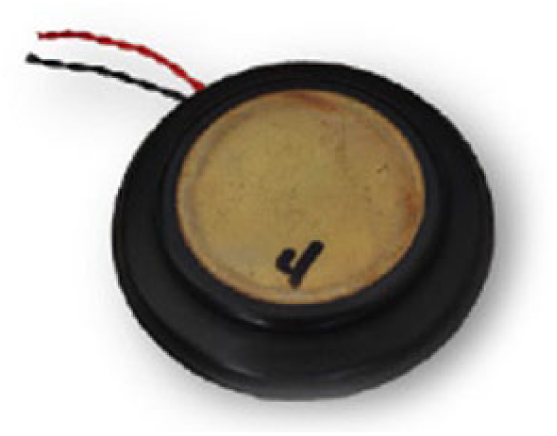
KCF Technologies has developed a high-temperature piezoelectric sound source for a commercial man-down alarm. This component enables the personal alert safety system (PASS) to sound a loud, piercing alarm whenever a firefighter becomes disabled or lies motionless for 30 s. The technology has been in production since 2007 and is available for application in other piezoelectric sound source markets.
For more information, follow the link: https://www.kcftech.com/research/noise-vibration.html