



Abstract
This article develops the modified couple stress theory to study the free vibration of bi-directional functionally graded microplates subjected to multidimensional temperature distribution. Third-order shear deformation and classical theories of plates are adapted for free vibration analysis of thick and thin microplates, respectively. Employing the third-order shear deformation theory, both normal and shear deformations are considered without the need for shear correction factor. Material of the bi-directional functionally graded microplate is graded smoothly through the length and thickness of the microplate. Gradient of the material is assumed to obey from the power law in terms of the volume fraction of the constituents. Assuming the uniform and nonuniform temperature distributions, the effect of thermal environment on dynamic behavior of the microplate is discussed in detail. Applying the Ritz method, the displacement field is expanded by admissible functions which satisfy the essential boundary conditions, and Hamilton principle is employed to determine the natural frequencies of the microplate. Developed model has been applied to determine the natural frequencies in problems of thin/thick, one-directional/bi-directional functionally graded, and homogeneous/nonhomogeneous microplates. Effects of parameters such as the thermal environment, power law indexes
Keywords
Introduction
Functionally graded materials (FGMs) are made from a mixture of two constituent material and are characterized by a smooth and continuous change of the properties from one surface to another. FGMs were originally designed as thermal barrier for aerospace structural applications and fusion reactors. However, nonhomogeneous nature of many structures in microscale requires to model their mechanical properties as multi-directional FGMs. Systems such as thin films, 1 atomic force microscopes (AFMs), 2 microplate spectrophotometers hotplate, and micro-electromechanical systems (MEMS)/nano-electromechanical systems (NEMS), 3 tunable micro/nanomechanical resonators, and paddle-like resonators 4 are among the extensive applications of microstructures. Experimentally, the size effect in these structures has been investigated by many research scholars.5–7
Well-known classical theories such as classical plate theory (CPT) based on Chauchy, 8 Poisson 9 or Kirchhoff 10 assumptions types, first-order shear deformation theory (FSDT), 11 third-order Vlasov–Reddy theory (TSDT), 12 and high-order shear deformation theories (HSDT) have been used to analyze the dynamic and static behavior of FG plates. While the classical theories may not predict the size effect in micro-structures, non-classical continuum theories were formed to model the size effect by applying material length scale parameters. To model the size effects in micro- and nano-scale, several size-dependent theories have been developed in continuum mechanics. Theories such as nonlocal elasticity theory, 13 strain gradient theory, 14 couple stress theory,15,16 and its modified version 17 have been developed to model the behavior of structures in nano- and micro-scale. The nonlocal elasticity theory 13 includes two material length scale parameters and the strain gradient theory 14 includes three material length scale parameters. Toupin, 16 Mindlin and Tiersten, 15 and Koiter 18 were the first research scholars who introduced the couple stress theory with two material length scale parameters. Afterward, Yang et al. 17 presented the modified couple stress theory in which one material length scale parameter is employed to analyze the micro-structures. Due to difficulties in determining the material length scale parameters, the modified couple stress theory with one material length scale parameter has been attracted many research scholars in the past years. Lei et al. 19 presented a size-dependent FG microplate model based on a modified couple stress theory requiring only one material length scale parameter. Based on the modified couple stress theory, Tsiatas 20 developed a new Kirchhoff theory for the static analysis of a microplate. Using the classical plate theory (CPT), Jomehzadeh et al. 21 employed the modified couple stress theory to study the vibrational behavior of microplates. Ma et al. 22 applied modified couple stress theory to analyze the vibrating microplate using FSDT. Ke et al. 23 developed a size-dependent model for Mindlin microplates based on the modified couple stress theory.
Displacement field based on the third-order shear deformation theory requires complex analysis for free vibration analysis of plates. However, since the theory predicts accurate results without employing the shear correction factor, it is popular in free vibration analysis of thick plates. Reddy 12 proposed a simple higher order shear deformation theory for laminated composite plates and reformulated it for bending and vibration of plates using the TSDT. 24 Using the third-order plate model and a modified couple stress theory, Gao et al. 25 developed a microplate model which contains one material length scale parameter. Furthermore, Ghayesh et al. 26 developed the size-dependent nonlinear third-order shear deformation for dynamic analysis of microplates.
Employed the modified couple stress theory, the majority of research works on FG microplates are limited to material grading in thickness direction (one-directional (1D)-FG). Thai and Choi 27 developed the size-dependent model for free vibration and buckling analysis of FG Kirchhoff and Mindlin plate. In their research, the equations of motion were derived from Hamilton’s principle based on a modified couple stress theory. Also, Thai and Kim 28 obtained more accurate results for the size-dependent thick FG plates, using Reddy’s plate theory. Recently, Thai and Vo 29 have used sinusoidal shear deformation theory based on the modified couple stress theory to determine the fundamental frequency of FG microplates. Reddy and Kim 30 presented a general nonlinear modified couple stress-based third-order plate theory and used the Hamilton principle to derive the equations of motion. He et al. 31 developed a four variable refined plate theory for size-dependent FG microplates based on the modified couple stress theory and obtained closed form solutions for bending, buckling, and free vibration responses of the microplate. Salehipour et al. 32 used the modified couple stress and three-dimensional elasticity theories for vibration analysis of FG microplates. Ansari et al. 33 utilized a size-dependent model for free vibration of Mindlin FG microplates within the framework of modified couple stress theory. Lou and He 34 studied the free vibration Kirchhoff, Mindlin, and Von karman FG microplates on elastic foundation using the modified couple stress theory.
New research works in the field of FG materials indicate that variation of volume fractions in two directions optimizes the mechanical and thermal tresses compared to conventional 1D-FGM. Some studies have been carried out about static, dynamic, and free vibration of two-directional (2D)-FG plate.35–39 The size-dependent models are not employed in these works, and mechanical behavior of the plate in microscale may not be captured, consequently. Studies in the field of size-dependent 2D-FG microstructures are limited to the beam. Trinh et al. 40 employed a size-dependent model for vibrational behavior analysis of bi-directional FG microbeams with arbitrary boundary conditions. Based on the modified couple stress theory and a quasi-3D theory, they developed governing equations of motion for bi-directional FG microbeams. Yu et al. 41 presented the formulation of a non-classical quasi-3D theory for 2D-FG microbeams. In their research, the small-scale effects were interpreted by the modified couple stress theory. Utilizing the modified couple stress theory and third-order shear deformation beam theory, Chen et al. 42 derived the governing equations of motion for the bi-directional FG microbeams. Finally, they extracted the natural frequency of the beam by differential quadrature method (DQM). Shafiei et al. 43 studied free vibration of two-directional imperfect FG (2D-FG) porous nano-/microbeams. In their work, governing equations of motion were solved using generalized differential quadrature method (GDQM). Mirjavadi et al. 44 analyzed the vibrational behavior of 2D-FG porous microbeams based on the couple stress theory in thermal environment. The generalized differential quadrature method is used to solve the equations. The temperature gradient is also considered to be uniform and nonuniform across the thickness of the microbeam. Howevere, a two-dimensional temperature distribution exists for the case where the material is graded in two directions and the beam is subjected to nonunifrom temperature distribution.
As the literature review shows, 1D-FG material is mainly considered in most of the works regarding to vibration of microplates. While the third-order plate theory takes account both normal and shear deformations without the shear correction factor, the authors could not find any research on free vibration of 2D-FG microplates using this theory.45–48 Moreover, the assumption of multidimensional temperature distribution is required to study effect of thermal environment in 2D-FGMs. So, the innovation of this article is application of the third-order plate theory with size-dependent model for free vibration analysis of bi-directional FG microplate. This article investigates the free vibration of a (2D-FG) microplate subjected to multidimensional temperature distribution. Applying the Hamilton principle and the Ritz method, the Lagrange function is minimized to obtain the natural frequencies of the microplate. The third-order and classical theories of plates with modified stress couple theory is used to model the size-dependent behavior of thick/thin microplates. Gradient of material through the thickness and length of the microplate is considered by volume fraction of constituent materials. A parameter study is performed to investigate effects of thermal environment, gradient of material in two directions, size-dependent behavior of microplate, and application of third-order theory on natural frequencies of the microplate.
Theoretical formulation
Formulation of 2D-FG plate
Assume a rectangular 2D-FGM plate of length a, width b, and thickness h, so that 0 ⩽ x ⩽ a, 0 ⩽ y ⩽ b, and h/2 ⩽ z ⩽−h/2. The x-axis is aligned with the longitudinal direction of the plate and the z-axis is aligned with the thickness direction of the plate. Figure 1 shows geometry and coordinate system of the 2D-FG rectangular plate which is considered in this article.
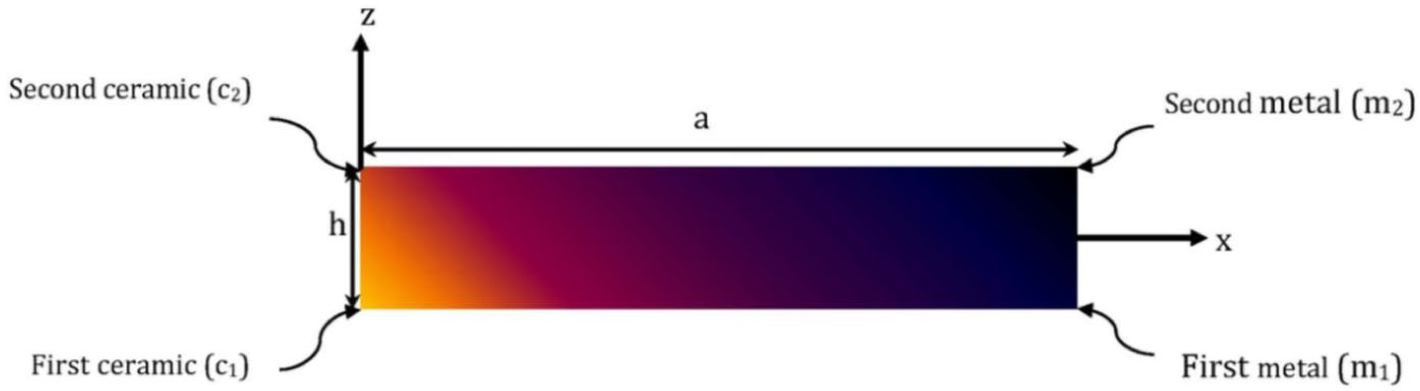
Geometry and coordinate system of the 2D-FG rectangular plate with coordinate convention.
Two-dimensional FGMs are usually made by continuous gradation of three or four different material phases. One or two of these phases are ceramics and the others are metal alloy. The volume fractions of the materials vary in a predetermined composition profile. In this article, the lower surface of the plate is assumed to be made of first ceramic in the left corner and it is made of first metal in the right corner. The upper surface of the plate is made of second ceramic and second metal in the left and right corners, respectively. Using the linear rule of mixtures, material properties at each point may be determined. Therefore, linear combination of volume fractions and material properties of the basic materials may be used to determine the distribution of material property P (e.g. modulus of elasticity and mass density) through the 2D-FGM plate. 47 That is

In equation (1),




where
Kinematics
The displacement field based on the TSDT is
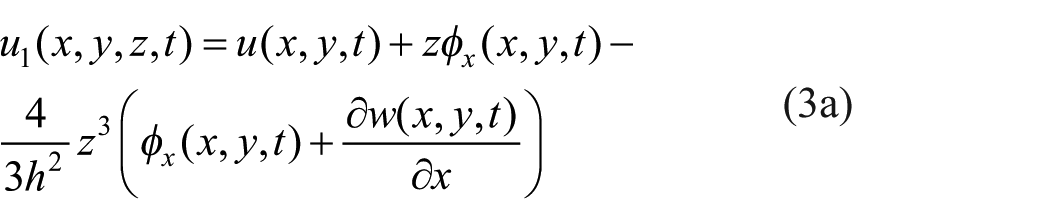
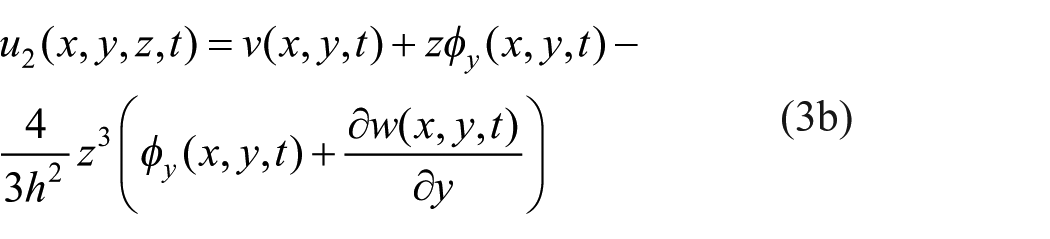

where t is the time, u, v, and w are displacements of a point on the middle plane in x, y, and z directions, respectively. Parameters

Displacement field and strain–displacement relations lead to the following equations for the strain tensor





where






In above equation,
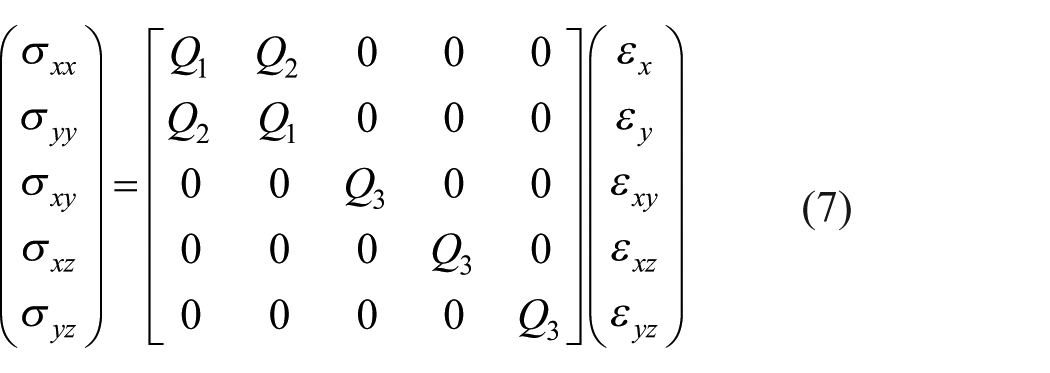
where

In equation (8), the term


where l is the material length scale parameter. The rotation vector

where



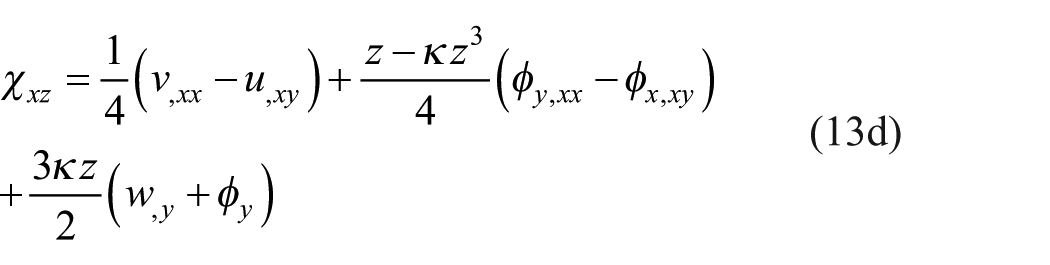
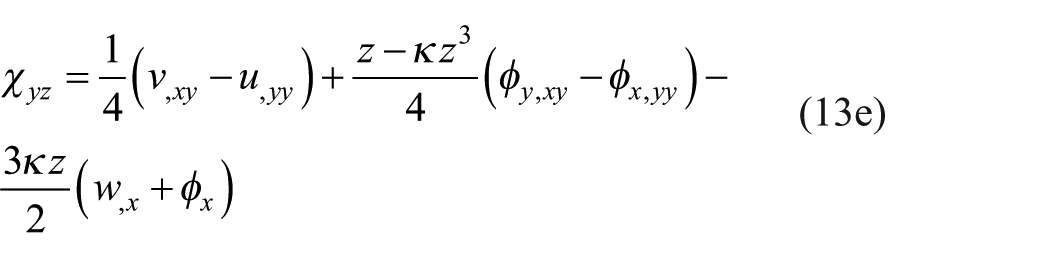
According to the third-order shear deformation theory, components of the symmetric curvature tensor are




Strain energy and kinetic energy
The strain energy of the system US is equal to the sum of the energy of the classical-elasticity strain energy USC, the strain energy from the initial stresses due to temperature rise UT, and couple–stress strain energy USNC. That is

The strain energy associated with classical elastic energy may be written as
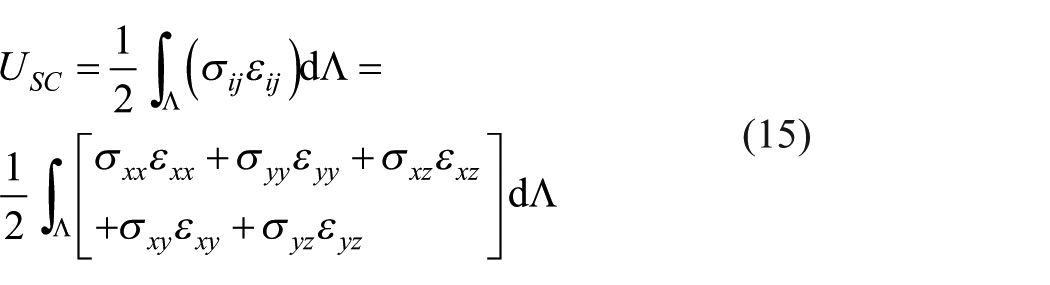
Substituting equations (5)–(7) into equation (15), the classical elastic energy is
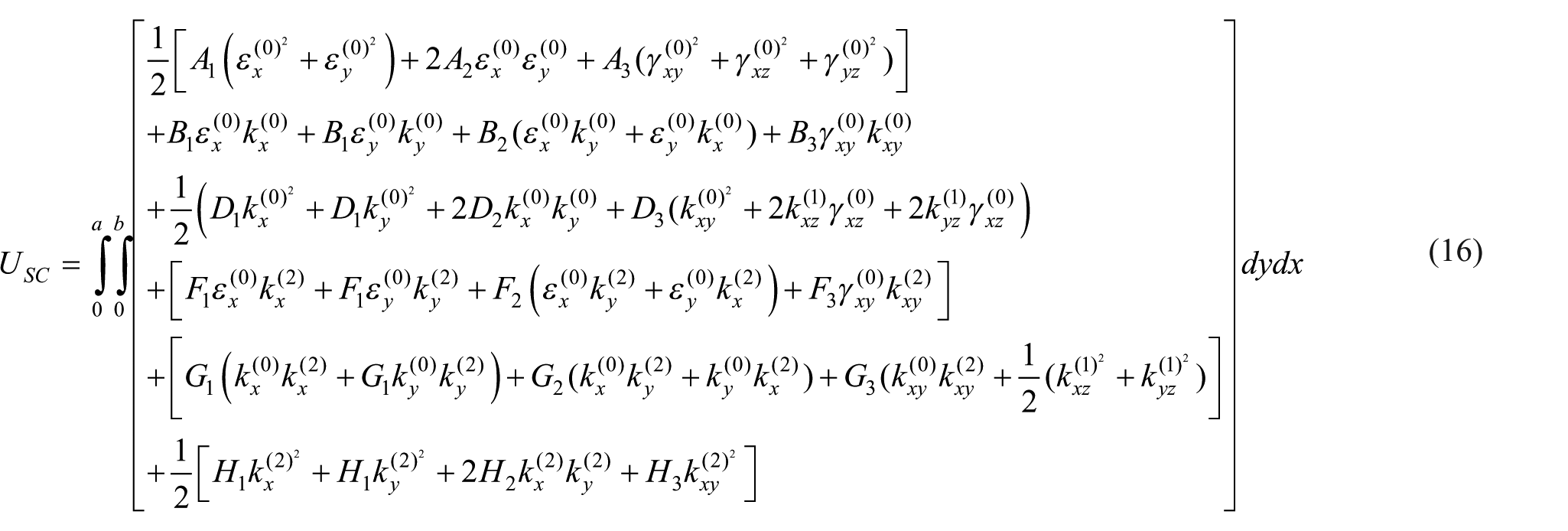
Constants
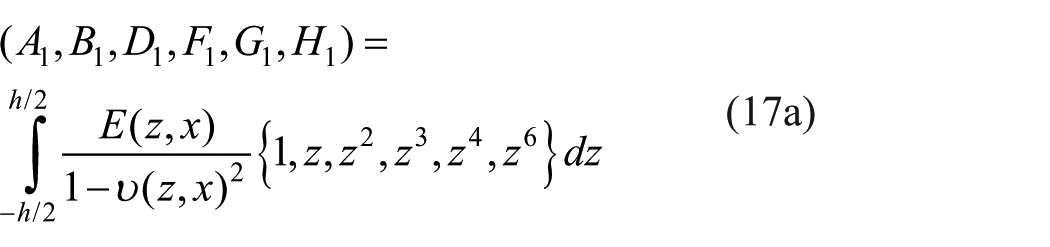
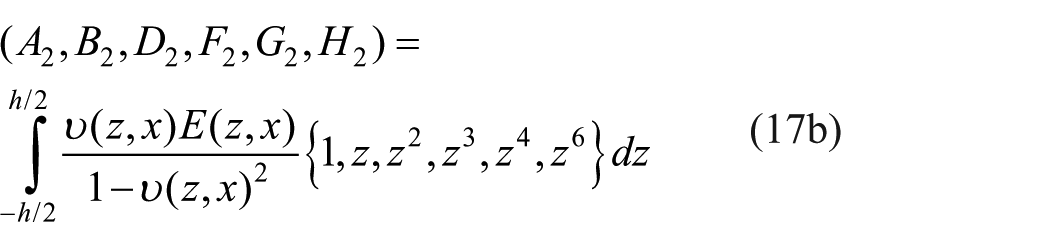

The strain energy from the initial stresses due to the temperature rise UT is

where

By substituting

where
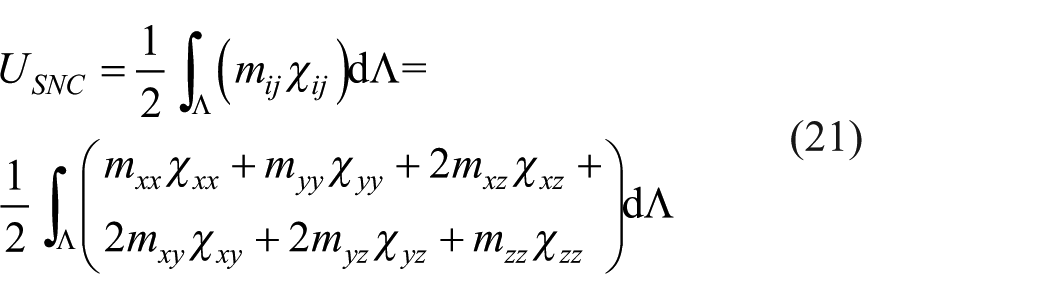
Equation (22) is rewritten as follows

Following integrals are applied to define

Strain energy for FG microplate using classical plate theory is included in Appendix 2. The kinetic energy of the FG microplate is

Temperature distribution
Two types of temperature distribution are assumed through the microplate. In the first type, a uniform temperature distribution is assumed through the body. In the second type, a sinusoidal temperature distribution is assumed through the thickness and length of the plate.
Uniform temperature rise
The uniform temperature rise though the microplate is represented as

where ∆T denotes the uniform temperature change and
Sinusoidal temperature rise
The temperature distribution of the plate should be determined by solving the heat transfer equation. However, in this case the heat transfer coefficient varies along the two directions, and the heat transfer equation changes to a differential equation with variable coefficients. As the result, no analytical solution could be found for the temperature distribution, and approximate temperature distribution which satisfies the thermal boundary conditions is employed. Generally, the form of this approximate solution is sinusoidal.46,49,50 The temperature field for the second type (i.e. the sinusoidal temperature distribution) is represented as

where Tb and Tc are constant values. Tb is the temperature of the four surfaces of the plate which are perpendicular to x and z axis. Parameter Tc is the temperature of the central line of the plate along the y axis which is located at
Mechanical boundary conditions
Assuming the simply supported conditions for all edges of the plate, the mechanical boundary conditions are


The following displacement functions satisfy the simply supported boundary conditions given in equation (27)





where t is the time,
Application of Rayleigh–Ritz method
In equation (28), the multipliers Am,n, Bm,n, Cm,n, Dm,n, and Em,n are calculated using the Ritz method. To this aim, the Lagrangian function is defined as

Applying the Rayleigh–Ritz method and substitution of admissible displacements given in equation (28), the Lagrangian functional is determined. Now, we extermize the Lagrangian with respect to the coefficients Am,n, Bm,n, Cm,n, Dm,n, and Em,n. That is

Substituting equation (28) into equations (16), (20), (22), and (24), the frequency equation is obtained as follows

In this equation, ω is the natural frequency, [M] is the mass matrix and [K] is the stiffness matrix. Elements of these sub-matrices are given in Appendices 1 and 2 for TSDT and CPT respectively. Solution of this eigenvalue problem results to the natural frequency of the FG microplate.
Validation
To best of our knowledge, no other authors have considered all conditions considered in this work simultaneously. So to validate the results, we have reproduced some data of other authors in several steps. In first step, the size-dependent behavior of the microplate is verified with results of Ke et al.
23
To this aim, the nonhomogeneous microplate is simplified to a homogeneous one by setting both power indexes to zero. Then, based on the classical and third-order plate theories, fundamental natural frequencies of this work are compared with results of Ke et al.
23
The fundamental frequencies in Ref. [23] are based on the Mindlin plate theory. Material properties for data given in Table 1 are
First natural frequency (MHz) of Simply supported homogeneous microplates (a/b = 1 and h = 2l).

CPT: classical plate theory; TSDT: third-order Vlasov–Reddy theory.
Verification of the fundamental frequency parameter Ω for 1D-FG plate (Si3N4/ SUS304) (a/b = 1 and a/h = 10).
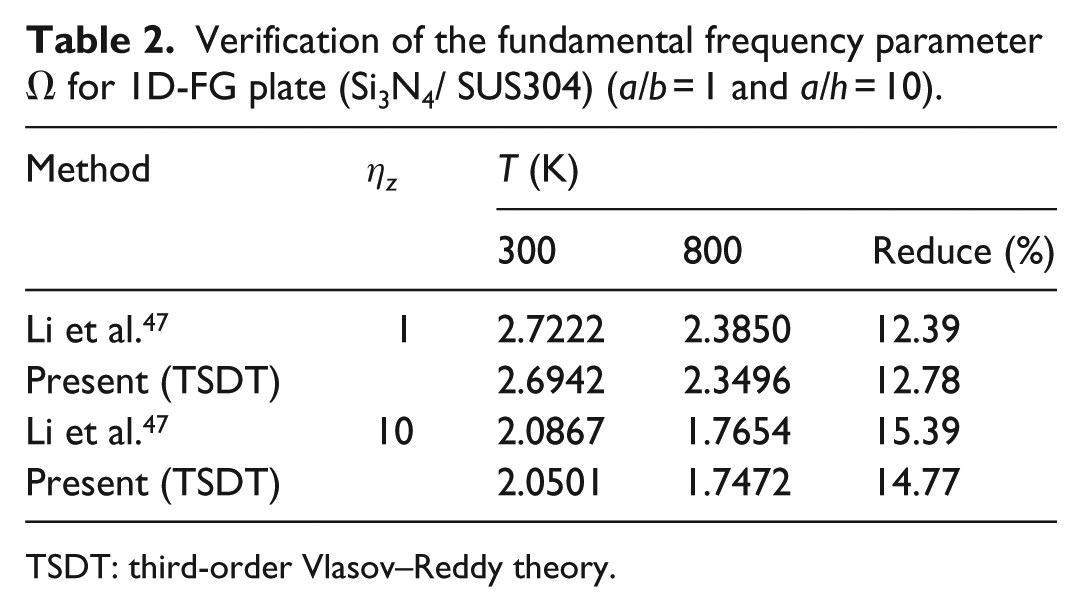
TSDT: third-order Vlasov–Reddy theory.
Verification of the fundamental frequency parameter Ω for 1D-FG plate (Si3N4/SUS304) (∆T = 300°K and a/b = 1).

TSDT: third-order Vlasov–Reddy theory.
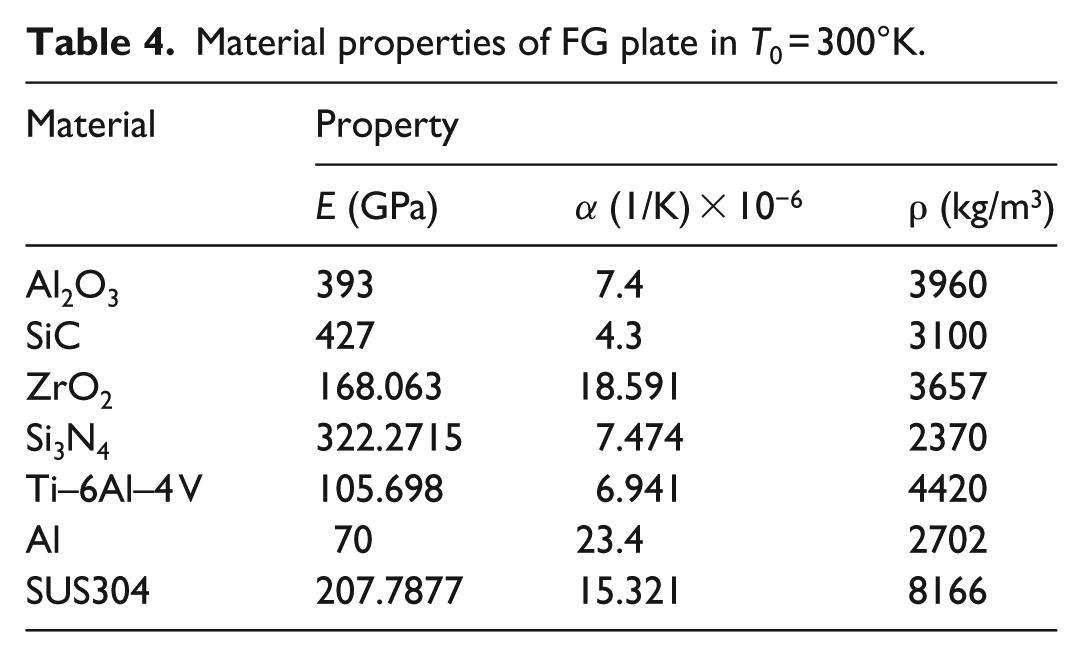
Material properties of FG plate in T0 = 300°K.
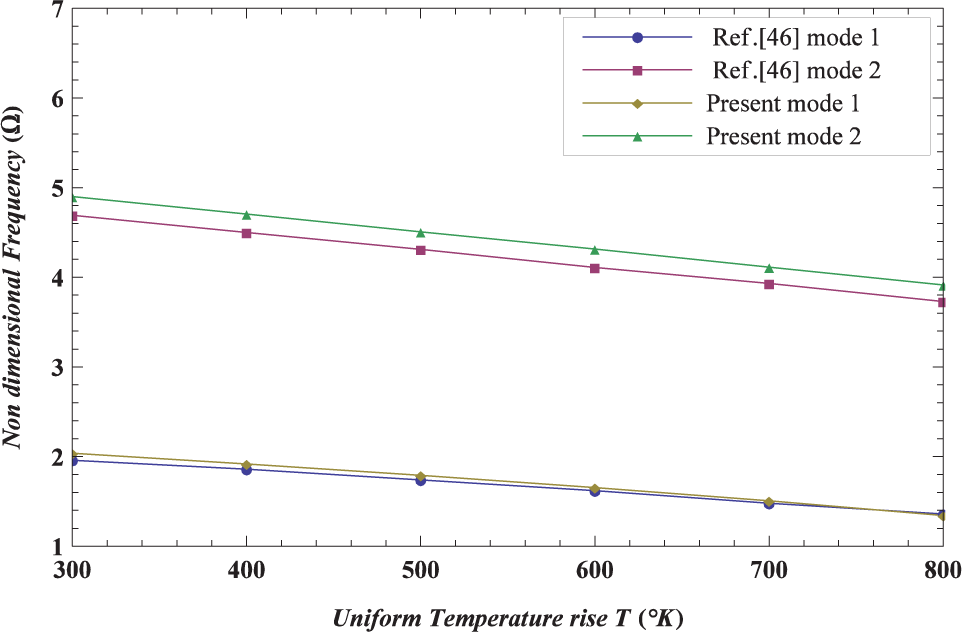
Verification of the first two normalized frequencies Ω for 1D-FG microplate (ZrO2/Ti–6Al–4V) (a/b = 1, a = 0.2 m, a/h = 10, ηx = 0, and ηz = 1).
Result and discussion
Natural frequencies of 2D-FG microplates are investigated in this work. The material of microplate is assumed to be Ti–6Al–4V, Al, SiC, and Si3N4 for metal type 1 (m1), metal type 2 (m2), ceramic type 1 (c1), and ceramic type 2 (c2), respectively. In Table 4, mechanical properties of FG plate at 300°K are specified. The simply supported boundary condition is assumed for all edges of the microplate and the length scale parameter is

In Figure 3, the volume fraction of the first type of ceramic
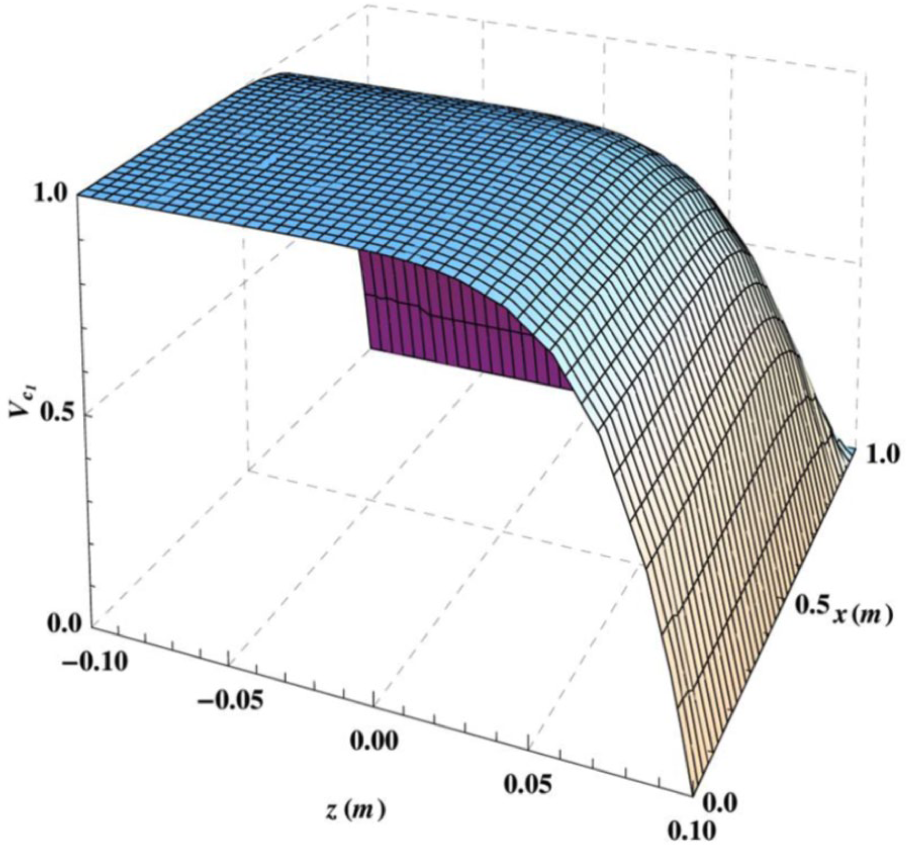
Variations of the volume fraction
Figure 4 shows the plot of sinusoidal temperature distribution in x and z directions for
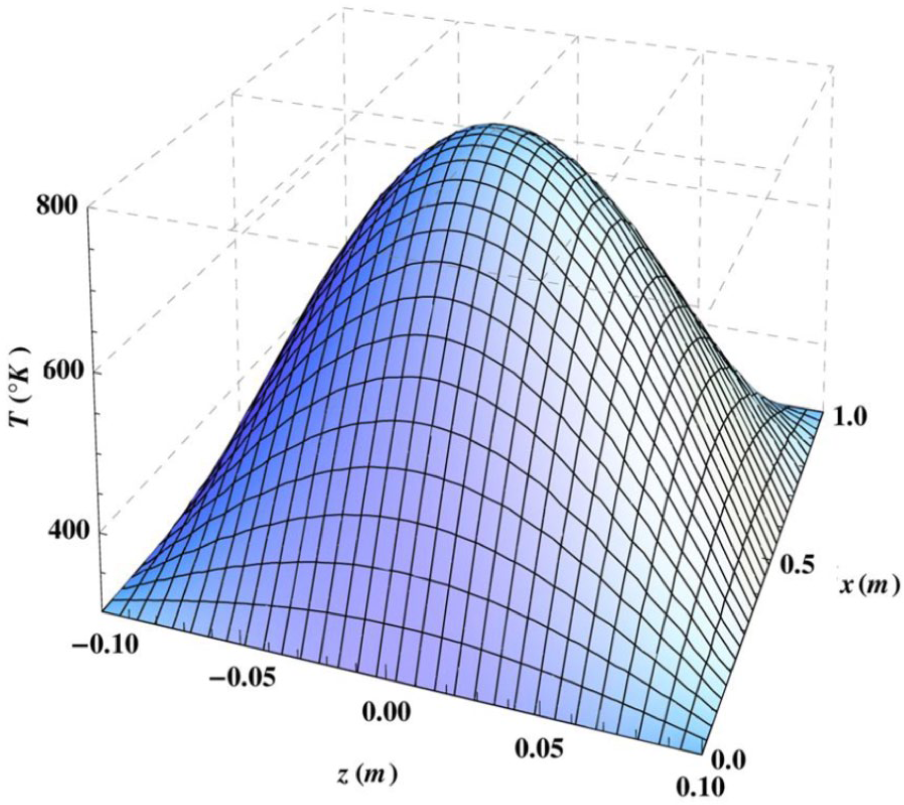
Sinusoidal temperature distribution T(x, z) along the thickness and length directions (Tc = 800°K).
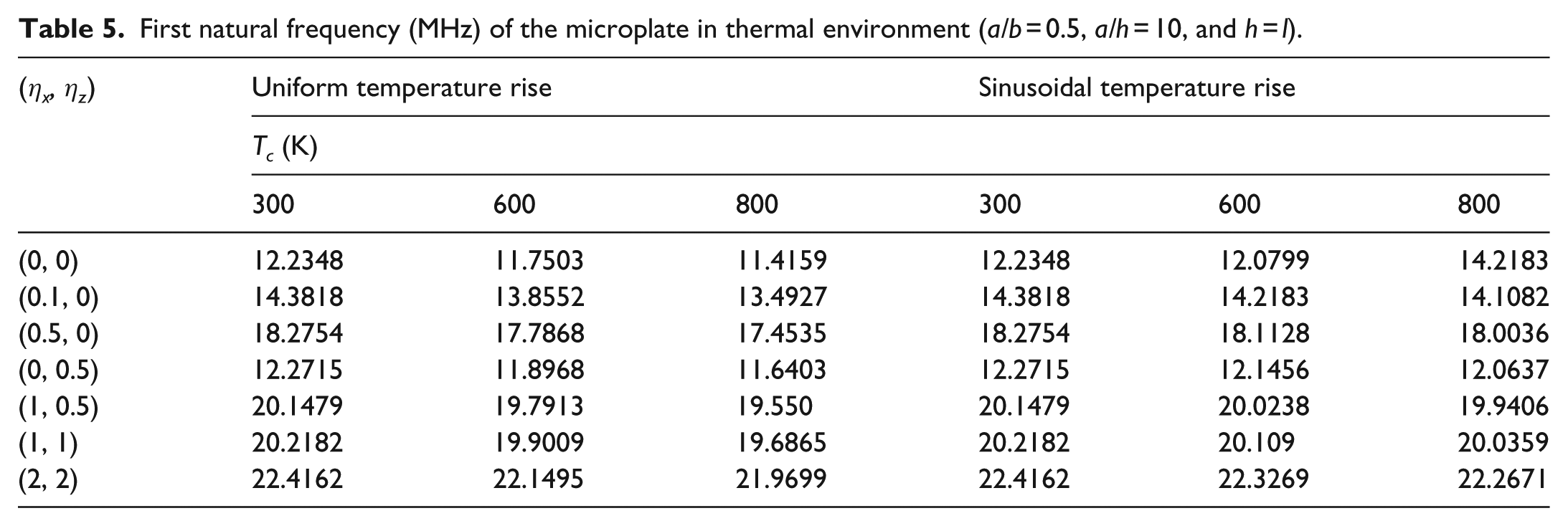
First natural frequency (MHz) of the microplate in thermal environment (a/b = 0.5, a/h = 10, and h = l).
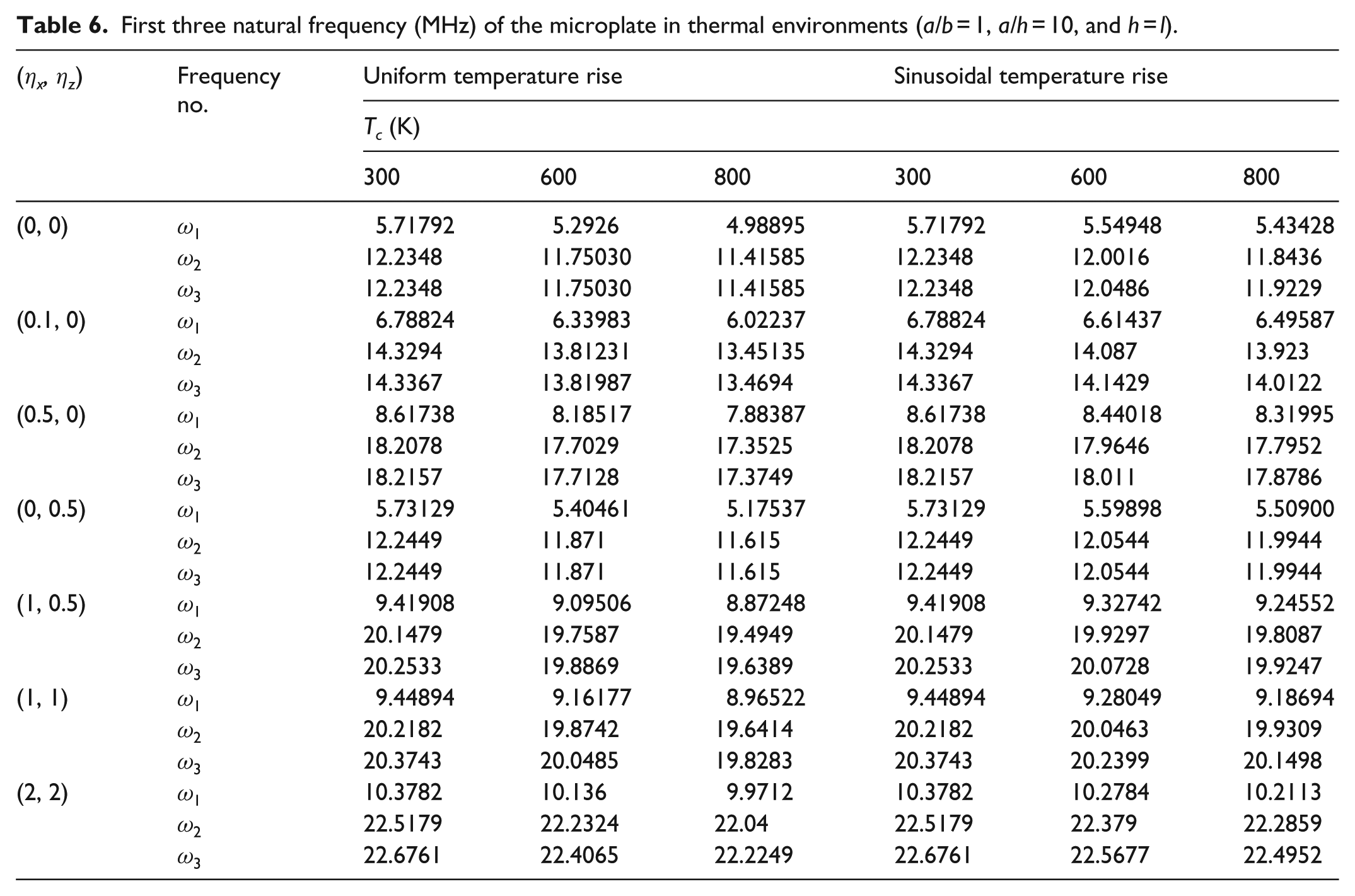
First three natural frequency (MHz) of the microplate in thermal environments (a/b = 1, a/h = 10, and h = l).
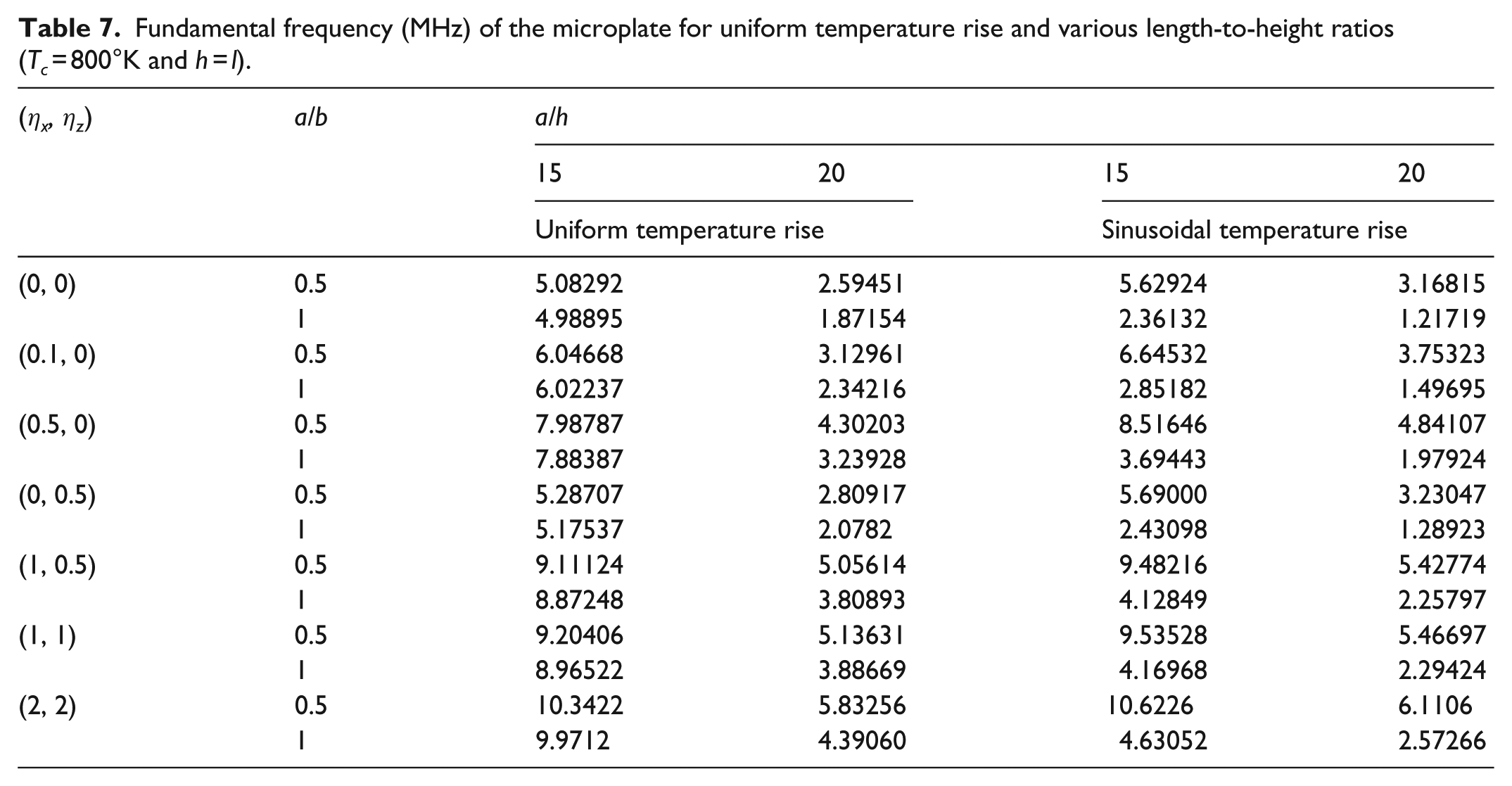
Fundamental frequency (MHz) of the microplate for uniform temperature rise and various length-to-height ratios (Tc = 800°K and h = l).
Compared the classical and the modified stress couple theories (MSCT), Figure 5 represents variation of first two natural frequency of the 2D-FG microplate versus height-to-length ratio for uniform temperature rise. The figure shows that higher height-to-length ratio decreases the natural frequencies of the microplate. The slope of the curve is high for small values of height-to-length ratio, and the difference between the classical theory and stress couple theory is considerable for
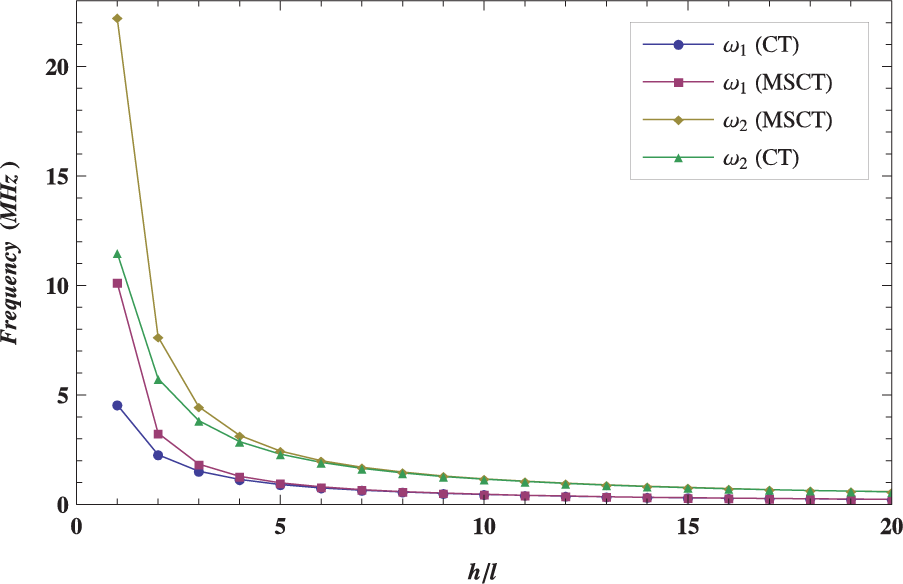
Comparison of the first two natural frequency (MHz) of the microplate between the classic and stress couple theories for uniform temperature rise (ηx = 2, ηy = 2, a/h = 10, a/b = 1, and T = 600°K).
Figure 6 compares the natural frequency of 2D-FG microplate between the TSDT and CPT. As the figure shows, difference between the natural frequencies obtained by these theories is increased for
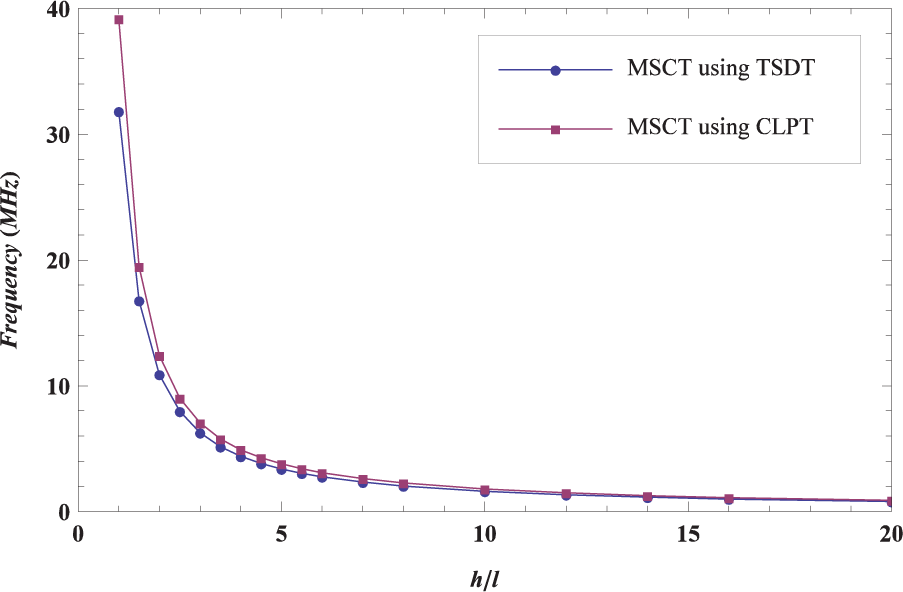
Comparison of the first natural frequency (MHz) of the microplate between classic and stress couple theories for uniform temperature rise (ηx = 1, ηy = 1, a/h = 5, a/b = 1, and T = 600°K).
Figures 7 and 8 show the plot of natural frequencies versus ηx and ηz, repectively. Increasing ηx results to increase in percent of metal, while increase in ηz results to decrease in percent of first material (either ceramic or metal). However, due to the layout of material at four corners of the plate, the difference between the stiffness of metal and ceramic is more tangible in comparison with the stiffness of the first and the second materials (either ceramic or metal). Therefore, the slope of natural frequency versus ηx is higher. Figure 9 shows the plot of natural frequencies versus ηx and ηz. The figure shows that increasing ηx and ηz result to increase in natural frequency.
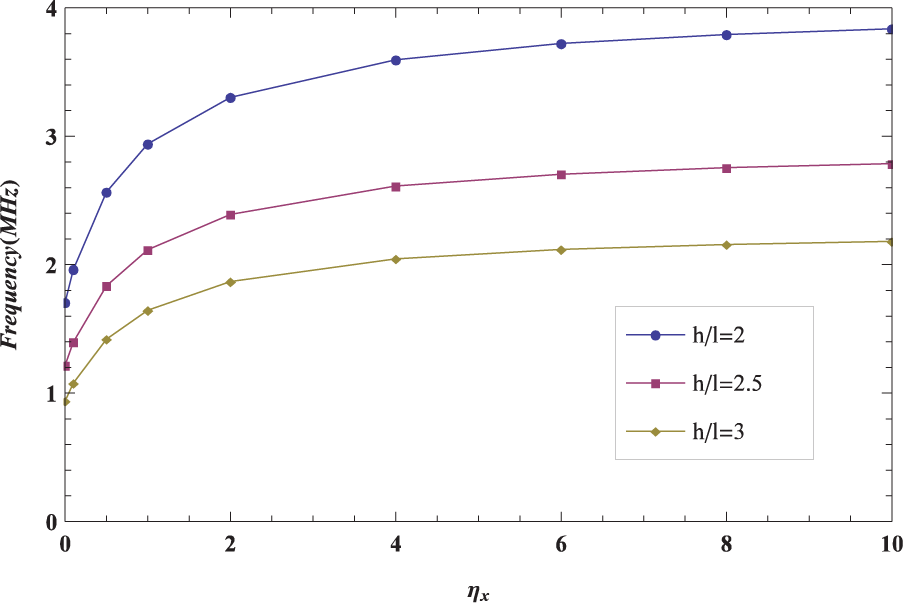
First natural frequency (MHz) of the microplate versus power index ηx for various h/l and uniform tmperature rise (ηy = 2, T = 600°K, a/h = 10, and a/b = 1).

First natural frequency (MHz) of the microplate versus the power index ηz for various h/l and uniform temperature rise (ηx = 4, T = 600°K, a/h = 10, and a/b = 1).
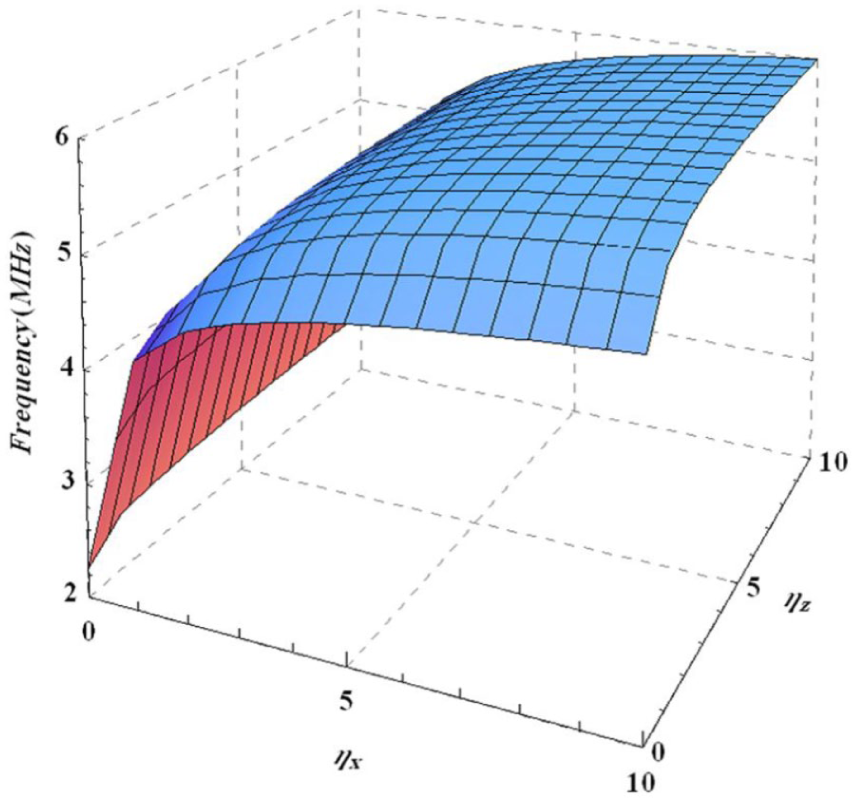
First natural frequency (MHz) of the microplate versus ηx and ηz for uniform temperature rize (h/l = 1.5, T = 600°K, a/h = 10, and a/b = 1).
Figures 10 and 11 show the plot of natural frequency of the microplate versus uniform and sinusoidal temperature rise, respectively. As it can be seen from the figures, the tempreature rise decreases the natural frequencies for both cases. While increase in h/l result to decrease in natural frequency, it does not effect the slope of the curves. Figure 12 is plot of natural frequency versus a/h at Tc = 300 and 800°K. Higher value of a/h increases the flexibility of the microplate. Therefore, the natural frequency of the plate decreases. Furthermore, effect of temperature on natural frequency increases with reduction in stiffness of the plate.
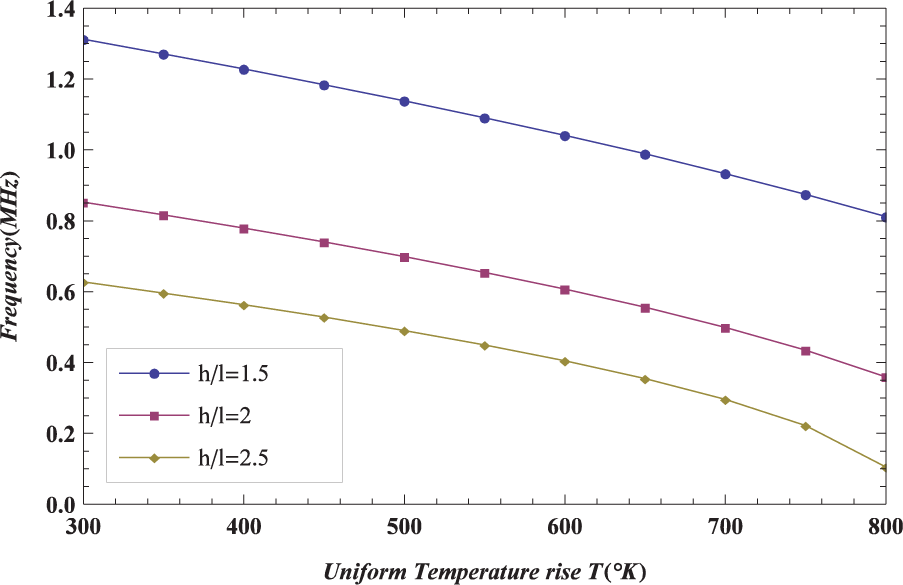
First natural frequency (MHz) of the microplate versus the uniform temperature rise for various h/l (ηx = 1, ηy = 1, a/h = 30, and a/b = 0.5).
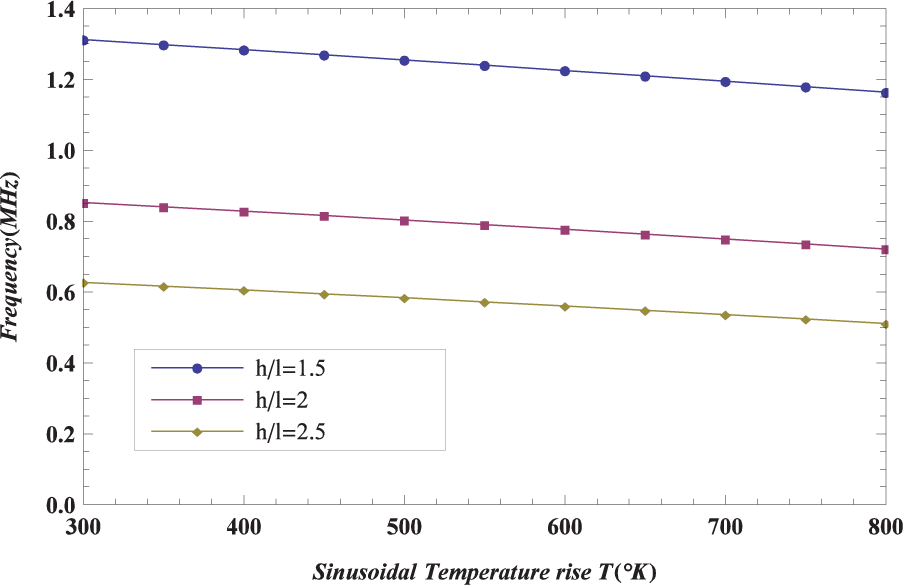
Variation of the first natural frequency (MHz) of the microplate for sinusoidal temperature rise for various h/l (ηx = 1, ηy = 1, a/h = 30, and a/b = 0.5).
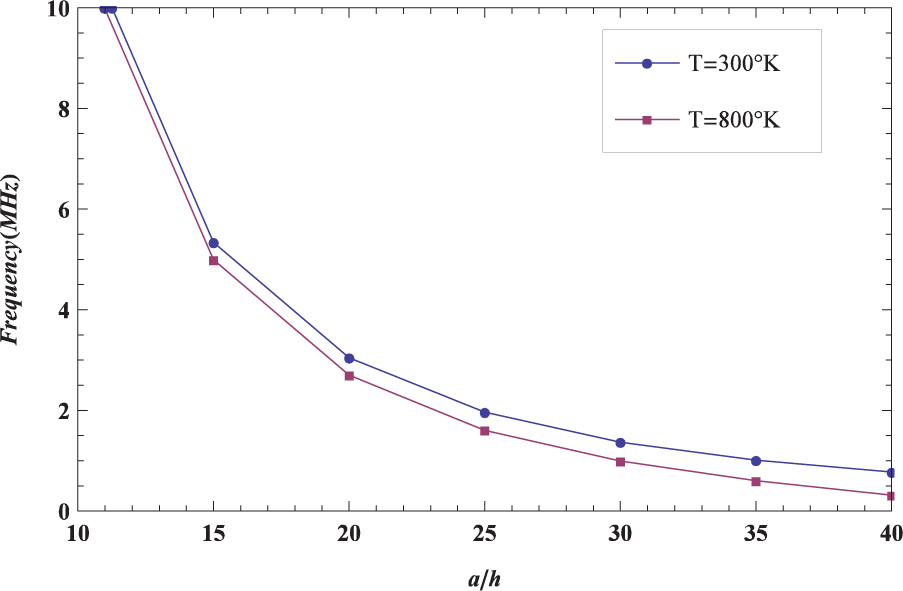
First natural frequency (MHz) of the microplate versus a/h for various Tc with sinosoidal temperature rise (ηx = 1, ηy = 1, h/l = 1, and a/b = 0.5).
Figure 13 compares variation of natural frequency with respect to the temperature for uniform and sinusoidal temperature rise. For the case of sinusoidal temparture rise, the temperature is
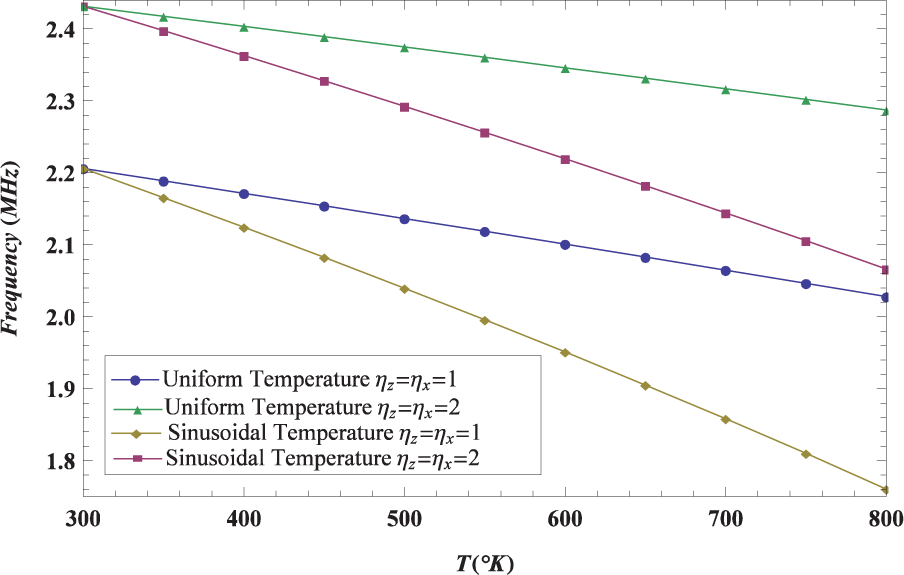
Comparison of the first natural frequency (MHz) of the microplate versus the temperature rise for uniform and sinusoidal condition when h/l = 1.5, a/b = 1, and a/h = 15.
Conclusion
In this article, thermoelastic vibration of a 2D-FG microplate based on the third-order shear deformation theory is investigated using the modified couple stress theory. The numerical Rayleigh–Ritz method is applied to obtain the natural frequencies. Analyzing the natural frequencies obtained by eigen value problem solution yields to the following conclusions.
Increasing the volume fraction powers in directions of x and z result to higher natural frequencies. Increasing the thickness-to-length ratio of the plate results to lower natural frequencies. For thickness-to-length ratio less than five, the difference between the classical theory and modified couple stress theory is significant. According to results obtained by classical and third-order shear deformation theories, the third-order shear deformation theory is proposed for vibration analysis of microplates with thickness-to-length ratio less than five. Increasing the geometric ratios such as length-to-thickness and length-to-width of the plate results to decrease in natural frequencies. Increasing the temperature reduces the natural frequencies, and this reduction of natural frequencies is more tangible for uniform temperature rise in comparison with sinusoidal temperature rise.
Footnotes
Appendix 1
The stiffness matrix is defined as the sum of matrices classical stiffness matrix [K] SNC , couple–stress stiffness matrix [K] SC , and thermal stiffness matrix [K] T . The stiffness and mass matrix in equation (31) is
where
The elements of the stiffness matrix and the mass matrix are given as follow
where
Appendix 2
The displacement field based on CPT is
The strain–displacement equations are
where
The constitutive equations are
The stress components due to temperature rise ∆
Components of the rotation vector for CPT are
Components of the symmetric curvature tensor according to the CPT are
The strain energy associated with the classical elasticity theory on CPT is
The strain energy associated with couple stress theory based on CPT is
The strain energy from the initial stresses due to the temperature rise UT is
where
By substituting
Defining the unknown coefficients in CLPT by
Elements of the stiffness matrix and the mass matrix are given as follows
Declaration of conflicting interests
The author(s) declared no potential conflicts of interest with respect to the research, authorship, and/or publication of this article.
Funding
The author(s) received no financial support for the research, authorship, and/or publication of this article.
