



Abstract
The equilibrium point and stability of the motion equation of the nonlinear near resonance centrifuge is studied, and the critical conditions for chaotic motions of the system under external excitation are studied by Melnikov method. The expression of Melnikov function and the boundary value between chaotic and non-chaotic regions are given. According to the range of parameters, the numerical simulations are carried out. The results show that the critical parameters of chaotic motion determined using Melnikov method are consistent with that obtained by the numerical simulation. This method effectively judges the occurrence of chaotic motion.
Introduction
The horizontal vibrating discharge centrifuge is the main dehydration equipment of the lump coal in the coal preparation plant.1,2 The near resonance centrifuge is a kind of vibration equipment whose elastic force is nonlinear. The near resonance centrifuge precisely uses the resonance principle to reduce the required excitation force. The force of the transmission mechanism and the friction power of the transmission part can be reduced according to the energy consumption.3,4 When the frequency and amplitude of the near resonance centrifuge, the anti-resonance centrifuge or the far resonance centrifuge are the same, the acceleration of nonlinear resonance centrifuge is larger, the material running speed is faster, and the processing capacity is larger. At present, the near resonance centrifuges used in domestic coal preparation plants are mainly HSG series centrifuges manufactured by Tianma Company in the Netherlands.5,6
Melnikov method is a typical method7,8 for theoretical prediction of chaotic motions in nonlinear vibration systems. This method can be used to analyze and determine chaos in the sense of Smale in quasi Hamiltonian systems. Compared with the traditional numerical simulation methods of chaotic motion,9–15 Melnikov method can give analytical conditions with less computation as the necessary conditions for existence of chaotic motions in the systems. For a Hamiltonian system, if the system has homoclinic or heteroclinic orbits, the stable and unstable manifolds of the fixed point of the system corresponding to the periodic orbit will split under the disturbance of weak periodic external forces. If these orbits intersect, it often means that the chaotic motion will occur. Melnikov method uses an integral (Melnikov integral) to determine the distance between stable and unstable manifolds. When the system satisfies a certain parameter relationship, the distance will have a simple zero point, and then Poincaré mapping has a cross-sectional homoclinic point. According to the Smale–Birkhoff theorem, it can be proved that there is a Smale horseshoe type chaotic set near the homoclinic point for the Poincaré mapping composite, from which it can be determined that the system will appear chaos.
In this article, the nonlinear dynamic equation of the resonant centrifuge under the excitation force is established, and the conditions that the system parameters need to be satisfied when the system appears chaos are studied by Melnikov method. At the same time, the chaotic motion of the system is simulated numerically.
Nonlinear near resonance centrifuge and the dynamics equation of the system
As shown in Figure 1, HSG series horizontal vibrating centrifuges adopt double-axis inertial exciter. The shaft is equipped with eccentric blocks, arranged symmetrically up and down, and a pair of gears with the same number of teeth forces synchronous rotation. The motor drives the driving wheel to rotate, and under the engagement of the gear, the driven wheel rotates synchronously and reversely, so as to generate the horizontal exciting force and make the screen blue horizontally vibrate and unload along the main shaft direction. The centrifuge exciter is consolidated with the sieve basket and the exciting force directly acts on the sieve blue mass.16,17 In Figures 1, 2, and 7 are rubber ring buffers, which mainly support and provide axial elastic force. Nos. 3 and 16 and their symmetrical parts are rubber fan-shaped buffers, and there is a certain gap between the two buffers. The big pulley, exciter, screen basket, and main shaft are the same vibrating mass. In normal operation, when the mass of the screen basket vibrates to the left and the amplitude is greater than the gap of the fan-shaped buffer pad, the impact of the fan-shaped buffer pad 3 will produce an elastic restoring force; similarly, when the mass of the screen basket vibrates to the right and the amplitude is greater than the gap of the fan-shaped buffer pad, the impact of the fan-shaped buffer pad 16 will produce an opposite elastic restoring force. The vibration mechanism of HSG series horizontal vibrating centrifuge is shown in Figure 2.
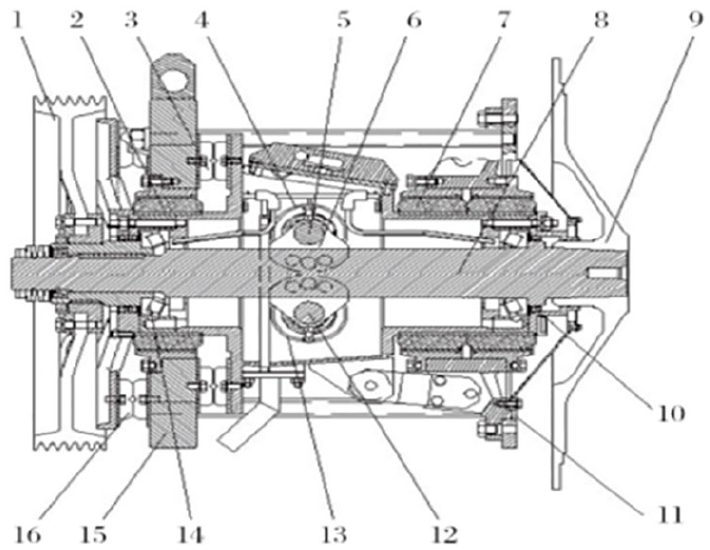
Structure of vibrating box of HSG series horizontal vibration centrifuge.
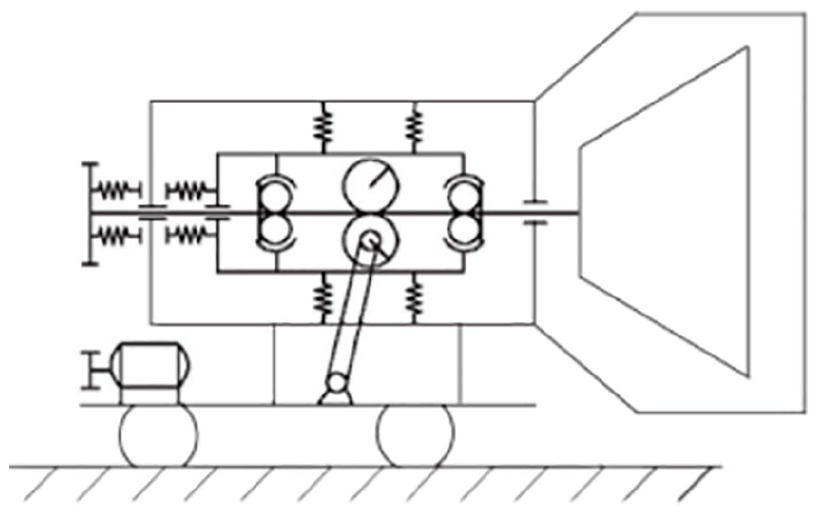
Vibration mechanism of HSG series horizontal.
The dynamic equation of the system
The simplified mechanical model is a single-degree-of-freedom spring force piecewise linear vibration model, as shown in Figure 3. The stiffness of the system is expressed by piecewise linear function k (x)

where k is the linear stiffness of main vibration spring,
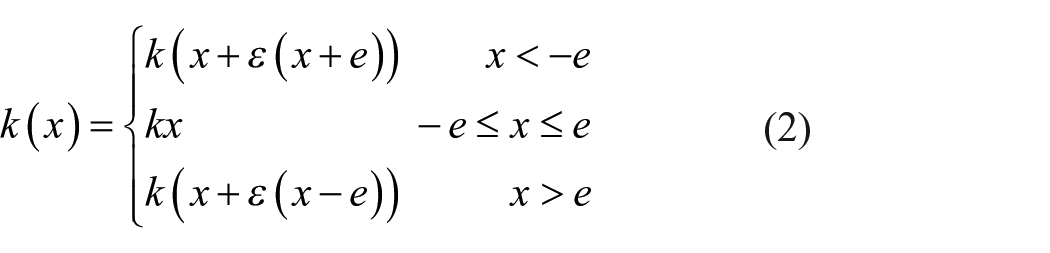
where
Suppose
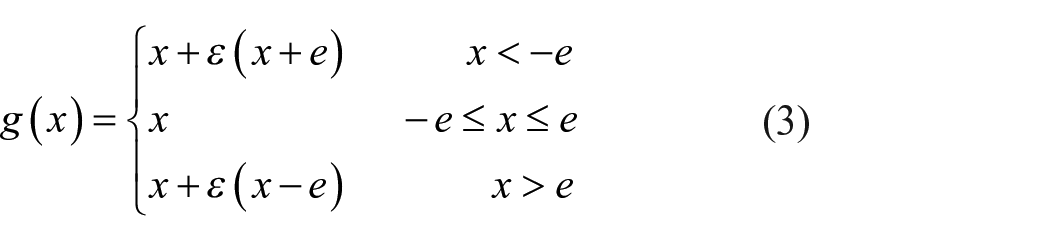
Assume that the system has a weak damping. The dynamics equation of this piecewise linear system is

In equation (4), m is the mass of vibrating mass, kg; c is the damping coefficient,
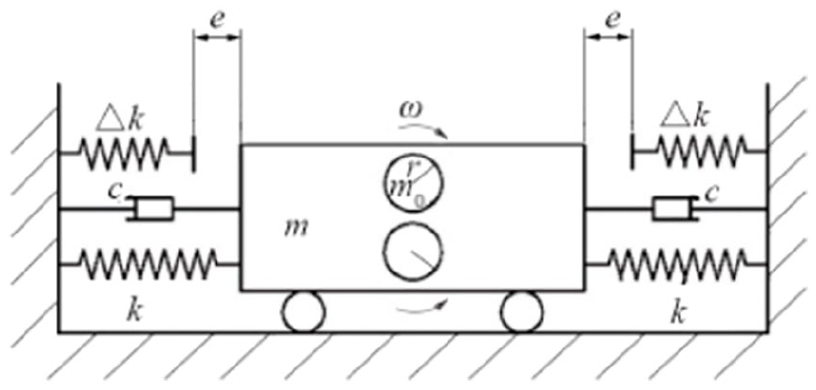
Vibration mechanical model of HSG series horizontal vibration centrifuge vibration centrifuge.
Duffing system is generally aimed at nonlinear system. Duffing equation takes the coefficient k of the third term as a small parameter, and k is a small independent parameter. Equation (4) divide both sides by m at the same time

where

In the case of small vibration amplitude, a continuous function
Take the state variable of equation (6), let
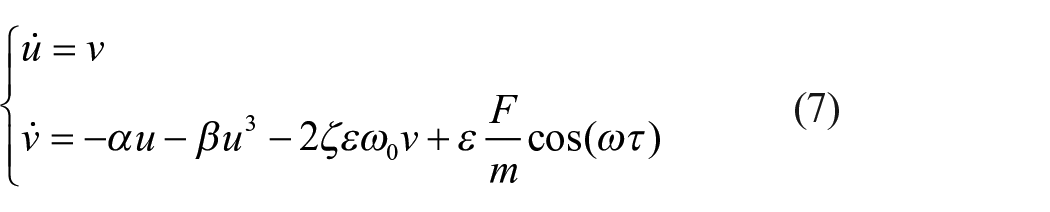
where
Because the amplitudes of damping and the exciting force F are small,
Periodic motion of the conservative system
When

If equation (8) is equal to zero, the equilibrium points of the system can be obtained. When
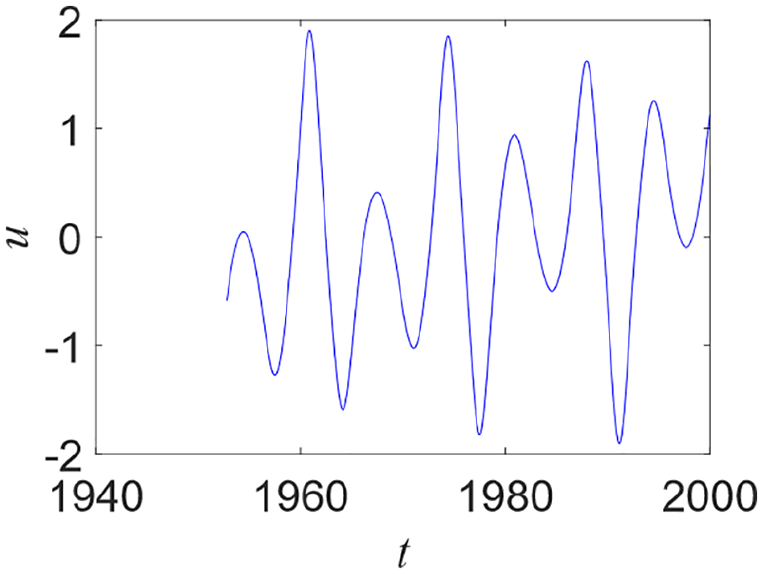
As shown in Figures 4 and 5, when
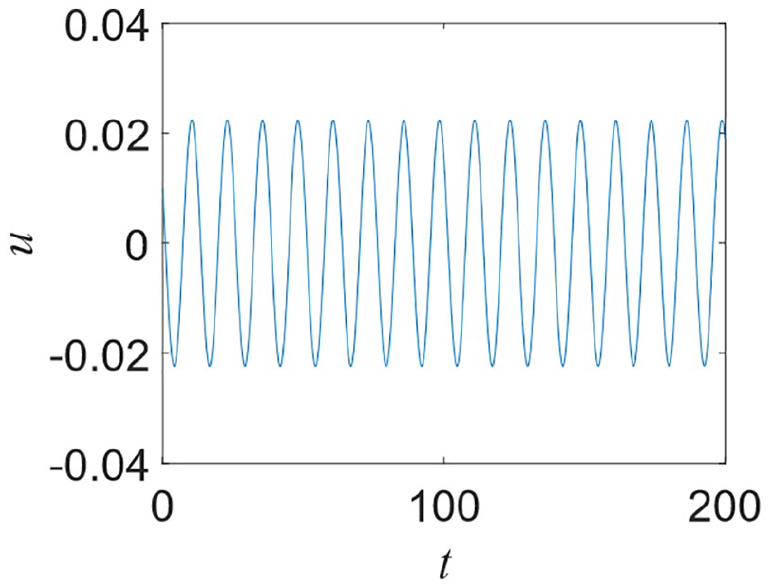
The time process diagram (t–u).
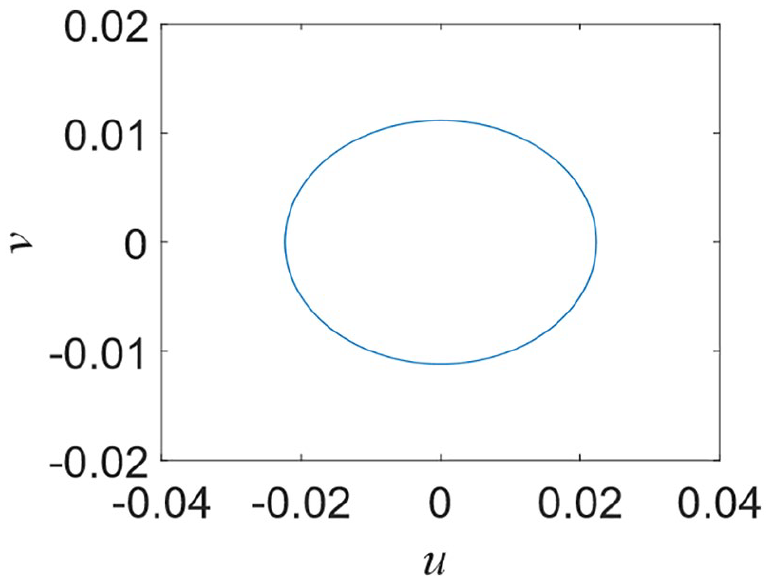
Phase diagram (u–v) of the unperturbed system.
When

From equation (9), we can find out the heteroclinic orbit of the hyperbolic saddle points
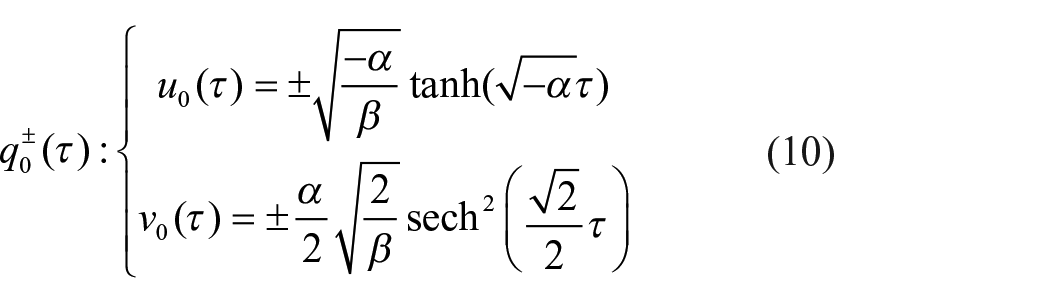
where (+) represents the positive axis part of the heteroclinic orbits and (–) represents the negative axis part of the heteroclinic orbits.
Melnikov method for chaotic motion analysis of the system
When
Quasi Hamiltonian system with equation (7) expression

where

where

Since the unperturbed system is a Hamiltonian system, the trace of the divergence of the vector field

Let
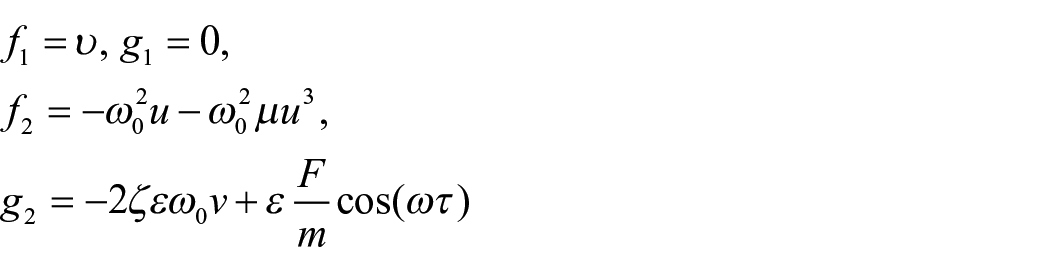
The Melnikov function corresponding to equation (7) is
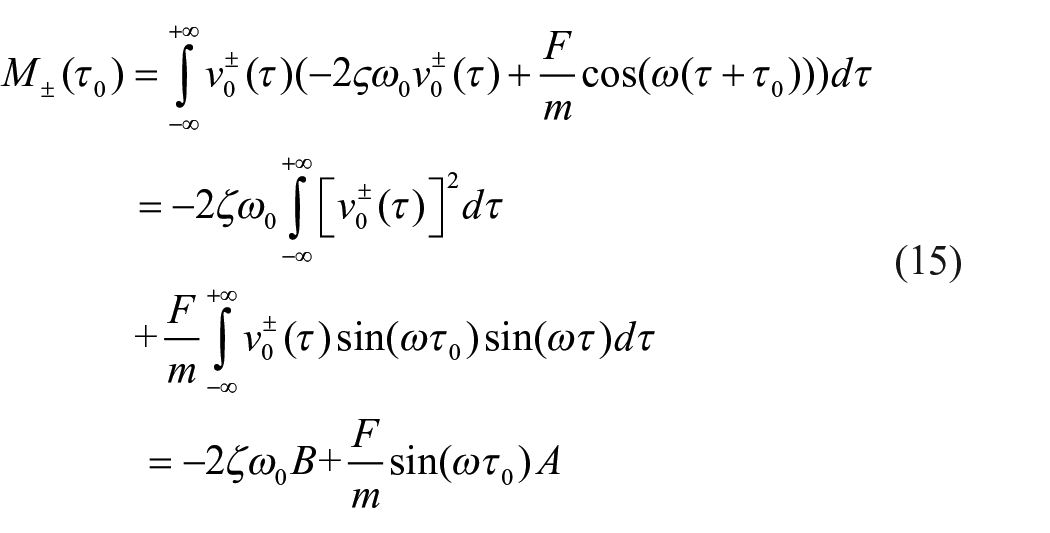
The Melnikov integral can be calculated as

According to Melnikov’s theory,10–12 if Melnikov’s function has a simple zero point which does not depend on

Then equation (7) appears a Smale horseshoe type chaotic motion.
Numerical integration method for calculating Melnikov function
From the above, in order to get the threshold value
If

On the heteroclinic orbit

It follows from equations (18), (19), and (16) that
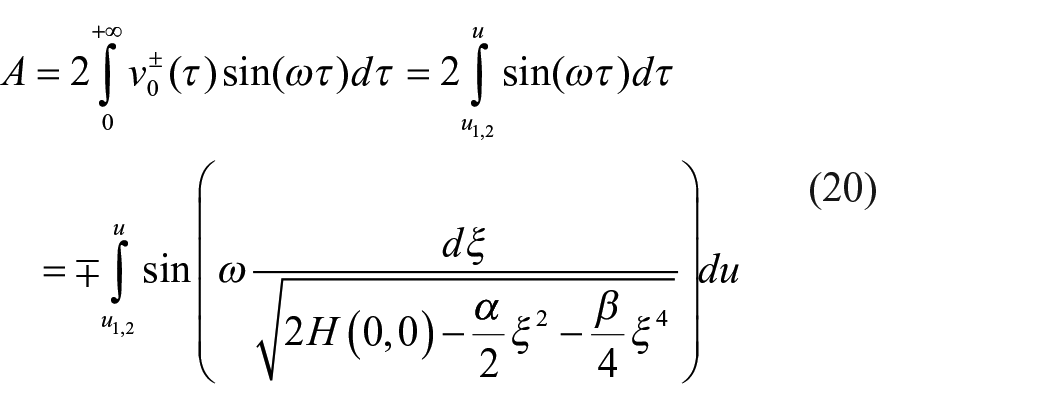
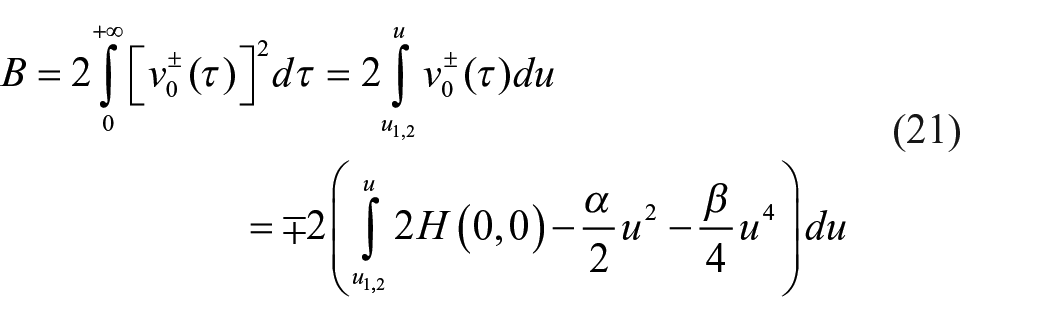
Now, we can use the numerical integration method to estimate the values of α and β according to this procedure. The values of α and β are obtained by numerical integration of equation (20) and (21) in terms of complex Simpson formula.
When the frequency ω of the applied force is in the interval [0,1], the complex Simpson formula is used to integrate u in 1000 steps and u in 500 steps, then the A and B values corresponding to each value ω can be obtained. We can get the Melnikov threshold value with ω. When the value of
Numerical simulation of the system
Let
The time process diagram (t–u).

The phase diagram (u–v) of equation (7).
When ω = 1.35, the time process diagram (t–u) and the phase diagram (u–v) of the conservative undisturbed equation (7) are shown in Figures 8 and 9. Equation (7) behaves in chaotic motion. The chaotic attractor of the system on Poincaré section is shown in Figure 10. It can be seen from the calculation results that the critical value of the parameters obtained from the numerical simulation results is consistent with the critical value determined by Melnikov method.
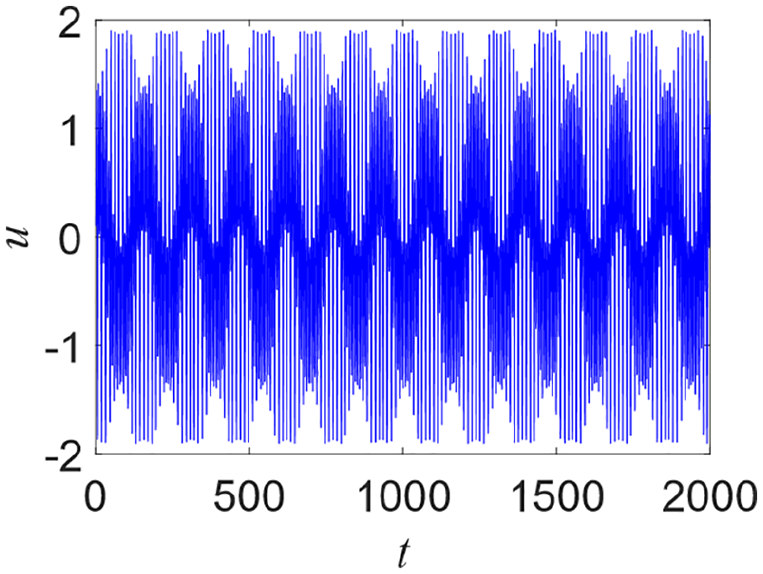
The time process diagram (t–u).
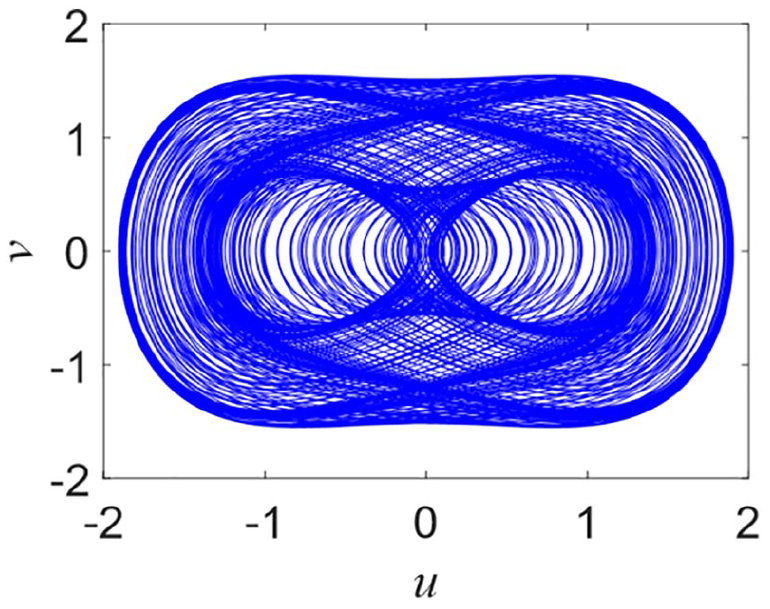
The phase diagram (u–v) of equation (7).
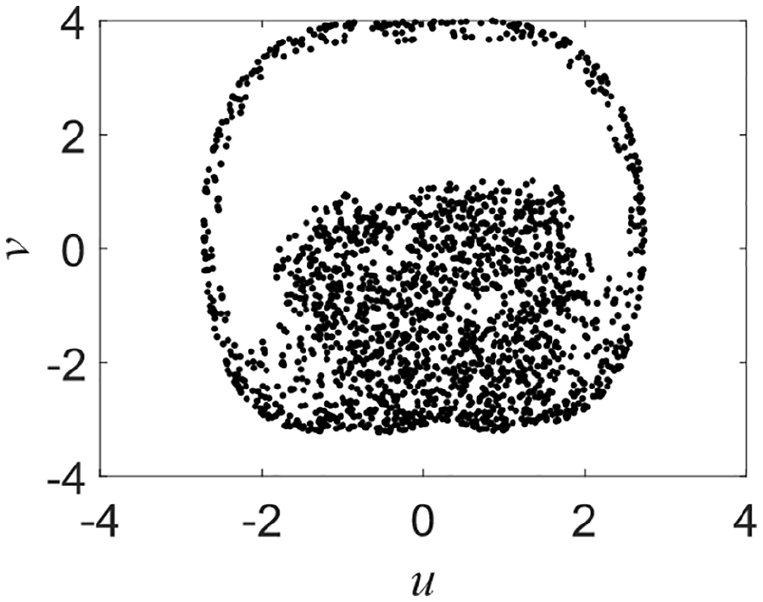
Chaotic attractor on Poincaré section of equation (7).
Conclusion
In this article, Melnikov method is used to analyze the critical conditions of the parameters of a nonlinear near resonance centrifuge when chaotic motion occurs under external excitation. The expression of Melnikov function and the boundary value between chaotic and non-chaotic regions are given. According to the range of parameters, the numerical simulation is carried out, and the results verify that the critical parameters of chaotic motion determined by Melnikov method are consistent with the corresponding critical parameters when chaotic motion occurs in the numerical simulation. The comparison with the numerical simulation results shows that the method can effectively determine the occurrence of chaotic motion of the system and provide theoretical basis for engineering application.
Footnotes
Declaration of conflicting interests
The author(s) declared no potential conflicts of interest with respect to the research, authorship, and/or publication of this article.
Funding
The author(s) disclosed receipt of the following financial support for the research, authorship, and/or publication of this article: This work is supported by the High Level Scientific Research Project Cultivation Fund of Shandong Women’s University.
