




Abstract
This study deals with piezoelectric energy harvesters carrying the magnet at the free end while a magnifier connected them to the base. The harvester consists of a cantilever beam with Functionally Graded (FG) porous foam core and two piezoelectric faces while taking into account the von-Karman strains and the magnetic interaction of two magnets. The governing equation has been developed using Hamilton’s principle and reduced-order via the Galerkin method. Frequency response of vibrations and voltage derived using harmonic balance method and the adjusted model has been confirmed by parametric studies of the lumped parameter model. A parametric study is also performed to expose the effects of porosity coefficient and pattern, magnifier ratios, and excitation level on the responses. Results show that by correct selection of the magnifier parameters, the proposed harvester can provide a higher output over a wider frequency band. Also, the core porosity increases the flexibility of the beam and raised the voltage by a factor of 1.8.
Keywords
Introduction
During the last decade, with the progress of low-power electronic mechanisms and integrated energy harvesting systems like wireless sensors and medical implants,e.g. leadless peacemakers, numerous research studies have focused on piezoelectric energy harvester units, which converts mechanical energy into electricity using piezoelectric elements. 1 Between lots of energy sources, energy harvesting from mechanical vibration has developed wide-ranging because of availability, 2 besides harvesting from the ambient vibrations is much considered due to the fact that recent electrical devices require little power, energy. 3
Most of the previous PEH is constructed based on resonance in linear systems, result in problems like high sensitivity to frequency band uncertainty. In linear systems, the device’s performance is limited to a narrowband frequency which was hard to achieve in practical operations. In order to broadband operating frequencies, scientists have developed several solutions including tuning method, multi-model and nonlinear method.4–10 Between these approaches, the nonlinear method has mostly important effects on extending the operating bandwidth. This technique introduces nonlinear factors into a linear system, converts its motion equation of a single solution into a multi-solution nonlinear equation, subsequently moves the peaks, and significantly changes the bandwidth characteristic,5,11 One of the advantages of a nonlinear system is the existence of multiple equilibrium points in them. Considering the nonlinearity in the system allows receiving a large amplitude response in a wider range of frequencies.
Newly scientists have used nonlinear methods to make energy harvesting available in a broadband frequency extensively. 12 Yang et al. 13 analyzed PEH contain geometric nonlinear factors and proved that increasing the nonlinear coefficient rises harvested voltage. Jahani et al. 14 considered PEH with nonlinear terms such as geometric nonlinearity and demonstrated the nonlinear factors lead to increasing the maximum harvested electrical power. Lin 15 appealed that the harvesting power of a piezoelectric cantilever beam excited by a random source can be enhanced by repulsive magnetic force.
Between the nonlinear techniques, the BPEH can produce a large amplitude motion of chaotic motion at various excitation by means of broadening the bandwidth greatly. 16 In general, beam-type bistable oscillators have a double-well restoring force potential that provides three separate inter-well dynamic regimes (e.g. low-energy vibration, chaotic and high-energy periodic vibration), depending on the input amplitude. 17 One of the most familiar arrangements for BPEH is the magnetic repulsion harvester in which the nonlinearity governed by the repulsion force can greatly increase the harvesting power. 18 Gammaitoni et al. 19 presented bistable PEH configuration and calculated the effect of magnet spacing on the output voltage. Erturk et al. 20 showed that the bistable PEH excited by harmonic inputs can show large-amplitude periodic or chaotic motions. Bistable PEH improves eight times in harvested power compared with linear ones. Ferrari et al. 21 compared the displacement response of a BPEH under band-limited excitation and confirmed the results by tests. Stanton et al.22,23 considered the performance of a BPEH by numerical and experimental methods. They established a horizontally placed bistable model and studied the influence of different structural parameters on the system output, e.g., amplitude and frequency of the excitation. Karami and Inman 24 considered the perturbation method for BPEH in the initial resonance state. Erturk et al. 25 considered another BPEH structure with cantilever beams. The results illustrate that the output power is eight times the linear system.
Nevertheless, despite the favorable profits of BPEHs, there is still a chance for improvement. One significant challenge is an operative technique to make the oscillations in a high-energy trajectory to increase the PEH performance. To progress the out power of PEH under low-level excitation, investigators have tried to make them vibrate with large-amplitude inter-well motion. Sebald et al.26,27 initiate that an external intrusion can help BPEH return to a large-amplitude motion state, and rising the excitation level may help them to change weak low-amplitude orbits to a large-amplitude motion. Kim and Seok 28 planned multi-stable PEH, having thinner and broader potential wells compared with BPEH, thus allowing them to extract power in a broadband frequency, even at low excitation levels. Novel 2-DOF BPEH is presented by Zhao et al. 29 is composed of two cantilever beams and mass blocks, which could makes the oscillations supplementary stable.
There have been essential concerns paid to structures coupled with elastic substructures. The magnifier substructure is planned to supply an advance for the BPEH. Its tasks by leading high-energy motion and enlarged output performance. However, there are some arrangements of elastic magnifiers that are generally displayed as a linear mass-spring system positioned between the bimorph beam and the base. Vasic et al. 30 developed double beam harvesters with a magnifier to investigate the added harvesting power than a traditional harvester. Similarly, Wang et al. 31 studied an effective PEH including an elastic substrate. Zhou et al. 32 proposed an innovative PEH with a multi-mode magnifier, which is capable of significantly increasing the bandwidth and harvesting energy from ambient vibrations. Aldraihem et al. 6 developed an energy harvester coupled with a mass-spring magnifier, their results are also consistent with increased power output and broader bandwidth process. In order to increase harvesting power, Aladwani et al. 7 analyzed a PEH contain a simple spring magnifier by means of finite element theory, the suggested harvester enhanced power output and broad the bandwidth by about 21%. An improved prototype for cantilevered PEH with a tip mass offset and magnifier is reported by Tang et al. 33 They also investigated a series of MDOF harvesters that resemble an elastic magnifier attached with a bimorph beam. 18 Wang et al. 34 investigated a BPEH with an elastic magnifier and derived the equations using a 2-DOF lumped parameter model.
In connection with vibration analysis of FG porous beam, Fazzolari 35 considered the vibration behavior of FG sandwich beams contained by two different types of porosity. Madenci et al. 36 examined the influence of porosity distributions on free vibration behavior of FG beams with different boundary conditions.
The effects of porosity coefficient and volume fraction index on the frequency responses of the FG piezoelectric bimorph cantilever beam are considered by AliAbbasi et al. 8 for the case of near resonance frequencies. By means of porous piezoelectric thin films, a flexible dual-cantilever energy harvester is offered to harvest the mechanical energy from the motion of the pacemaker by Dong et al. 37 Shin et al. 32 investigated porous sandwich structures based on ceramic piezoelectric materials for energy harvesting applications materials with high piezoelectric charge coefficient and low dielectric constant Fan 38 proposed a nano energy harvester with porous piezoelectric materials based on Biot’s porous elasticity and derived the analytical expressions for the resonant frequencies and the energy capturing ability of the porous energy harvester. A sandwich piezoelectric nano-energy harvester model under compressive axial loading with a core layer made-up FG porous material is presented by Zeng et al. 39 with the von Karman type assumption. The effects of various porosity forms, porosity coefficients, length scale, excitation frequencies and lumped on the natural frequency and voltage output of nanobeams were investigated. Moradi-Dastjerdi et al. 40 proposed a PEH made of an advanced porous nanocomposite substrate activated by two piezoceramic layers. The advanced passive layer is made of a lightweight polymeric foam which reinforced with carbon nanotubes. The results exposed that embedding pores leads to higher deflection/voltage peaks and higher vibration frequencies.
Due to the influence of the distributed mass of the cantilever structure on the exciting amplitude, the results of the lumped model are inaccurate. The present study attentions essentially on the development of a BPEH with a magnifier using distributed parameter model including von-Karman strains. The system is analytically solved to examine the harvested voltage and dynamics of the PEH consist of a bimorph beam with FG porosity.
Analytical modeling and equations
Harvester modeling
Figure 1 illustrates the configuration scheme of 2-DOF PEH involves a cantilever bimorph beam including an FG porous metallic core layer covered by two piezoelectric faces and resting on an elastic substructure, in which the porosities are distributed along with the core thickness. Additionally, (a) Configuration of bistable PEH with magnifier substructure, (b) Different pattern of porosity for metallic foam core.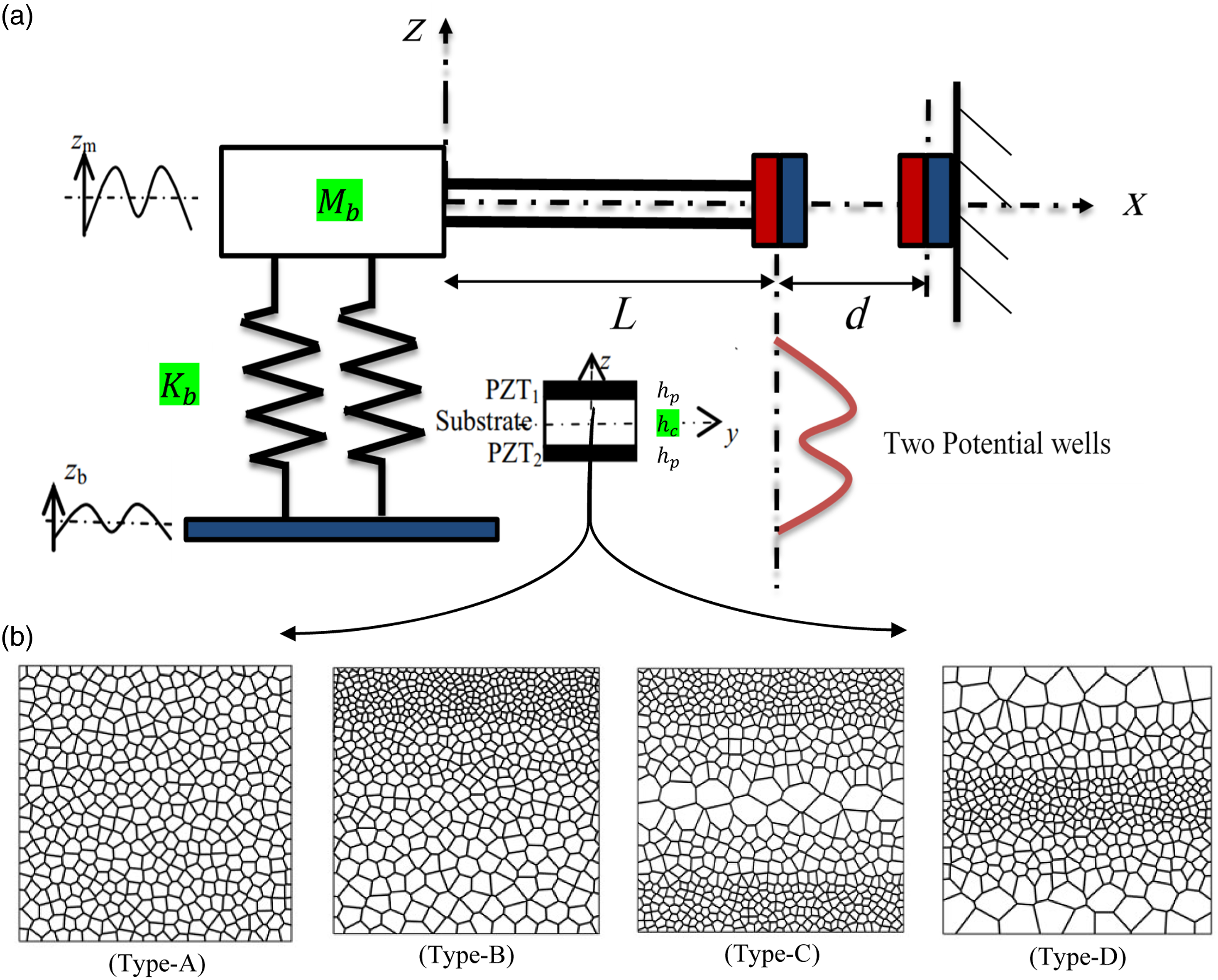
Effective material properties
Figure 1(b) depicts the porosity distributions of the core layer along the thickness direction. The variation of Young’s modulus, shear modulus, and mass density through the thickness of metal foam core layer (-hc/2 ≤ z ≤ hc/2) corresponding to three different types of porosity distributions are explicitly formulated as
41
:



In which

Also, the porosity coefficient
Hamilton principle and equilibrium equation
To obtain equilibrium equations for the distributed parameter system using the Hamilton principle, one can write:

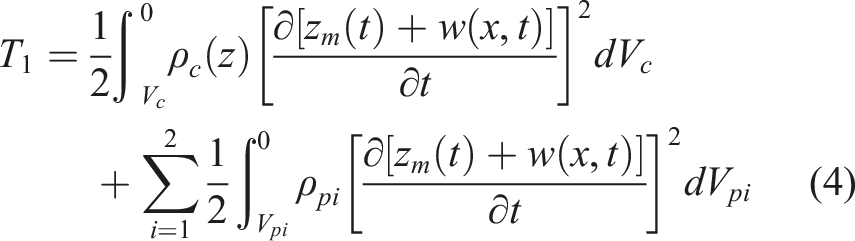


The total potential energies of the harvester are


The main constructional relations of piezoelectric materials are as follows:


Where

The Electrical energy at both piezoelectric layers are:

Besides the Magnetic potential created by the magnetic force are as follows, where

Reduced-order of equations
Dynamic response of the cantilever beam can be formulated using the Rayleigh-Ritz method as
43
:

In which





The coefficients of above equations are:
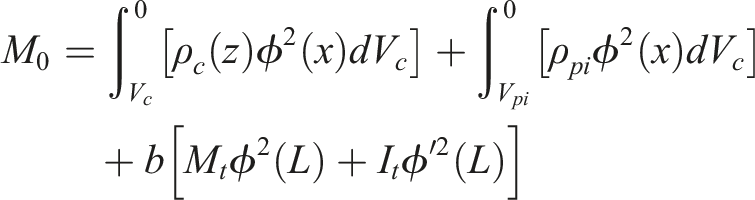



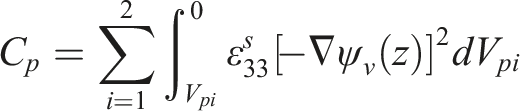

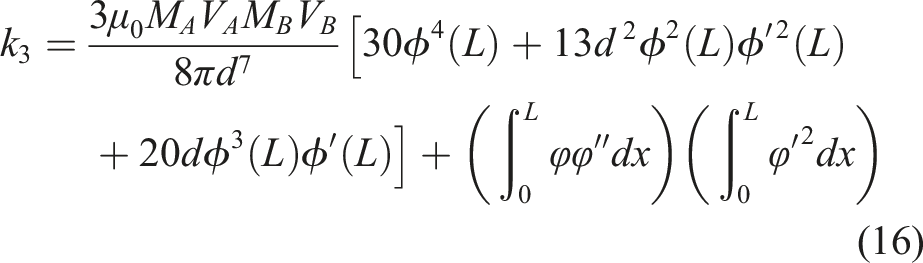
The dimensionless form of equation (15) are as follows:



In which:

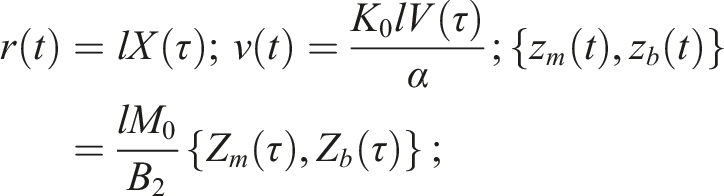

Steady-state solution
In this section, the frequency response of the nonlinear harvester was obtained using the harmonic balance method, analytically. Considering harmonic excitation of base as


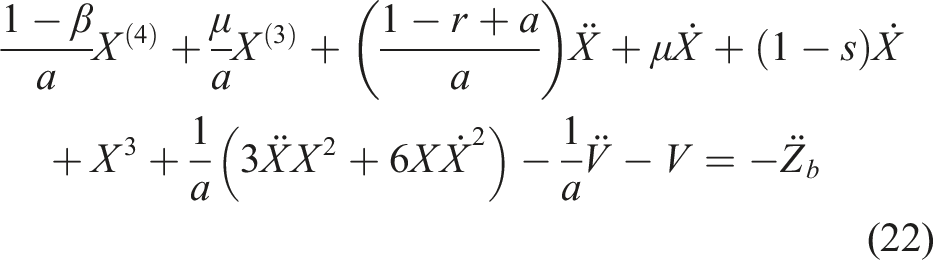
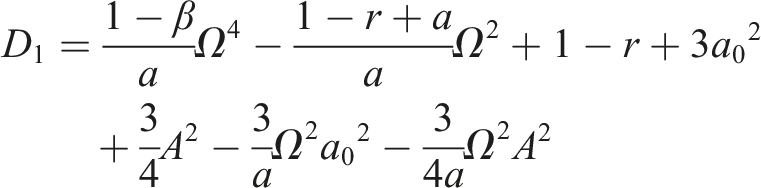
Substituting the above relations in the main equation and performing some math operation, the Frequency response of the harvester are:

The unknown coefficients are as follows:

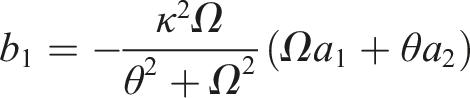
Also, the coefficients of voltage response are equals to:

Results and discussion
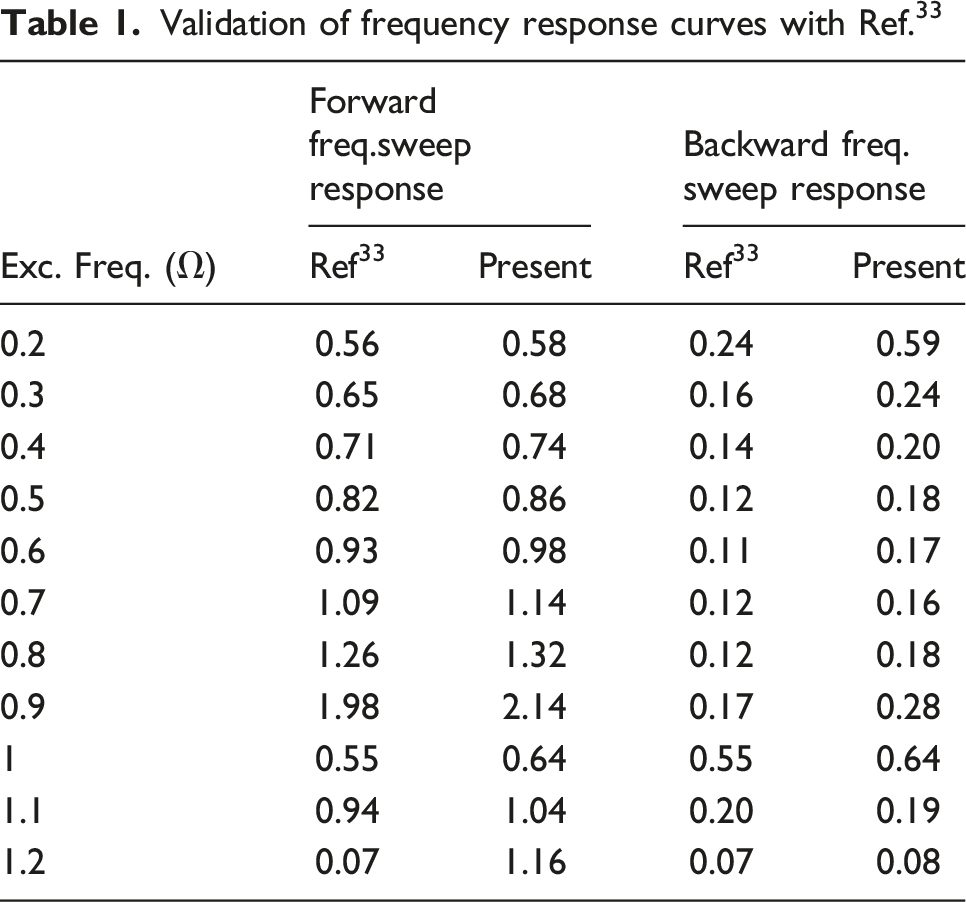
Validation
The physical properties of the harvester beam are:
Validation of frequency response curves with Ref. 33
Frequency response
In this subsection, the frequency-response curves and output voltage are plotted to investigate the effects of various parameters such as Frequency-response curves are plotted for vibration of tip mass and harvested voltage, at different values of mass and stiffness ratios.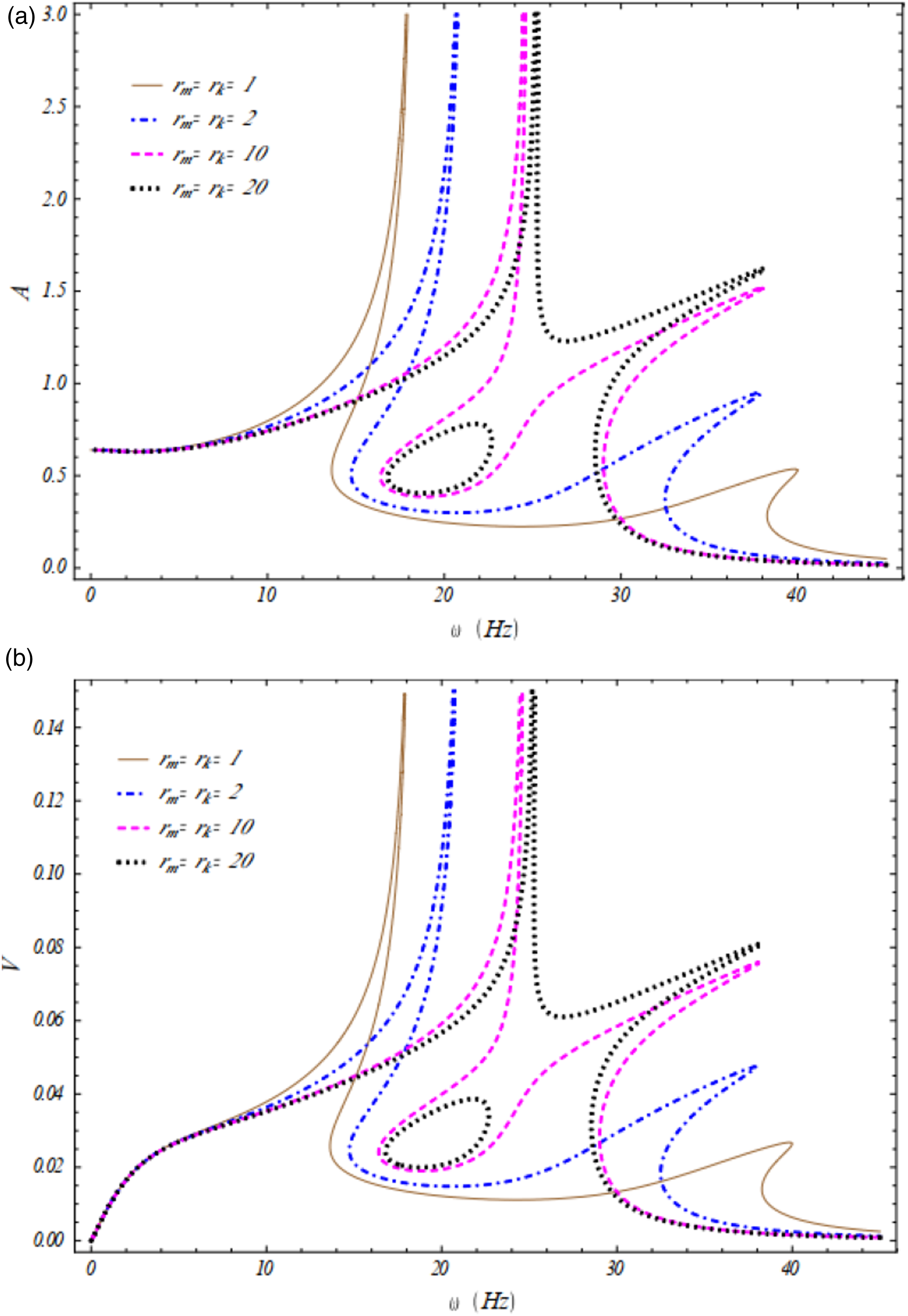
In Figure 3, the frequency-response amplitudes are plotted for different values of porosity coefficient of metallic foam core when rm = rk = 10. According to Figure 4, by increasing the porosity of the beam core, the value of two frequency peaks is shifted to the left and occurs at lower frequency values. The two escape frequencies in the curves are also transmitted to the left. On the other hand, the rate of vibration response and surge voltage also increases with increasing porosity, which is due to reduced stiffness and increased flexibility. However, increased porosity will lead to increased stress and the possibility of beam failure for high values of vibration. Influence of core porosity on: (a) A-Ω curves, (b) V-Ω curves of harvester. Response versus excitation level for different porosity pattern of core.
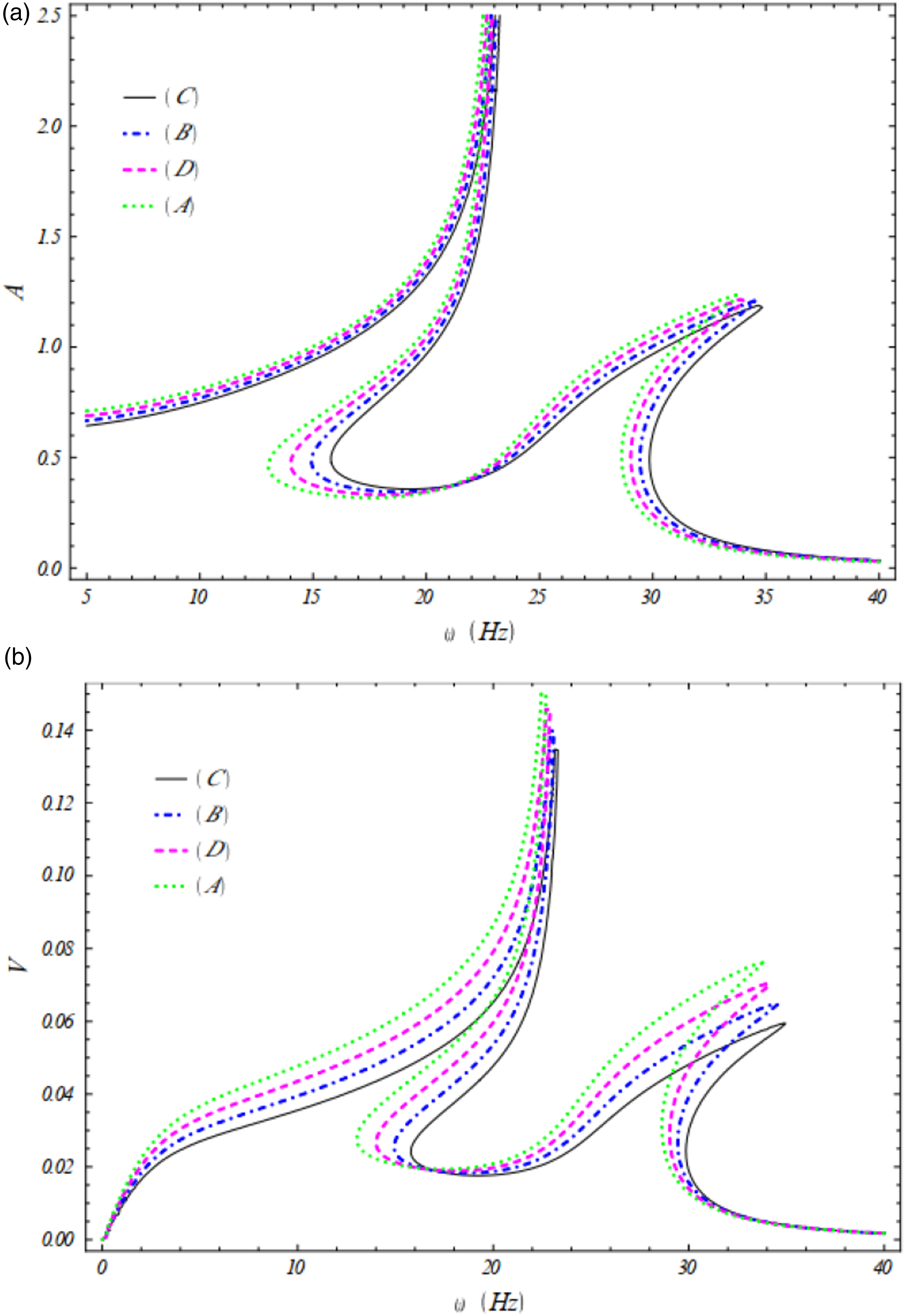
Frequency response curves for different forms of porosity distribution along the core thickness are presented in Figure 4. The porosity types A and C had the highest and lowest amplitude of vibration response and the harvested voltage, respectively. The first peak of all curves has nearly the same states, but for the second peak of the response, the foam core with type C has the lowest frequency and the highest curvature due to the nonlinear behavior.
Transient response
In this section as shown in Figure 5, the voltage-time response of 2-DOF harvester and phase plane diagram of bimorph beam has been plotted when rm = rk = 10. Figure 5 shows the graphs for various excitation levels. As demonstrated in Figure 5(a), if the excitation level is very small, the system oscillates about an equilibrium point with very small tip velocity and vibrations which, cause the inter-well motion and low harvested voltage. Because of the weak excitation level, in this case, the performance of the 2-DOF harvester is not enough to overcome the potential barrier, so the harvester shows bistable motion. As shown in Figure 5(b), when the value of excitation is raised, the harvested voltage has high-level non-periodic motion since the tip mass oscillates between potential barriers with chaotic motion. Considering Figure 5(c), by rising the excitation level more, the beam tip shows a high-energy inter-well motion, considered by a periodic oscillation with high amplitude, because the substantial increase of the vibration amplitudes and the harvested power. Time response of harvested voltage and phase portrait diagram of tip mass when 
Figure 6 presents the phase portrait diagrams of the harvester tip mass and the response of harvesting voltage for three different values of the porosity coefficient of foam core. Accordingly, with increasing porosity in the beam core, the vibration amplitude of the tip increases, and consequently the harvesting voltage rises. In addition, the energy of bimorph for the oscillation between the two potential wells has increased. Harvesting voltage and oscillation phase plane of when 
At the end of this section, the dynamic phase diagram of the harvester with metal core and the temporal changes of the harvested voltage with Ω = 0.8, Ω = 1 are presented in Figure 7, with different porosity porosities. Voltage-time and deflection-velocity curve of the tip mass oscillation when 
Conclusions
Based on distributed parameter model, the present study analyzes 2-DOF bistable PEH with an elastic substructure in order to amplify the harvesting voltage and broadband the frequency range, considering both nonlinear strains and porosity of metallic foam core.
Nonlinear dynamic analysis of the bistable piezoelectric harvester with high energy inter-well motion is the main purpose of this research.
After validating the numerical results, results of frequency and time response analysis in terms of various system parameters presents, the most important of which are summarized below: • By tuning the system parameters, such as the mass and stiffness ratios of substructure to the harvester, the magnified excitation level should be expressively reinforced to supply the harvester oscillation and cause both large-amplitude motion and harvested power over broadband frequencies. Also, by rising the elastic substructure stiffness ratio, the harvester oscillations may transform from a low-energy and tight-fitted motion into a bistable and high-energy one that increases the harvesting power. It can be concluded that for BPEH, inter-well motion with a high energy level is crucial. • Increasing the porosity of the beam core leads to a decrease in frequency and an increase in flexibility and increases the amplitude of the oscillation, and the peak frequency of the response curve is shifted to the left and lower frequencies are transferred. On the other hand, increasing porosity leads to a decrease in beam strength and increases beam stress in wide-range oscillations.
Footnotes
Declaration of conflicting interests
The author(s) declared no potential conflicts of interest with respect to the research, authorship, and/or publication of this article.
Funding
The author(s) received no financial support for the research, authorship, and/or publication of this article.
