



Abstract
This article investigates the impact of moisture and temperature on vibration characteristics of bio-composite skew-laminated composite sandwich (SLCS) plates. The bio-composite SLCS plates with bamboo face sheets and polylactic acid (PLA) cores are biodegradable, radiolucent, lightweight, high strength, and withstand vibrations. The coupled thermo-elastic and hygro-elastic finite element (FE) model of the SLCS plate is derived using the higher-order shear deformation theory (HSDT). An initial stress stiffness matrix is developed using the nonlinear strain-displacement relations to incorporate the effect of temperature and moisture in FE modeling. Temperature and moisture-dependent material properties of bamboo fiber-reinforced biocomposite (BFB) and PLA core are employed for the analysis. A comprehensive investigation has been carried out to study the impact of moisture and temperature situations with different geometrical parameters and various skew angles on the frequency of the SLCS plate. The results indicate that the biocomposite sandwich material has excellent potential for structural applications under different environmental conditions in various applications like food processing, and biomedical applications, including MRI and CT scan beds.
Keywords
Introduction
The sandwich structures with a thin fiber-reinforced composite face sheet and a thick core are often widely used in numerous engineering fields, including aerospace, automobile, healthcare, and construction. 1 This wide range of usage is due to desirable mechanical characteristics, including a high strength-weight ratio, specific stiffness, vibration damping, and fatigue resistance. 2 The laminated composite (LC) face sheet in sandwich structures is fabricated using synthetic fibers such as carbon, glass, kevlar, and aramid. Similarly, synthetic core materials, especially polyvinyl chloride and polyethylene terephthalate, have been used in sandwich structures. 3 The concerning impact on the environment and the high production cost of synthetic fibers accelerate the development of sustainable, atmosphere-friendly, and ecological materials. The composites with natural fiber reinforcement as face-sheet and biodegradable cores for sandwich structures are in trend due to less manufacturing cost and minimal environmental impact.
Many studies were carried out on various natural fibers for reinforcement in biocomposites, namely banana, bamboo, sisal, kenaf, jute, pineapple leaf, flax, and hemp.4–12 Among all the different natural fibers, bamboo fibers are relatively inferior to glass fiber in mechanical properties but much cheaper, 13 making bamboo fiber-reinforced biocomposite (BFB) with different matrix materials a great option to replace synthetic fiber composite. Several kinds of research on bamboo, bamboo fibers, and BFB have been conducted; chemical and physical treatments are also carried out to enhance the bonding between bamboo fiber reinforcement and several matrix materials, which improves BFB performance.14–21 Literature reveals several studies on the mechanical characteristics of BFB with a thermosetting matrix such as polyester and epoxy and a biodegradable matrix such as polypropylene.22–28 Jindal 25 experimentally investigated mechanical characteristics and properties such as tensile strength, impact strength, and modulus of elasticity. The results demonstrate that BFB has an ultimate tensile strength equivalent to mild steel, although its density is around one-eighth that of mild steel. The study also concluded that the behavior of BFB is similar to the commonly used composites like glass fiber reinforced composite (GFRC). Mohanavel et al. 26 conducted a similar experimental study with unidirectional bamboo fiber and bidirectional bamboo strip mats as reinforcement. They found out that reinforcement in the orthogonal direction possesses valuable biaxial strength. Verma and Chariar 27 studied the mechanical properties of BFB, including compressive, tensile, and flexural strength as well as screw-holding capability. The study focuses on identifying the mode of failure at a macroscopic level, the mechanism of failure, and the environmental impact of BFB. Khan et al. 28 studied the fracture behavior of BFB, i.e., fracture toughness for BFB and fractographic results, which shows matrix crack, fiber breakage, fiber pull-out, and fiber-matrix debonding. Ismail et al. 29 investigated the vibrational and acoustic behavior of composite with kenaf and bamboo fiber. The investigation shows that the kenaf bamboo composite is suitable for sound absorption and noise control structures.
Another vital constituent, along with LC face sheet in the sandwich structure, is the core. Numerous studies use different core materials in a sandwich structure, such as functionally graded material, polylactic acid (PLA), viscoelastic material, ceramic, and carbon nanotube-reinforced composite core.30–32 Zenkour and Alghanmi 30 investigated the static behavior of sandwich plates comprised of a functionally graded material core and piezoelectric face sheets. The study investigates the stresses and center deflection produced in sandwich plates when subjected to sinusoidal thermo-electro-mechanical loading conditions. Katariya et al. 31 investigated the vibrational response of skewed laminated composite sandwich (SLCS) plates with epoxy-filled softcore numerically as well as experimentally. Daikh et al. 32 investigated the static behavior of ceramic core sandwich plates exposed to thermo-mechanical stresses using higher-order shear deformation theory (HSDT). Literature shows that PLA has essential features among the different core materials, such as biodegradability, high tensile strength, and stiffness. 33 The thermoplastic polymer PLA is produced from renewable sources such as sugar or starch-rich crops such as sugar cane fermentation. Also, it can be manufactured using standard processes such as injection extrusion, hot compression molding, and 3D printing. Due to ease of manufacturing and desired properties, the usage of PLA has increased significantly in the packaging and biomedical sector.34,35 PLA can also be utilized as a matrix material in composites with natural fiber reinforcement. 36 Antony et al. 37 investigated the mechanical properties of a hemp/PLA 3D-printed core. The mechanical parameters of the honeycomb sandwich construction were also determined by analytical analysis. It is gaining importance in numerous systems consisting of composite sandwich structures like 3D-printed honeycomb cores and skin on various composite panels. 38 Lascano et al. 39 studied the fabrication and mechanical characterization of the laminated composite sandwich (LCS) plate with flax/PLA face-sheet and PLA as the core.
Though natural and biodegradable materials provide several advantages, such as low density, ease of availability, and good mechanical properties, they are vulnerable to higher moisture concentrations and temperatures. The composite’s severe degradation in mechanical characteristics can be seen under the temperature and moisture environment. Numerous studies have been carried out on sandwich structure considering environmental conditions.40–48 Ding et al.44,45 studied the influence of various adverse environmental effects on the mechanical properties of LCS experimentally. Garg et al. 46 applied the modified trigonometric zigzag theory to understand the influence of hygro-thermo-mechanical load on the performance of composite and sandwich plates. Kallannavar et al. 47 studied the effects of change in temperature as well as moisture conditions on the free vibration characteristics of the hybrid skew laminated composite (SLC) and the LCS plates using FSDT. There is inadequate literature on moisture and temperature affecting natural fiber composite face sheets.22,49–53
The sandwich structure with natural fiber-reinforced composite (NFRC) and biodegradable core can also be advantageous in biomedical applications. Many parts of machines used in the medical field can be replaced by parts made of eco-friendly and sustainable materials. Magnetic Resonance Imaging (MRI) machines and Computerized Tomography (CT) scan machines are two examples of vital medical equipment that are widely employed in medical research and hospitals. 54 Material required for such application should be radiolucent, lightweight, high strength, and withstand vibrations.55,56 One of the clinical requirements for a vital aspect of the material for MRI and CT scan machines is that it provides minimal attenuation to strong X-ray photon beams used in radiotherapy treatment. The MRI machine utilizes a rotating gradient coil to create the rapidly changing orientation of high magnetic fields inside the machine for imaging. This rotating coil is the primary source of acoustic noise and vibrations while scanning and reduces the quality of scans. It may be uncomfortable and even hazardous to the hearing of patients and workers. 56 Many studies show that the use of composite materials than conventional materials are more likely to be used for more transmission and good structural strength.55,57,58 Bie De Ost et al. 55 studied the use of carbon fiber as an excellent choice for radiotherapy plates along conventional table tops for different types of photon beams and validated its radiolucent properties. But some studies show that carbon fiber is less compatible for the parts of large MRI machines due to its severe radio frequency (RF) shading and some material heating due to RF coil.59,60 Morris et al. 61 studied NFRC with polystyrene core under mentioned environment and outperformed carbon fiber reinforced composites (CFRC) in RF shading and distortion in MRI. NFRC performed well in megavoltage imaging homogeneity and was superior to glass fiber-reinforced composite (GFRC). Paley et al. 62 developed an MRI-compatible carbon fiber incubator to carry newborns to the MRI machine in order to detect problems and make early diagnoses. Because of the conductive nature of carbon fiber, RF shadowing distortions were observed in the diagnostic scans. Morris et al.61,63 used NFRC and claimed that NFRC outperformed carbon fiber in imaging capabilities and had no effect on the scans obtained, i.e., good radiolucency.
It is observed from a comprehensive literature survey that though synthetic fiber reinforcement for composites serves the purpose of good strength, they are costly and ecologically destructive. In comparison, natural fiber-reinforced composites are environment-friendly and cost-effective for manufacturing, with fewer carbon footprints and good mechanical characteristics. Additionally, the natural fiber composites, i.e., biocomposite materials for structural application in biomedical imaging systems such as MRI or CT scan machines, provide good radiolucency and give better imaging capabilities than CFRC, GFRC, and different conventional materials. As biomedical imaging systems are less prone to harsh loading conditions, the natural fiber biocomposite with sufficient structural strength, good radiolucency, and ecologically sustainable nature can be a suitable replacement for synthetic fiber composites. Hence this has motivated the authors to investigate the behavior of biocomposites in structural applications for biomedical imaging systems under environmental factors.
There is a scarcity of published research on biodegradable materials which are radiolucent and good in vibration response when used for sandwich plates considering environmental conditions. To the best of the authors’ knowledge, there is limited research on the influence of thermal and moisture conditions on the vibrational properties of sandwich structures with biocomposite face sheets and biodegradable cores in the open literature. Consequently, the present research focuses on studying free vibration characteristics of laminated biocomposite sandwich (LBCS) plate consisting of bamboo fiber as reinforcement in composite face-sheet and biodegradable PLA core under changing moisture concentration and temperature. The behavior of the plate is predicted by FE analysis considering HSDT and the dynamic version of virtual work principle. The initial stress stiffness using nonlinear strain-displacement relation is considered for the effect of thermal and hygroscopic conditions along with linear strain-displacement relation based on mechanical stiffness matrix. The impact of length-to-width ratio, length-to-thickness ratio, core thickness to face-sheet thickness ratio, skew angles, and different boundary conditions (BC) under various thermal and hygroscopic conditions on the vibrational behavior of the LBCS plate are studied.
Mathematical modeling
A sandwich composite plate with a bamboo fiber-reinforced biocomposite as a face sheet and PLA as a biodegradable core material is represented in Figure 1(a). The sandwich plate is made of N numbers of orthotropic laminae in the top face sheet and bottom face sheet, and a core is considered equivalent isotropic material. The sandwich plate’s thickness, length, and breadth are h, l, and w, respectively. h
t
is the top face sheet thickness, 2h
c
is the total thickness of the core, and the thickness of the bottom face sheet is h
c
. Further, h
l
is the thickness of the lamina of LC face sheet. Figure 1(b) shows the deformation kinematics of composite sandwich plate in different planes. The angles φ
x
, α
x
, and β
x
denote the rotation of normal on the top face sheet, core, and bottom face sheet, respectively, in the xz plane. Similarly, angles φ
y
, α
y
, and β
y
denote rotation in the yz plane. The displacement field obtained from the kinematics of deformation for LCS plate using HSDT is written as follows: (a) Schematic representation of the LBCS plate, (b) kinematics of deformation of the LBCS plate.
For face-sheet laminate at the top,
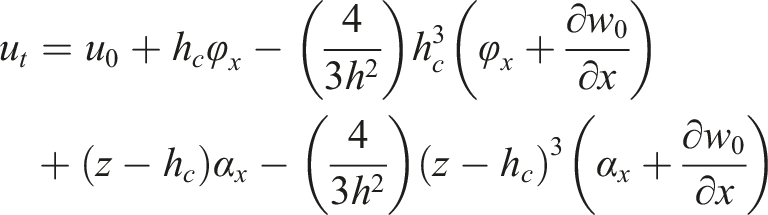





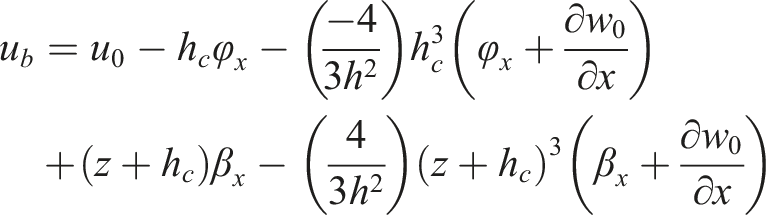
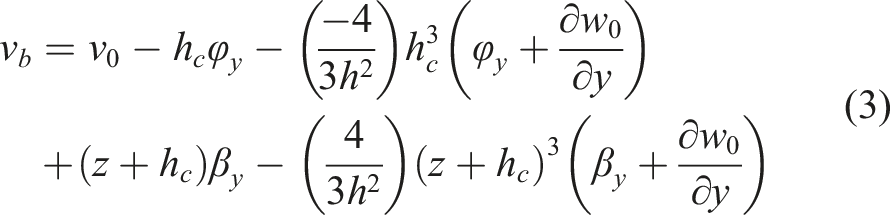

In equations (1)–(3), u, v, and w are displacements along x, y, and z axis, respectively. The axial displacements of the top face-sheet, bottom face-sheet, and core are noted by suffixes as t, b, and c, respectively. The translational displacements of any point on the center plane of an LCS plate are represented as u
0
, v
0
, and w
0
along the x, y, and z axes, respectively. The translational displacement and rotational variables can be separated for the easy solution of a problem and can be written as follow:


Linear strain-displacement relations
The condition of strains at every location in the plate is divided into two different strain vectors, normal strain (


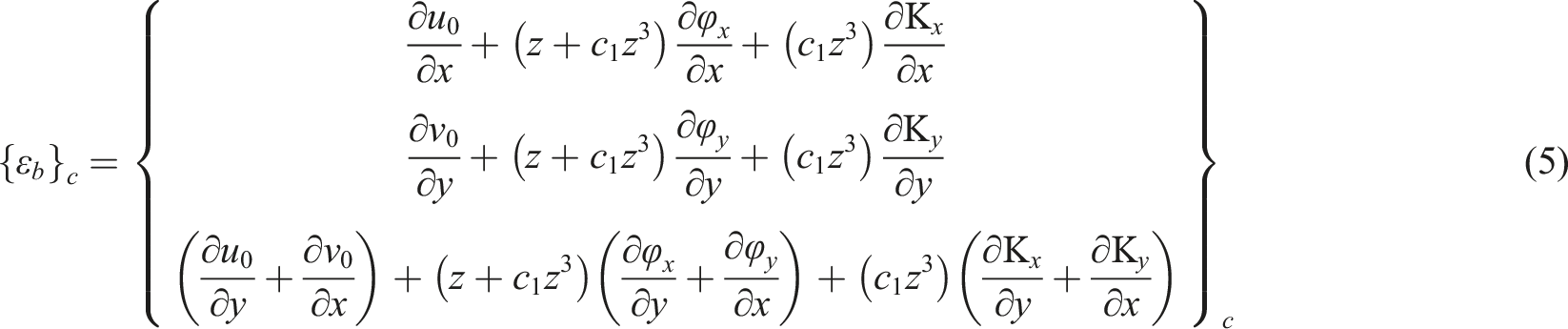




The normal strains along the x-axis and y-axis, respectively, are ε
x
and ε
y
. The in-plane shear strain is
Governing equation
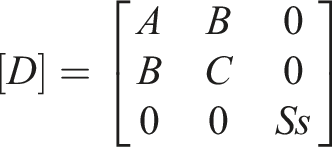
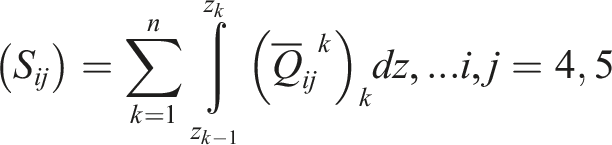
The behavior of LC plate can be governed by the constitutive relation shown by equation (7) when exposed to temperature and moisture conditions,






Finite element formulation
The iso-parametric quadratic elements with eight nodes are used to discretize the model. For each node, three translational and eight rotational degrees of freedom are considered. To generalize, the displacement vectors for any element can be stated as given in equation (9).


The generalized nodal vectors are used to form generalized displacement vectors for elements as equation (10),


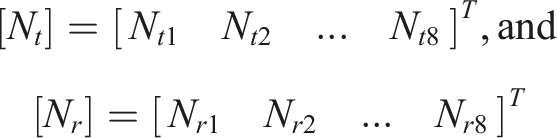



I
t
= (3 × 3) Identity matrix, I
r
= (8 × 8) Identity matrix, the natural coordinate’s shape functions are connected to the ith node is
Elemental stiffness matrix
The linear strain can be written as follows in equation (11),


The relation between strain and displacement can be expressed as follows,






Various matrices used in equation (12) are elaborated in Appendix 1, The dynamic version of the virtual work principle is applied to obtain the equations of motion. Accordingly, the potential energy and kinetic energy can be represented by equation (13),






Matrices used in equations (14)–(17) are defined in Appendix 2.
From solving the above equations (equations (11)–(13)), the equations of motion can be written as follow:


The element stiffness matrix ([K e ]) can be obtained after solving the equations of motion.
Elemental initial stress stiffness matrix
The non-mechanical force and moment due to temperature and moisture are shown by equation (19),

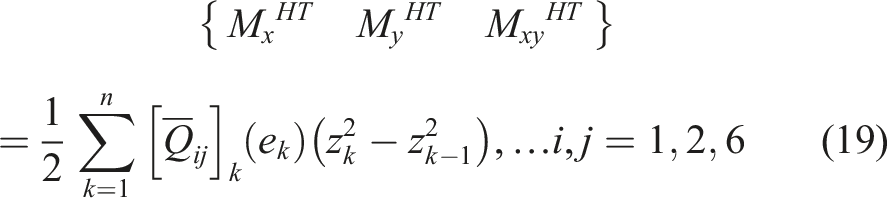


And,

The nonlinear strain can be stated as


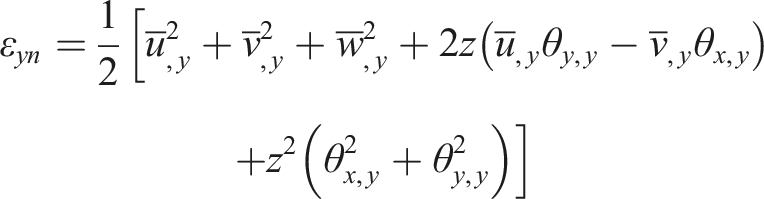





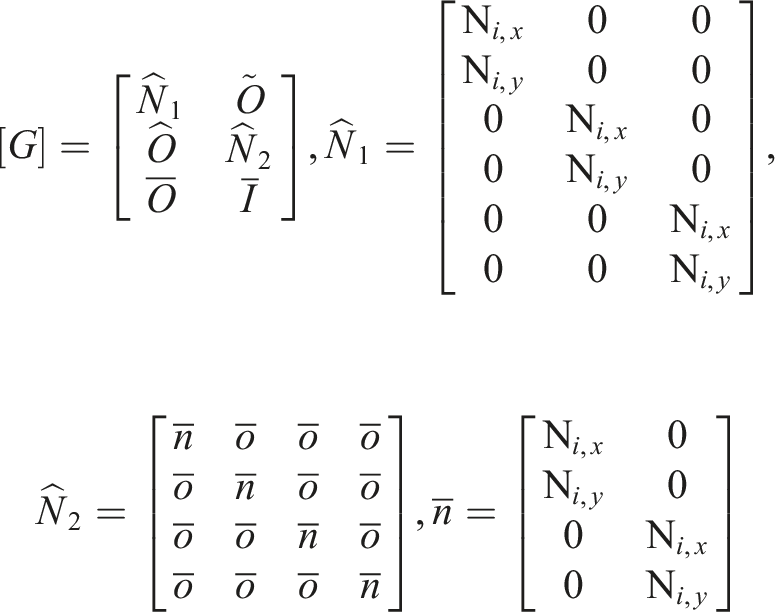
Õ, Ô, Ō, and ō are (6 × 8), (16 × 3), (8 × 3), and (4 × 2) null matrices, respectively. Ī is identity-matrix (8 × 8).
The initial stress stiffness matrix can be expressed as:

(S) matrix is elaborated in the Appendix 3.
Solution process
Gaussian integration rule is implemented to obtain bending and shear deformation at the element level. Then, the stiffness matrix [K
e
], initial stress-stiffness matrix [K
σe
], and mass matrix [M
e
] for an element are computed. The calculated matrices at the elemental level are accumulated to the stiffness matrices [K], [K
σ
], and [M] at the global level. The stiffness matrices determined at the global coordinate system are used to find the system’s natural frequency under free vibration by using the following equation.

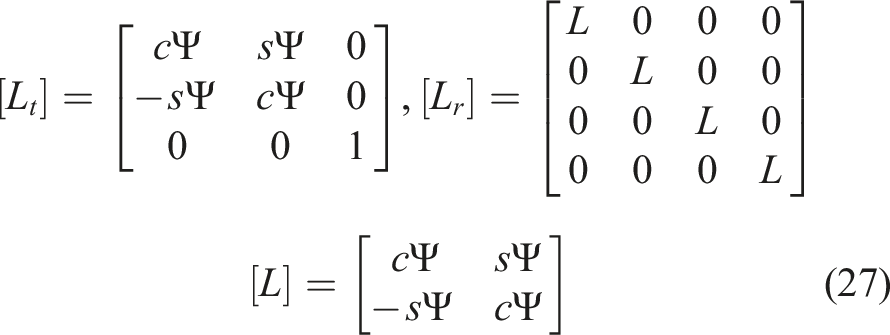
For skew sandwich plates, instead of rectangular coordinates (x, y, z), the skew coordinates (x', y', z') are used. The displacement vector, which is generalized for any point located on the skew edge of the plate, can be changed as given in equation (25),

For new coordinate system


The transformation matrices for the above are given as,
Material properties
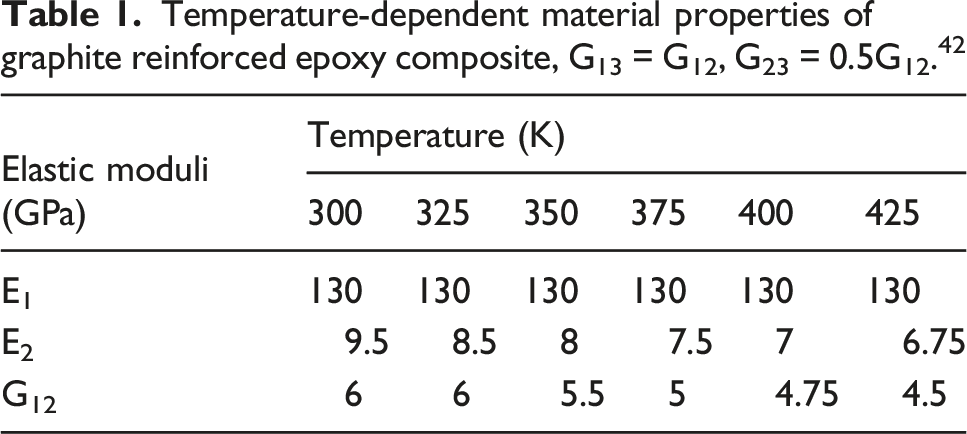
Temperature-dependent material properties of graphite reinforced epoxy composite, G13 = G12, G23 = 0.5G12. 42
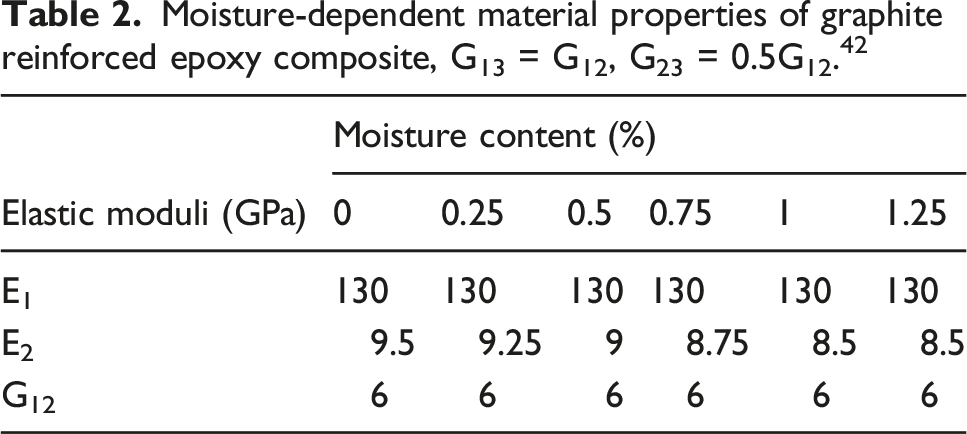
Moisture-dependent material properties of graphite reinforced epoxy composite, G13 = G12, G23 = 0.5G12. 42
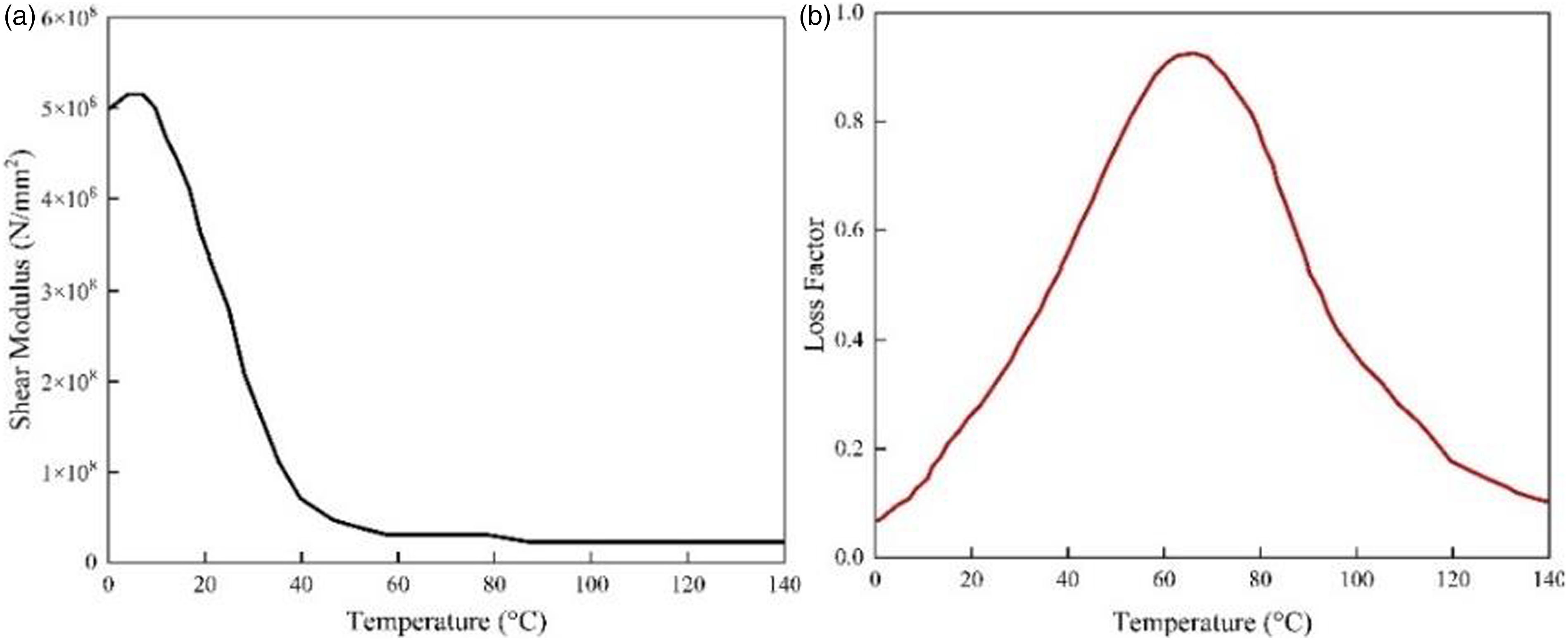
Mechanical properties of viscoelastic material dyad 606 (a) shear modulus, (b) loss factor. 71
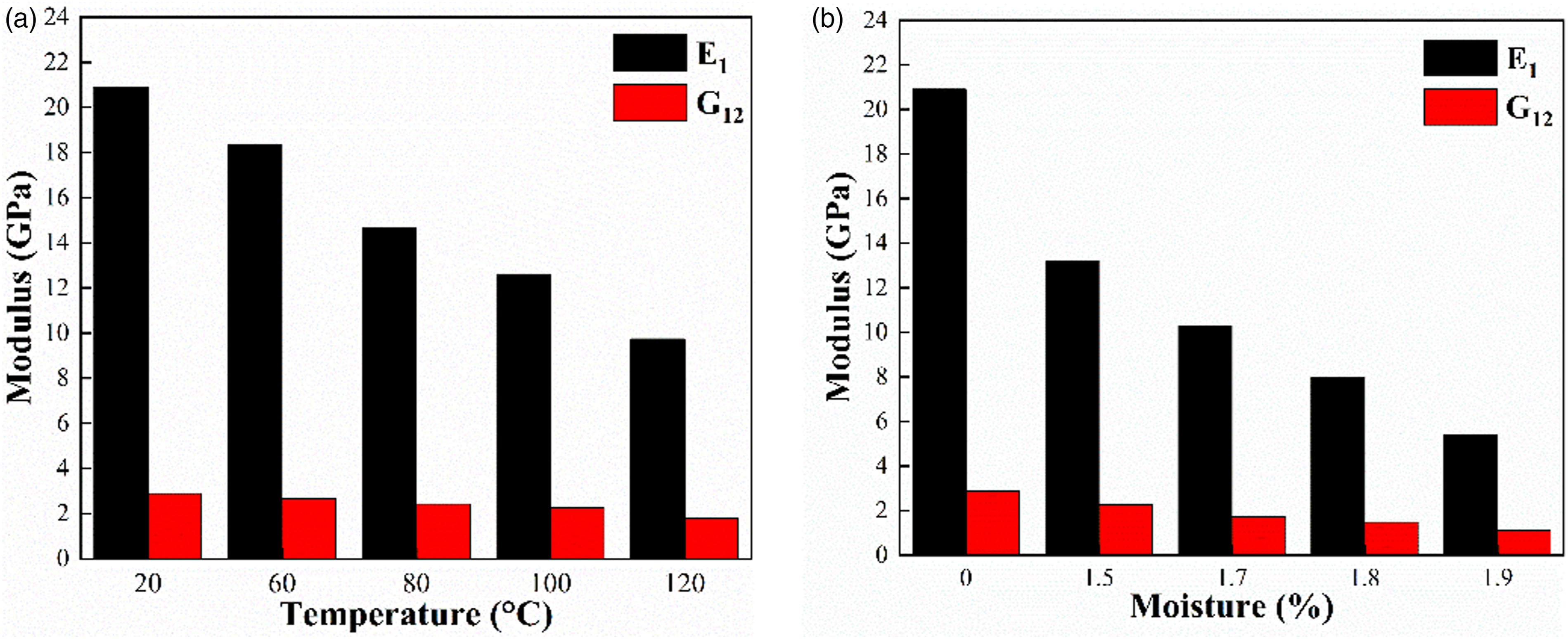
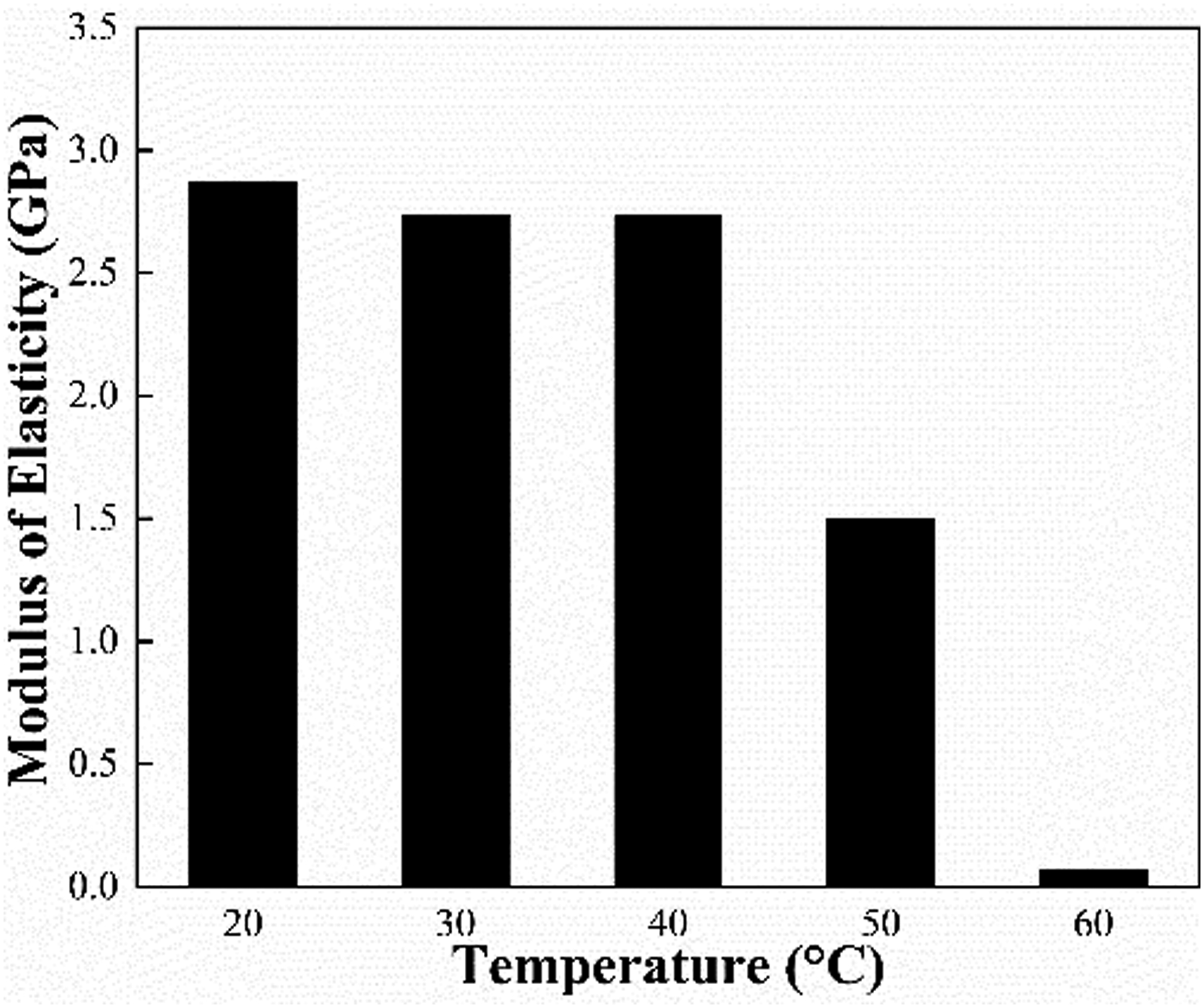
The moisture and temperature-dependent material properties for bamboo-epoxy composite
22
and PLA
64
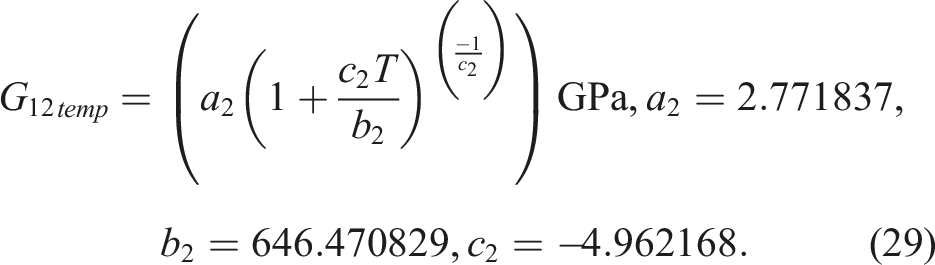
are shown in Figures 3 and 4, respectively, are not continuous for all temperature and moisture values. Therefore, to interpolate the required data, certain equations (equations (28)–(32)) are generated using different curve fitting techniques as follows: Degradation of mechanical properties of BFB with rising (a) temperature, (b) moisture concentration.
21
Modulus of elasticity of PLA varying with rising temperature.
63
For BFB,


For PLA,
The density of BFB and PLA are taken as 1830 kg/m3 and 1240 kg/m3, respectively.
Boundary conditions
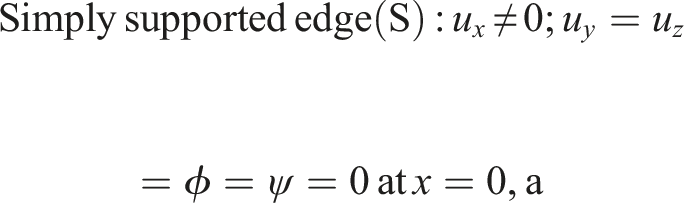
Four different cases (boundary conditions) are considered to mimic the actual supports in the radiotherapy bed or patient positioning system in the MRIsystem. Thus, the boundary conditions of the plate are all sides are clamped (CCCC), two opposite sides are clamped, and the other two are simply supported (CSCS), one side is clamped, and the other three sides are simply supported (CSSS). Finally, all four sides are simply supported (SSSS), and are given as follows:

Results and discussions
The developed mathematical formulation is used to investigate the influence of hygroscopic and thermal conditions on the natural frequency of the LC and LCS plates. While performing FE simulation, a uniform rise in temperature and moisture concentration is considered.
Convergence study
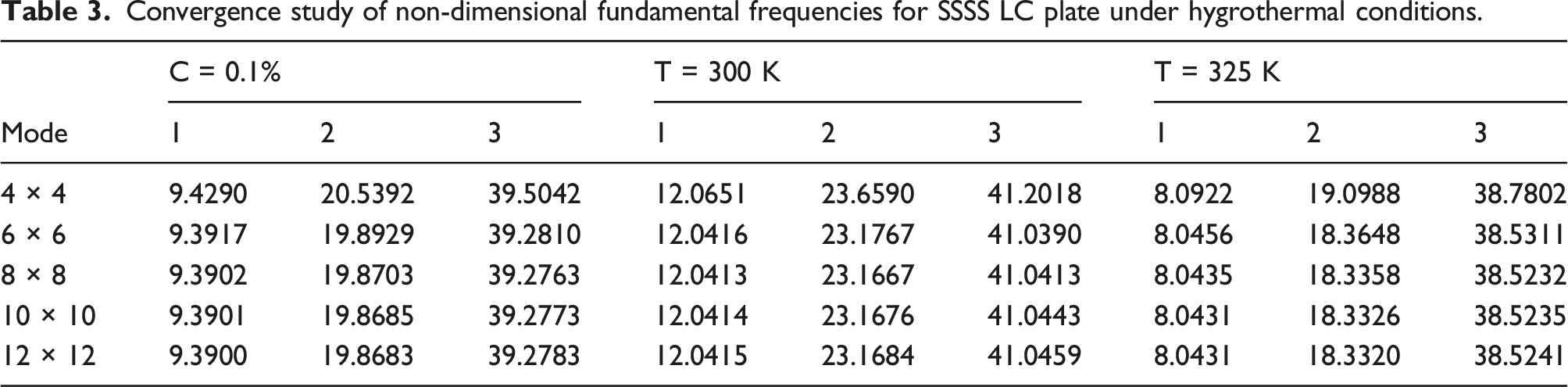
The fundamental non-dimensional natural frequencies of SSSS square LC plate with four-layer symmetric cross-ply laminae are determined using a convergence study at 300 K and 325 K temperature and 0.1% moisture concentration for different mesh divisions. The length-to-thickness (l/h) ratio is set to 100. The following material properties of graphite-epoxy are used for the convergence study.
E1 = 130 GPa, E2 = 9.50 GPa, G12 = G13 = 6.00 GPa, G23 = 0.50G12, μ12 = 0.30, α1 = −0.30×10⁻⁶/K, α2 = 28.10×10⁻⁶/K, β1 = 0, β2 = 0.44, ΔT = 25, ΔC = 0.1%.
The computed natural frequency is converted to non-dimensional form as:
Convergence study of non-dimensional fundamental frequencies for SSSS LC plate under hygrothermal conditions.
Validation with previous studies
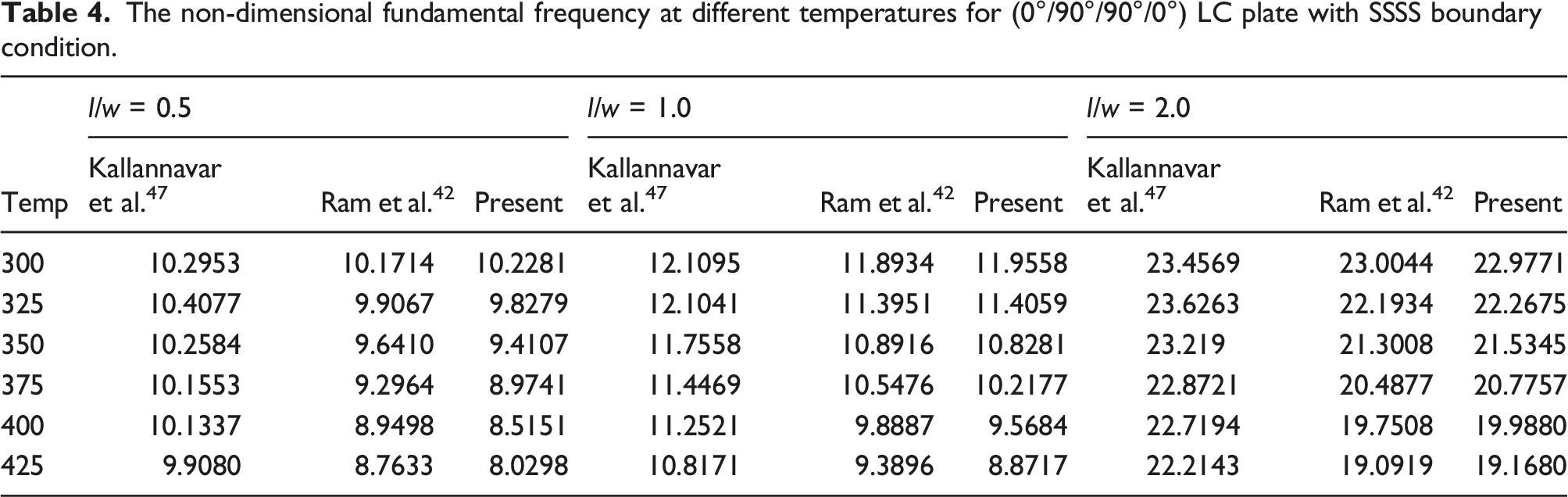
The non-dimensional fundamental frequency at different temperatures for (0°/90°/90°/0°) LC plate with SSSS boundary condition.
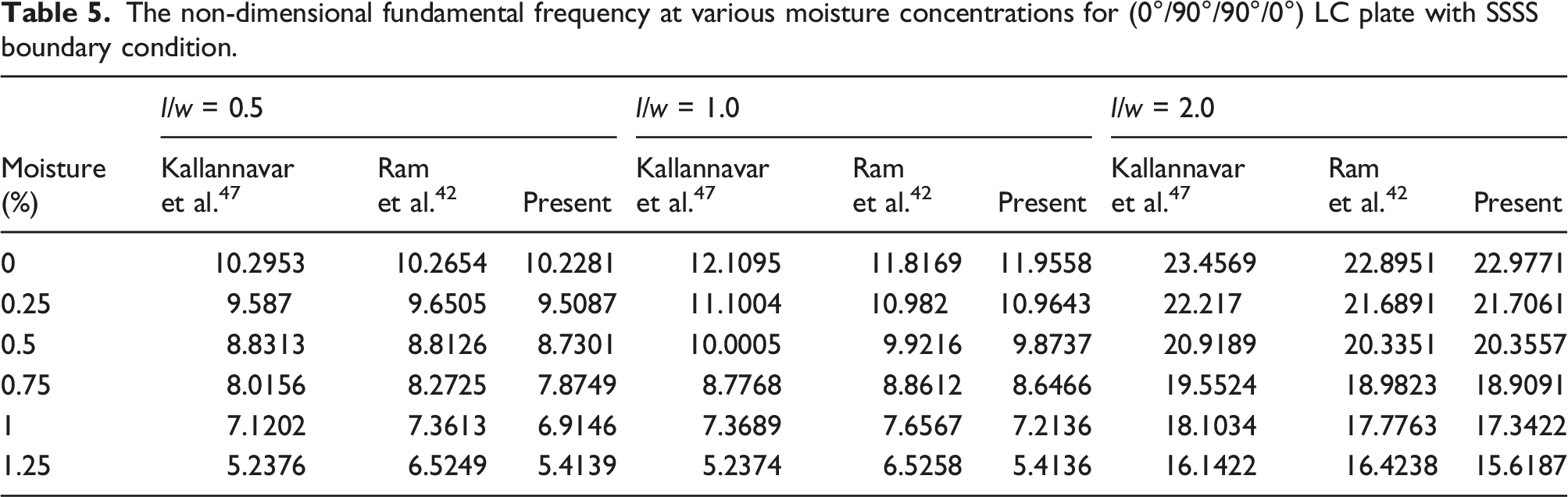
The non-dimensional fundamental frequency at various moisture concentrations for (0°/90°/90°/0°) LC plate with SSSS boundary condition.
Skew laminated composite sandwich plate

Effect of temperature on a SLCS plate with graphite-epoxy as a face-sheet and dyad 606 as a core.

Effect of initial stress stiffness matrix due to temperature and moisture on the natural frequency
Several studies show that the mechanical properties of composite materials change when subjected to various thermal and moisture environments. The stiffness of composite materials deteriorates under high-temperature and high-moisture environments, resulting in natural frequency deterioration. This behavior is due to the changing volume of the composite because of thermal expansion of the polymer matrix; a similar phenomenon happens with moisture absorption also. As a result, the geometry of the structure or a structural component deforms and loses stability. It causes initial strain, which results in severe geometric nonlinearity, which leads to a change in stiffness. This change can be incorporated by considering the initial stress stiffness (Kσ) owing to temperature and moisture. Thus, the temperature and moisture-dependent properties of materials can be considered. The simulation has been carried out to evaluate the impact of environmental conditions on the LBCS plate consisting of PLA as a core and BFB as a face sheet. The temperature and moisture-dependent material properties are determined from equations (27)–(31) are used for the analysis. The LBCS plate with l/h ratio as 40, l/w ratio as 1, and core thickness to face sheet thickness (h
c
/h
t
) ratio of 2 is considered for the computation. Figure 5(a) and (b) show that non-dimensionalized natural frequency (NDNF) decreases with increasing temperature and moisture. Figure 5 depicts that material with moisture and temperature-independent properties with or without Kσ underpredicts the NDNF of the LBCS plate. Whereas the consideration of temperature and moisture-dependent material properties and Kσ gives results in close agreement with experimental results, as shown in a study presented by Sit and Ray.
22
Subsequently, these dependent material properties, and initial stress stiffness are used for further investigations. In Figure 5(a), we see a significant drop in NDNF from 50°C. This behavior is noticed because the glass transition temperature (Tg) of the PLA used as the core ranges from 50°C to 70°C,65–67 which reduces the strength of the LBCS plate. No such behavior of the LBCS plate can be seen in the moisture environment in Figure 5(b). It is due to the material properties of only bamboo face sheets degrading with an increase in moisture, but there is a negligible change in the properties of PLA.
68
Comparison of effect of initial stress stiffness matrix and temperature and moisture dependent material properties NDNF.
Effect of length-to-width ratio on the natural frequency of the plate in different boundary conditions under thermal environment
The influence of l/w ratio on the NDNF of the LBCS plate under various BCs using material properties of the BFB and PLA at room temperature and dry conditions are presented in Figure 6. For the computation, the l/h ratio of 40, as well as the hc/ht ratio of five is employed. According to the results, NDNF increases when the length-to-width ratio increase. This behavior is because of the transition from a thick to a thin plate as l/w ratio increases. As a result, the stiffness matrix in relation to the mass matrix increases, resulting in a rise in NDNF value. Several investigators1,40,46,69 have found similar conclusions for different composite material structures. The plate with CCCC boundary condition possesses the highest NDNF for all l/w ratios considering other boundary conditions due to an increase in the plate’s stiffness due to all sides being in the clamped condition. But the increase in NDNF with l/w ratio changing from 0.5 to 2.0 is the most minor, i.e., increment of 284% compared to 594% in CSCS, 439% in CSSS, and 296% in SSSS boundary conditions. Effect of l/w ratio on NDNF for various boundary conditions at room temperature and dry condition.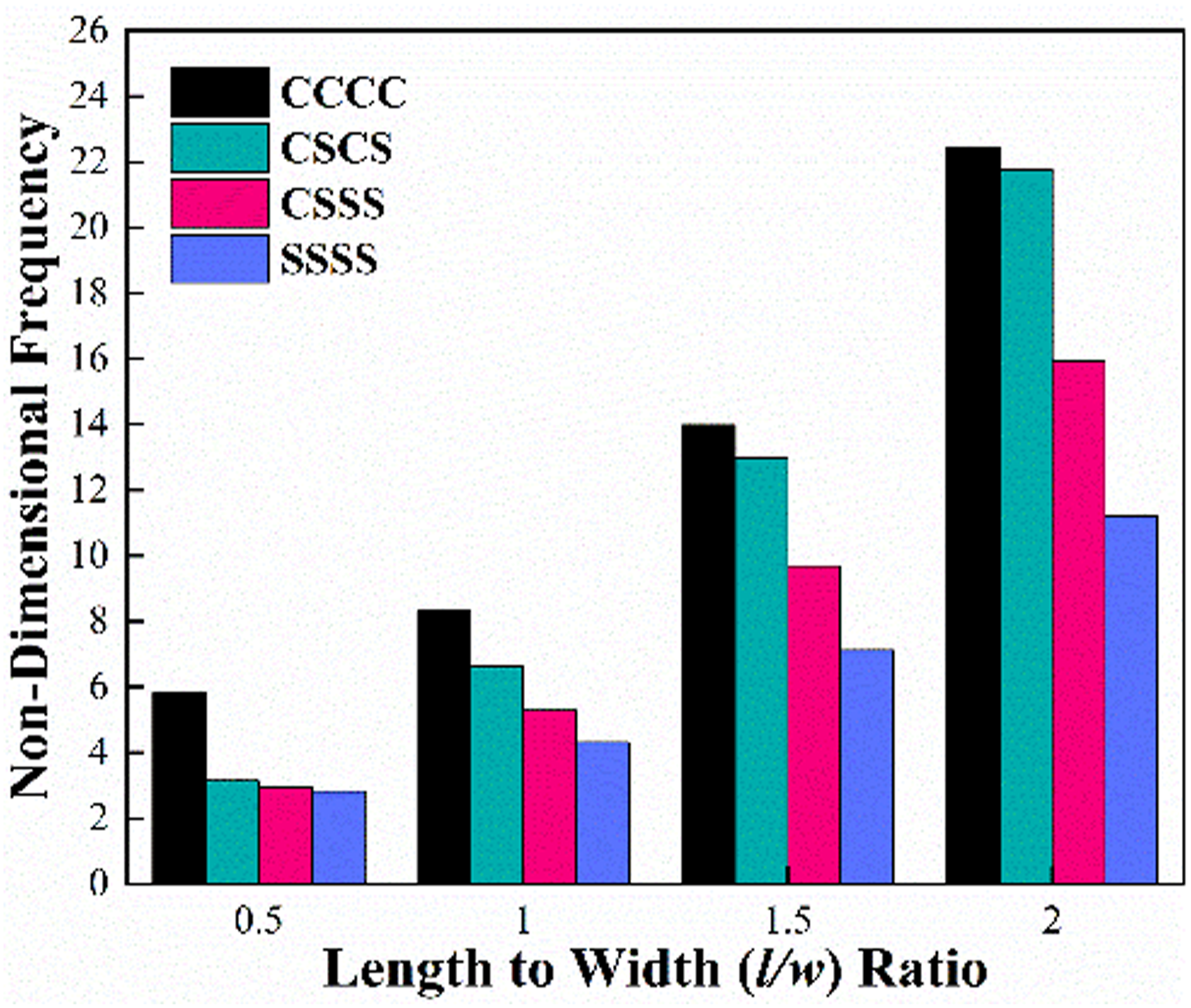
The behavior of the LBCS plate under the thermal environment with varying l/w ratios for various boundary conditions is represented in Figure 7. Temperature-dependent material properties are utilized with an l/h ratio of 40, h
c
/h
t
ratio of 10, and four different boundary conditions: CCCC, SSSS, CSCS, and CSSS. As expected from previous results, the NDNF starts to drop rapidly after 50°C. It can be seen in all cases of various boundary conditions. The highest drop of 48.57% in NDNF from room temperature to 60°C can be seen in l/w ratio of 2.0 in CCCC boundary conditions. Similarly, for the same l/w ratio of 2, a rise in temperature causes a maximum reduction of 34.1%, 48.9%, and 41.8% in SSSS, CSCS, and CSSS boundary conditions, indicating that the drop in NDNF is more evident in higher l/w ratios as temperature increases. Effect of thermal environment on NDNF with different l/w ratio (a) CCCC, (b) SSSS, (c) CSCS, (d) CSSS.
Effect of ratio of length-to-thickness of LBCS plate on the natural frequency at different temperature
The effect of l/h ratio is studied on the BFB face-sheet/PLA core sandwich plate with l/w = 2 and h
c
/h
t
= 5 for different boundary conditions at room temperature and dry conditions. The results presented in Figure 8 show an increase in NDNF with an increase in l/h ratio. Further, the behavior of the LBCS plate with increasing l/h ratio as for the behavior under varying l/w ratio. Results show that the LBCS plate with CCCC has the maximum natural frequency while the SSSS exhibits a minimum natural frequency value in all the boundary conditions. The increment in non-dimensional frequency for CCCC, CSCS, CSSS, and SSSS are 61.6%, 62.4%, 38.2%, and 18.3%, respectively, for l/h value changing from 10 to 80. Effect of l/h ratio on NDNF with various boundary conditions.
Further, the effect of increasing temperature on NDNF for l/h as 2, 10, 20, and 40 is investigated for different boundary conditions depicted in Figure 9. The non-dimensional natural frequency decreases as the temperature value increases. For all the boundary conditions, as l/h increases, the increment in the NDNF decreases for the considered temperatures. This decrease in the increment of NDNF is substantial as the number of simply-supported sides increases. A similar conclusion can be observed in the study of some investigators.
68
The maximum reduction of 75.8%, 67.9%, 75.5%, and 72.7% in non-dimensional fundamental NDNF can be seen for CCCC, SSSS, CSCS, and CSSS boundary conditions, respectively. Effect of temperature on NDNF for different l/h ratio with (a) CCCC, (b) SSSS, (c) CSCS, (d) CSSS.
Effect of skew angle with changing temperature and moisture concentration on LBCS plate
The study of the influence of skew angle on NDNF in BFB face-sheet/PLA core sandwich plate with varying l/w ratios, l/h ratios, and boundary conditions under temperature and moisture environments is continued. Firstly, the influence of skewness is studied for different boundary conditions with h
c
/h
t
ratio of 5, l/w ratio of 1, and l/h ratio of 40. The results are illustrated in Figure 10, showing that the NDNF increases with an increasing skew angle for other parameters that remain unchanged. Many researchers studied the influence of skew angle and reported identical results.70,71 The impact of BC increases as there is an increase in the skew angle, and the affected area of the plate reduces, increasing NDNF. Again, it is clearly seen that CCCC and SSSS have the maximum and minimum NDNF, respectively. Effect of skew angle on NDNF for a different boundary.
The current research is also conducted for several l/w and l/h ratios and the influence of skew angle on non-dimensional fundamental natural frequency. Figure 11(a) depicts the study for four different l/w ratios for l/h ratio of 40, h
c
/h
t
ratio of 5, and at CCCC boundary conditions in room temperature and dry conditions. From the figure, we can say that as the skew angle increases, the NDNF increase for every l/w ratio. The maximum gain of 55.8% from 0° to 45° skew angle is observed for l/w ratio of 2. A similar study has been done for varying l/h ratios to study its effect on NDNF for increasing skew angle. Figure 11(b) shows similar results of increasing NDNF for a rise in skew angle with l/w ratio of one and keeping everything else constant. A maximum of 51.9% increment can be observed in NDNF between two extreme skew angles. As we see in Figure 11(a) and (b), the change in NDNF between 0° to 15° is significantly less, but from 30° onward, the NDNF is altered substantially. Effect of skew angle on NDNF for different (a) l/w ratios, (b) l/h ratios.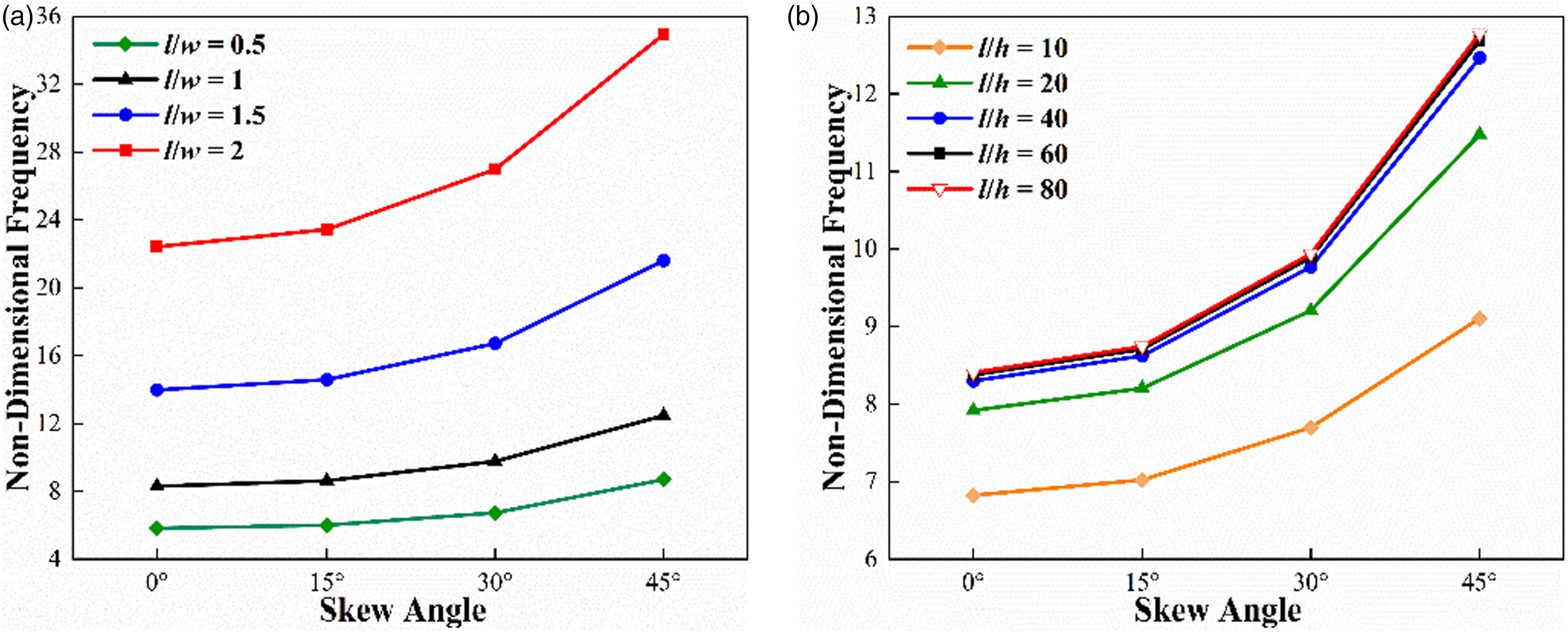
The experiment is being carried out to assess the effect of temperature on NDNF for different skew angles. The l/h ratio of 40, l/w ratio of 1, and h
c
/h
t
ratio of five are considered for the simulation. As shown in Figure 12, increased temperature decreases the NDNF for all skew angles and boundary conditions. Further, as the skew angle increases, the difference in all the curves increases for every boundary condition. The maximum reduction in the NDNF for CCCC, SSSS, CSCS, and CSSS is 44.8%, 42.7%, 42.2%, and 42.3%, respectively, with varying temperatures from 20°C to 60°C. Effect of temperature on NDNF for different skew angle with (a) CCCC, (b) SSSS, (c) CSCS, (d) CSSS.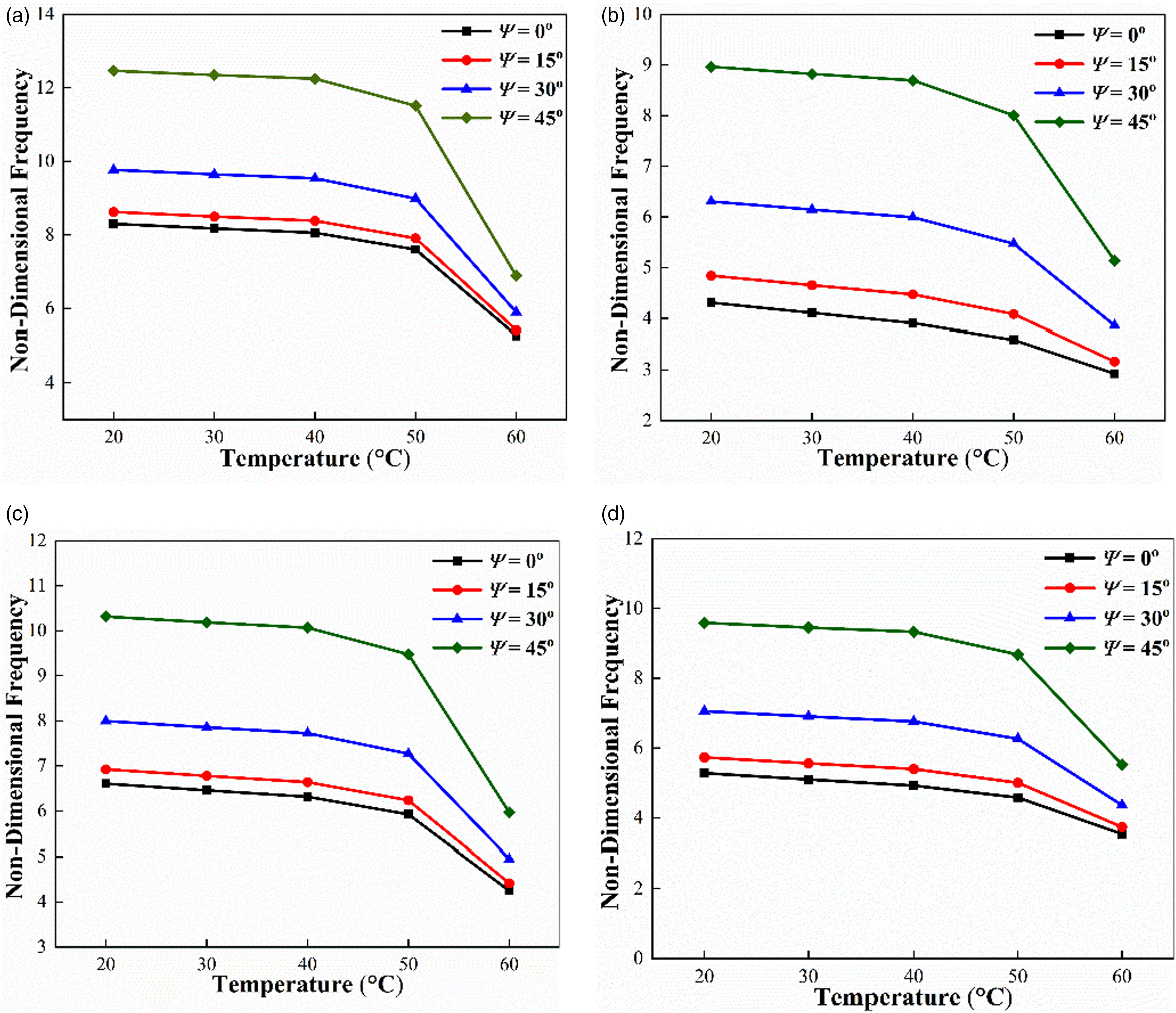
Further investigation is carried out to study the effect of moisture on NDNF for different skew angles keeping all the parameters the same; results are shown in Figure 13. There is no sudden drop in NDNF in case of changing moisture environment. It may be because of degradation in the mechanical properties of face sheets only, which gradually decreases over moisture exposure. Therefore, the decrease in NDNF is due to a reduction in the mechanical properties of the bamboo composite face sheet. The maximum reduction in NDNF for CCCC, SSSS, CSCS, and CSSS are 16.7%, 87.6%, 28.1%, and 48.5%, respectively. Effect of moisture on NDNF for different skew angle with boundary conditions: (a) CCCC, (b) SSSS, (c) CSCS, (d) CSSS.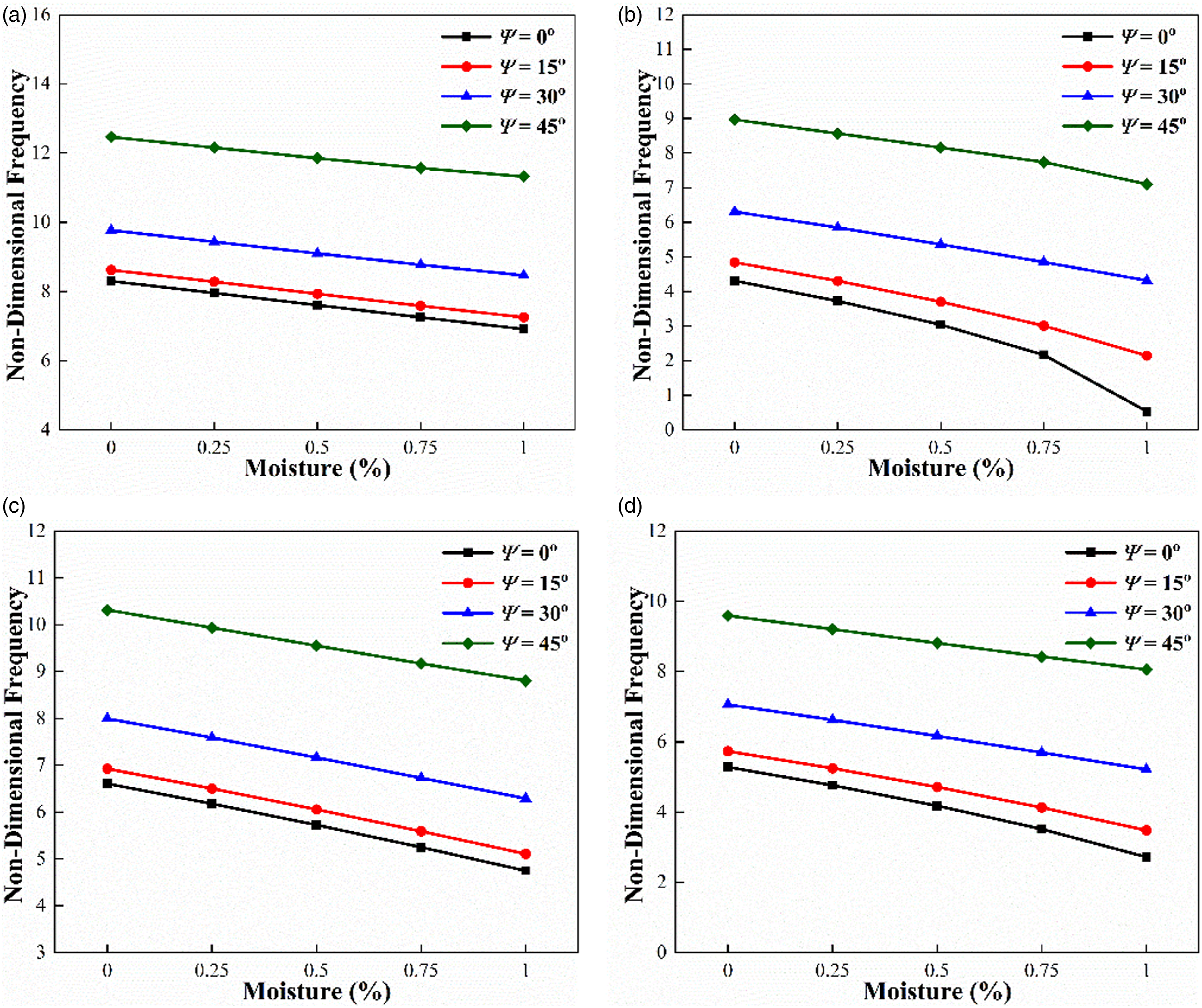
Effect of change in core thickness to face-sheet thickness ratio with temperature and moisture concentration on the LBCS plate
The current study has continued to consider the effect of changing the core-to-face sheet thickness ratios on NDNF under different temperature and moisture conditions. Figure 14 shows the effect on NDNF due to change in h
c
/h
t
with different boundary conditions for l/h ratio of 40, l/w ratio of 1, and skew angle of 0°. As the h
c
/h
t
ratio increases, the NDNF decreases. While changing h
c
/h
t
, keeping the sandwich plate’s cross-section area constant, only the core and face sheet thickness varies. As h
c
/h
t
increases, the core thickness increases, and reduction in the thickness of the face sheet, which in turn reduces the stiffness and NDNF as well. The CCCC boundary condition possesses higher NDNF than the other boundary conditions for all h
c
/h
t
ratios. The maximum reduction of 39% can be seen in the CCCC boundary condition over h
c
/h
t
ratio of 1 to 20. Effect of h
c
/h
t
on NDNF for different boundary conditions.
Similar simulation is continued for different l/w ratios, l/h ratios, and skew angles, which are shown in Figure 15(a)–(c), respectively. The results in Figure 15(a) are computed at l/h ratio of 40 and skew angle of 0°, and in Figure 15(b), l/w ratio is 1, and the skew angle is 0°. Similarly, for Figure 15(c), the l/h and l/w ratios are 40 and 1. In all cases, NDNF decreases with an increase in h
c
/h
t
ratio. The maximum reduction in NDNF can be seen as 39.9%, 39.7%, and 39.0% for each case in Figure 15(a)–(c), respectively. The reduction can be seen as prominent after h
c
/h
t
ratio of 2, as a significant contribution of core increases in the strength of the BFB face-sheet/PLA core sandwich plate. Effect of h
c
/h
t
ratio on NDNF for different (a) l/w ratios (b) l/h ratios (c) skew angle.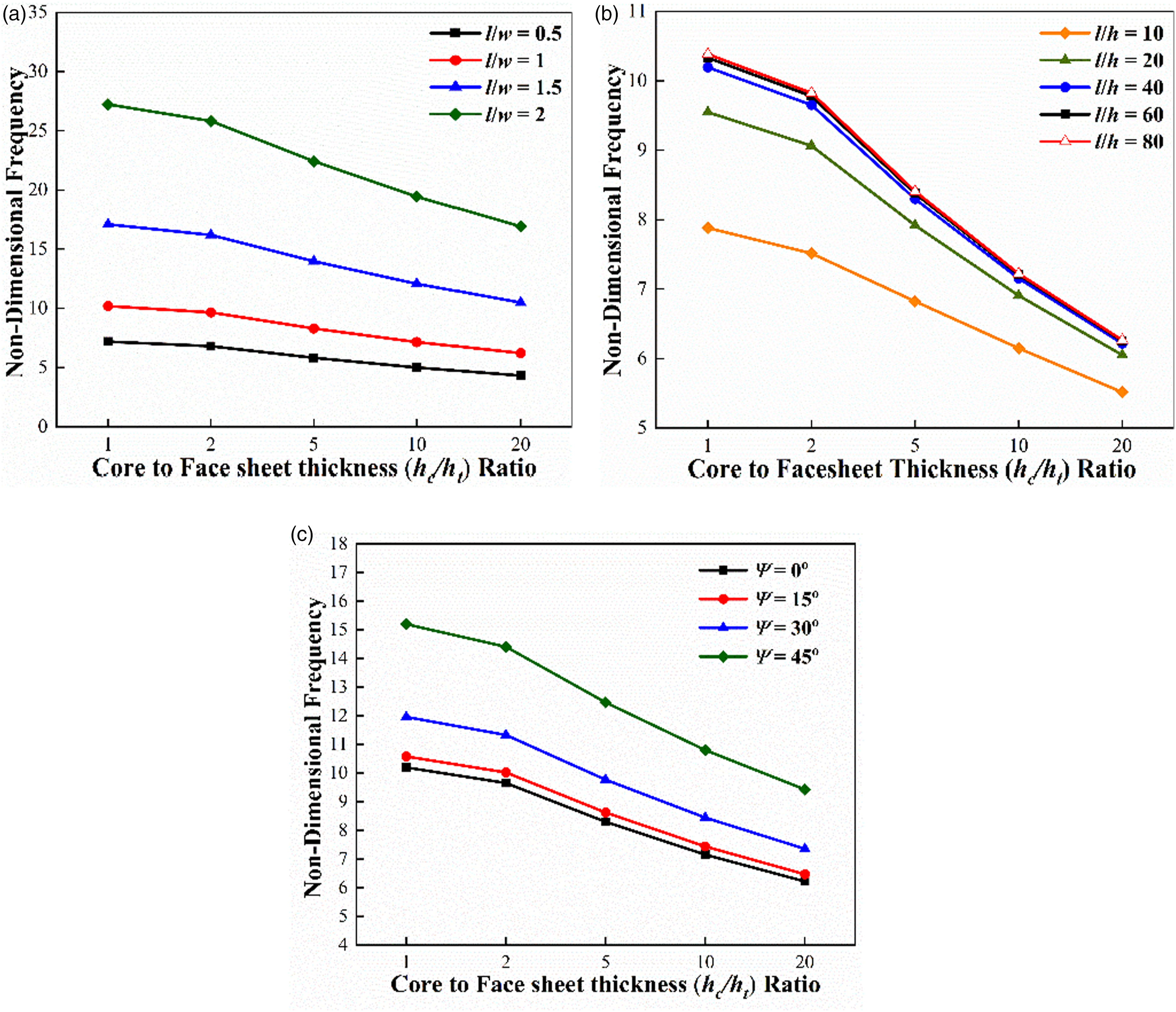
The effect of h c /h t ratio on the NDNF at different temperatures with varying l/w ratios and skew angles.

The effect of h c /h t ratio on the NDNF at different moisture concentrations (%) with varying l/w ratios and skew angles.

Conclusion
This article focuses on studying the influence of temperature and moisture conditions on the natural frequency of the LBCS plate with bamboo fiber-reinforced biocomposite face sheets and biodegradable PLA cores. The effect of temperature and moisture concentrations with different geometric parameters and various skew angles for the free vibration response of sandwich plates is thoroughly studied. The current analysis reveals that considering the initial stress stiffness matrix and the temperature and moisture-dependent material properties anticipate the proper behavior of biocomposite sandwich plates. Bamboo fiber-reinforced biocomposite and PLA core for sandwich plate follow a similar trend as a synthetic fiber-reinforced face-sheet sandwich plate in fundamental frequency when temperature or moisture concentration increases. A severe decrement in frequency is observed as the temperature reaches the Tg of PLA. A gradual degradation of natural frequency can be seen for increasing moisture concentration because of the deteriorating material properties of BFB.
The length-to-width and length-to-total thickness ratios significantly affect the natural frequency, and the frequency increases with an increase in the l/w and l/h ratio. The reduction in frequency for increasing temperature is more significant in thick plates. The stiffness of the sandwich structure increases as the skew angle in the BFB face-sheet/PLA core sandwich plate increases, which elevates the value of the fundamental frequency of the structure. The increment is observed in fundamental frequency with an increment in skew angle. The reduction in frequency is more compelling at a smaller skew angle for increasing moisture concentration. The ratio of core thickness to face sheet thickness significantly impacts the behavior of the sandwich plate. The frequency reduces with an increase in h c /h t ratio as there is an increase in the influence of the core in the sandwich plate system. For the change in h c /h t ratio, the decline in frequency is more prominent in a higher h c /h t ratio for increasing temperature or moisture concentration. Considering the vibration response under the effect of varying temperature and moisture concentration, the bamboo fiber-reinforced biocomposite and biodegradable PLA core for the sandwich plate with optimum geometric parameters can be a suitable replacement for conventional materials for various applications.
Footnotes
Declaration of conflicting interests
The author(s) declared no potential conflicts of interest with respect to the research, authorship, and/or publication of this article.
Funding
The author(s) disclosed receipt of the following financial support for the research, authorship, and/or publication of this article: The authors would really like to take this opportunity to express their gratitude to the Science and Engineering Research Board (SERB) ASEAN-India S & T Collaborative (AISTDF) Project No. IMRC/AISTDF/CRD/2019/000128, Govt. of India, towards providing the grants and resources for the research.
Data availability statement
The  used to support the findings in the study is mentioned within the article
47
.
used to support the findings in the study is mentioned within the article
47
.