



Abstract
In recent decades, noise has emerged as one of the most annoying and tiring factors in working environments, be it in factory, workshop, academic or research setup. This paper presents the noise status and noise reduction analysis of Robotics lab in an academic institute. The average equivalent continuous noise level (
Introduction
In recent decades, noise pollution has emerged as one of the most significant environmental problems due to rapid urbanization and fast expansion of industrial operations.1–3 Industrial noise is one of the most annoying and tiring factors in working environments, be it in factory, workshop, academic or research setup.4–9 Studies have revealed that noise of factories/workshops account for about 80% noise pollutants. 10 It has detrimental physiological and psychological effects on a person’s health and, in extreme cases, may lead to hearing impairment.11–18 Investigations have indicated students being exposed to noise in educational institutes, particularly engineering and technology institutes where workshops/laboratories operate under-industrial set up.5–7,9,19–22 Exposure to high noise levels from workshops/laboratories cause disturbances in teaching-learning process, such as classroom discussion, task performance, problem-serving and mental stress.14,20,23–26
Therefore, it is crucial to utilize efficient acoustic (sound insulation) or sound absorption materials in workshops/laboratories in educational institutes for noise mitigation. Although the terms ‘sound insulation’ and ‘sound absorption’ are frequently used interchangeably in everyday speech but they are fundamentally distinct. Sound absorbing materials are intended to enhance sound quality, minimize echo and annoying reverberation inside a place but don’t dampen the noise; whereas, sound insulation serve as an acoustic barrier to the sound source by preventing sound waves from entering or leaving a place.27,28 Researchers have studied the sound transmission loss (STL) or insertion loss (IL) in different types of enclosures using variety of materials. Ming & Pan, 29 observed that insertion loss in different type of enclosures (aluminium and fibrous glass covered with rockwool layers) varied with different range of frequencies. Asdrubali 30 reported that airborne sound insulation of natural material is similar to the glass. Ayub et al. 31 reported best results with double-layer panels when the inner perforated plate has lower porosity material (coir fiber) and was backed with an air gap. Tao et al. 32 studied the combination of multiple perforated plates, air gap and coir fiber for enhancing sound absorption quality and reported that the absorption coefficient of panel was governed by the porosity of the perforated plates. Gao et al. 33 reviewed active and passive metamaterials (artificial composite materials) for noise reduction and concluded that metamaterials can reduce very low frequency noise that may not be possible by conventional acoustic materials.
Now a day, industrial robots or mechanized equipment have been widely used for high-volume productivity to yield the best cost per unit performance in comparison to manual and hard automation.
34
Welding is an integral part of advanced manufacturing and robotics welding has become the symbol of modern industrial welding technology that has now become indispensable because manual welding yields low production rates due to harsh work environment and extreme demands.
35
Despite the benefits of using robotics systems, the welding process (tig, mig and spot welding) are a source of noise, particularly in the academic environment where the prevention of sound waves (noise) leaving a place (workshop/laboratory) becomes important consideration to safeguard the teaching-learning process in the surrounding academic area. In view of this, noise study of the Robotics lab/workshop was carried out with the following objectives – ⁃ noise assessment status – indoor (working environment under-industrial conditions) and outdoor (noise assessment in academic area due to transmission of sound from Robotics lab/workshop); ⁃ noise reduction analysis by using different types of acoustic materials for windows of Robotics lab/workshop; and ⁃ develop a model or mathematical relationship between sound transmission loss by acoustic material(s) and noise level.
Further, suggestions and recommendations have been made based on the outcome of the present study.
Materials and methods
Study area
The study was carried out for Robotics lab located in Siemen Centre of Excellence in the academic area of National Institute of Technology Kurukshetra, Haryana (India). The lab is being used by students and faculty for academic, research and consultancy purposes. There are three machines in Robotics lab, namely Model KR10 R1420, KR10 R1420 and KR210 R2700 for Tig, Mig and Spot welding respectively. The Hall consisting of (18.5 m × 11.6 m × 3.2 m) and the top of hall is covered with the false ceiling and the floor is covered with the epoxy coating which prevent the floor from degradation from the vibration caused by the machinery. The operating areas of the machines are on one side of the hall near the windows. All the windows (2.6 m × 1.32 m) adjacent to the operating areas are single glazed with 3 mm thick glass. The image of the Robotics lab and the layout plan with the noise measurement points/locations are presented in Figure 1. The welding machines are being operated individually, i.e., one at a time. Indoor measurements were thus made for noise produced by Tig, Mig and Spot welding machines in the space designated for operational activity at locations I1, I2a & I2b, and I3 respectively under-industrial conditions. Outdoor noise measurements were made near the windows at locations O1, O2 and O3 during the operation of Tig, Mig and Spot welding respectively. The locations were selected such that the noise reduction by various acoustic materials can be analyzed. For noise reduction analysis, the following acoustic materials have been used for windows – glass (3 mm thick), curtain (1 mm thick) made up of polyester, cardboard (5 mm thick), thermocol (15 mm thick) and a combination of curtain and glass (1 & 3 mm thick respectively). Photograph and layout plan of Robotics Lab with noise monitoring locations.
Noise measurement
Noise measurements were made during January-February 2023 with the class-1 digital sound level meter (SLM) Casella CEL-620B1 using ‘A’ frequency weighting network and fast response mode. The SLM was held at 1.3 to 1.5 m above the ground, and 3.0 to 3.5 m away from reflective surfaces, and with the microphone directed to the noise source. 36 Calibration of the SLM was performed at 114 dB (A), both before and after the day’s measurements using Casella CEL-120/1 class-1 acoustic calibrator.
Noise measurements were taken at all the seven locations (as shown in Figure 1) for 3 min’ duration per run so that machines get stabilize on a constant vibrations and variation of noise can be accurately monitored. Further, a set of three measurements was taken at each station so that chances of error will not be there. 19
The following noise indices were used for noise measurement and/or assessment of results:
The average

Sound Transmission Loss (STL), or Insertion Loss (IL), is used to express the efficiency of the acoustic material and is calculated from equivalent continuous noise level by the following expression:
37

Indian ambient air quality standards in respect of noise.

Note: (1) Silence zone is an area comprising not less than 100 m around hospitals, educational institutions, courts, religious places or any other area which is declared as such by the competent authority.
(2) Mixed categories of areas may be declared as one of the four above mentioned categories by the competent authority.
The Robotics lab has been considered under Category: Industrial Area for indoor locations (I1, I2a, I2b and I3), and the Academic Area of the Institute has been considered under Category: Silence Zone for outdoor locations (O1, O2 and O3) in the present study in accordance with the above Indian noise standards.
Analysis approach
The analysis of collected data was carried out in accordance with the scheme covering – ⁃ preparatory work, that includes determining the number of noise measurement points and their locations, starting the machine and defining its parameters, ⁃ diagnostic evaluation, that includes noise measurements, computation and analysis of study results, ⁃ drawing inferences, that includes comparison and evaluation of results as compared to the permissible levels as per Indian noise standards for industrial and silence area/zone during day time (Table 1), ⁃ development of mathematical model for predicting STL from acoustic material(s), and ⁃ conclusion and suggestions, along with recommendations for future research.
Results and discussion
Indoor and outdoor noise indices with existing acoustics.

The deviation of average noise levels ( Deviation of noise levels at indoor and outdoor locations with existing glass window acoustics.
Noise indices at outdoor locations without and with acoustics.
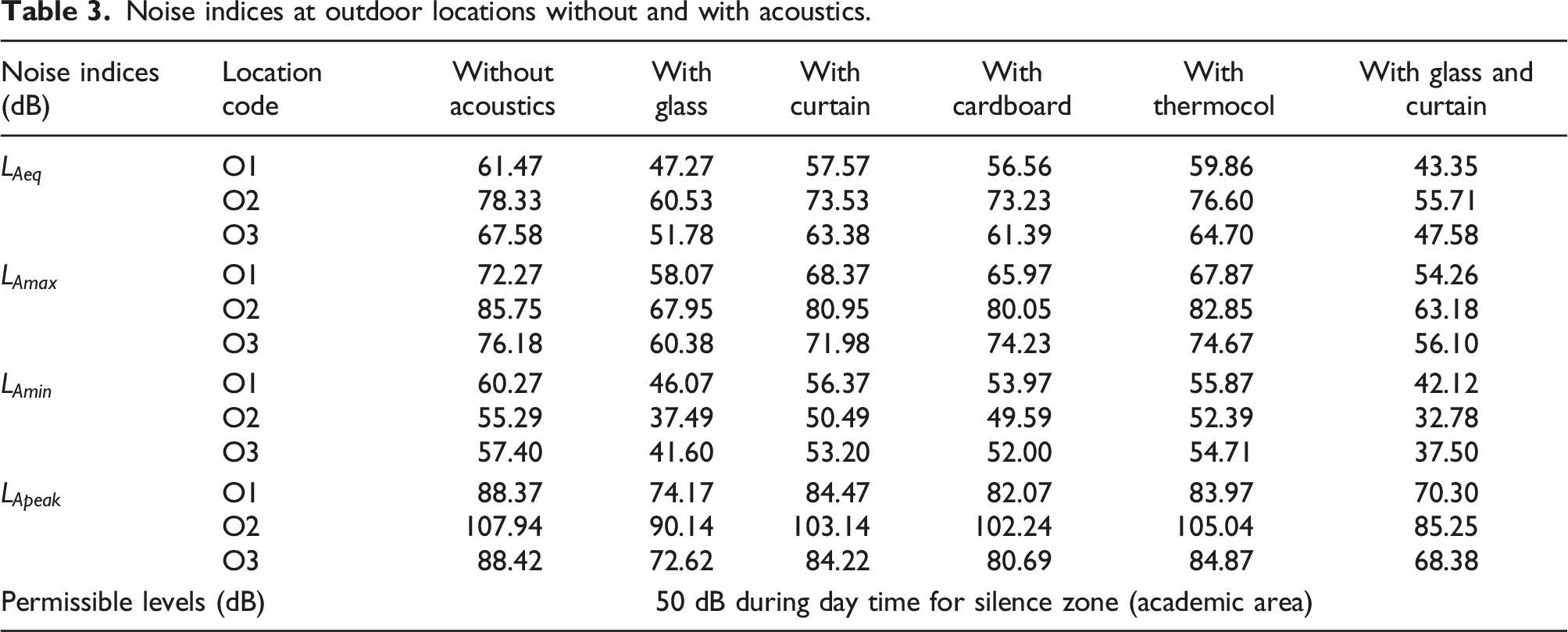
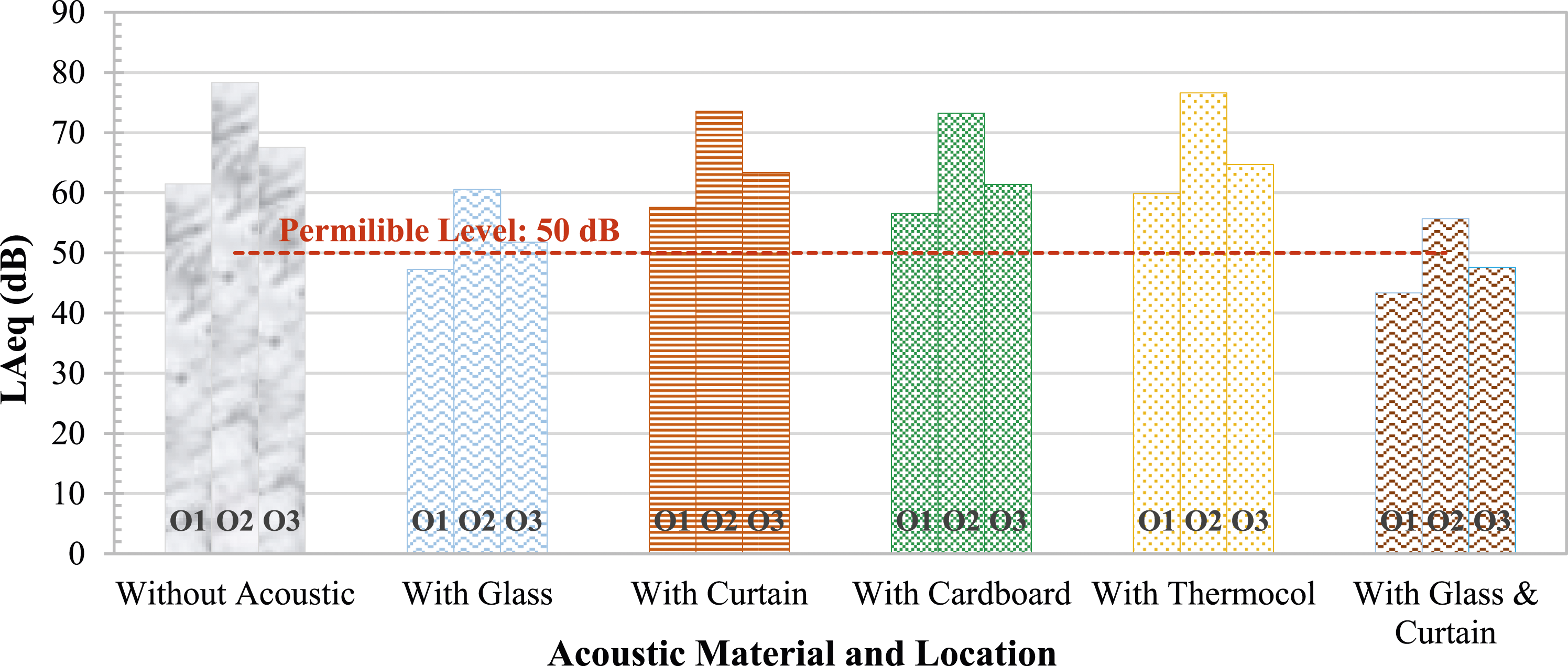
Noise levels at outdoor locations with acoustic material in comparison to without acoustics.
The computed Sound Transmission Loss (STL) was plotted for all the studied acoustic options in Figure 4. Sound transmission loss (STL) for acoustic materials at outdoor locations.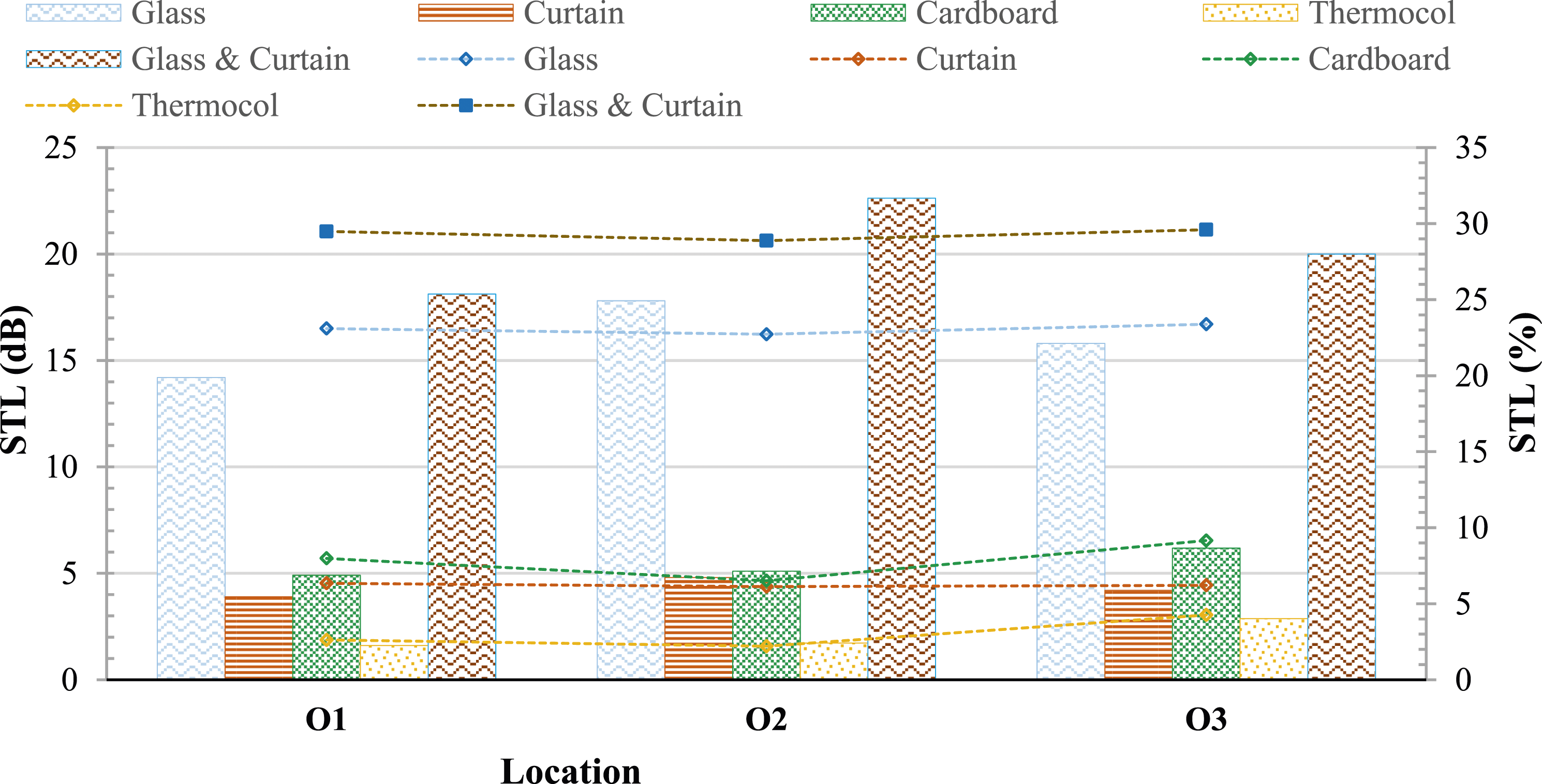
A glance at the Figure 4 showed that the STL (both in terms of dB and %) was minimum with thermocol (1.61–2.88 dB; 2.21–4.26%), followed by curtain (3.90–4.80 dB; 6.13–6.34%), cardboard (4.91–6.19 dB; 6.51–9.16%) and glass (14.20–17.80 dB; 22.72–23.38%). In the existing scenario of the Robotics lab, the windows have glass pans that are not acoustically sufficient to improve the STL to the desired extent, that is to reduce the
The experimental data was then used for developing a mathematical model for predicting the STL for the combination of glass and curtain from the Prediction of STL for combination of glass and curtain as acoustic material for windows.
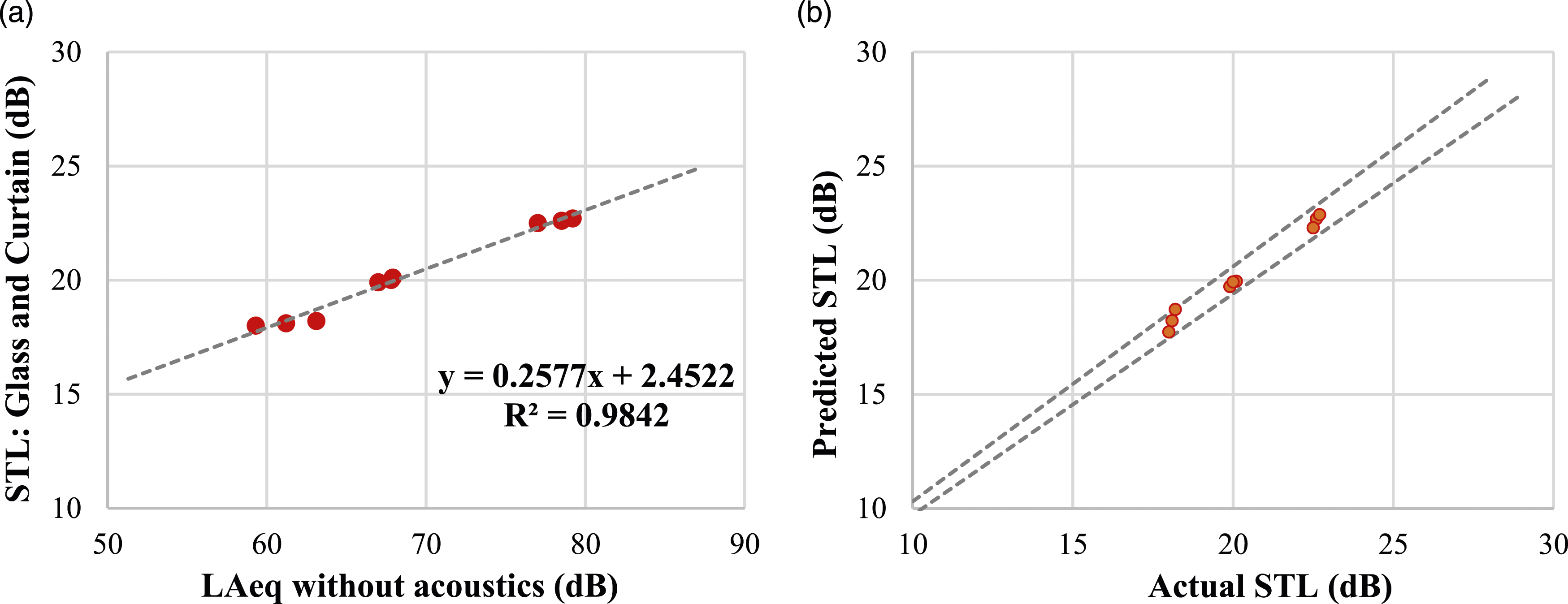
The coefficient of determination (R2) is very high (0.9842) of the above relationship that signify the accuracy of the model in prediction. Thereafter, the actual and predicted values of STL were plotted for validation of the model (Figure 5(b)). The scattering of ±3% along with the excellent computed statistical performance parameters, namely mean absolute error (−0.00016), root mean square error (0.23227) and correlation coefficient (0.992) suggests the application of the proposed model (Equation (3)) for predicting STL for the glass and curtain combination from
Conclusion
The sound levels measured in the Robotics lab of an academic institute showed that the noise inside the lab was within or marginally above the permissible limits as per Indian standards of 75 dB for industrial category; but the operation of Mig and Spot welding were a source of noise nuisance to the adjoining academic area due to the sound transmission from the Robotics lab during the operations of the machines. This necessitates the usage of acoustic barrier so that high indoor noise in the workshop/lab under-industrial conditions does not leave the place and transmits to surrounding academic area. The noise reduction analysis demonstrated the usage of acoustics (glass, curtain, cardboard and thermocol) as sound barriers. The Sound Transmission Loss (STL) was observed to be highest in the range of 18.12–22.62 dB (28.88–29.59%) by using the combination of glass and curtain as acoustic barrier in windows of the Robotics lab; thereby, reducing noise nuisance significantly in the academic area. The proposed model has the potential of predicting STL for the combination of glass and cardboard from
Suggestions and recommendations
It can be suggested and recommended from the above study results that: ⁃ personal protection equipment (PPE) such as ear muffs or ear plugs for workers during operation of the machines, ⁃ curtains must be drawn during the operation of the machines, and ⁃ double glazed windows can be used to further dampen the transmission of sound in academic area.
Footnotes
Acknowledgments
This study was carried out in the Robotics Lab of Siemens Centre of Excellence at National Institute of Technology Kurukshetra. The authors acknowledge the cooperation and support of the staff during the period of study.
Declaration of conflicting interests
The author(s) declared no potential conflicts of interest with respect to the research, authorship, and/or publication of this article.
Funding
The author(s) received no financial support for the research, authorship, and/or publication of this article.
