



Abstract
When a compound failure occurs in a bearing, the failure information included in vibration signals is featured by being weak, complex and combined. This fact makes it difficult to identify a compound failure precisely. Variational mode extraction (VME) solves the problem of variational mode decomposition (VMD) in being difficult to determine the number of decomposition layers and has certain applications in the identification of bearing failures. However, the initial expected central frequency of VME and option of penalty factor is crucial to the extraction of expected mode. To precisely determine the central frequency and penalty factor of VME and fulfill the correct extraction of feature information of compound failures in bearing, the paper has proposed a method based on synchro squeezing transform (SST) and information entropy to adaptively determine the parameters in VME (SST-VME). Firstly, SST is used to make time-frequency analysis of original vibration signals and characteristic frequency bands with larger energy are chosen from time-frequency spectrum to adaptively determine the expected central frequency of VME. Secondly, as information entropy has representation capacity for information included in the signal, penalty factor of VME was adaptively determined according to information entropy. Thirdly, original signals were subjected to VME according to expected central frequency and penalty factor adaptively determined; the expectation mode obtained was denoised by singular value decomposition algorithm. Finally, the type of compound failures of bearing is determined according to the frequency spectrum of denoised signals. To verify the effectiveness of proposed method, a comparison with VMD algorithm is conducted. As indicated by the result, the proposed method is more precise and comprehensive than VMD algorithm to extract the feature information corresponding to compound faults of bearing, and thereby correctly determines the type of compound failures.
Keywords
Introduction
Ball bearings, as crucial components of rotating machinery, play an irreplaceable role in system transmission and are widely available for several important fields such as aviation, electricity, and machinery.1–3 Ball bearings often operate in complex situations, such as high temperatures and pressures, and their failure is one of the typical equipment failures. 4 When a bearing failure occurs, it can cause breakdown to the entire system.5–7 Therefore, it is of relevance importance to effectively monitor the operational status of the bearings and accurately identify their failure types.
The vibration signals of ball bearings include a plethora of failure information during a breakdown. 8 Extracting failure feature from vibration signals based on various signal decomposition algorithms is a crucial research direction for failure identification of bearing. 9 Typical signal decomposition algorithms include empirical mode decomposition, 10 local mean decomposition, 11 intrinsic time-scale decomposition, 12 wavelet transform, 13 VMD 14 etc. In 2014, Dragomiretskiy and others proposed the VMD method, 14 which improved the problems of modal aliasing and endpoint effects in signal decomposition to a certain extent. 15 Currently, VMD is widely used in vibration signal processing of rotating machinery. Tang et al. combined the VMD method with envelope spectrum characteristic factors optimized parameters to extract the early weak failure information of ball bearings. 16 Wei et al. proposed a failure diagnosis method based on the improved sparrow search algorithm optimized variational mode decomposition and weighted kurtosis, achieving accurate extraction of bearing failure characteristic information and accurate judgement of bearing failure types. 17 The premise of accurately decomposing signals on account of the VMD algorithm is the reasonable determination of the decomposition layers and penalty factors. When the decomposition layers or penalty factors are not reasonably set, it might be difficult to accurately extract failure information based on the VMD algorithm. 18 In 2018, Nazari and others proposed the VME method and applied it to extract respiration signals in electrocardiograms. 19 VME is a signal decomposition algorithm proposed in response to the difficulty of defining the amount of decomposition layers in VMD. 19 Its core concept is to decompose the signal into the expected mode and residual error signal and minimize the overlapped spectral energy between the expected mode and the residual error signal. 19 Currently, VME has some applications in the field of bearing failure identification. To facilitate the extraction of failure information, VME itself still needs to set a desired center failure frequency value as an initial parameter and an appropriate penalty factor to extract the desired mode. Liu et al. proposed an adaptive the most fitting mode extraction way, which determined the centroid frequency of apiece mode by fitting the envelope curve after dividing the spectrum, and adaptively adjusted the penalty factor by the relative amplitude ratio, achieving the adaptive determination of the VME center frequency and penalty factor, and completed the feature extraction of bearing failures. 20 Guo et al. bring up the use of short time Fourier transform to select the center frequency of VME and constructed the standard deviation index of the maximum differential value of the envelope to select the penalty factor, determined the parameters of VME, and completed the extraction of gearbox failure features. 21 It can be seen that how to determine the expected centroid frequency and punishment factor of VME is a key issue for accurately extracting failure information based on the VME method.
In time-frequency analysis, the SST calculates the instantaneous frequency of the time-frequency spectrum and redistributes energy in the spectrum in the frequency direction. This results in a more accurate frequency curve, significantly improving the readability of time-frequency. 22 The SST can enhance the energy concentration of the instantaneous frequency, achieving the compression and rearrangement of time-frequency coefficients. Through the obtained time-frequency spectrum, the selection of the failure frequency band can be achieved. Information entropy is a measure of the complicacy of the system. The greater the amount of information a signal contains, the higher its information entropy value becomes, increasing the likelihood of it encompassing extensive failure characteristic information. 24 Conversely, if a signal contains less information, its information entropy value will be smaller, and it will contain less failure information. In instances of compound failures in bearings, the impact features present within the signal tend to be more pronounced. However, the subtlety and unpredictability of these impacts increase the complexity of signals. Therefore, the characterizing ability of information entropy can be utilized to effectively describe the failure characteristics of bearings.
Based on the above research, this paper uses SST and information entropy to adaptively determine the expected center failure frequency and penalty factor of VME and uses the determined centroid frequency and penalty factor based on the VME algorithm to extract compound failure information of bearings. The principal contributions of this paper are as bellows: (1) The SST is employed to adaptively select the failure frequency band during compound failures of ball bearings. (2) Utilizing the adaptively selected failure frequency band, the central frequency of the VME is determined in an adaptive manner. (3) The penalty factor of VME is adaptively determined with information entropy. (4) The optimal expected mode of VME is extracted using the adaptively determined central frequency and penalty factor.
Variational mode extraction theoretical algorithm
Variational mode extraction (VME) primarily considers the primitive signal

At the same time, (1) Initialize n = 1, (2) Set n = n + 1 and start the loop of the algorithm. (3) For all (4) Finish if the set value of e is satisfied; otherwise, return to step (2).



The above derivation process can be seen in detail in reference 19.
In VME, the Lagrange multiplier
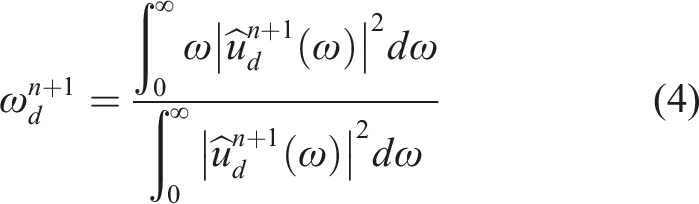
According to equation (4), it is evident that the central frequency of VME is a crucial characteristic parameter that needs to be ascertained when performing VME on signals. This parameter is key in determining the optimal expected mode. An inaccurately determined central frequency can result in the misidentification of the optimal expected mode. If the optimal expected mode is inaccurately identified, it leads to imprecise extraction of compound failure characteristics in bearings, subsequently hindering the accurate identification of bearing failure types. Therefore, the precise determination of the central frequency is of paramount importance.
Proposed adaptive determination of the optimal expected mode in variational mode extraction
Adaptive determination of central frequency of variational mode extraction based on synchro squeezing transform
Transform core of SST provides short-time Fourier transform and wavelet transform. The paper chooses the SST of short-time Fourier transform.
Let original vibration signal is

In the formula (6),
Based on short-time Fourier transform, SST is:

In the formula (7),
This paper uses the time-frequency distribution diagrams obtained to select frequency bands with high energy. These bands are used for the adaptive determination of the central frequency for the optimal expected mode in VME.
Adaptively option of penalty factor of variational mode extraction
The presence of compound failures in bearings increases the impact features within the signal. The subtlety and uncertainty associated with these impacts further complicate the signal. Information entropy is utilized to describe this complexity, the higher the failure information content in the signal, the greater the information entropy.
24
Therefore, after central frequency
The circulation extent of Flowchart for the adaptive determination of the penalty factor. IE, information entropy.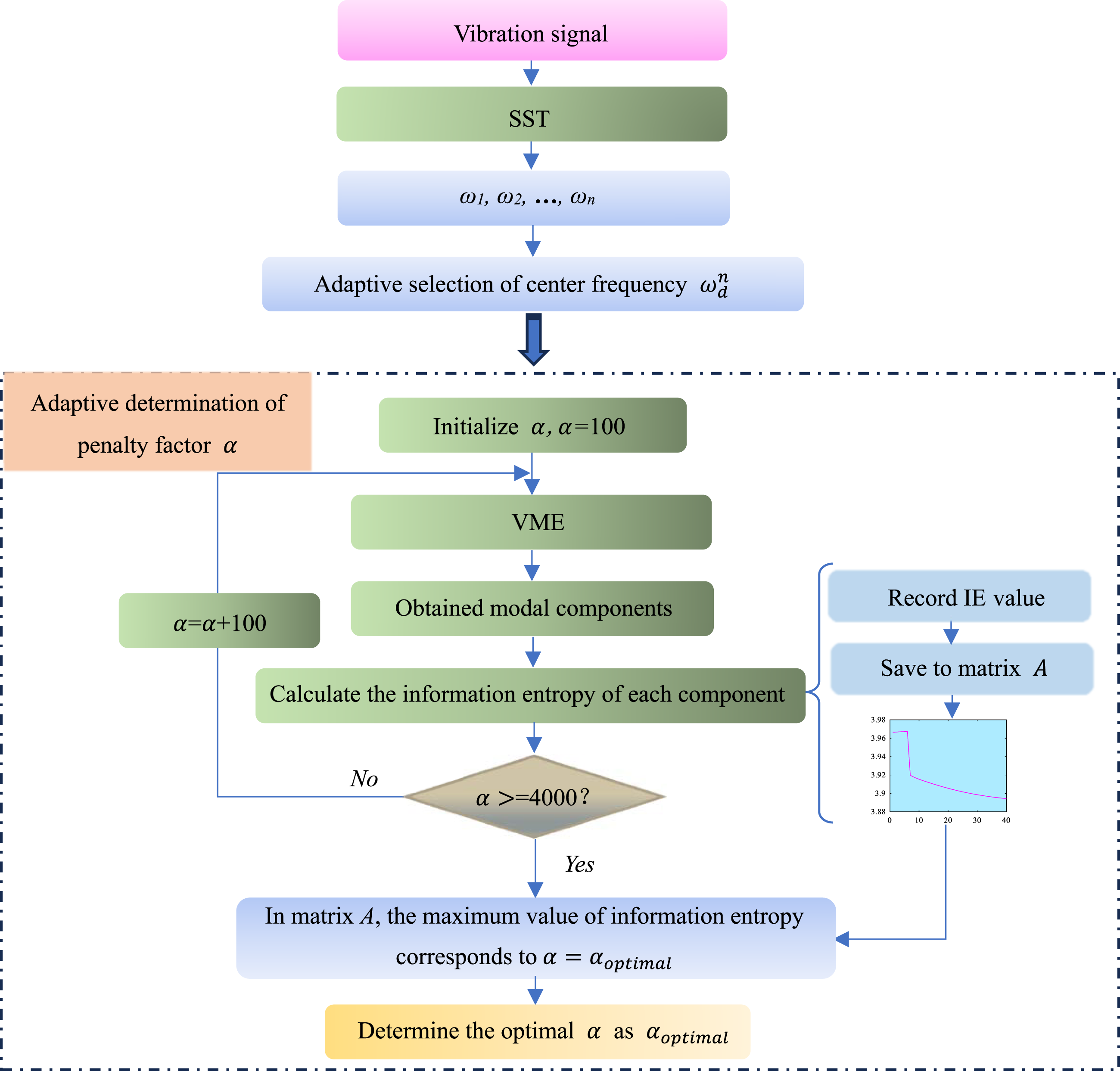
The overall idea of proposing method
The paper has brought forward a failure feature extraction method for ball bearing according to SST and information-entropy-optimized multiscale VME (SST-VME) to accurately extract feature information of compound failures of ball bearing. The process of the presented method is shown in Figure 2. Block diagram of bearing failure identification.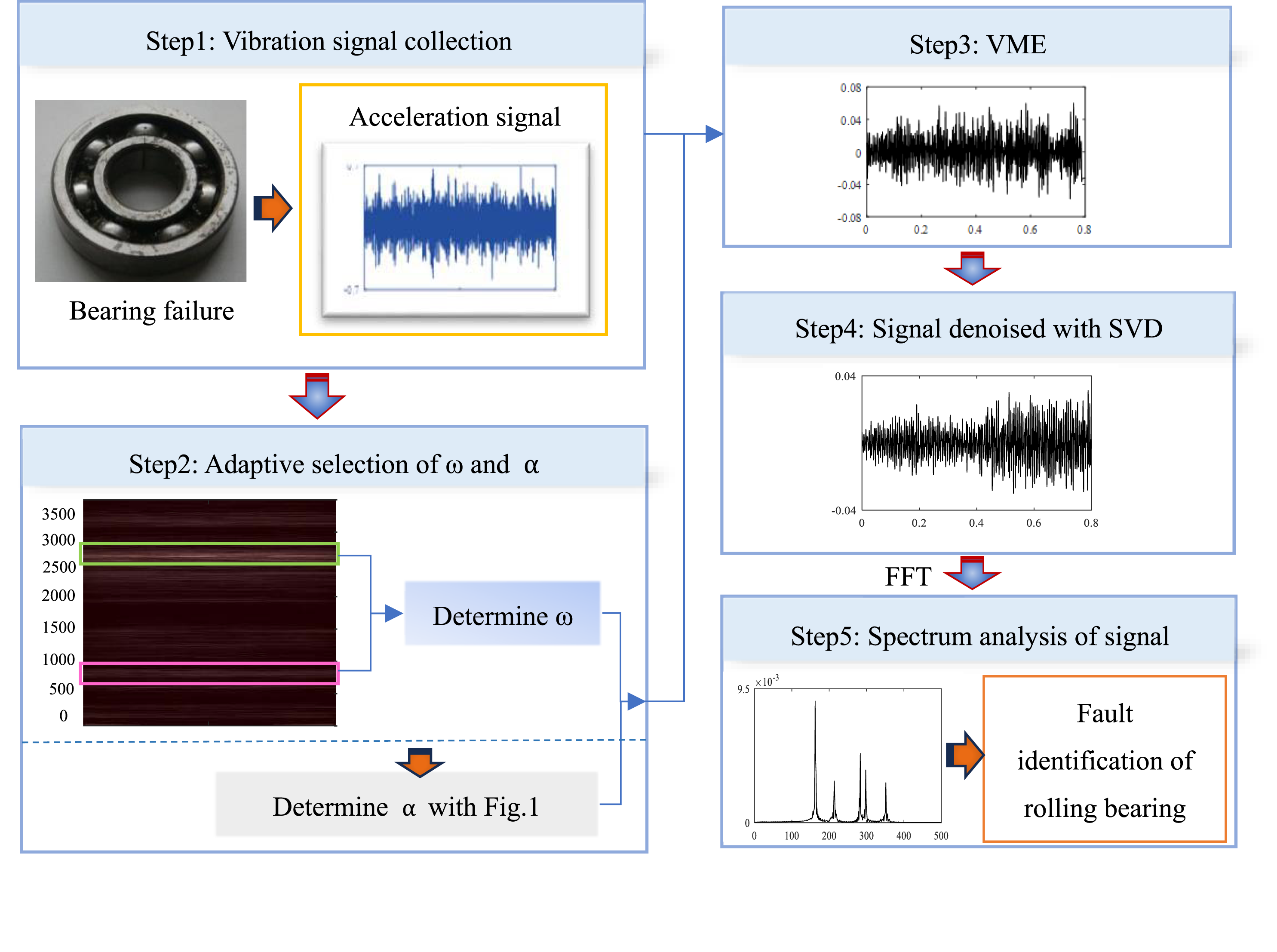
Details: 1) By SST of original signals to obtain a range of frequency band where compound faults were located. 2) The initial central frequency of VME is adaptively determined based on the determined failure frequency range. 3) The penalty factor is adaptively ascertained using the adaptively determined initial central frequency, as illustrated in Figure 1. 4) VME of the signal is conducted using the adaptively determined initial central frequency and penalty factor. 5) Expected mode was denoised, which was implemented by singular value decomposition; by referring to reference 26, the paper chose the first 10 singular values for signal reconstruction. 6) Spectral analysis is performed on the denoised signal to extract the characteristic frequencies of compound failures of bearings, enabling the identification of the types of compound failures in bearings.
Method proving and analysis
Bearing failure experiment
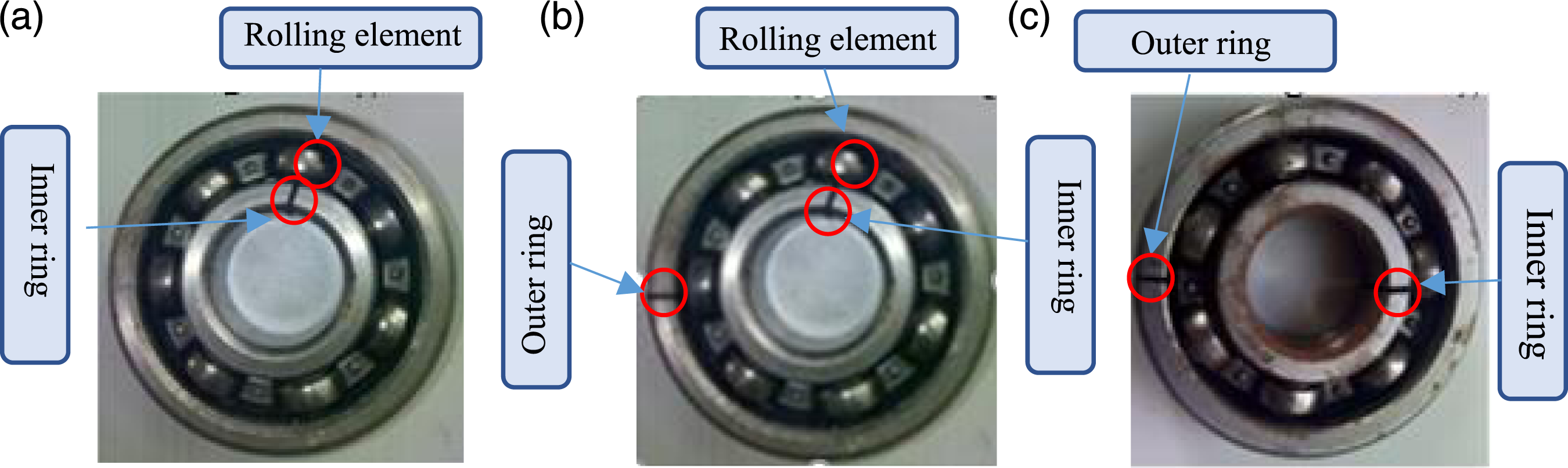
The data used in this paper are all from the aeroengine ball bearing tester as shown in Figure 4. This tester is composed of a rotating shaft, gearbox, ball bearings, an adjustable speed motor, rotor disc, and bearing seat. The tester can simulate various types of failures in ball bearings. During the experiment, an eddy current sensor is used to collect the rotation speed, and the vibration acceleration sensors fixed in the horizontal and vertical directions of the tester are used to collect acceleration signals. The specific installation positions of sensors and their channel configurations are shown in Figure 3. Channels CH1-CH4 in Figure 3 correspond to four different types of channels. In this study, we intentionally damaged the bearings using a spark wire cutting method, with a cut depth of 0.2 millimeters. The arguments of this faulty bearing are shown in Table 1. Figure 4 corresponds to ball bearings under different compound failure types, specifically: in Figure 4(a) corresponds to a compound failure of the inner ring and ball element; in Figure 4(b) corresponds to a compound failure of the inner ring, outer ring, and ball element; in Figure 4(c) corresponds to a compound failure of the inner and outer rings. Aeroengine rotor-ball bearing test rig. Ball bearing arguments. Compound failures of bearings.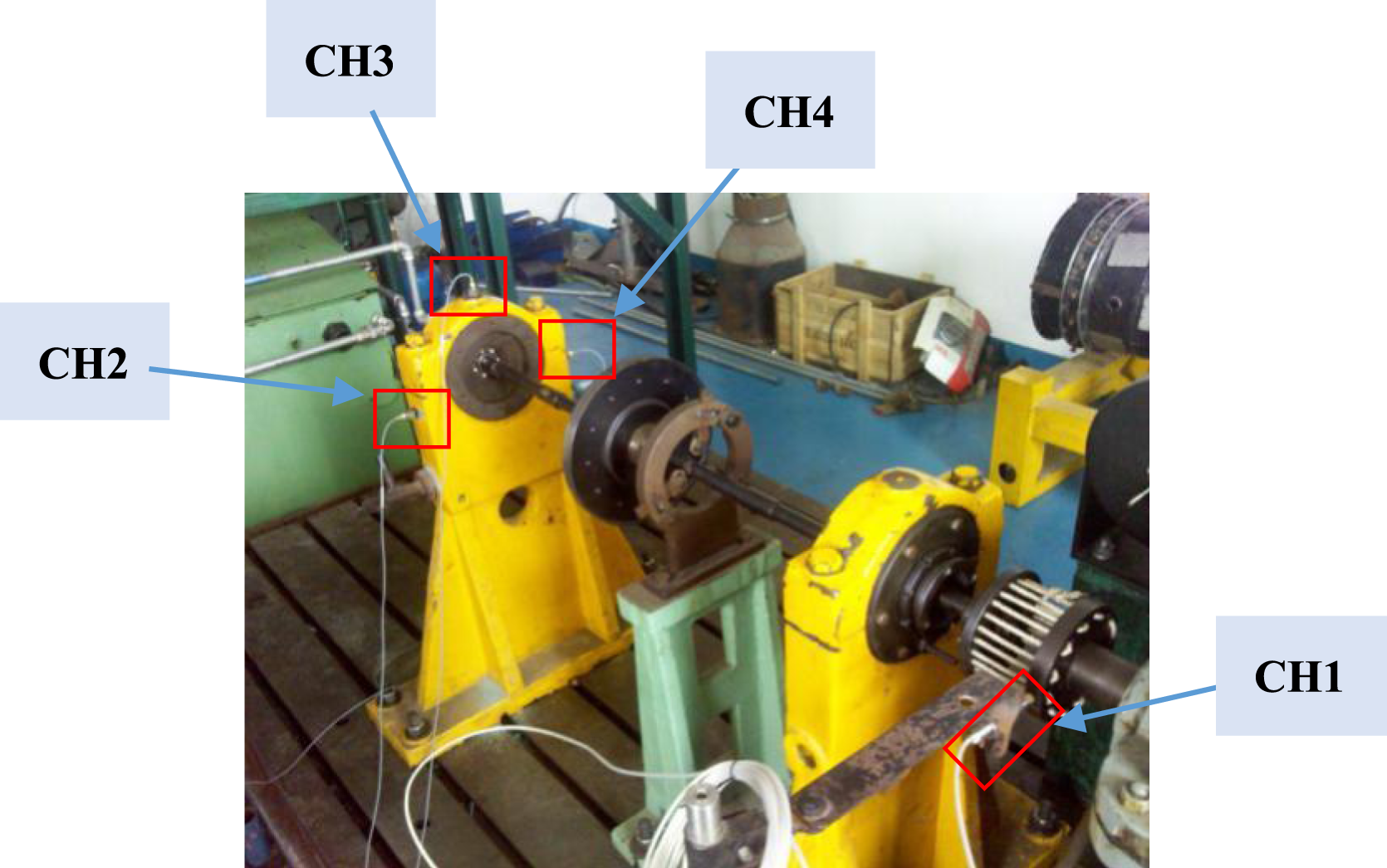

Characteristic frequencies of ball bearing failures
Calculation formulas of feature frequencies of ball bearings.
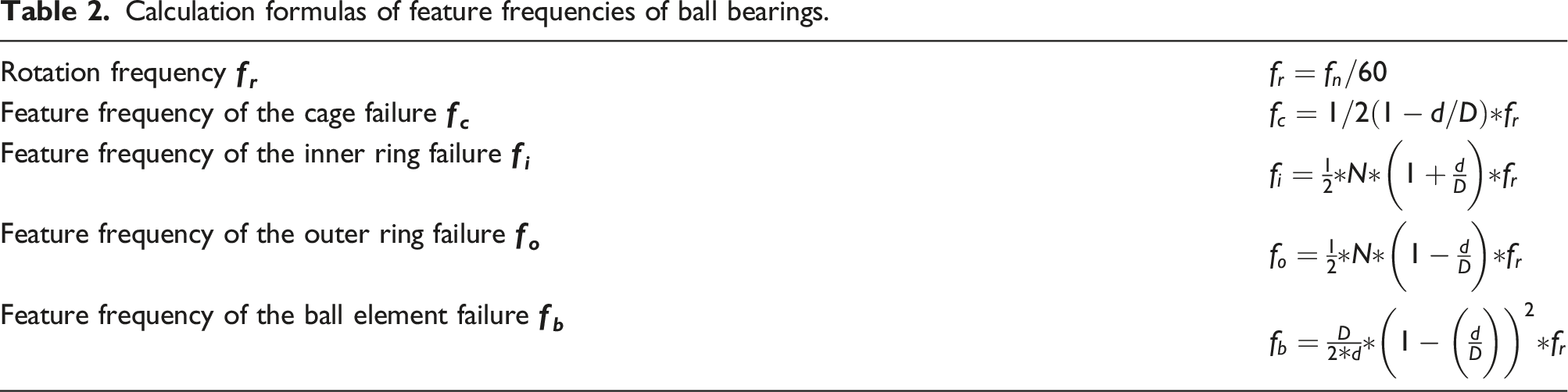
As demonstrated in Tables 1 and 2, the characteristic frequencies of a bearing are defined by its geometric dimensions and rotational frequency. With the bearing model and rotational speed established, the fault characteristic frequencies can be obtained from Table 2.
Recognition of compound failures of bearings
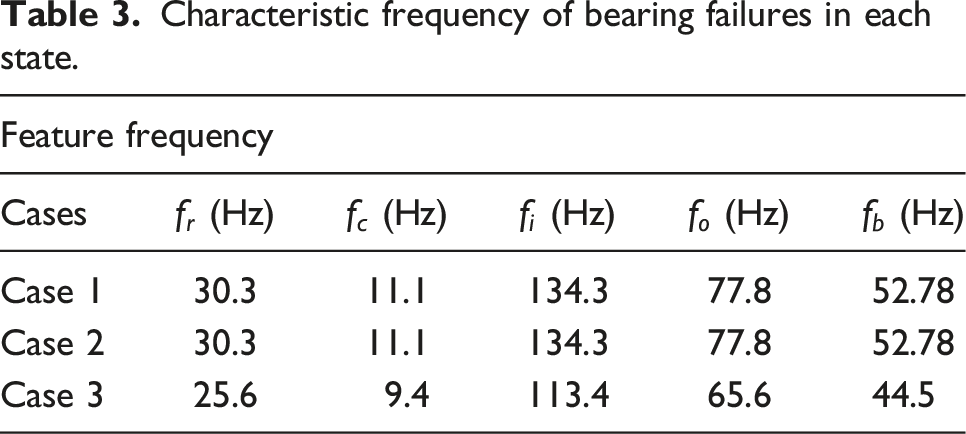
Characteristic frequency of bearing failures in each state.
Proposed methodology
Firstly, the first set of data in Table 3 is processed using the proposed method (as per section 3.3) for failure feature extraction and failure type identification, with results displayed in Figure 5. Figure 5(a) and (b) are the time-domain and frequency-domain graphs of the original acceleration signal, respectively. Figure 5(c1) is the time-frequency graph obtained after performing the SST on the original signal. As seen from Figure 5(c1), the typical failure frequency bands are: 2π*300 rad/s, 2π*600 rad/s, 2π*1200 rad/s, 2π*2600 rad/s. Figure 5(c2) represents the information entropy values of the signal under different penalty factors, where the maximum information entropy is found at Fault identification of bearing with proposed methodology. SST, synchro squeezing transform; VME-ASVD, variational mode extraction-adaptive singular value decomposition. (a) Time domain diagram of signal. (b) Spectrum of (a). (c1) Time-frequency diagram with SST of (a). (c2) Adaptive determination of penalty factor. (d1) Time domain diagram of model 1 after VME. (d2) Time domain diagram of model 2 after VME. (e1) Time domain diagram of (d1) after ASVD. (e2) Time domain diagram of (d2) after ASVD. (f1) Spectrum of (e1). (f2) Spectrum of (e2).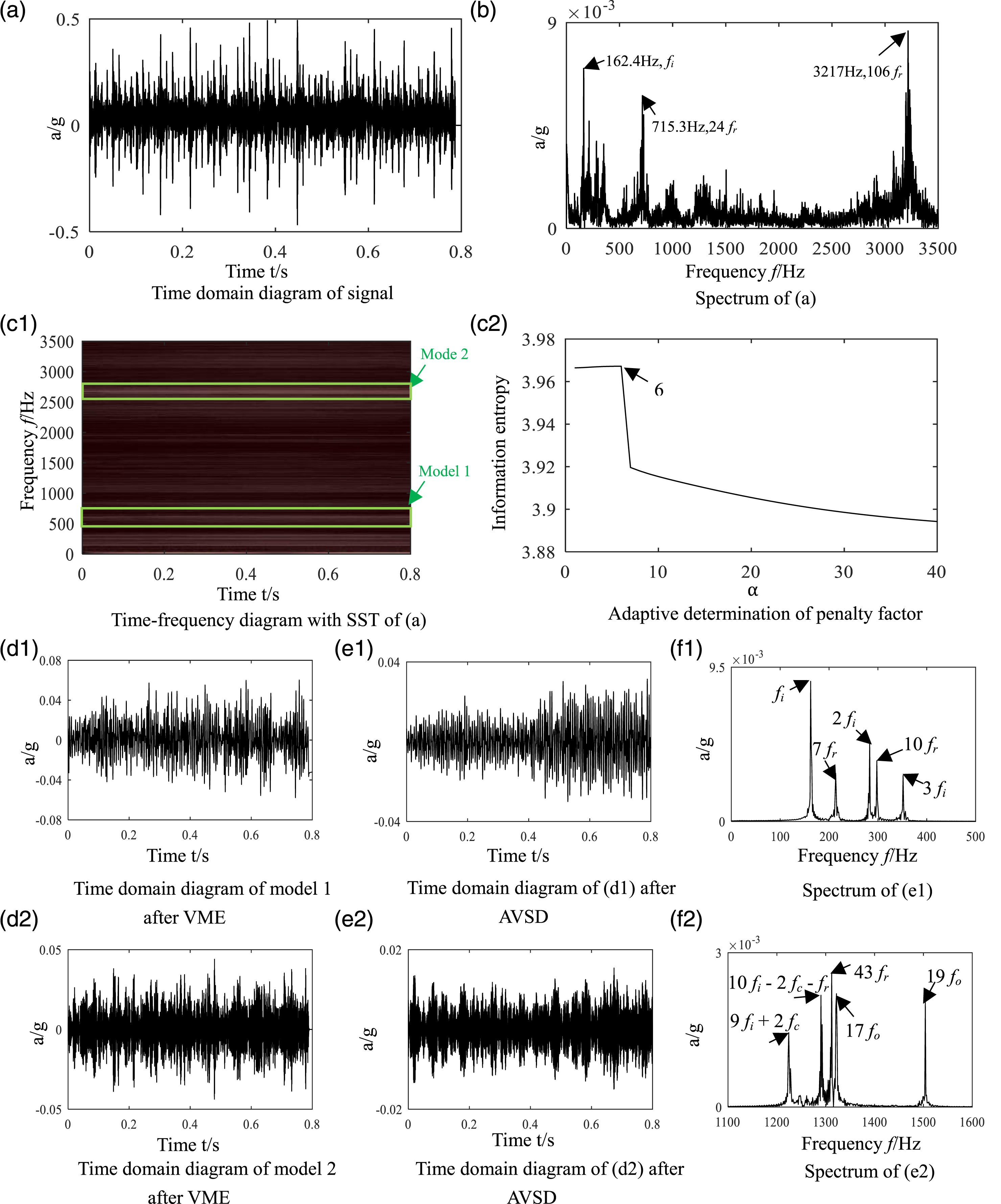
Analysis of Figure 5(b), spectrum of the original signal, reveals: (1) The relatively prominent frequency components include: 162.4 Hz, which corresponds to 1x of the inner ring failure feature frequency (f
i
, 134.8 Hz) (162.4-30.3 = 132.1 Hz); 715.3 Hz (715.3/24 = 29.8 Hz) and 3217 Hz (3217/106 = 30.3 Hz), which correspond to 24x and 106x of rotation frequency (f
r
, 30.3 Hz) respectively. (2) No outstanding frequency component corresponding to outer ring failure of this bearing was found, which leading to inaccurate judgement of failure type of bearings. (3) The presence of excessive noise components hampers accurate failure identification and determination.
Analyzing Figure 5(f1)–(f2), the spectrum corresponded to proposed method, shows: (1) A significant reduction in noise when compared to Figure 5(b). (2) Extraction of typical frequency components corresponding to failure types of this bearing, including: 1) Frequency components corresponding to outer ring failures (f
o
, 77.8 Hz) 1322 Hz, this frequency corresponds to 17 f
o
, (1322/17 = 77.8 Hz); 1504 Hz, this frequency corresponds to 19 f
o
, (1504/19 = 79.2 Hz). 2) Frequency components corresponding to inner ring failures (f
i
, 134.3 Hz), including:162.4 Hz, this frequency corresponds to f
i
+f
r
(162.4-30.3 = 132.1 Hz); 283.2 Hz, this frequency corresponds to 2f
i
+f
c
, ((283.2.9-11.1)/2 = 136.05 Hz); 351.6 Hz, this frequency corresponds to 3f
i
-f
r
-2*f
c
, (351.6 + 30.3+2*11.1)/3 = 134.7 Hz); 1224 Hz, this frequency corresponds to 9fi+2fc, ((1224-11.1)/9 = 134.25 Hz);1290 Hz, this frequency corresponds to 10 f
i
-f
r
-2f
c
, ((1290 + 30.3+2*11.1)/10 = 134.25 Hz).
From the analysis above, it is evident that for the randomly chosen typical compound failure in ball bearings (inner ring and outer ring, CH3, rotational speed of 1800 r/min), the method of compound failure feature extraction for ball bearings based on SST and information entropy optimized VME effectively suppresses noise. It also extracts the momentous feature frequencies corresponding to the bearing failure types, thus achieving accurate identification of the type of compound failure in the bearing.
Contrast method: Variational mode decomposition
To test and verify the effectiveness of the proposed methodology in this paper (SST-VME-ASVD), a comparative analysis is carried out with the variational mode decomposition (VMD: Fault identification of bearing with contrast method. (a1) Time domain diagram of k=1 after VMD. (b1) Time domain diagram of (a1) after ASVD. (c1) Spectrum of (b1). (a2) Time domain diagram of k=2 after VMD. (b2) Time domain diagram of (a2) after ASVD. (c2) Spectrum of (b2).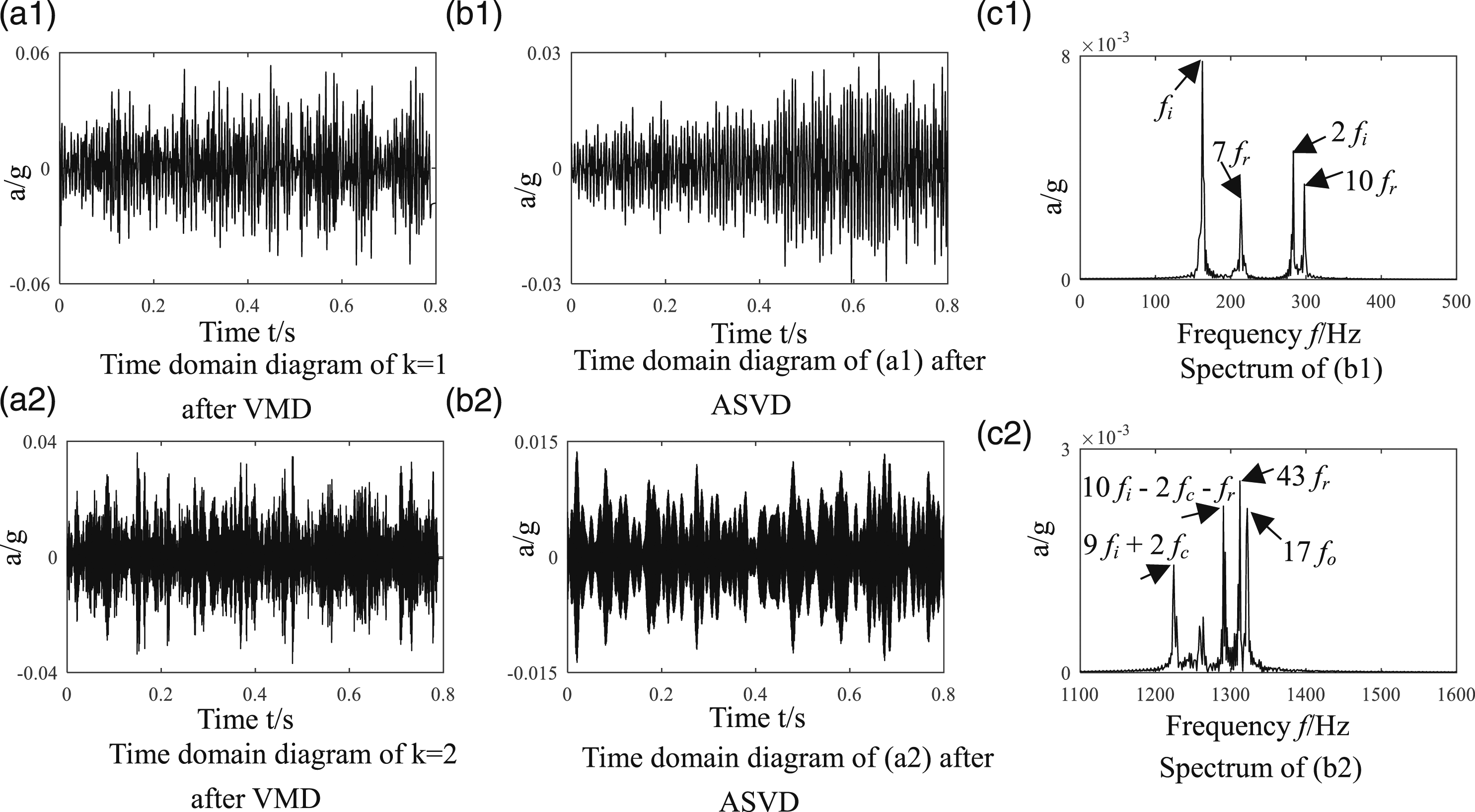
Analyzing Figure 6(c1)–(c2), the spectrum of the signal obtained based on VMD has the following characteristics: (1) Noise is still effectively suppressed. (2) The exist following typical feature frequencies corresponding to the bearing failure types, including: 1) Frequency components corresponding to outer ring failures (fo, 77.8 Hz), including 1322 Hz, this frequency corresponds to 17fo, (1322/17 = 77.8 Hz). 2) Frequency components corresponding to inner ring failures (fi, 134.3 Hz), including: 162.4 Hz, this frequency corresponds to fi+fr (162.4-30.3 = 132.1 Hz); 283.2 Hz, this frequency corresponds to 2fi+fc, ((283.2.9-11.1)/2 = 136.05 Hz); 1224 Hz, this frequency corresponds to 9fi+2fc, ((1224-11.1)/9 = 134.25 Hz); 1290 Hz, this frequency corresponds to 10fi-fr-2fc, ((1290 + 30.3+11.1*2)/10 = 134.25 Hz).
It can be seen that VMD method can still achieve accurate identification of bearing failure types. However, a comparison with the method proposed in this paper (Figure 5) reveals that: (1) The comparative method has more noise components, and the overall denoising effect is relatively worse compared to this paper. (2) The failure characteristic frequencies obtained by the proposed method are more comprehensive, and it has extracted the 3rd harmonic of inner ring failure feature frequency (356.1 Hz) and the 19th harmonic of the outer ring failure feature frequency (1504 Hz), which were not found in the comparative method.
Effectiveness analysis of the proposed methodology under different conditions
To further analyze the effectiveness of the proposed SST-VME method, we now analyze the vibration data of bearings from sensor on different installation positions, different rotational speeds, and different compound failure types. The results are shown in Figure 7. Fault identification of bearing in different compound faults with proposed method. (a1) -(a13), inner ring and outing ring compound faults; (b1) -(b7), inner ring, outer ring and rolling element compound faults. (a1) Time domain diagram of signal-case 2. (a2) Spectrum of (a1). (a3) Time-frequency diagram of (a1) with SST. (a4) Adaptive determination of penalty factor- case 2. (a5) Time domain diagram of mode 1after VME-case 2. (a6) Signal denoised of (a5) with ASVD-case 2. (a7) Spectrum of (a6). (a8) Time domain diagram of mode 2 after VME-case 2. (a9) Signal denoised of (a8) with ASVD. (a10) Spectrum of (a9). (a11) Time domain diagram of mode 3 after VME-case 2. (a12) Signal denoised of (a11) with ASVD. (a13) Spectrum of (a12). (b1) Time domain diagram of signal-case 3. (b2) Spectrum of (b1). (b3) Time-frequency diagram of (b1) with SST. (b4) Adaptive determination of penalty factor -case 3. (b5) Time domain diagram of mode 1 after VME-case 3. (b6) Signal denoised of (b5) with ASVD-case 3. (b7) Spectrum of (b6). b8) Time domain diagram of mode 2 after VME-case 3.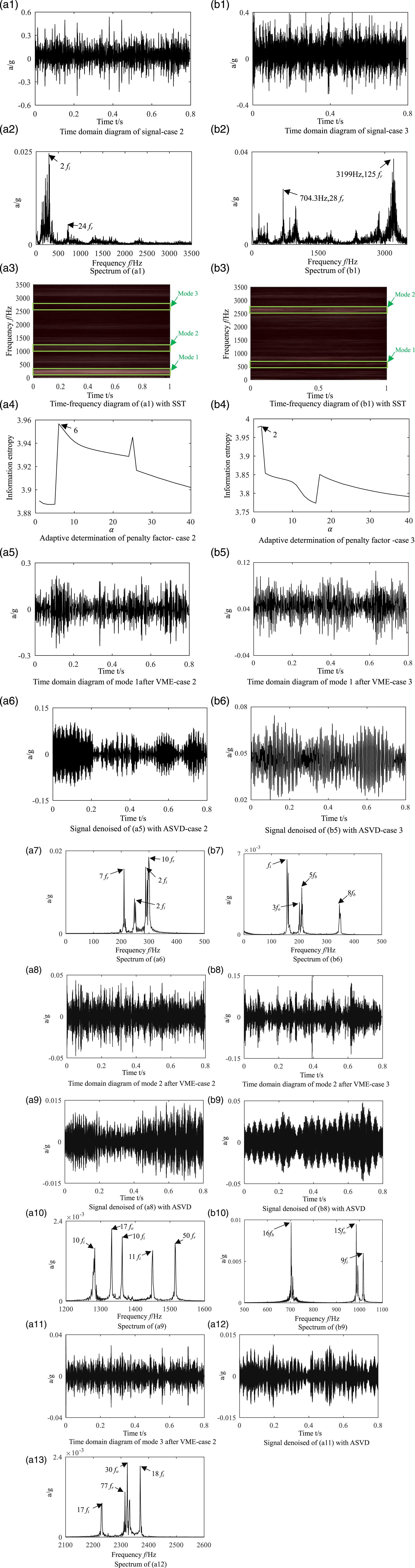
Figure 7(a1)–(a13) correspond to case2; Figure 7(b1)–(b10) correspond to case3.
Figure 7(a1) and (b1) are the time-domain graphs of case2 and case3 in Table 3; Figure 7(a2) and (b2) are the spectral graphs of Figure 7(a1) and (b1). Figure 7(a3) respects time-frequency graphs of Figure 7(a1) with SST. As seen from Figure 7(a3), the typical failure frequency bands are: 2π*300 rad/s, 2π*1100 rad/s, 2π*1800 rad/s, 2π*2600 rad/s. Figure 7(a4) represents the information entropy values of the signal under different penalty factors, where the maximum information entropy is found at
Analysis of Figure 7(a2), spectrum of the original signal, reveals: (1) The relatively prominent frequency components include: 288.1 Hz, which corresponds to 2x the inner ring frequency (f
i
, 134.3 Hz) ((288.1 + 11.1-30.3)/2 = 134.5 Hz); 720.2 Hz, which corresponds to 24x the rotation frequency (f
r
, 30.3 Hz) (720.2/24 = 30 Hz). (2) No outstanding frequency component corresponding to bearing outer ring failure was found, leading to inaccurate judgement failure type. (3) The presence of excessive noise components hampers accurate failure identification and determination.
Analyzing Figure 7(a7), (a10), (a13), the spectrum obtained by the proposed method shows: (1) A significant reduction in noise when compared to Figure 7(a2). (2) Extraction of typical frequency components corresponding to this bearing failure types, including: 1) Frequency components corresponding to outer ring failures (f
o
, 77.8 Hz): 1332 Hz, this frequency corresponds to 17 f
o,
(1332/17 = 78.4 Hz); 2323 Hz, this frequency corresponds to 30 f
o
, (2323/30 = 77.4 Hz). 2) Frequency components corresponding to inner ring failures (f
i
, 134.3 Hz), including: 247.8 Hz, this frequency corresponds to 2 f
i
-2f
c
((247.8 + 2*11.1)/2 = 135 Hz); 288.1 Hz, this frequency corresponds to 2 f
i
+f
r
-f
c
((288.1-30.3 + 11.1)/2 = 134.5 Hz); 1283 Hz, this frequency corresponds to 10 f
i
-2*f
r
, (1283 + 30.3*2)/10 = 134.4 Hz); 1450 Hz, this frequency corresponds to 11 f
i
-2 f
i
, ((1450 + 2*11.1)/11 = 133.8 Hz); 2231 Hz, this frequency corresponds to 17 f
i
-f
r
-2 f
c,
((2231 + 30.3+2*11.1)/17 = 134.3 Hz); 2369 Hz, this frequency corresponds to 18 f
i
-f
r
-2 f
c
, ((2369 + 30.3+2*11.1)/18 = 134.5 Hz).
From the analysis above, it is evident that for the randomly chosen typical compound failure in ball bearings (inner ring and outer ring, CH4, rotational speed of 1800 r/min), the method of compound failure feature extraction for ball bearings based on SST and information entropy optimized VME effectively suppresses noise. It also extracts the prominent characteristic frequencies corresponding to the bearing failure types, thus achieving accurate identification of the type of compound failure in the ball bearing.
Analysis of Figure 7(b2), frequency of raw signal, reveals: (1) The relatively prominent frequency components include: 704.3 Hz, which corresponds to 28x the rotation frequency (f
r
, 25.58 Hz) (704.3/28 = 25.15 Hz); 3199 Hz, which corresponds to 125x the rotation frequency (f
r
, 25.58 Hz) (3199/125 = 25.59 Hz). (2) No remarkable frequency component corresponding to outer ring, inner ring and ball element failure of bearing is found, which leading to inaccurate judgement of failure type of the bearing. (3) The presence of excessive noise components hampers accurate failure identification and determination.
Analyzing Figure 7(b7), (b10), the spectrum obtained by the proposed method shows: (1) A significant reduction in noise when compared to Figure 7(b2). (2) Extraction of typical frequency components corresponding to bearing failure types, including: 1) Frequency components corresponding to outer ring failures (fo, 65.6 Hz), including: 201.4 Hz, this frequency corresponds to 3 fo (201.4/3 = 67.1 Hz); 986.3 Hz, this frequency corresponds to 15 fo, (986.3/15 = 65.8 Hz). 2) Frequency components corresponding to inner ring failures (fi, 113.4 Hz), including: 156.3 Hz, this frequency corresponds to fi+2*fr-fc (156.3-2*25.6 + 9.4 = 114.5 Hz); 1017 Hz, this frequency corresponds to 9fi (1017/9 = 113 Hz). 3) Frequency components corresponding to ball element failures (f
b
, 44.5 Hz), including: 210 Hz, this frequency corresponds to 5f
b
-f
c
((210 + 9.4)/5 = 43.9 Hz); 346.7 Hz, this frequency corresponds to 8f
b
(346.7/8 = 43.3 Hz); 703.1 Hz, this frequency corresponds to 16f
b
(703.1/16 = 43.9 Hz).
From the analysis above, it is evident that for the randomly chosen typical compound failure in ball bearings (inner ring, outer ring and ball element, CH3, rotational speed of 1500 r/min), the method of compound failure feature extraction for ball bearings based on SST and information entropy optimized VME effectively suppresses noise. It also extracts the prominent characteristic frequencies corresponding to the bearing failure types, thus achieving accurate identification of the type of compound failure in the ball bearing. The method is insensitive to the compound failure types of bearings, positions of sensors fixed, and rotational speeds.
Conclusions
To solve the problem of not being able to determine central frequency and penalty factor of VME and extract optimal expected modality precisely in compound failures of bearing, the paper has proposed a method to adaptively determine central frequency and penalty factor from variational modality by combining SST and information entropy. By a comparison with VMD and analysis of typical signals in the condition of different types of compound failures, sensor sites and rotate speeds, the following conclusion can be drawn: (1) SST can determine the range of characteristic frequency bands of failure and adaptively determine the expected central frequency of VME. (2) With the representation capacity of information entropy, it can be used to adaptively determine penalty factor of VME. (3) In VME algorithm, the central frequency and penalty factor adaptively determined by proposed method can be used to extract typical failure information in line with the type of failure, and precisely determine the type of compound failures of bearings. (4) Compared with the VMD method, this paper’s method has a more ideal noise suppression capability, and the extracted failure information is more comprehensive. (5) The proposed SST-VME-ASVD method is insensitive to the type of compound failures, installation positions of sensors and rotate speeds of equipment. In the condition of different rotate speeds (1542 r/min and 1818 r/min), sensor installation positions (horizontal and vertical) and types of compound failures of bearings, the proposed method can control the noise, precisely extract failure information of bearings and determine the type of compound failures of bearings.
Footnotes
Declaration of conflicting interests
The author(s) declared no potential conflicts of interest with respect to the research, authorship, and/or publication of this article.
Funding
The author(s) disclosed receipt of the following financial support for the research, authorship, and/or publication of this article: This work was supported by the National Natural Science Foundation of China [51605309], Natural Science Foundation of Liaoning Province [2022-MS-299], Aeronautical Science Foundation of China [20230033054001] and Department of Education of Liaoning Province [LJKMZ20220529].
