




Abstract
A significant body of literature within International Relations research attests to a securitization of poverty, since 9/11 especially, and within this process to the centrality of discourse. Remarkably, there has been little reciprocal work within Discourse Analysis to scrutinize the emergence of contemporary security agendas of non-traditional security issues and, as far as we were able to discern, nothing at all of the securitization of poverty. This article reports on part of a larger study into transatlantic representations of international poverty. It responds to the evident need of interdisciplinary research into the securitization of poverty by examining the discursive construction of poverty by United States administrations before and after 9/11. Adopting a Discourse Historical Analysis approach, we examine selected US National Security Strategies for evidence that supports or otherwise makes claims in International Relations literature for the American securitization of poverty. We ultimately conclude that they have engaged in a public discourse that represents poverty as a security issue, cast light upon how this is discursively legitimized and contend that 9/11 accelerated but did not cause this paradigm shift in the treatment of international poverty.
Introduction
Poverty is an increasingly mainstreamed issue in national and international relations. An abundant literature discusses state and non-state actors’ policies and prescriptions, global structural economic inequalities, and so forth. Since 9/11 (11 September 2001) especially, leaders of nations and international organizations frequently speak of the ‘dark side of globalization’ and of the need to counter terrorism by addressing root causes of the despair and hopelessness that allegedly drive its perpetrators. Poverty has therein been placed at a nexus with insecurity, radicalization and terrorism.
A significant International Relations (IR) literature attests to a post-Cold War western ‘securitization’ of poverty and debates the validity of causal connections between poverty and, especially, terrorism (e.g. Krueger and Maleckova, 2003; Piazza, 2006). Yet, despite acknowledgement in some IR quarters of the role of language in securitization processes, there has been no systematic investigation of the construction of poverty as a security issue from a Discourse Analysis (DA) perspective. We consequently conducted an interdisciplinary (DA/IR) project examining post-Cold War western political discourses – specifically within the European Union (EU), the United Kingdom (UK) and the United States of America (USA) – of poverty vis-a-vis security. In this article, we focus on US administrations in order to address three questions. First, does DA support IR claims that poverty has been securitized in US government policies? Second, assuming that there has been a securitization of poverty, was 9/11 a formative event triggering this paradigm shift? Third, if securitization has happened, how have connections between poverty and security been discursively drawn?
Poverty, security and discourse
Poverty defies easy definition. Its conceptualization includes, amongst others, poverty as a social, political and/or security issue, associating it respectively with social exclusion and discrimination, economic migration, and terrorism and (inter)national insecurity. Although these definitions and associations are often interlinked, (non-DA) scholarship on poverty has still sought to define poverty by classifying it into clear-cut categories. A series of ‘objective’ approaches to poverty has therefore ensued: monetary, capabilities, social exclusion and participatory methods (Stewart et al., 2007). Other, more ‘subjective’ approaches have been developed, too. These tap into perceived notions of well-being, happiness and having one’s basic needs covered. The same scholarship has also acknowledged that, while classifications are useful in the formulation of poverty-eradication policies, there is a significant element of ‘construction’ within each measure of poverty. Importantly, this element of construction is authored by ‘outsiders’, rather than by those individuals, groups and nations that experience poverty (Stewart et al., 2007). This means that constructions of poverty – through definition, classification and measurement – rest with elite groups. Yet scholarship has not gone on to address the discursive basis of such elite constructions. This is particularly surprising given that work on other complex macro-level phenomena involving elite groups, such as racism and gender discrimination, has demonstrated the crucial role that discourse plays therein. 1
Poverty is (re)produced through discourse practices, most of which are enacted by groups with direct access to social, cultural and political power. Governments and supra-governmental organizations, for example, set ‘poverty thresholds’, metaphorically coining them in terms of ‘bread lines’, and place individuals, groups and societies ‘above’ or ‘below’ such lines. ‘Big Media’ reporting on world poverty often employ the same metaphorical constructions and measuring criteria. The media also, and through persuasive multimodal texts in, for example, television documentaries and reality shows on deprived groups such as ‘the homeless’, (re)produce (stereotyped) beliefs about who ‘the poor’ are and how they live. This aestheticizes the ‘lifestyles of the poor’ for the assumed pleasure of viewers and activates discriminatory practices of othering (Pardo, 2011). Furthermore, legal and financial systems determine eligibility for financial support necessary to ‘escape’ poverty through a range of oral and written texts (e.g. court case hearings, documents detailing loan terms and conditions). The macro-level (social) phenomenon of poverty, therefore, is (re)constructed through an array of micro-level practices of speaking, writing and/or visually showing, in a range of spaces and contexts to which elite groups have exclusive and/or privileged access.
Our particular focus stems from the juxtaposition of these elite discourses of poverty with IR scholarship suggesting that poverty has been securitized. The context for this transition is the end of the Cold War, which sparked fierce debate about security and the referent thereof (Dannreuther, 2007; Krause and Williams, 1996). A new security agenda emerged that in relative terms foregrounded non-traditional security threats. In explaining how issues were accorded a new special level of priority, thereby justifying a high level of resources and an urgent response, the Copenhagen School (Buzan et al., 1998) developed a thesis of securitization that included identification of the role played by discourse.
The Copenhagen School brokedown securitization into three stages. The first entails the elevation of an issue that is perceived subjectively by a community to represent an existential threat to a referent object. The second stage is a speech act that uses the discourse of security to locate a subject within this special category. 2 This speech act is performed by groups within the community that have responsibility for ensuring security (elite groups). The third and final stage is acceptance of this discursive construction of a security issue by a mass audience, resulting in its legitimization. Securitization is thus intersubjective and depends upon a successful coordinative and communicative interactional discourse. The former provides ‘a common language and ideational framework through which key policy groups seek to come to agreement about a policy paradigm’; the latter serves as ‘a vehicle through which policy elites seek to persuade the public that the policy paradigm is necessary and appropriate’ (Schmidt, 2000: 285).
Governments have long considered poverty within calculations of obtaining security. During the Cold War, the USA, for instance, viewed economic well-being as an antidote to the attraction of communism and radical nationalism. As early as 1983, Buzan urged a wider conceptualization of security, arguing that it represented a feeling of well-being, an absence of fear (Buzan, 1983). Poverty’s potential to be securitized blossomed once post-Cold War debates challenged traditional referents of security, especially in the ‘human security paradigm’ (Kaldor, 2007; Matlary, 2008). The events of 9/11 then seemingly actualized a western communicative discourse of poverty as a security issue. Connections were widely proclaimed between poverty, insecurity, radicalization and terrorism. In March 2002, Head of the World Trade Organization (WTO), Michael Moore, declared: ‘Poverty in all its forms is the greatest single threat to peace, security, democracy, human rights and the environment’. 3 President of the United Nations (UN) General Assembly, Han Seung-Soo, argued in similar vein, 4 and even Nobel laureate Desmond Tutu contended in 2007: ‘You can never win a war against terror as long as there are conditions in the world that make people desperate – poverty, disease, ignorance, etcetera’. 5 Moreover, this connection of poverty with insecurity, radicalization and terrorism has shaped a policy environment that encourages development agencies to devise programmes that serve in part as preventative security measures. Indeed, IR academics cite a securitization of aid and development policies within what is sometimes referred to as the new humanitarianism (Fox, 2001; Jackson, 2008). Duffield (2002: 89) argues explicitly that ‘The securitization of aid embodies one of the main responses to the resistant and reflexive modernity of the new wars’ (see also Howell and Lind, 2009).
Despite precedents in both DA and IR that link macro phenomena (e.g. racism and securitization) to discourse, to our knowledge no study has hitherto systematically examined the discursive construction of poverty as an international security issue. Indeed, with the notable exception of Street (1994) and De Goede (1996) in a UK and US context respectively, DA research into poverty generally has had a national rather than international focus. At the forefront of DA work is the Red Latinoamericana de Análisis del Discurso (REDLAD; Latin American Discourse Analysis Network). REDLAD explicitly and systematically examines poverty across a range of (non-)institutional contexts, principally in Latin America (for an overview, see e.g. Pardo, 2008). REDLAD, encompassing teams in Argentina, Brazil, Chile, Colombia, Puerto Rico and Venezuela, has developed a fairly systematic methodology to the study of poverty – one that favours case study approaches and qualitative methods.
Two recurrent findings by REDLAD (and other) researchers about poverty are of particular interest. The first concerns a tendency in political and media elite discourses to quantify poverty, typically through statistics that deprive those being thus defined of their individual identity. Pardo Abril (2008: 193) argues in relation to the Colombian press that quantifying poverty lends apparent objectivity to unflattering generalizations made about the poor. De Melo Resende’s (2009: 367) work shows that ‘homeless people’ living in Brazilian city peripheries can be more easily reduced to conditions of ‘social apartheid’ in their capacity as quantifiable groupings, and therein have their ‘identity as human beings’ negated. The second finding concerns the construction of ‘the poor’ as passive, indolent and immoral. Pardo Abril (2008: 193) argues that Colombian media and political elite generalizations about the poor often revolve around their assumed ‘defeated, loser attitude, their lack of a solid moral conduct, their acceptance of their destiny, their lack of realist ambitions, their pursuance instead of life projects that aim solely at surviving, and their lack of planning’ (authors’ translation). This conclusion resonates with those drawn by De Goede (1996) in a US context.
Kress’ (1994) analysis of the ‘grammar’ of the noun ‘poverty’ in English is particularly instructive in this respect. Kress argues:
Poverty is something that you are in; this makes it unlike measles, for instance, or luck or hunger, which are things you can have. The place you are in when you are in poverty is an abstract place, like despair (which you are also in), a kind of mental place, an emotional state of affairs. Poverty is not active; it is something with which you are afflicted, like hunger. Poverty is a state; not an event. (1994: 28–29)
Kress (1994: 29) further shows that the grammar of the noun ‘poverty’ in English has covert effects, for ‘poverty is something that you can be in, or get yourself into; that is, it is a classification of the person to whom it attaches: “I am poor” is like “I am tall” in that respect’. Indeed, Kress argues that, as far as English grammar is concerned, to be poor is more intrinsic a property of humans than physical attributes such as height. This Kress exemplifies through the order of adjectives in sentences like ‘that tall poor man’, rather than ‘*that poor tall man’, which would only be grammatically correct if ‘poor’ had the meaning of pitiful or pathetic. A corollary of the non-agentive grammar of poverty in English is that individuals are seen to get or fall into poverty accidentally. In Kress’ (1994: 29) words, being poor ‘is not a state of being or a quality under our control. We don’t move into poverty, nor do we acquire it’. Furthermore, and it is this double-edged sword around poverty as a noun that is particularly informative for our work, although the poor cannot help themselves out of poverty (for theirs is, grammatically, a state of being beyond their control), ‘poverty itself can act agentively – poverty can drive us into despair, poverty causes the break-up of families, and so on’ (1994: 29). This is important given causal connections drawn in IR literature between poverty, insecurity, radicalization and terrorism. Clearly, if poverty can discursively have the potential for action, and since the poor are constructed by a number of media and political elites as indolent and immoral, then elites have fertile ground for discourse that ‘demonizes’ poverty/the poor and legitimizes their raising of poverty to the special category of a security issue. Indeed, one finds numerous statements of poverty being constructed as a ‘driver’ of insecurity. For instance, the 2008 British National Security Strategy declares: ‘Poverty increases instability and the risks of conflict, increases both the likelihood and the effect of acute resource competition, and can be a driver of migration’ (p. 23). It proceeds to argue that poor governance, poverty and inequality ‘can combine with other factors to become drivers of extremism, and which terrorist groups exploit in their propaganda’ (p. 27).
Methodology
Framework: Discourse Historical Analysis
Our work follows the Discourse Historical Analysis (DHA) approach, first developed by Ruth Wodak and her collaborators at the University of Vienna (e.g. Van Leeuwen and Wodak, 1999; Weiss and Wodak, 2003; Wodak, 2001; Wodak et al., 1999). Like other Critical Discourse Studies approaches, DHA is concerned with problem-oriented social research. But, distinctively, DHA is interdisciplinary in terms of the theories it draws upon and integrates in the analyses, the actual analytic work, the teams of experts involved therein, and the intended practical applications of its results. As its name indicates, too, DHA is concerned with the historical dimension of discourse, seeking to reveal how particular discourse genres may change diachronically. Indeed, analysis within this approach uses as wide as possible a range of available knowledge sources, from multiple genres, in order to examine intertextual and interdiscursive relationships vis-a-vis the social problem under investigation. This eclectic, comprehensive approach is necessarily abductive – examination of theories and empirical data is fluid and constant throughout the research process. Different ‘types’ of theories are used, moreover, to address the four levels of context identified within the DHA approach, namely linguistic analysis (the actual use of language or text), discourse theory (the intertextual/interdiscursive relationships between utterances, texts, discourses and genres), mezzo-theories (the extra-linguistic sociological and institutional variables) and grand theories (the wider socio-political and historical contexts that bear upon discursive practices). Grand theories, for instance, are used as a foundation, whereas mezzo-theories are more appropriate to analytic aims (Wodak, 2001: 63–70).
In examining the link between poverty and discourse through the notion of securitization over a period of time (post-Cold War), our work is problem-orientated and concerned with diachronic processes of change. It also stems from the interrogation of theories and methods from different academic disciplines (principally IR, Security Studies and DA). In terms of empirical analysis, our study draws upon as comprehensive as possible a corpus that includes different discourse genres and is interrogated via a set of analytic categories and tools that have been selected according to the different steps taken in the analysis, as we next explain.
Data
Data for this article comprise post-Cold War oral and written texts relating to US administrations’ treatment of poverty in the context of (inter)national security. This includes National Security Strategies (NSSs), the Quadrennial Defense Review, Military Strategy and National Intelligence Strategy. Our trawl also extends to documents released by American government agencies concerned with poverty and development but not directly with security, especially the US Agency for International Development. Beyond that, it entails transcripts of speeches made by leading US government officials, White House Press briefings and statements made by American officials in leading international organizations. Finally, media and academic commentary on US foreign policy and literature from international organizations such as the Organisation for Economic and Co-operative Development (OECD) form part of our corpus, too.
The centrepiece of US administrations’ public presentation of security priorities and programmes are their NSSs. These serve several distinct purposes. They can provide guidance to departments and agencies by offering prioritized objectives and indicating preferred instruments in their pursuit; provide the executive branch with a key tool for justifying requested resources to Congress; and help inform domestic and international audiences about US government intent (Dale, 2008). NSSs are mandated from the National Security Act of 1947, as amended by the Goldwater-Nichols Department of Defense Reorganization Act of 1986. The legislation requires that each report addresses five points: worldwide American interests, goals and objectives that are vital to US national security; the foreign policy, worldwide commitments and national defence capabilities necessary to deter aggression and to fulfil the NSS; the proposed short-term and long-term uses of the political, economic, military and other elements of America’s national power to protect or promote the interests and achieve the goals and objectives referred to; the adequacy of US capabilities to prosecute the NSS; and whatever other information is necessary to help inform Congress on matters relating to the NSS (Dale, 2008). From post-Cold War US NSS, two were selected for detailed analysis in this article: the first was published by the Clinton administration in 1996; the second was released by the George W Bush administration in 2006.
The rationale for our selection is fourfold. First, though compiled under different ideologically orientated US administrations, the 1996 and 2006 NSSs are directly comparable insofar as they sit within a single discourse genre of government. 6 Second, the genre of which they are part is the expected principal repository of texts detailing US security priorities and responses. Third, of all the documents within that genre, the NSSs are the most appropriate texts for the purposes of our study. The Quadrennial Defense Review, Military Strategy, National Intelligence Strategy, Quadrennial Intelligence Community Review, National Strategy for Homeland Security, and so forth are all nested parts of NSS. Moreover, and crucially for our purposes, NSSs are security-centric de-classified documents that have become increasingly orientated towards public diplomacy. The Center for Strategic and International Studies argues specifically that US administrations from Reagan onwards have tended to treat the NSS as ‘a requirement to publicly explain and sell its policies rather than an opportunity to undertake a rigorous internal strategic planning process’ (Murdock and Flournoy, 2005: 28, authors’ emphasis). In other words, they have become primary vehicles for the US government of public persuasion and legitimization.
Finally, the mandatory production of NSS means we could use them as directly comparable documents across time and, through cognisance of relevant ‘grand theories’ (i.e. knowledge of the socio-historical context), we were able to select ‘start’ and ‘end’ points around 9/11 – the potential catalyst for revised security discourses. The 1996 NSS, subtitled ‘Engagement and Enlargement’, was drafted when US adventurism abroad was constrained by embroilment in the Balkans, the Mogadishu syndrome caused by the disastrous intervention in Somalia in October 1993, the Clinton administration’s political loss of both Houses of Congress, and Congressional demands for cuts in overseas expenditure (Dobson and Marsh, 2006). In 2006, the Bush administration was also weakened, suffering blowback from military intervention in Iraq especially and, rhetorically at least, seeking to re-engage domestic and international constituencies in its Global War on Terrorism (GWOT). The 2006 NSS was notably toned down compared with its controversial 2002 predecessor, which fronted pre-emptive military action. It retained a unilateralist option but recognized that ‘there is little of lasting consequence that we can accomplish in the world without the sustained cooperation of our allies and partners’ (US NSS, 2006: 37). This is similar to Clinton’s position of ‘diplomacy when we can, but force when we must. We will act with others when we can, but alone when we must’ (NSS, 1996: Preface). Also, the 2006 NSS foregrounded a Clintonesque preoccupation with addressing globalization, promotion of democratization and preference for diplomatic solutions and working with allies. Its ‘two pillars’ – promoting freedom, justice and human dignity, and leading a growing community of democracies (US NSS, 2006: Preface) – might have been taken from almost any US post-war administration.
Elements of continuity between the 1996 NSS and the 2006 NSS, however, must be seen in light of a radically changed context. The single most important change was that, as a consequence of 9/11, America was now officially ‘at war’ (US NSS, 2006: 1). Bush administration officials repeatedly cited 9/11 as a defining moment in American history akin to Pearl Harbor. 7 The terrorist attacks re-orientated US foreign policies, infused them with tremendous extra resources – physical and attitudinal – and provided a new focal point: the GWOT. As George W Bush put it, before 9/11, ‘we were pretty confident that we were protected ourselves by oceans. That changed’. 8
This contextual shift suggests it is reasonable to expect transitions in elite constructions of poverty to be most pronounced in our post-9/11 corpus. Indeed, James D Wolfensohn, World Bank President, argued that on 9/11 ‘the imaginary wall that divided the rich world from the poor world came crashing down’, and declared of the development agenda that ‘[r]arely has there been an issue so vital to long-term peace and security, and yet so marginalized in domestic politics in most of the rich world’. 9 Wolfensohn’s identification of 9/11 as a watershed in respect of poverty also underscores the importance of all levels of context to our analysis and, hence, as the DHA approach advocates, the centrality of interdisciplinarity in attempting to ‘transcend the pure linguistic dimension and to include more or less systematically the historical, political, sociological and/or psychological dimensions in the analysis and interpretation of a specific discursive occasion’ (Weiss and Wodak, 2003: 23).
Procedure and analytic categories
Following data collection from multiple sources and contemporaneous critical reading of relevant theories in the IR and Security Studies literature, a three-dimensional linguistic analysis (Wodak, 2001) of the two NSSs was conducted. First, we established their main topics by manually conducting a semantic-discursive category analysis (Pardo, 2008) of the entire documents. Semantic-discursive categories differ from grammatical ones in that the latter are common to all languages and do not vary with genre, appearing in every text. Although presupposing grammatical structure, semantic- discursive categories are closely related to the lexicon and can hence be fruitfully combined with lexical approaches, such as those used in Corpus Linguistics, in order to establish the ‘aboutness’ of texts. Semantic-discursive categories may vary with text or even utterance. They are therefore text-specific and permit a text-based inquiry into author-constructed topics or contents. Examples of semantic-discursive categories include ‘heroism’, ‘war’, ‘battleground’, ‘camaraderie’ and ‘family’, in a corpus of news reports on the 25th anniversary of the Falklands war (Pardo and Lorenzo-Dus, 2010).
Second, we investigated the discursive strategies in the documents, focusing on legitimation strategies on account of the markedly persuasive nature of the NSS genre of government discourse. The study of (de)legitimation enjoys a long and rich tradition in Linguistics (see e.g. Martín Rojo and Van Dijk, 1997; Peled-Elhanan, 2010). The specific model adopted in our work is the one devised by Van Leeuwen (2007) which, as in our case, seeks to provide a framework for analysing how discourses construct legitimation for social practices in everyday interaction and public communication.
Building upon previous work (Van Leeuwen and Wodak, 1999), Van Leeuwen’s (2007) framework distinguishes between four non-mutually exclusive (de)legitimation categories: ‘authorization’, ‘moral evaluation’, ‘rationalization’ and ‘mythopoesis’. Authorization is (de)legitimation ‘by reference to the authority of tradition, custom and law, and of persons in whom institutional authority of some kind is vested’. (De)legitimation by moral evaluation occurs by means of ‘(often very oblique) reference to value systems’. Rationalization is (de)legitimation ‘by reference to the goals and uses of institutionalized social action, and to the knowledge society has constructed to endow them with cognitive validity’. Finally, (de)legitimation by mythopoesis entails the use of ‘narratives whose outcomes reward legitimate actions and punish non-legitimate actions’ (2007: 92). Each of these categories includes several types – for example, authority legitimation can be invoked through custom (conformity or tradition), authority (personal or impersonal) and commendation (expert or role model) (2007: 97). And moral evaluation legitimation can be of three types: ‘evaluation’, ‘abstraction’ and ‘comparison (negative or positive)’ (2007: 100). Actions and/or actors (representations) and their legitimations (interpretations) are related in and through discourse. Van Leeuwen’s (2007) framework also enables identification of recurrent topoi within texts. Topoi designate commonsensical ways of thinking about specific issues. As such, they may be framed within discourse units of compatible topics and be embodied in specific metaphors. In our case, analysis of (de)legitimation strategies enables identification of topoi through which both positive attributes of the US government and negative attributes of poverty requiring American intervention are justified.
Third, we examined the main linguistic indicators through which (de)legitimation strategies and topoi were manifested in the NSS, as well as the actual linguistic realizations of these means. In line with the abductive DHA approach, we did not pre-determine a set of linguistic means at this level. Instead, we were guided by a combination of DA/IR theories and emergent linguistic patterns in the data. Here we focus on metaphor – common in political discourse (e.g. Chilton and Lakoff, 1995; Zinken, 2003) and a key feature of the selected documents.
The importance of metaphor in social and political conceptualizations has long been acknowledged. Within cognitive metaphor analysis approaches, and seminally in the classic work by Lakoff and Johnson (1980), metaphor is seen as ‘allowing forms of reasoning and words from one domain […] to be used in the other […] domain’, that is, as enabling mapping across knowledge domains that underlie our understanding of the world. Within the political sphere, metaphor and political discourse/thought have sometimes enjoyed a less than candid relationship. In his study of speeches by, especially, presidents of the US and American allies in the 1991 and 2003 Gulf Wars, Lakoff (2003a) showed consistent use of metaphor to construct a particular view of world events and government responses to them. And Musolff’s (2004) work on metaphor recounts former British Prime Minister Thatcher’s distrust of metaphor in politics, drawing one example from her autobiography where she cautions:
… anyone dealing with the European Community should pay careful attention to metaphors. We in Britain were inclined to minimize their significance […]. We had to learn the hard way that by agreement to what were apparently empty generalizations or vague aspirations we were held to have committed ourselves to political structures which were contrary to our interests. (Thatcher, 1993: 319; cited in Musolff, 2004: 30–31)
For Musolff, the reason why, as feared by Thatcher, metaphorical mapping suggests a certain commitment prior to it having ‘acquired “reality” status through political practice’ is that political metaphors constitute ‘integral aspects of argumentative reasoning, i.e., reasoning which typically aims to prove a contested issue and thus also legitimize a certain course of action’ (2004: 32, italics in the original). In this respect, metaphors in political discourse can function like warrants in an argument. Warrants, in Toulmin’s (1958: 100) argumentation model, ‘register explicitly the legitimacy of the [argumentative] step involved and refer it back to the larger class of steps whose legitimacy is being presupposed’. Such warrants, therefore, are ‘hypothetical, bridge-like statements’ (1958: 105) that, if questioned, need to be supported by further data and ‘field-dependent’ (1958: 104) arguments. Thus, within political discourse and thought, presuppositions that appear unproblematic in metaphors may be seen to ‘impose an “unconscious conceptual framework” (Lakoff, 2003b: 386) or “commit [users] to political structures” which are “contrary to [their] interests” (Thatcher)’ (Musolff, 2004: 33).
The use of metaphor in NSS may or may not have contentious political consequences. Nevertheless, metaphor clearly has an ideological nature (see also Lakoff and Johnson, 1980) and is strongly linked with argumentation/(de)legitimation in political discourse. As such, analysis of metaphor usage in NSS documents that aim to make a case for the adoption of specific security policy measures is a key avenue of investigation.
Discussion
Key semantic-discursive categories in the US National Security Strategies of 1996 and 2006
Analysis of the two NSSs revealed four key semantic-discursive categories in both documents: security, poverty, aid and terrorism. That security-related terms (insecurity, security threat, security challenges) were salient was expected, given the selected genre of government discourse. In comparative terms, the 2006 NSS showed a ‘negative slant’ to security, specifically by discussing security often in terms of threats and absence of security (insecurity), whereas the 1996 NSS often referred to security challenges (rather than threats) and only occasionally to insecurity. This, too, might be expected, given America’s shift in the interim from a peace-time to war-time posture and the context of the GWOT.
The other three categories were further examined by using the word-list facility of the Corpus Linguistics software Wordsmith Tools (Version 5.0), which is useful in determining what given texts are about. ‘Wildcard terms’ (see Baker, 2006) were used, specifically ‘poor*’ and ‘poverty’ for poverty; ‘aid*’, ‘develop*’ and ‘assist*’ for aid; and ‘terror*’ for terrorism. The results are shown in Table 1.
Frequency of use of poverty, terrorism and aid in the 1996 NSS and 2006 NSS.
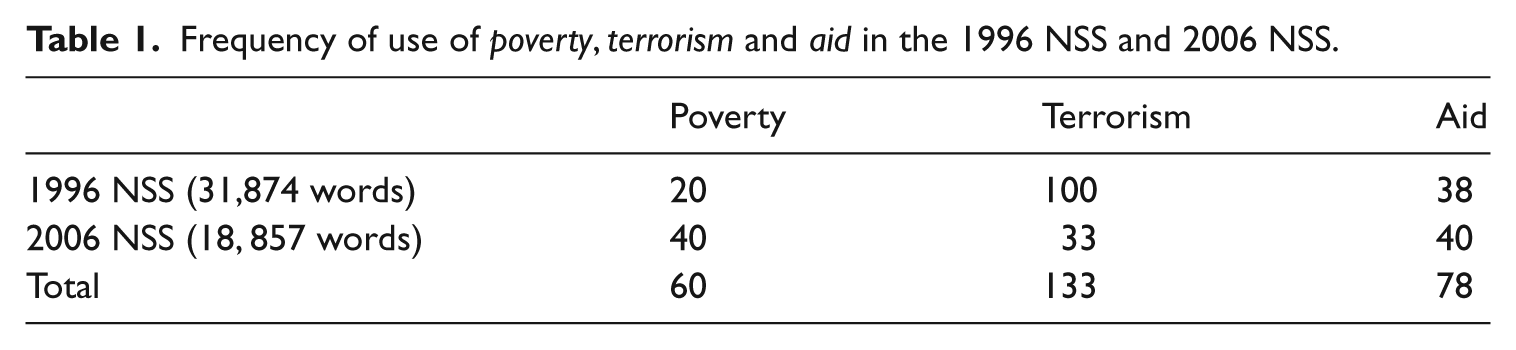
Aid maintained relatively similar salience in the two documents which, considering that the 1996 NSS is nearly twice as long as its 2006 counterpart, actually suggests reduced topical prominence, at least as determined by lexical frequency. Poverty was more frequently invoked in the 2006 document. Moreover, the 1996 NSS only once linked poverty overtly to security – specifically to insecurity. This unique example is reproduced in extract 1 below:
(1) The continuing poverty of a quarter of the world’s people leads to hunger, malnutrition, economic migration and political unrest. (p. 39)
Several direct effects of ‘continuing poverty’ are listed in extract 1, with political instability featuring last and after three other effects, the logic of which no one may easily argue against, for they are either commonsensical (‘hunger’ and ‘malnutrition’) or historically evidenced (‘economic migration’). ‘Political unrest’ is not a natural sequitur of poverty. However, by positioning it within a list of logical (‘hunger’, ‘malnutrition’) and attested (‘economic migration’) effects, its assumed links to poverty are strengthened. Overall, considering the greater length of the 1996 NSS, the comparative low usage of poverty and its infrequent explicit linkage to (in)security lend quantitative support to claims within IR literature that poverty has featured more prominently on the security agenda since 9/11.
As for terrorism, we expected it to feature more saliently in the 2006 document, given 9/11 and the GWOT. It did not. This confirms received wisdom in IR literature that US recognition of a broadening security agenda, including terrorism, pre-dates 9/11. Indeed, the first post-Cold War NSS by the George H Bush administration in 1991 developed some now familiar themes – regional ‘hotspots’ such as the Korean Peninsula, non-proliferation, arms control, combating international terrorism, countering states that had made themselves ‘champions of regional radicalism’, and ameliorating the conditions of human existence that made citizens ‘ripe for radicalization’. The successor administration took up these themes, Clinton calling in his 24 January 1995 State of the Union address for a global effort to combat terrorism.
Still, though, to find terrorism had lesser salience as a semantic-discursive (and lexical) category in the 2006 document than in the 1996 version appears counter-intuitive. Part of the answer may lie in the shorter length of the 2006 NSS and in its being written within the very public overarching foreign policy framework of combating global terrorism. Furthermore, blowback from the Bush doctrine, and military intervention in Iraq especially, meant the 2006 NSS was one of a series of texts reflecting US efforts to re-engage domestic and international support, part of which included less confrontational stances and appeal to shared agendas. Other instances of this in our wider corpus include President Bush’s second-term inauguration speech in which he pointedly hailed the importance of allies and the assertion in February 2006 by Kurt Volker, US Principal Deputy Assistant Secretary for European and Eurasian Affairs, that a conscious effort was being made to improve personal diplomacy. 10
However, our work revealed a more compelling explanation for the lower frequency of terrorism, namely the semantic-discursive category of tyranny, which proliferated in the 2006 NSS but which was absent from that of 1996. The first mention of tyranny within the 2006 NSS text is reproduced in extract 2:
(2) To protect our Nation and honor and values, the United States seeks to extend freedom across the globe by leading an international effort to end tyranny and to promote effective democracy […] Tyranny is the combination of brutality, poverty, instability, corruption, and suffering, forged under the rule of despots and despotic systems. […] An end to tyranny will not mark an end to all global ills. Disputes, disease, disorder, poverty, and injustice will outlast tyranny. (p. 3)
Tyranny, self-evidently, constitutes an unproblematic ‘other/them’ group against which the US administration can justify action to ‘protect our Nation’– i.e. securitizing poverty on rational and moral ground. (We return to this in our analysis of legitimation strategies.) The ‘us versus them’ dichotomy at play in extract 2 is consistent with a Manichean tendency within American foreign policy to portray the world in terms of good versus evil, epitomized by Bush’s (in)famous polemic: ‘You are either with us or you are against us in the fight against terror.’ 11 Tyrants, moreover, tend to be state-based and more identifiable than are elusive terrorists and their amorphous networks. Foregrounding tyranny in the 2006 NSS hence served as an ex post facto justification of intervention in Iraq and Afghanistan, offered a more tangible focal point of ‘evil’, and positioned the USA as the leader of an ‘international effort’ (an ‘us’ group) ‘to end tyranny’ (a ‘them’ group) in order to safeguard (inter)national interests.
Extract 2 is also illustrative of the treatment of poverty as a security issue in the 2006 NSS. Here it features amidst a list of extremely negative terms and expressions: ‘brutality’, ‘instability’, ‘corruption’, ‘suffering’, ‘the rule of despots’ and ‘despotic systems’. Like these, poverty is defined as a component of tyranny even though the logic of the argument is clearly flawed, for ‘[a]n end to tyranny’ (and hence to poverty and the other categories with which it is associated) is said not to ‘mark an end to all global ills’, which include poverty. Crucially, this broad-brush definition of tyranny, within which poverty is embedded, sets the tone for the whole document as it occurs at the start of the NSS, specifically in its Introduction section entitled ‘Explaining the goal: Ending tyranny’. While subsequent coverage of the category tyranny abounded throughout the document, complete with implicit references to poverty, the latter was infrequently lexicalized in the document as a whole (see Table 1).
Our analysis of the ‘aboutness’ of the two NSSs suggests that poverty has been discursively securitized. Poverty’s low lexical visibility throughout the 2006 NSS document, and explicit association with tyranny (and its other equally negative ‘components’), helped transition poverty from being cautiously problematized in 1996 to being demonized in 2006. Discursive constructions of ‘us’ and ‘them’ constitute the fundamental basis for discourses of identity and difference, which are in turn crucial within discourses of discrimination (Van Dijk, 1998). Poverty is no exception, and being constructed as a component of tyranny placed it firmly in an undesirable ‘them’ group that threatened the interests of a positively constructed ‘us’ group.
Concomitant government discourse genres within our corpus resonated heavily with this new representation of poverty. For instance, in official public addresses to (inter)national organizations such as the US Congress and the UN, American officials post-9/11 ascribed rhetorically to the assumed connection between poverty, terrorism and, albeit less frequently, aid. 12 The 2002 NSS, for the first time, designated global development as a pillar of US national security. In 2004, two of the five core operational goals of American foreign assistance, designated by the US Agency for International Development, were supporting US geostrategic interests and strengthening fragile states. 13 This rhetoric (micro level of discourse) was translated directly into the macro level of policy. The Bush administration’s New Compact for Development promised a 50% increase in US development assistance and included new funds for famine and emergency relief, an Emergency Plan for AIDS relief, increased contributions to the World Bank and creation of the Millennium Challenge Account. Moreover, evidence emerged suggesting a newly strategic use of aid. For instance, FY2004 US aid figures revealed that Ethiopia, Kenya and Uganda – important African allies of the USA – were amongst the top 15 aid recipients as a consequence of their being designated focus countries for the Global AIDS initiative. Figures for 2001–2003 suggest, though, that there were worse affected countries than these and that the AIDS infection rate was actually falling faster in Uganda and Kenya than anywhere else in Africa. 14
Legitimizing the securitization of poverty
Our findings suggest that, prior to 9/11, there already existed some level of agreement within policy elites about a relationship between poverty and insecurity. From a cautious communicative discourse of this relationship in the 1996 NSS, the securitization of poverty accelerated to the point that in the 2006 NSS the connectivity was explicit and pervasive through the notion of tyranny. Both documents, therefore, had to present strategies to justify developing policies towards poverty within a security context. In doing so, drafters employed two key topoi (usefulness and humanitarianism 15 ) and two main legitimation strategies (moral evaluation and rationalization). Let us examine a typical realization of the two topoi and the moral evaluation strategy in the 1996 NSS:
(3) The money we devoted to development, peacekeeping and disaster relief helped to avert future crises whose cost would have been greater in terms of lives lost and resources spent. (p. 9)
In extract 3, poverty is constructed as an economic issue, and saliency is given to US actions through syntactic thematization of monetary aid. Such aid is part of both a useful and a humanitarian policy. It is useful because investing in alleviating poverty (‘development, peacekeeping and disaster relief’) is said to be an advantageous measure insofar as it helps ‘avert future crises’. Interestingly, the latter constitute unspecified threats and the document does not indicate who may be affected were the USA not to provide aid. This, as we shall see below, becomes clearly spelled out in post-9/11 US texts generally and the 2006 NSS specifically.
The policy is also humanitarian because it involves protecting the lives of individuals. Indeed, in extract 3, actors (a ‘we’ that comprises the US administration) and actions (monetary aid) are accompanied by purposes (avert future crises) and then aligned to legitimation of the moral evaluation category, specifically of the positive comparison type (Van Leeuwen, 2007). ‘[D]evelopment’, ‘peacekeeping’ and ‘disaster relief’ aid are presented as a better (more efficient) financial commitment than that which would otherwise have been invested in ‘avert[ing] future crises’. As Van Leeuwen (2007: 99) argues when explaining the (de)legitimatory function of comparisons in discourse, ‘the implicit answer to the question “Why must I do this?” or “Why must I do this in this way?” is not “because it is good”, but “because it is like another activity which is associated with positive values”’ (positive comparison). In this case, monetary aid is associated with saving lives and thus legitimized comparatively as a positive action by the US administration.
Crucially, poverty as an economic state of affairs in the 1996 NSS document was consistently presented as a condition that the poor can change, with US assistance. The topoi of usefulness and humanitarianism were, once again, effectively used to argue this. Consider extract 4:
(4) Long-term efforts will be maintained to help nations develop healthy economies with fewer market incentives for producing narcotics. (p. 22)
(Poor) nations are portrayed as being capable of ‘develop[ing] healthy economies’, that is, escaping poverty is constructed as being within their reach. However, liberation requires ‘long-term efforts’ from the USA, especially in helping poor nations to develop free market policies. The justificatory argument is that greater prosperity and trickle-down effects from the free market will weaken the attraction to the poor of engaging in criminal and destabilizing activities (in this example, drug trafficking). These arguments are consistent with the self-help ethos and economic liberalism common in the US administrations’ discourses that we examined and in those by other key western actors such as the UK and the EU. They reflect and help construct, too, the structures and ideologies of international organizations such as the WTO, International Monetary Fund and World Bank. For instance, the latter’s official goal is poverty reduction, and it governs its decisions by commitment to facilitating capital investment and promoting foreign investment and international trade.
By the time of the 2006 NSS, the link identified in the 1996 document between free market policies, poverty alleviation and threat tackling – argued via usefulness and humanitarian topoi – had become a key argument scheme. But how was the need of aid for the poor (i.e. for the ‘them’ group) legitimized within the 2006 NSS, which sought to end tyranny and defined the latter as in part comprising poverty? Extract 5 is one of a number of examples of the use of instrumental rationalization:
(5) We have increased our overall development assistance spending by 97 per cent since 2000. In all of these efforts, the United States has sought concrete measures of success. Funding is a means, not the end. We are giving more money to help the world’s poor, and giving it more efficiently. (p. 32)
In Extract 5, funding is justified as a practice by reference to its goals, uses and effects. Legitimation through instrumental rationalization is similar to constructions of purpose. However, there is a key difference: ‘In order to serve as legitimations, purpose constructions must contain an element of moralization’ (Van Leeuwen, 2007: 101). Instrumental rationalization relies on a ‘rationality of means and ends’ (2007: 101) whereby a given action is deemed to work or not. Funding is explicitly constructed in extract 5 as ‘a means, not the end’ – the latter has been framed throughout the 2006 NSS as to end tyranny (see extract 2). It is moreover linked to a discourse of values insofar as it constitutes a means to ‘help the world’s poor’, where helping denotes a morally positive discourse of altruism in which for actions (funding) to be legitimate they must be geared towards those who need help.
This moralized purpose is accompanied by the idea of effectiveness, in the form of the expressions ‘the United States has sought concrete measures of success’ and ‘giving it [money] more efficiently’. These expressions are legitimatory in that they derive from the philosophical traditions of utilitarianism and pragmatism, where ‘purposefulness, usefulness and effectiveness [are] criteria of truth and foundations for non-comformative, ethical behaviour’ (Van Leeuwen, 2007: 101). They also legitimize expenditure in terms of its being financially prudent and efficient. This (re)produces a wider movement in western approaches to poverty eradication, such as the EU’s replacement of the Lomé Conventions with the Cotonou agreement, which has shifted the balance between aid and trade towards the latter and introduced detailed targets and benchmarking to improve effectiveness and reduce waste. It is a particularly important legitimation strategy in the US context, given Congress and American citizenry have not always looked kindly upon transferring US resources abroad through foreign aid. For instance, in 1994 National Security Advisor Anthony Lake warned the Organization of African Unity that pro-African policymakers in the USA ‘are confronting the reality of shrinking resources and an honest scepticism about the return on our investments in peacekeeping and development’ (Rothchild and Sisk, 1997: 272).
Securitizing poverty and metaphor
Two related metaphorical constructions of poverty were most frequently used across the two NSSs and especially in the 2006 one: poverty as illness and poverty as entrapment. Both constructions were complemented by a third metaphor that presented the USA as providing the necessary ‘antidote’ and ‘liberation’. This was often economic (rather than holistic) and attached to particular political/economic principles that reflect the American way of life, thereby tapping into the US free market enterprise culture and political traditions of exceptionalism and manifest destiny (Dobson and Marsh, 2006). Illustrative examples from the 2006 NSS document of poverty as an illness and/or the free market as an antidote (6a–6b), and of poverty as entrapment and/or free market as liberation (7a–7b), appear below:
(6a) … millions of people in the world who continue to suffer from poverty and disease. (p. 32) (6b) … history has judged the market economy as the single most effective economic system and the greatest antidote to poverty. (p. 25) (7a) Such distortions of the market stifle growth in developed countries, and slow the escape from poverty in developing countries. Against these …, the United States promotes the enduring vision of a global economy that welcomes all participants and encourages the voluntary exchange of goods and services based on mutual benefit, not favoritism. (p. 27) (7b) … and to remove tariffs, subsidies, and other trade barriers that distort global markets and harm the world’s poor. (p. 28)
Representing poverty as an illness means classifying it as a biological entity – as a phenomenon from the natural, rather than the social, world. This fits the passive status of the noun ‘poverty’ (Kress, 1994), for natural phenomena obey natural forces, over which societies ultimately have little control. As Pardo Abril (2008: 205, 206) observes in the context of similar metaphorical constructions of poverty in the Colombian press, ‘social phenomena [such as poverty] are represented as organisms that limp, agonize, become ill, suffer, grow, reproduce […] they are treated as immutable biological states’ (authors’ translation). This metaphorical ‘biologization’ of poverty enables responsibilities, causes and solutions to be conveniently swept under the carpet, as it were. While poverty is also ‘biologized’ in the two NSSs under analysis, we saw earlier that responsibilities and causes are spelled out in the 2006 document as component parts of tyranny. Solutions, in turn, are offered in the form of ‘the greatest antidote’ (extract 6b) – free market – thereby enabling societal change.
Embracing free market policies is also the solution offered to the related metaphorical construction of poverty: entrapment. The extremely poor are represented as in need of being ‘liberated’ (extract 7a), which, as made explicit in (extract 7a) and (extract 7b), free market policies are best equipped to achieve. Within these constructions, moreover, the USA becomes a fair benefactor – one that, for example, ‘removes … barriers that distort … and harm …’ (extract 7b). As a benefactor, the USA is careful not to appear too interventionist and so it ‘welcomes all’, ‘encourages the voluntary exchange of goods and services’ and assists by ‘removing’ obstacles to others’ prosperity (extract 7a). Such ‘altruism’ legitimizes actions through moral authority. It also obviates at this point (and others in the wide range of texts examined) the fact that US aid comes with strings attached, not least the acceptance of the free market as a political economy model. This steers a careful path between traditional American anti-colonial sentiment and contemporary charges of US neo-imperialism. Aid effectively becomes a trigger for a ‘positive legitimatory cycle’ that will end poverty (tyranny) and hence bring national security to the USA. A schematic representation of this cycle is presented in Figure 1:
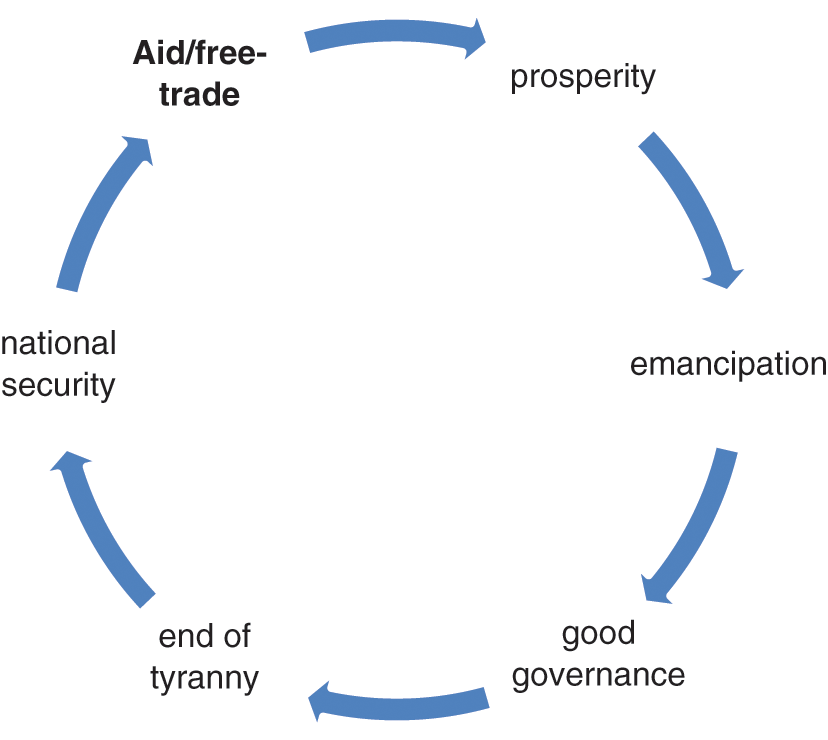
Aid and free trade as triggers to a positive legitimatory cycle aimed at ending tyranny/poverty in the 2006 NSS.
Finally, in the 2006 NSS especially, another metaphor was frequently used to justify the securitization of poverty: ‘cycles of poverty’. Extract 8 provides a typical realization of this metaphor:
(8) The deceptive appeal of anti-free market populism must not be allowed to erode political freedoms and trap the [Western] Hemisphere’s poorest in cycles of poverty. (p. 37)
A strong association is constructed between ‘anti-free market populism’ and ‘cycles of poverty’. The former is negatively appraised as having a ‘deceptive appeal’. The latter is constructed as a ‘trap’ that must be sprung in order to safeguard ‘political freedoms’ in poor nations. The US solution to breaking such negative cycles lies, once again, in the free market.
Other components of these negative cycles of poverty were described throughout the 2006 NSS document, even though the actual cycles were not always lexicalized, as is the case in extracts 9a and 9b:
(9a) … Weak and impoverished states and ungoverned areas are not only a threat to their people and a burden on regional economies, but are also susceptible to exploitation by terrorists, tyrants, and international criminals. (p. 33) (9b) Repression has fostered corruption, imbalanced or stagnant economies, political resentments, regional conflicts, and religious extremism. (p. 38)
In both examples, poverty is grouped with highly negative phenomena, ranging from corruption and international criminality through to tyranny and religious extremism. Incidentally, in extract (9a), the logic of poverty being a component of tyranny collapses once again, this time through a tautological construction that sees it as being susceptible to exploitation by tyrants, that is to itself in part. To break these dangerous metaphorical cycles of poverty requires more urgent action and of a different kind – the logic underpinning securitization.
In the 2006 NSS, one finds such a need being legitimized mainly on twin grounds of national strategic priorities (rationalization) and morality (moral evaluation). For example: ‘Helping the world’s poor is a strategic priority and a moral imperative’ (p. 31). Moral imperatives are, of course, something to which every culture – regardless of the political, economic and strategic priorities of its nation/s – stakes claim. Conflating strategic priorities (rationalization) and moral imperatives (moral evaluation) is thus central to treatment of poverty as a security issue in the 2006 NSS: it has become right and necessary to help liberate developing countries from their negative cycles of poverty.
Evidently, the Clinton and, especially, George W Bush administrations calculated that moral evaluation was insufficient justification alone to secure and expend American resources in the relief of poverty abroad. Moral evaluation finds fertile ground in American political traditions and a long-established morality discourse on poverty, but there are strong political and economic counter-forces, including isolationist sentiment and domestic demands on government spending. In the OECD records we examined, the USA frequently lags at the bottom of rankings of major aid donors as a percentage of gross national income; and Congress is often unconvinced of Overseas Development Aid as a funding priority. For instance, it slashed the Bush administration’s Millennium Challenge Account funding requests from $1.3b to $994m in FY2004 and from $2.5b to $1.488b in the FY2005. Interestingly, the melding of moral evaluation and rationalization in respect of poverty extends beyond the USA. America’s closest partner in the GWOT, Britain, stressed in its 2008 NSS that ‘Poverty, inequality, lack of economic development and opportunity, and poor governance are all highly correlated with insecurity and instability …’ It went on to argue that ‘those parts of Africa and the wider Middle East which have suffered from a vicious circle of poverty, poor governance, and conflict, need integrated international engagement across security, governance and economic development’ (p. 18). The EU, too, in its 2003 Security Strategy talked explicitly of a ‘cycle of conflict, insecurity and poverty’ and cautioned that ‘… poverty and disease cause untold suffering and give rise to pressing security concerns’ (p. 12).
Conclusions
Research into the validity of connections between poverty, insecurity, radicalization and terrorism is vital to the future direction of policy. However, it is equally important to reflect upon how these connections have been publicly articulated and the impact that these discursive representations have upon discrete policy and issue areas. We began this project surprised by the lack of DA work that could complement or challenge claims within IR literature that poverty had undergone securitization. We finish it more convinced than ever of the need for greater IR/DA interdisciplinary work into securitization specifically and policy evolution more generally.
Our DHA broadly confirms claims within IR literature that US administrations have securitized international poverty and shaped relevant policy domains accordingly. Furthermore, we have been able to cast light upon how the communicative discourse securitizing poverty has been developed. Herein our analysis of NSS suggests that this has relatively seldom been done explicitly. This is evident in the comparatively low frequency results for poverty as a semantic-discursive category. Instead, it operates through three principal practices that: (1) demonize poverty, in the case of the 2006 NSS by portraying it as a component part of tyranny; (2) passivize it by metaphorically representing it as an illness/entrapment, for/from which the poor do not possess in and of themselves an antidote/means of escape; and (3) (for the main part) implicitly present it as a security threat on account of its being part of negative ‘cycles’, responses to which are legitimized on strategic and moral imperative grounds.
Each of these three practices tap into American foreign policy traditions and the self-image of the USA as a beacon of liberty, justice and freedom. The justificatory appeal to values is further reflected in there being little attempt in either of the NSSs examined to draw upon rational arguments connecting poverty and security developed within IR studies. Rather, both documents develop intuitive connections between poverty and (in)security, and trumpet America and its way of life (e.g. free market capitalism) as mutually beneficial solutions to the poverty of the disenfranchised and to the associated threats of radicalization and terrorism. Furthermore, the crudeness of the documents in their appeal to a mass audience is reflected in their often linguistically inexact and poor construction. The 2006 NSS especially wraps itself in tautological argumentation knots through its rudimentary representation of poverty as being a component of tyranny.
Finally, our work underscores the importance of context in the success or otherwise of securitizing an issue, and that 9/11 accelerated rather than created a new paradigm for American discursive treatment of poverty. Analysis of the 1996 NSS and other government texts at that time suggests that a coordinative discourse had already developed within American elites that poverty constituted a security as well as a moral and economic issue for the USA, but that the communicative discourse of such was then putative. For instance, poverty was linked just once with insecurity in the 1996 NSS, and concomitant Congressional cuts to US overseas aid suggests such arguments had gained limited traction. How and why this changed by 2006 can be understood only in appreciation of particular political, historical, sociological and psychological conditions within the USA in the intervening period. Especially significant was 9/11, this being the first time that US enemies had struck the American homeland and generating a particularly new sense of vulnerability through the success of such a low-tech attack by a few individuals upon iconic symbols of American power. This created a permissive political and popular climate in which to revise US foreign policy priorities and imbue them with greater resources. The consequent GWOT drew forth poverty on account of its assumed connectivity with insecurity, radicalization and terrorism. Poverty had thus to be addressed through revised policies and investment, which in turn required a forceful and sustained communicative discourse of poverty as constituting a security and moral imperative for the USA. The success of this discourse in legitimizing the poverty–insecurity–terrorism nexus – the Copenhagen School’s third stage of securitization – owes much to the newly receptive post-9/11 audience to which it was delivered.
Footnotes
Acknowledgements
An earlier version of this paper was presented by invitation at the annual REDLAD (Latin American Discourse Analysis Network) colloquium on poverty held in Argentina in 2010. We are grateful to Professors Maria Laura Pardo and Neyla Pardo Abril, and all the participants of this colloquium, for their feedback. Any omissions are of course our own.
This research received no specific grant from any funding agency in the public, commercial or not-for-profit sectors.