



Abstract
This article presents findings from a critical historical analysis of UK education policy discourse from 1972 onwards. It argues that the pronoun we was introduced as an important rhetorical tool by which New Labour was able to legitimate its policy decisions through the idea of a neoliberal ‘consensus’ on the context of education, while at the same time articulating a ‘politics of inclusion’. The study combined a corpus-aided approach to critical discourse analysis with political economic theory in order to interpret the data in relation to its historical context of a profound rethink of the relationship between education, the state and the economy. The analysis reveals how the flexible semantics of person deixis are exploited in a highly systematic way so as to claim consensus over politically contestable claims.
Keywords
Introduction
My aim in this article is to show how the pronoun we helped the New Labour government introduce a marked shift in education policy rhetoric, and assess its potential relationship to the mode of governance in this period. By combining a corpus-based approach to critical discourse analysis with political economic theory, I will argue that the pronoun we was an important rhetorical tool by which New Labour was able to legitimate its policy decisions through the idea of ‘consensus’, while at the same time articulating a ‘politics of inclusion’. The rhetorical and ideological importance of pronouns in political discourse has been widely documented. 1 This article argues that the extent and manner of their use under New Labour are unprecedented in education policy discourse.
The evidence for this claim stems from a larger study examining change in the forms of political rhetoric used to govern state education in Britain since 1972. 2 The aim was to use the lens of policy discourse through which to map the dynamics and tensions arising from a turbulent period of profound structural change in education policy and to relate this to the wider political economic context. Drawing on evidence from educational sociology (e.g. Dale, 1989; Trowler, 2003), it was postulated that these policy changes fundamentally threatened the existing organisational architecture of public education in the UK, and entailed a renegotiation of roles and power relations among diverse educational actors. The social theorist Nikolas Rose (1999a) commented that a key factor in successfully negotiating governmental legitimacy is the institutional identity it projects to the public. The focus of the linguistic analysis was therefore on how the government represents itself, its decisions and its relations with other educational stakeholders. The study used an abductive approach, continually moving between theory, method and data in order to construct explanatory concepts and linkages between the data and its wider socio-historical context. Corpus linguistic methods were combined with an approach to critical discourse analysis (CDA) mainly influenced by Fairclough (2003, 2006). CDA is a particularly dynamic and continually developing interdisciplinary tradition, comprising many different approaches and methodologies (for recent overviews, see Fairclough et al., 2011; Wodak and Meyer, 2009). Despite these divergences, at the most fundamental level all are premised on the socially embedded nature of discourse – that is, language as social semiotic (Halliday, 1978). 3 This means that education policy texts do not exist in a social vacuum, but have a complex, historically changing and mutually constitutive relationship with their social context. They therefore offer an ideal forum to explore the dynamics of governing during a period of profound political and economic change. Corpus linguistics is a computer-based method for analysing large bodies of textual data. Its incorporation in CDA has been a relatively recent development. 4 The choice to combine them in this study was motivated partly by practical considerations, namely the need for a systematic and readily replicable approach to CDA in order to facilitate an iterative analysis of different governments. Furthermore, I wished to investigate patterns of change over a significant period of time. This inevitably required a large corpus of data (500,000 words), which logically suggests the use of corpus tools. There is also a heuristic value to this combined approach in directing the analyst’s gaze in unexpected and often fruitful directions. For example, I have elsewhere used ‘keywords’ 5 analysis to investigate the historical rise and fall of the most prominent political discourses of education in the UK (Mulderrig, 2008).
One of the themes emerging from this historical study was a marked shift towards a more ‘personalised’ form of self-representation under the New Labour government. This article is an attempt to draw on the political economic context in order to interpret the potential rhetorical and ideological significance of those discourse patterns. In particular, I examine their relationship with New Labour’s ‘Third Way’ discourse and its central concept of ‘social inclusion’, entailing a more participatory and active form of citizenship. I argue that the pronoun we helps shape this new relationship between governing and governed, using deixis to shape the context of policy discourse so as to include ‘the governed’ in the ‘discourse world’ of policy. In this way, ‘we the public’ become involved in the propositions it contains; sharing the same perspective as the government and, by implication (and reinforced through patterns of modality), being complicit in its policy decisions.
In the following sections, I begin by outlining the historical context of the New Labour government, the ideological dilemmas it faced, and why this political landscape made education policy a particularly interesting object of study. I then discuss the methodological approach used in this study. In the section on ‘Proximisation in policy discourse’, I present the first stage of the findings from this study, involving a general shift towards pronominal self-representation under New Labour, and assess its potential significance. The semantics of the pronoun we are particularly complex and lie at the heart of its rich rhetorical potential. I discuss this in detail in the section ‘Deixis and the meanings of we’. I then present the remaining findings from this study, identifying the distinctive functional distribution of this pronoun across the corpus and assessing its role in constructing ‘inclusion’ and ‘assumed consensus’ in policy discourse.
New Labour, the state and education policy
The Labour Party came to power in Britain after a long period of Conservative rule (1979–1997) and following a series of major political, economic and cultural changes to the post-war welfare state. While the welfare regimes of many European nations underwent similar restructuring programmes during this period (Jessop, 2002), the New Labour government of 1997–2010 is of special interest because of the particular ideological 6 challenge it faced. Two key factors lie behind this.
The first is the party’s own political past. Positioned on the political left, the British Labour party has its origins in the representation of the working classes. It therefore has important ties to the trade unions – whose power was radically curbed by the Thatcher government – and a broadly socialist commitment to the redistribution of wealth. Although strong in opposition, the party has traditionally enjoyed less electoral success than the Conservatives, and in general elections has battled to win credibility with the economically and culturally conservative mainstay of British politics often referred to as ‘middle England’. It is widely believed that their decisive electoral success in 1997 owed much to a political and discursive 7 makeover, given symbolic expression in their ‘New’ name, as well as its commitment to a distinctive ideological programme called the ‘Third Way’. 8
Second is the legacy of Thatcherism, which was at the vanguard of a progressive, but piecemeal and uneven, ‘neoliberalisation’ of the capitalist world (Harvey, 2005: 13), which helped redesign the operations of global capitalism and the role of the nation state, leaving a political economic ‘reality’ more often characterised as globalisation. Harvey (2005: 2) defines neoliberalism as:
in the first instance a theory of political economic practice that proposes that human well-being can best be advanced by liberating individual entrepreneurial freedoms and skills within an institutional framework characterized by strong private property rights, free markets, and free trade.
In the UK from the Thatcher government onwards, successive waves of privatisation, marketisation and welfare retrenchment brought about the gradual shift from an industrial to a ‘knowledge-based’ and globalised economy; from a welfare to a ‘workfare’ approach to social policy; as well as the emergence of devolved and networked forms of governance (Jessop, 1994, 2006). In short, New Labour inherited a neoliberal consensus on the relationship between economy, state and society. As Harvey (2005: 13) puts it, ‘by the 1990s both Clinton and Blair could […] simply have said “We are all neoliberals now”’. 9 We should therefore not be surprised that in power New Labour displayed much neoliberal continuity with Thatcherism (notably labour market flexibilisation, deregulation, and marketisation of public services).
In ideological terms, this neoliberal consensus represented for Labour a ‘legitimation crisis’. How does a left-wing political party, ideologically defined by its commitment to state protection of the social wage, openly embrace a political agenda committed to undermining those same regulatory protections? The solution it found was to reinvent itself; to embrace a ‘New’ political identity and ideological programme – to adopt a ‘Third Way’. The Third Way project for New Labour involved reshaping social democracy so as to incorporate a fundamental acceptance of globalised neoliberalism, while addressing the need for social justice. Of course, this almost inevitably means subordination of the latter to the former, which resists the forms of state intervention required for social redistribution (Hay, 1999).
For New Labour, its political discourse has therefore been an important tool in overcoming the tensions arising from this ‘neoliberal consensus’, in particular by reworking social justice into a discourse of social inclusion, thereby allowing it to redefine justice as the provision of opportunities to participate in the labour market. In essence, New Labour political discourse offers a ‘have your cake and eat it’ solution to neoliberalism. This is achieved partly through a recurrent textual pattern of ‘not only but also’, used to blend together in apparent harmony neoliberal elements alongside reworked social democratic values (Fairclough, 2000). Rather than offering a way of removing the inequalities and insecurities arising from a neoliberal commitment to free market economics, the Third Way offers a way around them:
The overall aim of third way politics should be to help citizens pilot their way through the major revolutions of our time: globalisation, transformations in personal life, and our relationship to nature. (Giddens, 1998: 64, my emphasis)
Importantly, this statement reveals the type of relationship between governing and governed that is envisaged in the ‘Third Way’. Governance is no longer to be achieved through the planning and hierarchies of the bureaucratic state, but instead through the coordination of complex, shifting flows of power, and by helping ‘responsibilised’, risk-prepared citizens to help themselves. This new model of governance entails a partnership between an enabling state and quasi-autonomous, responsible, active citizens. In turn, this implies a shift in the relationship between, and respective roles of, the government and its citizens (Farrelly, 2010; Mulderrig, 2011b).
For Rose (1999b), a key development in advanced liberal states has been the emergence of what he terms ‘etho-politics’, which seeks to govern by acting upon the sentiments, beliefs, ethics and values of individuals and groups. Two central concerns are an emphasis on morality and the attempt to revitalise ‘community’ – indeed, community and neighbourhood ‘renewal’ are at the heart of the social inclusion agenda. 10 Similarly, the Third Way relies to some extent on the ties of mutuality and social capital that ‘community’ is seen to bring (Giddens, 1998; Levitas, 2004; Putnam, 1995). ‘Belonging’ is therefore a baseline concept in this modality of governance. In essence, the Third Way calls for the (re)invention of a moral tradition and form of communitarianism capable of buffering the individualistic entrepreneurialism produced by neoliberalism. New Labour in power represents the attempt to put this lofty ambition into governance practice. This is no small task for any political programme, and one which logically requires considerable discursive work to construe this shared moral order and ties of belonging. I suggest that the pronoun we rose to prominence in education policy under New Labour precisely because it is a useful vehicle for constructing the collective identity and shared values of this ‘stakeholder’ model of governance and the politics of ‘inclusion’ it espouses.
Where does all this leave education? Why focus on education policy? One might argue that the values underpinning universal, free, state education are fundamentally threatened by neoliberalism (Ainley, 2000; Molesworth et al., 2010). In fact, education has acquired a particular salience to the neoliberal project of building a post-industrial, globally competitive economy. At the heart of this economy is the ‘knowledge worker’; the wealth of nations and success of individuals is seen to depend upon the ‘imagination, creativity, skills and talents of all our people’ (Department for Education and Skills (DfES), 2003: 2). This signals an increase in the perceived importance of education to both social and economic policy: ‘not only is education seen to hold the key to a competitive economy but it is also seen to be the foundation of social justice and social cohesion’ (Brown and Lauder, 2006). It is therefore not surprising that when it came to power in 1997, New Labour placed ‘Education, Education, Education’ at the vanguard of its electoral campaign. The impact of neoliberalism on education policy in the UK and across the EU was increasing structural and ideological pressure to align schooling more closely with economic policy goals. This entailed a rearticulation of the nature and purpose of education (Dale, 1989; Mulderrig, 2003), notably developing policies to create a lifelong ‘learning society’ (Dale and Robertson, 2006), producing systemic competitiveness (Mulderrig, 2008) and self-governing efficiency (Mulderrig, 2011a), and designing educational practices to produce marketable outputs (Molesworth et al., 2010). The challenge for New Labour was to represent these changes as being in everyone’s best interests.
Data and methods
The whole corpus, of which the New Labour data forms a subset, 11 comprises 17 education policy documents dating from 1972 to 2005. The corpus was subdivided into four periods to allow for comparison over time. Wordsmith software (Scott, 1997) was used to search the entire corpus and its subsections, and to compare against a reference corpus. 12 Most corpus software tools offer the same basic functions: ‘keywords’ (a list of the most unusually frequent words in your corpus compared with a reference corpus); concordances (every instance of a particular search word with its co-text); and collocate information (those words frequently co-occurring with that search word, including the statistical significance of the pairings). These search functions can serve as a useful entry point into the data, providing a principled and automated means of narrowing the analytical focus and reducing the corpus to a more manageable size. In short, they provide an ‘automated gaze’ on the data (though not a neutral one), highlighting particular sections of it for more detailed analysis. However, there are important limitations to this procedure. Narrowing the focus of analysis in this way inevitably means that other potentially significant elements of the texts may be entirely overlooked. It is also important to remember that corpus tools present the data to the analyst in the form of short extracts removed from their context, thereby inevitably making retrieval of all relevant discoursal and contextual information virtually impossible (Van Dijk, 2008). Any analysis of these findings must therefore be seen as a partially informed interpretation of the data. It is with this caveat that I offer my own interpretation of policy discourse.
In the first stages of the analysis, I ran concordance searches for the two most prominent (in terms of ‘keyness’) forms of self-representation used in the whole corpus: we and government (respectively, around 2600 and 2000 occurrences). I then used ‘functional grammar’ (Halliday and Matthiessen, 2004) to code each instance according to the type of action it performs. 13 This first stage of the analysis displayed a marked trend in the New Labour section of the corpus: the emergence of an increasingly personalised, inclusive identity represented for the government, which I discuss in the next section.
Proximisation in policy discourse
This study examines a single genre: a type of policy document known in the UK as a ‘White Paper’. It is the main vehicle by which the government formally communicates its policy intentions to the wider public and the various stakeholders in that policy arena. Its communicative purpose is both expository and hortatory: these documents outline, explain and justify the government’s plans for legislation. Providing advance public notification and detailed explanation of government decisions, White Papers are an important part of the parliamentary democratic process through which the relationship between the elected government and its citizens is continually negotiated. We can examine this dynamic at work through textual patterns of representation and role-allocation. A collective institutional entity, the government can refer to itself with either the third person (the government) or the first (we). The former makes a clear separation of the government from the governed; the latter does not. As Wilson (1990: 62) puts it,
indicating self-reference by means other than I or we is said to represent a distancing strategy on the part of the speaker, because the choice of pronoun indicates how close-distant the speaker is to the topic under discussion, or the participants involved in the discussion.
The use of first-person reference in policy discourse we might thus characterise as a ‘proximisation’ strategy, drawing the public closer to the policy-making process.
One of the most striking findings in the whole corpus was a shift from third- to first-person reference under New Labour, where the pronoun we eventually displaces the term government almost entirely (see Figure 1). An outcome of this shift is apparently a more government-centred set of texts. The graph clearly indicates a dramatic surge in the overall textual prominence of the government, almost doubling the figure for the preceding period, with an average figure of 1.34% compared with 0.74% under Major. As shown in the graph, the use of the pronoun we in New Labour is not entirely without precedent, although its use is negligible until Thatcher when it is used in a limited and fairly inconsistent way. This is in fact quite surprising, given that we is acknowledged to be an important rhetorical resource in politics, and its strategic use by Thatcher herself in speeches and interviews is well-documented (Fairclough, 1989; Wilson, 1990). The Blair government therefore introduced a dramatic and enduring 14 change in self-representational style: of the 2654 instances of we throughout the entire corpus, 2421 of them (91%) occur under Blair. This pronoun is the second-highest keyword in New Labour education policy (after ‘skills’). In a written genre, for a personal pronoun to be the second-highest keyword is a marked finding. While this may well be a symptom of developments in public discourse more generally, it nevertheless shows that New Labour’s mode of self-identification is distinct from that of previous governments.
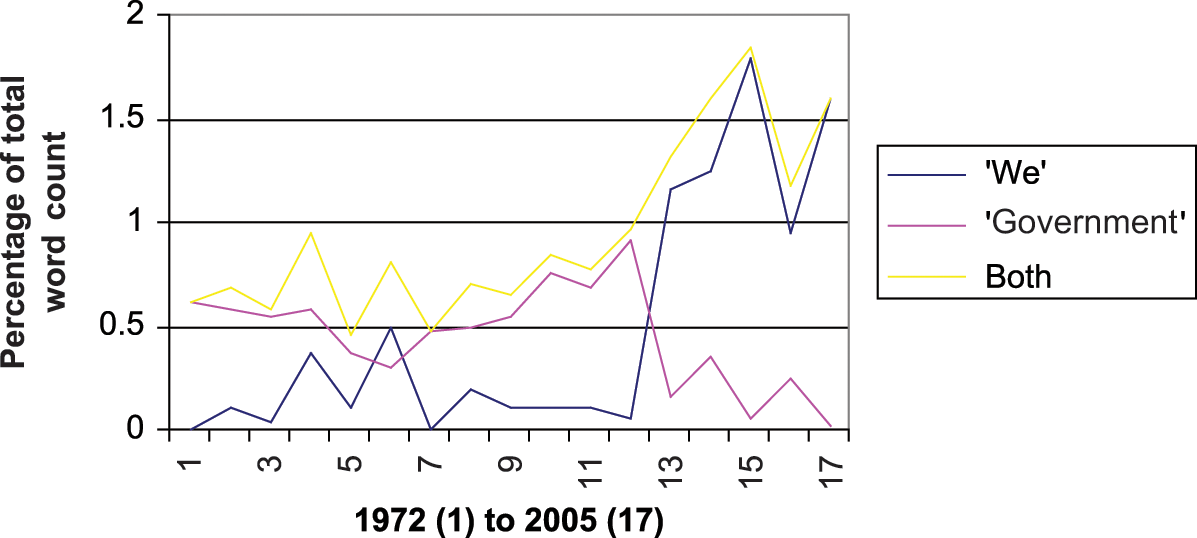
Textual prominence of the UK New Labour government.
It has been shown that the increasing use of the pronoun we, alongside other discursive strategies, is part of a general trend in recent decades towards the ‘personalisation’ of public discourse. 15 Sometimes referred to as ‘corporate we’, the phenomenon is usually thought to have originated in the world of commerce, where the success of businesses may rest on their ability to project the right corporate identity to the public (Pearce, 2001). More generally, it may signal what Fairclough (1992) terms a process of ‘democratisation’ of discourse, of which one aspect is a tendency towards more informal language and the removal of explicit textual markers of power asymmetries.
In the realm of politics, it has particular significance; by collapsing the distinction between the government and the people, this mode of representation draws citizens into the very processes of governing, thus implicating them in policy decisions. When adverts or commercial organisations adopt this ‘personalised’ collective identity, the effect is not the same. It may generate greater affinity and identification with the brand or company in question (as it is doubtless intended to), but it does not draw us into the governance processes of that organisation. In New Labour discourse, the pronoun we may have been favoured over the government, with its inherent marking of authority, in order to create a discourse more consonant with its claims to participatory democracy, and the ‘stakeholder’ vision of citizenship discussed above. However, as Fairclough (1992) observes, democratised discourse can in fact simply be a means of disguising power asymmetries, rather than removing them. Moreover, because we potentially includes the reader, it allows for a more seamless transition between different forms of reference (an inclusive and exclusive we) and thus a potential blurring of responsibility for propositions.
In order to understand the full significance of this shift in self-representation, we need to look in more detail at its distinctive semantic properties. In the next section, I discuss the place of this pronoun in the linguistic system of deixis, its relationship with modality and its rhetorical potential.
Deixis and the meanings of we
The pronoun we is referentially complex; its meaning cannot be recovered without reference to the speech context (Levinson, 1983). Significantly, policy texts are widely recontextualised (Fairclough and Wodak, 2008) and ‘repackaged’ for diverse audiences, making the retrieval of context-dependent meaning quite problematic. One consequence is that the referents of pronouns can be unclear and subject to slippage. Pronouns belong to a closed class of deictic expressions like I, you, here, yesterday, whose meaning is not encoded intrinsically, but instead depends on the context of utterance in order to ‘anchor’ the meaning. In face-to-face contexts, the anchorage point of deictic expressions is the speaker’s position and can only be successfully interpreted with reference to that position (O’Keefe et al., 2011). Where this information is not available, the deixis is said to be unanchored, like the message in a bottle that reads ‘meet me here at noon tomorrow with a stick about this big’ (Fillmore, 1997: 60). This point of anchorage in deixis is variously known as the ‘deictic centre’ or ‘origo’ (Bühler, 1934/1982). In the traditional model of deixis, the speaker or writer is located at this deictic centre and meanings are interpreted in relation to that reference point. Therefore, in terms of the three main semantic dimensions of deixis, the unmarked centre is the speaker/writer (person), the time of utterance (time) and the speaker’s location at the place of utterance (space). Prototypical examples of each of these dimensions would be personal pronouns (I, you), demonstratives (this, that) and adverbs of time or place (now, here). The system of deixis thus creates a fundamental distinction in texts: self versus other and near versus far (both temporally and spatially). Entities can thus be identified as being ‘proximal’ or ‘distal’ in relation to the origo (e.g. I is proximal, you is distal).
Deictic choices always entail a particular demarcation of participatory boundaries in the ‘discourse world’ created in texts; of speakers’ and hearers’ relative positions to the events described and their involvement with them. In the context of political discourse, roles and responsibilities are negotiated in part through the deictic system (Chilton, 2004; Van Dijk, 2002). Central to this process is the pronoun we which can both include and exclude participants from the deictic centre. As Chilton argues, it ‘can be used to induce interpreters to conceptualise group identity, coalitions, parties, and the like, either as insiders or outsiders’ (2004: 56). Recognising this duality, Pennycook (1994) calls it the pronoun of ‘solidarity and rejection’ of ‘communality and authority’. Polarising distinctions like ‘inside–outside’ and ‘us–them’ are of great significance in political discourse; they help construct and maintain group membership and privilege, and are the discursive basis of discrimination and exclusion. 16 Most analyses capture the semantic duality of we by drawing a distinction between ‘inclusive’ and ‘exclusive’ forms. Respectively, these ‘are used to create a perspective of: (1) I the speaker and you the addressee(s) in the immediate context … and (2) I the speaker and someone else not in the immediate context’ (O’Keefe et al., 2011: 47).
In the case of inclusive we, the speaker(s) and addressees are bound together, jointly anchored to the deictic centre. This grammatical tie explains why (inclusive) we is typically used to establish solidarity and social bonding by creating a clear ‘in-group’. Exclusive we has the opposite effect, excluding the addressees from the deictic centre. Where inclusive forms are used in White Papers, ‘we the public’ thus acquire a presence in the discourse world of policy-making and its arena of accountability. Deciding which form is intended is frequently a tricky matter of interpretation. Grundy (2008: 28) cites this example from Salman Rushdie’s written apology for the distress caused by his ‘Satanic Verses’, issued after an Iranian fatwa on him had been pronounced: ‘living as we do in a world of so many faiths, this experience has served to remind us that we must all be conscious of the sensibilities of others’. If we are to interpret we exclusively, then responsibility for the proposition is narrowed to Mr Rushdie, but widened to the issuers of the fatwa if it is inclusive. The distinction is significant: the exclusive option is more apologetic; the inclusive one more accusatory. Grundy offers a third possibility that a ‘non-deictic’ meaning may be intended, in which Rushdie adopts a more neutral stance somewhere between apology and accusation. As Grundy observes, given Rushdie’s precarious position, it is possible that ‘the writer intends it to be difficult to determine the status of the pronouns here’ (2008: 274). As this example illustrates, sometimes referential ambivalence can be rhetorically useful. Indeed, in the case of New Labour policy discourse it occurs frequently and is used in a distinctive way from inclusive and exclusive reference. In the following analysis, I therefore propose a third category of ‘ambivalent’ we, in order to assign full weight to the rhetorical significance of this ‘strategic vagueness’.
The importance of context
The range of intended referents of we will always depend on the context and the speaker’s purpose, which may make their identification more or less easy. The inherent ambiguity of we means that the listener may actively choose to include themselves in its referential scope, thus implying a degree of alignment with the speaker’s perspective. For this reason, Fowler (1991) suggests that the use of we in media discourse always involves an ‘implied consensus’ between the newspaper and its readership; consensus over shared group membership. In the case of national newspapers, we can assume the limit of the readership is primarily national, based on contextual factors like their patterns of distribution, and therefore that the ‘default’ referent of (inclusive) we is the nation (Petersoo, 2007). Of course, the limits of this collective identity are variable; some instances may be larger than the nation (the EU, the West, the world), as well as comprising various sub-national groups. Moreover, defining ‘nation’ may be problematic, particularly in contexts like the UK where the concept may variously include England, Scotland, Wales and Northern Ireland. Here again, we must rely on context. Silverstein (2003) argues that indexical meanings comprise both a pre-established context of interaction and emergent contextual factors arising from the interaction. Thus, context is inherently dynamic and under negotiation, and a key aspect of this dynamism is the continually shifting process of deictic anchoring as the discourse unfolds (Van Dijk, 2008).
Education policy White Papers are intended for and consumed by a highly diverse readership. These documents have always been publicly available in certain libraries or to purchase from The Stationery Office. However, since the early 1990s they have also been available to download from the internet. This development coincided with changes to the form and structure of the genre. The traditionally simple ‘royal octavo’ format (6 × 9 inches, stapled) was changed to the larger A4 size and various embellishments added, courtesy of desktop publishing technology (visual images, variable fonts and colours). The new format also included a new ‘foreword’ from the Minister of Education (upgraded under Tony Blair’s premiership to a foreword from the Prime Minister) and was accompanied by a new corporate genre, the ‘Executive Summary’. These changes suggest greater attention to the design and rhetorical impact of the genre as it becomes more readily accessible to the public. The documents comprising the corpus for this study outline policy for compulsory education in England and Wales. 17 We might then conclude that here the ‘imagined national community’ of these texts and thus default referent of inclusive we is England and Wales (as a national community and more specifically as the set of educational stakeholders within it). Moreover, as a piece of political communication intended for wide distribution, its deictic meanings need to be one of two things: (a) readily recoverable from the co-text and shared background knowledge or (b) sufficiently vague in their reference to allow the reader to interpret herself as included in their scope. Precisely because of its inherent duality in meaning, the pronoun we allows for this kind of deictic flexibility. In the next section, I consider the rhetorical purposes it can serve in political discourse.
Strategic vagueness
Slippage between the different ‘types’ of we is both possible and common in many discourse contexts. Indeed, the phenomenon is a symptom of the continual (re)negotiation of context (Van Dijk, 2008). Precisely because of its deictic flexibility, this pronoun is a particularly useful rhetorical tool. Its use is well documented in political discourse, where the politician can use it to ‘indicate, accept, deny or distance themselves from responsibility for political action; to reveal ideological bias; to encourage solidarity; to designate and identify those who are supporters (with us) as well as those who are enemies (against us)’ (Wilson, 1990: 76). Analyses of the functional distribution of this pronoun in political discourse reveal its rich rhetorical potential. In her speeches Margaret Thatcher, for example, used inclusive we to trigger a patriotic discourse and exclusive we (instead of I) to assign political responsibility collectively rather than individually (Wilson, 1990). Similarly, in an election broadcast Tony Blair used we exclusively and inclusively to align himself with the Labour Party and the British people respectively (Pearce, 2001). In the context of EU politics, Cramer (2010) found that semantic shifts in pronouns are used to variously align or distance speakers from different social groups, and thus ideological allegiances.
Different forms of we can thus be used to draw lines of inclusion and exclusion, distinguishing between different forms of belonging and identification. They can equally be used to blur those boundaries through continual ambivalence and slippage between these forms across text (Fairclough, 2000). The following analysis reveals that New Labour policy discourse exploits this kind of semantic slippage to negotiate distinctive political perspectives and adopt variable responsibility for different kinds of speech acts.
In addition to the functional distribution of types of we, the ‘blocking’ of pronouns within smaller stretches of text can be of rhetorical significance. Wilson defines a block as ‘the repetition of the pronominal form three or more times in the same syntactic position in consecutive sentences’ (1990: 63). This strategy, he argues, can be used to ‘express sincerity and belief’, especially when the pronouns co-occur with mental process verbs expressing beliefs or wishes. Next I identify the strategic sequencing of different types of we (used in rhetorically distinctive ways) within this kind of blocked structure in such a way as to legitimate policy actions.
Coding forms of we
In the corpus, we can variously refer to ‘the government’, ‘the nation’, ‘citizens of the world’, ‘England and Wales’, ‘businesses’, ‘the partners of government’ or ‘those people concerned about education’. Instances of exclusive we were by far the most explicit in their reference. For example, in some cases they co-occur with textual ‘anchors’:
By contrast, the referent(s) of inclusive we involved some form of imagined community. Sometimes this was rendered explicit through textual anchors: We can
Thus, drawing on contextual information to interpret its deictic scope, I coded each instance of we as inclusive (I), exclusive (E) or ambivalent (?). A random sample of 100 concordance lines was used to test the coding system. 18 This coding system was then used to annotate the corpus in order to re-sort the data and search for further patterns in the functional distribution of the different ‘types’ of we. In the following sections, I present the findings for each as it was used under New Labour.
The functional distribution of we
Instances of exclusive we were by far the most numerous. Of 2421 instances (excluding 9 cases of reported speech), on average 83% are exclusive in each document, in a fairly stable distribution ratio. The same stability applies to the distribution of ambivalent (13%) and clearly inclusive (3%) cases. The three different ‘types’ of we were further coded using functional grammar to identify the type of action they represent in each case. In the following sections, I summarise the most prominently used forms (see the Appendix for a detailed statistical breakdown).
A distinctive feature of the New Labour period was the emergence of a clear functional division of labour among these three forms of we. To summarise, inclusive we [I] is used to make evaluative descriptions of the nation, usually in terms of competitive relations with others. Ambivalent we [?] is frequently textured with modal forms so as to construct exhortations for future policy action, while exclusive we [E] is used to represent the government’s own past, present or future actions. Typically, past actions and present descriptions function as boasts (we have already made it easy to become an Academy; we have put in place major reform programmes; we are on track with our reform of schools), and irrealis (often
Exclusive we: Hedging governance
The results for this pronoun were analysed according to its verbal collocates (including clusters, where prominent). In respect of the verbs that co-occur with we, there is a large number of verbal and mental processes of ‘saying’ and ‘sensing’, such as discuss, consider, expect, which fits with what we would expect of a genre whose function is to present and weigh up arguments about policy decisions (Graham, 2002). However, under New Labour there is a marked shift in this pattern. In contrast to the previous 25 years, for the first time material processes of ‘doing’ (make, create, establish, set up) displace the more typical mental and verbal ones as the most frequent collocates of the government. This trend is illustrated in Figure 2.
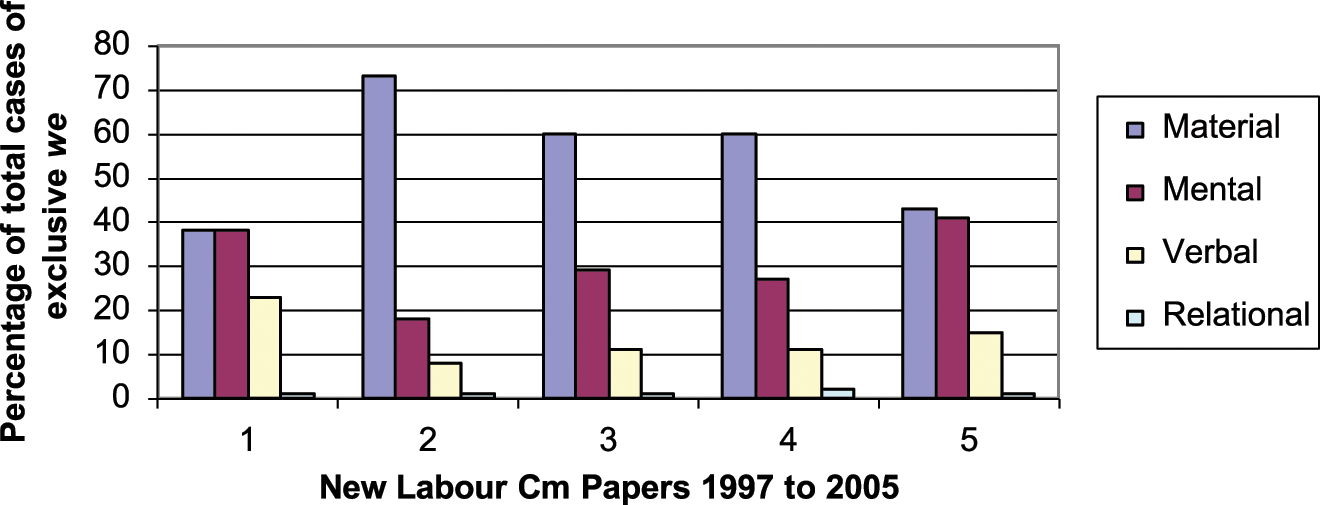
Activities of exclusive we by process type.
In fact, many of these ‘material’ processes represent quite abstract and somewhat vague managerial activities like providing leadership and delegating responsibilities. Stylistically, this helps create a more dynamic image for the government and resembles strategies found in other public, promotional genres like advertising or the external communications of large corporations (Wodak and Koller, 2008). Indeed, a comparison with the discourse of other national governments of this period may well display a similar stylistic trend. In particular, given the increased influence of European-level policy-making during this period (Dale and Robertson, 2006), we might reasonably expect a considerable degree of rhetorical and policy alignment with European policies. Indeed, the following extract illustrates this in respect of the Lisbon agenda. Once again, this is worded in the rhetoric of ‘conviction politics’, realised through a relational process (underlined) indicating the government’s positive stance towards the part it must play in achieving European policy objectives. The extract draws a clear functional link between education and the economy through a neoliberal workfare commitment to employability: ‘
There are two main groups of material processes through which the government constructs its management role. One type draws on building, transportation and sporting metaphors to represent the government’s creation of new institutions and strategies, and stylistically convey a sense of newness, progress, movement or leadership. The most frequently used are: deliver, establish, build (upon), develop, pilot, carry through, carry forward, benchmark, target, tackle, drive.
The second main type of process represents the government orchestrating in some way the actions of others. Often this is relatively direct through a particular category of verbs like ensure, help, provide support, enable, which I call ‘managing actions’. Elsewhere I have argued that this newly prominent grammatical feature of policy discourse plays an important role in constructing the ‘soft power’ of contemporary governance (see Mulderrig, 2011b). Other cases represent the government organising the structural conditions within which others’ actions take place (e.g. we will establish a new framework; we will make it easier for those who most need extra skills; we are reforming the quality and responsiveness of colleges; we will create a new entitlement). At this level, the management is extremely oblique, often instrumentalised rather than represented through managing actions. Nevertheless, insofar as these activities are concerned with orchestrating the activities of others towards desired outcomes, I would characterise them as commensurate with strategic management and, more generally, the new governance model of public management. 20
A large number of examples draw on a managerial discourse in representing actions which are very vague and difficult to classify: set challenging targets; tackle regeneration; bring the criteria for approval in line with one another; benchmark our progress. Indeed, the steadily increasing use of managerial discourse in policy is a key factor in explaining an apparent ‘materialisation’ in representation under New Labour. Despite the often irrealis nature of contingency planning and strategic calculation involved in the highest levels of management, its actions tend to be represented, typically through metaphors, as concrete, decisive and dynamic-sounding actions, located in the here and now. This suggests that an inherent feature of the character of the manager is a self-promotional identity. In the rigours of the competitive neoliberal marketplace, survival demands a dynamic, ‘take no prisoners’ social identity. One expression of this is the recurrent use of military metaphors: combat, target, tackle and spearhead. Fairclough (2000) observes that military metaphors are very often used by New Labour in a discourse of social exclusion. Similarly, in the present data they co-occur with educational problems to which the government’s energies are committed. Most frequently, failure is tackled, along with bad behaviour and disaffection. The problems of discipline and under-achievement are similarly the objects of combat, as is social exclusion.
Hedging
Within this framework now set by the skills strategy, The affluent can buy choice by moving house or going outside the state.
These three extracts 21 illustrate a distinctive pattern of modality that emerged under New Labour in respect of its future policy commitments. In a departure from preceding governments, the cluster used most frequently with reference to the government is we want to (used 90 times; the next most frequent cluster, we believe that, occurs 44 times 22 ). This introduces more affective language into policy. In locating the basis for policy decisions in the realms of belief and desire, these verbal patterns seem to be consistent with the forms of argument characteristic of neoliberal ‘conviction politics’ (Pearce, 2001; Peck, 2001). Similar patterns were found under Major, through clauses expressing the government’s ‘strong’ commitment to some principle or course of action. Approximately half of the cases for both Major and Blair represent a commitment to future action. The grammatical form under Major was: the government is (firmly) committed to + [do], and under Blair, we want to + [do]. These are ‘modulated’ forms expressing the government’s degree of inclination in respect of an offer. Compared with an unmodulated offer, they limit the degree to which government is committed by its speech acts to the policy actions it proposes. In scalar terms, moreover, it is clearly the case that the level of inclination expressed is far stronger under Major 23 than under Blair. Expressed through modal meaning, the degree of commitment to future actions thus appears to have declined, while giving the appearance of the opposite.
In fact, greater hedging when it comes to formulating policy strategies makes sense in an era of increasing policy harmonisation across Europe and beyond (Dale and Robertson, 2006), set in the imagined context of economic uncertainty and rapid change. Within the logic of this prevailing political imaginary, it follows that the governance regime must be adequately flexible in order to be responsive to the socio-economic conditions created by global capitalist competition. We might therefore logically expect more hedged, contingent and provisional policy commitments in order to allow for this kind of flexibility. The extracts above are also interesting in respect of their propositional content. Their construal of the content and structure of education appears consistent with the ‘sugared pill’ of Third Way politics, with its valorisation of ‘free markets’ and celebration of competition and choice (Peck, 2001: 445). The first two underline the economic and social role of education, simultaneously producing skills for employability and providing a vehicle for ‘inclusion’ (into the labour market) of the poor and marginalised. In terms of the structure of the education system, the third extract acknowledges the social inequalities associated with market choice in education. However, instead of questioning this market model of delivery, it proposes to mitigate this by offering more choice. In a pattern typical of New Labour discourse, ‘choice’ is construed as inherently desirable, rather than envisaging a more egalitarian education system in which (school) choice is not necessary.
Inclusive we and shared (neoliberal) values
We are at an historic turning point: we now have an education system that is largely good, after eight years of investment … we are poised to become world class.
This extract
24
typifies the use of inclusive we in the data. It mainly occurs with (relational) processes that draw comparisons either between Britain and its international competitors, or the Britain of today and that of the past. Many of these constitute an implicit evaluation of some aspect of the education system. Examples include: we are at an We must
Inclusive we is also used in more explicit evaluative claims that help texture a set of shared values, which again serve as the rationale for the government’s policy decisions. For example: [education provides] the skills and attitudes
Ambivalent we and policy imperatives
The most frequent use of ambivalent we (75% of the time) is to represent exhortations with varying degrees of explicitness. Given that policy is fundamentally about ‘getting people to do things’, the presence of exhortations, whether explicit or tacit, is not in itself a marked finding. However, from the perspective of the (re)negotiation of socio-economic responsibilities in late capitalist society, what is significant is the fact that under New Labour there is an increased tendency to obfuscate social responsibility, in respect of both the obligations and desires that constitute the rationale for policy proposals.
In an argumentation strategy typical of this genre, the government outlines the problems it is attempting to address through policy in a problem–solution textual pattern. This causal relation between policy problem and policy solution is represented in terms of social necessity. Policies are thereby represented as meeting some form of shared need, where the (grammatical) subject of that need is ambivalent we. The necessity is of two main types: a particular felt need or a duty to act in some way. Respectively, these are realised through evaluative statements representing the mental processes of others (e.g. we need + nominal group), and through explicitly modalised statements (we must/need/have to + verbal group). Both cases, by virtue of the referential ambivalence of this pronoun, allow the government to act as a spokesperson, making statements on behalf of an unspecified collective. This is a strategy associated with socially powerful actors: ‘like the “power of prediction”, the power of making statements on behalf of others, or indeed on behalf of “all of us” … is a power which has an uneven social distribution, and is important for identification’ (Fairclough, 2003: 171). The first type of exhortation construes social necessity in evaluative statements like: To carry out the agenda for raising standards in education In February the European Commission published its Action Plan on Skills … This details particular areas where
This extract contains a clear intertextual link to a discourse of lifelong learning, a prominent feature of Third Way politics, in which the continuing acquisition of skills is construed as the solution to labour market insecurity. The reference of we here is unclear in both cases. The co-text suggests a European scale of inclusion, but whether this extends beyond governmental organisations depends on who are likely to be the agents responsible for developing the labour force. Presumably this also involves employers (particularly when we consider that the remit of this policy document extends beyond schooling to cover workplace training). The second type of exhortation involves the use of modal verbs that signal a high degree of obligation on the part of the writer. In other words, they construe social imperatives, not possibilities.
Chilton (2004) posits modality as a fourth dimension of deixis, through which speakers locate entities and processes in terms of what ‘is’ (epistemic modality) and what ‘ought to be’ (deontic modality). Thus, entities and events can definitely (not) exist, reportedly exist etc., and they may be represented as (un)necessary, morally imperative, and so on. He argues that, as with other forms of deixis, entities may be located more or less proximal to the deictic centre. ‘Will’ and ‘must’ are located closest to the centre; items like ‘outghtn’t’ and ‘may’ are much further away on the scale. In crude terms: ‘Self is always right or in the right, the Other is always wrong or in the wrong’ (2004: 60). In essence modality, like other aspects of the deictic system, helps the hearer interpret discourse with reference to coordinates within the ‘reality space that S expects H to know and accept’ (2004: 61). Following this model, the Self is the ‘authoritative’ centre on the axis of modality; the place from which exhortation is possible and ‘natural’. By collocating ambivalent we with must, ‘we the nation’ are potentially invited into that authoritative centre, subtly dispersing responsibility and obligation for the predicate across an unspecified collective.
So what is it we must do? The most frequent collocates (of must and need to) are the verbs ensure and make/be sure, a pattern which is also commonly used in cases where we is clearly exclusive, illustrating the rhetorical slippage involved in legitimating policy. The verbs ensure and make sure are frequently used in New Labour policy discourse to construct a managerial role for the government, steering others’ actions. They form part of a larger ‘grammar of governance’ that plays a significant part in constructing a so-called ‘enabling’ model of governance (for a more detailed treatment, see Mulderrig, 2011b). They are similarly used in this hortatory context. In all but two cases, the remainder of the clause represents a managed actor or actors engaged in some process. The following are typical examples: [we must ensure that] all [pupils] have the skills and capabilities; people learn how to be creative and all schools deliver high standards. Three main types of managed actor are represented in this way: (1) people engaged in learning; (2) institutions engaged in educational administration; and (3) geographical territories in competition with one another.
People and the commodification of learning
People and pupils are represented as engaged in activities related to learning. This activity is represented as a relation of possession that contributes to the commodification of knowledge, an integral process in the construction of a knowledge-based economy. This ‘possessivisation’ of the process of learning is construed textually through the possessive relational processes have [the learning and skills] or material processes acquire and obtain. In such cases, the learning process is nominalised, creating an instrumental view of education as the accumulation of tangible outputs (skills). This commodification of the learning process is vital to a neoliberal supply-side economic strategy, wherein globalisation (rather than the political and economic actors behind it) is blamed, through patterns of agency, for the ‘inevitability’ of labour market insecurity. Through sporting metaphors, national governments are represented as being in inexorable competition with one another. Rather than full employment, full employability becomes the only realistic policy objective for national governments. The feverish accumulation of skills is presented as the solution:
[POLITICAL ECONOMIC LANDSCAPE] The
Institutions and new models of governance
We must ensure that excellence is properly rewarded … we need to reform good schools so that they have the freedoms and flexibilities to deliver that tailored, choice-driven education. Skills are not an end in themselves, but a means towards supporting successful businesses and organisations. We must ensure that employers can access the training they need and have more influence in deciding how that training is provided.
The verbs representing the actions of institutional managed actors (industry, businesses, schools, DTI, etc.) draw on a broadly managerial discourse where a strategic and instrumental rationality predominate. As in the examples above, they also contribute to two key representational themes emerging from the New Labour data, namely a choice-based, market model of educational organisation and an employability-oriented instrumental view of learning. Thus, the government ‘ensures’ that the institutional actors, including educational ones, deliver high standards; make the most of and seize opportunities; exploit [research]. There is a subtle difference in the degree of autonomy assigned to different social groups through such managing actions. Industry and businesses are represented as exploiting research and exerting influence over the content of skills, while schools are represented as subject to more centralised control through various accountability mechanisms, with freedoms dependent on their capacity to deliver high-quality outputs (standards).
Territories and the discourse of economic competition
A final set of actors figuring in these cluster findings for ensure/make sure represents groups of people in geographic terms (region, nation, UK). Where the representation involves the UK, it draws on positional metaphors to construct a discourse of global competitiveness. Just as with the representational patterns for inclusive we, when the subject is the nation as a whole, the representation of its actions serves to position it in a competitive relationship with the rest of the world, here through a discourse of leadership: [must ensure that] the UK is at the forefront of renewable energy; the UK can lead the way in developing learning resources. In these examples, the representation names the specific territory (UK) in order to compare it with other countries. Like the deictic patterns observed throughout the data, these examples illustrate the importance of demarcating lines of inclusion and exclusion in the neoliberal discourse of global competitiveness.
Strategic vagueness: Textual sequencing of we
In this section, I discuss the way the three identified categories of we are textured in close sequences in the data, serving as a rhetorical frame for policy proposals. The pattern of such sequences is as follows: an evaluation (textured with inclusive we), followed by an exhortation (ambivalent we), followed by a policy commitment (exclusive we). Such sequences are increasingly frequent in the New Labour documents (respectively, 12, 9, 15, 16 and 19 cases). Quite often, these involve extended sequences, sometimes spanning several paragraphs, where slippage across the different types of we is textured into a ‘scene-setting’ argument about the economic and social context for policy. Such passages include a series of comparative descriptions of the world we (I) live in, typically invoking a discourse of competitiveness, followed by a series of we (?) exhortations and needs arising from this context, and then one or more proposals, evaluations or boasts by we (E).
This pattern is illustrated in the following example from the 2003 Skills Strategy, where a relatively dense clustering occurs in the Foreword section of the document. The concordance lines are reproduced in Figure 3. Extending across several paragraphs of opening argument, these clusters illustrate this rhetorical strategy. 27
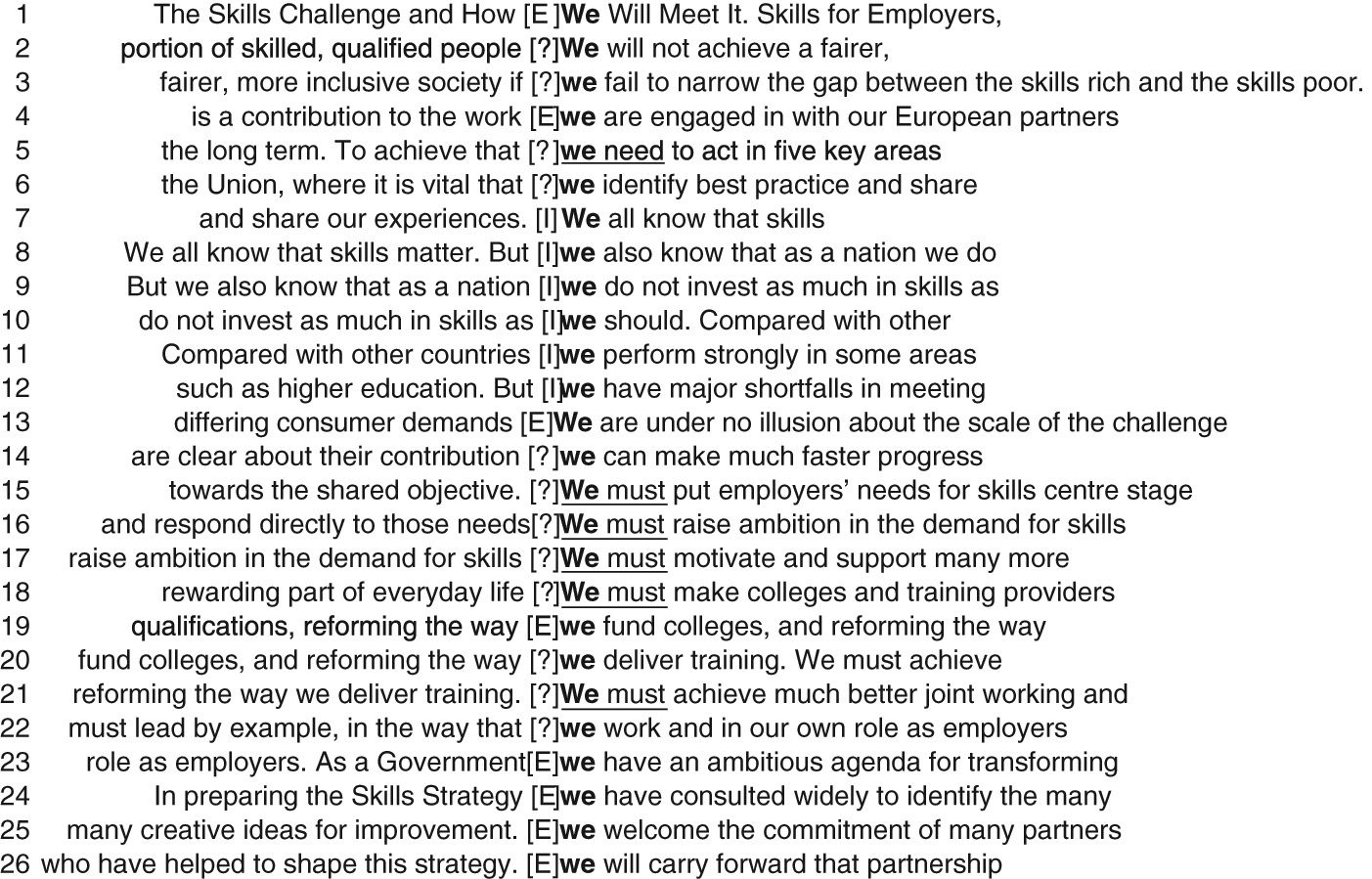
Extract from concordance results for we in the 2003 Skills Strategy.
This extract illustrates the typical collocation patterns for the different types of we discussed above, as well as how these are sequentially ordered for strategic effect. Following a section heading, two instances of ambivalent we in a single sentence set out this White Paper’s overall skills-based agenda for both economic growth and social inclusion (lines 2 and 3). The sentence helps foreground individual responsibility for achieving personal employability, a political strategy whose negotiation is a key element in New Labour’s Third Way discourse (Fairclough, 2000). It does so through a relatively simple evaluative claim that social justice can only come from equipping everyone with skills. However, the way that claim is textured illustrates the role of discourse structures in naturalizing (contestable) political strategies. In this case, ‘skills’ is inserted as a qualifier in the phrase ‘narrow the gap between rich and poor’. This phrase has particular historical associations with the political left in Britain, evoking a concern with the social structuring of (dis)advantage. To put it another way, the phrase allows New Labour to ‘tap’, intertextually, the resonance of its own ideological history. However, by qualifying this phrase with the term skills, material wealth and poverty are treated metaphorically, subsumed under the possession of skills necessary to make us employable. Thus, the insertion of this single word adds a new semantic and ideological flavour to a familiar phrase.
Returning to the concordance lines, after a single exclusive we (line 4), lines 5 to 6 illustrate the use of exhortations with ambivalent we to evaluate policy on the basis of necessity (Lemke, 1998). The next several sentences then employ inclusive we to construe an assumed consensus on the value of skills and the inadequacy of current levels of investment in them. Concordance lines 7 to 12 in fact constitute a fairly straightforward piece of rhetoric. If we examine them a little more closely, we see rhetorical devices typical of New Labour. Consensus is assumed by claiming to represent the mental processes of ‘us all’. In turn, this process knowing renders ‘fact like’ whatever comes after it, which in this case is two evaluative statements: skills matter and we do not invest as much in skills as we should. The effect of placing these (contestable) claims after the verb ‘know’ is to reify the beliefs that underlie them.
This ‘opinion-turned-fact’ about skills is elaborated in the next two sentences (lines 11 to 12) in a way that introduces a specifically neoliberal discourse of skills, notably promulgated by the EC (Levitas, 1999; Robertson, 2002), conflating economic and social policy in a workfarist regime of perennial ‘re-skilling’ in transferable competencies for an unstable labour market. Inclusive we textures evaluative descriptions that effectively benchmark the nation against other competitor countries (we perform strongly; we have major shorktfalls). Line 13 represents exclusive we (we are under no illusion), which lends weight to this macro policy objective (skills as key to employability) by conveying its importance in scalar terms. The scale of the challenge is then elaborated in an extended sequence of injunctions with ambivalent we (underlined). These are represented through material processes, stylistically conveying a sense of dynamism. The extract ends with a series of activities by exclusive we, whose sequential arrangement suggests these are the government’s response to the imperatives (lines 14 to 23) arising from a shared consensus on the contemporary policy landscape of global competition (lines 7 to 12). However, the represented actions commit the government to very little in the way of future concrete action. Instead, they provide an opportunity for self-promotion by representing the government’s current and past actions, which it positively evaluates (it has an agenda which is ‘ambitious’, and has consulted ‘widely’).
This extract illustrates a rhetorical strategy repeatedly found in the data, exploiting the deictic flexibility inherent in the first-person pronoun. Drawing on a functional division of labour among the different types of we, these are sequentially arranged in such a way as to create a legitimatory rationale for policy, construed as a set of shared needs or imperatives, to which the government responds with a highly abstract set of boasts or promises.
Conclusions
A key feature of New Labour policy discourse is the marked personalisation in its self-representational style compared with previous governments. The dramatic surge in the use of the personal pronoun we, the dynamic and affective representations with which it occurs, and the fact that for the first time in 30 years the government becomes the most textually prominent actor in policy discourse, suggest much closer attention to the discursive construction of governmental identity. Moreover, there were marked regularities in the rhetorical distribution of this pronoun. Inclusive we is regularly textured with passages that construe a logic of competitiveness between social groups, and/or claim a shared vision of social (and educational) need. This frequently co-occurs with exhortations collocating with ambivalent we, suggesting a globally competitive impetus for policy decisions. Importantly, this has implications for the way we conceptualise and shape our national identity; a highly contentious, politically divisive, and at times violently contested issue. This rhetorical pattern is repeatedly used in the data to texture an ‘inexorable’ landscape of global competition, presented as the impetus and self evident rationale for many of the policies proposed. In doing so, it also reinforces a contradictory and unstable representation of our relationship with other countries. Economically, we are in competition and socially, we are in cooperation with a ‘global village’ tied together by the bonds of ‘global citizenship’ and a celebration of the diversity arising from greater social, linguistic and cultural mobility. This contradiction operates, moreover, at multiple levels, the myth of global citizenship never quite managing to overcome the boundary construction necessary for the (re)production of a globally competitive knowledge-based economy. Where the government’s actions are exclusively represented, there is a trend towards the managerialisation of governing activities. These are frequently realised through quite abstract processes that create the appearance of dynamism on the part of the government. Finally, all three forms of we are juxtaposed in sequences that help rhetorically frame policy. One effect of this textual pattern is that government policy decisions effectively become harder to criticise since their legitimacy rests on global economic forces apparently beyond the government’s control. The legitimation is implicit, triggered only by juxtaposing: we [I] live in a competitive and changing world + we [?] must respond with X activity + we [E] will provide the following policy solution. Given our potential inclusion in the deictic centre of these claims, it follows that we are now all implicated in the rationalisation of policy. In this way, political consensus is assumed, not jointly produced.
In historical terms, this strategic use of deixis for rhetorical ends was introduced to policy discourse under New Labour. I argued that this ‘strategy of inclusion’ is compatible with a Third Way politics in which the concept of inclusion is key to developing ‘neoliberalism with a heart’, in which globally competitive free market capitalism is not seriously challenged, but instead mitigated through social policies heavily focused on education and the acquisition of skills for ‘employability’ in a fast-changing knowledge economy. Of course, Third Way politics were also embraced by other regimes such as those of Schroder and Clinton. To the extent that the rhetorical patterns observed for New Labour might indeed map onto Third Way politics, we might therefore predict similar rhetorical strategies in the discourse of these other two regimes. More generally, these findings might relate to the mode of governance that has developed in advanced liberal states in recent decades, in which the activation of individual autonomy, participation and responsibility (towards self and others) become central to both economic and social well-being (Dean, 1999; Rose, 1999b). Indeed, the same themes of inclusion and responsibility are prominent in more recent policy discourses like the current UK Prime Minister David Cameron’s DIY approach to social policy, known as the ‘Big Society’. Given the apparent importance of social inclusion to contemporary forms of governance, it is perhaps no accident that grammatical inclusion became such a prominent feature of New Labour policy discourse. Far from being a trivial matter of political dressage, its pervasive use by that government may be an expression of its importance in enacting a form of governance associated with this phase of the capitalist state. Whether and how it endures will prove interesting questions for future research.
Footnotes
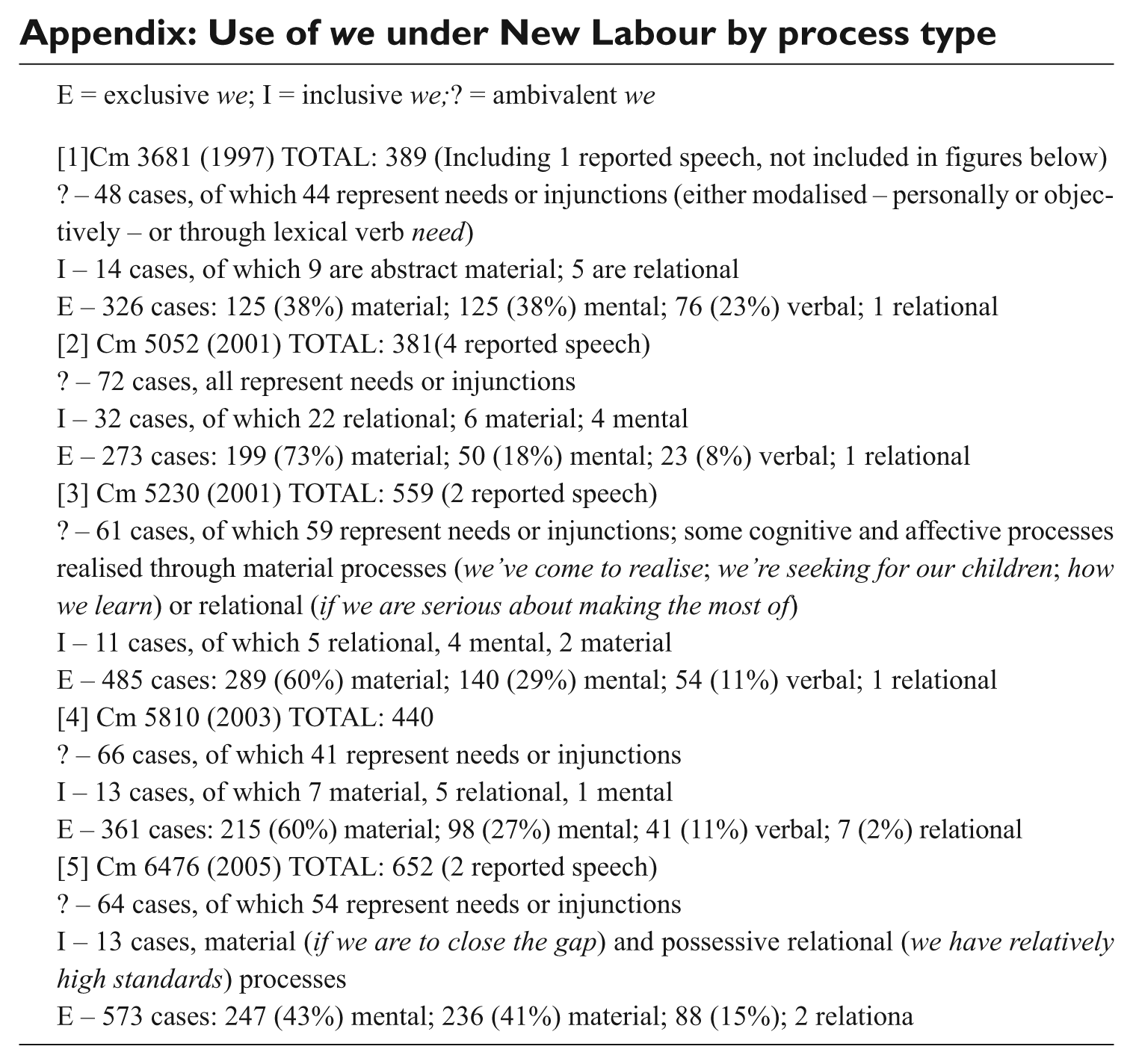
Appendix
Use of we under New Labour by process type
| E = exclusive we; I = inclusive we;? = ambivalent we |
| [1]Cm 3681 (1997) TOTAL: 389 (Including 1 reported speech, not included in figures below) |
| ? – 48 cases, of which 44 represent needs or injunctions (either modalised – personally or objectively – or through lexical verb need) |
| I – 14 cases, of which 9 are abstract material; 5 are relational |
| E – 326 cases: 125 (38%) material; 125 (38%) mental; 76 (23%) verbal; 1 relational |
| [2] Cm 5052 (2001) TOTAL: 381(4 reported speech) |
| ? – 72 cases, all represent needs or injunctions |
| I – 32 cases, of which 22 relational; 6 material; 4 mental |
| E – 273 cases: 199 (73%) material; 50 (18%) mental; 23 (8%) verbal; 1 relational |
| [3] Cm 5230 (2001) TOTAL: 559 (2 reported speech) |
| ? – 61 cases, of which 59 represent needs or injunctions; some cognitive and affective processes realised through material processes (we’ve come to realise; we’re seeking for our children; how we learn) or relational (if we are serious about making the most of) |
| I – 11 cases, of which 5 relational, 4 mental, 2 material |
| E – 485 cases: 289 (60%) material; 140 (29%) mental; 54 (11%) verbal; 1 relational |
| [4] Cm 5810 (2003) TOTAL: 440 |
| ? – 66 cases, of which 41 represent needs or injunctions |
| I – 13 cases, of which 7 material, 5 relational, 1 mental |
| E – 361 cases: 215 (60%) material; 98 (27%) mental; 41 (11%) verbal; 7 (2%) relational |
| [5] Cm 6476 (2005) TOTAL: 652 (2 reported speech) |
| ? – 64 cases, of which 54 represent needs or injunctions |
| I – 13 cases, material (if we are to close the gap) and possessive relational (we have relatively high standards) processes |
| E – 573 cases: 247 (43%) mental; 236 (41%) material; 88 (15%); 2 relationa |
Acknowledgements
I am grateful to the Economic and Social Research Council (ESRC) for funding this doctoral work.
Funding
I am grateful to Teun van Dijk, Ruth Wodak and an anonymous reviewer for their detailed and valuable comments on previous drafts of this article.
Notes
Author biography
